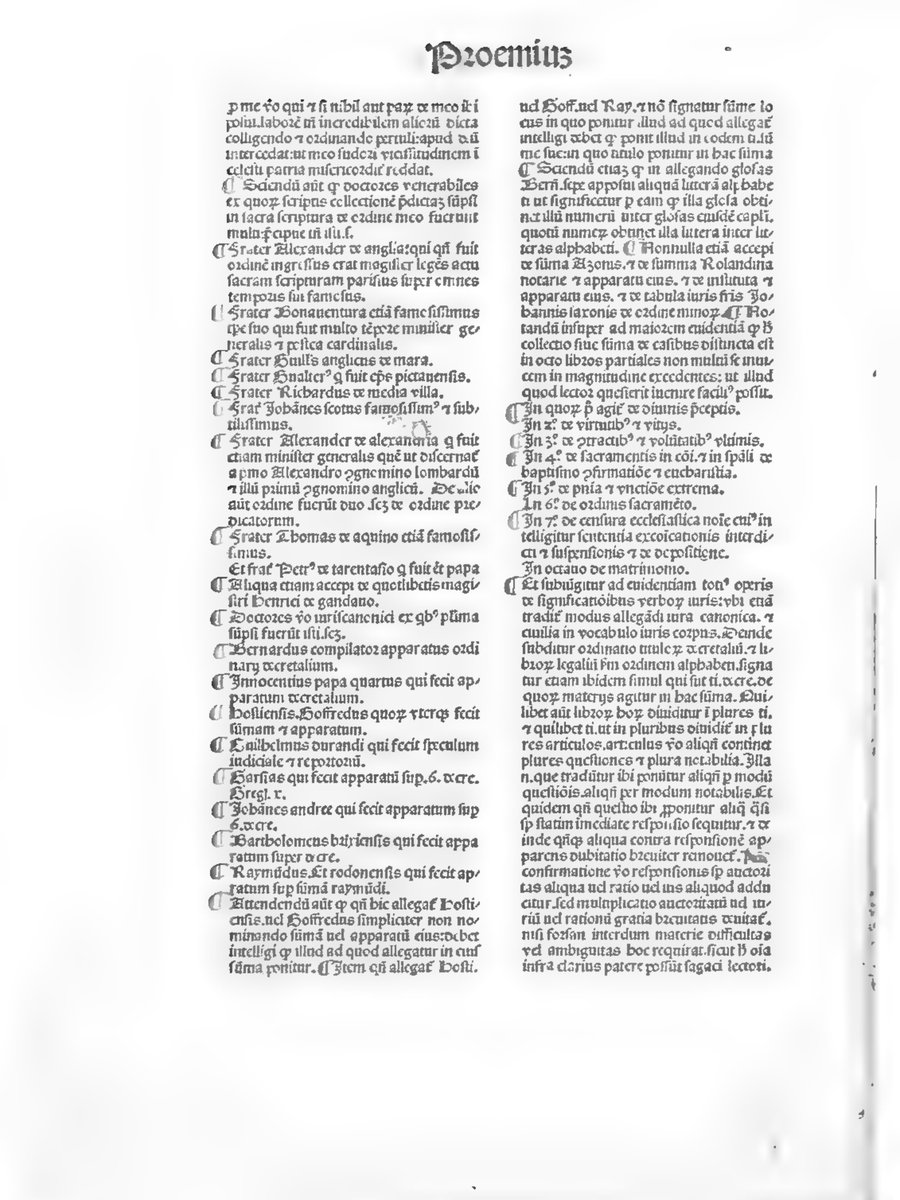
On Simony
De simonia
 Astesanus of Asti
De simonia. Titulus .55.
Consequenter viso de excessibus prelatorum in subditos et e converso, consequenter considerandum est de simonie excessu specialiter. Et primo quid sit et vnde dicatur. 2° vtrum sit peccatum. 3° quando et quibus modis committatur. 4° qua pena simoniaci feriantur. 5° de restitutione simoniace receptorum. 6° qua dispensatio circa eos et per quos adhibeatur. 7° specialiter de simonia quam committunt prelati vices suas vel ecclesias pro censu annuo procedendo. 8° vtrum committatur simonia si exigatur pecunia pro doctrina et concedi licetiam. 9° de quibusdam casibus dubijs circa simoniam. 10. qui admittuntur ad accusandum simoniaci et testificandum cotra eum.
Primo quid est simonia. Respondeo secundum Damascenum et alios plures doctores iuris canonici, quod simonia est studiositas siue studiosa cupiditas emendi vel vendendi spiritualia vel spiritualibus annexa. Et redit in idem cum descriptione magistrali quam ponit doctores sacre scripture, scilicet: simonia est studiosa voluntas emendi vel vendendi aliquid spirituale vel annexum spirituali. Et elicit ex ibis Gregorii nazanzeni i.q.i. qui igitur studet continue vel mercari precio, permanere non potest in ordine sacro.
quia ipsa innuit quod simonia promittitur sola intentione, cuius contrarium videtur per plura iura, vt extra eo. tua nos. in fine et c. vltimo et extra vt ecclesie beneficia. vt nostrum. Propter quod dixit Lancele, sola pactio facit aliquem simoniacum. Hoc videtur sentire Bernardus extra eo. c. vltimo et c. consulere, vbi dicit quod non credit quod sola voluntas faciat hominem simoniacum, licet aliter peccet. Sed Hostiensis dicit concordando, quod sola voluntate committitur simonia quo ad deum, non tamen quo ad ecclesiam, vt extra eo. tua nos. in fine. Vnde talis simonia sine resignatione et restitutione eius quod
taliter sine pactione aliqua est receptum pro penitentiam electus: ut extra eo. c. vlt. Et si obijcitur quod sola intentione committitur vsura. extra de vsur. consuluit. Respondetur quod hoc non est verum in foro iudiciali ut patet ex c. de vsur. in ciuitate: sed in penitentia inducitur vsurarius ad restituendum sic accepta: ut dicit c. consuluit. Si queratur quare etiam hic in penitentia non inducitur abbas ad restituendum: et monachus ad renunciandum: sicut vsurarius ad restituendum. Respondeo distinguendum est: quedam sunt prohibita quia simoniaca ut emere vel vendere sacramenta. Et breuiter omnia que erant in veteri nouoque testamento simoniaca: et in his sufficit sola voluntas. s. ad introducendum peccatum siue stet in finibus suis: siue progrediatur vlterius ad actum emendi vel vendendi vel etiam paciscendi. Sed non sufficit ad introducendam irregularitatem: si non progrediatur ad actum paciscendi: quedam vero sunt simoniaca quia prohibita per ecclesiam: vt cum quis renunciat sue ecclesie hac conditione vel pacto: vt detur cui placuerit sibi: et illis non obest sola voluntas: sed requiritur actus paciscendi ad introducendum peccatum. extra de offi. ele. ex parte. et de renuc. de multa. Non enim peccat qui vult renunciare: vel etiam actu renunciat beneficio ad opus alterius si dignus sit: dum tamen pactio non intercedat. hosti. vero de his: que sunt simoniaca propter prohibitionem ecclesie ponit exemplum de venditione beneficij dicens: quod non erat prohibita in veteri testamento. hodie ergo est simoniaca: quia prohibita: vnde hodie est simoniacum vendere vel mercari gastaldia. hyconomatum. aduocatiam. et hijs. extra eo. ad nostram. i. q. i. si quis. et. q. z. saluator. Et in his non obest sola voluntas: sed requiritur actus quo ad ecclesiam. hosti. Predicta tamen distinctio circa ea: que sunt simoniaca ponitur communiter a doctoribus modernis et antiquis: et ponitur a hen. ex. de offi. ele. ex parte. i. hosti. ergo respondens ad questionem premissam dicit: quod illo modo quo seruatur de vsura: que vtroque testamento condemnatur seruabitur etiam de simoniacis primo modo dictis. Et sic intelligi potest illud. i. q. i. qui studet. et. c. reperiunt. et similia. De simoniacis vero secundo modo dictis loquitur extra eo. c. vlti. vnde videtur secundum ipsum: quod si episcopus tali spe inductus. s. pecunia habendi clericum secu-
larem ordinauit: et postea pecuniam: quam sperauit receperit induci debet in iudicio aic: vt pecuniam reddat: et clericus qui eam intentionem habuit: induci debet: ne suum exequatur officium: quousque secum fuerit dispensatum: tamen quo ad ecclesiam celebrabit. Reddit etiam aliam rationem ipse hosti. s. quod monachus nihil proprium habet: vnde quicunque sibi precium restitueret: precium semper esset monasterij: sed ei qui dederit vsuram restitutio fiet: quia proprium habet. Obijcit iterum hosti. eandem descriptionem: quia innuit: quod sine studiosa cupiditate emendi vel uendendi spiritualia spiritualia: vel spiritualibus annexa non committit simonia: quod est falsum: vt patebit infra. Propter predicta igitur hosti. describit simoniam sic. Simonia est spiritualium vel spiritualibus annexorum precedente pacto promissionis. conditionis. modi. seruitij. precij. vel cuiusuis temporalitatis receptio. siue donatio. Hec autem descriptio ex his que dicentur infra patebit. Potest tamen descriptio premissa sustineri dicendo quod studiosa voluntas dicit ibi voluntas ad actum exteriorem progressiua. secundum glo. i. q. i. qui studet. Potest etiam dici quod quia peccati perfectio est in electione: licet quandoque homo inclinetur ad hoc ex infirmitate vel ignorantia. Ideo simonia dicitur voluntas studiosa: vt intelligatur esse voluntas eligens: non surreptitia. Nomine vero emptionis et venditionis intelligitur ibi omnis contractus non gratuitus: vnde etiam dignitates vel prebede vel alia ecclesiastica beneficia primitaria non possunt auctoritate proprij sine simonie periculo permutari: nec eciam transigi ex de trans. sup eo. Episcopus tamen hoc facere potest propter causam necessariam vel vtilem. extra de rerum permu. quesiti. Est aut transactio de re dubia lite incepta: nondum finita: non gratuita pactio: vt dicit Rof. quod simoniaci sunt qui inter se paciscuntur hoc modo. tu facies pro posse tuo: quod ego habeam beneficium tuum et ego pro te tuum. Possunt tamen sibi voluntates suas inuicem intimare: dicendo sic libentius essem in ecclesia tua: et econuerso et episcopo significare. ### Vlterius ad euidentiam predicte descriptionis videndum est quid ibi dicatur spirituale: et quid annexum spirituali. Circa quod sciendum: quod spirituale potest dici dupliciter. s. per comparationem ad spiritum sanctum: et per comparationem ad spiritum humanum. Spirituale dictum primo modo potest dici tripliciter. scilicet per essentiam: vt gratia et virtutes gratuite
per casualitatem et dispositionem: vt sacramenta: que sunt quodammodo causa gratie et virtutum. Et per effectum: vt ea que conueniunt alicui ex aliquo dono vel officio spuali: vt prophetare: miracula facere: diuinum officium celebrare. Annexum autem spuali scilicet per comparationem ad spm sanctum dicitur multipliciter. Uno modo: quia in eo spuale ministratur: vt vasa sacra, ecclesia, cimiterium. Alio modo quia ex spuali dependet siue consequitur: vt habere eccliam vel dignitatem ecclesiasticam: canoniam vel prebendam: siue aliud beneficium ecclesiasticum: vel ius percipiendi fructus prouenientes ex predictis vel ius percipiendi decimas: primitias vel oblationes: hec enim omnia ordini clericali annexa sunt: quia solis clericis conueniunt. Tercio modo quia antecedens ad spualia ordinatur: vt ius personatus: quod est potestas presentandi ad officium ecclesiasticum. Posset tamen etiam annexum spuali dici largo modo spuale. Spirituale primo modo dictum nec de iure nec de facto potest vendi. Spuale vero secundo modo et tercio et etiam annexum quocunque modo dictum vendi non potest de iure: sed de facto tantum: que patebunt infra plenius. Et sicut spuale predictis modis dictum non potest vendi et emi: ita nec redimi vel resignari pro pecunia: vt extra e. querelam et i. q. i. nullus epus. 2. Non potest inquam redimi ab illo scilicet qui ius habet percipiendi: alias potest redimi sicut redimuntur decime de manu militum eas iniuste retinentium. In omnibus enim predictis omnis promissio: omnis conditio: omnis pactio commodi temporalis simoniam inducit: vt extra de pac. c. vlti. et i. q. 2. quam pio. Conditio tamen licita et que de iure est potest apponi. extra de elec. significasti.
Spuale autem per comparationem ad spiritum humanum dicitur dupliciter. Uno modo per essentiam: vt scientie phice: que per inuestigationem et doctrinam humanam acquiruntur. Alio modo per causam: vt doctrina predictarum scientiarum. Scientie nec de iure nec de facto possunt vendi. Unde prouerbiorum 17: Quid prodest homini stulto habere diuitias: cum non possit emere sapientiam. Doctrina vero de iure et de facto potest vendi: de qua dicetur vt infra. Annexa vero huic spirituali: vt schole et libri vendi possunt de facto et de iure communi: nisi ecclesia locum scholarum assignaret doctori.
gratiam a beato Petro Acti. 8. Giezita vero dicitur a giezi seruo helizei: qui vendidit gratiam sanitatis Naaman syro. 4. Reg. 5. i. q. i. qui studet. Ex quo paret quod venditor spualium proprie dicitur gieziticus. emptor vero proprie simoniacus vsus tamen obtinuit: vt vterque simoniacus dicatur. et hoc conuenienter. Ad hoc enim Simon voluit emere pecunia donum spus sancti: vt alii postea venderet: vnde in eo fuit quasi ad voluntatem vicium emptoris et venditoris.
Sequitur videre de 2° scilicet vtrum simonia sit peccatum. Respondeo quod sic: etiam mortale valde graue. Unde i. q. i. qui studet. dicitur crimen capitale. Sicut enim dictum est 2 li. aliquis actus est malus ex genere: ex hoc quod transit super materiam indebitam. Emptionis autem et venditionis indebita materia est res spiritualis. Cuius ratio est triplex. Prima est: quia res spualis non potest aliquo terreno precio compensari: sicut dicitur de sapia prouerbiorum 3. preciosior est cunctis opibus: et omnia que desiderantur huic non valent comparari. Et ideo Petrus dixit Simoni Acti. 8. Pecunia tua tecum sit in perditionem quoniam donum dei existimasti pecunia possideri. 2a ratio est: quia illud solum est materia debita venditionis: cuius venditor est dominus: prelatus autem ecclesie non est dominus rerum spiritualium: sed dispensator. Sed illud i. Cor. 4. Sic nos existimet homo: vt ministros christi et dispensatores ministeriorum dei. 3a est ratio: quia venditio repugnat origini spiritualium: que proueniunt ex gratuita dei voluntate. Unde Mathei 10 dicitur. Gratis accepistis gratis date. Et ideo aliquis in vendendo et emendo spiritualia exhibet irreuerentiam deo et tribus personis diuinis: ideo peccat peccato irreligiositatis. Comparatur autem peccato heresis. i. q. i. qui studet. et i. q. vlti. c. finali. non quia sit heresis proprie: sed similitudinarie: quia simoniacus ita operatur: ac si contra fidem sentiret: dum scilicet emere et vendere precio spiritualia nititur.
Utrum in his que simoniam inducit auctoritas pape excusaret a simonia. Respondet Ber. extra de pactis. cum predictis. quod in his que sunt ex sui natura simoniaca in veteri testamento: vt vendere sacramenta et huiusmodi spiritualia non excusat auctoritas pape. In his vero que sunt simoniaca per constitutionem ecclesie excusat
quia potest in talibus dispensare. Sed Bernardus. Unde pape non liceret accipere pecuniam pro aliqua re spirituali, sicut nec alteri homini, immo tanto peccaret gravius quanto locum maiorem obtinet. Licet enim res ecclesie sint ipsius ut dispensatoris principalis, non tamen sunt ipsius ut domini et possessoris. Et ideo dicit Thomas, quod si reciperet pecuniam pro aliqua re spirituali, sive de bonis ecclesie sive de bonis aliis, non caret vicio simonie.
Circa quod sciendum, quod simonia committitur triplici munere, ut dicit Gregorius, propter quod dicit Isaiah 33: Beatus qui excutit manus suas ab omni munere. Est enim munus a manu, scilicet pecunia, et a lingua, scilicet favoris, et ab obsequio, ut servitus iugiter impensa, 1, q. 1, sunt nonnulli. Et contrahitur quandoque ex altera parte tantum, scilicet dantis et accipientis, quandoque ex utraque, quandoque ex neutra, ut cum utroque ignorante amicus ordinandi dat aliquid consiliario episcopi vel promittit, 1, q. 1, statuimus, et c. si qui a simoniacis.
unde dixit quod conferre ecclesiam vel prebendam alicui intuitu consanguinitatis est simoniacum. Sed aliis ut Alexandro de Hales et Thome videtur quod hoc sit bene grave peccatum, non tamen simoniacum, quia nihil ibi in precium datur vel recipitur quod ad simoniam requiritur. Si tamen aliquis prelatus beneficium aliquod ecclesiasticum alicui daret hoc pacto vel intentione ut ipse suis consanguineis provideret, simoniacus esset. De tribus ergo muneribus supradictis per ordinem est dicendum.
dare vel accipere pro spiritualibus, vel etiam annexis spiritualibus semper inducit simoniam, nisi adeo sit parvum quod non debeat inducere, promoventis animum inspectis causa, tempore et qualitate persone, ut ex c. ad questiones, quod est verum si pactum non precessisset, alias contra, ut extra eodem, tue, et 1, q. 1, placuit et nullus. Et iudices precipue debent intendere, quia quicquid agant homines, intentio iudicat omnes, scilicet quo ad eum, extra de electione, cum ex officio. Ideo dicit Laurentius: muneribus vadis attende quatuor ista: quis das, quisve petes, queres que causa petendi, quis, scilicet pauper vel divites, que res, precium magni vel parvi, et potest addi 5m, scilicet an instante necessitate vel alio tempore conferat. Vetus enim proverbium est, nec
omnes nec omnia nec ab omnibus. Valde enim inhumanum est a nemine velle recipere, sed et omnia et ab omnibus vilissimum est, ff. de offi. proconsulis, solent, § ultimo. Ergo esculentum et poculentum, quod consumi possit infra triduum, recipere licet, ff. de offi. presidis, plebiscito. Si tamen corrupta intentione et sine pacto teneant vel recipiant munera quotcunque, parva committitur simonia, scilicet quo ad deum, que tamen sine resignatione executionis ordinis vel beneficii collati, purgatur sola penitentia. Et secundum hoc potest intelligi illud ex c. nemo, secundum Hostiensem.
pro sepulturis aut exequiis mortuorum, vel benedictionibus nubentium, nec pro crismate nec pro oleo sancto, extra c. cum ecclesie, ea que ad nostram sententiam in tantum. Nec pro ecclesia conferenda vel consecranda, vel abbate vel abbatissa in sede ponenda. Nec pro ecclesie investitura, nec pro consecrationibus episcoporum, intronizationibus eorum, benedictionibus abbatum, ordinationibus clericorum, licet de corruptela sit taxatum quantum sit isti vel illi tribuendum, ut ex c. in tantum, sicut nec pro aliquo sacramento ecclesie, nec etiam pro pastu vel pastillo vel pro voce vel pro calamo, sive scriptura et similibus est aliquid petendum vel dandum, extra c. veniens, et c. 1, et 1, q. 3, si quis obiecerit. Nec aliqua consuetudo prodest ut pro talibus aliquid exigatur, extra c. non satis, et c. sequenti.
laudabiles observari debent, 1, q. 3, quesitum, et di. 18, de eulogiis. Dicendum secundum Hostiensem, quod ex pacto nihil recipi debet obtentu alicuius consuetudinis, sed recipi potest si offeratur gratis, sicut curia tenet et probatur ex c. dilectus filius. Et dicetur iam statim. Vel etiam secundum eundem Hostiensem melius sic: Aut clerici exigunt a laycis obtentu consuetudinis, et tunc non debent clerici retinere pignus spirituale, sed gratis debent sepelire vel benedictionem dare, et postea veritate cognita per episcopum loci cogent layci laudabilem consuetudinem observare, ex c. ad apostolicam. Aut clerici a clericis, et isti si petant aliquid in quo propria et privata utilitas versatur, non valet, ut patet in dictis c. quesitum, de eulogiis.
in quibus munus a manu recipitur vel recipi potest. Unus est si offeratur gratis, ex c. dilectus filius, in fine glo. a. Si autem dubitetur utrum gratis vel ex pactione vel ex corrupta voluntate sit datum, debet attendi prenotata super prime. Et secundum ea
presumi potest pro et contra, scilicet in foro exteriori, sed in foro conscientie attenditur intentio. Quidam tamen quibus consentit Raymundus distinguunt, quia aut dat aliquod temporale pro spirituali sive propter spirituale principaliter, et sic est simonia, 1, q. 1, eos in fine, et 1, q. 7, si quis prebendas. Aut non principaliter, ita quod alias daretur, et sic non est simonia, ex c. licet questiones, et c. dilectus filius a, in fine. De qua opinione dicit Hostiensis quod videtur dura, quia raro vel numquam contingeret. Si quis enim episcopus Parisiensis intronizatur, archidiaconus Senonensis consuevit ei dare dimidiam marcam auri, quod autem vel quando sibi daretur, nisi cum intronizaretur, unde credit quod si sponte sine pacto fiat, non est simonia, credit etiam quod si aliquod temporale detur, non ut debitum sed ut datum consuetum, non est simonia, secundum Hostiensem.
Nam possessio dari potest ut in ea construatur oratorium, ut extra de rescriptis spontanea, olim. Et sic certo pacto dari potest licentia construendi ipsum, extra de censibus, conquerente, et extra eodem, ex insinuato, nec talia enim pacta reputantur spiritualia, sicut illud, extra de prebendis, significatum. Et in traditione sue rei quilibet potest quomodo sibi placet apponere pactum, extra de conditionibus appositis, nullum.
quia ad ea alias non tenetur, 12, q. 2, charitatem. Et hoc est verum si non habeat aliunde unde vivat, ut 1, q. 1, iudices. Et argumentum optimum, 12, q. 1, illi qui. Unde suas operas locare potest ad tempus, ut faciunt presbyteri educticii, vel quia hoc male sonat, vicarii dicantur vel subsidiarii, ut extra ne prelati vices, c. quoniam frequenter, dummodo, ut dictum est secundum Hostiensem et Bostiensem, principalem intentionem suam inferat non ad pecuniam sed ad obtinendam veniam. Si vero ad eas ex officio suo teneatur, puta quia est sponsatus et intitulatus ecclesie, nihil etiam obtentu sumptuum accipere debet, et de consecratione, di. 2, sufficit, alias simoniam committeret, ut 1, q. 3, vendentes. Parrochiani tamen cogendi sunt per superiorem solvere illud, quod consuetudo laudabilis introduxit, extra eodem, ad apostolicam, in fine. Et sic ad dandum oblationes, 16, q. 1, statuimus. Si autem non tenetur et habet alios sumptus aut debet gratis cantare aut cessare, et si hoc faciat pro pecunia, aut erit ibi simonia aut avaritia, ut dicit Hostiensis et Raymundus. Licet enim, ut dicit Raymundus, forte non esset
simonia, eo quod nullus tenetur suis stipendiis militare, extra eodem, cum sit. Tamen est ibi turpe lucrum vel ad minus habet speciem mali. Predicto modo distinguunt Raymundus, Hostiensis et Bostiensis. Hostiensis autem dicit quod presbytero sive indigeat sive non, pecunia dari potest in sumptus eius, non in munera sacerdotii, id est sacerdotalis officii, quod impendit, sicut dicit Hieronymus, quod racemi, panes et vas mellis si prophete data fuerunt, magis sunt in sumptus eius quam in munera prophetie reputanda, 1, q. 1, iudices. Cum ergo officians presbyter recipit pecuniam pro officiando ad tempus, ecclesie loquitur, putly per notat causam sine qua non, vel eam adminiculativam, et non appreciationem siue estimationem in officio vel etiam laboris quem habet, quia labor ille adeo est annexus illi officio, sicut aliqui dicere voluerunt, quod non debet vendi vel locari, sicut nec officium ipsum, quia quisquis alterum illorum vendit, vendit sibi reliquum, unde in omni casu predicto debet officium impendere gratis. Et sicut dicit Augustinus, apostoli gratis ab illis accipiebant panem, quibus gratis predicabant, secundum Hostiensem.
hec prepositio pro potest denotare appreciationem siue estimationem, et sic non debet concedi, potest etiam denotare causam finalem vel efficientem, et sic utroque modo potest concedi, ut sit sensus: ille dat pecuniam pro missa, id est propter venerationem misse, et tunc denotat finem, vel pro missa, id est pro celebratione misse, que movet eum ad dandum pecuniam, et hoc denotat causam efficientem, potest etiam denotare adminiculationem, et etiam reducitur ad causam efficientem, ut cum dicit ille ministrat sibi librum et calicem presbytero pro missa celebranda, vel ille dat pecuniam presbytero, et sic etiam potest concedi. Notandum etiam quod temporalia ministrantibus spiritualia dantur et ab eis accipiuntur tanquam stipendium necessitatis, et secundum approbatam consuetudinem, non vt precium mercedis spiritualium, quia tunc committeretur simonia. Dantes accipientesque non obstante aliqua consuetudine, quia consuetudo non preiudicat iuri naturali vel divino, quod prohibet simoniam, ut 1, ad Thi. 5, super illud quod dicit glossa Anselmi: accipiat dispensationis a domino, ipsi mercedem pro vita eterna.
in remissionem peccatorum, secundum illud Dan. 4: Peccata tua eleemosynis redime, extra de testibus c. fi., et 12. q. 2. aiebat. Sed quare non est hic simonia, cum hec sunt spiritualia? Respondeo quia eleemosyne dantur pauperibus deo, qui est dominus spiritualium; ideo simonia non committitur cum eo, sicut cum prelatis, qui non sunt domini, sed dispensatores eorum. Item predicta cadunt sub merito et exponunt nobis venialia a deo per moneta dilectionis et operibus charitatis; non sic de spiritualibus, que per ministros ecclesie conferuntur. Unde corporalis eleemosyna non est precium vite eterne, nisi inquantum imperatur a charitate.
Quartus casus est cum datur pro redimenda vexatione, extra eodem, dilectus filius i. Unde si episcopus excommunicet me iniuste, vel minetur auferre mihi beneficium quod iuste possideo, licite redimo ius in eum dando sibi pecuniam ut sententiam iniustam revocet, vel ab hac iniuria cesset, argumentum extra de magistris, prohibemus. Nec obstat illud extra e. querelas, ubi videtur prohiberi et emi et redimi, quia ibi exponit secundum Hostiensem redimi, id est per pecuniam resignari. Nec obstat etiam illud extra e. nemo, quia secundum Hostiensem ibi non redimitur vexatio, sed emitur absolutio; vel potest dici etiam secundum Hostiensem et Iohannem, extra e. dilectus i., quod si quis excommunicat iuste beneficium acquisivit iniuste, tunc in utroque casu committitur, extra e. nemo et 1. q. 1. nullus episcopus. Secunda redemptio ergo rei spiritualis permittitur vexato iniuste et redimenti, sed prohibetur vexanti, et per vexationis cessatione recipienti. Si tamen excommunicavit me iuste, non licet mihi pecuniam pro beneficio absolutionis ei dare, nec licet sibi accipere, licet tamen pro peccati punitione. Caveat autem absolvens ne in hoc magis intendat cupiditati, quam correctioni servire. Rodericus autem sentire videtur quod etiam simonia est si aliquid pro revocatione iniuste sententie detur; unde secundum eum iniuste excommunicatus coram superiore conqueratur, sed quod dictum est prius communiter tenetur. Nihil ergo dandum est iudici pro absolutione directe; sumptus tamen quos fecit propter rei contumaciam adversarius, vel etiam iudex cum procedit ex officio suo, debet ipse reus antequam absolvatur reficere, extra ut lite non contestata, quoniam, paragrapho, in aliis, et de sententia excommunicationis, sacro, et de appellationibus, cum speciali. Si tamen sit excommunicatus iniuste absolvi debet sine omni gravamine, ut in c. sacro. Hec Berengarius, extra e. ad aures.
diat eius electionem. Respondeo quod hoc non licet sibi nec ante electionem nec post, si per electionem non sit ius acquisitum ei, extra e. de hoc. Si autem sit ei ius acquisitum, licet sibi non quidem per electionem, sed per vexationis sue iniuste redemptionem, extra eo. dilectus filius i. Quid si aliquis de quo constaret quod in electione nullum ius haberet ante electionem impediret ne electio fieret, numquid capitulum vexationem eius redimere posset? Respondet Rodericus quod sic, scilicet si ille impediret ne simpliciter electio fieret; si impediret ne de isto vel de illo electio fieret, forte tunc capitulum impedienti nihil dare posset, sicut nec ille cuius electionem impediret.
Quintus casus circa de consecratione et visitatione. Si enim episcopus ecclesiam consecrat, vel episcopatum visitat, potest procurationem moderatam recipere, extra de censibus, cum apostolus, et extra e. cum sit romana, et de prescriptionibus, cum ex officii, et 10. q. 3. relatum. Et nihilominus tamen videtur hoc facere gratis, argumentum extra de vita et honestate clericorum, cum ab omni. Non tamen intelligas quod exigatur aliquid pro ipsa consecratione, alias contra 1. q. 1. statuimus, sed pro labore vie, 12. q. 2. charitate, etiam si ecclesia sit in civitate, extra de censibus venerabilis, secundum Hostiensem. Secundum vero Hostiensem in summa, cum talis labor sit spiritualis, quem prelatus necessario et ex officio sibi iniuncto tenetur subire, melius est dicere quod hoc provenit ex consuetudine, extra e. ad apostolicam, et ex equitate, ut qui seminat spiritualia metat et temporalia, ut patet per multa exempla, 12. q. 2. paragrapho, quia ergo, quinimo hoc est ex connexitate, ut extra de censibus, cum venerabilis. Secundum autem Berengarium et Hostiensem in glosa, extra c. cum sit, predicta procuratio premissa est a iure quasi licita, quia non peccatur legis auctoritate, 23. q. 4. quod peccat. Et debet fieri secundum facultates ecclesie sicut et alie, extra de censibus, sopite. Imo etiam si ecclesia non possit ex penuria, episcopus suis sumptibus ecclesiam consecrabit, 1. q. 1. placuit.
Sed quare datur episcopo procuratio pro ecclesie consecratione, et non pro clericorum ordinatione, cum etiam ibi sit labor? Respondeo quia episcopus potest ordinare in sua ecclesia, et facile potest habere expensas in domo sua, non sic autem cum aliam consecrat aut visitat ecclesiam.
simonia est, ut extra eodem, cum essent. Si autem non interueniat pactum, tunc sic distinguitur secundum Hoff., Hosti. et Ber. super c. cum essent, quia aut seruio tibi hac spe secundario ductus, scilicet quod conferas mihi beneficium, principaliter seruio gratis, et tunc non pecco, ar. di. i. quid proderit; aut seruio principaliter ut conferas mihi beneficium, et secundario gratis, et tunc delinquo, in quo tamen casu sufficit mihi per penitentiam satisfacere, ut dictum est supra. Et secundum hanc distinctionem intelligitur illud extra eodem tua nos secundum Hoff., et concordant iura que videntur sibi inuicem contraria. Aliter potest distingui secundum Ray., Hoff., Hosti. sic: obsequium aut est corporale aut spirituale; si sit corporale honestum non inducit uicium, dummodo non interueniat pactum, ut si quis seruiat pro romam eundo, pro eo aduocando, eius negocia procurando. Et hoc innuit a contrario sensu i. q. i. sunt nonnulli, ibi munus ab obsequio cum seruitus indebite impensa. Et hoc intellige ubi dignus digni pristat obsequium, ut dictum est; si vero dignus indigno, uel indignus digno obsequium prestet, simonie uicio non caret, ut si fuiat ad utilitatem consanguineorum eius, uel faciat aliquid sibi, est munus ab obsequio, et est simoniacum secundum Tho. Si autem fit spirituale et interueniat pactum inducit uicium, nisi beneficio uel personatui sit annexum, ut cum est impositum hoc onus alicui prebende ut qui eam habuerit dicat missas de beata uirgine, ut extra de prebendis significasti. Et intellige secundum Rod. quod propter obsequium corporale et honestum dari non debet beneficium, sed datur obsequenti meritis suis cognitis per huiusmodi obsequium, quia ut dixit cantor parisiensis: curie predatores sunt probatoria clericorum.
Sed pone quod unus debeat dicere missam maiorem, alius minorem, et conueniunt adinuicem quod unus dicat missam pro alio reconuerso; nunquid eis licebit? Respondeo quod sic, quia cum dicit iste impendit obsequium spirituale pro alio spirituali, pro non denotat ibi appreciationem, sed adminiculationem, cum ille non possit cantare pro alio, nisi etiam ille cantet pro eo.
Esto quod duo sint baptizandi: unus dicat alteri baptizabo te tali pacto, quod postea baptizes me; nunquid est ibi simonia? Respondet Rich. quod sic, quia in talibus nulla pactio uel conuentio debet interuenire, extra eodem tua nobis. Licet enim dare aliquid spirituale pro facto ex
pacto non sit licitum ex tot causis ex quot illicitum est dare aliquid temporale, unde est illicitum propter duo, scilicet quia res a non domino emitur, quod est contra rationem que datur. Dicere tamen posset: ego baptizo te et rogo te quod postea baptizes me, quod intelligo in casu necessitatis.
Circa autem munus a lingua sciendum quod hoc munus, quod sub precio cadit, uel ipsa laus pertinens ad fauorem humanum, uel preces ex quibus fauor humanus acquiritur, uel commendatio: et idco si quis principaliter ad hoc intendit simoniam committit, quia contrarium uitatur. Et idem si quis principaliter ad hoc intenderet quod preces pro indigno, scilicet ex aliquo crimine, uel huiusmodi simonia exaudirentur. Si uero pro digno non est simoniacum, quia subest debita causa quod ei aliquid spirituale detur, nisi forte ipsum factum est simoniacum, et tunc esset simonia in intentione. Potest tamen aliquis simpliciter ad humanum fauorem attendere, non ad personam dignitatem, et tunc simoniam committit si beneficium alicui propter consanguinitatem concedit, alias non concessurus, quia si quis iniusto cordis amore, uel sordidis precibus etc. i. q. i. si quis. Nec obstat ar. ex eo nemo et c. cum, ex quo enim fauor tertii munus fauoris inducit, multo magis fauor eius qui ordinatur, i. q. i. sunt nonnulli, hoc notat extra ut ec. bene, ut nostrum.
Secundum autem Tho. talis collatio est carnalis et illicita, non tamen simoniaca, quia nihil recipit, sed quare minus simonia committit rogando pro indigno quam pecuniam dando? Respondet Bar. i. q. i. quibusdam: quia in rogando nihil dat nihil accipit, et ideo ibi nullum commercium intelligit. Sed pro indigno magis peccat. Uel secundum Alex. de an. preces ordinatur ad notificandum dignitatem, et pecunia ad mouendum inordinate arbitrium conferentis. Potest autem circa hoc distingui secundum Hoff. Hosti. sic: aut mouetur quis precibus suis, aut alienis; si suis aut ad prelaturam, et confert per electionem, et tunc simonia committit quia talis uidetur ambiciosus et indignus, extra de elec. qualiter, et i. q. i. sicut. Aut ad simplex beneficium, et tunc non committit, dum tamen sit dignus, ut extra eodem tua nos in principio. Si autem promouet precibus alienis, aut precibus spiritualibus aut carnalibus; si spiritualibus simonia non
promittit. i. q. i. latorem. nisi prelatus consanguinitate trahatur. i. q. i. ordinationes. 7 c. sunt nonnulli. ubi dicit quod preces succedunt loco precij. Land. autem 7 Bregl. Halo. dixerunt quod nullo dato simonia non committitur. i. q. 2. quam pio. Sed hoc intelligit Hosti. quod consanguineus est dignus. tali enim magis quam extraneo tenetur providere prelatus. ar. extra de cohabi. cle. c. i. Si vero sit indignus locum habet: ut prius dictum est. Si vero precibus alienis 7 carnalibus: aut promovetur ad prelationem: aut ad simplex beneficium: si ad prelationem iniuste sunt preces maxime quando rogans est laycus: cuius vultus timeri potest: ut extra de elec. Osius. quisquis nisi forte prelatus non habito respectu ad preces eius instituat ex officio suo necessitate vel utilitate ecclesie exigente: ut extra de cra. 7 quali. curam. Si autem ad beneficium simplex: aut ille pro quo rogatur est indignus: 7 tunc simonia committitur: ut i. c. de ordinationibus. 14. q. 1. 7. c. nonnulli. aut est dignus 7 tunc non committitur: si prelatus principaliter preces non sequatur i. q. i. quibusdam. 7 ar. in. c. tuam. 15 Ho. Ray. vero 7 Ber. extra de eta. tuam. conveniunt in premissa di. cum Hosti. 7 Hoff. nisi quod in primo membro. s. quando quis promovet precibus suis sic distinguunt. s. quod quis pro se petere non potest ecclesiam vel dignitatem vel beneficium aliquod habens annexam curam animarum. ad hoc. ar. 8. q. i. in scripturis. 7. i. q. i. ordinationes. 7 extra de iure patro. per nostras. beneficii vero simplex si indigeat 7 dignum se sentiat petere potest sine metu simonie 7 pacto. extra. c. ad aures. Si vero sit indignus vel etiam non indigens peccat: ut dicit ibidem. 7. i. q. 2 clericos. Et dicit hic beneficium simplex illud: quod est sine cura animarum vel dignitate. Rob. vero dicit: quod hec opinio videtur dura: unde credit quod aliquis pro se petere possit nisi sit indignus beneficii habens curam animarum annexam. exemplo Isa. qui dicit. Ecce ego mitte me. Credit etiam quod ex quo quis est promotus ad ordines sacros: cum huiusmodi ordinatio requirat ecclesiasticum titulum petere possit ecclesiasticum beneficium: licet abundet in temporalibus. Et iura: que Ray. inducit loquuntur pro statu ecclesie primitive: quando redditus erat exiles 7 distribuebantur de facultatibus ecclesie: prout opus erat cuique.
Sequitur de 4°. s. qua pena simoniaci feriantur. Circa quod sic no secundum Hosti. quod simoniaci puniuntur 7 a iure 7 a iudice. a iure enim puniuntur ipso facto. Qui enim fuerit ordinatus simoniace ipso facto est suspensus: etiam quantumcumque sit occultum. secundum Ray. Hosti. Hoff. 7 Ber. extra eo. accusant. 7 Innoc. sup. c. ex e. tanta. Et quo ad se ut s. de sui ordinis executione se non intromittat. Et quo ad alios ut s. nullus ei in executione ordinis communicet: siue peccatum eius sit publicum vel occultum. extra eo. tanta. ubi etiam dicit in aggravationes criminis simonie: quod omnis peccator potest missam celebrare preter simoniacum. Omnis inquam peccator subaudi non precisus toleratus penitens potest 2c. Sic subaudiri debet secundum Hoff. Host. 7 Ber. ibidem. Per hoc quod dicit non precisus. s. ab ecclesia per sententiam excommunicationis iudicis vel canonis tollit obiectio de excommunicatis 7 suspensis: qui excluduntur a participatione sacramentorum: per hoc vero. quod dicit penitens tollit obiectio de eo: qui est in mortali: qui suspensus est quo ad se. 1. q. 1. sacerdotes. hoc tamen locum non habet ut dicit Hoff. in enormibus etiam neque mediocribus notorijs de iure vel de facto. huiusmodi enim crimina post pactam penitentiam impediunt executorem ordinis 7 quo ad se 7 quo ad alios: ut extra de temp. ordi. c. fl. 7 de renuc. nisi cum pridem. Unde Hoff. sic supplet. Omnis peccator non precisus toleratus penitens potest celebrare missam preter simoniacum: 7 preter alios relinquentes enormia etiam occulte: vel mediocriter notorie. Alias etiam expones illius ubi ponit glosa Ber. Nec obstat predictis illud ex c. ex tue fraternitatis. ubi dicitur: quod non est tutum simoniacum cohercere in ordine ab officio: quia illud intelligit quando crimen est occultum: ita quod prelatus non scit illud nisi per professiones: 7 ideo non potest eum prohibere: quin de suo officio exequatur: ut extra de offi. ordi. si sacerdotes. Dam. vero dixit quod simoniacus in ordine occultus est suspensus quo ad se tantum: notorius vero quo ad se 7 quo ad alios. 7 per. c. ex tue. loquitur de occulto. 7. c. tanta loquitur de notorio. Sed secundum Hosti. melius est dicere cum doctoribus alijs illud quod dictum est prius. s. quod etiam occultus est suspensus quo ad alios. quia talis habet characterem furtivum. s. large: quia non intravit per hostium secundum quod dicit Jo. io. qui non intrat 2c. 7. i. q. i. ordinationes; 7 ordo ideo ortus cecidit: ut. i. q. i.
quibusdam narrantibus. et extra co. accusatum. quotiens. hoc intellige quo ad executionem de iure. Et secundum Innocentium super c. per tuas. 2. Talis intelligitur esse suspensus ab actibus omnium ordinum: non tamen ordinis simoniace recepti: et per consequens administrationem in temporalibus perdit. distinctione 81. eos etiam qui. Et idem dicit de simoniaco in beneficio notorio. Si vero aliquis sit simoniacus: quia ordinem vel beneficium contulit simoniace: vel quia beneficium recipit simoniace: vel quia fuit mediator simonie: si sit occultum suspensus est ipso iure: quo ad se: sicut et quilibet criminosus alius: non autem quo ad alios. argumentum extra co. ut si questiones. veniens. ex tue. Si vero sit publicum sive notorium est ipso iure suspensus: quo ad se et ad alios. extra co. accusatum. quotiens. et distinctione 22. § verum. hec secundum Ray. Hoff. vero distinguit de eo qui receperit beneficium simoniace: et hoc est occultum si sit simplex beneficium suspensus est quo ad se tantum. Si vero sit dignitas que requirat ordinem certum: suspensus est quo ad se et ad alios. unde quicquid gerendo dignitatis officium facit: suspensus agit: et animas subditorum decipit. Et idem dicit de beneficio curam animarum habente: quia de hijs duobus idem debet haberi iudicium: ut extra de elec. dudum. retho. et eta. c. i. et extra. de si. p. c. si. hec Hoff. et eius socii Hosti. Innocentius autem extra co. super c. per tuas. 2. de simoniaco occulto in beneficio notat: quod talis licet non sit suspensus ipso iure: tamen ratione beneficij simoniace quesiti non ministrabit sine peccato: nec temporaliter nec spiritualiter: puta conferendo ordines si emit episcopatum vel dignitatem episcopalem. Ab alijs tamen beneficijs: que non simoniace quesivit suspensus non erit. ### Sed que est simonia occulta. Rendet Rod. quod hec est illa de qua non constat per sententiam vel confessionem in iure factam: nec per rei evidentiam: que nulla possit tergiversatione celari. ### Sed nunquid clericus publice simoniacus est ipso facto excommunicatus. ut sic. i. qui reperiunt. ubi dicit quod quicumque per spirituali dignitate munus aliquod ve rectus fuerit obtulisse ex eodem tempore se noverit anathematis opprobrio condemnatum: atque a participatione corporis et sanguinis christi alienum: ex quo constat illum hoc perpetrasse. Et ad idem dicit ibidem c. quicumque sacros. et c. placuit. Sed dic
quod talis non est proprie excommunicatus: quia in c. repiuntur secundum glo. anathema non significat excommunicationem: sed separationem a corpore et sanguine christi. Unde subditur ibi atque per 2 c. quod enim generaliter pro quolibet mortali intelligit: hic specialiter in detestationem huius dicit: postea tamen excommunicandus est: si eius contumacia hoc requirat. Et nota: quod hec determinatio: ex qua si determinet hoc verbum constat tunc talis demum suspensus erit: ex quo eum simoniacum esse constabit. Et hoc dixit Martinus hyspanus. Si vero determinet hoc verbum perpetrasse secundum hoc etiam occultus simoniacus est suspensus. hoc notatur in glo. predicta. In glo. vero illius. c. qui studet. eiusdem dicitur: quod qui est simoniacus in accepto ordine non debet ante penitentiam ecclesiam intrare. Sed Jo. theutonicus dicit: quod quilibet peccator etiam excommunicatus intrare potest ecclesiam ut oret: dummodo divinis officijs non intersit: quia hoc non invenit prohibitum. ### Puniuntur etiam simoniaci a iudice. Nam secundum Ray. et Hoff. simoniacus in ordine qualitercunque hoc iudici constiterit: sive per modum accusationis sive inquisitionis sive denunciationis deponitur et fit infamis. de primo extra de accu. super his. et 2° ibidem. inquisitionis. et i. q. i. siquis. neque. et ca. q. 7. requiritis. secundum Ray. et Hoff. Simoniaci enim sunt infames. i. q. 3. c. ultimo. Et hec est talis infamia: quod talis admitti non debet ad aliquod beneficium ecclesiasticum: nisi cum eo per principem dispensetur: tamen quo ad deum pacta penitentia tollit. ar. 2. q. 7. § hinc colligitur secundum Ber. extra e. ex diligenti. in glo. penultima. Rod. autem dicit: quod non credit quod sequi debeat depositio: vel infamia quando simonia probat: quia tunc ad modum denunciationis probatur: que nichil ad solam penitentiam agit. Simoniacus autem in beneficio et dignitate secundum Hoff. convictus per accusationem deponitur ab ordine et a beneficio. per inquisitionem vero amovetur ab administratione. extra de elec. per inquisitionem. Idem fit quando per denunciationem: Et ratio est: quia non posset agi penitentia illud vel illa retinendo. vi. 12. Herui. Hosti. autem distinguit sic. scilicet quod si queratur de crimine per modum accusationis: et is qui accusatur est infamatus debet eum iudex ad tempus suspendere ab ordinis executione: quousque viderit an verum sit illud de quo accusatur
vt extra eodem accusatum 7 cap. quotiens. Et idem sentit ibidem Ber. Dicit enim quod sub duobus capitulis debet intelligi de publice infamato: alias non debet suspendi secundum eum. 2. q. 5. presul 7 §. si. talis enim cum sit suspensus ipso iure: vt dictum est supra suspendetur de facto a iudice. Et idem fit secundum Hosti. si sit occultus exquo habent indicia certa. Et sic intelligi potest illud extra eodem sicut simoniaca. Et si accusator suam intentionem probauerit: siue per confessionem: siue per testes: quia non refert dummodo sufficienter clareat id est probetur debet deponi. sic intelligi potest cap. sicut simoniaca. 7. i. q. i. presbyter. 7. i. q. 7. cap. si. Si autem per modum inquisitionis: aut is contra quem inquiritur est secularis: aut regularis. Si secularis est qui beneficium simoniace acquisiuit vel ordinem: aut acquisiuit illud ignoranter: tunc renunciare cogitur si non deponitur: vt extra eodem ex insinuatione. aut scienter: tunc reponitur extra de accusa. inquisitionis. Et idem sentit Ber. ex eo. de hoc. Et idem erit si regularis sit simoniacus in ordine. ar. ex e. cap. tuas. z. Si vero in beneficio 7 ignoranter renunciare tenetur: de nouo recipiet loco priori mutato: 7 inferiori sibi assignato vel ipso in alio loco eiusdem ordinis collocato: vt ex e. de regularibus in fine. tamen dantes 7 recipientes sunt pena canonica feriendi. ex e. sicut tuis. §. penult. 7 finali. ### Sed quid si resignet quia restitui sperant: alias non resignent: sic iterum recipitur. Respondet Robertus quod sic recepti possunt remanere si conditio vel pactio non interuenit. ita tamen quod peniteat eos de corrupta intentione. Si vero regulares scienter promoti sunt simoniace ad consortium regulare: pena depositionis puniuntur: recepti tamen quod concilium generale de monasterio: quod taliter adepti sunt inouentur: aliis monasteriis strictioris regule intrudantur: in his vero qui recepti sunt ante concilium generale: misericorditer dispensatur: vt in aliis locis eiusdem ordinis collocentur vel si pre nimia multitudine non posset hoc fieri permittit: vt in eodem monasterio post liberam resignationem remaneant: primis sedibus mutatis: 7 inferioribus assignatis. Secundum hoc intellige illud extra eo. de regularibus. responsio. i. 7 concilium generale quoniam simoniaca. hoc secundum Hosti. Secundum autem Ber. sup hoc cap. quoniam. standum est hodie isti constitutioni: quoniam est contra regulares simoniacos: qualitercunque de crimine constet
vt scilicet sine executione ordinis ad penitentiam agendam retrudantur in monasterio artiori cum aliis penitentiam agere non possint. ar. i. q. 7. requiritis. 7 ex de accusa. inquisitionis. Et tunc satis intelliguntur depositi: nam extra claustrum morari non debent: ne damnabiliter euagentur: vt dicitur in d. cap. quoniam. ar. ex de regularibus. cap. finali. ### Sed quid fieret in casu precedenti si non inueniretur artior ordo credit Ray. cum Jo. 7 Ber. sup illud. cap. quoniam. quod post renunciationem mutari debeat in aliud monasterium vel locum eiusdem ordinis: quod si fieri non potest comode: fiat saltem ad tempus. ar. dis. 81. valet. 7 postea eligat de nouo vt supra. Et idem fiat secundum Ber. si nec potest ad tempus commode mutari 7 maxime vbi agitur de penitentia. ### Nota quod Ray. intelligit rigorem supradictum esse seruandum de simoniacis occultis: 7 in foro penitentiali: licet non constet de crimine in foro iudiciali: quod etiam credit Rob. per illam decretalem: quoniam simoniaca: que non loquitur de inquisitione: licet quidam dicant quod ille rigor seruari non debet: nisi de crimine in foro iudiciali constet ar. ex e. dilectus filius. vbi loquitur de inquisitione. Sic etiam cum receptis citra: aliqui per papam dispensantur. Et quod dictum est de monachis: etiam ad abbates extenditur: non cogunt tamen renunciare monachi spiritualibus: nec abbates temporalibus hincinde acquisitis: nullo pacto precedente: 7 sola intentione: vt dictum est supra. ### Sed quare secularis conuictus per modum inquisitionis degradatur 7 non regularis. Respondit Hosti. quod ratio huius est. quia in inquisitione secularis subtilitas iuris requiritur: 7 ideo in huiusmodi criminibus exceptis de stricto iure pronunciatur: sed in inquisitione regularis de plano pceditur 7 ideo de plano punietur. ### Quid si monasterium non abundat: sed est tenue 7 oppressum paupertate nimia: nunquid pecunia dari potest 7 recipi sine vicio simonie. Responsio secundum Hoff. Hosti. Ray. 7 Ber. extra eo. non satis. 7. cap. quoniam simoniaca. in tali casu concedi potest quod possent sub verba dicere illi qui sunt de conuentu volenti intrare: nos libenter 7 gratis recipimus te ad nostri consortium spirituale: sed cum bona nostra non sufficiant nobis 7 tibi: porta tecum vnde possis viuere. vel sic prouideas tibi vnde viuas: dum tamen hec non dicant in fraudem: 7 dicantur sine pacto: tunc enim si intrans confert aliqua bona temporalia non comittitur simonia
ar. est secundum Ber. i. q. ii. § Si quis propter hoc. Tho. autem dixit in summa quod pro ingressu monasterii non licet aliquid recipere vel exigere quasi precium, sed pro victu persone recipiende licet recipere aliquid si non sufficiat ad hoc opes monasterii. Similiter etiam licitum est quod aliquis propter devotionem, quam ostendit monasterio largas elemosinas faciendo, facilius in monasterio recipiatur, sicut etiam licitum est econverso provocare aliquem ad devotiones monasterii per temporalia beneficia, ut per hoc inclinetur ad ingressum monasterii. Sed non sit licitum ex pacto aliquid dare vel accipere pro ingressu monasterii, i. q. ii. § Pio. Ros. vero dicit quod etiam pacisci in talibus, quando monasterium est indigens, non est simoniacum, dum tamen non fiat pro spiritualibus conferendis vel recipiendis, sed pro expensis faciendis vel recompensandis, unde credit quod licet exprimere nomina et quantitatem numeri oblatorum. Sententia potior est hec ultima, quia magis convenit cum verbis tam iurium quam doctorum, ut patet si quis consideret. Non obstat autem predictis Extra eodem quam simoniaca, ubi dicit, paupertatis pretextu volentes vitium suum palliare, hoc enim intelligit secundum Hoff. et Hosti. quando non sic caute predicitur, immo recipientes faciunt pactum forum certum, et cum sic promiserint, nituntur pretextu paupertatis se excusare, sed ex hoc pretextu non parcit delinquenti, extra de divor. ex litteris. Secundum autem Ray. et Ber. hoc intelligit cum hoc dicebat in fraude, unde consulendum est ingredientibus quod intendant dare principaliter propter deum, et ne sint domui onerosi, ar. optimum 16. q. 6. de lapsis, nec obstat quod etiam a furto necessitas nimie famis excusat de conse. di. 5. discipulos, quia tunc sunt omnia communia, sed si non sit tanta necessitas non excusat in totum, extra de furtis, si quis per necessitatem.
Quid de monasterio ubi nullum pactum imponitur, est tamen taxatum quantum puella intrans debet dare. Respondeo secundum Hosti. talis taxa reprobatur, extra eodem sicut pro certo et c. intantum in fine. Ideo si pactus interponatur in tali consuetudine servanda, est simoniacum, extra e. veniens et c. intantum § cum vero expressius. Idem est si gratis recipiatur et postea consuetudinem servare cogatur, extra e. audivimus et c. iacobus. Si autem omni conventione et omni coactione cessante, illud quod est consuetum gratis detur, simonia non committitur quo ad ecclesiam, sed committatur quo ad reum, et hoc est expressum extra e. c. fi. et habitum
est. § Sed numquid posset super hoc aliquod remedium adhiberi. Respondeo quod sic secundum Hosti. ut moniales puellas gratis et spiritualiter recipiant. Etsi ita paupes sunt, quod eis non possint in necessariis providere, agant contra patrem ad dandum alimenta, ad que tenetur, ut dicetur infra tractatu de matrimonio, vel si est mortuus, agant ad patrem hereditatis sue, ut in c. de sanctis. epis. § nullam penulti. col. 9. Pone quod aliquis timens pati repulsam dixerit abbati: si velletis recipere me, darem vobis terram meam. Abbas vero habito consilio cum fratribus recipit eum ignarum iuris, et coram quibus dixit abbas in capitulo, ille autem postea antequam induat dat res suas totas vel partem monasterio, numquid est simonia, et potest talis ibi remanere. Respondet Ros. quod sive intuitu illius promissionis fuerit receptus sive non, simonia est ex parte saltem offerentis, cum interposuerit conditionem dandi temporalia pro sua receptione, sicut innuit canon, extra e. nobis. Nec potest iste remanere in huius monasterio, nec data repetere, cum sit in turpi causa, tenetur tamen ad aliud monasterium transire, si ex illa sua receptione obligatus fuit ad religionem, ut puta si cedit se, et receptus fuit in monachum et fratrem, quia hec est quedam professio, ar. extra de regu. et trans. ad reli. porrectus. § Quid si expressa fuit conditio ex talibus habendis ex parte recipientis, et recipiendus omnino tacuit, proponens quod non daret, sed tamen propter deum ingrederet, numquid potest ibi remanere. Respondet Ros. quod non, sicut nec in precedenti casu, quia taciturnitas eius cum non dixerit illicite pactioni per consensum habenda est, etiam in foro penitentiali, si propter hoc tacuit, quia timebat repulsam si hoc diceret. § Quid si interponatur conditio ex parte recipiendi vel ex parte abbatis, sed antequam recipiatur, et antequam ingrediatur penitent utrumque de conditione apposita, et eam revocant, et iste petit recipi propter deum tamen, quod illi consentiunt, numquid licet. Respondet Ros. quod sic, dum tamen intentio non sit corrupta. Si autem iam receptus fuisset et ingressus illud monasterium, ante revocationem huiusmodi conditionis, eo ipso indignum illo monasterio se fecisset.
Quid de regularibus, quod concedunt alicui quod completo biennio recipietur, si tamen didicerit artem sutoriam vel pistoriam vel aliam mechanicam qui est laycus, vel qui est clericus si interim studuerit in scholis theologie vel alterius facultatis, quid erit si recipiatur
talem sub predicta conditione. Nec tamen volunt recipere cum ad habitum nisi elapso termino et impleta conditione. Item quid de seruiente regularibus qui non vult seruire eis nisi promittant ei quod recipiant cum saltem post triennium vel alium certum terminum illi promittunt ei: nunquid simonia est in talibus? Respondet Ros. quod in casu vltimo est simoniaca talis promissio. In reliquis autem casibus supra positis non credit committi simoniam nec est illicita huiusmodi pactio vel questio: quia proprium est ac si dicat: te recipiemus tali tempore vel tali, si tu vel quum tu interim reddas te idoneum ad hoc vt recipiaris, et vtile monasterio addiscendo tale artificium vel tale, vel sciam talem vel talem.
Ros. dicit quod si nullum fecit votum nec se obligauit illis ad intrandum: sed promissionem termini sibi factam acceptauit volens sibi prouidere in futurum, non tenetur intrare secundum iudicium fori penitentialis. In foro autem causarum dei iudicabit secundum presumptiones et allegata probata. Sed et episcopus qui recipit promissionem vel iuramentum ab ordinando quod eum non inquietabit super petendo titulo, et presentando qui simile pactum recipit puniuntur. vterque enim, scilicet episcopus in ordinatione et presentans in presentatione tenetur ordinato titulum assignare. extra de prebendis. episcopus. Ideo vterque punitur, nam presentator ipso iure suspensus est per triennium ab executione ordinum, ordinator vero et ordinatus suspensi sunt sine prefinitione temporis a collatione et executione ordinis, sic suscepti, donec gratiam sedis apostolice mereantur. extra c. si quis ordinauerit. Haec gloss. Et habet intelligi secundum Hosti. extra decretalis in foro penitentiali non iudiciali. quasi diceret: caueant sibi ordinator et ordinatus et presentator tale pactum interponens et recipiens, quia licet occultum sit et probari non possit, penam tamen istam ipso facto a canone patiuntur, et sic ipso iure suspenduntur.
Sed quod idem est remittere quod dare. extra de testibus c. veniens: sed iste, scilicet presentator vel ordinator remisit ius: quod sibi competebat quod presentatores vel ordinatorem de prouisione facienda sibi. Sed videtur quod debet non tantum suspendi, sed etiam deponi. vt extra eodem c. B. Respondet Hen. extra c. si quis, quod talis nihil remittit, quia nihil adhuc sibi debetur: sed renunciat iuri, quod acquireret si presentaretur debito modo. Sed in c. veniens
remittitur quod in presenti debetur. Et si iste sic remitteret, tamen ipse et recipientes deponerentur et conuincerentur. ar. extra eodem c. B. et in c. insinuatum, et ideo minor pena imponitur. Et hoc intellige si crimen sit occultum. Si vero crimen esset manifestum semper essent suspensi. Et si accusarentur de tali promissione vel iuramento deponerentur. Sed Ber. Si autem crimen probari non possit indicitur purgatio infamato: in qua si deficiat punitur tanquam conuictus. extra de probationibus c. continuatum.
Pone quod aliquis non habeat titulum et vult ordinari, episcopus vero non vult eum ordinare quia caret titulo, rogat autem aliquem presbyterum vt presentet eum ad ecclesie sue titulum, quod ille facere renuit, et iste promittit sibi quod si eum presentet nunquam portionem aliquam de ecclesia sua petet, et sic illo presentante ordinatur, nunquid committitur ibi simonia?
Respondet Ray. quod talis nisi fuerit cum eo misericorditer dispensatum nec ad ordines superiores ascendere, nec in suscepto taliter ordine debet ministrare. extra c. per tuas. 2. Nec etiam excusatur per ignorantiam iuris, scilicet si non credebat hoc licitum esse, vt dicit ibidem. Sed quis cum eo dispensabit? Credit Ray. cum Io. quod solus papa: et est simoniacus in ordine. Ordinator autem a collatione ordinum, et presentator ab executione per triennium quia ordinati se nouerint suspensos. extra c. si quis ordinauerit. Secundum Rod. autem potest cum eo episcopus dispensare vt ministret in ordinibus an rite susceptis. Sed nunquid licet simoniaco beneficium dimittere sine licentia superioris?
Respondet Ber. extra c. de regularibus, quod de regularibus tenendum est quod dicitur extra eodem qui. est. §. Epi vero renunciare non possunt sine licentia pape. Inferiores vero renuncient in manibus suorum prelatorum. ar. extra de renunciationibus. nisi §. 1. et c. admonet, quod si nollet recipere nihilominus debet cedere, quia non dimittit peccatum nisi restituatur ablatum. 14. q. 6. si res.
Respondeo quod non. Obstat illud ar. 2. q. 4. interrogatum. Nec di. 79. si quis pecunia. vbi dicitur quod ille qui est in papam simoniace electus non habeatur apostolicus. Quod loquitur de illo qui non a cardinalibus sed ab aliis eligendi potestatem non habentibus est electus. Sic notatur in glo. c. si quis pecunia. Nihilominus tamen cardinales possent accusari de simonia: vt di. 79. si transitus, vt etiam notatur in glo. predicta. Sed
nunquid papa potest committere simoniam. Respondet Thomas quod sic: et tanto gravius quanto in altiori gradu consistit: res enim ecclesie non sunt eius ut domini: sed ut dispensatoris: unde si pro aliqua re spirituali reciperet aliquam pecuniam de redditibus ecclesie simoniacus esset. Et idem est si reciperet pecuniam ab aliquo layco: ut de rebus ecclesie.
Sequitur videre de 6o. scilicet de restitutione simoniace acceptori. Circa quod sciendum: quod recipiens beneficium simoniace tenetur renunciare et restituere omnes fructus perceptos: et qui recipi potuissent. scilicet a possessore sufficienter diligenti. 14. q. 6. si res aliena. et extra de restitutione spoliatorum. grauis. hoc verum est si eo sciente et consentiente simonia commissa fuit: vel si statim cum sciuit non renunciauit. extra eodem sicut tuis. circa finem. Nam si esset bone fidei possessor: quia eo nesciente simonia emissa fuit: et cum sciuit statim renunciauit: non de consumptis sed tantum de restantibus teneretur. C. de rei vendi. certum. Generaliter enim possidens sine titulo tenetur ad omnia vana et lucra percepta et percipienda. scilicet ff. si rei vendi. si nauis. §. generaliter. Et dicit hic titulum iustum initium vel iusta causa possidendi: ut emptio. venditio donatio. filia. Idem est si titulum habeat tale: quod pro non titulo sit habendus: ut si contra leges interdicta sit mercatus. C. de agri. et censi. l. queadmodum. hoc autem intellige de fructibus: qui supersunt deductis expensis. que sunt gratia querendi. seruandi. et congregandi. fructus. he enim deducuntur tam a bone fidei possessore: quam a male fidei possessore. ff. de pet. her. si a patre. §. ulti. hoc etiam intellige de fructibus: quos non expendit in seruitium et utilitatem ecclesie: sed in alios usus. argumentum ff. de ne. ge. si pupilli. §. sed et si quis. Sed cui restituetur pecunia vel possessio simoniace accepta. Respondeo secundum Hostiensem nasonem. ubi totum capitulum eligit restitui debet ei qui dedit. Sic intelligit illud extra c. veniens. Si autem unus vel duo vel aliquis extraneus reliquit debet dari ecclesie in cuius iniuriam data fuit. Sic intelligit illud extra c. ex. B. Sed secundum Tancredum. si ille qui pecuniam dedit in seculo remanere uelit: non restituetur sibi: quia indignum se ea fecit: quia turpiter dedit 14. q. 5. non sane. sed ecclesie ut. s. Si vero religionem intrare uelit vel iam intrauit debet ei restitui: ne sit onerosus monasterio ad quod transit. Et huius sententie est
etiam Hostiensis. et Raymundus. Dicit etiam Hostiensis in glosa super c. ex. B. quod ide est iuris uidetur si adeo sit pauper: quod non habeat unde uiuat: secus est si sibi sufficiat. dicit etiam ibidem. quod si dans errauit in iure subueniet ei: et restituetur. extra eo. ueniens. Addit aut Raymundus et conuenit cum eo Bernardus. extra eo. hoc. in fi. ulti. glosa quod si transit de illo monasterio: quod simoniace intrauerat ad aliud monasterium: debet ei reddi pecunia simpliciter: et possessiones saltem quo ad usufructum illi monasterio ad quod transit: ut sicut habet onus: ita habeat emolumenti. Et sic legitur in huius simile. 16. q. 6. de lapsis. 7. 27. q. 1. si quis rapuerit. et ille usufructus statim eo mortuo erit finitus: et redibit ad primum monasterium. ### Sed quid si est abbas et totum collegium sunt in culpa. Respondet Rofredus et Thomas. quod si fuerit data pecunia: non debet remanere penes monasterium: quia se fecit indignum illa: sed in dispositione superioris est paupibus vel alteri monasterio danda si vero possessio fuit data: debet similiter auctoritate superioris alteri monasterio dari: vel eius pretium pauperibus erogari. Si aut non fuit in culpa totum collegium si solus abbas: vel aliquis de collegio reliquit personas non quod redundare in dampnum ecclesie vel monasterii: uno potest illud quod fuit datum: remanere penes monasterium illud: presertim cum in eius iniuria fuerit acceptum: ita tamen quod quantum potest fieri commode illi qui fuerunt in culpa inde non habeant commodum. ### Quid si aliquis clericus secularis dedit pecuniam pro plebe beneficiando vel ordinando: cui restituetur pecunia sic recepta. Respondet Rofredus. quod si dedit eam pro habendo beneficio: refundi debet in utilitatem ecclesie vel prebende: quam sic habuit: ipso amoto a beneficio illo: nisi forte pro ipso habendo pecuniam dedisset alicui seculari collegio: tunc enim debet fieri de illa: sicut dictum est. s. de pecunia abbati et monachis data. Si autem dedit ea pro ordine habendo: et ipse non habebat beneficium ecclesiastici. Illa pecunia debet dari illi ecclesie cathedrali in cuius ignominiam fuit accepta. Si autem habebat beneficium: ad cuius tituli gratiam ordinari debebat: aut si dedit pecuniam pro aliquo beneficio obtinendo ab episcopo vel alio prelato ecclesiastico cum facta sit iniuria: ecclesie illius prelati: et ecclesie vel prebende sic acquisite: pecunia debet cedere partim in usum huius ecclesie: et partim in usum illius
Quid si quis ecclesie vel monasterio bona sua simpliciter offerat sine pacto: hac tamen intentione. scilicet ut per bona temporalia adipisci possit spiritualia non daturus aliter illa: nec etiam aliter clerici vel monachi reciperent eum: numquid receptio talis erit simoniaca et numquid taliter accepta erunt restituenda. Respondeo tam ille quam illi simoniaci: quia sola voluntate committitur simonia: ut dictum est supra circa principium huius tituli: et secundum Raymundum. Nec ille sic receptus tenetur renunciare: nec sic recipientes taliter accepta tenentur cuique restituere: quia huius simonia mentalis: alias per condignam penitentiam expiatur. extra c. mandato. ### Nota secundum aliquos quod recipitur pecunia cum iniuria plurium restitui debet ei: qui potior erat in re data post dantem. Et sic si aliqui alliciant aliquem per auaritiam et fraudem: ut intret monasterium ut habeant inde magnam pecuniam: licet in iniuria monasterii sit recepta: tamen quia heredes in hoc defraudantur: qui potiores erant post illum debet eis reddi; sic intelligunt illud .20. q. 2. constituit. ### Ad hoc nota quod prelatus extorquens aliquid ab ecclesia per simoniam: reddere debet duplicatum. extra c. audiuimus. extorquens vero per concussionem reddere debet quadruplicatum. 1. q. 1. concussionis. Concutere autem dicitur: qui pretextu officii sibi commissi extorquet aliquid ab inuito comminando. 22. q. 1. militat. hec supra dicta sunt de pena clericorum. layci autem debent excommunicari. 1. q. 1. reperiuntur. si quis episcopus.
Sequitur videre de 6.f.q. dispensatio et per quos circa simoniam adhibeatur. Circa quod distinguendum est: utrum quis sit simoniace promotus: simoniacus: vel simoniace promotus: et non simoniacus: et utrum committat simoniam in ordine vel beneficio. Simoniace promotus: et non simoniacus est quis: quando aliquo pro eo pecuniam dante vel promittente: ipso tamen ignorante: nec postea cum ad eius noticiam peruenerit ratum habente est ordinatus vel beneficiatus. Simoniace vero promotus: et simoniacus est quis qui ipse vel alius pro eo sciente vel postea ratum habente est ordinatus vel beneficiatus. Cum promoto igitur simoniace: simoniaco in ordine: episcopus dispensare non potest. extra e. nobis in fi. sed solus papa. extra e. si quis. in tex. et glo. et de renunciatione. post transactionem. in glo. 6. Sed numquid papa potest dispensare cum tali. nisi renunciet ordini male recepto: et videtur quod non: quia simoniacus furi comparatur. 1. q.
- ordinationes. et vicium furti non purgatur: nisi in potestate domini reuertatur. 14. q. 6. si res alie. Sed dicendum: quod bene potest dispensare: quia vicium furti potest purgari: re etiam apud furem remanente. ff. de vsuris et vsucapionibus. si fur. hoc nota in glosa illius c. ordinationes. ### Quid si de pecunia simoniaca fundata sit ecclesia. Respondetur. 1. q. 1. non est putanda. in glosa. quod non demolietur. 24. q. 3. compimus. et 12. q. 2. aurum. ### Quid si de pecunia simoniaca emat quis vineam: numquid de fructu eius facere poterit elemosinam. Respondet ibi glossa predicta quod non. quia eodem iure censetur cum pecunia: cum fructus loco pecunie succedat. ar. extra de vsuris l. cum tu. in fi. Cum simoniace vero ordinato non simoniaco potest episcopus dispensare. 1. q. 1. latorem pristinum. et 1. q. 1. pristinus. et secundum extra ex simoniaco. in tex. et glosa. et hoc secundum Raymundum. Hostiensem. et Bernardum. ibidem. si postquam sciuerit se simoniace ordinatum: renunciet prius simpliciter: et pure executioni ordinis sic suscepti. ad hoc. n. tenetur extra de electione. si alicuius. e. ex insinuatione. 1. q. s. quicquid. in principio. et ex quo. n. dicunt hec iura et alia in beneficio et locum in ordine. Si vicat quod talis non habet executionem: et nullus renunciare potest ei quod non habet. Respondet Hostiensis. quod potest renunciare quantum est in eo offerendo se perpetuo deponi: ut di. 21. nunc autem. Secundum autem Hostiensem cum tali simoniace ordinato non simoniaco: potest forte si crimen sit occultum episcopus dispensare. ar. extra. e. de simonia. Cum promoto vero simoniace ad aliquam religionem non simoniaco: similiter aliis potest episcopus dispensare. ar. ex eo. de regularibus. Secundum alios vero indistincte standum est illi. extra e. quoniam. Prime opinionis videtur esse Raymundus. imo bene cum tali potest dispensare: non tantum episcopus: sed etiam alius prelatus eius: vel capitulum: dum tamen ipsi non fuerit principes simonie: tunc enim cum propter hoc debeat puniri. extra e. dilectus. non debent ex eodem facto priuilegio gaudere: sed potius videntur potestatem eligendi amisisse: et alii qui non peccauerunt acquisiuisse. extra de electione. bone memorie. ### Sed numquid cum eo: qui per alienam simoniam religionem intrauit: vel beneficium vel ordinem obtinuit: nec statim cum sciuit renunciauit: sed in ordine suscepto ministrauit: et ordinem aliter recepit episcopus dispensabit. Credit Rofredus quod hoc episcopus possit: quia talis non est simoniacus: licet in hoc grauiter deliquerit: non tamen de abbate vel capitulo credit: quod circa ordinem dispensare possit: quia hoc eis concessum
ee non recolit. De simoniace vero promoto non simoniaco ad beneficium: distinguunt sic Hosti. in summa. et Ray. et Ber. extra de renunc. post translationem in glo. 2. scilicet quod si beneficium illud erat simplex: tunc post liberam eius resignationem: potest illud recuperare ex dispensatione episcopi: vel capituli cum consensu episcopi. extra eodem. ex insinuatione. et de elec. si alicuius. in fine. Vel potest dici secundum glossam illius. c. ex insinuatione. quod capitulum non dispensat: sed eligit talem per dispensationem episcopi: quia episcopus cum eo dispensat de consilio capituli. 1. q. 5. presentium. Et dicit Rod. quod hoc dicit simplex beneficium: quod est sine prelatione dignitatis. Aliquando enim dicitur simplex beneficium: quod non habet curam animarum annexam: ut supra in ar. 2. §. circa autem munus a lingua. unde dicit: quod de ecclesia habente huiusmodi curam animarum annexam: sine prelatione dignitatis: potest episcopus in hoc casu dispensare. Sed quid si ei dignitas sit annexa: dicit quod non potest. ar. extra de preben. c. ult. Si autem erat prelatio vel dignitas: ibi distingue. scilicet si ad episcopum sine aliqua accusatione venerit: et proprio motu renunciavit: humiliter postulans ut eius renunciationem admittat: facta renunciatione recuperare poterit eam ex dispensatione episcopi sui si tamen utilitas vel necessitas ecclesie hoc requirat. ar. 1. q. 5. presentium. et c. quicunque. circa principium. et ar. extra de elec. si alicuius. a contrario sensu. Si vero in iudicio contenderit vel vocatus fuerit: et timore probationum in iudicio confessus fuerit: non potest episcopus illa vice. vel in illa vocatione cum eo dispensare: sed potest alia vice: ut ar. extra eodem. nobis. §. 1. et extra de elec. si alicuius. in principio. Et secundum hoc intellige illud. 1. q. 1. erga. et 1. q. 5. presentium. et alia similia. Sed autem dicit Rod. quod est verum: quando aliquis est electus ad prelationem: vel dignitatem per collegium: sed si eligeretur per regem: vel per aliquem iuspatronatus habentem: credit quod episcopus dispensare posset quod post resignationem iterum eligeretur. Et idem dicit si non constaret de simonia: nisi per confessionem occultam: in foro penitentiali factam ante confirmationem electionis. Vel dic brevius etiam secundum Hosti. quod in simplici beneficio dispensat episcopus cum capitulo cum causa et sine causa: dum tamen hoc exposcunt merita: sic intelligunt illa. c. ex insinuatione. et si alicuius. in fine. In duplici autem potest dispensare episcopus etiam illa vice: si hoc requirat ecclesie necessitas: ut in c. presentium. alias non
potest illa vice: ut in c. si alicuius. in principio. Et sic illud decretum antiquum. scilicet presentium. determinat Gregorius in c. si alicuius. et hoc determinat Celestinus in c. nobis fuit. Cum simoniace vero ad beneficium promoto et simoniaco secundum Ray. Hoff. et Ber. solus papa dispensare potest: et non alius: nec in illo beneficio: nec in alio. scilicet si remanet in seculo. Et ar. secundum Ray. extra eodem de regularibus. Secundum vero Hoff. et Ber. in c. nobis. Finis enim huius c. referri non debet secundum Hoff. ad eius principium: sive ad casum in eo prius positum. scilicet de simoniace promoto non simoniaco: de quo certum est quod episcopus dispensare potest: ut dictum est supra. Sed referri debet ad casum de simoniaco qui ponebatur in precisa illius decretalis: quem etiam intellectum ponit Ber. ibidem. Secundum vero Hosti. cum tali episcopus in duplici modo potest dispensare: sed in simplici forte potest instante necessitate ecclesie: alias autem non. Innocentius ait de hac materia sic notat. extra eodem. supra c. de simoniace. scilicet quod quod ignoranter simoniace promotus remanet in ordine sic recepto per dispensationem episcopi. 1. q. 5. presentium. In aliis autem ordinibus vel beneficiis non simoniace habitis: et sine dispensatione manebit: et nova beneficia acquirit. Novos autem ordines habere non potest: nisi primo dispenset cum eo: in ordine simoniace habito: cum per saltum est promotus. di. 52. c. 1. De ordinato vero simoniace scienter idem dicit cum aliis. De beneficiis autem distinguit sic. scilicet quod si quis ignoranter obtinuit simoniace prelationem non potest episcopus dispensare ut habeat illam: sed in simplici beneficio potest: sed dispensare non potest ut ad maiores ordines ascendat. 1. q. 5. §. 1. secundum Innocentium. Et idem dicit Hosti. ibidem. in glossa. Item episcopus potest dispensare secundum Ray. cum eo: qui sola voluntate sine intentione comisit occulte simoniam: quia non invenit sibi prohibitum. ar. extra de sen. exco. nuper. immo etiam ex toto per condignam penitentiam liberatur. extra eodem. mandato. Item secundum Ray. episcopus dispensare potest cum his: qui sequuntur post legitimam penitentiam. scilicet cum eo: qui ordines vel beneficium contulit simoniace: vel fuit mediator simonie dummodo sit occultum. Item cum eo: qui carnales preces interposuit pro indigno: nulla interveniente conditione vel pactione. Item cum eo qui recipit ordines simoniace in ordinibus antea rite susceptis. Item cum eo qui recipit beneficium simoniace postquam resignaverit in
ordinum executione. Qui vero scit vel credit conferentem eidem ordinem et beneficium contulisse principaliter propter obsequia, vel carnales preces interpositas a se vel ab alio, si indignus erat ex alio crimine, quam ex illa simonia, resignare habet, quia tunc huius succederet loco precii: alias si dignus erat non tenet, sed penitet, ut de intentione corrupta. i. q. i. sunt nonnulli, et eo. mandato. Ut Ray.
Sed numquid episcopus cum eo qui recepit beneficium simoniace, postquam resignavit, sicut in ordini executione, ita etiam in ordinum receptione dispensare poterit. Respondet Hostiensis quod non. Cum enim non possit dispensare in beneficio recipiendo, quod enim probabile, quod nec in ordine recipiendo, nisi intraret religionem, tunc enim favore religionis episcopus dispensare posset, si simonia occulta esset. Si autem manifesta vel diffamatus in illa esset, non posset, quia si infamatus esset, tunc ad inquisitionem procedendum vel purgationem infamato indice oportet.
Sed numquid episcopus dispensare potest simonia commissa circa officia mortuorum, benedictiones nubentium, sepulturas, chrismata, venditiones sacrorum vasorum sive vestium benedictiones et similes species minores. Respondet Hostiensis quod sic secundum magistros post peractam penitentiam, quia non prohibetur, argumentum de symonia ex. nuper. Nec obstat illud i. q. i. erga, quia loquitur de simoniaco in dignitate, sicut ex de symonia nobis in fine, secundum Hostiensem. Quod autem dictum est supra, scilicet episcopum dispensare posse, debet intelligi qui non sibi, sed alicui sociorum eius ipso ignorante fuit pecunia data: alias si ipse deliquisset, potestate dispensandi indignus esset, argumentum ex de clerico coniugato. diversis. in fine. et. i. q. 5. prelatium. Et tunc, ut dicit Hostiensis, dispensaret papa, vel successor illius episcopi, aut alius iudex ordinarius illius clerici, puta si domicilium habet vel beneficium in diocesi alterius episcopi, vel etiam archiepiscopus secundum Raymundum, adhibita discretione in foro penitentiali. Et hoc debet intelligi secundum Hostiensem, quando archiepiscopus habet hoc ex consuetudine, quod possit confessiones subditorum suffraganeorum audire, alias non, quia non est ordinarius iudex eorum, nisi in casibus expressis in iure, inter quos non est iste.
Ad hoc nota quod secundum Raymundum cum simoniaco sit quadruplex dispensatio, scilicet parva, ut habeat laycam communionem. i. q. i. data laycis in pascha, vel aliis solentibus communicare. Magna, ut post peractam penitentiam in ecclesia alia remaneat in ordine suo. Maior ut etiam in eadem ecclesia remaneat, et in minoribus ordinibus. Maxima ut etiam maiores in eadem exer-
ceatur, non tamen habeat prelationem. i. q. 5. c. i. Item secundum Hostiensem dispensat aliquando semiplene, scilicet ut possit in minoribus ordinibus ministrare, ex de qui clerici. vel mo. c. 2. et. i. q. i. si quis habet plene, scilicet ut ad sacerdotium, et non ultra ascendat, ex de qui clerici. c. i. et. i. q. 7. convenientibus. Plenius, scilicet ut episcopus fieri possit, et non ultra. di. 12. nos consuetudinem. Plenissime, scilicet ut ad omnia dispenset. 23. q. 4. ipsa pietas.
Sequitur videre 7. specialiter de simonia prelatorum, quam committunt vices suas vel ecclesias per centum annuo concedendo. Circa quod sciendum quod aliquis prelatus suam prelationem, iurisdictionem officium, vices suas circa ea quae sunt spiritualia i. iurisdictiones, non debet pretio concedere nec locare. Huius autem ratio est triplex. Prima est, quia hoc in gravamen subditorum et subversionem iudiciorum cedit, ex c. cum. 2. 2. quia qui vicarium constituit, ei curam animarum tradit. ex de officio vicarii. c. ultimo. Et ideo qui pro vicaria pecuniam dat vel accipit simoniam committit. ex de simonia ad nostram. Spiritualia enim vendi non possunt, ut habitum est supra, et iurisdictio est spiritualis. i. q. 3. ex multis, vel iurisdictio est spiritualis. i. q. 3. ex multis, unde et vendere gastaldionatum vel iconomatum est simoniacum. i. q. i. si quis episcopus, et i. q. 3. salvator. Omnis enim potestas et omnis iurisdictio a deo est, et spiritualis esse videtur. Et est hoc argumentum secundum Hostiensem, quia si quis det pecuniam ut promoveatur in imperatorem vel potestatem vel rectorem alicuius civitatis simoniam committit. Secunda ratio est, cum prelatus gratis debeat iudicare, 14. q. 5. non sane, iudicium venale constituit in quo cum lege offendit. ii. q. 3. qui recte.
Sed quod hec duo sunt paria quantum ad simoniam committendam, scilicet spiritualia per pecuniam remittere vel proferre, ex de simonia querelam, et de restitutione veniens. Et tamen episcopus cum consensu capituli potest sub annuo censu iurisdictionem remittere, ex de religiosis domibus constitutus. Sed prelatus privilegium libertatis indulgens pro temporalibus, qui remittit censum sibi retinet, ex de censibus cum venerabilem, immo in traditione sue rei retinere potest, quod sibi placet, ex de censibus quanto. Preterea census impositio non inducit vicium simonie, quia non imponitur ut iurisdictio remittatur, quia hoc esset simonia, ex de transactione preterea. Sed ut antiquam subiectionem probet, ex de censibus omnis anima, et libertas pristina ostendat, ex de privilegiis recepimus. Ex predictis patet quod is qui iurisdictionem recipit pecuniam pro ea dare non debet. Econtrario vero is qui iurisdictionem alicui committit, potest
debet ei dare salarium: in qsta parte non in qta. ar. expressum extra de offi. ordina. inter cetera. de appella. peruenit. Et talis habebit curam animarum et iurisdictionem delegatam: sed non ordinariam: et ad tempus non imperpetuum quando vicarius constituitur: vel imperpetuum: quando adiutor perpetuus datur: vt patet in dictis prime. c. ### Sed nunquid licet alicui prelato suam ecclesiam sub annuo censu concedere. Et videtur quod non per rubricam quartam quinti libri decretalium prohibentem: et per eiusdem capitulum tertium. Sed quod sic videtur per eiusdem c. vlt. ### Ad hoc respondet Ber. ibidem quod nomen ecclesie dicitur multipliciter. Dicitur enim collectio malignantium. ps. Odiui ecclesiam malignantium. Dicitur etiam ecclesia collectio fidelium. de conse. di. i. ecclesia. Dicitur etiam ambitus murorum. de consecra. di. i. de fabrica. Dicitur etiam corpus christi. i. q. i. in ecclesia. Dicitur etiam prelatura ipsius ecclesie. extra eo. c. 7 et in predicta rubrica: et hoc modo ecclesia prohibetur sub annuo censu concedi: vt patet ibidem. et extra de simonia. non satis. quia nec conducticiis presbyteris debet ecclesia sic accepta committi. di. zi. q. z. precipimus. Dicitur etiam ecclesia ipse obuentiones prouenientes ratione ecclesie et sic sumitur extra eo. c. finali. et iste vendi possunt ab eo: qui habet ecclesiam intitulatam: vel commendatam sub censu certo. Intuenda est tamen pactio: vt patet ibidem. non obstante contrario diocesis statuto: vt extra de locato. nostra. et hoc vsque ad tempus certum et modicum: non imperpetuum: nec ad tempus non modicum: dummodo ecclesiam non tradat ad firmam layco. extra ar. ecla. c. z. nec monacho. ergo a contrario sensu potest eam tradere seculari clerico. extra ne cle. fm instituta: sed et monasterii nomine potest modico tempore: vt dicitur ibidem. ### Nunquid potest vendi ecclesia hoc modo layco religioso. ar. quod sic. extra de decimis. quamuis sit graue: dummodo non habeat spualem administrationem: quia illam habere non potest. ex de constitu. ecclesia. sancte marie. et de rebus eccle. non al. cum laycum nec ecclesias regere: nec oblationes recipere debet. io. q. i. quia sacerdotes. duobus. c. se. Et videtur ibi dici quod tales sunt excommunicati: generaliter etiam prohibitum est omnibus
laycis: quod de spiritualibus se nullatenus intromittant. extra de arbi. cum contingit. Sic intellige illud extra de decimis. quamuis. et c. prohibemus. Nec excusare videtur auctoritas episcopi in hac parte: vt patet ibidem. Potest ergo dici: quod fructus ecclesie vendi possunt layco: non tamen quod administret sed potius alius ponetur qui sibi reddet. ar. extra de loca. nostra. licet enim fructus ex spiritualibus proueniant non tamen sunt spirituales: vnde et possunt vendi ita tamen quod in venditione siue in ista locatione nihil admisceatur spirituale. extra de rerum permu. ad questiones. ### Quid si quis prelatus fructus ecclesie sue vsque ad septimum annum vendat: et statim pecuniam totius septennii recipiat: et mox postea decedat: nunquid successor stare tenetur venditioni. Respondet Hoff. quod non: quia cum beneficia sint personalia contractus de ipsis personas concedentium excedunt. ar. extra de pben. nisi. clericus enim vsufructuario comparatur: qui vsufructum rei que habet vltra suam vitam locare non potest: vnde si conductor tales expensas circa rem ipsam fecerit sibi computabit: quia illum mori posse prospicere debuit. ff. loca. et conduc. si quis dom. Forte tamen ab heredibus vsufructuarii possunt expense repeti. ar. extra de rebus eccle. non ali. ad audientiam. hec fm Hoff. Secundum autem Hostien. et Ber. extra eo. querelam. si pecunia in vtilitatem ecclesie sit conuersa necesse est: vel reddat pecuniam: vel locatio sit rata. ar. extra de sol. c. i. Alias contra extra de preca. c. i. et imputet sibi is qui pecuniam dedit nisi forte impetratum esset a principe speciali priuilegio: causa forte theologie vel peregrinationis terre sancte: vel alia causa. extra de magistris. sup specula. Innocentius autem sup. c. querelam. dicit. quod si locatio fiat nomine ecclesie: et vtiliter successor tenetur. extra de solu. c. i. secus est si inutiliter. Si autem nomine suo locauerit: non intendens ecclesiam obligare: non tenetur successor: sed nec heres eius. Et hoc est verum de ministro siue prelato eius. scilicet quod successor tenetur habere totum ratum: quod est a predecessore factum. Canonicus tamen prebendarius nunquam locare potest prebendam suam vltra tempus vite sue. ### Quid si quis obliget fructus ecclesie obuentiones et omnia ad suam ecclesiam pertinentia: nunquid transit commodum iurisdictionis
si iurisdictionem habeat ecclesia. Respondet Hostiensis, quod sic: nisi sit excepta: licet non debeat specialiter vendi: ut dictum est supra: sic et cum universitate transeunt tacite plura alia: ut patet de iure.
Respondeo quod non.
Respondeo non sequitur: quia et in hoc prelatus est minor. Nam prelatus non habet ius in re, id est in fructibus: ut patet. si. q. 2. si quis episcopus. Et habet necessario gratis conferre. extra de preben. relatum. Sed ubi pecunia datur gratificatio removetur: ut insti. de mandato.§. fi. nec eternum premium consideratur. extra eodem c. penult. Intitulatus autem ius habet in re. Ideoque qui diu vivit potest vendere: et sic usufructuario comparatur. extra de pecu. cleri. c. fi.
Respondeo si prelatus non recepit ante donationem proventus: sed alius: et ex donatione consequitur quod eos percipiat: simoniacum est. Si vero ante donationem perceperit: tunc aut ipse antedictum constituit: quod proventus illi beneficii retinerentur ad tempus pro iusta causa: et necessaria: et hoc est licitum: aut convenit cum beneficiato vel cum mediatore: quocunque: quod retineret proventus: et hoc est illicitum. extra ut ec. be. di. confe. ut nostri in fi.
Respondeo quod sic: gratis tamen et sine aliqua pactione: et episcopi auctoritate interveniente. extra de offi. vica. ad hoc. Sed cavendum est ne hec duo admisceantur. extra de rege. primum. ad questiones. Bene enim prohibetur. Et sic intellige illud. 12. q. 2. precipimus. Videtur etiam quod cura committi possit ad tempus per modicum episcopi auctoritate proficiscendi necessitate iminente. ar. extra de magistris. querelam. quod forte potest admitti per unum diem vel per paucos dies. Alias contra. 10. q. 1. per totum. quia nec rector ecclesie potest peregrinari sine auctoritate episcopi. de conse. di. 5. Nec in totum suam iurisdictionem committere. ff. de offi. presi. legatus. Licet in quibusdam possit. ff. de iudi. pretor. §. i. et extra de pre. et re. omis.
ecclesie: quoniam illud est spirituale. extra de simo. non satis. et de rebus ec. non aliud ad audientiam. Sed ipsi fructus cum sint corporales possunt vendi: non quidem a prelato: qui ius habet conferendi: sed a beneficiato quamdiu ipse vivit. ar. extra ut bene. eccle. sine dimi. confe. c. i. §. fi.
Ad hoc nota quod is qui iurisdictionem aliquam per pecuniam acquirit ab officio sic adepto et a clero est removendus: procedens autem conferendi potestate privatur: ut quilibet in eo in quo deliquit puniatur: ut extra de magistris. c. i. et §. Et quandoque deponitur. di. 81. dictum. quandoque ad tempus suspenditur. i. q. i. quisquis.
Et circa hoc queruntur plura.
Respondeo secundum Hostiensem, talis aut ingerit se et sic est repellendus aut mittitur a suo superiore: et licentiatur ab eo ad quem pertinet: et sic est admittendus. 16. q. 1. moderamine. et c. sunt nonnulli. Dum tamen a prohibitis abstineat scientiis: cum non specialiter prohibeatur religiosis de aliquibus scientiis. de ne cleri. non magno. videtur hoc concessum et aliis. extra de presump. none. maxime de theologia ad quam omnes indistincte debent admitti: quoniam omnes inducit ad bonum. extra c. sup specula. Sed etiam exigit animarum salus et utilitas communis. ut dicitur ibidem que preferri debet privato unde in hoc potissime debet monachus abbati obedire: cum hoc exposcat: non tamen utilitas proprii monasterii: sed generalis ecclesie. ar. 16. q. i. monachi. puta si monachus est idoneus pre ceteris ratione vite et scientie quare non poneretur melius in cathedra quam secularis clericus: qui eo minus idoneus sit. secundum Chrysostomum. ar. di. 40. multi sacerdotes. Et Ambrosius. 16. q. i. coactos. et c. sequenti. maxime cum gratis doceant. et sic in hoc casu ecclesie cathedrales relevari valeant: unde non sunt prohibendi secundum concilium Lateranense. et generale concilium. extra de magi. c. i. et penultimo. Nec obstat quod secundum Hieronymum monachus non docentis sed plangentis habet officium: nec debet pascere sed pasci. 16. q. i. monachus. et in multis. c. sequentibus. quia illud verum est: nisi eligat ad
illud officium. ###Utrum magister a scholaribus possit leuare collectam. Respondeo dicunt doctores indistincte quod sic, si non percipiat salarium de publico: quia non tenetur propriis stipendiis militare. ar. 12. q. 2 quicunque. 7. c. ecclesiasticis. Ideo statutum est quod in omnibus locis in quibus suppetunt ecclesie facultates: siue sit cathedralis ecclesia siue alia: ponatur magister in gramatica: cui competens beneficium assignetur, vel fructus vnius prebende percipiat: non tamen quod propter hoc canonicus fiat. extra de magistris. quia nonnullis. §. i. quod antiquitus de omnibus ecclesiis. Et per Alexandrum tantum de cathedralibus ecclesiis statutum fuit. extra de magistris. c. i. Intelligendum autem quod magister pro labore suo in quacunque scientia potest accipere pecuniam. vnde Prouerbio. 23. Veritatem eme: gratis tamen debet dare scientiam: aliter committeret simoniam. Nam scientia est donum dei. vnde Exodi. 31. Posuit deus in corde suo. dicit ibi quod scientia est donum dei. Et Math. 10. dicitur. Gratis accepistis gratis date. Et Prouerbio. 23. dicitur. Noli vendere sapientiam et doctrinam et intelligentiam. sic distinguit Alexander de anglia. ###Quid si magister festum de iure colendum vel de consuetudine non velit concedere scholaribus colendum: nisi pecunia sibi data, vel econuerso diem non colendum concedat colendum pro pecunia. Respondet Ray. quod committit simoniam. Et addit Rod. quod si magister pro pecunia scholaribus consentiret cessare aliquo die a lectionibus: propter recreationem: sicut fieri solet ab auctoristis: non esset simonia: sed turpilucrum. ###Quid si eo pacto recipiatur aliquis magister in canonicum vt teneat scholas. Respondeo dicunt quidam hoc esse simoniacum: quia omnis pactio cessare debet: vacante tamen prebenda illud onus posset ei annecti. extra de preben. significatum. hoc notat etiam Ber. extra eo. quia nonnullis. Sed et secundum Hostien. videtur quod posset tali pacto recipi: quasi permutatio fieret de spirituali ad spirituale: vt extra de rerum permu. ad questiones. ###Nunquid currit tempus sex mensium canonicis: qui prebendam assignauerunt magistro si non eligant. Respondeo quod non: vt dicit Ber.
auctoritate concilii: quod nec beneficium vacare dicitur: dum magister est ibi. extra eo. quia nonnullis. Sed currerent si fructus ad tempus retinuissent. ar. extra vt beneficia ecclesiarum. vt nostrum. ###Quid si nulla prebenda vacet. Respondeo secundum Bernardum. expectetur donec vacet. extra de preben. dilectus. 2. vel secundum Hostiensem. quilibet de ecclesia det tantum de suo quod faciat vnam prebendam. ar. extra de his que fi. a maiori parte ca. c. finali. Nec obstat illud extra de preben. ca. antepenultimo. quia intelligitur quando quis priuatus volebat recipi: petens sibi prebendam assignari: que detalcaretur de prebendis aliorum: ergo in illa donatione versaretur vtilitas priuata. Hic autem publica que est priuate preferenda. Insuper autem statutum est quod in ecclesia metropolitana theologus et gramaticus ponatur: nisi de ambobus nimius grauetur: et tunc per metropolim theologo prouideri debet. Et per aliam ecclesiam ciuitatis vel diocesis grammatico. Et tales magistri clericos eiusdem ecclesie: et etiam pauperes extraneos debent gratis docere: sed ab aliis extraneis diuitibus possunt collectam leuare. sic intelligunt illud extra eodem. c. primo. et c. quia nonnullis. Vnde secundum Bernardum ibidem. magister cui et beneficium competens est constitutum: collectam a diuitibus petere potest scilicet ab extraneis. Secundum autem Hostiensem: si magister sit pauper vel obligatus: siue percipiat salarium: siue non: licite recipit collectam: cum enim scholares teneatur cuilibet in necessitatibus subuenire: multo fortius magistro. Est ergo docentis necessitas releuanda: vt extra de magistris. quia nonnullis. Et est ei dandum inspecta scientia. facudia. et labore. extra de prebendis. de multa. et inspecta dignitate et facultatibus scholarium. ff. de administra. tu. cum plures. §. procurator. Si vero nulla necessitas immineat magistro: et habeat salarium vel etiam beneficium sufficiens ad victum et vestitum: nihil exigere debet: potest tamen accipere gratis oblatum: vt extra de simonia. dilectus filius. in fine. 7. 1. q. 1. placuit. Si vero non habeat salarium nec beneficium: vel si habet non tamen sufficiens: vel non percipit in scholis quatenus deberet: exigere potest: vt dictus
est supra. Et videtur Hostien. innuere quod tunc non tantum ab extraneis, sed etiam a clericis illius ecclesie exigere potest per exemplum episcopi qui subsidium requirit a subditis. Sed si non indiget, et tamen requirit a clericis ecclesie vel a pauperibus, simonia est. Sed in nullo casu a paupere aliquid debet exigere, cum potius sibi debeat subuenire, ut Extra de censibus, licet. Hec omnia intellige secundum Hosti. de idoneo ad regendum, alias non est ei ex debito prouidendum.
Respondeo quod non, non tamen est ibi simonia, secundum Hoff. et Hosti. Non enim emitur vel venditur aliquid spirituale vel spirituali annexum, sed est ibi crimen concussionis. Est autem crimen concussionis cum quis pretextu officii sui ab inuito extorquet, quod non debet, xxiii. q. i. a. militare. Vnde qui exegerit dignitate, officio ac beneficio spolietur, Extra eodem c. primo et c. sexto in fine. Debet enim cuilibet idoneo gratis concedi licentia docendi ab eo qui potestatem habet de iure, vel de priuilegio, vel de consuetudine; vel si consuetudo non apparet ad episcopum simul et capitulum videtur pertinere, Extra eodem quia § nullum. Secus est si non est idoneus, quia tunc iuste negare potest, ar. ibidem et c. i. Sed et si quis in locis congruis ponere magistros distulerit, superior negligentiam inferioris supplebit, Extra eodem prohibeas. Licet ex parte dantis et exigentis turpitudo versari videatur, sic potior sit conditio possidentis, et deterior conditio recipientis, xiiii. q. v. non sane. In hoc tamen casu promittenti succurritur ut promissum remittatur, soluenti ut solutum reddatur, Extra eodem prohibeas, et hoc in odium exigentis. Vel potest dici secundum Hoff. quod non versatur turpitudo ex parte promittentis vel soluentis. Cum enim sit idoneus, quod quidem requirit Extra eodem c. i, et impediatur vel non permittatur a iure, licet ei suam vexationem redimere, Extra de simonia, dilectus, et hoc eadem notat Ber. super c. prohibeas.
Respondet Rod. quod si sit consuetudo loci quod alium possit substituere, recipere poterit expensas factas pro interesse,
dum tamen doceat eius vice, sicut quibus ecclesiam potest eam alii committere. Si autem totum ius suum in eum transferat, non deberet ab eo aliquid recipere, etiam pro interesse, sicut nec cancellarius quod scholas concedit. Quando etiam subditus docet loco eius, non debet pacisci cum canonicis de certa parte lucri sine suo labore, cum non inueniatur concessum. Nec est simile de tradente ecclesiam ad firmam, quia huiusmodi beneficia pro titulo et pro vite sustentatione clericis dantur.
Respondet Hostien. quod non, etiam si sit valde idoneus, ar. Extra de off. archipresbyteri c. ultimo. Nam adhuc impedit docentem et discentem. Talis enim forte audiret alium qui non audiret eum. Amor enim magistri et modus docendi et eloquentia multum in huiusmodi operatur. Et idem etiam sentit Bernardus super c. prohibeas.
Et ne propter raritatem magistrorum se possint aliqui excusare, statuit quod ab ecclesiarum prelatis ad theologie studium aliqui docibiles, idest secundum Ber. ad docendum habiles, destinentur, ex quibus doctores postea beant, quibus si propria beneficia non sufficiant per predictos scilicet presbyteros et capitula necessaria ministretur. Hec omnia Extra eodem super specula. Et secundum Bernardum ibidem dicti docibiles debent a capitulis eligi. Et per vim constitutionis huiusmodi vt videtur, prelati et capitula ad supplendum, quod deest eis possunt cogi, sed tamen nihil horum videmus hodie obseruari. Mandatur etiam hodie quod in curia romana, Parisius, Bononie, Oxonie, Salmantice, teneri debeant duo viri catholici in hebrea, greca, arabica et caldea lingua periti, qui doceant alios illas linguas, libro v, c. i, de magistris. Item ibi etiam ponitur per quos predictis debet prouideri. Insuper docentes in theologia dum in scholis docent et vivunt, secundum quinque annos, studentes in ea, scilicet non per capitulum missi sed proprio motu integre per annos quinque, scilicet tantum recipiant de licentia sedis apostolice prouentus prebendarum et beneficio-
rum suorum omnium, non obstante aliqua contraria consuetudine vel statuto, ut in c. super specula §. docentes. Sic ergo percipiunt de licentia generali concessa auctoritate huiusmodi constitutionis, unde ut dicit ibi Ber. non oportet ut impetretur super hoc alia indulgentia, sed executio sola si non faciant hoc capitula. Sed nunquid haec determinatio scilicet per annos quinque referat etiam ad studentes a capitulis electos? Et videtur quod non, quia maius tempus in illis requiritur ad hoc ut doceant; non fit etiam de eis mentio in §. illo. Sed extra de ap. inquisitioni ar. in fine, quia illa determinatio ponitur in fine. Ber. Quid ergo de episcopo qui clerico suo licentiam dare noluit ad scholas eundi nisi data pecunia sibi? Respondet Ray. cum Lauri. quod non est simonia, loquendo stricte de simonia, sed turpilucrum. ar. i. q. z. venantes. Rob. vero credit quod si det licentiam talem pro pecunia de quinquennio a iure concesso est simonia, extra eo. magistris, super specula. Si vero det pro alio tempore, et habeat respectum principaliorem ad solvendum cum ad tempus vel imperpetuum a spirituali officio quod ecclesie debet, est simonia. Si autem ad moram in studio faciendam, turpilucrum est, non simonia. Et credit quod in primo casu ille qui dedit, illud quod dedit repetere potest, quia non est in turpitudine cum ius suum redemerit.
Sequitur videre 9° de quibusdam scilicet dubitabilibus circa simoniam, ut aliqua que alicubi superius omittuntur hic aliqualiter suppleantur. Et primo ponentur aliqua dubia circa sacramenta et sacramentalia aliqua. 2° circa dignitates et beneficia. 3° circa quedam opera spiritualia. 4° circa quedam spiritualibus annexa. Circa primum igitur queruntur plura.
Et primum: utrum sit simonia si pro matrimonio detur pecunia. Respondeo: matrimonium est sacramentum consistens in dispensatione ministrorum ecclesie, et sic non cadit sub venditione; unde qui pro benedictione nubentium pecuniam exactam accipit, simoniam committit. Est etiam officium nature, sic licet quod de eo pactum interponere et precium dare et accipere, sicut et pro aliis officiis civilibus et corporalibus.
Sed quid si presbyter nolit benedi-
sine precio. Respondeo secundum Alex. de an. benedictio non est substantia matrimonii, sed de solennitate; tamen quia habetur eis ex constitutione ecclesie, debet ad superiorem recurrere, qui si noluerit cogere presbiterum, tutius est abstinere quam ei occasionem peccandi prebere.
Quid de presbytero quod duo de diversis parrochiis matrimonialiter coniunguntur, dare non vult licentiam alteri presbytero de benedictione facienda nisi data vel promissa sibi pecunia. Respondet Rod. quod si presbyter ille non intendat licentiam benedictionis faciende vendere, sed sibi super obventionibus et oblationibus quas cum contingerent providere, non est simonia; sed forte plus ei detur vel promittatur quam haberet si ipse benediceret. Si tamen plus exigeret quam presumeretur valere portio contingens eum, merito presumi posset quod etiam licentiam illam vendere voluisset.
Numquid notarius aliquid potest sine simonia recipere pro scriptura facta de alicuius ordinatione. Respondeo quod non. extra eo. c. i. et i. q. z. sicut episcopum. Sed pro quo nemo cogitur de suo beneficium facere. io. q. z. precarie. Ad hoc nota Ber. ex c. eo. c. i. quod Bar. communiter aliqui tenent, ubi notarius percipit salarium de publico. Lauri. vero dixit quod etiam si nihil percipiat de publico, nihil debet pro tali scriptura recipere, quia committeret simoniam; et est speciale in odium simonie ne fraus procurari possit. Ber. vero ibidem dicit quod ex pacto nihil licet accipere, sed si gratis et sponte offerat aliquid et accessit ad hoc ab initio sine omni intentione, non credit quod notarius laycus peccaret si acciperet. ar. extra eo. cum sit romana. Et est expressum i. c. sic episcopum. Sed Ber. Bartholomeus vero super c. sicut episcopum tenet cum Lauri. dicens quod notarius nec pro labore nec pro carta vel aliquid accipere; sed episcopus procuret ut scribat sine omnis muneris acceptione.
Quid si detur aliquid pro calicibus, vestibus vel literamibus benedicendis. Dicunt quedam quod ibi non est simonia, nisi hoc inveniatur expressum, ut habet videri de chrismate, baptismo, communione, eucharistia
balsamo sepultura, et basilicis dedicandis, 1.q.1. divina placuit ut unusquisque, et extra e.c. cum in ecclesie. Et hoc idem scripsit Ray. Sed Hosti. dicit quod in quolibet ministerio potest committi simonia: quod verius reputat Hosti. ut extra e. ad nostra.
Respondet Alex. an. et Rod. quod sic, quia in receptione talium confertur remissio venialium peccatorum.
Respondet Bar. di. 54. quod non, quia ibi non fit transactio super ordine, super libertate vel super ipso servitio. Et super fruitio potest fieri transactio. 26.q.1. raptoribus. nec est ibi magis simonia: quam si quis emeret terram pro edificanda ecclesia.
Respondeo quod sic. 1.q.1.§. qui aut, et c. quando ad finem questionis. arg. ex c. nemo. Et idem si quis pro pecunia vel cuicunque persone consanguinitatis vel familiaritatis gratia peccatum publicum alicuius prelati celet. Et idem si gratia vel favore minus digne penitentem reconciliet, vel etiam digne penitentem livore non reconciliet, ut in c. nemo, in textu et glossa. Et secundum Innod. ibidem in glossa, qui celat per gratiam alterius similitudinarie dicit simoniacus, quia puniendus est ut simoniacus.
Et hos decernimus ut sacrilegos iudicandos, 1.q.1. fit autem quidam. Et subaudi secundum Hoff. et coiter secundum omnes, et nihilominus ut simoniacos: quod subaudiendum intelligit, quando violentia infert ex pacto: aliter non.
Circa vero dignitates et beneficia ponitur et alia dubia, scilicet utrum ante promotionem aliqua cautio possit exigi, scilicet nuda promissio sine vicio simonie. Respondeo quod non, et multo minus exigi potest cautio idonea, scilicet iuratoria, pignoratoria, vel fideiussoria. Sed postea potest, 1.q.2. quam pio. dummodo non precesserit pactum. Alias tractatur 8.q.3. artald. postea vero prabitur cautio que ex antiqua consuetudine approbata di. 63. quod sancta. Superior tamen et ante confirmationem et post potest exigere debitam cautionem. ex re elec. significasti. Auctoritas enim superioris plerunque vicium tollit. ex de pac. cum pridem.
superior exigere potest cautionem ante electionem sive promotionem. Ray. videtur sentire quod sic. Rob. credit quod non. Et dicit quod iura quae Ray. adducit ad probandum, quod sic, loquitur de iam electis et non eligendis. Hosti. etiam dicit cum Rob. quod non, ar. ex de elec. officii.
Respondet Hosti. quod servari debet consuetudo talis laudabilis. extra e. ad apostolicam, et extra de preben. significatum, non tamen retineatur prebenda loco pignoris. arg. eiusdem c. vel etiam bene retineri potest, si consuetudo sit quod non assignetur prebenda quousque cappam fecerit. In hoc enim casu potest dans de clerico facto canonico spirituale exigere ut sic fiat: quasi quidam permutatio spiritualis ad spirituale, ut extra de rerum permutatione ad questiones. Et sic in hac exactione reprobatur canonicorum utilitas privata, non publica, ar. extra de consti. cum omnes, et c. ex parte.
Quid de quadam consuetudine que in plerisque ecclesiis inolevit, scilicet quod cum debent fieri canonici multi dicunt adinvicem precipue maiores: canonizemus nepotulos nostros, forte addunt in cuius placeat tibi de meo, et mihi placebit de tuo, et sic paciscuntur per hec verba vel similia.
Respondet Ray. quod est ibi simonia, quia nulla debet ibi esse pactio nulla conventio, 1.q.2. quam pio.
Respondet Ray. quod ibi est simonia, sicut in casu precedenti.
Respondet Ray. quod si preces sint spirituales non est ibi simonia, ar. di. 62. Quis igitur. omnes enim qui uno domino famulantur, pari debent libertate gaudere, cum pondus et pondus mensura et mensura. 22. extra de consti. cum omnes. et ar. ad hoc 16.q.7.c.1. et 25.q.1.§. is itaque. Respondet. Si autem sunt carnales, vel ex pacto quodam facto vel faciendo, ibi est simonia.
Respondeo nihil mihi nocet ne talis commodum ex
colo reportet. extra eo. nobis fuit. 7. c. sic. Rai. tamen credit quod si inimicus meus in meum preiudicium munus episcopo daret: 7 ego scirem: aliquis episcopus me ad beneficium vocaret: 7 protestarer mihi: quod non vocaret me: nisi propter munus illud recipere non deberem. Quia si aliquis me inscio vel dicente expresse latenter pecuniam dedit: vel promisit episcopo nolenti estimare electionem meam vel collateralibus suis. Respondet mihi nihil nocet: ut i. c. nobis. 7. c. sic. Secus est si me sciente 7 patiente: tunc enim dico voluntatem meam interponere. Et ideo licet occulte tenear renunciare si meam animam volo saluare ex e. matheus. Et quod dictum est in primo casu: quod nihil mihi nocet: intelligitur esse uerum nisi postea consenserim pecuniam soluendo promissam: vel reddendo solutam: ut in. c. sicut.
Sed pone quod ratum ratum habeam: quod aliquis pro me dederit pecuniam non tamen soluo eam numquid amitto simoniam. Ad hoc notat Ber. ibidem quod quidam dicit sicut Tanc. quod simoniam non amitto: tamen grauiter pecco. ar. ex e. tua. 7 in. c. dicto. ubi dicitur soluendo pecuniam.
Sed esto quod pecuniam soluerim vel reddiderim quis mecum poterit dispensare. Respondet Rai. quod episcopus: quia non fui simoniacus in beneficij receptione: sicut notat Tanc. Notat etiam Ber. in. c. dicto. sicut. quod illud: quod dictum est s. de p casu. s. quod mihi nihil nocet: intelligitur secundum Innoc. cum ego iam sum electus: 7 me ignorante 7 reclamante: confirmatoribus pecunia datur. Si autem nondum essem electus: licet me reclamante pecunia electoribus daretur: mihi obesset: quia per pecuniam odium meum eligerent: nisi dans hoc faceret in sui fauorem ut in. c. nobis fuit. Notat etiam Innoc. super illud. c. tanta. quod si quis obtinuerit ordinem vel beneficium alio pecuniam dante: non tamen ordinatori non est simonia: si etiam sine pecunia obtinuisset. ar. i. q. 6. §. si. Si vero ipse ordinato pecuniam daret: simonia esset etiam si sine pecunia ordinatus fuisset. ar. i. q. z. quamuis pio. 7. q. 6. c. i.
Quid si quis beneficiarius a sede apostolica super prouisione sibi facienda in aliqua ecclesia recipiat pensionem annuam ab ea: vel aliud beneficium ut renunciet primis impetratis. Et casus ille ponitur extra de rescriptis. ad. audientiam. Et secundum Innoc. ibidem in glo. 7 Ber. 7 Hosti. non est ibi simonia. Et dicit ibi Hosti. quod si ex pactione partium fiat renunciatio pro aliquo temporali: est ibi simonia. Si vero fiat ex officio iudicis: vel mediantibus bonis viris: 7 ex altera parte detur ei aliquid temporale: ibi non est simonia: ut
colligitur ex de renunc. sane. 7. c. venies. de pac. cum pridem. ubi vero allignatur beneficium spuale: ita etiam quod ex pacto renunciet: est simonia: ut fuit dictum in B. c. ad audientiam: tamen quia fuit ibi quasi permutatio spiritualis ad spuale. ex de permu. ad questiones ad hoc tenetur: 7 tacite licet B perditio. f. quod si recipit unius beneficij renunciet alteri: cum utrumque simul de iure non possit habere: et p. pben. cum non ignores. Et secundum B exponendum in B. c. ad audientiam. venditas. i. tali pacto renunciatas.
Quid si episcopus in fundatione ecclesie phendalis statuat: quod quisquis illi ecclesie tantum dederit in redditibus annualibus i perpetuum recipiat in canonicum: 7 illud quod dederit habeat pro pbenda. Respondet Rai. quod si talis institutio fiat ad tempus: 7 hoc principaliter intentione augendi dei cultum: quod ualidus propter eius deuotionem principaliter: non propter deuotionem recipiat ad spualia: tolerari potest dummodo sit dignus quem recipit: alias non. Et idem potest dici de monasteriis de nouo fundatis pro egenis. s. quod quisquis daret tantum reciperetur ad illud monasterium: usque ad certum numerum ar. ex tua nos.
Pone quod aliquis beneficiari uel ordinari ianitori uel exactori det ut eum ad episcopum intrare permittat ad petendum beneficium uel ordinem uel electionis confirmationem: numquid talis est simoniacus. Respondet Rai. quod non. si non det intentione corrumpendi. s. ut per interceffionem eius cui dat consequatur intentum. Similiter si abbas uel alius det aliquid familie episcopi: ne auarus videatur: 7 ut magis placeat: 7 facilius accessum ad episcopum habeat: aut de largitate laudetur: non est simonia. si intentio non sit corrupta: ut dictum est: licet talia possint fieri cum peccato. ut si causa iactantie uel inanis glorie fiant.
Quid si quis clericus hac conditione uel pacto det aut offerat sua bona: ut in canonicum postea admittatur: 7 illa retineat pro phenda. Respondetur ad hoc. extra eo. tua. quod huiusmodi oblatio siue receptio non potest fieri sine simonia. quia in talibus omnis pactio 7 omnis conuentio cessare debet. Si vero pure ac sine pacto 7 conditione qualibet offerat: rogans humiliter ut in canonicum admittatur: 7 bona sua sibi liceat retinere pro prebenda: 7 clerici eiusdem ecclesie consentiat pure: receptio huiusmodi poterit fieri sine vicio simonie: si tamen is q talem conditionem facit intendat: ut per bona temporalia que offerat adipisci spiritualia valeat: 7
cum in fratres non recipiunt: nisi quod modo temporalia perciperent: apud deum culpabiles iudicatur.
Respondeo si instituit eam de consensu episcopi in constitutione eius potest de consensu episcopi et fratrum eius si sint aliqui ibi: retinere sibi iuspatronatus: vel imperpetuum vel ad tempus.
Respondeo secundum Goffredum et Hostiensem si sit ibi aliquid spirituale: quod detur principali: tunc est ibi simonia: si ille provocet appreciatorem: sive eam principalem.
Credit Hostiensis quod ibi committit simoniam maxime si necessitas vel utilitas sit quod talis amoneatur: si autem sine muneribus obsequiis vel precibus carnalibus procuraret per episcopum ne removeretur: cum nec utilitas utilem amotionem exigeret: nec intentio corrupta esset, non peccaret.
Respondet Hostiensis si talis ex hoc aliquod ius consequatur spirituale: simoniam committit. Si autem recipiat tantum ad hoc ut serviat ad tempus vel in vita sua in coquina vel in alio loco non est simonia: alias licet turpe sit aliquid pro talibus accipere vel dare.
Et videtur quod sic ex c. dilectus filius. a. et de pac. c. vlt. et i.q.z. quam pio. pecunia enim dari potest ad hoc ut aliqui convertantur ad fidem. zz.q.4.c.plt. 7.q.7.q autem. sub tali etiam conditione possumus ducere aliquam in uxorem. z8.q.i. cave. duriori etiam pensione possumus aliquem ut convertatur onerare. zz.q.6.iam non. Est enim talis conditio bona secundum Jo. A. no. ex c. dilectus filius. a.
Respondeo quod non. nisi in pacti ducat. ex de preben. dilectio. habere tamen spem de hoc non est simonia. ex c. de pac. cum pridem. et notat. i.q.i. ordinationes.
et ecce mortuis personis constitutis per abbatem in illa ecclesia: episcopus nolebat ibi clericos instituere per voluntate sua: nisi daret ei pecuniam. Respondetur i.q.z. quesitum. i. ter. et glo. quod talis pactio est simoniaca. ar.i6.q.z.c.i.
nos redemptionem habuit a monasterio recepit nunquid per hoc aliquid ei acquisitum erit.
Respondeo quod non. simoniace.n. et furtive recepit: ideo non praescripsit. Et licet fuerit simonia ex parte episcopi: non tamen ex parte monasterii: quod ius suum redimebat quod facere poterat. i.q.i. nullus.
Respondet Raymundus quod si fiant propter causam honestam: ut pro pauperibus alendis. captivis redimendis. et hoc non est ibi simonia: imo licite sunt et laudande: et qui respicit eas est anathematizandus. dis.4z. si quis respicit. et ar.i6.q.7.sane. Non approbo tamen iuramenti propter periurii periculum. Secundum Hostiensem vero: statutum tale sub tali forma. negativa non est licita: quia excludit pietatem sed sub forma affirmativa esset licitum: ut quisquis receptus fuerit det tantum.
Respondet Hostiensis quod si sit consuetudo q hoc presbyter officium tale possit retinere: et per se et per aliquem de sua familia et proventus eius recipere: non est simonia nisi committat illud ad firmam: sicut ecclesiis quisquis dant ad firmam: alias esset simonia: large accipiendo simoniam: et ad minus turpiliter.
Respondet Thomas in quadam q. de quolibet. quod cum persuasio presbyteri sit: quod sit spirituale: et credat quia est presbyter: in tali casu est simonia respectu presbyteri: et sacrilegii respectu dantium sibi: quia ibi est defraudatio elemosynarum contra intentionem dantium: et tenet utrumque ad restitutionem.
Respondet Hostiensis quod ibi est simonia: supto nomine simonie large: sic etiam talia officia sunt spiritualia large: si tamen datum sit alicui gratis illud officium: et consuetudo sit loci: quod ponere possit alium loco sui: et locare et vendere vel ad firmam dare vel et dare in dote filie ad vitam ipsius datis: preest illius officii. non est simonia, hec Hostiensis. unde de officio claudendi hostia ecclesie dr. i.q.z.c.i. q non est sacri muneris officio etsi sibi adiunctum. Et dicit glo. ibi. q tunc est simonia emere aliquam administrationem ecclesie: quando est annexa alicui spirituali: vel consuevit per clericum exerceri.
alicui pro pecunia et postea reuocat efficaciter et fideliter pactionem et re integra. Respondet Richardus quod tales faciendo pactum illicitum peccauerunt, quia tamen ad effectum pacti non procedunt penam depositionis et irregularitatis non incurrunt. Item dicendum est si episcopus postea obliuiscens pactum det eidem tantum pietatis intuitu beneficium, nisi expost facto sciens recipiat id quod fuerit sibi promissum, quia talis interpretatiue recessit a pacto re integra secundum dei iudicium.
Respondet Richardus quod tale pactum est licitum, vnde clericus non tenetur resignare beneficium taliter acquisitum. Et idem est si diceret episcopus alicui: promitto tibi quod prouidebo tibi de competenti beneficio si bonus fueris et honestus, talis enim conditio est ad dei reuerentiam et honorem.
Ad hec nota quod synodus Calcedonensis ponit i. q. i. si quis episcopus iudicat esse simoniacos procuratores rerum ecclesie, defensores et regule subiectos, si per pecuniam constituantur. Et intelligit ibi nomine procuratoris quilibet administratores rerum ecclesie, vt prepositus, iconomus, vicedominus. Nomine vero defensoris intelligit aduocatus, vel gastaldus, et iudex. Nomine vero subiecti regule, scilicet presbyter, archidiaconus, canonicus, monachus, et quilibet officio ecclesiastico mancipatus i. q. iii. saluator.
Respondet ibi glossa quod nomen prepositi est generale, et continet alia sub se, ar. eo. de verbo. sig. quoniam. Vel prepositus et iconomus significat idem vel bene in eadem ecclesia possunt esse. Vicedominus est ille qui preest rebus episcopi di. 89. volumus, iconomus autem rebus canonicorum, sepe tamen vnum ponitur pro alio. Aduocatus est qui preest causis ecclesie tractandis qui etiam dicitur aliter syndicus. Syndicus enim est aduocatus vniuersitatis. Gastaldus est qui curam habet exteriorum rerum episcopi, qui etiam aliter maior domus dicitur, iudex scilicet episcopi, sicut in ecclesia Bononiensi.
Respondeo sine dubio quod sic, quia potest esse aduocatus, gastaldus, et iudex et tunc nihil spiritualitatis habet annexum. Quo ergo in illis officiis committitur simonia. Ad hoc dixit Hostiensis quod in omni administratione rei ecclesie simonia committitur
si ematur, hoc est simoniacum quia prohibitum strictius. Alii vero simoniam sumentes generali consuetudini inherentes dicunt, et probabilius secundum Raymundum, quod tunc tantum est simonia in administratione empta, quando est talis qui habet aliquid spirituale sibi annexum, alias non, sed notatur in glossa illius capituli saluator et ibi Raymundus in fine titulo de simonia. Et dicit Hostiensis ibidem quod episcopus potest reddituarios suos vel terram dare ad firmam sub annuo censu, dum tamen non sit ibi iurisdictio spiritualis annexa. Sed nihil potest recipere ab aliquo, vt eum constituat prepositum vel iconomum, vel vicedominum. Prepositurum tamen vel balliuam temporalem cum iurisdictione temporali dare solent ad firmam episcopi, sicut et principes seculares.
Respondeo quod non, hec enim et similia dicuntur spiritualia in quantum ex gratia procedunt et ad gratiam disponunt, que tamen per hominis ministerium exhibentur, quos oportet a populo sustentari, secundum illud i. Cor. ix. quis militat suis stipendiis vnquam. Et ideo vendere quod est in his spirituale est simoniacum, dare autem vel accipere aliquid pro sustentatione ministrantium secundum ordinationem ecclesie, et per consuetudinem approbatam est licitum. Ita tamen quod desit intentio emendi et vendendi, et quod ab inuitis non exigatur per subtractionem spiritualium, quia sunt exhibenda. Hec enim haberet quandam speciem vendendi gratiam, sed spiritualibus opus agentibus exhibitis licite possit statute et consuete oblationes a volentibus et valentibus soluere conuentus exigi a superioris auctoritate interueniente.
De oratione igitur dico quod dantes elemosinas pauperibus, vt ipsi orent ab eis orationum suffragia, non dant quasi intendentes orationes emere, sed quasi per gratuitam beneficentiam eos prouocare ad orandum pro se ex caritate.
De predicatione vero dico quod predicatoribus temporalia debentur ad eorum sustentationem, non autem ad emendum predicationis verbum vnde super illud i. Thimotheum v. quod bene presunt presbyteri etc. dicit glossa necessitatis est, quod a phebe non tamen est euangelium venale, vt predicet eis predicans.
De laude autem dei dico quod aliqui temporalia dant laudantibus eum in celebratione officii ecclesiastici, siue pro viuis, siue pro defunctis, non quasi pretium officii officiationis, sed quasi stipendium sustentationis. Eodem etiam tenore predictorum faciendis processionibus in aliquibus funeribus
dantur alique elemosine: si autem huiusmodi fiant pacto interveniente vel etiam causa emendi vel vendendi intentione, est ibi vicium simonie.
Respondet Ray. et Tho. tale statutum illicitum esset quia pietatis officium excluderet, scilicet si presto gratis vel pro summa minori pro aliquo non fieret. ar. extra de iureiur. sicut. et i.7.z. Si autem statueretur quod ab omnibus certam summam legantibus talis honor fieret, si alias ad hoc non tenebantur, non est simonia nec illicitum, dummodo intendant hoc habere ratione laboris tantum. ar. extra. cum sit. prima ordinatio spem habet exactionis, secunda habet spem gratuite recompensationis.
Respondet Rich. quod non licet pro hoc pactum facere de danda pecunia, si tamen ex devotione detur, ecclesia tenetur celebrare pro illis pro quibus datur, secundum quod magis pro beneficio obligata. Innoc. tamen dicit ex ne prela. vi. suas. super c. cum enormis. quod meritorium est constituere aliquos redditus in aliqua ecclesia ut ibi fiat anniversarium alicuius. Et hoc constitui potest per illos qui habent anniversaria facere. extra de preben. significati. non autem per donatorem, quia non licet ei conditiones apponere spirituales et temporales, ut redemptores captivorum. et i.q.z. aurum. Sed Hosti. super idem c. cum enormis. dicit quod hoc sibi non placet. Et quod hoc onus imponens redditibus, tutius tamen esset dicere: relinquo tali ecclesie annuatim x. lib. super tali domo inter illos tantummodo meo anniversario interessentes dividendas, et rogo prelatum sive capitulum vel conventum predicte ecclesie ut faciat anniversarium meum ut predictum est.
Respondet Jo. An. ex. li. 6. de cleri. non re. secundum Hosti. qui notat hoc extra de verbo sig. cum olim. quod talis simoniam non committit, quia nulla expressa pactio intercedit, tamen graviter peccat et per penitentiam satisfacit. extra e. tua nos. et c. ult.
Respondet Hosti. quod si fecit pactum quod pro decem denariis legeret psalterium est simonia, si autem quod vigilaret ad defunctum non est simonia, licet ita sit tacite quod debeat legere. ar. extra de pre. significatum. Et sic non spiritualitatem sed laborem, que non tenetur ex necessitate sive
ex officio subire potest vendere.
Quid de his que habent cimiteria diversa, scilicet unum in quo non ponitur aliquis nisi sit canonicus vel frater, aliud commune. Est autem taxatum pro quanto potest aliquis extraneus in fratrum vel canonicorum cimiterio sepeliri.
Respondeo simonia est. extra e. audivimus. et c. sicut. quia nec pro terra nec pro officio aliquid recipi debet.
Respondet Hosti. quod hoc est signum avaritie et inducit vicium simonie. extra e. audivimus.
Respondeo lectus est quid temporale et ideo potest vendi, redimi, donari et permutari ab initio et ex post facto.
Respondet Hosti. quod hoc est species mali, cum fiat pactum de temporali ad spirituale. ex de rerum permu. c. ult.
Respondet Hosti. nihilominus corpus debet gratis et honorifice sepeliri. Si tamen sit consuetudo generalis ecclesie vel quasi generalis quod lectus retineatur a clericis, possunt amici cogi per censuram ecclesiasticam restituere lectum, quia consuetudo talis est laudabilis. Et illud et in hoc casu et similibus potest intelligi c. ad apostolicam.
Respondeo et sic secundum Rich. et Ray. loquendo quando danda est iustitia ecclesiastica, ut datur episcopo vel aliis pro reddendo iure super spiritualibus. Idem etiam credit Rod. quia super temporalibus si sit persona ecclesiastica quia debet reddere ratione iurisdictionis ecclesiastice. Secus est si sit iudex laycus, licet alias graviter peccet. ex hoc i.q.z. vendentes. in tex. et glosa. Quibusdam tamen ut dixit Alex. an. videtur quod et in iudice seculari vendere iudicium iustum sit simonia, quia hoc est actus virtutis et ita quod ad aliquid est spirituale.
Respondet quod sic. ex e. nemo. ubi dicitur quod non tantum interventu pecunie sive lucri temporalis sed etiam pro respectu persone et consanguinitatis et affinitatis occultare peccatum publicum subditi prelato est simonia, unde si presbiter non notificet episcopo publice peccantem incorrigibilem propter predicta simoniam committit. Et est hoc spirituale, quia sub precio ponitur peccati revelatio ad quam ex officio tenebatur.
Respondeo secundum Rich., quod sic in causa spirituali, aliter non, licet sit ibi grave peccatum. Vel secundum Alex. an., in causis ecclesiasticis et a personis ecclesiasticis simoniam committit si testimonium vendat, in aliis graviter peccat.
Respondeo quod non est simile de iudice et de advocato: quia iudex habet redditus sibi pro suo officio assignatos, et tenetur reddere iustum iudicium; sed advocatus nihil habet assignatum, et ideo pro labore suo, cum sit corporalis, nec ad hoc teneatur ex officio, accipere potest salarium moderatum. Et idem dicendum est de iurisperito qui dat consilium.
Sed quare non idem de teste? Respondet Alex. an. quod hoc est ideo, quia veritas testimonii est de ipsa causa terminanda; consilium autem sicut et patrocinium adminiculatur exterius causae; unde testes coguntur testificari, non autem iurisperiti consiliari. Quidam tamen adhuc distinguunt, scilicet quod si advocati et consiliarii vendant scientiam committunt simoniam, et hoc maiorem vel minorem secundum scientiam oratoriam; non autem si vendant laborem suum, quia ad hoc non tenentur. Iudex autem et testes nihil possunt accipere pro labore iudicandi et testificandi, quia ad hoc non tenentur. Hoc Alexander.
Respondetur ut supra de decimis, ar. 7.
Respondeo quod sic, quia non est modo sicut erat antiquitus annexum spiritualibus: quia ut dicitur in glo. Gen. 14, aiunt hebrei omnes progenitos a Noe usque ad Aaron pontifices fuisse. Emit tamen Iacob, Gen. 25, ab Esau ius illud, nec de hoc reprehenditur, quia illud ius debebat ipsi Iacob divina ordinatione; et ideo magis dicendum suam iniustam vexationem redemisse quam ius illud emisse. Vel potest dici quod non sic erat ex annexis spiritualibus in lege naturae et veteri sicut in nova, quia sicut sacerdotium illud Christi debet dici magis fuisse figura sacerdotii quam sacerdotium, ita debet dici magis fuisse signum spiritualis officii quam spirituale officium.
Respondeo quod non, quia in spirituali enim esset simonia. ex de iurepatronatus c. in re. Bene tamen transit cum universitate sive villa vendita in vili nisi excipiatur, ut e. ti. ex litteris et c. cum primum, sicut etiam transit ecclesia, ut dicitur ibidem. Et sicut iuspatronatus non potest vendi, ita etiam nec in feudum dari. Et si villa maiori pretio venderetur propter iuspatronatum esset simonia, quia talis venditio attingeret aliquo modo ipsum iuspatronatum.
Alex. an.
Respondet 1. q. 1. non est putanda, in glo., et extra de iurepatronatus, quia clerici, in glo., quod applicabit ecclesiae cui per huiusmodi emptionem est iniuria facta, ar. extra de hoc. Et sic ecclesia erit sui ipsius patrona.
Et videtur quod non penes ecclesiam quae emit, ar. extra de iurepatro. illo, quod venditio non tenuit, quia spirituale vel annexum spirituali vendi non potest, extra e. querelam, et sic remanebit apud patronum pecunia restituta. Sed contrarium colligi potest ex supradicto c., ubi dicitur quod emptor spolietur et non venditor. Si autem voluisset venditorem spoliare, sed dixisset de ipso sicut de alio. Vel dic quod privari debet uterque. Sed notat in glo. illius c. clerici. Et ultima sententia per Innocentium approbatur.
Consecrantur ratione formae, non ratione materiae; et ideo licet ea vendere ratione materiae, non habito respectu ad consecrationem, ita tamen quod per personam saecularem non vendantur, nisi prius in massam redigantur. Alii vero ecclesiae vendi possunt etiam in eadem forma. 19. q. 2. hoc ius porrectum. Non sic autem de oleo et chrismate consecratis ratione materiae, quia haec consecrantur ratione materiae.
Respondeo, ut dicit apk., 19. q. 3. ligna debent vel igni comburi, vel in usum alterius converti ecclesiae, vel ad profectum fratri in monasterio poni; et hoc non indifferenter, sed ut continetur secundum glo., et in locis religiosis, ut in coquina vel in dormitorio, capitulo, et huiusmodi, non autem in cognationibus pastinandis, nec habent in usum laicorum converti, ut dicitur eo. c. ligna, et 19. q. 3. quae semel.
Et videtur quod non, quia Effron vituperatur de hoc quod vendidit agrum in quo erat spelunca duplex, in qua mortui sepeliebantur, Gen. 23. Respondeo: potest dici, commendando quod praedictis, scilicet in principio tituli de sepulturis, ad argumentum vero oppositum secundum Alex. an. quod cum agro illo vendito transivit illa spelunca; et hoc potuit fieri sine peccato. Aliqui vero dicunt ut Praepositinus quod etiam illa spelunca vendi et emi potuit sine peccato, quia non erat ad sepeliendum benedicta vel consecrata. Et secundum utranque harum solutionum fuit apta eandem rationem mutuatum nomen ipsi Effron, ut scilicet postea diceretur extra promissionem. Effron enim voluit dare gratis, quod est preciosorum.
et postea vendidit legitime: et ideo cum primo diceretur Effron .i. confirmatus et perfectus dictus est, postea Effra .i. infirmus et imperfectus. Dicebatur autem illa spelunca duplex: quia erat duplex mansio: superior in qua sepeliebantur viri, inferior in qua femine.
Restat videre di. x. q. i. et ult. scilicet qui admittantur ad accusandum simoniacum et testificandum contra eum. Sciendum igitur quod ad accusandum simoniacum admittuntur omnes etiam criminosi et infames, dummodo non sint inimici aut conspiratores. Et hoc si accusatus sit clericus male fame. Secus est si sit clericus bone fame: ut extra de teste, tanta. r. 2. q. i. in primis. Cum tamen accusator non probet, sed testes multi ad accusandum admittuntur, qui a testimonio repelluntur. Et ideo refert inter hoc et illud extra eodem licet. §. proximo in fi. Qui autem admittantur ad testificandum docemur per illam decretalem extra eodem per tuas. i. quam quidam ad maiorem evidentiam multipliciter distinguunt. Et primo circa modum agendi: utrum agatur de crimine simonie criminaliter vel civiliter; et si civiliter, utrum de rigore vel de equitate. 2o distinguunt circa personas contra quas proceditur: utrum si sint regulares vel seculares; et si sint regulares utrum sint inferioris gradus an excellentioris dignitatis; et an illi iidem sint bone opinionis vel male fame, et utrum possint puniri de facili an sine scandalo non possint condemnari. 3o distinguunt circa personas testium videlicet si sint honesti, vel emendati de crimine, an perseverent in ipso, et an ipsi testificentur ex charitate vel ex odio. 4o etiam quia crimina obiiciantur testibus, utrum eadem vel maiora an paria vel minora. 5o an sint etiam alia adminicula que adiuvent testes. Recollige illos. 5. modos quantum ad alteram partem dicendo: quod testes criminosi et maxime emendati de crimine: quos aliis adminiculis fulciuntur. Et credit necessarium esse Hosti. quod scilicet aliis adminiculis fulciantur qui sunt criminosi non emendati, alias non. Maxime non participes in scelere, ex munere, zelo iustitie testificantes, quibus minora crimina opponuntur, ut furti et adulterii, que sunt minora simonia, admittunt regularem inferioris gradus graviter infamatum, qui sine scandalo potest facile removeri. Et hoc quando agitur civiliter et secundum temperantiam equitatis: non ut deponatur ab ordine, sed ut amoveatur ab administratione. Et ideo tales contra talem taliter admittuntur: quia ex levioribus causis removentur, sicut quorundam religiosorum
approbata consuetudo deposcit. Et hoc omnia probant ex c. per tuas. Predictam autem distinctionem dicit Hosti. ita stricte servandam, quod si membrorum unum deficiat, testem repellit. Et hoc videtur etiam Ber. sentire in prima glo. Et sic non admittit Hosti. criminosos sine adminiculis etiam in crimine simonie: et contra regularem inferioris gradus. Nec etiam illos qui non zelo iustitie sed malignitatis fomite testificantur, ut inimicos capitales et conspiratores: ut in c. per tuas. i. §. nos vero. Nec etiam admittit predictos si agitur ad depositionem gradus. Ant etiam si testificetur crimen palam que ad hoc, ut quis removeatur ab administratione, quia tunc secundum rigorem iuris proceditur. Item nec ipsos admittit si secularis accusatur, vel regularis superioris gradus ut episcopus vel inferioris gradus bone opinionis, vel qui non potest sine scandalo removeri. Alii dicunt quod ista decretalis per tuas corrigitur per Greg. extra de testibus testimonium. Sed Hosti. reputat absurdum, cum ipsa sit valde rationabilis. Ideo dicit decretalem Greg. intelligendam secundum predictam distinctionem. Quid de socio sine mediatore in simonia, numquid admittetur contra auctorem simonie. Respondeo si talis sit socius tantum criminis et non muneris, admittetur contra eum: etiam si agatur tantum civiliter. Non autem si agatur criminaliter; socius vero criminis et muneris, non admittetur etiam si agatur tantum civiliter. li. 6. de testibus mediatoris. Et secundum Io. an. hoc c. intelligitur de mediatore non emendato de crimine, alias esset quoddam speciale in hoc, ex e. ti. testimonium. Vel potest dici quod de emendato intelligitur, et bene est speciale, quod mediator admittatur. ### Sed quomodo repellet socius sive particeps criminis si enim accusatus dicat non potes contra me testificari, quia socius meus in eodem crimine fuisti, condemnabitur ut confessus, ut extra de confessis c. i. Si vero dicat non feci quod imponitur mihi, si fecissem non potes esse testis tanquam eodem vicio laborans, sic mentitur, et lex non docet mentiri. 22. q. 4. q. peccat. Secundum autem Gre. nason. cui etiam sentit Hosti. dicere potest excipio contra te, quia dico te crimine illo commisisse super quo vis me accusare vel testificari, apponens non fore audiendum: et quia ita offero me probaturum. Si enim iudex exceptionem talem non admittat appellabit iuste, ut extra de appellationibus interposita.
On Simony. Title 55.
Having examined in turn the wrongs committed by prelates against their subjects and conversely, we must now consider in particular the wrong of simony. And first, what it is and whence it takes its name; second, whether it is a sin; third, when and in what ways it is committed; fourth, with what penalty simoniacs are struck; fifth, on the restitution of things received simoniacally; sixth, what dispensation is to be applied concerning them and through whom; seventh, in particular, on the simony committed by prelates who lease out their offices or churches for an annual rent; eighth, whether simony is committed if money is exacted for teaching and granting a license; ninth, on certain doubtful cases concerning simony; tenth, who are admitted to accuse a simoniac and to bear witness against him.
First, what is simony? I respond, following Damascenus and many other doctors of canon law, that simony is the eagerness or eager desire to buy or sell spiritual things or things annexed to spiritual ones. And this comes back to the same as the magisterial description set down by the doctors of sacred Scripture, namely: simony is the eager will to buy or sell something spiritual or annexed to a spiritual thing. And it is drawn from the words of Gregorius Nazianzenus, 1, q. 1, “Qui igitur studet”: one who continually strives to traffic for a price cannot remain in sacred orders.
since it implies that simony is committed by intention alone, the contrary of which seems to follow from many passages of law, as in extra eo. “tua nos.” at the end, and the last chapter, and extra “ut ecclesie beneficia,” “ut nostrum.” For this reason Lancelottus said that the pact alone makes someone a simoniac. Bernardus seems to hold this view in extra eo. c. ult. and c. “consulere,” where he says that he does not believe that will alone makes a man a simoniac, although he sins in another way. But Hostiensis says, by way of reconciliation, that simony is committed by will alone with respect to God, but not with respect to the Church, as in extra eo. “tua nos.” at the end. Whence such simony, without resignation and restitution of that which
[the penitent] is so received without any pact for his penance, as in Extra eod. c. ult. And if it is objected that usury is committed by intention alone (Extra de usur., Consuluit), the reply is that this is not true in the judicial forum, as is clear from c. De usur. In civitate; rather, in the penitential forum the usurer is induced to restore what he has thus received, as c. Consuluit says. If it is asked why here in the penitential forum the abbot is not likewise induced to restore, and the monk to renounce, just as the usurer is induced to restore, I answer that a distinction must be drawn. Some things are forbidden because they are simoniacal, such as buying or selling sacraments. And, in brief, all things that were simoniacal in the Old and New Testaments — for these the will alone suffices to introduce the sin, whether it remains within its own bounds or proceeds further to the act of buying or selling, or even of bargaining. But it does not suffice to introduce irregularity unless it proceeds to the act of bargaining. Other things, however, are simoniacal because they are forbidden by the Church — for instance, when someone renounces his church on this condition or by this pact, that it be given to whomever pleases him; and in such cases the will alone does no harm, but the act of bargaining is required to introduce the sin (Extra de offi. ele., Ex parte; and De renun., De multa). For one does not sin who wishes to renounce, or even actually renounces, a benefice for the use of another, provided that other be worthy, so long as no pact intervenes. Hostiensis, on those things which are simoniacal because of the Church’s prohibition, gives the example of the sale of a benefice, saying that this was not forbidden in the Old Testament; today, therefore, it is simoniacal because forbidden. Hence today it is simoniacal to sell or trade a stewardship (gastaldia), an yconomatum, an advowson, and the like (Extra eod., Ad nostram; i. q. i., Si quis; and q. iii, Salvator). And in these the will alone does no harm, but an act is required as regards the Church, according to Hostiensis. The aforesaid distinction concerning what is simoniacal is, however, set forth commonly by both modern and ancient doctors, and is set forth by Henricus [of Susa] (Extra de offi. ele., Ex parte) — that is, by Hostiensis. Replying, then, to the question proposed, he says that in the same manner that is observed concerning usury, which is condemned by both Testaments, so likewise will it be observed concerning simoniacs in the first sense described. And in this way can be understood that text i. q. i., Qui studet, and c. Reperiunt, and the like. Concerning simoniacs in the second sense described, however, Extra eod. c. ult. is speaking. Whence it seems, according to him, that if a bishop, induced by such hope — namely, of having money — has ordained a secular cleric [as monk],
and afterwards has received the money he hoped for, he ought to be induced in court to repay the money; and the cleric who had that intention ought to be induced not to exercise his office until a dispensation has been granted him — though as regards the Church he will celebrate. Hostiensis offers yet another reason, namely that a monk has nothing of his own, so that whoever might restore the price to him, the price would always be the monastery’s; whereas restitution is made to one who has given usury, because he has property of his own. Hostiensis again objects to the same description, because it implies that without studious cupidity to buy or sell things spiritual, or things annexed to the spiritual, simony is not committed — which is false, as will appear below. On account of these things, then, Hostiensis describes simony thus: Simony is the receiving or giving of things spiritual or of things annexed to the spiritual, where there has preceded a pact of promise, of condition, of mode, of service, of price, or of any temporal consideration whatever. This description, however, will be made clear from what is said below. Yet the foregoing description [i.e., the standard one] can be sustained by saying that “studious will” there means a will progressing to an external act, according to the Gloss on i. q. i., Qui studet. It can also be said that, since the perfection of sin lies in choice — although a person is sometimes inclined to it through weakness or ignorance — therefore simony is called a “studious will,” that it may be understood as a choosing will, not a surreptitious one. By the name of buying and selling there is understood every contract that is not gratuitous; whence even dignities, prebends, or other primary ecclesiastical benefices cannot be exchanged on one’s own authority without danger of simony, nor even compromised about (Ex de trans. supra eod.). A bishop, however, may do this for a necessary or useful cause (Extra de rerum permu., Quesiti). Now a “compromise” (transactio) is a non-gratuitous pact concerning a doubtful matter when litigation has begun but is not yet ended, as Roffredus says, that those are simoniacs who bargain among themselves in this manner: “You shall do what lies in your power that I obtain your benefice, and I shall do likewise for you regarding mine.” They may, however, intimate their wishes to one another by saying, “I would more gladly be in your church,” and conversely, and signify the same to the bishop. ### Further, for the elucidation of the foregoing description, it must be seen what is there called “spiritual,” and what is called “annexed to the spiritual.” Concerning which it must be known that “spiritual” can be understood in two ways, namely by comparison to the Holy Spirit, and by comparison to the human spirit. “Spiritual” understood in the first way can be spoken of in three ways: namely, by essence, as grace and the gratuitous virtues;
[things spiritual] by way of causation and disposition, as the sacraments, which are in a certain manner the cause of grace and the virtues. And by way of effect, as those things which belong to someone from some spiritual gift or office, such as to prophesy, to work miracles, or to celebrate the divine office. Now what is annexed to the spiritual—that is, by relation to the Holy Spirit—is so called in many ways. In one way, because in it something spiritual is administered, as sacred vessels, the church building, the cemetery. In another way, because it depends upon or follows from the spiritual, as to hold a church or an ecclesiastical dignity, a canonry or prebend, or any other ecclesiastical benefice; or the right of receiving the fruits arising from the aforesaid; or the right of receiving tithes, first-fruits, or oblations. For all these are annexed to the clerical order, since they belong to clerics alone. In a third way, because it is antecedently ordered to spiritual things, as the right of patronage, which is the power of presenting to an ecclesiastical office. One might also, in a broad sense, call what is annexed to the spiritual itself “spiritual.” The spiritual in the first sense can neither by law nor in fact be sold. But the spiritual in the second and third senses, and likewise what is annexed to the spiritual in any sense, cannot be sold by law, but only in fact—matters which will be set forth more fully below. And just as the spiritual in the aforesaid senses cannot be sold and bought, so neither can it be redeemed or resigned for money, as in Extra, On this, Querelam, and Causa 1, q. 1, Nullus episcopus. 2. It cannot, I say, be redeemed from him, namely, who has the right of receiving [it]; otherwise it can be redeemed, as tithes are redeemed from the hand of soldiers unjustly retaining them. For in all the aforesaid every promise, every condition, every pact for temporal advantage induces simony, as in Extra, De pactis, last chapter, and Causa 1, q. 2, Quam pio. A lawful condition, however, and one which is according to law, may be appended, as in Extra, De electione, Significasti.
Now the spiritual, by relation to the human spirit, is so called in two ways. In one way by essence, as the philosophical sciences, which are acquired by human investigation and teaching. In another way by cause, as the teaching of the aforesaid sciences. The sciences can neither by law nor in fact be sold. Whence Proverbs 17: “What does it profit a foolish man to have riches, since he cannot buy wisdom?” But teaching can by law and in fact be sold, of which we shall speak below. The things annexed to this spiritual, however—such as schools and books—can be sold both in fact and by common law, unless the Church has assigned the place of the school to the teacher.
grace from blessed Peter, Acts 8. The “Gehazitic” [seller], however, is so called from Gehazi, the servant of Elisha, who sold the grace of healing to Naaman the Syrian, 4 Kings 5, Causa 1, q. 1, Qui studet. From which it appears that the seller of spiritual things is properly called Gehazitic, while the buyer is properly called simoniac. Custom, however, has prevailed that both are called simoniac—and this fittingly. For Simon wished to buy the gift of the Holy Spirit with money for this very end, that he might afterwards sell it to others; whence in him there was, as it were according to his intention, the vice of both buyer and seller.
There follows the consideration of the second point, namely, whether simony is a sin. I respond that it is, and indeed a mortal sin and very grave. Whence in Causa 1, q. 1, Qui studet, it is called a capital crime. For as was said in book 2, an act is evil by its kind from the fact that it is directed upon an undue matter. Now an undue matter for buying and selling is a spiritual thing. The reason for this is threefold. The first is that a spiritual thing cannot be compensated by any earthly price, as is said of wisdom in Proverbs 3: “She is more precious than all riches, and all the things that are desired are not to be compared with her.” And therefore Peter said to Simon, Acts 8: “May your money be with you in perdition, since you have thought that the gift of God may be possessed by money.” The second reason is that that alone is the due matter of sale of which the seller is the owner. But the prelate of the church is not the owner of spiritual things, but the dispenser. As is said in 1 Corinthians 4: “Let a man so account of us as ministers of Christ and dispensers of the mysteries of God.” The third reason is that selling is repugnant to the origin of spiritual things, which proceed from the gratuitous will of God. Whence Matthew 10 says: “Freely you have received, freely give.” And therefore one who in selling and buying spiritual things shows irreverence to God and to the three divine persons sins by the sin of irreligion. It is, however, compared to the sin of heresy, Causa 1, q. 1, Qui studet, and Causa 1, q. last, last chapter—not because it is heresy properly, but by way of similitude, because the simoniac so acts as if he held something contrary to the faith, namely, while he strives to buy and sell spiritual things for a price.
Whether in those things which induce simony the authority of the pope would excuse from simony. Bernard responds, in Extra, De pactis, Cum predictis, that in those things which are by their own nature simoniacal in the Old Testament—as to sell the sacraments and other such spiritual things—the authority of the pope does not excuse. But in those things which are simoniacal by constitution of the Church, it does excuse,
because in such matters he can grant a dispensation. But Bernardus says: hence the pope is not permitted to take money for any spiritual thing, just as no other man may, indeed he sins all the more gravely the higher the office he holds. For although the goods of the church belong to him as principal dispenser, they do not belong to him as lord and possessor. And so Thomas says that if he were to receive money for any spiritual thing, whether from the goods of the church or from other goods, he is not free of the vice of simony.
Concerning this it must be known that simony is committed by a threefold gift, as Gregorius says, on account of which Isaiah 33 says: Blessed is he who shakes his hands free of every gift. For there is the gift of the hand, namely money; the gift of the tongue, namely favor; and the gift of service, namely servitude continually rendered, 1, q. 1, sunt nonnulli. And it is sometimes contracted on one side only, that is, of the giver or of the receiver; sometimes on both sides; sometimes on neither, as when, with both parties unaware, a friend of the one to be ordained gives or promises something to the bishop’s counselor, 1, q. 1, statuimus, and c. si qui a simoniacis.
whence he said that to confer a church or prebend on someone in consideration of consanguinity is simoniacal. But to others, such as Alexander de Hales and Thomas, it seems that this is indeed a grave sin, but not simoniacal, because nothing is given or received there as a price, which is what is required for simony. Nevertheless, if any prelate were to give some ecclesiastical benefice to someone with this pact or intention that he provide for his own kinsmen, he would be a simoniac. Of the three gifts mentioned above, then, we must speak in order.
for spiritual things, or even for things annexed to spiritual things, always entails simony, unless it be so small that it ought not to entail it, the disposition of the giver being considered along with the cause, the time, and the quality of the person, as in c. ad questiones — which is true if no pact preceded; otherwise the contrary, as extra eodem, tue, and 1, q. 1, placuit and nullus. And judges especially must attend to this, because whatever men do, intention judges all, that is, with respect to the giver, extra de electione, cum ex officio. Hence Laurentius says: in matters of gifts, attend to these four things: who you are giving, or who you are seeking from, what cause is being sought, who — that is, poor or rich, what thing, a price great or small; and a fifth may be added, namely whether he confers it under pressing necessity or at another time. For there is an old proverb: neither
all things, nor all kinds of things, nor from all people. For it is exceedingly inhumane to be willing to receive from no one, but to receive everything and from everyone is most base, ff. de offi. proconsulis, solent, § ultimo. Therefore it is permitted to receive food and drink that can be consumed within three days, ff. de offi. presidis, plebiscito. If, however, with corrupt intention and without a pact they hold or receive gifts, however many, a small simony is committed, namely with respect to God, which nevertheless, without resignation of the exercise of the order or of the benefice conferred, is purged by penance alone. And according to this, that text in c. nemo can be understood, according to Hostiensis.
for burials or funeral rites of the dead, or for the blessings of those marrying, nor for chrism, nor for holy oil, extra c. cum ecclesie, ea que ad nostram sententiam in tantum. Nor for conferring or consecrating a church, or for installing an abbot or abbess in the seat. Nor for investiture of a church, nor for the consecrations of bishops, their enthronements, the blessings of abbots, the ordinations of clergy, even though by corrupt practice it has been fixed how much is to be paid to this one or that one, as in c. in tantum; just as nothing is to be sought or given for any sacrament of the church, nor even for fodder or pastry, nor for one’s voice, nor for one’s pen, that is, writing, and the like, extra c. veniens, and c. 1, and 1, q. 3, si quis obiecerit. Nor does any custom avail to allow anything to be exacted for such things, extra c. non satis, and the following chapter.
ought to be observed, 1, q. 3, quesitum, and di. 18, de eulogiis. It must be said, according to Hostiensis, that nothing ought to be received by pact under the pretext of any custom, but it can be received if it is offered freely, as the curia holds and as is proved from c. dilectus filius. And this will be discussed immediately. Or, also according to the same Hostiensis, better thus: Either clerics are exacting from laymen under the pretext of custom, and then the clerics ought not to retain a spiritual pledge, but ought to bury freely or give the blessing freely, and afterward, the truth being known through the bishop of the place, the laymen will be compelled to observe the praiseworthy custom, ex c. ad apostolicam. Or clerics are exacting from clerics, and these, if they seek something in which their proper and private utility is involved, it is not valid, as appears in the said c. quesitum, de eulogiis.
in which a gift of the hand may be received or can be received. One is if it is offered freely, ex c. dilectus filius, in fine glo. a. If, however, it is doubted whether it was given freely or by pact or by corrupt will, the points noted above on the first [gift] must be attended to. And according to these
it can be presumed both for and against, that is, in the external forum; but in the forum of conscience, intention is what is attended to. Some, however, with whom Raymundus agrees, distinguish: either one gives some temporal thing for a spiritual thing, that is, principally on account of the spiritual thing, and thus it is simony, 1, q. 1, eos in fine, and 1, q. 7, si quis prebendas. Or not principally, such that it would otherwise be given, and thus it is not simony, ex c. licet questiones, and c. dilectus filius a, in fine. Of which opinion Hostiensis says that it seems harsh, because it would rarely or never occur. For if some bishop of Paris is enthroned, the archdeacon of Sens has been accustomed to give him a half-mark of gold; but when otherwise would it be given to him, except when he is enthroned? Hence he believes that if it is done spontaneously without a pact, it is not simony; he also believes that if some temporal thing is given, not as a debt but as a customary gift, it is not simony, according to Hostiensis.
For a possession can be given so that an oratory may be built on it, as extra de rescriptis spontanea, olim. And thus by a definite pact license to build it can be given, extra de censibus, conquerente, and extra eodem, ex insinuato; for such pacts are not reckoned spiritual, as in extra de prebendis, significatum. And in the conveyance of his own thing anyone can attach a pact in whatever manner he pleases, extra de conditionibus appositis, nullum.
because he is otherwise not bound to them, 12, q. 2, charitatem. And this is true if he has not whence to live from another source, as in 1, q. 1, iudices. And the strongest argument, 12, q. 1, illi qui. Hence he can hire out his services for a time, as the rented-out priests [presbyteri educticii] do — or, because this sounds bad, let them be called vicars or auxiliaries, as in extra ne prelati vices, c. quoniam frequenter — provided, as has been said, according to Hostiensis and Bostiensis, that he direct his principal intention not toward the money but toward obtaining a stipend. But if he is bound to those works by his office — for example, because he is wedded and titled to a church — he ought to receive nothing even under the pretext of expenses, de consecratione, di. 2, sufficit; otherwise he would commit simony, as 1, q. 3, vendentes. The parishioners, however, are to be compelled by the superior to pay what praiseworthy custom has introduced, extra eodem, ad apostolicam, in fine. And likewise to give offerings, 16, q. 1, statuimus. If, however, he is not bound and has other expenses, he must either chant freely or cease; and if he does this for money, either there will be simony there or avarice, as Hostiensis and Raymundus say. For although, as Raymundus says, perhaps it would not be
simony, on the ground that no one is bound to serve as a soldier at his own expense, extra eodem, cum sit. Nevertheless, there is base gain there, or at the least it has the appearance of evil. In the manner described, Raymundus, Hostiensis, and Bostiensis distinguish. Hostiensis, however, says that to a priest, whether he is in need or not, money can be given for his expenses, but not as gifts for the priesthood, that is, for the priestly office which he discharges, just as Hieronymus says, that grape-clusters, loaves, and a vessel of honey, if they were given to a prophet, are rather to be reckoned as for his expenses than as gifts for prophecy, 1, q. 1, iudices. Therefore when an officiating priest receives money for officiating for a time, he speaks for the church, and [the money] points to a cause sine qua non, or to an auxiliary cause, and not to a valuation or estimation of the office, or even of the labor he undertakes; because that labor is so annexed to that office, as some have wished to say, that it ought not to be sold or hired out, just as the office itself ought not to be — because whoever sells either of those, sells the other to himself. Hence in every case mentioned above he ought to discharge the office freely. And as Augustinus says, the apostles received bread freely from those to whom they preached freely, according to Hostiensis.
this preposition “for” can denote a valuation or estimation, and thus it ought not to be conceded; it can also denote a final or efficient cause, and thus in either way it can be conceded, so that the sense is: he gives money for a Mass, that is, on account of veneration of the Mass — and then it denotes the end; or “for a Mass,” that is, for the celebration of the Mass, which moves him to give the money — and this denotes the efficient cause. It can also denote auxiliary support, and is also reduced to the efficient cause, as when one says: he supplies the priest with a book and chalice for celebrating the Mass; or, he gives money to the priest, and thus it can also be conceded. It must also be noted that temporal things are given to those who minister spiritual things and are received by them as a stipend of necessity, and according to approved custom, not as the price of a recompense for the spiritual things, because then simony would be committed by both givers and receivers — notwithstanding any custom, because custom does not prejudice natural or divine law, which prohibits simony, as 1 Timothy 5, on which the Gloss of Anselmus says: let him receive his stipend of dispensation from the Lord himself, the recompense for eternal life.
[which is given] for the remission of sins, according to that passage of Daniel 4: “Redeem your sins by almsgiving” (Extra, de testibus, c. fi., and C. 12, q. 2, aiebat). But why is this not simony, since these things are spiritual? I answer that almsgiving is given to the poor on God’s behalf, who is the Lord of spiritual things; therefore simony is not committed with him, as it is with prelates, who are not lords but stewards of those things. Likewise the aforesaid acts fall under the order of merit and atone for venial sins before God through the currency of love and works of charity; this is not so with spiritual things which are conferred through the ministers of the Church. Hence corporal almsgiving is not the price of eternal life, except insofar as it is commanded by charity.
The fourth case is when something is given to redeem oneself from harassment (Extra, eodem, dilectus filius i.). Hence if a bishop excommunicates me unjustly, or threatens to take from me a benefice that I justly possess, I may lawfully redeem my right against him by giving him money so that he may revoke the unjust sentence or cease from this injury (argument from Extra, de magistris, prohibemus). Nor does the passage Extra, eodem, querelas stand against this, where both buying and redeeming seem to be forbidden, because there, according to Hostiensis, “to redeem” is explained as “to resign by means of money.” Nor does that passage Extra, eodem, nemo stand against it, because, according to Hostiensis, there it is not the harassment that is being redeemed but absolution that is being bought. Or, again according to Hostiensis and Iohannes (Extra, eodem, dilectus i.), it can be said that if someone justly excommunicates a person who acquired a benefice unjustly, then in either case [simony] is committed (Extra, eodem, nemo, and C. 1, q. 1, nullus episcopus). The second redemption of a spiritual thing, therefore, is permitted to the one unjustly harassed who redeems himself, but it is forbidden to the one harassing and to the one who receives [the money] in exchange for ceasing the harassment. If, however, he has excommunicated me justly, it is not lawful for me to give him money for the benefit of absolution, nor lawful for him to accept it — although it is lawful as a punishment for sin. The one absolving must take care, however, that in this he does not serve cupidity more than correction. Rodericus, however, seems to think that it is also simony if anything is given for the revocation of an unjust sentence; hence according to him the one unjustly excommunicated should complain before a superior. But the position stated above is held in common. Therefore nothing is to be given to the judge directly for absolution; the costs, however, which his adversary incurred on account of the contumacy of the accused, or which the judge incurred when proceeding ex officio, the accused must himself reimburse before being absolved (Extra, ut lite non contestata, quoniam, paragraph in aliis; and de sententia excommunicationis, sacro; and de appellationibus, cum speciali). If, however, he has been unjustly excommunicated, he ought to be absolved without any burden, as in the chapter sacro. Thus Berengarius, on Extra, eodem, ad aures.
his election? I answer that this is not lawful for him either before the election or after, if no right has been acquired for him through the election (Extra, eodem, de hoc). But if a right has been acquired for him, it is lawful — not indeed by way of [purchasing] the election, but by way of redeeming himself from the unjust harassment (Extra, eodem, dilectus filius i.). What if someone who clearly had no right at all in the election, before the election, were to impede it from taking place — could the chapter redeem itself from his harassment? Rodericus answers that it could, namely if he were impeding the election from happening at all; if he were impeding the election from falling on this or that particular person, then perhaps the chapter could give nothing to the one impeding, just as neither could the person whose election he was impeding.
The fifth case concerns consecration and visitation. For if a bishop consecrates a church, or visits a diocese, he may receive a moderate procuration (Extra, de censibus, cum apostolus; and Extra, eodem, cum sit romana; and de prescriptionibus, cum ex officii; and C. 10, q. 3, relatum). And nonetheless he seems to do this gratis (argument from Extra, de vita et honestate clericorum, cum ab omni). You should not, however, understand this to mean that anything is exacted for the consecration itself — otherwise it would be against C. 1, q. 1, statuimus — but rather for the labor of the journey (C. 12, q. 2, charitate), even if the church is in the city (Extra, de censibus, venerabilis), according to Hostiensis. According to Hostiensis in the Summa, however, since such labor is spiritual — labor which the prelate is bound to undertake of necessity and by virtue of the office enjoined upon him — it is better to say that this proceeds from custom (Extra, eodem, ad apostolicam) and from equity, namely that the one who sows spiritual things should reap also temporal things (as is clear from many examples, C. 12, q. 2, paragraph quia ergo); or rather, this arises from the connection [between the spiritual and temporal], as in Extra, de censibus, cum venerabilis. According to Berengarius and Hostiensis in the gloss on Extra, c. cum sit, the aforesaid procuration is permitted by law as quasi-licit, because no sin is committed under the authority of the law (C. 23, q. 4, quod peccat). And it must be done according to the resources of the church, like other levies (Extra, de censibus, sopite). Indeed, even if the church cannot afford it because of poverty, the bishop shall consecrate the church at his own expense (C. 1, q. 1, placuit).
But why is procuration given to the bishop for the consecration of a church and not for the ordination of clerics, since there too there is labor? I answer that the bishop can ordain in his own church and can easily have his expenses at his own house, but it is not so when he consecrates or visits another church.
it is simony, as in Extra, eodem, cum essent. If, however, no pact intervenes, then a distinction is drawn according to Hoff., Hostiensis, and Berengarius on the chapter cum essent: either I serve you with this hope as a secondary motive — namely, that you may confer a benefice on me, while I serve principally for free — and then I do not sin (argument from D. 1, quid proderit); or I serve principally so that you may confer a benefice on me, and [serve] gratis only secondarily, and then I sin — though in such a case it is enough for me to make satisfaction by penance, as was said above. According to this distinction the passage Extra, eodem, tua nos is to be understood, according to Hoff., and the laws which seem mutually contradictory are reconciled. Otherwise it can be distinguished according to Raymundus, Hoff., and Hostiensis as follows: the service is either corporal or spiritual; if it is corporal and honorable, it does not induce [the] vice, provided no pact intervenes — as if someone serves by going to Rome, by acting as advocate, by transacting his business. And this is implied a contrario in C. 1, q. 1, sunt nonnulli, where it speaks of “a gift from service when service is rendered improperly.” And understand this where a worthy person renders service to a worthy person, as has been said; if, however, a worthy person renders service to an unworthy one, or an unworthy person to a worthy one, it is not free of the vice of simony — as if he acts to the advantage of his [the prelate’s] kinsmen, or does something for him, this is a “gift from service,” and it is simoniacal according to Thomas. If, however, the service is spiritual and a pact intervenes, it induces the vice — unless it is annexed to the benefice or personatus, as when this burden is imposed on a particular prebend, that whoever holds it shall say Masses of the Blessed Virgin (Extra, de prebendis, significasti). And understand, according to Rodericus, that a benefice ought not to be given on account of corporal and honorable service; rather, it is given to the one rendering service whose merits have been made known through such service, because, as the Cantor of Paris said, “courts are the proving-grounds of clerics.”
But suppose that one priest is to say the High Mass and another the Low Mass, and they agree among themselves that one will say the Mass for the other on a reciprocal basis; is this lawful for them? I answer that it is, because when this one says [Mass] he renders a spiritual service for another spiritual [service]; the word “for” here does not denote pricing but support, since the one cannot sing for the other unless that one also sings for him.
Suppose that two persons are to be baptized: one says to the other, “I will baptize you on the condition that afterwards you baptize me”; is this simony? Richardus answers that it is, because in such matters no pact or convention should intervene (Extra, eodem, tua nobis). For although it is permitted to give a spiritual thing for a deed, by
pact this is not lawful — for the same range of reasons that it is unlawful to give something temporal — and so it is unlawful for two reasons, namely because the thing is bought from one who is not its lord, which is contrary to the rationale of the gift. He could, however, say: “I baptize you and ask you that afterwards you baptize me,” which I understand [to apply] in a case of necessity.
Concerning the gift “from the tongue” it must be known that this gift, which falls under a price, is either praise itself pertaining to human favor, or entreaties by which human favor is acquired, or commendation. And therefore if anyone aims principally at this, he commits simony, because the contrary [disposition] is forbidden. And the same applies if anyone should aim principally that prayers on behalf of an unworthy person — namely [unworthy] on account of some crime or the like — be granted hearing in simony of this sort. If, however, [the prayers are] for a worthy person, it is not simoniacal, because there is a due cause for which something spiritual should be given to him — unless perhaps the very deed itself is simoniacal, in which case there would be simony in intention. Yet someone may simply attend to human favor rather than to a person’s worthiness, and then he commits simony if he grants the benefice to someone on account of consanguinity, when he would not otherwise have granted it — because “if anyone, by an unjust love of the heart, or by base prayers” etc. (C. 1, q. 1, si quis). Nor does the argument from the chapter nemo and the chapter cum stand against this, for if the favor of a third party constitutes a gift of favor, much more so the favor of the one who is being ordained (C. 1, q. 1, sunt nonnulli; this is noted in Extra, ut ec. bene, ut nostrum).
According to Thomas such a collation is carnal and unlawful, but not simoniacal, because nothing is received. But why is less simony committed by entreating on behalf of an unworthy person than by giving money? Bartholomeus answers (C. 1, q. 1, quibusdam) that in entreating one gives nothing and receives nothing, and so no commerce is to be understood there. But on behalf of an unworthy person one sins more gravely. Or, according to Alexander [of] Hales, prayers are ordered to making known a person’s worthiness, while money is ordered to moving the will of the conferrer in a disordered way. Concerning this a distinction can be drawn according to Hoff. and Hostiensis as follows: either someone is moved by his own entreaties or by another’s; if by his own, then either to a prelacy — and he is conferred [the office] through election, and then he commits simony, because such a person appears ambitious and unworthy (Extra, de elec., qualiter; and C. 1, q. 1, sicut). Or to a simple benefice, and then he does not commit [simony], provided he is worthy (Extra, eodem, tua nos at the beginning). If, however, he is promoted by the entreaties of others, these are either spiritual or carnal entreaties; if spiritual, simony is not
is committed (i. q. i. latorem), unless the prelate is drawn by ties of blood (i. q. i. ordinationes and c. sunt nonnulli), where it is said that prayers take the place of a price. Landulphus, however, and Bregl. and Halo. said that, where nothing is given, simony is not committed (i. q. 2. quam pio). But Hostiensis understands this to apply when the kinsman is worthy, since the prelate is bound to provide for such a one rather than for a stranger (argument from extra de cohabi. cle. c. i.). If, however, he is unworthy, then [the rule] applies, as was said above. If, on the other hand, the prelate is moved by another’s prayers — and these carnal — then either the man is promoted to a prelacy or to a simple benefice. If to a prelacy, the prayers are unjust, especially when the petitioner is a layman whose face may be feared (extra de elec. Osius. quisquis), unless perhaps the prelate, paying no regard to his prayers, institutes him by virtue of his own office because the necessity or utility of the church requires it (extra de cra. 7 quali. curam). If, however, to a simple benefice, then either the man for whom petition is made is unworthy — and then simony is committed (as in c. de ordinationibus, 14. q. 1, and c. nonnulli) — or he is worthy, and then it is not committed, provided the prelate is not principally following the prayers (i. q. i. quibusdam, and the argument in c. tuam, 15). Ho. Raymundus, however, and Bernardus (extra de eta. tuam) agree on the foregoing distinction with Hostiensis and Hoff., except that on the first member — namely, when someone promotes by his own prayers — they distinguish thus: that one cannot petition for himself a church, dignity, or benefice having attached cure of souls (argument from 8. q. i. in scripturis, and i. q. i. ordinationes, and extra de iure patro. per nostras); but a simple benefice, if he is in need and judges himself worthy, he can request without fear of simony or pact (extra c. ad aures). If, however, he is unworthy, or even if not in need, he sins, as is said in the same place, and i. q. 2. clericos. And he calls a “simple benefice” that one which is without cure of souls or dignity. Robertus, however, says that this opinion seems harsh, whence he believes that anyone may petition on his own behalf unless he is unworthy of a benefice having attached cure of souls — by the example of Isaiah, who says, “Behold, here am I; send me.” He likewise believes that, since one who has been promoted to sacred orders [in such a way that] this kind of ordination requires an ecclesiastical title, he may petition an ecclesiastical benefice, even though he abound in temporal goods. The legal authorities that Raymundus adduces are speaking of the state of the primitive church, when revenues were slender and were distributed from the church’s resources according to each one’s need.
There follows the fourth point: namely, by what penalty simoniacs are struck Concerning this, note thus, according to Hostiensis, that simoniacs are punished both by law and by judge. By law they are punished ipso facto: for whoever has been ordained simoniacally is ipso facto suspended, even however hidden it may be — according to Raymundus, Hostiensis, Hoff., and Bernardus (extra eo. accusant. and Innocentius on c. ex e. tanta). And as regards himself, namely, that he should not occupy himself with the execution of his order; and as regards others, namely, that no one should communicate with him in the execution of the order, whether his sin be public or hidden (extra eo. tanta). There it is also said, in aggravation of the crime of simony, that every sinner can celebrate Mass except a simoniac. “Every sinner,” I say — understand: not cut off, tolerated, penitent — can [celebrate] etc. Thus it ought to be supplied, according to Hoff., Hostiensis, and Bernardus in the same place. By what he says, “not cut off” — namely, from the church through a sentence of excommunication of judge or canon — he removes the objection concerning excommunicates and the suspended, who are excluded from participation in the sacraments; but by what he says, “penitent,” he removes the objection concerning him who is in mortal sin, who is suspended as regards himself (1. q. 1. sacerdotes). This, however, has no place, as Hoff. says, in enormous [crimes] or even in middling ones that are notorious by law or in fact: for crimes of this kind, even after performed penance, impede the executor of the order, both as regards himself and as regards others (extra de temp. ordi. c. fl. and de renuc. nisi cum pridem). Whence Hoff. supplies thus: “Every sinner not cut off, tolerated, penitent, can celebrate Mass — except a simoniac, and except others abandoning enormous crimes even occultly, or middling ones notoriously.” Otherwise also you will expound that passage where Bernardus’s gloss is placed. Nor does what is said in c. ex tue fraternitatis stand against the foregoing, where it is said that it is not safe to restrain a simoniac in his order from his office: for that is to be understood when the crime is hidden — so that the prelate does not know it except through professions [of confession] — and therefore he cannot prohibit him from performing his office (extra de offi. ordi. si sacerdotes). Damasus, however, said that a hidden simoniac in his order is suspended only as regards himself, but a notorious one as regards himself and as regards others; and that c. ex tue speaks of the hidden, and c. tanta of the notorious. But according to Hostiensis, it is better to say with the other doctors what was said before — namely, that even the hidden [simoniac] is suspended as regards others, because such a one has a stolen character — that is, in a broad sense, because he did not enter through the door, according to what John says: “He who enters not” etc.; and i. q. i. ordinationes; and the order, having arisen, has therefore fallen, as in i. q. i.
quibusdam narrantibus; and extra co. accusatum. quotiens. Understand this as regards execution by law. And according to Innocentius on c. per tuas. 2: such a one is understood to be suspended from the acts of all orders — yet not from the order received simoniacally — and consequently he loses administration in temporal matters (distinction 81, eos etiam qui). And he says the same of a simoniac in a notorious benefice. If, however, someone is a simoniac because he conferred an order or benefice simoniacally, or because he received a benefice simoniacally, or because he was a mediator of simony: if it is hidden, he is suspended ipso iure as regards himself, just as any other criminal, but not as regards others (argument from extra co. ut si questiones. veniens. ex tue). If, however, it is public or notorious, he is ipso iure suspended as regards himself and as regards others (extra co. accusatum. quotiens, and distinction 22, § verum). This is according to Raymundus. Hoff., however, distinguishes concerning him who has received a benefice simoniacally: if it is hidden, then if it is a simple benefice he is suspended only as regards himself; but if it is a dignity which requires a particular order, he is suspended as regards himself and as regards others — whence whatever he does in performing the office of the dignity, he does as one suspended, and he deceives the souls of those subject to him. And he says the same of a benefice having cure of souls: for the same judgment is to be had concerning these two (as in extra de elec. dudum, retho, and eta. c. i, and extra de si. p. c. si). So Hoff. and his colleagues Hostiensis. Innocentius, however (extra co. super c. per tuas. 2), notes concerning a hidden simoniac in a notorious benefice that, although such a one is not suspended ipso iure, nevertheless by reason of the benefice simoniacally sought he will not minister without sin — neither temporally nor spiritually — for instance, by conferring orders if he bought an episcopate or episcopal dignity. From other benefices, however, that he did not seek simoniacally, he will not be suspended. But what is hidden simony Rod. answers that this is that [simony] which is not established by sentence, or by confession made in court, or by the evidence of the matter — [evidence] which can be concealed by no evasion. But is a publicly simoniac cleric ipso facto excommunicated Yes — as in i. qui reperiunt, where it is said that whoever shall be found to have offered any gift for a spiritual dignity, from that very time should know himself condemned by the reproach of anathema and alienated from participation in the body and blood of Christ, from the moment it is established that he has perpetrated this. And to the same effect it says in the same place, c. quicumque sacros and c. placuit. But say
that such a one is not properly excommunicated: because in c. repiuntur, according to the gloss, “anathema” does not signify excommunication, but separation from the body and blood of Christ. Whence it is added there, “and through” etc. — for what is generally to be understood for any mortal [sin], here is said specifically in detestation of this [crime]. Yet afterwards he is to be excommunicated, if his contumacy requires it. And note that this determination — [the question] from which, if this word “constat” determines [the meaning], then such a one will be suspended only from the moment it is established that he is a simoniac. And this Martinus Hispanus said. If, however, it determines this word “perpetrasse,” then according to this even a hidden simoniac is suspended. This is noted in the aforesaid gloss. In the gloss, however, of c. qui studet of the same [place], it is said that he who is simoniac in a received order ought not to enter the church before penance. But Iohannes Teutonicus says that any sinner — even an excommunicate — can enter the church to pray, provided he does not take part in the divine offices, since he does not find this prohibited. Simoniacs are also punished by the judge For according to Raymundus and Hoff., a simoniac in his order, in whatever way it has been established before the judge — whether by way of accusation, or of inquisition, or of denunciation — is deposed and is made infamous. On the first, extra de accu. super his; and on the second, in the same place, inquisitionis; and i. q. i. siquis. neque; and ca. q. 7. requiritis — according to Raymundus and Hoff. For simoniacs are infamous (i. q. 3. c. ult.). And this is such an infamy that such a one ought not to be admitted to any ecclesiastical benefice unless dispensation be granted with him by the prince; yet as regards God, performed penance removes it (argument from 2. q. 7. § hinc colligitur, according to Bernardus, extra e. ex diligenti, in the penultimate gloss). Rod., however, says that he does not believe that deposition or infamy ought to follow when simony is proved, because then it is proved by way of denunciation, which has no effect against penance alone. A simoniac in benefice and dignity, however, according to Hoff., when convicted by accusation is deposed from the order and from the benefice; but by inquisition he is removed from administration (extra de elec. per inquisitionem). The same is done when by denunciation. And the reason is that penance could not be performed while retaining that [order] or those [goods] (vi. 12. Herui). Hostiensis, however, distinguishes thus: namely, that if the crime be inquired into by way of accusation, and he who is accused is publicly defamed, the judge ought to suspend him for a time from the execution of the order, until he see whether what he is accused of is true,
as in X eod. 7 c. Quotiens. And Bernardus holds the same view there. For he says that under the two chapters one must understand the case of someone publicly defamed: otherwise, in his view, the man is not to be suspended (C. 2 q. 5 Presul 7 §. Si). For such a man, since he is suspended by the law itself, as was said above, will then be suspended in fact by the judge. The same procedure, according to Hostiensis, applies even when the offense is hidden, provided there are sound indications of it. And it is in this sense that one can understand X eod. Sicut simoniaca. And if the accuser proves his charge, whether by confession or by witnesses (it does not matter which, so long as the matter is sufficiently established, that is, proved), the accused must be deposed. In this sense one can understand the chapters Sicut simoniaca (X eod.), C. 1 q. 1 Presbyter, and C. 1 q. 7 c. Si. If, however, the proceeding is by way of inquisition, then the man being investigated is either a secular or a regular cleric. If a secular obtained the benefice or order simoniacally, he either acquired it in ignorance [of the simony] — and then is forced to resign if he is not deposed (X eod. Ex insinuatione) — or knowingly, and then he is deposed (X De accusationibus Inquisitionis). Bernardus holds the same view in the same place. The same will hold if a regular is simoniacal in his order (argument from c. Tuas of the same title). But if it concerns a benefice and was done in ignorance, he is bound to resign; he then receives it anew, with the prior place changed and a lower one assigned to him, or else he is placed in another house of the same order (as in X eod. De regularibus at the end). Yet both givers and receivers are to be struck with the canonical penalty (X eod. Sicut tuis §. penult. and final). But what if he resigns because they hope to have him reinstated, and would not otherwise resign — is he then received back? Robertus answers that those received in this way may remain, provided no condition or pact intervened, and provided they repent of their corrupt intention. But if regulars have been knowingly promoted simoniacally into the regular community, they are punished with the penalty of deposition. Nevertheless, those received [under such circumstances] are, by decree of the General Council, to be removed from the monastery they obtained in this way and thrust into other monasteries of stricter rule; toward those received before the General Council, however, mercy is shown by way of dispensation, so that they may be placed in other houses of the same order, or — if this cannot be done because of their too-great number — they are permitted to remain in the same monastery after a free resignation, with their original seats changed and lower ones assigned them. Understand in this sense X eod. De regularibus, Responsio 1, and the General Council’s decree Quoniam simoniaca. So Hostiensis. According to Bernardus, however, on this same chapter Quoniam, today one must abide by this constitution, since it is directed against simoniacal regulars however the crime may be established —
namely, so that, suspended from the exercise of their order, they may be confined for the doing of penance in a stricter monastery, since they cannot do penance with the others (argument from C. 1 q. 7 Requiritis and X De accusationibus Inquisitionis). And in this case they are sufficiently understood to be deposed: for they are not to dwell outside the cloister, lest they wander about to their own damnation, as is said in the said c. Quoniam (argument from X De regularibus c. final). But what would happen, in the preceding case, if no stricter order can be found? Raymundus, with Johannes [Teutonicus] and Bernardus, on the said c. Quoniam, holds that after the resignation he must be transferred to another monastery or place of the same order; and if this cannot conveniently be done, let it at least be done for a time (argument from D. 81 Valet), and afterwards let him be elected anew, as above. The same is to be done, according to Bernardus, if he cannot be conveniently transferred even for a time, especially where penance is at issue. Note that Raymundus understands the above-mentioned rigor to be observed regarding hidden simoniacs even in the penitential forum, even though the crime is not established in the judicial forum. Robertus also believes this on the basis of the decretal Quoniam simoniaca, which does not speak of inquisition. Some, however, say that this rigor is not to be observed unless the crime is established in the judicial forum (argument from X eod. Dilectus filius, where it speaks of inquisition). And so, even with those received in such a way, some are dispensed with by the pope. What has been said about monks extends also to abbots. Yet monks are not compelled to renounce spiritual goods, nor abbots temporal goods, acquired on either side, where no pact has preceded and intention alone is at issue, as was said above. But why is a secular convicted by way of inquisition degraded, while a regular is not? Hostiensis answers that the reason is this: in an inquisition concerning a secular the strict subtlety of the law is required, and so in offenses of this kind one pronounces according to strict law; but in an inquisition concerning a regular one proceeds summarily [de plano], and therefore he is also punished summarily. What if the monastery is not wealthy, but is meager and oppressed by extreme poverty: may money in such a case be given and received without the vice of simony? Reply, according to Hugo [of Pisa], Hostiensis, Raymundus, and Bernardus on X eod. Non satis and c. Quoniam simoniaca: in such a case it can be conceded that those of the convent may say in these terms to one wishing to enter, “We willingly and freely receive you into our spiritual fellowship; but since our goods do not suffice for us and you, bring with you the means of living,” or “Provide for yourself the means of living” — provided they do not say this fraudulently, and provided it is said without a pact. For then, if the entrant brings with him certain temporal goods, no simony is committed.
The argument is, according to Bernardus, C. 1 q. 2 § Si quis propter hoc. Thomas, however, said in his Summa that for entry into a monastery one may not receive or demand anything as a price, but for the support of the person to be received it is permissible to receive something if the resources of the monastery do not suffice for this. Likewise it is also lawful that someone be more readily received into a monastery on account of the devotion he has shown by giving large alms to it — just as, conversely, it is lawful to draw someone toward devotion to a monastery by temporal benefits, so that he may thereby be inclined to enter. But it is not lawful, by pact, to give or to take anything for entrance into a monastery (C. 1 q. 2 § Pio). Rosso, however, says that even to bargain in such matters, when the monastery is in need, is not simoniacal — provided it is not done for spiritual things to be conferred or received, but for expenses to be made or recompensed; whence he believes that it is permissible to specify the names and the amount of what is offered. The stronger opinion is the last, since it agrees better with the words both of the canons and of the doctors, as is plain to anyone who considers the matter. Nor is the foregoing contradicted by X eod. Quam simoniaca, where it says, “those who, under the pretext of poverty, wish to cloak their vice.” For this, according to Hugo and Hostiensis, is to be understood of cases where it is not so cautiously expressed but rather the receivers make a pact for a definite payment, and when they have promised in this way they then try to excuse themselves under pretext of poverty — but such a pretext does not spare an offender (X De divortiis Ex litteris). According to Raymundus and Bernardus, however, this is to be understood when one says it fraudulently. Hence those entering should be advised that they intend to give principally on God’s account, and so as not to be a burden to the house (argument from Optimum, C. 16 q. 6 De lapsis). Nor is it an objection that necessity arising from extreme hunger excuses even from theft (De cons. D. 5 Discipulos); for in such cases all things are common, but if the necessity is not so great, it does not entirely excuse (X De furtis, Si quis per necessitatem).
What of a monastery where no pact is imposed, but it is fixed how much an entering girl must give? I reply, according to Hostiensis, that such a fixed assessment is reproved (X eod. Sicut pro certo and c. Intantum at the end). Therefore, if a pact is interposed for the observance of such a custom, it is simoniacal (X eod. Veniens and c. Intantum §. Cum vero expressius). It is the same if she is received freely [gratis] and afterwards compelled to observe the custom (X eod. Audivimus and c. Iacobus). If, however, all agreement and all coercion ceasing, what is customary is given freely, simony is not committed as regards the church, but it is committed as regards the giver [the guilty party] — and this is expressly stated in X eod., the final c., and is held there.
§ But could any remedy be applied to this matter? I reply that yes, according to Hostiensis: namely, that the nuns receive girls freely and spiritually. And even if they are so poor that they cannot provide for them in necessities, let them proceed against the father to compel him to give support, to which he is bound, as will be said below in the treatise on matrimony; or, if he is dead, let them proceed against the father’s heir, as in c. De sanctis Episcopis §. Nullam, penult. col. 9. Suppose someone, fearing to suffer a refusal, says to the abbot, “If you would receive me, I would give you my land.” The abbot, having taken counsel with the brethren, receives him [in ignorance of the law], and [the man] in whose hearing the abbot spoke this in chapter — afterwards, before he takes the habit, gives all his goods, or part of them, to the monastery: is this simony, and may such a man remain there? Rosso replies that whether he was received with a view to that promise or not, there is simony at least on the part of the offerer, since he interposed the condition of giving temporal things for his reception, as the canon implies (X eod. Nobis). Nor may the man remain in this monastery, nor may he reclaim the goods given, since he is in a base cause; he is, however, bound to transfer to another monastery, if by that reception he was bound to religious life — for example, if he gave himself over and was received as a monk and brother, since this is a kind of profession (argument from X De regularibus et transeuntibus ad religionem Porrectus). § What if the condition of having such things was expressly made on the part of the receiver, and the one to be received remained altogether silent, intending not to give but to enter on God’s account: may he remain there? Rosso replies that he may not, just as in the preceding case, since his silence — when he did not refuse the unlawful pact — must be reckoned as consent, even in the penitential forum, if he kept silent for this reason: that he feared a refusal if he spoke. § What if a condition is interposed on the part of the one to be received or on the part of the abbot, but, before he is received and before he enters, both repent of the condition imposed, and revoke it, and he asks to be received on God’s account alone, to which they consent: is this lawful? Rosso replies that it is, provided that the intention is not corrupt. But if he had already been received and had entered the monastery before the revocation of such a condition, by that very fact he would have made himself unworthy of that monastery.
What of regulars who grant someone that, after a two-year period is completed, he will be received — provided, however, he has learned the cobbler’s or baker’s trade or some other mechanical art (in the case of a layman), or, if he is a cleric, has meanwhile studied in the schools of theology or some other faculty: what will be the case if he is received
[such a person] under the aforesaid condition. They are nevertheless unwilling to receive him into the habit until the term has elapsed and the condition has been fulfilled. Likewise, what about a servant of religious who refuses to serve them unless they promise him that they will receive him at least after a three-year period or some other definite term, and they so promise him: is there simony in such cases? Rosella replies that in the last case such a promise is simoniacal. In the other cases set forth above, however, he does not believe that simony is committed, nor is such an agreement or arrangement unlawful, because it is properly as if he were saying: “We will receive you at such-and-such a time, provided that in the meantime you make yourself fit to be received and useful to the monastery by learning such-and-such a craft, or by gaining knowledge of such-and-such a subject.”
Rosella says that if he made no vow nor obliged himself to them to enter, but accepted the promise of a term made to him wishing to provide for himself in the future, he is not bound to enter according to the judgment of the penitential forum. In the forum of God’s causes, however, he will be judged according to presumptions and the things alleged and proven. But also the bishop who receives a promise or oath from one to be ordained that he will not trouble him about asking for a title, and the presenter who accepts a similar pact, are punished. For each of them — namely the bishop in the ordination and the presenter in the presentation — is bound to assign a title to the one ordained, Extra, de prebendis, “Episcopus”. Therefore each is punished, for the presenter is by the law itself suspended for three years from the execution of orders, while the ordainer and the one ordained are suspended without a fixed time from the conferral and execution of the order thus received, until they merit the favor of the Apostolic See, Extra c. “Si quis ordinaverit”. Thus the Glossa. And it is to be understood, according to Hostiensis on Extra “Decretalis,” in the penitential and not the judicial forum — as if he were saying: let the ordainer and the ordained and the presenter beware of interposing and accepting such a pact, because although it is hidden and cannot be proven, they nevertheless suffer this penalty by the very fact through the canon, and so are suspended by the law itself.
But to remit is the same as to give, Extra, de testibus, c. “Veniens”: but this man — namely the presenter or ordainer — has remitted a right that belonged to him, namely that the presenters or the ordainer should make provision for him. But it seems that he ought not merely to be suspended but also deposed, as in Extra, eodem, c. “B.”. Henricus replies, on Extra c. “Si quis,” that such a person remits nothing, since nothing is yet owed to him, but renounces the right that he would acquire if he were presented in the due manner. But in c. “Veniens”
what is presently owed is remitted. And if such a man were so to remit, nevertheless he and those receiving [the remission] would be deposed and convicted, by the argument of Extra, eodem, c. “B.” and c. “Insinuatum,” and therefore a lesser penalty is imposed. And understand this if the crime is hidden. But if the crime were manifest, they would always be suspended. And if they were accused of such a promise or oath, they would be deposed. But Bernardus says that if the crime cannot be proven, purgation is enjoined upon the one defamed; and if he fails in it, he is punished as one convicted, Extra, de probationibus, c. “Continuatum”.
Suppose someone has no title and wishes to be ordained, but the bishop refuses to ordain him because he lacks a title. He asks some priest to present him to the title of his church, which the priest refuses to do. Then the candidate promises him that, if he presents him, he will never seek any portion from his church; and so, with that priest presenting him, he is ordained. Is simony committed there?
Raymundus replies that such a man, unless he has been mercifully dispensed with, ought neither to ascend to higher orders nor to minister in the order thus received, Extra c. “Per tuas,” 2. Nor is he excused by ignorance of the law — namely, if he did not believe this to be lawful — as is said in the same place. But who shall dispense with him? Raymundus, with Iohannes, believes that only the pope can: and he is a simoniac in the order. The ordainer, however, [is suspended] from the conferral of orders, and the presenter from the execution [of orders] for three years, since the ordained ought to know themselves suspended, Extra c. “Si quis ordinaverit”. According to Rodericus, however, the bishop can dispense with him so that he may minister in the orders not duly received. But may a simoniac relinquish a benefice without the license of his superior?
Bernardus replies, on Extra c. “De regularibus,” that concerning religious it must be held as is said in Extra, eodem, “Qui est,” § “Episcopi”: indeed they cannot renounce without the pope’s license. But inferiors may renounce into the hands of their prelates, by the argument of Extra, de renunciationibus, “Nisi,” § 1 and c. “Admonet,” that if he is unwilling to receive [the renunciation], he must nevertheless yield, because the sin is not remitted unless what was taken is restored, 14, q. 6, “Si res”.
I reply that he is not. The argument of 2, q. 4, “Interrogatum” stands against this. Nor does Distinction 79, “Si quis pecunia” apply, where it is said that the one who is simoniacally elected pope is not to be considered apostolic. That speaks of one who is elected not by the cardinals but by others who do not have the power to elect. So it is noted in the gloss on c. “Si quis pecunia.” Nevertheless, the cardinals could be accused of simony, as in Distinction 79, “Si transitus”, as is also noted in the aforesaid gloss. But
can the pope commit simony? Thomas replies that he can: and so much the more grievously, the higher the rank in which he stands, since the goods of the Church are not his as lord but as steward. Hence, if for some spiritual matter he were to receive any money from the revenues of the Church, he would be a simoniac. And the same holds if he were to receive money from any layman as if from the goods of the Church.
Next, on the sixth point: namely, restitution to the simoniac receiver. Concerning which it must be known that one who receives a benefice simoniacally is bound to renounce and to restore all fruits received and all that could have been received — namely by a sufficiently diligent possessor, 14, q. 6, “Si res aliena” and Extra, de restitutione spoliatorum, “Gravis”. This is true if simony was committed with his knowledge and consent, or if, as soon as he knew, he did not renounce, Extra, eodem, “Sicut tuis,” near the end. For if he were a possessor in good faith — because the simony was committed without his knowledge, and as soon as he knew he immediately renounced — he would not be bound for what was consumed but only for what remains, C. de rei vendi., “Certum”. For generally one possessing without title is bound for all advantages and gains received and to be received, ff. si rei vendi., “Si navis,” § “Generaliter”. And he calls “title” here a just beginning or just cause of possessing, such as purchase, sale, gift, daughter [i.e., succession]. The same applies if he has such a title that it is to be held as no title — for instance, if a sale has been forbidden against the laws, C. de agri. et censi., l. “Quemadmodum”. Understand this, however, of the fruits that remain after deducting expenses, which are for the sake of seeking, preserving, and gathering the fruits — for these are deducted from a possessor in good faith as well as from one in bad faith, ff. de pet. her., “Si a patre,” § ult.. Understand this also of the fruits which he did not spend in the service and utility of the Church, but for other uses, by the argument of ff. de neg. ges., “Si pupilli,” § “Sed et si quis”. But to whom should the money or possession simoniacally received be restored? I reply, according to Hostiensis, where the entire chapter chooses, that it ought to be restored to the one who gave it. Thus he understands Extra c. “Veniens”. But if one or two persons or some outsider [gave it], it ought to be given to the church to whose injury it was given. Thus he understands Extra c. “Ex. B.”. But according to Tancredus, if the one who gave the money wishes to remain in the world, it shall not be restored to him, since he made himself unworthy of it because he gave it shamefully, 14, q. 5, “Non sane”, but to the church as above. If, however, he wishes to enter religion or has already entered, it ought to be restored to him, lest he be a burden on the monastery to which he transfers. And of this opinion is
also Hostiensis and Raymundus. Hostiensis also says, in his gloss on c. “Ex. B.”, that the same is the law, it seems, if he is so poor that he has nothing to live on; it is otherwise if he has enough for himself. He also says in the same place that if the giver erred in law, this will assist him, and [the money] will be restored, Extra, eodem, “Veniens”. Raymundus adds — and Bernardus agrees with him on Extra eodem, “Hoc,” in the final gloss — that if he transfers from the monastery he had simoniacally entered to another monastery, the money ought to be returned to him simply, and the possessions, at least as to usufruct, ought to belong to the monastery to which he transfers, so that, just as it has the burden, so it may have the benefit. And so it is read in something similar at 16, q. 6, “De lapsis,” 7 and 27, q. 1, “Si quis rapuerit”. And that usufruct will, immediately upon his death, be ended, and [the property] will return to the first monastery. ### But what if it is the abbot and the entire collegium that are at fault? Rofredus and Thomas reply that if money was given, it ought not to remain with the monastery, since it has made itself unworthy of it; but at the disposition of the superior it is to be given to the poor or to another monastery. If, however, possession was given, it ought likewise to be given by authority of the superior to another monastery, or its price distributed to the poor. If, however, the entire collegium was not at fault — if only the abbot, or some of the collegium, was at fault — provided that no [loss] redounds to the harm of the church or monastery, what was given can remain with that monastery, especially since it was received to its injury, yet so that, as far as can be done conveniently, those who were at fault have no advantage from it. ### What if some secular cleric gave money to be beneficed in a parish or to be ordained: to whom shall the money so received be restored? Rofredus replies that if he gave it to obtain a benefice, it ought to be applied to the use of the church or prebend that he so obtained, with himself removed from that benefice — unless perhaps he had given the money for obtaining it to some secular collegium, for then it ought to be done with that money as has been said above concerning money given to an abbot and his monks. If, however, he gave it for obtaining an order, and he had no ecclesiastical benefice, that money ought to be given to the cathedral church to whose ignominy it was received. If, however, he had a benefice to whose title’s favor he was to be ordained, or if he gave money for obtaining some benefice from a bishop or another ecclesiastical prelate, since injury has been done to the church of that prelate and to the church or prebend so acquired, the money ought to be applied partly to the use of this church and partly to the use of that
What if someone simply offers his goods to a church or monastery without any pact, but with this intention—namely, that through temporal goods he may obtain spiritual ones, being unwilling to give them otherwise, nor would the clergy or monks otherwise receive him: will such a reception be simoniacal, and must what was thus accepted be restored? I answer that both he and they are simoniacs, because simony is committed by the will alone, as was said above near the beginning of this title, and according to Raymundus. Nor is the one so received bound to renounce, nor are those receiving him in this way bound to restore to anyone what was thus accepted, because this mental simony is otherwise expiated by worthy penance. X 5.3.mandato. ### Note, according to some, that money received with injury to many ought to be restored to the one who, after the giver, had the strongest claim to the thing given. And so if some entice another through avarice and fraud—so that he enters the monastery in order that they may have great wealth from him—although it was received to the injury of the monastery, nevertheless because the heirs are defrauded in this matter (who had the strongest claim after him), it ought to be restored to them; thus they understand that text C.20 q.2 constituit. ### On this point note that a prelate who extorts something from the church through simony must restore double. X 5.3.audivimus. But one who extorts through extortion (concussio) must restore fourfold. C.1 q.1 concussionis. Now to “extort” (concutere) is said of one who, under pretext of an office committed to him, extorts something from an unwilling party by threat. C.22 q.1 militat. The above has been said concerning the penalty of clerics. Laymen, however, ought to be excommunicated. C.1 q.1 reperiuntur; si quis episcopus.
There follows the sixth principal question: dispensation, and through whom it may be applied in matters of simony. Concerning this a distinction must be made: whether one is a simoniacally promoted simoniac, or simoniacally promoted but not a simoniac, and whether he commits simony in the order or in the benefice. Simoniacally promoted but not a simoniac is one who, when someone gives or promises money on his behalf without his knowledge—and who afterwards, when it comes to his notice, does not ratify it—is ordained or beneficed. Simoniacally promoted and a simoniac is one who, with himself or another acting on his behalf knowing of it, or afterwards ratifying it, is ordained or beneficed. With one simoniacally promoted, then, who is a simoniac in the order, the bishop cannot dispense. X 5.3 nobis in fin., but only the pope. X 5.3 si quis, in the text and the gloss, and X de renunciatione post transactionem in gloss 6. But can the pope dispense with such a one unless he renounces the order ill-received? It seems not, because the simoniac is compared to a thief. *C.1 q.
1 q.1 ordinationes. And the vice of theft is not purged unless the thing returns into the power of the owner. C.14 q.6 si res aliae. But it must be said that he can indeed dispense, because the vice of theft can be purged even while the thing remains with the thief. Dig. de usuris et usucapionibus si fur. Note this in the gloss on that chapter ordinationes. ### What if a church has been founded with simoniacal money? It is answered, C.1 q.1 non est putanda in the gloss, that it shall not be torn down. C.24 q.3 comperimus; C.12 q.2 aurum. ### What if someone buys a vineyard with simoniacal money: can he give alms from its fruit? The aforesaid gloss there responds that he cannot, because the fruit is judged by the same law as the money, since the fruit succeeds in the place of the money. Argument from X de usuris cum tu in fin. With one simoniacally ordained who is not a simoniac, however, the bishop can dispense. C.1 q.1 latorem; pristinum; C.1 q.1 pristinus; and according to X ex simoniaco in the text and gloss; and this according to Raymundus, Hostiensis, and Bernardus, in the same place—if, after he learns that he was simoniacally ordained, he first renounces simply and purely the execution of the order so received. For he is bound to this. X de electione si alicuius; eodem ex insinuatione; C.1 q.5 quicquid in the beginning. And from this fact, these laws and others speak of the benefice as well as the place in the order. If it be objected that such a one has no execution, and no one can renounce what he does not have, Hostiensis responds that he can renounce in so far as it is in him by offering to be perpetually deposed. D.21 nunc autem. But according to Hostiensis, with such a simoniacally ordained non-simoniac, the bishop can perhaps dispense if the crime be hidden. Argument from X eodem de simonia. And with one simoniacally promoted to some religious order who is not a simoniac, the bishop can likewise dispense, as with others. Argument from X ex eo de regularibus. According to others, however, one must abide indistinctly by X eodem quoniam. Of the first opinion seems to be Raymundus—indeed not only the bishop, but also another prelate of his, or the chapter, can well dispense with such a one, provided they themselves were not the principals of the simony; for then, since on this account he ought to be punished (X eodem dilectus), they ought not by the same act enjoy a privilege, but rather seem to have lost the power of electing, and others who have not sinned to have acquired it. X de electione bone memorie. ### But can the bishop dispense with one who, through another’s simony, entered religion or obtained a benefice or order—who did not renounce immediately when he knew, but ministered in the order received, and received the order otherwise? Roffredus believes that the bishop can do this, because such a one is not a simoniac, although he gravely transgressed in this matter; nevertheless he does not believe of the abbot or the chapter that they could dispense concerning the order, because he does not recall that this was granted to them.
Concerning the simoniacally promoted non-simoniac with respect to a benefice, Hostiensis in his Summa, and Raymundus, and Bernardus on X de renunciatione post translationem in gloss 2, distinguish thus: namely, that if the benefice was a simple one, then after his free resignation he can recover it by dispensation of the bishop, or of the chapter with the consent of the bishop. X eodem ex insinuatione; X de electione si alicuius at the end. Or it may be said, according to the gloss on that chapter ex insinuatione, that the chapter does not dispense, but elects such a one through the dispensation of the bishop, because the bishop dispenses with him on the counsel of the chapter. C.1 q.5 presentium. And Rod[ericus] says that this means a simple benefice, that is, one without prelatial dignity. For sometimes “simple benefice” is said of one which does not have the cure of souls annexed, as above in article 2, §. circa autem munus a lingua. Whence he says that concerning a church having such a cure of souls annexed without prelatial dignity, the bishop can dispense in this case. But what if a dignity is annexed to it? He says that he cannot. Argument from X de prebendis c. ult. But if there was a prelacy or dignity, distinguish there: namely, if he came to the bishop without any accusation and of his own motion renounced, humbly asking that he admit his renunciation, then once the renunciation has been made he can recover it by dispensation of his bishop, provided however that the utility or necessity of the church requires this. Argument from C.1 q.5 presentium and c. quicunque near the beginning, and argument from X de electione si alicuius a contrario sensu. But if he contended in court or was summoned, and out of fear of the proofs in court confessed, the bishop cannot dispense with him on that occasion or in that summons, but can on another occasion. As argument X eodem nobis §.1, and X de electione si alicuius at the beginning. And according to this understand that text C.1 q.1 erga and C.1 q.5 presentium and other similar texts. But Rod[ericus] also says that this is true when someone is elected to a prelacy or dignity by a college, but if he were elected by the king or by someone holding the right of patronage, he believes that the bishop could dispense so that after resignation he might be elected again. And the same he says if there were no proof of simony except by hidden confession made in the penitential forum before confirmation of the election. Or say more briefly, also according to Hostiensis, that in a simple benefice the bishop with the chapter dispenses with cause and without cause, provided however that merits demand it; thus they understand those chapters ex insinuatione and si alicuius at the end. In a double [benefice], however, the bishop can dispense even on that occasion, if the necessity of the church requires this, as in c. presentium; otherwise he cannot
on that occasion, as in c. si alicuius at the beginning. And thus that ancient decree, namely presentium, Gregory determines in c. si alicuius, and Celestine determines this in c. nobis fuit. With one simoniacally promoted to a benefice who is also a simoniac, according to Raymundus, Hoff[mannus, i.e. Hostiensis] and Bernardus, only the pope can dispense, and no other—neither in that benefice nor in another—that is, if he remains in the secular life. As argument, according to Raymundus, X eodem de regularibus. But according to Hoff[mannus] and Bernardus, in c. nobis. For the end of this chapter, according to Hoff[mannus], should not be referred to its beginning, that is, to the case set forth earlier in it (namely of the simoniacally promoted non-simoniac, concerning whom it is certain that the bishop can dispense, as was said above), but should be referred to the case of the simoniac which was set forth in the precise text of that decretal—an interpretation Bernardus also adopts in the same place. According to Hostiensis, however, with such a one the bishop can dispense in a double [benefice], but in a simple one perhaps he can when the necessity of the church is pressing; otherwise not. Innocent[ius IV] notes thus on this matter, X eodem, on the chapter de simoniace: namely that one ignorantly simoniacally promoted remains in the order so received through dispensation of the bishop. C.1 q.5 presentium. In other orders or benefices not simoniacally held he will remain even without dispensation, and acquires new benefices. New orders, however, he cannot have unless one first dispenses with him in the simoniacally held order, when he has been promoted by leap. D.52 c.1. Concerning the one knowingly simoniacally ordained, he says the same as the others. Concerning benefices, however, he distinguishes thus: namely that if someone ignorantly obtained a prelacy simoniacally, the bishop cannot dispense that he should have it, but in a simple benefice he can; but he cannot dispense for him to ascend to higher orders. C.1 q.5 §.1 according to Innocent[ius]. And the same says Hostiensis in the same place in the gloss. Likewise the bishop can dispense, according to Raymundus, with one who by will alone, without intention, secretly committed simony, because he does not find that this is forbidden to him. Argument from X de sententia excommunicationis nuper; indeed he is even wholly freed by worthy penance. X eodem mandato. Likewise according to Raymundus the bishop can dispense with these who follow after legitimate penance: namely, with one who conferred orders or a benefice simoniacally, or was a mediator of simony, provided it be hidden. Likewise with one who interposed carnal entreaties for an unworthy person, with no condition or pact intervening. Likewise with one who receives orders simoniacally upon orders previously rightly received. Likewise with one who receives a benefice simoniacally, after he has resigned from
the exercise of his orders. But one who knows or believes that the conferrer bestowed an order and benefice upon him principally on account of services, or because of carnal entreaties interposed by himself or by another, must resign [the benefice] if he was unworthy by reason of some other crime besides that simony, since in that case it would take the place of a price; but otherwise, if he was worthy, he is not bound [to resign], but only to do penance, as in the case of corrupt intention. C. 1 q. 1 Sunt nonnulli and eo. Mandato. So Raymond.
But can a bishop also dispense with one who has received a benefice simoniacally, after he has resigned, in the reception of orders, just as in the exercise of orders? Hostiensis answers no. For since he cannot dispense as to the receiving of a benefice — which is probable — neither [can he dispense] as to the receiving of orders, unless the man enters religion; for then, by favor of religion, the bishop could dispense, provided the simony were occult. But if it were manifest, or if he were defamed by it, he could not, because if he were defamed, then one must proceed to inquisition or to purgation upon the defamed party’s testimony.
But can a bishop dispense as to simony committed concerning the offices of the dead, the blessings of those being married, burials, chrism, the sale of sacred vessels or the blessing of vestments, and similar lesser species? Hostiensis answers yes, according to the masters, after penance has been performed, since it is not prohibited — argument from De simonia, ex. Nuper. Nor does that text C. 1 q. 1 Erga stand in the way, because it speaks of a simoniac in a dignity, as in X De simonia, Nobis at the end, according to Hostiensis. But what was said above, namely that the bishop can dispense, must be understood of one to whom the money was given not personally but to one of his associates without his knowledge: otherwise, if he himself had been at fault, he would be unworthy of the power to dispense, argument from X De clerico coniugato, Diversis at the end, and C. 1 q. 5 Prelatum. And then, as Hostiensis says, the pope would dispense, or the successor of that bishop, or some other ordinary judge of that cleric — for instance, if he has his domicile or benefice in the diocese of another bishop — or even the archbishop, according to Raymond, with discretion exercised in the forum of penance. And this must be understood, according to Hostiensis, when the archbishop has it by custom that he may hear the confessions of the subjects of his suffragans; otherwise not, because he is not their ordinary judge except in the cases expressed in law, among which this is not one.
On this note that, according to Raymond, there is a fourfold dispensation with a simoniac: namely, a small one, that he may have lay communion, C. 1 q. 1 Data laycis, at Easter or other times when it is customary to communicate. A great one, that after performing penance he may remain in his order in another church. A greater one, that he may remain even in the same church, and in the minor orders. A greatest one, that he may even exer-
cise the major [orders] in the same [church], yet without holding any prelacy. C. 1 q. 5 c. 1. Likewise, according to Hostiensis, he sometimes dispenses semi-fully, namely that he may minister in the minor orders, X De qui clerici vel mo. c. 2 and C. 1 q. 1 Si quis. He has [the dispensation] fully, namely that he may ascend to the priesthood, but no further, X De qui clerici c. 1 and C. 1 q. 7 Convenientibus. More fully, namely that he may become a bishop, but no further, D. 12 Nos consuetudinem. Most fully, namely that he is dispensed for everything, C. 23 q. 4 Ipsa pietas.
There follows, in the seventh place, the special consideration of the simony of prelates, which they commit by granting their offices or churches for an annual fee. Concerning which it must be known that no prelate ought to grant or lease for a price his prelacy, jurisdiction, office, or his offices regarding spiritual things — that is, jurisdictions. The reason for this is threefold. The first is that this redounds to the burden of subjects and the subversion of judgments, X c. Cum. 2.2, since one who appoints a vicar entrusts to him the care of souls, X De officio vicarii c. ult. And therefore one who gives or receives money for a vicariate commits simony, X De simonia, Ad nostram. For spiritual things cannot be sold, as has been established above, and jurisdiction is spiritual, C. 1 q. 3 Ex multis; whence to sell a stewardship or an oeconomate is also simoniacal, C. 1 q. 1 Si quis episcopus, and C. 1 q. 3 Salvator. For all power and all jurisdiction is from God, and is seen to be spiritual. And this is the argument according to Hostiensis, that if anyone gives money to be promoted to emperor, or as a podestà or rector of any city, he commits simony. The second reason is that, since a prelate ought to judge gratis, C. 14 q. 5 Non sane, he establishes a venal judgment in which he offends with the law, C. 11 q. 3 Qui recte.
But [it should be noted] that these two are equal as regards the commission of simony, namely to remit or to confer spiritual things for money, X De simonia, Querelam, and De restitutione, Veniens. And yet a bishop, with the consent of the chapter, can remit jurisdiction under an annual census, X De religiosis domibus, Constitutus. But a prelate granting a privilege of liberty for temporal goods, who remits the census, retains [some right] to himself, X De censibus, Cum venerabilem; indeed in the conveyance of his property he can retain what pleases him, X De censibus, Quanto. Furthermore, the imposition of a census does not introduce the vice of simony, because it is not imposed in order that jurisdiction be remitted — for that would be simony, X De transactione, Preterea — but in order to prove an ancient subjection, X De censibus, Omnis anima, and to manifest pristine liberty, X De privilegiis, Recepimus. From the foregoing it is clear that one who receives jurisdiction ought not give money for it. On the contrary, however, one who entrusts jurisdiction to another may
ought give him a salary: in this part, not in that. Argument expressly X De officio ordinarii, Inter cetera; De appellationibus, Pervenit. And such a one will have the care of souls and a delegated jurisdiction — but not an ordinary one — and for a time, not in perpetuity, when a vicar is appointed; or in perpetuity, when a perpetual coadjutor is given, as is clear from what has been said in the first [part of] the chapter. But may a prelate grant his church under an annual census? It seems not, by the fourth title of the fifth book of the Decretals which prohibits this, and by the third chapter of the same. But that he may, seems to follow from the last chapter of the same. To this Bernard answers in the same place that the name “church” is said in many ways. For it is called the assembly of the wicked: Ps. [25:5], “I have hated the church of the wicked.” It is also called the assembly of the faithful, De cons. d. 1 Ecclesia. It is also called the enclosure of the walls, De cons. d. 1 De fabrica. It is also called the body of Christ, C. 1 q. 1 In ecclesia. It is also called the prelacy of that church itself, X eo. c. 7 and in the aforesaid title; and in this sense the church is forbidden to be granted under an annual census, as appears there, and X De simonia, Non satis, because a church so received ought not even be entrusted to hired priests, D. 71 q. 2 Precipimus. The church is also called the offerings coming in by reason of the church, and so it is taken in X eo. c. final; and these can be sold by him who has the church entitled to him, or commended under a fixed census. Yet the agreement must be examined, as appears there — notwithstanding any contrary diocesan statute, as in X De locato, Nostra — and this for a fixed and modest term, not in perpetuity, nor for a non-modest term, provided he does not hand over the church under firma to a layman, X Ar. ecclesiastica c. 2, nor to a monk; therefore by contrary sense he can hand it over to a secular cleric, X Ne clerici, Iuxta instituta; but he can also [grant] it in the name of a monastery for a modest time, as is said there. May a church be sold in this way to a religious layman? [There is] argument that yes, X De decimis, Quamvis, though it is grave, provided he does not have the spiritual administration, because that he cannot have, X De constitutionibus, Ecclesia Sancte Marie, and De rebus ecclesiasticis, Non alienandis, since a layman ought neither to govern churches nor to receive offerings, C. 10 q. 1 Quia sacerdotes; Duobus c. 2. And it seems to be said there that such persons are excommunicated; it is also generally prohibited to all
laymen that they should in no way involve themselves in spiritual matters, X De arbitris, Cum contingit. So understand that text X De decimis, Quamvis, and c. Prohibemus. Nor does the authority of the bishop seem to excuse [anyone] in this part, as is clear there. It can therefore be said that the fruits of the church can be sold to a layman, but not such that he administer them, but rather another shall be appointed who will render [them] to him, argument from X De locato, Nostra. For although the fruits proceed from spiritual things, yet they are not spiritual; whence they may be sold, provided that in the sale or in this lease nothing spiritual is mixed in, X De rerum permutatione, Ad questiones. What if some prelate sells the fruits of his church up to the seventh year, and immediately receives the money for the whole seven-year term, and then shortly thereafter dies — is the successor bound to abide by the sale? Hostiensis answers no, because, since benefices are personal, contracts about them do not exceed the persons of the granters, argument X De prebendis, Nisi. For a cleric is compared to a usufructuary, who cannot lease the usufruct of a thing he has beyond his own life; whence if the lessee has made such expenses upon the thing itself, he must reckon them to himself, because he ought to have foreseen that the man could die, Dig. Locati et conducti, Si quis dom. Yet perhaps the expenses can be reclaimed from the heirs of the usufructuary, argument X De rebus ecclesiasticis, Non alienandis, Ad audientiam. Thus far Hostiensis. But according to Hostiensis [i.e., the gloss] and Bernard X eo. Querelam, if the money has been turned to the utility of the church, it is necessary either that he return the money or that the lease stand, argument X De solutionibus c. 1. Otherwise the contrary, X De precariis c. 1, and let him impute it to himself who gave the money — unless perhaps it had been obtained from the prince by special privilege, perhaps for the cause of theology or pilgrimage to the Holy Land, or some other cause, X De magistris, Super specula. But Innocent on c. Querelam says that if the lease is made in the name of the church, and usefully, the successor is bound, X De solutionibus c. 1; otherwise if uselessly. But if he leased it in his own name, not intending to obligate the church, the successor is not bound, nor even his heir. And this is true of the minister or prelate of the church, namely that the successor is bound to hold ratified everything that was done by his predecessor. A canon prebendary, however, can never lease his prebend beyond the time of his life. What if someone obligates the fruits of the church, the offerings, and all things pertaining to his church — does the advantage of jurisdiction pass over
if the church has jurisdiction. Hostiensis responds that it does, unless it is excepted: although it should not specifically be sold (as was said above), so too along with the totality many other things are transferred tacitly, as is plain from the law.
I respond that he may not.
I respond that this does not follow, for in this respect the prelate is the lesser. For the prelate has no ius in re — that is, no right in the fruits — as is plain at si. q. 2. si quis episcopus. And he must confer it freely of necessity, extra de preben. relatum. But where money is given, the gratuitousness is removed, as at insti. de mandato §. fi.; nor is an eternal reward to be considered, extra eodem c. penult. The intitulatus, however, has a ius in re. And therefore one who lives a long time can sell, and is in this respect compared to a usufructuary, extra de pecu. cleri. c. fi.
I respond that if the prelate did not receive the revenues before the donation, but another did, and by the donation it follows that the prelate receives them, this is simoniacal. But if he received them before the donation, then either he himself stipulated beforehand that the revenues of that benefice should be retained for a time for a just and necessary cause, and this is licit; or he agreed with the beneficed person, or with any intermediary whatever, that he would retain the revenues, and this is illicit. Extra ut ec. be. di. confe. ut nostri in fi.
I respond that he may, but freely and without any pact, and with the intervention of the bishop’s authority, extra de offi. vica. ad hoc. But care must be taken that these two are not mixed together, extra de rege. primum. ad questiones. For it is indeed forbidden. And so understand that text at 12. q. 2. precipimus. It also seems that the cure may be committed for a short time by the bishop’s authority when the necessity of setting out is pressing, by argument from extra de magistris. querelam — perhaps for one day or a few days. Otherwise the contrary holds, at 10. q. 1. per totum, for the rector of a church cannot go on pilgrimage without the bishop’s authority, de conse. di. 5. Nor may he commit his entire jurisdiction, ff. de offi. presi. legatus — although in certain matters he may, ff. de iudi. pretor. §. i. and extra de pre. et re. omis.
of a church neither ought to be nor can be sold or bought, since this is something spiritual, extra de simo. non satis and de rebus ec. non aliud ad audientiam. But the fruits themselves, since they are corporeal, can be sold — not, indeed, by the prelate, who has the right of conferring, but by the beneficed holder so long as he lives, by argument from extra ut bene. eccle. sine dimi. confe. c. i. §. fi.
On this point note that one who acquires any jurisdiction by money is to be removed from the office thus obtained and from the clergy: and one who proceeds [in that office] is deprived of the power of conferring, so that each may be punished in that wherein he offended, as at extra de magistris. c. i. et §. And sometimes he is deposed, di. 81. dictum; sometimes suspended for a time, i. q. i. quisquis.
And concerning this, several questions are asked.
I respond, according to Hostiensis, that such a person either thrusts himself forward (and thus is to be repelled) or is sent by his superior and licensed by him to whom it pertains — and thus is to be admitted, 16. q. 1. moderamine and c. sunt nonnulli. Provided that he abstains from the prohibited sciences: since he is not specifically prohibited to religious in certain sciences, de ne cleri. non magno, this seems to be granted to others as well, extra de presump. none — especially theology, to which all without distinction ought to be admitted, since it leads all toward the good, extra c. sup specula. Moreover, the salvation of souls and the common utility — which, as is said in the same place, ought to be preferred to private [utility] — also demand it. Hence in this above all a monk ought to obey his abbot, when this requires it, provided it is not the utility of his own monastery but of the universal Church, by argument from 16. q. i. monachi. For instance, if a monk is more suitable than others by reason of life and learning, why should he not better be placed in the chair than a secular cleric who is less suitable? According to Chrysostom, by argument from di. 40. multi sacerdotes; and Ambrosius, 16. q. i. coactos and the following chapter — especially when they teach freely; and thus in this case cathedral churches may be relieved, whence they are not to be prohibited, according to the Lateran Council and the General Council, extra de magi. c. i. and the penultimate [chapter]. Nor does it stand against this that, according to Jerome, a monk has the office not of teaching but of mourning, and ought not to feed but to be fed, 16. q. i. monachus and in many following chapters. For this is true, unless he is chosen for
that office. Whether a master may levy a collection from his scholars. I respond: the doctors say without distinction that he may, if he does not receive a salary from public [funds]; for he is not bound to serve at his own expense, by argument from 12. q. 2 quicunque. 7. c. ecclesiasticis. Therefore it has been decreed that in all places where the resources of the church suffice — whether a cathedral church or another — a master in grammar should be appointed, to whom a suitable benefice should be assigned, or who should receive the fruits of one prebend, but not in such a way that he should thereby become a canon, extra de magistris. quia nonnullis. §. i. — which anciently was [decreed] concerning all churches. And by Alexander it was decreed only concerning cathedral churches, extra de magistris. c. i. It is to be understood, however, that a master, for his labor, may receive money in any science whatsoever. Whence Proverbs 23: “Buy the truth”; yet he ought to give knowledge freely, otherwise he would commit simony. For knowledge is a gift of God. Hence Exodus 31: “God placed it in his heart” — where it is said that knowledge is a gift of God. And in Matthew 10 it is said: “Freely you have received, freely give.” And Proverbs 23 says: “Sell not wisdom, and instruction, and understanding.” Thus Alexander of England distinguishes. What if a master, on a feast that is to be observed by law or custom, will not grant it to the scholars to be observed unless money is given to him; or conversely, what if he grants a non-observed day to be observed for money. Raymundus responds that he commits simony. And Rodericus adds that if a master should, for money, consent that the scholars cease from lectures on some day for the sake of recreation — as is customarily done by the auctoristae — this would not be simony, but base gain. What if someone is received as a master into a canonry on this pact, that he should hold the schools. I respond: some say this is simoniacal, because every pact ought to cease; yet, with the prebend vacant, that burden could be annexed to it, extra de preben. significatum. Bernardus also notes this, extra eo. quia nonnullis. But also according to Hostiensis it seems that he can be received on such a pact, as though an exchange were made of spiritual for spiritual, as at extra de rerum permu. ad questiones. Whether the term of six months runs for the canons who have assigned the prebend to a master, if they do not elect. I respond that it does not, as Bernardus says
on the authority of the council: because the benefice is not even said to be vacant while a master is there, extra eo. quia nonnullis. But [the term] would run if they had retained the fruits for a time, by argument from extra ut beneficia ecclesiarum. ut nostrum. What if no prebend is vacant. I respond, according to Bernardus: let one wait until one falls vacant, extra de preben. dilectus. 2. Or, according to Hostiensis: let everyone of the church give so much of his own as makes up one prebend, by argument from extra de his que fi. a maiori parte ca. c. finali. Nor does that stand against this at extra de preben. ca. antepenultimo: for this is understood of the case when some private person wished to be received, asking that a prebend be assigned to him which would be deducted from the prebends of others — so that in that gift a private utility was involved. Here, however, public [utility] is at stake, which is to be preferred to private. Moreover, it has been decreed that in a metropolitan church a theologian and a grammarian be appointed — unless it would be too burdensome to support both, in which case the theologian should be provided through the metropolitan church, and the grammarian through another church of the city or diocese. And such masters ought to teach freely the clerics of the same church and also poor strangers; but from other wealthy strangers they may levy a collection. Thus they understand that text at extra eodem. c. primo and c. quia nonnullis. Whence, according to Bernardus on the same passage: a master to whom a suitable benefice is assigned may seek a collection from the wealthy — namely from strangers. But according to Hostiensis, if the master is poor or under obligation, whether or not he receives a salary, he licitly takes a collection. For since the scholars are bound to assist anyone in necessity, much more the master. Therefore the necessity of the teacher is to be relieved, as at extra de magistris. quia nonnullis. And it is to be given to him with regard to his learning, eloquence, and labor, extra de prebendis. de multa, and with regard to the dignity and resources of the scholars, ff. de administra. tu. cum plures. §. procurator. But if no necessity presses upon the master, and he has a salary or even a benefice sufficient for food and clothing, he ought to exact nothing — yet he may accept what is freely offered, as at extra de simonia. dilectus filius. in fine. 7. 1. q. 1. placuit. But if he has neither salary nor benefice, or if he has but not sufficiently, or does not receive in the schools as much as he ought, he may exact, as has been said
is above. And Hostiensis seems to suggest that in such a case he may demand it not only from outsiders but also from the clerics of that church, by analogy with a bishop who requests a subsidy from his subjects. But if he does not have need and yet demands it from the clerics of the church or from the poor, it is simony. In no case, however, may he demand anything from a poor person, since he ought rather to provide for him, as in Extra, De censibus, “Licet.” Understand all of this in accordance with Hostiensis as referring to one fit to govern; otherwise it is not owed to him as a matter of right that provision be made for him.
I answer that it may not, yet there is no simony there, according to Goffredus and Hostiensis. For nothing spiritual or annexed to a spiritual thing is bought or sold, but rather there is the crime of extortion. The crime of extortion occurs when someone, under pretext of his office, extorts from an unwilling party what he ought not to receive, xxiii. q. i. “A militare.” Hence one who has so demanded is to be stripped of dignity, office, and benefice, Extra eodem c. 1 and c. 6 at the end. For the license to teach ought to be granted gratis to anyone fit by the one who has the power, whether by right, by privilege, or by custom; or, if no custom appears, it seems to belong jointly to the bishop and chapter, Extra eodem “Quia” § “Nullum.” It is otherwise if he is not fit, since then refusal is just, by argument from the same place and c. 1. But also if anyone has delayed to set masters in suitable places, the superior shall supply the negligence of the inferior, Extra eodem “Prohibeas.” Although there seems to be turpitude on the part both of the giver and of the demander, so that the condition of the possessor is the stronger and the condition of the receiver the worse, xiiii. q. v. “Non sane,” yet in this case relief is given to the one who promises so that the promise be remitted, and to the one who pays so that what was paid be returned, Extra eodem “Prohibeas,” and this in odium of the one demanding. Or it may be said with Goffredus that there is no turpitude on the part of the one promising or paying. For since he is fit, which indeed is required Extra eodem c. 1, and is being impeded or not permitted what is his by right, it is lawful for him to redeem his vexation, Extra, De simonia, “Dilectus,” and Bernardus notes the same on c. “Prohibeas.”
Rodericus answers that if it is the custom of the place that he may substitute another, he may receive expenses incurred for his interest,
provided that the substitute teaches in his place, just as one to whom a church [is committed] may commit it to another. But if he transfers his entire right to that other, he ought not to receive anything from him, even for his interest, just as the chancellor receives nothing for granting the schools. Likewise, when a subordinate teaches in his place, he ought not to bargain with the canons for a fixed share of the gain without his own labor, since this is found nowhere conceded. Nor is it like the case of one who farms out a church, because benefices of this kind are given to clerics as a title and for the sustenance of life.
Hostiensis answers that he may not, even if the other is highly fit, by argument from Extra, De officio archipresbyteri, last c. For he still impedes both the teacher and the learner. For such a one might perhaps hear another whom he would not hear from him. The love for the master, the manner of teaching, and eloquence have great effect in matters of this sort. Bernardus on c. “Prohibeas” holds the same view.
And lest any be able to excuse themselves on account of the scarcity of masters, it has been decreed that some teachable men—that is, according to Bernardus, men suited for teaching—be designated by the prelates of churches for the study of theology, from whom they may afterwards make doctors; and if their own benefices do not suffice, what is necessary should be supplied to them by the aforesaid [prelates], namely the priests and chapters. All of this in Extra eodem “Super specula.” And according to Bernardus in the same place, the said teachable men ought to be elected by the chapters. And by the force of this constitution, as it seems, the prelates and chapters can be compelled to supply what is lacking to them—yet we see none of these things observed today. It is also enjoined today that at the Roman curia, Paris, Bologna, Oxford, and Salamanca, two Catholic men skilled in the Hebrew, Greek, Arabic, and Chaldean tongues are to be maintained, who shall teach others these languages, book v, c. 1, De magistris. Likewise it is set down there by whom the aforesaid [masters] are to be provided for. Moreover, those teaching in theology, while they are teaching and living in the schools, and [likewise] for five years those studying in it—that is, those not sent by the chapter but [present] of their own motion entirely for five years—shall, by license of the apostolic see, receive the revenues of their prebends and benefi-
ces in their entirety, notwithstanding any custom or statute to the contrary, as in c. “Super specula” § “Docentes.” Thus, then, they receive by virtue of the general license granted by the authority of this constitution; whence, as Bernardus says there, it is not necessary that any other indulgence be obtained for this, but only execution [of the constitution] if the chapters do not do it. But does this determination, namely the five years, also refer to students elected by the chapters? It seems not, because more time is required of those, in order that they may teach; nor are they mentioned in that paragraph. But [see] Extra, De appellationibus, “Inquisitioni,” argument at the end, because that determination is placed at the end. Bernardus. What then of the bishop who refused to give his cleric license to go to the schools unless money was given to him? Raymundus, with Laurentius, answers that this is not simony, speaking strictly of simony, but base gain, by argument from i. q. [3] “Venantes.” Robertus, however, believes that if he gives such a license for money for the five-year period conceded by the law, it is simony, Extra eodem De magistris “Super specula.” But if he gives it for another period, and has principal regard to releasing him for a time or in perpetuity from a spiritual office which he owes to the church, it is simony. If, however, [the regard is] to making a stay in study, it is base gain, not simony. And he believes that in the first case the one who gave may reclaim what he gave, because he is not in turpitude, since he was redeeming his own right.
Ninthly, there follows the consideration of certain doubtful matters concerning simony, so that some things omitted somewhere above may here be in some measure supplied. And first there shall be set down some doubts concerning the sacraments and certain sacramentals; second, concerning dignities and benefices; third, concerning certain spiritual works; fourth, concerning certain things annexed to spirituals. Concerning the first, then, several questions are raised.
And the first: whether it is simony if money is given for matrimony. I answer: matrimony is a sacrament consisting in the dispensation of the ministers of the church, and so it does not fall under sale; whence one who receives money exacted for the blessing of the spouses commits simony. It is also an office of nature, and so it is permitted to enter into a pact concerning it and to give and receive a price, just as for other civil and corporal offices.
But what if a priest will not bless
without a price? I answer, according to Alexander de Ales, that the blessing is not of the substance of matrimony but of the solemnity; nevertheless, since they have it from the constitution of the church, recourse must be had to the superior, who if he refuses to compel the priest, it is safer to abstain than to offer him an occasion of sin.
What of the priest, when two persons of different parishes are joined in matrimony, who refuses to give license to another priest to perform the blessing unless money is given or promised to him? Rodericus answers that if that priest does not intend to sell the license to perform the blessing but [merely] to provide for himself with respect to the offerings and oblations which would have come his way, it is not simony; but perhaps more is given or promised to him than he would have had if he himself blessed. If, however, he should demand more than the share coming to him would presumably be worth, it could rightly be presumed that he intended also to sell that license.
Whether a notary may receive anything without simony for writing concerning someone’s ordination. I answer that he may not, Extra eodem c. 1 and i. q. [3] “Sicut episcopum.” But for one for whom no one is bound to make a benefice from his own. io. q. [3] “Precarie.” On this, note Bernardus on c. eodem c. 1 [saying] that this Bartholomeus and certain others commonly hold, where the notary receives a salary from the public. Laurentius, however, said that even if he receives nothing from the public, he ought to receive nothing for such writing, because he would commit simony; and this is special in odium of simony, lest fraud be procured. Bernardus, however, in the same place says that nothing may be taken by pact, but if anyone freely and spontaneously offers something, and he came to this from the beginning without any [such] intention, he does not believe that a lay notary would sin if he received it, by argument from Extra eodem “Cum sit Romana.” And it is express in c. “Sic episcopum.” But Bernardus and Bartholomeus on c. “Sicut episcopum” hold with Laurentius, saying that the notary may take nothing either for his labor or for the parchment or anything else; but the bishop should provide that he writes without acceptance of any gift.
What if something is given for chalices, vestments, or linens to be blessed? Some say that there is no simony there, unless this be found expressly stated, as may be seen concerning chrism, baptism, communion, the Eucharist,
balm, burial, and the dedication of basilicas, 1 q. 1 Divinæ placuit ut unusquisque, and Extra, eodem titulo, c. Cum in ecclesie. Raymundus also wrote the same. But Hostiensis says that simony can be committed in any ministry whatever, which Hostiensis reckons the truer view, as in Extra, eodem titulo, Ad nostra.
Alexander of Hales and Rodingus answer that it is, because in receiving such things the remission of venial sins is conferred.
Bartholomeus answers, di. 54, that he does not, because there no transaction takes place over the order, over the freedom, or over the service itself. Yet a transaction can be made over the use [of the slave]. 26 q. 1 Raptoribus. Nor is there any more simony there than if someone bought a piece of land for the purpose of building a church.
I answer that it is. 1 q. 1 § Qui aut, and c. Quando ad finem questionis; argument from c. Nemo. And the same holds if anyone, for money or for the sake of consanguinity or familiarity with any person, conceals the public sin of some prelate. The same applies if, by favoritism or partiality, he reconciles a less-than-worthy penitent, or, out of malice, fails to reconcile a worthy one — as in c. Nemo, in the text and the gloss. And according to Innocentius there in the gloss, one who conceals [a sin] through favor toward another is called a simoniac by way of analogy, since he is to be punished as a simoniac.
We decree that these are to be judged as sacrilegious, 1 q. 1 Fit autem quidam. And one should also understand, according to Hoffredus and commonly according to all, that they are no less to be judged as simoniacs — which is to be understood, he holds, when violence is brought to bear by virtue of a pact; otherwise not.
Concerning dignities and benefices, however, other doubts are also raised — namely, whether before promotion any security may be required, that is, a bare promise, without the vice of simony. I answer that it may not, and much less may a formal security be required — namely, by oath, by pledge, or by surety. But afterward it may, 1 q. 2 Quam pio, provided no pact has preceded. Other matters are treated at 8 q. 3 Artald. Afterward, however, the security that is approved by ancient custom is to be given, di. 63 Quod sancta. The superior, however, both before and after confirmation, can require the due security. Extra, de elec., Significasti. For the authority of the superior generally takes away the vice. Extra, de pac., Cum pridem.
a superior require security before election or promotion. Raymundus seems to hold that he can. Robertus thinks he cannot, and says that the laws which Raymundus adduces to prove that he can speak of those who have already been elected and not of those still to be elected. Hostiensis too, with Robertus, says that he cannot — argument from Extra, de elec., Officii.
Hostiensis answers that such a praiseworthy custom ought to be observed. Extra, eodem titulo, Ad apostolicam, and Extra, de preben., Significatum; the prebend, however, must not be retained as a pledge, argument from the same chapter. Or it may even properly be retained, if the custom is that the prebend is not assigned until he has furnished the cope. For in this case, once made a canon, the cleric can be required to furnish the spiritual [cope], so that it may be done — as a kind of permutation of spiritual for spiritual, as in Extra, de rerum permutatione, Ad questiones. And so in this exaction the private interest of the canons is reproved, but not the public interest, argument from Extra, de consti., Cum omnes, and c. Ex parte.
What of a certain custom that has grown up in many churches — namely, that when canons are to be made, many, especially the senior ones, say to one another: “Let us make canons of our little nephews,” and perhaps add, “let it please you to choose one of mine, and I shall be pleased to choose one of yours” — and so they bargain by these or similar words.
Raymundus answers that simony is committed there, since there ought to be no pact and no agreement, 1 q. 2 Quam pio.
Raymundus answers that there is simony there, just as in the preceding case.
Raymundus answers that, if the requests are spiritual, there is no simony there, argument from di. 62 Quis igitur: “All who serve one Lord ought to enjoy equal liberty, since ‘a weight and a weight, a measure and a measure’ [Proverbs 20:10],” 22, Extra, de consti., Cum omnes; and argument to this effect from 16 q. 7 c. 1, and 25 q. 1 § Is itaque. Respondet. But if they are carnal, or arise from some pact made or to be made, there is simony there.
I answer that it does no harm to me, lest such a man should reap profit from
his deceit. Extra, eodem titulo, Nobis fuit, 7 c. Sic. Raymundus, however, holds that if my enemy gave a gift to a bishop to my prejudice, and I knew of it, and some bishop summoned me to a benefice, and I protested to myself that he would not have summoned me except on account of that gift, I ought not to accept. For if someone, without my knowing or expressly speaking, secretly gave or promised money to a bishop unwilling to weigh my election or to his associates, the answer is that it does me no harm, as in Extra, eodem titulo, c. Nobis, and c. Sic. It is otherwise if it is done with my knowledge and consent: for then I am said to interpose my will. And therefore, even if it is done in secret, I am bound to renounce [the benefice] if I wish to save my soul, Extra, eodem titulo, Matheus. And what was said in the first case — that it does me no harm — is to be understood as true unless I afterward consent by paying the money promised, or by repaying what was paid, as in c. Sicut.
But suppose I ratify what someone has given on my behalf, though I do not pay it: do I incur simony. On this point Bernardus there notes that some — like Tancredus — say that I do not incur simony, but that I sin gravely, argument from Extra, eodem titulo, Tua, and in c. Dictum, where it is said by the paying of money.
But suppose I have paid or repaid the money: who can dispense with me. Raymundus answers that the bishop can, since I was not a simoniac in the receiving of the benefice, as Tancredus notes. Bernardus also notes, on c. Dictum, Sicut, that what was said above concerning the first case — namely, that it does me no harm — is to be understood, according to Innocentius, when I have already been elected, and money is given to the confirmors without my knowledge and over my protest. But if I had not yet been elected, even though I protested, money given to the electors would harm me, since by money they would elect one whom I hate — unless the giver did this in his own interest, as in c. Nobis fuit. Innocentius also notes, on c. Tanta, that if someone obtains an order or a benefice through another’s giving money, but not to the ordainer, there is no simony, if he would have obtained it even without the money, argument from 1 q. 6 § Si. But if he himself gave money to the ordainer, it would be simony, even if he would have been ordained without money, argument from 1 q. 2 Quamvis pio, and 7 q. 6 c. 1.
What if a beneficiary, on the matter of a provision to be made for him by the apostolic see in some church, receives an annual pension from it, or another benefice, in exchange for renouncing the first benefices he had obtained. This case is set out in Extra, de rescriptis, Ad audientiam. According to Innocentius there in the gloss, and Bernardus and Hostiensis, there is no simony there. And Hostiensis says there that, if the renunciation is made by a pact between the parties for some temporal thing, there is simony. But if it is made by the office of the judge, or through the mediation of good men, and on the other side something temporal is given to him, there is no simony, as
is gathered from Extra, de renunc., Sane, and c. Venies, de pac., Cum pridem. But where a spiritual benefice is assigned in such a way that he renounces by pact, it is simony, as was said above in c. Ad audientiam; nevertheless, since it was there a kind of permutation of spiritual for spiritual (Extra, de permu., Ad questiones), he is bound to it, and tacitly so, even though there is loss involved — namely, that if he receives one benefice he must renounce the other, since he cannot lawfully hold both at once; and Extra, de preben., Cum non ignores. According to Bernardus, what is said in c. Ad audientiam by venditas is to be understood as renounced by such a pact.
What if a bishop, in founding a feudal church, lays down that whoever shall give such-and-such an amount in annual rents to that church shall in perpetuity be received as a canon, and shall hold what he has given as his prebend. Raymundus answers that, if such an institution is made for a time, and this principally with the intention of increasing the worship of God — so that the candidate is received to spiritual things principally on account of his own devotion, and not on account of his [gift] — it can be tolerated, provided the one received is worthy; otherwise not. The same can be said of monasteries newly founded for the needy: namely, that whoever gives such-and-such an amount be received into that monastery, up to a certain number, argument from Extra, Tua nos.
Suppose someone wishing to be beneficed or ordained gives something to the doorkeeper or steward to let him in to the bishop in order to ask for a benefice or an order or the confirmation of an election: is such a man a simoniac. Raymundus answers that he is not, if he does not give with the intention of corrupting — that is, in order, by the intercession of him to whom he gives, to obtain his end. Likewise, if an abbot or another gives something to the bishop’s household so as not to seem mean, and so as to be more pleasing, and to gain easier access to the bishop, or to be praised for his liberality, it is not simony, provided the intention is not corrupt, as has been said — although such things may be done with sin, as if they are done for the sake of boasting or vainglory.
What if a cleric, on the condition or by the pact that he be afterward admitted as a canon and may keep [his goods] for his prebend, gives or offers his goods. The answer is in Extra, eodem titulo, Tua: such an offering or reception cannot be made without simony, since in such matters every pact and every agreement must cease. But if he offers [them] purely and without any pact or condition, humbly asking that he be admitted as a canon and that he be allowed to keep his goods for his prebend, and the clerics of the same church consent purely, such a reception can take place without the vice of simony — provided that the one who makes such a condition intends, by the temporal goods which he offers, to acquire spiritual goods; and
when they do not receive into the brotherhood except those who would obtain temporal goods, they are judged guilty before God.
I respond: if he established it with the consent of the bishop, then in its constitution he can, with the consent of the bishop and of his brethren if any are there, retain for himself the right of patronage, either in perpetuity or for a time.
I respond, according to Goffredus and Hostiensis, if there is something spiritual there which is given as the principal object, then there is simony, if he provokes the appraiser, or if it is the principal object.
Hostiensis believes that he commits simony there, especially if there is necessity or utility that such a one be removed; but if without gifts, services, or carnal entreaties he procures through the bishop that he not be removed, when neither utility required a useful removal nor was the intention corrupt, he does not sin.
Hostiensis responds that if such a one obtains thereby some spiritual right, he commits simony. But if he is received only on condition that he serve for a time, or for his life, in the kitchen or in some other place, it is not simony — although it is base to take or give anything for such things.
It seems that he may, from c. Dilectus filius [Extra, de simonia], and De pactis, c. ult., and 1 q. 2 Quam pio. For money may be given so that some may be converted to the faith: 23 q. 4 c. pen., 7 q. 7 Quod autem. Under such a condition we may also lead a woman in marriage: 28 q. 1 Cave. With a heavier penance also we may burden someone so that he be converted: 22 q. 6 Iam non. For such a condition is good, according to Iohannes Andreae, note on c. Dilectus filius [Extra, de simonia].
I respond that it is not, unless it is brought into a pact: Extra, de prebendis, Dilectio. To have hope of this, however, is not simony: Extra, de pactis, Cum pridem, and noted at 1 q. 1 Ordinationes.
and behold, when those persons appointed by the abbot in that church died, the bishop refused to install clerics there at his own will unless they gave him money. The response is given at 1 q. 2 Quesitum, 1 Ter, and the gloss, that such a pact is simoniacal. Argument: 16 q. 2 c. 1.
received the redemption from the monastery: will anything thereby be acquired by him?
I respond that nothing is. For he received it simoniacally and stealthily, and so did not prescribe. And although it was simony on the part of the bishop, it was not on the part of the monastery, which was redeeming its own right — which it was free to do: 1 q. 1 Nullus.
Raymundus responds that if they are made for an honest cause, such as for feeding the poor, redeeming captives, and the like, there is no simony in this; rather, they are lawful and praiseworthy, and whoever opposes them is to be anathematized: dist. 42 Si quis respicit, and argument from 16 q. 7 Sane. I do not, however, approve the oath, because of the danger of perjury. According to Hostiensis, however, such a statute under such a negative form is not lawful, because it excludes piety; but in an affirmative form it would be lawful, namely, “whoever shall be received shall give such-and-such an amount.”
Hostiensis responds that if it is the custom that the presbyter may retain such an office, and exercise it by himself or by someone of his household and receive its proceeds, it is not simony — unless he commits it to farm, as those who give churches to farm. Otherwise it would be simony, taking simony broadly, and at the least basely.
Thomas responds in a certain Quodlibetal Question that since the presbyter’s persuasion is that it is something spiritual, and people believe him because he is a presbyter, in such a case there is simony with respect to the presbyter, and sacrilege with respect to those giving to him, because there is a defrauding of alms contrary to the intention of the givers; and he holds both bound to restitution.
Hostiensis responds that there is simony there, taking the name of simony broadly, since such offices are spiritual broadly speaking. If, however, that office has been given to someone gratis, and it is the custom of the place that he may put another in his place, and lease, sell, give to farm, or even give it as dowry to his daughter for the lifetime of those given, it is not simony. So Hostiensis. Hence concerning the office of closing the church doors it is said at 1 q. 2 c. 1, that it is not the office of a sacred gift, even if joined to it. And the gloss there says that it is then simony to buy any administration of the church, when it is annexed to something spiritual, or has customarily been performed by a cleric.
to someone for money, and afterwards effectively and faithfully revokes the pact while the matter is yet whole. Richardus responds that such persons, by making an unlawful pact, sinned; nevertheless, since they do not proceed to the carrying out of the pact, they do not incur the penalty of deposition or irregularity. Likewise, it is to be said that if the bishop, afterwards forgetting the pact, gives him the benefice solely from a motive of piety, unless after the fact, knowing it, he receives what had been promised him — for such a one has, by interpretation, withdrawn from the pact while the matter was whole, according to God’s judgment.
Richardus responds that such a pact is lawful; whence the cleric is not bound to resign the benefice so acquired. And the same holds if the bishop should say to someone, “I promise you that I will provide for you a suitable benefice if you will be good and honest” — for such a condition is to the reverence and honor of God.
In addition, note that the synod of Chalcedon lays down at 1 q. 1 Si quis episcopus, that procurators of church property, defenders, and those subject to the rule are judged to be simoniacs if they are appointed for money. And it understands there by the name “procurator” any administrators of church property, such as the prepositus, iconomus, vicedominus. By the name “defender” it understands the advocate or gastaldus and judge. By the name “those subject to the rule” it means the presbyter, archdeacon, canon, monk, and anyone bound to ecclesiastical office: 1 q. 3 Saluator.
The gloss there responds that the name prepositus is general and contains the others under it: argument from Eo. de verborum significatione, Quoniam. Or, prepositus and iconomus signify the same thing, or at any rate they may well exist in the same church. The vicedominus is the one who has charge of the bishop’s property: dist. 89 Volumus; the iconomus, however, of the canons’ property — though one is often put for the other. The advocate is the one who has charge of handling the church’s lawsuits, who is also otherwise called syndicus. For a syndicus is the advocate of a corporation. The gastaldus is the one who has the care of the bishop’s external affairs, who is also otherwise called maior domus — namely, the bishop’s judge, as in the church of Bologna.
I respond, without doubt, that he can, because he can be advocate, gastaldus, and judge — and then he has nothing spiritual annexed. How then is simony committed in those offices? To this Hostiensis said that in every administration of church property simony is committed
if it is bought; this is simoniacal because it is more strictly prohibited. Others, however, taking simony according to the general custom they adhere to, say — and more probably, according to Raymundus — that there is then simony in an administration that has been bought only when it is such as has something spiritual annexed to it; otherwise not. But this is noted in the gloss on that chapter Saluator, and there Raymundus at the end of the title De simonia. And Hostiensis says in the same place that a bishop may give his rent-collectors or his land to farm under an annual rent, provided that no spiritual jurisdiction is annexed thereto. But he can receive nothing from anyone in order to appoint him prepositus, iconomus, or vicedominus. Nevertheless, bishops are accustomed to give to farm a prepositura or temporal bailiwick with temporal jurisdiction, just as secular princes do.
I respond that it is not, for these and similar things are called spiritual inasmuch as they proceed from grace and dispose unto grace; yet they are exhibited through the ministry of men, who must be sustained by the people, according to that text of 1 Corinthians 9: “Who ever serves as a soldier at his own expense?” And therefore to sell what is spiritual in these things is simoniacal; but to give or receive something for the sustenance of the ministers, according to the ordinance of the Church and approved custom, is lawful — provided, however, that the intention of buying and selling is absent, and that it is not exacted from the unwilling by withholding the spiritual things, since these are to be furnished. For this would have a certain appearance of selling grace; but, the spiritual works being lawfully exhibited, the established and customary offerings may rightly be exacted from the willing and able to pay, with the authority of the superior intervening.
Concerning prayer, then, I say that those giving alms to the poor, that they may pray for them with the suffrages of their prayers, do not give as if intending to buy prayers, but as if to provoke them by gratuitous beneficence to pray for them out of charity.
Concerning preaching, I say that to preachers temporal goods are owed for their sustenance, but not as a price for buying the word of preaching. Whence on that text of 1 Timothy 5, “those presbyters who rule well,” etc., the gloss says it is of necessity, that not even from Phoebe [Phebe] is the gospel a thing for sale, that the preacher should preach to them.
Concerning the praise of God, I say that some give temporal goods to those praising him in the celebration of the ecclesiastical office, whether for the living or for the dead — not as the price of officiating the office, but as a stipend of sustenance. By the same tenor of the foregoing, also for the carrying out of processions at certain funerals
certain alms are given: but if such things are done with a pact intervening, or even with the intention of buying or selling, the vice of simony is present.
Raymundus and Thomas reply that such a statute would be illicit, because it would exclude the office of piety — that is, if the procession were not held for someone present either gratis or for a smaller sum (argument from Extra, de iureiurando, “Sicut”, and i.7.z.). But if it were established that for all who bequeath a fixed sum such an honor would be performed, when otherwise there was no obligation to do so, this is neither simony nor illicit, provided they intend to have it only by reason of the labor (argument from Extra, “Cum sit”). The first arrangement entails the expectation of an exaction; the second entails the expectation of a gratuitous recompense.
Richardus replies that it is not lawful to make a pact for giving money for this; yet if it is given out of devotion, the church is bound to celebrate for those for whom it is given, in proportion as it is more obligated by the benefaction. Innocentius, however, in Ne praelati vices suas, in book VI, on the chapter Cum enormis, says that it is meritorious to establish certain rents in some church so that someone’s anniversary may be performed there. And this can be established by those who have the power to make anniversaries (Extra, de praebendis, “Significati”), but not by the donor himself, since it is not lawful for him to attach spiritual and temporal conditions, like the redeemers of captives (and i.q.z. “Aurum”). But Hostiensis, on the same chapter Cum enormis, says that this does not please him; and that, while imposing this burden on the rents, it would be safer to say: “I leave to such-and-such a church annually 10 pounds upon such-and-such a house, to be divided only among those present at my anniversary, and I ask the prelate or chapter or convent of the said church to perform my anniversary as has been said.”
Iohannes Andreae replies, in book VI, De clericis non residentibus, following Hostiensis (who notes this at Extra, de verborum significatione, “Cum olim”), that such a one does not commit simony, because no express pact intervenes; yet he sins gravely and makes satisfaction by penance (Extra, eodem, “Tua nos”, and the last chapter).
Hostiensis replies that if he made a pact that for ten pence he would read the Psalter, it is simony; but if the pact was that he would keep vigil over the dead, it is not simony, even though it is tacitly understood that he must read it (argument from Extra, de praebendis, “Significatum”). And thus it is not the spiritual matter but the labor — which he is not bound by necessity or
by his office obliged to undergo — that he is able to sell.
What about those who have separate cemeteries — that is, one in which no one is buried unless he is a canon or brother, and another that is common — and where it is fixed at how much an outsider may be buried in the cemetery of the brothers or canons?
I reply that it is simony (Extra, eodem, “Audivimus”, and the chapter “Sicut”), because nothing ought to be received either for the ground or for the office.
Hostiensis replies that this is a sign of avarice and induces the vice of simony (Extra, eodem, “Audivimus”).
I reply that the bier is something temporal and therefore can be sold, redeemed, donated, and exchanged from the beginning and after the fact.
Hostiensis replies that this is a species of evil, since a pact is made about a temporal matter in respect to a spiritual one (Extra, de rerum permutatione, the last chapter).
Hostiensis replies that nonetheless the body must be buried gratis and honorably. But if it is the general or quasi-general custom of the church that the bier be retained by the clerics, the friends can be compelled by ecclesiastical censure to restore the bier, since such a custom is praiseworthy. And in this case and similar ones, the chapter “Ad apostolicam” can be understood.
I reply, according to Richardus and Raymundus, that it is so when speaking of cases where ecclesiastical justice is to be rendered — as it is given to a bishop or others for rendering judgment on spiritual matters. Rodericus likewise believes the same with respect to temporal matters, if the person is ecclesiastical, since he is bound to render judgment by reason of ecclesiastical jurisdiction. The case is otherwise if he is a lay judge, although otherwise he sins gravely (from this i.q.z. “Vendentes”, in the text and gloss). Yet to some, as Alexander [of Hales] said, it seems that even in the case of a secular judge to sell a just judgment is simony, because this is an act of virtue, and thus in some respect it is spiritual.
He replies that it is. From eodem, “Nemo”, where it is said that it is simony to conceal a public sin of a subject from the prelate, not only when money or temporal gain intervenes, but also out of respect for the person, kinship, or affinity. Hence, if a priest does not notify the bishop of an incorrigible person sinning publicly, on account of the aforesaid he commits simony. And this is a spiritual matter, because the revelation of a sin — to which he was bound by office — is set under a price.
I reply, according to Richardus, that it is so in a spiritual case, but not otherwise — although there is a grave sin even there. Or, according to Alexander [of Hales]: in ecclesiastical causes and on the part of ecclesiastical persons, one commits simony if he sells his testimony; in others, he sins gravely.
I reply that the case of the judge and the advocate is not the same. For the judge has rents assigned to him for his office, and is bound to render a just judgment; but the advocate has nothing assigned to him, and therefore for his labor — since it is corporal, and he is not bound to it by office — he can take a moderate fee. The same is to be said of the jurist who gives counsel.
But why is it not the same with the witness? Alexander [of Hales] replies that this is so because the truth of testimony belongs to the very case to be decided, whereas counsel, like advocacy, supports the case from outside. Hence witnesses are compelled to testify, but jurists are not compelled to give counsel. Some, however, distinguish further: namely, that if advocates and counselors sell their knowledge, they commit simony — and this greater or lesser according to their oratorical knowledge — but not if they sell their labor, since they are not bound to that. The judge and the witnesses, however, can take nothing for the labor of judging and testifying, since they are bound to it. Thus Alexander.
The reply is as above concerning tithes, argument 7.
I reply that it is, because it is not now, as it was anciently, annexed to spiritual things. For, as is said in the gloss on Genesis 14, the Hebrews say that all the firstborn from Noah down to Aaron were pontiffs. Yet Iacob bought that right from Esau, Genesis 25, and is not reprehended for this, because that right was owed to Iacob himself by divine ordination; and therefore it should rather be said that he redeemed his unjust vexation than that he bought that right. Or it can be said that it was not in such a way among the things annexed to spiritual matters in the law of nature and the old law as it is in the new — because just as that priesthood ought rather to be called a figure of the priesthood of Christ than a priesthood, so it ought rather to be called a sign of a spiritual office than a spiritual office.
I reply that it is not, because in something spiritual it would be simony (Extra, de iurepatronatus, “In re”). Yet it does pass with a corporation or village sold cheaply, unless excepted (eodem titulo, “Ex litteris” and “Cum primum”), as the church likewise passes, as is said in the same place. And just as the right of patronage cannot be sold, so neither can it be given in fief. And if a village were sold for a higher price on account of the right of patronage, it would be simony, because such a sale would in some way reach the right of patronage itself.
Thus Alexander [of Hales].
He replies (1 q. 1, “Non est putanda”, in the gloss, and Extra, de iurepatronatus, “Quia clerici”, in the gloss) that it shall be applied to the church to which an injury has been done by such a purchase (argument from Extra on this point). And so the church will be the patron of itself.
It seems that it does not remain with the church which bought it (argument from Extra, de iurepatronatus, “Illo”), since the sale did not stand: because a spiritual thing or one annexed to a spiritual thing cannot be sold (Extra, eodem, “Querelam”); and so the money will remain with the patron, restored to him. But the contrary may be gathered from the chapter cited above, where it is said that the buyer should be despoiled, not the seller. But if he had wished to despoil the seller, he would have spoken of him as of another. Or say that both ought to be deprived. But the gloss on the chapter “Clerici” notes this. And the last opinion is approved by Innocentius.
They are consecrated by reason of their form, not by reason of their matter; and therefore it is permitted to sell them by reason of their matter, without regard to their consecration — provided, however, that they not be sold by a secular person except after first being reduced to a mass. They may, however, be sold to other churches even in the same form (19. q. 2, “Hoc ius porrectum”). It is not so, however, with consecrated oil and chrism, because these are consecrated by reason of their matter.
I reply, as the apostle says (19. q. 3): the wood ought either to be burned in fire, or converted to the use of another church, or set aside for the benefit of the brothers in the monastery — and this not indifferently, but, as is contained according to the gloss, in religious places, such as the kitchen, the dormitory, the chapter house, and the like; not, however, in planting vineyards, nor may they be converted to the use of laymen, as is said in the same chapter “Ligna”, and 19. q. 3, “Quae semel”.
It seems that it is not, because Effron is reproached for the fact that he sold the field in which there was a double cave, in which the dead were buried (Genesis 23). I reply: it can be said, commending what was said above (namely at the beginning of the titulus on burials), to the contrary argument — according to Alexander [of Hales] — that with that field, when sold, the cave passed; and this could be done without sin. Some, however, like Praepositinus, say that even that cave could be sold and bought without sin, because it had not been blessed or consecrated for burial. And according to either of these solutions, for that very reason the name was changed for Effron himself — namely, that afterwards he was called [differently], outside the promise. For Effron wished to give gratis what was of the precious things,
and afterwards he sold legitimately. And therefore, when at first he was called Effron — that is, “confirmed and perfect” — afterwards he was called Ephra — that is, “infirm and imperfect.” That cave was called double because there was a double dwelling: the upper, in which the men were buried, and the lower, in which the women.
It remains to consider (di. x. q. i. and last) namely, who are admitted to accuse a simoniac and to testify against him. It must be known, then, that all are admitted to accuse a simoniac, even the criminous and infamous, provided they are not enemies or conspirators. And this if the accused is a cleric of ill repute. The case is otherwise if he is a cleric of good repute (Extra, de testibus, “Tanta”, and 2. q. i. “In primis”). When, however, the accuser does not prove the case, many witnesses are admitted for accusing who are excluded from giving testimony. Hence there is a difference between this and that (Extra, eodem, “Licet”, §. “Proximo”, at the end). Who, however, may be admitted to testify is taught us by that decretal, Extra, eodem, “Per tuas. i.”, which some, for greater clarity, distinguish in many ways. First, concerning the manner of proceeding: whether the case of simony is being treated criminally or civilly; and if civilly, whether by strict law or by equity. Second, they distinguish concerning the persons against whom one proceeds: whether they are religious or seculars; and if religious, whether of inferior grade or of higher dignity; and whether those same are of good opinion or ill repute, and whether they can be punished easily, or cannot be condemned without scandal. Third, they distinguish concerning the persons of the witnesses: namely, whether they are honest, or amended of their crime, or persevere in it, and whether they testify out of charity or out of hatred. Fourth, also, because crimes are objected against witnesses: whether the same or greater, or equal or lesser. Fifth, whether there are also other supports that aid the witnesses. Recall those five modes as to one side, by saying: that criminous witnesses, and especially those amended of their crime — supported by other supports — and Hostiensis believes it necessary that they be supported by other supports if they are criminous and not amended, otherwise not — and especially those not partakers in the crime, testifying out of duty, with zeal for justice, against whom lesser crimes are objected (such as theft and adultery, which are less than simony) — admit a regular of inferior grade gravely defamed, who can easily be removed without scandal. And this when the matter is treated civilly and according to the temperance of equity: not so that he be deposed from his order, but so that he be removed from his administration. And therefore such are admitted against such a one in such a manner, since for lighter causes they are removed, just as the approved custom of certain religious
demands. And all this they prove from the chapter “Per tuas”. Hostiensis, however, says that the foregoing distinction must be so strictly observed that, if one of its members fails, the witness is rejected. And Bernardus also seems to feel this in the first gloss. And so Hostiensis does not admit criminous witnesses without supports even in the crime of simony, even against a regular of inferior grade. Nor does he admit those who testify not out of zeal for justice but with the kindling of malice — like capital enemies and conspirators (as in the chapter “Per tuas. i.”, §. “Nos vero”). Nor does he admit the aforesaid if proceedings are brought for deposition from grade. Nor likewise if testimony is given of a public crime to the effect that someone be removed from his administration, since then proceedings are by the rigor of the law. Likewise he does not admit them if a secular is accused, or a regular of higher grade such as a bishop, or one of inferior grade of good opinion, or one who cannot be removed without scandal. Others say that this decretal “Per tuas” is corrected by Gregorius (Extra, de testibus, “Testimonium”). But Hostiensis considers this absurd, since the decretal itself is highly reasonable. Therefore he says that the decretal of Gregorius is to be understood according to the foregoing distinction. What about an associate without an intermediary in simony — will he be admitted against the author of simony? I reply that if such a one is associate only of the crime and not of the gift, he will be admitted against him: even if proceedings are merely civil. Not, however, if proceedings are criminal. But an associate both of the crime and of the gift will not be admitted, even if proceedings are merely civil (book VI, de testibus, “Mediatoris”). And according to Iohannes Andreae this chapter is to be understood of an intermediary not amended of his crime; otherwise there would be something special in this case (from eodem titulo, “Testimonium”). Or it can be said that it is to be understood of one amended, and it is indeed special that the intermediary is admitted. ### But how shall an associate or partaker in the crime exclude [the testimony]? For if the accused says, “You cannot testify against me, since you were my associate in the same crime,” he will be condemned as a confessed party (Extra, de confessis, the first chapter). But if he says, “I did not do what is imputed to me; if I had done it, you could not be a witness, as one laboring under the same vice,” in this way he is lying, and the law does not teach lying (22. q. 4, “Quaepeccat”). According to Gregorius Nazianzenus, however — with whom Hostiensis also agrees — he can say: “I except against you, since I declare that you committed the crime concerning which you wish to accuse me or to testify; adding that you ought not to be heard, and that I offer myself to prove this.” For if the judge does not admit such an exception, he will appeal justly (as in Extra, de appellationibus, “Interposita”).