Readings
Demonstration I, §1
Demonstratio I, §1
The opening paragraph of Aphrahat's first Demonstration (De Fide), addressed to the unnamed correspondent who wrote requesting instruction in faith. Aphrahat acknowledges the letter and cites Matthew 10:8 — "Freely you have received, freely give" — to justify his willingness to share what he himself has received without charge. The same verse and theme are taken up at length in Demonstration X §8 (cross-referenced in the footnote here).
 Aphrahat·337·Demonstratio I (De Fide), §1·col. 5–6
Demonstration X, §8
Demonstratio X, §8
A passage from Aphrahat's tenth Demonstration (De Pastoribus, "On Pastors") meditating on the inexhaustibility of the Lord's treasury of wisdom, freely shared with prophets, apostles, and pastors. Aphrahat invokes Matthew 10:8 — "Freely you have received, freely give" — to argue that those who received gratuitously must likewise give gratuitously; if they hoard or sell what was given, it will be taken from them. A key patristic locus for the theological argument against simony.
Aphrahat·337·Demonstratio X (De Pastoribus), §8·col. 459–464
Letter LIII: To the Chorepiscopoi
Epistola LIII: Χωρεπισκόποις
Letter 53 of Basil of Caesarea, addressed to the chorepiscopoi (country bishops under his jurisdiction), addresses two concerns. The first section defends the full equality of the Holy Spirit with the Father and Son against any attempt to subordinate, elevate, or otherwise displace the Spirit from its proper rank within the Trinity. The second — and for this project, central — section denounces the taking of money from candidates for ordination, even when disguised under the name of piety. Basil identifies the practice as worse than ordinary simony because it corrupts the good as an instrument of sin, condemns it with Peter's curse upon Simon Magus, and declares covetousness to be the root of all evils and equivalent to idolatry. He threatens any minister who continues the practice with expulsion from the altars of the diocese.
 Basil of Caesarea·370·Letter LIII·p. 336–341
Apostolic Canons, Canon 29
Canones Apostolorum, Canon XXIX
The twenty-ninth of the Canones Apostolorum, the collection of eighty-five disciplinary canons appended to Book VIII of the Constitutiones Apostolorum (c. 380). Presented in Funk's edition with the Greek text on the facing page. Canon 29 forbids the purchase of episcopal, presbyteral, or diaconal office: anyone who obtains ordination through money is to be deposed, along with the bishop who ordained him, and both are to be cut off entirely from communion — "as Simon Magus was by me, Peter."
 Anonymous·380·Latin·Canon XXIX·p. 577–577
Apostolic Constitutions VI, 9
Constitutiones Apostolorum VI, 9
Chapter 9 of Book VI of the Constitutiones Apostolorum (c. 380), presented in Funk's critical edition with the Greek text. Peter narrates his encounters with Simon Magus — first at Caesarea, then at Rome, where Simon attempts to fly before Nero, falls, and breaks his legs. One of the principal patristic retellings of the Simon Magus legend.
Anonymous·380·Latin·Constitutiones Apostolorum VI, 9·p. 324–326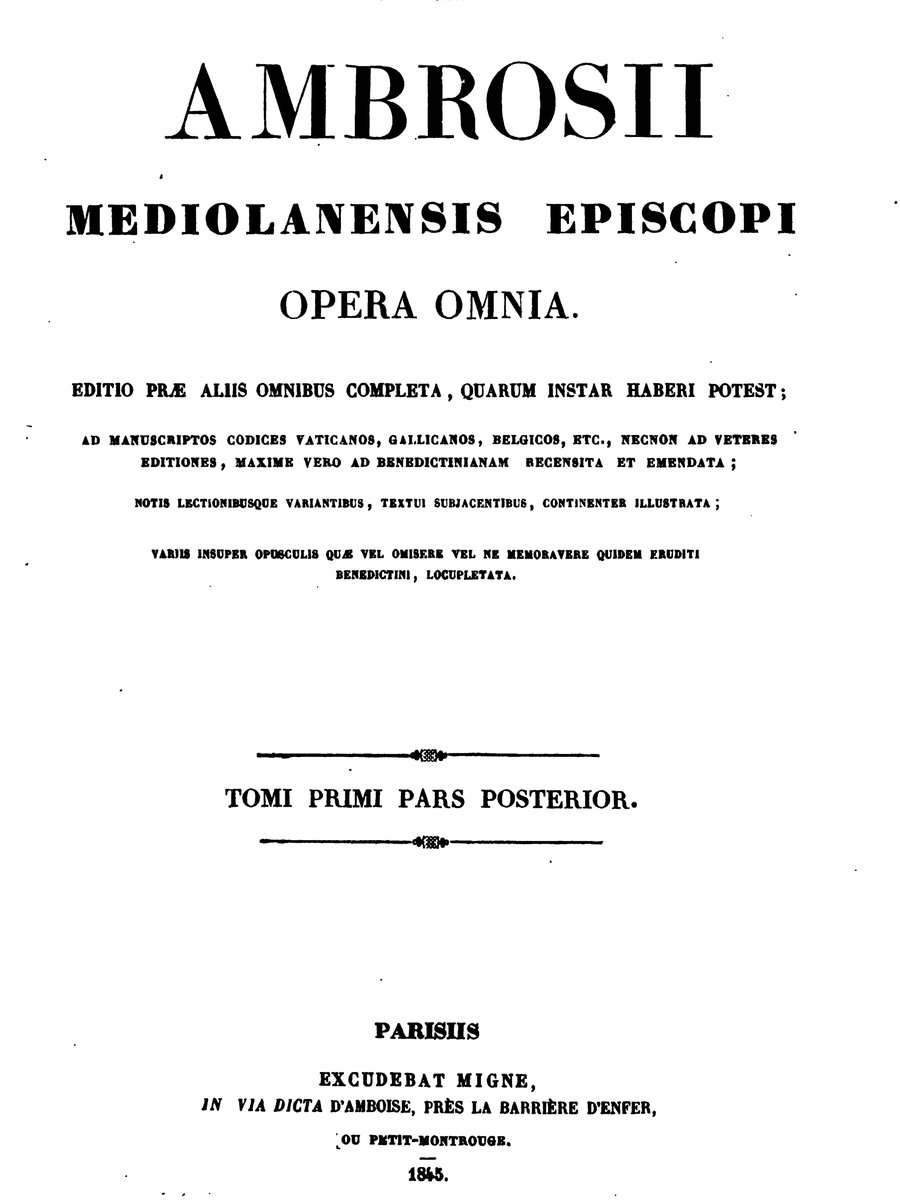
Commentary on the Gospel according to Luke, Book IV, §§52–54
Expositio Evangelii secundum Lucam, Liber IV, §§52–54
Three sections from Book IV of Ambrose's Expositio Evangelii secundum Lucam, drawing the lessons of Naaman's healing (2 Kings 5) into a teaching against simony. Commenting on Christ's command in Luke 4 — "Gratis accepistis, gratis date" — Ambrose insists that no price may be exacted in the dispensation of the sacraments and that the grace of healing is no man's to sell. The reading culminates with a denunciation of Gehazi, whose hereditary leprosy (4 Kings 5:27) Ambrose reads as the figure of all who, like Simon Magus, would profit from sacred ministry: such men are made foreign to the Kingdom of God, "neque ebriosus, neque idolis serviens regnum Dei possidebit" (1 Cor. 6:10).
 Ambrose of Milan·389·Latin·Liber IV, §§52–54·col. 1627–1628
Commentary on the Gospel according to Luke, Book IX, §19
Expositio Evangelii secundum Lucam, Liber IX, §19
A single section from Book IX of Ambrose's Expositio Evangelii secundum Lucam, on Christ's overturning of the seats of those who sold doves in the Temple (Luke 19:45–46; Matt. 21:12). Reading the gesture spiritually rather than literally — for "what dignity is there among doves?" — Ambrose connects the dove with the Holy Spirit descending at Christ's baptism, and so identifies the dove-sellers as those who "would peddle the grace of the Holy Spirit" (qui sancti Spiritus gratiam nundinentur). He invokes Christ's command "Freely you have received, freely give" (Matt. 10:8) and Peter's rebuke of Simon Magus — "Thy money perish with thee, because thou hast thought that the gift of God may be purchased with money: thou hast no part nor lot in this faith" (Acts 8:20–21) — to bar simoniacs from the company of the Church.
Ambrose of Milan·389·Latin·Liber IX, §19·col. 1798–1798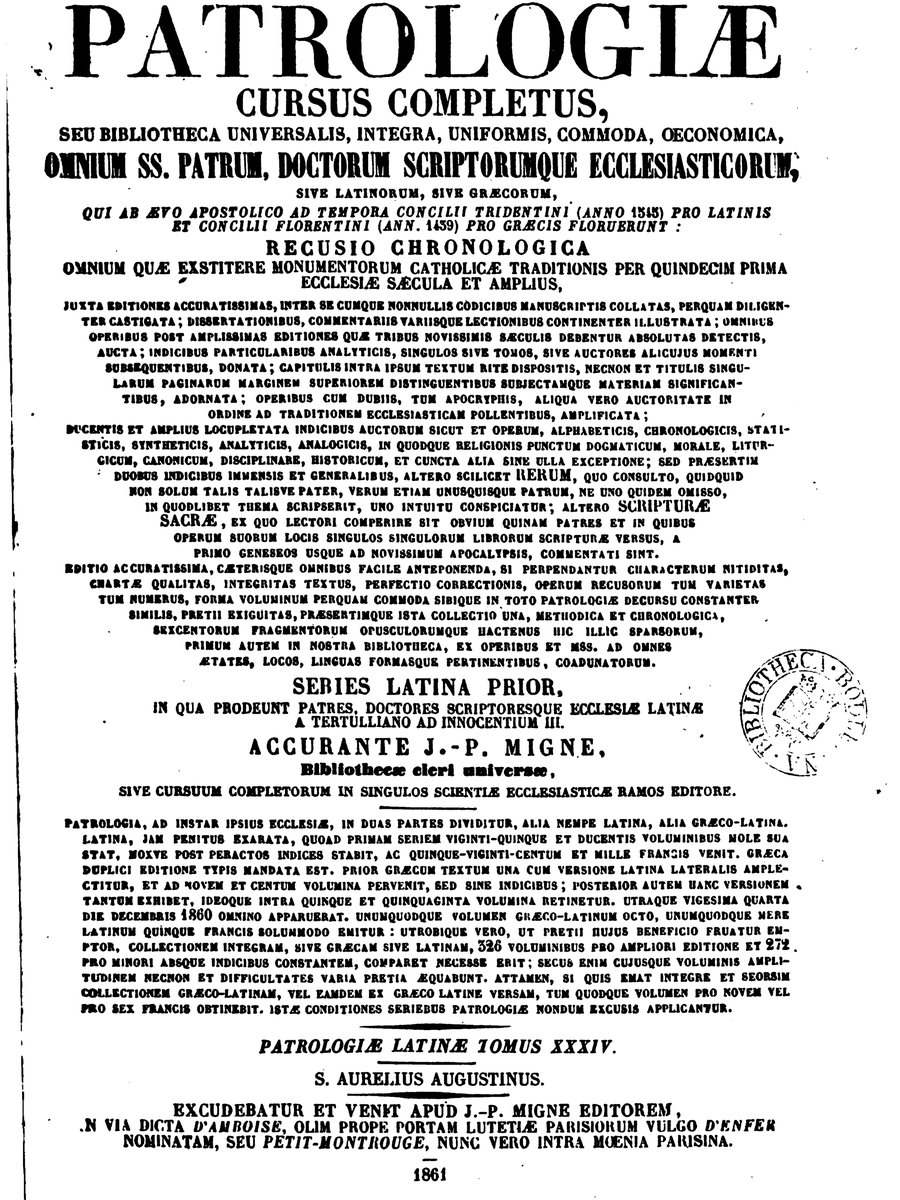
On the Sermon on the Mount, Book II, Chapter XVI
De Sermone Domini in Monte, Liber II, Caput XVI
Chapter XVI of Book II of Augustine's De Sermone Domini in Monte, comprising sections 53–55. Augustine comments on Matthew 6:25–34 ("nolite esse solliciti animae vestrae"), arguing that Christ's prohibition on anxiety about food and clothing rests on the argument from the greater to the lesser: since God has already given the soul — the greater good — he will surely provide for the body's lesser needs as well. The chapter turns on the distinction between seeking temporal necessities as an ultimate end and seeking them as means subordinated to the kingdom of God, closing with the exhortation to seek first the kingdom and its justice, trusting that all else will be added.
 Augustine of Hippo·394·Latin·Liber II, Caput XVI, §§53–55·col. 1292–1293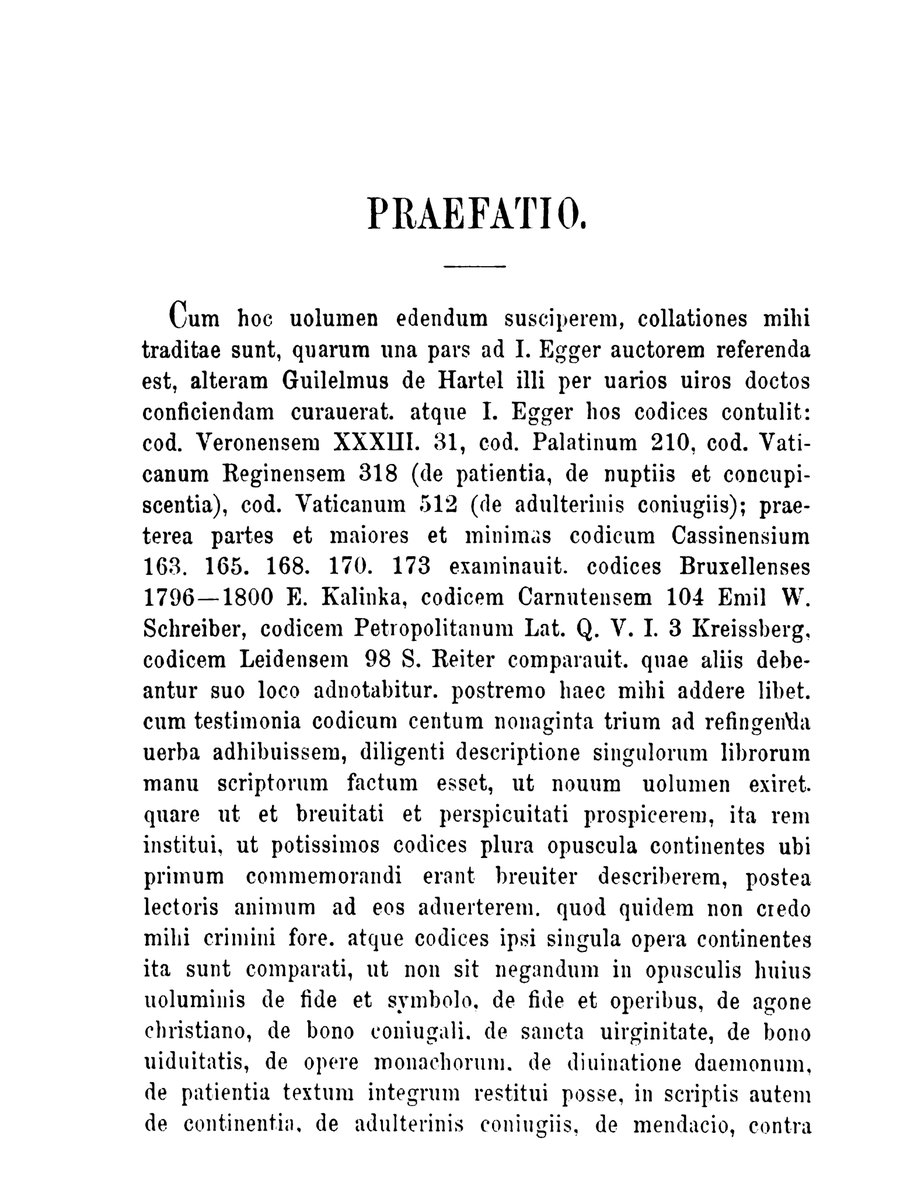
On the Work of Monks
De opere monachorum
Augustine's De opere monachorum (c. 401) was written at the request of Aurelius, bishop of Carthage, in response to a controversy among North African monks who refused manual labor, citing Matthew 6:25–34 ("consider the lilies of the field") as grounds for living solely on alms. Augustine argues systematically from Paul's letters — especially 1 and 2 Thessalonians and 1 Corinthians — that the apostolic example obliges monks to work with their hands, and that the gospel precepts concern trust in providence, not exemption from labor.
Augustine of Hippo·401·Latin·De opere monachorum·p. 531–594
Sermon 117, Chapter 1
Sermo CXVII, Caput I
The opening chapter of Augustine's Sermo CXVII, a sermon on John 1:1–5 ("In principio erat Verbum, et Verbum erat apud Deum, et Deus erat Verbum") preached against the Arians. §1 ("Verbum Dei ut intelligatur, quo pretio comparandum") opens with an argument about the incalculable worth of the divine Word: every saleable thing is either equal to, subject to, or exceeds its price, but to the Word of God nothing can be made equal, nothing can be subjected to it, and nothing can be set above it — an argument of immediate relevance to the theology of simony, which treats spiritual goods as though they could be priced. §2 ("Pretium Verbi ipse homo") turns this into a soteriology: the price the Word demands is the self, offered not as a loss but as a gain, since Christ's humanity was made through the Word and is restored to it. §3 ("Verbum Dei forma quædam non formata") concludes with a meditation on the Word as the uncreated form of all forms — immutable, without time or place, the ground and summit of all created things.
Augustine of Hippo·411·Latin·Sermo CXVII, §§1–3·col. 661–662
Gregory to Virgilius, Bishop of Arles
Gregorius Vergilio episcopo Arelatensi
In this letter of August 12, 595, Gregory grants Virgilius, bishop of Arles, the apostolic vicariate over the Gallic churches under the Frankish king Childebert II, following ancient custom and at the king's request. Gregory transmits the pallium and instructs that bishops may not travel far without Virgilius's authority; disputes among bishops are to be settled in a synod of twelve, with unresolved cases referred to Rome. The letter then turns to the twin abuses Gregory has heard are common in Gaul and Germany: simony (condemning the sale of ordinations as the heresy of Simon Magus) and the sudden tonsuring of laymen for vacant sees, without due passage through clerical orders.
 Gregory I·595·Latin·Liber V, Epistula LVIII·p. 368–371
Gregory to Victor, Primate of Numidia
Gregorius Victori episcopo Numidiae primati
In this letter of March 602, Gregory writes to Victor, primate of Numidia, about grave complaints lodged by the clergy of Paulinus, bishop of Tegesis, concerning both his personal conduct and the charge that he has been conferring ecclesiastical orders for payment. Gregory instructs Victor to conduct a careful investigation together with his fellow bishop Columbo and other priests, correcting Paulinus according to canon law should the complaints be verified and ensuring that his own primatial authority is not slighted. Gregory is particularly urgent about the simony charge, warning that if confirmed it must be punished and the illicit ordinations voided of all benefit to those who sought them; the letter concludes by directing Victor to summon Gregory's chartulary Hilary if needed to help resolve the matter.
Gregory I·602·Latin·Liber XII, Epistula IX·p. 356–357
Letter to Archbishop Heribert on Simony
Epistola ad Heribertum Archiepiscopum
Wido of Pomposa's letter to Archbishop Heribert of Milan is one of the earliest systematic polemical treatments of simony from the reform period. Written in the early eleventh century, the letter argues that simony is not merely an irregular transaction but a fundamental violation of the nature of holy orders: spiritual gifts cannot be bought or sold, and those who receive ordination through payment receive nothing valid, since the grace of ordination is not transmissible by money. Drawing on Gregory the Great and the Acts of the Apostles account of Simon Magus, Wido situates simony as a heresy that corrupts the entire sacramental order of the church and demands active resistance from the faithful. The letter was preserved and edited by Friedrich Thaner for the MGH Libelli de Lite, vol. I (1891).
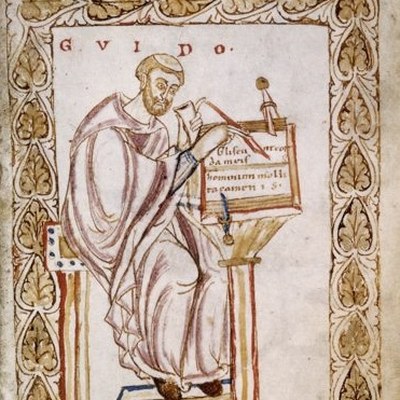 Guido of Arezzo·1015·Latin·Widonis Monachi Epistola ad Heribertum Archiepiscopum·p. 5–7
The Most Welcome Book
Liber Gratissimus
Peter Damian's Liber Gratissimus (1052) is a sustained canonical and theological argument on one of the most contested questions of the Gregorian Reform: whether clerics ordained by simoniacal bishops received valid orders. Written in response to the reforming synods of Clement II and addressed to the archbishop of Ravenna, the work argues that ordinations performed by simoniacs — though gravely sinful — are nonetheless valid and need not be repeated, since sacramental efficacy derives from God and not from the moral state of the minister. This position set Damian in direct conflict with Cardinal Humbert of Silva Candida, who argued for the invalidity and heretical character of simoniacal ordination. Damian's more moderate position eventually prevailed in practice, and was confirmed by the synodal decisions of Pope Nicholas II. Edited by L. de Heinemann for the MGH Libelli de Lite, vol. I (1891).
 Peter Damian·1052·Latin·Petri Damiani Liber Gratissimus·p. 15–75
Three Books Against the Simoniacs
Libri III Adversus Simoniacos
Cardinal Humbert of Silva Candida's Libri tres adversus simoniacos (ca. 1058) is the most radical and systematic of the eleventh-century treatises against simony. In three books, Humbert argues that simony is not merely a canonical irregularity but a formal heresy: simoniacal ordinations are utterly invalid, and those ordained by simoniacs must be reordained rather than simply reconciled. The first book surveys the canonical and patristic evidence against simony; the second argues that simoniacal bishops are not true bishops at all but heretics masquerading in ecclesiastical office; the third extends this logic to lay investiture, arguing that the entire system of royal appointment to episcopal and abbatial offices is itself simoniacal. This last argument made the Libri tres a foundational text of the Gregorian Reform's most aggressive wing and contributed to the theoretical framework of the Investiture Controversy. Edited by Friedrich Thaner for the MGH Libelli de Lite, vol. I (1891).
 Humbert of Silva Candida·1058·Latin·Humberti Cardinalis Libri III Adversus Simoniacos·p. 95–253
Gregory VII to the People of Lodi
Gregorius VII Laudensis ecclesie filiis
In this letter of 3 March 1075, Gregory VII writes to the people of Lodi to applaud their zeal against simony and clerical incontinence and to urge them to support their bishop Opizo in extirpating these "pests" from their church. Issued within days of the 1075 Lent Synod (Reg. II.52a), the letter expressly invokes the synodal program: no one is to serve at the altar over the relics of St. Bassianus in the cathedral if he has entered the church by purchase, is a fornicator, or is a pursuer of base gain. Apostolic blessing is promised to those who cooperate with Opizo, apostolic curse to those who oppose him.
 Gregory VII·1075·Latin·Liber II, Epistula LV·p. 200–201
Protocol of the Roman Lent Synod of 1076
Protocollum synodi Romanae anni MLXXVI
The protocol of the Roman Lent Synod of 14–20 February 1076, preserved in Gregory VII's Register as III.10a. The synod is the climactic event of the early Investiture Controversy: it suspended Archbishop Siegfried of Mainz and the German bishops who had renounced obedience to Rome, excommunicated the Lombard bishops, deposed and excommunicated a series of transalpine bishops (including Hermann of Vienne "pro simonia, periuriis, sacrilegio, et apostasia…"), and finally suspended and excommunicated King Henry IV himself in a formal address to St. Peter ("Beate Petre, apostolorum princeps…"). The record contains the first use of the noun simonia in Gregory's Register and provides the canonical text of Henry IV's excommunication — the act that precipitated the king's penance at Canossa in January 1077. The synod is dated anno MLXXV in the manuscript, following the Pisan/Florentine calendar style in which the year began on 25 March; modern reckoning places it in 1076 (indiction XIV).
Gregory VII·1076·Latin·Liber III, Epistula Xa·p. 268–271
Libellus on the Fact That the Prince of This World Has Now Been Judged
Libellus de eo, quod princeps mundi huius iam iudicatus sit
Gerhoch of Reichersberg's Libellus de eo, quod princeps mundi huius iam iudicatus sit, also known as the Liber de Simoniacis, is a polemical treatise addressed to Bernard of Clairvaux in which Gerhoch argues that the simoniacal clergy of his day embody the "prince of this world" whose judgment Christ announced in the Gospel of John. Drawing on scripture, canon law, and patristic authority, he contends that bishops and priests who obtained their offices through simony are spiritually dead and that the sacraments they perform are invalid or gravely suspect. The work opens with a dedicatory prologue to Bernard and proceeds through a sustained argument that the reform of the church requires the rooting out of simony at every level of the ecclesiastical hierarchy.
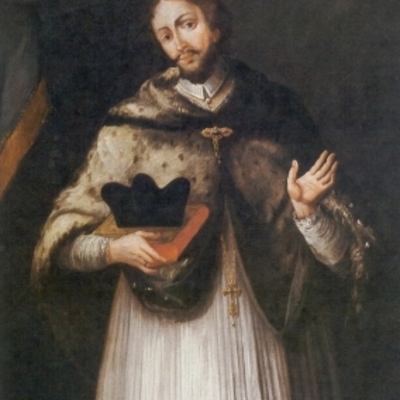 Gerhoch of Reichersberg·1136·Latin·Liber de Simoniacis·p. 239–272
Causa 1: On Simony and Simoniacal Ordination
Causa I
Causa 1 of the Decretum is Gratian's comprehensive treatment of simony, structured around a hypothetical case of a man ordained through payment. Seven questions explore whether simoniacally ordained clergy can function validly (Q. I), whether they must be deposed (Q. II), whether they must surrender their benefices (Q. III), whether the sin is mortal (Q. IV), whether ordaining bishops are excommunicated (Q. V), whether simony can be committed through prayer or service rather than money (Q. VI), and whether lay investiture constitutes simony (Q. VII). The causa draws on patristic authority, papal decretals, and Roman law, and represents the most systematic canonical treatment of simony produced in the medieval West.
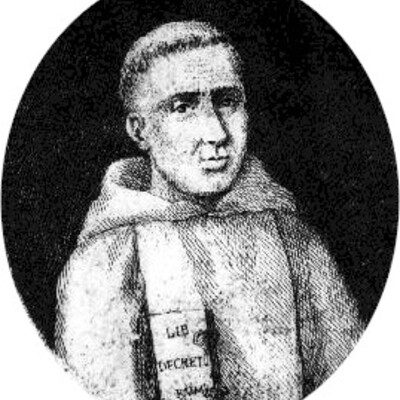 Gratian·1140·Latin·Causa I·p. 179a–219a
Distinction 25: On Those Ordained by Heretics and Simoniacs
Distinctio Vigesima Quinta: De Ordinatis ab Haereticis et Simoniacis
Lombard's Distinctio XXV of Book IV of the Sentences addresses ordinations performed by heretics and simoniacs. Chapter I asks whether orders conferred by heretics are valid. Chapter II provides the foundational definition of simony — buying or selling sacred things, named after Simon Magus — and Chapters III–V distinguish who counts as a simoniac, whether buying material rather than spiritual goods is excused, and the tripartite classification of simoniacs derived from Nicholas I. Chapter VI addresses those forcibly ordained by simoniacs; Chapter VII closes with the canonical age requirement for ordination.
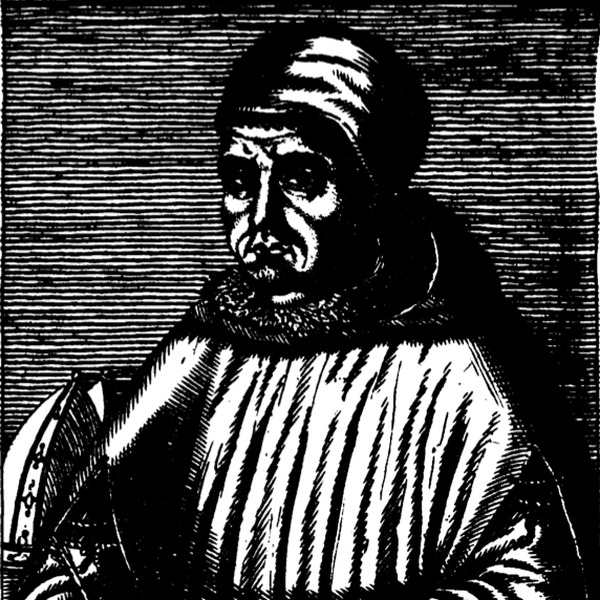 Peter Lombard·1150·Latin·Liber IV, Distinctio XXV·p. 904–911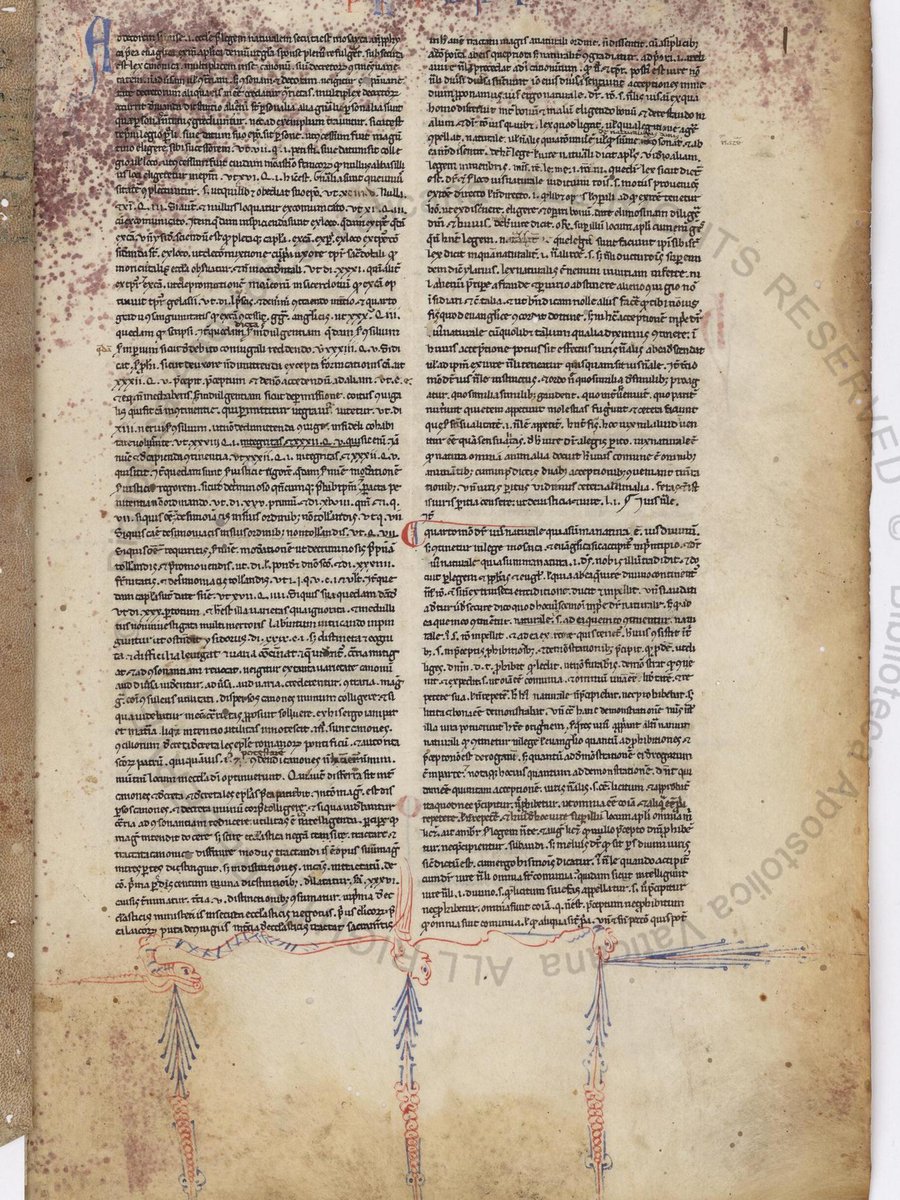
Summa, on Causa 1: On simony
Summa, ad C. 1: de symonia
Huguccio of Pisa's commentary on Causa I of Gratian's Decretum — the great twelfth-century quaestio de symonia. Causa I treats a man who buys a church for his son and the chain of consequences for the simoniacal ordainer, the paying purchaser, the ordained son, and the parishioners who receive the sacraments from him. Across seven quaestiones Gratian asks whether such a transaction is simony at all, what counts as the munus a manu, lingua, obsequio, whether bishops who confer free orders may afterwards charge fees for chrism or consecration, whether ordinations conferred by simoniacs are valid, whether the simoniacally ordained should be deposed even if ignorant, and how parishioners should regard sacraments from a simoniacal priest. Huguccio works through each quaestio with characteristic rigor, drawing on the prior decretist tradition (Rufinus, Stephen of Tournai, Johannes Faventinus, Simon of Bisignano) and shaping the doctrine that the Glossa ordinaria would later inherit.
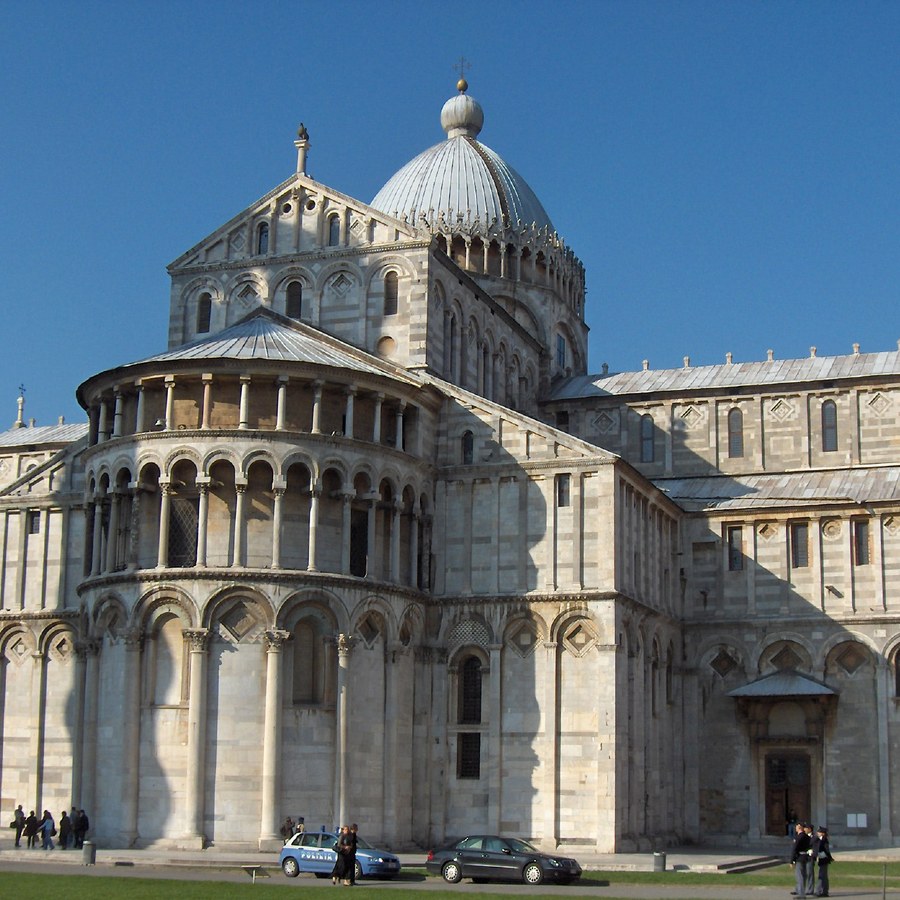 Huguccio of Pisa·1190·Latin·ad Decretum, Causa I (de symonia)·fol. 117ra–119rb
Summa, on D. 37, c. 12 (De quibusdam locis): On the license to teach
Summa, ad D. 37, c. 12 (De quibusdam locis): de licentia docendi
A short gloss-cluster from Huguccio's Summa on D. 37, c. 12 (De quibusdam locis), turning a casus about teachers and students into one of the earliest decretist treatments of selling the licentia docendi as simony. Huguccio asks first whether a master who refuses a cleric leave to attend school unless paid commits simony, then — similiter — whether the chancellor who sells the license to teach commits simony, recalling the practice "quod parisius olim fiebat" and the reforming decretals Quanto Gallicana (X 5.5.3) and Quoniam ecclesia Dei (X 5.5.1). He concludes that the act is at the very least turpe lucrum and peccatum mortale, and forte outright simony where the license concerns sacred learning such as theologia.
Huguccio of Pisa·1190·Latin·ad Decretum, D. 37, c. 12 (De quibusdam locis)·fol. 48rb–48rb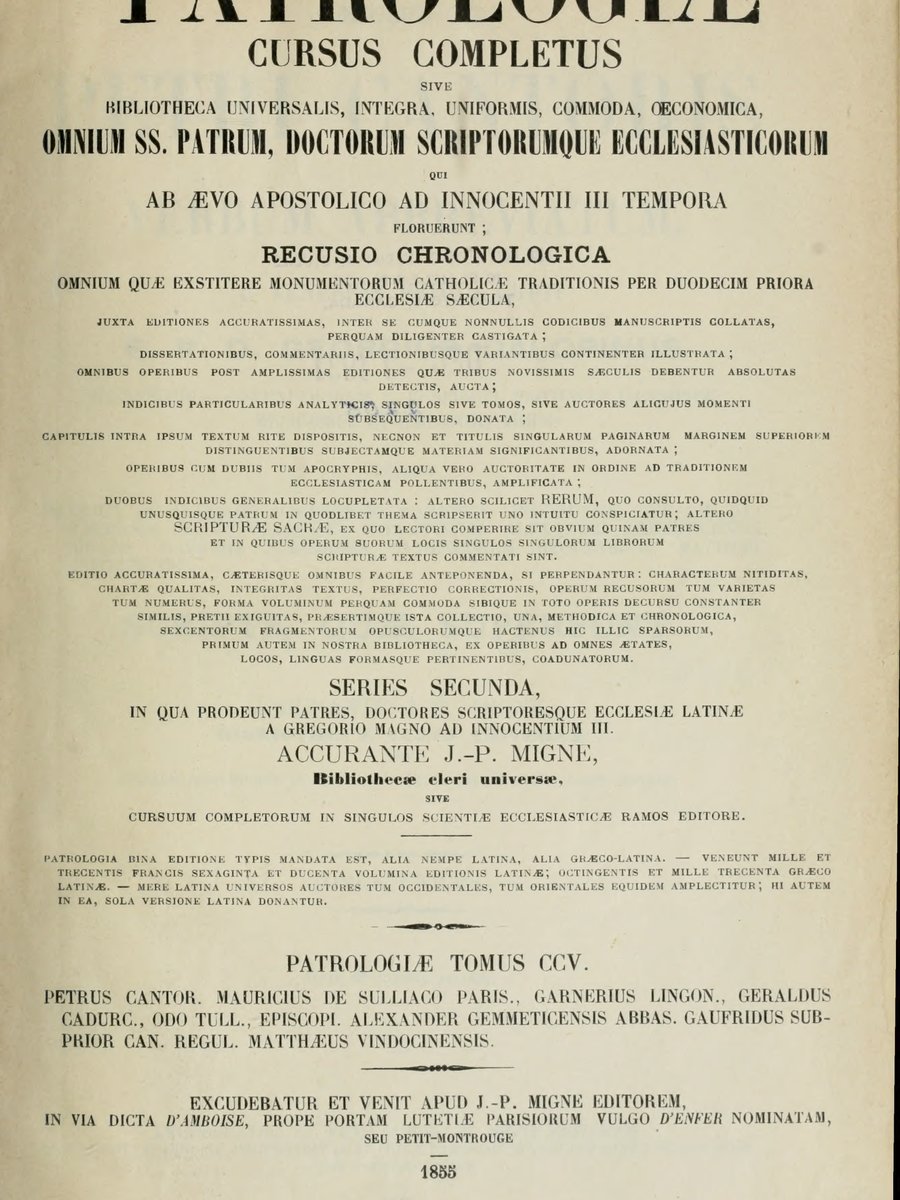
The Abridged Word, Chapters XXV–XL
Verbum Abbreviatum, Capita XXV–XL
Chapters 25–40 of Peter Cantor's Verbum Abbreviatum, the section of the work devoted to simony. Chapter 25 opens against those who exercise ecclesiastical offices or spiritual functions for temporal reward. Subsequent chapters work through the distinctions, circumstances, and borderline cases of simoniacal exchange: receiving benefices in hope of temporal gain, the role of episcopal intent in benefice resignations, gratis ordination, and the limits of what counts as simoniacal. Together these chapters constitute the most concentrated treatment of simony in the Verbum Abbreviatum, drawing on Scripture, canon law, and Patristic authority.
 Peter Cantor·1191·Latin·Capita XXV–XL·col. 95–134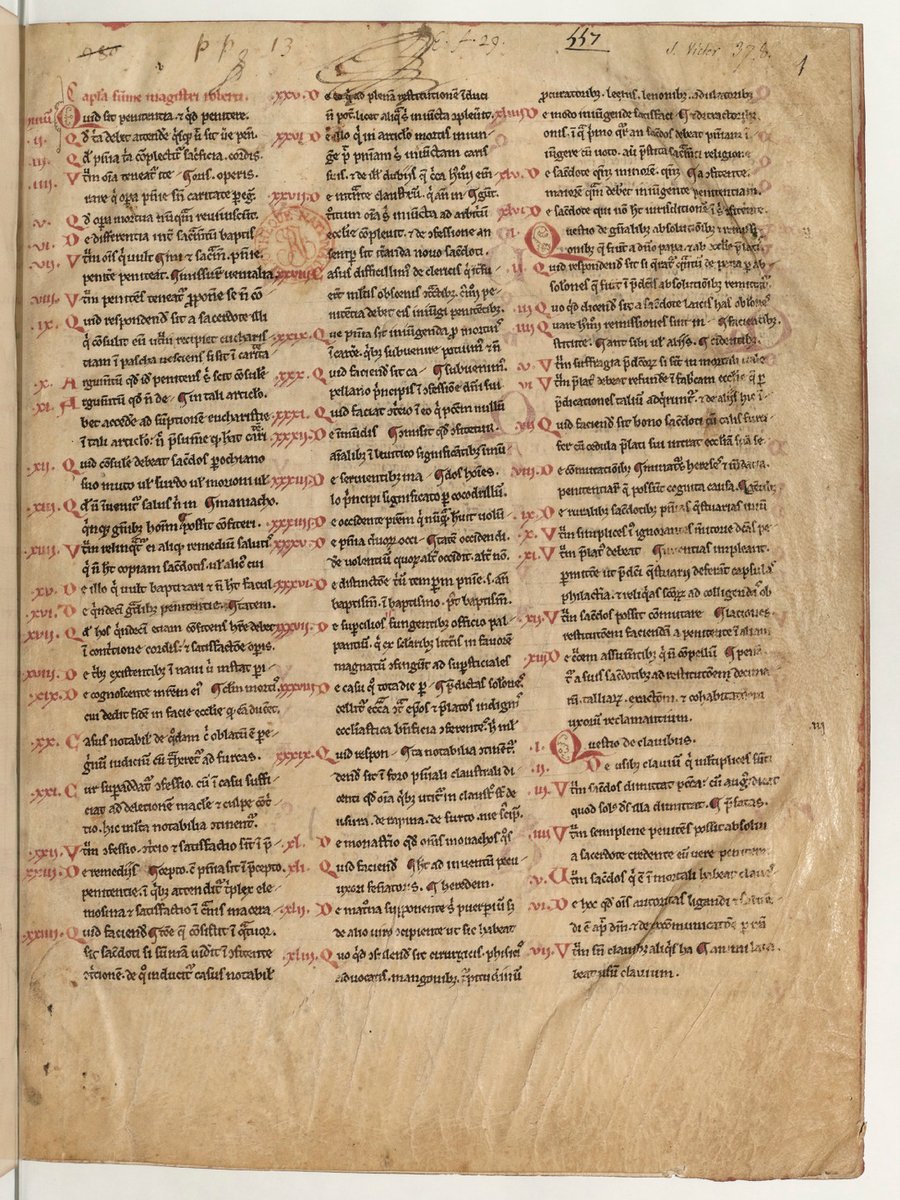
Questions on Simony
Questiones de simonia
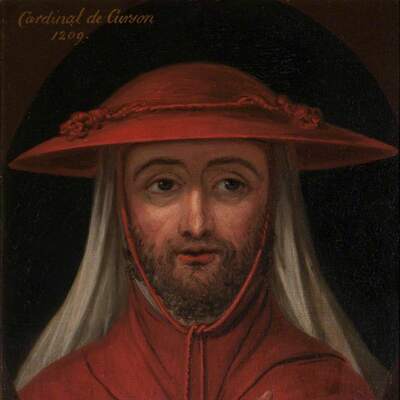
Robert of Courson's simony treatise from his Summa (c. 1208–1214). Structured as a series of questiones, the treatise begins from the question of whether general absolutions and remissions granted by pope and bishops truly benefit the recipients, then proceeds through a sweeping treatment of simoniacal heresy: its definition and varieties; the validity of sacraments conferred by simoniac priests; remedies for those who have unwittingly received orders or sacraments from them; the proper election and installation of clergy; simony in patronage rights, oblations, and tithes; and canonical procedures for purging and penalizing simoniacs, including appeals to Rome. The treatise draws throughout on Gratian's Decretum, the papal Decretals, Scripture, and the Parisian theological tradition. BnF Latin 14524, ff. 18v–118r.
 Robert of Courson·1214·Latin·Questiones de simonia·fol. 18va–118ra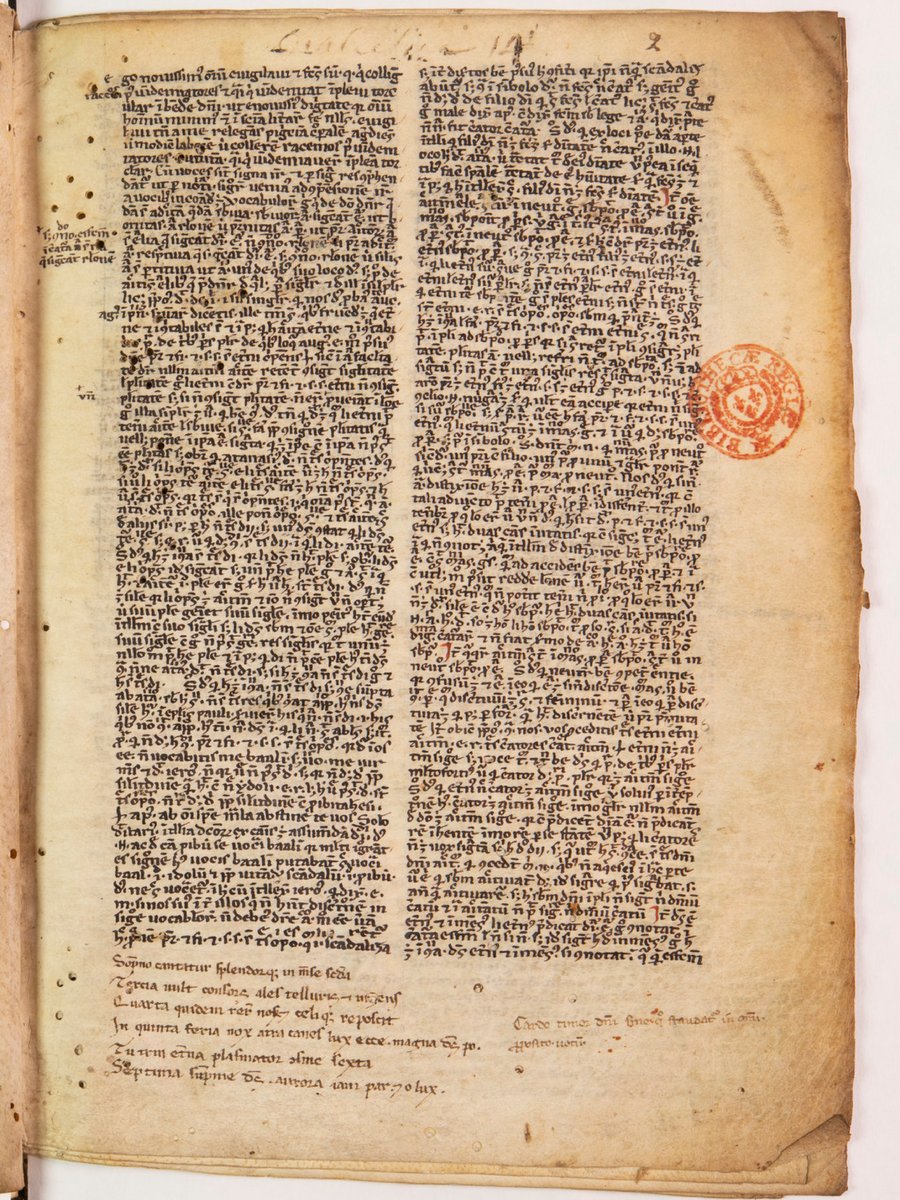
On the Work of God
De opere dei
A three-column chain of quaestiones from Geoffrey of Poitiers' Summa working out, under the umbrella of Jeremiah 48:10 (maledictus qui facit opus dei negligenter), what it means to do God's work the wrong way. Geoffrey moves through three species — opus dei done negligently (folio 39ra), done fraudulently (39rb), and done for money (39va) — culminating in the celebrated quaestio on whether the master who teaches theology for fees falls under the curse of Micah 3:11, sacerdotes eorum in mercede docebant. There he draws the classic Parisian distinction that publicly licensed teachers (publice persone) are bound to teach freely as doctores verbi dei, lest they become venditores verbi dei.
 Geoffrey of Poitiers·1215·Latin·De opere dei·fol. 39ra–39va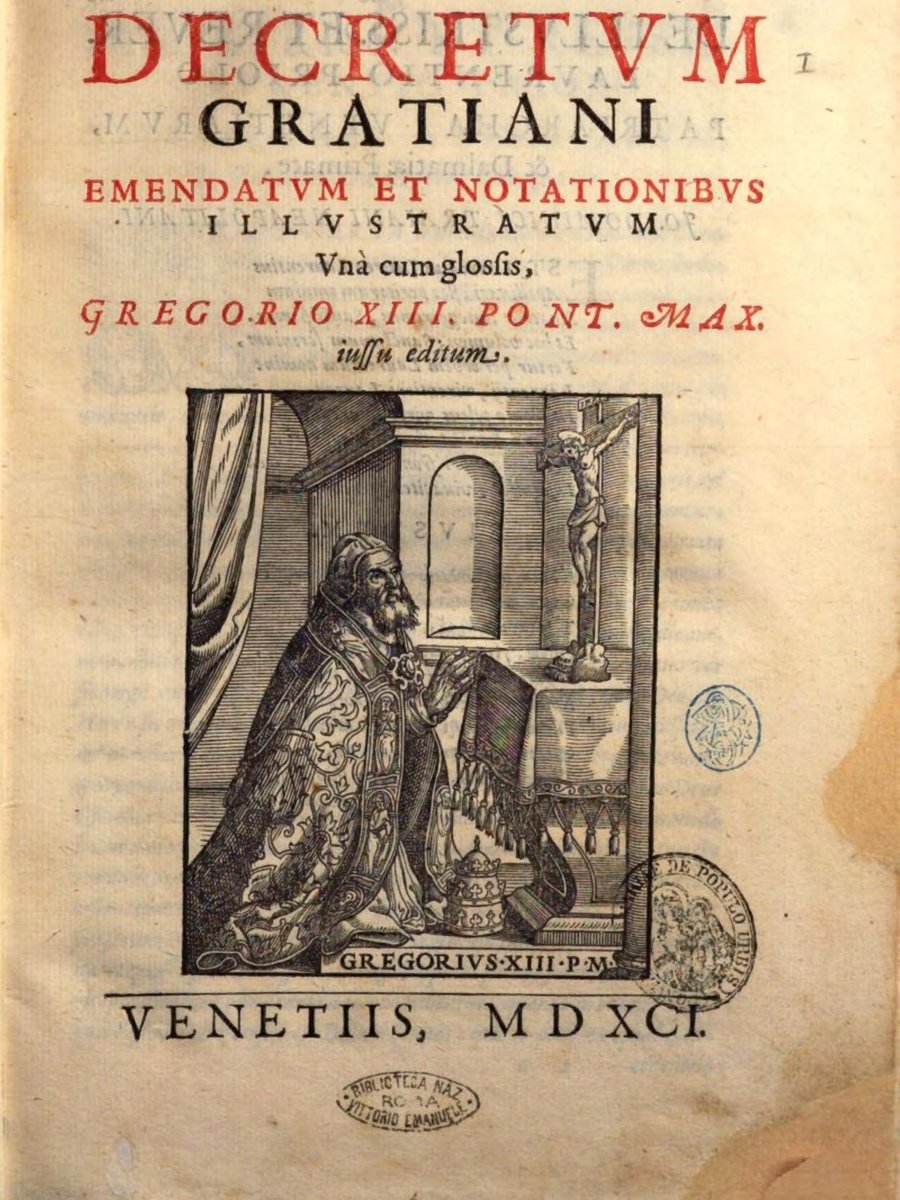
Glossa ordinaria on Causa 1, Question 1 (Simoniacal Ordination)
Glossa ordinaria ad C. 1 q. 1
The glossa ordinaria on Causa 1, Question 1 of Gratian's Decretum — the standard medieval commentary on the question whether sacraments and orders conferred by a simoniac are valid, and more broadly whether the simoniacally ordained have any real ecclesiastical standing. The gloss was compiled by Johannes Teutonicus around 1216 and revised by Bartholomaeus Brixiensis around 1245; the text here follows the post-1582 editio Romana corrected under Gregory XIII. Question 1 is the longest of the seven questions in Causa 1 and the heart of the Decretum's treatment of simony, working through whether Simon Magus and Gehazi were truly simoniacs, whether the sin lies in intent or transaction, what counts as a munus (gift) that vitiates an ordination, and whether sacraments conferred by simoniacs convey grace. Each gloss is keyed to a lemma in the central text by a printed superscript letter.
Johannes Teutonicus·1216·Latin·Causa I, Quaestio I·p. 467–529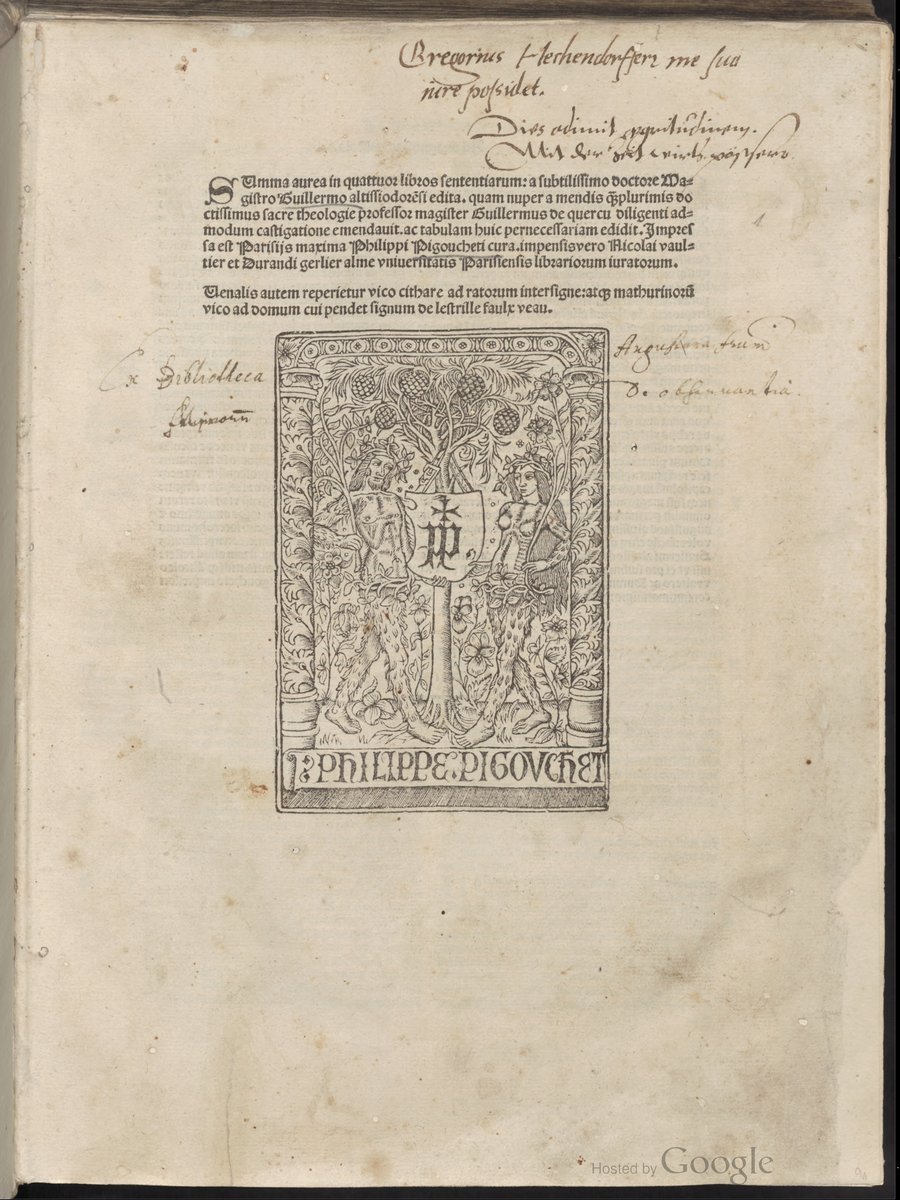
On Simony
De symonia
William of Auxerre's treatise on simony, occupying the second half of Book III, Tractatus XXI of the Summa aurea (c. 1220s). Following the discussion of usury that opens the tractate, Auxerre turns to simony with the question quid sit symonia, defining it as "the deliberate will to buy or sell something spiritual or annexed to a spiritual thing." The treatise then proceeds through a series of questions: whether a secular judge selling justice commits simony; whether preaching for temporal gain is simoniacal; the sale of sacraments and the canonical gift-types (munus a manu, a lingua, ab obsequio); the conferral of prebends for money; the sale of schools; whether the decretists err on simony; the sale of testimony; and whether the right of patronage may be sold. Throughout, Auxerre weighs Scripture, the Decretum, and the Parisian theological tradition, marking an important early-scholastic moment in the transition from canonistic to systematic-theological treatment of simony.
 William of Auxerre·1225·Latin·Liber III, Tractatus XXI·fol. 226va–230va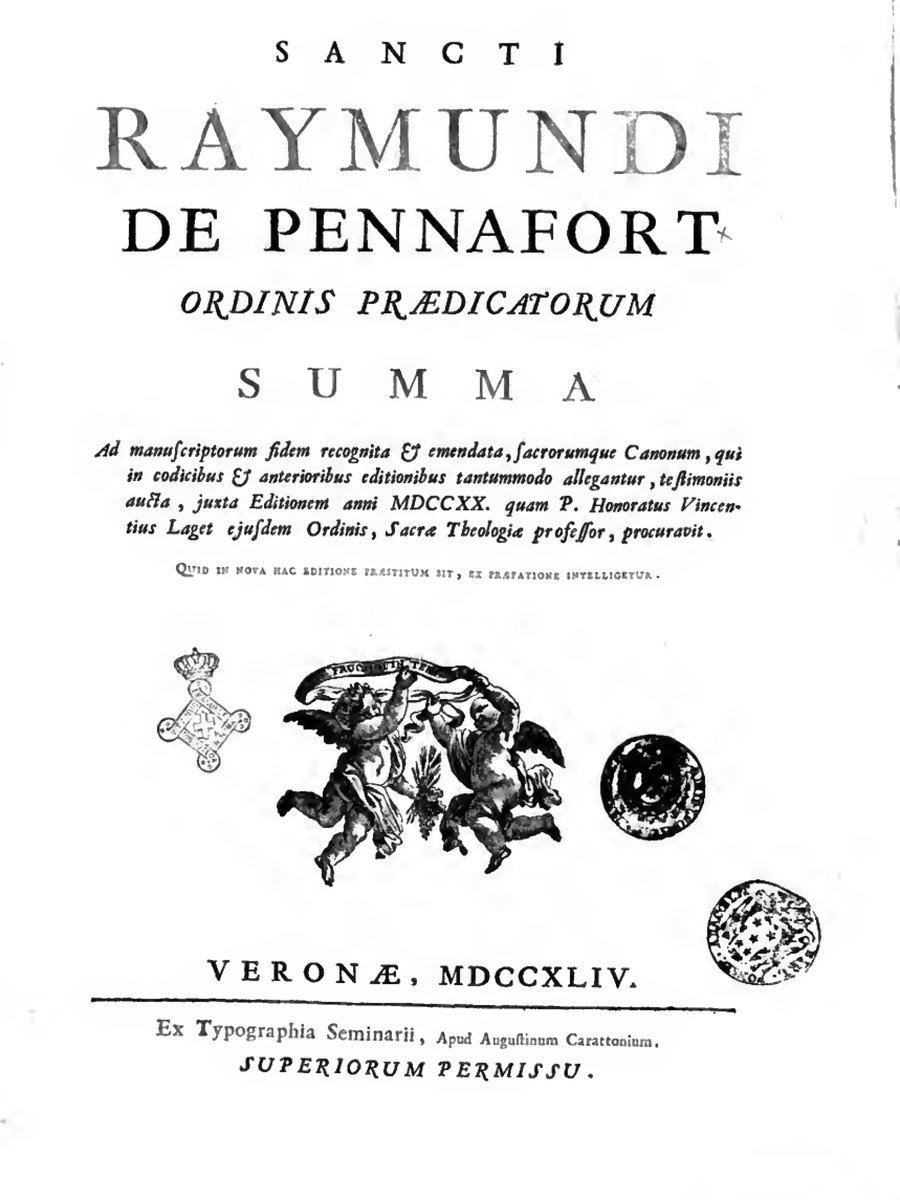
On Masters, and that they should not exact anything for a license to teach
De Magistris, & ne aliquid exigant pro licentia docendi
Raymond's treatment of teaching licenses in Book 1, Title 3 of the Summa. Drawing on papal decretals of Alexander III (Prohibeas, Quanta), it prohibits masters and chancellors from demanding any payment for the licentia docendi, treating such licenses as annexed to spiritual goods and therefore subject to the law against simony. Discusses what compensation teachers may lawfully receive (voluntary offerings, expense recovery), addresses the chanceries of Paris and Bologna, and considers the bishop who withholds a cleric's license to study unless paid.
 Raymond of Penyafort·1234·Latin·Liber I, Titulus III·p. 21–24
On Simony
De Simonia
Raymond's treatment of simony in Book 1, Title 1 of the Summa. Defines simony as the deliberate will to buy or sell a spiritual thing (§. I), covers the various modes of committing it — by gift, service, or flattery — and distinguishes licit from illicit transactions involving ecclesiastical offices, ordinations, benefices, and patronage rights. Addresses penalties for simoniacs and conditions for dispensation, with extensive citation of the Decretum and Decretals.
Raymond of Penyafort·1234·Latin·Liber I, Titulus I·p. 1–20
On Simony, and That Nothing Should Be Demanded or Promised for Spiritual Things
De Simonia, et Ne Aliquid Pro Spiritualibus Exigatur vel Promittatur
The forty-six canons of Decretales Gregorii IX, Book V, Title III, compiled by Raymond of Penyafort and promulgated by Pope Gregory IX in 1234. This title gathers papal decretals from Gregory I through Gregory IX on simony — the buying and selling of spiritual goods, ordinations, and ecclesiastical offices — and on the broader prohibition against demanding payment for the sacraments, burial, monastic profession, or other sacred acts. The canons address the definition of simony, the penalties for simoniacal ordination and election, and the obligations of bishops, abbots, and other clergy to confer spiritual benefits freely.
Raymond of Penyafort·1234·Latin·Decretales Gregorii IX, Lib. V, Tit. III·p. 375a–384a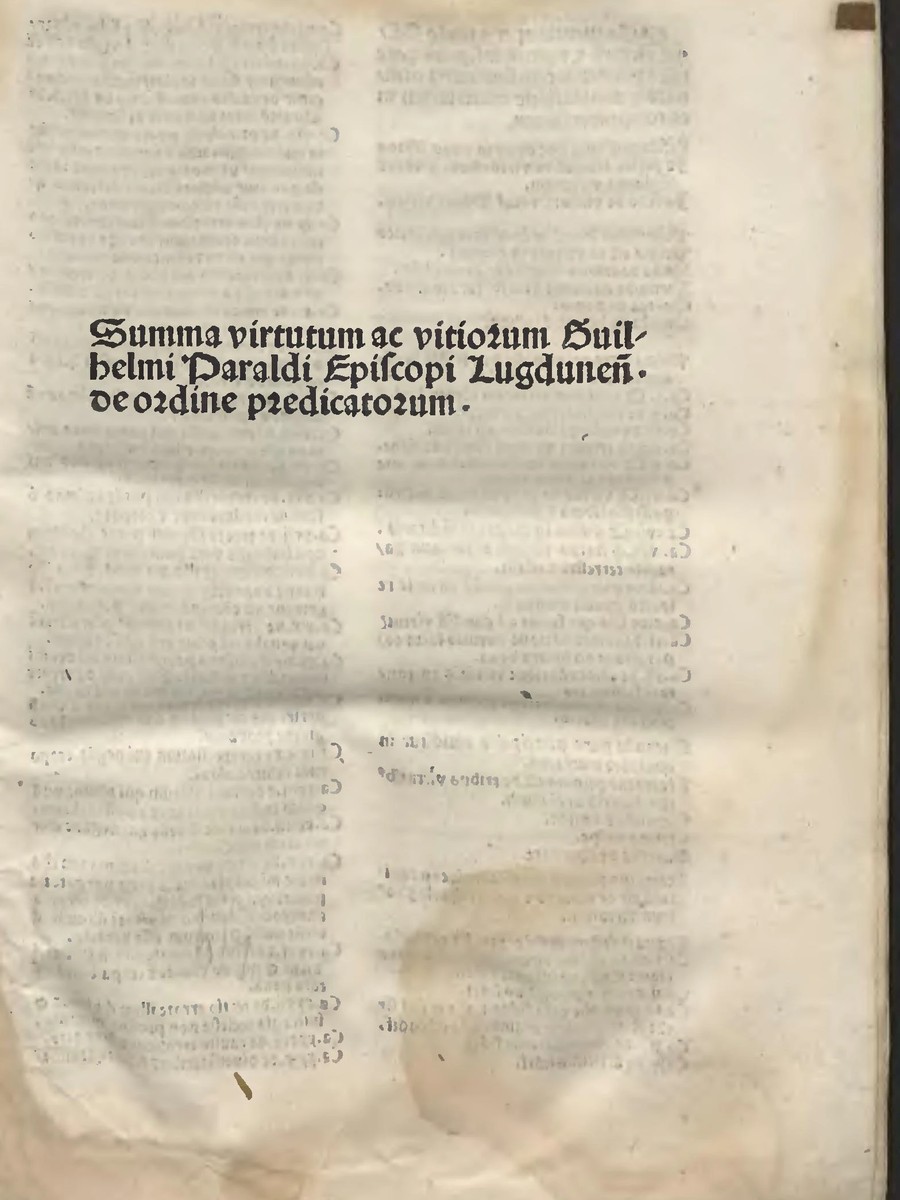
On Simony (On Vices, On Avarice)
De Symonia (De Vitiis, De Avaritia)
Peraldus's treatment of simony within his influential treatise on the vices. Covers the detestation of simony as a heresy, twelve insults simony does to God, the multiple harms it causes, simoniacs as worse than Judas, the difficulty of their salvation, and the divisions of simony (fourfold: by money, flattery, carnal relations, and service).
 William Peraldus·1236·Latin·De Vitiis, De Avaritia·fol. 218vb–220vb
Title II: On Simony
Titulus II: De Simonia
The Summa Halensis's treatise on simony (Titulus II: De Simonia), part of the broader treatment of vices opposed to the gifts of the Holy Spirit. The treatise is divided into seven capita: (1) the name of simony; (2) what it is; (3) the modes in which it is contracted; (4) its material differences; (5) the penalty of simony; (6) doubtful cases; and (7) satisfaction and restitution. Composed by Alexander's Franciscan students in the 1240s and contemporary with the early teaching of Bonaventure, this is the foundational early Franciscan synthesis on simony, parallel to and predating Aquinas's Summa Theologiae II-II, Q. 100.
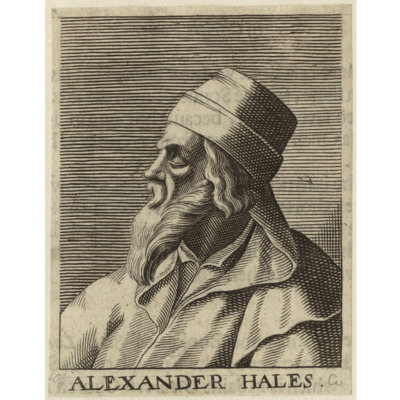 Alexander of Hales·1245·Latin·Inq. III, Tract. VIII, Sect. I, Quaest. III, Tit. II·p. 2.789a–2.810a
Distinction 25: On the Dispensation of the Sacrament of Orders
Distinctio Vigesima Quinta: De Dispensatione Sacramenti Ordinis
Albert the Great's commentary on Distinction 25 of Book IV of Peter Lombard's Sentences, which treats the dispensation of the sacrament of orders. Opening with the question whether heretics cut off from the Church can confer valid orders (and whether those they ordain must be reordained on return to Catholic unity), Albert surveys the conflicting patristic authorities and sides with the "moderns": so long as the minister is validly ordained and preserves the form and intention of the Church, the sacrament is effected, whether the minister is heretical or schismatic. He then turns to simony — defining it as the willing exchange of temporal price for spiritual gift in imitation of Simon Magus — and works through a series of articles on whether simoniacal ordinations are valid, whether an inferior can commit simony with a superior (and notably with the pope), the fourfold classification of "spiritual" things that can be made the object of simony, the three modes of simoniacal exchange (gift of hand, tongue, and service), the status of those knowingly and unknowingly ordained by simoniacs, and the canonical ages required for ordination.
 Albert the Great·1249·Latin·Liber IV, Distinctio XXV·p. 82a–96b
Distinction 25: On the Conferral of Holy Orders
Distinctio XXV: De dispensatione sacri ordinis
Bonaventure's commentary on Distinction 25 of the fourth book of Peter Lombard's Sentences, which treats the conferral of holy orders. Article 1 asks who can confer orders, working through whether bishops alone hold the power, whether a heretical bishop can validly ordain, whether a simoniac bishop can ordain, and whether the act of ordaining simoniacally itself makes one a heretic. Article 2 examines questions about the recipient of orders. The Dubia at the end of the distinction include the influential Dub. VI on the modes of simony, asking quibus modis contrahitur simonia and unpacking the mnemonic verse Nummus, lingua, timor, caro cum fama populari / Non faciunt gratis spirituale dari — the gift of hand, tongue, fear, flesh, and favor.
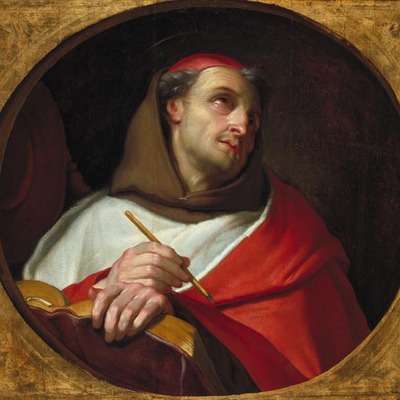 Bonaventure·1253·Latin·Liber IV, Distinctio XXV·p. 2.641a–2.659b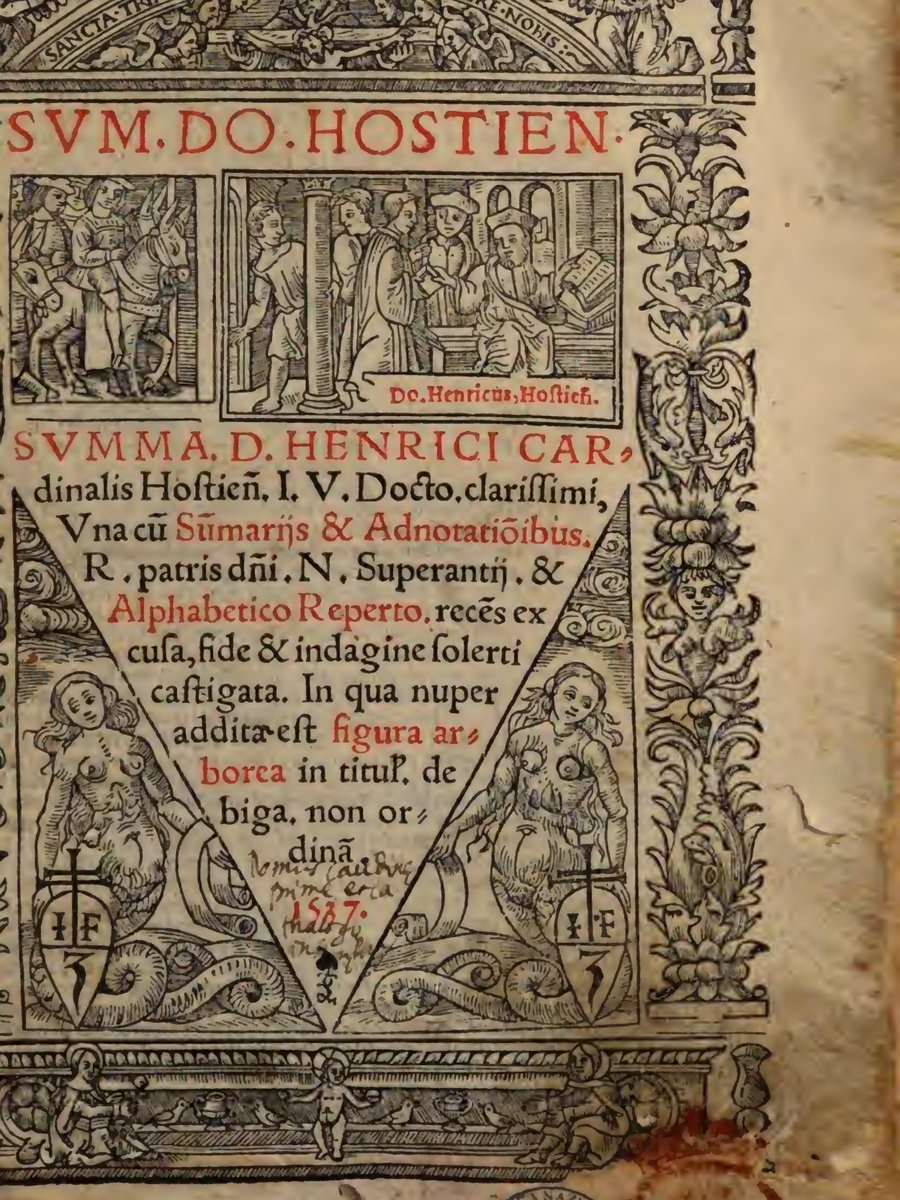
On Simony, and that Nothing Be Demanded or Promised for Spiritual Things
De simonia et ne aliquid pro spiritualibus exigatur vel promittatur
Henry of Susa's title De simonia from Book V of his Summa on the Decretals of Gregory IX, the central canon-law treatment of simony by its greatest thirteenth-century systematiser. Hostiensis frames the title under his standard schema of questions: what simony is (its definition as the deliberate will to buy or sell spiritual things, or things annexed to the spiritual), why it is forbidden, how it is committed (through the hand, the tongue, or service — a manu, a lingua, ab obsequio), the penalties incurred, the obligation of restitution, dispensation and rehabilitation of simoniacs, the species of simoniacal pact and price, and adjacent crimes including extortion under colour of office (concussio). Throughout, Hostiensis weaves together Roman and canon-law authorities — the Decretum and Decretales, the Codex and Digestum, the glossators and his own predecessors — into the most influential canonist account of simony of the later Middle Ages.
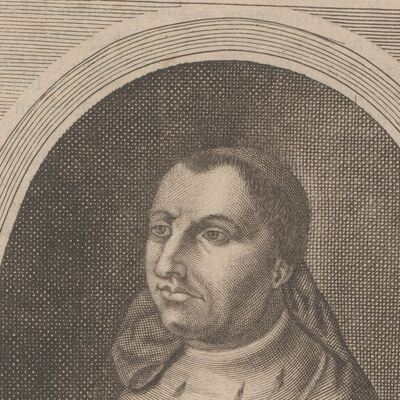 Henry of Susa·1253·Latin·Liber V, Titulus III·fol. 533rb–539vb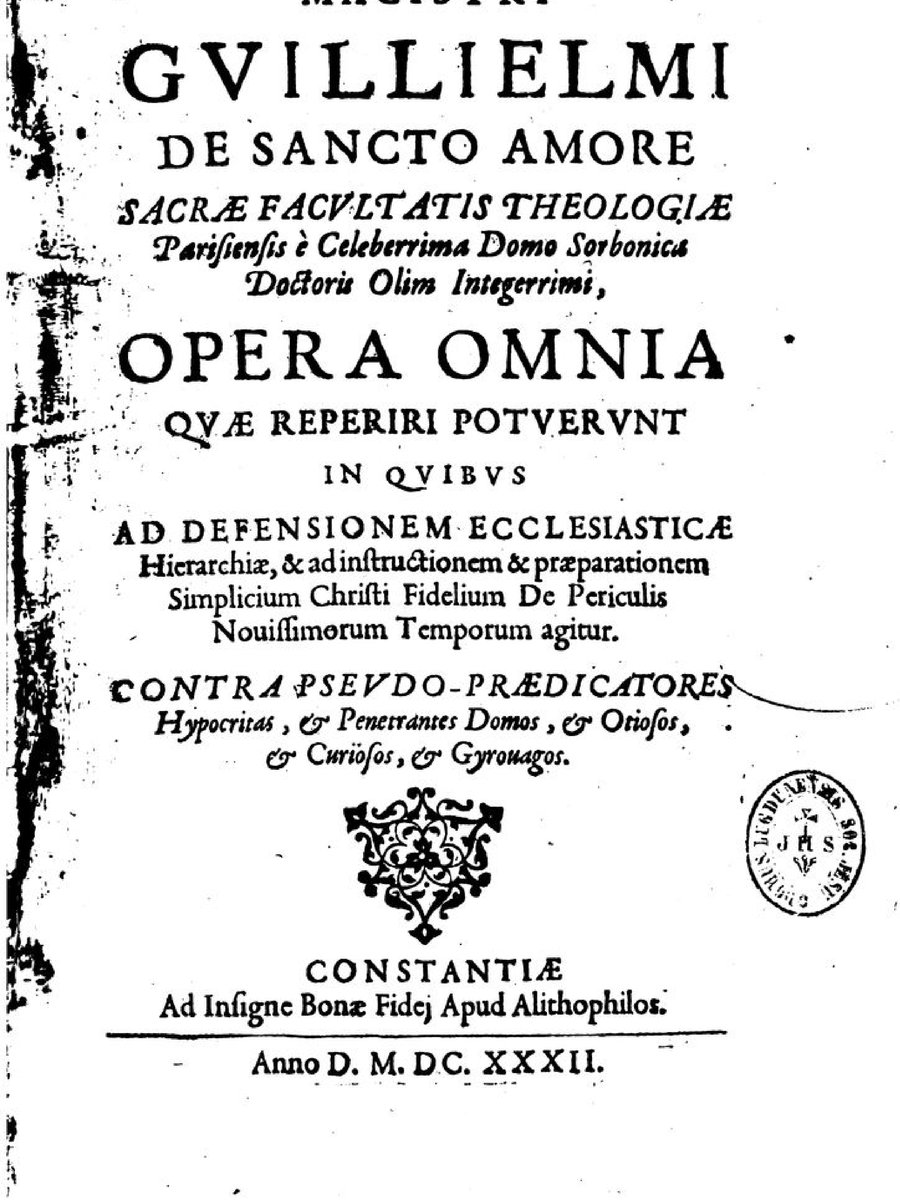
On the Dangers of the Last Times, Chapter 12
De Periculis Novissimorum Temporum, Caput XII
Chapter 12 of William of Saint-Amour's De Periculis Novissimorum Temporum (1256), addressing how the foregoing dangers of the last times are to be repelled. William enumerates six things necessary for repelling them, then mounts an extended argument against perpetual mendicancy by preachers — refuting the claim that Christ and the apostles begged, and concluding that withdrawing the means of mendicancy from pseudo-preachers also withdraws their usurped office of preaching.
 William of Saint-Amour·1256·De Periculis Novissimorum Temporum, Caput XII·p. 46–53
On the Dangers of the Last Times, Chapter 14
De Periculis Novissimorum Temporum, Caput XIV
Chapter 14 of William of Saint-Amour's De Periculis Novissimorum Temporum (1256), enumerating the many signs—some infallible, others probable—by which pseudo-apostles may be distinguished from true apostles of Christ. Sign 20 holds that true apostles do not take the temporal goods of those to whom they preach, on pain of committing simony in the manner of Gehazi.
William of Saint-Amour·1256·De Periculis Novissimorum Temporum, Caput XIV·p. 57–72On the Dangers of the Last Times, Chapter 2
De Periculis Novissimorum Temporum, Caput II
Chapter 2 of William of Saint-Amour's De Periculis Novissimorum Temporum (1256), identifying the kind of men through whom the dangers of the last times will come. Drawing on 2 Timothy 3, William catalogues the self-loving, "house-penetrating" preachers — the penetrantes domos — who claim a right to preach without being canonically sent, and argues from Scripture and canon law that such men are to be reckoned as pseudo-apostles.
William of Saint-Amour·1256·De Periculis Novissimorum Temporum, Caput II·p. 21–28On the Able-Bodied Mendicant
De Valido Mendicante
A scholastic quæstio by William of Saint-Amour debating whether alms ought to be given to the able-bodied mendicant — that is, to one who is poor but capable of supporting himself by work. After arrays of scriptural and patristic arguments on both sides, William concludes that able-bodied beggars are not to be supported, since Scripture and the Fathers everywhere enjoin labor on those who can work; alms are owed only to the genuinely poor — the disabled, the aged, pilgrims, scholars, and others unable to earn their bread. The tract closes with a brief sub-question on whether preachers may beg, answered in the negative lest they fall into avarice, flattery, or simony.
William of Saint-Amour·1256·Quæstio: De Valido Mendicante·p. 80–87Collectiones, Distinction I: On Helpers
Collectiones, Distinctio I: De Opitulationibus
A passage from the first distinction of William of Saint-Amour's Collectiones treating the Opitulationes — the auxiliary or "helper" offices in the Church. William argues that those who exercise such helping roles outside the ordinary hierarchy of bishops and parish priests lack proper jurisdiction over their hearers, and that the sustenance they receive from preaching is therefore not owed potestative (by right) but only mendicative (by begging for God's sake).
William of Saint-Amour·1266·Collectiones, Distinctio I (on Opitulatores)·p. 145–157Collectiones, Distinction IV: Signs 40–48
Collectiones, Distinctio IV: Signa XL–XLVIII
Signs forty through forty-eight from the fourth distinction of William of Saint-Amour's Collectiones, part of the catalogue of scriptural marks by which pseudo-preachers may be distinguished from true apostles. These signs concern motives of gain, manner of receiving offerings, and related abuses.
William of Saint-Amour·1266·Collectiones, Distinctio IV, §§ 40–48·p. 456–476
Question 100: On Simony
Quaestio Centesima: De Simonia
Aquinas's treatment of simony in the Summa Theologiae (II-II, Q. 100), comprising six articles: whether simony is a sin; whether it is always a mortal sin; whether simony can be committed by thought, word, or deed; whether things annexed to spiritual goods may be sold; the penalties incurred by simoniacs; and special cases and dispensations.
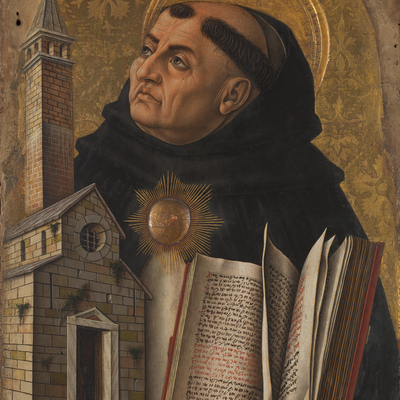 Thomas Aquinas·1272·Latin·Secunda Secundae, Quaestio C·p. 352a–367b
Distinction 25: On Those Ordained by Heretics and Simoniacs
Distinctio Vigesima Quinta: De Ordinatis ab Haereticis et Simoniacis
Richard of Middleton's commentary on Distinction 25 of Book IV of Peter Lombard's Sentences, which addresses ordinations performed by heretics and simoniacs. The commentary proceeds through articles and questions: Article I asks whether a non-episcopal priest can ordain; Articles II–III treat simony directly — defining it, asking whether simoniacal ordinations are valid, and examining the different modes (gift of hand, tongue, and service); subsequent articles address canonical impediments to ordination including irregular clerics, heretical bishops, and age requirements.
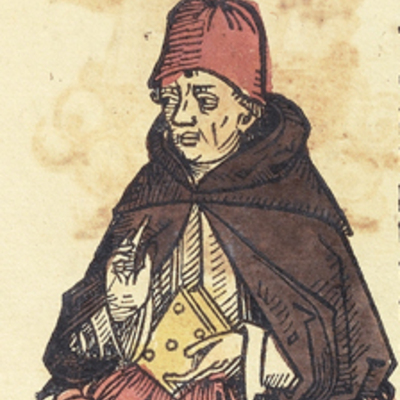 Richard of Middleton·1285·Latin·Liber IV, Distinctio XXV·p. 378a–399a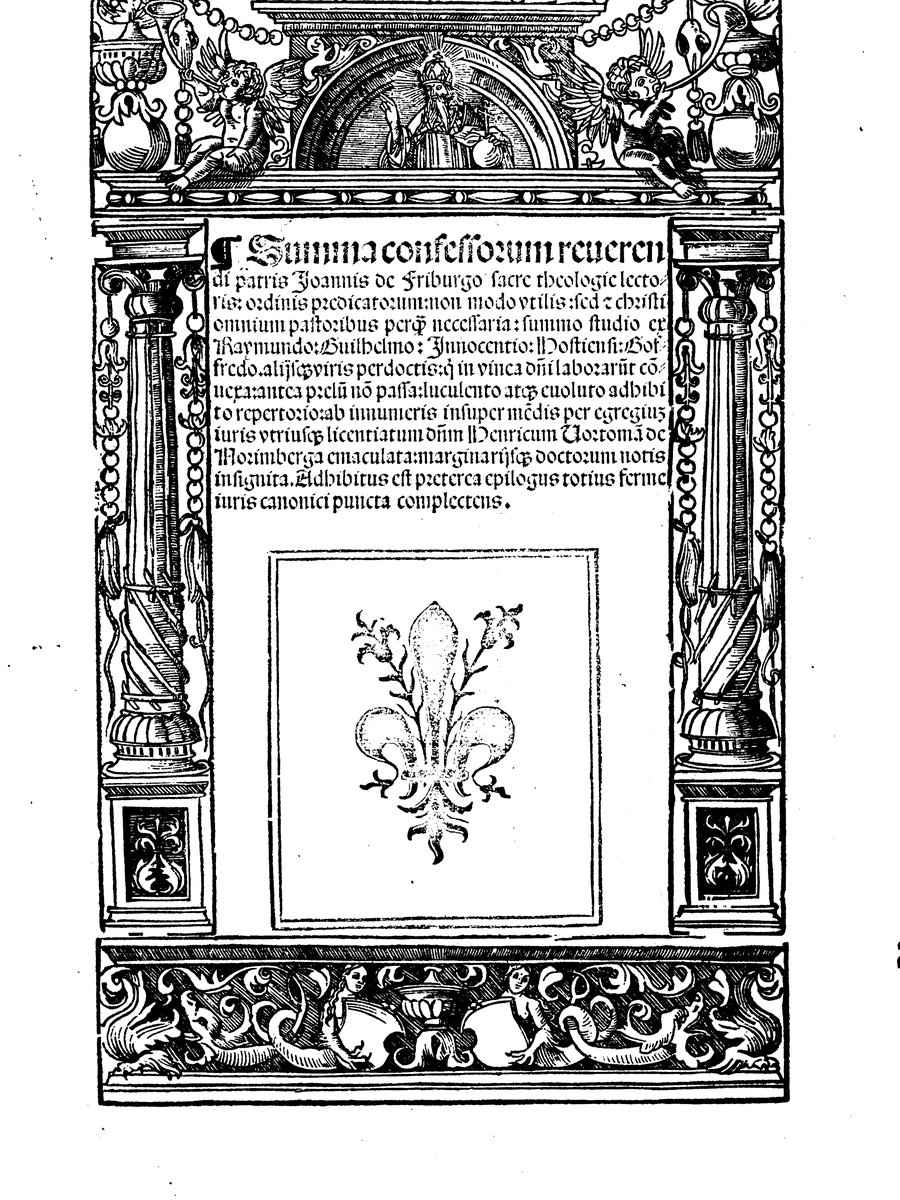
On Simony, Title I
De symonia, Titulus I
The opening of the first title of John of Freiburg's Summa confessorum, De symonia. After a brief preface noting that simoniacal heresy holds first place among ecclesiastical crimes, John proceeds through sixteen questions in the scholastic quaestio form: what simony is (the studiosa voluntas emendi vel vendendi aliquid spirituale vel annexum spirituali), the three kinds of gift by which it is committed (a manu, a lingua, ab obsequio), ordination and promotion for money, and related cases of conscience. Throughout, John digests and weighs the authorities — Raymond of Penyafort, Hostiensis, Goffredus of Trani, the Glossa, and Thomas Aquinas — whose names are keyed in the margins, exemplifying the method that made the Summa confessorum the standard confessor's manual of the later Middle Ages.
 John of Freiburg·1298·Latin·Liber I, Titulus I, Quaestiones I–XVI·fol. 1ra–2vb
Distinction 25: On Those Ordained by Heretics and on Simony
Distinctio Vigesima Quinta: De Ordinatis ab Haereticis et de Simonia
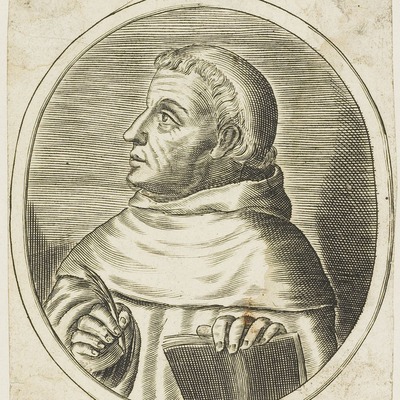
Duns Scotus's commentary on Distinction 25 of Book IV of Peter Lombard's Sentences, which treats the validity of orders conferred by heretics and the question of simony. Taking up Lombard's opening question on whether heretics cut off from the Church can validly confer the sacrament of orders, Scotus distinguishes the validity of the sacrament (which depends on the character of the minister and the form of the rite, not on his sanctity or orthodoxy) from the licit exercise of the power conferred. He then turns to simony, defining it as the deliberate will to buy or sell something spiritual or annexed to the spiritual for a temporal price, and examines its species, the three "gifts" (of hand, tongue, and service) by which it is committed, the validity of simoniacal ordinations, the penalties incurred, and special cases involving prelates and the pope. The Vivès edition prints the text with the marginal annotations of the Irish Franciscan Antonius Hiquaeus (Antoine Hickey, d. 1641), who supplies references to canon law, Suárez, and the Council of Trent.
 John Duns Scotus·1304·Latin·Liber IV, Distinctio XXV·p. 106a–143b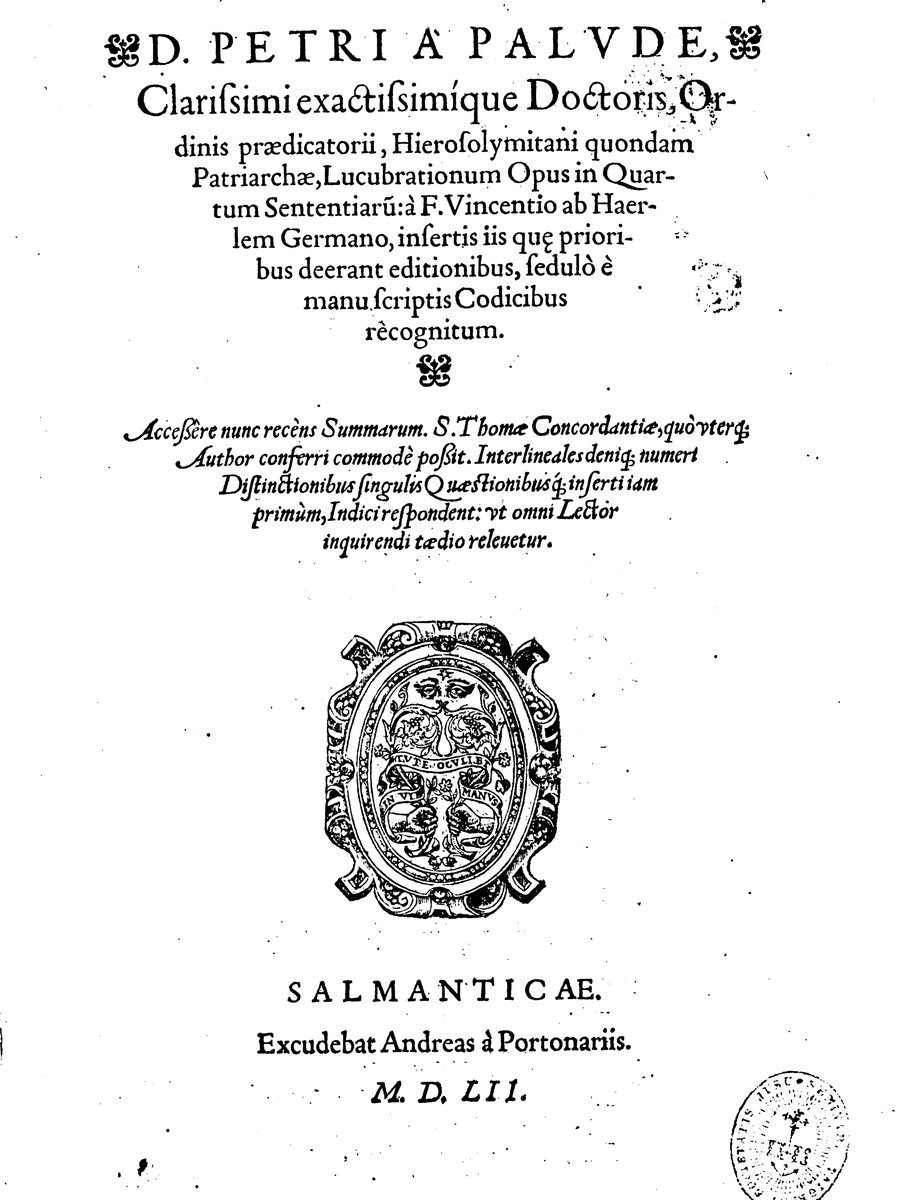
Distinction 25: On Simony
Distinctio Vigesima Quinta: De Simonia
Peter of Palude's full treatment of Distinction 25 in his commentary on the Fourth Book of the Sentences, covering all five questions. Question I asks whether all bishops — including heretics and those cut off from the Church — can confer orders, treating the sacramental power of order as distinct from jurisdictional standing. Question II concerns the proper times for ordinations, with conclusions on canonical ages, ordination days, and the obligation of benefice-holders to receive orders. Question III addresses impediments to holy orders in general — including sex (women cannot be ordained), age, and bodily defect. Question IV asks whether the Pope can commit simony, arguing from the will-based nature of the sin and distinguishing penal from moral dimensions. Question V examines the essence of simony and its three species — munus a manu, munus a lingua, and munus ab obsequio — and discusses when transactions involving sacred things, relics, burial, patronage rights, and benefices become simoniacal.
 Peter of Palude·1315·Latin·Distinctio XXV·p. 307b–321b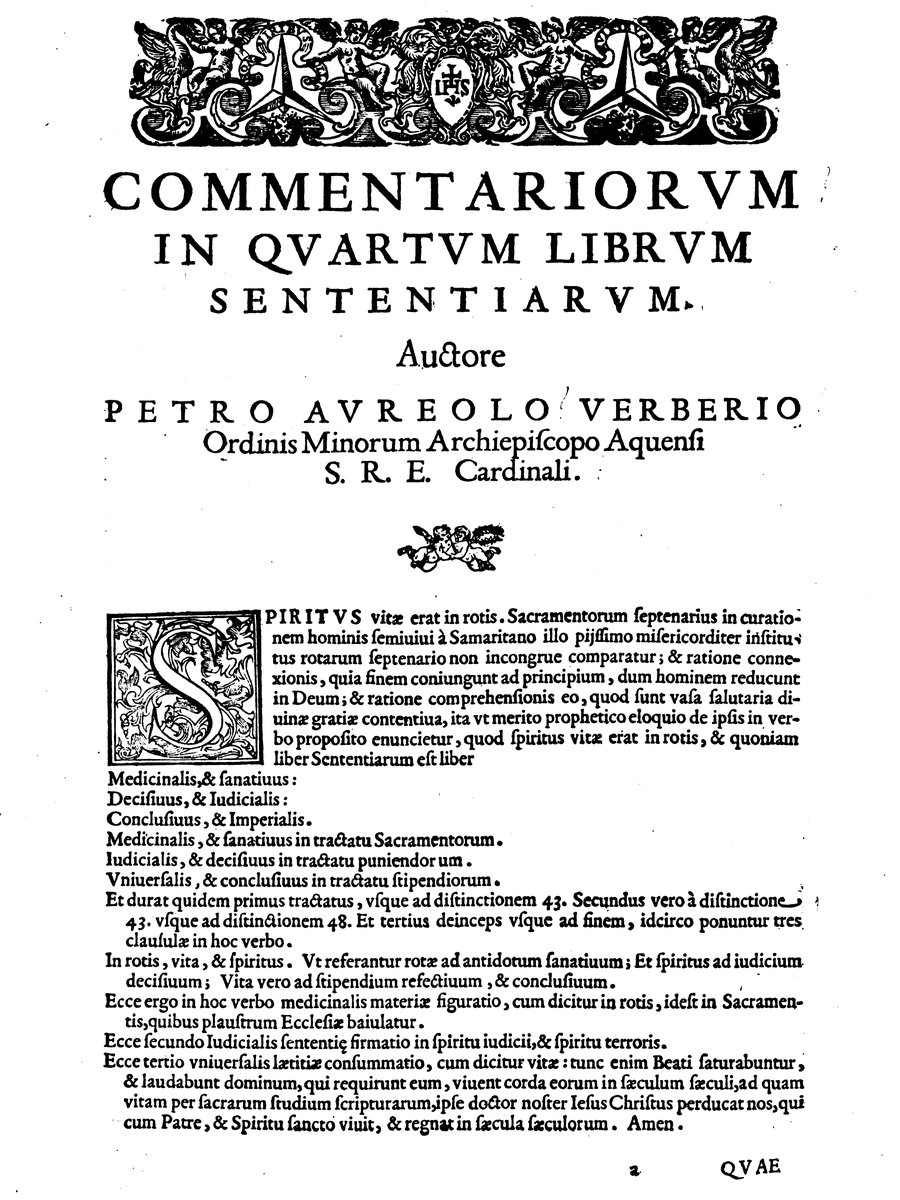
Distinction 25: On Those Receiving Orders
Distinctio Vigesimaquinta: De Suscipientibus Ordines
Peter Auriol's commentary on Distinction 25 of Book IV of Peter Lombard's Sentences, which treats those receiving and conferring the sacrament of orders. Auriol poses three questions: first, whether bishops alone can minister the sacrament of orders; second, whether simony is a vice directly opposed to justice — working through the tripartite classification of spiritual things (sanctifying grace, freely given grace, and temporal emoluments annexed to spiritual offices), the three modes of simoniacal exchange (by word, by service, and by money), and concluding that exchanging sacraments for temporal goods is against justice as well as against religion, since it renders saleable what nature ordains to be given freely; third, whether the Pope can commit simony in any case.
 Peter Auriol·1316·Latin·Liber IV, Distinctio XXV·p. 164b–166b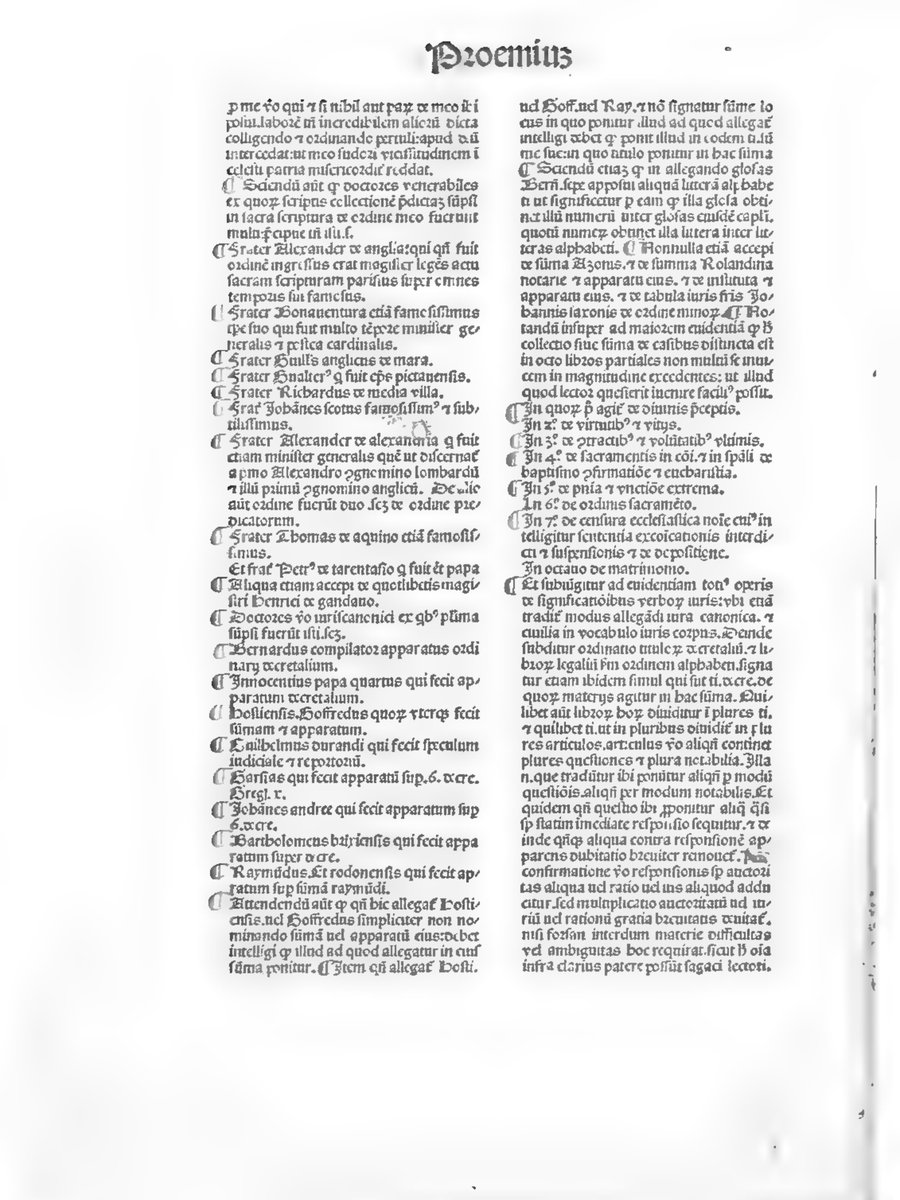
On Simony
De simonia
The De simonia titulus (Book VI, Titulus 55) of Astesanus of Asti's Summa de casibus conscientiae — the last titulus of Book VI, which treats the sacramentum ordinis and ecclesiastical persons and things. After surveying the excesses of prelates against their subjects and vice versa in the preceding titulus, Astesanus turns to simony, which he treats specialiter in seven parts: what simony is and how it is named; whether it is a sin; through whom it is committed (manu, lingua, obsequio); penalties for simoniacs; restitution of things simoniacally received; dispensation in such cases; and species of simony, including the case where the mediator alone is admitted. Throughout, Astesanus weighs civil and canon law authorities — Hostiensis, Goffredus, the Decretum and Decretales, and the Glossa — making this titulus a compact handbook of the simony tradition as received in the early fourteenth century.
 Astesanus of Asti·1317·Latin·Liber VI, Titulus LV·fol. 6.98vb–6.112rb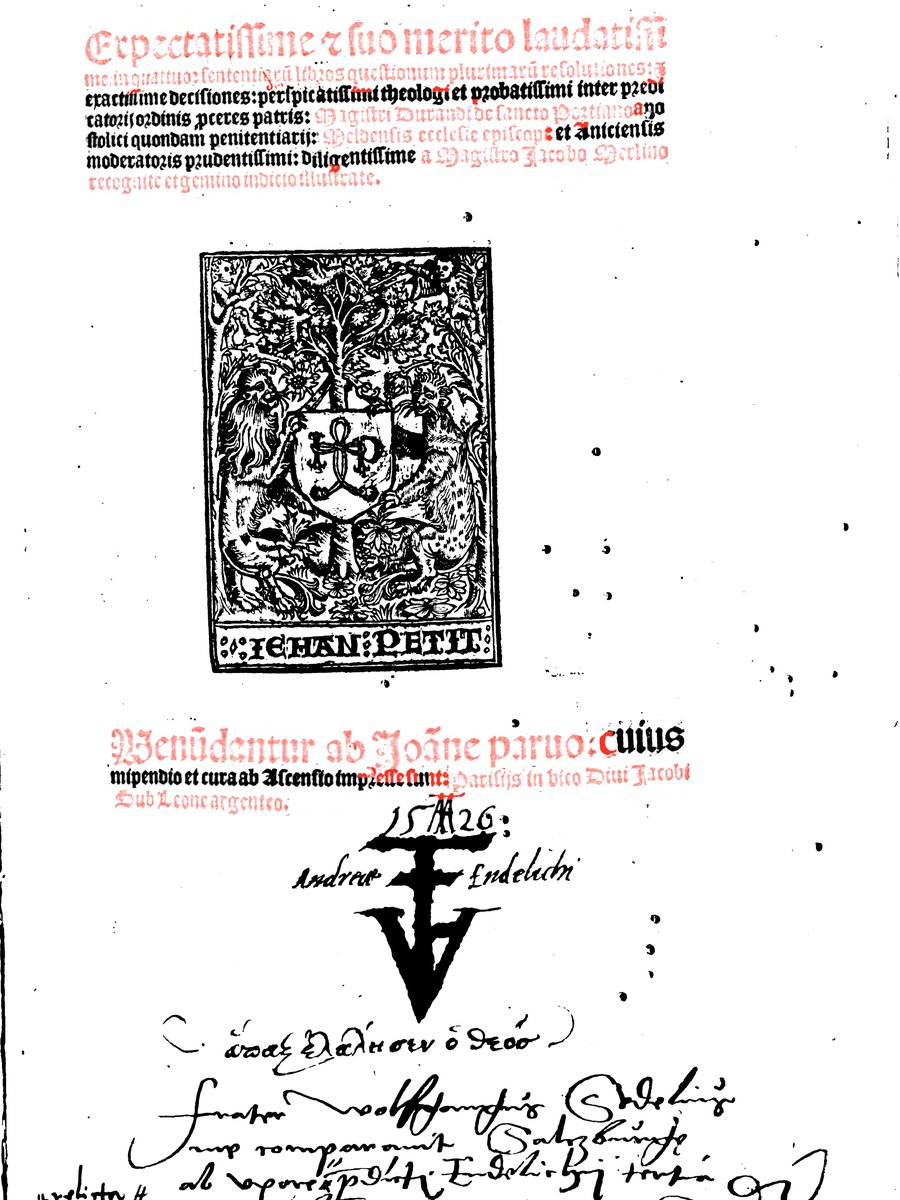
Distinction 25: On Simoniacs in Holy Orders
Distinctio Vigesima Quinta: De Simoniacis in Ordine
Durandus's commentary on Lombard's Distinction 25, which addresses simony in the conferral of holy orders. The "In generali" section defines simoniacs and distinguishes those who knowingly receive orders from a simoniac bishop (whose ordination is wholly invalid) from those who do so unknowingly (whose ordination is mercifully tolerated). Question I asks whether every bishop can confer orders, distinguishing between episcopal power, its exercise of right, and its exercise of fact. Question II asks whether a woman or child can be ordained, arguing from defects that can occur in the conferral of orders. Question III asks whether it is licit to buy or sell spiritual things for a temporal price. Question IV asks whether simony is committed in three customary modes: by gift of hand, by gift of tongue, and by gift of service. Question V asks whether the pope can commit simony.
 Durand of Saint-Pourçain·1317·Latin·Distinctio XXV·fol. 413va–417ra
Inferno, Canto XIX
Canto XIX of Dante's Inferno is devoted to the simoniacs — popes and prelates who trafficked in sacred offices — whom Dante places in the third bolgia of the eighth circle. They are buried head-down in stone sockets with flames burning the soles of their feet. The canto opens with an invective against Simon Magus and his followers, culminates in Dante's dialogue with Pope Nicholas III (who mistakes him for his successor Boniface VIII), and closes with a prophetic denunciation of the Donation of Constantine as the root of the Church's corruption.
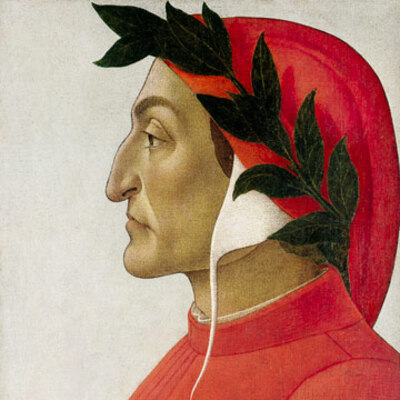 Dante Alighieri·1321·Inferno, Canto XIX·p. 75–78
Distinction 25: On the Conferral and Reception of Orders
Distinctio Vigesima Quinta: De Ordinum Collatione et Receptione
Thomas of Strasbourg's commentary on Distinction 25 of Book IV of Peter Lombard's Sentences, which treats the conferral and reception of holy orders. The distinction opens with an overview of the Lombard's structure and a resolution stating that while only a bishop can confer orders by common law, a heretical or censured bishop still validly ordains when the Catholic form and intention are observed. Article I examines the power of the ordainer, establishing that episcopal authority alone suffices to confer the sacrament of order. Subsequent articles address simoniacal ordination: whether orders conferred or received simoniacally are valid, the three modes of simoniacal exchange (gift of hand, tongue, and service), and the conditions under which a transaction involving spiritual or annexed goods constitutes simony.
 Thomas of Strasbourg·1335·Latin·Liber IV, Distinctio XXV·fol. 364ra–367vb
On Simony, to the Beguines
De simonia ad beguttas
Geert Groote's treatise De simonia ad beguttas (c. 1380), addressed to the beguines on the question of whether it is simony to buy a place or prebend in a beguinage. Groote answers that, where any spiritual good — admission to the community, the habit, share in prayers, or the right to common life under a rule — is attached to the place, the purchase is indeed simony; he then unfolds the doctrine through a series of distinctions on what constitutes a spiritual good, the difference between buying the thing and buying the means to it, and the legal and moral remedies. The treatise survives in eastern Middle Dutch in fifteenth-century manuscripts from the IJssel and Cologne region, edited here by Rudolf Langenberg.
 Geert Groote·1380·De simonia ad beguttas·p. 3–33
Treatise on Simony
Tractatus de Simonia
Wycliffe's complete treatise on simony, written c. 1379–1380. In eight chapters he attacks the buying and selling of spiritual goods as a heresy rooted in clerical endowment, treating papal provisions, annates, benefice trafficking, and the corrupt practices of religious orders. He argues that simony offends the entire Trinity and that secular lords have a duty to suppress it.
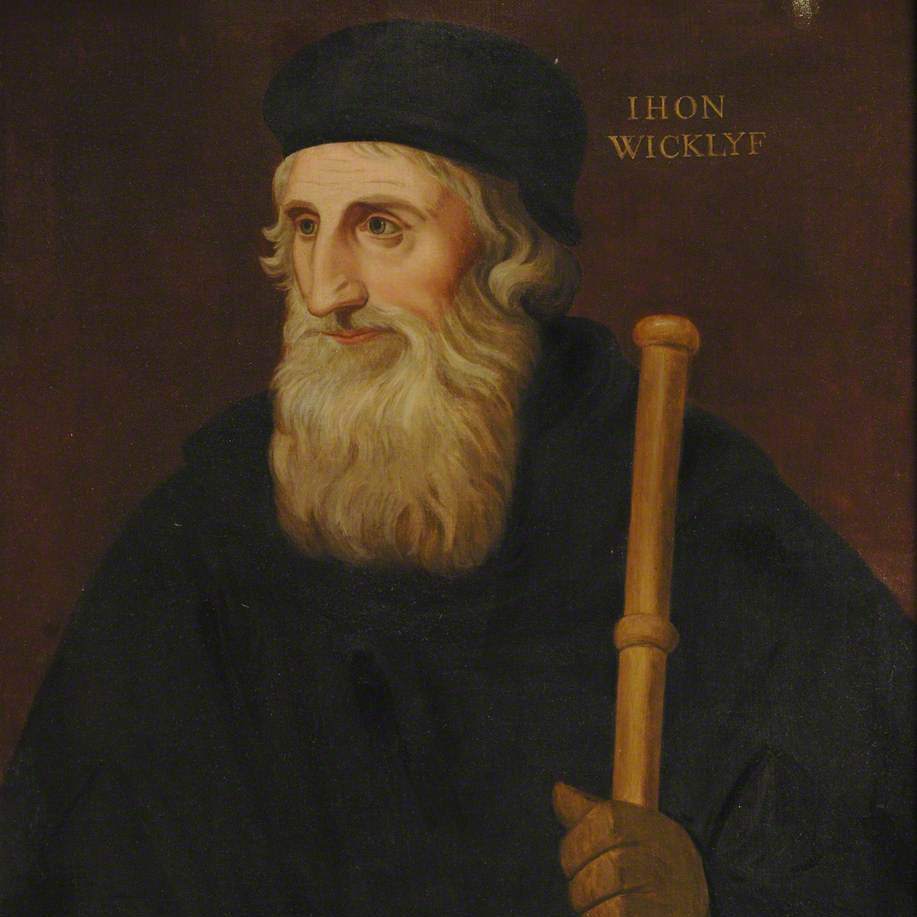 John Wycliffe·1380·Latin·Complete Work·p. 1–112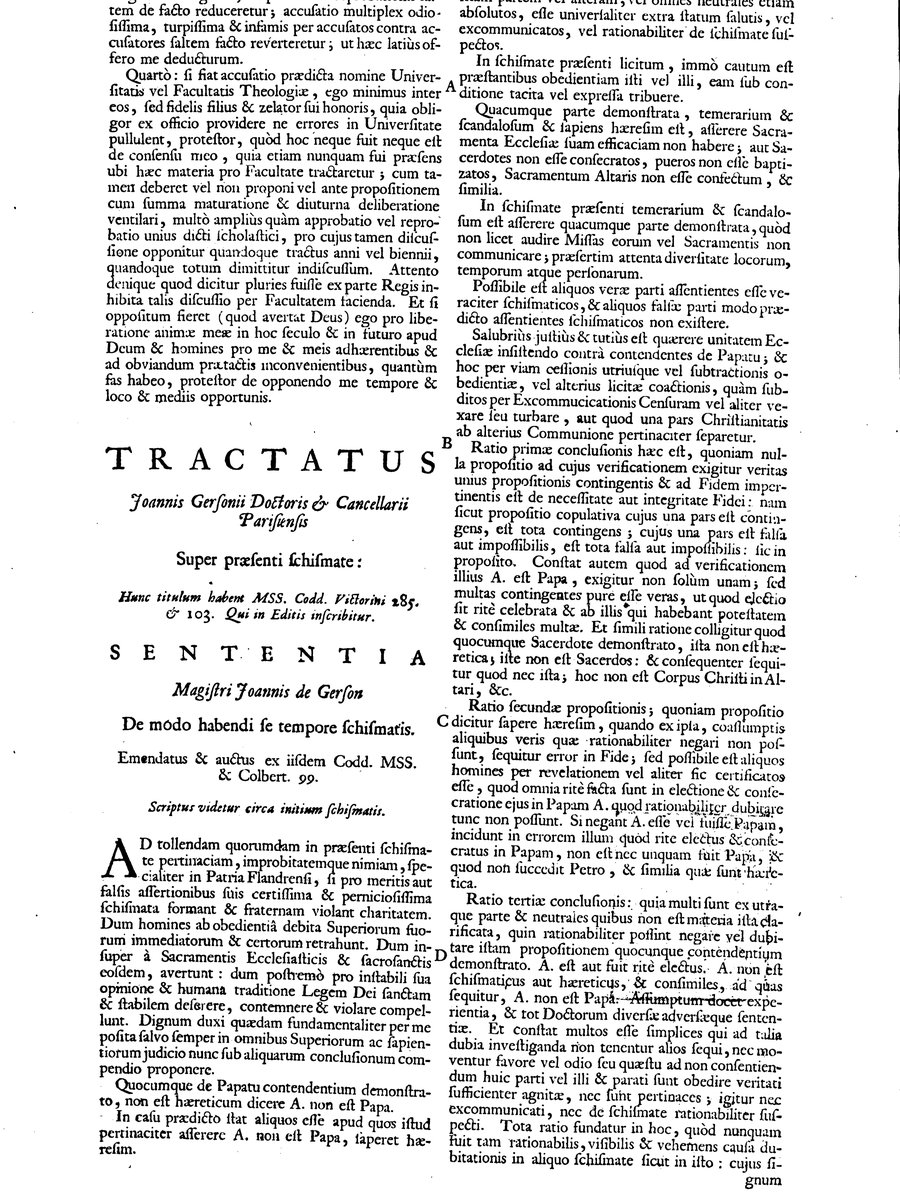
Treatise on Simony
Tractatus de Simonia
Jean Gerson's treatise on simony, a short scholastic work laying out suppositions, propositions, and considerations on simoniacal corruption in ecclesiastical appointments and benefices. Printed in the 1706 Antwerp Opera Omnia, vol. II, running from column 645 to column 652.
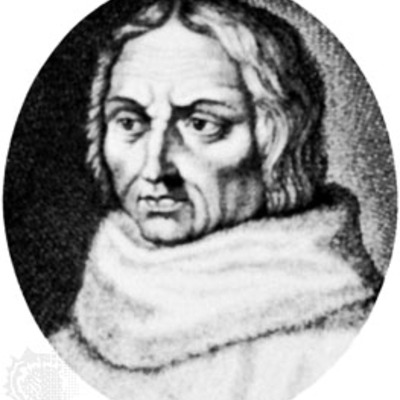 Jean Gerson·1400·Latin·Tractatus de Simonia·col. 645–651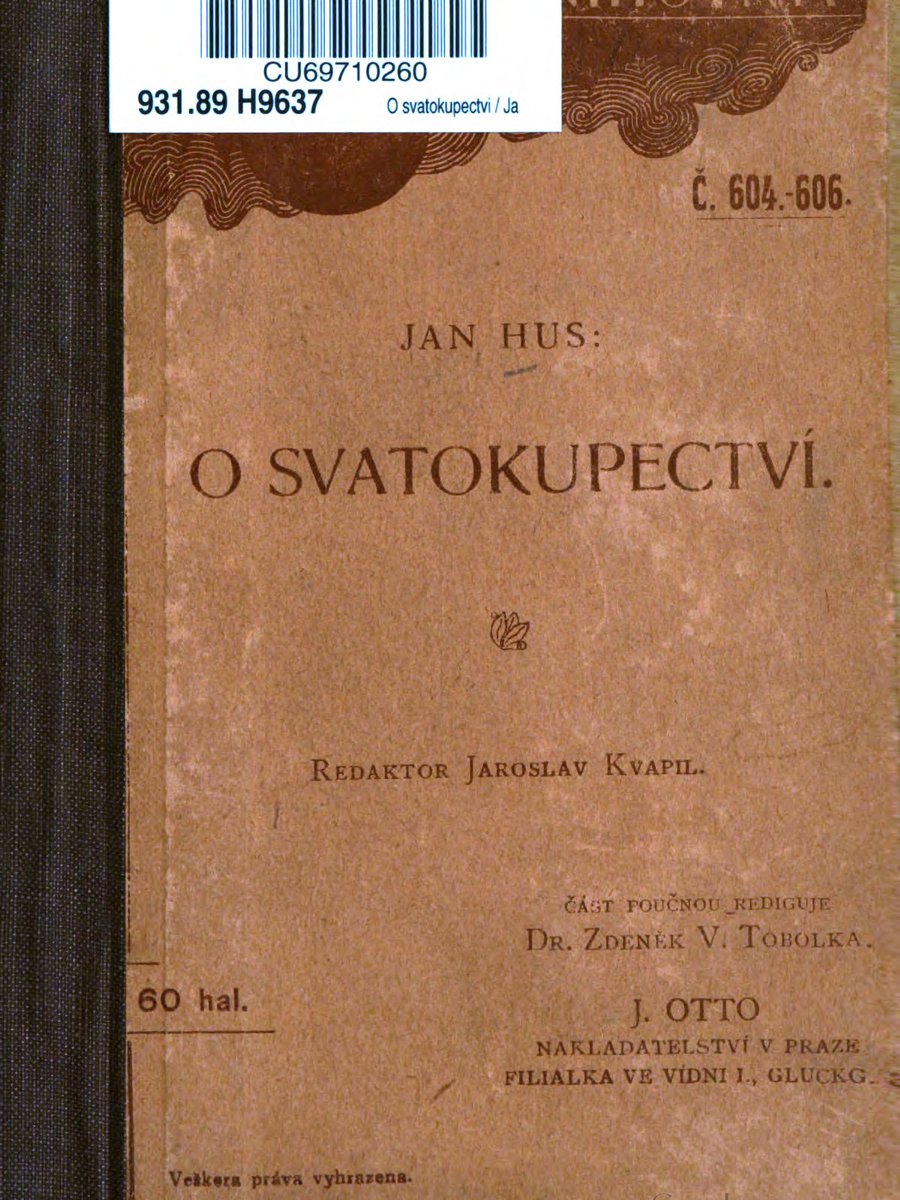
On Simony
O svatokupectví
Hus's complete treatise on simony, written in Czech in 1413 and completed on Candlemas (2 February). In ten chapters he attacks the buying and selling of spiritual goods — from sacraments and benefices to monastic letters and episcopal fees — as a heresy against the Holy Spirit. Drawing on Wycliffe and scripture, he condemns simony at every level of the Church, from parish priests to the papacy, and calls on secular rulers and the lay faithful alike to resist it.
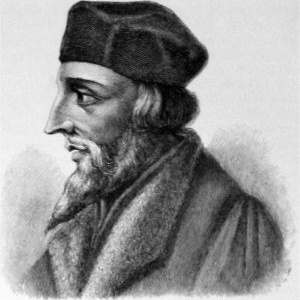 Jan Hus·1413·Czech·Complete Work·p. 3–155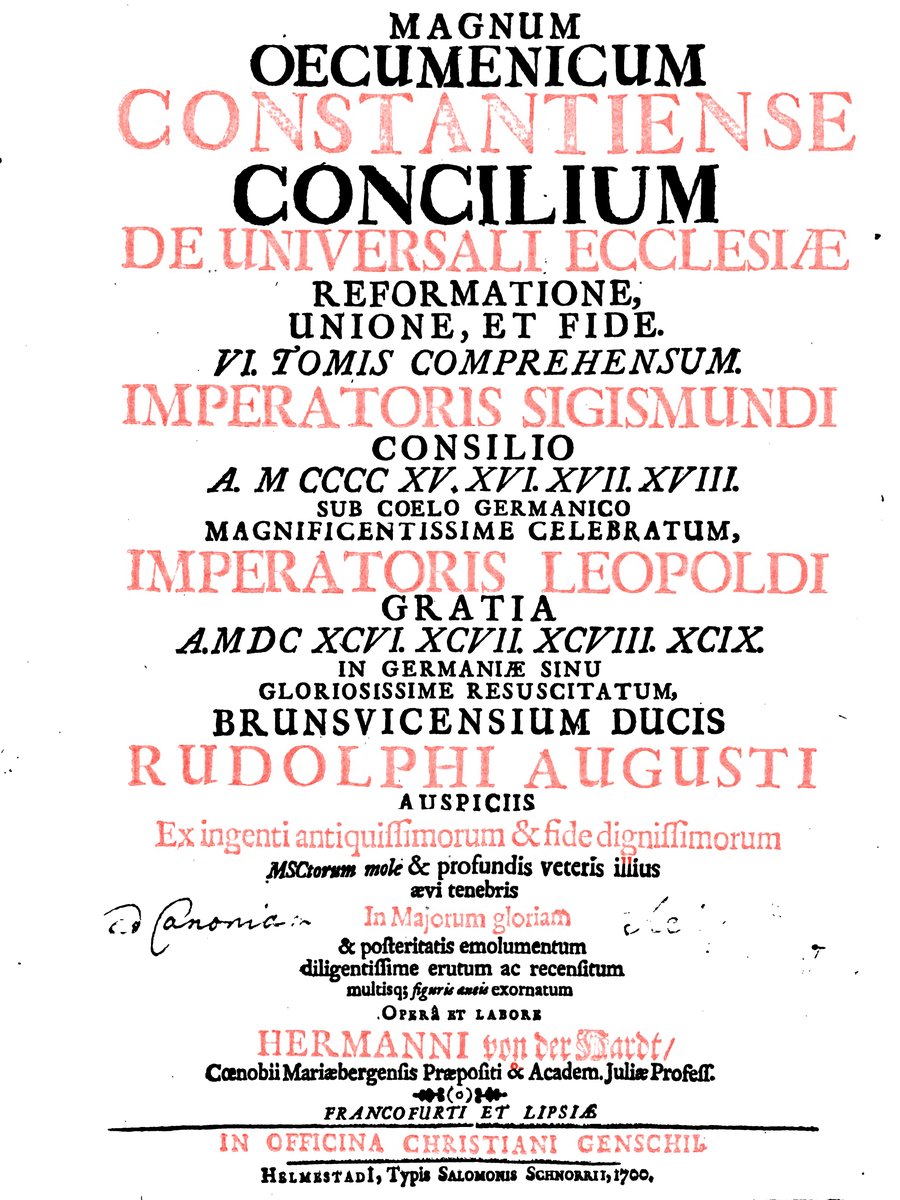
Counsel on the State of the Church to be Reformed in the Council of Constance
Consilium de Ecclesiastico Statu in Concilio Constantiensi Emendando
A sermon-treatise (consilium) delivered by Maurice of Prague, Chancellor of the Church of Prague and professor of sacred theology, before the Fathers of the Council of Constance in 1417. Taking as his thema "Aperte vobis dicere" (John 16), Maurice argues for the reform of the ecclesiastical estate along the lines of the primitive Church, castigating arrogance and simony as the roots of dissension in the Church and pleading for the restoration of sound learning and probity among the clergy. Transcribed from a Viennese manuscript codex by Hermann von der Hardt.
Maurice of Prague·1417·Latin·Sermon delivered at the Council of Constance·p. 860–874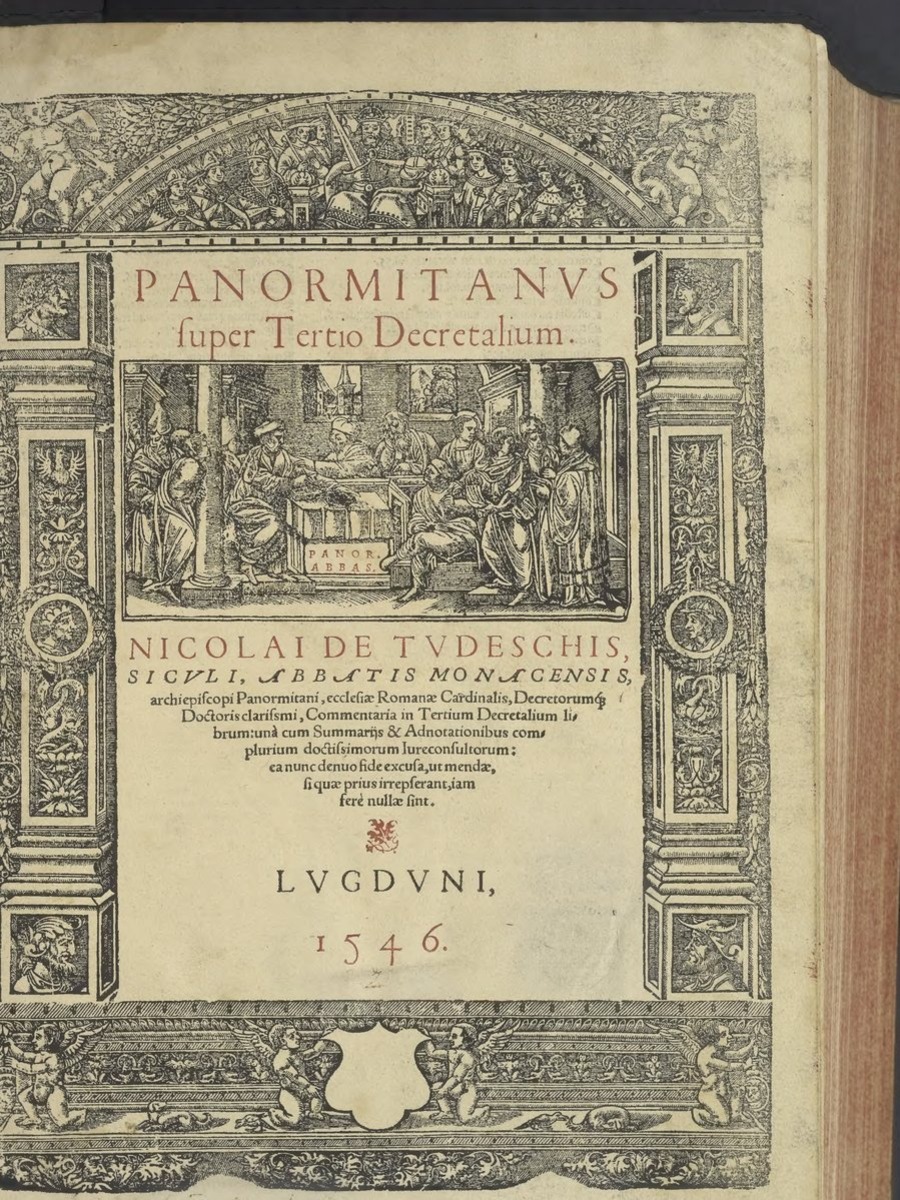
On Simony (Book 5, Title 3)
De Simonia (Liber V, Titulus III)
Panormitanus's commentary on the De simonia title of the Decretals, covering the definition of simony, the buying and selling of spiritual goods, penalties for simoniacs, and related canonical questions.
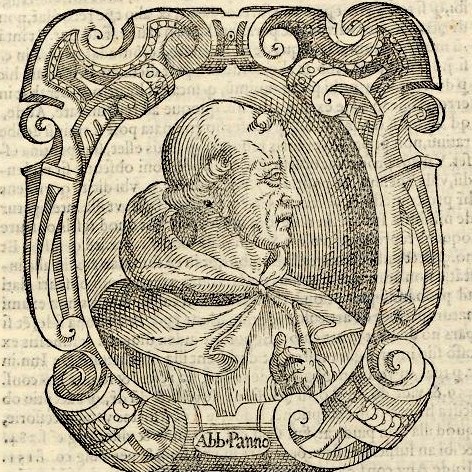 Panormitanus·1440·Latin·Liber V, Titulus III·fol. 2.69ra–2.82vb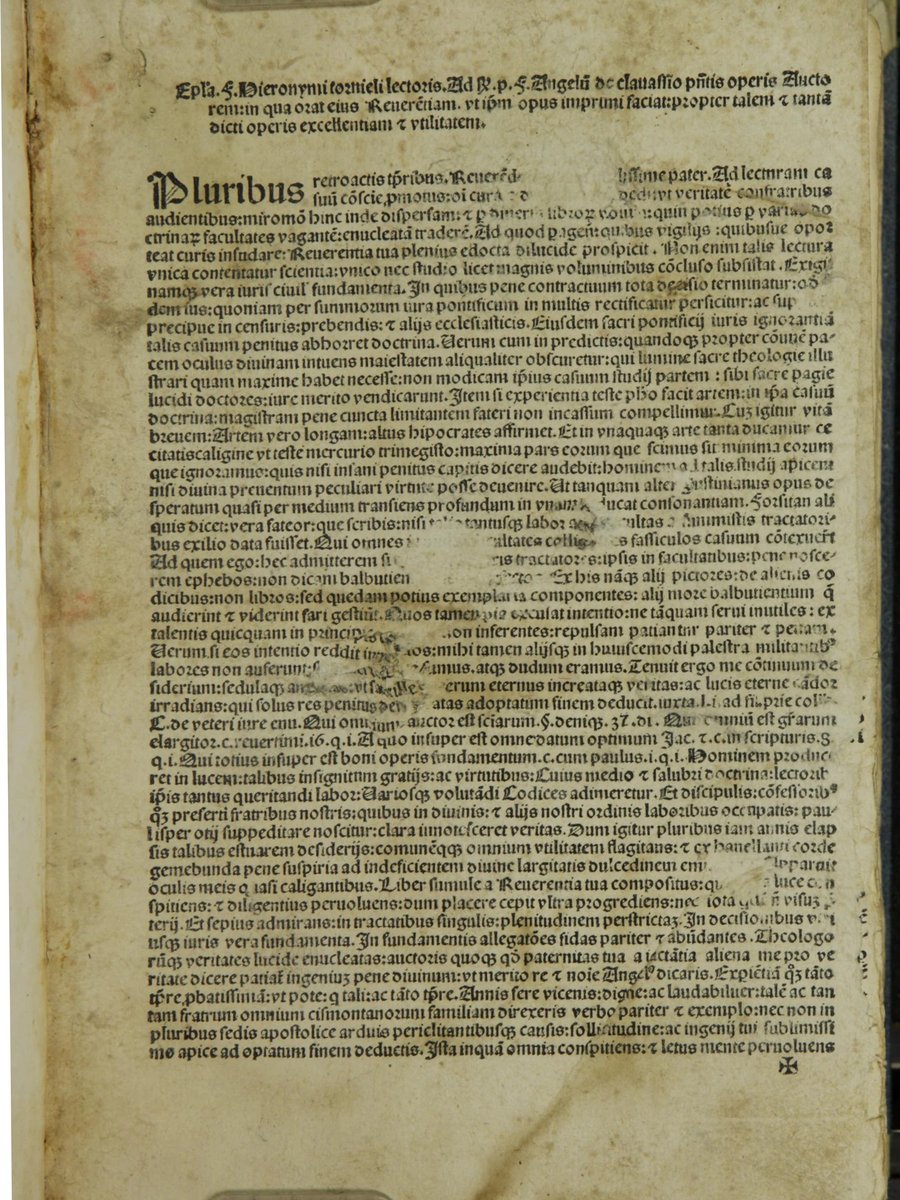
Simony
Simonia
The article on simony from Angelus de Clavasio's Summa angelica de casibus conscientiae, the alphabetically arranged confessor's manual first printed in 1486. Opening on folio 313v with a decorated initial immediately after the brief Sigillum article, the entry treats simony across twenty-six numbered sections: its definition as the deliberate buying or selling of something spiritual or annexed to the spiritual; the three modes by which it is committed — a manu, a lingua, ab obsequio; simoniacal ordination, promotion, and the conferral of benefices; the standing of sacraments received from simoniacs; penalties, irregularity, and the conditions for dispensation. Throughout, Angelus digests the canon-law tradition — the Decretum, the Decretals, and the major glossators and doctors — into practical cases of conscience for the confessor.
 Angelo Carletti di Chivasso·1486·Latin·Littera S, s.v. Simonia·fol. 313vb–320ra
Distinction 13, Question 2: On the Matter of the Sacrament of Penance
Distinctio XIII, Questio II: De Materia Sacramenti Poenitentiae
Gabriel Biel's discussion of the matter of the sacrament of penance, engaging the view attributed to Jean Gerson in his Flores morales that the penitent recipient is himself the matter of the sacrament. Against this, Biel presents the standard tripartite scheme: the remote matter is sins committed, the proximate matter is confession, and the form is sacramental absolution. He works through the question of whether the sacrament requires any act on the part of the recipient, compares the structure of penance to that of baptism and the Eucharist, and examines the conditions under which the sacrament produces grace—concluding that the sacrament confers grace on one who receives it without the obstacle of mortal sin, whether actual in deed or persistent in the will.
 Gabriel Biel·1488·Latin·Liber IV, Distinctio XIII, Questio II·p. 159b–160b
Distinction 15, Question 3: On Various Kinds of Restitution
Distinctio XV, Questio III: De Variis Speciebus Restitutionum
Gabriel Biel's extended treatment of the various kinds of theft and the obligations of restitution, introduced as the third question of Distinction XV. The question proceeds through three articles: (1) whether all thieves and robbers are required to restore specifically to each defrauded owner; (2) noting special classes of theft—peculatus (embezzlement of public property), abigeatus (theft of dispersed livestock), plagiatus (sale of a free person), and rapina (violent seizure)—and defining their conditions; and (3) resolving a series of seven dubia concerning cases where restitution obligations may be mitigated or excused, including extreme necessity, the rule that found property whose owner is unknown may go to the poor, the status of goods seized in shipwreck, and the excommunication decreed at the Fourth Lateran Council against those who plunder Christian castaways.
Gabriel Biel·1488·Latin·Liber IV, Distinctio XV, Questio III·p. 192b–202aDistinction 16, Question 4: On Almsgiving as Satisfaction
Distinctio XVI, Questio IIII: De Eleemosyna ut Satisfactione
Gabriel Biel's fourth question under Distinction XVI, treating almsgiving as a form of penance-satisfaction. Invoking James 5 and the principle that the whole Church is one commonwealth—so that whoever spends on those in need receives in turn what is necessary for Christian life—Biel argues by reason, example, and authority that almsgiving is obligatory on those with surplus, citing the mendicant exemplars of Alexius, Benedict, Dominic, and Francis. Five dubia follow: whether healthy beggars are obligated to work; whether almsgiving (as satisfaction) is superior to fasting and prayer; whether spiritual alms outrank bodily alms; whether venial sin can be remitted while mortal sin persists; and whether venial sin can become mortal. The question's explicit closing—"Et tantum de illa questione ac tota distinctione"—ends Distinction XVI.
Gabriel Biel·1488·Latin·Liber IV, Distinctio XVI, Questio IIII·p. 349b–356aDistinction 5, Question 1: On Intention in Baptism
Distinctio V, Questio Vnica: De Intentione in Baptismo
Gabriel Biel's treatment of the intention required for valid baptism, presenting the latter conclusions of the sole question under Distinction V. Drawing on Alexander of Hales, Thomas Aquinas, Richard of Middleton, and Scotus, Biel argues (Conclusio III) that the minister's intention must extend not only to the baptismal act as such but to its effect and terminus; (Conclusio IV) that specific actual intention is not required—it suffices to intend what the Church intends in general, so that infidels and heretics may validly baptize provided they intend to do what Christians do; (Conclusio V) that virtual intention (neither merely habitual nor fully actual) is what is strictly required; and (Conclusio VI) that when multiple ministers jointly baptize a single person, each must complete the entire form—including ablution and words with intention—for the sacrament to be valid, as illustrated by the hypothetical of a mute and a one-handed man.
Gabriel Biel·1488·Latin·Liber IV, Distinctio V, Questio Vnica·p. 85b–86b
Distinction 25: On Simony
Distinctio Vigesima Quinta: De Simonia
Major's discussion of simony in the context of the sacrament of orders. He examines the canonical definitions of simony, the distinction between simony by divine law and by positive law, and the various ways in which the buying and selling of spiritual goods can occur.
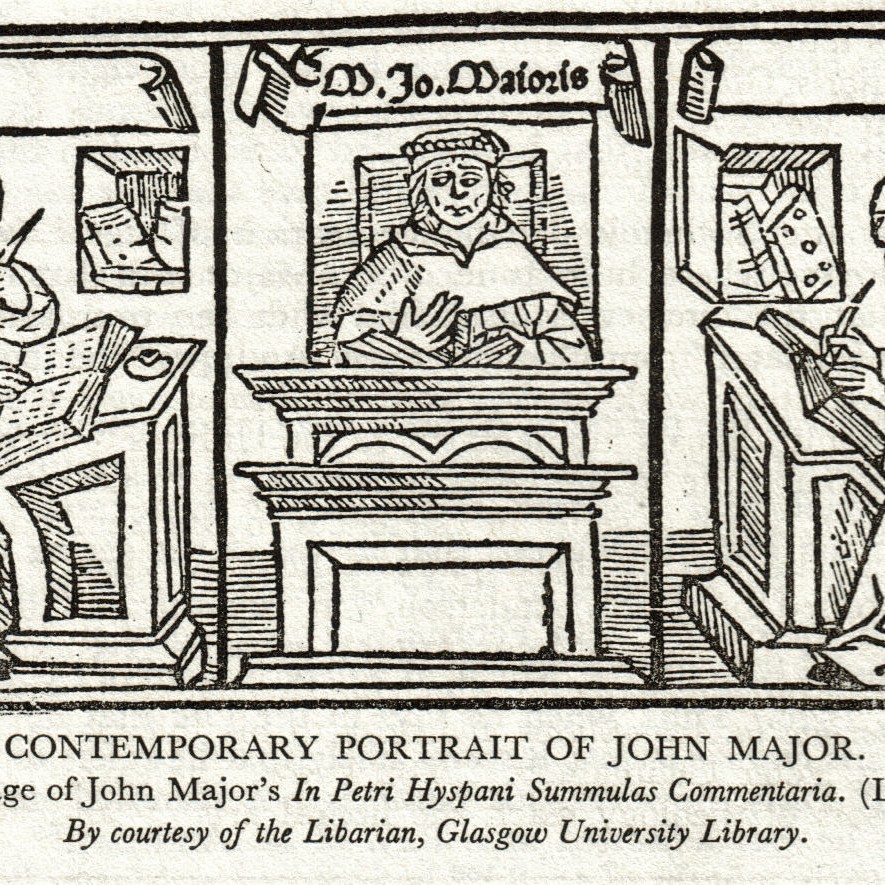 John Major·1509·Latin·Distinctio XXV·fol. 145rb–149ra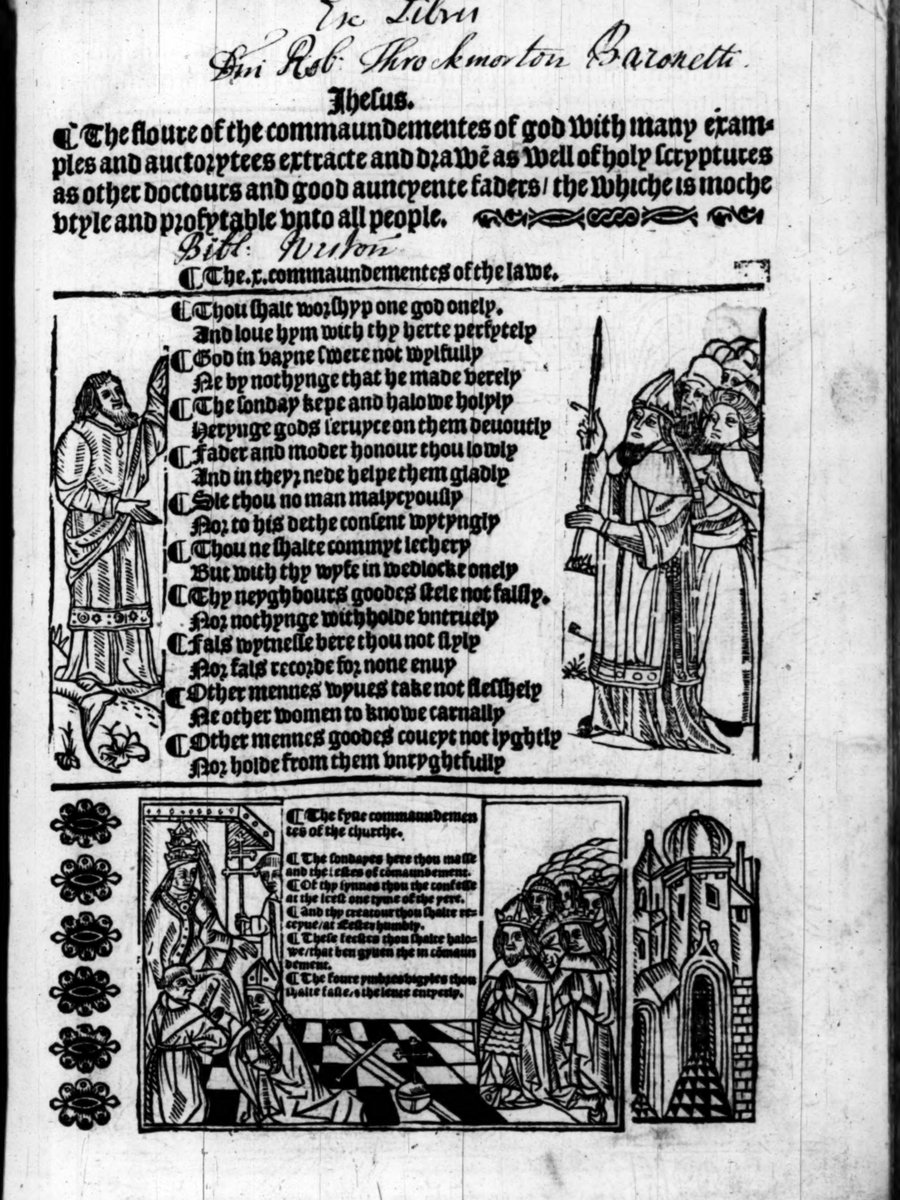
Of Simony, Which God Forbids
Of Symony That God Defendeth
A chapter from The Floure of the Commandementes of God, the English translation (first printed 1510, traditionally ascribed to the translator Andrew Chertsey) of the French Fleur des commandements de Dieu, giving a complete popular treatise on simony. It opens with the scholastic definition — Simonia est studiosa voluntas emendi vel vendendi spirituale vel spirituali annexum — and the three modes of simoniacal exchange (the gift of the hand, of the tongue, and of service), then surveys simony in benefices, resignations, and pensions. It turns to the great scriptural exempla: Simon Magus and Peter's rebuke, and Gehazi and the leprosy that clung to him for taking Naaman's gifts. It closes by condemning the simony of advocates who sell their pleading and of clerks who sell the gospel and the sacraments, and by commending penance and almsdeeds as the remedy for those who have sinned by simony.
Anonymous·1510·Early Modern English·The Commandments: Of Simony·fol. 78va–82rb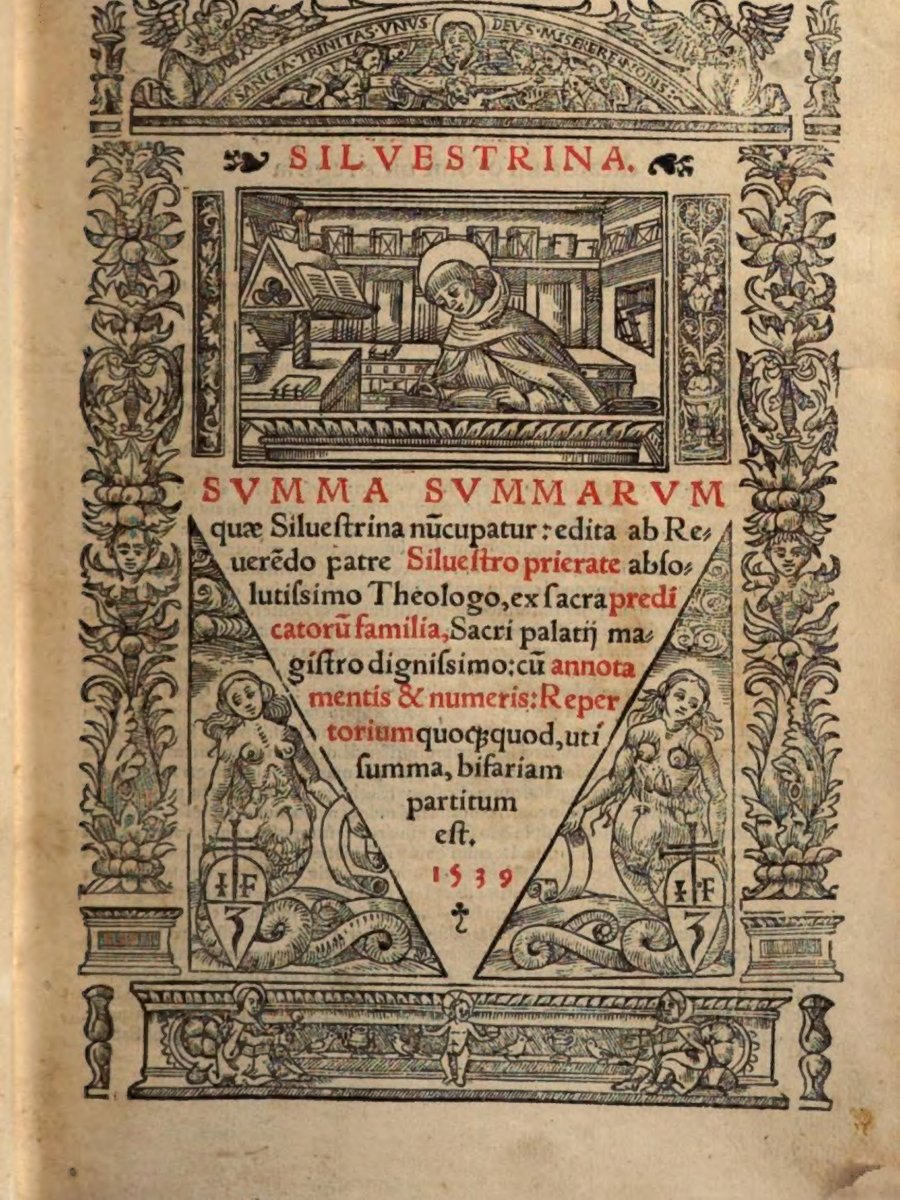
On Simony
De simonia
The entry De simonia from the Secunda pars of Sylvester Prierias's Summa Sylvestrina, his alphabetical compendium of moral and canonical cases of conscience. Prierias treats the question in roughly thirty numbered articles, beginning from the term's derivation from Simon Magus and the canonical definition of simony as the studied will to buy or sell things spiritual or annexed to the spiritual. He works through the classification of spiritual things, the species of simoniacal pact, the question of when simony arises in ordinations and the conferral of benefices, the role of patron and presenter, the limits of papal dispensation, the obligation of restitution, and the penalties — drawing throughout on Aquinas, Hostiensis, Innocent IV, Antoninus, Cajetan and the canonist tradition. The article is among the most thorough confessor's-manual treatments of simony to appear in print on the eve of the Reformation, and through its forty-plus editions became a standard reference for sixteenth-century moral theology.
 Silvester Prierias·1515·Latin·Secunda pars, s.v. Simonia·fol. 3.259rb–3.268ra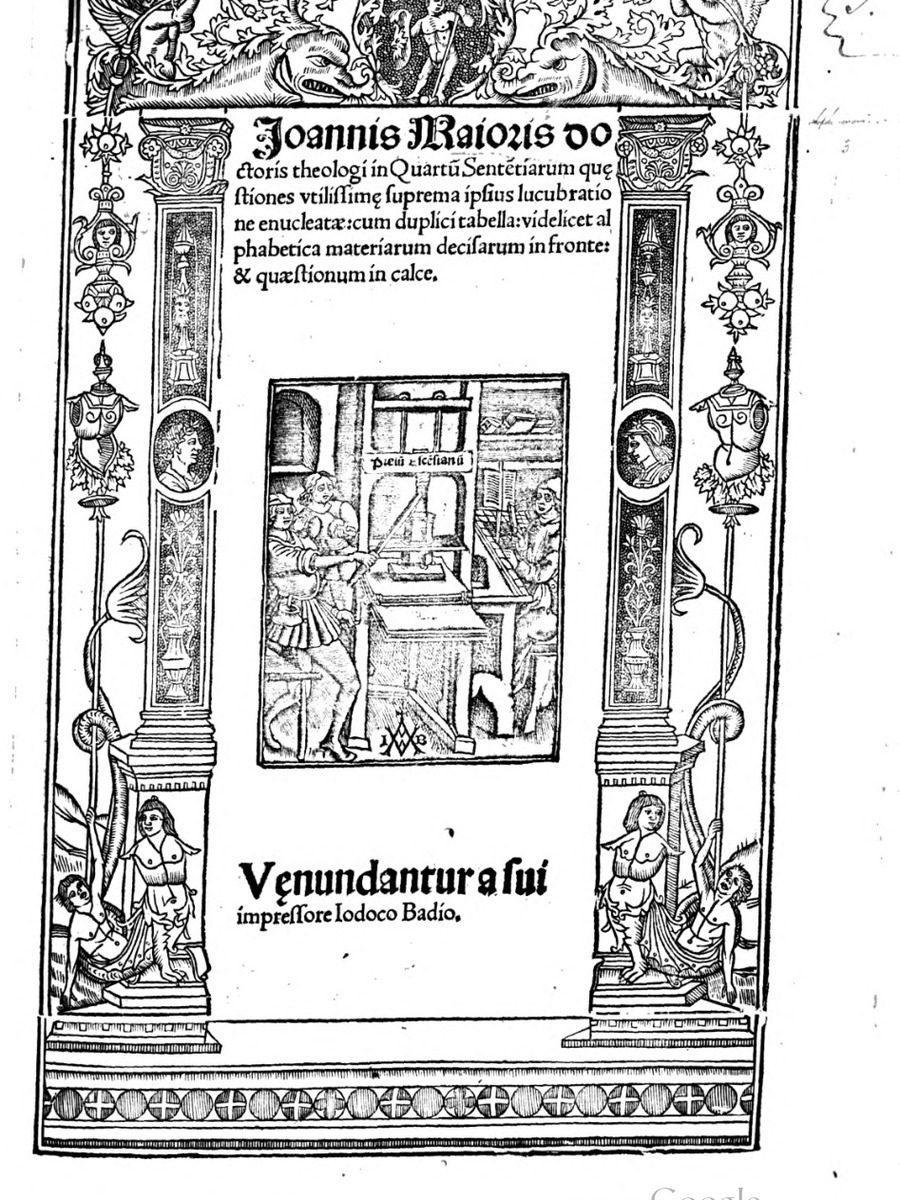
Distinction 25: On Simony
Distinctio Vigesima Quinta: De Simonia
Major's revised discussion of simony from the 1516 second edition. Covers seven questions on the definition of simony, its forms (mental, conventional, real), the buying and selling of spiritual goods, and penalties for simoniacs.
John Major·1516·Latin·Distinctio XXV·fol. 181va–188vb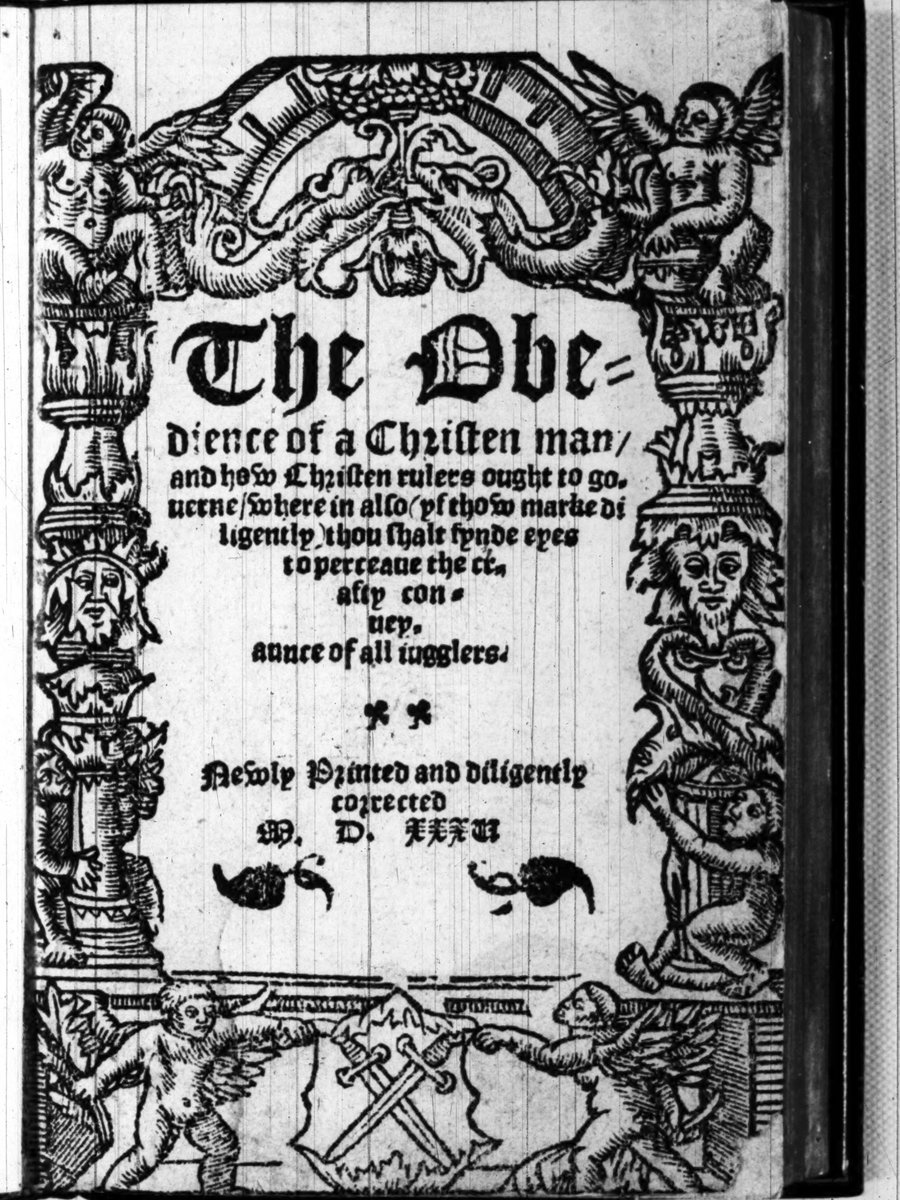
Of the Covetousness of the Spiritualty
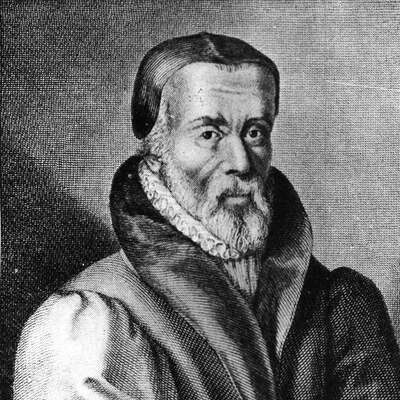
Tyndale's catalogue of the exactions by which the clergy fleece the realm. Beginning with their seizure of the tithe — "the tenth of all the realm" — he enumerates their temporal lands, mortuaries, offering-days, and privy tithes, and the endless fees for churchings, weddings, burials, hallowings, and priests' first masses. The indictment climaxes in his image of the clergy flaying the laity: "the parson shears, the vicar shaves, the parish priest polls, the friar scrapes, and the pardoner pares; we lack but a butcher to pull off the skin." He likens the spiritualty to horseleeches, caterpillars, and wolves in lambs' skins, to be known and judged by their works.
 William Tyndale·1528·Early Modern English·The Duty of the Higher Powers·fol. 76r–78r
Of Matrimony, and the Pope's Dispensations
The close of Tyndale's section on the obedience of children, treating Christian matrimony. Tyndale argues that lawful marriage — made with the consent of parents and friends — may not be dissolved by the Church's vows and traditions, and he attacks the way the clergy separate those whom God has joined. Above all he assails the Pope's traffic in dispensations, releasing men from monastic profession and priestly vows for money, closing with the famous gibe that to sell a benefice outright is reckoned simony, but to resign it on a pension and redeem it again is held no simony at all: "O crafty jugglers and mockers with the word of God!"
William Tyndale·1528·Early Modern English·The Obedience of Children unto their Elders·fol. 26r–27r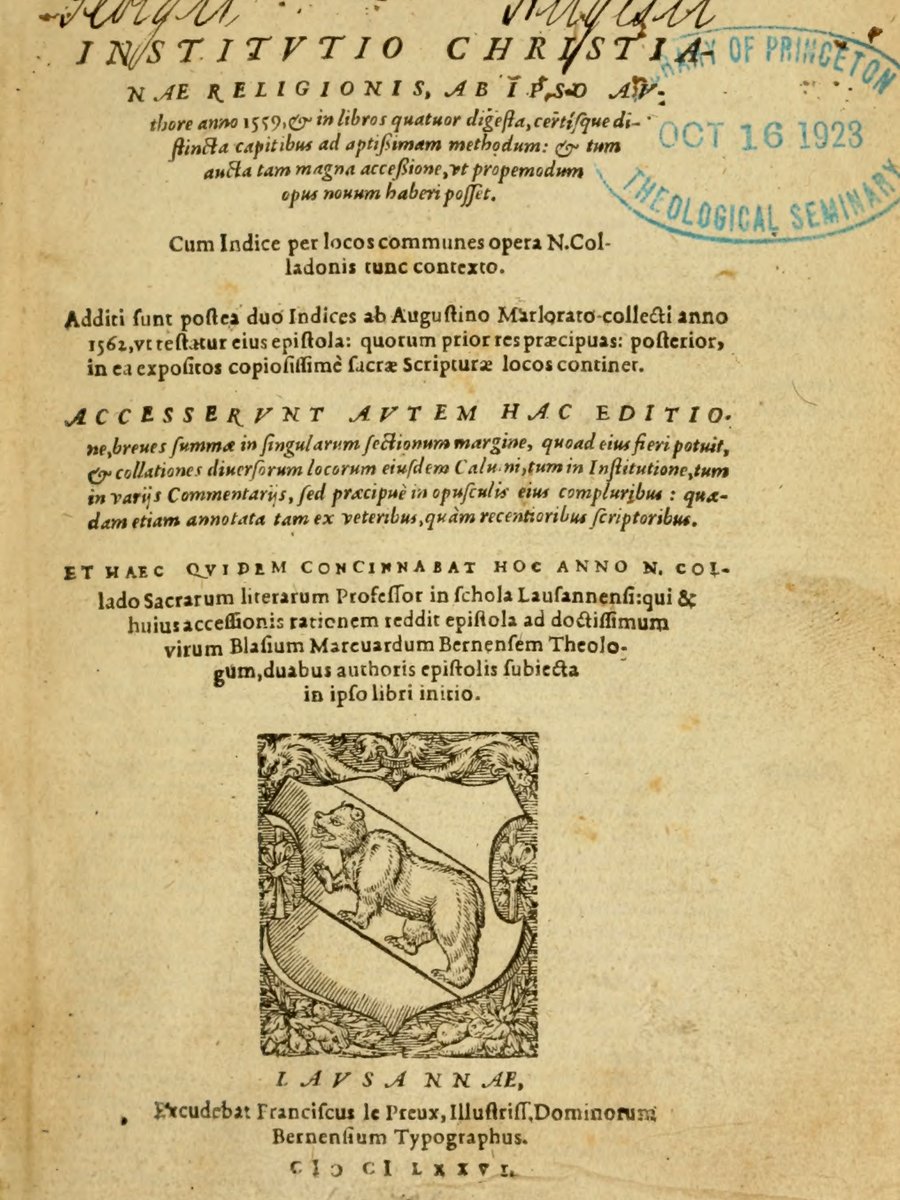
Prefatory Address to Francis, King of France
Praefatio ad Franciscum Regem Galliarum
Calvin's prefatory letter to Francis I, King of France (originally Basel, 1 August 1536), defending the Reformed faith against charges of sedition and heresy. Written when the persecution of French Protestants was intensifying, Calvin argues that the reformers are falsely accused of promoting disorder and licentiousness, that the true disorder comes from those who suppress the Gospel by fire and sword, and that the king should grant the Reformed cause a fair hearing. He answers the main slanders against evangelical doctrine—on original sin, justification, the sacraments, and Christian liberty—and closes with a prayer for the king and an appeal to divine judgment.
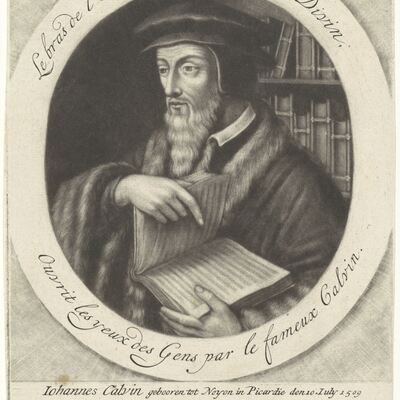 John Calvin·1536·Latin·Praefatio·fol. 3r–8r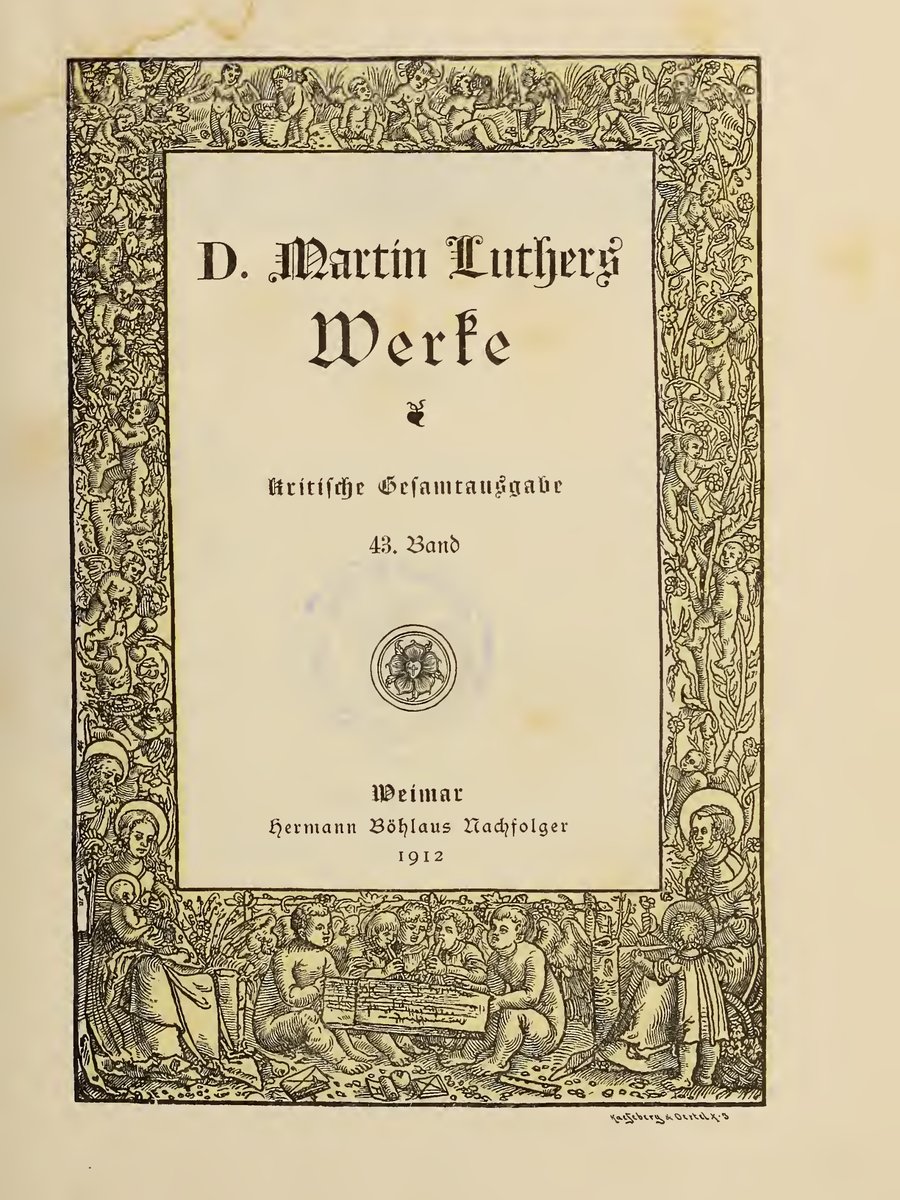
Lectures on Genesis: Genesis 23:3–4
In Primum Librum Mose Enarrationes: Gen. 23, 3–4
Luther's commentary on Abraham's words to the sons of Heth—"I am a stranger and a sojourner among you"—uses the patriarch's humble request for burial rights as the occasion for an extended treatment of simony. Luther draws on the canonists' definition of simony and the proper use of ecclesiastical revenues, contrasting Abraham's approach with the corruption of Church officials who improperly acquire benefices, burial privileges, and property through simoniacal means. The passage engages extensively with the canonical tradition, Gratian, and the abuses of the papal church in the administration of sacramental and temporal goods.
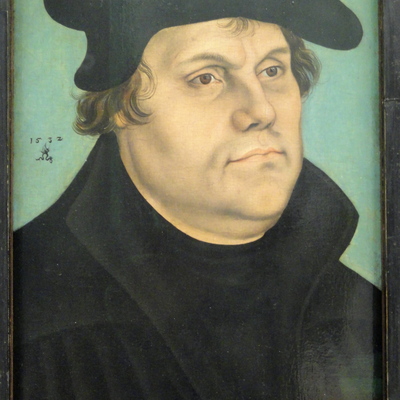 Martin Luther·1540·Latin·Genesis 23:3–4·p. 277–288
Lectures on Genesis: Genesis 25:31–34
In Primum Librum Mose Enarrationes: Gen. 25, 31–34
Luther's commentary on the sale of Esau's birthright reads the episode as a typological account of simony: Esau, who despises his spiritual inheritance for a bowl of lentils, becomes the type of those who traffic in sacred goods for material gain, while Jacob represents the faithful recipient of divine promise. Luther develops this through extended comparison of Esau with papal and monastic hypocrisy, contrasting carnal ostentation with the hidden, suffering life of genuine faith, and using the passage to reflect on the proper valuation of spiritual succession and ecclesiastical office.
Martin Luther·1540·Latin·Genesis 25:31–34·p. 419–432That all the ancients communicated under both kinds
Veteres omnes sub utraque specie communicasse
Paragraph 49 of Book IV, Chapter 17 of Calvin's Institutes marshals patristic evidence that both elements of the Eucharist were always administered to all communicants in the ancient church. Calvin cites Gregory I, Gelasius, Cyprian, and others to show that withholding the cup from the laity was considered sacrilege. He argues that the Roman practice of communion under one kind violates both the explicit command of Christ and the universal custom of the church for over a millennium.
John Calvin·1559·Latin·Liber IV, Caput XVII, §49·p. 2.716–2.717That the ancient form of church government was completely subverted by papal tyranny
Antiquam regiminis formam omnino pessum datam fuisse tyrannide Papatus
Book IV, Chapter 5 of Calvin's Institutes demonstrates that the papal system of church governance has nothing in common with the ancient church. Calvin surveys how the early church elected its bishops by clergy and people together, how no bishop claimed primacy over others, how councils were conducted without papal domination, and how clerical offices were held without the pluralism, non-residence, and luxury of the contemporary papacy. He concludes by contrasting the ancient diaconal care for the poor with the current diversion of church revenues to ornamentation and episcopal display.
John Calvin·1559·Latin·Liber IV, Caput V·p. 2.541–2.551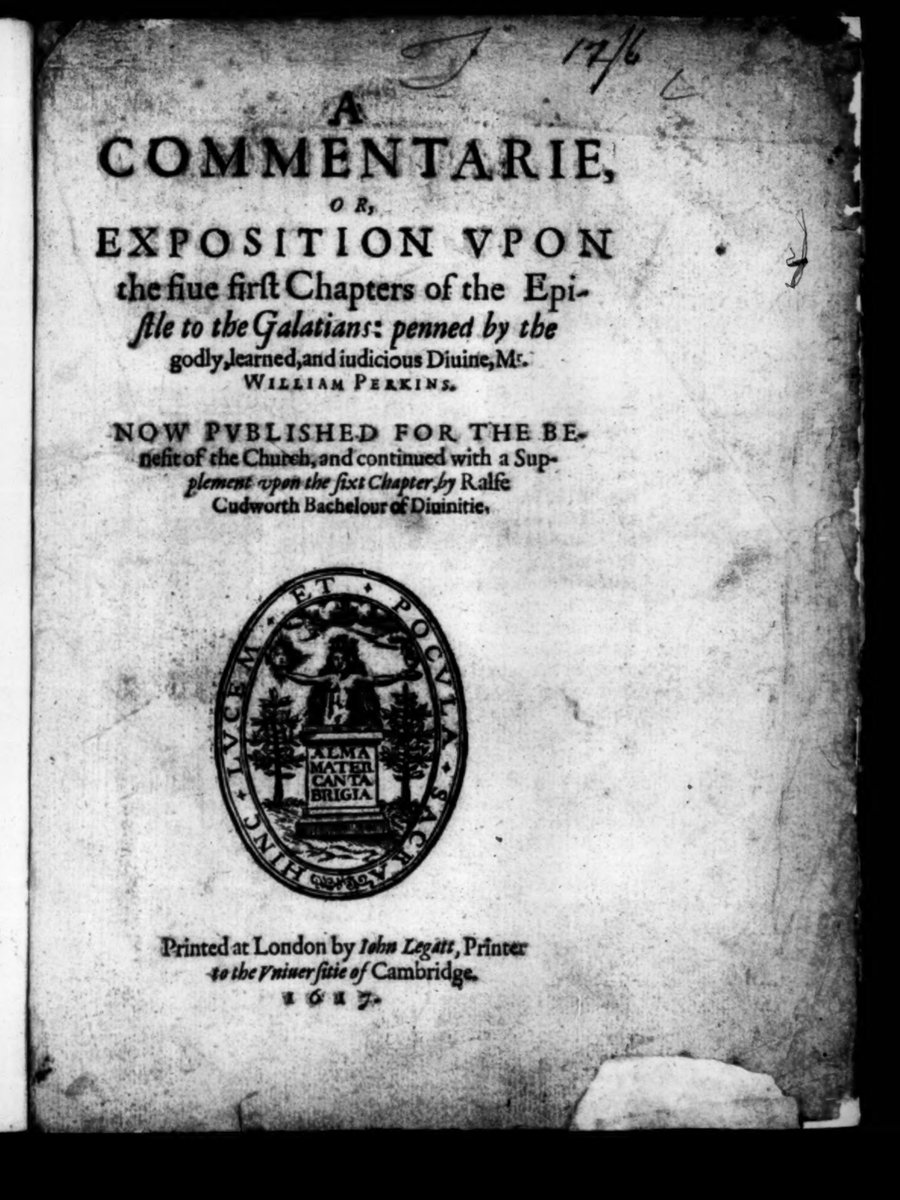
Commentary on Galatians 6:6
Ralph Cudworth's commentary on Galatians 6:6 — "Let him that is taught in the word, make him that hath taught him partaker of all his goods" — from his continuation of Perkins's exposition of the Epistle. The section treats the verse as an apostolic rule for the maintenance of the ministry, examining the meanings of "taught in the word," "him that teacheth," and "communicate." It argues from scripture, natural law, and civil law that congregations are bound to provide a sufficient and liberal allowance for their ministers, condemning those who withhold support or strip the Church of her revenues.
 Ralph Cudworth·1607·Early Modern English·Galatians 6:6·p. 467–480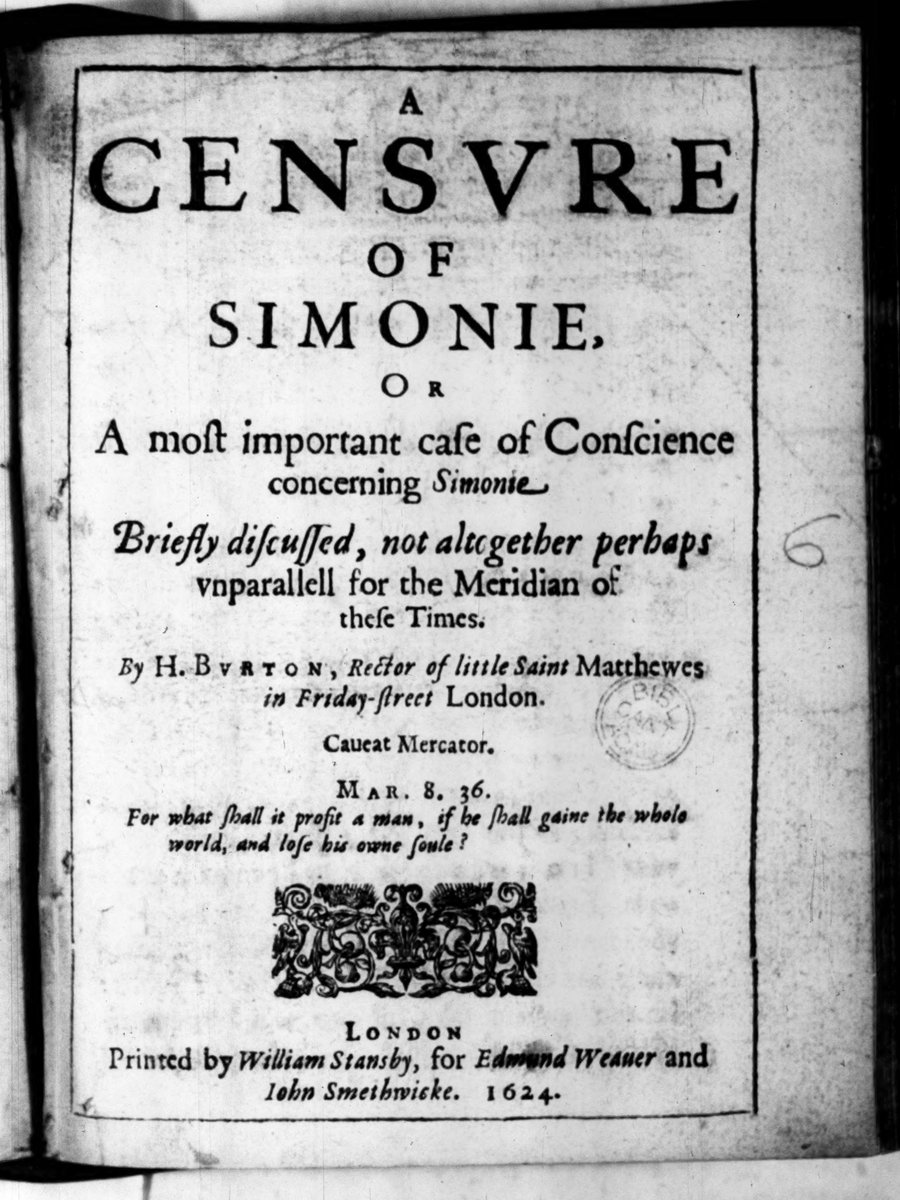
A Censure of Simony
A Censure of Simonie
A complete transcription and translation of Henry Burton's 1624 treatise against simony — the buying and selling of ecclesiastical offices and spiritual goods. Comprising fourteen chapters, Burton systematically defines simony from canon law and Scripture, examines its various forms (in presentation, institution, and ordination), refutes objections, and concludes with a protestation addressed to Prince Charles, calling for legal reform. The work draws on Gratian, scholastic theologians, and civil law to argue that contemporary English practices of purchasing church livings, tithes, and patronage rights stand condemned by the universal church.
 Henry Burton·1624·Early Modern English·Complete treatise·p. 1–134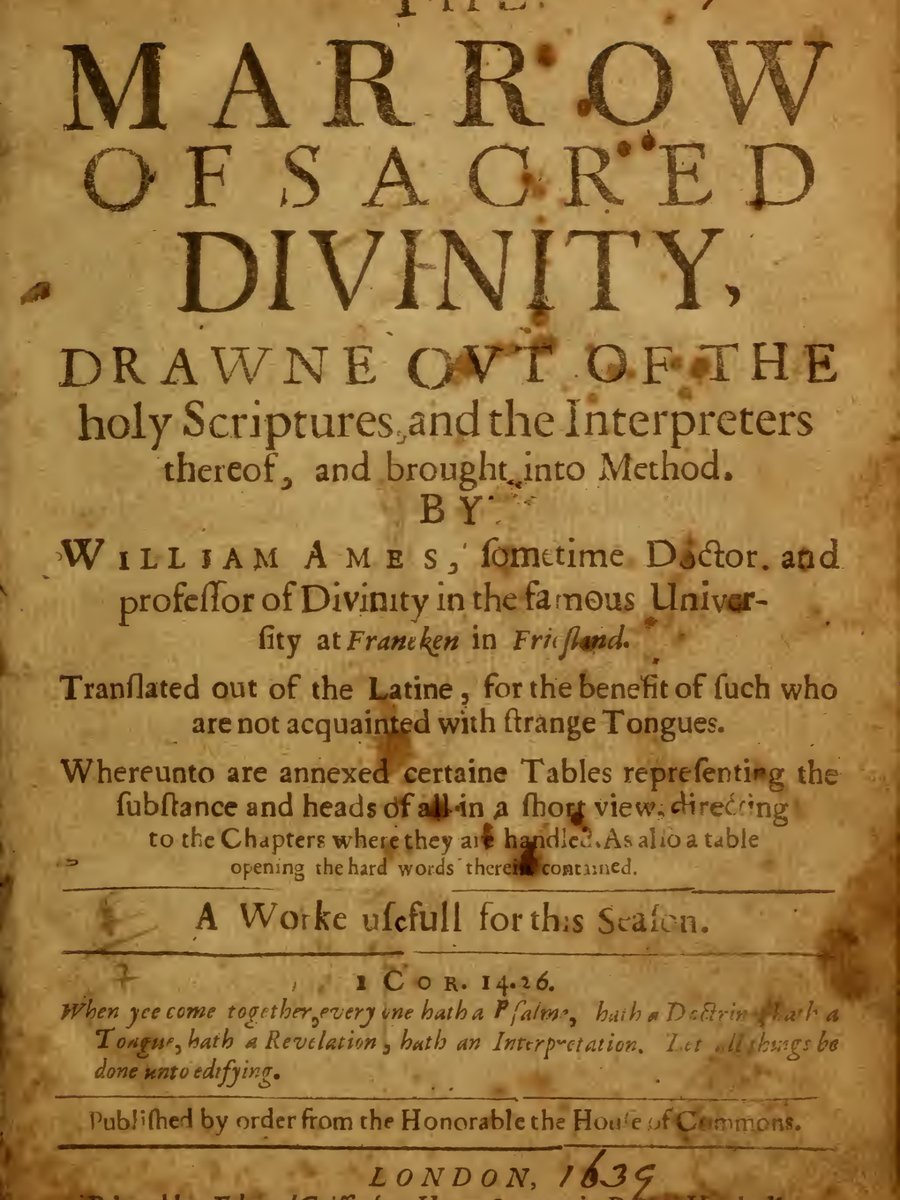
Of Justice and Charity toward our Neighbour
Book II, Chapter 16 of Ames's Marrow of Sacred Divinity treats justice and charity as the two principal virtues governing human relations. Ames defines justice as conformity to the second table of the Decalogue, distinguishing its distributive, commutative, and corrective forms, and differentiating justice strictly taken from equity and charity. He discusses the nature of obligation in contracts, the basis of restitution, and concludes by examining how ill will and unjust discord can culminate in schism when directed against fellow believers.
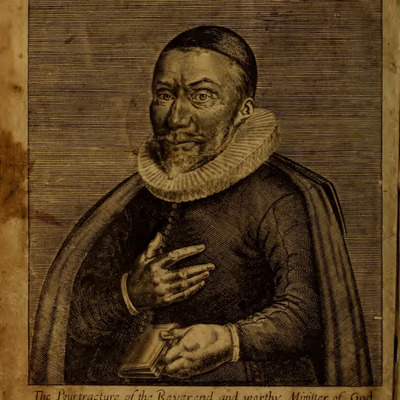 William Ames·1627·Early Modern English·Book II, Chapter XVI·p. 296–306
Of calling to the Ministry
Book IV, Chapter 25 of Ames's Conscience with the Power and Cases Thereof addresses the call to the ministry. Ames argues that a singular calling is required for the ministerial office, distinguishing it from the general duty of all Christians to teach. He examines what integrity of life, knowledge, and divine assurance are required of candidates, how a vocation is confirmed by the judgment of the Church, and on what grounds a minister may lawfully leave one congregation for another.
William Ames·1631·Early Modern English·Book IV, Chapter XXV·p. 64–71Of Contracts
Book V, Chapter 42 of Ames's Conscience with the Power and Cases Thereof treats the law of contracts. Ames defines the conditions required for a lawful contract — fit persons, free and promissive consent, and outward expression — and examines the matter, form, and end of contracts. The chapter addresses simony as the paradigmatic case of an unlawful contract, covering its extension to sacraments and ecclesiastical benefices, the three modes of simoniacal gift (hand, tongue, and observance), and the analogous corruption involved in the sale of public offices of jurisdiction.
William Ames·1631·Early Modern English·Book V, Chapter XLII·p. 229–237
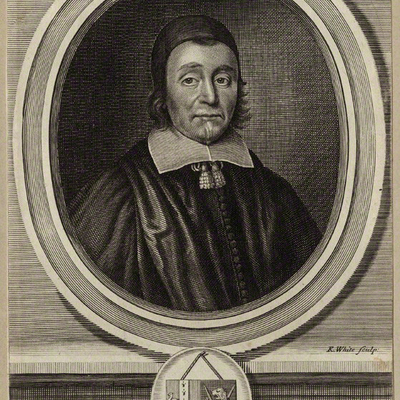
Sermon 38 on Matthew 24:45–46
Sermon XXXVIII on Matthew 24:45–46
The thirty-eighth sermon in Tuckney's collection, the second of two sermons on Matthew 24:45–46 ("Who then is a faithful and wise Servant, whom his Lord hath made Ruler over his Houshold, to give them Meat in due season?"). Tuckney treats this as the "2nd Work" on this text, focusing on the servant's duty of giving food: what the food is (not poison, not airy speculations, but solid nourishing doctrine), how it is to be dispensed to the various members of God's household according to their condition, and the importance of giving it in due season — catching the fittest opportunities of pastoral care. The sermon ends just before the title page of Sermon XXXIX on the same printed page.
 Anthony Tuckney·1676·Early Modern English·Matthew 24:45–46·p. 644–649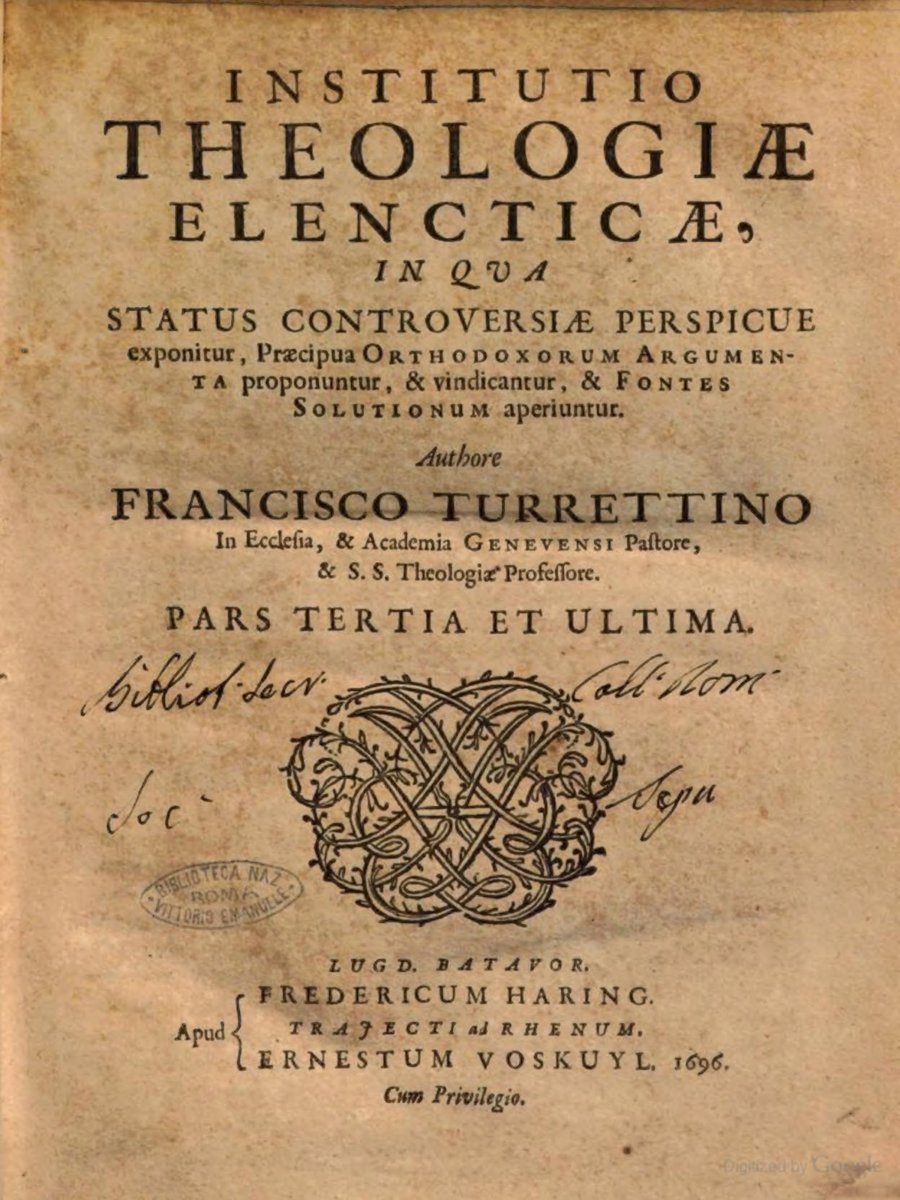
Where Our Church Was Before Luther and Zwingli
Ubinam Ecclesia Nostra Fuerit Ante Lutherum et Zuinglium
Section X of Quaestio X in Turretin's treatment of the Church provides the positive response to the Roman Catholic challenge demanding to know where the Reformed church was before Luther and Zwingli. Turretin argues that the question must be understood under four aspects—doctrine, persons, location, and form of governance—and that under the first and most important aspect (doctrine), the substance of saving faith has been preserved in every age through Scripture, the Apostles' Creed, baptism, and the Lord's Supper, even when the church lay hidden and was mixed with the corruptions of Rome, as God has always providentially conserved his elect until the Reformation.
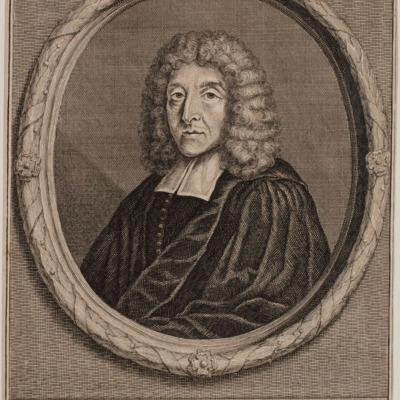 Francis Turretin·1685·Latin·Locus XVIII, Quaestio X, §X·p. 66–67
On the Stipends of Ministers and Ecclesiastical Goods
De Stipendiis Ministrorum, & Bonis Ecclesiasticis
Quaestio XXVIII of Turretin's treatment of the Church asks whether ministers of the church are owed some stipend, and answers affirmatively against the Anabaptists. Turretin marshals scriptural arguments from both Testaments to show that those who labor in the Gospel have a right to be supported by it, then surveys the legitimate sources of ministerial income—the labor of preaching, congregational provision, and endowments—while warning against the excesses of greed and luxury. He also traces the historical origin of ecclesiastical benefices and properties, acknowledging how an originally legitimate institution was corrupted by papal patronage and monastic accumulation.
Francis Turretin·1685·Latin·Locus XVIII, Quaestio XXVIII·p. 300–306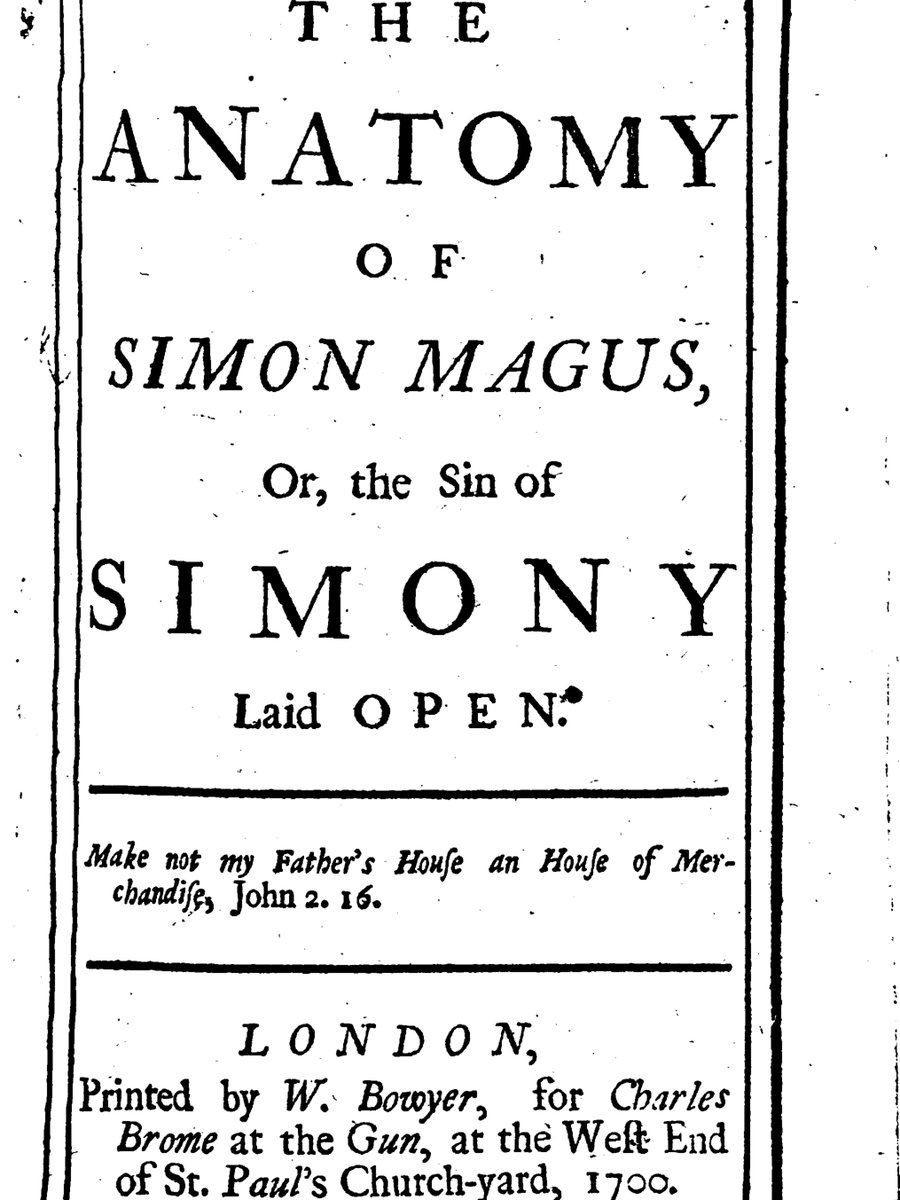
The Anatomy of Simon Magus
The complete text of the anonymous 1700 treatise on simony, comprising twelve chapters examining the nature of simony, its manifestations in the Church of England's patronage system, and remedies for it. The work addresses bishops and clergy, drawing on scripture and patristic sources to argue that simoniacal corruption destroys the whole fabric of the Church.
Anonymous·1700·Early Modern English·Complete Work·p. 3–212