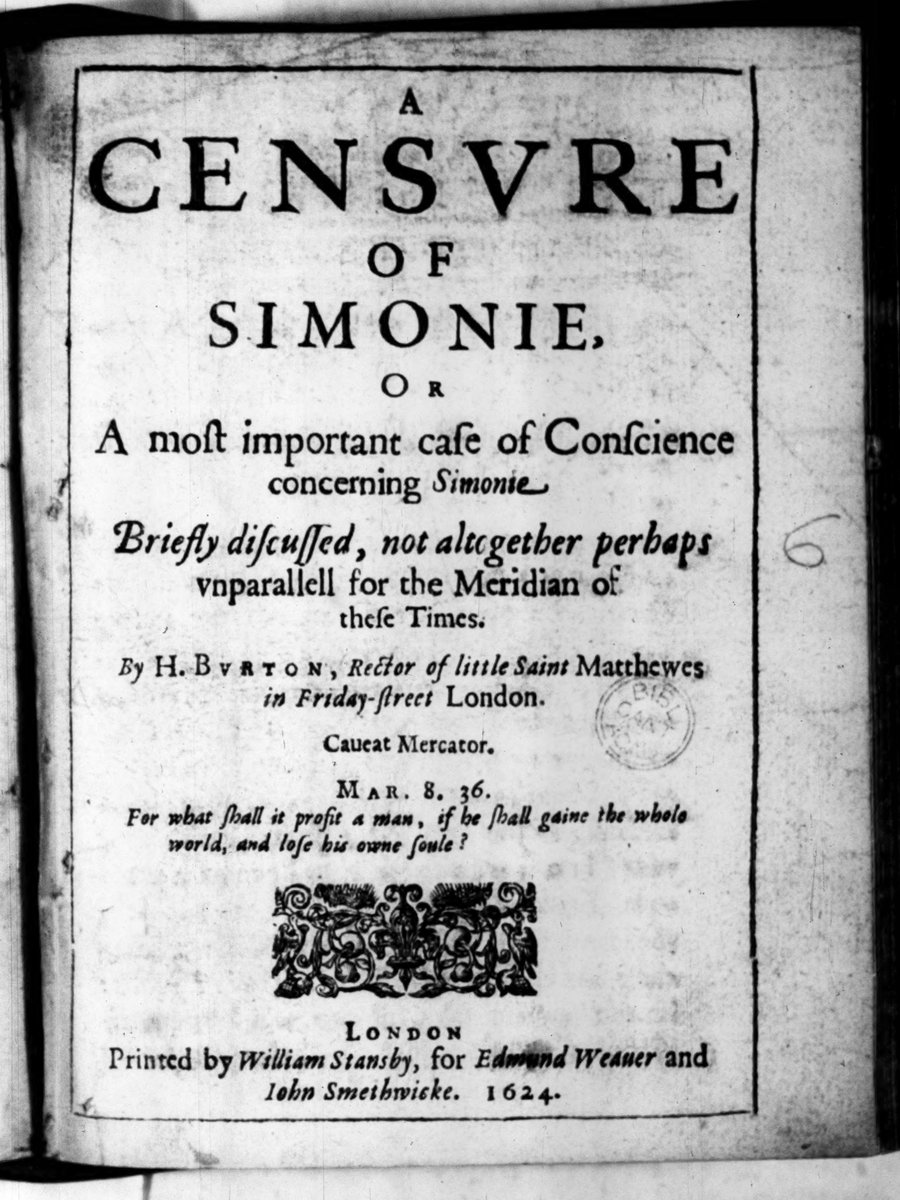
A Censure of Simony
A Censure of Simonie
 Henry Burton
A CENSVRE OF SIMONIE.
Here first I may seeme to vsurpe the Mathematicians priuiledge, in begging a Suppositum, that such a thing there is, as Simony. For in the opinion of many, Simony hath lost its being, in rerum natura, as being long agoe antiquated, and out of date, dead and buried with Simon himselfe. And if (as Chrysostome saith) the gift of giuing the Holy Ghost, was peculiar to the Apostles, so that not euen Philip baptizing, gaue the Holy Ghost withall; For this gift was proper onely to the twelue: and if Simony be sirnamed of Simon the Sire, and Simons Sinne was about the buying of the Holy Ghost: then that gift ceasing, and Simon being deceased, where is there left so much as the name of Simony, to lend a title to our intended Treatise? The Germanes haue very good Lawes to punish drunkennesse, but they find it very hard to define what drunkennesse is. So in England, we haue good Lawes to punish adultery, but wee find a great difficultie in conuincing any of committing the act of adultery. So it may bee said of Simony. First therefore let vs see what Simony is.
Wherein Simony is defined, first, generally and largely, then more strictly and exactly.
For the Definition of Simony, briefly, we may reduce it to the Authoritie and Testimony of two especially: to wit, the Canonists and Schoolemen, who haue beene the most exact obseruers and Collectors of what hath been deliuered by the most learned Doctors of the Church from time to time touching the nature of this matter.
matter. For the Canonists, let Gratian speake, who saith, Simonia est studiosa cupiditas, vel voluntas emendi vel vendendi aliquid Spirituale : Simony, is an intentive desire, or purpose to buy or sell some spirituall thing. And in another place hee addeth, Simonia est, emere vel vendere res Corporales Ecclesiae. It is Simony to buy or sell the Corporall goods of the Church. For Schoolemen, let Thomas Aquinas speake, who succeeded about one hundred yeeres after Gratian, hee saith in effect the same : Simonia est studiosa voluntas emendi vel vendendi aliquid Spirituale vel Spirituali annexum. Simony is an earnest desire of buying or selling any spirituall thing, or that which is annexed to that which is Spirituall. On these two Definitions (in effect One) depends the whole Law of Simony, hauing the testimony of the whole Church from the Primitiue age thereof, till this present. Zanchius vsing the very same Definition concludeth, Sic definierunt Theologi. All Diuines and Doctors haue so defined it. And not without good reason: For in these two Definitions is concluded whatsoeuer may be said of Simony, whither wee respect the Obiect, or the Subiect of it; in the Obiect, whether wee vnderstand the Spirituall gifts, or Corporall goods of the Church. in the Subiect (I meane not the Subiect of Predication, as Logicians speake, but of Inherence) whither wee vnderstand the Affection onely, or the Action also; Be it Actual, or bee it onely Intentionall. All is Simony. As Gratian also saith, Simonia committitur & circa ordinem, & circa Beneficium; Simony is committed both in respect of Orders, and in respect of the Benefice it self. The Councel of Constance hath decreed the same, That Simony is as well committed in the Title, as in the Order. But hereunto Gratian puts an obiection : Non videntur Spiritus Sancti donum emere, qui non pro consecratione, sed pro electione munera largiuntur: cum nullius spiritualis gratia aliquos faciat electio participes: that is, They seeme not to buy the gift of the Holy Ghost, who bestow their rewards, not for the Consecration, but for the Election. But he addeth the answer: Sed sicut Ecclesiasticarum rerum emptores simoniaci iudicantur, quia Ecclesiasticis officijs ita adiuncti sunt, ut alterum sine alte-
ra alieni non proueniat : ita quia per electionem peruenitur ad consecrationem, perinde simoniacus habetur, qui pro Electione premia largitur, ac si pro consecratione munera dedisset; But (faith he) as buyers of Ecclesiasticall things, are iudged simoniacall, because those things are so annexed to Ecclesiasticall duties, as one cannot haue the one without the other: so because by election a man comes to his consecration, hee is accounted no lesse a Simonist, who bestoweth gifts for the Election, then if hee had giuen his money for Consecration.
Now if the former Definitions seeme too large; especially to such, as would faine packe vp all Simony in the same fardell, with the gifts of the Holy Ghost, as Commodities of one and the same kinde; to gratifie these, we might reduce All to the same termes, and say, Simony is a Desire or Act of buying or selling the gifts of the Holy Ghost. So Master Caluin (in Act.8.) approues this to be the most proper Definition of Simony. Onely the Question is, what kindes of gifts of the holy Ghost may bee here implied, the Merchandizing and Chafering whereof, either is, or may well be called either Simony, or at least a branch of it. Lyra (in Act.8.) faith, Simon volebat emere potestatem dandi Spiritum Sanctum, intentione Lucri inde recipiendi : propter quod ab ipso nominatur vitium Simonia, quo aliquis vendit aut emit Spiritualia; Simon would buy the power of giuing the Holy Ghost, with intention of gaining thereby : as Saint Augustine faith: Quod venderet, emere volebat. He would buy that, which he purposed to sell againe.
For which respect from him is named the sinne of Simony; when any man buyeth or selleth Spirituall things. Now wee may reduce all those gifts of the Holy Ghost concerning his Ministers (for these onely are pertinent to our purpose in hand) to these two heads : either those gifts giuen by imposition of hands in Ordination, whereby Ministers receiue a ministeriall power to preach the Word, to administer the Sacraments, to remit and retaine sins, which is the dispensation of the Keyes: Or else those, whereby a Minister receiueth a particular Charge ouer this or that flocke,
flocke, which being done by canonicall and orderly calling, it is a gift no lesse ascribed to the Holy Ghost, then that other of Ordination. So the Apostle expresseth in his charge to the Clergie of Ephesus (Act.20. 28.) Take heed to your selues, and to the whole flocke of God, Whereof the Holy Ghost hath made you Episcopos, or Ouerseers. See here, to be an Ouerseer, whether Episcopus, by a note of Excellencie, as the Superior Ouerseer, or Superintendent ouer all particular both flockes and Pastors in his peculiar Diocesse: Or else euery inferiour and subordinate Minister in his seuerall Parish, placed as an Ouerseer or Watch-man ouer his flocke, as Lyra also vnderstandeth. This is the gift of the Holy Ghost. Now then to buy this gift, to be made a Bishop ouer such a See, or a Pastor, or Rector of such a flocke, doth it not iumpe with this definition of Simony? For Simony is a trucking of the gifts of the holy Ghost: but such an Ouerseership is a gift of the Holy Ghost. Therefore to buy this gift, is Simony.
Wherein the former definitions are cleered from certaine obiections and nice distinctions.
But for answere to our former Argument, The sophisticall Simonist, or simoniacall Sophister, distinguisheth, Inter Beneficium & beneficium, betweene the Benefice, and the benefit; Or more distinctly, Beneficium emit, non officium: He buyeth the profit, not the office: Non Curam, Sed curam; not the Cure of others soules, but the Cure and prouision for his owne body. Paschalis answereth this obiection: Si quis obiecerit non consecrationes emi, Sed res que ex consecratione proueniunt, penitus desipere probatur; Nam cum corporalis Ecclesia, aut Episcopus, &c. If any shall obiect that hee buyeth not the Consecrations, but those things which follow and attend the Consecration, hee is a manifest Dotard. For seeing a Corps
Corps of a Church, or a Bishop, or such, cannot subsist or be maintained, without things Corporall; no more then the soule can liue corporally without the body; whosoeuer selleth the one of these, without which the other cannot goe alone, hee leaues neither vnsold. Whereupon Gratian faith, Quando quis promouendus est ad Ecclesiam vel ordinem, fructus proueniunt iure ordinis; & ideo non licite emit. When a man is to be promoted to a Church or Bishopricke, or to the order and office of it, the fruits doe follow by right of order, and therefore the purchase is not lawfull. Both Pascals comparison, and Gratians reason, are apt and good. For there is such a mutuall and immediate relation, yea, combination and vnion betweene the Ministery and the Maintenance, as one cannot Subsist without the Support of the other, no more then the soule can exercise sundry faculties (especially those sensitiue offices) without the instrument of the body, or the body can doe her Dutie, without her ordinarie Diet. And as Boaz tendered to his kinsman the purchase of Elimelecks Lands, which at first offer he was willing to buy; but told him withall, that hee must purchase it of Naomi by marrying Ruth, both must goe together: So he that will buy the lands or inheritance of the Church and of the Ministry, hee must make account to buy Ruth with it. The maintenance & the ruthful, and carefull office of the Ministry goe hand in hand together; buy the one, and buy the other too. Therefore anciently Ordination did vse to carry the title with it; as Concil. Chal. Can. 6. So that hee who would buy the Maintenance, must buy also the Ordinance. And is not as well the Maintenance, as the ordinance of the Ministery, a gift of the Holy Ghost? Doth not the Lord say, I haue given the tithes to the Leuites? and are not these tythes holy? And who can giue a holy gift, or make a gift holy, but the Holy Ghost? Whence I inferre this Conclusion: Simony is a Desire, or Act of buying or selling the gifts of the Holy Ghost: but tythes, holy tythes are a gift of the Holy Ghost: Therefore, the Desire or Act of buying or selling holy tythes (by which I vnderstand all Church Maintenance) is Simony.
So that the Simonists former distinction serueth onely to distinguish betweene right reason, and his owne fond imagination, which are no way compatible, but must needs make him, vt cum ratione insaniat. And truely I very easily beleeue, that hee speakes as hee thinkes? For few such Merchants would bee at that cost, to purchase such a Cure, were it not for the Commodity, as Chrysostome saith, I suppose no man, though neuer so thirstie of glory, would euer be made a Bishop, vnlesse necessitie called him thereunto; For who is sufficient for these things? And Cardinall Poole, being charged by a Cardinall of the aduerse faction, with ambition in ouer-hasty seeking after the Popedome, answered, That he thought not the burthen of that great office to be so light, but that he was of the minde, that it was rather to be feared, then desired. But later times are so pregnant, producing such sky-soaring spirits, as now, who is not sufficient for these things? And what reason hath any man of reason to thinke, that these sufficient men should haue such leaden heads, as once to vouchsafe to reach out their golden hands, to the end to purchase and pull vpon themselues the burthen of such a Cure: no more then he would thinke, that such would euer bee content (if it were possible) to become ioynt-purchasers with Christ, whose Bishopricke cost him the shedding of his most precious bloud; no nor euer imitate Saint Pauls example, Phil.2.17. or obey Saint Johns precept, 1.Ioh.3.16.
Wherein other shifts and euasions are met withall.
But what is become of my Simonist? I thought I had catched him fast euen now with my Sillogisme. But Quo teneam vultum mutantem Protea nodo? How shall I hold this shifting Proteus? with what Cords or Wychs shall I bind this Sampson-like Simon! Emit, non Emit : beneficium, non
non Beneficium : curam, non Curam, But at the last, hee must confesse (and therein hee mockes not) that hee hath certaine Lockes, whereon neuer came Razor; that is, certaine Flockes or Fleeces neuer yet polled from the Church, or not touched (at least in his owne sleepie sense and apprehension) with the Razor of Conuiction vnder the name of Simony. The temporall benefit indeed hee hath bought, to wit, the Glebe, the Tythe, and the like: proue this to bee Simony, & then I shall be as other men. And in this his conceit, hee is as strong as Sampson: yea, so confident, that hee dare say, that Tythes are meere Temporalls, Lay Fees. But as Sampson, after his lockes were shauen, neuer thought that his strength was gone, till by wofull proofe he found it: So our Simon here, thinkes all is well with him, so long as he strongly imagineth that his Tythes are but Temporalls; and so long, no Simonist, not as other men.
But now Sampson, the Philistins bee vpon thee; yea, stronger then the Philistins, A Troope of Truths doth beset thee. What? Tythes temporall? In what Grammer haue you learned to ioyne this Substantiue and Adictiue together? I am sure not in Gods Booke? There is no such incongruitie, no Solecisme, no false construction there. There he deserues the Ferula, the Rod, a ve, that incongruously calls Sower, Sweet: and Sweet, Sower; Good, Euill; and Euill, Good: And shall hee escape, that calls Sacred, Secular? Tythes, Temporalls? Or he, who saith, Giue vnto Caesar the things that are Gods? Let mee but a little shake Aarons Rod, and Christs many-corded Whip, at our indisciplined Simon, to make him at least attentiue to what the Scripture faith. Tythes, I am sure, were once Sacred; and what God hath once Sacred, call not thou Common. But when Sacred? When? Why not, when Adam was first Created? When hee was endued with the ten Moralls of the Law? And is it not more then probable, that among the ten, the Lord allotted a Tythe, for the maintenance of his seruice: Seeing among the ten hee appointed a time for his
his seruice, euen the Sabbath Day, the Sanctification whereof, Tythes were properly to attend vpon? Tythes then, no doubt, were sacred from the beginning of Adams creation. For else, when did Abraham learne to pay tythe of All to Melchisedech, the Priest of the most high God? Or what moued Iacob to vow the paying of Tythes? Was it onely from the Example of his grandfather? Or were his Tythes onely voluntary and arbitrary, till by vow made necessary? Why not then his other seruice, which he then vowed, which he was bound to performe, though hee had not vowed it at all? His vow was but a stronger Bond to hold and helpe him, to the better performance of that dutie, which notwithstanding was due without a vow. As our solemne vow in Baptisme is but a stronger Bond to tye vs to that obedience to God, which wee ought most carefully to performe, no lesse, then if wee had not vowed at all.
But if as yet you deny Tythes to bee Consecrate and Sacred, by diuine instinct or institution, as wanting expresse precept: yet at least you your selfe cannot but confesse they began then to be sacred, when God said (Leuit.27.30.) All the Tythe of the Land, both of the Seed of the ground, and the fruit of the Trees, is the Lords; it is holy to the Lord. Yea, so holy, so sacred, that (as in the next Verse) If any man shall redeeme any of his Tythe, he shall adde the fifth part thereto. And euery Tythe of Bullocke, and of Sheep, and of all that goeth under the Rod, The tenth shall be holy unto the Lord, v.32. Yea, so holy, as v.33. He shall not looke if it be good or bad, neither shall he change it, else if he change it, both it, and that it was changed with all, shall be holy, and it shall not be redeemed. Loe then, how sacred Tythes bee ratified by a double Tense, They are holy, and, They shall bee holy to the Lord: As Iacob confirmed his sonnes blessing, I haue blessed him, and hee shall bee blessed. And where it is said, That the Tenth Is holy to the Lord, * a Learned and Reuerend Prelate of our Church in his Booke of Tythes, hath out of the Present Tense, drawne
drawne this obseruation, That the Tenth began not now to bee sacred, or consecrated, but onely to bee appropriated for the time to the Leuites, concluding the Ordinance to be morally perpetuall from the Creation.
Tythes in the New Testament proued to be equally Sacred with those in the Old, against the Simonists obiection: and consequently the definition of Simony, concluded according to the former definitions of it, by the Schooles and Canons.
Yea, faith our Simon, I deny not, but that the tenth was holy and sacred during the time of the Old Testament, but it ceaseth to be so now in the New. O Heresie, worthy of Simon himselfe! O Folly, well beseeming the Aramites! who being alreadie ouercome in the Mountaines, promised to themselues the Victorie in the Vally, Saying, The Lord is the God of the Mountaines, and not God of the Vallyes: And is the Lord the God of the Old Testament, and not God of the New? Yes, euen of the New also. For Marke: The Tythes were not said to bee holy to the Leuites, but to the Lord; Nor, that they were the Leuites, but the Lords? The Tythes is the Lords, it is holy to the Lord, Leuit.27.30. Therefore the Lord rebuking the Iewes for neglecting the payment of their Tythes, hee takes the wrong as done to himselfe, saying, Yee haue robbed Mee. Mal.3.8. Hee faith not, Yee haue spoyled the Leuite, and the Priest, but, yee haue spoyled Mee. Yf then the Lord himselfe, and not the Leuite bee intitled and interested in the proper right of Tythes, then certainely they are as sacred now in the New Testament, as euer they were in the Old. The Tythes are holy to the Lord. Lewit. 27.28. and they shall bee holy to the Lord, v. 32. They are holy (it was said then) to the Lord of the Old Testament, and they shall bee holy
holy to the Lord of the New Testament: And to vs there is but one Lord.
And tell mee, foolish selfe deceiving Simonist, whosoever thou art, tell me when and where Tythes ceased to be sacred? and if thou canst not tell, how darest thou call them Temporalls? But let me tell thee by the Word of the Lord, that Tythes are perpetually sacred. Search the Scriptures. Goe learne what that meaneth, Abraham gaue Melchifedech Tythe of all. If thou vnderstandest it not, aske the Apostle: and it is worth the consideration, For Consider (faith hee) how great this man was, unto whom euen the Patriark Abraham gaue Tythe of the Spoyls. Abraham, the Father of all the Faithfull, not of the Iewes onely, but of vs Gentiles also, paid Tythe of All. To whom? To Melchifedeck. And what was this Melchifedeck? Priest of the most high God, King of Righteousnesse, King of Salem: in all, a perfect Type of Christ our eternall high Priest, the Lord our righteousnesse, Prince of Peace. Did Abraham then the Father of the Faithfull, yes, the Type of Gods faithfull Church, in the Loynes of whose faith (as I may say) were all the faithfull, giue the Tythe of all to Melchifedeck, the true Type of Christ our eternall high Priest, and the Minister of a better Testament? and shall wee doubt to tread in the steps of faithfull Abraham, except wee will be Bastards and not Sonnes? And if the Apostle vse it as an Argument to proue Christs Priesthood more excellent then Aarons, inasmuch as euen Leui in the Loynes of Abraham paid Tythes to Melchifedech: How doe wee then vphold and maintaine this Prerogatiue of Christs Priesthood, while wee either deny or diminish his right of Tythes in the Ministry of the New Testament, Sith Aaron, who was farre inferiour, received Tythes in the Old; yes, rather, if the Leuiticall Priesthood, being inferiour, received Tythes: then the Euangelical, being superiour, much more. And why is Leui said in the Loynes of Abraham to haue paid Tythes to Melchifedech? but plainly to giue vs to vnderstand that this payment implied an acknowledgement of Christ their Soueraigne Lord and true high Priest,
as in whose onely title and right they also receiued Tythes. Hence is it, that all the Leuites paid the tenth of their Tenths to Aaron the high Priest, and to his Successors; Hee being also a* Type of Christ, Let euen the spirit of contradiction it selfe, but note how frequently and how effectually the Apostle presseth the right of Tythes resident in Christ, as a notable proofe of the eternitie of his Priesthood. For in the seuenth Chapter to the Hebrewes, the Apostle mentioneth this argument of Tythes no lesse then six or seuen times; as, Verse 2.4,5,6,8,9. Hee therefore that denieth Tythes to bee due to Christ in the Ministry of the New Testament: what doth he else but deny the eternitie of Christs Priesthood, the ministration wherof must continue till time shall be nomore. Yea, he must also deny, that Melchifedeck was a true type of Christ, by vertue of receiuing tythes: if now Tythes bee not really due to Christ in the New Testament, as they were typically prefigured in the Old.
Againe, when began Tythes first to be paid? Was it not so long before the Law was giuen, or the Leuites borne? Could the Leuiticall Law then disannull the nature of Tythes, that they should not for euer continue sacred, being before the Law consecrated in Act by our Father Abraham, the Type of Christs Church, vnto Melchifedech the Type of our eternall high Priest Christ Iesus? * Decimas Deo, & Sacerdotibus Dei dandas Abraham factis, & Iacob promissis insinuat; & omnes Sancti Doctores commemorant, That Tythes are to bee given to God, and to the Priests of God, both Abraham by fact, and Iacob by vow doth insinuate: and all holy Doctors doe avouch it. Admonemus vel præcipimus, vt Decima de omnibus Dari non negligatur quia Deus ipse sibi Dari constituit, &c. Wee admonish and command that the tenth of all things be not neglected to bee paid, because God himselfe hath ordained it to bee given to himselfe. And the perpetuitie of Christs Priesthood is proued by Tything, as Heb.7.8. There hee receiueth Tythes, of whom it is witnessed that hee liueth. Or let the Simonist goe learne what that meaneth, Euen so hath
hath the Lord ordained, that they which preach the Gospel, should liue of the Gospel. Who seeth not, that the Apostle there, doth paralell the Leuiticall maintenance, and the Lords Ordinance, the Altar, and the Gospel together. And doth not the Apostle there challenge to himselfe a power in such maintenance, as well as others? Marke; power. And whence, but from the Lords Ordinance? And where appeareth the generall practise of this Ordinance, but in the Leuiticall Maintenance? And where hath this Maintenance the first foundation and institution (besides the Creation) but in Christ, figured in Melchifedech, who receiued Tythes of Abraham, the father and figure of all the faithfull, the Church of God? And shall not Tythes then be for euer sacred? And if sacred, is not hee a prophane Simonist, that offereth to buy them? Yea moreouer, are not the Ministers of the Gospel called the sonnes of Leui? Mal. 3. 3. The text is pregnant, and plaine, and Interpreters subscribe to the truth of it. Christ was to refine the sonnes of Leui, that they might offer to the Lord in righteousnesse; that is, his Apostles and Disciples of the Gospel. These are called the sonnes of Leui, because they succeed Leui, in the Ministry. And if wee be Leuies sonnes, who shall deny vs Leuies inheritance; seeing wee are Leuites to the same Lord, the perpetuitie of whose Priesthood, the paiment of Tithes to his Leuites are a pregnant argument of. And if yee deny him Tithes, you must of necessity deny him the Priesthood too, & so with the Iewes conspire to kill him, that the inheritance may be yours. Yea, we are Leuies sonnes refined and purged from the refuse of Legal Types and Ceremonies: & shall our Tythes be lesse sacred! Obiect. But some will say: Wee haue no expresse Precept in the Gospel for paying of Tythes. I answere, There are demonstrations enow, and those most strong. But what needs any expresse Precept? The Precept is expresse enough in the Law. He that is more seene in the Law, then in the Gospel, and stands more vpon Antiquities, then Verities; If the God of this world had not blinded his eyes, might acknowledge the antiquitie of this Precept in the Law to be
be so plaine, as it needs no further explication or reestabliment in the Gospel. The Tythe is the Lords, saith the Law. And doth not the Gospel ratifie the same, saying, Giue vnto God those things that are Gods? Is not this an expresse Precept. Indeed Christ and his Apostles being busie in founding a new Church, suspended the practice of receiuing Tythes, vntill the decrepite Synagogue of the Leuiticall Ordinance expired, and the finall obsequies thereof were fully ended. But they left abundant euidence in their Gospels, to euict the right of Tithes to Christs Ministers, in the succeeding ages of the Church.
To conclude this point, That Tythes and all Church maintenance (call it what you will) benefit, or Benefice, profits, or corporall goods, they are holy, and of a spirituall nature, because they are consecrate to a holy vse: I doe not say, that Res decimarum, the things whereof Tythes consist, are in their owne nature spirituall: but qua Decima, as they are Tythes, consecrate to a holy end, and vse, they put on a spirituall nature. For euen as the bread in the Sacrament before it bee consecrate, and sanctified by the word, it is common; but after the consecration, it becomes Sacramentall and spirituall bread (which is that change the ancient Fathers so vsually speake of, not that bastard substantiall change, which the Pontificians would falsly father vpon them) in which respect the Apostle calleth the Manna, and the water of the Rocke, in regard of their typicall signification, spirituall meate, and spirituall drinke: So those things whereof Tythes and all Church maintenance consist, in their owne nature, are temporall and common, but being dedicated to God to a holy vse and end, they are not to be holden any longer for temporall, but spirituall, I say in regard of their spirituall end and vse, for which they are consecrated. And what is the end and vse, of such consecrate things? Is it not for the maintenance of Christs Ministers? and are not they in their persons, in their profession, by calling spirituall? and of what nature then can their maintenance be, but Spirituall? For Omne nutritur a Simili, Spirituall
rituall men, and spirituall meate: both of a like nature, both a like consecrated to God. So then Tythes, or Church liuings, comming within the Verge of the definition of Simony, as being not onely annexed vnto spirituall things, but spirituall things themselues: it followeth necessarily, that to buy or sell such spirituall things, is Simonie. The definition then of the Schoole-men and Canonists formerly cited, stands firme and good, having all the termes and parts of a perfect definition, according to the rules of Logicke: which in briefe may be reduced to a syllogisme thus: Emptio vel venditio rei spiritualis est simonia: sed decima sunt res spirituales: ergo emptio vel venditio decimarum est simonia. Emptio & venditio, is the Genus: Simonia, is the Species: and res Spiritualis, is the Differentia. As Homo est animal rationale: is a perfect definition: having the Genus, the Species, and Differentia. Therefore according to the definition of Simonie, to buy or sell any spirituall thing, is Simonie. In which respect Iudas in selling Christ, is said to commit Simonie: Non solum plagium commisit, quod liberum hominem: sed & Simoniam, in eo quod rem sacram vendidit: Hee committed not onely the sinne of man-stealing, by selling a free-man: but also of Simonie, in selling a thing sacred or spirituall.
Other euasions or starting holes stopped. Obiections answered.
But the Simonist hath yet another vsuall starting hole, whereinto he creeps, when he is pursued with the Hue and Cry of Simonie: hee confesseth indeed, because he cannot denie it, that Tithes are perpetually consecrate, and so, spirituall; and therefore to buy or sell them is Simonie: but hee sayth, hee buyeth not the Tithes; but either the Gleebe, or the Temporalls annexed to his Benefice, or Bishopricke. Well, to answere this, we will not take the benefit and aduantage of
of the definition of Simonie, which includeth as well those things annexed to spirituall things, as the Spirituall things themselves; but wee say, that such Gleebe and such Temporalls are now Spiritualls, as Tithes be. Foras well the Free will offerings and Oblations, as the Tithes were called holy. If a man dedicate to the Lord any ground of his inheritance, the field shall be holy to the Lord, when it goeth out in the Iubile, as a field separate from common uses; the possession thereof shall be the Priests. Such Gleebs therefore and Lands commonly called Temporalls, are indeed not temporall, being once freely and solemnly given by vow of our noble Predecessors vnto the Lord, for the more honorable maintenance of his Church; but they are now spirituall, sanctified and separate from common vse, as Tithes bee, they are holy to the Lord. Therefore, as it is a snare to denoure that which is thus sanctified, and after such vowes to enquire: So the Simonist doth but intangle himselfe in a snare, as the Conny is in her owne Burrow, when hee makes this his starting hole; that so long as hee buyeth but the Temporall lands of the Church, hee commits no Simonie. Sed cominus res agatur. Simoniace, quid emisti? Glebam inquis, aut (te arbitro) Temporalia. Quanti emisti? Tantis. Agedum. Permittatur iam arbitrio calculorum, quantum inde sis lucratus, & num te negotiatorem satis prudentem cautumque præstiteris. Annui gleba tua reditus æstimantur forte 20. li. aut supra; ducentis vero, aut trecentis, aut quadringentis libris emisti. Na tu, hæreditatem tibi ac posteris, tandidem emere potuisses. Summa igitur, si computetur, huc recidit, quod hoc tuo mercimonio teipsum prodideris aut puerilem mercatorem, aut (quod magis suspicor) egregium veteratorem. Excute vero tuam tanta causa nimium indormientem conscientiam, & fatebere tandem, non te glebam tanti, nisi decimarum maior fuisset ratio, emisse. Vel sicut siquis domicilium charius emit, bonæ viciniæ gratia. Eadem prorsus ratio latifundiorum Episcopalium, vulgo Temporalium, habenda est. Emit quis, non Episcopatum, sed Temporalia, non quod sacrum est, sed quod seculare. Ista autem Temporalia partim ex latifundiy vtilitate, partim ex dominis dignitate æstimantur. Quanti autem constet
constet Ecclesiasticus honor, mihi non constat. Nec quenquam arbitror φιλοδοξιαν seu φιλοτιμιαν præ se tantum laturum, vt dicas se honorem Ecclesiasticum emere. Si vero quod reliquum est Temporalium emat, viderit Emptor, ne quantum rem emptam pretium superat, tantum ipsum se honorem non neglexisse videatur. Nec quamquam existimo eo processurum audacia, ut dicat, tantundem esse, honorem Ecclesiasticum & ciuilem emere. Nihil addo amplius. Satis est quod hic noster mercator ex sua ipsius conscientia arquatur. Nec sibi cauere poterit, quin in istorum Scopulorum alterum, Directe, vel Indirecte, misere impingat. But let this suffice to haue showne, both by euidence of Holy Scriptures, and testimonies of Ecclesiasticke Doctors, and learned Diuines, that all buying and selling any Church preferments, vpon what pretence soeuer, is grosse Simonie, how finely and artificially soeuer conueyed.
Simonists conuicted by the vniuersall voyce of common Fame.
IF Gods Word were altogether silent in the Law of Tythes, leauing them as a thing indifferent to bee paid or not, according to mens fancies and wills; and that the Scriptures had consequently no show of arguments to conuince Simonists, as wee haue heard: yet euen the generall voyce of common fame (mee thinkes) should bee sufficient to cry downe Simonie, and to present it in the Spirituall Court, or to procure a Decree against it in the high Court of Conscience. And here before the Barre of this unpartiall Court, let mee by Writ Summon the Simonist to appeare. Thou hast bought some Benefice; or other Ecclesiasticall preferment in the Church, but hast so carried and conueied the matter, as the world cannot bee witnesse how much thou hast giuen: yet so, and so much thou hast giuen, as by some circumstance or other, generall notice is taken of it (for such corruption
corruption will soone cast abroad a sauour) whereupon a common fame is raised vpon thee, that thou art a Simonist. So that if thou wilt be tried by God and the Countrey, thou art sure to bee condemned for a Simonist. For vox populi, vox Dei, euerie one saith thou art a Simonist; therefore thou art one. Euen as an intemperate or incontinent person in a Parish; the one is commonly drunke, the other followeth harlots, euerie boy in the street points at them; There goes a Drunkard, There goes a Whoore-master; But yet for all this, neither will the one confesse himselfe a Drunkard, because hee keepes his feet; he wallowes not in the kennell, hee can vse his tongue, and the like; Nor the other will bee an Adulterer, because hee thankes God, hee medleth not with other mens wiues, but vseth onely for recreation to meete with merrie companie, although in suspected places, to see their fashions, and to learne rather to hate women, then to loue them. And if hee enter into more familiaritie with them, it is but simple fornication at the worst, and (according to Romane-Catholike Doctrine) a Veniall sin, which his nature is now and then necessitated vnto, for his healths sake: Iust so, is our common Simonist. Hee hath deuoured pluralities of preferments, as so many full cups; hee hath deflowred so many, once Virgin Churches, the Patron perhaps, or some for him being the Pandor; so that euerie one can point with the finger, There goes one who paid so much for such a Benefice, such a D. such a B. Yet for all this hee will bee no Simonist, because, forsooth, hee hath not bought the Holy Ghost; nor by way of Lapse entred vpon anothers Liuing, as it were, another mans wife, which some flaw in this wife, not fault in the Incumbent, hath brought into the lapse, and so now free for any to sue out a Divorce, and marry her, though so, as he commits adulterie with her.
But thou wilt say, It is one thing to bee called, and another thing to be; Though the ignorant vulgar call mee so, yet it therefore followeth not, that I am so. Things are to be measured not by report, but by reason; and the vulgar can
can giue no other reason of calling me a Simonist, but onely because Simon bought the gifts of the holy Ghost, and I onely buy the corporall commodities of the Church. Well, yet if there were no other respect, but this, how ought euery Minister especially to bee carefull of preseruing the credite of his holy calling and profession: As Saint Hierome writing, De vita Clericorum & Sacerdotum, saith. Caueto omnes, suspitiones, & quicquid probabiliter fingi potest, ne fingatur, ante deuita. Avoid all suspitions, and whatsoever may bee probably forged, preuent it first, that it may not bee forged. For as euery good Christian ought not onely to abhorre Adulterie and all vncleane Acts; but also to direct his conuersation so, as he may preserue his good name from the least suspition of lightnesse and dishonestie: so euerie good Minister of Christ should so much detest the sinne of Simon himselfe, as to decline whatsoeuer hath any similitude or affinitie therewith. Abstaine (saith the Apostle) from all appearance of euill.
And if there were no other reason to ground common fame vpon, but this, that merchandizing of Church-liuings is called Simonie, because Simons sinne in offering to buy the gifts of the holy Ghost, is truly called Simonie: it were euen proofe good enough. As Theopompus called a drunken murther, Cilicismus, of the barbarous manners of the Cilicians: and lasciuious lust, Canobismus, of the filthy Canobites.
So Iudas is called a Deuill, for being like him. Herod, a Fox, for his craft; The Church of Antichrist, a Whoore, for her whoorish conditions; and many a man is called a Simonist, for resembling Simon. As Saint Augustine marshalleth Simon, and all Ecclesiasticall Merchants in the same ranke together: Simon erat de talibus, qui in Templum intrant ad emendum & vendendum; Simon is one of those, that enter into the Temple, to buy and sell. In Ps. 130. And see what a similitude there is betweene Simon, and the Simonist. Simon would haue bought the gifts of the Holy Ghost, this man buyeth the goods of the Holy Ghost, which are the gifts of God
God to his Ministers. Simon offered money, not so much for the gift, as for the gaine; this Man, not onely offereth, but giueth his mony, not perhaps for his Ordination, not for that most carefull Cure of Soules, not for that most watchfull and weightie (Angelorum humeris tremendum Onus) office of an Antistes: I dare say; what then? if neither, to make himselfe the more rich & honorable in the world, and consequently the more capable of a greater preferments all probable coniecture were at a stand. Blame not then euen the common vulgar, for calling thee a Simonist after the name of Simon, whom thou dost so neerely resemble in thy manners, and which thou hast so deerely purchased with thy monies.
Againe, They that haue but in a mediocritie attained the grounds of their Catechisme (whereof there are enow to make vp a common fame) are able thus to conclude against common Simonie. The Commandement saith, Thou shalt not Kill. Is therefore onely the Act of Murther here forbidden? Is not also the enuious, the back-biter, the hater of his brother, a Murtherer? Hee that hateth his brother is a Manslayer. The Commandement saith, Thou shalt not commit Adulterie; Is onely the Act forbidden? Is not also the affection? the lust? the looke? Hee that looketh on a woman, and lusteth after her, hath committed Adultery with her alreadie in his heart. Euen so, Thou shalt not commit Simonie: Therefore is only the buying and selling of the most proper gifts and graces of the Holy Ghost so hainous, as to deserue that odious name of Simonie: and shall not the buying and selling of Church preferments (being also the Holy Ghosts gifts, but of an inferiour nature) (that which Simon himselfe had most respect vnto, when he offered his money) deserue also the name of Simonie? And why should not the buying and selling of Church liuings be called Simonie: as well as a lustfull looke be called Adulterie? For he that vseth lustfull lookes, and wanton gestures, is not onely an Adulterer in his heart, but the likelier and neerer to commit it in the act: So he that will not sticke to buy a Benefice, bee it but an Aduowson,
Aduowson, before hee haue taken some Orders, is hee not the likelier to buy his Orders too, especially being some rusticke Pedanticke, that so hee may enioy his former bargaine? For euerie one that buyeth a preferment of this nature, doth vndoubtedly preferre it before the honour of his Calling (for he that truely honoureth this holy Calling, is of that holy mind, as to despise all base meanes to aduance himselfe in this calling) and consequently will make small conscience to buy holy Orders, which hee accounts but as accessories, when as he hath made shipwrack of conscience alreadie in purchasing the profits, which he deemeth as the Principall. And vpon these reasons, not onely the Common fame of this our Church, and of the present time, but of the whole Catholike Church from time to time, is grounded. So that the verie same of it being so vniuersall, if there were no other reason, mee thinkes it should make any common Christian both ashamed, and afraid to oppose either his priuate opinion, or practise, against such a streame and cloud of witnesses.
Simonie demonstrated by our positiue Lawes, and by Ecclesiasticall Canons: and in fine, by the conuiction, and confession of the Simonist himselfe.
BEsides all the former conuictions, yea, euen without them all, the same Lawes which haue appointed and imposed the Oath of Simonie, may serue for sufficient and competent Iudges in the case of Simonie. And it stands with good reason, that the same Law which forbids and punisheth Simonie, should bee its owne Interpreter, what it meaneth by Simonie. And so, That is iustly censured for Simonie, which the Law understands to be Simonie. Now the words of the Statute shewing what Simony is, be these: And for the anoyding of Simonie and Corruptions in Presentations,
tations, Collations, and Donations, of, and, to Benefices, Dignities, Prebends, and other liuings and Promotions Ecclesiasticall, and in admissions, institutions and inductions to the same: Be it further enacted, &c. See here what our Statutes call Simonie. And according to the Interpretation of this Statute, doth the Oath take place. For vpon this impregnable Bulwarke of the Law positiue, is mounted the Canon of the Church, full charged vpon Simonists with powder and shot, to batter downe this high towring conceite of all those, that stand out in defiance of all opposition, and in defence of their vngodly merchandise. The charge of this Canon is heavier then Lead, and harder then Iron, and so planted against the Simonist, that hee must of force receiue it into his verie mouth; I meane, that most fearefull Oath of Simonie. But the Simonists Motto is, Iuraui lingua, mentem iniuratam gero: The Oath may well touch the tip of his tongue, but it shall not come neere his heart; he hath some euasion, some reservation, or tricke to clude the Oath, either by giuing it a false glosse, or by looking the face of his conscience in a false glasse, vnlesse by way of commutation he decline it, as other offenders doe the wearing of the White Sheete; but neuer any by commuting, or call it what you will, is able to shift off his winding sheet: Many may auoide the mouth of the Canon, but when it comes once to the ryding of the Canon, that will bee sure to pay his ryder. For to bring it home to the conscience, let mee borrow an example of a Simoniacall Bishop from Rome, whereof that now step-mother Church is fruitfull, and may spare enow to stand for sea-markes for our better direction. Imagine you see him entring the Chancell of Saint Peters in Rome, to receiue his consecration in all his Pontificalls, and standing in the middest of such a congregation as at least themselues account most sacred: To this man let that dreadfull and direfull Oath (which our Church hath religiously prouided as a wholsome remedie and preservatiue against this dangerous disease of Simonie) be administered. And before hee take it, let some powerfull voyce (such
(such as came to Balaam, to forbid him to goe to Balack for the wages of iniquitie, or as came to Abimelech, to forbid him to touch Abrahams wife) summon and rowse his conscience, as on this wise. Come now, O Roman Prelate, who hast purchased a Bishopricke, as the Centurion did his Burgeship, for a great summe: I dispute not now about the manner, it makes no matter, a purchase it is: But now thou art come to the place of thy Consecration (take heed it proue not thy Execration:) Now thou standest in the middest of an assembly of Prelats and Priests, on a day, in a place, all sacred: the seruice sacred, praying, praising, preaching, communicating; expecting also the presence of the Holy Ghost, with his manifold gifts to bee conferred vpon thee by imposition of hands: now thou art set in the presence of Men and Angels, who stand about thee as so many eye and eare witnesses of this dayes deed. All these weightie circumstances considered, might be of force to put thee to a stand; and because I haue knowne that a desperate fellow comming before a Iudge in open Court, armed with a strong and obstinate resolution to take a solemne oath in the maintenance of a wrong cause, which the Iudge hauing smelled out, first, wisely admonished him to bee well aduised what hee would doe, laying before him the fearefulnesse of an oath wrongfully taken: Hee thereupon, feeling the remorse of conscience, openly confessed the whole truth of the businesse: Therefore bee aduised before thou commest to take thine oath; first to read the Oath, that weighing the tenure of it, thou mayest rather timely preuent the danger, then afterwards repent thee when it is too late.
The wordes of the Canon prefixed stand thus: To auoyd the detestable sinne of Simonie, because buying and selling of Spirituall and Ecclesiasticall Functions, Offices, Promotions, Dignities, and Liuings, is execrable before God: Therefore the Archbishop, and all and euery Bishop or Bishops, or any other person or persons, hauing authoritie to admit, institute, collate, install, or to confirme the election of any Archbishop, Bishop, or any other person or persons to any Spirituall or Ecclesiasticall Function, Dignitie
tie, Promotion, Title, Office, Iurisdiction, Place, or Benefice, with Cure, or without Cure, or to any Ecclesiasticall Liuing whatsoever, shall before euery such Admission, Institution, Collation, Installation, or Confirmation of election, respectively minister to euery person hereafter to bee admitted, instituted, collated, installed, or confirmed, in, or to, any Archbishopricke, Bishopricke, or other Spirituall or Ecclesiasticall Function, Dignitie, Promotion, Title, Office, Iurisdiction, Place or Benefice, with Cure, or without Cure, or in any Ecclesiasticall liuing whatsoever; This Oath in manner and forme following, The same to be taken by euery one whom it concerneth in his owne person, and not by a Proctor:
The words of the Oath. I N.N. doe sweare, That I haue made no Simoniacall payment, contract, or promise, directly or indirectly, by my selfe, or by any other to my knowledge, or with my consent, to any person, or persons whatsoever, for, or concerning the procuring and obtaining of this Ecclesiasticall dignitie (to wit, the Bishopricke of, &c.) Nor will at any time hereafter performe, or Satisfie any such kind of payment, contract or promise made by any other, without my knowledge or consent; So helpe mee God, through Iesus Christ.
Hast thou now duely and seriously weighed the substance and circumstances of this most solemne Oath? Then let it summon and assemble thy saddest thoughts in counsell together, all mouing thee thus to argue with thy selfe: I am now in a place sacred, in the open view of Men and Angels, all Spectators, all Expecters of what I am to doe: Here I come to bee consecrated a Bishop, a great honour, but a greater burthen, which taking vpon mee, I must ouer-top many here present, and many more absent, all deseruing this honour farre before mee; So that I pull vpon my selfe, and that iustly, the most insupportable burthen of Enuy: yea more, if this Bishopricke had fallen vnto mee by Lot, as that fell vpon Mathias, or had beene cast or inforced vpon mee, as Bishoprickes were once wont to bee vpon good men in the time of the Churches innocencie, I might better beare and brooke it, yea, it would diminish all the Enuy: But my conscience tells mee, yea, and others also can too well witnesse (for ambition is not hid in a corner) how eagerly? how ambitiously,
how vnbeseeming the grauitie and modestie of a Priest, yea, the ingenuitie of any honest man, by cap and knee, by soothing and flattery, by often visiting and long attending the Court, when I should haue beene at my sheepe-coat, haue I at length attained to this reuerent Dignitie: Nay more, though the world perhaps know it not (as yet) my conscience failes not to charge me, what a Summe of money I haue and am to pay for it (that which my kindred and friends may one day rue, if the lease of my momentanie lent life be not all the longer) besides the faire and goodly liuings I haue parted withall into the bargaine: yet if this were all, it were the more tolerable. But alas? here is an Oath, a direfull, a dreadfull Oath (alas!) which I must take: I must, there is no euasion, no redemption, no baulking of it, I can no more escape it, then a dead man his winding sheet, and taking it vpon mee, it will bee worse then Deianira's inchanted shirt, sitting close to my conscience, and tormenting it with the fire of hell. This will be worse vnto mee then the ryding of the Cannon, for it will shake and shatter my soule and conscience all to pieces. How Should I then take this fearefull Oath, and so sinne against God, the Iudge: sinne against this sacred Assembly, the Grand Iury passing vpon mee? sinne against the Church? against my profession, which is sacred, against the dignitie of a Bishop, which is venerable; and lastly against my owne soule, the subiect of all this sinne, and the obiect of all those ineuitable iudgements of that iust God hanging ouer my head? And what shall it aduantage me, thus to win a Bishopricke, and lose mine owne soule? What aduantage? Nay what disadvantage will it bring vnto me? For what ioy or injoyment can I haue in my Bishoprick, when my conscience Shall be still dogging mee at the heeles, yea biting me at the heart, and vpbraiding me with Simonie & Periury: what honor shall the title of Lord be vnto me, when my Simonie and Periury (too manifest to the world) shal make me a table talke, a byword, a scornfull Parable in euery mans mouth, a contemptible obiect in every mans eyes? The Rotchet being an embleme of the pure linnen righteousnesse and innocencie of Saints, so often as I shall put it on, what doth it but put mee in minde to apply that saying to my selfe, being one of those false Apostles, who transforme my selfe into
into the Apostle of Christ, as Satan is transformed into an Angel of Light? And what benefit shall my Bishopricke be vnto me, being so deerely bought, that I must lay the burthen of my Simonie, vpon my poore Clergie, racke my rents, sell my Presentations, keepe a miserable house, and all, and more then all these, to patch vp a poore bargaine, and to heape more burthens vpon my conscience, enduring more already, then I am able to beare? were it not much better for mee rather to forgoe Bishopricke and all, and to preuent all those matchlesse mischiefes, that depend and attend vpon the conditions of accepting it: then by going on, to plunge my soule into infinite calamities, and wrap my selfe in endlesse and remedilesse miseries? For that Oath, that Oath, O that fearefull Oath (alas) admitting no euasion, no mentall reseruation, no equiuocation; that Oath, being once taken, becomes a great gulfe for euer set between my conscience, & comfort, between my soule, and saluation, betweene mee and blisse: And what can I expect, but that my tongue, for being but an instrument in pronouncing this Oath, shall be tormented in a greater flame then that of poore Diues in hellfire? And then, and there, what shall it boote me to disclaime the name of Simonie, when I now suffer for it? or to say, I bought the benefit, and dignitie, not the Office of a Bishop, when now my false and foolish equiuocation is found out? when as my conscious Agents, and all that confederate crew, the Vsurer, the Scriuener, the Solicitor, and the like, shall vpbraid and accuse me, for being an accessary, yea, a principall occasion of their sin? For had not I beene so forward to giue, they had not participated with mee in my sin, and so not in my punishment; mine owne conscience neuer ceasing her hideous and hellish clamors vpon mee, tormenting mee for my desperate periurie, for my deepe hypocrisie, for playing the Chop-Church, which my punishment shall then tell me, is either Simonie, or some other crime worse then it, if worse can be imagined.
Now shall not these considerations moue such a man, yea, euen a Romish Simonist, to a timely preuention of Simoniacall periurie, or of becomming a periured Simoniack? And rather then desparately proceed to take the direfull Oath, bee content to remaine stript of all his other
promotions, and bidding adue to Bishopricke and all, goe vow himselfe to a perpetuall monasticke life, there to doe penance, if it were onely for making such a bold attempt.
Of the sixe euasions of the Simonist, whereby hee thinkes to elude the Oath.
BVt there is a new found Well, which may well bee called after that ancient Riuer Orcus (yet farre vnlike that ancient Beersheba) the Well of that Oath, betweene Abraham and Abimelech; it hauing sixe porches: which at a certaine time, being stirred by an Angell (called Legion) whatsoeuer diseased Ecclesiasticall person steppeth in first, and in stead of washing, taketh a draught of this Well (it springing from the Riuer Styx, by which, as Poets faine, the Gods drinking thereof were wont to sweare) hee passeth forth at any of these Ports or Porches a whole and sound man. The Morall is this: this Orcum, is the Oath of Simonie: the Angel, called Legion, is easily knowne by his name, what metall he is of: Hee that first steps in vpon the Angels motion, is the corrupt and diseased Simonist: This sicke and ill affected person taking a draught of this blacke Stygian water, the Oath of Simony passeth out at sixe Porches, by sixe euasions by himselfe inuented, perfectly cured (as he conceiueth) of two most desperate diseases; Simonie, and Periurie, and all other Symptomes of the same. Now all these sixe Porches, tend to make a cleere passage for one word in the Oath Simoniacall, wherein consists the whole power of the Oath.
First therefore, they plead Not-guiltie of Simonie, and so consequently, not of periury, because they buy onely the Temporalls. This, I touched before: But now I retort it vpon themselues. They buy the temporall Benefit, therefore it is Simoniacall. For euen Simon had a respect that way:
way: Mercari vult, quod pluris reuendat, Hee would buy, to sell the dearer, saith Erasmus. So Augustine; Emere volebat, quod vendere disponebat. Caluin also confesseth the same temporall respect to bee Simoniacall. For to imitate Simon in any such respect, is sufficient to proue the Act Simoniacall.
Secondly not Simoniacall (say they) because they bargaine not with the Patron. Why? no more did Simon: for Peter was not the Patron of the Holy Ghost, but God; Peter prayed, and God gaue. But this shift is all one, as if the Chap-man should deny hee bought such a Merchants wares, because hee dealt onely with his Factor, and therefore no lawfull bargaine. Thy Solicitor in thy name and stead procureth it of the Patron, thou payest thy money to thy Solicitor. And wilt thou sweare thy purchase had no relation to thy Patron? Though I could cut off all thy reasons at one blow, with Phocion Axe, to wit, Directly, or Indirectly.
Thirdly, not Simoniacall (say they) because what they gaue, was but respectiuely to their Solicitors, for their paines imploied therein. But is not his paines valued according to the preferment, as it is more or lesse worth? as Clients fee their Lawyers, according to the value of their suit in hand? If so, is it not Simoniacal? But attendants must liue, either by their seruice, or by suits. So it hath beene the custome of the Court of Rome, that Simonie should goe vnder the name of Subsidiary or Eleemosynary pension, either for the Popes Courtiers, or Cofers; But farre be it from the Court of England. What befell Gehezi? call Simonie a gratuitie, or what plausible name you will, yet it altereth not his nature; no more then the calling and ranking Father Garnet among the Saints & Martyrs of the Church of Rome, wil alter him from a Traitor; or the painting of him among the Saints in Heauen, free him from the fire of Hell. And doth not such a gratuitie or almes, reflect vpon the Patron, as an implicite compact of Simonie, when the Patron respectiuely pleasures his seruant, and thy Solicitor, with the Collation
on of such a liuing, by meanes whereof he holds his seruant well appaid and recompensed for his seruice?
Fourthly, not Simoniacall: for the preferment came not by purchase, but by wager, as it were casually, or by buying a horse, to pay for him so much at the day of marriage. But who seeth not this horse to interfer betweene Directly and Indirectly? who seeth not, that this Merchant laid, purposely to lose? But enough of such horse-play.
Fifthly, not Simoniacall, sith he had the fauor to obtaine, vnder an implicite Faith, without explicite or expresse conditions; to saue his Oath and honestie, Quippe qui non adeo sit plumbei tardique cerebri, vt foro vti nesciat, and as wee say, Doe reason. Verbum enim sapienti. O, for a Phocion, refusing Alexanders Presents (though sent him, because he was an honest man) and saying, εασατω με τουτον: Let him suffer mee to be an honest man still. Pauper Fabricius quartam a Pyrrho regni partem sibi oblatam recusanit, ne fidem suam Romanam temeraret. Poore Fabricius refused the fourth part of Pyrrhus his Kingdome offered him, least hee should dishonour his Roman fidelitie. But this Roman fidelitie was, in diebus illis, when Rome was heathen. And Damianus saith, Simoniaci sunt, non solum qui paciscuntur, sed etiam qui pecuniam non pactam postulant: more Gibezi, Simonists are they, not only that bargain, but also that require mony, not of compact: as Gibezi did. For the condition, be it implicite, or be it explicite, Simoniacall it is, directly, or indirectly. Yea, this is met withall in the conclusion of the Oath, which forbids to performe any contract made by another, though without thy knowledge: how much more should a man renonce all purpose to performe an implicite contract or condition, which his owne heart is conscious of, and priuy to?
Sixthly, not Simoniacall, because this was obtained before it fell, as it were in the nature of an Aduowson, by promise; which differeth from an Aduowson onely, as a word of mouth, from writing. And an Aduowson is no Simonie. For answere: first, promise and Aduowson in common estimate and practise, differ much; for promise is ex-
presly excepted against in the Oath; otherwise, what needed there be any Simonie, when as promise might preuent it? For Aduowsons, I referre to a more proper place, yet this I will say by way of anticipation, that if buying of an Aduowson (it passing vnder hand and seale) bee no Simonie: what reason is there, why a contract made onely by word of Mouth, should bee accounted Simoniacall? Thus haue wee hunted the Simonist out of his six Meshes: and if hee haue or find any more, we will set him for him Directly, or Indirectly, which will be sure to catch this Foxe, and all his Cubs.
Wee haue seene what a Simonist is: Now let vs see who, & of how many sorts they be. It was a wicked and impious decree of Pope Hildebrand, Gregory the seuenth, to draw all Kings and Princes, and Lay-persons into the ranke of Simonists, onely for presenting to Bishoprickes and Benefices, although they did it most freely and honestly. But the maine drift of this grand founder of Antichristian vsurpation ouer Christian Princes, was both to inrich his Coffers, and to fortifie his Papall See, by oblieging the whole Prelacie, and Clergie to his Pontificall Chaire. But all Simonists are either buyers or sellers. The common fame indeed runnes onely vpon the buyers, as if they onely were the Simonists: but if the buyer be one, the seller must needs be another, by the Law of Relatiues. Of sellers, Efau is reckoned for the first, who sold his Birth-right, and with it the Priesthood. For the birth-right had annexed vnto it Dominion; double portion, and the Priesthood. So that with his Birth-right selling the Priesthood, the most sacred Prerogatiue, hee is iustly called profane Efau.
Obiect. Some here may obiect, that reciprocally lacob also in buying the Birthright, committed Simonie. But Lyra answereth well, Not so; for the Birthright belonging to lacob by Gods owne designement and donation (Gen.25.23.) Efau therefore hauing lost his right to it, by selling it, committed Simonie: whereas lacob, by buying that which by the best title was his owne alreadie, intended, Non emere rem Sacram, sed redimere vexationem suam, Onely to buy his owne peace.
Obiect. If lacob in so buying committed no Simonie, because he bought but his owne: then why may not a Minister buy, and yet commit no Simonie, sith Tithes doe as well appertaine to the Minister, as the Birthright did to lacob, both, by Gods donation. But the case is not alike. For, although Tithes are by Gods owne intitling tied and intailed to his Ministrie: yet this or that Minister hath no title to this or that Tythe, till hee be lawfully possessed and inuested in them. And when hee is so, if hee meete with a craftie or cruell Patron, a prophane Efan, who either fraudulently vsurpeth, or forceably detaineth any part of the Tithes, then may hee lawfully and laudably imitate lacobs wise Example, Non emere rem Sacram, iam suam, sed redimere vexationem suam. Yet, if there were any such well minded lacobs, Gods Ministers, that could and would redeeme Church goods to the true heire, they should draw vpon themselues a Blessing, and not a Curse. Although I confesse the Councell of Ments saith, Decimas, quas populus dare non vult, nisi quolibet munere ab eo redimantur, ab Episcopis prohibendum est, ne fiat. Those Tithes, which the people (or any Patron) will not pay, unlesse they bee redeemed of them by some reward, the Bishops ought to forbid such dealing.
But some say, It is not lawfull for a man to redeeme his Spirituall right, because it is Simonie. But I thinke few will bee so forward so to redeeme, as to need the Bishops prohibition. Or if they were, the mischiefe is, the Market is so raised, that a Messe of Broth will not serve the turne, to satisfy hungrie Efan. It is a pot, not of Red broth, but of precious
cious Red earth, which all Edoms so much hunger after. Auri sacra fames! The time was once indeed, when our great Iacob, made a noble and gracions tender to the Church, to haue redeemed her patrimonie at easie and honourable conditions, if shee would, which had beene a most happy purchase.
Another Simoniacall seller was Gehezi, of some taken for the first Simonist in the Old Testament. Gehezi primo in veteri Testimento Simoniam inuenit. Hereupon all such sellers were wont to bee called Gehezites, as buyers, Simonists. But Simon hath obtained to beare the bell, and to carry the name away for both; sith the money so giuen and taken becomes Sin-money, bearing the image and superscription of Simon. Sinne stickes so ioyntly betweene these two, the Buyer and the Seller, as a naile betweene the toynts of the stones. And as Chrys. Qui emit & vendit, sine periurio esse non potest: Hee that buyeth and selleth, cannot bee without periury. Which might well bee applied indifferently to both, the Merchant and Chap-man in Simonie, if they did both indifferently take the Oath. Therefore our Lord whipped all out of the Temple, as well the Sellers, as Buyers; which Gregory applying to Simony, saith, Columbas vendere, est de Spiritu Sancto Commodum temporale percipere: To sell Doues, is to reape a temporall benefit of the Holy Ghost. Sellers therefore are as deepe in Simonie, as buyers.
It is the common error of many Patrons, to account the Benefices, within their Presentatiue power, as their goods and chattels, as a part and parcell of their Patrimonie; whether deuolued vpon them by inheritance, or purchased with their money; whereupon they resolve, that being their owne, they may doe with them as they list; Vendere sure potest, emerat ille prius; Hee sells, but that hee bought. Hence it is, that so many hunt after the purchase of Patronages; as being, in their estimate, none of the worst markets. But herein, such men miserably misdeeme the matter: at least if all be true, which the Canonists, and Schoolmen, yea and the ancient Fathers, haue deliuered touching these
these things. For Aquinas saith, That right of Patronage cannot bee sold, nor giuen in fee, but passeth with the Village; which is sold, or set ouer. Gratian giues the reason; Because the right of Patronage is neither simply Temporall, nor Spirituall, a Lay-man may haue it: (to wit, Ius patronatum) and leave it to his heires: not Temporall, because it cannot bee sold. Saint Hierome to Damascus writing about a point, bordering vpon our present purpose, saith, Quia Beatitudo tua quaesiuit, vtrum vsus Decimarum & oblationum secularibus prouenire possit: nouit vestra sanctitas omnino non licere: Protestantibus hoc Diuinis Authoritatibus Paternorum Canonum. Because your Blessednesse demanded, whether the vse of Tithes and Oblations might bee deriued to Lay-men: your Holinesse may know, it is altogether vnlawfull. And diuine Authorities of ancient Councels auouching the same. Gratian addes the reason: Non licere: Hoc est certum, quod Ius Decimarum Laicus possidere non potest, cum sit Spirituale: This is certaine, that a Lay-man may not possesse the right of Tythes, seeing it is Spirituall. Distinguishing betweene the right of the patronage, and the right of the personage. And for this cause, De sola gratia, &c. Only of favour, not of meere lay-right or claime, the Ius Patronatus, or right of Patronage was conferred upon the Lay-founders, or Indowers, or Builders; according to that Verse,
Patronum faciunt Dos, Ædificatio, Fundus.
Gratian, saith moreover, Sunt autem tria, &c.: There bee three things which the Patron attaineth, Honour, Charge, and Profit: Honour in presenting: Charge or burthen in defending the Church from Dilapidations: Profit, because if hee fall into pouertie, the Church shall prouide for him; and that in a more ample manner and measure, then for other poore.
As also Concil. Tolet. 4. Can. 37. hath so prouided. Further, the ninth Toletan Councell hath decreed, Vt quamdiu, &c. That so long as the founders of Churches (as the Patrons) shall liue, they should haue a solicitous care of those places; so that Rectores idoneos in eisdem Basilicis ydem ipsi Episcopo efferant ordinandos.
ces; therefore let them present fit Rectors or Parsons vnto the Bishop for the same Churches. Patrons then, hauing a power conferred vpon them by the Church to present and commend a person, not simply to bestow and collate the personage, this being a distinct thing from the right of Presentation; yea, though Presentation be called sometimes a Collation, yet this Collation is not Donation, because Donation is of free liberalitie, without compulsion; but Collation is ioyned with compulsion, when as the Collator must present within sixe moneths, else his power is then lost: Then Patrons haue no power to sell that, which (to speake simply) they haue no power to giue. Hereupon Aquinas saith: Any act is naturally euill, when it falleth upon an vndue subiect. Now a spirituall thing (saith hee) is an vndue subject of buying and selling; and that for these three reasons. First, because a spirituall thing cannot bee equalized, or made equiualent with any terrene price: Thy money perish with thee, because thou thinkest the gift of God may bee obtained with money; as it was said to Simon. Secondly, because that cannot be a due matter of sale, whereof the seller is not master or owner; As a Prelate of the Church is not Lord of spirituall things, but onely a dispenser or steward: 2.Cor.4. Thirdly, because selling is opposite to the originall propertie of spirituall things, which proceed of the free meere gift of God; freely yee haue received, freely giue: Talia ergo emere vel vendere est peccatum irreligiositatis: Therefore to buy or sell such things, is a sinne of irreligion. So he. Wherupon Zanchie: His rationibus Luce claris efficitur, Simoniam admitti non posse, sine maxima in spiritum Sanctum, ejusque dona, adeog, in res omnes spirituales iniuria, & irreuerentia; eog, Simoniam ad ἀσεβείαν pertinere: By these reasons (saith hee) it is made more cleere then the light, that Simonie cannot bee committed without exceeding great iniury, and irreverence towards the Holy Ghost and his gifts, and so towards all spirituall things. Therefore deuout Bernard to Pope Eugenius writeth thus, concerning placing of Priests in Benefices: Sunt quædam, &c. There bee some things, which either importunitie of suiters doth extort, or necessitie doth merit necessarily
necessarily of vs; but it must bee in those things which are our owne: But where it is not lawfull for mee to doe as I would, what place is left for the suiter? vnlesse haply the suiter intreat this of mee, that what himselfe would haue, it may bee lawfull for mee to bee the more willing not to doe it. Espensæus saith: Sunt adulatores potius, quam Doctores, qui, &c. They bee rather flatterers then teachers, who teach that the Pope is Lord of all Benefices: and therefore seeing as Lord, hee doth by right sell that which is his owne, it necessarily followeth, that Simonie cannot be imputed to him. Belike the Holy Ghost, with his gifts are also his owne; were they not as well Peters? Yet if he had sold, he had beene a Simonist. Sed nemo potest retinere, quod vendidit; vt Iudas Christum: But no man can retaine that, which hee hath retaild: as Iudas selling Christ, lost Christ. Greg. Naz. Grat. We will conclude this with that of Saint Ambrose: Sunt quidem Decima Depositum seruorum Dei in Ecclesia seruata: Tithes are kept in the Church in trust for Gods seruants. Now for a man to take vpon him to bee a disposer of that to his owne benefit, which as a pledge is committed to him of trust to bee deliuered to the true owner, when it should be required; what this is, let any reasonable man iudge.
In the Canon Law, all Aduowsons, as being contained vnder Ius Patronatus, The right of Patronage, were forbidden to be bought and sold: as Gregory saith (Decret. lib. 3. De Iure Patronatus, tit. 38.cap.6.) calling Aduowsons, Adnocatias, Ius Patronatus, or Aduocationes, or Vice-dominatum, or Custodias, or Guardias: Quia Clerici quidam Adnocatias Ecclesiarum comparant, vel quocunque modo possunt, acquirunt, vt postmodum eorum filij, vel nepotes, ad easdem Ecclesias praesententur, praecipimus vt id arctius inhibeatur; eosdem aduocationibus taliter acquisitis, appellatione postposita, spoliando. So that the Canon Law forbiddes merchandizing of Adnowsons.
Now let vs see in a word, vpon what reason that which hath beene delivered by the Canonists and Schoole-men, and learned Diuines concerning this point, is grounded:
The right of Patronage (say they) may not be fold. Why? Not onely in regard of the nature, and condition of such dedicate things, which are spirituall; and therefore incompetent matter of Sale: but also of the neceffarie effects, and inconueniences which must needes follow vpon such Sale. For, grant a libertie that it be lawfull to fell a Patronage: then it followeth, that it will be as lawfull to fell a Prefentation, and then an Aduowson: And then I would faine know, why it should not bee as lawfull to fell the Benefice, when it is vacant? But because men make no great question about the lawfulnesse of felling, either in the Vacancie, or much lefse before it; consider we the lawfulneffe or vnlawfulnesse of buying. To buy an Aduowson paffeth currant for lawfull: and yet to buy the Vacancie, is iudged Simonie, both by our Statute Lawes, and Church Canons. Well, I thus infer, and so conclude: if it be Simoniacall to buy a Benefice, when it is vacant: why then should it not be equally Simoniacall to buy the Aduowson? and so of the Presentation? and so of the Patronage? Or if it bee lawfull to buy the Aduowson, why should it not bee as lawfull euerie whit to buy the Benefice? yea, of the two I should thinke it rather lawfull to buy in the Vacancie, then before. Because it may feeme an iniurious thing, as to take another mans Leafe, so another mans Lining ouer his head: And it is vnlawfull to contract for anothers mans wife, before her husband bee dead. But it is an infallible rule: Quod est fecundum se malum ex genere, nullo modo potest effe bonum & licitum. It is Aquinas speech, which he applies to disproue the lawfulnesse of a lie for any respect. That which in its owne nature and kinde is euill, can by no meanes bee good and lawfull; or that which is substantially euill, cannot bee made good by any circumstance. To buy things of a spirituall nature, is naturally euill, as was said before: Any act is naturally euill, when it falleth vpon an vndue subiect; if therefore it be euill to buy a Benefice in the Vacancie, then it is euill to buy the same, either in the Aduowson, or in the Presentation, or in the Patronage. And if it bee euill
euill to buy: then by the Law of Correlation, it is euill to sell in all these respects. And if the buyer bee Simoniacall, the seller must be so too. Again, as it is unlawfull so to buy and sell, in regard of the nature of such things, being spirituall: so also in regard of the common effects and fruits of such merchandize. For tell me when yee buy an Aduowson, or Patronage of an Ecclesiasticall Liuing; to what end is it? To bestow it freely and faithfully vpon some worthy able Minister, for the good of Gods Church, without any Temporall respect? It were to bee wished, this were your end. But doe you not intend to gaine by such a bargaine, either by placing some of your kin, or by selling it in the Vacancie to him that will be your best Chap-man? Is not this the generall practise? Nor doe I hereby condemne our Law, for allowing such things, as Aduowsons and Patronages to bee bought and sold: Seeing it also disalloweth Simoniacall, or by respects, which being taken away, either few or none would meddle with such merchandise, or else they should not so iustly incurre the Censure of Simonie, as so commonly they doe.
Yet here I put a difference betweene the purchase of an Aduowson, and of the intire Patronage. And againe, I put a difference betweene the purchasing of a Patronage by a priuate man, and by a Colledge in the Vniuersitie. For the purchase of a single Aduowson doth too commonly aime at some temporall or carnall respect, or commoditie, whereas some may happily purchase the perpetuall Patronage, to leave it as an honour to his House, or posteritie, while hee and his heires, according to his intention and will, become the instruments of Gods glorie in the judicious and ingenuous bestowing the Benefice franke and free at cuerie Vacancie. But this being verie rare, although I neither denie, nor enuie the right of Patronage to bee resident in priuate men, so it bee rightly vsed: yet I confesse I could wish (for the auoiding of that generall corruption, and abuse in the collation of Benefices) that Colledges in each Vniuersitie were possessed of as many Patronages in this Land, as possibly
poffibly they could procure, or purchase, redeeming them out of many hucksters hands, which would be an excellent meanes, to increase Learned Diuines, to repreffe Simoniacall Pedanticks, to refresh the Colledges by continuall interchange of Students, to prouide for manie able men to be exercised in the Church, whose gifts, for want of fuch meanes, often lie buried in a Colledge life. Yet I denie not, but fometimes corruption may creepe in at the Colledge gates, but the ftrict Lawes of Colledges, well executed, may, as a carefull Porter, either whip, or keepe it out. This were (in my opinion) the likeliest way to preuent Simonie, and to prouide a good Ministrie. And fome Colledges (I know) are carefull this way, both in Cambridge and Oxford, whose example I could wish all the rest would bee as carefull to follow. But so much of purchafing.
As all Simonists are either Buyers or Sellers: So, out of these wee may obserue the sundrie forts of Simoniacall Contracts. For Simonie is growne such a Trade, wherein so many great Merchants doe trafficke, as it may challenge as good a Charter for a Hall to make it a Corporation or Societie in the Church, as the Worshipfull Company of Cut-purses are faid to vfurpe in the Citie. Many, well towards the trade, openly profeffing, that were it not for the Oath, they hold it as lawfull to buy a Benefice, as a horse in Smithfield. But let vs see this Pedlers packe opened.
The most beaten high-way of Simonists is by Siluer Croffe; Monie, or monie worth, at two or three yeeres purchase, or by referuation of some tithes, whether by expreffe contract, or by long concealement, or by strong hand. Whereupon Aquinas faith, Si Patronus, &c. If the Patron require
require of him, on whom hee conferres the Benefice, any of the fruits thereof, it is all one, as if hee exacted some Bribe; and this is Simoniacall. Sometimes hee deales by his Factor; or giues such a Benefice to his seruant for a Reward and Salarie of his seruice, to make his best Market of it: To this purpose the said Author saith, Si aliquis, &c. If any give an Ecclesiasticall Benefice to one, with this condition or intention, that thereby hee may prouide for his Kindred, it is manifest Simonie: As for a Patron to bestow his Benefice upon his kinsman, for alliance sake, it is Simonie. Nam potest, &c. For there may be Simonie in the intention, if not the worthinesse of the Person, but humane fauour be respected; saith Aquinas. So many parents buy a Presentation or Aduowson, that in time to come it may fall to bee a portion to one of their children, proue hee at all aduenture fit, or vnfit, good, or bad, Scholler, or man, Quanquam, &c. Though according to the Decrees of Ancient Canons, children, which through the couetousnesse of their parents, haue obtained Churches by money, are bound to forgoe them againe; yea, and to loose their money too. Pecunia tua, &c. Thy money perish with thee; as Aquinas also saith, Simoniacus nullum ius habet, pecuniam suam turpiter collatam iniuste detentam, repetendi: A Simonist hath no right to plead the restitution of his money corruptly disbursed, and vniustly detained.
Some other Pedanticke will needes ride gallop to the Deuill, by buying a horse of the Patron, and so hee will come as freely by the Benefice, as hee that was inuited of free cost to a fat goose, paying onely for the sauce. Others, Vili obsequio aut corporali seruitio Simoniam perpetrant; which is not the cheapest rate. Manifestum est autem, quod obsequium hominis ad aliquam vtilitatem ordinatur qua potest precio pecunia estimari. Ecclesiasticke Doctors propound three kindes of Simonie: first, manuum: secondly, obsequy: thirdly, linguæ: that of the hand they account inferiour to the other two. Damianus saith: Oportet Pontificem esse boni operis sectatorem. Nam bonum opus desiderat. Excute manus ab omni dono. At nunc excutit, sed implicasse conuincitur, qui nanciscende dignitatis ambitu; Potestatum sublimium castra sectant. Nam dum
dum in vehiculis acquirendis, diuersorumque, sumptuum apparatibus, non modica summa profunditur, hic proculdubio date pecunia obnoxius inuenitur. Qui etiam, nulli dubium, quin ei & obsequium prabeat, cui saltus asserta, sub tanto laboris, & itineris fasce desuda. Postremo, dum Domino suo blandiri, eiusque, voluntati per omnia congruere nititur, sepe sibi quibusdam adulatorijs fauoribus assentatur. Porro autem, quisquis in dandis accipiendisue dignitatibus Ecclesiasticis, una duntaxat earum, que predicta sunt, peste corrumpitur (nempe manus, obsequij, lingua) Simoniace hereseus teneri crimine indicatur. Veruntamen iactant se, & eo gloriantur innoxios, quia nullam Talenti summam pro suscipiendis honoribus se pepigere daturos. Sed dic mihi e Clerice, quisquis es, si redempto quolibet aureo vase vel pradio, distractor exigeret, vt retenti apud te vice pretij huiusmodi sibi sedulitatis impendium exhiberes, nunquid non postmodum constanter assereres, te, quod acceptum est, iusto pretio comparasse? Non videlicet, quia pecuniam persoluisti, sed quin seruitium prabuisti. Diceres enim, & non hoc fortassis impudentier assures, charius emi, dum tanto me labore vexarem, dum toties facultatum mearum sumptus expenderem, quam si semel prefixe quantitatis pecuniam numerarem. Nequaquam ergo sibi innocentiam Spondeant, & a Simoniaca hereseos maculis se mundos esse confidant, qui licet metalla vibrantia non appendunt, pretium tamen pro suscipiendis honoribus per subiectionis & obsequy quadam quasi Talenta persoluunt. And in his third Epistle of the same Booke hee alledgeth a strange example of a Curiall Bishop of Bononia, who hauing got much preferment by his Courtly obsequiousnesse, hee straight way fell dumbe, and for seuen yeeres space, so long as hee liued, continued a paralytick, and speechlesse. A fearefull example, yet now adaies not found so rare, especially in Transmaritin Courts, as the Court of Rome, where preferments and Prelacies purchased by obsequiousnesse, or otherwise by indirect meanes, depriue the Parties promoted, of the right vse of their tongue, in the prime execution of their Episcopall function.
But farre bee it from any to taxe worthy Schollars and Preachers,
Preachers, entertained as Chaplaines in honorable houses, which place together with any ensuing preferment, their owne modestie and good merits rather found, then sought, rather accepted, then sued for; being rather humble Passiues, then ambitious Actiues in their preferment. Si quis directè habeat animum ad Beneficium, cum seruit, est Simoniacus.
But all ambitious suing is of the ancient learned Diuines iudged and condemned for Simoniacall. Deuout Bernard to Eugenius giueth this aduise: Pro quo rogaris, sit Suspectus : qui ipse rogat pro se, iam indicatus est. Clericum curiam frequentantem, qui non sit de Curia, ad idem noris pertinere ambientium genus. Adulantem & ad placitum cuiusque loquentem, unum de rogantibus puta, etiamsi nihil rogauerit. Non volentes, neque Currentes assumito, sed cunctantes, & renuentes. Isti sunt tui sociy & collaterales. Ne te dixeris sanum, dolentem latera ; ne te dixeris bonum, malis innitentem. Gregory thus: Sicut is qui inuitatus renuit, quesitus refugit, sacris est altaribus admouendus: sic qui vltro ambit, vel importune se ingerit, est procul dubio repellendus, &c. Nemo sibi honorem Sumit, &c. Percutiuntur hac sententia, qui honores Ecclesiasticos, ad quos Diuinitus non vocantur, arripere cupiunt. Qui enim se ingerit, & propriam gloriam quarit, non sumit honorem, Prelatus factus : Sed gratia Dei rapinam faciens, ius alienum usurpat. Et ideo non accipit benedictionem, sed maledictionem. Qui autem recte & Canonice vocatur, a Deo vocatur. Chore voluit sibi sumere honorem, & ideo Diuinam sentit vltionem. I conclude this with that of Chrysostome;
What skils it, if thou giuest not sheere money but in stead thereof dost flatter, suborne, and keepe a stirre? Thy money perish with thee, was said to Simon: and to these it shall be said, Thy ambition perish with thee, because thou hast thought the gift of God may bee obtained by mans ambition. It was one of the heauie curses vpon Elies posteritie, that they should crouch, and say, Put me I pray thee into one of the Priests offices, that I may eate a piece of bread. 1.Sam. 2.36.
Some commit Simonie, by selling their faith and religion for preferment; when with discontent they flie out beyond
yond Seas, expecting to bee lured home againe with some high preferment. Of such, Cyprian in his 72. Epistle speaketh copiously and very aptly; where he aduiseth that after their returne from their Heresies, they should not by and by be admitted to place of preferment in the Church, but first be proued by long humiliation: he giues the reason; because oftentimes they proue dangerous, sith they cannot easily cast up the poison of Heresie, which they haue once drunke in; so that they should be content onely to be pardoned, & receiued into the peace of the Church, and so remaine till they have giuen sufficient triall and testimonie of their sound repentance and reformation. Concil. Elebert. can. 22. saith of such; Placuit huic pænitentiam non esse denegandam, eo quod cognouerit peccatum suum, qui etiam decem annis agat pænitentiam : nisi Infantes suissent transducti : We are pleased not to deny penance to such a one, sith hee hath acknowledged his sin, who also let him doe ten yeeres penance. Vnlesse they had beene carried away in their infancie. (Though such are most incurable; as the Poet saith, Quo semel est imbuta recens seruabit odorem Testa diu. When they doe cum lacte nutricis errorem surgere, sucke error from the Nurse, it stickes by them. As we see the Jesuiticall milke doth, whereby men coming to some growth, their nurcerie becomes a second nature.) Otherwise, as Boniface said well, Nullum precio est inuitandus ad conuersionem: None is by reward to be inuited to conuersion. For, as Seneca saith, Precio parata, soluitur pretio fides : Bought faith, is easily sold againe.
Others are said to commit Simonie, when by mutuall stipulation or couenant they make an exchance of Benefices or Prebends, making their match according to the value of the things. And if this be Simonie, as the Ancients haue defined it to bee, it were to bee wished that the exchange, at least were free from stipulation, and that the maine end of such permutations did ayme principally at the common good of the Church. Yea, I haue heard of a strange kind of Simonie in fashion beyond the Seas, which they call, Sacrum-aucupium, in English, Sermon-simonie. When
When the fratres prædicantes, being about to purchase, haue in a readinesse some exquisite master-piece, the merite whereof challenging no meane aduancement, serueth only to couer and colour ouer, or as a purse, to carrie and conuey the more closely the set price of the preferment, at least to take away the smell of Simonie, that so the Patron may be as free from suspicion of Simonie, as the adulterous woman, when she hath wiped her lips, and saith, I haue not committed iniquitie. So saith the Patron, I haue bestowed it vpon a worthy and rare Preacher: so rare, as it is thought he spent more sweat in that one Sermon, about the getting, then euer hee meanes to spend againe in all his Sermons hee makes, while hee keepeth his preferment. Now what should moue this Frier predicant, thus to colour and gild ouer his Simonie with such a sacred gold, is hard to say, vnlesse some false Glosse vpon the Prouerbs hath made him beleeue, that such preaching to such ends, is to speake a word in season, which is, Like apples of gold in pictures of siluer, as Salomon saith. But the Glosse is ill turned into a Glose. The Apostle forbids such merchandise of the Word for filthy lucre sake. 2. Cor. 2.17. 1. Pet. 5.2.
What should I speake of that more then common custome of Matrimoniall Simonie, no lesse odious then the rest, when a Benefice, or other Ecclesiasticall dignitie, must become the portion of some daughter or Kinswoman, at the least, an honest woman? And so if that glosse bee true, that a Bishop must bee the husband of one wife, that is, of one Benefice (as the Romish Church expoundeth it, not for any zeale they beare to singularitie of Benefices, but for the hatred they haue against the vniuersalitie of Priests marriages) then also may it bee as true, that a man making such a match for a Benefice, should marrie two wiues at once.
I haue also heard of another base kind of Simonie in practise: That the Patron admits not his Incumbent, but with a strong Obligation or Bond, to tye the Incumbent to quit the Benefice at three moneths warning, whensoeuer the
the Patron shall require, or hold vp his finger: as Maisters vse to giue their seruants a quarters warning, when they are wearie of them. By this deuice the Patron holds the Incumbent in a miserable seruitude, as being his Tenant at will; while in the meane time the Patron may Lord it as he list without controll: for the Incumbent is bound not to reproue any thing his good Master doth, or saith, but must say Amen to all, or else farewell All. The Patron hath also another drift in this, that wanting for the present a good Chapman, to gaine time, and a better thing, hee puts in his Bond-man, till he be prouided to his liking.
All vnpreaching Ministers possessing any good Benefice, are by strong presumption deepe Simonists. For let them tell mee, for what respects, or good gifts they were so preferred: except it be that they and all their good gifts, shook hands, and parted, so soone as they and their fat Benefice met.
Some, by mentall reseruation commit Simonie, when both the Patron expects to receiue, and the Presentee purposes to giue some gratuitie afterwards, without any expresse promise or pre-contract, onely vpon trust, that so he may saue his Oath. This is a mock-Simonie, and mock-Oath. For is not this Gehezi's sinne? Of which the Glosse (saith) Hoc exemplum est Argumentum contra eos, qui non exigunt, seu accipiunt, ante Collationem Beneficy. Gehezi asked but a gratuitie after the healing; or say, It was his fee: For seruants must liue. But hee had his gratuitie with a vengeance. Is this a time to receiue siluer and gold? The leprosie therefore of Naaman cleaue vnto thee, and to thy seed for euer. Away with such gratuitie. Indeed if a Benefice were a temporall benefit, it might require a temporall requitall: But being of a spirituall nature, what gratuitie or thankfulnesse should the Patron expect, or the Incumbent performe, but a painefull & faithfull discharge of that Cure of Soules committed to his trust? This is to giue spirituall thanks, for a spirituall gift. As Gratian saith; Semper premium aliquid debet interuenire, spirituale scilicet meritum hominis: There ought alwaies some
some gift to interuene, to wit, a mans spirituall merit. Such a spirituall gift, as the Apostle longed to bestow vpon his Romans, Rom. 1.11. But of any other gift the verie expectation is in danger of Simonie. I haue heard of Temporall men, who haue refused after-gifts of their seruants, whom they had preferred freely to some temporall Office, taking the verie offer verie indignely: How much more should this puritie be preserued in spirituall preferments?
But here some may obiect.
Ob. But hauing receiued a temporall benefit, shall I not, or may I not in some sort recompense it with some temporall signification of thankfulnesse? I answere, That this benefit is not of a temporall nature, but spirituall, as we said before. Or allow it to bee so farre temporall, as it may require some temporall requitall: yet it must bee with certaine limitations. * Alexander the third, writing to the Archbishop of Strygon concerning a horse, which his brother vnwitting to him gaue to P. the Popes Legate, for his election after it was done, which notwithstanding was a scruple in the Archbishops conscience, resolueth him thus: In giuing or receiuing, three things are to bee obserued: first, The qualitie of the persons, of, and to whom it is giuen, whether poore or rich: Secondly, The quantitie of the gift: thirdly, The time of giuing, whether in time of necessitie, or otherwise. If therefore, saith he, we respect the conditions of the foresaid parties, the Cardinall and your brother, it was no great matter for the one to send the other a horse, which haply such a rich man as that would giue to a jester, without requesting it. But if we consider the necessitie of the time, it appeares it was done with no other intention, then to supply the Cardinalls want at that time, when in an vnquoth place hee was vnprouided of a horse. And forasmuch (saith hee) as it is written, Beatus qui excutit manus ab omni munere: Blessed is hee, that shaketh his hands from euery bribe: it is spoken of those gifts, which are wont to allure and peruert the minde of the receiver. But such gifts, as without compact the elected giueth to his Patron; or so, as the quantitie of them bee not of force to incline or moue
the will of the Receiuer; Non interpretari confueuit Eccl. Ro. accipientem, in his Delinquere, vel donantem: In these things, the Romane Church doth not use to interpret the Receiuer, or the giuer to offend. So hee. Note here the tendernesse of this Archbishops confcience; his brother gaue but a horse vnwitting to him, without any precompact, and that after the Election, and in the Cardinalls need at that time. And yet I read not that this horfe was of any extraordinarie price, not worth fiue hundred, or a thousand pound; as Patrons horses are eftimated elsewhere.
Not much vnlike to this, is a kind of Simonie, not vnfrequent in the world; but so fine, as it disclaimeth and disdaineth all affinitie with Simonie. A man hath fairely and incorruptly (at leaft for any money matter) obtained of the Patron a free graunt of fome Ecclefiafticall preferment: but after the graunt, before it passe the feales, the fuiter muft passe the pikes of much difficultie, yea and danger too, leaft through some neglect, or delay, some other get betweene him and home. As the Spider hauing intangled some sturdie Fly in her fubtill net, bestirres her nimble ioynts, to make the weakeft places fure, where is any danger of euafion. But the Schollar being of an ingenuous difpofition, one that cannot dance attendance at euerie doore, and that blusheth to appeare an importunate fuiter, and that in such places, where all Schollars, being not in ordinarie attendance, are suspected: to cut off all impatience of delay, and feare of dangers, chuseth rather, Redimere vexationem fuam quàm queat minimo; si nequeat paululo, at quantuli queat; Say it be, &c. This cafe was put to mee by a learned man, to know what I thought of it. I told him ingenuously, that for my part, I could be content to redeeme the credit of a Minifters modestie, in such attendance with any reasonable ransome. But to giue such a round summe, not onely to redeeme impatience, but to prevent the perill of loofing the preferment for lacke of prouident, yea importunate pursuing: it was in my iudgement like the Secundine, or after-birth of Simonie. A moderate & modeft diligence,
gence, and sober vigilancie (especially, ubi Viuitur ex rapto non hospes ab hospite tutus, &c.) is not disallowed for such a dispatch, performed either by himselfe, or rather by his honest friend, or seruant: But to come off so roundly (say it be to some Courtier) what doth it, but imply, that either the grand Patrons graunt is of small validitie, without it be seconded with the fauour of some speciall seruant about him, whose fauour must bee purchased: or that the suiter had a purpose rather to haue giuen, then gone without: or at least, some implicite condition must be performed. For I would aske this suiter, or rather now in a manner, speeder, whether before the obtaining of the Benefice, this summe, whatsoeuer it is (not nothing) were not implied, if not expressed, to bee (for the shifting off of Simonie) thus bestowed: without which, why should not the suiter as well haue come short of his preferment, before the graunt, as now for want of eaking out his arme with a siluer hand, not reaching the seale, to be in danger to bee ouer-reached by a longer arme. For so, Multa cadunt inter calicem, supremaque labra.
Another hath found out a prettie way of Simonie; for the Patron, and he, are agreed for the Vacant Benefice, that it shall come gratis; But with a promise, That he shall buy the next Presentation, which payes for all.
I might here speake of many other Branches of this cursed Tree; as if there should be any buying or selling, chopping and changing for Colledge Fellowships (wherein Simonie layeth her first foundation, and hatcheth her first egge; for who fitter to trade in the Church, then hee that hath begun in a Colledge) yea trucking for a Porters, a Bell-ringers place, in Colledge or Church: For Simoniacum est emere officium ostiarii, seu pulsandi campanam: It is Simonie to buy a Doore-keepers, or a Bel-ringers place. But because euerie branch bearing the same fruit, is knowne to be of the fame tree: therefore it shall bee as superfluous to speake of more, as it would bee infinite and impossible for an vnexperienced Simplicitie to diue into the Mysterie
sterie of this iniquitie, and found all the deepes of it.
As for Impropriations, though they were originally maine branches of the Leuiticall Stock, and so the merchandizing of them also might claime kindred with Simonie: yet because they are slips broken off, and transplanted out of the Garden and Paradise of God; the Learned Treatise of that godly Scotish knight, Sir Iames Semple, as also that other of Sir Henry Spelman, an English Knight, both of the Lay Tribe, two noble and pregnant witnesses, doth more iustly intitle it selfe to this Argument. Onely, I would to God these two worthy Treatises were throughly studied, and conscionably applied, and printed in the hearts and consciences of all Impropriators, to their eternall saluation; by being conscionably perswaded to shake their hands of such sacred things, restoring them to Christ the onely true Proprietary, the wronging of whom in this kind will one day proue fearefull sacriledge, whatsoeuer men thinke of it now.
Concerning Simonie committed in Ordination, although haply the money giuen for a simple Ordination be but small, vnlesse it be for some egregious Dunce, to which, as Salomon saith of a dull-edged instrument, a man must put the more strength; and, as it were, the more weight to the lighter scale. Yet of all other kindes of Simonie, this is the most pernicious and damnable: yea, the lesse a man giueth or receiueth in this respect, it is an argument of the lesse esteeme he makes of so holy and excellent a Calling. As the Lord saith of Iudas his selling of Christ for thirtie pieces of siluer: A goodly price that I was prized at of them
them. Now this is so properly Simonie, as it is the very sinne of Simon himselfe, which is to buy the gifts of the Holy Ghost. A sinne so detestable, as that the Church of Rome it selfe (though now the Mother and Nurse of abominations) hath cried out against This sinne. For we must put a great difference betweene the now Church of Rome, and that which it hath beene formerly, and that euen within these three or foure hundred yeeres. For in former times, as that Church hatched & fostered many enormities, both of Doctrine and Manners, which by degrees crept in, till Antichrist should come to his full stature; yet there was place left for reproofe, deuout and learned men might speake and write freely of the abuses of it. But now, within lesse then these hundred yeeres, since the Councell of Trent, this Church is growne to that superciliousnesse and height of pride, that no man may once mention the least speck or blemish of that foolish Virgin, or rather, filthy Whoore; nay those that haue alreadie in their writings left any record or Monuments of Romes sinne, and in especiall, of this of Simonie, it must passe through the fire of their Index Expurgatorius. Take one example among other. Claude Espencæus, in his Commentaries vpon his Epistle to Titus; where he toucheth the corruptions of the Church of Rome in matter of Simonie, there hee must bee purged. For the purpose, in that Impression at Paris, by Michael Sonnius, in quarto, Pag. 65. Deleatur ab illis verbis, sed annon αἰσχροκερδία, vsque ad, Idque, adeo in confesso est. And Pag. 74. Circa medium deleantur illa verba, Adeo Romanam Curiam repurgare sibi non permifit. And Pag. 76. Deleatur ab illis verbis, Viuere qui capitis, vsque ad, Sacra sunt venalia Romæ. & pag. 78. lin. 8. Deleatur ab illis verbis, Et cum alia vendant alij, vsque ad, Cælum est venale, Deusque. Which places, because they are not obvious to euery Reader, and that it may appeare how their Index cannot so blur the truth, or bleere mens eyes, but that the Whoores filthinesse will be discouered: I haue thought good to set downe the former alledged places at large; saving
uing where whole pages are expurged, too long here to be inserted. In the first place those Verses out of Mantuan are to be cashiered.
Si quid Roma dabit, nugas dabit, accipit aurum, Verba dat, heu Rome nunc sola pecunia regnat. Hoc est Roma viris, auibus quod noctua.
If Rome giues ought, tis trifles; gold shee takes, Giues words, at Rome (alacke) now money makes Alone the market. Rome is that to men, Which th'owle is to the birds.
Where also other most beastly stuffe, such as my Author saith, breeds horrour in the very mention, all contained in the Roman Taxa Camera, where all sorts of most horrible sinnes are dispensed withall, at such a rate, as Presbytericide, or Priestkilling, Parricide, Matricide, or killing of ones parents, though willingly, also Simonie, as deseruing to bee ranked among such sinnes, all which, and much more are not onely dispensed with for so much money; but the offenders made capable of any honour or preferment in the Church: all that rabble must bee expurged out of the Author; notwithstanding the Taxa Camera remaines still in force, and none of all these reformed; as the Author saith, which must also bee expurged, Adeo Romanam Curiam repurgare sibi non permisit, &c. no reformation will bee indured. Againe, these Verses must out: so famous in many Authors:
Viuere qui capitis Sanctè, discedite Romæ: Omnia cum liceat, non licet esse bonum.
All you that would liue holy, hence from Rome: Where all things else, but goodnesse, find a roome.
And these also related by my Author, must out:
Quisquis opes sacras nummo reperire profano Quærit, eat Romam, sacra sunt venalia Romæ.
Who sacred grath seeks with vnhallowed gold: Get him to Rome, where sacred things are sold.
And
And this which followeth: Et cum alia vendant alij: And whereas others sell other things
Et cum alia vendant alij, Templa, Sacerdotes, Altaria, Sacra, Corona, Ignes, Thura, Preces, Cælum est venale, Deusque.
Wee doe sell Temples, Priests, Altars, Sacrifices, Crownes, Fires, Incense, Prayers, Heauen, God, are sold for crownes.
But it is labour in vaine, for Rome to goe about thus to purge out of mens writings, the memory of her inbred corruptions; out of which source, whatsoeuer Simonie is now in any part of the Church, hath issued. Enough to stigmatize and brand this sinne with the greater note of infamie, if it should bee found as well in Iudah, where religion is maintained in her integritie; as in that Idolatrous reuolted Israel, where that grand Jeroboam of Rome, for base bribes, admits into the Priesthood the basest of the people.
I loue not to bee an vnguis in this vlcer: yet being to speake of this sinne, as it is committed in the highest degree, to wit, in Ordination, leauing it to Cham to diuulge his owne Fathers nakednesse, if any such nakednesse were; it shall suffice to doe herein, as Lycurge of old, who to deterre the Lacedemonian lads, from that more then beastly vice of drunkennesse, caused their drunken slaves to bee made a spectacle vnto them, by whose example they might take the deeper impression of dislike and hatred against that sinne. So let vs take, though a briefe view of the Church of Romes sinne in this kinde; omitting particular instances, and contenting our selues with generalls; their good lawes being occasioned by their euill manners.
Pope Leo saith: Gratia si non gratis datur, vel accipitur, gratia non est. Simoniaci autem non gratis accipiunt. Quid ergo dant? profecto quod habent. Quid habent? Spiritum vtique mendacij. Quomodo hoc probamus? Quia si spiritus veritatis (testante ipsa veritate, de qua procedit) gratis accipitur: procul dubio spiritus mendacij esse conuincitur; qui non gratis accipitur, vel datur. If grace, faith hee (speaking of the grace that is conferred by imposition of hands in Ordination) be not gi
uen or receiued freely, it is no grace. But Simoniacks doe not receiue freely. What giue they then? Surely such as they haue. What haue they? Verily the spirit of lyes. How proue wee this? Because the Spirit of truth (the Truth it selfe being witnesse, from whom it proceedeth) is receiued freely: then doubtlesse it is conuinced to bee the spirit of lyes, which is not receiued or giuen freely. And Gregory, ibidem: Quicunque ftudet per pretij donationem facrum ordinem accipere, Sacerdos non eft : fed nomen tantummodo dici concupifcit. Whosoever affectes to receiue holy orders by the gift of money, hee is no Priest: but couets onely to be called by an emptie title. And a little after, Quisquis per pecuniam ordinatur, ad hoc, ut fiat hæreticus, promouetur. Whosoever is ordained by money, is euen hereunto promoted to bee an hereticke. And Pope Gelatius: Quoscunque stiterit, &c. If it shall appeare that any vnworthy person hath bought the facred Dignitie with money, being conuict, let him be deprived. But what if some worthy man buy with his money? I answere, That cannot bee, if hee be worthy. But let him be what he will, if he buy, it argues vnworthinesse.
Also Saint Ambrofe is alledged: Reperiuntur quamplurimi, negotiatione muneris mercari velle gratiam Spiritus Sancti, dum illi pretium donant, ut Pontificalis Ordinis fublimitatem accipiant, &c. There are found many that by the merchandise of money would buy the grace of the Holy Ghost, while they giue money, to receiue the dignitie of the Pontificall Order. Whereupon a fearefull Anathema is decreed to fuch, as so giue or take. Likewise it is cited out of the Councell of Chalcedon: Si quis Epifcopum per pecuniam Ordinationem fecerit, &c. If any Bishop shall Ordaine for money, and shall purchase the grace of the Holy Ghost at a price, which indeed cannot bee fold: and shall for money ordaine a Priest or Deacon, or shall promote any degree or order within the Verge of the Clergie for filthy lucre, hee that shall attempt this, let him vpon conuiction bee deprived of all. Si quis vero mediator, &c. And if any shall bee a mediator or stickler, for fuch foule and nefarious corruption in giuing and receiuing; if a Clerke, let him be degraded: and if a Laick, accurfed. And out of the eight Synod: Qui per pecuniam, &c. Hee that shall
consecrate any for money, or is consecrated of another, let him be casheered from the Priesthood. And many other authorities are there alledged to this purpose. And Ambrose saith; Inexpiabilis est culpa venditi Ministerij, & vindicta gratiæ cælestis transit in Posteros. The sinne of selling the Ministery is vnpardonable, and the reuenge of Diuine grace passeth along to the posteritie, like Gehezies leprosie.
But as it is obiected, ibid. Ventum est. Simoniaci, &c. Simoniackes, though they thinke that the grace of the Holy Ghost is vendible, yet they professe the faith, and true religion, and consequently are no Heretickes. It is answered: Simoniaci, &c. Simoniackes, although they seeme to hold the faith: yet they are inthralled to the perdition of infidelitie: as Gregory saith; Cum omnis auaritia, &c. Sith all auarice is Idolatry, whosoeuer doth not carefully auoid this, and especially in bestowing of Ecclesiasticall dignities, is subiect to the perdition of infidelitie: although hee seeme to hold the faith in words, which in deeds hee denyeth. And after; Cum omnis auaritia. Those that ordaine for money, are accounted more intollerable Heretickes then the Macedonians, who denying the Deitie of the Holy Ghost, grossly affirmed him to bee onely the Seruant of the Father and the Sonne: but these make him to be their seruant. And also worse then those Iewes, that blasphemed the Holy Ghost, in ascribing Christs miracles to the power of Beelzebub. And to speake truely, Iuda comparantur Proditori qui Iudais occisoribus Christum vendidit: They are compared to Iudas the Traitor, who sold Christ to the murtherous Iewes. And therefore, Ex Concilio Bracharensi; Placuit. It seemeth good vnto vs, that for ordination of Clerkes, Bishops take no rewards, and that the grace of God by imposition of hands bee not sold for money, but giuen freely, as the Lord hath commanded. For it is an ancient Decree of the Fathers, Anathema sit danti & accipienti: Cursed be the giuer and the receiuer.
Ob. But some obiect: It was vsuall in times past, to bring the reward of soothsaying to the Prophet: as Balack sent to Balaam: and Saul came to Samuel with a gift in his hand. Now prophecie is a gift of the Holy Ghost.
But that in the Old Testament was wont to bee sold. Answ. Wee neuer read that the good Prophets tooke any reward at the handes of those that brought it. Elisha flatly refused any part of those riches which Naaman would have presented him with. It was enough for Balaam, and such wicked Prophets, to prophecie for rewards; as the Lord complaineth of such, saying, The Prophets diuine for money: but wee read not, that the good Prophets did receiue any such rewards. Yea, in stead of receiuing any thing, Samuel feasted Saul, and his. Sed fac eum accepisse, say he did receiue it. What was it? The fourth part of a Sicle, a matter of twentie half-penies: so Sauls reward hee brought to Samuel came but to fiue half-pennies. Which yet if Samuel did at all receiue, Supes magis sunt estimande tabernaculi, quam munera Propheta: They are rather to bee esteemed the maintenance of the Tabernacle, then rewards of the Prophet. Et hec magis in sumptum Propheta, quam muneri Prophetia reputanda sunt : licet potuerunt hi, qui ariolos, &c. Though they that accustomed to goe to soothsayers, might out of an euill custome thinke that the Prophets would doe so, to wit, receiue gifts. But Gratian concludes vpon that fourth part of a Sicle, containing fiue half-pennies, which Saul carried to Samuel: Nostri ergo Sacerdotes si volunt vendere prophetiam, & columbam in Cathedres suis proponere, quas Dominus flagello Subuertit: quinque tantum obolorum sint mercede contenti: qui vtinam non pretium villarum, sed quinque obolos acciperent: Therefore our Priests (faith he) if they will sell the gift of prophecie, and set the Doue (to wit, the Holy Ghost) to sale in their Cathedralls, or Seats which the Lord ouerthrew with his whip, let them be content with the reward of fiue half-pennies onely; would they would not receive the worth of whole Villages, but onely fiue half-pennies. In a word, Gregory speaking against Simoniacall ordination raigning in France, our next neighbour, and exhorting Theodoricke and Theobert then raigning there, to call a Synod for the reformation of such Simoniacall Heresie and corruption, faith, In Sacerdotibus fides sit eligenda, cum vita. Que autem opera esse valeant Sacerdotis, qui
honorem tanti Sacramenti conuincitur obtinere per praemium. Ex qua re agitur, ut ipsi quod, qui sacros Ordines appetunt, non vita corrigere non mores componere studeant sed diuitias, quibus honor sacer emitur, satagant congregare. Hinc fit etiam ut innocentes pauperes a Sacris ordinibus prohibiti, despectique, resiliant. Et dum innocentia displicet, dubium non est, quod praemium illic delicta commendet; quia vbi aurum placet, ibi & vitium. Hinc igitur non Solum in Ordinatoris & Ordinati animam letale vulnus infligitur, verum etiam excellentiae vestrae regnum Episcoporum culpa, quorum magis intercessionibus munari debuerat, pregranatur. Si enim dignus is Sacerdotio creditur, cui non actionis merita, sed praemiorum copia suffragatur, restat vt nihil sibi in honores Ecclesiasticos grauitas, nil defendat industria, sed totum auri profanae amor obtineat. Et dum vitia remunerantur honore, hinc Sacerdotes non proficere, sed perire potius indicantur. Let faith with good life be made choyce of in Priests. But what workes can a Priest haue, who is conuicted of obtaining the honour of so great a Sacrament by rewards. By which meanes it comes to passe, that euen they which desire holy Orders, take no care to correct their life, or to compose their manners, but labour tooth and naile to gather riches, wherewith the sacred honour is purchased. And hence also it commeth, that innocent and poore men, being prohibited and despised, start backe from holy Orders. And while innocencie is not set by, no doubt but there a bribe doth promote vices: because where gold is in request, there also vice is interteined. And hereupon not onely a deadly wound is inflicted upon the soule of the Ordainer, and Ordained, but also the Kingdome of your Excellence, is burthened and oppressed through the fault of Bishops, by whose intercessions rather it should be relieved. For if he be thought worthy of the Priesthood, whom not his good merits, but ample gifts promoted, it remaines that grauity, that industrie carrieth no right at all for it selfe unto Ecclesiasticall dignities, but that the profane loue of gold possesseth all. But while vices are recompensed with honour, well may Priests bee iudged not to prosper, but to perish rather. And he concludes with an exhortation to the two Kings. Proinde Paterno salutantes affectu petimus excellentissimi Filij, ut hoc tam detestabile malum
de regni vestri studeatis finibus prohibere, & nulla apud vos excusatio, nulla contra animam vestram suggestio locum inueniat : quia facientis proculdubio culpam habet, qui quod potest corrigere, negligit emendare. Wherefore (saith hee) greeting you with a fatherly affection, We pray you most excellent sonnes, that you studie to banish this detestable mischiefe out of the coasts of your Kingdome, and let no excuse or pretence, let no suggestion finde place with you against your owne soule : because he is doubtlesse guiltie of the deede it selfe, that hauing power to correct it, neglects to reforme it.
Well, to conclude this point, whether this morbus gallicus were so purged, and banished out of the coast of France as no reliques remaine, I know not. But if it were, I pray God, that for the neernesse of the neighbourhood it haue not sailed ouer (as many other French fashions haue done) and set footing on the Albion shoare, there to spread the infection. I well hope, that the Cinque Ports are so well fortified, as they will not suffer such base wares to come to be entred at the Custom-house, and so to passe vendible here: where Religion is purely planted, Faith truly professed, the practice of Pietie so frequently professed, and well charged Canons mounted. The cinque Ports are the fiue Senses, which Religion so guardeth, as no such Simoniacall corruption can enter at any one Port. Would it enter at the Port of sight, the Eye? That, hath learned to turne away from such vanitie, or not to looke with delight, or not to be dazled, much lesse blinded with such glittering objects, or to bee enamoured with the beautie of faire white and red earth. Or at the Port of touch, the Hand? That, hath learned (not in superstition, Touch not: but) in sinceritie, Touch no vnclean thing; yea, though a gift should leape and fasten it selfe vpon the hand, yet to shake it off into the fire, as Paul did the Viper, without any hurt, or swelling at all. Or at the Port of hearing, the Eare? A religious eare loues not male audire, as to be charmed with any such siluer-sounding musick, though for Time, Number, and Measure, it be neuer so compleat. Or at the Port of the Smell? It, takes
the Incense of any such sacrifice in scorne and high disdaine. Or at the Port of Taste? It cannot relish such γλυκοπικρα, bitter-sweets, though sweet in the mouth, yet bitter in the belly, which the stomack of Conscience can neuer digest, or away with all, as the Apostle said, concerning the incest committed by one among the Corinthians, that they had altogether proued themselues to be cleere in that businesse: so, may not any man say, that the Church of England is altogether free from this kinde of Simonie? How many may say that truly, which Saul did fainedly, I haue kept the Lords Commandement, in this point. But some will say, as Samuel said, What meaneth then the bleating of the sheepe, and the bellowing of the Oxen which I heare? There goes a rumour of I know not what. Some false fame. How? Simonie committed in giving and taking holy Orders? Absit. In France indeede, our neighbour Nation: but the Sea is betweene, enough to drowne such Simonie, and so neuer suffer it to arriue at vs. When Saint Ambrose spake of this sinne, saying of a Simoniacall Bishop, Ab Archiepiscopo sum nuper Episcopus ordinatus, centumque ei solidos dedi, ut Episcopalem gratiam consequi meruissem; quos si minime dedissem, hodie Episcopus non essem; unde mihi melius est aurum de saccello subtrahere, quam tantum Sacerdotium perdere; aurum dedi, & Episcopum comparaui; quos tamen solidos si viuo, recepturum me illico non diffido; Ordino Presbyteros, consecro Diaconos, & accipio aurum: nam de alys nihilominus Ordinibus pecunia questum profligare confido, &c. doth any man thinke that this holy man euer meant or thought of any such Simoniacall Bishop beyond any part of the Sea from Millan? much lesse,
Vt penitus toto diuisos orbe Britannos Simonia argueret tanta?
Farre be Saint Ambroses instance from England, as wee are from Millan, where he was then Bishop. I hope, nay I dare say that there is no Bishop in England, though of small meanes, who accompteth Ordination-fees among his reuenues. Absit. Imo absint, qui talia somniant. Wee disdaine
to stoope to any such Lure, or base Lucre. Let no man take vs for such rude Artists, as that while we teach others the way to heauen with our tongues, wee should commit such a solecisme, as to point to the earth with our hand. Or such shallow Diuines, that, as if wee had neuer beene trayned vp in Vniuersitie studies, we should make such a glosse vpon the holy Text, Let not thy left hand know, what thy right hand doth: that a man may therefore practise pietie with the one hand, and Simonie with the other. But if such there should chance to bee, that dare sell the holy Ghost, as there was euen among the twelue one Iudas, that did sell his Lord & Master Christ: What then? What successe had Iudas? after restitution, suspension. Ecclesiasticall suspension were too good for such. VVhen Esau had sold his birth-right, wherein was included the Priesthood, hee was so desperately cut off from the blessing, that hee found no place for repentance to obtaine so much as one blessing, though hee sought it with teares: Hast thou not one blessing, my father? Not one. The blessing remained with Iacob, to whom God had promised, & giuen it with the Priesthood. Yet profane Esau liued, and inioyed the fatnesse of the earth, and the deaw of heauen. True. But how? He must liue by his bowe; by killing and destroying. The very life of Simoniacall ordainers, and ordained: like the Theefe which climing up into the sheep fold another way, comes not, but to steale, to kill, and to destroy. While Iacob, he that is called by God to the Priesthood, and to bee a Shepherd, keepes and feedes the flock, but kills none; insomuch as Laban missed none of all his sheepe, while they were in Iacobs keeping. Gihezi for his though after-selling, purchased Naamans leprosie to himselfe, and to his posteritie for euer; all selling ordainers are Gihezites, and therefore lepers, and so shut out by Gods Law from his holy Congregation, euen the communion of Saints, as vnhallowed and vncleane persons, Simons doome was, Thy money perish with thee: thou hast no part, nor lot in this businesse: thy heart is not right; thou art in the gall of bitternesse, and in the bond of iniquitie. Here is a hard choice
choice for all Simonists, especially Simoniacall ordainers, that sell (quantum in se est, Spiritus Sancti, quod certe nihil est) the holy Ghost, they may choose whether they will haue Esaus curse, or Naamans leprosie, or Iudas his suspension, or Simons perdition: or rather all of these together, sith such Simoniacks are of Edoms line, Gibezies posteritie, successors of Iudas, and Simons owne sonnes. But how can such a faire body, of so sound a constitution, as is this noble Church of England, euer hatch or harbour tales vomicas, such impostumated humours, and not vomit them out of her mouth? Impossible it is, that such weedes should grow in this Garden, the very Paradise of God. But if they should, the Lord roote them out, and euer preserue this his Eden with the flaming sword of the fierie Cherubims, that neuer any Simoniacall Ordainer, or Ordained, may dare to set his filthy foot on this holy ground, or thrust in his soule hand, to take of the Tree of Life, to purchase to himselfe that power of Christ, of which hee said to his Disciples, Freely you haue receiued, freely giue. I will conclude with that of Cyprian: Dominus Gibezi mercenarium lepra condemnat, & Ieroboam vendentem Sacerdotia cum Apostatis locat. Hic Simonem gratia Dei nundinatorem a Sanctorum consortio exhaeredat, cuius detestabiles ausus ultrix ruina confundit & quassat. Hic Balaam ad maledicendum conducto silentium imponit; & per Asinam redargutum, colliso ad parietem pede vacuum pecunia, oneratum contumelia, claudicantem ad propria remisit confusum: The Lord doth condemne mercenarie Gibezi with the leprosie, and ranketh Ieroboam, selling the Priesthood, with Apostataes. He dis-inheriteth Simon from the communion of Saints for bartering of the grace of God, whose detestable darings a reuengefull ruine doth confound and shake. Hee imposeth silence upon Balaam, being hired to curse, and being reprooued by his Asse, dashing his foot against the wall, he sent him back confounded, emptie of money, loaden with infamie, and returning halting home.
As euery sinne is in its owne nature vnreasonable, as being repugnant euen to the Dictate of naturall reason: So Simonie, for this reason, may challenge a place and ranke among other sinnes.
First, Simonie is vnreasonable, because it is sacriledge, it robs God of his right. Will a man rob his gods, to vsurpe vpon Tithes, by buying and selling (for buying and selling Tithes is an vsurping vpon Tithes) is to robbe God. For to buy of the Patron, is to subscribe that the right of Tithes is interessed in him, and not in God, and so to ascribe the power and propertie of tithes to the Patron that sels them, not to God, who gaue them, still retayning the proprietie of them in himselfe. Whence wee may conclude, all those to bee either Simonists, or Fauourers of them, that denie Tithes to be due Iure Diuino. For why denie they this, but flattering themselues, that thus they may the more licentiously buy and sell them, and so hold the poore Ministers nose to the grindstone; whereas although they had beene dedicate onely by Man, yet ought they not so to bee profaned.
Secondly, Simonie is vnreasonable, because it debaseth and vilifieth that which is honorable, as is the gift of God. And Tithes are the gift of God; therefore honorably to be esteemed. Peter said to Simon, Thy money perish with thee, because thou thinkest the gift of God may bee obtayned with money. Hee vilified Gods gift, and therefore hee was set light by the Apostle. Wherefore, and what was Belshazzars punishment? Hee set light by the holy Vessels of Gods Temple, when prophanely hee presumed to drinke in them, He and his Concubines: and was he not well requited, when while hee was drinking, hee saw that hand-writing vpon the wall, Thou art weighed in the ballance and found
too light? He set light by Gods consecrate things, and God set light by him, hee finds him too light. Let all spirituall merchants, both Patrons and Parsons, bee strucke with terror of this example, as Belshazzar was with the hand-writing. And hee must needes bee culpable of this sinne, that setteth any terrene price vpon a spirituall thing.
A third reason, why Simonie is vnreasonable, is because it makes the Simonist besides himselfe. For hee comes as a Minister to buy: but buying, hee professeth and proueth himselfe to bee no Minister of God. For as God gaue the Tithes anciently to the Leuites, he gaue them freely, and a free gift ought not to bee bought: So hee hath giuen the same to his Ministers of the new Testament as freely; whatsoeuer Minister therefore shall offer to buy these Tithes, must either confesse that they are not the free gift of God, or that he himselfe hath no interest in them, as the Minister of God, and so no Minister of God. If therefore holy Tithes belong properly and of right to Ministers, why doe they buy them? And if they buy them, what right had they vnto them?
Fourthly, it is against reason to commit treason; but Simonie is treason. For as Iudas conspiring with the Iewes by buying and selling, betraied the person of Christ: So Simonists conspiring together through buying and selling, betray the Church of Christ, yea betray the body of Christ, the members of Christ; as shall appeare more at large, when we come to shew the effects of Simonie.
But the Simonist obiecteth. I am faine to buy, because All, or Most are set a buying; So that if I buy not I am like to haue nothing. This is as good a reason, as if hee said, I must sinne, because it is the fashion of All, or Most, so to doe. This man will goe to the Deuill for companie. But let mee tell thee, if it were not for such as thou art, wee should shortly haue no Simonists at all. For thou buyest, because others buy; Well: Doe but thou, and all such as thou art, who thus sinne by others example, hold your hand a while, and in short time desinet amnis, the Brooke at last of such
examples will be quite dried vp, when it ceaseth to be fed and supplied with such headie Currents. For else, by following such examples, thou, and such as thou art, become examples to draw others after thee, and so each for his part both maintayneth and increaseth that wicked Trade, each striuing who can runne fastest to the Deuill. Another saith, he buyeth of force, that he may haue a place in the Church to exercise those gifts God hath bestowed vpon him, for the good of his Church. And if he buy not, those gifts shall lie buried in the earth. That were great pitie. But what gifts? I doubt whether any sanctified and true Priestly gifts, that will so easily be corrupted with Simonie. But as the King of Gath said to Dauid, counterfeiting madnesse; Haue wee neede of mad men? So, haue wee neede of Simonists in the Church? Or as Philip King of Macedon, seeing his sonne Alexander by large gifts to wooe the good will of the Macedonians, writ vnto him in an Epistle: Qua te malum ratio in istam spem induxit, vt eos tibi fideles putares fore, quos pecunia corrupisses? An id agis, vt Macedones non te Regem suum, sed Ministrum & præbitorem putent, quo quid Sordidius Regi? So we may inuert it vpon our Simonist thus: Qua te malum ratio in istam spem induxit, vt populo te fidelem putares fore Pastorem, cum tuam ipse conscientiam pecunia tua corrupisses? An id agis, ut populus Dei non te Pastorem suum, sed Depastorem, non Concionatorem sed Corruptorem putent, quo quid Sordidius Rectori? But if thou hast such a desire to exercise thy gifts, audiamus disertum: bestow them there, where is most neede, where the people perish for want of prophecie, and prophecie faileth there, because the Tithes are impropriate. Sed nullus ad amissas, ibit Amicus opes. But thou wilt say: Dignus est operarius Mercede sua. True: But either bewray not thy Hypocrisie, by seeking the richest and most eminent places & preferments in the Church (for scarce any else please thee) to exercise thy gifts in: or else make proofe of thy sinceritie, by desiring so to imploy thy gifts in Gods Church, as for that end thou wilt rather content thy selfe with a meane Liuing honestly attained, then
to aspire to a greater by corrupt meanes. For it is a question, which is the worst of the two, for the Church to want a Minister, or to be serued with a Simonist.
Another obiecteth: I see the Church of God in great danger, the chiefe places are intruded into by such as will make no conscience of their dutie, as is manifest by those lesser charges and places, wherein they haue beene most negligent and vnfaithfull; and so the ship of the Church shall be in danger of casting away, being gouerned by carelesse Pilots: Therefore for the loue and care I beare to the Church, being conscious of my good conscience, that I ayme chiefly at the good thereof: why may I not redeeme the danger of it with my money? A plausible reason, I confesse; for our very liues are not too deare, much lesse our liuings, to bee spent and sacrificed for the Church of God. It was the Apostles ioy and reioycing, To bee offered vp vpon the sacrifice and seruice of the Philippians faith. And this ought to bee the ioy of euerie faithfull Minister of Christ, lawfully called, and canonically placed in this or that place in the Church. But in this the case is otherwise. A man as yet is not called lawfully and orderly to this or that charge in the Church. Well, the Church wants a good Pastor; Wolues seeke to enter. Shall I to preuent them, climbe vp another way into the Sheep-fold, and not by the Doore? What benefit will this be to the Flocke, when the Thiefe and the Robber comes to preuent the Wolfe? Why was Vzza, being no Priest, smitten? was it not for laying his hand vpon the Arke? contrary to Gods Commandement, Numb.4.15. They shall not touch any holy thing, least they dye? But the Arke was shaken with the Oxen, and he did but stay it; well, hee had his payment for his officiousnesse. So thou seest (at least in thy apprehension) in stead of the true Leuites, the Arke to be drawne by Oxen, the Church to bee swayed by whom it ought not, and the state of it to be shaken, and to bee in ieopardie. Yet take heed thou put not forth thy hand, thy Simoniacall hand to the end to saue the Church from ruine. So, to touch holy
holy things, is death; Thy money perish with thee. If Simonie be vnlawfull, and so condemned of all: if it be a sinne, commit it not, yea, though thou couldest thereby procure the safetie of the whole Church of God. For men to say, Let vs doe euill, that good may come thereof: their damnation is iust. Shall I destroy mine owne soule (for euery sinne slayeth the soule) to saue others soules? Yea, saith Iob, Will yee Speake wickedly for Gods defence? and talke deceitfully for his cause? Whereupon Mercerus noteth, saying, Deus hac vestra Defensione non indiget, neque ita se defendi postulat cum alterius Detrimento, ut interim proximo fiat Iniuria. If God then will not haue his cause defended to any mans wrong: neither will he haue his Church saued by any mans destruction. It is against the order of charitie, to lose my owne soule for the sauing of others. Let such a man rather resolue thus; If God will haue mee to helpe to preserue his Church, hee will offer meanes lawfull for mee to attaine this charge. Yea, in such a case the meanes for vs to vse is, Pray the Lord of the Haruest, that hee would send forth Laborers into his Haruest.
And whereas a man may pretend, yea and promise to himselfe, if hee were promoted to such a place, to become a profitable member in the Church: let such a one examine himselfe by that which Gregory faith: Perhaps (saith he) he that desireth Prelacie in the Church, hath a purpose to doe good. Sed cum percepti Principatus officio perfrui feculariter coepit, libenter obliuiscitur, quicquid religiose cogitauit. Quia nequaquam valet in culmine humilitatem discere, qui in imis positus non desinit superbire. Nam plerunque in occupatione regiminis, ipse quoque boni operis vsus perditur, qui in tranquillitate tenebatur: quia quieto mari recte nauem & imperitus se nauta dirigit: turbato autem tempestatis fluctibus, etiam peritum se nautam confundit. Quid namque est potestas culminis, nisi tempestas mentis? Inter haec itaque, quid sequendum est, quid tenendum, nisi vt virtutibus pollens, coactus ad regimen veniat, virtutibus vacuus ne coactus accedat? But when he hath begun, worldly to inioy the office of his received principalitie, he willingly forgets, whatso-
euer bee religiously purposed. Because hee cannot learne humilitie when hee is aloft, who while hee was below ceased not to bee proud. For commonly in the negotiation of Gouernment, the very vse of good workes is also lost, which in the tranquillitie of a priuate life was preserued. Sith in a calme sea, euen an vnexpert Mariner can direct and guide his ship, and himselfe: but in a tempestuous sea, euen a skilfull Pilot confounds himselfe. For what else is the power of regiment, but the tempest of the minde? Therefore in these cases, what is to be followed, what to be obserued, but that hee which excelleth in vertues, should come to place of gouernment by compulsion, but he that is destitute of vertues, should vpon no termes, no not by compulsion be drawne vnto it. And hee concludes: Considerandum est ei, qui curam populi electus Praesul suscipit, quia quasi ad agrum medicus accedit. Si ergo in eius opere passiones viuunt, qua presumptione percussum mederi properat, qui in facie vulnus portat? Therefore (faith he) the elect Prelate, which takes vpon him the care of the people, must consider, that hee comes as a Physician to a sicke Patient. If therefore passions doe yet liue in his practise, with what presumption doth hee hasten to heale the diseased, when hee carrieth his wound in his owne face?
But will some say, Qui Episcopatum desiderat, bonum opus desiderat. Ergo licet mihi Episcopatum desiderare. He that desireth a Bishopricke, desireth a worthy worke. Therefore it is lawfull for mee to desire a Bishopricke. Let the same Gregory make answere, vpon the very same words, in his eight Chapter of the foresaid Booke, which hee intituleth thus: De iis, qui praeesse concupiscunt, & ad vsum suae libidinis instrumentum Apostolici sermonis arripiunt: Ti.3.1. Notandum (faith hee) quod illo in tempore hec dicitur, qua quisquis praeerat, primus ad martyrij tormenta ducebatur. Tunc ergo laudabile fuit Episcopatum querere, quando per hunc, quemquam dubium non erat ad supplicia grauiora peruenisse. Vnde ipsum quoque Episcopatus Officium boni operis expressione definitur, cum dicitur, si quis Episcopatum desiderat, bonum opus desiderat. Ipse ergo sibi testis est, quia Episcopatum non appetit, qui non per hunc, boni operis Ministerium, sed honoris gloriam qua-
rit. Quin repente subiungit Apostolus: Oportet autem Episcopum irreprehensibilem esse. Et sanet ergo ex desiderio, & terret ex precepto, ac si aperte dicat, laudo quod quaeritis, sed prius discite, quid queratis: ne dum vosmet ipsos metiri negligitis, tanto foedior vestra reprehensibilitas appareat quanto, & a cunctis conspici in honoris arce aestimatis. Sacrum quippe Officium non solum non diligit omnino, sed nescit, qui ad culmen regiminis anhelans in occulta meditatione cogitationis caeterorum subiectione pascitur: laude propria laetatur: ad honorem cor eleuat: rerum affluentium abundantia exultat. Mundi ergo lucrum quaeritur sub eius honoris specie, quo mundi destrui lucra debuerant. Cumque mens humilitatis culmen arripere ad elationem cogitat: quod foris appetit, intus immutat. It is to be noted (faith hee) that this was spoken at that time, when euery Prelate was the first that was drawne to the torments of martyrdome. Then it was commendable to desire a Bishopricke, when by it a man was sure to come to more grieuous torments, &c. But that man doth not onely not loue, but not vnderstand the sacred Function at all, who breathing to climbe to the top of gouernment, doth in his priuate thoughts feed vpon the subiection of others, flatter himselfe in his owne prayse, exalt his heart vnto honour, and exult in the abundance of his wealth. Therefore the lucre of the world is sought vnder the shew of that Honor, by which the emoluments and gainers of the world should haue beene destroyed.
Another obiection doth here crosse my way on the Patrons behalfe, Sir, you need not bee so rigid against giuing and receiuing for a Spirituall preferment: For, for my part, I haue a good intent to conuert such money to some charitable vse, as to bestow it in Almes, &c. Indeed this hath beene an old shift in the Court of Rome. But Gratian faith, Non potest fieri Eleemosyna ex pecunia Simoniac acquista. Almes may not bee giuen of money Simoniacally gotten. And Gregor. Epist.110. to certaine BB. doth condemne this sinne thus. Nimis Declinandum est, dilectissimi fratres, sub obtentu Eleemosyna peccata Simoniacae haerescos perpetrare. Nam aliud est propter peccata Eleemosynas facere, aliud propter Eleemosynas peccata committere. Wee are to bee exceeding carefull, beloued
beloued brethren, not to commit the sinnes of Simoniacall heresie, vnder pretence of almes. For it is one thing to doe almes for sinne sake, another thing to commit sinne for almes sake. This is like Sauls sacrifice; reproued and reiected by Samuel, 1.Sam. 15. Or like the high Priests Charitie, who with Judas treason- money, by some called Simonie, bought, forsooth, a field to bury Strangers in. But for all this charitable werke, by di- uine Ordination(as Lyra saith) the field got such a Name, as could neuer bee washed off. For it is called, the field of blood to this day. Matth. 27.8. And mought such charitable workes, as they are done by Simonie, so for euer beare the brand of Simonie. As a famous Curtizan in Rome, hauing built a faire house, caused this Motto to bee set ouer the front of the gate, well beseeming her owne shamelesse front, Edificauerunt Peccatrices: Curtizans built this house.
Of the vnreasonablenesse of Simonie, particularly in regard of the Office and Function of a B. or Minister of the Gospel.
The Apostle, 1.Tim.3.1. saith, This is a true saying; if a man desire the Office of a Bishop (or Minister of the Gospel) hee desireth a good worke. Now such is the Office of a Bishop, and Minister of Christ, as if it bee well weighed, a man will bee well aduised how hee seekes or sues for such an Office, much lesse be at the cost to purchase it with any price. For the Office of the sacred Order of Bishops is not altogether so easie, as the world takes it to be. Origen saith, He that desireth the Office of a Bishop, to purchase glory
glory and estimation with men, or to be called of men Rabbi, or to get gayne of those that come to the Word, and doe giue for pietatis sake: such a Bishop desireth not a good worke, nor can hee bee without crime, neither vigilant, neither sober, being drunke with glory, wherein he hath intemperately drenched himselfe. And in his twentie foure Tract vpon Matthew : Some doe attempt many wayes to be called of men Bishops, that is Rabbi: when in the meane time they should vnderstand, that a Bishop must bee vnreproueable, and so forth, as followeth in the Apostles description, so as although of men hee bee not called a Bishop, yet with God he is a Bishop. And Cyril faith, speaking of the Office of Ministers: If so bee wee execute this Office aright, wee shall receiue a reward, yea and prayse too: but if otherwise, or peruersly, what flames shall bee sufficient to punish vs? Wee shall beare that voice, Thou hast destroyed mine heritage, thou hast slaine my people. As for Lay-men, they shall indeed render euery one a particular account for his owne life: But we who beare the burthen of Sacerdotall offices, wee shall answere, not onely for our selues, but also for all beleevers in Christ. And Saint Augustine writing to Valerius, whom he calls his louing Father, faith, Ante omnia peto, ut cogitet religiosa prudentia tua, nihil esse in hac vita, & maxime hoc tempore facilius, & letius, & hominibus acceptabilibus, Episcopi, aut Presbyteri, aut Diaconi Officio, si perfunctorie atque adulatorie res agatur: sed nihil apud Deum miserius, & tristius, & damnabilius. Item nihil esse in hac vita & maxime hoc tempore difficilius, laboriosius, periculosius Episcopi, aut Presbyteri, aut Diaconi Officio: sed apud Deum nihil beatius, si eo modo militetur, quo noster Imperator iubet. Et hinc erant Lachryma illa, quas me fundere in ciuitate Ordinationis mea tempore nonnulli fratres animaduerterunt, nescientes causam doloris mei, &c. Aboue all things I desire (faith he) that your religious prudence would consider, that there is nothing in this life, and most of all at this time, more easie, more pleasant, and
and more acceptable to men, then the Office of a Bishop, or a Priest, or Deacon, if the Office bee carelesly, or men-pleasingly performed: but with God nothing more miserable, wofull, and damnable. Also that there is nothing in this life, and most of all at this time, more difficult, painfull, and perilous, then the Office of a Bishop, Priest, or Deacon : but with God nothing more blessed, if the combat bee so managed, as our Captaine commandeth. And hence were those many teares, which certaine brethren, not knowing the cause, saw mee shed in the Citie, in the time of mine Ordination. And the same Father elsewhere faith: vpon the words of the Apostle, Qui Episcopatum desiderat, bonum opus desiderat: Exponere voluit, quid sit Episcopatus; quia nomen est operis, non honoris: vt intelligat non se esse Episcopum qui praeesse dilexerit, non prodesse. And a little after he faith, Locus superior, sine quo regi populus non potest, etsi ita teneatur, atque administretur, ut decet, tamen indecenter appetitur. The Superiour place (of the B.p) without which the people cannot bee gouerned, although it be so maintained and managed, as is meete, yet it is vnseemely for a man to hunt after it. So that (faith he) Ocium sanctum quarit charitas veritatis; negotium iustum suscipit necessitas charitatis. Quam Sarcinam si nullus imponit, percipienda atque intuenda vacandum est veritati: si autem imponitur, suscipienda est propter charitatis necessitatem. In this case, faith he, The loue of truth seekes a holy retirednesse: and it is the necessitie of charitie that vndergoeth a iust imployment. Which burthen if no man impose it, then a man is the more vacant to exercise his priuate life in the study of the Truth: but if it bee imposed, it must bee vndergone for very necessitie of charitie. Saint Chrysostom faith: I suppose no man, though neuer so thirstie of glory, would euer bee made a Bishop, vnlesse necessitie impose it vpon him. For who is sufficient for these things. For as that holy man further faith: If thou knewest (faith he) that the Bishop ought to beare the burthen of all; that if others be angrie, they are pardoned, but not he: that others sinning may haue excuse, but not he: thou wouldest not so hasten, thou wouldest not so runne to the Prelacy. For hee (the Bishop) is exposed to all tongues, is subject to all censures, both of the wise and vnwise: he
perplexed with perpetuall cares, night and day. He is enuied of many, he is obserued of many. Doe not tell me of those, who are ambitious of fauour, that loue to sleepe, that come to their Episcopall office, as to a bed of rest. I speake not of these: but of those, which watch for your soules, which preferre the saluation of their people before their owne safetie. Tell me, if a man haue but ten children vnder his gouernment, liuing continually with him, he is forced without intermission to take care of them: what then shall not he suffer, that hath so many, not domesticks, but such as haue others also vnder their authoritie? But hee is in great honour, say they. What honour? Three halfe-peny wretches doe raile vpon him in the market place. Why doth he not then stop their mouthes! A proper reason. For now you are farre wide of the office of a Bishop. Moreouer, vnlesse he giue himselfe to please all, both those that liue idlely, and those that follow their businesse, hee beares a thousand accusations on euery side. None is afraid to accuse and traduce him. For they are afraid to speake euill of Princes, but not of Bishops, because the feare of God is of no force with them. Who can expresse their sollicitous care in preaching and teaching? Who can tell what plunges they are put to in their elections? His minde differeth nothing from a ship tossed with waues. He is pressed on euery side with his friends, and with his foes, with his owne kindred, and with forreners. If he be vehement and zealous, they say, he is cruell: if not vehement, they say, hee is cold. But these two contraries must concurre, that so he may neither bee contemned, nor hated. How is hee preuented, how pressed with businesse? How many is hee inforced to offend, volens nolens? How many must he rebuke, will he, nill hee. I speake not vnaduisedly, but as I am affected, and as I thinke. I doe not thinke, that among Priests there are many, that shall be saued, but farre more that shall perish. The reason is, because this Office requireth an high and excellent spirit. For there bee many occasions to driue him from his owne disposition, and he hath neede of many eyes. Doe yee not see how many things are behoofull for a Bishop to haue, that he be apt to teach, that he be patient in suffering of euils, that hee bee constant and faithfull in the Doctrine of the Word? What a difficulty is this? And when others sinne, it is imputed to him. I neede say
no more (faith he) if but one depart this life, vninitiated, or vnbaptized, is hee not altogether condemned? For the destruction of one onely soule is such a losse, as it cannot possibly bee estimated. For if the saluation of one soule was so precious, that for this the Sonne of God became Man and suffered so great things: consider then what punishment the destruction of one soule will bring. Doe not tell me therefore, The Priest hath sinned, or the Deacon: all their sins redound vpon the head of those, that chose them. Therefore if any shall approach to the chiefe Priesthood (to wit, a Bishoprick) as to a function full of care and trouble, no man will easily vndertake it. But now we doe no otherwise affect this Dignitie, then as ciuill Magistracies, namely, that we may be magnified and honoured with men, while we are cast out of fauour with God. What gaine doth this honour bring? How doth it appeare to be nothing? When thou shalt desire the Priesthood, set before thee on the one side those accusations, which it necessarily must suffer; on the other side a life free from publike imployment, and compare the measure of the punishment. For if thou sinnest the sin of a priuate man, thou shalt not suffer so great punishment in comparison: but if thou sinnest in the Priesthood, thou art vndone. A Bishop cannot sinne priuily. For it is well with him, if not offending, he can bee free from slanders, much lesse if hee doe offend, can hee escape. If either hee bee angrie, or laugh, or desire a little sleepe to refresh him, there bee many readie to taunt him, many that will be offended, many that will censure him, and prescribe Lawes vnto him, many that will renew the memorie of former Bishops, and despise the present, and they doe it not to praise them, but to pinch him. Warre is sweet to the vnexpert. For wee fight not against those, who by might oppresse the poore, nor haue we the courage to stand in defence of the flocke: but after the example of these shepherds, whom Ezechiel mentioneth, We kill and deuour. Which of vs is so carefull and sollicitous for the sheepe of Christ, as Iacob was for Labans flock? Who can expresse what cold he suffered by night? And doe not tell mee of any night-watchings, or any such care taken. It is altogether contrarie. Princes and Rulers inioy not so great honour, as he that is a Prelate of the Church. If he goe into the Kings Court, who hath the precedence of him? There is
is an vniuersall decay and corruption. These things I speake, not to inforce shame vpon you, but to restraine your eager desires. But perhaps there is none such: God grant it that so our wordes may vanish into the aire, and proue but wordes; and so may proue as potions, which being presented by the Patients instant recouery, are throwne away. For considering the waight of a Bishops office, and the weaknesse of many aduanced to high places, I cannot imagine, faith he, that any man, though neuer so ambitious, vnlesse meere necessitie constraine him, would euer bee consecrated a Bishop. Thus farre this holy and good Bishop Saint Chrysostome.
The same Father in another place, faith: Not onely ciuill Magistrates, but also Prelates of the Churches must render an account of their administration: and that a more strict and mightie account, then any other. For to whom the ministery of the Word is committed there shall be a rigid examination: whether he hath neither through slothfulnesse, nor enuy omitted to speake any thing which hee ought to haue spoken, and hath declared by his deedes that hee hath taught all good duties, and hath concealed nothing from his hearers, which might be profitable for them. Againe, He that hath obtained a Bishopricke, the more highly he is exalted to the top of honor, the more strict reckoning shall be required of him, not onely of his doctrine, and care for the poore, but also of his examination of those that are to be ordained Ministers, and of infinite other duties. And in his Commentarie vpon Titus: The higher the dignitie is, the greater are the dangers of a Minister. To omit other things, which fall out daily; if at any time it happen, that either a friend, or some other occasion bee a meanes to promote an vnworthy person to the dignitie of a Bishopricke, and commit vnto him the waightie gouernment of a Citie, into what tormenting fires doth he throw himselfe? For he that in his more priuate manner of life hath not beene religious, certainly hee must needes bee much worse, when hee comes to vndertake the gouernment of the Church. Therefore it is by all meanes to bee wished, that hee that hath beene formerly endued with pietie, he may remaine so still, hauing taken vpon him such a ministeriall function. For now, both vaine glorie doth more eagerly haunt him, together with the loue of
of mony, and supercilious pride: whenas Domination it selfe begets a licentiousnesse of being offensiue, and contumelious, and to giue ill language, and innumerable other. And if hee that offends one soule, had better haue a mill-stone hanged about his necke, and be drowned in the bottom of the Sea: then he that shall Scandalize so many Soules, and whole Cities, and People, Men, Women, Children, Citizens, Countrimen, his neighbours, and others further off, which are vnder his charge, what shall he suffer? Therefore such a man hath more need of the grace and peace of God; for vnlesse these bee the prop of his gouernment, all must perish, and fall to the ground. For although thou beest neuer so expert in gouerning, vnlesse in this thy gouernment, thou hast that grace and peace which is of God: the storme will inuolue and drowne in the deepe, both thy ship, and those that saile with thee. For which cause, I am possessed with a great admiration of those men, which are so desirous of such burthens. Thou most vnhappy and miserable of all men, doest thou not see what that is, which thou so desirest? If a man diligently weigh the truth of the matter, such a one is not aduanced to a Lordship, but rather he is a seruant to innumerable Lords, which doe continually couet, and speake contrary things. So he and much more to this purpose. And vpon the Epistle to the Colossians, We doe execute an Ambassage. But we desire not this honour for our selues, God forbid: for we know the vilenesse of it: but for your sakes, that those things which are vttered by vs, you may the more diligently attend vnto, that you may receiue profit thereby, lest you heare slothfully and negligently the things which are deliuered. Let no man attend to mee, but to the dignitie of my Ambassage. So this holy Bishop.
In a word, Erasmus in his Epistle Dedicatorie, before Saint Chrysostomes Commentarie vpon that Epistle to the Galatians, saith, that a Bishop sustaines three persons: one, of a Father, in his Sacerdotall authoritie: another, of a Mother in the desire of bringing forth, and bringing vp her children: a third, of a Nurse, in feeding the Soule with wholesome Doctrine. And as Aaron might not enter into the Tabernacle and Sanctuarie, but with his golden Bels, or else he must die: so the Minister of the
the Gospell must haue the golden Bels of the Gospell alwayes Sounding in his mouth, whereby the sheepe of Christ may be fed.
Seeing then that the office of a Bishop is attended with so many cares, exercised with so many duties, inuolued in so many dangers, exposed to so many stormes, obnoxious to so heauy iudgements, liable to such sharpe censures: who can blame Saint Chrysostome for admiring, how any man should ambitiously seeke & pursue after such places, much lesse bee at the cost to purchase them? Yea, how many, waighing with themselues the insupportable burthen of this Office, which would make the shoulders of Angels to stoope vnder it, haue not onely refused it being offered (and that not with a formall Nolo, nolo) but haue hid themselues; and runne from it as farre as they could. How often did Nilus, a holy man of God, seriously and really refuse a Bishoprick so often vrged vpon him? who at length in the middest of his feruent prayer, which hee offered vp to God, yeelded vp his spirit to him that gaue it. Besides, sundrie of the Fathers, and those whom Claudius Espencaeus mentioneth, de fuga Episcopatus, that shunned those high places, as measuring them rather by their waight, then by their height: wee could produce examples at home, as of that learned Deane Nowell, of reuerend memorie, and that learned and godly Gilpin, who both liued within the memorie of this present age, when both there was so much grace in the World, as freely to offer, and in them as constantly, as modestly to refuse.
Gaspar Contarenus, a learned Cardinall, one that liued, and was one in the Councell of Trent, but who was much more honest then many of his fellowes, writing of the office of a Bishop, hath these words: Episcopus medius est inter diuinos spiritus, & humanum genus. Ex quo perspicuum est, Oportere Episcopum tum Angelica, tum humana naturae quadam ratione participem esse: quod cum de se nullus, quanquam virtutibus ornatissimus, polliceri possit: idcirco Episcopatum optare, absque arrogantiae crimine, aut auaritia, aut ambitionis, nequit illas. A Bishop (saith hee) is a middle person betweene the diuine
diuine Spirits, and humane kind. Whence it is plaine, that a Bishop in some regard ought to partake both of the Angelicall, and the humane Nature: which thing, seeing no man, although the most vertuous can promise of himselfe: therefore for any to desire a Bishopricke, he cannot doe it without suspicion of arrogancy, or of auarice, or of ambition. But the want of the due consideration of the waightinesse of a Bishops office, hauing opened a wide window in the Church for such arrogant, auaricious, and ambitious climing spirits to enter at, that come not in by the doore, gaue the same Author occasion a little after in the same Booke, to vtter this lamentation of that present state of the Church of Rome: Non possum hoc in loco non magnopere miserari nostrae tempestatis calamitatem, cum paucos admodum Christiani populi moderatores comperias, qui degant in ciuitatibus fidei eorum commissis. Verum satis officio suo fecisse putant, si procuratori regendam urbem tradiderint, ipsi vero reditibus potiantur; ac magni quidem cuiusdam in Romana Curia pompam comitantur, regnorumque tractant, ac bellorum negotia; de populo vero, cui praesunt, an in Christiana Religione proficiat, an deficiat, ne nuncium quidem accipiunt, egenoso, gregis sui omnino negligunt & ignorant: Hoccine est Episcopum gerere? Hoccine Discipulos Christi imitari, praeceptaque Euangelica seruare? Probus ergo Episcopus operam dabit, ne alteri tradat gregem suum curandum, sed quam breuissimo tempore ab ouili aberit, nisi aliqua ratione a Pontifice euocatus alicui officio inseruiat, quod ad emolumentum Christianae Reipublicae spectet. Verum non hanc dari sibi occasionem optet, neque tale quid ambiat; sed aegre ac fere inuitus huiusmodi onus suscipiat; quo expedito non aliud procuret, sed quam citissime ad gregem redeat. I cannot here (saith hee) but greatly pity the calamitie of our time, when you shall finde very few Gouernours of the Christian people, that reside in those Cities committed to their charge; but thinke they haue performed their dutie sufficiently, if they shall commit the gouernment of the Citie to a Proctor, while themselues inioy the reuenues, and they accompanie the pompe and traine of some great one in the Court of Rome, and doe manage the affaires of States, and of the Warres, but of the people ouer whom they beare rule.
rule, whither they goe forward, or backward in Christian Religion, they doe not so much as beare one message; and for the poore of their flocke, they are altogether negligent, and ignorant of them. Is this to be a Bishop? Is this to imitate the Disciples of Christ, and to obserue the Euangelicall precepts? Therefore a good Bishop shall labour, not to commit his flocke to anothers Cure, but to bee absent from the Fold as little space as may bee, vnlesse for some reason he be called away by the Pope for some speciall seruice, for the good of the Christian common-wealth. But let him not wish or desire this occasion to be giuen him, nor let him make suite for any such thing; but let him very hardly, and in a manner vnwillingly vndertake this taske; which being dispatched, let him not procure another, but with all speede let him returne to his flocke: so he. As Cardinall Poole, being intreated by a Bishop for one moneths absence from his flocke, notwithstanding hee had admonished him formerly not to leaue his flocke: answered (giuing him leaue, but for no longer time) I shall take this comfort by your departure, that you shall bee beaten the lesse. This Cardinall also being in election and nomination for the Popedome, and being charged with ambition in ouer-hastie aspiring to that Dignitie: answered, That hee thought not the burthen of that great office to be so light, but that he was of the minde, that it was rather to be feared, then desired. As for them, which vnderstood not, and thought more basely of so great a place, he lamented their case, and was sorry for them.
Deuout Bernard complaining also of the course of his times, saith, among many other things, in his Ser. ad Cler.: Quem dabis mihi de numero Episcoporum, qui non plus inuigilet Subditorum euacuandis marsupiis, quam vitiis extirpandis? Vbi est, qui flectat iram? Vbi est, qui praedicet annum placabilem Domino? Propterea relinquamus istos, quia non sunt Pastores, sed traditores, & imitemur illos, qui viuentes in carne, plantauerunt Ecclesiam sanguine suo. Et quidem isti sortiti sunt Ministerii locum, sed non zelum. Successores omnes cupiunt esse, imitatores pauci. Vtinam tam vigiles reperirentur ad curam, quam alacres currunt ad Cathedram, &c. Whom wilt thou shew mee among all the row of Bishops, who is not more vigilant in emptying his
his peoples purses, then in rooting out their vices? Where is one that pacifieth wrath? Where is he, that preacheth the acceptable yeare of the Lord? Therefore relinquish we these, because they are no Pastors, but Traytors, and imitate we those, who while they liued on the flesh, planted the Church with their blood. These indeed haue chosen the place of the Ministerie, but not the zeale. All affect to bee Successors, few Imitators. I would to God they were found as watchfull ouer their Cure, as hastie to runne to the Chaire, &c. And againe in the same Sermon, he faith: Quatuor his qui praesunt in Ecclesia Dei, necessaria esse prae omnibus reor: videlicet, vt per ostium intrent, vt in humilitate se contineant, auaritiam declinent, munditiam tam corde, quam corpore seruare studeant. Sed quid prodest, si Canonice eligantur (quod est per ostium intrare) & non Canonice viuant? Dixit Dominus ad duodecim, Nonne ego vos duodecim elegi, & vnus ex vobis diabolus est? Domine Iesu, cum esset electio illa in manu tua, & non haberes aliquem contradicentem & reclamantem tibi, quare elegisti diabolum Episcopum? Cur bone Iesu non elegisti bonum, & iustum, & sanctum, sicut Petrus bonus, & iustus, & sanctus fuit? Vel si elegisti diabolum, cur te iactas elegisse? Fratres, sic facit Iesus hodie, eligens sibi multos diabolos Episcopos. Vbi (proh dolor!) reperiemus Episcopos, qui post adeptam dignitatem, in humilitate se contineant? Nempe superbia eis occasio est, vt ad tantam dignitatem aspirent, vt in Ouile Christi impudenter irrumpant, cum tamen per Psalmistam Dominum dicat, Non habitabit in medio domus meae, qui facit superbiam. Vae mihi Domine Iesu, si tecum ero in domo tua, & non in medio domus tuae; nam tu semper in medio es. At isti non sic. Sunt quidem cum Iesu, sed non in medio domus eius, quia amant, & faciunt superbiam, parentes suos extollentes, pauperes autem negligentes, deprimentes. Male viuunt, & subiectos male viuere volunt. Et idcirco comparantur Apostatae Angelo, qui dixit in corde suo, Ponam sedem meam ad Aquilonem &c. Quid est Diabolum ad Aquilonem sedem velle ponere, nisi superbum quempiam & impium, super suos similes, a charitatis calore, vel sapientia, luce alienos principatum appetere, vel adeptum tenere? &c. For those (saith he) that beare rule in the Church, foure things are prin-
principally necessarie: to wit, That they enter in by the doore, that they containe themselues in humilitie, that they eschew Auarice, that they studie to keepe cleannesse as well in heart, as in bodie. But what doth it awayle to bee canonically chosen (which is to enter in by the doore) and not to liue canonically? The Lord said to the twelue, Haue not I chosen you twelue, and one of you is a Deuill? Lord Iesus, seeing the election was in thine owne power, and thou hadst none to contradict, or controle thee, why didst thou chuse a Deuill? Why, good Iesus, didst thou not chuse a good, a iust, and a holy man, such as Peter was? Or if thou chusest a Deuill, why dost thou boast of it? Brethren, so doth Iesus now, chusing many Deuill-bishops. Where (alas!) shall we find Bishops, who after they haue got the dignitie, containe themselues in humilitie? For pride prouokes them to aspire to so great a dignitie, to make an impudent irruption into Christs sheepefolde; though notwithstanding the Lord saith by the Psalmist, The proud man shall not dwell in the midst of my house. Woe is me, O Lord Iesus, if I shall be in thy house, and not in the midst of thy house: for thou art alwayes in the midst. But these not so. They are with Iesus, but not in the midst of his house, because they loue and liue in pride, extolling their Parents that promoted them, but despising and depressing the poore. They liue a naughtie life, and would haue their people to liue so too. And therefore they are compared to the Apostate Angel, which said in his heart, I will plant my Seat vpon the North Pole. What is this, that the Deuil will pitch his Seat vpon the North? But that euery proud and impious man, doth either aspire or vsurpe principalitie ouer such as bee like him, such as are remote from the heate of charitie, and from the light of wisedome? This and much more this deuout man.
Now to draw all that hath beene said in this Chapter, by those holy and ancient men of the Church, to a corollary, or conclusion: If such be the Office of a Bishop; if (as Origen saith) it makes the ambitious drunke with vaine-glory: If (as Saint Cyril) to bee punished with fearefull flames; if hee must render a strict account for himselfe, and for all vnder his iurisdiction: If (as Saint Augustine) no-thing
thing be more easie, pleasant, contentfull to men, if perfunctorily and carelesly performed; but nothing more vnhappy, miserable, damnable with God, for which that holy man wept at his Ordination; If a Bishop bee a name rather of labour, then honour, and of dutie, rather then dominion; If not to be sought, nor vndertaken, but for meere charitie sake, when necessitie compelleth: If (as Saint Chrysostome) hee beare the burthen of all, bee most inexcusable, exposed to all tongues, distracted with daily and nightly cares, subiect to all censures, liable to all iudgements; if others sins bee imputed to his misgouernment; if the losse of each soule, so precious, shall bee required of him; if to affect it, be to cast him out of Gods fauour; if a priuate life be much more sweet, more secure and safe; if it be not a bed of rest, but of break-sleepe; if their preaching be most solicitous, most assiduous; if he be like a ship continually tossed with waues, and driuen with contrary windes; if not many Ministers bee saued, but much more doe perish; if subiect, euen in despight oftentimes to bee diuerted and driuen from his owne disposition; if onely pride in such, be enough to cause an vniuersall decay and corruption; if their account be most seuere, both for their doctrine, what, and how, with what diligence, with what deuotion performed; and for their life, how answerable to their doctrine, how holy, how religious, how euery way exemplary to their flocke; how carefull in relieuing the poore, how circumspect in electing good Ministers, in reiecting the vnworthy; if this Office make men rather greater, then better, hoysing vp the sayles of each passion to all winds of temptation, especially when it findes pride, auarice, ambition, and the like: If (as Erasmus) a Bishop put on the person of a Father, a Mother, a Nurse, all importing manifold Offices: If, as Aaron with his Bells, hee must be euer sounding forth the word of Truth: if, for the multiplicitie and difficultie of the duties of this calling, chained one within another, many wise and graue men of God haue shrunke their shoulders from it: if (as Contarenus) a Bishop must bee
bee aboue a man, of an Angelicall spirit; if the very desire and seeking of it, imply arrogancie, auarice, and ambition; if it bee not enough to serue his Cure by a deputie; if it giue him no dispensation to bee a Courtier, and Negotiatour; if thus hee bee vnlike Christ, and his Apostles : If (as Poole) it be so dangerous to be Non-resident; if a Bishoppricke be rather to bee feared, then desired: If (as Bernard) it be vsually made rather a secular merchandize, then a spirituall meanes to gaine soules vnto God; if such bee to bee abandoned, as betrayers, not shepheards; hauing the seat, not the zeale; being successors, not imitators; if any ambitious Bishop be a Iudas, a Deuill, an Apostate Angel, that would haue all like himselfe to domineere ouer: if thus hee be excluded from inioying of Christ: if this Office be a Ministration, not a domination; then to say no more, but what so many holy, graue, learned Fathers haue said alreadie: What reason can any reasonable man pretend, to excuse not onely the purchase, but the least pursuite of such a preferment, from the imputation of extreame vnreasonablenesse?
Come wee now to obserue the censures and penalties, which haue been generally imposed vpon Simonie, and Simoniacks. Aquinas following his Ancients, calls Simonie, Haresis quadam. Gregory calls it, The prime Heresie in the Primitive Church. Altare vel Decimas, vel Spiritum Sanctum emere vel vendere, Simoniacam Haresin esse nullus fidelium ignorat: To buy or sell the Altar (as the Sacrificer doth his Masse) or Tythes, or the Holy Ghost, there is none of all the faithfull, that knoweth not this to bee Simoniacall Heresie. Irenaus
Ireneus calls Simon Magus, The Father of all Heretickes. Yea, saith Aquinas, The impious Heresie, of the Macedonians, and of those of his Sect, impugners of the Deitie of the Holy Ghost, is more tolerable, then that of the Simonists: For those in their dotage, yet confessed, that the Holy Ghost was a Creature, and seruant of the Father and the Sonne: But they doe make the same Holy Ghost to be their owne seruant. For hee that takes upon him to buy or sell any thing, takes upon him also to bee the master and proprietary of that, which hee so buyeth or selleth.
Yea, so odious is the sinne of Simonie, that Pope Deodate said. That no Catholike is to bee refused, but, for auouching the Truth, and to make knowne the madnesse of Simonie is to bee exhorted with most earnest intreatie. For, saith he, none is so vile or infamous, which may not be admitted for a competent witnesse against a Simoniacke, as being the most vile and infamous of all men. Therefore euen a bond-slaue, a whoore, a criminall person, may accuse a Simonist, yea, euen a seruant his master. And euery sinfull man may sing a Masse, But a Simonist may not. So he.
But some will say, This is but the Brutum Fulmen of a Pope. Yea, it ought so much the more to make vs, whom the condition of so many Popes hath made to abominate the very name of Pope, to bee afraide, and to startle at the very name of Simonie, more then at a cracke of Thunder. If Heathenish Abimelech so highly honour Marriage, and the sacred Lawes thereof, as hee sharpely reproues Abraham, for hazarding his faire wife: how shall not faithfull Abraham and Sara blush the more at such a Mans reproofe?
Gregory saith: Specialiter, &c. Let both the Clergie and people, the Electors, specially and absolutely know, that that man is not onely vnworthy of the Priesthood, but will bee found also obnaxius and culpable of other crimes, whosoeuer hee bee that presumeth to buy the gift of God with money. So that the like punishment and penaltie is equally due, both to the elected, and to the
the Electors, if they shall assay to violate the sinceritie of Priesthood with a sacrilegious intent. So hee.
Whence we may learne, that the sinne of Simonie neuer goeth alone, whether in the Buyer, or in the Seller: but as the Master Bee, it is attended with a swarme of other enormities. In the Canons of the Apostles (so called) Si quis Episcopum, &c. If any Bishop or Priest, or Deacon shall obtaine this dignitie by money, let both him and his Ordainers bee degraded and quite cut off from the communion of Saints, as Simon Magus was by Peter. Aquinas saith; No man vpon any respect ought to receiue Ordination by a Bishop, whom hee knoweth to haue beene Simoniacally promoted. And if hee be ordained by him, hee receiueth not the Execution of his Order, although hee wist not the Bishop to bee a Simoniacke, but hath need of a dispensation: Yea, saith another; Hee that is a Simoniacke in Order, albeit he be a Bishop, none can dispense with him, no not our Lord the Pope (vt ajunt) because such hath a cracke Character, which being notwithstanding indeleble, hee cannot renounce, and so the sinne cannot be purged. (Although Gratien say, that the Pope may as well dispense with it, as with a Thiefe, though hee restore not the theft.) So that the case of Simonie in Ordination, may seeme not much unlike the Popish Transubstantiation, which stands vpon such tickle points, Iffs, and Ands, as if the * intention of the Priest, iust at the word of their consecration, be wanting, or wandring some other way, as Baals Ghost was, while his Prophets prayed vnto him; or if the Bishop, that gaue that Priest Ordination, had not in the time thereof a right intention; or if the Bishop, that consecrated that Bishop, wanted in the very act a right intention; and so vpwards; If (as they say) any of these haue failed, there is like to bee no Creator created of the Creature, no Transubstantiation: So in Simonie: If a man obtaine a Bishopricke by Simonie, he receiueth not the power of the execution of his Order, and consequently hee can conferre no power vpon any whom hee shall ordaine, because, Nemo Dat, quod non habet. And being so, it should follow, that all the Ministry ordained by him, & so successiuely downward be.
becomes a meere nullitie. Whereupon Gregory in the Glosse saith: Can a man receiue Orders of him, whom hee knoweth to bee Simoniacally promoted to his Bishopricke? Dico, quod non. Yea, although he knew it not: and by receiuing Orders of him, hee receiueth not withall the Execution, sith the Ordinator hath none himselfe. And a man (saith he) ought rather to suffer Excommunication, then receiue Ordination of such a one. If it bee so, then what a flaw and breach doth Simonie make in a Ministrie? Yet Pope Urban doth somewhat mitigate the matter. Si qui, &c. If any bee ordained of Simoniackes not Simoniacally, and can proue, that when they were ordained, they knew not their Ordeiners to bee Simoniackes in Order; and that at that time, the Ordinations of such were holden in the Church for Canonicall, wee mercifully beare with them, so as they liue worthily. But they that wittingly suffer themselues to bee consecrated (or rather execrated) of Simoniackes, wee adiudge their Consecration to be altogether voyd. So hee. Also Nic. Iunior & Alex. 2. De catero Statuimus, &c. Wee doe further enact, that if any hence forward shall suffer himselfe to bee consecrated of him, whom hee doubts not to be a Simoniacke (in Order) both the Consecrater, and the Consecrated shall undergoe like damnation, and both of them being deposed, let them repent and doe penance, and so remaine deprived of their proper dignitie. And againe, Erga Simoniacos, &c. Towards Simoniackes wee haue decreed, that no mercie be extended for the retaining of their Dignitie, but according to Canonicall Sanctions and Decrees of Holy Fathers, Wee doe by Apostolicke Authoritie adiudge them to bee altogether condemned and deposed. What terrible thunderclaps bee here. Now if the case bee so, as the Disciples said about Diuorce, Then it is not good to Marry: So some man might say, Then it is not good to bee a Minister. But as our Lord said vpon another purpose in the said Chapter (Matth. 19.) when his Disciples said, Who then can bee saued? Hee answered, with men it is vnpossible, but with God all things are possible. But euery one shall beare his owne burthen. I will conclude with the Conclusion of the second Canon of the Councell of Calcedon: Si quis
quis, &c. If any should mediate by any filthy and wicked giuing or receiuing, if he be a Clerke, Let him be degraded: if a Layicke, anathematized. Also the second Councell of Orleance, Can. 4. Si quis Sacerdotium, &c. If any shall through execrable ambition, by money, seeke the Priesthood, Let him bee a reprobate cast-away; because the sentence of the Apostle teacheth, That the gift of God ought not to bee obtained by the ballance of Money. Not a Councell almost, but hath a Thunderbolt against this sinne. Mediatores etiam Simonie eadem censura Ligantur; qui a solo Papa absoluentur: The Mediators also of Simonie are liable to the same censure, and they cannot be absolued, but onely of the Pope. A most inexpiable and hainous sinne, I wisse which onely the Pope can absolue. Wee will shut vp this, with that which is fathered vpon Saint Augustine, Ser. 37. ad Fratres in Eremo (though those Sermons be confessed to be none of his) Qui Sacramentum emit vel Ecclesiam, vel Prebendas, vel Ecclesiarum introitus, vel seculari potentia hoc pro se procurarit, sciat quod cum Gehezi & Iuda iam condemnatus est, iam Leprosus factus, iam de Templo Domini expellendus est. Hee that buyeth the Sacrament, or a Church, or a Prebend, or his admission into the Church, or hath procured this for himselfe by secular power; let him know, that with Gehezi and Iudas hee is alreadie condemned, now become a Leper, and now to bee expelled out of the Lords Temple.
And if wee should goe about to collect the Exemplary punishments inflicted by diuine hand vpon Simoniacall offenders, it would fill a whole Volume; yea, if wee could onely obserue many of the judgements of God, which haue remarkeably fallen vpon Sacrilegious Vsurpers and Simoniacall Traders, euen in this our Church, how, not onely Tythes improperly detained, but Patronages purchased, are posted off from man to man as Gods Arke among the Philistins (for what can rest out of the proper place?) from Citie to Citie, bringing a plague with it, whithersoeuer it came: How many Patrons haue beene driuen to sell away their owne Inheritance for abusing Gods Inheritance, and taking to themselues the houses of God in possession; How many
many Ecclesiasticall Chapmen of all degrees liue and die beggars, leaving their beggarly families and friends behind them, themselues cut off by vntimely death, before they could recouer their Simoniacall debts, to consider those many examples, no maruaile if some haue beene of the minde to take the paines, to make a Collection of them throughout the Land, and so compile them into one book, which would be a worthy worke. And as the plague ceased not among the Philistims, vntill the Lords Arke was sent backe (and that not emptie, euen by the aduice of their own Priests and Soothsayers, but with a Sinne-offering) vnto Beth-Shemesh: So neuer let any Simoniacal or Sacrilegious detayning Patron expect immunitie and freedome from Plagues and punishments, vntill the Lords Tithes belonging to the Lords Arke his Church, bee without any Simoniacall contract freely and faithfully rendred vnto the Church, and that with a sinne-offering of repentance and restitution, they be brought home to Bethshemesh, to the house of the Sunne of Righteousnesse, to the Church of Iesus Christ.
But to leaue the common examples of Diuine reuenge in this kinde to some others diligent collection, and in the meane time to the sad consideration of those that feele them, and to the rest, that may as iustly feare them: (for God is no respecter of persons) and it is the Apostles admonition immediatly inferred vpon his exhortation to the paying of Tithes, Gal.6.7. Be not deceiued, God is not mocked, for whatsoener a man soweth, that shall he reape; suffise it to keepe within the Verge of Scripture examples. Wherein, when I shall name Sacriledge for Simonie, let no man maruaile, or impute impertinence to this Discourse, sith all * Simonie is a kinde of sacriledge, and they are so inuolued one within another, as they may easily be taken one for another, yet without any great mistaking, at least in those examples, which I shall alleage. And so it shall not bee improper to begin with the example of Cain (whom Saint Ambrose ranketh among such sacrilegious persons) who because he offered sparingly, de fructu, of the fruit, not fruits in the plurall,
rall, as Abel offered, de primogenitis, of the firstlings: Secondly, contemptuously, of the meanest, opposite to Abels fatlings. Thirdly, with an auerse or impious mind: for Cain brought, not Cain ipse, as it is said of Abel, Abel ipse, Abel himselfe brought, that is, with all his heart; for animus cuiusq; is est quisq; A mans soule is himselfe: Fourthly, proudly, as scorning himselfe to carry his Offering, therefore Cain ipse, is not expressed (as the learned note) as Abel ipse attulit: For this (I say) for offering sparingly, contemptuously, impiously, proudly, Cain was reiected, the Lord had no respect to him, and his offering. So that this impious minde of his towards God, begetting other sinnes, did quite cast him out from the presence of Gods grace and fauour, the greatest punishment in the world, as he himselfe confessed and complained of. Gehezi and his whole posteritie, how fearefully were they branded with an hereditarie leprosie, for the fathers only sinne of selling his Masters gift of healing. A stupendious example, and the more, if we doe but weigh the circumstances. For Gehezi receiued his two talents of Naaman onely after the cure, and not by any precontract, or fore-condition: also hee was not so couetous, as to take or demand All, that Naaman brought to present his Master withall; yea, more was forced vpon him, then he required. Againe, Naaman was a Syrian, a stranger, one whom perhaps hee should neuer see more, and one rich enough to spare such a small reward, as Gehezi thought hee might aswell take, as let him goe away free: Behold (saith he to himselfe) my Master hath spared this Aramite Naaman: as the Lord liueth, I will runne after him, and take something of him. But indeed he lyed to Naaman, and returning lyed againe to his Master (and perhaps he would haue most couragiously taken the Oath of Simonie vpon it: For the sinne of Simonie neuer goes alone) yet his taking, it was, that was expresly obiected vnto him, and for which hee was smitten with an inexpiable leprosie, that smitted and smote his whole Race. Now, if so direfull were his doome, but for so doing: what shall become of all those Patrons, who stand
Stand not vpon a bare promise or intimation of gratuitie, but make their bargaine sure vpon the Naile, or vpon the Scale; as Iudas would not sell and betray Christ, before he saw and felt the money: that take all that commeth, and more too, if they can compasse it, and suffer their seruants also to make their best aduantage, so it be not to their owne hindrance? That respect not whether the Chapman be rich or poore, Syrian or Christian, good or bad, All is fish that commeth to his Net? Or this example of Gehezi may terrifie all such seruants of the Prophet, or of any Patron, who, howsoever their Master make a conscience of receiuing ought at the hands of Ministers, yet hee, forsooth, must haue a feeling in the businesse, else it shall goe but slowly forward. To omit Achans example, as being onely sacrilegious, not Simoniacall, but his punishment was fearefull. What a generall judgement of dearth was vpon all the Land of the Iewes, for onely defrauding God of his Tithes? And is not selling a Benefice, or Ecclesiasticall preferment equiualent to sacrilegious detayning of Tithes, and so a defrauding of God? For it is a snare to deuoure that which is sanctified, and after the vowes to enquire. Yee are cursed with a curse, euen this whole Nation. Why? Yee haue spoyled me, saith the Lord. Wherein? In Tithes and Offerings: therefore I haue cursed your blessings. O fearefull curse! But bring yee all the Tithes into the store-house: Marke, all the Tithes; abate none, either by way of Fine, or of Rent, either by manuall payment in grosse, or by annuall deduction. Else the curse will not away. Yea I will curse your blessings, saith God. What is this to vs? Surely when I consider, how like Tantalus we are perplexed amidst prosperitie, how pinched in the midst of plentie; How our Farmers (the staffes of State) neuer complayned more of want and penurie, then now, when their Barnes bee most full, and their Fields most fruitfull; Yea more, when in such abundance of that celestiall Bread, that bread of Life, the blessed Word of God, yet the soules of men in generall are so hunger-starued, so ill thriven, like Pharaohs leane Kine; when in such plentie of preaching and teach-
teaching I see so little, little or no practice: May we not see, and may wee not say, that this curse is befallen Vs, I haue cursed your blessings? What might be the cause? Is there any other cause, but one? No other cause, but one, can wee reade of, for which, the Lord saith, I haue cursed your blessings; or, I haue cursed you with a curse. If Sacriledge and Simonie on all sides may be the cause: Hath not God cause enough to deale thus with vs? The Lord amend vs, that so hee may both lighten his heauie hand vpon vs, which wee cannot but feele for the present, and stay his heaued-vp hand, which we cannot but see threatning vs with greater judgements (if greater iudgements can be, then the cursing of our blessings) except wee repent. And repent wee doe not, vnlesse wee obey the Lords voyce, who saith there, Bring yee all the Tithes into the store-house, that there may bee meat in my house and proue me now herewith, saith the Lord, if I will not open the windowes of Heauen, and powre you out a blessing without measure. A Blessing without a Cursing. This the good King Hezechias and his whole Kingdome proued, when vpon the bringing in of all their Tithes and Offerings faithfully, they found such abundance, as Hezechias maruailed at the heapes: And Azarias the Priest answered him, that since the People brought their Tithes and Offerings, the Lord hath blessed his people, and this abundance is left. What should I here insert Baltasars profane drinking in the sacred Bowles, who in the midst of his jollitie saw that fearefull hand-writing vpon the wall? Dan. 5. And shall our Sacrilegists, or Simonists so securely carowse not onely in sacred bowles, but euen the bloud of mens soules, by either their Sacrilegious detayning in grosse, or their Simoniacall purloyning by peece-meale the maintenance of the Ministerie, which God hath ordayned for the saluation of the soules of his people?
Come we to the examples of the New Testament. With what a diuine zeale and fierie indignation was that meeke Lambe of God inflamed, when hee whipped those Buyers and Sellers out of the Temple, calling them Theeues, and cutting
cutting them off from partaking with his Temple? For as Nazianzen saith: Quos Christus ciecit de Templo, nunquam Spiritus Christi sibi faciet Templum. Those whom Christ cast out of the Temple the Spirit of Christ wil neuer make his Temple; as being destitute and void of the grace of the holy Ghost. As Saint Ierome saith: In Simoniacis nulla spiritualis gratia operatur: In Simonists no spirituall grace hath any operation. Non enim operatur Spiritus Sanctus spiritualiter in perfidis mercimoniis auaritia: For the holy Spirit doth not spiritually worke in the perfidious merchandise of couetousnesse. And Innocentius hath a sentence no lesse fearefull: Simoniaci etsi fidem tenere videantur, infidelitatis tamen perditioni subyciuntur: Simoniacks, although they seeme to be of the true Faith, yet they lye vnder the perdition of Infidelitie. And Saint Ambrose: Simoniaci integritatem, & conscientiam puram fidei non habent: Simonists haue not the integritie, and pure conscience of Faith.
What shall I speake of Ananias and Saphira? How fearfully and dreadfully were they struck, for detayning part of that, which they had dedicated and deuoted to God, and to his Congregation, yea to the maintenance of the Apostles? And what should I speake of Simons curse, exemplarie indeede, but such as rather the Conscience, then the Sense apprehendeth, as being rather spirituall, then temporall; and yet both: For such Ecclesiasticall Chapmen pull vpon themselues an vniuersall curse, vpon their soules, by a depriuation euen of common grace, and ministeriall abilities: vpon their bodies and goods, by a diminution of strength and stay, health and wealth, life and liuelihood; nothing thriveth with them, all contayned in this, Thy money perish with thee, Thou hast & μερις, & η κληρον, neither part, nor lot in this matter. A Simonist is no Minister, by Saint Peters Doctrine.
And if wee adde hereunto the example of Heliodorus in the third Chapter of the second of Macchabees, let none blame it, because it is Apocryphall. For as Saint Ierome instructing the Lady Leta about the education of her daughter Paula, saith, Caueat omnia Apocrypha, qua non ad dogma-
tum veritatem, sed ad signorum reuerentiam legat: Let her beware of all Apocryphall bookes, which yet shee may reade, not for truth of Doctrines, but for the reuerence of the examples in the storie: So of the truth of this example, let no man doubt. Saint Ambrose also mentioneth it vpon the like occasion. This Heliodorus being sent by King Seleucus to robbe the Temple, when no humble intreaties of the Priests & people would disswade him from his impious enterprise, hee was miraculously assaulted by a man on horse-backe in gilt armour; yea moreouer, he was fiercely set vpon, whipt, and scourged by two (in shew) young men; So that with much difficultie recouering from a deadly stound, & at the Priests prayers escaping with his life, He returnes home with this answere to his King, that if the King had any Enemies or Traitors, whom he would haue well punished, hee should but send them thither where he had beene. Iosephus reports, how Marcus Crassus hauing spoiled the Temple at Hierusalem of all that masse of treasure, which pious Pompey had forborne once to touch, was therefore himselfe and his whole Armie vtterly ouerthrowne at the passage of Euphrates. And in his sixt booke of the same, and sixteenth Chapter, he sheweth in the example of Iohn, one of the Seditions, that sacriledge committed by him in robbing the Temple of the Priests maintenance, was one of those forerunning sinnes, which hastened the finall and fatall ruine of the holy Citie. I might adde to these, many examples in profane stories, religiously obserued of Heathens themselues, inflicted by Diuine reuenge vpon their sacrilegious persons. But Esop may serue to summe them all vp in his Apologue of the Eagle, which snatching away the Sacrifice from off the Altar, catched withall a coale, which, carried with the Sacrifice to her Nest, set both her Nest and selfe on fire. The morall applies it selfe. And I pray God all sacrilegious Simonists may so apply it, and lay it to their hearts, that they may preuent hell fire prepared for the Deuill, and his angels, for Simon and all his Angels.
Now all these exemplarie punishments and iudgements that
that wee may preuent in our selues, let vs hearken to that which Saint Augustine saith: Decima tributa sunt egentuum animarum. Quod si Decimam dederis (he saith not, Si vendideris) non solum abundantiam fructuum recipies, sed etiam sanitatem corporis & anime consequeris. Non igitur Dominus Deus praemium postulat, sed honorem. Deus enim noster, qui dignatus est totum dare, Decimam a nobis dignatus est recipere, non sibi, sed nobis sine dubio profuturam. Sed si tardius dare peccatum est, quanto magis peius est peccatum non dedisse? De militia, de negotio, & de artificio redde Decimas. Cum enim Decimas dando, & terrena, & caelestia possis praemia promereri: quare pro auaritia duplice benedictione fraudaris? Hac est enim Dei iustissima consuetudo, ut si tu illi Decimam non dederis, tu ad Decimam reuoceris: dabis impio militi, quod non vis dare Sacerdoti. Benefacere Deus semper paratus est, sed hominum malitis prohibetur. Decima enim ex debito requiruntur, & qui eas dare noluerint, res alienas inuadunt. Et quot pauperes in locis suis, ubi ipse habitat, illo Decimas non dante, fame mortui fuerint, tot homicidiorum reus ante aeternum Iudicis Tribunal apparebit, quia rem a Deo pauperibus delegatam suis vsibus reseruauit. Qui igitur sibi, aut praemium comparare, aut peccatorum desiderat indulgentiam promereri, reddat Decimam; etiam de nonem partibus studeat eleemozynam dare pauperibus. Tithes (saith hee) are the tributes of poore soules: If thou giuest thy Tithe (hee saith not, if thou sellest it) thou shalt not onely receiue abundance of fruits, but also shalt obtaine health of body and soule. Nor doth the Lord God require a reward, but honor. For our God who hath vouchsafed to giue vs the whole, hath also vouchsafed to receiue of vs a Tenth, not for his owne profit, but without question for ours. But if it be a sinne to giue slowly, how much more grieuous a sinne is it not to giue at all, or not to giue all the Tithes of thy warfare, of thy trade, of thy craft. For when as thou mayest by paying thy Tithes obtaine both earthly and heauenly rewards, why art thou defrauded of this double blessing through thy couetousnesse? For this is a most iust and common Law with God, that if thou bringest not thy Tenths, thou shouldest be brought to a Tenth; thou shalt giue to the impious Souldier,
dier, that which thou wilt not giue to the Priest. God is alwayes readie to blesse, but hee is hindered by the malice of men. For Tithes are required of due: and they who will not pay them, doe inuade others goods. And looke how many poore soules in that Parish, where hee dwelleth that payeth not his Tithes, shall perish for hunger, of so many murthers shall he stand guiltie, before the Tribunall of the eternall Iudge: because that which God hath allotted for the poore, hee hath reserued to his owne vses. He therefore who desireth either to purchase to himselfe a reward, or to procure the pardon of his sinnes, let him pay his Tithes: Also let him not be negligent to giue almes of the Nine parts to the poore. Thus this holy Father.
Now for a Corollarie or Conclusion of this point touching the Censures of sacrilegious Simonists, I will make a briefe relation of those obseruations which Rebuffus hath collected in his last question of his Tract of Tithes. I omit to set downe his Authors quoted by him, referring that to the Reader at his pleasure, or leasure. Hee that payeth not his Tithes but either selleth them or detayneth any part of them, hee fighteth against God. Secondly, He shall be alwayes poore. In times past when foure kindes of Tithes were duely paid, men grew rich; Now when one is not well paid, men are brought to a Tenth, And the Lord doth not remoue their plagues. Thirdly, They are cursed of God with penurie, with pestilence, with sudden death, and with a perishing name. Fourthly, They shall want necessaries, that denie God their duties. Fiftly, They are the heires of eternall death. Sixtly, They shall bee subiect to bodily infirmities and diseases. Seuenthly, They shall be associated with the Deuils which (as some say) are the Tenth part of the Angels. Eightly, Hee that will not giue his due to God, shall giue that to the profane Souldier, which hee will not giue to the Priest. Ninthly, Such is a Thiefe, and infamous person. Tenthly, Such shall be guiltie before Gods Tribunall, of murthering so many poore soules, as haue perished for want of not paying the Minister maintenance. Eleuenthly, Such are sacrilegious persons, & consequently lyable to eternall damnation, and ought euery Lords day to be denounced by the Minister, excommunicate. Twelfthly, defrauders of Tithes ought
ought to want Christian buriall. Thirteene, If such cannot bee compelled by Ecclesiasticall Censures, the Secular sword is to bee implored. Fourteene, Hee that oweth his Tithes, cannot denie them upon pretext of any debt due vnto Him; because Tithes admit no such compensation, nor any appeale. In a word, all Detayners or Defrauders of Tithes, in what manner soever, whether it be Sacrilegious, or Simoniacall, are the sonnes of perdition, notwithstanding any custome, vsurpation, or violent occupation; They are in the state of damnation, and all that partake with them, either by counsell, aide, consent, or defence, directly or indirectly; They are all of them theeues, and robbers of Gods goods, Pillers and Pollers of the Saints, Church-robbers, and excommunicate persons, excluded from the benefit of Prayer, remission of sinnes, and all benefit of the Church: and without restitution before death, no receiuing of the Sacrament, no Confession of sinnes, no absolution of the Priest, will doe them any good: But with Iudas they are traytors and robbers of Gods treasure. They are Infidels, and vngracious vngrateful persons, and shall bee eternally damned in hell. And as the Philistins were punished with Mice and Locusts, with Emrods and manifold miseries, so long as they detayned the Lords Arke: So shall the Defrauders of Tithes bee continually exercised with punishments, and wax old in miseries, vntill they make a full restitution. For such are well worthy to bee Smitten with Diuine reuenge, to be punished with Gods own iudging hands, as either to be punished with wicked children, or to die a sudden death, or to bee slaine, or to haue their house and goods consumed with fire from heauen. Such is the reward of sacrilegious Simonie, or simoniacall Sacriledge. But he that shall vse no fraude or couen in his Tithes, shall be rewarded of God with eternall life, which the Father, Sonne, and holy Ghost vouchsafe to grant vnto vs. Amen. So hee. Whence wee may obserue how detestable the sinne of Sacriledge and Simonie is; although otherwise, I doe not approue of euery particular passage cited by my Author, as some of them smelling of the Romish Caske. But let it suffice to make such sinnes the more odious to all louers of the Truth.
The effects and fruits of Simonie are no lesse miserable, then the Censures are grieuous, and the punishments thereof intollerable. For as Simon is the Father of all Simonists: So Simonie is the Mother of all Mischiefes in the Church. For Simonie doth vsually poyson and corrupt two Well-heads, whence the streames of good life doe generally flow vnto all the people; that is, the Parson, and the Patron. These be, as the two great Lights in the Firmament of the Church, from whom the sublunary and subordinate people receiue the direction and conduct of their life.
Now for the Parson or Minister, hee is the Salt of the earth, the Light of the world, the Guide of the simple. But whom Simonie maketh vnsauoury, darkneth, blindeth: Wherefore as Saint Chrysostome saith, When the Candle is extinguished, when the Pilot is drowned, when the Captaine is captived, what remaines for the remnant? Let no man despise thy youth, said the Apostle to Timothy. Why? Because nothing doth more impeach and disaduantage a Ministers labours, and frustrate all the fruit of his calling, then contempt iustly contracted vpon his person. And nothing makes him more contemptible, then Simonie. And what so captiuates their spirituall Captaines, what makes them so mute in Gods cause? what doth so euirate their masculine profession, that they dare not doe their dutie, when necessitie commands it? If not Simonie? For as Saint Cyril saith, *A good Pastor, entring into the Fold, by the Authoritie of the Holy Ghost, as of the Porter, the Sheepe heare his voyce, and willingly obey him, as knowing and acknowledging the goodnesse and integritie of their Shepheard: But when they finde that their Pastor came not in by the doore, but climbed vp another way: Neither doe they so much esteeme of his exhortations
ons to vertue, nor so readily obey his precepts, because his violent intrusion into the Sheepe-fold diminisheth much of his Reuerence and Dignitie, and causeth them lesse to loue him, and more lightly to set by him. So hee. And Gregory, Epist. 113. Ad Brunchildam: Hinc igitur agitur, ut Sacerdotij dignitas in despectu, & Sanctus sit honor in crimine. Perit vtiq, reuerentia, adimitur disciplina; quia qui culpas debuit emendare, committit: & nefaria ambitione honorabilis Sacerdotij ducitur in deprauatione censura. Nam quis denuo veneretur, quod venditur? aut quis non vile putet esse, quod emitur? So that Simonie is as the dead Flye corrupting the boxe of oyntment: it marreth not onely the good nature, but the good name of a Minister, which should bee as a precious oyntment powred forth, perfuming the whole house of God, and causing others to run after the sweete smell of it. Saint Ambrose compareth the Minister to the head, saying, Sicut validioribus morbis capite vitiato, reliquum necesse est corpus inundatione superioris morbi letaliter irrigari: ita & ij, qui caput videntur Ecclesiae, morbo pestifero fraternum vitiant corpus, vt nihil ex totius corporis compagine insanciatum possit euadere, quod negligentium Sacerdotum vitiositatis mortale insecerit virus, ita vt videas in Ecclesia passim, quos non merita, sed pecuniae ad Episcopatus Ordinem prouexerunt: nugacem populum & indoctum, qui talem sibi ascituerunt Sacerdotem: quos si percontari fideliter velis, quis eos prafecerit Sacerdotes, respondent mox, & dicunt, ab Archiepiscopo sum nuper Episcopus ordinatus: centumque ei solidos dedi, vt Episcopalem gratiam consequi meruissem: quos si minime dedissem, hodie Episcopus non essem. Vnde mihi melius est aurum de saccello inuebere, quam tantum Sacerdotium perdere. Aurum dedi, & Episcopatum comparaui. Quos tamen solidos, si vino, recepturum me illico non diffido. Ordino Presbyteros, consecro Diacones, & accipio aurum. Nam & de alijs nihilominus Ordinibus pecuniae questum profligare confido. Ecce & aurum, quod dedi in meo saccello recepi & Episcopatum gratis accepi. Et nescij homines & indocti in Ordinationibus eorum clamant & dicunt, Dignus es, & iustus es: & conscientia misera, Indignus es, & iniustus es, dicit. Pronunciat enim Episcopus huiusmodi ad populum
tum, dicens: Pax vobis. Oculis quidem carnalibus videtur quasi Episcopus magnus, & diuinis obtutibus, inspicitur leprosus magnus. Per pecuniam acquisijit indebitum Ordinem, & Deum perdidit in interiore homine. Caro suscepit dignitatem, & anima perdidit honestatem. Caro ancilla Domina facta est anima; & anima, quae erat Domina, facta est famula carni. Caro dominatur populis, & anima seruit Daemoni. Carni Sacerdotium comparauit, & animae detrimentum parauit. Quod dedit, cum ordinaretur, aurum fuit: & quod perdidit, anima fuit. Cum alium Ordinaret, quod accepit, pecunia fuit, & quod dedit, lepra fuit. Haec sunt mercimonia iniquorum, in pernitiem eorum. And the same holy Father, in his sixt Chapter of the same Booke, prosecutes this argument thus: Ecce ad qua mala voluitur Deificus Ordo! Ecce ad qua probra sunt prolapsi Sacerdotes, qui audire meruerunt a Iudico Mundi, Vos estis sal terra. Ergo si lux est Ecclesiae Episcopus a Domino Ordinatus, ita vt imperitia tenebras praedicationis sua eloquio rutilante, conscientiarum latebras illuminet: cur ipse palpabilibus tenebris tenetur obstrictus? Et non solum, quia ipse, dum male agit, digne perit, insuper & alios secum indigne perdit. Si enim meruisti salis possidere saporem, vt insipientum possis arua condire: cur infatuatus tali vitio, immundis te porcorum conculcandum pedibus prabuisti, ita vt nec alios, nec teipsum possis condire? Oculorum etiam in corpore officium, id est, in Ecclesia, voluntarius appetisti, vt reliquum per te corpus ducatum lucis haberet: & nunc quadam lippitudine, & caligine vitiorum obtenebratum, nec teipsum luci idoneum praebes, alijs adimis lumen. De quibus oculis in Euangelio dicitur: si oculus tuus simplex fuerit, totum corpus tuum lucidum erit: id est, si Episcopus, qui lumen promeruit praesse in corpore, simplicitate est Sancta, & innocentia decoratus, omnis Ecclesiae Splendore luminis radiatur. Si autem oculus tuus nequam est, totum corpus tuum tenebrosum est, id est, si Episcopus, qui videbatur corpori subdito lucem praebere, obnubiletur nequitia caecitate, quid caetera facient membra, quibus lux adempta est oculorum? Id est, quid secularis factura est multitudo, cum voluptatibus illicitis, & actionibus vetitis, ad similem facinorum voraginem Episcopus multitudinem populi prouocauerit, vt nulli iamque illicitum esse
esse videatur, quod ab Episcopo quasi licitum perpetratur. Sed ipsum magis credunt homines esse laudabile, quicquid Episcopus habuerit delectabile. Nec quisquam, quod agere Pontifex non dubitat, se indubitanter agere dicat. Episcopus enim a cunctis indubitanter vocaris, praesertim cum ipso nomine censeris, si tamen actio concordet nomini, & nomen se societ actioni. Nam quid aliud interpretatur Episcopus, nisi superinspector? Maxime cum solio in Ecclesia editiore resideat, & ita cunctos respiciat, vt cunctorum oculi in ipsum respiciant. Ergo quia ita est, cur te velut tetrum speculum vniuersorum oculis demonstras, ita vt non possint obscuritate tua se comptius exornare? So this holy Bishop. Quid referam plura? Si Rex Ieroboam, veris exclusis Leuitis, ex intima plebe vnumquemque inuenculam suam, & septem arietes secum afferentem, sibi in Sacerdotem consecret: quid mirum si solus vniuersam gentem Israeliticam fecerit peccatricem? Ecqui autem isti infimi plebei, ex face populi in sacrum Ordinem cooptati? Nempe quos Dauid viles appellat, quippe timore Domini destitutos. In tali igitur Sacerdotio Israelitico, si nemo inueniatur Sanctus ac probus, si inter tot Reges ne vnus quidem foedissima idololatria, adeoque omnium vitiorum labe non fuerit notatus: quis iure miretur? Vt enim Totus componitur orbis Regis ad exemplum: sic qualis Pastor, talis grex. In Sacerdotio Simoniae corruptela vitiato, frustra quaeris pium probumque populum. Et si Simoniacus Sanctus esse possit, etiam furi competet nomen sanctitatis. Qui enim non per ostium intrat, sed alia in ouile scandit, fur est ac latro, inquit Pastor ille Magnus. Vnde Lyra: Atque hoc faciunt omnes infideles, & etiam mali fideles (hoc est, qui fidem profitentur) statum Praelationis indebite assequentes. But (saith he) he that entreth in by the doore, that is, by the faith and humilitie of Christ, and by his other vertues, to him the Porter openeth, that is, the Holy Ghost reueleth his truth, that he may feed his sheepe: but the thiefe commeth not, but to kill. So Lyra. Damianus tels of a certaine Simoniacall Bishop, who by no meanes could name the holy Ghost; although he could name the Father, and the Sonne; but when hee came to name the holy Ghost, his tongue did stammer, and became stiffe. Merito enim, Spiritum Sanctum,
dum emit, amisit: Vt qui exclusus erat ab anima, procul etiam esse consequenter a lingua. Hac igitur difficultate conuictus, Episcopale decarcerauit Officium, qui per Simoniacam haeresim ad Episcopatus culmen irrepserat. For buying the Holy Ghost, he deservedly lost it; that it being shut out of his soule, should bee also farre off from his tongue. So that being by this impediment committed, hee abandoned his Episcopall Function, hauing crept to that top of his Episcopalitie by Simoniacall heresie. So hee.
Gratian also relates a saying of Gregory to this purpose: Vulnerato Pastore, quis curandis ouibus adhibet medicinam? Aut quomodo populum orationis clypeo tueatur, qui iaculis hostium sese feriendum exponit? aut qualem fructum de se producturus est, cui grani pesteradix infesta est? Maior ergo metuenda est locis illis calamitas, vbi tales intercessores ad locum regiminis adducuntur, qui Dei magis in se iracundiam prouocant, quam per semetipsos placare debuerant. To this purpose Bernard saith to such, Soli non potestis perire, qui praire debetis docendo & operando. Multi sunt Catholici praedicando, qui Haeretici sunt operando. Quod Haeretici faciunt per praua dogmata, hoc faciunt plures hodie per mala exempla: Et tanto grauiores sunt Haereticis, quanto praeualent opera verbis. So Bernard. Simoniaci autem haeretici sunt, in quibus quid impedit, quo minus omne genus peccati dominetur. For as Senectus est omnis Morbus; So Simonia est omne malum. It is the Mare Mortuum, wherein are buried, yea bred more then all the sinnes of Sodome, and her confederate Cities. From whence come all those sinnes of Bribery in the Common-wealth, but from this stinking lake? from whence, all that Lay-Simonie in buying and selling all sort of Offices, great and small, of publike Iustice, and priuate seruice, but from the authenticke precedent, yea the spawne and sperme of Simonie? Thus the Virgin Dinah, the Virgin Church being rauished, what followeth, but that these two, Simeon and Leui, the Simoniacall Patron and Parson, brethren in euill, will be the Instruments of crueltie to destroy the whole Citie, or Parish where they dwell; and so make the whole profession of true religion to stinke in the nostrills euen of the enemies of
of the truth. These two being like the two maine pillars, whereon the whole house leaned: if Simonie like Sampson shake these downe, tell mee how the whole Parish cannot but perish with them? Wee haue a memorable and deplored example hereof in Herod and Caiphas, the one, the Patron selling, the other, the Priest purchasing. For it is well obserued by Ferus, that Annas and Caiphas did purchase to themselues the yeerely vicissitude of succession in the Office of the High Priest, which is noted by the Euangelist, saying, That Caiphas was the High-Priest for that yeere. So that Annas and Caiphas, the father and sonne in law, had their yeerely turnes in the High-Priests Office, yeelding to Herod a yeerely returne for the same, to keepe his fingers in vse and vre. Vnde facile conjici potest quam nihil pietatis habuerint, multum autem arrogantiae & vana gloria: Whence it may easily bee coniectured, how little or no pietie they had, and how much pride and vaine-glory; saith Ferus. And who so fit as these grand Simoniackes, to be the betrayers and murtherers of the Lord Iesus Christ? whereupon insued the fatall ruine of that most ancient and renowned Church and Nation of the Iewes. So when the Lord had denounced that fatall and finall destruction to Hierusalem, and that Church; doth he not immediately thereupon goe into the Temple and purge it from those profane Merchants? Intimating, that such like profanation of the Church by buyers and sellers, should be one principall cause of the ruine thereof, Luke 19. 44, 45. Saint Augustine reported, that the holy fire of the Sacrifice, which during the seuentie yeeres captiuitie in Babylon liued vnder water, was extinguished, when Antiochus sold the Priesthood to Iason. And what maruell then, if the fire of godly zeale, and the very life and light of religion bee in danger to bee wholly extinguished in that Church, where Simonie is predominant? In Pope Gregory the ninths time, a Grecian Archbishop elect, comming to Rome to bee confirmed, and not speeding without a large summe, thereupon returned, re infecta, which gaue the first occasion to the Greeke Church to reuolt and rent it selfe from
from the Latin, as Matthew Paris saith. But this by the way, to shew how odious, and how pernicious Simonie is.
Cyprian de Lapsis, saith. Non in Sacerdotibus religio deuota, non in Ministris fides integra, non in operibus misericordia, non in moribus disciplina. Episcopi plurimi, quos & hortamento esse oportet caeteris & exemplo, diuina procuratione contempta, Procuratores rerum secularium fieri, derelicta Cathedra, plebe deserta, negotiationis quaestuosae nundinas aucupari; esurientibus in Ecclesia fratribus non subuenire, habere argentum largiter velle, &c. Quid non perpeti tales pro peccatis eiusmodi mereremur! Adeo traditam nobis diuinitus Disciplinam pax longa corrupit &c. And de ieiunio & tent. 6. Simon Apostolorum temporibus vanalem putans Spiritum Sanctum, Petrum donis aggreditur, & tentat emere potestatem, per quam plura lucretur. Haec sacrilegi forma per omnia Officia, gradusque, discurrit, & nihil intentatum ambitio praetermittit. Nec dubitet quisquam Diaboli esse negotia, & nundinatores eius, quicunque, haec exercent commercia, nec quicquam huiusmodi ab eo, nisi praemissa Apostasia, donari. So that Simonie and Apostacie goe together.
What should I speake here of the infinite and insupportable discouragements, which both learning and honestie ioyntly suffer by reason of Simonie? when as an honest Schollar seeth before his eyes, an impossibilitie of comming to any place in the Church, his honestie being in this respect so lame, as it cannot stirre either hand or foot to climbe, or clamber to any such place by by-paths.
That reuerend and learned Bishop Iewell, in one of his Sermons before the late Queene Elizabeth of famous memory: among many other excellent obseruations to the like purpose, saith thus: Loth I am to speake, quoth hee, *yet the case so requireth. Maintenance of Learning, whereby an able and sufficient Ministry may grow and bee established in all the Churches of this Realme, is to bee wished for. The good estate of this noble Kingdome, the comfort of posteritie, the stay of religion, the continuing of the Gospel, the remouing of darkenesse, han-
geth vpon it. One asked sometimes how it was, that in Athens, so goodly and great a Citie, there were no Physitians. To whom the answere was made, because there are no rewards appointed for them that practice physicke. The same answere may be made for our times; the cause why the Church of God is so forsaken, is the want of zeale to them, that should either for their courtesie, or for their habilitie, bee fosterers of learning, and increase the liuings, where occasion is, and giue hope and comfort to learned men. What said I? Increase? Nay the liuings and prouision, which heretofore were giuen to this vse, are taken away. Haue patience, if any such bee here (as I well know there are) whom these things touch. Suffer me to speake the truth, it is Gods cause. The liuings of such, as are in the Ministry, are not in their hands, to whom they are due. All other Laborers and Artificers haue their hyer increased double as much, as it was wont to bee: onely the poore man that laboureth and sweateth in the Vineyard of the Lord of hosts, hath his hire abridged and abated. I speake not of the Curates, but of the Parsonages and Vicarages, that is of the places, which are the Castles and Towers of fence for the Lords Temple. They seldome passe now adayes from the Patron, if hee bee no better then a Gentleman, but either for the Lease, or for present money. Such Merchants are broken into the Church of God, a great deale more intollerable, then were they, whom Christ whipped and chased out of the Temple. Thus they that should be carefull for Gods Church, that should be Patrons to prouide for the consciences of the people, and to place among them a learned Minister, who might bee able to preach the Word vnto them out of season, and in season, and to fulfill his Ministry, seeke their owne, and not that which is Iesus Christs. They serue not Iesus Christ, but their belly. And this is done not in one place, or in one Countrey, but throughout England. A Gentleman cannot keepe his house, vnlesse he haue a Parsonage or two in farme for his prouision.
O mercifull God, whereto will this grow at last? If the miserie, which this plague worketh, would reach but to one age, it were the more tolerable. But it will be a plague to the posteritie, it will be the decay and desolation of Gods Church. Young men, which are
are toward, and learned, see this. They see, that hee which feedeth the flocke, hath least part of the milke: hee which goeth a warfare, hath not halfe his wages. Therefore they are wearie and discouraged, they change their studies, some become Prentises, some turne to Physicke, some to Law: all shun and flee the Ministerie. And besides the hinderance that thus groweth by wicked dealing of Patrons, by reason of the Impropriations, the Vicarages in many places, and in the properest Market townes, are so simple, that no man can liue vpon them, and therefore no man will take them. They were wont to say, Beneficia sine Cura, Benefices without charge: but now may bee said, Cura sine Beneficio, Charge or Cure without Benefice. Thus and much more to this purpose said that peerlesse Iewell. And he concludes with a graue Exhortation to her Maiestie, as followeth: *O that your Grace did behold the miserable disorder of Gods Church, or that you might foresee the calamities, which will follow. It is a part of your Kingdome and such a part, as is the principall prop and stay of the rest. I will say to your Maiestie, as Cyrillus sometimes said to the godly Emperours, Theodosius, and Valentinian, Ab ea, que erga Deum est, pietate, reipub. vestre status pendet: The good estate and welfare of your Common-weale hangeth vpon true godlinesse. You are our Gouernour, you are the Nurse of Gods Church. We must open this griefe before you. God knoweth if it may bee redressed, it is runne so farre. But if it may bee redressed, there is no other besides your Highnesse, that can redresse it. I hope I speake truely, that which I speake without flatterie, that God hath indued your Grace with such measure of learning and knowledge, as no other Christian Prince. He hath giuen you peace, happinesse, the loue, and the hearts of your Subiects. Oh, turne and imploy these to the glorie of God: that God may confirme in your Grace the thing, which he hath begun. To this end hath God placed Kings and Princes in their state, as Dauid saith, that they serue the Lord, that they may see, and cause others to see to the furniture of the Church. The good Emperour Iustinian cared for this as much, as for his life. Constantine, Theodosius, and Valentinian, and other godly Princes, called themselues Vassallos, the Sub-
Subiects and Bond-seruants of God. They remembred that God furnished them in their houses, and were not vnmindfull to furnish his House.
To this purpose also a graue and learned now Prelate of this Church in his sermon at Paules Crosse, thus said: Wee that are bred vp in learning, and destinated by our Parents to this end. We suffer our child-hood in the Grammar Schoole, which Augustine calls, Magnam tyrannidem, & graue malum, and compares it to the torments of Martyrdome; when wee come to the Vniuersitie, if we liue of the Colledge allowance, as Phalaris obiected to the Leontines, παντων ενδεΐς, πλην λιμ κj φυσ4, needy of all things, but hunger and feare; or if wee bee maintayned but partly by our Parents cost, doe expend in Vniuersitie maintenance, books and degrees, before wee come to any perfection, fiue hundred pounds, or a thousand markes; if by this price of the expence of our time, our bodies and spirits, our substance and patrimonies, wee cannot purchase those small rewards, which are ours by Law, and the right of inheritance, a poore Parsonage or a Vicarage of fiftie pounds, per annum, but we must pay to the Patron for the lease of a life (a spent and out-worne life) either in annuall pension, or aboue the rate of a Copy-hold, and that with the hazard and losse of our soules, by Simonie and Periurie, and the forfeiture of all our spirituall preferment in esse and posse, both present and to come: What father after awhile will be so improuident, to bring vp his sonne, to his great charge, to this necessarie beggerie? What Christian will be so irreligious, to bring vp his son in that course of life, which by all probabilitie and necessitie, Cogit ad turpia, inforcing to sinne, will intangle him in Simonie and Periurie? whereas the Poet saith, Inuitatus ad haec aliquis de ponte negabit; A beggars brat taken from the bridge, where hee sits a begging, if he knew the inconuenience, had cause to refuse it. So he. Let me conclude it with the wordes of our Democritus: *This being thus, saith he, haue wee not fished faire all this while, that are initiated Diuines to finde no better fruits of our labour? Hoc est cur palles? cur quis non prandeat, hoc est? Doe wee macerate our selues for this? If this be all the respect, reward, and honour we shall haue, Frange leues calamos, & scinde Thalia libel-
libellos; Let vs giue ouer our bookes, and betake our selues to some other course of life. To what end shall we studie? Quid me literulas stulti docuere parentes? What did our parents meane, to make vs Schollers? to be as farre to seeke for preferment, after twentie yeeres studie, as we were at first? Why doe wee take such paines? Quid tantum insanis iuuat impallescere chartis? So he. Honos alit Artes, Honor and reward is the maintayner of Arts. But the Ministerie is the Art of Artes. And that which God and Man hath appointed for the maintenance of the Ministerie, shall we call it the reward of a Minister? Alas: God helpe vs, if this were our reward, which at the most hath no correspondency to the worke of a Minister. For if wee haue sowne vnto you spirituall things, is it a great matter if wee reape your carnall things? yea, Non magnum, sed minimum, saith Anselme, A very small matter. But shall the worke of our Ministerie so infinitely exceede that, which in no proportion can bee reputed a reward: and yet can wee not haue this poore recompense of our labour, though not of our function, to sustaine our poore bodies and studies, but we must pay as deare for it, as he that neuer saw Schoole may pay for this, or any temporall commoditie? If so, then frange leues calamos, & scinde Thalia libellos. Away with learning, and consequently away with the Ministerie, yea farewell all good Ministers. For euery Minister should bee an honest man, and no honest man will be a corrupt Minister: and consequently, no honest Minister will be a Simonist: and doth not Simonie tend then to the vter abolition of the Ministerie? And what other Ministerie can be expected in a Church, where Simonie reigneth, then such as was vnder Ieroboam? to whom Abiah King of Judah said, Haue yee not driuen away the Priests of the Lord, the sonnes of Aaron and the Leuites, & haue made you Priests like the people of other Countries? whosoeuer commeth to consecrate with a young Bullocke and seuen Rammes, the same may be a Priest. So Simonie driueth away all good men, and admitteth into the Church those that bee corrupt, of the basest of the people. Master Perkins that Reuerend man of God alleageth this, as
as one of the maine reasons of the rarenesse and scarsitie of good Ministers, namely, want of maintenance and preferment for men that labour in this Calling. And what difference is there (I pray you) betweene want of maintenance or preferment, and the buying and purchasing of them? For so, preferment becomes a recompence of my mony, not of my Ministerie. I will relate the wordes of that good man. Men (saith he) are flesh and bloud, and in that respect must bee allured and wonne to imbrace this Vocation, by some Arguments which may perswade flesh and bloud. The world hath in all ages beene negligent therein, and therefore God in his Law, tooke such strict order for the maintenance of the Leuites: but especially now vnder the Gospell, this Calling is vnprouided for, when it deserues best of all to be rewarded; certainly (if Gods Law did not binde vs) it were a worthy Christian policy to propound good preferments to this Calling, that thereby men of the worthiest gifts might be won vnto it, and the want thereof is the cause, why so many young men, of speciall parts, and greatest hope, turne to other Vocations, and especially to the Lawes, wherein at this day the greatest part of the finest wits of our Kingdome are imployed; And why? But because they haue all the meanes to rise, whereas the Ministerie for the most part yeeldeth nothing, but a plaine way to beggerie. This is a great blemish in our Church; and surely I wish, the Papists, those children of this world were not wiser in their kinde (in this point) then the Church of God: the reformation hereof is a worke worthy the labour of a Prince and people; and speciall care is to be had in it, else it will not be reformed. For doubtlesse had not God himselfe in the Old Testament taken such strickt Orders for the liuings of the Leuites, they had beene put to no lesse extremities, then is the Ministerie of this age. And this reason added to the other makes them perfect, and all put together makes a reason infallible: For who will undergoe so vile contempt, and so great a charge for no reward? And where there is so great contempt, and so meane a reward, what maruell if a good Minister be one of a thousand? So this holy man. By all which we may both see the miserie of the Ministerie of a Church, where not onely the one moitie of Church mainte-
maintenance is impropriate. But the other for the most part is in Hucksters handling, the propertie of it, as of a preferment and reward of a faithfull Minister, being altered by Simonie, and as it were made impropriate too: and consequently, we cannot but feele, and more yet feare the ruefull effects thereof, both in Church and Common-wealth.
Againe, for asmuch as Simonists are the most doughtie Non-residents, making vse of their Benefices, as Fishers doe of their lesser fishes, as baits to catch the greater fish, and so leaue the sweet fresh Riuers at home, to goe fish abroad in the mayne Sea (because, No fishing to the Sea, nor service to a King) whereas they might wisely with the Vine and Fig-tree, and Oliue-tree, enjoy their sweet priuate life in Gods Vineyard, feeding their harmelesse flocke, and not with the Bramble Abimelech, aspire to become, as Saint Peter saith, κυριεύοντες ἐπὶ κλήρων: not examples to the flocke. Doing so, what else can come of it, but ruthfull ruine, as to themselues, so to the flocke of God? For Simonie doth necessarily imply Non-residency. For first, a Simonist, after the payment of his first purchase, is commonly inforced to liue priuately, to let out his Parsonage to farme, defrauding the poore of their hospitall reliefe, and goe sculke in some corner of the Citie or other, and there thrust himselfe into some Lecture: there hee gathers vp his crums againe. And after some miserable difficultie recouering himselfe, doth hee then retire home to feede his flocke? Nothing lesse: But as Issachar, hee is like a strong Asse, couching downe betweene two burthens, he seeth that rest is good, and the land pleasant, and now begins he tooth and naile to gather another stocke, to purchase another preferment: and that done, after awhile another, and so the tyde at last comes in so fast vpon him, as it beares vp his Barke now readie rigged for any Port of preferment or Prelacy, like some trauailing heads, who for gayne will hazard their life in some farre and dangerous voyage: but herein vnlike: Those, goe with a minde and hope to returne home: These, sel-
seldome or neuer so much as once looke backe towards their more homely home on the Playne, fearing belike the punishment of Lots wife, So eager they be with the wings of Ambition to flie to the highest Mount of preferment, as if there were no safetie but there: Those againe, lay out one to receiue three or foure at their returne: These, will give three for one, if they neuer returne. Whence, what mischiefe to the Church? What decay of Religion? What coldnesse of deuotion? What contempt of the sacred Calling? What scandall to the Gospell? What ignorance, the mother of Popish deuotion, indeede of all impietie and profanenesse, of all heresie and superstition? All threatning imminent and ineuitable danger (if it bee not the sooner preuented by a happy reformation) both to Church and Common-wealth. It were endlesse to muster vp all the mischiefes, which follow this one Generall, Simonie. A worthy Minister once of this Church, said: A Simonist is a perpetuall care-boared bond-slave to his Patron. Hee hath no warrant to teach the people, and commonly lesse successe. Whereas if a man be sent of God to gouerne a people neuer so ignorant and fierce, God will put his hand betweene, and tame them. According to that of the Prophet, Ierem. 23.32. I sent not those Prophets, nor commanded them; therefore they shall not profite this people at all, saith the Lord.
I will conclude therefore with two or three zealous and pithy Admonitions of Gregorie to this purpose, in his 64. Epistle to Queene Brunichilda; hee instantly exhorteth her to roote out of her Kingdome this heresie of Simonie, saying, Prouidete anime vestrae, &c. Haue a care of your soule, haue a care of your posteritie, to whom you wish a happy raigne, haue a care of your Prouinces, and before our Creator put forth his hand to smite, bethinke you most carefully of the correction of this sinne. And in his 51. Epistle to Virgilius Bishop of Arles, *Constat &c. It is reported that in the prouinces of France and Germanie, none is admitted to holy Orders, without giuing a bribe; if it be so, I speake it with teares, I denounce it with griefe, that the Priestly order being decayed inwardly, the out-ward
ward state of it cannot stand. And Epist. 54. Hee exhorteth Theodorick the French King, to assemble a Synode, Misse &c. That all euill conuersation of the Priests, and Simoniacall heresie, which first arose in the Church by impious ambition, may by the definitive Sentence of the Councell, backed with the censure of your authoritie, bee taken away, and rent vp by the rootes: Lest if gold be more set by, then God, Hee whose gentlenesse is now dispised in his precepts, may afterwards cause his wrath to be felt in revenge. And Epist. 57. to Queene Brunichilda. Synodum &c. Call a Synode, and amongst other things, carefully cause the heresie of Simonie to be abandoned out of your Kingdome. For beleeue mee, as wee haue learned by manifold experience, That is to bee reckoned among our losses, whatsoeuer is gayned by sinne. If therefore you would bee defrauded of nothing vniustly, bee carefull to possesse nothing vniustly. For in earthly things alwayes the cause of damage is originally from sinne. If therefore you would out-strip your aduerse Nations, if by Gods assistance you desire the conquest of them, entertaine with reuerence the Commandements of the same Almightie Lord, that hee may vouchsafe to fight for you against your foes, who hath in his holy Oracle promised, saying, The Lord shall fight for you, and you shall hold your peace. So this last good Bishop of Rome. Now the Almightie Lord God, give grace to this Church and Common-wealth, that for the still flourishing of his glorious Gospell amongst vs, the good of our soules, the welfare of our estates, the settling of our peace, the securing of our posteritie, and the subduing of all our enemies, there may be stirred vp in vs all a godly care and conscience, to ioyne hearts and hands together, to the vtter extirpation (if possible) of this mother sinne of Simonie.
Although, when the Article of Simonie (among other enormities) came to bee considered of in the
Councell of Trent, for reformation, it was cautelously proposed, that the abuse occurring in the collation of Benefices should not be mentioned, as being an infirmitie, not to be cured with any remedie, but death: Yet sith this Morbus Romano-Catholicus, is not yet growne so epidemicall, or inueterate in the maine branches of the true Catholicke Church, but that there is some hope left of staying the further spreading, and of allaying the fury of it: My conclusion shall bee an humble supplication to the Almightie (to whom nothing is impossible) through the mediation of the great Shepheard, to perswade and moue his Vice-gerent, our gracious King, and the most honourable and high Court of Parliament now assembled: That for as much as Simonie is the very Masse of all mischiefe and misdemeanure both in Church and Common-wealth: It would therefore please his Royall Maiestie, and this Noble Assembly, to adde some more cords to the whip of former Lawes, and to make, and take order, that it bee more surely and seuerely inflicted vpon the transgressors in this kind.
True it is, that we Ministers, for our parts, need not desire any other Lawes, for the restraint of Simonie, then the Oath it selfe; which alone is sufficient, if there were no other reason, to make vs decline all the wayes of Simonie. For how many thousands doth this Oath alone preuaile with? Loth we are in the most opposite sense, to become Spectacle to the world, and to Angels, and to men. Wee will chuse rather with the Apostles of Christ, to become spectacles for our pouertie, and contempt, which our very Calling suffereth of the vngratefull world. Therefore, as Ezra the Priest was ashamed to require of the King a Guard for his safe conduct, hauing professed to the King, and promised to himselfe, that God would guard and defend them that seeke him in goodnesse: So I confesse (and that in the name of all my reuerend Brethren.) I cannot, but bee ashamed to request of my Soueraigne any other stronger guard to keepe off this dangerous way-laying enemy, from assaulting
faulting Gods Ezraes, his Priests and Ministers, as they are going towards Hierusalem, to the repairing of the Temple, to the reedifying of the ruines of Gods Church, in these last loosest times, seeing we, of all other, professe our selues precedents of Vertue, patters and patrons of the practise of Pietie, of faith towards God, of pure conscience amongst men, and whom not direfull Oathes, inuented by mans wit should constraine, but the liuely Oracles of Gods Word should sweetly and graciously moue, to come with pure hearts, and cleane hands to beare, yea to bee the holy vessels of the Lord in his Sanctuary. But forasmuch as many doe take their first degree of Simonie, before their commencement in the Vniuersitie, and perhaps before they haue taken Orders in the Church, as some prettie pregnant Pedant, that hath learned to distinguish, per se, aut per alium, to contract by precontract, but ignorant of the nature of such bargaines, fals vnwittingly into the snare: and seeing also, that if there were no sellers, there would bee no buyers at all: therefore for the prevention of much Simonie, either betweene the Patron and his Schoole-master, or between the Patron & his neighbor, too prouident for his sonnes preferment: it were to bee wished that the Oath of Simonie might be ministred to the Patron presenting, that so the wicket being stopt vp, the path in time would be so ouergrowne, as men would bee diuerted from euer seeking to enter at the broad gates. Though if some wily Chapman can with his Logicke, or rather selfe-deceiuing sophistry find out euasions, euen beyond Hercules pillars, Directly and Indirectly, beyond which there cannot bee plus vitra: will not the Merchant, trow wee, by some tricke or quillet in Law, as easily waft himselfe out of that narrow mouthed strait? Notwithstanding (I say) it were to bee wished, that as well the Presenter, as the Presentee, might take the Oath. Howsoeuer I would to God that a seuera penaltie might bee indifferently imposed vpon both the Simoniacall parties, and that the Patron peccant might not onely bee dispossessed of all present title of presentation, but
but for euer after deprived, and disabled of being capable of any presentatiue power. And this stands with good reason and equitie, seeing the sinne of the Seller (except the condition of his person may somewhat extenuate it, in comparison of the buyer, if he be sacred) is not inferiour to that of the buyer. For as Gelasius saith, Dantes pariter & accipientem damnatio Simonis inuoluit: The giuer, together with the receiuer is inuolued in the same damnation of Simon. And the buyer (we know) the Relatiue peccant is by ancient Canons depriued and dispossessed of all spirituall promotion, and Ministeriall function, both for the present and the future. And if either shall be found periured, let them vndergoe the penaltie of Periury. Paulus Venetus p. 2. to restraine the sinne of Simonie saith: Cum detestabile Scelus Simoniaca prauitatis tam Diuinorum, quam Sacrorum Canonum authoritas, abhorreat atque damnet: nos considerantes, quod plures pœnarum grauitas, quam Dei Timor arcere solet a voluntate peccandi, ac summis desiderijs affectantes, ut horum pestiferum vitium non ex vsu solum, sed etiam mentibus hominum, saltem propter pœnarum metum penitus euellatur, &c. Seeing the authoritie, as well of diuine, as sacred Canons, doth abhor and condemne the detestable sinne of Simoniacall prauitie: wee considering that the greatnesse of punishments, is commonly of more force to restraine most men from pronenesse vnto sinne, then the feare of God; and earnestly desiring, that the pestiferous vice of these men, at least for the feare of penalties, may bee altogether rooted out, not onely from the vse, but also from the mindes of men, &c. Hee includes and inuolues all, of what degree or dignitie soeuer, whether Ciuill or Ecclesiasticall, giuers or receiuers, principalls or accessaries, in the same penaltie of Simonie, and that is, suspension from the execution of their place and function, and excommunication, not to bee absolved, but by the Pope himselfe, except in the very point of death. Extran. cons. li. 3. de Simonia.
And here let mee craue leaue to relate a passage in the Councell of Trent concerning this purpose: which whether it may bee thought a good rule and law to vs, for the better
better preuention of Simonie, I referre to grauer iudgements. The Church of Rome being desperately and deadly sicke with infinite enormious diseases, especially of her Clergie, in whom that of Simony might challenge the precedencie: This Councell pretending, but neuer intending (as the sequell proueth) a reformation; after much adoe, and long debatement about the Care of such an inueterate and epidemicall disease; at length the Romish Doctors, hauing beaten their braines about it, set downe their Recipe, as an Antidote against Simonie: at length I say, after fore trauell, posting to Rome, and againe, this Catholicke Mother, brings forth a faire and well featured Child to see to, which if it had not proued abortiue in the birth, might haue liued to haue wrought wonders in the coniuring downe of the spirit of Simonie, which Simon the Sorcerer first coniured vp. Wherefore finding this Infant lying all along dead, and exposed in the eighteenth Chapter, of the twentie foure Session of that Councell: Let mee, not with Gehezies staffe, but with Elizeus his spirit, proue if any life may be fetcht againe out of it. Thus it lieth: Expedit maxime animarum saluti a dignis atque idoneis Parochis gubernari: id vt diligentius, ac rectius perficiatur, statuit Sancta Synodus, &c. (Loe, what a faire and well-fauoured face is here:) It is most behooufull, for the saluation of soules, to bee governed by worthy and fit Pastors: which that it may the more diligently and duely be effected, the holy Synod doth decree, that upon the vacuation of any Benefice, the Bishop should presently, upon the notice of it, take order for a fit Incumbent Rector; for which purpose, the Bishop and the Patron within ten dayes, or such a time limited by the Bishop, shall nominate some fit Clerkes to gouerne the Church, before the Examiners that are to be deputed and appointed. Yea, let it also bee free for others, who shall know any to be fit for that function, to bring their names; that a diligent inquiry may thereupon bee made of every ones age, manners, and sufficiency. And if it seeme good to the Bishop, or Prouinciall Synod, let them also bee called by publike Edict, as many as are willing to bee examined. And to the end, a fit choice may bee made, let there
there be appointed at every yeeres Diocesan Synod of the Bishop, or his Deputie, at the Visitation, sixe Examiners approued of the whole Synod: that at the Vacancy of any Church in the Diocesse, the Bishop may choose three of those Examiners, which he will, to ioyne with him in the Examination of a fit succeeding Incumbent. And these examiners, being men of qualitie, shall sweare by the holy Euangelist; that setting aside all humane affection, they shall faithfully execute their Office. And let them take heed, that upon the occasion of their Examination, neither afore, nor after, they finger any fee: least otherwise, as well they the receiuers, as their giuers, incurre the sinne of Simonie, from which they cannot be absolved; unlesse they forgoe all their Benefices, upon what condition soever formerly obtained, and become incapable of any afterwards. And at every Prouinciall Synod, they may bee called to account, and if they be found faultie, to bee punished, as the Synod shall appoint. Now upon every such foresaid Examination, those whom the Examiners approue of most for their sufficiencie, Shall be commended to the Bishop; and of those, let the Bishop choose him, whom hee shall iudge most fit, and upon him, and none else, shall the Patron conferre the Benefice. All other formes of institution, let them be holden for surreptitious, notwithstanding any exemption or priuiledge heretofore to the contrary whatsoeuer, or to whomsoever.
Thus this Councell. And although, I confesse, this Chapter (as also the whole Councell, containing the whole Mystery of iniquitie) is very perplexedly compiled, as if the Councell meant no such matter, though so speciously pretended (as the judicious Reader may easily discerne, when hee reads the Chapter it selfe, being full of reservations and equiuocations) yet the reading of this Riddle may open a way to stop and stay this fretting Gangrene: the Pearles gathered out of this mud, may serue to hold our Simoniacall Merchant from dealing in other merchandize; A sword framed out of this Forge, may cut off the head of Simonie; and a line drawne from the windings of this Circle, may regulate and confine all irregular and Simoniacall persons.
Yet
Yet after all these wayes, which haply may proue either irksome to him, that hath not gone them before, as for the Patron to be put to the Oath or wearisome, to make them passable; there is a shorter cut (I confesse) to a more speedy reformation, but that it is very hard to hit vpon. It cannot better be described, then by setting downe an example or two of those that haue gone this way. And heere wee haue a noble Precedent in the Emperor, Henry the Fourth. It is recorded by the late reuerend Bishop of Winchester, in his Booke of Christian subiection, and Antichristian rebellion, the third part, and taken out of Lamberti Scafn. in An. 1075. that this Henry the Fourth, in the vacancie of the Abby of Fuld, being sollicited very ambitiously by sundry Monkes and Friars, competitors for the place, on the sudden, as led by a diuine spirit, chose one Ruzelin, a good honest poore Monke, that dreamt of no such matter. The like also this Emperour did vpon the vacancie of the Abby of Loressan.
For conclusion, it were to bee wished, that, for the more carefull cure of this cursed cankered sinne, all, not onely profest Recusants, but Church-Papists, such as will come to the Church but once a moneth at most, may bee by Act actually and potentially depriued & dispossessed of all presentatiue power whatsoeuer, in disposing of any Church-liuing: And that for the better discouery, euery Patron presenting, shall presently take oath, not onely of Allegiance, but of Supremacie, this being the Lidius Lapis, or touchstone to discerne a true Christian, from a counterfeit Catholike, and a good Patron, from a craftie Romish Latron. For can the flocke bee in safetie, when the dog is of the wolfes prouiding? And will not such a wolfe, bee sure to prouide such a dog, as the Holy Ghost speaketh of by his Prophet (Esa.56.10,11.) either some dumbe dog, or lazie and sleepy mungrell, or ranging spaniell, or rauenous hound? Such as are muzzled, either ignorant, and cannot; or can, and will not; or would, but dare not barke at sinne and sinners? Or whose mangie manners are enough to infect
fect his whole flocke? or whose rangeing Non-residence, giues the wolfe leaue to prey the more securely? or whose rapatious and rauenous auarice deuoureth no lesse, then doth the wolfe? or in one word, all of these, of necessitie some grand Simoniacke, so deepely drenched and bemudded with Simonie, that he is for euer after (so vnspongiable is this pitchy sinne) both a laughing stocke to the wolfe, and a stumbling blocke to his owne flocke. For a Simonist he must needs bee, and that some vnlettered Capito, whom Popish Patrons amongst vs preferre to their Benefices, accounting such money well got, which they bestow in tam pios vsus, vpon such pious vses, as the maintenance of their Masse-Priests. So that by this meanes the wolfe must bee maintained by the Simoniacall Pastor.
Now before I shut vp my little Treatise, I intreate all Lay-persons, especially Patrons of Benefices, and also all such Fathers, as make no difference betweene the purchase of a Benefice, and of a Farme, to leaue as a portion for their children: that they would patiently peruse, and wisely weigh these few lines; which, as they proceed from a heart inflamed with the zeale of Gods glory, of the propagation of his Church, and of the Soule-saluation of all those whom it especially concerneth: So I desire they may be affectuously imbraced, and effectually followed of all. For, sith I speake vnto wise men, let me speake the more freely in few words; but they are the words of our Lord Iesus Christ: What shall it profit a man, if he win the whole world, and lose his owne soule? Hereby the Lord implies, that a mans soule is infinitely of more value, then the whole world. Now if it be so in the whole, what is it in euery little part? What shall it profit a man, if
if he winne a little piece of the world, and lose his owne soule? What gained Esau, for selling his birthright, and typically his soule, for a messe of broth? or Achan, for a wedge of gold? or Iudas, for selling both his soule and his Sauiour for thirtie pence? or Gibezi, for selling his Masters gift for two talents? or Ananias and Saphira, for detaining what was vowed and consecrate? Now God is the same iealous God still, that hee was from the beginning. And the Apostle saith concerning sacrilegious persons; Be not deceiued, God is not mocked; for what soeuer a man soweth, the same shall bee also reaped. But wherefore all this? First, this concerneth all Patrons to looke vnto it; such as account it no lesse lawfull to sell a Benefice, or to vsurpe by strong hand, or cunning, either the whole, or a part, to his owne proper improper vse, then to sell his horse, or house.
Now to all Patrons is my speech chiefly addressed. The Benefices in your Patronage, are but a gage committed to you of trust. And it is no small trust. The soules of Gods people are ingaged in it. Your first and chiefe care should be to make choice of a worthy Minister; next, to collate it on him freely, without either exacting, or expecting of him lesse or more. Much lesse should you set a rate vpon it, or make portsale of it to him that will giue most; or to reserue your owne Tithes, or the glebe, or such a portion to maintaine your house with bread-corne, or drinke-corne, or some other commodities. The Eagle snatching the sacrifice from the Altar, carried withall a coale that claue vnto it, which proued enough to set her nest, and selfe on fire. O looke vnto it, if euer you looke for Gods blessing vpon you, and your posteritie. Gibezies curse was fearefull, it claue also to his posteritie. How many such Merchants haue beene outed of all, if wee did but obserue the examples? Nor is it sufficient that you shake your owne hands from Simonie, but see that your family, your wife, your sonne, or daughter, or seruant, bee free from it. In vaine did Pilate wash his hands, from the guilt of that innocent bloud of the Lambe of God, while he suffered himselfe to be
be ouercome with the malicious importunities of those murtherous Iewes, himselfe passing the sentence, though it were perhaps as much against his will, as against his conscience. When you bestow a Benefice at the earnest suit of any of yours, when you cannot bee ignorant of some base corruption, you giue your consent to the betraying of the lambes of Christ into the wolfes power. And where doth Simonie begin, but at this source? At this gate is let in some Alphabeticall homebred Pedant, the verie fry of Simonie. Such a one will bee content to change his Ferula, for a broken shortned Sheep-hook, and to accept, not what the Church may challenge, but what the Patron will leaue, and perhaps will cite authoritie out of the Grammer Schoole for it, if he haue so much Grecke, πλεον ημισυ παντος. Dimidium plus toto. Halfe a loafe is better then no bread, nay then a whole loafe which hee cannot come by. For it cannot bee, that an ingenuous Schollar, of liberall education, will euer seeke to enter into Christs fold, vpon any base and vnworthy termes. If there bee any Simoniacall Ministers in the Church (as I charitably hope there may be none) that goe about to purchase dignities, it is most probable they learned first to chafer in this market. O shut your gates against such pedling Merchants. The way to keepe the coasts cleere, is for you to be no lesse carefull in prouiding a worthy Incumbent before-hand, then the illiterate Pedant is watchfull to catch the preferment before it fall. But your giuing way to such, opens a wide gate to euerie Farmer, teaching him by this meanes to prouide a sufficient maintenance, perhaps for the most vntowardly, and most deformed of all his sonnes, by laying out his money for the next vacancie, which lay in your power to preuent. Haply you will say, You bought the perpetuall Presentation or Patronage at a great rate; or, if not your selfe, your father or predecessors. If your predecessors bought, & left it freely to you, you may the more freely bestow it. If you bought it for your mony, and not with a purpose to bestow it freely for the glory of God, & good of his Church; but to make a gaine of it, your sin is so much the greater, & not to be
be pardoned, without speedie and heartie repentance, nor that repentance euer true, or pleasing to God, vnlesse you bestow euen that you deerly bought, both freely, and worthily. You sinned in the buying of it, with respect to gaine: but your sinne is doubled, and sealed vp in a bag, if you sell it againe. Therefore in the feare of God take heed to your selues. The Liuing is Gods, not yours. You keepe it but in trust. Discharge your trust faithfully. So, God will reward it. Otherwise, he will require it.
And you Fathers, let mee vse a word of aduice to you. You desire to leaue your children portions for this life. I commend it. For hee that doth not prouide for his family, hath denied the faith, and is worse then an Infidel. But let your prouision (as I say) be honest. Prouide honest things aforehand, saith the Apostle, and that honestly. First, let your monies bee lawfully gotten. Next, if you will disburse a piece of money for the setling of your sonnes Patrimonie, bestow it, where you may lawfully. Take heed of purchasing that, which is Gods owne Patrimonie, Gods Tithes, or a Benefice. Much lesse, for one of your most vnlikely sonnes, for him, that you know not, or rather may suspect whether hee will proue Schollar, or no; or if Schollar sufficient, whether an honest man; or if both, whether he may bee fit for that holy calling, apt to teach, wise and faithfull to goe in and out before Gods people, family, and flocke. Who is a faithfull steward and wise, whom his Master may set ouer his family, to giue them their portion in due season? For, who is sufficient for these things, saith the Apostle? Take heed, least while you seeke to purchase your sonne a fathers blessing, you procure vnto him an ineuitable, an inheritable curse. Besides, though you are the principall Simonist in the purchase, yet hee is the accessarie, in one degree, or other; either hee knowes, or suspects at least, and that strongly, that he comes in by purchase, and so by an implicite faith hee becomes a periured Simonist. But if you will needs make your sonne a Minister, let him bee one of the best and towardliest; and if you will needs purchase for him, let it be of
of such things as are common merchandise, not Gods inheritance. Tithes are Sacred, not to bee bought and sold, no more then the Cure of Soules, or the Calling of the Ministrie, vpon which Tithes attend, as their ordinarie maintenance. Meddle not you with that, for feare of Christs whip. Hee cannot indure buiers and sellers in his Temple. And doth it not stand with good reason, why Lai-men should not meddle with purchasing of Benefices, sith you haue by a strict Law prouided, that Ministers shall not meddle in purchasing your Farmes? And shall not Gods Law be as powerfull to restraine you from laying profane hands vpon that which is sanctified: as mans Lawes are to inhibite Ministers to purchase a poore Lease of a Farme or Tenement? Nay rather let Gods Law stand for euer inuiolable, and consider with your selues, how reasonable your owne Law is, that vpon any termes, without any expresse limitation, prohibits to a Minister the laying out of a little money (if perhaps hee haue it) vpon a poore Lease, that may be at least some staie for his poore wife and children, when hee is gone. Haply the first hint of this Law, was some abuse. If so, as Saint Hierome said vpon the like purpose, I am not so sorry for the Law, as for the occasion of it. Yet if some men abuse wine, you doe not presently make a law to forbid all men to drinke any wine at all. But the way is to make a law against drunkennesse: If wee could as readily define what drunkennesse is, as wee are sharpe sighted to condemne a Minister for base couetousnesse, in case hee had a Farme in possession. Indeed, if a Minister should turne Farmer, and Negotiator, relinquishing, or neglecting his calling, let the Law forbid that in any case, For as Saint Hierome saith, Negotiatorem Clericum, ex inopi diuitem, ex ignobili gloriosum, quasi quandam pestem fuge. This were for Ministers to turne Impropriators (the worst of all other) to impropriate their Sacred Calling, by bemudding their hands, but more, their mindes, by leauing to bee the Lordes husband-men, to become the worlds drudges. But howsoeuer, remoue the abuse by law, and that euen of the
the Medes and Persians, that altereth not. In the meane while bee pleased to take into your consideration, what equalitie there is (and consequently, what equitie) between your restraining Ministers from the lawfull purchase of your Farmes, and your vnlimitted purchasing of our proper Free-holds, the purchase whereof howsoeuer Humane Law makes it currant, yet Diuine Law hath proclaimed the contrarie. Besides, if Gods Law were silent, or of no force, yet herein humane and carnall reason might sway you. For consider, I pray you, & consult but with flesh and bloud; in restraining Ministers from that libertie, what doe you, but bring an old house vpon your owne heads? For doe not Ministers come out of your loines? Doe you not make interchangeable & reciprocal marriages with them? (except where any of the Lay-tribe (as too many there be) doe disdaine to match with a Priest, as they terme vs) Are not their children your grand-children, doe not their sons match with your daughters, and their daughters with your sonnes? We are not, as once the Leuites, a Tribe so select, and so separate from the rest of our brethren, but that in all naturall respects we communicate with you. We that are now Ministers, were once (if you remember) your sonnes. And your sonnes may be (if you consider) Ministers as we. To whom then doe you denie this libertie? Is it not to your owne sonnes and daughters, and grand children? Euen to your owne flesh and bloud? Say, a Minister, your sonne-in-law dieth poore, leauing a poore widow, and so many small helplesse orphanes behind him; is she not now your daughter still, and are not her babes your grand-children, flesh of your flesh, and bone of your bone? Well; you that cannot bee content to giue Ministers libertie so much as to purchase a Farme, if they bee able in their life time (& haply they were able; had money; but for want of such occasion to lay it out, spent it, now it is gone; and no signe of it, but perhaps a few bookes, which now at the Booke-binders rate will not purchase the fourth part of a Farme) yet no doubt (such are the bowells of naturall loue, yea
yea and compassion in you, that you will not denie your daughter and grand-children, harbor and maintenance, in this their distressed calamitie. But now if you find a yearning in your bowels, vpon better reason to repeale this law, then haply whereon it was first grounded: yet for all that, you must not thinke to claime the like libertie in purchasing Gods owne patrimonie, which is holy. Your doing Gods Ministers right and reason, giues you no warrant or priuiledge to wrong God. Doe God right, and deny his Ministers, your owne bowells, no reason. But this by the way, to show that in no case sacred Tithes are to be bought and sold.
No? In no case? Yes, in some case. There is a way of purchasing the sacred Tithes, which would be both acceptable to God, profitable to his Church, and comfortable to the soule and conscience of the purchaser himselfe. How is that? But alas! where shall wee find one Purchaser? Yet wee are not altogether hopelesse. There be verie many charitable and well disposed Christian men and women in this our Church, whom God hath inabled as well with a large hand, as a gracious heart, to leaue goodly Legacies to charitable vses, as Hospitalls, and the like: and no doubt more would bee, if they could find Executors or Feoffees in trust, who could but liue to see the will of the bequeather duly executed. Now to all such well disposed Christians, that desire to make them friends of the vnrighteous mammon, and to lay vp in store for themselues a good foundation for the time to come, that they may inherit eternall life: to such let me addresse my speech. How many haue money to lay out vpon land, or so, and cannot light of a fit purchase? I wil be your intelligencer to discouer vnto you a faire purchase, so faire, as I cannot but maruell, that neuer yet any hath traded in it. Shall I tell you? The purchase of Tithes. Why, that is no newes. They are bought and sold euerie where. But I meane here the purchase of Tithes impropriate. These also are commonly bought and sold. But I meane, the purchasing of them, and redeeming of them, to
restore them to God againe, for the maintenance of his Ministrie. O noble purchase! so rare as vnheard of. A worthy obiect, indeed, for euerie rich good man to pitch the eye of his charitie vpon, a worthy subiect to deale in. Would yee erect a new Hospitall? Saue your labour. You haue all readie at your hand in an impropriate Parsonage; both house, and demaines. Plant your hospitall there. A hospitall not onely for poore bodies, but for poore soules too; poore starued soules. For a Parsonage being rightily vsed, is a verie hospitall for the poore, in both these kindes. O, lay out your money heere. Christ made one invaluable and incomparable purchase, redeeming our soules with his most precious blood. That is indeed without parallell. All the merits of Saint Francis, or Saint Dominicke, wherewith the golden Legend is stuffed, or the vertue of our Ladies Milke, as they call it, are not to bee compared vnto That. But if any purchase may bee named after That, in any relation, surely this purchase, of all other is neerest a kin vnto it; not by way of merit, in no sort that; for it cost more to redeeme their soules, but by way of meanes to saue mens soules. To purchase an Impropriation, and to restore it to the Church, whose it is, and where it ought to bee, is to purchase the meanes of sauing so many soules, which for lacke of that meanes doe perish. For where the maintenance faileth, the Ministrie faileth (for Ministers are men, and cannot liue by the aire) and consequently the people perisheth, for whom Christ dyed. O then, you Christian hearted ones, whom the Lord hath blessed with abundance, make your purchase heere. O, how happie you, that thus may bee the Instruments of sauing so many poore soules, by pulling them out of the fire, as Iude speaketh! But you will say, How shall this bee done? I will tell you, doe but entertaine
certaine such a purpose in your heart, and God that put it in your heart to will, will also direct and enable you to doe it, of his good pleasure. The readie way is, as one saith, Sapere aude, Incipe, &c. Resolue to bee wise betime; begin. Hee that delates the time of doing good, is as hee that obserues the Riuer, while it runne all out. Men vse to put off their doing of good vntill their death. A dangerous aduenture. For either they may bee preuented by vntimely death vnexpected: or after death, their Will may either bee neglected by, or betweene the Executors, or made frustrate by some little flaw in the conueyance, if it bee no bigger, then haply some nimble Atturney may put in his little finger, or but looke through the narrow crany of it, be it no wider then the space of one word, or one small letter. But this commonly happeneth vnto such Legacies, as extend no farther then to temporall ends, as to bodilie reliefe. Although I could wish men would see it done in their life time. But this, which concerneth mens soules, would bee done now while wee liue. Wee need not distrust Gods prouidence, as fearing to lacke it our selues, ere wee die: no, wee may rather expect a greater blessing of God euen in this life. For as our Saviour saith, Hee that forsaketh house or land, for my sake, and for the Gospels, shall receive an hundred fold now in this life. Now the money wee part withall for such a purchase, is for Christs sake, and for the Gospells. But if you cannot come to see it performed in your life time; then consider vpon what assurance you may best trust it to bee done after your death. If I were either able or worthy to give aduice in this matter, I should thinke, that the Legacie, so to bee bestowed, were best to bee put into the hands of some Colledge in Cambridge, or Oxford, and they, both to lay out the money vpon the purchase,
and so to haue the perpetuall Patronage, for the placing of some worthy member of their house in the Pastorall charge so redeemed. But they that are so well disposed and inclined to so worthy a worke, cannot want the best aduice, for the wise and well managing of such a businesse. The Lord God strengthen the hands, and stirre vp the hearts of all true Christians, to put their helping hands to this great worke. No doubt, but many Impropriators themselues well considering and weighing the nature of such a businesse, will be content to meet the Purchaser halfe way, or at least be content to stoope and condescend to some reasonable composition.
The humble Supplication of the Author, in behalfe of many poore Soules, that perish for want of foode.
Humbly shewing, to the wisdome of you, the most Noble Senate of this State, that whereas in many places of this Land, where Impropriations be, the allowance for the Vicar and Curate is so pitifully small, and the Charge or Cure it selfe so exceeding great (as commonly Impropriate liuings be, being great
Parishes) as no Minister of any parts, can easily be inuited to take it vpon him, but is necessarily deuolued vpon some poore ten-pound-man at the most, nay in many places lower value, and that by more then halfe in mine owne knowledge; to the ineuitable perill of so many poore soules, whose mouthes should be fed with the bread of life: yea, my selfe knowing by mine own wofull experience, that in a poore Towne in Yorkeshire, where first I tooke breath, and was bred vp, that long before I was borne, and euer since now aboue this fortie yeeres, there hath not been a Preacher, but only a poore Reader, one of the cheapest rate, yea one that dwelleth two long miles off, at another Towne, where he hath also another Cure, posting between, (albeit now a poor Emeritous Octogenarie Leuite) to serue both hired at so
small a rate, as I think himselfe, as poore as he is, would blush to name it, although the Parsonage it selfe be worth two hundred and forty pounds at the least by the yeere, there being also a poore Vicaridge house, which is also made by long-custome impropriate, being let out for a Lay-mans tenement; so that there is neither Minister, nor School-master to instruct old or young: which one Precedent, without any further knowledge, may iustly breed a feare, that many other places impropriate in this Kingdome may suffer the like calamitie.
May it please your wisdomes therefore, out of a tender compassion to the many dispersed Flockes of Iesus Christ in this Kingdome, who are as Sheep without a Shepheard, suffering Egyptian darknesse, euen in the midst of Goshen, to appoint and allot by Act
a certaine proportion (according to your graue iudgements) of all Impropriations within this Kingdome, to the better maintenance of a worthy Minister, especially where there are no Vicaridges at all indowed, or those that be are very poore and incompetent to maintaine liberally the Lords labourers. So shall you bring a blessing vpon you and yours, yea vpon this whole Land and Church, extending euen to Posteritie, whose race shall (we trust) sing the memorable Acts of this euery way (as we pray) most prosperous and happy Parliament: and your humble Suppliant shall daily pray to God so to blesse this your happy Assembly, as hereby Gods glory may be aduanced, Religion propagated, the Common-wealth established, Antichristian Heresie extirpated, and your selues blessed in your deed, Amen.
The
As it is in the naturall body: so in the politike. The fairest and best constituted body may haue some bad inbred Humours, or Impostumes, or Vlcers, which as they bee growne to greater height, require the bitterer Pills and Potions, the sharper Lancers, the hotter Cearers, and more eating Corrosiues. Now although the remedie bee applied onely to the ill-affected part, or member: yet, such is the mutuall sympathie of all the parts, that they all ioyntly suffer, as one; all complaine alike of the bitternesse, sharpnesse, and smartnesse of the physicke, impatient of it, as if each part were the Patient. Which waighing with my selfe, I might iustly suspect, least this Censure of Simonie (consisting of so many Ingredients, composed as it were into one plaister or pill, according to the iudgement and prescript of so many Doctors, proportionated to the qualitie and quantitie of the disease) being found to be so bitter and sharpe as it is, although it be applied onely vnto some ill affected members in this goodly
and beautifull body politicke, yet the most intire, vncorrupt, and most noble parts, out of some tender sympathie, might complaine, as if without discretion I applied it to the whole: but that I know, there is no one member of the body naturall, can better put a difference betweene its owne integritie, and its fellowes infirmitie, then those of the politick can. So that for me, as it were but the simple Apothecarie of so many Doctors, to goe about to protest, that this Censure is not generall, as applied to the whole: what were it else, but to argue, as if any impotency of sinister conceit (where there is no iust cause giuen) could take impression in such noble generous brests, the intire members of this beautifull body, or as if I could be guiltie of mine owne innocency. But herein must my protestation breake forth: nay, rather let it be turned into a ioyfull gratulation: How many are there, how many (I say) not a few, both of the truly generous Nobilitie, and of the truly noble Gentrie, euen all the truly vertuous of both, whose Patronages are not tainted with the least touch of Simoniacall corruption? Yea how many, and some of mine owne knowledge (whom I should not stick for their honour sake to name, but that the raritie of them in regard of mine owne knowledge, might seeme to breed enuie, and therefore I will reserue their names, till I can get a greater number, and shall haply haue occasion to touch vpon this argument againe) many, I say, who in the vacancie of the Benefices within their Presentation are not Patients, looking to be sought to, and sollicited (a thing which commonly
hath no good sauour) but themselues are Agents and Sollicitors, sending to the Vniuersities, and inquiring after the worthiest men for such a place and charge of Soules, on whom, thus carefully sought, and iudiciously found, they freely collate the Benefice, sending the worthy Scholler (haply now pooring on his bookes in his priuate Cell, and dreaming on no such matter) the Presentation sealed vp in a Box: so farre are they from expecting, that any Schollers modestie should be made so much as to blush, by being a Suitor, much lesse his honestie be blamed, for presenting his suite sealed vp in a Bagge. Wherein, mee thinkes, I see a noble emulation betweene the Laitie, and the Clergie of England, and (let mee speake it in the Apostles sense) betweene the children and the fathers. You are the gracious Sonnes, the sacred persons Patrons, are your spirituall Fathers, who haue begot you by the Word of Truth. O blessed emulation, free from the least enuie, sauing that it may well bee the enuie of other Nations. Emulate still yee sacred Fathers of the Church, and you noble heauen-bred Sonnes of such Fathers, of such a Mother. Contend on Gods Name, who shall bee able to lift vp whitest and purest hands, freest from Simoniacall briberie, when you shall all stand together at the great Barre: that as you were carefull to call worthy persons to the Pastorall Cures within your Patronage, bidding them, Come, not abiding till they should come without a Calling: so it may bee said to you at that day, being of the number of Gods Elect, and called to the great assembly of the Great
Great Shepherd, collected by his Angels from the foure windes, Come yee blessed of my Father, inherit the Kingdome prepared for you from before the foundation of the world. O blessed recompence! As you freely called the blessed Ministers of Christ, inuiting them to come to their Ecclesiasticall or Leuiticall inheritance here in the Kingdome of Gods grace, prepared for them by Gods speciall appointment, and vnder God by your speciall care, as Gods Feoffees in trust: so then at that day, You that haue beene faithfull in a little, shall bee made Rulers ouer much, and enter into your Masters ioy. What shall I say more? Your vertues haue almost rapt mee with you into that third Heauen, where also I see other of your workes following you, and giuing full testimonie to what I haue said. And here I haue a new occasion to breake forth into a second Gratulation; where I must begin with you the worthy Knights and Gentlemen of the Lower House of Commons. For I heare that now of late you haue by one vnanimous Vote, for your parts, passed a Bill in your House, that Patrons also shall take the Oath of Simonie, in as large and ample manner as the Presentee doth. Here let mee also congratulate my owne happinesse, that my maine Petition and Desire is granted, before I could come to make it knowne vnto you. And blessed bee God, who hath put into your hearts this godly care. You haue begun it, and it is alreadie more then halfe done; nay, as good as altogether done. For you haue commended it to the Honorable Lords both Spirituall
tuall and Temporall of the Vpper House. And is it not then as good as done? For comming to the Temporall Lords, their pure vn-simoned hands will easily subscribe: and doubt not then of the sacred hands of the Lords Spirituall; whom, if the matter laboured of some difficultie, you should finde as the Triarij, to redintegrate all. And what is wanting then, but (which is neuer wanting vnto you, and to the Church of God) the Kings Royall assent, which shall crowne this noble Act. From the influence of whose Spirit (no doubt, next vnder God) as from a most carefull Nursing-Father of Gods Church, this motion came first to bee inspired into you, as the will and affections receiue their prime direction from the Soueraigne Dictate of the intellectuall Power. And to make this good, mee thinkes, I see the very foot-steps of his Maiesties Spirit and ingenie leading you along vpon the ground of reason, and equitie. For, with what reason and equitie, shall hee that purchaseth, both be punished in purse, and pinched in conscience, by taking the Oath; and he that selleth, shall inioy his Chapmans pecuniarie mulct, as a reward of his owne equall, if not superiour, sinne, and his conscience called to no account for it. As if a Law were made to punish him that is robbed, and not the Thiefe; or to punish him that is oppressed by vsurie, and not the Oppressor. If any Recusant, though hee professe to bee the Kings Liege Subiect, yet refuse to take the Oath of Allegeance, who will sweare for him, that hee is, and will bee a loyall Subiect?
so that Patron, that shall bee vnwilling, either that a Law shall bee made for him to take the Oath of Simonie, or being made, will be loth to take it, who will sweare for him, that he neither is, nor meanes to bee a Simonist?
A CENSURE OF SIMONY.
Here first I may seem to usurp the mathematician’s privilege, in begging a supposition — that such a thing exists as simony. For in the opinion of many, simony has lost its existence in the nature of things, having long ago been antiquated and gone out of date, dead and buried with Simon himself. And if (as Chrysostom says) the gift of conferring the Holy Ghost was peculiar to the Apostles alone — so that not even Philip, when baptizing, also conferred the Holy Ghost, for that gift was proper only to the twelve — and if simony takes its name from Simon the originator, and Simon’s sin concerned the buying of the Holy Ghost: then, that gift having ceased and Simon being deceased, where is there so much as left the name of simony, to lend a title to our intended treatise? The Germans have very good laws to punish drunkenness, but they find it very hard to define what drunkenness is. So in England, we have good laws to punish adultery, but we find great difficulty in convicting anyone of committing the act of adultery. So it may be said of simony. First, therefore, let us see what simony is.
Wherein simony is defined, first generally and broadly, then more strictly and exactly.
For the definition of simony, briefly, we may refer it to the authority and testimony of two sources especially: to wit, the canonists and scholastics, who have been the most exact observers and compilers of what has been delivered by the most learned doctors of the Church from time to time touching the nature of this matter.
For the canonists, let Gratian speak, who says: Simonia est studiosa cupiditas, vel voluntas emendi vel vendendi aliquid Spirituale — simony is an intentional desire or purpose to buy or sell some spiritual thing. And in another place he adds: Simonia est, emere vel vendere res Corporales Ecclesiae — it is simony to buy or sell the corporeal goods of the Church. For the scholastics, let Thomas Aquinas speak, who came about one hundred years after Gratian; he says in effect the same: Simonia est studiosa voluntas emendi vel vendendi aliquid Spirituale vel Spirituali annexum — simony is an earnest desire of buying or selling any spiritual thing, or that which is annexed to what is spiritual. Upon these two definitions (in effect one) depends the whole law of simony, having the testimony of the whole Church from its primitive age to the present. Zanchius, using the very same definition, concludes: Sic definierunt Theologi — all divines and doctors have so defined it. And not without good reason: for in these two definitions is contained whatever may be said of simony, whether we regard its object or its subject — in the object, whether we understand the spiritual gifts or the corporeal goods of the Church; in the subject (I mean not the subject of predication, as logicians speak, but of inherence), whether we understand the affection only or also the action, be it actual or only intentional. All is simony. As Gratian also says: Simonia committitur & circa ordinem, & circa Beneficium — simony is committed both in respect of orders and in respect of the benefice itself. The Council of Constance has decreed the same, that simony is as well committed in the title as in the order. But hereto Gratian raises an objection: Non videntur Spiritus Sancti donum emere, qui non pro consecratione, sed pro electione munera largiuntur: cum nullius spiritualis gratia aliquos faciat electio participes — that is, they do not seem to be buying the gift of the Holy Ghost, who bestow their rewards not for the consecration but for the election, since election does not make anyone a partaker of any spiritual grace. But he adds the answer: Sed sicut Ecclesiasticarum rerum emptores simoniaci iudicantur, quia Ecclesiasticis officijs ita adiuncti sunt, ut alterum sine alte-
ra alieni non proueniat: ita quia per electionem peruenitur ad consecrationem, perinde simoniacus habetur, qui pro Electione premia largitur, ac si pro consecratione munera dedisset — But (says he) as buyers of ecclesiastical things are judged simoniacal, because those things are so annexed to ecclesiastical duties that one cannot have the one without the other: so because by election a man comes to his consecration, he is accounted no less a simoniac who bestows gifts for the election than if he had given his money for the consecration.
Now if the former definitions seem too broad — especially to those who would gladly pack up all simony in the same bundle as the gifts of the Holy Ghost, as commodities of one and the same kind — to gratify these, we might reduce everything to the same terms and say: simony is a desire or act of buying or selling the gifts of the Holy Ghost. So Master Calvin (on Acts 8) approves this as the most proper definition of simony. The only question is, what kinds of gifts of the Holy Ghost may be implied here, the trafficking and trading in which either is, or may well be called, either simony or at least a branch of it. Lyra (on Acts 8) says: Simon volebat emere potestatem dandi Spiritum Sanctum, intentione Lucri inde recipiendi: propter quod ab ipso nominatur vitium Simonia, quo aliquis vendit aut emit Spiritualia — Simon wished to buy the power of conferring the Holy Ghost, with the intention of gaining thereby; as Saint Augustine says: Quod venderet, emere volebat — he wished to buy what he intended to sell again.
For which reason, from him is named the sin of simony, when any man buys or sells spiritual things. Now we may reduce all those gifts of the Holy Ghost concerning his ministers — for these only are pertinent to our present purpose — to these two heads: either those gifts given by imposition of hands in ordination, whereby ministers receive a ministerial power to preach the Word, to administer the sacraments, to remit and retain sins, which is the dispensation of the keys; or else those whereby a minister receives a particular charge over this or that flock,
which charge, being received by canonical and orderly calling, is a gift no less ascribed to the Holy Ghost than that other of ordination. So the Apostle expresses in his charge to the clergy of Ephesus (Acts 20:28): “Take heed to yourselves and to the whole flock of God, whereof the Holy Ghost has made you episcopos, or overseers.” See here — to be an overseer, whether episcopus by a mark of excellence as the superior overseer or superintendent over all particular flocks and pastors in his peculiar diocese, or else every inferior and subordinate minister in his several parish, placed as an overseer or watchman over his flock, as Lyra also understands — this is the gift of the Holy Ghost. Now then, to buy this gift — to be made a bishop over such a see, or a pastor or rector of such a flock — does it not accord precisely with this definition of simony? For simony is a trafficking in the gifts of the Holy Ghost; but such an overseership is a gift of the Holy Ghost; therefore to buy this gift is simony.
Wherein the former definitions are cleared from certain objections and subtle distinctions.
But in answer to our former argument, the sophistical simoniac, or simoniacal sophist, distinguishes inter Beneficium & beneficium — between the benefice and the benefit — or more precisely: Beneficium emit, non officium — he buys the profit, not the office; Non Curam, Sed curam — not the cure of others’ souls, but the care and provision for his own body. Paschal answers this objection: Si quis obiecerit non consecrationes emi, Sed res que ex consecratione proueniunt, penitus desipere probatur; Nam cum corporalis Ecclesia, aut Episcopus, &c. — if anyone shall object that he buys not the consecrations but those things which follow and attend the consecration, he is a manifest dotard. For seeing that a body
The body of a church, or a bishop, or such, cannot subsist or be maintained without material things, any more than the soul can live corporally without the body; and therefore whoever sells the one, without which the other cannot stand alone, leaves neither unsold. Whereupon Gratian says, Quando quis promouendus est ad Ecclesiam vel ordinem, fructus proueniunt iure ordinis; & ideo non licite emit [When a man is to be promoted to a church or bishopric, or to its order and office, the revenues follow by right of order, and therefore the purchase is not lawful]. Both Paschal’s comparison and Gratian’s reasoning are apt and sound. For there is such a mutual and immediate relation — indeed combination and union — between the ministry and its maintenance that one cannot subsist without the support of the other, any more than the soul can exercise its various faculties (especially those sensitive functions) without the instrument of the body, or the body can perform its duty without its ordinary nourishment. And as Boaz tendered to his kinsman the purchase of Elimelech’s lands, which at first offer the man was willing to buy, but told him withal that he must purchase them from Naomi by marrying Ruth — both must go together — so he who will buy the lands or inheritance of the church and of the ministry must reckon on buying Ruth with it. The maintenance and the compassionate [ruthful], careful office of the ministry go hand in hand together; buy the one, and you buy the other too. Therefore anciently ordination customarily carried the title with it, as the Council of Chalcedon, canon 6, shows. So that he who would buy the maintenance must buy also the ordinance. And is not the maintenance of the ministry, as much as its ordinance, a gift of the Holy Spirit? Does not the Lord say, “I have given the tithes to the Levites”? And are not these tithes holy? And who can give a holy gift, or make a gift holy, but the Holy Spirit? From this I draw the following conclusion: simony is the desire or act of buying or selling the gifts of the Holy Spirit; but tithes — holy tithes — are a gift of the Holy Spirit; therefore the desire or act of buying or selling holy tithes (by which I understand all church revenues) is simony.
So the simoniac’s earlier distinction serves only to distinguish between sound reason and his own foolish imagination, which are utterly incompatible and must inevitably make him, ut cum ratione insaniat [rave with a show of reason]. And truly I very easily believe that he speaks as he thinks. For few such merchants would be at that cost to purchase such a cure were it not for the profit — as Chrysostom says, “I suppose no man, however thirsty for glory, would ever be made a bishop unless necessity called him to it; for who is sufficient for these things?” And Cardinal Pole, being charged by a cardinal of the opposing faction with ambition in too eagerly seeking the papacy, answered that he did not think the burden of that great office so light, but that he was of the mind it was rather to be feared than desired. But later times are so fertile, producing such sky-soaring spirits, that now who is not sufficient for these things? And what reason has any man of reason to think that these sufficient men should have such leaden heads as ever to condescend to reach out their golden hands in order to purchase and pull upon themselves the burden of such a cure? No more than one would think that such men would ever be content (were it possible) to become joint-purchasers with Christ, whose bishopric cost him the shedding of his most precious blood — nor ever imitate Saint Paul’s example (Philippians 2:17) or obey Saint John’s precept (1 John 3:16).
Wherein other shifts and evasions are met with.
But what has become of my simoniac? I thought I had caught him fast even now with my syllogism. But Quo teneam vultum mutantem Protea nodo? [With what knot shall I hold Proteus, who changes his shape?] How shall I hold this shifting Proteus? With what cords or withies shall I bind this Samson-like Simon! He buys, he does not buy; it is a benefice, it is not a
not a benefice; a cure, not a cure. But in the end he must confess (and in this he does not jest) that he has certain locks on which a razor has never come — that is, certain flocks or fleeces never yet shorn from the church, or not touched (at least in his own drowsy sense and apprehension) with the razor of conviction under the name of simony. The temporal benefit he has indeed bought — namely the glebe, the tithe, and the like: prove this to be simony, and then I shall be as other men. And in this conceit of his he is as strong as Samson — indeed so confident that he dares say that tithes are mere temporalities, lay fees. But as Samson, after his locks were shaved, never thought his strength was gone until by woeful proof he found it: so our Simon here thinks all is well with him as long as he firmly imagines that his tithes are but temporalities — and on that ground, no simoniac, not as other men.
But now, Samson, the Philistines are upon you — yea, stronger than the Philistines: a troop of truths besets you. What? Tithes temporal? In what grammar have you learned to join this substantive and adjective together? I am certain not in God’s book. There is no such incongruity, no solecism, no false construction there. There he deserves the ferula, the rod — a woe upon him — who incongruously calls sour sweet and sweet sour, good evil and evil good; and shall he escape who calls sacred secular? Tithes, temporalities? Or he who says, “Give to Caesar the things that are God’s”? Let me but shake Aaron’s rod and Christ’s many-corded whip a little at our undisciplined Simon, to make him at least attentive to what the Scripture says. Tithes, I am certain, were once sacred; and what God has once made sacred, call not you common. But when were they sacred? Why, was it not when Adam was first created — when he was endued with the ten moral [precepts] of the law? And is it not more than probable that among the ten the Lord allotted a tithe for the maintenance of his service, seeing that among the ten he appointed a time for his
service — even the Sabbath day — upon the sanctification of which tithes were properly to attend? Tithes, then, were doubtless sacred from the beginning of Adam’s creation. For otherwise, when did Abraham learn to pay tithes of all things to Melchizedek, the priest of the most high God? Or what moved Jacob to vow the paying of tithes? Was it only from the example of his grandfather? Or were his tithes only voluntary and discretionary until made necessary by a vow? Why not, then, his other service, which he vowed at the same time, and which he was bound to perform even had he not vowed it at all? His vow was only a stronger bond to hold and help him to the better performance of a duty that was nonetheless owed without any vow — just as our solemn vow in baptism is only a stronger bond to bind us to that obedience to God which we ought most carefully to perform, no less than if we had not vowed it at all.
But if you still deny that tithes are consecrated and sacred by divine instinct or institution, for want of an explicit precept, yet at the very least you yourself cannot but confess that they began then to be sacred when God said (Leviticus 27:30), “All the tithe of the land, both of the seed of the ground and the fruit of the trees, is the Lord’s; it is holy to the Lord.” Yea, so holy, so sacred that (as in the next verse) “if any man shall redeem any of his tithe, he shall add a fifth part thereto.” And “every tithe of bullock and of sheep, and of all that goes under the rod, the tenth shall be holy unto the Lord” (v. 32). Yea, so holy that at v. 33, “he shall not look whether it be good or bad, neither shall he change it; else if he change it, both it and that with which it was changed shall be holy, and it shall not be redeemed.” See then how sacred tithes are ratified by a double tense — “they are holy” and “they shall be holy to the Lord” — as Jacob confirmed his son’s blessing: “I have blessed him, and he shall be blessed.” And where it is said that the tenth is holy to the Lord, *a learned and reverend prelate of our church in his book on tithes has drawn from the present tense
drawn this observation: that the tenth did not begin now to be sacred or consecrated, but only to be appropriated for a time to the Levites, concluding the Ordinance to be morally perpetual from the Creation.
Tithes in the New Testament proved to be equally sacred as those in the Old, against the simoniacs’ objection: and consequently the definition of simony, concluded according to the former definitions of it, by the Schoolmen and Canons.
“Yes,” says our Simon, “I do not deny that the tenth was holy and sacred during the time of the Old Testament, but it ceases to be so now in the New.” O Heresy, worthy of Simon himself! O Folly, well befitting the Arameans! who, having already been overcome in the mountains, promised themselves victory in the valley, saying, “The Lord is the God of the mountains, and not God of the valleys.” And is the Lord the God of the Old Testament, and not God of the New? Yes, even of the New also. For mark this: the tithes were not said to be holy to the Levites, but to the Lord; nor that they were the Levites’, but the Lord’s. “The tithe is the Lord’s; it is holy to the Lord” (Leviticus 27:30). Therefore, the Lord rebuking the Jews for neglecting the payment of their tithes, he takes the wrong as done to himself, saying, “You have robbed Me” (Malachi 3:8). He does not say, “You have despoiled the Levite and the Priest,” but, “You have despoiled Me.” If then the Lord himself, and not the Levite, is entitled and vested in the proper right of tithes, then certainly they are as sacred now in the New Testament as ever they were in the Old. “The tithes are holy to the Lord” (Leviticus 27:28), “and they shall be holy to the Lord” (v. 32). They are holy (it was then said) to the Lord of the Old Testament, and they shall be holy
holy to the Lord of the New Testament: and to us there is but one Lord.
And tell me, foolish self-deceiving simoniac, whoever you are — tell me when and where tithes ceased to be sacred; and if you cannot tell, how dare you call them temporalities? But let me tell you by the Word of the Lord that tithes are perpetually sacred. Search the Scriptures. Go learn what that means: “Abraham gave Melchizedek tithe of all.” If you do not understand it, ask the Apostle; and it is worth the consideration. “For consider,” he says, “how great this man was, unto whom even the patriarch Abraham gave tithe of the spoils.” Abraham, the father of all the faithful — not of the Jews only, but of us Gentiles also — paid tithe of all. To whom? To Melchizedek. And what was this Melchizedek? Priest of the most high God, King of Righteousness, King of Salem: in all, a perfect type of Christ our eternal high Priest, the Lord our righteousness, Prince of Peace. Did Abraham then, the father of the faithful — yes, the type of God’s faithful Church, in the loins of whose faith (as I may say) were all the faithful — give the tithe of all to Melchizedek, the true type of Christ our eternal high Priest and the minister of a better Testament? And shall we doubt to tread in the steps of faithful Abraham, unless we will be bastards and not sons? And if the Apostle uses it as an argument to prove Christ’s Priesthood more excellent than Aaron’s, inasmuch as even Levi in the loins of Abraham paid tithes to Melchizedek — how do we then uphold and maintain this prerogative of Christ’s Priesthood while we either deny or diminish his right of tithes in the ministry of the New Testament? Since Aaron, who was far inferior, received tithes in the Old; yes, rather, if the Levitical Priesthood, being inferior, received tithes, then the Evangelical, being superior, much more. And why is Levi said in the loins of Abraham to have paid tithes to Melchizedek? But plainly to give us to understand that this payment implied an acknowledgment of Christ their Sovereign Lord and true high Priest,
as in whose title and right alone they also received tithes. Hence it is that all the Levites paid the tenth of their tenths to Aaron the high Priest and to his successors — he being also a type of Christ. Let even the spirit of contradiction itself but note how frequently and how effectually the Apostle presses the right of tithes resident in Christ, as a notable proof of the eternity of his Priesthood. For in the seventh chapter to the Hebrews, the Apostle mentions this argument of tithes no fewer than six or seven times: as at verses 2, 4, 5, 6, 8, 9. He therefore who denies tithes to be due to Christ in the ministry of the New Testament — what does he do but deny the eternity of Christ’s Priesthood, the ministration of which must continue until time shall be no more? Yes, he must also deny that Melchizedek was a true type of Christ, by virtue of receiving tithes — if now tithes are not really due to Christ in the New Testament, as they were typically prefigured in the Old.
Again, when did tithes first begin to be paid? Was it not so long before the Law was given, or the Levites born? Could the Levitical Law then annul the nature of tithes, so that they should not forever continue sacred, being before the Law consecrated in act by our father Abraham, the type of Christ’s Church, unto Melchizedek the type of our eternal high Priest Christ Jesus? Decimas Deo, & Sacerdotibus Dei dandas Abraham factis, & Iacob promissis insinuat; & omnes Sancti Doctores commemorant — “That tithes are to be given to God and to the Priests of God, both Abraham by fact and Jacob by vow doth insinuate; and all holy Doctors do avouch it.” Admonemus vel præcipimus, vt Decima de omnibus Dari non negligatur quia Deus ipse sibi Dari constituit — “We admonish and command that the tenth of all things be not neglected to be paid, because God himself has ordained it to be given to himself.” And the perpetuity of Christ’s Priesthood is proved by the paying of tithes, as Hebrews 7:8: “There he receives tithes, of whom it is witnessed that he lives.” Or let the simoniac go learn what that means: “Even so has
the Lord ordained that they who preach the Gospel should live of the Gospel.” Who does not see that the Apostle there draws a parallel between the Levitical maintenance and the Lord’s Ordinance, the Altar and the Gospel together? And does not the Apostle there claim for himself a power in such maintenance as well as others? Mark: power. And whence, but from the Lord’s Ordinance? And where does the general practice of this Ordinance appear, but in the Levitical maintenance? And where has this maintenance its first foundation and institution (besides the Creation) but in Christ, figured in Melchizedek, who received tithes of Abraham, the father and figure of all the faithful, the Church of God? And shall not tithes then be forever sacred? And if sacred, is not he a profane simoniac who offers to buy them? Yes, moreover, are not the ministers of the Gospel called the sons of Levi? (Malachi 3:3). The text is pregnant and plain, and interpreters subscribe to the truth of it. Christ was to refine the sons of Levi, that they might offer to the Lord in righteousness — that is, his Apostles and Disciples of the Gospel. These are called the sons of Levi because they succeed Levi in the Ministry. And if we are Levi’s sons, who shall deny us Levi’s inheritance, seeing we are Levites to the same Lord, the perpetuity of whose Priesthood the payment of tithes to his Levites is a pregnant argument of? And if you deny him tithes, you must of necessity deny him the Priesthood too, and so conspire with the Jews to kill him, that the inheritance may be yours. Yes, we are Levi’s sons refined and purged from the refuse of legal types and ceremonies — and shall our tithes be less sacred! Objection. But some will say: we have no express Precept in the Gospel for the paying of tithes. I answer: there are demonstrations enough, and those most strong. But what need is there of any express Precept? The Precept is express enough in the Law. He who is better versed in the Law than in the Gospel, and sets more store by antiquities than verities — if the God of this world had not blinded his eyes, he might acknowledge the antiquity of this Precept in the Law to be
be so plain as to need no further explication or reestablishment in the Gospel. “The tithe is the Lord’s,” says the Law. And does not the Gospel ratify the same, saying, “Give to God those things that are God’s”? Is this not an express precept? Indeed, Christ and his apostles, being busy in founding a new Church, suspended the practice of receiving tithes until the decrepit Synagogue of the Levitical Ordinance expired and its final obsequies were fully ended. But they left abundant evidence in their Gospels to establish the right of tithes to Christ’s ministers in the succeeding ages of the Church.
To conclude this point: that tithes and all church maintenance — call it what you will, benefit or benefice, profits or corporeal goods — are holy and of a spiritual nature, because they are consecrated to a holy use. I do not say that res decimarum, the things of which tithes consist, are in their own nature spiritual; but qua decima [as tithes], consecrated to a holy end and use, they take on a spiritual nature. For even as the bread in the Sacrament, before it is consecrated and sanctified by the word, is common — but after consecration it becomes sacramental and spiritual bread (which is that change the ancient Fathers so commonly speak of, not that bastard substantial change which the Pontificians would falsely father upon them) — in which respect the Apostle calls the manna and the water of the rock, in regard of their typological signification, “spiritual meat” and “spiritual drink”: so those things of which tithes and all church maintenance consist, in their own nature are temporal and common, but being dedicated to God for a holy use and end, they are no longer to be held temporal, but spiritual — I say, in regard of their spiritual end and use, for which they are consecrated. And what is the end and use of such consecrated things? Is it not for the maintenance of Christ’s ministers? And are not they, in their persons and their profession, by calling spiritual? And of what nature then can their maintenance be, but spiritual? For omne nutritur a simili [everything is nourished by its like]: spiritual
men and spiritual meat: both of a like nature, both alike consecrated to God. So then tithes or church livings, coming within the scope of the definition of simony — being not only annexed to spiritual things, but spiritual things themselves — it follows necessarily that to buy or sell such spiritual things is simony. The definition then of the Schoolmen and Canonists formerly cited stands firm and sound, having all the terms and parts of a perfect definition according to the rules of logic; which in brief may be reduced to a syllogism thus: emptio vel venditio rei spiritualis est simonia; sed decimæ sunt res spirituales; ergo emptio vel venditio decimarum est simonia [the purchase or sale of a spiritual thing is simony; but tithes are spiritual things; therefore the purchase or sale of tithes is simony]. Emptio et venditio [purchase and sale] is the genus; simonia is the species; and res spiritualis [spiritual thing] is the differentia. As homo est animal rationale [a human being is a rational animal] is a perfect definition, having the genus, species, and differentia. Therefore, according to the definition of simony, to buy or sell any spiritual thing is simony. In this respect Judas, in selling Christ, is said to commit simony: non solum plagium commisit, quod liberum hominem; sed et simoniam, in eo quod rem sacram vendidit [he committed not only the crime of man-stealing, by selling a free man, but also simony, in selling a sacred or spiritual thing].
Other evasions or loopholes stopped. Objections answered.
But the simoniac has yet another usual loophole into which he creeps when pursued with the hue and cry of simony: he confesses indeed — because he cannot deny it — that tithes are perpetually consecrated and therefore spiritual, and that to buy or sell them is simony; but he says he is not buying the tithes, but either the glebe, or the temporalities annexed to his benefice or bishopric. Well, to answer this, we will not take the benefit and advantage of
of the definition of simony, which includes as well those things annexed to spiritual things as the spiritual things themselves; but we say that such glebe and such temporalities are now spirituals, just as tithes are. For as well the freewill offerings and oblations as the tithes were called holy. “If a man dedicate to the Lord any ground of his inheritance, the field shall be holy to the Lord when it goes out in the Jubilee, as a field set apart from common uses; the possession thereof shall be the priest’s.” Such glebe lands therefore, and lands commonly called temporalities, are in truth not temporal, having once been freely and solemnly given by vow of our noble predecessors unto the Lord for the more honorable maintenance of his Church; but they are now spiritual, sanctified and set apart from common use, as tithes are — they are holy to the Lord. Therefore, as it is a snare to devour that which is thus sanctified and after such vows to make inquiry [about reclaiming it]: so the simoniac only entangles himself in a snare, as the rabbit in her own burrow, when he makes this his loophole — that so long as he buys only the temporal lands of the Church he commits no simony. Sed cominus res agatur. Simoniace, quid emisti? Glebam inquis, aut (te arbitro) Temporalia. Quanti emisti? Tantis. Agedum. Permittatur iam arbitrio calculorum, quantum inde sis lucratus, et num te negotiatorem satis prudentem cautumque præstiteris. Annui gleba tua reditus æstimantur forte 20 li. aut supra; ducentis vero, aut trecentis, aut quadringentis libris emisti. Na tu, hæreditatem tibi ac posteris, tantidem emere potuisses. Summa igitur, si computetur, huc recidit, quod hoc tuo mercimonio teipsum prodideris aut puerilem mercatorem, aut (quod magis suspicor) egregium veteratorem. Excute vero tuam tanta causa nimium indormientem conscientiam, et fatebere tandem, non te glebam tanti, nisi decimarum maior fuisset ratio, emisse. Vel sicut siquis domicilium charius emit, bonæ viciniæ gratia. Eadem prorsus ratio latifundiorum Episcopalium, vulgo Temporalium, habenda est. Emit quis, non Episcopatum, sed Temporalia, non quod sacrum est, sed quod seculare. Ista autem Temporalia partim ex latifundii utilitate, partim ex domini dignitate æstimantur. Quanti autem constet [But let the matter be brought closer to home. Simoniac, what did you buy? The glebe, you say, or — as you judge it — the temporalities. How much did you pay? Such and such. Come now. Let the arithmetic be left to reckon how much profit you have made from it, and whether you have shown yourself a sufficiently prudent and careful merchant. The annual revenues of your glebe are reckoned perhaps at £20 or more; yet you paid two hundred, or three hundred, or four hundred pounds for it. Why, you could have bought an inheritance for yourself and your heirs for the same sum. The sum total, then, if it be reckoned up, comes to this: that by this your bargaining you have shown yourself either a childish merchant, or — which I more suspect — a thoroughgoing swindler. Rouse then your conscience, which sleeps far too soundly in a matter of such weight, and you will confess at last that you would not have paid so much for the glebe, had not the tithes been the greater part of the calculation. It is just as if someone buys a house at a higher price for the sake of a good neighborhood. The same reasoning applies entirely to episcopal estates, commonly called temporalities. A man buys not the bishopric but the temporalities — not what is sacred, but what is secular. These temporalities, however, are valued partly by the profitability of the estate, partly by the dignity of the lord. But what the ecclesiastical honor amounts to]
constet Ecclesiasticus honor, mihi non constat. Nec quenquam arbitror φιλοδοξίαν seu φιλοτιμίαν præ se tantum laturum, ut dicas se honorem Ecclesiasticum emere. Si vero quod reliquum est Temporalium emat, viderit Emptor, ne quantum rem emptam pretium superat, tantum ipsum se honorem non neglexisse videatur. Nec quemquam existimo eo processurum audacia, ut dicat, tantundem esse, honorem Ecclesiasticum et civilem emere. Nihil addo amplius. Satis est quod hic noster mercator ex sua ipsius conscientia arguatur. Nec sibi cavere poterit, quin in istorum Scopulorum alterum, Directe, vel Indirecte, misere impingat. [I cannot say. Nor do I think anyone will put forward such love of glory or ambition as to say that he is buying ecclesiastical honor. But if he buys what remains of the temporalities, let the buyer take care lest, to the extent that the price exceeds the value of the thing purchased, he appear not to have neglected the honor. Nor do I think anyone will go so far in boldness as to say it is the same thing to buy ecclesiastical and civil honor. I add nothing more. It is enough that our merchant here is convicted by his own conscience. Nor will he be able to protect himself from wretched shipwreck on one or the other of these reefs, directly or indirectly.] But let this suffice to have shown — both by evidence of Holy Scripture and by testimonies of ecclesiastical doctors and learned divines — that all buying and selling of any church preferments, on whatever pretext, is gross simony, however finely and artfully conveyed.
Simoniacs convicted by the universal voice of common fame.
If God’s Word were altogether silent in the law of tithes, leaving them as a thing indifferent to be paid or not according to men’s fancies and wills, and if the Scriptures consequently had no show of arguments to convict simoniacs, as we have heard: yet even the general voice of common fame — it seems to me — should be sufficient to cry down simony, and to present it in the Spiritual Court, or to procure a decree against it in the high Court of Conscience. And here before the bar of this impartial Court, let me by writ summon the simoniac to appear. You have bought some benefice or other ecclesiastical preferment in the Church, but have so managed and conveyed the matter that the world cannot witness how much you have given; yet you have given so much and in such a way that by some circumstance or other, general notice is taken of it — for such corruption
corruption will soon cast abroad a savor) — whereupon a common fame is raised against you, that you are a simoniac. So that if you will be tried by God and the country, you are sure to be condemned as a simoniac. For vox populi, vox Dei — everyone says you are a simoniac; therefore you are one. Just as an intemperate or incontinent person in a parish: the one is commonly drunk, the other follows harlots; every boy in the street points at them — “There goes a drunkard,” “There goes a whoremonger.” But for all this, neither will the one confess himself a drunkard, because he keeps his feet, wallows not in the gutter, can use his tongue, and the like; nor will the other admit to being an adulterer, because he thanks God he meddles not with other men’s wives, but uses it only for recreation to meet with merry company — though in suspected places — to observe their fashions, and to learn to hate women rather than to love them. And if he enters into greater familiarity with them, it is but simple fornication at the worst, and (according to Roman Catholic doctrine) a venial sin, which his nature is now and then compelled to, for his health’s sake. Just so is our common simoniac. He has devoured pluralities of preferments like so many full cups; he has deflowered so many once-virgin churches, the patron perhaps — or some agent acting for him — serving as the procurer; so that everyone can point with a finger: “There goes one who paid so much for such a benefice, such a [deanery], such a [bishopric].” Yet for all this he will be no simoniac, because, forsooth, he has not bought the Holy Ghost; nor has he entered upon another’s living by way of lapse — as it were, another man’s wife — which some flaw in this wife, not fault in the incumbent, has brought into lapse, and so now free for anyone to sue out a divorce and marry her, though in so doing he commits adultery with her.
But you will say: it is one thing to be called [a simoniac], and another thing to be one. Though the ignorant common people call me so, it does not therefore follow that I am so. Things are to be measured not by report but by reason; and the common people can
give no other reason for calling me a simoniac but only that Simon bought the gifts of the Holy Ghost, and I only buy the bodily commodities of the Church. Well, yet if there were no other consideration but this, how ought every minister especially to be careful of preserving the credit of his holy calling and profession. As Saint Jerome, writing De vita Clericorum et Sacerdotum, says: Caueto omnes suspitiones, et quicquid probabiliter fingi potest, ne fingatur, ante deuita — Avoid all suspicions, and whatever may be plausibly fabricated, prevent it first, that it may not be fabricated. For as every good Christian ought not only to abhor adultery and all unclean acts, but also to direct his conduct so as to preserve his good name from the least suspicion of looseness and dishonesty: so every good minister of Christ should so greatly detest the sin of Simon himself as to shun whatever has any resemblance or affinity to it. “Abstain,” says the Apostle, “from all appearance of evil.”
And if there were no other reason to ground common fame upon but this — that the trafficking in church livings is called simony, because Simon’s sin in offering to buy the gifts of the Holy Ghost is rightly called simony — it were proof enough. As Theopompus called a drunken murder Cilicismus, from the barbarous manners of the Cilicians, and lascivious lust Canobismus, from the filthy Canobites.
So Judas is called a devil, for being like one. Herod, a fox, for his cunning. The Church of Antichrist, a whore, for her whorish character. And many a man is called a simoniac for resembling Simon. As Augustinus ranks Simon and all ecclesiastical merchants in the same class together: Simon erat de talibus, qui in Templum intrant ad emendum et vendendum — Simon is one of those that enter into the Temple to buy and sell. (In Ps. 130.) And see what a resemblance there is between Simon and the simoniac. Simon would have bought the gifts of the Holy Ghost; this man buys the goods of the Holy Ghost, which are the gifts of God
to his ministers. Simon offered money, not so much for the gift as for the gain; this man not only offers but gives his money — not perhaps for his ordination, not for that most careful cure of souls, not for that most watchful and weighty (Angelorum humeris tremendum onus [a burden at which angels’ shoulders tremble]) office of a bishop: I dare say — what then? If for neither of these, then to make himself the richer and more honorable in the world, and consequently the more capable of greater preferments — all probable conjecture being at a standstill. Do not blame then even the common people for calling you a simoniac after the name of Simon, whom you so closely resemble in your conduct, and which [resemblance] you have so dearly purchased with your money.
Again, those who have attained even a moderate grasp of the grounds of their Catechism (of whom there are enough to make up a common report) are able to reason thus against common simony. The Commandment says, “You shall not kill.” Is therefore only the act of murder forbidden here? Is not also the envious person, the slanderer, the hater of his brother, a murderer? “He that hates his brother is a manslayer.” The Commandment says, “You shall not commit adultery.” Is only the act forbidden? Is not also the affection? The lust? The look? “He that looks on a woman and lusts after her has committed adultery with her already in his heart.” Even so: you shall not commit simony. Is therefore only the buying and selling of the most properly so-called gifts and graces of the Holy Ghost so heinous as to deserve that odious name of simony? And shall not the buying and selling of church preferments — being also the Holy Ghost’s gifts, though of an inferior nature (that which Simon himself had most regard to when he offered his money) — deserve also the name of simony? And why should not the buying and selling of church livings be called simony, just as a lustful look is called adultery? For he that uses lustful looks and wanton gestures is not only an adulterer in his heart, but the likelier and nearer to commit it in the act. So he that will not scruple to buy a benefice — be it but an advowson,
an advowson, before he has taken any orders — is he not the likelier to buy his orders too, especially being some rustic pedant, so that he may enjoy his former bargain? For everyone who buys a preferment of this kind undoubtedly prizes it above the honor of his calling (for he that truly honors this holy calling is of that holy mind as to despise all base means of advancing himself in it), and consequently will make little conscience of buying holy orders, which he accounts but as accessories, having already made shipwreck of conscience in purchasing the profits, which he regards as the principal. And upon these reasons is grounded not only the common report of this our Church and of the present time, but of the whole Catholic Church from age to age. So that the very fame of it being so universal, if there were no other reason, one would think it should make any ordinary Christian both ashamed and afraid to set either his private opinion or practice against such a stream and cloud of witnesses.
Simony demonstrated by our positive laws and by ecclesiastical canons: and finally, by the conviction and confession of the simoniac himself.
Besides all the former convictions — yea, even without them all — the same laws which have appointed and imposed the oath against simony may serve as sufficient and competent judges in the case of simony. And it stands to good reason that the same law which forbids and punishes simony should be its own interpreter as to what it means by simony. And so, that is justly censured as simony which the law understands to be simony. Now the words of the statute showing what simony is are these: “And for the avoiding of simony and corruptions in presentations,
tations, collations, and donations of and to benefices, dignities, prebends, and other livings and ecclesiastical promotions, and in admissions, institutions, and inductions to the same: Be it further enacted, etc. See here what our statutes call simony. And according to the interpretation of this statute, the oath takes effect. For upon this impregnable bulwark of positive law is mounted the cannon of the Church, fully charged upon simoniacs with powder and shot, to batter down this high-towering conceit of all those who stand out in defiance of all opposition and in defence of their ungodly merchandise. The charge of this cannon is heavier than lead and harder than iron, and so planted against the simoniac that he must of necessity receive it into his very mouth — I mean that most fearful oath of simony. But the simoniac’s motto is, Iuravi lingua, mentem iniuratam gero [“I have sworn with my tongue, but keep my mind unsworn”]: the oath may well touch the tip of his tongue, but it shall not come near his heart; he has some evasion, some reservation, or trick to elude the oath, either by giving it a false gloss, or by looking at the face of his conscience in a false glass — unless by way of commutation he declines it, as other offenders do the wearing of the white sheet; but no one, by commuting — call it what you will — is able to shift off his winding-sheet. Many may avoid the mouth of the cannon, but when it comes once to the riding of the cannon, that will be sure to pay its rider. For to bring it home to the conscience, let me borrow an example of a simoniacal bishop from Rome, of which that now step-mother Church is fruitful and may spare enough to serve as sea-marks for our better direction. Imagine you see him entering the chancel of Saint Peter’s in Rome, to receive his consecration in all his pontificals, standing in the midst of such a congregation as at the very least accounts itself most sacred. To this man let that dreadful and direful oath — which our Church has religiously provided as a wholesome remedy and preservative against this dangerous disease of simony — be administered. And before he takes it, let some powerful voice (such
(such as came to Balaam, to forbid him to go to Balak for the wages of iniquity, or as came to Abimelech, to forbid him to touch Abraham’s wife) summon and rouse his conscience, in this manner. Come now, O Roman Prelate, who has purchased a bishopric as the centurion did his citizenship, for a great sum: I dispute not now about the manner — it makes no matter, a purchase it is. But now you have come to the place of your consecration (take heed it does not prove your execration): now you stand in the midst of an assembly of prelates and priests, on a day, in a place, all sacred; the service sacred — praying, praising, preaching, communicating — expecting also the presence of the Holy Ghost, with his manifold gifts to be conferred upon you by imposition of hands. Now you are set in the presence of men and angels, who stand about you as so many eye- and ear-witnesses of this day’s deed. All these weighty circumstances considered might be of force to give you pause; and because I have known that a desperate fellow coming before a judge in open court, armed with a strong and obstinate resolution to take a solemn oath in maintenance of a wrong cause — which the judge having smelled out, first wisely admonished him to be well advised what he would do, laying before him the fearfulness of an oath wrongfully taken — he thereupon, feeling the remorse of conscience, openly confessed the whole truth of the business: therefore be advised before you come to take your oath; first read the oath, that weighing the tenor of it, you may rather timely prevent the danger, than afterwards repent when it is too late.
The words of the Canon prefixed stand thus: To avoid the detestable sin of simony, because buying and selling of spiritual and ecclesiastical functions, offices, promotions, dignities, and livings is execrable before God: Therefore the Archbishop, and all and every bishop or bishops, or any other person or persons having authority to admit, institute, collate, install, or to confirm the election of any Archbishop, Bishop, or any other person or persons to any spiritual or ecclesiastical function, dignity
ty, promotion, title, office, jurisdiction, place, or benefice, with cure or without cure, or to any ecclesiastical living whatsoever, shall before every such admission, institution, collation, installation, or confirmation of election respectively administer to every person hereafter to be admitted, instituted, collated, installed, or confirmed in or to any archbishopric, bishopric, or other spiritual or ecclesiastical function, dignity, promotion, title, office, jurisdiction, place, or benefice, with cure or without cure, or in any ecclesiastical living whatsoever: this oath in manner and form following, the same to be taken by every one whom it concerns in his own person, and not by a proctor:
The words of the Oath. I, N.N., do swear, that I have made no simoniacal payment, contract, or promise, directly or indirectly, by myself, or by any other to my knowledge, or with my consent, to any person or persons whatsoever, for or concerning the procuring and obtaining of this ecclesiastical dignity (to wit, the bishopric of, etc.); nor will at any time hereafter perform or satisfy any such kind of payment, contract, or promise made by any other, without my knowledge or consent. So help me God, through Jesus Christ.
Have you now duly and seriously weighed the substance and circumstances of this most solemn oath? Then let it summon and assemble your gravest thoughts in council together, all moving you thus to argue with yourself: I am now in a sacred place, in the open view of men and angels, all spectators, all expecters of what I am to do. Here I come to be consecrated a bishop — a great honor, but a greater burden — which taking upon me, I must surpass many here present, and many more absent, all deserving this honor far before me; so that I draw upon myself, and that justly, the most insupportable burden of envy. Yea more: if this bishopric had fallen to me by lot, as that fell upon Matthias, or had been cast or forced upon me, as bishoprics were once wont to be upon good men in the time of the Church’s innocence, I might better bear and brook it — yea, it would diminish all the envy. But my conscience tells me — yea, and others also can too well witness (for ambition is not hid in a corner) — how eagerly, how ambitiously,
how unbecoming the gravity and modesty of a priest — yea, the candor of any honest man — by cap and knee, by soothing and flattery, by frequent visiting and long attendance at court, when I should have been at my sheepfold, have I at length attained to this reverend dignity. Nay more: though the world perhaps does not know it (as yet), my conscience fails not to charge me — what a sum of money I have paid and am yet to pay for it (which my kindred and friends may one day rue, if the lease of my momentary borrowed life be not all the longer) besides the fair and goodly livings I have parted with into the bargain. Yet if this were all, it would be more tolerable. But alas, here is an oath — a direful, a dreadful oath (alas!) — which I must take. I must; there is no evasion, no redemption, no avoiding it. I can no more escape it than a dead man his winding-sheet, and taking it upon me, it will be worse than Deianira’s enchanted shirt, sitting close to my conscience and tormenting it with the fire of hell. This will be worse to me than the riding of the cannon, for it will shake and shatter my soul and conscience all to pieces. How then should I take this fearful oath, and so sin against God, the Judge; sin against this sacred assembly, the grand jury passing upon me; sin against the Church; against my profession, which is sacred; against the dignity of a bishop, which is venerable; and lastly against my own soul, the subject of all this sin and the object of all those inevitable judgments of that just God hanging over my head? And what shall it advantage me to win a bishopric and lose my own soul? What advantage? Nay, what disadvantage will it bring to me? For what joy or enjoyment can I have in my bishopric, when my conscience shall be still dogging me at the heels — yea, biting me at the heart — and upbraiding me with simony and perjury? What honor shall the title of lord be to me, when my simony and perjury (too manifest to the world) shall make me a table-talk, a byword, a scornful parable in every man’s mouth, a contemptible object in every man’s eyes? The rochet, being an emblem of the pure linen righteousness and innocence of saints, so often as I shall put it on, what does it but put me in mind to apply that saying to myself — being one of those false apostles who transform myself
into the Apostle of Christ, as Satan is transformed into an Angel of Light? And what benefit shall my bishopric be to me, being so dearly bought, that I must lay the burden of my simony upon my poor clergy, rack my rents, sell my presentations, keep a miserable house, and all, and more than all these, to patch up a poor bargain, and to heap more burdens upon my conscience, enduring more already than I am able to bear? Would it not be much better for me rather to forgo the bishopric and all, and to prevent all those matchless mischiefs that depend and attend upon the conditions of accepting it, than by going on to plunge my soul into infinite calamities, and wrap myself in endless and irremediable miseries? For that Oath, that Oath — O that fearful Oath — admitting no evasion, no mental reservation, no equivocation; that Oath, being once taken, becomes a great gulf set forever between my conscience and comfort, between my soul and salvation, between me and bliss. And what can I expect, but that my tongue, for being but an instrument in pronouncing this Oath, shall be tormented in a greater flame than that of poor Dives in hellfire? And then, and there, what shall it profit me to disclaim the name of simony, when I now suffer for it? or to say, I bought the benefit and dignity, not the office of a bishop, when now my false and foolish equivocation is found out? when my conscious agents, and all that confederate crew — the usurer, the scrivener, the solicitor, and the like — shall upbraid and accuse me for being an accessory, yea, a principal occasion of their sin? For had I not been so forward to give, they had not participated with me in my sin, and so not in my punishment; my own conscience never ceasing her hideous and hellish clamors upon me, tormenting me for my desperate perjury, for my deep hypocrisy, for playing the chop-church [a buyer and seller of church livings], which my punishment shall then tell me is either simony, or some other crime worse than it, if worse can be imagined.
Now shall not these considerations move such a man — yea, even a Romish simoniac — to a timely prevention of simoniacal perjury, or of becoming a perjured simoniac? And rather than desperately proceed to take the direful Oath, be content to remain stripped of all his other
promotions, and bidding adieu to bishopric and all, go vow himself to a perpetual monastic life, there to do penance, if only for making such a bold attempt.
Of the six evasions of the simoniac, whereby he thinks to elude the Oath.
But there is a new-found Well, which may well be called after that ancient river Orcus [the underworld] (yet far unlike that ancient Beersheba) — the Well of that Oath between Abraham and Abimelech — having six porches; which at a certain time, being stirred by an Angel called Legion, whatever diseased ecclesiastical person steps in first, and in place of washing, takes a draught of this Well (it springing from the river Styx, by which, as the poets feign, the gods drinking thereof were wont to swear), he passes forth at any of these ports or porches a whole and sound man. The moral is this: this Orcus is the Oath of Simony; the Angel called Legion is easily known by his name, what metal he is of; he that first steps in upon the Angel’s motion is the corrupt and diseased simoniac; this sick and ill-affected person taking a draught of this black Stygian water — the Oath of Simony — passes out at six porches, by six evasions of his own invention, perfectly cured (as he conceives) of two most desperate diseases: simony and perjury, and all other symptoms of the same. Now all these six porches tend to make a clear passage for one word in the Simoniacal Oath, wherein consists the whole power of the Oath.
First, therefore, they plead not guilty of simony, and so consequently not of perjury, because they buy only the temporalities [the secular revenues of the see]. This I touched before; but now I retort it upon themselves. They buy the temporal benefit — therefore it is simoniacal. For even Simon had a respect that way:
way: Mercari vult, quod pluris revendat — “He would buy, to sell the dearer,” says Erasmus. So Augustine: Emere volebat, quod vendere disponebat — “He wished to buy what he intended to sell.” Calvin also confesses the same temporal regard to be simoniacal. For to imitate Simon in any such respect is sufficient to prove the act simoniacal.
Secondly, not simoniacal (say they) because they bargain not with the patron. Why? No more did Simon: for Peter was not the patron of the Holy Ghost, but God; Peter prayed, and God gave. But this shift is all one, as if the buyer should deny that he bought a merchant’s wares, because he dealt only with his factor, and therefore no lawful bargain. Your solicitor in your name and stead procures it of the patron; you pay your money to your solicitor. And will you swear your purchase had no relation to your patron? Though I could cut off all your arguments at one blow with Phocion’s axe — to wit, “Directly or Indirectly.”
Thirdly, not simoniacal (say they) because what they gave was but in respect of their solicitors’ pains employed therein. But is not his labor valued according to the preferment, as it is more or less worth? As clients fee their lawyers according to the value of their suit in hand — if so, is it not simoniacal? But attendants must live, either by their service or by suits. So it has been the custom of the Court of Rome, that simony should go under the name of a subsidiary or alms-pension, either for the Pope’s courtiers or coffers; but far be it from the Court of England. What befell Gehazi? Call simony a gratuity, or by whatever plausible name you will, yet it alters not its nature — no more than the calling and ranking Father Garnet among the saints and martyrs of the Church of Rome will alter him from a traitor, or the painting of him among the saints in heaven free him from the fire of hell. And does not such a gratuity or alms reflect upon the patron as an implicit compact of simony, when the patron in turn pleasures his servant and your solicitor with the collation
of such a living, by means whereof he holds his servant well paid and recompensed for his service?
Fourthly, not simoniacal: for the preferment came not by purchase, but by wager, as it were casually, or by buying a horse, to pay for him so much on the day of marriage. But who does not see this horse to interfere between “Directly” and “Indirectly”? Who does not see that this merchant laid purposely to lose? But enough of such horse-play.
Fifthly, not simoniacal, since he had the favor to obtain under an implicit faith, without explicit or express conditions — to save his oath and honesty; quippe qui non adeo sit plumbei tardique cerebri, ut foro uti nesciat [for he is not of so leaden and slow a wit as not to know how to work the courts], and as we say, “Do reason.” Verbum enim sapienti [a word to the wise]. O, for a Phocion, refusing Alexander’s presents (though sent him because he was an honest man) and saying, εἰάσατω με τοῦτον — “Let him suffer me to be an honest man still.” Pauper Fabricius quartam a Pyrrho regni partem sibi oblatam recusavit, ne fidem suam Romanam temeraret — “Poor Fabricius refused the fourth part of Pyrrhus’s kingdom offered him, lest he should dishonor his Roman fidelity.” But this Roman fidelity was in diebus illis [those days], when Rome was heathen. And Damianus says, Simoniaci sunt, non solum qui paciscuntur, sed etiam qui pecuniam non pactam postulant: more Gibezi — “Simoniacs are they, not only who bargain, but also who require money not of compact, after the manner of Gehazi.” For the condition, be it implicit or explicit, simoniacal it is, directly or indirectly. Yea, this is met with in the conclusion of the Oath, which forbids one to perform any contract made by another, though without your knowledge — how much more should a man renounce all purpose to perform an implicit contract or condition, which his own heart is conscious of and privy to?
Sixthly, not simoniacal, because this was obtained before it fell, as it were in the nature of an advowson, by promise — which differs from an advowson only as a word of mouth differs from writing. And an advowson is no simony. For answer: first, promise and advowson in common estimate and practice differ much; for promise is ex-
expressly excepted against in the Oath; otherwise, what need would there be for any simony, when a promise might prevent it? As for advowsons, I refer that to a more proper place; yet I will say by way of anticipation that if buying an advowson (it passing under hand and seal) is no simony, what reason is there why a contract made only by word of mouth should be accounted simoniacal? Thus we have hunted the simoniac out of his six meshes; and if he has or finds any more, we will set for him Directly or Indirectly, which will be sure to catch this fox and all his cubs.
We have seen what a simoniac is; now let us see who they are, and how many sorts there be. It was a wicked and impious decree of Pope Hildebrand, Gregory the Seventh, to draw all kings and princes and laypeople into the rank of simoniacs, merely for presenting to bishoprics and benefices, though they did it most freely and honestly. But the main drift of this grand founder of Antichristian usurpation over Christian princes was both to enrich his coffers and to fortify his papal see, by obliging the whole prelacy and clergy to his pontifical chair. But all simoniacs are either buyers or sellers. The common report indeed runs only upon the buyers, as if they alone were the simoniacs; but if the buyer is one, the seller must needs be another, by the law of relatives. Of sellers, Esau is reckoned the first, who sold his birthright, and with it the priesthood. For the birthright had annexed to it dominion, a double portion, and the priesthood. So that by selling his birthright — and with it the priesthood, that most sacred prerogative — he is justly called profane Esau.
Objection. Some may here object that reciprocally Jacob also, in buying the birthright, committed simony. But Lyra answers well: not so; for the birthright belonging to Jacob by God’s own appointment and donation (Genesis 25:23), Esau having forfeited his right to it by selling it committed simony, whereas Jacob, by buying what was already his own by the best title, intended non emere rem sacram, sed redimere vexationem suam [not to buy a sacred thing, but to buy his own peace].
Objection. If Jacob in so buying committed no simony because he bought but his own, then why may not a minister buy and yet commit no simony, since tithes appertain to the minister as fully as the birthright did to Jacob, both by God’s donation? But the cases are not alike. For although tithes are by God’s own entitling tied and entailed to his ministry, yet this or that minister has no title to this or that tithe until he is lawfully possessed and invested in them. And when he is so, if he meets with a crafty or cruel patron — a profane Esau — who either fraudulently usurps or forcibly withholds any part of the tithes, then he may lawfully and commendably imitate Jacob’s wise example: non emere rem sacram, iam suam, sed redimere vexationem suam [not to buy a sacred thing that is already his, but to buy his own peace]. Yet if there were any such well-minded Jacobs, God’s ministers, who could and would redeem church goods to their true heir, they would draw upon themselves a blessing, and not a curse. Although I confess the Council of Mainz says: Decimas, quas populus dare non vult, nisi quolibet munere ab eo redimantur, ab Episcopis prohibendum est, ne fiat [Those tithes which the people — or any patron — will not pay unless they are redeemed by some reward, the bishops ought to forbid such dealing].
But some say it is not lawful for a man to redeem his spiritual right, because it is simony. But I think few will be so eager to redeem it as to need the bishop’s prohibition. Or if they were, the mischief is that the market is so raised that a mess of broth will not serve the turn to satisfy hungry Esau. It is a pot not of red broth but of precious
red earth, which all Edomites hunger after so greatly. Auri sacra fames! [Accursed hunger for gold!] There was indeed a time once when our great Jacob [King James I] made a noble and gracious offer to the Church, to have redeemed her patrimony at easy and honorable conditions, if she would — which would have been a most happy purchase.
Another simoniacal seller was Gehazi, by some taken for the first simoniac in the Old Testament. Gehezi primo in veteri Testamento Simoniam invenit [Gehazi was the first to devise simony in the Old Testament]. Hence all such sellers were accustomed to be called Gehazites, as buyers were called simoniacs. But Simon has obtained to bear the bell, and carries the name away for both; since the money so given and taken becomes sin-money, bearing the image and superscription of Simon. Sin cleaves as closely between these two — the buyer and the seller — as a nail between the joints of stones. And as Chrysostom says: Qui emit & vendit, sine periurio esse non potest [He that buys and sells cannot be without perjury]. Which might well be applied indifferently to both the merchant and the chapman in simony, if they both indifferently took the oath. Therefore our Lord whipped all out of the Temple, sellers as well as buyers; which Gregory, applying to simony, says: Columbas vendere, est de Spiritu Sancto commodum temporale percipere [To sell doves is to reap a temporal benefit from the Holy Ghost]. Sellers therefore are as deep in simony as buyers.
It is the common error of many patrons to account the benefices within their presentative power as their goods and chattels, as a part and parcel of their patrimony — whether devolved upon them by inheritance or purchased with their money — whereupon they resolve that, being their own, they may do with them as they please: Vendere sure potest, emerat ille prius [He may surely sell what he himself first bought]. Hence it is that so many hunt after the purchase of patronages, as being in their estimation none of the worst markets. But herein such men miserably misjudge the matter — at least if all is true that the canonists and schoolmen, yea and the ancient fathers, have delivered touching these
things. For Aquinas says that the right of patronage cannot be sold, nor given in fee, but passes with the village when it is sold or conveyed. Gratian gives the reason: because the right of patronage is neither simply temporal nor spiritual. A layman may have it — that is, the ius patronatus — and leave it to his heirs; yet not temporal, because it cannot be sold. Saint Jerome, writing to Damasus on a point bordering upon our present purpose, says: Quia Beatitudo tua quaesivit, utrum usus Decimarum & oblationum secularibus provenire possit: novit vestra sanctitas omnino non licere: Protestantibus hoc Divinis Authoritatibus Paternorum Canonum [Because your Blessedness inquired whether the use of tithes and oblations might be derived to laymen: your Holiness may know it is altogether unlawful, the divine authorities of the ancient councils attesting the same]. Gratian adds the reason: Non licere: Hoc est certum, quod Ius Decimarum Laicus possidere non potest, cum sit Spirituale [It is unlawful: this is certain, that a layman may not possess the right of tithes, seeing it is spiritual] — distinguishing between the right of the patronage and the right of the personage. And for this cause, de sola gratia [of favor alone], not of mere lay-right or claim, the ius patronatus, or right of patronage, was conferred upon the lay founders, endowers, or builders; according to that verse:
Patronum faciunt Dos, Aedificatio, Fundus. [A patron is made by endowment, construction, and land.]
Gratian says moreover: Sunt autem tria, &c. [There are three things] which the patron attains — Honor, Charge, and Profit: honor in presenting; charge or burden in defending the church from dilapidations; profit, because if he falls into poverty the church shall provide for him, and in a more ample manner and measure than for other poor.
As also the Fourth Council of Toledo, canon 37, has so provided. Further, the Ninth Council of Toledo decreed: Ut quamdiu, &c. [That so long as the founders of churches (as the patrons) shall live, they should have a solicitous care of those places], so that rectores idoneos in eisdem basilicis iidem ipsi episcopo efferant ordinandos [they themselves present fit rectors to the bishop for ordination in those same churches].
therefore let them present fit rectors or parsons to the bishop for those churches. Patrons, then, having a power conferred on them by the Church to present and commend a person — not simply to bestow and collate the benefice, this being a distinct thing from the right of presentation; indeed, though presentation is sometimes called a collation, yet this collation is not a donation, because donation is an act of free liberality without compulsion, whereas collation is joined with compulsion, in that the collator must present within six months or else his power is lost — patrons therefore have no power to sell that which, strictly speaking, they have no power to give. Hereupon Aquinas says: any act is naturally evil when it falls upon an unsuitable subject. Now a spiritual thing, he says, is an unsuitable subject for buying and selling, and for three reasons. First, because a spiritual thing cannot be made equal to or equivalent with any earthly price: “Your money perish with you, because you thought the gift of God could be obtained with money” (Acts 8:20), as was said to Simon. Second, because that cannot be a proper matter for sale over which the seller is not master or owner; for a prelate of the Church is not lord of spiritual things, but only a steward and dispenser: 2 Corinthians 4. Third, because selling is contrary to the original nature of spiritual things, which proceed from the free and pure gift of God: “Freely you have received, freely give” (Matthew 10:8). Talia ergo emere vel vendere est peccatum irreligiositatis: therefore to buy or sell such things is a sin of irreligion. So he. Whereupon Zanchi [Hieronymus Zanchius] adds: His rationibus Luce claris efficitur, Simoniam admitti non posse, sine maxima in spiritum Sanctum, ejusque dona, adeoque, in res omnes spirituales iniuria, & irreuerentia; eoque, Simoniam ad ἀσεβείαν pertinere: By these reasons, he says, it is made clearer than daylight that simony cannot be committed without the greatest injury and irreverence toward the Holy Spirit and his gifts, and therefore toward all spiritual things — and thus that simony belongs to the category of impiety. So devout Bernard writes to Pope Eugenius concerning the placement of priests in benefices: Sunt quædam, etc. There are some things which either the importunity of petitioners extorts, or necessity necessarily demands
of us; but these must be things that are our own. But where it is not lawful for me to do as I would, what place is left for the petitioner? — unless perhaps the petitioner would entreat this of me: that what he himself desires, it may be lawful for me to be all the more willing not to do. Espencaeus [César Espence] says: Sunt adulatores potius, quam Doctores, qui, etc. They are flatterers rather than teachers who teach that the Pope is lord of all benefices — and therefore, since as lord he sells by right what is his own, it necessarily follows that simony cannot be imputed to him. As though the Holy Spirit with his gifts were also his own! Were they not equally Peter’s [i.e., possessed by Peter]? Yet had he sold them, he would have been a simoniac. Sed nemo potest retinere, quod vendidit; ut Judas Christum: But no one can retain what he has sold — as Judas, by selling Christ, lost Christ. Gregory Nazianzen; Gratian. We will conclude this point with the words of Saint Ambrose: Sunt quidem Decimæ Depositum seruorum Dei in Ecclesia seruatæ: Tithes are kept in the Church as a deposit held in trust for God’s servants. Now for a man to take it upon himself to dispose of that for his own benefit which has been committed to him as a pledge in trust, to be delivered to the true owner when required — what this amounts to, let any reasonable person judge.
In the canon law, all advowsons, being contained under ius patronatus [the right of patronage], were forbidden to be bought and sold; as Gregory says (Decret. lib. 3, De Iure Patronatus, tit. 38, cap. 6), calling advowsons Adnocatias, ius patronatus, advocationes, vice-dominatum, custodias, or guardias: Quia Clerici quidam Adnocatias Ecclesiarum comparant, vel quocunque modo possunt, acquirunt, ut postmodum eorum filii, vel nepotes, ad easdem Ecclesias præsententur, præcipimus ut id arctius inhibeatur; eosdem advocationibus taliter acquisitis, appellatione postposita, spoliando: Because certain clergy purchase church advowsons [adnocatias], or acquire them by whatever means they can, so that afterwards their sons or grandsons may be presented to those same churches, we command that this be more strictly prohibited, stripping them of advowsons so acquired, with no right of appeal. So the canon law forbids the trafficking of advowsons.
Now let us see in brief upon what reasoning the conclusions delivered by the canonists, the schoolmen, and learned divines on this point are grounded:
The right of patronage, they say, may not be sold. Why? Not only in regard of the nature and condition of such dedicated things, which are spiritual and therefore an improper subject for sale, but also in regard of the necessary effects and inconveniences that must inevitably follow from such a sale. For grant that it is lawful to sell a patronage: it then follows that it will be equally lawful to sell a presentation, and then an advowson. And then I would fain know why it should not be equally lawful to sell the benefice when it falls vacant. But because men raise little question about the lawfulness of selling, either during a vacancy or still less before it, let us consider the lawfulness or unlawfulness of buying. To buy an advowson passes current as lawful; and yet to buy the vacancy [i.e., to purchase the right to fill a benefice while it is vacant] is judged simony both by our statute laws and by the canons of the Church. Well, I thus reason and conclude: if it is simoniacal to buy a benefice when it is vacant, why should it not be equally simoniacal to buy the advowson? and so with the presentation? and so with the patronage? Or if it is lawful to buy the advowson, why should it not be equally lawful to buy the benefice outright? Indeed, of the two, I should think it rather more lawful to buy during the vacancy than before it. For it seems an injurious thing — as much as to take over another man’s lease — to take another man’s living over his head; and it is unlawful to contract for another man’s wife before her husband is dead. But there is an infallible rule: Quod est secundum se malum ex genere, nullo modo potest esse bonum et licitum. This is Aquinas’s dictum, which he applies to disprove the lawfulness of lying for any end: that which is evil in its own nature and kind can by no means be good and lawful; or, that which is substantially evil cannot be made good by any circumstance. To buy things of a spiritual nature is naturally evil, as was said before: any act is naturally evil when it falls upon an unsuitable subject. If therefore it is evil to buy a benefice in the vacancy, then it is evil to buy the same whether in the advowson, or in the presentation, or in the patronage. And if it is evil
to buy, then by the law of correlation it is evil to sell in all these respects. And if the buyer is simoniacal, the seller must be so too. Again, as it is unlawful to buy and sell in this way in regard to the nature of such things as being spiritual, so also in regard of the common effects and fruits of such trafficking. For tell me: when you buy an advowson or patronage of an ecclesiastical living, to what end? To bestow it freely and faithfully upon some worthy and able minister, for the good of God’s Church, without any temporal consideration? It were to be wished that this were your purpose. But do you not intend to profit by such a bargain — either by placing some of your own kin, or by selling it during the vacancy to whoever will be your best customer? Is this not the general practice? Nor do I hereby condemn our law for allowing such things as advowsons and patronages to be bought and sold, seeing it also disallows simoniacal dealings, or those conducted by [self-interested] considerations — which being removed, either few or none would deal in such merchandise, or else they would not so justly incur the censure of simony as so commonly they do.
Yet here I draw a distinction between the purchase of an advowson and of the entire patronage. And again, I draw a distinction between the purchase of a patronage by a private individual and by a college at the university. For the purchase of a single advowson does too commonly aim at some temporal or carnal respect or advantage; whereas some may perhaps purchase a perpetual patronage to leave it as an honor to his house and posterity, while he and his heirs, according to his intention and will, become instruments of God’s glory in the judicious and generous bestowing of the benefice freely and without condition at every vacancy. But this being very rare, although I neither deny nor begrudge the right of patronage residing in private persons, so it be rightly used — yet I confess I could wish (for the avoiding of that general corruption and abuse in the collation of benefices) that the colleges of each university were possessed of as many patronages in this land as possibly
possibly they could procure or purchase, redeeming them out of many hucksters’ hands — which would be an excellent means to increase learned divines, to repress simoniacal pedants, to refresh the colleges by continual interchange of students, to provide for many able men to be exercised in the Church, whose gifts, for want of such means, often lie buried in a college life. Yet I do not deny that corruption may sometimes creep in at the college gates; but the strict laws of colleges, well executed, may, like a careful porter, either whip it out or keep it out. This would be (in my opinion) the likeliest way to prevent simony and to provide a good ministry. And some colleges (I know) are careful in this regard, both in Cambridge and Oxford, whose example I could wish all the rest would be as careful to follow. But enough of purchasing.
As all simoniacs are either buyers or sellers: so, from these we may observe the sundry sorts of simoniacal contracts. For simony has grown such a trade, in which so many great merchants traffic, that it may claim as good a charter for a hall to make it a corporation or society in the Church as the Worshipful Company of Cutpurses is said to usurp in the City. Many, well advanced in the trade, openly professing that were it not for the oath, they hold it as lawful to buy a benefice as a horse in Smithfield. But let us see this pedlar’s pack opened.
The most beaten highway of simoniacs is by silver cross — money, or money’s worth, at two or three years’ purchase, or by reservation of some tithes, whether by express contract, or by long concealment, or by strong hand. Whereupon Aquinas says: Si Patronus, etc. If the patron requires
of him on whom he confers the benefice any of the fruits thereof, it is the same as if he exacted some bribe; and this is simoniacal. Sometimes he deals by his factor, or gives such a benefice to his servant as a reward and salary for his service, to make the best market of it. To this purpose the said author says: Si aliquis, etc. If any person gives an ecclesiastical benefice to someone with the condition or intention that thereby he may provide for his kindred, it is manifest simony — as for a patron to bestow his benefice upon his kinsman for kinship’s sake is simony. Nam potest, etc. For there may be simony in the intention, if not the worthiness of the person but human favor be respected; says Aquinas. So many parents buy a presentation or advowson, that in time to come it may fall to be a portion for one of their children, whether he prove fit or unfit, good or bad, scholar or man, at all adventure. Quanquam, etc. Though according to the decrees of ancient canons, children who through the covetousness of their parents have obtained churches by money are bound to relinquish them again — yea, and to lose their money too. Pecunia tua, etc. Your money perish with you; as Aquinas also says: Simoniacus nullum ius habet, pecuniam suam turpiter collatam iniuste detentam, repetendi: A simoniac has no right to plead the restitution of his money corruptly disbursed and unjustly detained.
Some other pedant will needs ride at a gallop to the devil, by buying a horse from the patron, and so he will come as freely by the benefice as he who was invited at free cost to a fat goose, paying only for the sauce. Others, vili obsequio aut corporali servitio simoniam perpetrant — commit simony by base service or bodily attendance, which is not the cheapest rate. Manifestum est autem, quod obsequium hominis ad aliquam utilitatem ordinatur qua potest precio pecunia estimari — It is manifest that the service of a man is directed toward some benefit that can be valued at a money price. Ecclesiastical doctors set out three kinds of simony: first, manuum [of the hand]; secondly, obsequii [of service]; thirdly, linguae [of the tongue] — that of the hand they account inferior to the other two. Damianus says: Oportet Pontificem esse boni operis sectatorem. Nam bonum opus desiderat. Excute manus ab omni dono. At nunc excutit, sed implicasse convincitur, qui nanciscende dignitatis ambitu; Potestatum sublimium castra sectant. Nam dum — A bishop ought to be a follower of good works. For good works he desires. Shake your hands free of every gift. But now he shakes them free, yet is proved to have been entangled, when in pursuit of dignity to be obtained he haunts the courts of the highest powers. For while
while no small sum is lavished on the acquisition of carriages, the furnishing of lodgings, and various other expenses, this man is without doubt found liable to have given money. And there is likewise no doubt that he renders service to the one at whose court he sweats under such a heavy burden of toil and travel. Finally, while he strives to flatter his lord and conform to his will in all things, he often panders to him with certain fawning favors. Moreover, whoever, in the giving or receiving of ecclesiastical dignities, is corrupted by even one only of the plagues aforesaid — namely, of hand, of service, or of tongue — is adjudged guilty of the crime of the simoniacal heresy. Yet they boast and glory that they are innocent, because they have covenanted to pay no sum of talent for the assumption of honors. But tell me, O cleric, whoever you are: if, having redeemed any golden vessel or estate, the dealer required that, in lieu of its price retained by you, you should render him a return of such diligence, would you not afterward steadfastly assert that you had obtained what was received at a just price? Not because you paid money, but because you rendered service. For you would say — and perhaps not too shamelessly — that you bought it more dearly when you wearied yourself with such great labor, when you so often expended the resources of your means, than if you had once counted out money of a fixed amount. By no means, therefore, should they promise themselves innocence, or be confident they are clean from the stains of simoniacal heresy, who, though they do not weigh out gleaming metal, yet pay a price for the assumption of honors through a kind of talent of subjection and service. And in his third epistle of the same book he adduces a strange example of a curial bishop of Bologna, who, having obtained much preferment by his courtly obsequiousness, straightway fell dumb and for seven years’ space — so long as he lived — continued a paralytic and speechless. A fearful example, yet nowadays not found so rare, especially in Transmarine courts such as the Court of Rome, where preferments and prelacies purchased by obsequiousness, or otherwise by indirect means, deprive the parties promoted of the right use of their tongue in the prime execution of their episcopal function.
But far be it from anyone to reproach worthy scholars and preachers
preachers, entertained as chaplains in honorable houses — which place, together with any ensuing preferment, their own modesty and good merits rather found than sought, rather accepted than sued for; they being humble passives rather than ambitious actives in their preferment. Si quis directe habeat animum ad Beneficium, cum servit, est Simoniacus — If anyone, while serving, has his mind set directly upon the benefice, he is a simoniac.
But all ambitious soliciting is judged and condemned as simoniacal by the ancient learned divines. Devout Bernard gives this advice to Eugenius: Pro quo rogaris, sit suspectus; qui ipse rogat pro se, iam indicatus est. Clericum curiam frequentantem, qui non sit de Curia, ad idem noris pertinere ambientium genus. Adulantem et ad placitum cuiusque loquentem, unum de rogantibus puta, etiamsi nihil rogaverit. Non volentes, neque currentes assumito, sed cunctantes et renuentes. Isti sunt tui socii et collaterales. Ne te dixeris sanum, dolentem latera; ne te dixeris bonum, malis innitentem — Let the man on whose behalf you are petitioned be held suspect; he who himself petitions on his own behalf is already judged. A cleric who haunts the court, not being of the court, you should know belongs to the same class of the ambitious. One who flatters and speaks to please everyone, reckon as one of the petitioners, even if he has petitioned for nothing. Take up those who are unwilling and do not run forward, but those who hesitate and refuse. These are your companions and associates. Do not call yourself well when your sides ache; do not call yourself good when you lean upon evils. Gregory thus: Sicut is qui invitatus renuit, quesitus refugit, sacris est altaribus admouendus: sic qui ultro ambit, vel importune se ingerit, est procul dubio repellendus, etc. — Just as he who when invited refuses, when sought out withdraws, is to be brought to the holy altars: so he who courts office of his own accord, or thrusts himself in importunately, is without doubt to be repelled. Nemo sibi honorem sumit, etc. — By this judgment are struck those who desire to seize ecclesiastical honors to which they are not divinely called. For he who thrusts himself forward and seeks his own glory does not receive honor when made a prelate: but making a robbery of the grace of God, he usurps another’s right. And therefore he does not receive a blessing but a curse. But he who is rightly and canonically called is called by God. Korah wished to take honor upon himself, and therefore he feels the divine sentence. I conclude this with that of Chrysostom:
What does it matter if you give no outright money, but instead flatter, suborn, and make a stir? “Your money perish with you” was said to Simon; and to these it shall be said, “Your ambition perish with you, because you have thought the gift of God may be obtained by man’s ambition.” It was one of the heavy curses upon Eli’s posterity that they should crouch and say, “Put me, I pray, into one of the priests’ offices, that I may eat a piece of bread.” 1 Samuel 2:36.
Some commit simony by selling their faith and religion for preferment, when with discontent they fly out beyond
beyond the seas, expecting to be lured home again with some high preferment. Of such persons Cyprian speaks copiously and very aptly in his seventy-second Epistle, where he advises that after their return from their heresies they should not at once be admitted to places of preferment in the Church, but should first be proved by long humiliation. He gives the reason: because they often prove dangerous, since they cannot easily cast up the poison of heresy which they have once drunk in; so that they should be content only to be pardoned and received into the peace of the Church, and so remain until they have given sufficient trial and testimony of their sound repentance and reformation. The Council of Elvira, canon 22, says of such persons: Placuit huic pænitentiam non esse denegandam, eo quod cognouerit peccatum suum, qui etiam decem annis agat pænitentiam: nisi Infantes fuissent transducti — We are pleased not to deny penance to such a one, since he has acknowledged his sin; let him also do ten years’ penance — unless they had been carried away in their infancy. (Though such are most incurable, as the poet says: Quo semel est imbuta recens seruabit odorem Testa diu — the vessel will long retain the scent with which it was once freshly soaked. When they cum lacte nutricis errorem surgere — suck error from the nurse’s milk — it sticks with them. As we see the Jesuitical milk does, whereby men coming to some growth find their nursery has become a second nature.) Otherwise, as Boniface said well, Nullum precio est inuitandus ad conuersionem — none is to be invited to conversion by a reward. For, as Seneca says, Precio parata, soluitur pretio fides — faith that is purchased is easily sold again.
Others are said to commit simony when by mutual stipulation or covenant they make an exchange of benefices or prebends, arranging their transaction according to the value of the things. And if this is simony — as the ancients have defined it to be — it were to be wished that the exchange, at the very least, were free from stipulation, and that the main end of such permutations aimed principally at the common good of the Church. Indeed, I have heard of a strange kind of simony in fashion beyond the seas, which they call sacrum aucupium — in English, sermon-simony. When
when the fratres prædicantes [preaching friars], being about to make a purchase, have in readiness some exquisite masterpiece, the merit of which, claiming no mean advancement, serves only to cover and color over — or, as a purse, to carry and convey more closely — the set price of the preferment; or at least to take away the smell of simony, so that the patron may be as free from suspicion of simony as the adulterous woman who, when she has wiped her lips, says, “I have not committed iniquity.” So says the patron: “I have bestowed it upon a worthy and rare preacher” — so rare, that it is thought he spent more sweat on that one sermon in the getting of it than he ever means to spend again in all the sermons he makes while he keeps his preferment. Now, what should move this preaching friar thus to color and gild over his simony with such a sacred gold is hard to say, unless some false gloss upon the Proverbs has made him believe that such preaching to such ends is to speak a word in season, which is, “Like apples of gold in pictures of silver,” as Solomon says. But the gloss is ill turned into a glose. The Apostle forbids such merchandising of the Word for filthy lucre’s sake. [2 Corinthians 2:17; 1 Peter 5:2.]
What should I speak of that more than common custom of matrimonial simony, no less odious than the rest, when a benefice or other ecclesiastical dignity must become the portion of some daughter or kinswoman — or at the least, an honest woman? And so if that gloss be true, that a bishop must be the husband of one wife — that is, of one benefice (as the Roman Church expounds it, not out of any zeal they bear toward singularity of benefices, but out of the hatred they have against the universality of priests’ marriages) — then it may also be equally true that a man making such a match for a benefice should be marrying two wives at once.
I have also heard of another base kind of simony in practice: that the patron admits his incumbent only under a strong obligation or bond, to tie the incumbent to quit the benefice at three months’ warning, whenever the
the patron shall require, or hold up his finger — as masters are accustomed to give their servants a quarter’s warning when they are weary of them. By this device the patron holds the incumbent in a miserable servitude, as his tenant at will; while in the meantime the patron may lord it as he pleases without restraint, for the incumbent is bound not to reprove anything his good master does or says, but must say amen to everything — or else farewell to everything. The patron has also another motive in this: that, lacking for the present a good buyer, he puts in his bondman to gain time and a better thing, until he is provided to his liking.
All non-preaching ministers who possess any good benefice are, by strong presumption, deep simoniacs. For let them tell me for what qualities or good gifts they were so preferred — unless it be that they and all their good gifts shook hands and parted the very moment they and their fat benefice met.
Some commit simony by mental reservation, when both the patron expects to receive and the presentee purposes to give some gratuity afterward, without any express promise or prior contract, relying only on trust — so that he may save his oath. This is a mock-simony and a mock-oath. For is this not Gehazi’s sin? Of which the Gloss says: Hoc exemplum est argumentum contra eos, qui non exigunt, seu accipiunt, ante Collationem Beneficii — this example is an argument against those who neither exact nor receive before the collation of a benefice. Gehazi asked but a gratuity after the healing — or call it his fee, for servants must live. But he had his gratuity with a vengeance: “Is this a time to receive silver and gold? The leprosy therefore of Naaman shall cleave to you, and to your seed forever.” Away with such gratuity. Indeed, if a benefice were a temporal benefit, it might call for a temporal recompense; but being of a spiritual nature, what gratuity or thankfulness should the patron expect, or the incumbent perform, but a painful and faithful discharge of that cure of souls committed to his trust? This is to give spiritual thanks for a spiritual gift. As Gratian says: Semper premium aliquid debet interuenire, spirituale scilicet meritum hominis — there ought always to intervene some
some gift to intervene — namely, a man’s spiritual merit. Such is the spiritual gift the Apostle longed to bestow upon his Romans (Romans 1:11). But as for any other gift, the very expectation of it is in danger of simony. I have heard of temporal men who have refused after-gifts from their servants whom they had freely preferred to some temporal office, taking the very offer very indignantly. How much more, then, should this purity be preserved in spiritual preferments?
But here some may object.
Objection. But having received a temporal benefit, shall I not — or may I not — in some measure recompense it with some temporal token of thankfulness? I answer that this benefit is not of a temporal nature but of a spiritual one, as we said before. Or, granting that it may be so far temporal as to call for some temporal recompense, yet it must be with certain limitations. Alexander III, writing to the Archbishop of Strigonia [Esztergom] concerning a horse which his brother, without his knowledge, gave to P., the Pope’s legate, for his election after it had been completed — which was nonetheless a scruple in the Archbishop’s conscience — resolves the matter thus: In giving or receiving, three things are to be observed: first, the quality of the persons by whom and to whom it is given, whether poor or rich; second, the quantity of the gift; third, the time of the giving, whether in time of necessity or otherwise. If therefore, he says, we consider the conditions of the aforesaid parties, the Cardinal and your brother, it was no great matter for the one to send the other a horse — which perhaps such a rich man as that would give to a jester without being asked. But if we consider the necessity of the occasion, it appears it was done with no other intention than to supply the Cardinal’s want at that time, when in an unfamiliar place he was without a horse. And inasmuch, he says, as it is written, Beatus qui excutit manus ab omni munere — blessed is he who shakes his hands from every bribe — this is spoken of those gifts which are wont to allure and pervert the mind of the receiver. But such gifts as, without any compact, the elected gives to his patron; or given in such measure that the quantity of them is not of force to incline or move
the will of the Receiver; Non interpretari consuevit Eccl. Ro. accipientem, in his Delinquere, vel donantem [in these matters the Roman Church does not customarily interpret either the receiver or the giver as having offended]. So he. Note here the tenderness of this Archbishop’s conscience: his brother gave but a horse, unknown to him, with no prior compact, and that after the election and in the Cardinal’s need at the time. And yet I do not read that this horse was of any extraordinary price — not worth five hundred or a thousand pounds, as patrons’ horses are estimated elsewhere.
Not very unlike this is a kind of simony not infrequent in the world, yet so refined that it disclaims and disdains all kinship with simony. A man has fairly and incorruptly (at least so far as any monetary transaction is concerned) obtained from the patron a free grant of some ecclesiastical preferment. But after the grant, before it passes the seals, the suitor must run the gauntlet of great difficulty — yes, and danger too — lest through some neglect or delay, some other person get between him and his goal. Like a spider that has entangled a sturdy fly in its subtle net and bestirs its nimble joints to secure the weakest places where there is any danger of escape. But the scholar, being of an ingenuous disposition — one who cannot dance attendance at every door, who blushes to appear an importunate suitor, and that in such places where all scholars, being not in ordinary attendance, are suspected — in order to cut off all impatience of delay and fear of dangers, chooses rather Redimere vexationem suam quàm queat minimo; si nequeat paululo, at quantuli queat [to buy off his trouble as cheaply as he can; if not for a trifle, then for as little as possible]. Say it be so, etc. This case was put to me by a learned man, to know what I thought of it. I told him frankly that for my part I could be content to redeem the credit of a minister’s modesty in such attendance with any reasonable ransom. But to give such a substantial sum — not only to purchase relief from impatience, but to forestall the peril of losing the preferment for want of provident, indeed importunate, pursuit — was in my judgment like the secundine, or afterbirth, of simony. A moderate and modest diligence,
gence and sober vigilance (especially ubi vivitur ex rapto, non hospes ab hospite tutus [where men live by plunder and no guest is safe from his host], etc.) is not disallowed for such dispatch, performed either by himself or, better, by his honest friend or servant. But to come off so roundly — say it be to some courtier — what does it imply but either that the grand patron’s grant is of little validity unless seconded by the favour of some special servant about him (whose favour must be purchased), or that the suitor had a purpose rather to pay than to go without, or at least that some implied condition must be fulfilled? For I would ask this suitor — or rather at this point, this expediter — whether, before the obtaining of the benefice, this sum, whatever it may be (certainly not nothing), was not implied, if not expressed, to be bestowed in this way (so as to shift off the charge of simony): without which, why should not the suitor have fallen just as short of his preferment before the grant, as now, for want of extending his arm with a silver hand that cannot reach the seal, be in danger of being overreached by a longer arm? For so, Multa cadunt inter calicem, supremaque labra [much falls between the cup and the lips].
Another has found a neat way of simony: the patron and he are agreed concerning a vacant benefice that it shall come freely — but with a promise that he shall buy the next presentation, which pays for everything.
I might here speak of many other branches of this accursed tree: as if there should be any buying or selling, bartering and exchanging for college fellowships (wherein simony lays her first foundation and hatches her first egg, for who is fitter to traffic in the Church than one who has begun in a college?) — yes, even trucking for a porter’s or bell-ringer’s place in college or church. For Simoniacum est emere officium ostiarii, seu pulsandi campanam [it is simony to buy a doorkeeper’s or bell-ringer’s office]. But because every branch bearing the same fruit is known to belong to the same tree, it will be as superfluous to speak of more as it would be endless and impossible for an inexperienced simplicity to dive into the mystery
stery of this iniquity and sound all its depths.
As for impropriations, though they were originally major branches of the Levitical stock, and the merchandising of them might accordingly claim kinship with simony — yet because these are slips broken off and transplanted out of the garden and paradise of God, the learned treatise of that godly Scottish knight Sir James Semple, as also that other of Sir Henry Spelman, an English knight, both of the lay tribe, two noble and weighty witnesses, does more justly lay claim to this argument. Only, I would to God that these two worthy treatises were thoroughly studied and conscientiously applied, and printed in the hearts and consciences of all impropriators to their eternal salvation — by being conscientiously persuaded to shake their hands free of such sacred things, restoring them to Christ the only true Proprietor, the wronging of whom in this kind will one day prove fearful sacrilege, whatever men may think of it now.
Concerning simony committed in ordination: although perhaps the money given for a simple ordination is but small (unless it be for some egregious dunce, to which, as Solomon says of a dull-edged instrument, a man must apply the more force — and, as it were, the more weight to the lighter scale) — yet of all other kinds of simony, this is the most pernicious and damnable. Indeed, the less a man gives or receives in this respect, it is an argument of the less esteem he makes of so holy and excellent a calling. As the Lord says concerning Judas’s selling of Christ for thirty pieces of silver: “A goodly price at which I was prized by them”
them. Now this is so properly simony that it is the very sin of Simon himself — which is to buy the gifts of the Holy Ghost. A sin so detestable that the Church of Rome itself (though now the mother and nurse of abominations) has cried out against it. For we must draw a great distinction between the present Church of Rome and what it was formerly, even within the last three or four hundred years. In former times, though that Church hatched and fostered many enormities both of doctrine and practice, which crept in by degrees until Antichrist should come to his full stature, yet there was still room for reproof: devout and learned men might speak and write freely of its abuses. But now, within less than the last hundred years since the Council of Trent, this Church has grown to such superciliousness and height of pride that no man may so much as mention the least speck or blemish of that foolish virgin — or rather, filthy whore. Indeed, those who have already in their writings left any record or monuments of Rome’s sin, and in particular of this of simony, it must pass through the fire of their Index Expurgatorius. Take one example among others. Claude Espencaeus, in his commentaries upon the Epistle to Titus, where he touches on the corruptions of the Church of Rome in the matter of simony — there he must be purged. For the purpose: in that impression at Paris by Michael Sonnius in quarto, Pag. 65. Deleatur ab illis verbis, sed annon αἰσχροκερδία, usque ad, Idque, adeo in confesso est [Page 65: delete from the words “but is it not αἰσχροκερδία [shameful greed]” to “and that, indeed, is so openly acknowledged”]. And Pag. 74. Circa medium deleantur illa verba, Adeo Romanam Curiam repurgare sibi non permisit [Page 74: around the middle delete those words, “it has by no means permitted itself to purge the Roman Curia”]. And Pag. 76. Deleatur ab illis verbis, Vivere qui capitis, usque ad, Sacra sunt venalia Romae [Page 76: delete from the words “you who seek to live” to “sacred things are for sale at Rome”]. Et pag. 78. lin. 8. Deleatur ab illis verbis, Et cum alia vendant alij, usque ad, Caelum est venale, Deusque [And page 78, line 8: delete from the words “and while others sell other things” to “heaven is for sale, and God himself”]. Which passages, because they are not obvious to every reader, and that it may appear how their Index cannot so obscure the truth or blear men’s eyes but that the whore’s filthiness will be discovered, I have thought good to set down the aforesaid passages at length — saving
saving where whole pages are expurgated, too long here to be inserted. In the first place, those verses from Mantuan are to be cast out:
Si quid Roma dabit, nugas dabit, accipit aurum,Verba dat, heu Rome nunc sola pecunia regnat.Hoc est Roma viris, avibus quod noctua.
If Rome gives anything, it gives trifles; gold she takes, gives words — at Rome (alas) now money alone rules the market. Rome is to men what the owl is to the birds.
Where also other most beastly matter, such as my author says breeds horror in the very mention — all contained in the Roman Taxa Camera [the official tariff of the Roman Chancery], where all sorts of most horrible sins are dispensed with at such a rate: Presbytericide, or priest-killing; Parricide; Matricide, or the killing of one’s parents, even willingly; also simony, as deserving to be ranked among such sins — all of which, and much more, are not only dispensed with for so much money, but the offenders are made capable of any honor or preferment in the Church. All that rabble must be expurgated from the author; notwithstanding the Taxa Camera remains still in force, and none of all these things reformed — as the author says, which must also be expurgated: Adeo Romanam Curiam repurgare sibi non permisit, etc. — no reformation will be endured. Again, these verses must come out — so famous in many authors:
Vivere qui capitis sancte, discedite Rome:Omnia cum liceat, non licet esse bonum.
All you who would live holy, hence from Rome: where all things else, but goodness, find a room.
And these also, cited by my author, must come out:
Quisquis opes sacras nummo reperire profanoQuerit, eat Romam, sacra sunt venalia Rome.
Whoever seeks sacred wealth with unhallowed gold: let him go to Rome, where sacred things are sold.
And
And this which follows: Et cum alia vendant alij — and whereas others sell other things:
Et cum alia vendant alii,Templa, Sacerdotes, Altaria, Sacra, Corona,Ignes, Thura, Preces, Caelum est venale, Deusque.
We [at Rome] sell temples, priests, altars, sacrifices, crowns, fires, incense, prayers — heaven itself is for sale, and God.
But it is labor in vain for Rome to go about thus to purge from men’s writings the memory of her inbred corruptions — out of which source, whatever simony is now found in any part of the Church has issued. Enough to stigmatize and brand this sin with the greater mark of infamy, if it should be found as well in Judah, where religion is maintained in her integrity, as in that idolatrous, revolted Israel, where that grand Jeroboam of Rome, for base bribes, admits into the priesthood the basest of the people.
I do not love to be a fingernail in this ulcer [i.e., to scratch at the wound]; yet being to speak of this sin as it is committed in the highest degree — to wit, in ordination — leaving it to Ham to divulge his own father’s nakedness, if any such nakedness there be, it shall suffice to do herein as Lycurgus of old: who, to deter the Lacedaemonian lads from that more than beastly vice of drunkenness, caused their drunken slaves to be made a spectacle to them, by whose example they might take the deeper impression of dislike and hatred against that sin. So let us take, though a brief, view of the Church of Rome’s sin in this kind — omitting particular instances and contenting ourselves with generalities, their good laws being occasioned by their evil manners.
Pope Leo says: Gratia si non gratis datur, vel accipitur, gratia non est. Simoniaci autem non gratis accipiunt. Quid ergo dant? Profecto quod habent. Quid habent? Spiritum utique mendacii. Quomodo hoc probamus? Quia si spiritus veritatis (testante ipsa veritate, de qua procedit) gratis accipitur: procul dubio spiritus mendacii esse convincitur; qui non gratis accipitur, vel datur. — If grace (says he, speaking of the grace conferred by imposition of hands in ordination) be not gi-
ven or received freely, it is no grace. But simoniacs do not receive freely. What do they give, then? Surely that which they have. What do they have? Verily the spirit of lies. How do we prove this? Because the Spirit of truth — Truth itself being witness, from whom it proceeds — is received freely; then doubtless it is proved to be the spirit of lies which is not received or given freely. And Gregory, in the same place: Quicunque studet per pretii donationem sacrum ordinem accipere, Sacerdos non est: sed nomen tantummodo dici concupiscit. — Whoever is eager to receive holy orders by the gift of money is no priest, but covets only to be called by an empty title. And a little after: Quisquis per pecuniam ordinatur, ad hoc, ut fiat haereticus, promovetur. — Whoever is ordained by money is thereby promoted to become a heretic. And Pope Gelasius: Quoscunque stiterit, etc. — If it shall appear that any unworthy person has bought the sacred dignity with money, being convicted, let him be deprived. But what if some worthy man buy it with his money? I answer: that cannot be, if he is worthy. But let him be who he will — if he buys, it argues unworthiness.
Also Saint Ambrose is alleged: Reperiuntur quamplurimi, negotiatione muneris mercari velle gratiam Spiritus Sancti, dum illi pretium donant, ut Pontificalis Ordinis sublimitatem accipiant, etc. — There are found many who by the merchandise of money would buy the grace of the Holy Ghost, while they give money to receive the dignity of the pontifical order. Whereupon a fearful anathema is decreed against such as so give or take. Likewise it is cited out of the Council of Chalcedon: Si quis Episcopum per pecuniam Ordinationem fecerit, etc. — If any bishop shall ordain for money, and shall purchase the grace of the Holy Ghost at a price — which indeed cannot be sold — and shall for money ordain a priest or deacon, or shall promote any degree or order within the verge of the clergy for filthy lucre, he that shall attempt this, let him upon conviction be deprived of all. Si quis vero mediator, etc. — And if any shall be a mediator or agent for such foul and nefarious corruption in giving and receiving: if a cleric, let him be degraded; and if a layman, accursed. And out of the eighth Synod [the Fourth Council of Constantinople, 869–870]: Qui per pecuniam, etc. — He who shall
consecrate any for money, or is consecrated by another [for money], let him be cashiered from the priesthood. And many other authorities are there alleged to this purpose. And Ambrose says: Inexpiabilis est culpa venditi Ministerii, et vindicta gratiae caelestis transit in Posteros. — The sin of selling the ministry is unpardonable, and the vengeance of divine grace passes along to posterity, like Gehazi’s leprosy.
But as it is objected, in the same place: Ventum est. Simoniaci, etc. — Simoniacs, though they think the grace of the Holy Ghost is vendible, yet they profess the faith and true religion, and consequently are no heretics. It is answered: Simoniaci, etc. — Simoniacs, although they seem to hold the faith, yet are enthralled to the perdition of infidelity: as Gregory says, Cum omnis avaritia, etc. — Since all avarice is idolatry, whoever does not carefully avoid it — and especially in the bestowal of ecclesiastical dignities — is subject to the perdition of infidelity, though he seems to hold the faith in words, which in deeds he denies. And after: Cum omnis avaritia — Those who ordain for money are accounted more intolerable heretics than the Macedonians [who denied the full divinity of the Holy Spirit], who, denying the deity of the Holy Ghost, grossly affirmed him to be only the servant of the Father and the Son; but these make him to be their own servant. And also worse than those Jews who blasphemed the Holy Ghost by ascribing Christ’s miracles to the power of Beelzebub. And to speak truly: Iudae comparantur Proditori qui Iudaeis occisoribus Christum vendidit — they are compared to Judas the traitor, who sold Christ to the murderous Jews. And therefore, Ex Concilio Bracharensi: Placuit — it seems good to us that for the ordination of clerics, bishops take no rewards, and that the grace of God by imposition of hands be not sold for money, but given freely, as the Lord has commanded. For it is an ancient decree of the fathers: Anathema sit danti et accipienti — Cursed be the giver and the receiver.
Ob. But some object: it was customary in times past to bring the reward of soothsaying to the prophet — as Balak sent to Balaam, and Saul came to Samuel with a gift in his hand. Now prophecy is a gift of the Holy Ghost.
But [the objection is] that in the Old Testament it was customary to sell [such gifts]. Answer: We never read that the good prophets accepted any reward from those who brought it. Elisha flatly refused any share of the riches that Naaman would have presented to him. It was enough for Balaam and such wicked prophets to prophesy for hire, as the Lord complains of them, saying, “The prophets divine for money” — but we do not read that the good prophets received any such rewards. Indeed, far from receiving anything, Samuel feasted Saul and his company. Sed fac eum accepisse — say he did receive something. What was it? The fourth part of a shekel, a matter of twenty halfpennies; so the reward Saul brought to Samuel came to only five halfpennies. Yet even if Samuel did receive this at all, Supes magis sunt estimande tabernaculi, quam munera Prophetae — these are rather to be reckoned as maintenance for the Tabernacle than as rewards for the Prophet. Et hec magis in sumptum Prophetae, quam muneri Prophetiae reputanda sunt: licet potuerunt hi, qui ariolos, &c. — And these are to be counted more as provision for the Prophet’s expenses than as payment for prophecy; although those who were accustomed to go to soothsayers, and so on, might out of an evil habit suppose the prophets would do the same, namely, accept gifts. But Gratian concludes upon that fourth part of a shekel — containing five halfpennies — which Saul brought to Samuel: Nostri ergo Sacerdotes si volunt vendere prophetiam, & columbam in Cathedris suis proponere, quas Dominus flagello subvertit: quinque tantum obolorum sint mercede contenti: qui utinam non pretium villarum, sed quinque obolos acciperent — Therefore our priests (he says), if they will sell the gift of prophecy and set the Dove [that is, the Holy Ghost] for sale in their cathedrals or seats which the Lord overthrew with his whip, let them be content with the reward of five halfpennies only; would that they would not receive the worth of whole villages, but only five halfpennies. In a word, Gregory, speaking against simoniacal ordination reigning in France — our nearest neighbor — and exhorting Theodoric and Theobert, then reigning there, to convene a Synod for the reformation of such simoniacal heresy and corruption, writes: In Sacerdotibus fides sit eligenda, cum vita. Quae autem opera esse valeant Sacerdotis, qui
honorem tanti Sacramenti convincitur obtinere per praemium. Ex qua re agitur, ut ipsi quod, qui sacros Ordines appetunt, non vitam corrigere non mores componere studeant sed divitias, quibus honor sacer emitur, satagant congregare. Hinc fit etiam ut innocentes pauperes a Sacris ordinibus prohibiti, despectique, resiliant. Et dum innocentia displicet, dubium non est, quod praemium illic delicta commendet; quia ubi aurum placet, ibi & vitium. Hinc igitur non solum in Ordinatoris & Ordinati animam letale vulnus infligitur, verum etiam excellentiae vestrae regnum Episcoporum culpa, quorum magis intercessionibus munari debuerat, pregranatur. Si enim dignus is Sacerdotio creditur, cui non actionis merita, sed praemiorum copia suffragatur, restat ut nihil sibi in honores Ecclesiasticos gravitas, nil defendat industria, sed totum auri profanae amor obtineat. Et dum vitia remunerantur honore, hinc Sacerdotes non proficere, sed perire potius indicantur. — Let faith together with a good life be the criterion in choosing priests. But what works can a priest perform who is convicted of obtaining the honor of so great a Sacrament by bribes? By this means it comes to pass that even those who aspire to holy Orders take no care to correct their life or amend their conduct, but labor tooth and nail to amass riches, with which the sacred honor is purchased. And hence it also comes about that innocent and poor men, being excluded and despised, shrink back from holy Orders. And while innocence counts for nothing, there is no doubt that a bribe advances vice in its place, for where gold is welcome, there vice is welcomed too. And thereby not only is a deadly wound inflicted upon the soul of the ordainer and the ordained, but the kingdom of your Excellency is also burdened and oppressed through the fault of bishops, whose intercessions ought rather to have relieved it. For if one is deemed worthy of the priesthood not on the merit of his conduct but on the abundance of his payments, it follows that neither dignity nor diligence can secure any claim to ecclesiastical honors, and that the profane love of gold wins everything. And while vices are rewarded with honor, priests may well be judged not to prosper but to perish. And he concludes with an exhortation to the two kings: Proinde Paterno salutantes affectu petimus excellentissimi Filii, ut hoc tam detestabile malum
de regni vestri studeatis finibus prohibere, & nulla apud vos excusatio, nulla contra animam vestram suggestio locum inveniat: quia facientis proculdubio culpam habet, qui quod potest corrigere, negligit emendare. — Wherefore (he says), greeting you with a fatherly affection, we pray you, most excellent sons, that you endeavor to banish this detestable evil from the borders of your kingdom, and let no excuse or pretext, let no suggestion, find place with you against your own soul; for he is without doubt guilty of the deed itself who, having the power to correct it, neglects to reform it.
Well, to conclude this point: whether this morbus Gallicus [the French disease, i.e., simony] was so purged and banished from the coasts of France that no remnants remain, I cannot say. But if it was, I pray God that, given the closeness of our neighborhood, it has not sailed over — as so many other French fashions have done — and set foot on Albion’s shore to spread the infection there. I trust that the Cinque Ports are so well fortified that they will not suffer such base wares to be entered at the Customs-house and so pass freely on sale here — where religion is purely planted, faith truly professed, the practice of piety so frequently professed, and well-charged Canons [punning on both church canons and cannon artillery] mounted. The Cinque Ports are the five senses, which religion so guards that no such simoniacal corruption can enter at any one of them. Would it enter at the port of sight, the Eye? That has learned to turn away from such vanity, or not to look with delight, or not to be dazzled — much less blinded — by such glittering objects, or to be enamored with the beauty of fair white-and-red earth. Or at the port of touch, the Hand? That has learned — not in superstition, “Touch not,” but in sincerity, “Touch no unclean thing” — yea, though a gift should leap up and fasten itself upon the hand, yet to shake it off into the fire as Paul did the viper, without any hurt or swelling whatsoever. Or at the port of hearing, the Ear? A religious ear does not love male audire [to hear ill things], so as to be charmed by any such silver-sounding music, however complete it may be in time, number, and measure. Or at the port of Smell? It takes
the incense of any such sacrifice with scorn and deep disdain. Or at the port of Taste? It cannot relish such γλυκοπικρά [bittersweets], sweet in the mouth yet bitter in the belly, which the stomach of Conscience can never digest or be done with. As the Apostle said concerning the incest committed by one among the Corinthians, that they had altogether proved themselves clear in that business: so, can any man say that the Church of England is altogether free from this kind of simony? How many may say truthfully what Saul said only in pretense, “I have kept the Lord’s Commandment,” in this point. But some will say, as Samuel said, “What means then the bleating of the sheep and the lowing of the oxen which I hear?” There goes a rumor of I know not what. Some false report. How? Simony committed in giving and taking holy Orders? Far be it. In France indeed, our neighboring nation — but the sea lies between us, enough to drown such simony and never suffer it to reach us. When Saint Ambrose spoke of this sin, saying of a simoniacal bishop: Ab Archiepiscopo sum nuper Episcopus ordinatus, centumque ei solidos dedi, ut Episcopalem gratiam consequi meruissem; quos si minime dedissem, hodie Episcopus non essem; unde mihi melius est aurum de saccello subtrahere, quam tantum Sacerdotium perdere; aurum dedi, & Episcopum comparavi; quos tamen solidos si vivo, recepturum me illico non diffido; Ordino Presbyteros, consecro Diaconos, & accipio aurum: nam de aliis nihilominus Ordinibus pecunia quaestum profligare confido, &c. [“I was recently ordained a bishop by the Archbishop, and I gave him a hundred solidi that I might merit to obtain episcopal grace; for had I not given them, I would not be a bishop today; wherefore it is better for me to subtract gold from my purse than to lose so great a priesthood; I gave gold and bought my bishopric; yet if I live, I am confident I will shortly recover those solidi; I ordain priests, I consecrate deacons, and I receive gold; for in the other Orders likewise I am confident of turning a profit from money”] — does any man think that this holy man ever meant or thought of any such simoniacal bishop beyond any stretch of sea from Milan? — much less,
That the Britons, utterly cut off from all the world, so great a simony should convict?
Far be Saint Ambrose’s example from England, as we are distant from Milan, where he was then bishop. I trust — nay, I dare say — that there is no bishop in England, however modest his means, who counts ordination fees among his revenues. Far be it. Indeed, far be those who dream of such things. We disdain
to stoop to any such lure or base lucre. Let no man take us for such crude practitioners that, while we teach others the way to heaven with our tongues, we should commit such a solecism as to point to the earth with our hand. Or [take us for] such shallow divines that, as if we had never been trained up in university studies, we should make such a gloss upon the holy text — “Let not your left hand know what your right hand does” — that a man may therefore practice piety with one hand and simony with the other. But if there should chance to be any who dare sell the Holy Ghost, as there was even among the twelve one Judas who did sell his Lord and Master Christ: what then? What success had Judas? After restitution, suspension. Ecclesiastical suspension would be too good for such. When Esau had sold his birthright, in which the priesthood was included, he was so desperately cut off from the blessing that he found no place for repentance to obtain so much as one blessing, though he sought it with tears: “Have you not one blessing, my father?” Not one. The blessing remained with Jacob, to whom God had promised and given it with the priesthood. Yet profane Esau lived and enjoyed the fatness of the earth and the dew of heaven. True. But how? He must live by his bow, by killing and destroying — the very life of simoniacal ordainers and the ordained: like the thief who, climbing up into the sheepfold by another way, comes not but to steal, to kill, and to destroy. While Jacob — he who is called by God to the priesthood and to be a shepherd — keeps and feeds the flock but kills none; insomuch that Laban missed none of all his sheep while they were in Jacob’s keeping. Gehazi, for his after-the-fact selling, purchased Naaman’s leprosy for himself and his posterity forever. All selling ordainers are Gehazites, and therefore lepers, and thus shut out by God’s law from his holy congregation — even the communion of saints — as unhallowed and unclean persons. Simon’s doom was: “Your money perish with you; you have no part nor lot in this business; your heart is not right; you are in the gall of bitterness and in the bond of iniquity.” Here is a hard choice
of a choice for all simoniacs, especially simoniacal ordainers who sell — quantum in se est, Spiritus Sancti, quod certe nihil est [insofar as it is in their power, the Holy Spirit, which is certainly nothing [that can be sold]] — the Holy Ghost. They may choose whether they will have Esau’s curse, or Naaman’s leprosy, or Judas’s suspension, or Simon’s perdition — or rather all of these together, since such simoniacs are of Edom’s line, Gehazi’s posterity, successors of Judas, and Simon’s own sons. But how can so fair a body, of so sound a constitution as is this noble Church of England, ever hatch or harbour tales vomicas, such festering abscesses, and not vomit them out of her mouth? It is impossible that such weeds should grow in this garden, the very paradise of God. But if they should, may the Lord root them out, and ever preserve this his Eden with the flaming sword of the fiery cherubim, so that no simoniacal ordainer or ordained may dare to set his filthy foot on this holy ground, or thrust in his foul hand to take of the tree of life — to purchase for himself that power of Christ of which he said to his disciples, “Freely you have received, freely give.” I will conclude with that of Cyprian: Dominus Gibezi mercenarium lepra condemnat, & Ieroboam vendentem Sacerdotia cum Apostatis locat. Hic Simonem gratia Dei nundinatorem a Sanctorum consortio exhaeredat, cuius detestabiles ausus ultrix ruina confundit & quassat. Hic Balaam ad maledicendum conducto silentium imponit; & per Asinam redargutum, colliso ad parietem pede vacuum pecunia, oneratum contumelia, claudicantem ad propria remisit confusum. [The Lord condemns mercenary Gehazi with leprosy, and ranks Jeroboam, who sold the priesthood, with apostates. He disinherits Simon from the communion of saints for trafficking in the grace of God, whose detestable audacities a vengeful ruin confounds and shatters. He imposes silence upon Balaam who was hired to curse, and, having been reproved by his ass, his foot dashed against the wall, sent him back confounded, empty of money, laden with infamy, and limping home.]
As every sin is in its own nature unreasonable, being repugnant even to the dictate of natural reason, so simony, for this reason, may claim a place and rank among other sins.
First, simony is unreasonable because it is sacrilege — it robs God of his right. “Will a man rob his gods?” To usurp upon tithes by buying and selling (for buying and selling tithes is a usurpation upon tithes) is to rob God. For to buy from the patron is to subscribe that the right of tithes is vested in him and not in God, and so to ascribe the power and property of tithes to the patron who sells them, not to God, who gave them, still retaining the ownership of them in himself. Whence we may conclude all those to be either simoniacs or favorers of them who deny tithes to be due iure divino [by divine right]. For why do they deny this, but flattering themselves that thus they may the more licentiously buy and sell them, and so hold the poor ministers’ nose to the grindstone — whereas even if tithes had been dedicated only by man, yet they ought not to be so profaned.
Secondly, simony is unreasonable because it debases and vilifies that which is honorable, as is the gift of God. And tithes are the gift of God, and therefore to be held in honor. Peter said to Simon, “Your money perish with you, because you think the gift of God may be obtained with money.” He vilified God’s gift, and therefore he was held in contempt by the apostle. Wherefore, and what was Belshazzar’s punishment? He set light by the holy vessels of God’s temple when profanely he presumed to drink from them — he and his concubines. And was he not well requited, when, while he was drinking, he saw that handwriting upon the wall: “You are weighed in the balance and found
too light?” He set light by God’s consecrated things, and God set light by him — he finds him too light. Let all spiritual merchants, both patrons and parsons, be struck with terror at this example, as Belshazzar was by the handwriting. And he must needs be culpable of this sin who sets any earthly price upon a spiritual thing.
A third reason why simony is unreasonable is that it makes the simoniac beside himself. For he comes as a minister to buy; but in buying, he professes and proves himself to be no minister of God. For as God gave the tithes anciently to the Levites — he gave them freely, and a free gift ought not to be bought — so he has given the same to his ministers of the New Testament as freely. Whatever minister therefore shall offer to buy these tithes must either confess that they are not the free gift of God, or that he himself has no interest in them as the minister of God, and so is no minister of God. If therefore holy tithes belong properly and of right to ministers, why do they buy them? And if they buy them, what right had they unto them?
Fourthly, it is against reason to commit treason; but simony is treason. For as Judas, conspiring with the Jews through buying and selling, betrayed the person of Christ, so simoniacs, conspiring together through buying and selling, betray the Church of Christ — yea, betray the body of Christ, the members of Christ — as shall appear more at large when we come to show the effects of simony.
But the simoniac objects: I am compelled to buy, because all, or most, are set to buying — so that if I do not buy I am likely to have nothing. This is as good a reason as if he said: I must sin, because it is the fashion of all, or most, to do so. This man will go to the devil for company. But let me tell you: if it were not for such as you, we should shortly have no simoniacs at all. For you buy because others buy. Well — do but you, and all such as you who thus sin by others’ example, hold your hand a while, and in short time desinet amnis [the stream will cease] — the brook at last of such
such examples will be quite dried up, when it ceases to be fed and supplied with such headlong currents. For otherwise, by following such examples, you and those like you become examples to draw others after you, and so each for his part both maintains and increases that wicked trade, each striving who can run fastest to the Devil. Another says he buys of necessity, so that he may have a place in the Church to exercise those gifts God has bestowed upon him for the good of his Church. And if he does not buy, those gifts will lie buried in the earth. That would be a great pity. But what gifts? I doubt whether any sanctified and true priestly gifts would so easily be corrupted by simony. But as the king of Gath said to David, who was counterfeiting madness: “Have we need of madmen?” — so, have we need of simoniacs in the Church? Or as Philip king of Macedon, seeing his son Alexander by lavish gifts wooing the goodwill of the Macedonians, wrote to him in a letter: Qua te malum ratio in istam spem induxit, ut eos tibi fideles putares fore, quos pecunia corrupisses? An id agis, ut Macedones non te Regem suum, sed Ministrum & præbitorem putent, quo quid Sordidius Regi? [What evil reasoning led you into this hope, that you thought those men would prove faithful to you whom you had corrupted with money? Is your aim that the Macedonians should regard you not as their king, but as a servant and paymaster — than which what could be more base in a king?] — so we may turn it upon our simoniac thus: Qua te malum ratio in istam spem induxit, ut populo te fidelem putares fore Pastorem, cum tuam ipse conscientiam pecunia tua corrupisses? An id agis, ut populus Dei non te Pastorem suum, sed Depastorem, non Concionatorem sed Corruptorem putent, quo quid Sordidius Rectori? [What evil reasoning led you into this hope, that you thought yourself a faithful pastor to the people, when you had corrupted your own conscience with your money? Is your aim that the people of God should regard you not as their pastor but as a despoiler, not as a preacher but as a corrupter — than which what could be more base in a rector?] But if you have such a desire to exercise your gifts, audiamus disertum [let us hear the eloquent man]: bestow them where they are most needed, where the people perish for want of preaching, and preaching fails there because the tithes are impropriated. Sed nullus ad amissas, ibit Amicus opes [But no friend will come to one whose wealth is gone]. But you will say: Dignus est operarius Mercede sua — the laborer is worthy of his wages. True: but either do not betray your hypocrisy by seeking the richest and most eminent places and preferments in the Church (for scarcely any others please you) in which to exercise your gifts — or else give proof of your sincerity by desiring to employ your gifts in God’s Church in such a manner that, to that end, you will rather content yourself with a modest living honestly attained, than
to aspire to a greater by corrupt means. For it is a question which is the worse of the two: for the Church to lack a minister, or to be served by a simoniac.
Another objects: I see the Church of God in great danger; the chief places are intruded into by those who will make no conscience of their duty, as is plain from those lesser charges and positions in which they have been most negligent and unfaithful; and so the ship of the Church shall be in danger of shipwreck, being governed by careless pilots. Therefore, for the love and care I bear to the Church, being conscious of my good conscience and that I aim chiefly at its good — why may I not ransom its danger with my money? A plausible reason, I confess; for our very lives are not too dear, much less our livings, to be spent and sacrificed for the Church of God. It was the Apostle’s joy and rejoicing to be offered up upon the sacrifice and service of the Philippians’ faith. And this ought to be the joy of every faithful minister of Christ, lawfully called and canonically placed in this or that position in the Church. But in this case the situation is otherwise. A man is not yet lawfully and orderly called to this or that charge in the Church. Well: the Church lacks a good pastor; wolves seek to enter. Shall I, to prevent them, climb up into the sheepfold by another way, and not by the door? What benefit will this be to the flock, when the thief and the robber comes to forestall the wolf? Why was Uzzah, being no priest, struck down? Was it not for laying his hand upon the ark, contrary to God’s commandment — Numbers 4:15: “They shall not touch any holy thing, lest they die”? But the ark was shaken by the oxen, and he only steadied it; yet he received his payment for his officiousness. So you see (at least in your own apprehension) that instead of the true Levites, the ark is drawn by oxen, the Church is swayed by those who ought not to sway it, and its state is shaken and in jeopardy. Yet take heed that you do not put forth your hand — your simoniacal hand — to save the Church from ruin. So, to touch holy
holy things is death; your money perish with you. If simony is unlawful, and so condemned by all; if it is a sin, do not commit it — no, not even if you could thereby procure the safety of the whole Church of God. For men to say “Let us do evil, that good may come” — their damnation is just. Shall I destroy my own soul (for every sin slays the soul) in order to save the souls of others? Indeed, says Job: “Will you speak wickedly for God’s defense, and talk deceitfully for his cause?” Whereupon Mercerus notes, saying: Deus hac vestra Defensione non indiget, neque ita se defendi postulat cum alterius Detrimento, ut interim proximo fiat Iniuria [God does not need this defense of yours, nor does he require to be defended at another’s loss, in such a way that injury is meanwhile done to one’s neighbor]. If God then will not have his cause defended to any man’s wrong, neither will he have his Church saved by any man’s destruction. It is against the order of charity to lose my own soul for the saving of others. Let such a man rather resolve thus: if God will have me help to preserve his Church, he will offer lawful means for me to attain this charge. Indeed, in such a case the means for us to use is: pray the Lord of the harvest, that he would send forth laborers into his harvest.
And whereas a man may pretend — and indeed promise himself — that if he were promoted to such a position he would become a profitable member in the Church: let such a one examine himself by what Gregorius says: Perhaps (says he) he who desires prelacy in the Church has a purpose to do good. Sed cum percepti Principatus officio perfrui feculariter coepit, libenter obliuiscitur, quicquid religiose cogitauit. Quia nequaquam valet in culmine humilitatem discere, qui in imis positus non desinit superbire. Nam plerunque in occupatione regiminis, ipse quoque boni operis vsus perditur, qui in tranquillitate tenebatur: quia quieto mari recte nauem & imperitus se nauta dirigit: turbato autem tempestatis fluctibus, etiam peritum se nautam confundit. Quid namque est potestas culminis, nisi tempestas mentis? Inter haec itaque, quid sequendum est, quid tenendum, nisi vt virtutibus pollens, coactus ad regimen veniat, virtutibus vacuus ne coactus accedat? But when he has begun, worldly to enjoy the office of his received principality, he willingly forgets, whatso-
ever he had religiously purposed. Because he cannot learn humility when he is aloft, who while he was below did not cease to be proud. For commonly in the conduct of government, the very practice of good works is also lost, which in the tranquility of a private life was preserved. Since in a calm sea even an inexpert mariner can direct and guide his ship and himself, but in a tempestuous sea even a skillful pilot loses himself. For what else is the power of rule but the tempest of the mind? Therefore in these cases, what is to be followed, what is to be observed, but that he who excels in virtues should come to the place of government under compulsion, while he who is devoid of virtues should under no terms — not even under compulsion — be drawn to it. And he concludes: Considerandum est ei, qui curam populi electus Praesul suscipit, quia quasi ad agrum medicus accedit. Si ergo in eius opere passiones viuunt, qua presumptione percussum mederi properat, qui in facie vulnus portat? Therefore (says he) the elect prelate who takes upon him the care of the people must consider that he comes as a physician to a sick patient. If therefore passions do yet live in his practice, with what presumption does he hasten to heal the diseased, when he carries his wound in his own face?
But will some say: Qui Episcopatum desiderat, bonum opus desiderat. Ergo licet mihi Episcopatum desiderare — He that desires a bishopric desires a worthy work; therefore it is lawful for me to desire a bishopric. Let the same Gregorius make answer, upon the very same words, in his eighth chapter of the aforesaid book, which he entitles thus: De iis, qui praeesse concupiscunt, & ad vsum suae libidinis instrumentum Apostolici sermonis arripiunt [Concerning those who covet to preside over others, and seize upon the instrument of the Apostle’s words for the use of their own ambition] — 1 Timothy 3:1. Notandum (says he) quod illo in tempore hec dicitur, qua quisquis praeerat, primus ad martyrij tormenta ducebatur. Tunc ergo laudabile fuit Episcopatum querere, quando per hunc, quemquam dubium non erat ad supplicia grauiora peruenisse. Vnde ipsum quoque Episcopatus Officium boni operis expressione definitur, cum dicitur, si quis Episcopatum desiderat, bonum opus desiderat. Ipse ergo sibi testis est, quia Episcopatum non appetit, qui non per hunc, boni operis Ministerium, sed honoris gloriam qua-
rit. Quin repente subiungit Apostolus: Oportet autem Episcopum irreprehensibilem esse. Et sanet ergo ex desiderio, & terret ex precepto, ac si aperte dicat, laudo quod quaeritis, sed prius discite, quid queratis: ne dum vosmet ipsos metiri negligitis, tanto foedior vestra reprehensibilitas appareat quanto, & a cunctis conspici in honoris arce aestimatis. Sacrum quippe Officium non solum non diligit omnino, sed nescit, qui ad culmen regiminis anhelans in occulta meditatione cogitationis caeterorum subiectione pascitur: laude propria laetatur: ad honorem cor eleuat: rerum affluentium abundantia exultat. Mundi ergo lucrum quaeritur sub eius honoris specie, quo mundi destrui lucra debuerant. Cumque mens humilitatis culmen arripere ad elationem cogitat: quod foris appetit, intus immutat. It is to be noted (says he) that this was spoken at that time when every prelate was the first to be led to the torments of martyrdom. Then it was commendable to desire a bishopric, when by it a man was certain to come to more grievous torments, etc. But that man not only does not love, but does not at all understand the sacred function, who, thirsting to climb to the top of governance, in his private thoughts feeds upon the subjection of others, flatters himself with his own praise, exalts his heart to honor, and exults in the abundance of his wealth. Therefore the gain of the world is sought under the guise of that honor by which the emoluments and gains of the world ought to have been destroyed.
Another objection here crosses my way on the patron’s behalf: “Sir, you need not be so strict against giving and receiving for a spiritual preferment — for my part, I have good intent to convert such money to some charitable use, as to bestow it in alms,” etc. Indeed this has been an old subterfuge in the Court of Rome. But Gratian says: Non potest fieri Eleemosyna ex pecunia Simoniacae acquisita — alms may not be given of money simoniacally gotten. And Gregory, Epistle 110, to certain bishops, condemns this sin thus: Nimis declinandum est, dilectissimi fratres, sub obtentu Eleemosynae peccata Simoniacae haeresos perpetrare. Nam aliud est propter peccata Eleemosynas facere, aliud propter Eleemosynas peccata committere — We must take the greatest care, beloved
beloved brethren, not to commit the sins of simoniacal heresy under pretense of alms. For it is one thing to give alms on account of [past] sins, another thing to commit sin for the sake of [future] alms. This is like Saul’s sacrifice, reproved and rejected by Samuel, 1 Samuel 15. Or like the high priests’ charity, who with Judas’s betrayal-money — called simony by some — bought, forsooth, a field to bury strangers in. But for all this charitable work, by divine ordination (as Lyra says) the field acquired such a name as could never be washed off. For it is called the Field of Blood to this day. Matthew 27:8. And would that such charitable works, as they are done by simony, might so forever bear the brand of simony. As a famous courtesan in Rome, having built a fair house, caused this motto to be set over the front of the gate — well befitting her own shameless front: Edificaverunt Peccatrices — Courtesans built this house.
Of the unreasonableness of simony, particularly with regard to the office and function of a bishop or minister of the Gospel.
The Apostle, 1 Timothy 3:1, says: “This is a true saying: if a man desires the office of a bishop (or minister of the Gospel), he desires a good work.” Now such is the office of a bishop and minister of Christ that, if it be well weighed, a man will be well advised how he seeks or sues for such an office, much less be at the cost to purchase it at any price. For the office of the sacred order of bishops is not altogether so easy as the world takes it to be. Origen says: he who desires the office of a bishop to purchase glory
glory and esteem among men, or to be called by men Rabbi, or to gain profit from those who come to the Word and give for piety’s sake — such a bishop does not desire a good work, nor can he be without fault: neither vigilant nor sober, being drunk with glory in which he has intemperately steeped himself. And in his twenty-fourth tract upon Matthew: some attempt many ways to be called by men bishops — that is, Rabbi — when in the meantime they should understand that a bishop must be above reproach, and so forth as follows in the Apostle’s description, so that although men do not call him a bishop, yet with God he is a bishop. And Cyrillus says, speaking of the office of ministers: if we execute this office rightly, we shall receive a reward, yes and praise too; but if otherwise, or perversely, what flames shall be sufficient to punish us? We shall hear that voice: “You have destroyed my heritage, you have slain my people.” As for laymen, they shall indeed render each a particular account for his own life; but we who bear the burden of sacerdotal offices shall answer not only for ourselves but also for all believers in Christ. And Saint Augustinus, writing to Valerius, whom he calls his loving father, says: Ante omnia peto, ut cogitet religiosa prudentia tua, nihil esse in hac vita, et maxime hoc tempore, facilius, et laetius, et hominibus acceptabilius, Episcopi, aut Presbyteri, aut Diaconi officio, si perfunctorie atque adulatorie res agatur: sed nihil apud Deum miserius, et tristius, et damnabilius. Item nihil esse in hac vita et maxime hoc tempore difficilius, laboriosius, periculosius Episcopi, aut Presbyteri, aut Diaconi officio: sed apud Deum nihil beatius, si eo modo militetur, quo noster Imperator iubet. Et hinc erant lachrymae illae, quas me fundere in civitate Ordinationis meae tempore nonnulli fratres animadverterunt, nescientes causam doloris mei. — Above all things I desire (says he) that your religious prudence would consider that there is nothing in this life, and most of all at this time, more easy, more pleasant, and
and more acceptable to men, than the office of a bishop, or a priest, or deacon, if the office be carelessly or men-pleasingly performed; but with God nothing more miserable, woeful, and damnable. Also that there is nothing in this life, and most of all at this time, more difficult, painful, and perilous, than the office of a bishop, priest, or deacon; but with God nothing more blessed, if the combat be so managed as our Captain commands. And hence were those many tears which certain brethren, not knowing the cause, saw me shed in the city at the time of my ordination. And the same father says elsewhere, upon the words of the Apostle, Qui Episcopatum desiderat, bonum opus desiderat [“He who desires the episcopate desires a good work”]: Exponere voluit, quid sit Episcopatus; quia nomen est operis, non honoris: ut intelligat non se esse Episcopum qui praeesse dilexerit, non prodesse — he wished to explain what the episcopate is, because it is a name of work, not of honor, so that one may understand that he is not a bishop who has loved to preside, not to benefit. And a little after he says: Locus superior, sine quo regi populus non potest, etsi ita teneatur atque administretur ut decet, tamen indecenter appetitur — the superior place [of the bishop], without which the people cannot be governed, although it be maintained and managed as is fitting, yet it is unseemly for a man to hunt after it. So that (says he): Otium sanctum quaerit charitas veritatis; negotium iustum suscipit necessitas charitatis. Quam sarcinam si nullus imponit, percipienda atque intuenda vacandum est veritati: si autem imponitur, suscipienda est propter charitatis necessitatem — the love of truth seeks a holy retirement, and it is the necessity of charity that undertakes a just employment. Which burden, if no man imposes it, then one is the more free to devote one’s private life to the study of truth; but if it be imposed, it must be taken up for the very necessity of charity. Saint Chrysostomus says: I suppose no man, however thirsting for glory, would ever be made a bishop unless necessity impose it upon him. For who is sufficient for these things? For as that holy man further says: if you knew (says he) that a bishop ought to bear the burden of all; that if others are angry they are pardoned, but not he; that others sinning may have excuse, but not he — you would not hasten so, you would not run so to the prelacy. For he [the bishop] is exposed to all tongues, subject to all censures, both of the wise and the unwise; he
perplexed with perpetual cares, night and day. He is envied by many, he is watched by many. Do not tell me of those who are ambitious for favor, who love to sleep, who come to their episcopal office as to a bed of rest. I speak not of these: but of those who watch for your souls, who prefer the salvation of their people before their own safety. Tell me, if a man has but ten children under his governance, living continually with him, he is forced without intermission to take care of them: what then shall not he suffer, who has so many — not members of his own household, but such as have others also under their authority? But he is in great honor, they say. What honor? Three-halfpenny wretches rail upon him in the market place. Why does he not then stop their mouths? A proper reason! For now you are far wide of the office of a Bishop. Moreover, unless he gives himself to please all — both those who live idly and those who follow their business — he bears a thousand accusations on every side. None is afraid to accuse and traduce him. For they are afraid to speak evil of princes, but not of bishops, because the fear of God carries no weight with them. Who can express their solicitous care in preaching and teaching? Who can tell what difficulties they are put to in their elections? His mind is no different from a ship tossed by waves. He is pressed on every side by his friends and by his foes, by his own kindred and by strangers. If he is vehement and zealous, they say he is cruel; if not vehement, they say he is cold. But these two contraries must be reconciled, so that he may be neither despised nor hated. How is he thwarted, how pressed with business? How many is he forced to offend, volens nolens [willing or unwilling]? How many must he rebuke, will he or no? I speak not unadvisedly, but as I am affected, and as I think. I do not think that among priests there are many who shall be saved, but far more who shall perish. The reason is, because this office requires a high and excellent spirit. For there are many occasions to drive him from his own disposition, and he has need of many eyes. Do you not see how many things are needful for a bishop to have — that he be apt to teach, that he be patient in the bearing of evils, that he be constant and faithful in the doctrine of the Word? What a difficulty is this? And when others sin, it is imputed to him. I need say
no more (he says) if but one departs this life uninitiated or unbaptized — is he not altogether condemned? For the destruction of one only soul is such a loss as it cannot possibly be estimated. For if the salvation of one soul was so precious that for its sake the Son of God became man and suffered so great things: consider then what punishment the destruction of one soul will bring. Do not tell me therefore, the priest has sinned, or the deacon: all their sins redound upon the head of those who chose them. Therefore if any shall approach the chief priesthood (that is, a bishopric) as to a function full of care and trouble, no man will easily undertake it. But now we desire this dignity no differently than civil magistracies — namely, that we may be magnified and honored before men, while we are cast out of favor with God. What gain does this honor bring? How does it appear to be nothing? When you shall desire the priesthood, set before you on the one side those accusations which it must necessarily suffer; on the other side a life free from public employment, and compare the measure of the punishment. For if you sin the sin of a private man, you shall not suffer so great a punishment in comparison: but if you sin in the priesthood, you are undone. A bishop cannot sin in private. For it goes well with him if, not offending, he can be free from slanders — much less if he does offend can he escape. If he is angry, or laughs, or desires a little sleep to refresh him, there are many ready to taunt him, many that will be offended, many that will censure him and prescribe laws to him, many that will revive the memory of former bishops and despise the present — and they do it not to praise them, but to sting him. War is sweet to the inexperienced. For we fight not against those who by might oppress the poor, nor have we the courage to stand in defense of the flock: but after the example of those shepherds whom Ezekiel mentions, we kill and devour. Which of us is so careful and solicitous for the sheep of Christ as Jacob was for Laban’s flock? Who can express what cold he suffered by night? And do not tell me of any night-watchings or any such care taken. It is altogether contrary. Princes and rulers do not enjoy so great honor as he who is a prelate of the Church. If he goes into the king’s court, who has precedence over him? There is
a universal decay and corruption. These things I speak, not to press shame upon you, but to restrain your eager desires. But perhaps there is none such: God grant it, that so our words may vanish into the air and prove but words; and so may prove as potions which, the patient’s instant recovery being achieved, are thrown away. For considering the weight of a bishop’s office, and the weakness of many advanced to high places, I cannot imagine (he says) that any man, however ambitious, unless sheer necessity constrain him, would ever be consecrated a bishop. Thus far this holy and good bishop, Saint Chrysostom.
The same Father in another place says: Not only civil magistrates, but also prelates of the churches must render an account of their administration — and that a more strict and severe account than any other. For to those to whom the ministry of the Word is committed, there shall be a rigorous examination: whether he has, neither through slothfulness nor envy, omitted to speak anything which he ought to have spoken, and has declared by his deeds that he has taught all good duties, and has concealed nothing from his hearers which might be profitable for them. Again, he who has obtained a bishopric — the more highly he is exalted to the summit of honor, the more strict a reckoning shall be required of him: not only of his doctrine and care for the poor, but also of his examination of those to be ordained ministers, and of innumerable other duties. And in his Commentary on Titus: The higher the dignity is, the greater are the dangers of a minister. To omit other things which arise daily — if at any time it happens that either a friend or some other occasion is a means to promote an unworthy person to the dignity of a bishopric and commit to him the weighty governance of a city, into what tormenting fires does he throw himself? For he who in his more private manner of life has not been religious will certainly be much worse when he comes to undertake the governance of the Church. Therefore it is by all means to be wished that he who has formerly been endowed with piety may remain so still, having taken upon himself such a ministerial function. For now both vainglory does more eagerly haunt him, together with the love of
money, and supercilious pride: inasmuch as dominion itself breeds a licentiousness of giving offense, of being contumelious, of speaking ill, and innumerable other [vices]. And if he who offends one soul had better have a millstone hung about his neck and be drowned in the bottom of the sea: then he who shall scandalize so many souls — whole cities and peoples, men, women, children, citizens, countrymen, his neighbors, and others further off who are under his charge — what shall he suffer? Therefore such a man has more need of the grace and peace of God; for unless these be the prop of his governance, all must perish and fall to the ground. For although you are ever so expert in governing, unless in your governance you have that grace and peace which is of God, the storm will engulf and drown in the deep both your ship and those who sail with you. For which cause, I am seized with great admiration of those men who so eagerly desire such burdens. You most unhappy and miserable of all men — do you not see what it is that you so desire? If a man diligently weighs the truth of the matter, such a one is not advanced to a lordship, but rather he is a servant to innumerable lords who continually covet and speak contrary things. So he, and much more to this purpose. And upon the Epistle to the Colossians: We execute an ambassage. But we desire not this honor for ourselves — God forbid: for we know the vileness of it — but for your sakes, that those things which are uttered by us you may the more diligently attend to, that you may receive profit thereby, lest you hear slothfully and negligently the things which are delivered. Let no man attend to me, but to the dignity of my ambassage. So this holy bishop.
In a word, Erasmus, in his Dedicatory Epistle before Saint Chrysostom’s Commentary upon the Epistle to the Galatians, says that a bishop sustains three persons: one, of a father, in his sacerdotal authority; another, of a mother, in the desire of bringing forth and bringing up her children; a third, of a nurse, in feeding the soul with wholesome doctrine. And as Aaron might not enter into the tabernacle and sanctuary except with his golden bells, or else he must die: so the minister of the
the Gospel must have the golden Bells of the Gospel always sounding in his mouth, by which the sheep of Christ may be fed.
Seeing then that the office of a Bishop is attended with so many cares, exercised with so many duties, involved in so many dangers, exposed to so many storms, subject to such heavy judgments, liable to such sharp censures: who can blame Saint Chrysostom for wondering how any man should ambitiously seek and pursue such places, much less be at the cost to purchase them? Indeed, how many, weighing with themselves the insupportable burden of this Office — which would make the shoulders of Angels stoop under it — have not only refused it when offered (and that not with a formal Nolo, nolo [I am unwilling, I am unwilling]), but have hidden themselves and run from it as far as they could. How often did Nilus, a holy man of God, seriously and truly refuse a bishopric so often pressed upon him? — who at length, in the midst of his fervent prayer offered up to God, yielded up his spirit to him who gave it. Besides, sundry of the Fathers — those whom Claudius Espencaeus mentions de fuga Episcopatus [on fleeing the episcopate] — shunned those high places, measuring them rather by their weight than by their height. We could produce examples at home: that learned Dean Nowell, of reverend memory, and that learned and godly Gilpin, who both lived within the memory of the present age, when both there was so much grace in the world as freely to offer, and in them as constantly as modestly to refuse.
Gaspar Contarenus, a learned Cardinal who lived and participated in the Council of Trent, but who was much more honest than many of his fellows, writing of the office of a Bishop, has these words: Episcopus medius est inter diuinos spiritus, & humanum genus. Ex quo perspicuum est, Oportere Episcopum tum Angelica, tum humana naturae quadam ratione participem esse: quod cum de se nullus, quanquam virtutibus ornatissimus, polliceri possit: idcirco Episcopatum optare, absque arrogantiae crimine, aut auaritia, aut ambitionis, nequit illas. A Bishop (says he) is a middle person between the divine
divine Spirits and humankind. From which it is plain that a Bishop ought in some respect to partake both of the Angelic and the human nature: which thing, since no man, however richly adorned with virtues, can promise of himself, therefore no one can desire a bishopric without suspicion of arrogance, or of avarice, or of ambition. But the failure to give due consideration to the weightiness of a Bishop’s office — having opened a wide window in the Church for such arrogant, avaricious, and ambitious climbing spirits to enter at, those who do not come in by the door — gave the same author occasion, a little after in the same book, to utter this lamentation over the present state of the Church of Rome: Non possum hoc in loco non magnopere miserari nostrae tempestatis calamitatem, cum paucos admodum Christiani populi moderatores comperias, qui degant in ciuitatibus fidei eorum commissis. Verum satis officio suo fecisse putant, si procuratori regendam urbem tradiderint, ipsi vero reditibus potiantur; ac magni quidem cuiusdam in Romana Curia pompam comitantur, regnorumque tractant, ac bellorum negotia; de populo vero, cui praesunt, an in Christiana Religione proficiat, an deficiat, ne nuncium quidem accipiunt, egenoso, gregis sui omnino negligunt & ignorant: Hoccine est Episcopum gerere? Hoccine Discipulos Christi imitari, praeceptaque Euangelica seruare? Probus ergo Episcopus operam dabit, ne alteri tradat gregem suum curandum, sed quam breuissimo tempore ab ouili aberit, nisi aliqua ratione a Pontifice euocatus alicui officio inseruiat, quod ad emolumentum Christianae Reipublicae spectet. Verum non hanc dari sibi occasionem optet, neque tale quid ambiat; sed aegre ac fere inuitus huiusmodi onus suscipiat; quo expedito non aliud procuret, sed quam citissime ad gregem redeat. I cannot here (says he) but greatly pity the calamity of our time, when you will find very few Governors of the Christian people who reside in the cities committed to their charge; but who think they have performed their duty sufficiently if they commit the government of the city to a Proctor, while they themselves enjoy the revenues, and they accompany the pomp and retinue of some great personage in the Court of Rome, and manage the affairs of States and of Wars — but of the people over whom they bear rule,
rule, whether they go forward or backward in Christian Religion, they do not so much as receive one message; and of the poor of their flock, they are altogether negligent and ignorant. Is this to be a Bishop? Is this to imitate the Disciples of Christ and to observe the Evangelical precepts? Therefore a good Bishop shall labour not to commit his flock to another’s Cure, but to be absent from the Fold as short a time as possible, unless for some reason he is called away by the Pope for some special service for the good of the Christian commonwealth. But let him not wish or desire this occasion to be given him, nor let him seek any such thing; but let him very reluctantly, and in a manner unwillingly, undertake this task; which being dispatched, let him not procure another, but with all speed let him return to his flock: so he. As Cardinal Pole, being entreated by a Bishop for one month’s absence from his flock — notwithstanding he had formerly admonished him not to leave his flock — answered (giving him leave, but for no longer time): I shall take this comfort from your departure, that you will be beaten the less. This Cardinal also, being in election and nomination for the Papacy and being charged with ambition in too hastily aspiring to that dignity, answered that he thought the burden of that great office by no means so light, but that he was of the mind that it was rather to be feared than desired. As for those who did not understand, and thought more meanly of so great a place, he lamented their case and was sorry for them.
Devout Bernard, complaining also of the course of his times, says among many other things in his sermon Ad Clerum [To the Clergy]: Quem dabis mihi de numero Episcoporum, qui non plus inuigilet Subditorum euacuandis marsupiis, quam vitiis extirpandis? Vbi est, qui flectat iram? Vbi est, qui praedicet annum placabilem Domino? Propterea relinquamus istos, quia non sunt Pastores, sed traditores, & imitemur illos, qui uiuentes in carne, plantauerunt Ecclesiam sanguine suo. Et quidem isti sortiti sunt Ministerii locum, sed non zelum. Successores omnes cupiunt esse, imitatores pauci. Vtinam tam uigiles reperirentur ad curam, quam alacres currunt ad Cathedram, &c. Whom will you show me from among all the row of Bishops, who is not more vigilant in emptying his
people’s purses than in rooting out their vices? Where is one who pacifies wrath? Where is he who preaches the acceptable year of the Lord? Therefore let us abandon these, because they are no Pastors but Traitors, and let us imitate those who, while they lived in the flesh, planted the Church with their blood. These indeed have chosen the place of the Ministry, but not the zeal. All desire to be Successors, few Imitators. Would to God they were found as watchful over their Cure as they are quick to run to the Chair, etc. And again in the same Sermon he says: Quatuor his qui praesunt in Ecclesia Dei, necessaria esse prae omnibus reor: videlicet, vt per ostium intrent, vt in humilitate se contineant, auaritiam declinent, munditiam tam corde, quam corpore seruare studeant. Sed quid prodest, si Canonice eligantur (quod est per ostium intrare) & non Canonice viuant? Dixit Dominus ad duodecim, Nonne ego vos duodecim elegi, & vnus ex vobis diabolus est? Domine Iesu, cum esset electio illa in manu tua, & non haberes aliquem contradicentem & reclamantem tibi, quare elegisti diabolum Episcopum? Cur bone Iesu non elegisti bonum, & iustum, & sanctum, sicut Petrus bonus, & iustus, & sanctus fuit? Vel si elegisti diabolum, cur te iactas elegisse? Fratres, sic facit Iesus hodie, eligens sibi multos diabolos Episcopos. Vbi (proh dolor!) reperiemus Episcopos, qui post adeptam dignitatem, in humilitate se contineant? Nempe superbia eis occasio est, vt ad tantam dignitatem aspirent, vt in Ouile Christi impudenter irrumpant, cum tamen per Psalmistam Dominum dicat, Non habitabit in medio domus meae, qui facit superbiam. Vae mihi Domine Iesu, si tecum ero in domo tua, & non in medio domus tuae; nam tu semper in medio es. At isti non sic. Sunt quidem cum Iesu, sed non in medio domus eius, quia amant, & faciunt superbiam, parentes suos extollentes, pauperes autem negligentes, deprimentes. Male viuunt, & subiectos male viuere volunt. Et idcirco comparantur Apostatae Angelo, qui dixit in corde suo, Ponam sedem meam ad Aquilonem &c. Quid est Diabolum ad Aquilonem sedem velle ponere, nisi superbum quempiam & impium, super suos similes, a charitatis calore, vel sapientia, luce alienos principatum appetere, vel adeptum tenere? &c. For those (says he) that bear rule in the Church, four things are prin-
principally necessary: namely, that they enter by the door; that they contain themselves in humility; that they shun avarice; that they study to keep purity as well in heart as in body. But what does it avail to be canonically chosen (which is to enter by the door) and not to live canonically? The Lord said to the twelve, “Have not I chosen you twelve, and one of you is a devil?” Lord Jesus, seeing that the election was in your own power, and you had none to contradict or control you, why did you choose a devil? Why, good Jesus, did you not choose a good, just, and holy man, such as Peter was? Or if you chose a devil, why do you boast of it? Brethren, so does Jesus now, choosing many devil-bishops. Where (alas!) shall we find bishops who, after they have obtained the dignity, contain themselves in humility? For pride provokes them to aspire to so great a dignity, to make an impudent irruption into Christ’s sheepfold — though notwithstanding the Lord says by the Psalmist, “The proud man shall not dwell in the midst of my house.” Woe is me, O Lord Jesus, if I shall be in your house and not in the midst of your house: for you are always in the midst. But these [bishops] are not so. They are with Jesus, but not in the midst of his house, because they love and live in pride, extolling their parents who promoted them, but despising and oppressing the poor. They live a wicked life and would have their people live so too. And therefore they are compared to the apostate angel, who said in his heart, “I will plant my seat upon the North Pole.” What does it mean that the devil will pitch his seat upon the North? Only that every proud and impious man either aspires to or usurps dominion over those who are like him — those who are remote from the warmth of charity and from the light of wisdom. This and much more this devout man.
Now to draw all that has been said in this chapter by those holy and ancient men of the Church to a corollary or conclusion: If such is the office of a bishop; if (as Origen says) it makes the ambitious drunk with vainglory; if (as Saint Cyril) [it is] to be punished with fearful flames; if he must render a strict account for himself and for all under his jurisdiction; if (as Saint Augustine) nothing
thing be more easy, pleasant, and satisfying to men if performed perfunctorily and carelessly, but nothing more unhappy, miserable, and damnable before God — for which that holy man wept at his ordination; if a bishop is a name of labor rather than honor, and of duty rather than dominion; if it is not to be sought nor undertaken except for pure charity’s sake when necessity compels; if (as Saint Chrysostome) he bears the burden of all, is most inexcusable, exposed to all tongues, distracted with daily and nightly cares, subject to all censures, liable to all judgments; if others’ sins are imputed to his misgovernment; if the loss of each soul, so precious, shall be required of him; if to desire it is to cast oneself out of God’s favor; if a private life is much more sweet, more secure and safe; if it is not a bed of rest but of broken sleep; if their preaching is most solicitous and most assiduous; if he is like a ship continually tossed with waves and driven by contrary winds; if not many ministers are saved but far more do perish; if he is subject even against his will to being diverted and driven from his own disposition; if pride alone in such a man is enough to cause a universal decay and corruption; if their account is most severe — both for their doctrine (what [they taught], and how, with what diligence, with what devotion it was performed) and for their life (how answerable to their doctrine, how holy, how religious, how in every way exemplary to their flock; how careful in relieving the poor, how circumspect in electing good ministers and rejecting the unworthy); if this office makes men rather greater than better, hoisting up the sails of every passion to all winds of temptation — especially when it finds pride, avarice, ambition, and the like; if (as Erasmus) a bishop puts on the person of a father, a mother, a nurse, all importing manifold offices; if, as Aaron with his bells, he must be ever sounding forth the word of truth; if, for the multiplicity and difficulty of the duties of this calling — chained one within another — many wise and grave men of God have shrunk their shoulders from it; if (as Contarenus) a bishop must be
above a man, of an angelical spirit; if the very desire and seeking of it implies arrogance, avarice, and ambition; if it is not enough to serve his cure by a deputy; if it gives him no dispensation to be a courtier and a negotiator; if in this way he is unlike Christ and his apostles; if (as Poole) it is so dangerous to be non-resident; if a bishopric is rather to be feared than desired; if (as Bernard) it is usually made rather a secular merchandise than a spiritual means to gain souls unto God; if such [bishops] are to be abandoned as betrayers, not shepherds — having the seat but not the zeal, being successors but not imitators; if any ambitious bishop is a Judas, a devil, an apostate angel who would have all like himself to domineer over; if in this way he is excluded from the enjoyment of Christ; if this office is a ministration and not a domination — then, to say no more than what so many holy, grave, learned fathers have already said: what reason can any reasonable man allege to excuse not only the purchase but the least pursuit of such a preferment from the charge of extreme unreasonableness?
Let us now come to observe the censures and penalties that have been generally imposed upon simony and simoniacs. Aquinas, following his ancients, calls simony haeresis quaedam [a kind of heresy]. Gregory calls it the prime heresy in the primitive Church. Altare vel Decimas, vel Spiritum Sanctum emere vel vendere, Simoniacam Haresin esse nullus fidelium ignorat: To buy or sell the Altar (as the sacrificer does his Mass), or tithes, or the Holy Ghost — there is none among all the faithful who does not know this to be simoniacal heresy. Irenaeus
Irenaeus calls Simon Magus the father of all heretics. Yea, says Aquinas, the impious heresy of the Macedonians and of those of his sect — impugners of the deity of the Holy Ghost — is more tolerable than that of the simoniacs. For those, in their dotage, yet confessed that the Holy Ghost was a creature and servant of the Father and the Son; but these make the same Holy Ghost to be their own servant. For whoever takes upon himself to buy or sell anything, takes upon himself also to be the master and proprietor of what he so buys or sells.
Yea, so odious is the sin of simony that Pope Deodate said that no Catholic is to be turned away but, for avouching the truth and making known the madness of simony, is to be exhorted with most earnest entreaty. For, says he, there is none so vile or infamous who may not be admitted as a competent witness against a simoniac, since the simoniac is the most vile and infamous of all men. Therefore even a bondservant, a whore, a criminal person may accuse a simoniac — yea, even a servant his master. And every sinful man may sing a Mass, but a simoniac may not. So he.
But some will say, this is but the brutum fulmen [empty thunderbolt] of a Pope. Yea, it ought so much the more to make us — whom the condition of so many popes has made to abominate the very name of Pope — to be afraid and to start at the very name of simony more than at a crack of thunder. If the heathen Abimelech so highly honors marriage and the sacred laws thereof that he sharply reproves Abraham for hazarding his fair wife, how shall not faithful Abraham and Sarah blush the more at such a man’s rebuke?
Gregory says: Specialiter, etc. — let both the clergy and people, the electors, specially and absolutely know that that man is not only unworthy of the priesthood but will be found also liable and culpable of other crimes, whosoever he be that presumes to buy the gift of God with money. So that the like punishment and penalty is equally due both to the elected and to the
the Electors, if they shall attempt to violate the purity of the Priesthood with a sacrilegious intent. So he.
From which we may learn that the sin of simony never goes alone, whether in the Buyer or in the Seller: but like the master bee, it is attended by a swarm of other enormities. In the Canons of the Apostles (so called): Si quis Episcopus, &c. [If any Bishop or Priest or Deacon shall obtain this dignity by money, let both him and his Ordainers be degraded and wholly cut off from the communion of Saints, as Simon Magus was by Peter.] Aquinas says: No man, on any account, ought to receive Ordination from a Bishop whom he knows to have been simoniacally promoted. And if he is ordained by him, he does not thereby receive the exercise of his Order, even if he did not know the Bishop to be a simoniac, but requires a dispensation. Indeed, says another: He who is a simoniac in Order, even if he be a Bishop, none can dispense with him — not even our Lord the Pope (as they say) — because such a one has a flawed Character, which, being nonetheless indelible, he cannot renounce, and so the sin cannot be purged. (Although Gratian says that the Pope may as well dispense with it as with a thief, though he restore not the theft.) So that the case of simony in Ordination may seem not much unlike the Popish Transubstantiation, which stands upon such slippery points, Ifs and Ands: as if the * intention of the Priest, at the very word of their consecration, is absent or wandering elsewhere, as Baal’s ghost was while his Prophets prayed to him; or if the Bishop who gave that Priest Ordination did not at that time have a right intention; or if the Bishop who consecrated that Bishop lacked a right intention in the very act; and so on upward. If (as they say) any of these have failed, there is likely to be no Creator created of the Creature, no Transubstantiation. So too in simony: if a man obtains a Bishopric by simony, he does not receive the power of exercising his Order, and consequently he can confer no power upon any whom he shall ordain, because Nemo dat quod non habet [No one gives what he does not have]. This being so, it should follow that all the Ministry ordained by him, and so successively downward, be.
becomes a mere nullity. Whereupon Gregory in the Gloss says: Can a man receive Orders from one whom he knows to have been simoniacally promoted to his Bishopric? Dico, quod non [I say, that he cannot]. Indeed, even if he did not know it: and by receiving Orders from him, he does not thereby receive the exercise [of the Order], since the Ordinator has none himself. And a man (says he) ought rather to suffer Excommunication than receive Ordination from such a one. If this is so, what a flaw and breach does simony make in a Ministry? Yet Pope Urban does somewhat mitigate the matter: Si qui, &c. [If any are ordained by simoniacs, not simoniacally, and can prove that when they were ordained they did not know their Ordainers to be simoniacs in Order, and that at that time the ordinations of such persons were held in the Church as canonical, we mercifully bear with them, provided they live worthily.] But those who knowingly allow themselves to be consecrated (or rather execrated) by simoniacs, we adjudge their Consecration to be altogether void. So he. Also Nicholas II and Alexander II: De cetero statuimus, &c. [We do further enact, that if any henceforth shall allow himself to be consecrated by one whom he does not doubt to be a simoniac in Order, both the Consecrator and the Consecrated shall undergo like condemnation, and both of them, being deposed, let them repent and do penance, and so remain deprived of their proper dignity.] And again: Erga Simoniacos, &c. [Towards simoniacs we have decreed that no mercy be extended for the retaining of their Dignity, but according to canonical sanctions and decrees of the Holy Fathers, we do by Apostolic Authority adjudge them to be altogether condemned and deposed.] What terrible thunderclaps are these. Now if the case be so, as the Disciples said about Divorce, then it is not good to Marry: so some man might say, then it is not good to be a Minister. But as our Lord said upon another occasion in that same chapter (Matthew 19), when his Disciples said, “Who then can be saved?” he answered, “With men it is impossible, but with God all things are possible.” But every one shall bear his own burden. I will conclude with the Conclusion of the second Canon of the Council of Chalcedon: Si quis
quis, &c. [If any should act as intermediary through any filthy and wicked giving or receiving: if he be a cleric, let him be degraded; if a layman, let him be anathematized.] Also the second Council of Orléans, Canon 4: Si quis Sacerdotium, &c. [If any shall, through execrable ambition, seek the Priesthood by money, let him be a reprobate and castaway; because the sentence of the Apostle teaches that the gift of God ought not to be obtained by the weight of money.] There is scarcely a Council that does not have a thunderbolt against this sin. Mediatores etiam Simoniae eadem censura ligantur; qui a solo Papa absolventur [The mediators also of simony are liable to the same censure, and they cannot be absolved except by the Pope alone]. A most inexpiable and heinous sin indeed, which only the Pope can absolve. We will close this with what is attributed to Saint Augustine, Sermon 37, Ad Fratres in Eremo (though those Sermons are acknowledged to be none of his): Qui Sacramentum emit vel Ecclesiam, vel Prebendas, vel Ecclesiarum introitus, vel seculari potentia hoc pro se procuraverit, sciat quod cum Gehezi et Iuda iam condemnatus est, iam Leprosus factus, iam de Templo Domini expellendus est [He who buys the Sacrament, or a Church, or a Prebend, or his admission into the Church, or has procured this for himself by secular power: let him know that with Gehazi and Judas he is already condemned, now become a leper, and now to be expelled from the Lord’s Temple.]
And if we were to set about collecting the exemplary punishments inflicted by the divine hand upon simoniacal offenders, it would fill an entire volume; indeed, if we could only observe the many judgments of God that have remarkably fallen upon sacrilegious usurpers and simoniacal traffickers even in this our Church — how not only tithes improperly withheld, but patronages purchased, are passed from man to man like God’s Ark among the Philistines (for what can rest out of its proper place?), from city to city, bringing a plague with it wherever it came; how many Patrons have been driven to sell away their own inheritance for abusing God’s inheritance, and taking to themselves the houses of God in possession; how many
many ecclesiastical chapmen of every degree live and die as beggars, leaving their beggarly families and friends behind them, themselves cut off by untimely death before they could recover their simoniacal debts — to consider those many examples, it is no wonder if some have been minded to take the trouble of making a collection of them throughout the land and compiling them into one book, which would be a worthy work. And as the plague did not cease among the Philistines until the Lord’s Ark was sent back (and that not empty — even by the advice of their own Priests and Soothsayers — but with a sin-offering) to Beth-shemesh: so let no simoniacal or sacrilegious withholding Patron ever expect immunity and freedom from plagues and punishments, until the Lord’s tithes belonging to the Lord’s Ark his Church are, without any simoniacal contract, freely and faithfully rendered to the Church, and — with a sin-offering of repentance and restitution — brought home to Beth-shemesh, to the house of the Sun of Righteousness, to the Church of Jesus Christ.
But to leave the common examples of divine vengeance in this kind to the diligent collection of others, and in the meantime to the sad consideration of those who feel them, and to the rest, who may as justly fear them (for God is no respecter of persons); and it is the Apostle’s admonition immediately appended to his exhortation on the paying of tithes, Galatians 6:7, “Be not deceived, God is not mocked, for whatsoever a man sows, that shall he reap” — suffice it to keep within the verge of Scripture examples. Wherein, when I shall name sacrilege for simony, let no man wonder, or impute irrelevance to this Discourse, since all * simony is a kind of sacrilege, and they are so intertwined with each other that they may easily be taken one for the other — yet without any great mistake, at least in those examples which I shall allege. And so it shall not be improper to begin with the example of Cain (whom Saint Ambrose ranks among such sacrilegious persons), who, because he offered sparingly, de fructu [of the fruit], not fruits in the plural,
in general, as Abel offered de primogenitis, of the firstlings: secondly, contemptuously, of the meanest, opposite to Abel’s fatlings; thirdly, with an averse or impious mind — for Cain brought, not Cain ipse, as it is said of Abel, Abel ipse, Abel himself brought, that is, with all his heart; for animus cuiusque is est quisque [a man’s soul is himself]: fourthly, proudly, as if scorning to carry his offering himself, and therefore Cain ipse is not expressed (as the learned note) as Abel ipse attulit. For this, I say — for offering sparingly, contemptuously, impiously, proudly — Cain was rejected; the Lord had no respect for him and his offering. So that this impious mind of his toward God, begetting other sins, did utterly cast him out from the presence of God’s grace and favor, the greatest punishment in the world, as he himself confessed and complained of. Gehazi and his whole posterity — how fearfully were they branded with a hereditary leprosy for the father’s single sin of selling his master’s gift of healing! A stupendous example, and the more so if we but weigh the circumstances. For Gehazi received his two talents from Naaman only after the cure, and not by any prior contract or precondition; also he was not so covetous as to take or demand all that Naaman had brought to present to his master; yea, more was pressed upon him than he required. Again, Naaman was a Syrian, a foreigner, one whom perhaps he would never see again, and one rich enough to spare such a small reward, as Gehazi thought he might just as well take rather than let him go away free. “Behold,” says he to himself, “my master has spared this Aramean Naaman: as the Lord lives, I will run after him and take something from him.” But indeed he lied to Naaman, and returning, lied again to his master — and perhaps he would most courageously have taken the oath of simony upon it: for the sin of simony never goes alone. Yet it was his taking that was expressly charged against him, and for which he was smitten with an inexpiable leprosy that struck and smote his whole race. Now, if so dire was his doom merely for such an act: what shall become of all those patrons who stand
not upon a bare promise or hint of gratuity, but make their bargain firm upon the nail or upon the scale — as Judas would not sell and betray Christ before he saw and felt the money — who take all that comes, and more too if they can compass it, and allow their servants also to make the best advantage, so long as it is not to their own hindrance? Who have no regard for whether the buyer is rich or poor, Syrian or Christian, good or bad — all is fish that comes to their net? Or this example of Gehazi may terrify all such servants of the Prophet, or of any patron, who, however their master makes a conscience of receiving anything from the hands of ministers, yet he, forsooth, must have a share in the business, or else it will go but slowly forward. To omit Achan’s example — being only sacrilegious, not simoniacal, though his punishment was fearful — what a general judgment of dearth was upon all the land of the Jews for only defrauding God of his tithes? And is not selling a benefice or ecclesiastical preferment equivalent to the sacrilegious withholding of tithes, and so a defrauding of God? For it is a snare to devour that which is sanctified, and after vows to make inquiry. “You are cursed with a curse, even this whole nation. Why? You have robbed me, says the Lord. Wherein? In tithes and offerings: therefore I have cursed your blessings.” O fearful curse! “But bring all the tithes into the storehouse” — mark, all the tithes; abate none, either by way of fine or of rent, either by manual payment in gross or by annual deduction. Else the curse will not depart. “Yea, I will curse your blessings,” says God. What is this to us? Surely when I consider how, like Tantalus, we are perplexed amid prosperity; how pinched in the midst of plenty; how our farmers — the staffs of state — never complained more of want and penury than now, when their barns are most full and their fields most fruitful; yea more, when in such abundance of that celestial bread, that bread of life, the blessed Word of God, yet the souls of men in general are so hunger-starved, so ill-thriven, like Pharaoh’s lean kine; when in such plenty of preaching and teach-
ing I see so little — little or no — practice: may we not see, and may we not say, that this curse has befallen us — “I have cursed your blessings”? What might be the cause? Is there any other cause but one? No other cause but one can we read of for which the Lord says, “I have cursed your blessings,” or “I have cursed you with a curse.” If sacrilege and simony on all sides may be the cause, has not God cause enough to deal thus with us? The Lord amend us, that so he may both lighten his heavy hand upon us — which we cannot but feel at present — and stay his raised hand, which we cannot but see threatening us with greater judgments (if greater judgments can be than the cursing of our blessings), except we repent. And repent we do not, unless we obey the Lord’s voice, who says there, “Bring all the tithes into the storehouse, that there may be food in my house, and prove me now herewith, says the Lord, if I will not open the windows of heaven and pour you out a blessing without measure.” A blessing without a cursing. This the good King Hezekiah and his whole kingdom proved, when upon the faithful bringing in of all their tithes and offerings they found such abundance that Hezekiah marveled at the heaps; and Azariah the priest answered him that since the people brought their tithes and offerings, the Lord has blessed his people, and this abundance is left. What should I here insert Belshazzar’s profane drinking from the sacred bowls, who in the midst of his revelry saw that fearful handwriting upon the wall? Daniel 5. And shall our sacrilegists or simoniacs so securely carouse not only from sacred bowls, but even the blood of men’s souls — by either their sacrilegious withholding in gross, or their simoniacal pilfering piece by piece of the maintenance of the ministry, which God has ordained for the salvation of the souls of his people?
Come we to the examples of the New Testament. With what divine zeal and fiery indignation was that meek Lamb of God inflamed when he whipped those buyers and sellers out of the Temple, calling them thieves, and cutting
cutting them off from partaking in his Temple? For as Nazianzen says: Quos Christus eiecit de Templo, nunquam Spiritus Christi sibi faciet Templum [Those whom Christ cast out of the Temple, the Spirit of Christ will never make his Temple]; as being destitute and void of the grace of the Holy Ghost. As Saint Jerome says: In Simoniacis nulla spiritualis gratia operatur [In simoniacs no spiritual grace has any operation]. Non enim operatur Spiritus Sanctus spiritualiter in perfidis mercimoniis avaritiae [For the Holy Spirit does not work spiritually in the treacherous merchandise of covetousness]. And Innocentius has a sentence no less fearful: Simoniaci etsi fidem tenere videantur, infidelitatis tamen perditioni subiciuntur [Simoniacs, although they seem to hold the true faith, are nonetheless subjected to the perdition of infidelity]. And Saint Ambrose: Simoniaci integritatem, et conscientiam puram fidei non habent [Simoniacs do not have the integrity and pure conscience of faith].
What shall I speak of Ananias and Sapphira? How fearfully and dreadfully were they struck for withholding part of that which they had dedicated and devoted to God and to his congregation, yea to the maintenance of the Apostles? And what should I speak of Simon’s curse — exemplary indeed, but such as the conscience rather than the senses apprehends, being spiritual rather than temporal, and yet both: for such ecclesiastical traffickers draw upon themselves a universal curse — upon their souls, by a deprivation even of common grace and ministerial abilities; upon their bodies and goods, by a diminution of strength and sustenance, health and wealth, life and livelihood; nothing thrives with them — all contained in this: “Thy money perish with thee; you have neither μερὶς [part] nor κλῆρον [lot] in this matter.” A simoniac is no minister, by Saint Peter’s doctrine.
And if we add to this the example of Heliodorus in the third chapter of the second book of Maccabees, let none blame it because it is Apocryphal. For as Saint Jerome, instructing the lady Leta concerning the education of her daughter Paula, says: Caveat omnia Apocrypha, quae non ad dogma-
Let her beware of all apocryphal books — which yet she may read, not for the truth of their doctrines, but for the reverence due to the examples in the story. So let no one doubt the truth of this example. Saint Ambrose also mentions it on a similar occasion. This Heliodorus, having been sent by King Seleucus to plunder the Temple, when no humble entreaties from the priests and people could dissuade him from his impious enterprise, was miraculously set upon by a man on horseback in gilded armor; and moreover was fiercely attacked, whipped, and scourged by two men who appeared to be young men — so that with great difficulty recovering from a deadly swoon, and escaping with his life through the priests’ prayers, he returned home with this answer to his king: that if the king had any enemies or traitors whom he wished well punished, he should simply send them to the place where he himself had been. Josephus reports how Marcus Crassus, having despoiled the Temple at Jerusalem of all that mass of treasure which the pious Pompey had refrained from touching, was therefore — he and his whole army — utterly overthrown at the crossing of the Euphrates. And in the sixth book of the same work, in the sixteenth chapter, Josephus shows by the example of John, one of the seditious men, that the sacrilege he committed in robbing the Temple of the priests’ maintenance was one of those forerunning sins that hastened the final and fatal ruin of the holy city. I might add to these many examples from secular histories, scrupulously noted by the pagans themselves, of divine vengeance inflicted upon their sacrilegious persons. But Aesop may serve to sum them all up in his apologue of the Eagle, which, snatching the sacrifice from off the altar, caught up with it a coal that, carried with the sacrifice to her nest, set both nest and herself on fire. The moral applies itself. And I pray God all sacrilegious simoniacs may so apply it, and lay it to their hearts, that they may prevent the hellfire prepared for the Devil and his angels, for Simon and all his angels.
Now all these exemplary punishments and judgments that
that we may prevent in ourselves, let us hearken to what Saint Augustine says: Decimae tributa sunt egentium animarum. Quod si Decimam dederis (he says not, Si vendideris) non solum abundantiam fructuum recipies, sed etiam sanitatem corporis et animae consequeris. Non igitur Dominus Deus praemium postulat, sed honorem. Deus enim noster, qui dignatus est totum dare, Decimam a nobis dignatus est recipere, non sibi, sed nobis sine dubio profuturam. Sed si tardius dare peccatum est, quanto magis peius est peccatum non dedisse? De militia, de negotio, et de artificio redde Decimas. Cum enim Decimas dando, et terrena, et caelestia possis praemia promereri: quare pro avaritia duplici benedictione fraudaris? Haec est enim Dei iustissima consuetudo, ut si tu illi Decimam non dederis, tu ad Decimam revoceris: dabis impio militi, quod non vis dare Sacerdoti. Benefacere Deus semper paratus est, sed hominum malitia prohibetur. Decimae enim ex debito requiruntur, et qui eas dare noluerint, res alienas invadunt. Et quot pauperes in locis suis, ubi ipse habitat, illo Decimas non dante, fame mortui fuerint, tot homicidiorum reus ante aeternum Iudicis Tribunal apparebit, quia rem a Deo pauperibus delegatam suis usibus reservavit. Qui igitur sibi, aut praemium comparare, aut peccatorum desiderat indulgentiam promereri, reddat Decimam; etiam de novem partibus studeat eleemozynam dare pauperibus. Tithes (says he) are the tributes of poor souls: if you give your tithe (he says not, if you sell it) you shall not only receive abundance of fruits, but shall also obtain health of body and soul. Nor does the Lord God require a reward, but honor. For our God, who has vouchsafed to give us the whole, has also vouchsafed to receive from us a tenth, not for his own profit, but without question for ours. But if it is a sin to give slowly, how much more grievous a sin is it not to give at all — or not to pay all the tithes of your warfare, of your trade, of your craft? For when you may obtain both earthly and heavenly rewards by paying your tithes, why are you defrauded of this double blessing through your covetousness? For this is a most just and common law with God, that if you do not bring your tenths, you yourself shall be brought to a tenth; you shall give to the impious soldier
that which you will not give to the priest. God is always ready to bless, but he is hindered by the malice of men. For tithes are required as a debt, and those who will not pay them invade the goods of others. And however many poor souls in that parish where he lives who pays not his tithes shall perish of hunger, of so many murders shall he stand guilty before the tribunal of the eternal Judge — because that which God has allotted for the poor, he has reserved for his own uses. He therefore who desires either to obtain a reward for himself, or to procure the pardon of his sins, let him pay his tithes; and let him also not be negligent in giving alms of the nine parts to the poor. Thus this holy Father.
Now for a corollary or conclusion of this point touching the censures of sacrilegious simoniacs, I will give a brief account of those observations which Rebuffus has collected in his last question of his Tract on Tithes. I omit to set down his authorities as cited by him, referring that to the reader at his pleasure or leisure. He who does not pay his tithes but either sells them or withholds any part of them fights against God. Secondly, he shall be always poor. In former times when four kinds of tithes were duly paid, men grew rich; now when even one is not well paid, men are reduced to a tenth, and the Lord does not remove their plagues. Thirdly, they are cursed by God with penury, with pestilence, with sudden death, and with a perishing name. Fourthly, they shall lack necessaries who deny God their duties. Fifthly, they are the heirs of eternal death. Sixthly, they shall be subject to bodily infirmities and diseases. Seventhly, they shall be associated with the devils, who (as some say) are the tenth part of the angels. Eighthly, he who will not give what is due to God shall give to the profane soldier that which he will not give to the priest. Ninthly, such a one is a thief and a person of ill repute. Tenthly, such shall be guilty before God’s tribunal of murdering so many poor souls as have perished for want of the minister’s maintenance not being paid. Eleventhly, such are sacrilegious persons, and consequently liable to eternal damnation, and ought every Lord’s day to be denounced by the minister as excommunicate. Twelfthly, defrauders of tithes ought
to be denied Christian burial. Thirteenthly, if such persons cannot be compelled by ecclesiastical censures, the secular sword is to be invoked. Fourteenthly, he who owes his tithes cannot deny them on the pretext of any debt owed to him, because tithes admit no such compensation, nor any appeal. In a word, all withholders or defrauders of tithes, in whatever manner — whether it be sacrilegious or simoniacal — are the sons of perdition, notwithstanding any custom, usurpation, or forcible occupation; they are in a state of damnation, and all who take part with them, whether by counsel, aid, consent, or defense, directly or indirectly; they are all of them thieves and robbers of God’s goods, pillagers and despoilers of the saints, church-robbers, and excommunicate persons, excluded from the benefit of prayer, remission of sins, and all benefit of the Church; and without restitution before death, no receiving of the sacrament, no confession of sins, no absolution of the priest will do them any good — but with Judas they are traitors and robbers of God’s treasure. They are infidels and ungracious, ungrateful persons, and shall be eternally damned in hell. And as the Philistines were punished with mice and locusts, with hemorrhoids and manifold miseries, so long as they detained the Lord’s Ark — so shall defrauders of tithes be continually exercised with punishments and grow old in miseries, until they make full restitution. For such are well worthy to be smitten with divine vengeance, to be punished by God’s own judging hands — whether with wicked children, or to die a sudden death, or to be slain, or to have their house and goods consumed with fire from heaven. Such is the reward of sacrilegious simony, or simoniacal sacrilege. But he who uses no fraud or deceit in his tithes shall be rewarded by God with eternal life, which the Father, Son, and Holy Ghost vouchsafe to grant to us. Amen. So he. From which we may observe how detestable the sin of sacrilege and simony is — although I do not otherwise approve of every particular passage cited by my author, as some of them smack of the Romish cask. But let it suffice to make such sins the more odious to all lovers of the truth.
The effects and fruits of simony are no less miserable than the censures are grievous and the punishments thereof intolerable. For as Simon is the father of all simoniacs, so simony is the mother of all mischiefs in the Church. For simony does usually poison and corrupt two wellheads from which the streams of good life generally flow to all the people — that is, the parson and the patron. These are, as it were, the two great lights in the firmament of the Church, from whom the sublunary and subordinate people receive the direction and conduct of their life.
Now for the parson or minister, he is the salt of the earth, the light of the world, the guide of the simple — but whom simony makes unsavory, darkens, and blinds. Therefore, as Saint Chrysostom says, When the candle is extinguished, when the pilot is drowned, when the captain is taken captive, what remains for the rest? “Let no man despise your youth,” said the Apostle to Timothy. Why? Because nothing does more impede and disadvantage a minister’s labors, and frustrate all the fruit of his calling, than contempt justly brought upon his person. And nothing makes him more contemptible than simony. And what so captivates their spiritual captains, what makes them so mute in God’s cause, what does so emasculate their manly profession, that they dare not do their duty when necessity commands it — if not simony? For as Saint Cyril says, A good pastor, entering into the fold by the authority of the Holy Ghost — as of the porter — the sheep hear his voice and willingly obey him, knowing and acknowledging the goodness and integrity of their shepherd: but when they find that their pastor came not in by the door but climbed up another way, neither do they so much esteem his exhortations
to virtue, nor so readily obey his precepts, because his violent intrusion into the sheepfold diminishes much of his reverence and dignity, and causes them to love him less and to esteem him more lightly. So he. And Gregory, Epistle 113, To Brunhild: “Therefore it comes about that the dignity of the priesthood is brought into contempt, and sacred honor is made into a crime. Reverence perishes and discipline is taken away, because he who ought to have corrected faults commits them; and the honorable censure of the priesthood is led into corruption by wicked ambition. For who will henceforth venerate what is sold? Or who will not think that cheap which is bought?” So that simony is as the dead fly corrupting the box of ointment: it mars not only the good nature but the good name of a minister, which should be as a precious ointment poured forth, perfuming the whole house of God and causing others to run after the sweet smell of it. Saint Ambrose compares the minister to the head, saying: “Just as when the head is diseased, the rest of the body must needs be lethally flooded by the overflow of the superior sickness — so also those who appear to be the head of the Church, being infected with a pestilential disease, corrupt the fraternal body, so that nothing from the whole frame of the body can escape uncontaminated by the deadly poison of the corruption of negligent priests. Thus you see in the Church everywhere those whom not merit but money has advanced to the order of the episcopate: a trifling and ignorant people who have brought such a priest upon themselves. If you would faithfully inquire of them who set them over the people as priests, they answer at once and say: ‘I was recently ordained bishop by the Archbishop; I gave him a hundred shillings so that I might merit to obtain episcopal grace. If I had not given them, I would not be a bishop today. Therefore it is better for me to spend gold from my purse than to lose so great a priesthood. I gave gold and purchased the episcopate. These shillings, however, I do not doubt I shall recover from wine straight away. I ordain priests, I consecrate deacons, and I receive gold. For from other orders likewise I am confident I can realize a profit from money. Behold, the gold I gave I have received back into my purse, and the episcopate I have received for nothing.’ And ignorant and unlearned people at their ordinations cry out and say, ‘You are worthy, you are just’; while the wretched conscience says, ‘You are unworthy, and unjust.’ For the bishop of this kind pronounces to the people
saying: ‘Peace be with you.’ To carnal eyes he appears as a great bishop, but to the divine gaze he is seen as a great leper. Through money he acquired an undeserved order, and he has lost God in the inner man. The flesh has received dignity and the soul has lost its honor. The flesh, formerly the handmaid, has become mistress of the soul; and the soul, which was mistress, has become servant to the flesh. The flesh rules over peoples, and the soul serves the devil. He has purchased the priesthood for the flesh and prepared ruin for the soul. What he gave when he was ordained was gold; what he lost was his soul. When he ordained another, what he received was money, and what he gave was leprosy. These are the traffickings of the wicked, to their own destruction.” And the same holy father, in his sixth chapter of the same book, pursues this argument thus: “Behold, to what evils is the godly order dragged down! Behold, to what shameful depths have priests fallen, who deserved to hear from the Judge of the world, ‘You are the salt of the earth.’ If therefore the bishop ordained by the Lord is the light of the Church — such that his eloquence, shining forth, illuminates the dark recesses of consciences with the light of his preaching amid the shadows of ignorance — why is he himself held fast and bound in palpable darkness? And not only does he himself perish deservedly by acting wickedly, but he also undeservedly destroys others along with himself. For if you merited to possess the savor of salt, so that you might be able to season the fields of the unwise — why, being made insipid by such a vice, have you offered yourself to be trampled under the unclean feet of swine, so that you can season neither others nor yourself? You also voluntarily sought the office of the eyes in the body — that is, in the Church — so that through you the rest of the body might have the guidance of light: and now, darkened by a kind of bleary-eyedness and blindness of vices, you neither offer yourself as fit for the light, nor do you refrain from taking away the light from others. Concerning these eyes, it is said in the Gospel: ‘If your eye is sound, your whole body will be full of light’ — that is, if the bishop, who has merited to preside as light in the body, is adorned with holy simplicity and innocence, the whole Church is bathed in the splendor of light. ‘But if your eye is evil, your whole body will be full of darkness’ — that is, if the bishop, who appeared to provide light to the subject body, is obscured by the blindness of wickedness, what shall the other members do, from whom the light of the eyes has been taken? That is: what will the mass of the secular people do, when by illicit pleasures and forbidden deeds the bishop has provoked the multitude of the people to a like whirlpool of crimes, so that nothing will now seem unlawful
which appears, as it were, lawfully perpetrated by the bishop. Rather, men believe that whatever a bishop finds pleasing is all the more praiseworthy. And no one says that he hesitates to do what the bishop does not scruple to do. For you are called bishop by all without hesitation — especially since you are known by that very name — provided that your conduct agrees with the name and the name joins itself to the conduct. For what else does ‘bishop’ mean but ‘overseer’? Especially since he sits on a loftier throne in the Church and so looks upon all, that the eyes of all look upon him. Since this is so, then, why do you display yourself as a foul mirror to the eyes of all, so that they cannot adorn themselves more fittingly in the reflection of your example?” So this holy bishop. Why should I cite more? “If King Jeroboam, having excluded the true Levites, consecrates as priest for himself anyone from the lowest of the people who brings with him a heifer and seven rams — what wonder if he alone made the entire nation of Israel to sin? But who are these lowborn men of the dregs of the people, co-opted into the sacred order? Namely those whom David calls vile — that is, devoid of the fear of the Lord. In such a priesthood of Israel, therefore, if no holy and upright person is to be found, if among so many kings not one was free from the most foul idolatry and the stain of every vice — who would rightly wonder? For just as the whole world is shaped by the example of the king, so such as the shepherd, such is the flock. In a priesthood corrupted by the taint of simony, you seek in vain for a pious and upright people. And if a simoniac can be holy, then the name of holiness would apply equally to a thief. For he who does not enter by the door but climbs up another way into the sheepfold is a thief and a robber, says that great Shepherd.” Hence Lyra: “And this is what all unbelievers do, and also wicked believers” — that is, those who profess the faith — “who attain to the state of prelacy without due right.” But (says he) he that enters in by the door — that is, by the faith and humility of Christ, and by his other virtues — to him the porter opens, that is, the Holy Ghost reveals his truth, that he may feed his sheep: but the thief comes not but to kill. So Lyra. Damianus tells of a certain simoniacal bishop who by no means could name the Holy Ghost, though he could name the Father and the Son; but when he came to name the Holy Ghost, his tongue would stammer and become stiff. “Deservedly indeed — for he who bought [the Spirit] by that very act lost it: so that the Spirit, being shut out from his soul, should consequently be far also from his tongue.” This bishop, convicted by this impediment,
dum emit, amisit: Ut qui exclusus erat ab anima, procul etiam esse consequenter a lingua. Hac igitur difficultate convictus, Episcopale decarceravit Officium, qui per Simoniacam haeresim ad Episcopatus culmen irrepserat. For in buying the Holy Ghost he deservedly lost it, so that it, being shut out of his soul, should also be far from his tongue. So that being convicted by this impediment, he abandoned his episcopal function, having crept to that summit of his bishopric by simoniacal heresy. So he.
Gratian also records a saying of Gregory to this purpose: Vulnerato Pastore, quis curandis ovibus adhibet medicinam? Aut quomodo populum orationis clypeo tueatur, qui iaculis hostium sese feriendum exponit? aut qualem fructum de se producturus est, cui grani pesteradix infesta est? Maior ergo metuenda est locis illis calamitas, ubi tales intercessores ad locum regiminis adducuntur, qui Dei magis in se iracundiam provocant, quam per semetipsos placare debuerant. [That is: “When the shepherd is wounded, who applies the medicine to heal the flock? Or how shall he protect the people with the shield of prayer, who exposes himself to be struck by the darts of the enemy? Or what fruit will he bring forth, whose very root is infected with the blight of grain? Therefore a greater calamity is to be feared in those places where such intercessors are brought to positions of governance, who provoke God’s wrath against themselves more than they ought to appease it through their own intercession.”] To this purpose Bernard says to such men: Soli non potestis perire, qui praire debetis docendo et operando. Multi sunt Catholici praedicando, qui Haeretici sunt operando. Quod Haeretici faciunt per prava dogmata, hoc faciunt plures hodie per mala exempla: Et tanto graviores sunt Haereticis, quanto praevalent opera verbis. [That is: “You alone cannot perish, you who ought to go before others by teaching and working. Many are Catholics in their preaching who are heretics in their practice. What heretics do by corrupt doctrines, many today do by evil examples; and they are so much more dangerous than heretics, as deeds prevail over words.”] So Bernard. Simoniaci autem haeretici sunt, in quibus quid impedit, quo minus omne genus peccati dominetur. But simoniacs are heretics, in whom nothing prevents every kind of sin from holding dominion. For as Senectus est omnis Morbus [old age is every disease], so simony is every evil. It is the Dead Sea in which are buried — indeed, bred — more than all the sins of Sodom and her confederate cities. From whence come all those sins of bribery in the commonwealth, if not from this stinking lake? From whence comes all that lay-simony in buying and selling every sort of office, great and small, of public justice and private service, if not from the authentic precedent — indeed, the spawn and seed of simony? Thus the virgin Dinah, the Virgin Church being ravished, what follows but that these two, Simeon and Levi, the simoniacal patron and parson, brothers in evil, will be the instruments of cruelty to destroy the whole city or parish where they dwell, and so make the whole profession of true religion to stink in the nostrils even of the enemies of
of the truth. These two being like the two main pillars upon which the whole house rests: if simony, like Samson, shakes these down, tell me how the whole parish can fail to perish with them? We have a memorable and much-lamented example of this in Herod and Caiaphas, the one the patron selling, the other the priest purchasing. For it is well observed by Ferus that Annas and Caiaphas purchased for themselves the yearly alternation of succession in the office of the High Priest, which is noted by the Evangelist in saying that Caiaphas was the High Priest for that year. So that Annas and Caiaphas, the father-in-law and son-in-law, had their yearly turns in the High Priest’s office, rendering to Herod a yearly return for the same, to keep his fingers in constant use and practice. Unde facile conjici potest quam nihil pietatis habuerint, multum autem arrogantiae et vana gloria — whence it may easily be conjectured how little or no piety they had, and how much pride and vain-glory; so says Ferus. And who so fit as these grand simoniacs to be the betrayers and murderers of the Lord Jesus Christ? From which followed the fatal ruin of that most ancient and renowned Church and nation of the Jews. So when the Lord had pronounced that fatal and final destruction upon Jerusalem and that Church, does he not immediately thereafter go into the Temple and purge it of those profane merchants? Indicating that such profanation of the Church by buyers and sellers should be one principal cause of its ruin (Luke 19:44–45). Saint Augustine reported that the holy fire of the sacrifice, which during the seventy years of captivity in Babylon had lived preserved under water, was extinguished when Antiochus sold the Priesthood to Jason. And what wonder then if the fire of godly zeal, and the very life and light of religion, is in danger of being wholly extinguished in that Church where simony is predominant? In Pope Gregory IX’s time, a Greek Archbishop-elect, coming to Rome to be confirmed and failing to obtain confirmation without a large sum of money, thereupon returned re infecta [his business undone], which gave the first occasion to the Greek Church to revolt and tear itself from
from the Latin, as Matthew Paris says. But this is by the way, to show how odious and how pernicious simony is.
Cyprian de Lapsis says: Non in Sacerdotibus religio devota, non in Ministris fides integra, non in operibus misericordia, non in moribus disciplina. Episcopi plurimi, quos et hortamento esse oportet caeteris et exemplo, divina procuratione contempta, Procuratores rerum secularium fieri, derelicta Cathedra, plebe deserta, negotiationis quaestuosae nundinas aucupari; esurientibus in Ecclesia fratribus non subvenire, habere argentum largiter velle, etc. Quid non perpeti tales pro peccatis eiusmodi mereremur! Adeo traditam nobis divinitus Disciplinam pax longa corrupit, etc. [That is: “Among the priests there is no devout religion; among the ministers, no sound faith; in [their] works, no mercy; in morals, no discipline. Very many bishops, who ought to be both an exhortation and an example to others, despising the management of divine things, have become managers of secular affairs; forsaking their cathedra and abandoning their people, they haunt the markets of gainful trade; they will not relieve their hungry brothers in the Church, but they desire to have money in abundance, etc. What suffering would we not deserve for such sins! So greatly has a long peace corrupted the discipline divinely delivered to us, etc.”] And de ieiunio et tent. 6: Simon Apostolorum temporibus vanalem putans Spiritum Sanctum, Petrum donis aggreditur, et tentat emere potestatem, per quam plura lucretur. Haec sacrilegi forma per omnia Officia, gradusque, discurrit, et nihil intentatum ambitio praetermittit. Nec dubitet quisquam Diaboli esse negotia, et nundinatores eius, quicunque, haec exercent commercia, nec quicquam huiusmodi ab eo, nisi praemissa Apostasia, donari. [That is: “Simon, in the time of the Apostles, thinking the Holy Spirit could be bought for money, approaches Peter with gifts and attempts to purchase a power by which he might gain more. This pattern of sacrilege runs through all offices and ranks, and ambition leaves nothing unattempted. Let no one doubt that these are the Devil’s business, and that those who practice such commerce are his merchants, and that nothing of this kind is granted by him without apostasy first being rendered.”] So that simony and apostasy go together.
What should I speak here of the infinite and insupportable discouragements that both learning and honesty jointly suffer by reason of simony? — when an honest scholar sees before his eyes the impossibility of attaining any place in the Church, his honesty being in this respect so lame that it cannot stir either hand or foot to climb or scramble to any such place by by-paths.
That reverend and learned Bishop Jewel, in one of his sermons before the late Queen Elizabeth of famous memory, among many other excellent observations to the like purpose, says thus: Loath I am to speak, says he, yet the case so requires. Maintenance of Learning, whereby an able and sufficient Ministry may grow and be established in all the Churches of this Realm, is to be wished for. The good estate of this noble Kingdom, the comfort of posterity, the stay of religion, the continuing of the Gospel, the removing of darkness, hang-
s upon it. One asked sometimes how it was, that in Athens, so goodly and great a City, there were no Physicians. To whom the answer was made, because there are no rewards appointed for them that practice physic. The same answer may be made for our times; the cause why the Church of God is so forsaken, is the want of zeal toward those who should either for their generosity, or for their ability, be fosterers of learning, and increase the livings, where occasion is, and give hope and comfort to learned men. What said I? Increase? Nay the livings and provision, which heretofore were given to this use, are taken away. Have patience, if any such be here (as I well know there are) whom these things touch. Suffer me to speak the truth, it is God’s cause. The livings of such, as are in the Ministry, are not in their hands, to whom they are due. All other Laborers and Artificers have their hire increased double as much, as it was wont to be: only the poor man that labors and sweats in the Vineyard of the Lord of hosts, has his hire abridged and abated. I speak not of the Curates, but of the Parsonages and Vicarages, that is of the places, which are the Castles and Towers of defense for the Lord’s Temple. They seldom pass now-a-days from the Patron, if he be no better than a Gentleman, but either for the Lease, or for ready money. Such Merchants are broken into the Church of God, a great deal more intolerable, than were they, whom Christ whipped and chased out of the Temple. Thus they that should be careful for God’s Church, that should be Patrons to provide for the consciences of the people, and to place among them a learned Minister, who might be able to preach the Word unto them out of season and in season, and to fulfill his Ministry, seek their own, and not that which is Jesus Christ’s. They serve not Jesus Christ, but their belly. And this is done not in one place, or in one Country, but throughout England. A Gentleman cannot keep his house, unless he has a Parsonage or two in farm for his provision.
O merciful God, to what will this grow at last? If the misery that this plague works would reach but to one age, it were the more tolerable. But it will be a plague to posterity; it will be the decay and desolation of God’s Church. Young men, which are
are forward and learned, see this. They see that he who feeds the flock has the least share of the milk; he who goes to war does not receive half his wages. Therefore they grow weary and discouraged; they change their studies — some become apprentices, some turn to medicine, some to law: all shun and flee the ministry. And besides the hindrance that thus grows from the wicked dealing of patrons, by reason of the impropriation [the appropriation of church revenues by laymen], the vicarages in many places, and in the most prominent market towns, are so meager that no man can live upon them, and therefore no man will accept them. They used to say, Beneficia sine Cura — benefices without charge; but now it might be said, Cura sine Beneficio — charge or cure without benefice. Thus, and much more to this purpose, said that peerless Jewel. And he concludes with a grave exhortation to her Majesty, as follows: Oh, that your Grace might behold the miserable disorder of God’s Church, or that you might foresee the calamities that will follow. It is a part of your kingdom — and such a part as is the principal prop and stay of the rest. I will say to your Majesty what Cyrillus once said to the godly emperors Theodosius and Valentinian: “Ab ea, quae erga Deum est, pietate, reipub. vestrae status pendet” — the good estate and welfare of your commonwealth hangs upon true godliness. You are our Governor; you are the Nurse of God’s Church. We must lay this grief before you. God knows whether it can be redressed, it has run so far. But if it can be redressed, there is none besides your Highness who can redress it. I hope I speak truly, and without flattery, that God has endued your Grace with such a measure of learning and knowledge as no other Christian prince. He has given you peace, happiness, the love and the hearts of your subjects. Oh, turn and employ these to the glory of God, that God may confirm in your Grace the thing he has begun. To this end has God placed kings and princes in their estate, as David says: that they serve the Lord; that they may see, and cause others to see to the furnishing of the Church. The good emperor Justinian cared for this as much as for his life. Constantine, Theodosius, and Valentinian, and other godly princes, called themselves Vassallos — the sub-
subjects and bondservants of God. They remembered that God furnished them in their houses, and were not unmindful to furnish his house.
To this purpose also, a grave and learned, now a prelate of this church, in his sermon at Paul’s Cross, spoke thus: We who are bred up in learning and destined by our parents to this end — we suffer our childhood in the grammar school, which Augustine calls “Magnam tyrannidem, et grave malum” [a great tyranny and a grave evil], comparing it to the torments of martyrdom; when we come to the university, if we live on the college allowance, as Phalaris objected to the Leontines, παντων ενδεῖς, πλην λιμοῦ καὶ φόβου, needy of all things but hunger and fear; or if we are maintained but partly by our parents’ cost, we expend in university maintenance, books, and degrees, before we come to any perfection, five hundred pounds or a thousand marks — if by this price of the expenditure of our time, our bodies and spirits, our substance and patrimonies, we cannot purchase those small rewards which are ours by law and right of inheritance, a poor parsonage or a vicarage of fifty pounds per annum, but we must pay the patron for the lease of a life (a spent and outworn life) either in annual pension or above the rate of a copyhold, and that with the hazard and loss of our souls through simony and perjury, and the forfeiture of all our spiritual preferment in esse and posse [in present possession and in future expectation], both present and to come: what father, after a while, will be so improvident as to bring up his son, at great cost, to this necessary beggary? What Christian will be so irreligious as to bring up his son in that course of life which, by all probability and necessity, “Cogit ad turpia” [forces him to shameful things], will entangle him in simony and perjury? whereas the poet says, Invitatus ad haec aliquis de ponte negabit — a beggar’s brat taken from the bridge where he sits begging, if he knew the inconvenience, would have cause to refuse it. So he. Let me conclude it with the words of our Democritus [Robert Burton]: This being thus, says he, have we not fished fairly all this while, we who are initiated divines, to find no better fruits of our labor? “Hoc est cur palles? cur quis non prandeat, hoc est?” [Is this why you grow pale? Is this why a man goes without dinner?] Do we macerate ourselves for this? If this is all the respect, reward, and honor we shall have, “Frange leves calamos, et scinde Thalia libel-
libellos — let us give over our books and betake ourselves to some other course of life. To what end shall we study? “Quid me literulas stulti docuere parentes?” [What did my foolish parents mean by making me a scholar?] — to be as far from advancement, after twenty years of study, as we were at first? Why do we take such pains? “Quid tantum insanis iuvat impallescere chartis?” [What pleasure is there in growing pale over mad pages?] So he. Honos alit Artes — honor and reward is the maintainer of arts. But the ministry is the art of arts. And shall we call that which God and man have appointed for the maintenance of the ministry a reward for a minister? Alas — God help us, if this were our reward, which at the most bears no proportion to the work of a minister. For if we have sown unto you spiritual things, is it a great matter if we reap your carnal things? Indeed — Non magnum, sed minimum, says Anselm — a very small matter. But shall the work of our ministry so infinitely exceed that which in no proportion can be reckoned a reward — and yet can we not have this poor recompense of our labor (though not of our function) to sustain our poor bodies and studies, but we must pay as dearly for it as he who never saw a school may pay for this or any temporal commodity? If so, then frange leves calamos, et scinde Thalia libellos — away with learning, and consequently away with the ministry; yes, farewell to all good ministers. For every minister should be an honest man, and no honest man will be a corrupt minister; and consequently, no honest minister will be a simoniac. Does not simony then tend to the utter abolition of the ministry? And what other ministry can be expected in a church where simony reigns, than such as existed under Jeroboam? To whom Abijah king of Judah said: Have you not driven away the priests of the Lord, the sons of Aaron and the Levites, and have made for yourselves priests like the people of other countries? Whosoever comes to consecrate with a young bullock and seven rams, the same may be a priest. So simony drives away all good men, and admits into the church those who are corrupt — the basest of the people. Master Perkins, that reverend man of God, cites this as
one of the main reasons for the rarity and scarcity of good ministers — namely, the want of maintenance and preferment for men who labor in this calling. And what difference is there, I pray you, between want of maintenance or preferment, and the buying and purchasing of them? For so, preferment becomes a recompense for my money, not for my ministry. I will set out the words of that good man. Men, says he, are flesh and blood, and in that respect must be allured and won to embrace this vocation by some arguments that may persuade flesh and blood. The world has in all ages been negligent in this matter, and therefore God in his Law took such strict order for the maintenance of the Levites. But especially now under the Gospel, this calling is unprovided for, when it deserves most of all to be rewarded. Certainly — if God’s law did not bind us — it were a worthy Christian policy to propose good preferments to this calling, that thereby men of the worthiest gifts might be won to it. The want thereof is the cause why so many young men of special parts and greatest hope turn to other vocations, and especially to the law, wherein at this day the greatest part of the finest wits of our kingdom are employed. And why? But because they have all the means to rise, whereas the ministry for the most part yields nothing but a plain way to beggary. This is a great blemish in our church; and surely I wish the papists — those children of this world — were not wiser in their kind in this point than the church of God. The reformation of this is a work worthy the labor of a prince and people, and special care is to be had in it, else it will not be reformed. For doubtless, had not God himself in the Old Testament taken such strict orders for the livings of the Levites, they would have been put to no less extremities than is the ministry of this age. And this reason, added to the other, makes them perfect; and all put together makes a reason infallible. For who will undergo so vile a contempt, and so great a charge, for no reward? And where there is so great contempt and so mean a reward, what marvel if a good minister is one of a thousand? So this holy man. By all which we may both see the misery of the ministry of a church where not only the one half of church mainte-
maintenance is impropriate. But the other [i.e., the other half of church maintenance] is for the most part in the hands of hucksters, its proper character as a preferment and reward for a faithful minister having been altered by simony — made, as it were, impropriate too — and consequently we cannot but feel, and still more fear, the grievous effects thereof, both in Church and Commonwealth.
Again, inasmuch as simoniacs are the most formidable non-residents — making use of their benefices as fishers do of their lesser fish, as bait to catch the greater, and so leaving the sweet fresh rivers at home to go fish abroad in the open sea (for there is no fishing like the sea, nor service like a king’s) — whereas they might wisely, like the vine and fig-tree and olive-tree, enjoy their sweet private life in God’s vineyard, feeding their harmless flock, and not, like the bramble Abimelech, aspire to become, as Saint Peter says, κυριεύοντες ἐπὶ κλήρων [“lording it over the flock”]: not examples to the flock. Doing so, what else can come of it but pitiful ruin, both to themselves and to the flock of God? For simony necessarily implies non-residence. For first, a simoniac, after the payment of his initial purchase, is commonly forced to live privately, to let out his parsonage on lease, defrauding the poor of their hospitality relief, and to go skulk in some corner of the city or other, and there thrust himself into some lectureship: there he gathers up his crumbs again. And after some miserable difficulty in recovering himself, does he then retire home to feed his flock? Far from it. But like Issachar, he is like a strong donkey crouching between two burdens; he sees that rest is good and the land pleasant, and now begins he tooth and nail to gather another stock, to purchase another preferment — and that done, after a while another — and so the tide at last comes in so fast upon him that it bears up his bark, now ready-rigged for any port of preferment or prelacy, like some traveling adventurers who for gain will hazard their lives in some far and dangerous voyage — but herein unlike them: those go with a mind and hope to return home; these sel-
seldom or never so much as once look back toward their more humble home on the plain, fearing, as it were, the punishment of Lot’s wife — so eager are they, on the wings of ambition, to fly to the highest summit of preferment, as if there were no safety but there. Those again lay out one [coin] to receive three or four at their return; these will give three for one if they never return. Whence, what mischief to the Church? What decay of religion? What coldness of devotion? What contempt of the sacred calling? What scandal to the Gospel? What ignorance — the mother of popish devotion, indeed of all impiety and profaneness, of all heresy and superstition? — all threatening imminent and inevitable danger (if it be not the sooner prevented by a happy reformation) both to Church and Commonwealth. It would be endless to muster up all the mischiefs that follow from this one general [sin], simony. A worthy minister once of this Church said: A simoniac is a perpetual care-worn bond-slave to his patron. He has no warrant to teach the people, and commonly less success. Whereas if a man be sent of God to govern a people, however ignorant and fierce, God will put his hand between and tame them. According to the word of the prophet, Jeremiah 23:32: I sent not those prophets, nor commanded them; therefore they shall not profit this people at all, says the Lord.
I will conclude therefore with two or three zealous and pithy admonitions of Gregory to this purpose. In his 64th Epistle to Queen Brunichilda he earnestly exhorts her to root out from her kingdom this heresy of simony, saying: Providete animae vestrae, etc. — Have a care of your soul; have a care of your posterity, to whom you wish a happy reign; have a care of your provinces; and before our Creator puts forth his hand to smite, bethink yourself most carefully of the correction of this sin. And in his 51st Epistle to Virgilius, Bishop of Arles: Constat etc. — It is reported that in the provinces of France and Germany none is admitted to holy orders without giving a bribe; if it be so — I speak it with tears, I denounce it with grief — that the priestly order being decayed inwardly, the outward
ward state of it cannot stand. And in Epistle 54 he exhorts Theodoric the French King to assemble a synod: Misse etc. — That all evil conduct of the priests, and the simoniacal heresy, which first arose in the Church through impious ambition, may by the definitive sentence of the council, backed with the censure of your authority, be taken away and torn up by the roots: lest, if gold be held in more esteem than God, he whose gentleness is now despised in his precepts may afterwards cause his wrath to be felt in revenge. And Epistle 57 to Queen Brunichilda: Synodum etc. — Call a synod, and among other things carefully cause the heresy of simony to be banished from your kingdom. For believe me, as we have learned by manifold experience, that is to be reckoned among our losses, whatsoever is gained by sin. If therefore you would be defrauded of nothing unjustly, be careful to possess nothing unjustly. For in earthly things the cause of damage always originates from sin. If therefore you would outstrip your adversary nations, if by God’s assistance you desire the conquest of them, receive with reverence the commandments of the same Almighty Lord, that he may vouchsafe to fight for you against your foes, who has in his holy oracle promised, saying: The Lord shall fight for you, and you shall hold your peace. So this last good Bishop of Rome. Now may the Almighty Lord God give grace to this Church and Commonwealth, that for the still-flourishing of his glorious Gospel among us, the good of our souls, the welfare of our estates, the settling of our peace, the securing of our posterity, and the subduing of all our enemies, there may be stirred up in us all a godly care and conscience, to join hearts and hands together for the utter extirpation (if possible) of this mother-sin of simony.
Although, when the article of simony (among other enormities) came to be considered at the
Council of Trent for reformation, it was cautiously proposed that the abuse occurring in the collation of benefices should not be mentioned, as being an infirmity not to be cured by any remedy but death — yet since this Morbus Romano-Catholicus [“Roman Catholic disease”] has not yet grown so epidemic or inveterate in the main branches of the true Catholic Church but that there is some hope left of arresting its further spread and allaying its fury: my conclusion shall be a humble supplication to the Almighty (to whom nothing is impossible), through the mediation of the great Shepherd, to persuade and move his vicegerent, our gracious King, and the most honourable and high Court of Parliament now assembled: that inasmuch as simony is the very mass of all mischief and misdemeanor both in Church and Commonwealth, it would therefore please his Royal Majesty and this noble assembly to add some more cords to the whip of former laws, and to make and take order that it be more surely and severely inflicted upon the transgressors in this kind.
True it is that we ministers, for our parts, need not desire any other laws for the restraint of simony than the oath itself, which alone is sufficient — if there were no other reason — to make us decline all the ways of simony. For how many thousands does this oath alone prevail with? We are loath, in the most opposite sense, to become a spectacle to the world, and to angels, and to men [1 Corinthians 4:9]. We will rather choose, with the apostles of Christ, to become spectacles for our poverty and contempt, which our very calling suffers at the hands of an ungrateful world. Therefore, as Ezra the priest was ashamed to require of the king a guard for his safe conduct, having professed to the king and promised to himself that God would guard and defend those who seek him in goodness — so I confess (and that in the name of all my reverend brethren) I cannot but be ashamed to request of my sovereign any other stronger guard to keep off this dangerous way-laying enemy from assaulting
faulting God’s Ezras, his priests and ministers, as they are going toward Jerusalem, to the repairing of the Temple, to the rebuilding of the ruins of God’s Church, in these last and loosest times — seeing we, of all others, profess ourselves precedents of virtue, patterns and patrons of the practice of piety, of faith toward God, of pure conscience among men, and whom not dreadful oaths invented by man’s wit should constrain, but the living oracles of God’s Word should sweetly and graciously move, to come with pure hearts and clean hands to bear — yea, to be the holy vessels of the Lord in his sanctuary. But inasmuch as many take their first degree in simony before their commencement at the university, and perhaps before they have taken orders in the church — as some clever and promising scholar, who has learned to distinguish per se, aut per alium [by himself or through another], to contract by precontract, but ignorant of the nature of such bargains, falls unwittingly into the snare — and seeing also that if there were no sellers, there would be no buyers at all: therefore, for the prevention of much simony, whether between the patron and his schoolmaster, or between the patron and his neighbor, too provident for his son’s preferment, it were to be wished that the oath of simony might be administered to the presenting patron, so that the wicket being stopped up, the path would in time become so overgrown that men would be diverted from ever seeking to enter at the broad gate. Though if some wily dealer can, with his logic — or rather self-deceiving sophistry — find out evasions even beyond the pillars of Hercules, directly and indirectly, beyond which there can be no plus ultra [further beyond]: will not the merchant, do you think, by some trick or quibble in law, just as easily ferry himself out of that narrow-mouthed strait? Nevertheless, I say, it were to be wished that as well the presenter as the presentee might take the oath. However, would to God that a severe penalty might be impartially imposed upon both the simoniacal parties, and that the offending patron might not only be dispossessed of all present title of presentation, but
but forever after deprived and disabled from being capable of any presentative power. And this stands with good reason and equity, seeing the sin of the seller — except that the condition of his person may somewhat extenuate it, in comparison with the buyer, if the buyer be a sacred person — is not inferior to that of the buyer. For as Gelasius says, Dantes pariter & accipientem damnatio Simonis involuit: the giver, together with the receiver, is involved in the same damnation of Simon. And the buyer — we know — the relative peccant [the counterpart offender], is by ancient canons deprived and dispossessed of all spiritual promotion and ministerial function, both for the present and the future. And if either shall be found perjured, let them undergo the penalty of perjury. Paulus Venetus, in part 2, to restrain the sin of simony, says: Cum detestabile Scelus Simoniaca pravitatis tam Divinorum, quam Sacrorum Canonum authoritas, abhorreat atque damnet: nos considerantes, quod plures pœnarum gravitas, quam Dei Timor arcere solet a voluntate peccandi, ac summis desideriis affectantes, ut horum pestiferum vitium non ex usu solum, sed etiam mentibus hominum, saltem propter pœnarum metum penitus evellatur, &c. — that is: seeing the authority as well of divine as of sacred canons does abhor and condemn the detestable sin of simoniacal depravity, we considering that the greatness of punishments is commonly of more force to restrain most men from proneness to sin than the fear of God; and earnestly desiring that the pestiferous vice of these men may be altogether rooted out, at least for the fear of penalties, not only from practice but also from the minds of men, etc. He includes and involves all, of whatever degree or dignity, whether civil or ecclesiastical, givers or receivers, principals or accessories, in the same penalty of simony — and that is, suspension from the execution of their place and function, and excommunication, not to be absolved except by the Pope himself, save in the very point of death. Extrav. cons. lib. 3. de Simonia.
And here let me crave leave to relate a passage in the Council of Trent concerning this purpose: which, whether it may be thought a good rule and law for us for the better
better prevention of simony, I refer to graver judgments. The Church of Rome being desperately and deadly sick with infinite enormous diseases, especially in her clergy — in whom that of simony might claim precedence — this Council, pretending but never intending (as the sequel proves) a reformation, after much ado and long debate about the cure of so inveterate and epidemic a disease, at length the Romish doctors, having beaten their brains about it, set down their prescription as an antidote against simony. At length, I say, after great travail and posting back and forth to Rome, this Catholic Mother brings forth a fair and well-featured child to look upon, which, had it not proved abortive at birth, might have lived to work wonders in the conjuring down of the spirit of simony which Simon the Sorcerer first conjured up. Wherefore, finding this infant lying stretched out dead and exposed in the eighteenth chapter of the twenty-fourth session of that Council, let me — not with Gehazi’s staff, but with Elisha’s spirit — try if any life may be fetched again out of it. Thus it lies: Expedit maxime animarum saluti a dignis atque idoneis Parochis gubernari: id ut diligentius, ac rectius perficiatur, statuit Sancta Synodus, &c. — (Lo, what a fair and well-favored face is here:) It is most behooving for the salvation of souls to be governed by worthy and fit pastors: which, that it may the more diligently and duly be effected, the holy Synod decrees that upon the vacation of any benefice, the bishop should presently, upon notice of it, take order for a fit incumbent rector; for which purpose the bishop and the patron, within ten days or such a time as limited by the bishop, shall nominate some fit clerks to govern the church before the examiners who are to be deputed and appointed. Yea, let it also be free for others who know any to be fit for that function to bring in their names, that a diligent inquiry may thereupon be made of every one’s age, manners, and sufficiency. And if it seem good to the bishop or provincial synod, let them also be called by public edict, as many as are willing to be examined. And to the end that a fit choice may be made, let there
there be appointed at every year’s diocesan synod of the bishop, or his deputy at the visitation, six examiners approved by the whole synod: that at the vacancy of any church in the diocese, the bishop may choose three of those examiners, as he will, to join with him in the examination of a fit succeeding incumbent. And these examiners, being men of quality, shall swear by the holy Evangelist that, setting aside all human affection, they shall faithfully execute their office. And let them take heed that upon the occasion of their examination, neither before nor after, they finger any fee: lest otherwise, as well they the receivers as their givers incur the sin of simony, from which they cannot be absolved unless they forgo all their benefices, upon whatever condition formerly obtained, and become incapable of any afterwards. And at every provincial synod they may be called to account, and if they be found faulty, to be punished as the synod shall appoint. Now upon every such aforesaid examination, those whom the examiners approve of most for their sufficiency shall be commended to the bishop; and of those, let the bishop choose him whom he shall judge most fit, and upon him and none else shall the patron confer the benefice. All other forms of institution, let them be held surreptitious, notwithstanding any exemption or privilege heretofore granted to the contrary, to whomsoever.
Thus this Council. And although I confess that this chapter — as also the whole Council, containing the whole mystery of iniquity — is very perplexedly compiled, as if the Council meant no such matter, though so speciously pretended (as the judicious reader may easily discern when he reads the chapter itself, being full of reservations and equivocations), yet the reading of this riddle may open a way to stop and stay this fretting gangrene. The pearls gathered out of this mud may serve to hold our simoniacal merchant from dealing in other merchandise; a sword framed out of this forge may cut off the head of simony; and a line drawn from the windings of this circle may regulate and confine all irregular and simoniacal persons.
Yet
Yet after all these ways — which may perhaps prove either burdensome to one who has not gone through them before (as for the patron to be put to the oath) or laborious to make them practicable — there is a shorter route (I confess) to a speedier reformation, though it is very hard to hit upon. It cannot be better described than by setting down an example or two of those who have gone this way. And here we have a noble precedent in the Emperor Henry IV. It is recorded by the late reverend Bishop of Winchester, in his book on Christian subjection and Antichristian rebellion, the third part, and taken from Lamberti Scafnaburgensis, in the year 1075: that this Henry IV, during the vacancy of the Abbey of Fulda, being solicited very ambitiously by sundry monks and friars — competitors for the place — on the sudden, as though led by a divine spirit, chose one Ruozelin, a good honest poor monk who had no thought of any such thing. The like also this emperor did upon the vacancy of the Abbey of Lorsch.
For conclusion, it is to be wished that, for the more careful cure of this accursed and cancerous sin, all — not only professed recusants, but church-papists, such as will come to church but once a month at most — may by act be both actually and potentially deprived and dispossessed of all presentative power whatsoever in disposing of any church living. And that for the better discovery [of such persons], every patron presenting shall promptly take oath, not only of allegiance but of supremacy, this being the Lidius Lapis [Lydian stone], or touchstone, to discern a true Christian from a counterfeit Catholic, and a good patron from a crafty Romish thief. For can the flock be in safety when the shepherd-dog is of the wolf’s providing? And will not such a wolf be sure to provide such a dog as the Holy Ghost speaks of by his prophet (Isaiah 56:10–11) — either some dumb dog, or a lazy and sleepy mongrel, or a ranging spaniel, or a ravening hound? Such as are muzzled: either ignorant and cannot, or can and will not, or would but dare not bark at sin and sinners? Or whose mangy manners are enough to infect
his whole flock? Or whose ranging non-residence gives the wolf leave to prey all the more securely? Or whose rapacious and ravening avarice devours no less than does the wolf? Or, in one word, all of these: of necessity some grand simoniac, so deeply drenched and bemired with simony that he is for ever after (so indelible is this pitchy sin) both a laughing-stock to the wolf and a stumbling-block to his own flock. For a simoniac he must needs be — and that some unlettered blockhead whom popish patrons among us prefer to their benefices, accounting as money well spent what they bestow in tam pios usus [on such pious uses] as the maintenance of their mass-priests. So that by this means the wolf must be maintained by the simoniacal pastor.
Now before I close my little treatise, I entreat all lay persons — especially patrons of benefices, and also all such fathers as make no distinction between the purchase of a benefice and of a farm to leave as a portion for their children — that they would patiently peruse and wisely weigh these few lines. These lines proceed from a heart inflamed with the zeal of God’s glory, of the propagation of his Church, and of the soul’s salvation of all those whom it especially concerns; and I desire that they may be affectionately embraced and effectually followed by all. For since I speak to wise men, let me speak the more freely in few words. But they are the words of our Lord Jesus Christ: What shall it profit a man, if he wins the whole world and loses his own soul? Hereby the Lord implies that a man’s soul is infinitely of more value than the whole world. Now if it be so in the whole, what is it in every small part? What shall it profit a man, if
if he wins a little piece of the world and loses his own soul? What did Esau gain by selling his birthright — and figuratively his soul — for a mess of broth? Or Achan, for a wedge of gold? Or Judas, for selling both his soul and his Savior for thirty pence? Or Gehazi, for selling his master’s gift for two talents? Or Ananias and Sapphira, for withholding what was vowed and consecrated? Now God is the same jealous God still that he was from the beginning. And the Apostle says concerning sacrilegious persons: Be not deceived; God is not mocked; for whatsoever a man sows, the same shall he also reap. But why all this? First, this concerns all patrons to look to it — such as account it no less lawful to sell a benefice, or to usurp by force or cunning either the whole or a part for their own proper yet improper use, than to sell their horse or house.
Now to all patrons is my speech chiefly addressed. The benefices in your patronage are but a pledge committed to you in trust, and it is no small trust — the souls of God’s people are engaged in it. Your first and chief care should be to make choice of a worthy minister; next, to collate it upon him freely, without either exacting or expecting of him anything more or less. Much less should you set a price upon it, or make a public sale of it to the one who will give most; or reserve your own tithes, or the glebe, or some such portion to maintain your household with grain for bread, or grain for drink, or some other commodities. The eagle snatching the sacrifice from the altar carried with it a coal that clung to it, which proved enough to set her nest and herself on fire. O look to it, if ever you look for God’s blessing upon you and your posterity. Gehazi’s curse was fearful — it clung also to his posterity. How many such merchants have been stripped of all, if we would but observe the examples? Nor is it sufficient that you shake your own hands of simony; see also that your family, your wife, your son, your daughter, or your servant, be free from it. In vain did Pilate wash his hands of the guilt of that innocent blood of the Lamb of God, while he suffered himself to be
overcome by the malicious importunities of those murderous Jews, himself passing the sentence — though it was perhaps as much against his will as against his conscience. When you bestow a benefice at the earnest suit of any of your household, when you cannot be ignorant of some base corruption, you give your consent to the betraying of the lambs of Christ into the wolf’s power. And where does simony begin but at this source? At this gate is let in some alphabetical homebred pedant [one who knows only his ABC’s] — the very spawn of simony. Such a one will be content to exchange his schoolmaster’s rod for a broken, shortened shepherd’s crook, and to accept not what the Church may claim, but what the patron will leave; and perhaps will cite authority out of the grammar school for it, if he has so much Greek: πλέον ἥμισυ παντός — Dimidium plus toto — half a loaf is better than no bread, nay than a whole loaf which he cannot obtain. For it cannot be that a man of ingenuous and liberal education will ever seek to enter Christ’s fold on any base and unworthy terms. If there are any simoniacal ministers in the Church (as I charitably hope there may be none) who go about to purchase dignities, it is most probable they first learned to traffic in this market. O shut your gates against such peddling merchants. The way to keep the coasts clear is for you to be no less careful in providing a worthy incumbent beforehand than the illiterate pedant is watchful to catch the preferment before it falls. But your giving way to such persons opens a wide gate to every farmer, teaching him by this means to provide a sufficient maintenance — perhaps for the most untowardly and most deformed of all his sons — by laying out his money for the next vacancy, which lay in your power to prevent. Perhaps you will say: you bought the perpetual presentation or patronage at a great price; or, if not you yourself, your father or predecessors. If your predecessors bought it and left it freely to you, you may the more freely bestow it. If you bought it with your money, and not with a purpose to bestow it freely for the glory of God and the good of his Church — but to make a gain of it — your sin is so much the greater, and not to be
be pardoned without speedy and heartfelt repentance, nor can that repentance ever be true or pleasing to God, unless you bestow freely and worthily even that which you dearly bought. You sinned in the buying of it, with an eye to gain; but your sin is doubled and sealed up in a bag if you sell it again. Therefore, in the fear of God, take heed to yourselves. The living is God’s, not yours. You hold it only in trust. Discharge your trust faithfully. So God will reward it. Otherwise, he will require it.
And you fathers, let me offer you a word of advice. You desire to leave your children portions for this life. I commend it. For he that does not provide for his family has denied the faith and is worse than an infidel. But let your provision (as I say) be honest. Provide honest things beforehand, says the Apostle, and that honestly. First, let your money be lawfully gotten. Next, if you will lay out a sum of money for the settling of your son’s patrimony, bestow it where you may lawfully do so. Take heed of purchasing what is God’s own patrimony — God’s tithes, or a benefice. Much less do so for one of your most unlikely sons, for him whom you do not know, or rather may suspect whether he will prove a scholar or not; or if scholar enough, whether an honest man; or if both, whether he may be fit for that holy calling, apt to teach, wise and faithful to go in and out before God’s people, family, and flock. Who is a faithful and wise steward, whom his master may set over his household to give them their portion in due season? For who is sufficient for these things, says the Apostle? Take heed, lest while you seek to purchase your son a father’s blessing, you procure for him an inevitable, an inheritable curse. Besides, though you are the principal simoniac in the purchase, yet he is the accessory in one degree or another — either he knows, or at least strongly suspects, that he comes in by purchase, and so by an implicit [unquestioning] faith he becomes a perjured simoniac. But if you will needs make your son a minister, let him be one of the best and most promising; and if you will needs purchase for him, let it be of
such things as are common merchandise, not God’s inheritance. Tithes are sacred, not to be bought and sold, any more than the cure of souls or the calling of the ministry, upon which tithes attend as their ordinary maintenance. Meddle not you with that, for fear of Christ’s whip. He cannot endure buyers and sellers in his Temple. And does it not stand with good reason why laymen should not meddle with purchasing benefices, given that you have provided by strict law that ministers shall not meddle in purchasing your farms? And shall not God’s law be as powerful to restrain you from laying profane hands upon what is sanctified, as man’s laws are to prohibit ministers from purchasing a poor lease of a farm or tenement? Nay, rather let God’s law stand for ever inviolable; and consider with yourselves how reasonable your own law is, that upon any terms, without any express limitation, prohibits a minister from laying out a little money (if perhaps he has it) upon a poor lease that may be at least some stay for his poor wife and children when he is gone. Perhaps the first occasion of this law was some abuse. If so, as Saint Jerome said upon a like matter, I am not so sorry for the law as for the occasion of it. Yet if some men abuse wine, you do not at once make a law to forbid all men to drink any wine at all. But the way is to make a law against drunkenness — if we could as readily define what drunkenness is as we are sharp-sighted to condemn a minister for base covetousness, in case he had a farm in his possession. Indeed, if a minister should turn farmer and trader, relinquishing or neglecting his calling, let the law forbid that in any case. For as Saint Jerome says, Flee the merchant-cleric, grown rich from poverty, grown renowned from obscurity, as you would some pestilence. This would be for ministers to turn impropriators — the worst of all — to impropriate their sacred calling by muddying their hands, and more, their minds, by leaving off being the Lord’s husbandmen to become the world’s drudges. But however that may be, remove the abuse by law, and that even of the
the Medes and Persians, which alters not. In the meantime be pleased to take into your consideration what equality there is (and consequently what equity) between your restraining ministers from the lawful purchase of your farms, and your unlimited purchasing of our proper freeholds — the purchase of which, however human law makes it current, yet divine law has proclaimed the contrary. Besides, if God’s law were silent or of no force, yet herein human and carnal reason might sway you. For consider, I pray you, and consult but with flesh and blood: in restraining ministers from that liberty, what do you but bring an old house upon your own heads? For do not ministers come out of your loins? Do you not make interchangeable and reciprocal marriages with them — except where any of the lay tribe (as too many there be) disdain to match with a priest, as they term us? Are not their children your grandchildren? Do not their sons match with your daughters, and their daughters with your sons? We are not, as once the Levites were, a tribe so select and so separate from the rest of our brethren, but that in all natural respects we hold in common with you. We who are now ministers were once (if you remember) your sons. And your sons may be (if you consider) ministers as we are. To whom, then, do you deny this liberty? Is it not to your own sons and daughters and grandchildren — even to your own flesh and blood? Say a minister, your son-in-law, dies poor, leaving a poor widow and so many small helpless orphans behind him: is she not still your daughter, and are not her babes your grandchildren, flesh of your flesh and bone of your bone? Well; you who cannot be content to give ministers liberty so much as to purchase a farm if they are able in their lifetime — and perhaps they were able, had money, but for want of such occasion to lay it out, spent it; now it is gone, and no sign of it, save perhaps a few books which at the bookbinder’s rate will not purchase the fourth part of a farm — yet no doubt (such are the bowels of natural love, yea
yea and compassion in you) that you will not deny your daughter and grandchildren harbor and maintenance in this their distressed calamity. But now, if you find a yearning in your bowels upon better reason to repeal this law than perhaps that on which it was first grounded, yet for all that you must not think to claim the like liberty in purchasing God’s own patrimony, which is holy. Your doing God’s ministers right and reason gives you no warrant or privilege to wrong God. Do God right, and deny his ministers — your own bowels — no reason. But this by the way, to show that in no case are sacred tithes to be bought and sold.
No? In no case? Yes, in some case. There is a way of purchasing sacred tithes which would be both acceptable to God, profitable to his Church, and comfortable to the soul and conscience of the purchaser himself. How is that? But alas, where shall we find one purchaser? Yet we are not altogether hopeless. There are very many charitable and well-disposed Christian men and women in this our Church whom God has enabled as well with a generous hand as a gracious heart to leave goodly legacies to charitable uses — hospitals and the like — and no doubt more would do so if they could find executors or feoffees in trust who could but live to see the will of the testator duly executed. Now to all such well-disposed Christians who desire to make themselves friends of the unrighteous mammon and to lay up in store for themselves a good foundation for the time to come, that they may inherit eternal life — to such let me address my speech. How many have money to lay out upon land or so, and cannot find a suitable purchase? I will be your intelligencer to discover to you a fair purchase, so fair that I cannot but marvel that none has ever yet traded in it. Shall I tell you? The purchase of tithes. Why, that is no news. They are bought and sold everywhere. But I mean here the purchase of impropriate tithes. These also are commonly bought and sold. But I mean the purchasing of them, and the redeeming of them, to
restore them to God again, for the maintenance of his Ministry. O noble purchase! So rare as to be unheard of. A worthy object, indeed, for every rich and good man to fix the eye of his charity upon — a worthy subject to deal in. Would you erect a new Hospital? Save your labor. You have already at your hand in an impropriated Parsonage both house and demesnes. Plant your hospital there. A hospital not only for poor bodies, but for poor souls too — poor, starved souls. For a Parsonage, being rightly used, is truly a hospital for the poor in both these kinds. O, lay out your money here. Christ made one invaluable and incomparable purchase, redeeming our souls with his most precious blood. That is indeed without parallel. All the merits of Saint Francis or Saint Dominic, with which the Golden Legend is stuffed, or the virtue of Our Lady’s Milk, as they call it, are not to be compared to That. But if any purchase may be named after That, in any relation, surely this purchase, of all others, is nearest of kin to it — not by way of merit, in no sense that; for it cost more to redeem their souls — but by way of means to save men’s souls. To purchase an impropriation and to restore it to the Church, to which it belongs and where it ought to be, is to purchase the means of saving so many souls, who for lack of that means do perish. For where the maintenance fails, the Ministry fails (for Ministers are men and cannot live on air), and consequently the people perish, for whom Christ died. O then, you Christian-hearted ones, whom the Lord has blessed with abundance, make your purchase here. O, how happy are you, that you may thus be the instruments of saving so many poor souls, by pulling them out of the fire, as Jude speaks! But you will say: how shall this be done? I will tell you — only entertain
a certain such purpose in your heart, and God, who put it in your heart to will it, will also direct and enable you to do it, of his good pleasure. The ready way is, as one says: Sapere aude, Incipe, etc. — dare to be wise; begin. He who delays the time of doing good is like one who watches the river while it all runs out. Men are accustomed to put off their doing of good until their death. A dangerous adventure. For either they may be prevented by untimely and unexpected death, or after death their will may either be neglected by, or fall between, the executors, or be made frustrate by some little flaw in the conveyance — if it be no bigger than that some nimble attorney may put in his little finger, or but look through a narrow crack of it, be it no wider than the space of one word or one small letter. But this commonly happens with such legacies as extend no further than to temporal ends, such as bodily relief. Although I could wish men would see it done in their lifetime. But this, which concerns men’s souls, ought to be done now while we live. We need not distrust God’s providence, fearing we shall lack it ourselves before we die — no, we may rather expect a greater blessing from God even in this life. For as our Savior says: he who forsakes house or land for my sake and for the Gospel’s shall receive a hundredfold now in this life. Now the money we part with for such a purchase is for Christ’s sake and for the Gospel’s. But if you cannot come to see it performed in your lifetime, then consider upon what assurance you may best trust it to be done after your death. If I were either able or worthy to give advice in this matter, I should think that the legacy, so to be bestowed, were best put into the hands of some College in Cambridge or Oxford, and they both to lay out the money upon the purchase,
and so to have the perpetual Patronage, for the placing of some worthy member of their house in the pastoral charge so redeemed. But those who are so well disposed and inclined to so worthy a work cannot want for the best advice, for the wise and well managing of such a business. May the Lord God strengthen the hands and stir up the hearts of all true Christians to put their helping hands to this great work. No doubt many impropriators themselves, well considering and weighing the nature of such a business, will be content to meet the purchaser halfway, or at least be content to stoop and condescend to some reasonable composition.
The humble Supplication of the Author, on behalf of many poor souls who perish for want of food.
Humbly showing to the wisdom of you, the most noble Senate of this State, that whereas in many places of this Land where impropriations [appropriations of church revenues by laymen] exist, the allowance for the Vicar and Curate is so pitifully small, and the charge or cure itself so exceeding great (as impropriate livings commonly are, being large
parishes) that no minister of any ability can easily be induced to take it upon himself, but it is necessarily devolved upon some poor ten-pound-man at most — indeed in many places of even lower value, and that by more than half, to my own knowledge — to the inevitable peril of so many poor souls whose mouths should be fed with the bread of life. Yes, I myself know from my own sorrowful experience that in a poor town in Yorkshire, where I first drew breath and was brought up, long before I was born and ever since, now more than forty years, there has not been a preacher, but only a poor reader of the cheapest sort — one who lives two long miles away, in another town where he also has another cure, posting between them (though now a poor emeritus octogenarian Levite) to serve both, hired at so
small a rate that I think he himself, poor as he is, would blush to name it — although the parsonage itself is worth at least two hundred and forty pounds a year, there being also a poor vicarage house, which by long custom has likewise been made impropriate, being let out as a layman’s tenement; so that there is neither minister nor schoolmaster to instruct old or young. This single precedent, without any further knowledge, may justly give rise to a fear that many other impropriate places in this Kingdom suffer a like calamity.
May it please your wisdom, therefore, out of tender compassion for the many dispersed flocks of Jesus Christ in this Kingdom, who are as sheep without a shepherd, suffering Egyptian darkness even in the midst of Goshen, to appoint and allot by Act
a certain proportion (according to your grave judgments) of all impropriations within this Kingdom, toward the better maintenance of a worthy minister, especially where there are no vicarages endowed at all, or where those that exist are very poor and insufficient to maintain the Lord’s laborers liberally. So shall you bring a blessing upon yourselves and yours — yes, upon this whole Land and Church — extending even to posterity, whose generations shall (we trust) sing of the memorable acts of this Parliament, in every way (as we pray) most prosperous and happy. And your humble suppliant shall daily pray to God so to bless this your happy Assembly, that thereby God’s glory may be advanced, religion propagated, the commonwealth established, Antichristian heresy extirpated, and yourselves blessed in your deed. Amen.
The
As it is in the natural body, so also in the body politic. The fairest and best-constituted body may have some bad inbred humors, or abscesses, or ulcers, which, as they have grown to greater height, require the more bitter pills and potions, the sharper lancets, the hotter cerate plasters, and more caustic corrosives. Now although the remedy is applied only to the ill-affected part or member, yet such is the mutual sympathy of all the parts that they all jointly suffer as one; all complain alike of the bitterness, sharpness, and smarting of the medicine, impatient of it, as if each part were the patient. Weighing this with myself, I might justly suspect that this Censure of Simony (consisting of so many ingredients, composed as it were into one plaster or pill according to the judgment and prescription of so many doctors, proportioned to the quality and quantity of the disease) — being found to be so bitter and sharp as it is, although it is applied only to some ill-affected members in this fair and
beautiful body politic — yet the most intact, uncorrupt, and most noble parts, out of some tender sympathy, might complain, as if without discretion I had applied it to the whole. But I know there is no one member of the natural body better able to distinguish between its own integrity and its neighbor’s infirmity than those of the politic body can. So that for me — being, as it were, but the simple apothecary of so many doctors — to go about protesting that this Censure is not general, as applied to the whole: what would that be but to argue as if any incapacity of sinister conception (where no just cause has been given) could take hold in such noble and generous breasts, the intact members of this beautiful body? Or as if I could be guilty of my own innocence. But here my protestation must break forth — nay, rather let it be turned into a joyful congratulation. How many are there, how many (I say) — not a few — both of the truly generous nobility and of the truly noble gentry, even all the truly virtuous of both, whose patronages are not tainted with the least touch of simoniacal corruption? Indeed, how many — and some within my own knowledge (whom I should not hesitate to name for their honor’s sake, but that the rarity of them within my own knowledge might seem to breed envy, and therefore I will reserve their names until I can gather a greater number and shall perhaps have occasion to touch upon this argument again) — many, I say, who in the vacancy of benefices within their presentation are not patients waiting to be sought out and solicited (a thing which commonly
has no good odor), but are themselves agents and solicitors, sending to the universities and inquiring after the worthiest men for such a place and charge of souls — upon whom, thus carefully sought and judiciously found, they freely confer the benefice, sending the worthy scholar (perhaps now poring over his books in his private cell, dreaming of no such thing) the presentation sealed up in a box. So far are they from expecting that any scholar’s modesty should be made to blush by being a suitor, still less his honesty blamed for presenting his suit sealed up in a bag. In this I think I see a noble emulation between the laity and the clergy of England, and (let me say it in the Apostle’s sense) between the children and the fathers. You are the gracious sons; the sacred persons, the patrons, are your spiritual fathers, who have begotten you through the word of truth. O blessed emulation, free from the least envy — save that it may well be the envy of other nations! Emulate still, you sacred fathers of the Church, and you noble heaven-bred sons of such fathers and such a mother. Contend in God’s name as to who shall be able to lift up the whitest and purest hands, freest from simoniacal bribery, when you shall all stand together at the great bar — that as you were careful to call worthy persons to the pastoral cures within your patronage, bidding them “Come,” not waiting until they should come without a calling, so it may be said to you on that day, being of the number of God’s elect and called to the great assembly of the great
Great Shepherd, gathered by his angels from the four winds: “Come, you blessed of my Father, inherit the kingdom prepared for you before the foundation of the world.” O blessed recompense! As you freely called the blessed ministers of Christ, inviting them to come to their ecclesiastical or Levitical inheritance here in the kingdom of God’s grace — prepared for them by God’s special appointment, and under God by your special care, as God’s feoffees in trust — so then on that day, you who have been faithful in a little shall be made rulers over much, and shall enter into your Master’s joy. What shall I say more? Your virtues have almost carried me away with you into that third heaven, where I also see other of your works following you and giving full testimony to what I have said. And here I have a new occasion to break forth into a second congratulation, where I must begin with you the worthy knights and gentlemen of the Lower House of Commons. For I hear that now of late you have by one unanimous vote, for your parts, passed a bill in your House that patrons also shall take the oath of simony in as large and ample a manner as the presentee does. Here let me also congratulate my own happiness, that my main petition and desire is granted before I could come to make it known to you. Blessed be God, who has put into your hearts this godly care. You have begun it, and it is already more than half done — nay, as good as altogether done. For you have commended it to the honorable lords, both spiritual
both Spiritual and Temporal of the Upper House. And is it not then as good as done? For coming to the Temporal Lords, their pure un-simoned hands will easily subscribe; and doubt not then of the sacred hands of the Lords Spiritual — whom, if the matter labored under some difficulty, you would find like the triarii [the veteran reserve troops of a Roman legion], to restore all. And what is wanting then, but — which is never wanting to you, and to the Church of God — the King’s Royal Assent, which shall crown this noble Act. From the influence of whose Spirit (no doubt, next under God), as from a most careful Nursing Father of God’s Church, this motion first came to be inspired in you, as the will and affections receive their prime direction from the Sovereign Dictate of the intellectual Power. And to make this good, I think I see the very footsteps of his Majesty’s Spirit and genius leading you along upon the ground of reason and equity. For, with what reason and equity shall he who purchases [a living] be both punished in purse and pinched in conscience by taking the Oath, while he who sells shall enjoy his buyer’s monetary fine as a reward for his own equal, if not superior, sin, with his conscience called to no account for it? As if a law were made to punish him who is robbed, and not the thief; or to punish him who is oppressed by usury, and not the oppressor. If any Recusant, though he professes to be the King’s liege subject, yet refuses to take the Oath of Allegiance, who will swear for him that he is and will be a loyal subject?
so that the patron who shall be unwilling either that a law be made requiring him to take the Oath of Simony, or, being made, will be loath to take it — who will swear for him that he neither is nor means to be a simoniac?