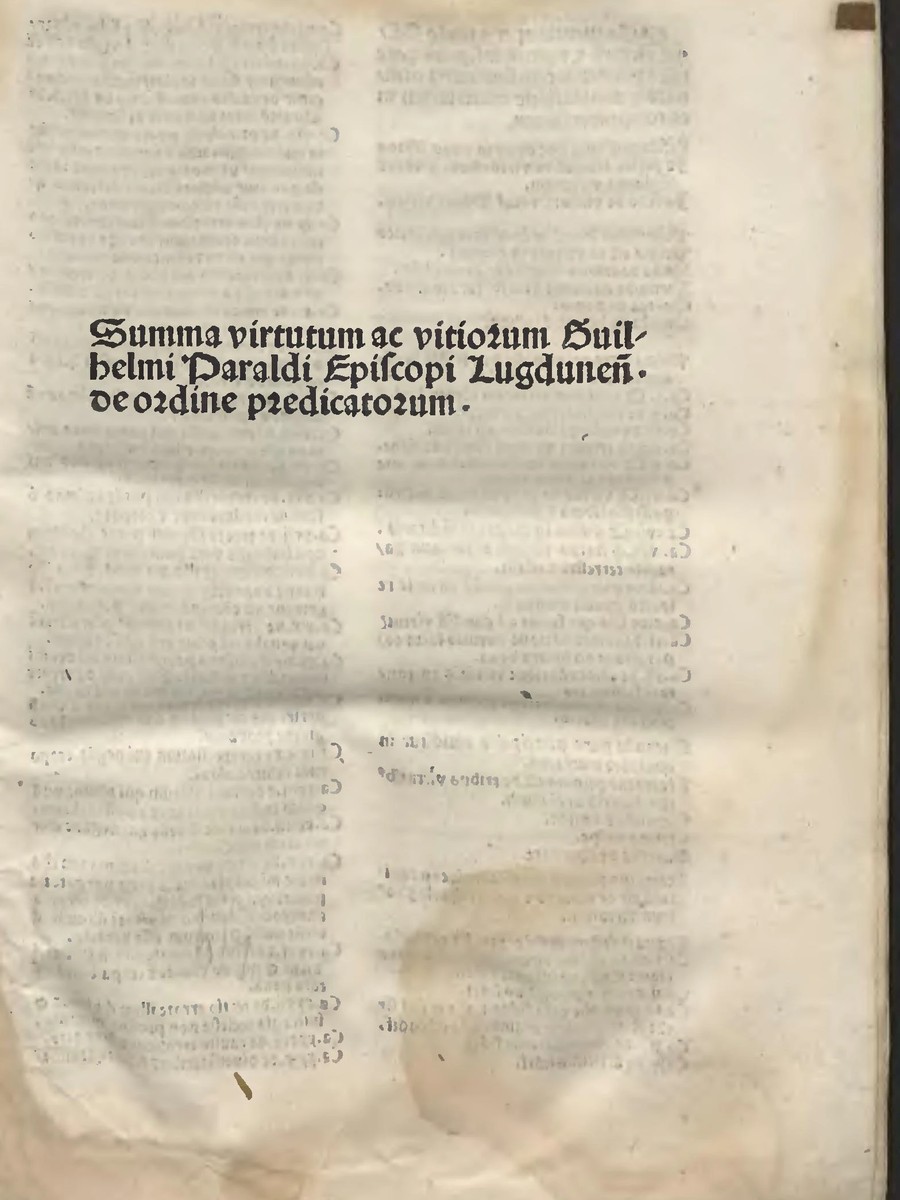
On Simony (On Vices, On Avarice)
De Symonia (De Vitiis, De Avaritia)
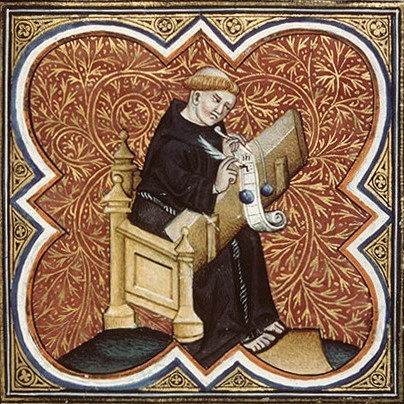 William Peraldus
De symonia
Et de octo que faciunt ad eius detestationem: Ca. VI.
Circa qua hoc modo procedemus. Primo dicemus de symonia. Secundo de peccato edificantium frontem consanguineorum. Tertio de peccato choristarum. Quarto de peccato mercenariorum. Quinto tangemus de signis auaricie que apparent in ecclesia. Sexto de peccato indigne conficientium. Septimo de vitio proprietariorum in claustralibus. Octavo de auaricia scienter celantium. Et de symonia primo dicemus.
Primo ponemus ea que pertinent ad detestationem symonie. Secundo divisiones et principales species symonie. Octo vero sunt que faciunt ad detestationem ipsius. Primum est illud verbum Damasi pape. Omnia crimina ad comparationem symoniace heresis: quasi pro nihilo reputantur. In quo verbo dupliciter detestabilis ostenditur: et quia ostenditur excedere cetera crimina: et quia heresi comparatur. In multis etiam aliis locis vocatur heresis peccatum illud. Unde Nicolaus papa. Statuimus decrevimus et confirmamus symoniacam tripertitam heresim esse damnatam. Et super illud Matth. xxj. Et cathedras vendentium columbas euertit: dicit glo. his qui columbas vendebant etc. dicit glo. interli. Specialiter damnat symoniacam heresim. Et Act. viij. ubi dicit petrus symoni mago. Penitentiam age ab hac nequitia tua: dicit glo. interli. id est a duplici malo: cupiditatis et prave fidei. Et in verbo illo ostenditur quia symonia est rem impreciabilem sub vili precio ponere: et separare corpus ecclesie a suo capite sicut heretici: et estimare mente vel facto: quod donum spiritus sancti sit sub dominio pecunie. Sicut enim in sodomia corporali facit contra naturam ille qui facit opus nature:
sic in symonia facit contra gratiam ille qui emit opus gratie: quia a gratia est redemptus. Et sicut in die iudicij obmutescet sodomita secundum interpretationem sui nominis: quia hostis nature que sibi coniunx fuerat: quantum enim in se est: sodomita genus humanum destruit: Sic obmutescet symoniacus qui hostis gratie fuit a qua redemptus fuerat. Et sicut secundum legem naturalem sodomia vel maximum peccatum: vel unum de maximis iudicatur: quia est contra naturam: ita in tempore gratie secundum legem evangelicam maximi peccati iudicatur symonia: que proprie est contraria gratie. Proprie enim facit contra illud Matth.x. Gratis accepistis: gratis date. Unde recte significati sunt simoniaci per sodomitas: volentes infringere fores domus loth: de quibus Gen.xix. Iamque prope erat ut effringerent fores: id est legem. Tertium quod facit ad detestationem symonie est magnus zelus quem legimus sanctos habuisse contra peccatum istud. Unde.iiij.Regum.v.dixit heliseus ad giezi. Lepra naaman adherebit tibi: et semini tuo in sempiternum. Et dominus in suo primo adventu non legitur contra aliquod peccatum ita exarsisse sicut contra istud. Unde bis legitur eiecisse ementes et vendentes de templo. De prima eiectione habetur Joh.ij. De secunda Matth.xxi. Venerat enim iudicari non iudicare: et ut in mansuetudine peccata toleraret: non ut ea puniret: et tamen propter istud peccatum: imo figuram istius peccati mansuetudinem seruare noluit: sed quasi iratus cum flagello de funiculis facto mensas numulariorum et cathedras vendentium columbas euertit. Et licet primus adventus esset misericordie: tamen de hoc peccato iustitia se intromisit. Unde Bern.ad Eugenium papam: loquens de peste symonie. Intuere inquit in magistrum: non parat aures ut audiat sed flagellum ut feriat: Verba nec facit nec recipit: nec enim sedet iudicans sed insequens puniens. Causam enim non tacet: quia fecistis domum orationis domum negotiationis: Ergo et tu fac similiter. Erubescant vultum tuum istiusmodi negociatores si fieri potest: sin autem: non conferant in numis: sed diffidant. Abscondant argentum suum a te: scientes te effundere non accipere paratiorem. Propter zelum quem habuit dominus contra hoc peccatum: scriptum est in Psal. in persona eius: Zelus domus tue comedit me. Etiam peccatum iude voluit deus patienter tolerare sed istud peccatum noluit. Petrus etiam magnum zelum habuit contra istud peccatum: quando dixit simoni mago: Pecunia tua tecum sit in perditionem: ut legitur Act.viij. Quantum etiam zelum habeat ecclesia contra hoc peccatum: satis patet illis qui canonici iuris peritiam habent.
Quartum quod facit ad detestationem symonie est multiplex contumelia quam facit istud peccatum deo. Et ponemus ad presens.xij.de contumelijs istis.
quod deum vendit. Et dupliciter. Primo: quia vendit gratiam sancti spiritus. Unde super illud Joh.ij. His qui columbas vendebant et cetera. dicit glo. Spiritus sanctus in columba apparuit. Unde per columbam spiritus accipitur: quem symoniaci vendunt: sed spiritus sanctus deus est: vendunt ergo symoniaci deum. Aliter etiam vendunt deum: dum christum in sacramento altaris vendunt eum pro pecunia celebrando. Nec est parua contumelia ista. Non est aliquis ita pauper in mundo qui non multum indignaretur: si quis vellet ducere eum ad forum: et ibi eum venalem exhibere tanquam iumentum suum: Quare ergo contumelia non est deo cum ipse venalis exponitur ab his a quibus precipue honorandus esset. Sufficere deberet talibus christum semel pro peccatis eorum venditum esse. Predicti isti peiores videntur esse iuda in his quinque. Vendunt immortalem et iam glorificatum: quem iudas vendidit mortalem: et in statu humilitatis. Maior autem contumelia est que fit alicui in statu honoris quam in statu humilitatis. Unde contumelia illata militi maior est quam si inferatur domicello. Nec semel tantum eum vendunt ut iudas: sed plus quam centies. Minori etiam pretio eum vendunt quam iudas. Credunt etiam eum deum esse: quod non credebat iudas cum vendidit.xxx.denarijs. Iudas etiam cum de hoc peccato penituit: penitentia ductus reddidit.xxx.argenteos quos pro christo acceperat: sed symoniaci ad penitentiam induci non possunt ut ea restituant que per symoniam acquisierunt.
ipsum deum venditorem estimare: quod non est parua contumelia. Si enim aliquis rex vel comes valde liberalis redargueretur super venditione vestium suarum vel armorum: pro magno malo haberet. Quid mirum si pro malo habeat ille qui est liberalissimus largitor omnium: qui omnia que fecit ad largiendum fecit: quedam ut eis largiretur: alia ut ea largiretur: qui munera sua dat bonis et malis: gratis et ingratis: amicis et inimicis: qui rogat ut ab eo petatur. Hanc contumeliam innuit petrus ubi dixit symoni: Quia existimasti donum dei pecunia possideri: ac si diceret: donatorem estimasti venditorem. Et Joh.ij.dicit dominus: Nolite facere domum patris mei domum negotiationis. Domum dei domum negotiationis facit: qui eum negotiatorem estimat.
quod dona dei pretio vili parificat: cum illud quod apud deum pretiosum est: quod pretium est regni celorum: lucro vili parificat: in quo etiam ipsum donatorem contemnit. Non solet parum displicere hominibus cum aliquis bona eorum contemnit: ut patet in mercatoribus et artificibus: precipue tunc cum dona eorum contemnuntur. Et hoc multum solet retrahere
etiam ipsos liberales homines a largiendo. Unde dominus Matth.vij.prohibuit ne dona eius largirent canibus. Nolite inquit margaritas spargere ante porcos: id est preciosa dona dare contemptoribus.
quia symonia aufert deo ostium ecclesie: quod dominus maxime voluit seruare: propter quod ostium se dixit: Ioh.x. sicut aliquis solet se ponere in medio ostij: cum vult seruare ne quis ingrediatur nisi de voluntate eius. In quo verbo significauit dominus: quod quasi violencia ei faceret: qui nisi per eum intraret. Ad ostendendum etiam quod ingressum ecclesie maxime seruari voluit: intrauit ipse ad discipulos ianuis clausis. Qui enim ingressum bene vult seruare: solet aperire volenti ingredi quantum minus potest de ostio: Et multum placeret ei si ille qui debet ingredi ostio omnino clauso ingredi posset. Ad idem ostendendum iussit dominus: Exo.xij. postes ostij sanguine agni liniri: quasi diceret: saltem ostium ecclesie quod proprio sanguine emi: seruare volo. Hac de causa tradidit ipse claues ecclesie petro: quia amabat eam ardentius ceteris. Per simile etiam potest idem manifestari in municionibus: dum guerre sunt: porte solent precipue custodiri. unde turres consueuerunt fieri super eas.
quia symonia procurat ut ecclesia que sponsa dei est: aliunde grauida sit quam a sponso suo. Ecclesia de solo spiritusancto concipere deberet: quod figuratum est in beata virgine: que inuenta est habens in utero de spiritusancto: Matth.j. Sed symonia facit ut ipsa concipiat de spiritu maligno. Unde mirum est quod sponsus eius non deserit eam. Ioseph enim voluit dimittere beatam virginem: cum dubitaret ut ipsa concepisset.
quod facit nutrire filios adulterinos.
quod filios dei exheredat a patrimonio christi: et filios diaboli ibi heredes constituit: iuxta illud Eccli.xxiij. Omnis mulier relinquens virum suum peccabit: statuens hereditatem ex alieno matrimonio.
quia deum idolothitum facit idolo cupiditatis ei offerens. Et in hoc detestabilior est symonia alijs speciebus auaricie. Symonie enim non sufficit quod alium deum constituat: sed proprium deum idolo suo immolat cum pro pecunia celebrat. Magna contumelia esset domino alicuius castri si subditi eius alium dominum constituerent: sed longe maior esset si domino constituto verum dominum captum offerrent.
quia illud peccatum nulli loco: nulli persone defert. Alia peccata sanctitati locorum deferunt. Nullus enim fornicaretur in ecclesia vel super altare: sed symo-
nia ipsa etiam altaria inuadit. Unde Hiere.xvij.dicit: peccatum iuda exaratum esse in cornibus altarium eorum. Per peccatum iuda peccatum clericorum intelligitur: qui debent vacare confessioni diuine laudis. Item est quia symonia in templo virginis ponit idolum cupiditatis iuxta filium dei: ut videatur impletum illud Daniel.ix. Et in templo erit abominatio desolationis. Symonia non defert deo: nec angelis eius. Interest enim cum diuina celebrantur: licet christus presens sit inquantum deus et inquantum homo cum angelis suis. In hoc symoniaci demonibus deteriores sunt: quia demones timent christum et angelos eius: ipsi vero non.
quia eisdem vtitur symonia ad hominum damnationem quibus christus instituit ad eorum sanctificationem. Unde videtur triumphasse diabolus de ecclesia: quando ecclesiam impugnat proprijs armis: et quasi proprio baculo percutit eam.
quia latrones et sacrilegos facit obtinere locum et vicem dei. Symoniacus enim latro est. Unde Ioh.x. Qui non intrat per ostium in ouile ouium: sed ascendit aliunde: ille fur est et latro. Unde super illud Matth.xxj. Vos autem fecistis illam speluncam latronum: dicit glo. Latro est qui lucra sectatur: qui non dantes corporaliter plectit: et dantes spiritualiter occidit. Et omnis latro sedem lesionis primum cogitat: quasi speluncam. Sacrilegus etiam est symoniacus: quia sacra sunt ea circa que latrocinio suo se exercet. Absurdum enim est dicere eum sacrilegum qui furatur vel rapit calicem alicuius ecclesie: et non dicere eum sacrilegum qui furatur vel rapit totam ecclesiam cum calice et alijs que ad eam pertinent. Dupliciter autem potest dici symoniacus fur: et respectu illius cuius bona consecrat eo nolente: et respectu pauperum quos bonis ecclesie defraudat. Unde cum prelatus vicem dei obtineat: quia symoniacus prelatus efficitur: latro et sacrilegus vicem dei in ecclesia fungit.
quia ecclesiam dei reptilibus et iumentis et animalibus replet. Suffodit enim murum ecclesie: sicut prelatus precipue si carnalis sit: iuxta illud Gen.xlix. Symeon et Leui fratres vasa iniquitatis. Et subiungit: In voluntate sua suffoderunt murum. Et interponit iacob quandam orationem: que frequenter facienda esset prelatis ecclesie. In consilium eorum non veniat anima mea. Nimium enim periculosum esset prelatum ecclesie habere in consilio suo demoniacos aut symoniacos. Suffosso autem muro ecclesie: intrat multitudo reptilium et iumentorum: iuxta illud Ezech.viij. Ingredere et vide abominationes pessimas. Et subdit: Et ingressus: vidi: et ecce omnis similitudo reptilium et animalium abominatio. Cum aliquis luxuriosus in aliqua ecclesia per symoniam beneficium obtineat: serpens in ecclesiam ingreditur. Cum aliquis amans lites et rixas in aliqua ecclesia beneficium obtineat: porcus aut canis in ecclesiam ingreditur. Cum aliquis auarus
Quinto facit ad detestationem symonie multiplex danum quod inde prouenit deo et ecclesie eius. Primum autem damnum est: quod deo quasi ecclesiam amiserit: dum amiserit ingressum et egressum in ea. Non enim est dicendum alicuius castrum de quo non habet ingressum et egressum in eo. Ideo dicebat Psalmista. Dominus custodiat introitum tuum et exitum tuum etc. Aliud damnum est: quod ecclesiam que deberet esse habitaculum filii dei: conuertit in speluncam latronum: iuxta illud Matth. xxi. Scriptum est: Domus mea domus orationis vocabitur: vos autem fecistis eam speluncam latronum. In hoc deteriores videntur esse prelati ecclesiastici principibus secularibus: quia illi in potestate sua speluncas latronum non tolerant: sed isti sustinent claustra in quibus symoniace intratur. Iudicio dei sunt spelunce latronum: Satis latrones sunt et a patibulo inferni non sunt adiudicandi. Aliud damnum est: quod vbi deus debuit honorari: ibi exercetur idolatria. Illi enim quos aurum et argentum introduxit: argento et auro quasi deo seruiunt. Unde Osee. viii. Ipsi regnauerunt et non ex me: principes extiterunt et non cognoui. Argenti sui et auri sui fecerunt sibi idola. Qui dignitatem emit: vult postea vendere que ad dignitatem pertinent. Unde super illud Act. viii. de symone mago: dicit Glossa. Spiritumsanctum emere volebat vt aliis vendens plus accipere posset. Et sicut beatus Bernardus dicit. qui infideliter intrat et non per christum: quid nisi infideliter agit et contra christum. Ex quo christus non introduxit aliquem in ecclesiam: postea non cognoscit eum. Unde petrus introductus ab ancilla ostiaria in atrium principum sacerdotum: dixit se christum non cognoscere. Ancilla ostiaria caro est que habet quinque sensus quasi ostia quinque. Ancilla ergo ostiaria illum introducit: quem carnalitas introducit. Aufert etiam symonia ecclesie spiritumsanctum: Ad quod videtur esse signatum in hoc quod ignis sacer qui per lxx. annos babylonice captiuitatis vixerat sub aquis: extinctus est antiocho vendente sacerdotium iasoni: sicut dicit Augustinus. Per quem ignem figurabatur spiritussanctus. Et hoc est maximum damnum quod possit fieri ecclesie dei: sicut maximum damnum quod posset fieri corpori nostro est: si auferretur ei spiritus a quo habet totum suum valorem. Symonia etiam facit vt ecclesia que sponsa christi est: et deberet deo filios generare: generet monstruosos talpas: serpentes et etiam asinos cornutos. Cum in aliqua ecclesia canonicatur vel preficitur aliquis ignarus: possunt dicere canonici illius ecclesie: Mater nostra que fratrem nobis generare debuit: et fratrem nobis talpam generauit. Cum vero canonicatur aliquis detractor: tunc serpentem generat illa ecclesia: iuxta illud Eccles. Si mordeat serpens
in silentio: nihil eo minus habet qui occulte detrahit. Cum vero indiscretus aliquis episcopatur in aliqua ecclesia: tunc asinus cornutus in ea nascitur. Nihil enim aliud est stolidus mitratus quam asinus cornutus. Asinus enim est per stoliditatem: cornutus per mitram.
quod peccatum hoc reddit hominem exosum deo et hominibus. Unde Eccles. xx. Qui potestatem sibi assumit iniuste: odietur. Glossa dicit. A deo et hominibus. frequenter enim licet symonia sit occulta: tamen hominem reddit exosum hominibus. Punit enim deus eum in hoc quod apud homines gratiam non habet.
quod ipsa vitiat radicem. Unde ea que sequuntur venenata vel saltem inutilia reddit. Ad quod referri potest illud Osee. ix. Radix eorum exiccata est: fructum nequaquam facient.
quod symoniaci difficile saluantur. Et hoc duabus de causis. Primo propter magnitudinem peccati. Secundo: quia oportet resignare beneficium quod symoniace acquisiuerunt. Unde sunt quasi nasse diaboli. Piscis in nassam ingressus est: non de facili ad locum per quem intrauit regreditur: et per alium locum non exit nisi captus. Sic non de facili renunciat homo beneficio quod symoniace habet: et non aliter saluatur. Unde quasi vno pede iam habet in inferno. Unde diligenter debet homo cauere quo intret in ecclesiam. Nisi enim caueat sibi in ingressu: quasi ponit pedem in inferno. Ideo dicit Eccles. iiii. Custodi pedem tuum ingrediens domum domini. Qui emit beneficium ecclesiasticum: similis est illi qui emeret vt magna moles terre super eum caderet que eum opprimeret: nec permitteret eum surgere. Ad difficultatem saluandi que est in symoniacis: potest referri illud Hiere. xvii. Peccatum iuda scriptum est stilo ferreo in vngue adamantino exaratum super latitudinem cordis eorum. Per iudam clerici intelliguntur: quorum est incumbere confessioni diuine laudis. Ad quos pertinet peccatum symonie: quod innuitur scriptum esse quasi indelibile per hoc quod dicit: stilo ferreo: quod idoneum instrumentum est ad scribendum et per hoc quod scriptum est in adamantino simili vngui: id est duro et plano. Scriptura enim in tali materia facta diu durat. Sed scriptura que indelibilis est: potest amitti: ideo subdit: Exaratum super latitudinem cordis eorum. Et ostendit quod hec scriptura sit in tabula cordis: que non potest ab eis vel amitti vel relinqui. Ad eandem difficultatem pertinet quod dicit petrus simoni mago Actuum. viii. Penitentiam age ab hac nequitia tua: et roga deum si forte remittatur tibi hec cogitatio cordis tui: In felle enim amaritudinis et obligatione iniquitatis video te esse.
Post ista ponende sunt diuisiones que faciunt ad detestationem symonie: et que pertinent ad symoniam. De quibus tres tantum ponemus. Et est prima diuisio: quod inter eos qui symoniam committunt: alij committunt eam emendo: vt Symon magus: qui proprie symoniaci dicuntur. Alij vero committunt eam vendendo: vt giezi: et giezite vocantur. Aliquando tamen large vocantur symoniaci et isti et illi. Secunda diuisio est secundum diuersitatem munerum per que symonia committitur.
Committitur autem symonia quadruplici munere: videlicet cum quis obtinet aliquid spirituale per pecuniam: aut per adulationem: vel per preces carnales: vel per obsequium sordidum. De primo legitur. iij. Regum xiij. quicunque volebat: implebat manum suam et fiebat sacerdos excelsorum. Et sequitur: propter hanc causam peccauit domus hieroboam et euersa est et deleta de superficie terre. Si venditio sacerdotij idolatrie sic vindicata est a domino: quomodo vindicabitur venditio veri sacerdotij? Adulatio vero valde timenda est: Penetrat enim cor hominis et allicit ipsum insensibiliter: propter quod oleum vocatur in Psalmo. Oleum autem peccatoris non impinguet caput meum. Et alibi. Intrauit sicut aqua in interiora eius: et sicut oleum in ossibus eius. Et sit sermo eius maledictio. Adulatio enim oleum est et maledictio: Oleum inquantum delectat: maledictio inquantum tormenta parat. Vnde Glosa super Malachiam dicit: Que male delectant dicuntur maledictio: quia tormenta parant. A precibus autem carnalibus diligenter cauendum est. Vnde Bernardus. Vbi non licet dare: quis locus roganti? Alius pro alio: alius forte pro se rogat. Pro alio rogas es suspectus: rogat pro se iam iudicatus est. Exemplum non acquiescendi precibus carnalibus dedit nobis dominus Iohannis ij. vbi dicit matri sue volenti vt faceret miraculum: Quid mihi et tibi est mulier? Innuens se non habere ex ea potestatem faciendi miracula. Et Matthei xx. Non exaudiuit matrem filiorum zebedei petentem: vt daret hanc dignitatem iacobo et iohanni: vt vnus sederet a dextris in regno eius: et alius a sinistris. Exemplum etiam non rogandi pro beneficio a temporalibus obtinendo: habemus Genesis xviij. vbi abraham rogauit deum ne sodomam destrueret: Non enim voluit eum rogare specialiter de nepote suo loth: vt eum ab incendio liberaret. Et dicebat cantor parisiensis bone memorie quod vix rogasset deum pro beneficio nepoti suo impetrando: qui noluit rogare deum: vt nepotem suum ab incendio liberaret. De illo vero qui per obsequium vult obtinere beneficium: dicit beatus Bernardus. Circuit sedulus explorator: sequitur et obsequitur: simulat et
dissimulat: manibus ac pedibus reptans si quomodo possit se introducere in patrimonium crucifixi. Tertia diuisio est secundum diuersitatem eorum que vendunt symoniaci: quia inter bona spiritualia que ipsi vendere volunt: quedam sunt spiritualia: quia illis accidit spiritussanctus: vt sunt sacramentalia ecclesie: Quedam vero spiritualia: quia illis confertur vel augetur gratia spiritussancti: vt sunt sacramenta ecclesie: preter matrimonium: et sepultura ecclesiastica: et officia vel dignitates ecclesie. Quedam vero dicuntur spiritualia: quia per spiritussanctum habentur: vt sunt scientia et virtus. Scientiam enim habet spiritussanctus inquantum illuminans: et ideo prohibetur vendi scientia Prouerbiorum xxiij. vbi dicit. Veritatem eme: et noli vendere sapientiam: et doctrinam et intelligentiam. Virtutem vero habet spiritussanctus inquantum afficiens animos. Quedam vero dicuntur spiritualia: quia per ea ostenditur haberi spiritussanctus: vt miracula. Quedam vero dicuntur spiritualia large sumpto nomine: quia spiritualibus exercitijs deseruiunt: vt sunt vasa et vestes ecclesie. Quedam vero dicuntur spiritualia a quibus illi sustentantur qui spiritualibus exercitijs sunt intenti: vt sunt decime. Sed ista duo vltima genera potius dicenda sunt annexa spiritualibus quam spiritualia.
On Simony
And on the eight things that contribute to its detestation: Chapter 6.
Concerning which we shall proceed in this manner. First we shall speak of simony. Second, of the sin of those who build up the interests of their relatives. Third, of the sin of choristers. Fourth, of the sin of mercenaries [hired clergy]. Fifth, we shall touch upon the signs of avarice that appear in the Church. Sixth, of the sin of those who unworthily confect [the Eucharist]. Seventh, of the vice of proprietorship among those in cloistered life. Eighth, of the avarice of those who knowingly conceal [sins]. And of simony we shall speak first.
First we shall set forth what pertains to the detestation of simony, and second the divisions and principal species of simony. There are eight things that contribute to its detestation. The first is that saying of Pope Damasus: “All crimes, in comparison with the heresy of simony, are reckoned as virtually nothing.” In this saying simony is shown to be detestable in two ways: because it is shown to exceed all other crimes, and because it is compared to heresy. In many other places as well, this sin is called a heresy. Hence Pope Nicolaus [II]: “We decree, establish, and confirm that the threefold heresy of simony stands condemned.” And on Matthew 21, “And he overturned the chairs of those selling doves,” the Gloss says — on the phrase about those who sold doves, etc. — the Interlinear Gloss says: “He specifically condemns the heresy of simony.” And in Acts 8, where Petrus says to Symon Magus, “Repent of this wickedness of yours,” the Interlinear Gloss says: “that is, of the twofold evil of covetousness and of perverse belief.” And in that passage it is shown that simony consists in placing something of inestimable value at a base price, and in separating the body of the Church from its head as heretics do, and in reckoning — whether in thought or in deed — that the gift of the Holy Spirit is subject to the dominion of money. For just as in bodily sodomy one acts against nature while performing the work of nature,
so in simony one acts against grace when he purchases the work of grace, since he has been redeemed by grace. And just as on the Day of Judgment the sodomite will be struck speechless — according to the interpretation of the name [Sodom, meaning “mute”] — because he was an enemy of nature, which had been his spouse (for as far as it lies in him, the sodomite destroys the human race), so too the simoniac will be struck speechless, who was an enemy of the grace by which he had been redeemed. And just as according to the law of nature sodomy is judged either the greatest sin or one of the greatest, because it is against nature, so in the age of grace, according to the law of the Gospel, simony is judged a sin of the greatest magnitude, because it is properly contrary to grace. For it directly contravenes that saying in Matthew 10: “Freely you have received; freely give.” Hence simoniacs are rightly symbolized by the Sodomites who sought to break down the door of the house of Loth, of whom it is said in Genesis 19: “And they were on the very point of breaking down the door” — that is, the law. The third thing that contributes to the detestation of simony is the great zeal that we read the saints had against this sin. Hence in 4 Kings 5 [i.e., 2 Kings 5], Heliseus said to Giezi: “The leprosy of Naaman shall cling to you and to your descendants forever.” And the Lord in his first coming is not recorded to have burned with anger against any other sin as he did against this one. Hence he is recorded twice to have driven out the buyers and sellers from the Temple: the first expulsion is found in John 2, the second in Matthew 21. For he had come to be judged, not to judge, and to bear sins with gentleness, not to punish them; and yet on account of this sin — indeed, on account of a [mere] figure of this sin — he refused to maintain his gentleness, but as if in wrath, with a whip made of cords, he overturned the tables of the money-changers and the chairs of those selling doves. And although his first coming was one of mercy, nevertheless on account of this sin justice intervened. Hence Bernardus [says] to Pope Eugenius, speaking of the plague of simony: “Look to the Master,” he says. “He does not prepare his ears to listen but a whip to strike. He neither speaks nor accepts words, for he does not sit judging but pursues and punishes. For he does not conceal the cause, saying: ‘You have made my house of prayer a house of commerce.’ Therefore do likewise. Let such traders blush before your face, if possible; if not, let them not bring their coins but rather lose confidence. Let them hide their silver from you, knowing you more ready to pour it out than to receive it.” On account of the zeal the Lord had against this sin, it is written in the Psalms [Psalm 69:9] in his person: “Zeal for your house has consumed me.” Even the sin of Iudas, God was willing to tolerate patiently, but this sin he would not tolerate. Petrus also had great zeal against this sin when he said to Symon Magus: “May your money go with you to perdition,” as is recorded in Acts 8. How great a zeal the Church also has against this sin is sufficiently clear to those who possess expertise in canon law.
The fourth consideration that contributes to the detestation of simony is the manifold insult that this sin inflicts upon God. And we shall set forth at present twelve of these insults.
that it sells God — and this in two ways. First, because it sells the grace of the Holy Spirit. Hence, on that passage in John 2, “To those who sold doves,” etc., the gloss says: “The Holy Spirit appeared in the form of a dove. Thus the dove signifies the Spirit, whom simoniacs sell. But the Holy Spirit is God; therefore simoniacs sell God.” They also sell God in another way: by selling Christ in the sacrament of the altar when they celebrate for money. Nor is this a small insult. There is no one so poor in this world who would not be greatly outraged if someone wished to lead him to the marketplace and there put him up for sale like a beast of burden. Why, then, is it not an insult to God when he is put up for sale by those who above all ought to honor him? It should be enough for such people that Christ was sold once for their sins. These aforementioned [simoniacs] appear to be worse than Iudas in five respects. They sell the immortal and already glorified one, whom Iudas sold as mortal and in a state of humility. But the insult done to someone in a state of honor is greater than that done in a state of humility — just as an affront to a knight is greater than one offered to a squire. Nor do they sell him only once, as Iudas did, but more than a hundred times. They also sell him for a lesser price than Iudas did. They even believe him to be God — which Iudas did not believe when he sold him for thirty coins. Iudas, moreover, when he repented of this sin, led by remorse returned the thirty pieces of silver he had received for Christ; but simoniacs cannot be brought to repentance so as to restore what they have acquired through simony.
to regard God himself as a seller, which is no small affront. For if some king or count of great liberality were reproached for selling his garments or his arms, he would consider it a great wrong. What wonder, then, if he who is the most liberal bestower of all things — who made everything he made in order to give it away, some things so that he might bestow [his gifts] upon them, and other things so that he might bestow them [as gifts], who gives his gifts to the good and the wicked, to the grateful and the ungrateful, to friends and enemies, who asks that petitions be made to him — [what wonder] if he takes it ill? Petrus alluded to this insult when he said to Symon: “Because you thought the gift of God could be obtained with money” [Acts 8] — as if to say: you regarded the giver as a seller. And in John 2 the Lord says: “Do not make my Father’s house a house of trade.” He who regards God as a merchant makes God’s house a house of trade.
that [simony] equates the gifts of God with a paltry price: it equates with base profit that which is precious in God’s sight, that which is the price of the kingdom of heaven — and in this it also shows contempt for the giver himself. People are usually not a little displeased when someone despises their goods, as is evident among merchants and craftsmen, especially when their gifts are scorned. And this greatly tends to discourage
even generous people from giving. Hence the Lord in Matthew 7 forbade that his gifts be lavished upon dogs: “Do not,” he said, “cast your pearls before swine” — that is, do not give precious gifts to those who despise them.
that simony takes from God the door of the Church, which the Lord especially wished to guard — on account of which he called himself the door (John 10), just as someone is accustomed to place himself in the middle of a doorway when he wishes to ensure that no one enters except by his will. By this word the Lord signified that anyone who entered other than through him would, as it were, do him violence. To show further that he wished the entrance to the Church to be guarded above all, he himself entered to the disciples through closed doors. For one who wishes to guard an entrance well is accustomed to open as little of the door as possible for the one who must enter, and it would greatly please him if the one who must enter could enter with the door entirely shut. To demonstrate the same point, the Lord commanded in Exodus 12 that the doorposts be smeared with the blood of the lamb — as if to say: at the very least I wish to guard the door of the Church, which I purchased with my own blood. For this reason he entrusted the keys of the Church to Petrus, because [Petrus] loved her more ardently than the rest. The same can also be illustrated by a parallel from fortifications: during wartime, the gates are customarily guarded above all else — hence towers are usually built above them.
that simony brings it about that the Church, which is the bride of God, becomes pregnant from someone other than her spouse. The Church ought to conceive from the Holy Spirit alone, which was prefigured in the Blessed Virgin, who “was found to have in her womb from the Holy Spirit” (Matthew 1). But simony causes her to conceive from an evil spirit. Hence it is remarkable that her spouse does not abandon her. For Ioseph wished to dismiss the Blessed Virgin when he doubted how she had conceived.
that it causes illegitimate children to be nurtured [at the Church’s expense].
that it disinherits the children of God from the patrimony of Christ and establishes the children of the devil as heirs in their place, according to Ecclesiasticus 23: “Every woman who abandons her husband will sin, establishing an inheritance from a strange marriage.”
that it makes God into an offering to an idol, presenting him to the idol of greed. And in this simony is more detestable than other species of avarice. For it is not enough for simony to set up another god; it immolates the true God to its idol when it celebrates [the sacrament] for money. It would be a great insult to the lord of a castle if his subjects established another lord; but it would be a far greater insult if they offered the true lord as a captive to that newly established lord.
that this sin shows deference to no place and no person. Other sins show deference to the sanctity of places. For no one would commit fornication in a church or upon an altar; but simo-
simony itself even invades the altars. Thus Jeremiah 17 says that the sin of Iuda is engraved on the horns of their altars. By the sin of Iuda is understood the sin of clerics, who ought to devote themselves to the confession of divine praise. Likewise, simony places the idol of cupidity in the temple of the Virgin alongside the Son of God, so that what is said in Daniel 9 seems fulfilled: “And in the temple there shall be the abomination of desolation.” Simony shows no deference to God nor to his angels, for it is present when the divine mysteries are celebrated, even though Christus is present both as God and as man together with his angels. In this the simoniacs are worse than the demons, because the demons fear Christus and his angels, but the simoniacs do not.
that simony uses for the damnation of men the very things which Christus instituted for their sanctification. Thus the devil seems to have triumphed over the Church when he attacks the Church with her own weapons and strikes her, as it were, with her own staff.
that simony causes robbers and sacrilegious men to hold the place and office of God. For the simoniac is a robber. Thus John 10: “He who does not enter the sheepfold by the door but climbs in by another way, that man is a thief and a robber.” And on Matthew 21, “You have made it a den of robbers,” the Gloss says: “A robber is one who pursues gain, who punishes corporally those who do not give, and kills spiritually those who do give. And every robber first selects a place of ambush, like a den.” The simoniac is also sacrilegious, because the things around which he plies his robbery are sacred. For it is absurd to call someone sacrilegious who steals or seizes the chalice of a church and not to call sacrilegious the one who steals or seizes an entire church together with its chalice and everything else belonging to it. Moreover, the simoniac can be called a thief in two respects: with respect to the one whose goods he consecrates against that person’s will, and with respect to the poor whom he defrauds of the goods of the Church. Thus, since a prelate holds the office of God, when a simoniac is made prelate, a robber and sacrilegious man exercises the office of God in the Church.
that simony fills the Church of God with reptiles, beasts of burden, and animals. For it undermines the wall of the Church, just as a prelate does — especially if he is carnal — according to Genesis 49: “Symeon and Leui are brothers, vessels of iniquity.” And it adds: “In their willfulness they undermined a wall.” And Iacob interposes a certain prayer that ought to be made frequently by prelates of the Church: “Let my soul not enter into their counsel.” For it would be exceedingly dangerous for a prelate of the Church to have demoniacs or simoniacs in his counsel. Once the wall of the Church has been undermined, a multitude of reptiles and beasts of burden enters, according to Ezekiel 8: “Go in and see the worst abominations.” And it continues: “And I went in and saw, and behold every likeness of reptiles and animals — an abomination.” When someone lustful obtains a benefice in a church through simony, a serpent enters the Church. When someone fond of quarrels and brawls obtains a benefice in a church, a pig or a dog enters the Church. When someone avaricious
Fifth, contributing to the detestation of simony is the manifold harm that arises from it to God and to his Church. The first harm is that God has, as it were, lost the Church, since he has lost entry and exit in it. For a castle is not said to belong to someone who has no entry and exit in it. Therefore the Psalmist said: “The Lord guard your coming in and your going out,” etc. [Psalm 121:8]. Another harm is that simony converts the Church, which ought to be the dwelling place of the Son of God, into a den of robbers, according to Matthew 21: “It is written: ‘My house shall be called a house of prayer,’ but you have made it a den of robbers.” In this, ecclesiastical prelates appear to be worse than secular princes, because the latter do not tolerate dens of robbers in their dominions, whereas the former permit cloisters into which entry is made simoniacally. In the judgment of God these are dens of robbers: they are plainly robbers and are not to be acquitted from the gallows of hell. Another harm is that where God ought to be honored, idolatry is practiced instead. For those whom gold and silver have introduced serve gold and silver as though it were God. Thus Hosea 8: “They have reigned, but not by me; princes have arisen, and I did not know them. Of their silver and their gold they have made idols for themselves.” He who buys a dignity afterwards wants to sell the things that pertain to that dignity. Thus on Acts 8, concerning Symon Magus, the Gloss says: “He wished to buy the Holy Spirit so that by selling it to others he could receive more.” And as the blessed Bernardus says, he who enters faithlessly and not through Christus — what does he do but act faithlessly and against Christus? Since Christus did not introduce someone into the Church, afterwards he does not recognize him. Thus Petrus, having been introduced by the servant girl who kept the door into the courtyard of the chief priests, said that he did not know Christus. The servant girl at the door is the flesh, which has the five senses as its five doors. Therefore the servant girl at the door introduces the one whom carnality introduces. Simony also takes the Holy Spirit away from the Church. This seems to have been signified in the fact that the sacred fire which had survived for seventy years of the Babylonian captivity under the waters was extinguished when Antiochus sold the priesthood to Iason, as Augustinus says. By that fire the Holy Spirit was prefigured. And this is the greatest harm that can be done to the Church of God, just as the greatest harm that could be done to our body is if the spirit from which it derives all its strength were taken away. Simony also causes the Church, which is the bride of Christus and ought to generate children for God, to generate monstrous moles, serpents, and even horned asses. When in a certain church someone ignorant is made a canon or is placed in charge, the canons of that church can say: “Our mother, who ought to have borne us a brother, has borne us a mole for a brother.” When someone who is a detractor is made a canon, then that church begets a serpent, according to Ecclesiastes [10:11]: “If the serpent bites
in silence: the one who secretly detracts possesses nothing the less [for his slander]. When some unfit person is made bishop in a church, then a horned ass is born in it. For a mitred fool is nothing other than a horned ass — an ass by his stupidity, horned by his mitre.
that this sin renders a person hateful to God and to men. Whence Ecclesiasticus 20: “He who assumes power for himself unjustly shall be hated.” The Gloss says: “By God and by men.” For frequently, even though the simony is secret, it nevertheless renders a person hateful to men. For God punishes him in this: that he has no favor among men.
that it corrupts the root. Whence it renders everything that follows poisoned or at least useless. To this may be referred that passage in Hosea 9: “Their root is dried up; they shall by no means bear fruit.”
that simoniacs are saved only with great difficulty. And this for two reasons. First, because of the magnitude of the sin. Second, because they must resign the benefice that they acquired simoniacally. Whence they are like the devil’s fish-traps. A fish that has entered a trap does not easily return to the place through which it entered, and it does not exit by any other way except as a catch. So too a person does not easily renounce a benefice that he holds simoniacally, and he is not saved in any other way. Whence he already has, as it were, one foot in hell. Therefore a person ought to take great care how he enters the church. For unless he watches himself at the entrance, he virtually sets his foot in hell. Therefore Ecclesiastes 4 says: “Guard your foot when you enter the house of the Lord.” One who buys an ecclesiastical benefice is like someone who would buy the privilege of having a great mass of earth fall upon him, crushing him and not allowing him to rise. Concerning the difficulty of being saved that exists in simoniacs, that passage from Jeremiah 17 may be cited: “The sin of Iuda is written with an iron stylus, engraved with an adamantine point upon the breadth of their heart.” By Iuda the clergy are understood, whose duty it is to devote themselves to the confession [that is, the proclamation] of divine praise. To them belongs the sin of simony, which is indicated to be written as though indelibly — by the fact that it says “with an iron stylus,” which is a fitting instrument for writing, and by the fact that it is written on something like an adamantine fingernail, that is, something hard and smooth. For writing made on such material lasts a long time. But writing that is indelible can still be lost; therefore he adds: “Engraved upon the breadth of their heart.” And he shows that this writing is on the tablet of the heart, which cannot be lost by them or abandoned. To this same difficulty pertains what Petrus said to Symon Magus in Acts 8: “Repent of this your wickedness, and pray to God, that perhaps this thought of your heart may be forgiven you. For I see that you are in the gall of bitterness and in the bond of iniquity.”
After these matters, we must set forth the divisions that serve to make simony detestable and that pertain to simony. Of these we shall present only three. The first division is this: among those who commit simony, some commit it by buying, as Symon Magus did — these are properly called simoniacs. Others commit it by selling, as Giezi did — and these are called Giezites. Sometimes, however, both groups are broadly called simoniacs. The second division is according to the diversity of gifts by means of which simony is committed.
Simony is committed by means of a fourfold gift: namely, when someone obtains something spiritual through money, through flattery, through carnal entreaties, or through servile compliance. Concerning the first, we read in 3 Kings 13 [1 Kings 13:33]: “Whoever wished, he filled his hand and became a priest of the high places.” And it continues: “On account of this the house of Hieroboam sinned and was overthrown and blotted out from the face of the earth.” If the selling of an idolatrous priesthood was so avenged by the Lord, how will the selling of the true priesthood be avenged? Flattery, indeed, is greatly to be feared, for it penetrates a person’s heart and draws him in imperceptibly — which is why it is called oil in the Psalm [Psalm 141:5]: “Let not the oil of the sinner anoint my head.” And elsewhere [Psalm 109:18]: “It entered like water into his inward parts, and like oil into his bones.” And let his speech be a curse. For flattery is both oil and a curse: oil insofar as it delights, a curse insofar as it prepares torments. Hence the Gloss on Malachias says: “Things that wrongly delight are called a curse, because they prepare torments.” From carnal entreaties, moreover, one must diligently guard oneself. Hence Bernardus says: “Where it is not lawful to give, what place is there for the one who asks? One person asks on behalf of another; another perhaps asks on his own behalf. If you ask on behalf of another, you are suspect; if he asks on his own behalf, he is already condemned.” The Lord gave us an example of not yielding to carnal entreaties in John 2, where he says to his mother, who wished him to perform a miracle: “What is that to me and to you, woman?” — indicating that he did not have from her the power to work miracles. And in Matthew 20, he did not grant the request of the mother of the sons of Zebedaeus, who asked that he give this dignity to Iacobus and Iohannes — that one might sit at his right hand in his kingdom and the other at his left. We also have an example of not asking for a benefice to be obtained from temporal [powers] in Genesis 18, where Abraham asked God not to destroy Sodom. For he did not wish to ask God specifically about his nephew Loth, that he might be delivered from the conflagration. And the cantor of Paris, of blessed memory, used to say that he would scarcely have asked God to obtain a benefice for his nephew — he who refused to ask God to deliver his nephew from the fire. Concerning the one who seeks to obtain a benefice through servile compliance, blessed Bernardus says: “He goes about as a diligent spy; he follows and fawns; he pretends and
dissembles, crawling on hands and feet, to see whether he might somehow introduce himself into the patrimony of the Crucified.” The third division is according to the diversity of things that simoniacs sell, because among the spiritual goods that they wish to sell, some are spiritual because the Holy Spirit is incidental to them, such as the sacramentals of the Church. Others are spiritual because through them the grace of the Holy Spirit is conferred or increased, such as the sacraments of the Church — except for matrimony — and ecclesiastical burial, and the offices or dignities of the Church. Some things are called spiritual because they are possessed through the Holy Spirit, such as knowledge and virtue. For knowledge belongs to the Holy Spirit insofar as he illuminates, and therefore the selling of knowledge is forbidden in Proverbs 23 [Proverbs 23:23], where it says: “Buy truth, and do not sell wisdom, and teaching, and understanding.” Virtue, moreover, belongs to the Holy Spirit insofar as he moves souls. Some things are called spiritual because through them one is shown to possess the Holy Spirit, such as miracles. Some things are called spiritual in a broad sense of the term, because they serve spiritual exercises, such as the vessels and vestments of the Church. Others are called spiritual because they sustain those who are devoted to spiritual exercises, such as tithes. But these last two categories should more properly be called things annexed to spiritual goods rather than spiritual goods themselves.