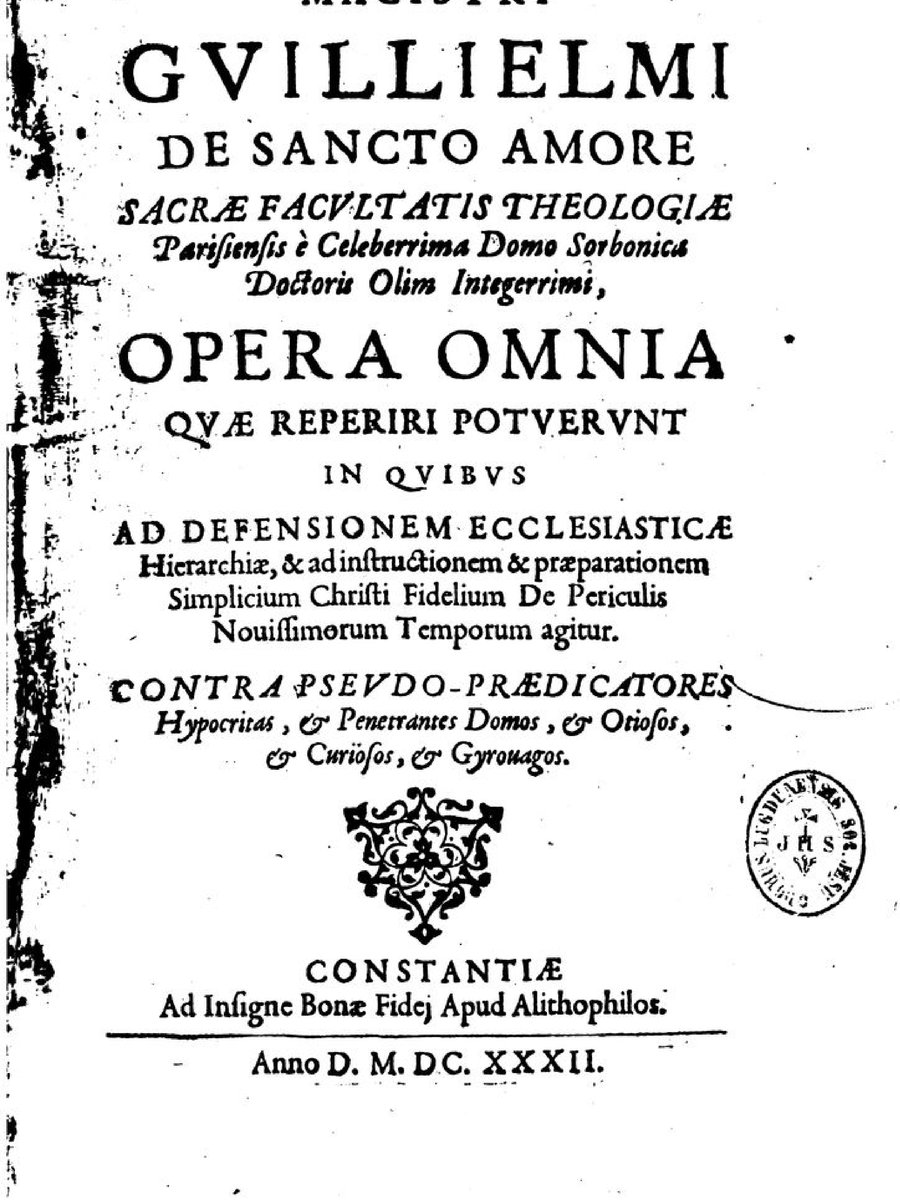
On the Dangers of the Last Times, Chapter 14
De Periculis Novissimorum Temporum, Caput XIV
 William of Saint-Amour
Signa plurima, quædam infallibilia, quædam vero probabilia, per quæ poterunt prædicti homines cognosci. CAP. XIV.
Circa decimum quartum, præter deductionem iam factam, quoniam Seductores prædicti dicturi sunt se esse Apostolos, siue à Deo missos ad prædicandum, & ad saluandum animas per ministerium suum, iuxta illud Apostoli 2. Corinth. 11. Eiusmodi Pseudo-Apostoli, sunt operarij subdoli, transfigurantes se in Apostolos Christi; ideò ostendemus quædam signa infallibilia, quædam verò probabilia, per quæ discerni poterunt Pseudo-Apostoli à veris Apostolis Christi.
Primum signum est, quod Veri Apostoli non penetrant domos, nec captiuas ducunt mulierculas oneratas peccatis, sicut faciunt Pseudo; 2. ad Timoth. 3. Ex his sunt, qui penetrant domos, & captiuas ducunt mulierculas oneratas peccatis. Et hoc expositum est suprà, 2. & 5. capitulis. Illi ergo Prædicatores, qui penetrant domos, & captiuas ducunt mulierculas oneratas peccatis, non sunt veri Apostoli, sed Pseudo.
Secundum signum est, quod Veri Apostoli non decipiunt corda simplicium verbis compositis, quibus traditiones suas commendant, sicut faciunt Pseudo; Rom. vlt. Per dulces sermones & benedictiones, seducunt corda innocentium. Glos. Compositis verbis traditiones suas commendant, quibus simplicium corda decipiunt. Adeò autem seducunt corda simplicium, quod faciunt eos ingredi sectam suam, quam Religionem appellant; & Qui prius in simplicitate viuebant, post ingressum suum, fiunt astuti, hypocritæ, pseudo, & penetrantes domos, vnà cum illis; & quandoque fiunt illis peiores. Vnde Matth. 23. Væ vobis Scribæ, & Pharisæi hypocritæ, quia circuitis mare, & aridam, vt faciatis vnum proselytum; & cùm fuerit factus, facitis eum filium gehennæ duplò, quàm vos. Illi ergo qui hoc faciunt, non sunt veri Apostoli, sed Pseudo.
Tertium signum est, quod Veri Apostoli, si arguantur, patienter sustinent. 2. ad Corinth. 12. Signa Apostolatus mei facta sunt super vos in omni patientia; Glossa, Patientiam commemorat, quæ ad mores Prædicatoris pertinet. Qui ergo non sustinent correctionem, veri Apostoli non sunt; immò ostendunt se non esse Christianos. 1. Corinth. 3. Nemo potest dicere, DOMINVS IESVS, nisi in Spiritu Sancto. Glos. Humiliari debent Christiani, vt patiantur se argui, non adulationibus deliniri. Item, tales ostendunt se esse carnales, licet simulent se esse spiritales. Galat. 4. Ergo factus sum vobis inimicus, verum dicens. Glos. Nemo carnalis vult se argui errantem. Illi ergo Prædicatores, qui correctionem non sustinent, non videntur esse veri Apostoli, sed Pseudo.
Quartum signum est, quoniam Veri Apostoli non commendant seipsos; 2. Corinth. 4. Non prædicamus nosmetipsos; & 2. Corinth. 19. Non audemus nos inserere, aut comparare quibusdam, qui seipsos commendant; Glos. sicut Pseudo, qui seipsos commendant quibusdam artibus, non Deus eos. Item, veri Apostoli, etsi per bona opera reddant se commendabiles ad omnem conscientiá hominum, non ad oculos tantùm, vt dicit Apostolus 2. Corinth. 4. Commendantes nosmetipsos ad omnem conscientiam hominum coram Deo; Non tamen commendant se in comparatione ad alios. Vnde Glos. ibid. Commendabiles nos facientes sine comparatione aliorum. Immò præferunt sibi virtutes aliorum; Vnde 2. Petri vlt. Sicut & charissimus frater noster Paulus secundùm datam sibi à Deo sapientiam scripsit vobis, Glos. Primus Apostolorum oblitus sui primatus, & datarum sibi clauium, datam Paulo sapientiam miratur; quia mos est electorum, vt magis aliorum, quàm suas mirentur virtutes. Et Phil. 2. In humilitate superiores sibi inuicem arbitrantes. Qui ergo contrarium faciunt, dicentes statum, aut traditiones suas esse meliores aliis, si sunt Prædicatores, non sunt veri Apostoli, sed Pseudo.
Quintum signum est, quod Veri Apostoli non indigent commendatijs literis; nec faciunt se ab hominibus ad homines per literas commendari. 2. Corinth. 3. Numquid egemus commendatitijs literis, sicut quidam? Glos. sicut Pseudo. Ergo, qui contrarium faciunt, non sunt veri Apostoli, sed Pseudo.
Sextum signum est, quod Veri Apostoli non prædicant nisi mis- Rom. 10. Quomodo prædicabunt, nisi mittantur. Glos. Non
sunt veri Apostoli nisi missi, nulla enim signa Virtutum eis testimonium perhibent. Qui autem missi sint, dictum est supra, 2. capitulo. Qui vero non missi praedicant, Pseudo sunt.
Septimum signum est, quod Pseudo, cum authoritatem a Deo non habeant, nomini suo vendicant authoritatem; vnde 2. Corinth. 10. super illud; Non audemus nos inserere, aut comparare quibusdam, dicit Glos. Pseudo non accepta a Deo potestate, sed vsurpata dominari volunt, nomini suo vendicantes authoritatem. Et ideo, licet forsitan dicant se missos a Deo per inspirationem, sicut omnes Haeretici; tamen, nisi probauerint suam missionem, aut per spiritualem prophetiam, sicut Ioan. Baptista dicens, Ego vox clamantis in deserto, sicut ait Isaias Propheta. Ioan. 1. aut per miraculum, sicut Moyses virgam conuertit in colubrum, & e contra, Exod. 7. excommunicari debent, donec cessent a praedicando, Extra, De Haeret. cap. Cum ex iniuncto. Et quamuis miracula facerent; non essent tamen sufficiens testimonium missionis, cum fiant frequenter a malis. 1. q. 1. cap. Teneamus. Et maxime in finali Ecclesia, vbi suspecta debent esse miracula, cum dicat Dominus Matt. 24. Surgent Pseudo-Prophetae, & dabunt signa magna, & prodigia; Illi ergo, qui nomini suo vendicant authoritatem, cum a Domino non habeant, non sunt veri Apostoli, sed Pseudo.
Octauum signum est, quod Pseudo praetendentes sapientiam in superstitione, & humilitate, traditiones suas Religionem appellant, quae potius sunt sacrilegium; quoniam aliorum iura sibi vsurpant, gloriando scilicet in plebibus alienis. Vnde Colos. 2. loquens Apostolus de Pseudo dicit; Secundum praecepta, & doctrinas hominum, quae sunt rationem quidem habentia sapientia in superstitione, & humilitate. Glos. Id est, in simulata Religione; quia traditioni humanae nomen Religionis applicant, vt Religio appelletur, cum sit sacrilegium; quia quod contra Authorem est, sacrilega mente inuentum est. Certum est autem, quod contra Authorem, id est, contra Deum est; velle regere populum sine mandato, aut authoritate illius, qui Plebanus est. Deut. 23. Ingressus Vineam proximi tui comede vuas, quantum tibi placuerit; foras autem ne aufer acceptum. Glos. In alterius Episcopi Ecclesia potest alter aliquos corrigere, vel monere; totam vero plebem non licet ei regere, vel magna negotia tractare; Et quod non licet Episcopo in Diocesi aliena, hoc non licet ei, qui nulli praeest in-
risdictioni. Ad hoc facit, quod legitur 6. q. 3. cap. Scriptum est, et 9. q. 2. per totum. Illi ergo Prædicatores, qui traditiones suas contra Deum, siue contra Scripturas Diuinas, factas, Religionem appellant, non sunt veri Apostoli, sed Pseudo.
Nonum signum est, quoniam Cum Pseudo ex potestate, quam habent, non sint Euangelistæ, aut dispensatores Sacramentorum; tamen viuere volunt de Euangelio, non de labore manuum; contra illud Apostoli 2. Thessal. 3. Neque gratis manducauimus panem ab aliquo, sed in labore, et fatigatione, nocte et die operantes. Glos. isti Pseudo multò magis viuere debent de labore suo, qui non habent potestatem hanc, quam habemus, scilicet, viuendi de Euangelio. Et hoc expressius dicit Augustin. in lib. De opere Monachorum, in his verbis. Isti fratres nostri temere sibi arrogant (quantùm existimo) quod eiusmodi habeant potestatem, scilicet, viuendi de Euangelio; Si enim Euangelistæ sunt, si ministri altaris sunt; si dispensatores Sacramentorum sunt; fateor, habent. Quasi diceret. Si tales non sunt, non habent potestatem viuendi de Euangelio. Illi ergo Prædicatores, qui, cùm non habeant potestatem viuendi de Euangelio, aut dispensandi Sacramenta Ecclesiastica (vtpote, qui plebem non habent, et non præsunt regimini animarum) viuere volunt de Euangelio, non sunt veri Apostoli, sed Pseudo.
Decimum signum est, quod Pseudo Apostoli potius gaudent commendari, quàm Dei doctrinam; Veri autem Apostoli è contrario. 1. Thess. 2. Neque quærentes ab hominibus gloriam. Glossa, Tangit Pseudo, qui se potius, quàm Dei doctrinam commendari volebant; Apostolus autem, qui non ad præsens, sed in futuro gloriam quærebat, se humilem faciebat, vt Dei prædicatio exaltaretur. Illi ergo Prædicatores, qui se potius, quàm Dei doctrinam commendari volunt, non sunt veri Apostoli, sed Pseudo.
Vndecimum signum est, quod Veri Apostoli propter Deum, et salutem animarum tantùm prædicant; non propter temporale lucrum; 2. Cor. 4. Non prædicamus nosmetipsos. Gloss. Prædicatio nostra non ad gloriam nostram tendit, vel lucrum nostrum, sed ad gloriam Christi. Sed prædicatio Pseudo ad contrarium tendit; vnde super illud Philip. 1. Siue per occasionem, siue per veritatem Christus annuntietur, dicit Gloss. Pseudo ex
occasione Euangelizant, quærentes commoda sua, vel pecuniaria, vel honorum, vel laudis humanæ, à quolibet volentes accipere munera; non tam salutem quærentes eius, cui annuntiant, quàm commodum suum. Et infrà. Quisquis à Deo præter Deum aliquid quærit, non castè Deum quærit; Vnde 2. Corinth. 12. Non quæro quæ vestra sunt. Gloss. Non diuitias vestras in auro, vel argento; SED Vos. Gloss. Quod aliter non fieret, nisi à sumptibus abstinerem. Et infrà, Vt intelligentes quia pecuniæ præponeret eos, tandem cognoscerent affectum illius erga se. Isti ergo prædicatores, qui propter lucrum temporale, aut propter honorem mundanum, aut propter laudem humanam prædicant, non sunt veri Apostoli, sed Pseudo.
Sed quomodò scietur, Quando prædicant ad gloriam suam? Respondemus, quando prædicant non vocati, 2. Corinth. 11. Qui gloriatur, in Domino glorietur. Gloss. Quod non potest ille, qui non habet à Domino potestatem. Potestatem autem à Domino non habet, qui à Deo vocatus non est, id est, ab Ecclesia. Ad Heb. 5. Nec quisquam assumit sibi honorem, sed qui vocatur à Deo tamquam Aaron; Gloss. A Deo vocatur, qui ab Ecclesia rectè eligitur.
Duodecimum signum est, quoniam Pseudo simulant se habere maiorem zelum animarum, quàm animarum Rectores, & Pastores; cùm tamen earum curam non habeant; contra illud, quod dicit Gloss. super illud. 1. Thess. 2. Facti sumus sicut paruuli inter vos, tamquam si nutrix foueat filios suos. Gloss. Alienos filios nutrit mulier pro mercede, non ex amore; proprios verò ex dilectione. Illi ergo Prædicatores, qui simulant se habere maiorem zelum animarum, quàm earum Rectores, non sunt veri Apostoli, sed Pseudo.
Tertiumdecimum signum est, quod Veri Apostoli non student eloquentiæ, aut compositioni verborum; Pseudo autem è contrario. 2. Corinth. 11. Nam si imperitus sermone. Gloss. Non erant eloquentes Apostoli, sed Pseudo verba componebant. Item super eod. alia Gloss. Corinthii præferebant Pseudo Veris Apostolis, causâ accurati sermonis. Item 1. Corinth. 1. Non in sapientia verbi, vt non euacuetur crux Christi; Gloss. Non in lepore, & ornatu verborum, quia Religio Christiana non indiget pompâ, & cultu sermonis. Item 2. Corinth. 1. Quod loquimur, non in doctis humanæ sapientiæ verbis; Gloss. sicut faciebant Pseu-
do. Malebat enim Apostolus verba sua sola veritatis puritate ostendere, quàm eloquentia orationem fuscare. Illi ergo qui student eloquentiæ, aut compositioni verborum, non sunt veri Apostoli, sed Pseudo.
Decimumquartum signum est, quod Veri Apostoli non adulantur hominibus questus causa, sicut Pseudo adulantur; de quibus ideo dicitur Ezech. 13. Ve qui consuunt puluillos sub omni cubito manus, & faciunt ceruicalia sub capite vniuscuiusque etatis. Gloss. id est, suauem adulationem; ET VIOLABANT ME ad populum meum propter pugillum hordei, & fragmen panis. Gloss. id est, pro refectione ventris; VT INTERFICERENT ANIMAS, que non moriuntur. Gloss. Mortuas diceres, si non datur quidpiam in ore eorum; ET VIVIFICARENT ANIMAS, que non viuunt. Gloss. Falsi Propheta Iustis viuentibus in Domino, & nihil eis dantibus, prophetabat mortem & infortunia; & Iniustis, qui per peccatum sunt mortui, prophetabant vitam & prospera, propter eorum dona. Item 2. Cor. 6. Exhibeamus nosmetipsos, sicut Dei ministros; Gloss. Ministri Dei non adulantur, sicut faciunt Pseudo, studentes lucro. Et ideo veri Apostoli non conuersantur in Curiis Principum & Magnatum, scientes illud Matth. 11. Ecce, qui mollibus vestiuntur, in domibus Regum sunt; Gloss. Rigida vita, & predicatio debet declinare mollium palatia, que frequentant induti mollibus adulantes. Illi ergo Prædicatores, qui in Curiis commorantur, vel alibi adulantur, non sunt veri Apostoli, sed Pseudo.
Decimumquintum signum est, quod Veri Apostoli non circumueniunt homines, vt dent eis bona temporalia, siue in vita, siue in morte; Immo & rogati recipere nolunt. Vnde 2. Corinth. 8. dicit Apostolus, Cum multa exhortatione obsecrantes nos. Gloss. cum timens eis non assentirem, vt eis permitteremus habere gratiam, & communicationem ministerij, quod fit in sanctos; obsecrabant nos, vt liceret eis dare sua, non quasi propria, sed quasi communia. Pseudo autem è contrario, vel importune petunt, vel saltem blande auferunt. 2. Corinth. 7. Neminem circumuenimus; Gloss. Fraudulenta rerum suarum ablatione, vt Pseudo faciunt, qui vestra blande auferant. Item Matth. 24. Ve vobis Scribe, & Pharisai hypocrite, qui comeditis domos Viduarum, orationes longas orantes. Gloss. Qui vestra superstitione nihil intenditis, nisi vt predam de subiecta plebe faciatis. Et Luc. 20. Qui deuorant domos Viduarum,
simulantes longam orationem. Glos. Vt religiosiores appareant, prolixius orant, vt ab infirmis, quasi patroni, laudes et pecunias accipiant; quorum oratio sit in peccatum; quia nec alijs, nec sibi possunt proficere ad salutem; Immo pre ipsis orationibus, cum per eas alios deceperint, magis damnabuntur. Per hoc autem, quod aurum et argentum recipiunt, apparet, quod non causa salutis aliorum predicant, sed causa lucri. Matth. 10. Nolite possidere aurum et argentum. Glos. Quia qui hec haberent, viderentur, non causa salutis predicare, sed lucri. Item dicit Hieron. super cap. 3. Michææ, Quod quia quidam Prophetæ pecuniam accipiebant, Prophetia eorum facta est Divinatio; id est, Prophetia eorum declarata est non esse Prophetia, sed Divinatio, id est, non esse a Deo, sed esse a Diabolo. Et hoc legitur 1. q. 1. cap. Numquam. Illi ergo Prædicatores, qui circumueniunt homines, vt dent eis bona temporalia, siue in vita, siue in morte, non sunt veri Apostoli, sed Pseudo.
Decimum sextum signum est, quod Pseudo, quando predicatur aliqua veritas eis insolita, et aspera, irritantur, et latrant in contrarium; Vnde de illis dicit Apostolus Philip. 3. Videte canes. Glos. Id est, cognoscite illos esse canes, non ratione, sed consuetudine, contra insolitam veritatem latrantes. Et infra. Bene ergo canibus comparat; quia sicut canes consuetudinem magis sequuntur, quàm rationem; Ita Pseudo Apostoli consuetudinis legem tenent, et contra veritatem irrationabiliter latrant, et mordent. Item 2. Timot. 4. Secundùm desideria sua coaceruabunt sibi magistros; Glos. Qui ea doceant, quæ libenter audiant, quia veritas eis aspera videbitur. Illi ergo Prædicatores, qui latrant contra veritatem eis insolitam, et eis asperam, et procurant, quod illa veritas taceatur, non sunt veri Apostoli, sed Pseudo.
Decimum septimum signum est, quod Veri Apostoli nolentibus recipere eos nullam molestiam inferunt; sed eos dimittunt, ne videantur quærere aliquid terrenum, Matth. 10. Quicunque non receperint vos, exeuntes foras de ciuitate, excutite puluerem de pedibus vestris; Glos. Vt ostendatis appetitum terrenorum non esse in affectibus vestris. Illi ergo Prædicatores, qui vt recipiantur ab hominibus, per lites contendunt, veri Apostoli non sunt; precipuè cum dicat Apostolus 1. Corinth. 11. Si quis videtur inter vos contentiosus esse, nos talem consuetudinem non habemus in Ecclesia Dei.
Decimum octauum signum est, quod Veri Apostoli Principes, quorum fauorem sunt adepti, non prouocant contra illos, qui eos recipere nolunt; secundum quod legitur in vita Simonis, & Iudæ Apostolorum, vbi dicitur; Iratus Dux iussit copiosum ignem accendi, vt Pontifices ibi præcipitarentur, & ij omnes, qui Apostolos Christi obfuscare videbantur; Apostoli autem prostrauerunt se ante Ducem dicentes, OBSECRAMVS DOMINE, NE FIAMVS CAVSA INTERITVS EORVM; NE QVE PRO SALVTE HOMINVM HIC MISSI SVMVS, VT VIVIFICAREMVS MORTVOS, VIVENTES OCCIDERE VIDEAMVR. Illi ergo Prædicatores, qui Principes eis fauorabiliores prouocant, contra illos, qui eos non recipiunt, aut quos odiunt, veri Apostoli Christi non sunt, sed Pseudo.
Decimum nonum signum est, quod Apostoli Christi non solum habent cognitionem de ijs, quæ fecit Deus; sed etiam de ijs, quæ facturus est in fine mundi. Vnde Apocal. 4. Animalia erant plena oculis antè, & retrò. Glos. Id est, fideles habentes cognitionem de ijs, quæ fecit Deus, vel facturus est in fine mundi. Illi ergo, qui dicunt se ignorare pericula finalis Ecclesiæ, quæ prædicta sunt; aut non curant de illis, ac si ignorarent; non habent oculos, antè, & retrò; vnde non sunt veri Apostoli; ergo cùm dicunt se esse Apostolos, Pseudo sunt.
Vigesimum signum est, quod Veri Apostoli non capiunt temporalia bona illorum, quibus predicant; per quod discernuntur à Lupis, id est à Pseudo. Vnde Actor. 20. Argentum, & aurum nullius concupiui. Glos. In hoc cognoscuntur Lupi, quod hoc concupiscunt. Et infra. Ad ea, quæ mihi opus erant, & ijs, qui mecum sunt, ministrauerunt manus istæ. Glos. Exemplum operandi etiam Episcopis, & signum, quo discernuntur à Lupis. Tales enim, qui petunt ab eis, quibus prædicant; aut alius nomine ipsorum, videntur committere Simoniam, ad instar Giezi, de quo legitur, 3. Reg. 16. quod petiuit vestes à Naaman Syro, cui Dominus eius, scilicet Elisæus, dederat gratiam sanitatis; & pro tanto dicitur Giezi vendidisse gratiam sanitatis Naaman Syro; licet petiisset vestes Domino ignorante, vt dicit Gregor. Nazian. 1. q. 1. cap. Qui Studet.
Sed dicet quis. Nonne potest Predicator ab illis, quibus predicat, sumptus petere, saltem mendicando?
Respondemus; si prædicat ex potestate, vt tamquam verus Pastor pascat gregem suum pabulô verbi, Sumptus potest recipere; Sed tunc non est mendicitas, sed potestas. 2. Timoth. 2. Laborantem Agricolam oportet primum de fructibus percipere; Gloss. Castum Euangelistam securum facit, et vult, vt intelligat, quod necessaria sumere ab eis, quos tamquam gregem pascit, non est mendicitas, sed potestas. Sed quod Prædicator valeat mendicare, numquam in sacris literis reperitur; sed mendicitas omni Christiano ab Apostolo prohibetur, et à Salomone abhorretur, et ab August. et aliis Sanctis Expositoribus reprobatur, vt ostensum est suprà, 12. capitulo. Sic ergo patet, quod veri Apostoli bona temporalia eorum, quibus prædicant, non cupiunt, nec etiam mendicant. Qui ergo petunt ab illis, quibus prædicant; aut alius pro ipsis; non videntur esse veri Apostoli, sed Pseudo.
Vigesimum primum signum est, quod Veri Apostoli in tribulationibus patientes sunt; nec reddunt malum pro malo. Vnde Matt. 10. Ecce ego mitto vos, sicut oues in medio Luporum. Glos. Qui locum prædicationis suscipit, mala inferre non debet, sed tolerare. Et hoc exemplô Domini, de quo 1. Petri 2. Qui cùm malediceretur, non maledicebat; tradebat autem se iudicanti iniuste. Qui ergo malum non tolerant, sed potiùs inferunt; non sunt veri Apostoli, sed Pseudo.
Vigesimum secundum signum est, quod Veri Apostoli in primo aduentu suo malè recipiuntur, Sicut dicit Dominus Matth, 23. Odio eritis omnibus hominibus propter nomen meum; SED posteà vincunt, Iuxta illud, 1. Ioan: 5. Omne quod est ex Deo, vincit mundum. Illi ergo, qui è contrario in principio lætantur, et benè suscipiuntur, in fine autem respuuntur; non videntur esse veri Apostoli, sed Pseudo.
Vigesimum tertium signum est, quod Veri Apostoli non vadunt ad predicandum illis, qui alios habent Apostolos; quia nolunt gloriari in plebibus alienis. Rom. vlt. Sic autem prædicaui Euangelium, non vbi annuntiatus est Christus, ne super alienum fundamentum edificarem. Et 2. Cor. 10. Non in immensum gloriantes in alienis laboribus. Gloss. Vbi alius fundamentum fidei posuisset. Item in eodem, Non habentes spem gloriari in aliena regula. Id est, in commißis alterius regimini. Præcipuè cùm dicat Gregor. in Moralib. Cùm locus superior imperatur, is, qui
ad participanda hæc obedit, obedientia sibi meritum evacuat, si ad hæc ex proposito anhelat. Item August. Honor debet quærere te, non tu honorem. Item Chrysost. Primatus fugientem desiderat, desiderantem horret. Illi ergo, qui non inuitati procurant, & gaudent prædicare plebibus alienis, quod est officium honoris, præcipuè in Conciliis, & Synodis, & Conuentibus magnis, necnon in Curiis Regum, & Prælatorum, non sunt veri Apostoli, sed Pseudo.
Vigesimum quartum signum est, quod Veri Apostoli, etiam quando magnum profectum faciunt in Ecclesia, non inde extolluntur. Ezech. 3. Fili hominis dedi faciem tuam, ut adamantem. Adamas, quando attrahit ferrum, non inde extollitur, nec mutatur; similiter verus Apostolus, quando prædicatione sua attrahit peccatores durissimos, etiam sicut ferrum, non inde extollitur. Item Luc. 17. Cum omnia feceritis, quæ præcepta sunt vobis, dicite, serui inutiles sumus. Et Psal. 113. Non nobis Domine, non nobis, sed nomini tuo da gloriam. Qui ergo de fructu, quem in Ecclesia Dei se facere dicunt, arroganter se iactant dicentes, Nos illuminauimus Ecclesiam vniuersam, quæ ante tempora nostra ceca erat; & extinximus flammam peccatorum in Ecclesia Dei; cum forsitan magis promouerint hypocrisim; non sunt veri Apostoli, sed Pseudo; de quibus dicitur in Canonica Iudæ, Os eorum loquitur superba.
Vigesimum quintum signum est, quod Veri Apostoli non querunt fauorem mundi, nec placere hominibus. Gal. 1. Si adhuc hominibus placerem, Gloss. id est, placere vellem; SERVVS Christi non essem. Vnde 1. Thess. 2. Non quasi hominibus placentes, Gloss. Id est placere quærentes, nec enim speciem placentis habemus. Illi ergo Prædicatores, qui quærunt fauorem mundi, & ad hoc laborant, non sunt veri Apostoli, sed Pseudo.
Vigesimum sextum signum est, quod Veri Apostoli oblatis sibi cibo & potu sunt contenti, nec quærunt cibaria lautiora; Iuxta illud Luc. 10. Edentes & bibentes, quæ apud illos sunt, Gloss. Sumptus ex Euangelio concedit, ita tamen, ut oblatis cibo & potu sint contenti. Illi ergo Prædicatores, qui licet non sint potestatem habentes, tamen offenduntur, quando non ministrantur eis cibaria lautiora, non sunt veri Apostoli, sed Pseudo.
Vigesimum septimum signum est, quod Veri Apostoli plus diligunt Legem Christi, quam proprium honorem; Iuxta illud
Prouerb. 7. Serua legem meam, quasi pupillam oculi tui; liga eam in digitis tuis, et scribe illam in tabulis cordis tui. Et super illud Psal. 118. Bonum mihi Lex oris tui, super millia auri et argenti, dicit Gloss. Christus plus diligit Legem Dei, quàm cupiditas millia auri et argenti. Qui ergo videns Legem Christi conculcari, et tolli per Euangelium illud maledictum, quod appellant Euangelium Æternum, negligit et contemnit, vel forsitan dissimulando consentit; et tamen pro honore suo temporali conseruando, vel quærendo, lites suscipere, et scandala incurrere non horrescit; non videtur esse Apostolus Christi, sed Pseudo, si fuerit Prædicator.
Vigesimum octauum signum est, quod Veri Apostoli non quærunt hospitia opulentiora, siue vbi meliùs procurentur; sed honestiora, et vbi gratulantiùs eis detur; Et ab illis tantùm recipiunt, quos credunt reputare sibi maiorem gratiam fieri, si recipiatur munus eorum, quàm si eis munus daretur; Iuxta illud Matth. 10. In quamcunque ciuitatem, vel castellum, intraueritis, interrogate, quis in ea dignus sit, et ibi manete donec exeatis. Gloss. Testimonio vicinorum eligendus est hospes, ne eius infamia prædicatio ledatur. Nec est cursitandum per domos, sed statim ad eum diuertendum, Qui est dignus. Gloss. Qui scit se magis accipere gratiam, quàm dare. Hoc est, qui libenter dat pro Christo, non pro alio commodo. Item Veri Apostoli non recipiunt ab illis, qui adhuc in peccatis suis iacent, sed ab emendatis; Vnde 2. Cor. 8. Sed semetipsos dederunt primùm Domino. Gloss. Qui emendantes errores pristinos ac morum vitia Deo se vouerunt, deinde Fratribus munera sua obtulerunt; aliter enim non erat accipiendum ab eis, quia et munera excæcant oculos, et iura authoritatis inclinant; Qui verò dant, vt non arguantur, fructum dandi non habent. Illi ergo Prædicatores, qui quærunt hospitia, vbi meliùs pascantur; et recipiunt munera malorum diuitum, vt eorum mala tegant; vel illorum munera recipiunt, qui magis dant propter importunitatem tollendam, vel præsentem verecundiam, quàm propter Deum; non sunt veri Apostoli, sed Pseudo; Iuxta illud 2. Cor. 9. Hilarem datorem diligit Deus. Gloss. Qui propter præsentem pudorem dat aliquid, vt tædio interpellantium careat, et rem et meritum perdit; Vnde qui à tali recipit, non quærit fructum, sed datum; contra illud Apostoli Philipp. 4. Non quæro datum, sed requiro fructum.
Vigesimum nonum signum est, quod Veri Apostoli non laborent curare negotia aliena, vt exinde pascantur; quia talium Deus venter est, iuxta illud 2. Thess. 3. Audiuimus quosdam inter vos ambulare inquiete, nihil operantes, sed curiose agentes. Gloss. de negotijs alienis; et hoc modo pasci merentur. Quod factum abhorret disciplina Dominica; eorum enim Deus venter est, qui fœda cura necessaria sibi prouident. Illi ergo Prædicatores, qui talia faciunt, non sunt veri Apostoli, sed Pseudo.
Trigesimum signum est, quod Veri Apostoli non gaudent de miraculis, vel aliis factis elegantioribus, quæ facit Dominus per eos, vt de illis cupiant honorari; sed potius gaudent de salute, quam a Domino expectant; Iuxta illud Luc. 10. In hoc nolite gaudere, quia Spiritus vobis subijciuntur; gaudete autem quod nomina vestra scripta sunt in cælis. Illi ergo, qui gloriantur de miraculis suis, vel suorum; et de hoc, quod per eorum ministerium saluantur multi, vt dicunt; non videntur esse veri Apostoli, sed Pseudo.
Trigesimum primum signum est, quod Veri Apostoli numquam gloriam suam quærunt in hac vita, sed gloriam Christi; Iuxta illud, Ioan. 7. Qui a semetipso loquitur, gloriam propriam quærit; qui autem quærit gloriam eius, qui misit illum, Id est, a quo se dicit missum, Verax est. Illi ergo, qui quærunt ea, quæ pertinent ad gloriam huius mundi (quorum vnum est regnantibus assistere, iuxta illud Boetij de Consolat. Qui in potentia extolli cupiunt, aut ipsi regnant, aut regnantibus adhærere conantur. Alterum vero est velle vincere, vbi non est præmium apud Deum; vnde super illud, Gal. 5. Non efficiamur inanis gloriæ cupidi. Gloss. Inanis gloriatio est velle vincere, vbi non est præmium) In quantùm talia quærunt, non videntur, veri Apostoli, sed Pseudo.
Trigesimum secundum signum est, quod Veri Apostoli fugiunt solemnitates hominum, et salutationes, et conuiuia; Iuxta illud Hieron. ad Nepotianum. Obsecro te, siue hic, siue ibi fueris; multitudines hominum, salutationes, officia, et conuiuia, quasi quasdam catenas voluptatis, fuge. Illi ergo qui quærunt, et amant consortia, et conuiuia, et officia potentum secularium, et diuitum; non videntur esse veri Apostoli, sed Pseudo.
Trigesimum tertium signum est, quod Veri Apostoli non
frequenter conueniunt ad alienam mensam, ne adulatores fiant, secundum quod dicit Gloss. 2. Thess. 3. super illud, Vt nosmetipsos formam daremus vobis ad imitandum nos. Gloss. Qui frequenter ad alienam mensam conuenit otio deditus, aduletur necesse est pascenti se; cum tamen Religio nostra, scilicet Christiana, ad libertatem homines aduocet. Illi ergo, qui ad alienam mensam libenter, & frequenter conueniunt, cum otio corporali, non videntur esse veri Apostoli, sed Pseudo.
Trigesimum quartum signum est, quod Veri Apostoli non odiunt homines, etiam inimicos, & odientes eos; Iuxta doctrinam Domini Matth. 5. Diligite inimicos vestros, & benefacite ijs, qui oderunt vos. Pseudo verò Prophetæ proximos lædunt, & diffamant. Vnde super illud Ierem. 23. A Prophetis Ierusalem egressa est pollutio super omnem terram, dicit Gloss. Non sufficit eis proximos lædere, sed quos semel oderunt, per totum orbem conantur diffamare. Illi ergo Prędicatores, qui oderunt illos, quos inimicos reputant, & eos diffamant; non sunt veri Apostoli, sed Pseudo.
Trigesimum quintum signum est, quoniam Pseudo quando examinantur, siue probantur, vtrum sint Veri Apostoli, vel mendaces, non patienter sustinent, quod faciunt veri Apostoli; sed potius illos, qui sic probare volunt, persequuntur, & ad persequendum illos per terrenas potestates simul se iungunt; Sicut fecerunt quidam Pseudo in primitiua Ecclesia, contra Episcopum Ephesinum, cui dicit Dominus Apoc. 2. Scio, id est APPROBO, opera tua, & laborem tuum, id est, tribulationem; Et quoniam non potes sustinere malos; Gloss. quin emendes, vel expellas; Et probasti eos, qui se dicunt Apostolos, & non sunt; Gloss. Id est, eos qui missos à Deo se dicunt, vt facilius decipiant. Et inuenisti eos mendaces, & patientiam habes; Gloss. In malis, quæ ipsi coniuncti per terrenas potestates ingerunt.
Trigesimum sextum signum est, quod Veri Apostoli non vadunt prædicaturi eis, qui iam per alios conuersi sunt; Sed potius ad eos conuertendos sese accingunt, qui nondum sunt conuersi per alios; Ne super alienum fundamentum ędificent; Sicut fecit B. Paulus. Rom. 15. Ita laboraui, vt ab Ierusalem per circuitum vsque ad Illyricum mare repleuerim Euangelium. Glossa, id est, Plenè prædicauerim. In quo magna semper Sancti virtus apparet; quod tot gentes per
eum Euangelium receperint. Et infra. Sic autem predicaui Euangelium, non vbi nominatus est Christus; ne super alienum, fundamentum edificarem. Glos. Ne prædicarem iam per alios conuersis. Item 2. Corinth. 10. Non sumus in immensum gloriantes in alienis laboribus. Glos. vbi alius fundamentum fidei posuisset; hoc enim facere esset gloriari in immensum. Item in eod. Non habentes spem gloriari in aliena regula; scilicet, in his, quæ præparata sunt, Glos. ab alijs Prædicatoribus; quia ijs prædicabat Apostolus, quibus non erat annuntiatum, vt gloriam suo labore quæreret. Illi ergo Prædicatores, qui non vadunt ad conuertendos, sed potius ad conuersos, habentes proprios Apostolos, & proprios Episcopos, & Sacerdotes; & ita gloriantur in plebibus alienis; non sunt veri Apostoli, sed Pseudo.
Trigesimum septimum est, quod Veri Apostoli, quando mittuntur, vadunt in suam legationem, non ad alienam; sicut Paulus missus ad Gentiles iuit prædicaturus ad illos, Act. 13. Segregate mihi Paulum & Barnabam in opus, ad quod assumpsi eos. Glos. Iuxta condictum Iacobi, Cephæ, & Ioannis, ad magisterium Gentium profectus est. Sed illos Prædicatores, qui stant super pedes suos (in qua specie situs minus tangitur terra) id est, illos Prædicatores, qui minus habent de bonis terrenis, propter quod expeditiores sunt ad mittendum quocumque Domino placet; illos, inquam misit Dominus ad prædicandum, non Orthodoxis, sed Infidelibus. Vnde Ezech. 2. Postquam statuit Spiritus Domini Ezechielem super pedes suos (in qua specie situs minus tangitur terra) dixit ei; Fili hominis; mitto ego te ad Gentes Apostatrices, quæ recesserunt à me; Id est, ad Iudeos, Hereticos, & illos Gentiles, qui aliquando fuerunt Christiani, sicut Ægyptij, Babylonij, & omnes, qui tenent legem Mahometi. Tales ergo, si vadunt ad Orthodoxos, qui proprios habent Apostolos, scilicet Episcopos suos, & Presbyteros; non vadunt ad suam legationem, sed tantùm ad alienam; vnde non sunt veri Apostoli, sed Pseudo. Et summè timendum est, ne per tales periclitetur Ecclesia, nisi expellantur ab ea; Sicut accidit de Iona, qui cùm à Domino missus fuisset in Niniuen (quæ interpretatur Spatiosa) non iuit illuc; sed fugere voluit à facie Domini in Tharsis, quæ interpretatur Exploratio gaudij; Et ideo nauis, in quam ascenderat vt trasfretaret in Tharsis, periclitabatur, donec inde eiectus est ipse Ionas, Ionæ 1, & 2. Ita isti missi
ad prædicandum Niniuitis, id est, illis, qui ambulant in via spatiosa, quæ ducit ad mortem; videlicet, Infidelibus supradictis; non vadunt ad eos, iuxta præceptum Domini; sed aliorsùm conuertuntur fugientes à facie Domini in Tharsis, quæ interpretatur exploratio gaudij, siue lætitiæ; id est, vadunt ad illos, qui eos lætantes, et cum gaudio recipiunt, et benè procurant eos; scilicet, ad deuotos, et bonos Christianos; Et ideò timendum est valdè, ne nauis, in qua sunt, id est, Ecclesia, periclitetur, nisi ipsi eijciantur, aut eant in suam legationem. Et ideò non sine causa dixit Apostolus de talibus Pseudo, 2. Timoth. 3. Et hos deuita, Glos. Tales; Quasi diceret Dum sunt tales, id est, Pseudo, deuita illos.
Trigesimum octauum est, quod Veri Apostoli non iactanter loquuntur, nec sibi attribuunt, nisi quæ facit Deus per eos; Rom. 15. Non enim audeo aliquid loqui eorum, quæ per me non efficit Christus Glos. Id est, ea tantum loquor, quæ per me, id est, ministerio meo efficit Christus. Illi ergo, qui multa iactanter loquuntur, et multa sibi attribuunt, quæ per eos non fiunt, non sunt veri Apostoli, sed Pseudo.
Trigesimum nonum est, quod Veri Apostoli non intendunt, nec innituntur rationibus Logicis, aut Philosophicis. 1. Corinth. 2. Veni, non in sublimitate sermonis, aut sapientia. Glos. Non veni, vt rationibus Logicis, aut Philosophicis vterer. Illi ergo Predicatores, qui huiusmodi rationibus intendunt, et innituntur, non sunt veri Apostoli, sed Pseudo.
Quadragesimum est, quod Veri Apostoli non amant carnalia, sed odio habent quicquid eis obsistit in seruitio Dei. Luc. 14. Qui non odit patrem suum, et matrem, et fratrem, et sorores; adhuc autem et animam suam propter me; non potest meus esse discipulus. Id est. Qui non odit, quidquid ei obsistit in seruitio Dei, non est dignus meo disciplinatu, nec potest in eo permanere. Cùm ergo veri Apostoli, sint veri discipuli Domini; Relinquitur, quod illi Prædicatores, qui nepotes, et consanguineos suos, quamuis indignos, promouent ad prouentus, et honores Ecclesiasticos, contra Dei voluntatem; vel aliud faciunt, quod eis obsistit in seruitio Dei; non sunt veri Apostoli, sed Pseudo.
Quadragesimum primum signum est, quod veri Apostoli non procurant sibi amicitias huius sæculi. Iacob. 4. Qui vult amicus huius sæculi fieri, inimicus Dei constituitur. Illi ergo Prædi-
catores, qui sibi procurant amicitias huius mundi, non sunt veri Apostoli, sed Pseudo.
Cum igitur veritas diuinæ Scripturæ sit infallibilis, Matth. 24. Cælum & terra transibunt; Verba autem mea non præteribunt; Et Spiritus Sanctus, qui locutus est in Apostolo prophetante, vt ostensum est suprà cap. 1. mentiri non possit, Non enim voluntate humana allata est aliquando Prophetia, sed Spiritu-Sancto inspirati locuti sunt Sancti Dei homines, vt legitur 2. Pet. 1. Restat, vt omnes, qui Ecclesiam defensare tenentur, surgant ad eius defensionem, iuxta illud Prouerb. 24. Erue eos, qui ducuntur ad mortem; eos, qui trahuntur ad interitum, liberare ne cesses. Nec pretendant friuolas excusationes, quia sic dicitur ibidem; Si dixeris vires non suppetunt, qui inspector est cordis, ipse intelligit, & saluatorem animæ tuæ nihil fallit, reddetque vnicuique iuxta opera sua. Quidquid enim perit in Ecclesia propter defectum Pastorum, totum ab eis in Iudicio exigetur, sicut confitetur Iacob ad Laban, cuius oues pascebat; Gen. 31. Ego omne damnum reddebam tibi, & quidquid furtô peribat, à me exigebas. Et Ezech. 3. Sanguinem eius de manu tua requiram; dicitur Pastori, siue Prælato.
Si autem cætera prædictorum Prælatos carnales non mouent; hoc saltem mouere debet, quod cùm spiritalis potestas Ecclesiæ, quæ in predicationibus exercendis, in confessionibus audiendis, in pænitentijs iniungendis consistit, eis pedetentim subripiatur (Frustratim enim Lupus comedit Agnum. 13. q. 1.) postquàm ex toto translata fuerit ab ipsis Prælatis ad illos, qui iam ratione Ordinis sui, vel Professionis, vel concessionis Apostolicæ, illam sibi arrogant potestatem; Profectò iurisdictio negotiorum forensium, quæ ipsis Prelatis lucrosa existit, necnon & possessio bonorum Ecclesiæ temporalium, apud ipsos Prelatos non diutiùs remanebunt. Cur enim habebunt carnalia bona Ecclesiæ, qui spiritalia non ministrant? Cum præsertim dicatur 1. Corint. 9. Nescitis, quoniam qui in sacrario operantur, quæ de sacrario sunt edunt? & qui altari deseruiunt, cum altari participant? Igitur, sicut corpus sine anima non viuit; ita nec bona Ecclesiæ corporalia sine spiritualibus diu stabunt. 1. q. 1. cap. Si quis obiecerit.
Many signs, some infallible and some probable, by which the aforesaid men may be recognized. CHAPTER XIV.
Concerning the fourteenth point, beyond what has already been set forth, since the aforesaid Seducers will claim to be Apostles, or sent by God to preach and to save souls through their ministry — according to the saying of the Apostle in 2 Corinthians 11: Such pseudo-apostles are deceitful workers, transforming themselves into the Apostles of Christ — we shall therefore set out certain signs, some infallible and some probable, by which pseudo-apostles may be distinguished from the true Apostles of Christ.
The first sign is that True Apostles do not creep into houses, nor lead captive little women laden with sins, as the pseudo-apostles do. 2 Timothy 3: Of these sort are they who creep into houses, and lead captive little women laden with sins. This has been expounded above, in chapters 2 and 5. Those Preachers, therefore, who creep into houses and lead captive little women laden with sins, are not true Apostles, but pseudo-apostles.
The second sign is that True Apostles do not deceive the hearts of the simple with contrived words by which they commend their own traditions, as the pseudo-apostles do. Romans, last chapter: By sweet speeches and blessings they seduce the hearts of the innocent. Gloss: With contrived words they commend their own traditions, by which they deceive the hearts of the simple. Indeed, they so seduce the hearts of the simple that they make them enter their sect, which they call a Religion; and those who previously lived in simplicity become, after their entrance, cunning, hypocrites, pseudo-apostles, and creepers into houses along with them — and sometimes they become worse than they. Hence Matthew 23: Woe to you, Scribes and Pharisees, hypocrites, because you compass sea and land to make one proselyte; and when he is made, you make him the child of hell twofold more than yourselves. Those, therefore, who do this are not true Apostles, but pseudo-apostles.
The third sign is that True Apostles, if they are reproved, bear it patiently. 2 Corinthians 12: The signs of my apostleship have been wrought upon you in all patience. Gloss: He calls patience to mind, which pertains to the character of a Preacher. Those, therefore, who do not endure correction are not true Apostles; indeed, they show themselves not to be Christians. 1 Corinthians 3 [i.e., 1 Corinthians 12]: No one can say, THE LORD JESUS, except in the Holy Spirit. Gloss: Christians ought to be humbled, that they may suffer themselves to be reproved, and not be soothed by flatteries. Likewise, such men show themselves to be carnal, although they pretend to be spiritual. Galatians 4: Have I then become your enemy, because I tell you the truth? Gloss: No carnal man wishes to be reproved when he errs. Those Preachers, therefore, who do not endure correction do not appear to be true Apostles, but pseudo-apostles.
The fourth sign is that True Apostles do not commend themselves. 2 Corinthians 4: We preach not ourselves; and 2 Corinthians 10 [printed as 19]: We dare not match or compare ourselves with certain who commend themselves. Gloss: as the pseudo-apostles, who commend themselves by certain arts, and not God commending them. Likewise, true Apostles, even though by good works they render themselves commendable to every conscience of men — not merely to the eyes — as the Apostle says in 2 Corinthians 4: Commending ourselves to every conscience of men before God; nevertheless do not commend themselves in comparison with others. Hence the Gloss in the same place: Making ourselves commendable without comparison with others. Indeed, they prefer the virtues of others to their own. Hence 2 Peter, last chapter: As also our most dear brother Paul, according to the wisdom given him by God, has written to you. Gloss: The first of the Apostles, forgetful of his own primacy and of the keys given to him, marvels at the wisdom given to Paul; for it is the custom of the elect that they should marvel at the virtues of others more than at their own. And Philippians 2: In humility, esteeming others better than themselves. Those, therefore, who do the contrary, saying that their state or their traditions are better than others’, if they are Preachers, are not true Apostles, but pseudo-apostles.
The fifth sign is that True Apostles do not need letters of commendation, nor do they cause themselves to be commended by men to other men through letters. 2 Corinthians 3: Do we need, as some do, letters of commendation? Gloss: as the pseudo-apostles. Therefore those who do the contrary are not true Apostles, but pseudo-apostles.
The sixth sign is that True Apostles do not preach unless they have been sent. Romans 10: How shall they preach, unless they be sent? Gloss: None
are true apostles unless they have been sent, for no signs of miracles bear witness to them. Who, however, are sent has been stated above, in chapter 2. But those who preach without having been sent are pseudo-apostles.
The seventh sign is that the pseudo-apostles, since they have no authority from God, claim authority in their own name. Hence on 2 Corinthians 10, on the words We dare not match or compare ourselves with certain ones, the Gloss says: “The pseudo-apostles, having not received power from God but usurped it, wish to rule, claiming authority in their own name.” And therefore, although they may perhaps say they were sent by God through inspiration — as do all heretics — nevertheless, unless they prove their mission either by spiritual prophecy (as John the Baptist did when he said, I am the voice of one crying in the wilderness, as the prophet Isaiah said, John 1) or by miracle (as Moses turned a rod into a serpent and the reverse, Exodus 7), they ought to be excommunicated until they cease from preaching, Extra, De Haereticis, c. Cum ex iniuncto. And even if they should perform miracles, these would still not be sufficient testimony of a mission, since miracles are frequently performed by evil men, 1 q. 1 c. Teneamus. And most especially in the final Church, where miracles ought to be suspect, since the Lord says in Matthew 24: There shall arise pseudo-prophets, and they shall give great signs and wonders. Therefore those who claim authority in their own name, when they do not have it from the Lord, are not true apostles but pseudo-apostles.
The eighth sign is that the pseudo-apostles, making a show of wisdom in superstition and humility, call their own traditions “religion,” which are rather sacrilege; for they usurp the rights of others to themselves, glorying, namely, in congregations belonging to others. Hence in Colossians 2, the Apostle, speaking of the pseudo-apostles, says: According to the commandments and doctrines of men, which have indeed a show of wisdom in superstition and humility. Gloss: “That is, in feigned religion; because they apply the name of religion to a human tradition, so that what is sacrilege should be called religion; for what is against the Author has been invented by a sacrilegious mind.” Now it is certain that it is against the Author — that is, against God — to wish to rule a people without the mandate or authority of him who is its parish priest. Deuteronomy 23: Going into the vineyard of your neighbor, eat as many grapes as you please; but carry none out with you. Gloss: “In the church of another bishop, someone else may correct or admonish some persons; but it is not lawful for him to rule the whole congregation or to handle great affairs. And what is not lawful for a bishop in another’s diocese, this is not lawful for one who is set over no juris-
diction at all. To this purpose makes what is read at 6 q. 3 c. Scriptum est, and at 9 q. 2 throughout. Therefore those preachers who call “religion” their own traditions, made against God or against the Divine Scriptures, are not true apostles but pseudo-apostles.
The ninth sign is that, since the pseudo-apostles by the power they possess are not evangelists or dispensers of the sacraments, they nevertheless wish to live off the Gospel and not by the labor of their hands; against that word of the Apostle in 2 Thessalonians 3: Nor did we eat any man’s bread for nothing, but in labor and toil, working night and day. Gloss: “These pseudo-apostles ought much more to live by their own labor, since they do not have this power that we have, namely, of living off the Gospel.” And Augustinus says this more expressly in his book De opere monachorum, in these words: “These brethren of ours rashly claim for themselves (so I think) that they have this kind of power, namely, of living off the Gospel; for if they are evangelists, if they are ministers of the altar, if they are dispensers of the sacraments, I admit they have it.” As if he said: If they are not such, they do not have the power of living off the Gospel. Therefore those preachers who, although they do not have the power of living off the Gospel, nor of dispensing the ecclesiastical sacraments (inasmuch as they have no congregation and are not set over the governance of souls), nevertheless wish to live off the Gospel, are not true apostles but pseudo-apostles.
The tenth sign is that the pseudo-apostles rejoice more to be commended themselves than God’s doctrine; but the true apostles, on the contrary. 1 Thessalonians 2: Nor seeking glory from men. Gloss: “He touches upon the pseudo-apostles, who wished themselves rather than God’s doctrine to be commended; but the Apostle, who sought glory not in the present but in the future, made himself humble, that God’s preaching might be exalted.” Therefore those preachers who wish themselves rather than God’s doctrine to be commended are not true apostles but pseudo-apostles.
The eleventh sign is that the true apostles preach only for God and the salvation of souls, not for temporal gain. 2 Corinthians 4: We preach not ourselves. Gloss: “Our preaching does not tend to our own glory or our own gain, but to the glory of Christ.” But the preaching of the pseudo-apostles tends to the contrary; hence on that passage of Philippians 1, Whether by occasion or by truth Christ be announced, the Gloss says: “The pseudo-apostles by oc-
[The pseudo-apostles] preach the Gospel out of opportunism, seeking their own advantage—whether of money, of honors, or of human praise—willing to accept gifts from anyone, seeking not so much the salvation of the one to whom they preach as their own profit. And below: Whoever seeks anything from God other than God does not chastely seek God. Hence 2 Corinthians 12: I seek not what is yours. Gloss: Not your riches in gold or silver; BUT YOU. Gloss: Which would not be the case unless I abstained from [receiving] expenses. And below: So that, understanding that he preferred them to money, they might at last recognize his affection toward them. Those preachers, therefore, who preach for the sake of temporal gain, or for worldly honor, or for human praise, are not true apostles but pseudo-apostles.
But how shall it be known when they preach for their own glory? We answer: when they preach without being called. 2 Corinthians 11: He who glories, let him glory in the Lord. Gloss: Which he cannot do who does not have authority from the Lord. And he does not have authority from the Lord who has not been called by God—that is, by the Church. Hebrews 5: Neither does anyone take the honor to himself, but he who is called by God, as Aaron was. Gloss: He is called by God who is rightly chosen by the Church.
The twelfth sign is that the pseudo-apostles pretend to have a greater zeal for souls than the rectors and pastors of those souls, although they have no care of them; contrary to what the Gloss says on 1 Thessalonians 2: We became like little ones among you, as if a nurse should cherish her children. Gloss: A woman nurses other people’s children for pay, not out of love; but her own children out of affection. Those preachers, therefore, who pretend to have a greater zeal for souls than their rectors do, are not true apostles but pseudo-apostles.
The thirteenth sign is that true apostles do not strive after eloquence or the composition of words; the pseudo-apostles, on the contrary, do. 2 Corinthians 11: For though I be unskilled in speech. Gloss: The apostles were not eloquent, but the pseudo-apostles composed their words [carefully]. Likewise on the same passage, another Gloss: The Corinthians preferred the pseudo-apostles to the true apostles on account of polished speech. Likewise 1 Corinthians 1: Not in the wisdom of speech, lest the cross of Christ be made void. Gloss: Not in charm and ornament of words, because the Christian religion has no need of pomp or cultivated speech. Likewise 2 Corinthians 1[?]: What we speak, not in the learned words of human wisdom. Gloss: as the pseudo-
apostles did. For the Apostle preferred to display his words by the sole purity of truth rather than to obscure his speech with eloquence. Those, therefore, who strive after eloquence or the composition of words are not true apostles but pseudo-apostles.
The fourteenth sign is that the true apostles do not flatter men for the sake of gain, as the pseudo-apostles flatter. Of these it is said in Ezekiel 13: Woe to them that sew cushions under every elbow, and make pillows for the head of every age. Gloss: that is, sweet flattery; AND THEY VIOLATED ME TOWARD MY PEOPLE FOR A HANDFUL OF BARLEY AND A PIECE OF BREAD. Gloss: that is, for the refreshment of the belly; THAT THEY MIGHT KILL THE SOULS THAT DO NOT DIE. Gloss: You would call them dead if nothing were placed in their mouth; AND MAKE ALIVE THE SOULS THAT DO NOT LIVE. Gloss: The false prophets prophesied death and misfortune to the just who live in the Lord and gave them nothing, and prophesied life and prosperity to the unjust who are dead through sin, on account of their gifts. Likewise 2 Corinthians 6: Let us exhibit ourselves as ministers of God. Gloss: The ministers of God do not flatter, as the pseudo-apostles do who are eager for gain. And therefore the true apostles do not frequent the courts of princes and magnates, knowing that text of Matthew 11: Behold, they that are clothed in soft garments are in the houses of kings. Gloss: A strict life and preaching ought to avoid the palaces of the soft, which those clothed in soft garments frequent, flattering. Those preachers, therefore, who dwell in courts, or flatter elsewhere, are not true apostles but pseudo-apostles.
The fifteenth sign is that the true apostles do not circumvent men so that they may give them temporal goods, whether in life or in death; indeed, even when asked they are unwilling to receive. Hence in 2 Corinthians 8 the Apostle says, With much entreaty begging of us. Gloss: When, fearing for them, I would not consent that we should allow them to have the grace and fellowship of the ministry that is done unto the saints, they begged us that they might be permitted to give their own goods, not as their own, but as common. The pseudo-apostles, on the contrary, either ask importunately or at least take away by smooth speech. 2 Corinthians 7: We have circumvented no man. Gloss: By a fraudulent removal of their property, as the pseudo-apostles do who carry off your goods by smooth talk. Likewise Matthew 24[?]: Woe to you, scribes and Pharisees, hypocrites, who devour the houses of widows, praying long prayers. Gloss: You who by your superstition aim at nothing except to make a prey of the people subject to you. And Luke 20: Who devour the houses of widows,
feigning long prayers. Gloss: In order that they may appear more religious, they pray at greater length, so that they may receive praises and money from the simple, as though they were their patrons; whose prayer becomes sin, because they can profit neither others nor themselves unto salvation; indeed, on account of those very prayers, since by them they have deceived others, they shall be more greatly damned. Now by this — that they accept gold and silver — it appears that they preach not for the sake of the salvation of others, but for the sake of gain. Matthew 10: Do not possess gold or silver. Gloss: Because those who possessed these things would seem to preach not for the sake of salvation, but for gain. Likewise Hieronymus says on Micah chapter 3 that, because certain prophets accepted money, their prophecy was turned into divination; that is, their prophecy was declared not to be prophecy but divination — that is, not from God but from the Devil. And this is read at C.1 q.1 c. Numquam. Therefore those preachers who circumvent men so that they may give them temporal goods, whether in life or in death, are not true apostles, but pseudo-apostles.
The sixteenth sign is that pseudo-apostles, when some truth unfamiliar and harsh to them is preached, are provoked and bark out against it. Whence the Apostle says of them in Philippians 3: Beware of dogs. Gloss: That is, recognize that these are dogs, not by reason but by habit, barking against unfamiliar truth. And below: He rightly compares them to dogs; for just as dogs follow habit rather than reason, so the pseudo-apostles hold to the law of custom, and irrationally bark and bite against the truth. Likewise 2 Timothy 4: According to their own desires they shall heap up to themselves teachers. Gloss: Who shall teach them those things which they gladly hear, because the truth shall seem harsh to them. Therefore those preachers who bark against truth unfamiliar and harsh to them, and procure that such truth be silenced, are not true apostles, but pseudo-apostles.
The seventeenth sign is that true apostles inflict no trouble on those unwilling to receive them, but rather dismiss them, lest they appear to be seeking anything earthly. Matthew 10: Whosoever shall not receive you, going forth out of the city, shake off the dust from your feet. Gloss: That you may show that the appetite for earthly things is not in your affections. Therefore those preachers who, in order to be received by men, strive by means of lawsuits are not true apostles; especially since the Apostle says in 1 Corinthians 11: If any man seems to be contentious among you, we have no such custom, nor the Church of God.
The eighteenth sign is that true apostles do not stir up against those who refuse to receive them the princes whose favor they have obtained; according to what is read in the life of the Apostles Simon and Jude, where it is said: The duke, being angered, ordered a great fire to be kindled, that the pontiffs might be cast headlong into it, and all those who seemed to obscure the apostles of Christ; but the apostles prostrated themselves before the duke, saying, WE BESEECH YOU, LORD, THAT WE MAY NOT BE THE CAUSE OF THEIR DESTRUCTION; NOR HAVE WE BEEN SENT HITHER FOR THE SALVATION OF MEN, TO BRING THE DEAD TO LIFE, THAT WE MAY BE SEEN TO KILL THE LIVING. Therefore those preachers who stir up princes more favorable to them against those who do not receive them, or whom they hate, are not true apostles of Christ, but pseudo-apostles.
The nineteenth sign is that the apostles of Christ have knowledge not only of those things which God has done, but also of those things which he is to do at the end of the world. Whence Apocalypse 4: The living creatures were full of eyes before and behind. Gloss: That is, the faithful having knowledge of those things which God has done, or shall do at the end of the world. Therefore those who say that they are ignorant of the perils of the final Church which have been foretold, or take no care for them as though they were ignorant of them, do not have eyes before and behind; whence they are not true apostles; therefore, when they say that they are apostles, they are pseudo-apostles.
The twentieth sign is that true apostles do not take the temporal goods of those to whom they preach; by which they are distinguished from wolves, that is, from pseudo-apostles. Whence Acts 20: I have coveted no man’s silver or gold. Gloss: In this are wolves recognized, that they covet these things. And below: For such things as I and they that are with me needed, these hands have ministered. Gloss: An example of working even for bishops, and a sign by which they are distinguished from wolves. For such men, who ask from those to whom they preach — or another in their name — seem to commit simony, after the manner of Gehazi, of whom it is read in 3 Kings 16 that he asked clothing from Naaman the Syrian, to whom his lord, namely Elisha, had given the grace of healing; and to that extent Gehazi is said to have sold the grace of healing to Naaman the Syrian, although he had asked the clothing without his lord’s knowledge, as Gregorius Nazianzenus says at C.1 q.1 c. Qui studet.
But someone will say: Can a preacher not ask sustenance from those to whom he preaches, at least by begging?
We answer: if he preaches by authority, so that as a true pastor he may feed his flock with the food of the word, he may receive support; but then it is not mendicancy, but authority. 2 Timothy 2: The husbandman that laboureth must be first partaker of the fruits; Gloss: He makes the chaste Evangelist secure, and wills that he understand that to take necessary things from those whom he feeds as a flock is not mendicancy, but authority. But that a preacher may beg is nowhere found in sacred Scripture; rather, mendicancy is forbidden to every Christian by the Apostle, abhorred by Solomon, and reproved by Augustinus and other holy expositors, as was shown above in chapter 12. Thus it is clear that true apostles do not covet the temporal goods of those to whom they preach, nor do they beg. Therefore those who seek from those to whom they preach—or someone else on their behalf—do not appear to be true apostles, but pseudo-apostles.
The twenty-first sign is that true apostles are patient in tribulations and do not return evil for evil. Hence Matthew 10: Behold, I send you as sheep in the midst of wolves. Gloss: He who undertakes the office of preaching ought not to inflict evils, but to endure them. And this by the example of the Lord, of whom 1 Peter 2 says: Who, when he was reviled, did not revile; but delivered himself to him that judged him unjustly. Therefore those who do not endure evil but rather inflict it are not true apostles, but pseudo-apostles.
The twenty-second sign is that true apostles are ill received at their first coming, as the Lord says in Matthew 23 [recte Matthew 10]: You shall be hated by all men for my name’s sake; BUT afterwards they conquer, according to that of 1 John 5: Whatsoever is born of God overcometh the world. Therefore those who, on the contrary, are at first welcomed with joy and well received, but afterwards rejected, do not appear to be true apostles, but pseudo-apostles.
The twenty-third sign is that true apostles do not go to preach to those who already have other apostles, because they are unwilling to glory in another’s people. Romans, last chapter: So have I preached the gospel, not where Christ has been named, lest I should build upon another man’s foundation. And 2 Corinthians 10: Not glorying beyond measure in other men’s labours. Gloss: Where another had laid the foundation of the faith. Likewise in the same passage: Not having hope to glory in another man’s rule—that is, in things committed to another’s governance. Especially since Gregorius says in the Moralia: When a higher position is commanded, he who
obeys in order to share in these things empties his obedience of merit, if he aspires to them of his own purpose. Likewise Augustinus: Honor ought to seek you, not you honor. Likewise Chrysostomus: He desires primacy who flees it; he shudders at one who desires it. Therefore those who, uninvited, procure for themselves and rejoice to preach to other men’s peoples—which is an office of honor—especially in councils, synods, great gatherings, and likewise in the courts of kings and prelates, are not true apostles, but pseudo-apostles.
The twenty-fourth sign is that true apostles, even when they make great progress in the Church, are not therefore puffed up. Ezekiel 3: Son of man, I have made thy face as an adamant. The adamant, when it attracts iron, is not therefore puffed up, nor changed; likewise the true apostle, when by his preaching he attracts the hardest sinners—even as iron—is not therefore puffed up. Likewise Luke 17: When you have done all the things that are commanded you, say, We are unprofitable servants. And Psalm 113: Not unto us, O Lord, not unto us, but unto thy name give the glory. Therefore those who arrogantly boast of the fruit that they say they produce in the Church of God, saying, We have illumined the universal Church, which before our time was blind, and we have extinguished the flame of sins in the Church of God—when perhaps they have rather advanced hypocrisy—are not true apostles, but pseudo-apostles, of whom it is said in the Canonical Epistle of Jude: Their mouth speaks proud things.
The twenty-fifth sign is that true apostles do not seek the favor of the world, nor to please men. Galatians 1: If I yet pleased men, Gloss: that is, wished to please, I should not be the servant of Christ. Hence 1 Thessalonians 2: Not as pleasing men, Gloss: that is, seeking to please, for we do not even have the appearance of one pleasing. Therefore those preachers who seek the favor of the world and labor for this end are not true apostles, but pseudo-apostles.
The twenty-sixth sign is that true apostles are content with the food and drink offered to them, and do not seek more sumptuous fare; according to that of Luke 10: Eating and drinking such things as they have, Gloss: He concedes support from the Gospel, yet in such a way that they be content with the food and drink offered. Therefore those preachers who, although they do not have authority [to demand support], nevertheless take offense when more sumptuous fare is not provided for them, are not true apostles, but pseudo-apostles.
The twenty-seventh sign is that true apostles love the Law of Christ more than their own honor; according to that
Proverbs 7: Keep my law as the apple of your eye; bind it on your fingers, and write it on the tablets of your heart. And on that verse of Psalm 118, The law of your mouth is good to me, above thousands of gold and silver, the Gloss says: Christ loves the Law of God more than greed loves thousands of gold and silver. Whoever, therefore, seeing the Law of Christ trampled upon and abolished through that accursed gospel which they call the Eternal Gospel, neglects and despises [this], or perhaps by dissimulation consents to it; and yet, for the sake of preserving or seeking his temporal honor, does not shrink from undertaking lawsuits and incurring scandals — such a person does not appear to be an Apostle of Christ, but a pseudo-apostle, if he is a Preacher.
The twenty-eighth sign is that the True Apostles do not seek out the more sumptuous lodgings, or those where they would be better catered for; but rather the more honorable, and those where it is given to them more gladly. And they receive only from those whom they believe will consider it a greater favor to themselves that their gift be accepted than if a gift were given to them. According to Matthew 10: Into whatever city or town you enter, ask who in it is worthy, and there remain until you depart. Gloss: A host should be chosen by the testimony of the neighbors, lest preaching be harmed by his ill repute. Nor should one run from house to house, but go straight to him who is worthy. Gloss: One who knows that he receives more grace than he gives — that is, one who gives gladly for Christ’s sake, not for some other advantage. Likewise, the True Apostles do not receive from those who still lie in their sins, but from those who have amended their lives. Hence 2 Corinthians 8: But they first gave themselves to the Lord. Gloss: Those who, amending their former errors and vices of conduct, vowed themselves to God, and then offered their gifts to the Brethren; for otherwise nothing should have been accepted from them, because gifts blind the eyes and pervert the judgments of authority; and those who give in order not to be reproved have no reward for their giving. Therefore those Preachers who seek out lodgings where they will be better fed, and who receive the gifts of wicked rich men in order to cover up their evils, or who receive the gifts of those who give more in order to be rid of the nuisance, or out of present embarrassment, than for God’s sake — these are not true Apostles, but pseudo-apostles. According to 2 Corinthians 9: God loves a cheerful giver. Gloss: He who gives something out of present shame, in order to be free of the weariness of those who keep asking, loses both the thing and the merit; whence he who receives from such a one does not seek the fruit but the gift — contrary to that saying of the Apostle in Philippians 4: I do not seek the gift, but I seek the fruit.
The twenty-ninth sign is that the True Apostles do not labor to manage other people’s affairs in order to be fed from them; for the god of such men is their belly, according to 2 Thessalonians 3: We have heard that some among you walk disorderly, doing no work, but meddling busily. Gloss: in other people’s affairs; and in this way they deserve to be fed. Such conduct is abhorrent to the Lord’s discipline; for the god of those who provide for their necessities by foul concern is their belly. Therefore those Preachers who do such things are not true Apostles, but pseudo-apostles.
The thirtieth sign is that the True Apostles do not rejoice over miracles or other more remarkable deeds which the Lord works through them, so as to wish to be honored on account of them; but rather they rejoice in the salvation which they await from the Lord. According to Luke 10: Rejoice not in this, that the spirits are subject to you; but rejoice that your names are written in heaven. Therefore those who boast of their miracles, or those of their own [order], and of the fact that through their ministry many are saved, as they say — these do not appear to be true Apostles, but pseudo-apostles.
The thirty-first sign is that the True Apostles never seek their own glory in this life, but the glory of Christ. According to John 7: He who speaks of himself seeks his own glory; but he who seeks the glory of him who sent him — that is, of him by whom he says he was sent — is truthful. Therefore those who seek the things that pertain to the glory of this world (one of which is to attend upon those who reign, according to that saying of Boethius in the Consolation: Those who desire to be exalted in power either themselves reign, or strive to cling to those who reign; another is to wish to win where there is no reward with God; hence on that verse of Galatians 5: Let us not become desirous of vainglory, the Gloss says: It is vain boasting to wish to win where there is no reward) — insofar as they seek such things, do not appear to be true Apostles, but pseudo-apostles.
The thirty-second sign is that the True Apostles flee the solemnities of men, and salutations, and banquets. According to Hieronymus to Nepotianus: I beseech you, whether you are here or there, flee the throngs of men, salutations, courtesies, and banquets, as if they were certain chains of pleasure. Therefore those who seek and love the company and banquets and attentions of secular potentates and the wealthy do not appear to be true Apostles, but pseudo-apostles.
The thirty-third sign is that the True Apostles do not
frequently gather at another’s table, lest they become flatterers, according to what the Gloss says on 2 Thessalonians 3, on the passage, That we might give ourselves to you as a pattern for your imitation of us. Gloss: He who frequently gathers at another’s table, given to idleness, must of necessity flatter the one who feeds him; whereas our religion, namely the Christian religion, calls men to liberty. Those, therefore, who willingly and frequently gather at another’s table, together with bodily idleness, do not appear to be true Apostles, but pseudo-apostles.
The thirty-fourth sign is that True Apostles do not hate men, even their enemies and those who hate them, according to the teaching of the Lord, Matthew 5: Love your enemies, and do good to those who hate you. But pseudo-prophets injure their neighbors and defame them. Whence on Jeremiah 23, From the prophets of Jerusalem pollution has gone forth over all the earth, the Gloss says: It is not enough for them to injure their neighbors, but those whom they once hate, they strive to defame throughout the whole world. Those preachers, therefore, who hate those whom they consider enemies, and defame them, are not true Apostles, but pseudo-apostles.
The thirty-fifth sign is that, when the pseudo-apostles are examined or tested as to whether they are True Apostles or liars, they do not patiently endure what the True Apostles do; but rather they persecute those who wish to test them in this way, and join themselves together through earthly powers to persecute them. Just as certain pseudo-apostles did in the primitive Church against the bishop of Ephesus, to whom the Lord says, Apocalypse 2: I know, that is, I APPROVE, thy works, and thy labor, that is, thy tribulation; and how thou canst not bear them that are evil; Gloss: without correcting them or expelling them; and thou hast tried them, who say they are apostles and are not; Gloss: That is, those who say they are sent by God, in order more easily to deceive. And hast found them liars, and hast patience; Gloss: In the evils which they themselves, joined together through earthly powers, bring upon you.
The thirty-sixth sign is that True Apostles do not go to preach to those who have already been converted by others; but rather they gird themselves to convert those who have not yet been converted by others, lest they build upon another’s foundation. So Blessed Paul did, Romans 15: Thus have I labored, that from Jerusalem round about, as far as the Illyrian sea, I have replenished the Gospel. Gloss: that is, I have preached it fully. In which the great virtue of the saint always appears, namely, that so many nations through
him received the Gospel. And below: And so I have preached this Gospel, not where Christ was named, lest I should build upon another man’s foundation. Gloss: Lest I should preach to those already converted by others. Likewise 2 Corinthians 10: We are not glorying beyond measure in other men’s labors. Gloss: where another had laid the foundation of the faith; for to do this would be to glory beyond measure. Likewise in the same place: Not having hope to glory in another man’s rule; that is, in those things which have been prepared, Gloss: by other preachers; because the Apostle preached to those to whom the Gospel had not been announced, in order to seek glory by his own labor. Those preachers, therefore, who do not go to those who need to be converted, but rather to those who are already converted, who have their own apostles and their own bishops and priests, and thus glory in another’s people, are not true Apostles, but pseudo-apostles.
The thirty-seventh is that True Apostles, when they are sent, go on their own mission, not on another’s. So Paul, sent to the Gentiles, went to preach to them, Acts 13: Separate me Paul and Barnabas for the work to which I have taken them. Gloss: According to the agreement of James, Cephas, and John, he set out for the office of teaching the Gentiles. But those preachers who stand upon their feet (in which posture the body touches the ground least), that is, those preachers who have least of earthly goods, on account of which they are more ready to be sent wherever it pleases the Lord — those, I say, the Lord sent to preach, not to the Orthodox, but to the infidels. Whence Ezekiel 2: After the Spirit of the Lord set Ezekiel upon his feet (in which posture the body touches the ground least), he said to him: Son of man, I am sending thee to the apostate Gentiles, who have departed from me; that is, to Jews, heretics, and those Gentiles who were once Christians, such as the Egyptians, the Babylonians, and all who hold the law of Mohammed. Such men, therefore, if they go to the Orthodox, who have their own apostles, namely their own bishops and presbyters, do not go on their own mission, but only on another’s; whence they are not true Apostles, but pseudo-apostles. And it is greatly to be feared that the Church may be endangered through such men, unless they are expelled from it. Just as happened with Jonah, who, when he had been sent by the Lord to Nineveh (which is interpreted as [the] Spacious [city]), did not go there, but wished to flee from the face of the Lord to Tarshish, which is interpreted as the exploration of joy; and therefore the ship in which he had embarked to cross over to Tarshish was endangered, until Jonah himself was cast out from it, Jonah 1 and 2. So these men, sent
to preach to the Ninevites — that is, to those who walk on the broad road that leads to death, namely the unbelievers mentioned above — do not go to them, in accordance with the Lord’s precept; but turn elsewhere, fleeing from the face of the Lord into Tarshish, which means “the exploration of joy” or gladness. That is, they go to those who receive them gladly and with joy, and provide well for them — namely, to devout and good Christians. And therefore it is greatly to be feared that the ship in which they are, that is, the Church, may be endangered, unless they themselves are cast out, or go on their proper mission. And therefore not without cause did the Apostle say of such pseudo-apostles, 2 Timothy 3: And avoid these. Gloss: Such as these. As if he were saying: while they are such, that is, pseudo-apostles, avoid them.
The thirty-eighth is that True Apostles do not speak boastfully, nor attribute anything to themselves except what God does through them. Romans 15: For I dare not speak of any of those things which Christ has not wrought by me. Gloss: That is, I speak only those things which Christ accomplishes through me, that is, through my ministry. Those, therefore, who speak many things boastfully and attribute to themselves many things which are not done through them, are not true Apostles, but pseudo-apostles.
The thirty-ninth is that True Apostles neither aim at nor rely upon logical or philosophical arguments. 1 Corinthians 2: I came not in loftiness of speech or of wisdom. Gloss: I did not come in order to use logical or philosophical arguments. Those preachers, therefore, who aim at and rely upon such arguments, are not true Apostles, but pseudo-apostles.
The fortieth is that True Apostles do not love carnal things, but hate whatever stands in their way in the service of God. Luke 14: He who does not hate his father, and mother, and brother, and sisters; and moreover his own soul also for my sake, cannot be my disciple. That is: he who does not hate whatever stands in his way in the service of God is not worthy of being my disciple, nor can he remain in that discipleship. Since, then, true Apostles are true disciples of the Lord, it follows that those preachers who promote their nephews and kinsmen — however unworthy — to ecclesiastical benefices and honors against God’s will, or who do anything else that stands in their way in the service of God, are not true Apostles, but pseudo-apostles.
The forty-first sign is that true Apostles do not seek the friendships of this world for themselves. James 4: Whoever wishes to become a friend of this world is constituted an enemy of God. Those preach-
ers, therefore, who procure for themselves the friendships of this world, are not true Apostles, but pseudo-apostles.
Since, then, the truth of divine Scripture is infallible — Matthew 24: Heaven and earth shall pass away; but my words shall not pass away — and the Holy Spirit, who spoke in the Apostle prophesying (as was shown above in chapter 1), cannot lie — For prophecy came not by the will of man at any time; but the holy men of God spoke, inspired by the Holy Spirit, as we read in 2 Peter 1 — it remains that all who are bound to defend the Church should rise to her defense, according to that passage in Proverbs 24: Deliver those who are led to death; and cease not to free those who are dragged to destruction. Nor let them put forward frivolous excuses, for it is said in the same place: If you shall say, my strength does not suffice, he who is the inspector of the heart himself understands, and nothing escapes the savior of your soul, and he shall render to every one according to his works. For whatever perishes in the Church through the failure of the Pastors will all be required of them at the Judgment, as Jacob acknowledges to Laban, whose sheep he was pasturing — Genesis 31: I made good every loss to you, and whatever was lost by theft, you required of me. And Ezekiel 3: His blood will I require from your hand — this is said to the Pastor, or Prelate.
If, however, the other things mentioned do not move the carnal Prelates, this at least should move them: that since the spiritual power of the Church — which consists in carrying out preaching, in hearing confessions, in imposing penances — is gradually being snatched from them (for the wolf eats the lamb piece by piece, 13. q. 1.), once it has been wholly transferred from those Prelates themselves to those who, by reason of their Order, or Profession, or Apostolic concession, already arrogate that power to themselves, then surely the jurisdiction over forensic matters — which is lucrative to those Prelates — and indeed the possession of the temporal goods of the Church, will not remain with those Prelates much longer. For why should they have the carnal goods of the Church, who do not minister the spiritual? Especially since it is said in 1 Corinthians 9: Do you not know, that they who work in the holy place eat the things that are of the holy place; and they who serve the altar partake with the altar? Therefore, just as the body does not live without the soul, so neither will the corporeal goods of the Church long stand without the spiritual. 1. q. 1. cap. Si quis obiecerit.