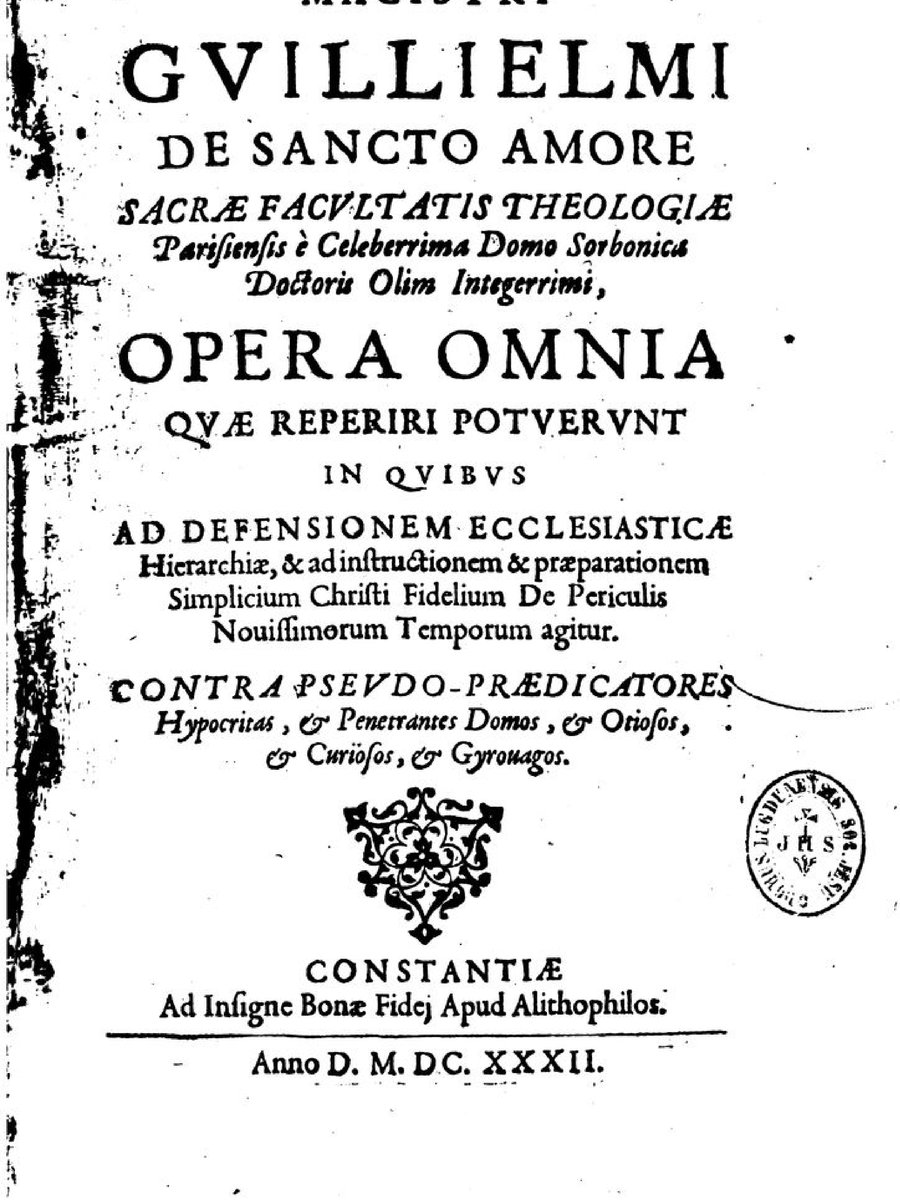
On the Dangers of the Last Times, Chapter 2
De Periculis Novissimorum Temporum, Caput II
 William of Saint-Amour
Per quos, aut cuiusmodi homines, futura sint pericula novissimorum temporum. CAP. II.
Circa secundum, videlicet, per quos instabunt ista pericula, prædicit Apostolus, 2. ad Timoth. 3. dicens quod erunt in Ecclesia quidam homines, seipsos amantes, per quos instabunt dicta pericula. Illi autem dicuntur amare seipsos, qui licet velint alios corrigere, tamen nolunt ab aliis hominibus corrigi in factis suis, quamvis aliquando perversis. Unde tales amant se plus quam veritatem, & idcirco plus quam Deum, qui est veritas, Ioan. 14. vt enim dicit Gregorius in pastorali. Qui perversa vult agere, & ad ea ceteros vult tacere, ipse testis sibi est, quod se plus veritate vult diligi, quam contra se non vult defendi. Item plus diligit se quam Deum, qui plus quærit honorem suum, quam honorem Dei; unde Augustinus de vita Christiana. Illi Deum diligunt, qui non aliud, quam unde nomen Dei glorificetur, exercent. Illi ergo, maxime qui in statu perfectionis sunt, & tamen honorem suum temporalem,
etiam cum multorum offendiculo appetunt et quærunt, plus diligunt se, quàm Deum.
Ex hoc autem peruerso amore sui, quasi ex mala quadam radice, incident illi homines Seipsos amantes in varia genera peccatorum, ita quod aliqui eorum fient Cupidi pecuniæ, vel mundanæ gloriæ; alij fient Elati contra Deum, vel contra Dominum, videlicet, quia nolent subesse Prælatis, sed superponi; alij fient Superbi de honoribus sibi impensis; alij fient Blasphemi in Deum per hæreses; alij fient Inobedientes parentibus, id est, Prælatis Ecclesiæ; alij fient Ingrati, de bonis sibi impensis; alij fient Scelesti, in grauibus peccatis perpetrandis, qui modum peccandi transcendunt, et animas suas, vel aliorum occidunt, vt qui corrigentibus mala pro bonis reddunt; Alij fient Sine affectione, non compatientes infirmis, scilicet peccatoribus, sed potius eos dedignantes; alij fient Criminatores, id est, crimen aliis imponentes, vel detractores, famam scilicet sanctorum maculare conantes; alij fient Incontinentes, gulæ vel libidinis non refrænantes malas cupiditates; alij fient Sine benignitate, nescientes alijs subuenire; alij fient Proditores, scilicet secretorum alterius, dum reuelant quæ occultanda nouerunt; alij fient Proterui, vel procaces, id est, quæ verecunde tractanda essent, scilicet de aliis hominibus, inuerecunde tractantes, vel agentes; alij fient Ceci, id est, non intelligentes quæ affirmant, nec de quibus agunt; alij fient Tumidi, scilicet inflato corde; alij fient Voluptatum amatores magis quàm Dei, id est, carnales delicias spiritualibus præponentes. Et hoc dicit Apostolus in his verbis. Et erunt homines seipsos amantes. Glos. Et pro quia, quasi diceret, Ideo instabunt tempora periculosa, quia erunt homines in Ecclesia seipsos amantes, cupidi, elati, blasphemi, ingrati, scelesti, sine affectione, sine pace, criminatores, incontinentes, sine benignitate, proditores, proterui, vel procaces, tumidi, Voluptatum amatores magis quàm Dei.
De omnibus autem istis generibus Peccatorum conuenient aliqui in sectam illam, per quam instabunt tempora periculosa. Vnde. 2. ad Timor, 3. post illa verba, Et erunt homines seipsos amantes, cupidi, elati, etc. subiungit Apostolus, Ex ijs sunt, qui penetrant domos, id est, Ex iis generibus Peccatorum conuenient aliqui in sectam illorum, qui penetrant domos, per quos penetrantes instabunt illa pericula, vt patebit. Qui autem sint pe-
netrantes domos, sic exponit Gloss. ad literam. Illi penetrant domos, qui ingrediuntur domos illorum, quorum regimen animarum ad eos non pertinet, et rimantur proprietates, id est, secreta eorum; Quod non potest fieri nisi se ingerant ad audiendum confessiones eorum; hoc enim est penetrare domos hominum prædictorum, scilicet rimari conscientias eorum, quæ domus appellantur, Eccl. 32. Præcurre prior in domum tuam, Glossa, id est, in domum conscientiæ. In hanc domum intrat per ostium Rector animarum, qui curam habet ab Ecclesia sibi commissam, cui præcipitur Prouerb. 27. Agnosce vultum pecoris tui. Glossa. Pastori Ecclesiæ dicitur, diligenter adhibe curam ijs, quibus te præesse contigerit; agnosce animos, actusque singulorum; et si quid vitij in eis inueneris, citius castigare memento. Hinc debet Pastori ostium domus aperiri per confessionem, iuxta illud Boetij de consolatione, si medicinam expectas, oportet vt vulnus retegas. Alienus autem, qui curam non habet, in hac domo recipi non debet. Eccl. 11. Non omnem hominem inducas in domum tuam, multæ enim insidiæ dolosi. Et in eodem. Admitte ad te alienigenam, et subuertet te in turbine, et abalienabit te a tuis proprijs. Et ideo de tali alieno dicit Apostolus, Rom. 14. Tu quis es, qui iudicas seruum alienum? Domino suo stat, aut cadit. Alienus ergo, si rimetur conscientiam subditi alieni, non intrat per ostium, sed aliunde ascendit, et ideo dicitur penetrare domum tanquam fur et latro. Ioan. 10. Qui non intrat per ostium in ouile ouium, sed ascendit aliunde, ipse fur est, et latro. Sic ergo habemus qui sunt, qui penetrant domos.
Consequenter dicit Apostolus in eodem capitulo 2. ad Timoth. 3. Et captiuas ducunt mulierculas oneratas peccatis. Glos. ad literam, subdolis et versutis verbis seducunt mulieres, et per eas viros earum, sicut Diabolus prius Euam seduxit, et per eam Adam. Et eodem modo viros seductibiles ad modum mulierum seducunt, id est, ad se, siue ad consilia sua adducunt; sic enim exponitur verbum hoc seducere Apocal. 19. soluetur Satanas, et seducet gentes. Glossa. id est, a Christo ad se ducet. Similiter et isti mulieres et viros seductibiles seducent, id est a consilio Prælatorum suorum ad sua consilia ducent, et tandem captiuabunt eos, id est, in suam redigent potestatem, obligantes scilicet eos ad viuendum secundum consilia sua: captiuari enim est a propria potestate, vel a potestate illius, cui subest quis, in alienam redigi potestatem. Sic ergo habemus quod, per illos,
qui penetrant domos, et captiuas ducunt mulierculas oneratas peccatis, instabunt pericula nouissimorum temporum; et qui sint penetrantes domos.
Instabunt etiam pericula per Pseudo-prædicatores, Matth. 24. Multi Pseudo-prophetæ surgent, et seducent multos. Pseudo autem Prædicatores sunt omnes, qui prædicant non missi, quantumcumque literati et sancti sint, etiamsi facerent signa, vel miracula. Rom. 10. Quomodo prædicabunt, nisi mittantur? Glossa, Non sunt veri Apostoli, nisi missi; nulla enim signa virtutum eis testimonium perhibent. Et sicut dicit Cyprianus distinct. 50. can. Si quis præpropere, MANDANT Martyres aliqua fieri, sed si in lege Domini scripta non sunt quæ mandant, ante est vt sciamus eos a Deo impetrasse quod postulant. Missi autem non sunt, nisi qui ab Ecclesia recte eliguntur; sicut nec a Deo vocantur, nisi qui recte eliguntur. Hebr. 5. Nec quisquam assumit sibi honorem, nisi qui vocatur a Deo tanquam Aaron. Glossa. A Deo vocatur qui recte eligitur. Ab Ecclesia vero recte eliguntur Episcopi, qui Apostolis successerunt; et Parochiales Presbyteri, qui Discipulis 72. successerunt, et eorum locum tenent. dist. 21. can. In Nouo Testamento. Vnde Luc. 10. in principio dicit Glossa, Sicut in 12. Apostolis forma est Episcoporum, sic in 72. Discipulis forma est Presbyterorum. Nec plures sunt in Ecclesia gradus ad regendam Ecclesiam constituti; vnde Chorepiscopi, quia officium Episcoporum in aliquo vsurpabant, ab Ecclesia sunt sublati; Cum enim non amplius, quam duos ordines inter Discipulos Domini esse cognouerimus, id est, 12. Apostolorum, et 72. Discipulorum; vnde iste tertius ordo processerit, funditus ignoramus; et quod ratione caret, extirpari necesse est. Ita legitur dist. 68. c. Chorepiscopi.
Si quis vero obiiciat de Archidiaconis, aut de Vicariis, qui vice aliorum exercent curam animarum; dicimus quod tales potestatem habent in Ecclesia, tamquam opitulatores, id est, opem maioribus ferentes; vnde Apostolus 1. Cor. 12. Quosdam quidem posuit Deus in Ecclesia, primum Apostolos, secundo Prophetas, tertio Doctores, deinde Virtutes, exinde gratias curationum, opitulationes, id est, vt inquit Glossa, qui maioribus ferunt opem, vt Titus Apostolo, vel Archidiaconi Episcopis. Nullus ergo habet regimen animarum, nisi Episcopi, et Parochiales Presbyteri, aut eorum opitulatores eis opem ferentes, vel ab eis legitime instituti, aut vocati.
Sed dicet quis, omnes prædicare possunt, qui habent authoritatem Domini Papæ, aut Episcoporum Diocesanorum; cum dicatur extra, De Hæreticis, cap. Excomunicamus. §. quia vero. OMNES, qui prohibiti, vel non missi, præter authoritatem a Sede Apostolica, vel Catholico Episcopo loci susceptam, publice vel priuatim prædicationis officium vsurpare præsumpserint, excommunicationis vinculo innodentur. Vnde videtur a contrario sensu, quod authoritate Sedis Apostolicæ, aut Episcoporum Diocesanorum, quilibet prædicare possit.
Respondemus, quod de potestate Domini Papæ, aut Episcoporum nolumus disputare; veruntamen, cum secundum iura tam diuina, quam humana, in vna Ecclesia non possit esse Rector nisi vnus; alioquin Ecclesia non esset sponsa, sed scortum, q. 2. cap. Sicut in vnaquaque. Et in vna Ecclesia non debeant esse plura capita, ne sit monstrum, extra De officio Iudicis ordinarij, cap. Quoniam in plerisque. Quoniam etiam in Ecclesiarum regimine, officium prædicationis existit præcipuum, sicut ordo prædicatorum est præcipuus, extra, De Hæreticis, cap. Cum ex iniuncto. Si forte Dominus Papa aliquibus personis concedat potestatem prædicandi vbique; intelligendum est, vbi ad hoc fuerint inuitati; quia etiam Episcopi, nisi inuitati fuerint ad hoc, vltra diocesim accedere non debent super aliquibus Ecclesiasticis disponenendis, 9. q. 2. cap. Non inuitati. Non enim princeps per mandata sua vult præiudicium iurisdictioni alterius generari, extra, De vsupallij, cap. Ex tuarum tenore; extra, De off. Iud. ord. cap. Licet; ff. Ne quis in loco publico, lege 2. §. si quis a principe. Ne, quod absit, inde videantur nasci iniuriæ, vnde iura nascuntur. C. Vnde Vi. meminerint cuncti; Et extra De accusationibus, cap. Qualiter & quando. Immo sibi iniuriam facit Apostolicus, qui fratrum suorum iura perturbat. 25. q. 2. cap. Quod vero dicitis. Et cum secundum Apostolum, nullus debeat gloriari in commissis alterius regiminis, 2. Cor. 10. Non in immensum gloriabimur vltra mensuram regulæ, qua mensus est nobis Deus. Glos. id est, Vltra mensuratum a Deo mihi populum, cuius ego sum regula ad dirigendum. Non est verisimile, quod Dominus Papa, contra doctrinam Apostoli Pauli, infinitis, vel pluribus licentiam concedat prædicandi plebibus alienis, nisi a plebanis fuerint inuitati; cum dicat capitulum Sunt quidam, 25. q. 1.
Quod si Romanus Pontifex, quod docuerunt Apostoli et Prophetæ, destruere, quod absit, niteretur; non sententiam dare, sed magis errare conuinceretur. Ipse etiam Apostolus plebi alienæ predicare nolebat ob rationem iam dictam, et ne super alienum fundamentum ædificaret, vt legitur Rom. 15. Sic autem predicaui Euangelium, non vbi nominatus est Christus, ne super alienum fundamentum edificarem. Glossa, Ne prædicarem iam per alios conuersis. Et 2. Cor. 1. Non in immensum gloriantes in alienis laboribus. Glossa, vbi alius fundamentum fidei posuisset. Et infra, Non habentes spem gloriari in aliena regula. Glos. In commissis alterius regimini.
Item, si vna persona, vel infinitæ personæ habeant potestatem prædicandi vbique, non inuitati; cùm hoc sit potissimum officium Episcoporum, iam erunt infiniti Episcopi vniuersales, quod est contra iura, vid. vt aliquis sit Episcopus vniuersalis, vel esse dicatur; dist. 99. cap. Nullus, et cap. Ecce.
Item constat, quod omnibus illis, qui predicant ex potestate, debetur procuratio, siue sumptus, 1. Cor. 9. Ordinauit Deus ijs, qui Euangelium annuntiant, de Euangelio viuere; Ergo si infinitæ personæ habeant potestatem prædicandi in qualibet Ecclesia, quælibet Ecclesia debebit infinitas procurationes, quod est absurdum dictu; Presbyteri enim Parochiales, qui suos habent Apostolos, id est, Episcopos, et eorum opitulatores, scilicet Archidiaconos, et Archipresbyteros, quibus visitantibus eos debent impendere procurationes secundum decreta Ecclesiastica: Et fideles laici, qui suos habent Presbyteros, quibus exhibent stipendia debita secundum ordinationem Ecclesiæ, vlterius grauari non debent; 10. q. 3. cap. Cauendum. Vnde si Episcopi mittant predicatores per suas dioceses ad predicandum, debent eis ipsi Episcopi, non Presbyteri, nec fideles laici vitæ necessaria exhibere; Extra, De off. ordin. cap. Inter cætera: Nec debent noui Apostoli constitui in Ecclesia Dei, Cum ipsa Ecclesia, tam de Apostolis, id est, Episcopis, quàm de alijs ministris, olim per Apostolos, et Sanctorum Patrum Concilia instinctu Spiritus Sancti, ad exemplar monstratum Moysi in monte Sina, diuinitus extiterit ordinata, vt dicit Beatus Dionysius in Ecclesiastica Hierarch. cap. 5. Cum igitur in Ecclesiastica Hierarchia, quæ ad instar Cœlestis Hierarchiæ ordinata est, vt ibid. dicitur, non sint nisi duo ordines, scilicet, ordo perficientium, qui est superior, ha-
bens tres gradus, scilicet Episcopos, Presbyteros, et Diaconos, siue ministros; Et ordo perficiendorum, qui est inferior, habens similiter tres gradus, Viros, scilicet, Regulares, qui et ibi Monachi appellantur, et Fideles Laicos, et Catechumenos; Nulli autem Spiritui Angelico licitum sit operari, præter quam ordinatum sit a Deo, vt dicit Dionysius in Cœlesti Hierarchia, cap. 3. a Deo autem ordinatum sit, vt nullus inferior exerceat officium superioris, nec influat super eum, sed contentus sit officio suo, vt dicitur in eodem capitulo: Relinquitur quod Viri Regulares, qui a Beato Dionysio Monachi appellantur, dum manent in ordine perficiendorum, qui est ordo inferior, superiorum, id est perficientium, officium, quod est purgare, illuminare, et consummare, vt dicitur in eod. cap. id est, officium docendi, prædicandi, et sacramenta ministrandi, nequaquam poterunt exercere. Et ideo dicitur in 6. cap. Ecclesiasticæ Hierarchiæ, quod, Monachatus ordo non debet aliis esse prælatus; vel secundum aliam translationem, Monachatus ordo non est aliorum adductiuus, scilicet, per prædicationem et doctrinam. Vnde super hoc emanarunt constitutiones Ecclesiasticæ, Quod Monachi, sicut nec Laici, quantacumque scientia nomine glorientur, prædicare publice non possint. 16. q. 1. cap. Adijcimus, cum suis concordantiis; licet ad officium prædicationis, id est, ad Episcopatum, vel Presbyteratum, per electionem canonicam possint assumi, vt dicitur 16. q. 1. cap. Sic Viue: Et hoc sic determinat Gratianus 16. q. 1. §. Ecce sufficienter. Non est autem verisimile, quod prædictam sacratissimam Hierarchiam liceat homini mortali immutare; præcipue cum dicat Leo Papa 25. qu. 1. cap. Quæ ad perpetuam, Ea, quæ ad perpetuam vtilitatem generaliter instituta sunt, nulla debere commutatione variari. Et sic non potest Romanus Pontifex destruere, quod ab Apostolis et Prophetis decretum est, alioquin errare conuinceretur, vt dicit Vrbanus Papa 25. q. 1. cap. sunt quidam. Sed, quomodo diuinitus ordinatam sacratissimam Ecclesiasticam Hierarchiam poterit quisquam mortalium immutare, aut etiam reuocare, cum nemini Prælatorum data sit potestas in destructionem, sed in ædificationem? 2. Corinth. 10. Etsi ergo aliis, quam Regularibus Viris, possit committi prædicationis officium, videtur tamen ex iam dictis, quod salua Ec-
ecclesiastica Hierarchia, Regularibus Viris, dum in suo inferiori perficiendorum gradu manent, prædicationis officium committi non possit; Igitur, si Viri Regulares prædicationi se immisceant, videtur quod non sint a Deo missi; et ideo pseudo sint reputandi. Sic ergo patet ex prædictis, qui sunt penetrantes domos et qui sunt pseudo; patet etiam, quod per tales instabunt, vel instant pericula nouissimorum temporum vniuersæ Ecclesiæ.
Through whom, or what manner of men, the dangers of the last times will come. CHAPTER II.
Concerning the second point, namely, through whom these dangers will press upon us, the Apostle foretells in 2 Timothy 3, saying that there shall be in the Church certain men, lovers of themselves, through whom the said dangers will press in. Now those are said to love themselves who, although they are willing to correct others, nevertheless are unwilling to be corrected by other men in their own deeds, even when those deeds are sometimes perverse. Hence such men love themselves more than the truth, and therefore more than God, who is the truth, John 14. For as Gregorius says in the Pastoral: He who wills to do perverse things and wills the rest to be silent about them is himself a witness to himself that he wills himself to be loved more than the truth, in that he is unwilling for the truth not to be defended against him. Likewise, he loves himself more than God who seeks his own honor more than the honor of God; whence Augustinus in De vita Christiana: Those love God who pursue nothing other than that whereby the name of God may be glorified. Therefore those, especially who are in the state of perfection, and yet who seek and pursue their own temporal honor,
even at the cost of giving offense to many, love themselves more than God.
Now out of this perverse self-love, as out of an evil root, those men, lovers of themselves, will fall into various kinds of sins, so that some of them will become covetous of money or of worldly glory; others will become haughty against God or against the Lord, namely, because they will be unwilling to be under prelates, but rather to be set over them; others will become proud of the honors bestowed upon them; others will become blasphemers of God through heresies; others will become disobedient to parents, that is, to the prelates of the Church; others will become ungrateful, for the goods bestowed upon them; others will become wicked, in perpetrating grave sins, who pass beyond the measure of sinning and kill their own souls or the souls of others, as those who repay evil for good to those who correct them; others will become without affection, having no compassion for the infirm, namely sinners, but rather disdaining them; others will become slanderers, that is, laying crimes upon others, or detractors, namely those who endeavor to stain the reputation of the saints; others will become incontinent, not restraining the evil cravings of gluttony or lust; others will become without kindness, not knowing how to come to the aid of others; others will become traitors, namely of another’s secrets, while revealing what they knew should be concealed; others will become insolent or impudent, that is, treating or handling shamelessly the things which ought to be treated with modesty, namely concerning other men; others will become blind, that is, not understanding what they affirm, nor the matters with which they deal; others will become swollen, namely with an inflated heart; others will become lovers of pleasures more than of God, that is, preferring carnal delights to spiritual ones. And this the Apostle says in these words: And men shall be lovers of themselves. Gloss: And stands for because, as if he were saying: For this reason perilous times shall press upon us, because there will be in the Church men who are lovers of themselves, covetous, haughty, blasphemers, ungrateful, wicked, without affection, without peace, slanderers, incontinent, without kindness, traitors, insolent or impudent, swollen, lovers of pleasures more than of God.
Now from all these kinds of sinners, some will come together into that sect through which perilous times will press upon us. Whence in 2 Timothy 3, after those words, And men shall be lovers of themselves, covetous, haughty, etc., the Apostle adds, Of these are they who penetrate houses — that is, from these kinds of sinners some will come together into the sect of those who penetrate houses, through whom, as house-penetrators, those dangers will press in, as will become clear. But who the house-pe-
[house]-penetrators, the Gloss expounds literally as follows. They penetrate houses who enter the houses of those whose government of souls does not pertain to them, and pry into their private affairs — that is, into their secrets. This cannot be done unless they thrust themselves forward to hear their confessions; for this is to penetrate the houses of the aforesaid men, namely, to pry into their consciences, which are called houses, in Ecclesiasticus 32: Run home first to thy house, Gloss: that is, into the house of conscience. Into this house the Rector of souls — who holds the cure committed to him by the Church — enters through the door, and to him it is commanded in Proverbs 27, Be diligent to know the countenance of thy cattle. Gloss: To the Pastor of the Church it is said, diligently apply care to those over whom thou hast been set; recognize the dispositions and acts of each one; and if thou findest any vice in them, remember to chastise it speedily. Hence to the Pastor the door of the house ought to be opened through confession, according to that saying of Boethius in The Consolation, if thou awaitest healing, thou must uncover thy wound. But a stranger, who does not hold the cure, ought not to be received into this house. Ecclesiasticus 11: Bring not every man into thy house, for many are the snares of the deceitful. And in the same place: Receive a stranger in, and he shall overthrow thee with a whirlwind, and shall estrange thee from thy own. And therefore concerning such a stranger the Apostle says, Romans 14: Who art thou that judgest another man’s servant? To his own lord he standeth or falleth. A stranger, then, if he pries into the conscience of another’s subject, does not enter through the door, but climbs up some other way, and therefore is said to penetrate the house as a thief and a robber. John 10: He that entereth not by the door into the sheepfold of the sheep, but climbeth up some other way, the same is a thief and a robber. Thus, then, we have who they are that penetrate houses.
Next the Apostle says in the same chapter, 2 Timothy 3, And lead captive silly women loaded with sins. Gloss, literally: With crafty and cunning words they seduce women, and through them their husbands, just as the Devil first seduced Eve and through her Adam. And in the same manner they seduce gullible men after the fashion of women — that is, to themselves, or draw them to their own counsels; for so this verb seduce is expounded in Revelation 19, Satan shall be loosed, and shall seduce the nations. Gloss: that is, shall draw them away from Christ to himself. In like manner, these men also will seduce both gullible women and men — that is, they will draw them from the counsel of their Prelates to their own counsels, and at last will lead them captive — that is, will reduce them under their own power, binding them, namely, to live according to their counsels: for to be led captive is to be brought from one’s own power, or from the power of him to whom one is subject, into the power of another. Thus, then, we have that, through those
who penetrate houses and lead captive silly women loaded with sins, the perils of the last times shall press in; and who the house-penetrators are.
Perils shall also press in through pseudo-preachers. Matthew 24: Many pseudo-prophets shall arise, and shall seduce many. Now pseudo-preachers are all those who preach without being sent, however learned and holy they may be, even if they should perform signs or miracles. Romans 10: How shall they preach, except they be sent? Gloss: They are not true Apostles unless sent; for no signs of virtues bear witness to them. And as Cyprianus says in dist. 50. can. Si quis præpropere: Martyrs do indeed command that certain things be done; but if what they command is not written in the law of the Lord, we must first know whether they have obtained from God what they ask. But none are sent except those who are rightly chosen by the Church; just as none are called by God except those who are rightly chosen. Hebrews 5: Neither doth any man take the honor to himself, but he that is called by God, as Aaron was. Gloss: He is called by God who is rightly chosen. Now by the Church the Bishops, who have succeeded the Apostles, are rightly chosen; and the parish Presbyters, who have succeeded the 72 Disciples and hold their place. Dist. 21. can. In Nouo Testamento. Whence on Luke 10 at the beginning the Gloss says, As in the 12 Apostles is the figure of Bishops, so in the 72 Disciples is the figure of Presbyters. Nor are there in the Church more grades established for governing the Church; whence the Chorepiscopi, because they usurped in some respect the office of Bishops, were abolished by the Church. For since we have known there to be no more than two orders among the Disciples of the Lord — that is, of the 12 Apostles and the 72 Disciples — whence this third order proceeded we are utterly ignorant; and what lacks reason must be uprooted. So one reads in dist. 68. c. Chorepiscopi.
But if anyone should object concerning Archdeacons, or concerning Vicars, who in the place of others exercise the cure of souls, we say that such men hold power in the Church as opitulatores, that is, as those bringing help to their superiors; whence the Apostle in 1 Corinthians 12: God indeed hath set some in the Church; first Apostles, secondly Prophets, thirdly Doctors, after that Powers, then graces of healing, helpers — that is, as the Gloss says, those who bring help to their superiors, as Titus to the Apostle, or Archdeacons to Bishops. No one, therefore, holds the government of souls except Bishops and parish Presbyters, or their helpers bringing help to them, or those legitimately instituted or called by them.
But someone will say: all those can preach who have the authority of the Lord Pope or of the diocesan bishops, since it is said in Extra, De Hæreticis, cap. Excommunicamus, §. quia vero: Let ALL who, being forbidden or not sent, presume to usurp the office of preaching, publicly or privately, apart from authority received from the Apostolic See or from the Catholic bishop of the place, be bound by the chain of excommunication. From which it seems, by argument from the contrary sense, that by the authority of the Apostolic See or of the diocesan bishops, anyone whatsoever may preach.
We answer that we do not wish to dispute concerning the power of the Lord Pope or of the bishops; yet, since according to both divine and human laws there can be in one Church only one rector — otherwise the Church would not be a bride but a harlot, q. 2. cap. Sicut in vnaquaque — and in one Church there ought not to be many heads, lest it be a monster, Extra, De officio Iudicis ordinarij, cap. Quoniam in plerisque; and since in the governance of the Church the office of preaching exists as the chief office, just as the order of preachers is the chief order, Extra, De Hæreticis, cap. Cum ex iniuncto: if perhaps the Lord Pope grants to certain persons the power of preaching everywhere, it must be understood as wherever they shall have been invited for this purpose. For even bishops, unless they have been invited for this, ought not to enter beyond their diocese to dispose of any ecclesiastical matters, 9. q. 2. cap. Non inuitati. For a prince does not, through his mandates, will that prejudice be brought upon the jurisdiction of another, Extra, De vsu pallij, cap. Ex tuarum tenore; Extra, De off. Iud. ord. cap. Licet; ff. Ne quis in loco publico, lege 2. §. si quis a principe. Lest — which God forbid — injuries seem to arise from the very source from which laws arise, C. Vnde Vi. meminerint cuncti; and Extra De accusationibus, cap. Qualiter & quando. Indeed, the Apostolic [Pope] does injury to himself who disturbs the rights of his brethren, 25. q. 2. cap. Quod vero dicitis. And since, according to the Apostle, no one ought to glory in matters committed to another’s governance, 2 Corinthians 10: We will not glory beyond measure, beyond the measure of the rule which God hath measured to us. Gloss: that is, beyond the people measured out to me by God, of whom I am the rule for directing. It is not likely that the Lord Pope, contrary to the teaching of the Apostle Paul, would grant license to an unlimited number, or to many, to preach to peoples not their own, unless they have been invited by the parish priests; since the chapter Sunt quidam, 25. q. 1, says [as much].
For if the Roman Pontiff should strive — which God forbid — to destroy what the Apostles and Prophets have taught, he would be convicted not of pronouncing sentence but rather of erring. The Apostle himself was unwilling to preach to a people not his own, for the reason already given, and lest he build upon another’s foundation, as is read in Romans 15: Thus I have preached the Gospel, not where Christ was named, lest I should build upon another man’s foundation. Gloss: Lest I should preach to those already converted by others. And 2 Corinthians 1: Not glorying beyond measure in other men’s labors. Gloss: where another had laid the foundation of faith. And below: Not having hope to glory in another’s rule. Gloss: In matters committed to another’s governance.
Likewise, if one person, or an unlimited number of persons, were to have the power of preaching everywhere uninvited — since this is the chief office of bishops — there would then be unlimited universal bishops, which is contrary to the laws, namely that anyone should be, or be said to be, a universal bishop; dist. 99. cap. Nullus, and cap. Ecce.
Likewise, it is established that to all those who preach by virtue of [official] power, procuration, that is, expenses, is owed, 1 Corinthians 9: God hath ordained that they who preach the Gospel should live by the Gospel. Therefore, if an unlimited number of persons had the power of preaching in any given church, every church would owe unlimited procurations, which is absurd to say. For the parish priests, who have their own Apostles, that is, bishops, and their helpers, namely the archdeacons and archpriests, to whom, when visiting them, they must furnish procurations according to the ecclesiastical decrees; and the lay faithful, who have their own priests, to whom they pay due stipends according to the ordinance of the Church, ought not to be further burdened; 10. q. 3. cap. Cauendum. Hence, if bishops send preachers through their dioceses to preach, those bishops themselves — not the priests nor the lay faithful — ought to furnish them with the necessities of life; Extra, De off. ordin. cap. Inter cætera. Nor ought new Apostles to be established in the Church of God, since the Church herself, both as to Apostles, that is, bishops, and as to other ministers, was once, by the inspiration of the Holy Spirit, divinely ordained by the Apostles and by the councils of the Holy Fathers, according to the pattern shown to Moses on Mount Sinai, as Blessed Dionysius says in Ecclesiastica Hierarchia, cap. 5. Since, therefore, in the ecclesiastical hierarchy — which is ordered after the likeness of the celestial hierarchy, as is said in the same place — there are only two orders, namely the order of those who perfect, which is the higher, ha-
having three grades, namely Bishops, Priests, and Deacons (or ministers); and the order of those being perfected, which is the inferior order, likewise having three grades, namely the Regulars (who are there also called Monks), the Faithful Laity, and the Catechumens. Now, no Angelic Spirit is permitted to do anything except what has been ordained by God, as Dionysius says in Celestial Hierarchy, chapter 3; and it has been ordained by God that no inferior should exercise the office of a superior, nor exert influence upon him, but should be content with his own office, as is said in the same chapter. It follows, then, that the regulars (whom blessed Dionysius calls Monks), so long as they remain in the order of those being perfected, which is the inferior order, can in no way exercise the office of the superiors\—that is, of the perfecters\—which is to purge, to illuminate, and to consummate, as is said in the same chapter; that is, the office of teaching, of preaching, and of administering the sacraments. And therefore it is said in chapter 6 of the Ecclesiastical Hierarchy that the monastic order ought not to be set over others; or, according to another translation, the monastic order is not for leading others, namely through preaching and teaching. Whence ecclesiastical constitutions have issued on this point: that monks, no more than laymen, however much they may glory in the name of learning, cannot preach publicly. 16. q. 1. cap. Adijcimus, with its concordances; although they may, through canonical election, be raised to the office of preaching, that is, to the episcopate or the priesthood, as is said in 16. q. 1. cap. Sic Viue. And Gratian determines this sufficiently in 16. q. 1. §. Ecce sufficienter. Nor is it likely that a mortal man is permitted to alter the aforesaid most sacred hierarchy; especially since Pope Leo says, 25. q. 1. cap. Quæ ad perpetuam, that those things which are generally instituted for perpetual usefulness ought to be varied by no change. And so the Roman Pontiff cannot destroy what has been decreed by the Apostles and Prophets; otherwise he would be convicted of erring, as Pope Vrbanus says, 25. q. 1. cap. sunt quidam. But how shall any mortal be able to alter, or even to revoke, the most sacred Ecclesiastical Hierarchy divinely ordained, since power has been given to none of the Prelates for destruction, but for edification? 2 Corinthians 10. Even if, therefore, the office of preaching may be committed to others than regulars, it nevertheless appears from what has already been said that, with the Ec-
clesiastical Hierarchy preserved, the office of preaching cannot be committed to regulars so long as they remain in their inferior grade of those being perfected. Therefore, if regulars meddle in preaching, it appears that they are not sent by God, and so are to be reckoned as pseudo-preachers. Thus, then, it is clear from what has been said who the penetrators of houses are and who the pseudo-preachers are; and it is clear, too, that through such men the dangers of the last times will press upon, or are pressing upon, the universal Church.