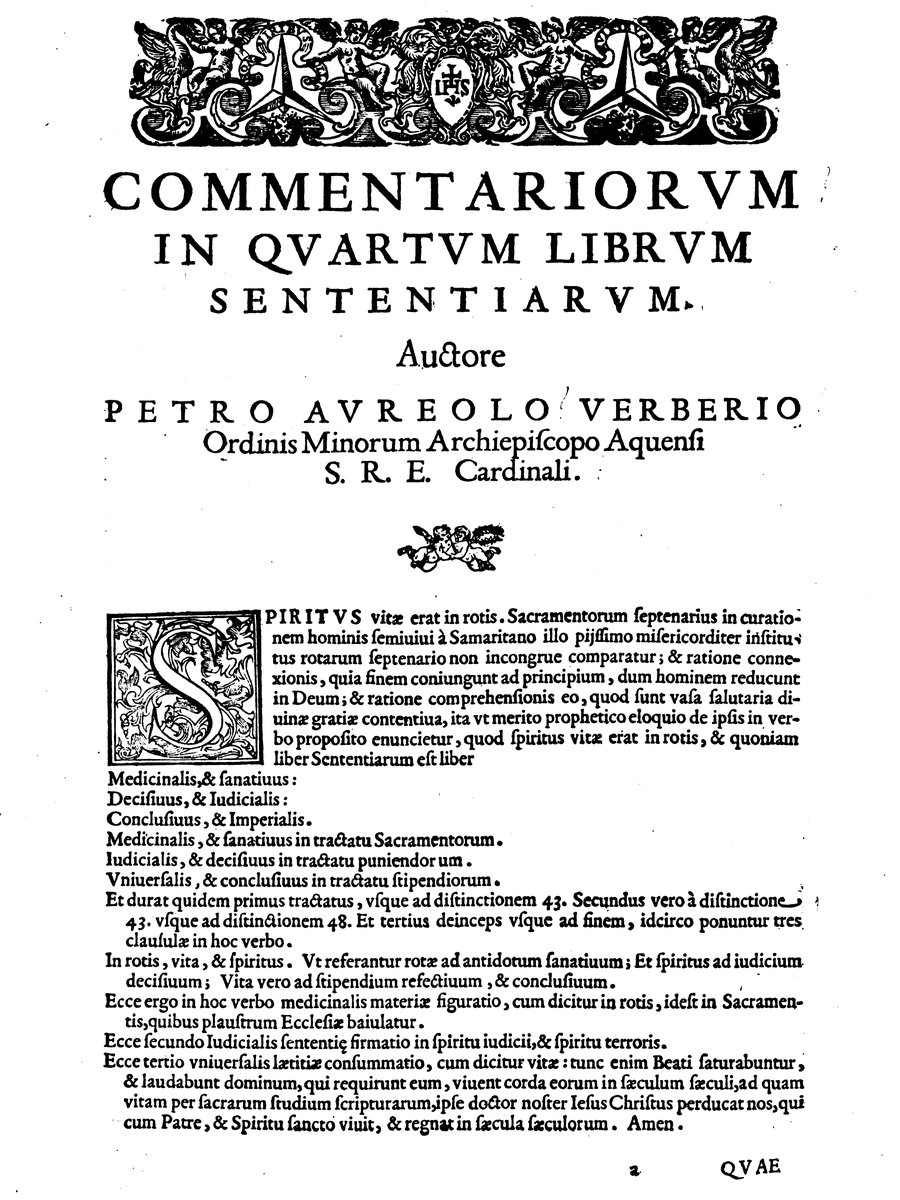
Distinction 25: On Those Receiving Orders
Distinctio Vigesimaquinta: De Suscipientibus Ordines
 Peter Auriol
DISTINCTIO XXV.
Solet etiam quæri, si hæretici, &c. In ista Distinctione Vigesimaquinta agit Magister de suscipientibus Sacramentum Ordinis, & etiam de ministris conferentibus. Ad euidentiam ergo istarum duarum materiarum quæro tres quæstiones.
Prima est: Vtrum solis Episcopis conueniat ministrare Sacramentum Ordinis.
Secunda est de symonia, quæ est communis ad ministrum, & suscipientem: Vtrum simonia sit vitium directe oppositum Iustitiæ.
Tertia est de eadem: Vtrum Dominus Papa possit in aliquo casu committere simoniam.
Vtrum solis Episcopis conueniat ministrare hoc Sacramentum Ordinis.
QVANTVM ad primam quæstionem arguo primo, quod non: imo quod possit etiam sacerdotibus simplicibus conuenire, & alijs, sic: Cui communicatur maius, potest etiam communicari minus: sed sacerdoti simplici communicatur maius, quam sit ordines ministrare, scilicet conficere corpus Domini: ergo.
In oppositum est, quia ad solum principem in Ecclesia pertinet gradus, & status in Ecclesia disponere, & dispensare, sed soli Episcopi sunt principes in Ecclesia: ergo.
Respondeo hic sunt videnda tria. Primum est de identitate suscipientium. Secundum de idonei-
eate ministrorum, & tertio de idoneitate signorum, in quibus imprimitur character.
De primo do istam regulam: Idoneus suscipiens est vir habens vsum rationis, non vitiatus corpore, natus legitime, non prohibitus excommunicatione, vel irregularitate, liber conditione.
Dico primo vir, vt excludam sexum muliebrem, & hoc ratione immunditiæ, & honestatis in circumstantibus, & ratione imbecillitatis deliberatiuæ ex primo Politicorum.
Secundo dico, habens vsum rationis, vt excludam amentes, fatuos, & insensatos, & pueros.
Sed nunquid posset Papa dispensare in ordinando pueros. Respondeo: Credo, quod peccaret grauiter, non curo modo dicere, si de facto esset puer ordinatus, bene tamen ratione necessitatis, quandoque permittuntur quidam iuuenes ordinari, & potissime in religionibus, & hoc quoad quatuor ordines minores: sed hodie per sacrum Concilium Tridentinum statutum est tempus suscipiendi ordines, quod debet seruari.
Sed quid de ordinibus maioribus? Puto, quod grauiter peccaret, qui talibus sacros ordines ministraret.
Tertio dico, corpore non vitiatus, & intelligo enormiter, sicut mutilatus, & huiusmodi. Ratio est quia minister debet esse in corpore expeditus, & ne sit in turpitudinem, & scandalum circumstantium.
Quarto dixi, natus legitime, & hoc propter honestatem, & decentiam status, & hoc nisi interueniat alia dispensatio.
Quinto dixi, conditione liber, ad excludendum seruum qui non debet ordinari. Ratio est, quia ratione gradus, & status Ecclesiastici, qui ad ordines promouetur aliquo modo, quasi manumittitur, & fit extra Domini potestatem, & ideo committeretur, & fieret iniustitia Domino suo.
Vltimo dico, excommunicatione non prohibitus, vel irregularitate, hoc dico, quia excommunicatus, etsi forte reciperet characterem, non reciperet tamen gratiam, & rem vltimam Sacramenti.
Sed de irregularitate sciendum est, quod irregularitas cum sit pœna, quandoque potest alicui aduenire sine culpa, vt propter homicidium iustum, sic si Iudex puniat, & occidat reum, & Aduocatus, qui aduocat, & Notarius qui scribit, & consimiles: quandoque potest interuenire ex culpa, puta ex simonia. De hoc dico, quod ordinatus scienter a simoniaco non potest ministrare in ordine recepto, sine dispensatione Papæ. In similem pœnam incidit, qui ponit se furtiue in numero vocatorum. Et consimili pœna plectitur, qui ministrat in ordine non suscepto.
Nunc secundo de ministro do regulam: Minister idoneus est solus Episcopus, licet ex dispensatione possit esse sacerdos. Dico secundo Episcopus quicunque, vt non excludatur malus, siue degradatus, siue excommunicatus: isti enim possunt Sacramentum ordinis ministrare, quoad primam rem, licet non quo ad secundam forte. Est tamen hic opinio quædam, quod degradatus, siue excomunicatus, quandiu toleratur, potest ministrare ordines: quandiu vero non toleratur, non potest. Doctores tamen communiter hoc non tenent. Ratio est, quia Episcopo in consecratione committitur indelebilis potestas modo dicto questione præcedenti.
Alij dicunt, quod talis Episcopus potest mini-
strare ordines, quantum in se est quantum ad vtriusque effectum, quia habet indelebilem, & inuariabilem respectu vtriusque potestatem: tamen alij tenentur a tali ministro ordines non suscipere.
Alij dicunt, quod bene habet potestatem, quoad vtrumque effectum, sed non potest ministrare sine speciali dispensatione.
Nunc tertio videndum est de signis, in quibus imprimitur character. Vbi sciendum, quod facile est hoc videre in illis ordinibus, in quibus non imprimitur, nisi vna potestas: ibi enim character, vel gratia imprimitur in tactu illius materiæ, quæ significat rem illius Sacramenti, sicut in tactu clauium in ordinatione Ostiarij, & in tactu libri in ordinatione lectorum. Sed accolito datur duplex potestas, per quam habet actum duplicem, vnum circa ministros, alium circa materiam, vt portare hostias, & vinum.
Circa hoc dicunt Doctores, quod res Sacramenti infunditur in tactu eius, quod est magis principale, puta in tactu vasis, sed non in tactu cerei. Videtur mihi, quod non sit inconueniens, quod detur in tactu vtriusque successiue potestas aliqua, & ambæ integrent vnam potestatem totalem.
De subdiacono dicitur, quod non datur ei effectus & res, & Sacramentum, quando tangit librum, sed quando tangit patenam, & calicem cum pane, & vino.
Videtur mihi, quod totum sit necessarium, vt in ambobus consistat ratio integri Sacramenti, sicut dictum est de Sacramento pœnitentiæ, quod consistit in confessione, & absolutione.
De Diacono alij dicunt, quod in impositione manuum, alij aliter. Dico, sicut dixi de alijs, quod totum est necessarium, vt vnum totale integrum signum.
De Sacerdote dicunt aliqui, quod potestas conficiendi datur in tactu calicis cum patena: sed potestas absoluendi datur cum dicitur, accipe Spiritum sanctum, &c, vnde & omnes illæ formæ, vt patet, sunt indicatiuæ.
Ad argumentum in oppositum, Etsi conficere corpus Christi sit dignius, quam ordines conferre, & hoc sit maius, est tamen difficilius, & ideo ad istum actum requiritur persona non tantum singularis, vt electa sicut ad alium actum, quæ etsi non sit ita nobilis, tamen est difficilior, & hinc est, quod oportet hunc actum competere singularibus, & electis de omnibus personis.
Vtrum Simonia sit vitium directe oppositum iustitiæ.
AD secundam quæstionem: Vtrum Simonia sit peccatum speciale oppositum iustitiæ, arguo, quod non sic: ex prima ad Corinth. 10.cap. Si nos vobis spiritualia seminamus, &c. ergo videtur velle Apostolus, quod pro spiritualibus accipere mercedem non sit peccatum.
In oppositum est illud Act. 8. vbi dicit Petrus Simoni volenti emere gratiam Spiritus sancti: Pecunia tua tecum sit in perditionem, &c.
Respondeo primo præmitto aliquas distinctiones. Secundo formabo propositiones. De primo præmitto istam distinctionem. Vbi considerandum est, quod Simonia non est nisi emptio quædam circa
circa spiritualia : spiritualia autem ista sunt gratia sancti Spiritus, & virtutes, vel potest esse gratia gratis data, cuiusmodi sunt prædicare, docere, officiare, & huiusmodi. Gratia autem gratum faciens, puta habitus virtutum potest considerari dupliciter, vel formaliter, vel causaliter. Primo modo consideratur gratia illa quo ad substantiam habitus, & hoc modo respectu eius nulla potest fieri commutatio, nec fit materia, & obiectum commutationis, nec per consequens potest committi Simonia.
Alio modo potest huiusmodi gratia accipi causaliter pro eo, quod confert quasi effectiue hanc gratiam, & hoc modo Sacramenta dicuntur gratia, quia ipsa conferunt nobis gratiam, pro quanto applicant nobis Deum, vt nobis gratiam conferentem, & hoc modo bene potest gratia esse obiectum commutationis : Sacramentum enim cum non fit aliud, quam signum corporale, potest vtique vendi, & pro alio commutari, sicut Baptismus, Missa & huiusmodi, & ideo ibi habet locum Simonia : imo istud est pessimum genus Simoniae.
Si vero accipimus gratiam gratis datam, puta prædicare, docere, & huiusmodi, aut accipietur quo ad actum intrinsecum, & hic nulla cadit venditio, non enim possum tibi vendere habitu scientiæ meæ ; aut accipitur quantum ad actum extrinsecum, puta prolationem vocis, motum corporis, & huiusmodi, sic bene in talibus cadit, & habet locum venditio, & hoc modo venditur doctrina, consilium, testimonium, & huiusmodi, & omnibus istis contingit esse peccatum.
Vlterius autem sciendum est, quod aliqua dicuntur esse spiritualia, non quod sint gratia, sed quædam emolumenta annexa, & hoc modo redditus pertinentes ad sustentationem sunt spiritualia quædam, quia spiritualibus annexa.
Tunc ergo recolligendo potest tripliciter intelligi committi, vel quia vendatur gratia gratum faciens, non quidem formaliter, sed causaliter puta Sacramenta, quæ habent hanc gratiam infundere : vel quia venditur gratia gratis data non quo ad actum intrinsecum, quia sic vendi non potest, sed quo ad actum extrinsecum : vel tertio modo, quod vendatur non gratia gratum faciens, nec gratis data, sed annexa, puta redditus temporales.
Secunda Distinctio est de Simonia ex parte dantis, quia Simonia quædam est a lingua, quædam ab obsequio, quædam pecuniaria.
Ad euidentiam autem istius distinctionis sciendum est, quod emere aliquid spirituale potest esse tripliciter, vel quando illud emitur, vel venditur verbo, puta cum precibus impetratur, & hoc modo Simonia dicitur a lingua, & hoc intelligendum est, quod spirituale illud obtinetur præcibus pro indigno. Alias enim, si pro digno impetretur, & non datur precum gratia principaliter, sed secundario, sic non committeretur Simonia, vnde cautela esset hic adhibenda, quod præces non tenderent directe ad rem obtinendam pro persona, sed ad sufficientiam allegandam, vt sic essent magis illa allegatiua, & testificationis, quam verba præcatoria, & obsecrationis.
Secundo committitur simonia, quando spirituale illud obsequio aliquo præuio impetratur, & impenditur, & dicitur simonia hæc ab obsequio, & intendendum est, quando principalis aspectus dantis esset ad obsequium ; si enim esset ad dignitatem,
& sufficientiam personæ, dato quod aliqualiter ab obsequio traheretur, non esset species simoniæ.
Tertio modo simonia potest committi pro pecunia, & nomine pecuniæ intelligo hic rem quamcumque temporalem, puta si detur ager, domus vel equus.
Secundo pono Propositiones, & est prima propositio, quod loquendo de emptione gratiæ gratum facientis causaliter, & gratiæ gratis datæ, quantum ad actum exteriorem, semper committitur peccatum simoniae : Ratio est, quia quando illud, quod non potest comparari, vel æquari, commutatur in aliquid aliud, committitur peccatum, & peccatum quidem est contra iustitiam : sed quando Sacramenta, vel alia huiusmodi commutantur pro re temporali, datur impreciabile, & inæquabile, pro eo ; quod nunquam poterit illud adæquare, puta Sacramentum, quod totus mundus non potest æquare, nec minimum gradum spiritualium. Ideo fit absolute contra naturam contractus, nam quod ex natura sua habet, quod gratis detur, ibi fit venale, ideo est peccatum contra iustitiam. Sed contra quam speciem iustitiæ ? Dico, quod contra religionem, & simile est de omni alia gratia, quæ appropriatur Spiritui sancto, vnde peccatum istud potest dici peccatum in Spiritum sanctum.
Secunda Propositio est, quod non tantum spiritualia prædicta non possunt vendi, sed nec labor, qui acquiritur in ministrando altari. Tamen sciendum est, quod bene potest administrans sustentationem competentem statui suo recipere, & hoc, modo tali, quod non facit per modum obligationis, & contractus, sed solum per modum necessariæ subventionis : & ratio huius decentiæ est, quia etsi spiritualia non possunt comparari, tamen qui occupatus est in eorum ministerio, non potest vacare temporalibus sibi necessarijs procurandis. Ea propter secundum rectam rationem recipiens ab isto spiritualia, est obligatus ad reddendum temporalia, non per modum contractus, sed per modum alterius obligationis naturalis, idest secundum dictamen rationis naturalis, propter quod peccat, qui ministris Ecclesiæ non dat decimas, primitias, & alia, quæ sustentationi eorum necessaria sunt. Ratio horum est, quia iustitia exigit, quod vnicuique reddatur, quod suum est : sed ministranti spiritualia obligata sunt temporalia, quantum sufficit ad sustentationem suam, vbi non posset aliter sustentari : ergo actus iustitiæ habet, quod ministrans spiritualia iuste recipiat temporalia : recipiens vero spiritualia, temporalia iuste reddat. Ex hoc patet : Vtrum liceat dare, vel recipere aliquid pro Missis cantandis : si enim aliquid detur titulo contractus venditionis, vel commutationis, expresse committitur Simonia : si autem titulo actus iustitiæ, obligatur ad reddendum alteri quod suum est, vt sic pecunia reddatur celebranti ad sustentationem victus, non ad meritum, & recompensationem illius boni spiritualis. Et hoc modo loquitur Apostolus ad Corinth. cap. 10. ex quo patet responsio ad argumentum principale.
Vtrum Dominus Papa possit in aliquo casu committere Simoniam.
Ad tertiam quæstionem : Vtrum Dominus Papa in aliquo gradu committere possit Simoniam.
DISTINCTION XXV.
It is also customary to ask, whether heretics, etc. In this Twenty-Fifth Distinction the Master treats of those receiving the Sacrament of Order, and also of the ministers who confer it. For the elucidation of these two matters, therefore, I raise three questions.
The first is: Whether it belongs to bishops alone to administer the Sacrament of Order.
The second concerns simony, which is common to both minister and recipient: Whether simony is a vice directly opposed to justice.
The third concerns the same: Whether the Lord Pope can in any case commit simony.
Whether it belongs to bishops alone to administer this Sacrament of Order.
WITH RESPECT TO the first question, I argue first that it does not — indeed, that it can also belong to simple priests and others — as follows: That to which a greater [power] is communicated can also have a lesser [power] communicated to it; but to a simple priest there is communicated something greater than the conferring of orders, namely the confecting of the Body of the Lord; therefore [a simple priest can also confer orders].
In opposition stands the argument that it belongs to the prince alone in the Church to arrange and dispense rank and station in the Church; but bishops alone are princes in the Church; therefore [it belongs to bishops alone].
I respond: three things are to be examined here. The first concerns the identity of those who receive [orders]. The second concerns the suit
[continuing the discussion] of the suitability of those who minister, and third, of the suitability of the signs in which the character is impressed.
Regarding the first point, I give the following rule: A qualified recipient is a man who has the use of reason, who is not physically defective, who is of legitimate birth, who is not barred by excommunication or irregularity, and who is free in his legal status.
I say first, a man, so as to exclude the female sex — and this on account of indecency, the propriety required before those present, and the weakness of deliberative capacity, as established in Book I of the Politics.
Second, I say, one who has the use of reason, so as to exclude the mentally impaired, the simple-minded, the insensate, and children.
But could the Pope dispense [from this requirement] and ordain children? I reply: I believe he would sin gravely [in doing so]. I need not address here whether in fact an ordained child [validly receives orders]; yet out of necessity, certain young men are sometimes permitted to be ordained — especially in religious communities, and this with respect to the four minor orders. Today, however, the sacred Council of Trent has established the age requirements for receiving orders, and these must be observed.
But what of major orders? I think that whoever would confer sacred orders on [such young persons] would sin gravely.
Third, I say, not physically defective — and I understand this in the sense of serious defect, such as mutilation and the like. The reason is that a minister must be physically capable, and [serious deformity] must not be a source of disgrace and scandal to those present.
Fourth, I said, of legitimate birth, and this for the sake of the dignity and fittingness of [the clerical] state — unless some other dispensation intervenes.
Fifth, I said, free in his legal status, so as to exclude a serf, who ought not to be ordained. The reason is that by reason of the rank and ecclesiastical status to which one who is promoted to orders is raised, he is in some fashion manumitted and placed outside his lord’s power; and therefore an injury would be committed and injustice done to his lord.
Finally, I say, not barred by excommunication or irregularity. I say this because an excommunicated person, even if he might perhaps receive the character, would not receive the grace, nor the ultimate reality of the sacrament.
Regarding irregularity, one must know that since irregularity is a penalty, it can sometimes befall a person without any fault on his part — as in the case of a just homicide: for example, when a judge sentences and executes a criminal, or an advocate who pleads the case, or a notary who draws up the documents, and the like. Sometimes, however, it can arise through fault — for instance, through simony. Regarding this I say that one who knowingly receives ordination from a simoniac cannot exercise the order he has received without a dispensation from the Pope. A like penalty is incurred by one who fraudulently inserts himself among those called [to ordination]. And a similar penalty is imposed on one who ministers in an order he has not received.
Now, second, regarding the minister I give the following rule: The qualified minister is the bishop alone, though by dispensation a [simple] priest may serve in his place. I say second, any bishop whatsoever, so that the wicked, or the degraded, or the excommunicated are not excluded: for these can indeed administer the sacrament of order with respect to its first effect, though perhaps not with respect to the second. There is, however, a certain opinion that a degraded or excommunicated [bishop], so long as he is tolerated, can administer orders; but so long as he is not tolerated, he cannot. The common opinion of the Doctors, however, does not hold this. The reason is that an indelible power is committed to the bishop at consecration, in the manner described in the preceding question.
Others say that such a bishop can admi[nister]
[nister] orders, as far as in him lies, with respect to both effects, because he possesses an indelible and unchangeable power with respect to both; yet others are bound not to receive orders from such a minister.
Others say that [such a bishop] does indeed have the power with respect to both effects, but cannot exercise it without a special dispensation.
Now, third, one must consider the signs in which the character is impressed. Here one must know that this is easy to see in those orders in which only a single power is impressed: for in those cases the character or grace is impressed at the touch of that material which signifies the reality of the sacrament — as in the touch of the keys at the ordination of a doorkeeper [ostiarius], and in the touch of the book at the ordination of lectors. But to the acolyte a twofold power is given, by which he has a twofold act: one with respect to the ministers, the other with respect to the matter [of the sacrament] — namely, carrying the hosts and the wine.
Regarding this, the Doctors say that the reality of the sacrament is infused at the touch of the more principal [instrument] — for example, at the touch of the vessel, but not at the touch of the candle. It seems to me that it is not incongruous that at the touch of each in succession some power should be given, and that both together constitute one total power.
Concerning the subdeacon, it is said that the effect, the reality, and the sacrament are not given to him when he touches the book, but when he touches the paten and chalice together with the bread and wine.
It seems to me that the whole [ceremony] is necessary, so that the full sacrament consists in both [elements] together — just as was said of the sacrament of penance, which consists in confession and absolution.
Concerning the deacon, some say [the character is impressed] at the imposition of hands, and others say otherwise. I say, as I said of the others, that the whole is necessary as one total complete sign.
Concerning the priest, some say that the power of consecrating is given at the touch of the chalice with the paten; but the power of absolving is given when it is said, “Receive the Holy Spirit,” etc. — whence also all those forms, as is evident, are in the indicative mood.
In reply to the argument on the other side: although to consecrate the body of Christ is more excellent than to confer orders, and this [former act, consecrating,] is the greater, [conferring orders] is nevertheless more difficult [in what it demands of the minister]; and therefore for this act [of conferring orders] one requires a person not merely singular, as is the person chosen for the other act [of consecrating] — who, although not so exalted, is nevertheless more demanding [a requirement]. Hence it is that this act must belong to persons who are singular and chosen from among all persons.
Whether Simony Is a Vice Directly Opposed to Justice.
On the second question — whether simony is a special sin opposed to justice — I argue that it is not: from 1 Corinthians 10, “If we have sown spiritual things among you,” etc. The Apostle therefore seems to hold that to receive payment for spiritual things is not a sin.
On the contrary is that passage in Acts 8, where Peter says to Simon, who wished to purchase the grace of the Holy Spirit: “May your money perish with you,” etc.
I reply. First, I will set out some distinctions. Second, I will formulate propositions. Regarding the first, I set out the following distinction: One must consider that simony is nothing other than a certain purchase concerning
concerning spiritual things. Now spiritual things are: the grace of the Holy Spirit and the virtues; or [the object of simony] may be freely-given grace, such as preaching, teaching, performing divine office, and the like. Sanctifying grace — say, the habitual disposition of the virtues — can be considered in two ways: formally or causally. Considered in the first way, grace is regarded according to the substance of the habit, and in this sense no exchange can be made with respect to it; it is not the matter or object of exchange, and consequently simony cannot be committed with respect to it.
In the second way, grace of this kind can be understood causally, [that is,] with respect to what confers this grace, as it were effectively. It is in this sense that the sacraments are called “grace,” because they confer grace upon us, insofar as they apply God to us as the one conferring grace — and in this sense grace can indeed be the object of exchange. For since a sacrament is nothing other than a bodily sign, it can certainly be sold and exchanged for something else, as with Baptism, the Mass, and the like; and therefore simony has its place here. Indeed, this is the worst kind of simony.
If, however, we take freely-given grace — such as preaching, teaching, and the like — it may be taken either with respect to the intrinsic act, in which case no sale can occur (for I cannot sell you the habit of my knowledge), or it may be taken with respect to the extrinsic act, such as the utterance of words, bodily movement, and the like. In this latter sense, sale can indeed occur and has its place in such things, and in this way doctrine, counsel, testimony, and the like are sold — and in all of these there can be sin.
Furthermore, it must be understood that some things are called spiritual not because they are grace, but because they are certain annexed emoluments. In this sense, revenues pertaining to maintenance are in some way spiritual, because they are annexed to spiritual things.
So then, to summarize, simony can be understood as committed in three ways: either because sanctifying grace is sold — not formally, but causally, as when the sacraments, which have the function of infusing this grace, are sold; or because freely-given grace is sold — not with respect to the intrinsic act (for it cannot be sold in that way) but with respect to the extrinsic act; or, third, because what is sold is neither sanctifying grace nor freely-given grace, but something annexed — for instance, temporal revenues.
The second distinction concerns simony on the part of the giver: some simony is [committed] by word, some by service, and some by money.
To clarify this distinction, it must be understood that the purchase of some spiritual thing can occur in three ways. [First,] when it is bought or sold by word — for instance, when it is obtained by prayers. Simony of this kind is called simony “of the tongue,” and this is to be understood as meaning that the spiritual thing is obtained by prayers on behalf of an unworthy person. For if it were sought on behalf of a worthy person, and the prayers were not given primarily for the sake of obtaining [the benefice] but only secondarily, simony would not thereby be committed. Hence a precaution is to be observed here: the prayers should not be directed explicitly toward obtaining the thing for the person, but toward setting forth his suitability — so that they function more as an assertion and attestation than as words of entreaty and supplication.
Second, simony is committed when a spiritual thing is sought and obtained through some prior service rendered — and this is called simony “of service.” The point to attend to is whether the principal intent of the giver was directed toward the service; for if it were directed toward the dignity
and the fitness of the person, even if it were in some measure drawn by [consideration of] service, it would not constitute a species of simony.
In the third way, simony can be committed for money — and by “money” I here mean any temporal thing whatsoever, such as a field, a house, or a horse.
Second, I set out propositions. The first proposition is that, speaking of the purchase of sanctifying grace causally understood, and of freely-given grace with respect to the exterior act, sin of simony is always committed. The reason is that when something which cannot be compared or equated [with anything else] is exchanged for something else, sin is committed — and it is indeed a sin against justice. But when the sacraments or other such things are exchanged for a temporal thing, something beyond price and beyond equivalence is given for [something] that can never equal it — for instance, a sacrament, which the whole world cannot equal, nor even the least degree of spiritual goods. Therefore this is absolutely contrary to the nature of a contract: that which by its very nature ought to be given freely is here made a thing for sale. Hence it is a sin against justice. But against which species of justice? I say that it is against religion, and the same holds for every other grace that is appropriated to the Holy Spirit — and so this sin can be called sin against the Holy Spirit.
The second proposition is that not only can the aforesaid spiritual things not be sold, but neither can the labor engaged in serving at the altar. Nevertheless it must be understood that the one who ministers may rightly receive maintenance suitable to his state, and in such a manner that he does not receive it by way of obligation or contract, but only by way of necessary support. The reason for this propriety is that, although spiritual things cannot be bought, yet the one who is occupied in their ministry cannot attend to procuring for himself the temporal necessities he requires. Therefore, according to right reason, the one who receives spiritual things from another is obligated to render temporal things in return — not by way of contract, but by way of a different, natural obligation, that is, according to the dictate of natural reason. For this reason, one who does not give to the ministers of the Church tithes, first-fruits, and other things necessary for their sustenance commits sin. The reason is that justice requires that to each be rendered what is his own; but to the one who ministers spiritual things, temporal things are owed to the extent sufficient for his maintenance, where he could not otherwise be sustained. Therefore it is an act of justice that the one ministering spiritual things justly receive temporal things, and that the one receiving spiritual things justly render temporal ones in return. From this the answer to the following question is clear: whether it is lawful to give or receive something for sung Masses. For if something is given under the title of a contract of sale or exchange, simony is expressly committed. But if it is given under the title of an act of justice — as one is obligated to render to another what is his own — then money is returned to the celebrant for the sustenance of his life, not as merit or recompense for that spiritual good. And this is how the Apostle speaks in 1 Corinthians 10, from which the response to the principal argument is clear.
Whether the Lord Pope can in any case commit simony.
On the third question: whether the Lord Pope can in any degree commit simony.