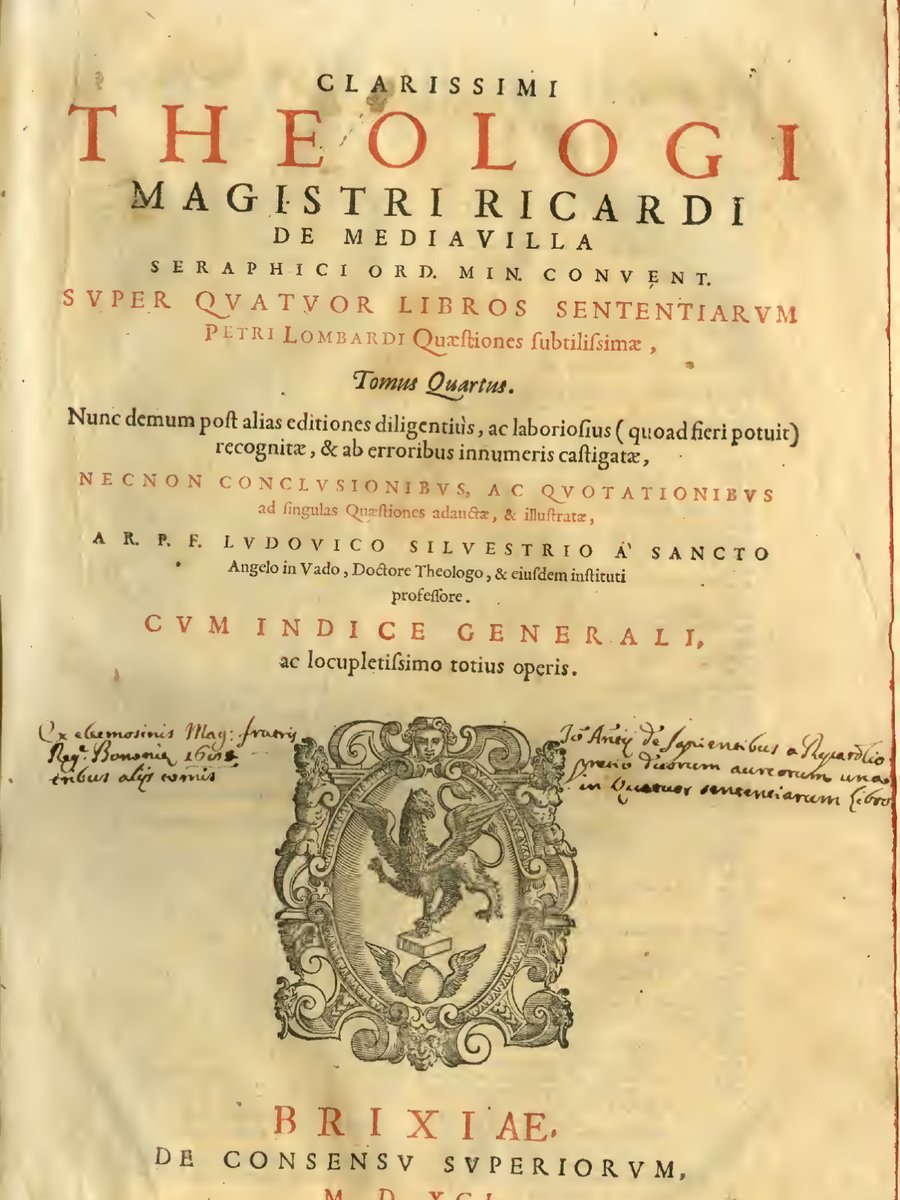
Distinction 25: On Those Ordained by Heretics and Simoniacs
Distinctio Vigesima Quinta: De Ordinatis ab Haereticis et Simoniacis
 Richard of Middleton
DISTINCTIO XXV.
Solet etiam quaeri, si haeretici ab ecclesia praecisi, & damnati possint tradere sacros ordines, et si ab eis ordinati, redeuntes ad ecclesiae vnitatem, debeant reordinari. Hanc quaestionem perplexam ac pene insolubilern faciunt doctorum verba: qui plurimum dissentire videntur. Videntur enim quidam tradere, haereticos sacros ordines dare non posse, nec illos qui ab eis ordinari videntur, gratiam recipere. Dicit enim Inno. Arrianorum clericos non videri suscipiendos cum sacerdotij, vel ministerij alicuius dignitate: quibus solum baptisma ratum esse permittit, quod in nomine patris, & filij, & Spiritus sancti percipitur. Dicit etiam eos non posse dare spiritum sanctum, quem amiserunt: & ordinatos ab haereticis, caput habere vulneratum, qui honorem amisit, honorem dare non posse: nec illum aliquid accepisse: quoniam in dante nihil erat, quod ille posset accipere. Tradit etiam, venientibus ab haereticis per manus impositionem, laicam tantum tribuendam communionem, nec ex his aliquem in clericatus honorem, vel exiguum subrogandum. Greg. etiam dicit sacrilegam esse Arrianorum consecrationem, cum ex eorum manu communio percipitur. Cyprian. etiam dicit, omnia quaecunque faciunt haeretici, carnalia, & inania, & sacrilega esse, & eorum altaria falsa, & illicita sacerdotia, & sacrificia sacrilega: qui more simiarum, quae cum homines non sint, formam imitantur humanam; vultum ecclesiae Catholicae, autoritatem sibi vendicant, cum ipsi in ecclesia non sint, & cum sint sacrilegi, sacerdotium administrant, & altare ponunt: cum nec sacrificari oblatio illic possit, vbi spiritus sanctus non sit: nec cuiquam Dominus per eius preces, & orationes prosit, qui Dominum ipsum violauit. Hiero. quoque asserit, omnia, quae offeruntur ab haereticis contaminata esse in conspectu Domini: quia licet sancta videantur specie sui, tamen quia contacta sunt ab illo, qui pollutus est, polluuntur omnia. Idem, Odit Deus sacrificia haereticorum, & a se proicit, & quoties in nomine eius congregati fuerint, detestatur faetore eorum, & claudit nares suas. Idem, Illi offerunt panem sacrilegum, &c. Leo etiam testatur, extra ecclesiam necrata esse sacerdotia, nec vera esse sacrificia. Idem etiam dicit, Per crudelissimam vefaniam in Alexandrina sede omnium sacramentorum lumen extinctum. Intercepta est sacrificij oblatio, defecit chrismatis sanctificatio, & parricidalibus manibus impiorum omnia se subtraxere mysteria. His alysque testimonijs astrui videtur, sacramenta ecclesiastica, praecipue corporis, & sanguinis, ordinationis, & confirmationis, per haereticos non posse ministrari.
Contra autem alij sentire videntur, & ab haereticis
cis etiam praecisis, sacri ordines, sicut, & baptismus, tradi valeant: nec ab haereticis redeuntes, qui illic ordinati sunt, & baptizati, iterum ordinandi sunt, sicut nec baptizandi. Vnde Augu. De haereticis etiam damnatis, quod quidam dicunt: Baptisma, quod accepit non amittit qui recedit ab ecclesia; ius dandi, quod accepit, amittit: multis modis apparet inaniter dici: Primo, quia nulla ostenditur causa, cur ille, qui illud baptisma amittere non potest, ius dandi possit amittere. Vtrunque enim sacramentum est, & quadam consecratione vtrunque homini datur: illud cum baptizatur, istud eum ordinatur. Ideo non licet in catholica ecclesia vtrunque iterari. Nam si quando ex ipsa parte venientes, etiam prapositi, pro bono pacis correctio schismatis errore suscepti sunt; etsi visum est opus esse, vt eadem officia gererent, quae agebant non sunt rursus ordinandi. Sed sicut baptismus in eis, ita in eis mansit ordinatio integra, quia in praecisione fuerat vitium, quod in vnitate pacis est correctum: non in sacramentis, quae vbicunque sunt, ipsa vera sunt. Et cum ipsi expedire videtur ecclesiae, vt prapositi eorum venientes ad Catholicam societatem, honores suos ibi non administrent, non eis tamen ipsa ordinationis sacramenta detrahuntur, sed super eos manent. Ideoque non eis manus imponitur: ne non homini, sed ipsi sacramento fiat iniuria. Sicut autem in baptismo est ius, quod per eos dari possit; sic in ordinatione ius dandi est: vtrunque quidem ad perniciem suam. Sed aliud est, non habere, aliud perniciose habere, aliud salubriter habere. Idem. De his qui ab ecclesia vnitate separati sunt, nulla iam quaestio est; quin & habeant, & dare possint, sed perniciose habent, pernicioseque dant, quia extra vinculum pacis sunt. Neutri sacramento facienda est iniuria. Sicut non recte habet: qui ab vnitate recedit, sed tamen habet, & ideo redeunti non redditur: sic etiam non recte dat qui ad vnitate recedit, & tamen dat, & ideo qui ab eo accipit, venienti ad vnitatem non iteratur. Idem, Aliud est non habere aliquid, aliud est non iure habere, vel illicite vsurpare. Non ergo ideo non sunt sacramenta Christi, & ecclesiae, quia eis illicite vtuntur, non modo haeretici, sed etiam omnes impij: sed illi corrigendi sunt, & puniendi, illa autem sunt agnoscenda, & veneranda. Item Greg. Quod dicitis, vt qui ordinatus est, iterum ordinetur, valde ridiculum est, vt enim baptizatus semel, iterum baptizari non debet, ita qui consecratus est semel, in eodem ordine non valet iterum consecrari. His alysque authoritatibus videtur asseri, in omnibus impiis, etiam in haereticis praecisis, & damnatis. Christi sacramenta permanere cum iure dandi. Possunt enim dare, sed perniciose, & quibus dederint, non sunt iterum ordinandi, quae praemissis ex opposito obuiare videntur.
Haec autem quidam ita determinant: dicunt enim haereticos accepta sacerdotali, vel episcopali vnctione ab ecclesia recedentes, baptismi quidem dandi ius retinere, sed non habere facultatem tribuendi sacros ordines, vel consecrandi dominicum corpus, postquam praecisi, & damnati sunt ab ecclesia. Sicut degradatus
tus episcopus non habet potestatem largiendi sacros ordines: facultatem tamen baptizandi non amisit. Quod vero Augustinus ait, intelligunt dictum de hereticis, qui non sententia ecclesie, sed prauitate sensus sui a fidei veritateac doctrine vnitate diuisi sunt, quilicet tales sint, ius tamen ordinandi, & consecrandi habent. Et qui ab eis ordinantur ante manifestam precisionem, etiam si cum eis aperte exierint, & sententia ecclesie damnati fuerint: tamen si redierint, iterum ordinandi non sunt. Et vbicunque legitur de ordinatis ab hæreticis, quod seruatis ordinibus ministrare valeant, vel iterum ordinandi non sint: de huiusmodi accipiendum dicunt. Nam postquam precisi fuerint, & damnari iudicio ecclesiæ, ius ordinandi consecrandi eis detractum afferunt, vt degradatis, vel excommunicatis.
Alij vero dicunt, sacramenta ab hereticis, & precisis secundum formam ecclesiæ celebrata, vera esse, & rata, quia recedentes ab Ecclesia ius dandi, & consecrandi non perdiderunt, qui sic ab bereticis ordinantur, cum redeunt, iterum ordinandi non sunt. Quæ vero ab hereticis aliter quam in ecclesia, fiunt, falsa sunt, & inania, qui a talibus ordinari videntur, non munus, sed vulnus accipiunt. Et secundum hanc differentiam varie de his loquuntur Doctores.
Quidam vero dicunt eadem sacramenta ab bereticis precisis posse celebrari, que a Catholicis, si ab illis forma ecclesiæ seruetur, & ab eis celebrata vera esse, & rata, quantum ad se: quantum vero ad effectum, falsa esse, & inania, & in his qui male tractant, & in his, qui male suscipiunt, ideo irrita, & falsa, quia quod promittunt, & conferre creduntur, non tribuunt. Damnanda etiam dicuntur, quia illicite dantibus, vel accipientibus sunt in iudicium. Polluta etiam dicuntur, non quantum ad se, sed propter indignam hæreticorum tractationem. Ideo Gregorius communionem Arrij vocat execrationem, & Innocentius Bonosii ordinationem, damnationem: non quia in se sint, sed quia male dantes, vel accipientes tales facit. Sicut etiam Hieronymus sacrificia eorum, panem luctus vocat, non quantum ad se, sed quantum ad effectum.
Nonnulli vero tradunt, illos hereticos, qui in ecclesia ordinati sunt, ius ordinandi, & consecrandi, etiam cum separati fuerint, habere. Qui vero in schismate, vel hæresi positi, ab eis ordinati, & inuncti fuerint, illo iure carent. Ideoque cum ordinare volunt, vulnus potius infligunt, quam gratiam conferant.
De Simoniacis vero non est ambigendum: quin sint hæretici: qui tamen ante sententiam degradationis, & ordinant, & consecrat. Et licet simoniaci proprie dicantur, qui instar Simonis magi impretiabilem gratiam pretio conducere volunt; & qui pro ministerio sacro pretium recipiunt in modum Giezi Giezite vocandi sunt; omnes tamen, dantes, accipientes, Simoniaci dicuntur, & vtrique eadem sententia percelluntur.
Differt tamen inter eos, qui ordinantur a simoniacis scienter, & eos qui ignoranter. Qui enim scienter a simoniacis se permiserint consecrari, imo execra-
ri, eorum consecratio omnino irrita est. Qui vero ordinatur a simoniacis, quos, cum ordinantur, nesciunt esse simoniacos, qui & tunc pro catholicis habentur eorum ordinatio misericorditer sustinetur.
Si vero aliqui obiecerint, se non consecrationes emere, sed res ipsas, que ex consecratione proueniunt penitus desipere probantur. Nam quisquis horum alterum vendit, sine quo alterum non habetur, neutrum vendere derelinquit.
Simoniace autem heresis tripartita est distinctio. Alij enim simoniace a simoniacis ordinantur, alij simoniace a non simoniacis, alij non simoniace a simoniacis. Vnde Nicolaus Papa, Statuimus decretum de simoniaca tripartita hæresi, id est, de simoniacis simoniace ordinantibus, vel ordinatis, & de simoniacis simoniace a non simoniacis, & de simoniacis non simoniace a simoniacis. Simoniaci simoniace ordinati, vel ordinatores, secundum canones a proprio gradu decidant. Simoniaci etiam simoniace a non simoniacis ordinati, similiter ab officio removeantur. Simoniacos vero non simoniace a simoniacis ordinatos, misericorditer per manus impositionem pro temporis necessitate in officio permittimus permanere. Quod intelligendum est de his, qui ordinantur a simoniacis, ignorantes eos esse simoniacos. Hoc facit simoniacos non reatus criminis, sed ordinatio simonici.
Similiter cum decernit Alexander Papa, simoniacos omnino damnandos, ac deponendos, subintelligendum est, nisi violenter quis attractus fuerit. De enim, & a quibuslibet hæreticis violenter ordinatis, dicit Innocentius, quòd possunt habere aliquem excusationis, si statim discedunt ab eis, & pessimo eorum conciliabulo renunciant.
Sacri, inquit, canones sanxerunt, vt Subdiaconus non ordinetur ante quatuordecim annos, nec Diaconus ante vigintiquinque, nec Presbyter ante triginta. Deinde, si dignus fuerit, ad Episcopatum eligi potest, quod nos etiam pari modo seruari iubemus. Item Fabianus, Si quis triginta ætatis non impleuerit annos, nullo modo Presbyter ordinetur, etsi valde dignus, quia & ipse Dominus triginta annorum baptizatus est, & sic cæpit docere.
Superius determinauit Magister de ordinum distinctione. Hic determinat de collatione. Et diuiditur in tres. Primo determinat de potestate conferentis. Secundo de vitio collationis.ibi.(De simoniacis.) Tertio
Tertio de impedimentis susceptionis. ibi. (Sacri.) Prima in tres.
Primo mouet quaestionem si hæretici possint tradere sacros ordines, & arguit ad partem negativam.
Secundo ad affirmativam. ibi. (Econtra.)
Tertio solvit ostendendo circa hoc opinionum diversitatem. ibi. (Hæc aute.) Illa pars, quæ ibi incipit. De symoniacis. Dividitur in tres partes.
Primo ostendit symoniæ gravitatem.
Secundo eius inexcusabilitatem. ibi. (Si vero.)
Tertio symoniacorum punitionem. ibi. (Symoniaci autem.)
CIRCA hanc distinctionem quærendum est principaliter de sex.
Primo de potestate conferentis ordines.
Secundo de vitio collationis. ibi. (Symonia.)
Tertio de casibus in quibus committitur symonia.
Quarto de puris naturalibus defectibus impedientibus ordinis susceptionem.
Quinto de impedimentis, quæ provenire possunt ex natura, & ex voluntate.
Sexto de impedimentis provenientibus ex infamia.
Vtrum presbyter non episcopus possit ordinare.
VIDETUR, sic: Quia cum sacerdos ordinatur non solus episcopus ei manus imponit: sed etiam omnes presbyteri, qui sunt præsentes. decre. di. 23. Presbyter: ergo non solum episcopus ipsum ordinat.
Item, quæ ad solum episcopum pertinent non episcopo committi non possunt: sed minores ordines quandoque conferuntur ex commissione a non episcopis. extra de ordinatis ab episcopo, qui renunciavit. c. 1. ergo conferre saltem minores ordines ad solum episcopum non pertinet.
Item magis excellit presbyter diaconum, quam episcopus episcopum: sed vnus episcopus potest alium consecrare: ergo presbyter potest diaconum ordinare.
CONTRA, Isid. lib. 17. ety. ca. 12. dicit de Pontifice, quod ipse efficit sacerdotes atque levitas: ipse omnes ordines ecclesiasticos disponit: ergo ordines conferre ad nullum alium pertinet.
Item solus episcopus potest virgines consecrare. 26. q. 6. Si iubet, & altare consecrare: eadem. q. ministrare. Sed maius est conferre ordines, quam altare consecrare, vel virgines: er-
go solus episcopus potest ordines conferre.
Solus episcopus, & non alius sacros ordines maiores conferre potest, minores vero etiam a sacerdote non episcopo conferri possunt, vel ex commissione, vel ex lege.
RESPONDEO, potestas conferendi ordines alicui potest convenire dupliciter, scilicet vel ex ordinaria potestate, vel ex generali seu speciali commissione.
Secundo modo minores ordines potest quandoque non episcopis convenire conferre, vt ostendebatur in arguendo.
Primo modo potestas conferendi quemcumque ordinem convenit solis episcopis. Cuius causa est institutio divina: cuius institutionis fuit ratio congrua, quia sicut ad solum principem pertinet non tantum ordinare viros bellatores in exercitu: sed etiam exercitus duces. Sic ad episcopos, qui sunt in ecclesia principes non tantum pertinet homines ordinare ad certandum contra fidei persecutores audacter confitendo Christi fidem, quod fit per sacramentum confirmationis: sed etiam ad ipsos solos pertinet duces ecclesiastici exercitus constituere, quod faciunt sacramentum ordinis conferendo, vt enim superius dictum est di. 5. ordinati administrandum sacramenta ad hoc sunt deputati, vt sint duces aliorum.
AD PRIMVM in oppositum dicendum, in manuum impositione non confertur ordo secundum quorundam opinionem. Vel potest dici secundum alios, impositio manuum episcopi est ad ordinem conferendum: sed impositio manuum sacerdotum assistentium est, ad concordiam, & communionem ecclesiasticam significandam.
Ad secundum patet solutio ex dictis in quæstione.
Ad tertium dicendum, quamvis presbyter magis excellat diaconum in ordine, quam episcopus episcopum consecrandum: tamen in dignitate est econtrario: consecrandus enim in episcopum nondum habet dignitatem episcopalem, quamvis ante hæc habeat, quæ iurisdictionis sunt post suam confirmationem.
Vtrum episcopus hæreticus possit ordines conferre.
VIDETVR, non, in ordinando Deus agit principaliter, & ordinans instrumentaliter: sed instrumentum non agit nisi coniunctum principali motori: ergo nec episcopus ordinat nisi in ordinando sit Deo coniunctus: sed episcopi hæretici in ordinando, Deo non sunt coniuncti, quia vt habetur prima. q. prima. Odit dominus sacrificia hæreticorum, & a se proijcit: ergo verum ordinem conferre non possunt.
Item ea. q. Si qui a symoniacis. Qui scienter se
se a symoniacis consecrari: immo execrari permiserint eorum consecrationem omnino irritam esse decernimus: ergo multo fortius irrita est ordinatio collata ab hæreticis.
Item maius est sacramentum ordinis conferre, quam recipere: sed hæretici non possunt recipere ordinis sacramentum: ergo nec conferre.
Contra, Aug. 2. li. contra epistolam parmeniani vltra medium, dicit de hæreticis, quod sicut habet in baptismo, quod per eos dari possit; sic in ordinatione ius vtrumque dandi ad perniciem suam quamdiu charitatem non habent vnitatis.
Item sacerdos hæreticus potest corpus Christi consecrare: ergo a simili episcopus hæreticus potest ordines conferre.
Episcopus hæreticus sacros ordines de facto conferre potest, modo intentione debita in forma ecclesiæ ordinet, etsi ordinando peccat.
Respondeo, quod episcopi hæretici, aut fuerunt ordinati, & consecrati in forma ecclesiæ, aut non: si non, veri episcopi non sunt, & ex consequenti nec ordines conferre possunt: si sic, veri episcopi sunt: sed officij executionem non habent, quia vt superius habitum est, omnes hæretici ipso iure sunt maiori excommunicatione excommunicati, & omnes sic excommunicati sunt suspensi ab omnibus actibus legitimis, & ideo episcopi hæretici executione ordinis conferre non possunt, quia eam non habent: quia quod non habet aliquis dare non potest, prima.q.7.Diambertum, & extra, de ordinatis ab episcopo qui renunciauit.c.1.in gl.
Verum tamen ordinem conferunt: si cum debita intentione formam ecclesiæ seruant: decre.di.19.Secundum. Si autem formam ecclesiæ non seruant cum debita intentione verum ordinem non conferunt: quantumcunque tamen seruent formam ecclesiæ in ordinando mortaliter peccant, quia ab executione sui officij sunt ipso iure suspensi.
Ad primum in oppositum dicendum, quod episcopi hæretici, & si non sint Deo coniuncti per fidem, & charitatem, quæ coniunctio respicit episcopum, inquantum est singularis persona, tamen Deo coniuncti sunt secundum quid scilicet inquantum mouentur a Deo in obseruando formam ecclesiæ in ordinando, quia quo ad hoc ministri ecclesiæ sunt.
Ad secundum dicendum, quod talis consecratio dicitur irrita quantum ad executionem.
Ad tertium dicendum, quod sicut hæretici verum ordinem conferre possunt de facto: non tamen de iure, sic & recipere. Vnde quamuis hæreticus si ordinatur in forma ecclesiæ, verum ordinem recipit: tamen recipiendo mortaliter peccat.
Quod quidam. §. Opponitur autem. Degradatus episcopus potestatem largiendi sacros ordines non habet, facultatem tamen baptizandi non amisit.
Item princeps iuste depositus non est princeps: ergo a simili nec episcopus iuste degradatus est episcopus: sed non episcopus non potest ordines conferre: ergo nec episcopus degradatus potest ordines conferre.
Item non potest veram tonsuram conferre quia tonsuratus ab eo debet iterum tonsurari: ergo a simili non potest conferre verum ordinem.
Contra, vt superius ostensum est. dist. 13. Sacerdos degradatus potest Christi corpus consecrare: ergo a simili episcopus degradatus potest ordines conferre.
Item hæretici ipso iure sunt omni dignitate priuati: cum ergo episcopi hæretici possint ordines conferre de facto, quamuis non de iure, vt in præcedenti quæstione habitum est: episcopus degradatus potest ordines conferre de facto, quamuis non de iure.
Item illa potestas fundata est super aliquid quod per hominem auferri non potest; fundata enim est super factum esse consecrationis, & decreto diuinæ sententiæ, quod decretum est, vt ille qui sic consecratus est, talem habeat potestatem.
Episcopus degradatus quamuis de iure sacros ordines conferre nequeat, tamen si ordinat, de facto verum ordinem confert, licet conferendo mortaliter peccet.
Ad istam quæstionem dixerunt aliqui quamuis episcopi suspensi excommunicati hæretici possint ordines de facto conferre: hoc tamen non possunt episcopi degradati, quia degradati non tantum sunt suspensi ab officij executione: sed etiam sunt spoliati episcopali dignitate, vnde non remanent episcopi, quamuis enim per hominem auferri non possit a sacerdote potestas conficiendi corpus Christi verum: eo, & nulli concessit Christus talem potestatem, quia nec decebat pro magna dignitate corporis sui, quia tamen dignitas episcopalis respicit corpus Christi mysticum: super quod concessit vicario suo potestatem: potest ab episcopo dignitas episcopalis totaliter auferri, auctoritate vicarij Christi.
Sed contra hoc sic potest argui. Altare, calix, & sic de aliis semel consecrata nunquam consecrationem amittere possunt nisi destruantur: ergo multo fortius nec episcopus: cum consecratio episcopi sit a Deo principaliter, quamuis ab homine ministerialiter.
Præterea episcopus, qui resignauit loco, & dignitate, quamuis talis exequi non debeat officium episcopi de iure: tamen si ordinat verum
rum ordinem confert, quamuis non ordinis executionem extra de ordi. ab episcopo, qui renunciauit episcopatui. ca. 1. quia vt ibi dicit gl. resignatio non abstulit isti ordinem: sed ordinis executione: sed degradatus non est magis spoliatus dignitate episcopali, quam iste: quamuis turpiori modo sit ab executione illius dignitatis suspensus, quam iste: ergo videtur, episcopus degradatus possit verum ordinem conferre de facto: quamuis non debeat de iure.
Et ideo alij hanc conclusionem concedunt dicentes: episcopum per hominem dignitate episcopali totaliter spoliari non posse. Vnde degradatio, non est dignitatis ablatio: sed perpetua suspensio ab executione dignitatis illius, extra de conse. ecclesiæ. in gl. ibi enim dicitur, visibilis vnctio exterior signum est interioris vnctionis in corde, quæ perpetua est, & amitti non potest: licet executio quandoque suspendatur.
QVI TENENT hanc secundam opinionem, quæ mihi videtur rationabilior possunt dicere ad primum, quod degradatus ideo dicitur potestatem largiendi sacros ordines non habere, quia effectu suæ potestatis penitus priuatur: secundum, patet per textum sequentem. Vnde secundum glo. ibidem confert ordinem: sed non ordinis executionem.
Ad secundum dicendum, sicut dignitate apostolatus omnes Apostoli, quorum sunt episcopi successores, immediate acceperunt a Christo: ita episcopus quantum ad dignitatem episcopalem supra se, potestatem quæ illam sibi possit auferre non habet nisi diuinam: quamuis eius executio a superiori in iurisdictione dependeat potestate scilicet a potestate Papæ, quæ est omnibus alijs potestatibus superior in iurisdictione, vt superius dictum est. Sed principatus terrenus dependet a potestate capitis ecclesiæ, & principatus inferior a superiori: ideo ab inferiori potest principatus auferri per principem superiorem, & a principe superiori per vicarium Christi, cum iusta causa, & rationabilis hoc requiritur.
Ad tertium dicendum: tonsuratus ab eo non debet iterum tonsurari: sed tamen debet puniri.
QVI TENENT opinionem primam possunt dicere ad primum in oppositum sicut dictum est in corpore quæstionis.
Ad secundum dicendum, quod hæretici ipso iure non sunt priuati omni dignitate, nisi quantum ad executionem. Vnde magis debent dici ab omni dignitate suspensi, quam priuati, per sententiam tamen sunt priuandi.
Ad tertium dicendum, sicut a Deo decretum est, vt ille circa quem fit talis consecratio habeat talem potestatem: ita decretum est, vt ille qui degradatur careat illa potestate.
AD PRIMVM quod arguebatur in cor-
pore quæstionis contra hanc opinionem solui potest per interemptionem maioris. Papa enim posset ab altari, & calice auferre consecrationem absque illorum destructione.
Ad secundum etiam dicendum, quod per resignationem non potest se episcopus priuare omnibus, quibus posset priuari per degradationem: quamuis enim iurisdictio siue ordinaria siue delegata sola voluntate, & verbo possit conferri: tamen consecratio episcopalis dignitatis sola voluntate, & verbo non confertur: immo facto opus est, extra de conse. ecclesiæ. A qua in glo. A simili dico, quamuis sola voluntate, & verbo possint episcopi ab his, quæ sunt iurisdictionis priuari: tamen sola voluntate, & verbo non possunt priuari dignitate episcopali:
CONSEQUENTER quæritur de secundo principali. Et circa hoc quæruntur tria. Primo vtrum simonia fit studiosa voluntas vendendi, vel emendi aliquid spirituale, vel annexum spirituali.
Secundo vtrum simonia conuenienter nominetur.
Tertio vtrum simoniaci sint irregulares. Vtrum autem sint hæretici superius quæsitum est. di. 3.
Vtrum sit simonia studiosa voluntas emendi, vel vendendi quid spirituale, vel spirituali annexum.
ET VIDETVR, quod non: quia voluntas studiosa respectu mali dicitur malitia, sed non semper committit homo simoniam ex malitia, sed quandoque ex infirmitate, vel ignorantia: ergo male ponitur in diffinitione simoniæ studiosa voluntas.
Item spiritualia non possunt pecunia possideri. Vnde vt habetur Act. 8. Symoni mago volenti emere donum spiritus sancti dixit Petrus, Pecunia tua tecum sit in perditione, quoniam donum Dei existimasti pecunia possideri: cum ergo vt habetur. 3. ethi. c. 5. electio non sit impossibilium, & studiosa voluntas fit cum electione: male dicitur, quod simonia fit studiosa voluntas vendendi, vel emendi spiritualia.
CONTRA, prima. q. prima. Qui studet, prædicta diffinitio implicite continetur.
Congrua profecto est simoniæ descriptio isthæc.
RESPONDEO, quod competens est prædicta descriptio simoniæ: continet principalem actum in hoc, quod dicitur voluntas studiosa, idest actus voluntatis cum effectu secundum glo. ibidem, & actum exteriorem scilicet venditionem, & emptionem, & obiectum, quod est spirituale, vel annexum spirituali.
AD PRIMVM in oppositum dicendum, quod studiosa voluntas, dicitur voluntas ad effectum deducta, quia quamuis simonia mentalis
lis sit peccatum: tamen non obligat ad renuntiationem, vel restitutionem rei acquisite. extra de simonia. Mandato nostro. Potest etiam dici, quia perfectio peccati est in electione: quamvis quandoque ad hoc inclinetur homo ex ignorantia, vel infirmitate: ideo dicitur simonia esse studiosa voluntas, vt intelligatur esse voluntas non subreptoria, sed eligens.
Ad secundum dicendum, quod aliquid spirituale dicitur dupliciter. Vno modo per essentiam: sicut gratia, & virtutes, & respectu talium non potest esse contractus venditionis vel emptionis. Alio modo causaliter, vel dispositive, & sic sacramenta sunt spiritualia, inquantum sunt causa instrumentaliter disponens ad gratiam, & virtutes, & ista inquantum sunt quaedam res corporales vendi possunt de facto, quamvis vendi non possint de iure, & sic accipiuntur spiritualia in diffinitione simoniae.
Vtrum simonia convenienter nominetur.
VIDETUR, non: quia vt habetur act. 8. Symon magus noluit vendere spiritualia: sed emere. Sed vt habetur 4. Reg. ca. 5. Gyezi spiritualia vendidit Naaman Syro: ergo no magis debet dici simonia, quam Gyezia.
CONTRA, simonia communiter nominatur in iure.
Apprime hoc nomen sibi vindicat.
RESPONDEO, convenientius nominatur simonia, quam Gyezia, quia vitium emptionis, & venditionis quantum ad voluntatem fuerunt in Simone mago: ad hoc enim voluit emere pecunia donum Spiritus Sancti, vt postea aliis venderet. Si tamen distincte & per appropriationem loqui volumus, possumus vocare spiritualia vendentes Gyezitas, & ementes simoniacos. Et sic patet quid dicendum est ad argumenta.
Vtrum simoniace sint irregulares.
VIDETUR, non. Dare pecuniam pro sacramentis sine pacto, & post sacramenti susceptionem non facit hominem irregulare: sed hoc faciens est simoniacus. Gyezi enim pecuniam a Naaman accepit non ex pacto, & postquam curatus fuerat: ergo no omnis simoniacus est irregularis.
Item vt habitum est li. 2. Ignorantia invincibilis totaliter excusat: sed potest accidere, aliquis ordinet, vel beneficium ecclesiasticum consequat per simoniam: ipso de hoc habente ignorantiam invincibilem, vt cum aliquis clam dat pecuniam ordinanti, vel praelato, vt ordinem, vel beneficium conferat alij ignoranti: ergo talis non efficitur irregularis.
CONTRA, decre. dist. 33. Maritum. Inter
non promovendos numeratur ille, qui per emptionem ad imitationem Simonis magi pecuniam obtulerit.
Quicunque per simoniam, vel ordinum susceptionem, vel beneficii ecclesiastici consecutionem sibi comparat, irregularis efficitur.
RESPONDEO, omnis simoniacus: sive sit simoniacus propter ordinis susceptionem simoniacae suscepti: sive propter beneficii ecclesiastici consecutionem irregularis est, quia tales iura decernunt sine dispensatione promoveri ad ordines non posse. Quod credo esse intelligendum, si talis simonia commissa fuit ipso sciente, quia si ipso ignorante invincibili ignorantia fuit data pecunia, vt ordinaretur, vel beneficium ecclesiasticum consequeretur, quamvis statim postquam huius rei notitiam habuerit teneatur renunciare beneficio sic assecuto, & desistere ab administratione ordinis sic suscepti: quousque cum eo fuerit dispensatum: irregularitatem tamen non incurrit pro beneficii tali assecutione: quamvis secundum quid eam incurrerit pro tali ordinis susceptione: inquantum in illo non debet ministrare sine dispensatione: non tamen est irregularis simpliciter, quia absque omni dispensatione in ordinibus ante legitime susceptis ministrare potest, & eo ipso, quod dispensatum est, cum eo in ordine quem sic suscepit potest absque alia dispensatione ad ulteriores ordines promoveri. Sciendum tamen, gravior est simonia in ordine, quam in consecutione beneficii ecclesiastici. Vnde cum illis qui ordinem scienter simoniacae susceperunt: maxime si commissa fuit simonia, & ex parte ordinati, & ordinatoris, vel praesentatoris: non est consuetum dispensari etiam in religione. extra de simonia. Ex tuae & cum simoniacis quibuscunque, qui scienter spirituale, vel spirituali annexum simoniacae susceperunt: solus Papa potest dispensare, vel ipse cui hoc commiserit, quod potest probari per illud, quod dicitur prima. q. 1. Erga, vbi ipse Papa eos omnino damnat: ac deponendos auctoritate Apostolica sancitur: nisi violenter attractus fuerit, & extra de simonia. Nobis fuit in textu, & in glosa.
Gyezi accipiendo pecuniam a Naaman, triplex incurrit peccatum, quia mentitus est, & famam domini sui laesit: quantum in se fuit, & quia directe & ex intentione pecuniam pro beneficio Spiritus Sancti: quamvis iam exhibito exegit: aliud enim est pro beneficio iam recepto liberaliter dare pecuniam: non sicut pretium: sed loco actionis gratiarum, quod licitum est, & aliud pecuniam exigere: sicut pretium, quod fecit Gyezi.
ignorantia invincibilis quamdiu durat a toto excusat ignorantem: sed postquam cessat homo tenetur quantum
tum in se est malum corrigere, quod ignorauerat, & ideo ille pro quo ignorante data fuit pecunia, vt eligeretur ad aliquam dignitatem, vel ordinaretur, vel beneficium ecclesiasticum sibi conferretur, postquam venit ad notitiam facti tenetur beneficiu, quod sic assecutus est, resignare, & ab executione ordinis sic suscepti desistere: nisi pecunia data fuisset in fraude, & in malum illius extra. de simonia. Nobis fuit: in hoc enim casu pecunia ab alio data ipse penitus ignorante non nocet: nisi ex post facto consentiat: alioquin contingere posset, ut alicuius factum infidias inimico parentis ei danosum existere: cui penitus displiceret, & aliquis de fraude sua commodum reportaret. extra. de simonia. Sicut tuis.
CONSEQUENTER quæritur de tertio. Primo vtrum simonia committatur in emptione, vel venditione sacramentorum. Secundo vtrum in emptione, vel venditione quorumcunque spiritualium. Tertio vtrum in emptione, vel venditione spiritualibus annexorum.
Vtrum in emptione, vel venditione sacramentorum committatur simonia.
VIDETVR, non: quia quamuis temporale non possit esse præcium spiritualium, tamen vnum spirituale potest esse præcium alterius: ergo videtur, non est illicitum emere vnum sacramentum per aliud.
Item missa principaliter consistit in altissimo Eucharistiæ sacramento: sed licitum est dare aliquid temporale pro celebratione misse, vt enim habetur extra. de præben. Significatum est: quidam canonici sacerdoti cuidam vnam præbendam in ecclesia dederunt, vt missam quotidie de beata Virgine celebraret, & Papa illam pactionem confirmauit.
Item electio ad episcopatum res est spiritualis, & ipse episcopatus quid sacramentale: sed vt habetur extra. de ele. vt præteritæ: dicit Papa Statuimus, vt expensæ necessariæ quas capitulum Constantinopolitanum, vel eius nuncij vacante sede pro electionis negocio fecerint: de bonis patriarchatus fiant totaliter, vel reddantur.
Item matrimonium est sacramentum: sed pro matrimonio licite datur pecunia ex pacto.
Item absolutio sacramentale quoddam est, sed officiales comuniter pecuniam accipit, vt ab excommunicatione absoluant.
Item episcopatus sacramentale quid est: sed electo in episcopum licet dare pecuniam aduersario suo, vt ab impedimento suæ electionis desistat.
Item sacramenta ordinantur ad remissionem peccatorum: sed remissio peccatorum po-
test emi. iuxta illud Dani. 4. Peccata tua eleemosynis redime: ergo multo fortius sacramentum ordinatum ad peccatorum remissionem emi potest.
Item si monachus roget sacerdotem, vt baptizet paruulum imminente mortis articulo nullo alio existente, qui ipsum baptizare possit, & sacerdos nolit ipsum baptizare nisi pro pecunia: tunc aut monachus permittet puerum damnari, quod nullo modo permittendum est, si sibi possit succurri: aut a sacerdote emet sacramentum baptismi: in casu ergo sacramentum baptismi licite potest emi.
CONTRA, prima. q. 1. Baptizandis, &c. In sequenti habetur contrarium.
Item extra. de simonia. Si quis. Si quis ordinauerit, seu ad ordinem præsentauerit aliquam promissionem, vel iuramentum ab ipso recipiens, quia super prouisione sua non inquietetur eundem: ordinator a collatione, præsentator vero ab executione ordinum per triennium, & ordinatus ab ordine sic suscepto donec dispensationem super hoc per sedem Apostolicam obtinere meruerit: nouerint se suspensos: ergo multo fortius illicitum est, ordinem, vel quodcunque aliud sacramentum emere, vel vendere.
Sacramenta aut vendendo, aut emendo simonia prorsus committitur.
RESPONDEO, in emptione, vel venditione sacramentorum ecclesiæ committitur simonia: cuius ratio triplex est.
Prima quia contra rationem gratiæ est ipsam vendi, vel emi. Vnde de ratione sua est, quod gratis detur: sacramenta autem sunt instrumenta disponentia ad gratiam, & ideo qui vendit ea, vel emit eis iniuriatur.
Alia ratio est, quia causa dispositiua cuius effectus mensurari non potest aliqua re temporali excedit precium cuiuscunque rei temporalis, & ideo cum pro sacramentis pecunia datur, res inappreciabilis sub temporali præcio ponitur: sacramenta enim sunt causæ instrumentales disponentes ad gratiam, quæ inappreciabilis est.
Tertia est, quia homines non sunt domini sacramentorum, sed ministri: res autem emi non debet nisi a domino: nec eam vendere debet nisi dominus, vel minister auctoritate domini: Deus autem hominibus non dedit potestatem sacramenta vendendi, quamuis ministris ecclesiæ potestatem dederit ea administrandi: & ideo quicunque emit sacramentum emit rem ab illo qui eius dominus non est, & qui eam vendere non potest, & ideo merito illicita est, & execrabilis talis emptio, vel venditio.
AD PRIMVM in oppositum dicendum, quod cum substantia spiritualis, & eius actus, & habitus non sint accepta Deo, nisi per gratias nullum
nullum aliud spirituale donum a gratia potest esse sufficiens precium gratiæ. Vnde apostolus ad Rom.11. Si gratia Dei iam non ex operibus: alioquin gratia iam non est gratia. Sed quamuis hæc solutio verum contineat: tamen argumento non satisfacit, quia unum sacramentum posset esse eiusdem sacramenti in specie precium si essent res vendibiles. Vnde nisi aliud obstaret possent duo adulti baptizandi hanc pactionem inter se facere. Promitto tibi, quod baptizabo te tali pacto, & postea baptizabis me, quod tamen facere licitum non esset, quia in talibus omnis pactio, vel conuentio cessare debet. extra. de simonia. Tua nos.
Dicendum ergo ad argumentum, quod dare aliquid spirituale pro sacramento ex pacto quamuis non sit illicitum ex tot causis ex quot illicitum est dare ex pacto pecuniam pro talibus: tamen illicitum est duabus de causis: tum quia emitur res a non domino: tum quia est contra rationem gratiæ vt vendatur pro quocunque precio: dicere tamen orabo pro vobis, & rogo vos quod pro me oretis, & similia in nullo est repræhensibile: hoc enim non est vendere, nec emere spirituale pro spirituali, quia hic nulla pactio est.
Ad secundum dicendum, quod non est licitum ex pacto aliquid dare tanquam precium misse: si tamen sacerdos non habet sumptus pro quibus missam teneatur ex officio celebrare: nec etiam aliunde: potest accipere pecuniam pro suo labore ad sustentationem vitæ: nec est decretalis allegata contra prædicta, quia ibi non fuit aliqua pactio: sed illi præbenda fuit annexum illud officium cantandi missam talem.
Ad tertium dicendum, quod aliud est expensas accipere necessarias pro labore, quod est ad procurandum negocium electionis, & aliud pecuniam accipere pro ipsa electione. Primum enim licet maxime cum accipiuntur non ex pacto: sed ex iuris auctoritate quo statutum est, vt accipi possint.
Ad quartum dicendum, quod matrimonium non tantum est sacramentum: sed etiam naturæ officium. Vnde ex illa parte qua est sacramentum in dispensatione ministrorum ecclesiæ consistens: non cadit sub venditione. Vnde qui pro benedictione nubentium pecuniam exactam accipit: simoniam committit. Sed pro matrimonio inquantum est naturæ officium: licet precium dare, & accipere, & conditionem interponere de re temporali accipienda, vel danda: sicut pro aliis ciuilibus, & corporalibus officiis.
Ad quintum dicendum, quod pro exhibitione absolutionis pecuniam accipere non licet tanquam absolutionis precium: sed illi qui absoluitur iniungi potest solutio pecunie in pænam peccati: tenetur tamen cauere absoluens ne in hoc magis intendat deseruire cupiditati, quam correctioni.
Ad sextum dicendum, quod si illi electo non est acquisitum ius per illam electionem: non licet dare pecuniam aduersario, vt desistat. Si autem est ei ius acquisitum: licet ei dare pecuniam aduersario non pro electione, quia iam debito modo electus est: sed pro redemptione vexationis suæ iniustæ. extra de simonia. Dilectus filius R.
Ad septimum dicendum, quod ibi accipitur redimere per quandam similitudinem, quia proprie redemptio non est: sed ideo redemptio dicitur, quia sicut per dationem precij homo retrahit ad se alienatam hæreditatem: sic homo dando eleemosynas pauperibus pro amore Dei dispositive ad se retrahit diuinam amicitiam, & ius participationis vitæ æternæ, a qua per sua peccata fuerat alienatus.
Ad octauum dicendum, quod in illo casu non sufficeret dicere, quod monachus emeret aquam a sacerdote, & puerum baptizaret, quia monachus ipsum non posset immergere. Si ergo ponatur casus in isto, distrahit: aut quod puer moriatur sine baptismo: aut quod sacerdoti detur pecunia pro sacramento: magis debet eligere monachus primum, quam secundum, quia secundum Apostolum ad Roma.3. Non facienda sunt mala, vt veniant bona. Aliqui tamen dicunt, quod in isto casu posset dari pecunia ita tamen quod dans non intenderet eam dare pro sacramento: sed pro vitanda damnatione pueri, & ad remouendum insaniæ sacerdotis. Secus autem est de aliis sacramentis, quæ sine periculo damnationis ex causa possunt differri.
Vtrum committatur simonia in emptione, vel venditione quorumcunque spiritualium.
Videtur, quod non: pro ecclesiarum consecratione potest episcopus procurationem exigere. extra de simonia. Cum sit Romana: sed ecclesiarum consecratio res spiritualis est.
Item totum officium ecclesiasticum quid spirituale est: sed frequenter accipiuntur certi redditus pro anniuersario celebrando.
Item visitatio, & correctio res spirituales sunt: sed pro visitationem prælati accipiunt procurationes.
Item doctrina est quid spirituale: sed magistri artium pecuniam accipiunt pro sua doctrina.
Item iudicium, consilium, testimonium sunt bona spiritualia: sed pro his potest accipi pecunia.
Item religiosus status quoddam bonum spiri-
spirituale est : sed in quibusdam monasteriis exiguntur quædam ab his qui sunt ibi recipiendi.
Item prædicatio bonum spirituale est: sed pro illa possunt accipi stipendia temporalia. Vnde apostolus prima ad Corinth. 9. Si nos vobis spiritualia seminamus : non magnum est si carnalia vestra metamus.
Item oratio maxime spiritualis est: & si viri dant eleemosynas pauperibus pro eis orantes.
Item prophetia res spiritualis est, & tamen prophetis afferebant dona. Vnde vt habetur, 3.Reg. 14. Vxor Ieroboam attulit ad Ahiam prophetam.10.panes & crustulam, & vas mellis quando venit quærere ab eo responsum domini.
CONTRA, prima.q.prima. Quicquid inuisibilis gratiæ consolatione tribuitur nunquam quæstibus, vel quibuslibet præmijs venundari penitus debet: dicente domino. Quod gratis accepistis gratis, date.
Item extra:de magistris ne aliquid exigant primo.cap. Pro licentia docendi nullus precium exigat, vel sub prætextu alicuius consuetudinis ab eis quos docet aliquid quærat: qui autem contra hoc venire præsumpserit ab ecclesiastico fiat beneficio alienus. In capitu. etiam immediate sequenti dicitur. Prohibeas ne pro licentia docendi exigatur aliquid: aut etiam promittatur. Cum ergo hæc licentia non sit aliquid spirituale nisi per comparationem ad spiritum humanum: multo fortius illicitum est emere, vel vendere quæcunque alia spiritualia.
Spiritualia emens, aut vendens, quæ ordinantur ad spiritum sanctum, proculdubio simoniam committit.
RESPONDEO, quod aliquid spirituale dupliciter potest dici, scilicet, vel per comparationem ad spiritum sanctum, vel ad spiritum humanum. Primo modo aliqua dicuntur spiritualia per essentiam, vt gratia, & virtutes, & hæc, nec de iure, nec de facto vendi possunt. Quædam per causam instrumentalem, vt sacramenta, & hæc de facto vendi possunt: non tamen de iure, vt in præcedenti quæstione habitum est. Quædam quasi per effectum, vt ea, quæ alicui ex aliquo spirituali dono, vel officio conueniunt, & hæc etiam vendi de iure non possunt: quamuis aliquando aliquid possit accipi pro labore in sustentationem vitæ.
Spiritualium etiam per comparationem ad spiritum humanum: quedam sunt spiritualia per causam, vt doctrina, quædam per essentiam, vt scientiæ philosophicæ, quæ per inue-
stigationem, & doctrinam humanam acquiruntur: doctrina prædictarum scientiarum potest vendi de facto, & de iure: cum doctor non habet aliquod stipendium ab ecclesia quo docere teneatur. Si autem habet salarium ab ecclesia incurrit vitium simoniae, vel quasi vitium simoniae, si pro doctrina sua precium exigat a clericis eiusdem ecclesiae, & a pauperibus vndecunque sint. extra. de magistris: ne aliquid exigant. Quia nonnullus. in text. & in glos.
Dicunt tamen aliqui, quod non prohibetur exigere a diuitibus, vt videtur dicere glo. ibidem quod credo debere intelligi non de diuitibus eiusdem ecclesiae: sed alterius: neque etiam ab illis deberet exigere, nisi ex licita causa esset factus pauper, vel debitis obligatus: prædictæ etiam scientiæ: nec de iure, nec de facto vendi possunt. Vnde prouer. 17. Quid prodest habere diuitias stulto cum sapientiam emere non possit.
Ad primum in oppositum dicendum, quod pro consecratione ecclesiæ non debet episcopus procurationem exigere: sed tanquam debitam pro suo labore secundum determinationem ecclesiæ.
Ad secundum dicendum, pro annuiuersario celebrando non licet facere pactum de pecunia danda: si tamen ex deuotione datur ecclesiæ, ecclesia tenetur pro illis celebrare pro quibus datur secundum, quod pro recepto beneficio se videt magis obligatam.
Ad tertium dicendum, quod pro correctione, seu visitatione, non licet pecuniam accipere, tanquam earum precium: sed tanquam debitam ad sustentationem ex ordinatione ecclesiæ.
Ad quartum solutum est ex dictis in quæstione.
Ad quintum dicendum, quod iudici non est licitum vendere iudicium, quia ad hoc tenetur ex officio suo: nec testimonium, quia quilibet interrogatus loco, & tempore tenetur veritati testimonium perhibere. Vnde tales prædicta vendentes grauiter peccant, & si talia respiciunt spiritualem causam simoniaci sunt: sed aduocatus vendere potest patrocinium, & iurisperitus suum consilium, quando a iudice, vel a curia non recipiunt salarium: pro quo ad ista exhibenda absque nouo precio teneantur. Nec potest dici, quod isti vendant iustitiam, vel veritatem, sed laborem suum, & suam sollicitudinem.
Ad sextum dicendum, quod quando possessiones alicuius loci religiosi non sufficiunt ad sustentandum plures, quam ibi sunt: volenti seruire Deo cum illis licitum est intimare sine pacto, quod nisi afferret vnde viueret: ipse & alij penuriam paterentur, per quam possent aliquo modo a diuino officio impediri: si autem monasterium abundat: hoc volenti intrare dicere non licet.
Ad septimum dicendum, quod nullo modo licitum est prædicare pro pecunia: ita vt sit prædicationis precium: licitum est tamen prædicare pro pecunia: ita vt sit res prædicata: dum tamen in hoc finis prædicationis non ponatur, vt cum homo prædicat diuitibus, vt dent pecuniam pauperibus, vel ad aliquod opus pium.
Ad octauum dicendum, quod oratio simpliciter supernaturalis est quantum ad essentiam, & quantum ad causam: vnde nullo modo pro ea aliquid ex pacto dari debet. Vnde illi qui dant pecuniam pauperibus orationem non emunt: sed animos pauperum alliciunt ad orandum pro se, & eos sibi debitores constituunt. Clerici autem dicentes psalteria pro mortuis si pecuniam accipiunt pro suo labore non peccant: si indigent, & ad hoc alias non teneantur.
Ad nonum dicendum, quod talia afferri poterant prophetis licite non tanquam precium prophetiæ: sed ad eorum sustentationem, vt spiritualibus vacarent liberius: non tamen erat licitum pactum aliquod interuenire.
AD SECVNDVM, ad secundam partem dicendum, quod quamuis exigere aliquod pro dando licentiam sit illicitum, vt bene ostendunt iura ad hoc allegata: tamen proprie loquendo simonia non est. vnde gloss. ibidem non dicit, quod sit simoniacum: sed quasi simoniacum, & dominus Hosti. dicit in summa: quod non est simoniacum: sed crimen concussionis. Est autem crimen concussionis cum aliquis prætextu officij sui ab inuito aliquid extorquet, quod non debet. 33.q.1. Militare: cum ergo simoniacum dicitur extenditur nomen simoniæ ad simoniam proprie dictam.
VIDETVR, quod non: quia vasa ecclesiæ sunt spiritualibus annexa, & tamen pro liberatione captiuorum, & subuentione contra inopiam miserorum vendi possunt, & debent. 12.q.2.Aurum.
Item ius patronatus est annexum spiritualibus, & tamen potest vendi cum villa, vel castro: transit enim cum tali venditione nisi excipiatur extra de iure patronatus. Ex literis, & c.Cum sæculum.
Item decimæ sunt spiritualibus annexæ: sed sicut dicitur extra de locato, & conducto. Vestra. Vestrarum decimarum prouentus il-
lis libere locare poteritis cum quibus ecclesiæ vestræ conditionem poteritis facere meliorem, sed quod locari potest vendi.
Item ius sepulturæ spiritualibus est annexum: est enim ius competens ecclesiæ. 13.q.1. Ecclesias, sed vt habetur Gen.23. Abraham emit ab Emor speluncam duplicem in sepulturam: nec de hoc reprehensus est.
Item ius primo genitura antiquitus erat spiritualibus annexum, quia vt habetur super illud Gen.14. At vero Melchisedech rex Salem. in gloss. aiunt hebræi omnes primogenitos a Noe vsque ad Aaron pontifices fuisse, & tamen vt habetur Gen.25 c. Iacob emit ab Esau fratre suo ius primogeniture: neque a Deo de hoc repræhensus est.
Item corporalis labor annexus est spiritualibus officij, sed vt superius habitum est aliquando licet homini suum laborem ven-
CONTRA, extra de iure patronatus, De iure. Et de simonia. Querela: dicitur quod annexum spirituali, nec emi, nec vendi potest de iure, & idem expresse dictum glossæ super decretalem vtramque.
Item emere decimas, vel vendere: simonia est. 1.quæst.1. Presbyter, sed decimæ sunt spiritualibus annexæ, quia debentur clericis pro cultu diuino. extra de decimis. Tua nobis: ergo a simili videtur quod alia spiritualibus annexa vendere vel emere simoniacum est.
Absque simoniæ vitio, & emi, & vendi possunt spiritualibus annexa, dummodo propter spiritualia nil exigatur.
RESPONDEO, sicut superius visum est quædam sunt spiritualia per comparationem ad spiritum sanctum: quædam per comparationem ad spiritum humanum. Spiritualium primo modo dictorum: quædam sunt spiritualia causaliter vt sacramenta: quædam essentialiter vt virtutes & gratia, quædam quasi effectiue, vt ea, quæ illic alicui conueniunt ex aliquo spirituali dono, vel officio, vt prophetare, & diuinum seruitium celebrare. Vnde omnia spiritualibus annexa, quæ de facto vendi possunt: aut sunt annexa sacramentis, vt vasa sacra: in quibus spiritualia ministrantur, & hæc licet vendere non habito respectu ad consecrationem: ita tamen vt personæ seculari non vendantur, nisi prius redacta in massam. 12.q.1.Aurum. Alij vero ecclesiæ in eadem forma vendi possunt. Aut sunt annexa spiritualibus, quæ alicui ex aliquo spirituali dono, vel officio conueniunt, & hoc tripliciter, scilicet, vel antecedenter, vt
ius patronatus, quod est potestas clericum præsentandi ad officia ecclesiastica, & istud vendere non licet in speciali. extra de iure patronatus. De iure: sed transit cum universitate vendita in universali: nisi excipiatur eod. titu. cap. Ex literis. Vel consequenter, ut perceptio decimarum, quæ clericis debetur propter diuinam cultum, & hoc vendere licet: ita tamen, quod ipsum ius percipiendi decimas non vendatur: aliud enim est fructus vendere propter necessitatem ecclesiæ: aliud ius percipiendi: hoc enim nullo modo vendi debet extra de loca. & conduc. Vestra. Vel concomitanter, ut labor annexus spiritualibus officiis, & tale annexum locari potest: si alias non tenetur ad exequendum illa officia: sicut patet in clerico legente psalterium pro defunctis, & sic de alijs.
De annexis vero spiritualibus per comparationem ad spiritum humanum dici potest, quod annexa doctrinæ Physicæ, ut sunt scholæ, libri, & consimilia, vendi possunt quantum est de iure communi: nisi ecclesia doctori propter instructionem clericorum talia ministraret: tunc enim pro prædictis non liceret ei præcium aliquod exigere.
Ad tria prima in oppositum patent solutiones ex dictis in quæstione.
Ad quartum dicendum, Abraham emit terram non consecratam, & hoc facere licet.
Ad quintum dicendum, quod ius primogenitura debebatur Iacob ex diuina ordinatione, & ideo non ita dici potest ius illud emisse: sicut suam vexationem iniustam redemisse. Vel potest dici, quod non sic dicendum est de annexis spiritualibus in lege veteri: sicut in noua, quia sicut sacerdotium veteris legis, magis debet dici fuisse figura sacerdotii, quam sacerdotium: ita magis debet dici fuisse figura spiritualis officii, quam spirituale officium.
Ad ultimum dicendum, quod labor corporalis annexus spiritualibus vendi potest: eo modo quo superius dictum est: non tamen ille, qui est in ministratione sacramentorum.
Ad argumenta ad partem alia patet quid dicendum ex dictis in quæstione.
Et notandum ad maiorem explanationem prædictorum, quod non tantum committitur symonia cum pro spiritualibus, vel annexis eisdem datur ex pacto pecunia. Sed etiam cum ex pacto datur munus quodcunque: siue sit munus ab obsequio, quod est seruitus indebite impensa: siue munus a lingua, quod est fauor. prima quæst. 1. Ordinationes, & expressius. cap. immediate sequenti: si tamen sine pacto ex libertate munus aliquod benefactori datur post beneficium iam receptum accipi potest. ead. quæst. Quicquid. Si etiam sine ali-
quo pacto aliquis seruit alij: ille qui seruitium recipit si ipsum remunerat aliquod beneficium ecclesiasticum conferendo: si tamen alias dignus sit: non peccat nisi principalem aspectum habeat ad seruitium, quod ab ipso recipit. Clericus etiam seruiens episcopo in spe futuræ remunerationis symoniam non committit: si sine omni pactione, vel conditione seruiat, dummodo principaliter hac intentione non seruiat: nec episcopus directe pro hoc seruitio præbendam ei assignet: extra de simonia. Cum essent in gloss. Si autem seruiat principaliter intentione obtinendi beneficium aliquod ecclesiasticum: nullo tamen pacto penitus interueniente, quamuis grauiter peccet, & simoniam incurrat mentalem: tamen non incurrit illam symoniam, quæ obligat ad resignationem beneficii ecclesiastici, quod simoniace adeptum est, quod potest probari a simili per illud quod habetur: extra de simonia. Mandato vestro.
Consequenter quæritur de quarto principali. Et circa hoc quæruntur tria.
Primo vtrum sexus muliebris impediat ordinis susceptionem.
Secundo vtrum infantilis ætas.
Tertio vtrum defectus natalium.
VIDETUR, quod non. Christus est qui principaliter ordinat: sed sicut dicitur ad Gal. 3. In Christo Iesu non est masculus neque femina: ergo ita potest ordinari fœmina sicut masculus.
Item decre. di. 32. Presbyter. & cap. Mulieres: fit mentio de presbytera, & 27. q. 1. dicitur diaconissam non debere ante anos 40. ordinari: ergo mulieres suscipere possunt ordines diaconatus, & presbyterii.
Item mulieres possunt habere actum prophetandi. Vnde Lucæ. 2. Erat Anna prophetissa: ergo a simili possunt ordinari.
Contra, decreto. distin. 23. Sacratas. Sacratas Deo feminas, vel monachas sacra vasa, vel sacras pallas penes vos contingere, & incensum circa altaria deferre perlatum est ad Apostolicam sedem, quæ omnia repræhensione, & vituperatione plena esse nulli recte sapientium dubium est. Sed illud quod impedit contactum sacramentorum, impedit ordinis susce-
susceptionem: ergo sexus muliebris impedit ordinis susceptionem.
Item clerici debent tonsurari (vt superius habitum est) sed vt dicit Apostolus, primae ad Corinthios secundo. Turpe est mulieri tonderi, & parum post. Si comam nutriat gloria est illi: cum ergo non debeant ordinari, nisi clerici: mulier non debet ordinari.
Tum de iure, tùm de facto sexus fæmineus ita impedit ordinis susceptionem, vt nulla femina characterem recipere possit.
RESPONDEO, quod sexus muliebris impedit susceptionem ordinis de iure, quia non debet ordinari, & etiam de facto, quia si circa mulierem fierent exterius omnia, quæ fiunt circa illos qui ordinantur ordinem non susciperet. Cuius ratio est. Sacramenta vim habent ex sua institutione; Christus autem hoc sacramentum instituit conferri masculis tantum, non mulieribus. Cuius institutionis duplex fuit ratio congrua.
Vna quia ordini competit officium doctrinæ inquantum omnis ordo ordinatur ad presbyteratum: cui hoc officium conuenit. 16. q. prima. Adijcimus, quòd etiam conueniat ordini diaconatus dicitur decre. distinct. 25. Perlectis. §. ad diaconum & 92. distin. In sancta, quod sic debet intelligi, vt sacerdotis sit principaliter officium, & diaconi ex delegatione, vel secundum glo. ibidem prædicationem vocat lectionem euangelicam: docere autem publice mulieri non conuenit propter debilitatem intellectus, & mutabilitatem affectus: quos defectus mulieres, de communi lege notabilius patiuntur, quam viri: decet enim Doctorem habere viuacem intellectum in veritatis cognitione, & stabilem affectum in persistendo in eius confessione.
Alia ratio est, quia ordo ordinatum constituit in aliquo gradu eminentiæ, quod aliquo modo significari debet ex eminenti natura illius qui ordinatur: mulier vero in respectu viri statum subiectionis habet, quod etiam naturæ consonum est, quia muliebris sexus naturaliter imperfectus est, in respectu sexus virilis. Has duas rationes extrahere possumus ex dictis Apostoli primo Timo. 2. dicentis. Mulier in silentio discat cum omni subiectione, docere autem mulieri non permitto: neque dominari in virum.
AD PRIMVM in oppositum, cum dicitur, quòd in Christo non est masculus, neque fœmina: dico, quòd per comparationem ad Christum, quamuis non sit differentia inter masculum, & fœminam quo ad meritum: est tamen quo ad officium.
Ad secundum dicendum, quòd ibi vocan-
tur presbytere viduæ seniores: non mulieres ordinatæ: immo de illis, quæ ibi vocantur presbytere dicit, idem canon, quòd illas tanquam ordinatas in ecclesia constitui non debere decernimus: per diaconissam autem intelligitur abbatissa secundum gloss.ibidem. Melius est tamen, vt dicamus, quòd diaconissæ dicebantur quibus fiebat aliqua benedictio ad legendum homeliam in matutino, vt dicit alia glo.ibidem.
Ad tertium dicendum, quòd non est simile, quia per prophetiam non datur mulieri potestas aliqua super virum: ordinatus autem est aliquo gradu eminentiæ super non ordinatos viros. Vnde quamuis non repugnet mulieri esse abbatissam super mulieres ad coercendum eas propter periculum cohabitationis virorum, tamen absonum esset, vt esset abbatissa virorum.
Vtrum infantilis ætas impediat ordinis susceptionem.
T VIDETVR, quòd sic. decre. distinct. 77. Subdiaconus non minor. 20. annorum ordinetur, & capitulo sequenti. Placuit. dicitur vt ante. 25. annos diaconi non ordinentur: nec virgines consecrentur, & lectores populum non salutent.
Item secundum Philosophum lib. de somno & vigilia. Cuius est potentia eius est actus: sed actus ordinis non potest conuenire infantibus: ergo nec potestas.
Item continentia annexa est ordini sacro: sed infantes non possunt ad continentiam obligari, quia ad hoc nullus nisi voluntarie obligatur: ergo non possunt recipere ordinem.
Item sicut forma non recipitur nisi in materia disposita: sic nec ordo nisi in anima disposita: sed dispositio in anima ad recipiendum ordinem est consensus: ergo infantes ordinem non possunt recipere cum consentire non possint.
CONTRA, ordinatus in minoribus ordinibus infra annos discretionis postea non reordinatur: extra de clerico per sal. promoto, quod verum non esset nisi ordinem verum suscepisset.
Item pueri possunt recipere alia sacramenta imprimentia characterem, vt baptismum, & confirmationem: ergo a simili, & istud cum characterem imprimat.
Aetas infantilis, aut defectus usus rationis nec minorum, nec maiorum impedit susceptionem ordinum.
dinum, & conferens mortaliter peccat.
RESPONDEO, quod infantilis ætas impedit rationis vfum, & ideo impedit omnia illa facramenta, quæ de necefsitate requirunt actum rationis, in suscipiente sacramentum: cuiufmodi funt penitentia, & matrimonium. Sacramentum autem ordinis non requirit ad hoc, vt suscipiatur actum rationis in suscipiente, quia in collatione ipfius sacramenti in suscipiente recipitur quedam infufa poteftas, quæ ordine naturæ, & temporis potest præcedere actum, & ideo quamuis non possit recipere sacramentum penitentiæ & matrimonij: potest tamen recipere ordinis sacramentum de facto.
In minoribus ordinibus requiritur discretionis vfus, in suscipiente, non de necessitate præcepti, fed de honestate propter reuerentiam facri. Sed ad susceptionem maiorum ordinum requiritur vfus rationis, non tantum de honestate, fed etiam de necessitate præcepti: tum propter votum continentiæ annexum: tum quia eis committitur poteftas tanta, non debet dari nifi illi, a quo cum reuerentia, & deuotione suscipitur.
AD PRIMVM in oppofitum dicendum, non omne, quod est de necessitate præcepti, est de necessitate sacramenti.
Ad fecundum dicendum, quod quamuis eiufdem fit potentia, cuius eft actus: tamen potentia præcedere poteft actum; non tantum ordine naturæ, fed etiam tempore.
Ad tertium dicendum, quod continentia fecundum aliquos non est annexa ordini sacro, nifi quoad illos qui ipfum voluntarie suscipiunt; quamuis aliqui dicant contrarium.
Ad quartum dicendum, quod ad hoc, vt forma suscipiatur in materia fufficit ex parte materie: quod in ea non fit aliquid repugnans formæ introducenda. In paruulis autem anima nihil repugnans eft fufceptioni characteris ordinis: videtur tamen multis, & probabiliter, quod in adultis requiritur fufcipiendi intentio explicite, vel implicite, in fpirituali, vel in generali, & quamuis ad fufceptionem formæ elementaris fufficiat ex parte materiæ, quod in ea non fit aliquid repugnans illi formæ: non tamen hoc est verum de quacunque alia forma: ad fufceptionem enim intellectiuæ requiritur in materia aliqua dispositio positiua, vt in libro secundo oftenfum eft.
Verum defectus natalium impediat ordinis fufceptionem.
VIDETUR, quod fic. Deutero. 23. Non ingredietur mancer: hoc est de fcorto natus in ecclefiam domini vfque ad decimam generationem. Sed quod impedit ingressum in ecclefiam,
multo fortius impedit ordinis fufceptionem.
Item decre. diftin. 56. in principio. Præsbyterorum filij ad facra officia non funt admittendi.
Item extra de filiis presbyterorum non ordinandis. capit. primo. Prohibentur filij presbyterorum, & cæteri ex fornicatione nati ad facros ordines promoueri.
CONTRA, filius quantum ad ea, quæ respiciunt animam, cum eam non habeat a carnali patre, non debet portare iniquitatem patris. Vnde Ezech. 18. Filius non portabit iniquitatem patris: ergo fornicatio patris, & matris non impedit in prole fornicatorum ordinis fufceptionem.
Item decre. diftin. 56. Satis peruerfum, & contra ecclefiafticam probatur effe cenfuram, vt fruftra, quorundam voluptatibus commodis fuis quis priuetur: fed fi nati de fornicatione non poffent ordines fufcipere, priuarentur fuis commodis propter illicitam parentum voluptatem: ergo videtur, quod defectus natalium non impediat ordinis fufceptionem.
Item vnicuique magis debet obeffe culpa propria, quam aliena: fed fornicator poft peractam pœnitentiam potest licite promoueri: ergo multo fortius ille qui est de fornicatione natus, & non eft fornicator.
Ordinis fufceptionem de iure impedit quidem defectus natalium: de facto autem illegitime natus fi ordinetur, vere facramentum fufcipit.
RESPONDEO, quod defectus natalium non impedit alicuius ordinis fufceptionem de facto, alias enim per difpenfationem non permitterentur miniftrare, nifi iterum ordinarentur; impedit tamen ordinis fufceptionem de iure. Iura enim tales prohibent ordinari tum propter facramenti reuerentiam: tum quia ordinatus conftituitur in aliquo eminenti gradu, quæ eminentia non conuenit illegitime natis, eo quod eorum claritas ratione turpitudinis fuæ originis in confpectu hominum offufcatur. Tum propter deteftationem criminis parentum. Tum quia tales plus quam alii, vt in pluribus folent esse male morigerati, eo, quod a parentibus non ita follicite, ficut legitime nati, inftruuntur. Per difpenfationem tamen nifi (paternæ incontinentiæ imitatores fuerint) poffunt licite promoueri, & tanto eft difficilior difpenfatio, quanto turpior eft eorum origo. Et cum talibus, vt pofsint obtinere dignitates, & perfonatus, & alia beneficia cura animarum habentia, difpenfatio ab apoftolica fede requiritur extra de filijs presbyterorum non ordinandis.
nandis.c.1.& c.vlt.etiam si religionem intrauerint:quamuis postquam in religione professi sunt, possint sine speciali dispensatione ad ordines omnes promoueri, & hoc habetur in glo.super decretalem predictam, & possunt tales in religione audire confessiones ex commissione:non tamen posset aliquis talis curatus poni in parochia non obstante, q abbas suus potest ipsum inde amouere.
Argumenta ad partem primam procedunt de ordinis susceptione de iure.
AD PRIMVM ad partem aliam dicendum, q irregularitas non semper est pæna iniquitati debita: cum quandoque ex actu virtutis homo fiat irregularis, vt patet cum iudex zelo iustitiæ suspendit latronem, & ideo quamuis nati de illegitimo thoro sint irregulares: non propter hoc sequitur, q portent parentum iniquitates.
Ad secundum dicendum, q secundum glo. ibidem istud capitulum intelligitur de iam promoto:talis enim propter delictum alterius sequens suam promotionem non priuatur iure suo.
Ad tertium dicendum, q ea, quæ committuntur per actum voluntarium, postea per actu contrarium cum Dei adiutorio possunt purgari:non sic autem defectus qui ex natura sunt, quamuis Deus si vellet ordinem naturæ mutare posset, & ideo cum defectus nataliu sit proueniens ex naturali origine, non purgatur per actum patientis illum defectum.
Vel potest dici, q quamuis vnicuique plus obfit culpa propria, quam aliena, quo ad meritum, & per comparationem ad Deum: non oportet tamen hoc verum esse quo ad officiu, & quo ad hominum forum.
CONSEQUENTER quæritur de quinto principali. Et circa hoc quæruntur tria.
Primo vtrum seruitus impediat ordinis susceptionem.
Secundo vtrum notabilis defectus alicuius membri.
Tertio vtrum homicidium.
Vtrum seruitus impediat ordinis susceptionem.
ET VIDETVR, q non. ad Gal.3. In Christo Iesu non est seruus neque liber: ergo ita potest ordinari seruus sicut liber.
Item omnia alia sacramenta ita possunt recipere serui sicut liberi: ergo a simili, & istud.
tus hominis, quia seruitus hominis est meritoria si patienter toleretur: sed seruus diaboli potest ordinari, quia quilibet existens in peccato mortali, diaboli seruus est: ergo multo fortius seruus hominis.
CONTRA, decre.distin.54. Nulli. Nulli de seruili conditione ad sacros ordines promoueantur, nisi prius a proprijs dominis legitimam libertatem consequantur.
Item extra de seruis non ordinandis. De seruorum. De seruorum ordinatione statutu est, vt nullus episcoporum deinceps ad sacros ordines eos promouere præfumat.
Item decre.diftin.54. Si quis. Si quis obligatus est tributo seruili, vel aliqua conditione, vel patrocinio cuiuslibet domini: non est ordinandus clericus nisi probatæ vitæ fuerit, & patroni consensus accesserit. Sed nullus potest recipere quemcunque ordinem quin sit clericus: ergo seruitus impedit cuiuscunque ordinis susceptionem.
Seruitus de facto ordinis susceptionem non tollit, sed tantùm ne sacri ordines de lege recipi possint in causa est.
RESPONDEO, quod seruitus non impedit alicuius ordinis susceptionem de facto: si enim ordinetur, vere ordinem suscipit:tamen impedit cuiuslibet ordinis susceptionem de iure. Iura enim tales prohibent ordinari, nisi prius sint redditi libertati, vel nisi sit de consensu dominorum: si enim domini consentiant ipso facto efficiuntur liberi, & consentire præsumuntur: nisi si sciant, & possint reclament.decre.diftin.54. Si seruus sciente. In susceptione enim ordinis mancipatur homo diuinis officijs, & quia seruus sui potestatem non habet, cum sit Domini sui: quia sicut dicit Philosophus primo Polit.capitulo tertio. Seruus est res animata possessa:non potest se dare seruitio ecclesiastico, quia nullus potest dare, quod suum non est: hæc ratio tangitur implicite decre.diftin.54.capitulo primo, vbi dicitur. Debet esse immunis ab alijs qui diuinæ militiæ est, aggregandus, vt a castris Dominicis, quibus nomen eius ascribitur: nullius necessitatis vinculis abstrahatur. Si autem seruus de facto ordinetur domino suo nesciente, quod ordinetur, & ordinatore, & præsentatore ignorantibus, quod sit seruus: tunc si non est constitutus nisi in minoribus ordinibus reuocatur in seruitutem, & domino redditur.decre.dift.54. Nulli, & cap. Ex antiquis. Diaconus autem dabit vicarium quem si sibi dare non potuerit domino reddetur.eadem distinct. Ex antiquis. Simili modo dicendum est de subdiacono pro nunc,
nunc, quia modo facere ordo est: extra de seruis non ordinandis. Miramur: si autem seruus fit factus sacerdos in eodem gradu peculij sola amissione mulctatus remaneat: decre. dist. 54. Ex antiquis: si vero peculium non habeat seruiat domino: non tamen in seruitijs inhonestis, quæ suum ordinem dedecent, sed in seruitijs honestis. eadem distinct. Frequens. Si autem seruus ordinetur domino ignorante seu contradicente, & ordinatore seu præsentatore scientibus, quod sit seruus, illæ qui hoc sciuit duo mancipia domino dare tenetur. e. di. Si seruus absente, si autem non habuerit, vnde hanc faciat satisfactionem domino, reddetur seruus ordinatus: si ipsemet, vel alius ipsum non redimerit, si tamen sacerdos est, domino seruiet in seruitiis honestis, vt dictum est: potest autem dominus seruum ordinatum ipso ignorante repetere infra annum a tempore scientiæ suæ. ea di. Si seruus sciente, in text. & in glo.
AD PRIMVM dicendum, ϕ illa auctoritas apostoli intelligenda est quo ad meritum, non quo ad officium.
Ad secundum dicendum est, ϕ non simile, quia conferendo alia sacramenta seruis nullum fit præiudicium dominis suis, quia dignitate illorum sacramentorum, & reuerentiam possunt in se seruare, & dominis suis seruire.
Ad tertium dicendum: ϕ non est simile, quia seruitus hominis non potest a seruo deponi pro sua voluntate, sed seruus diaboli potest fieri liber quando vult, Deo adiuuante. Potest etiam dici, ϕ clericus quamdiu est in peccato mortali ordinari non debet, & qui scienter talem ordinaret peccaret, nisi, in casu, in quo peccatum suum esset occultum, & episcopus eum ordinare teneretur.
Argumenta ad partem aliam procedunt de ordinis susceptione de iure.
Vtrum notabilis defectus alicuius membri impediat ordinis susceptionem.
ET VIDETUR, ϕ non: Afflicto non debet addi afflictio: ergo propter defectum membri, qui est quædam afflictio, non debet impediri homo ab ordinis susceptione.
Item ad ordinis susceptionem magis requiritur integritas discretionis, quam corporis: sed aliqui possunt ordinari ante annos discretionis: ergo non impediuntur ab ordinis susceptione propter defectum notabilem membri.
CONTRA, extra de corpore vitiatis. Exposuisti, dicitur de mutilato manu, ϕ non potest ad sacros ordines promoueri.
Corpore notabiliter vitiatus ordinum promotioni ineptus decernitur ob sacramenti reuerentiam.
ni ineptus decernitur ob sacramenti reuerentiam.
RESPONDEO, quòd defectuum in membris quidam sunt ita notabiles, ϕ impediunt officij executionem: verbi gratia. abscissio pollicis, & sic de similibus, & hæc prohibent ordinis susceptionem de iure: quidam offuscat notabiliter personæ claritatem, vt abscissio nasi, & sic de similibus, & tales etiam defectus impediunt ordinis susceptionem de iure. iura. nam tales prohibent ordinari propter sacramenti reuerentiam dignitatem. Vnde Leui. 21. dicitur. Homo qui habuerit maculam non offerret panes Deo suo, nec accedet ad ministerium eius: in quo fuit figuratum, ϕ non tantummodo in hominibus promouendis ad sacerdotium nouæ legis attendendum est, ϕ careant macula animæ, sed etiam, ϕ careant notabili macula corporis, quæ derogare posset illi reuerentiæ, quæ debetur ordini: vnde habens oculum erutum, siue sit per culpam suam, siue non prohibetur ordinari. 55. distin. Si euangelica. Defectus autem membrorum notabilem deformitatem in facie, vel in manibus non generantes, si non est introducta ex culpa propria, nullam inducunt irregularitatem. Vnde. e. dist. Eunucus, Eunucus si per insidias hominum factus est, vel si in persecutione eius sunt amputata virilia, vel si ita natus est, & est dignus, fiat episcopus, & cap. sequenti. Si quis. Si quis pro ægritudine naturalia a medicis secta habuerit. Similiter & qui a barbaris aut a dominis suis castrati fuerint, & moribus digni inueniuntur, hos canon permittit ad clerum promoueri. Si autem se sponte non interueniente iusta causa mutilat, a susceptione ordinum repellendus est. Vnde qui ad reprimendum carnis tentationem sibi abscindunt virilia irregulares sunt. ea. distin. Si quis absciderit, talis enim non habet iustam causam castrationis suæ: quia virtute carnali vitio repugnandum est. ea. distin. Hi qui se. Eadem etiam dist. dicitur. Qui partem cuiuslibet digiti sui volens abscidit hunc ad clerum canones non admittunt: sic ergo patet, ϕ plura sunt vitia membrorum, quæ si ex culpa vitiati proueniant irregularitatem inducunt, & si sine sua culpa proueniant ipsum irregularem non reddunt, & plura, quæ ex quacunque prouenientia causa vitiatum irregularem efficiunt. Nullum tamen prædictorium vitiorum impedit ordinis susceptionem de facto: si enim circa irregularem fiant ea, quæ fieri debet circa illum qui ordinatur vere suscipit ordinem, quem sicut suscipere non debuit: ita nec susceptum debet exequi.
AD PRIMVM in oppositum dicendum, quòd quandoque affligitur aliquis sine culpa sua, & tamen non sine iusta causa: loquendo de temporali afflictione, & similiter afflicto addi potest temporalis afflictio ex iusta causa.
Ad secundum dicendum, ϕ quamuis ante annos
annos discretionis possit aliqua suscipere ordinem de facto, non tamen de iure.
Vtrum homicidium impediat ordinis susceptionem.
ET VIDETVR, non: Exod. 32. dicit Moyses leuitis. Consecrastis manus vestras hodie domino vnus quisque in filio, & in fratre suo, vt detur vobis benedictio, sed sicut dicit magister in praecedenti distinctio. c. 7. Ordo diaconatus a tribu Leui nomen traxit: ergo videtur in diaconibus licet occidere homines ex iusta causa, sicut licuit leuitis.
Item 50. dist. decret. Quia te. dicitur de illo qui captus a saracenis videbatur homines interfecisse, quod quia non sua sponte illud fecisse cognoscitur, inde canonice nullo modo iudicabitur: ergo non omne homicidium impedit ordinis susceptionem.
Item pro actu virtutis nulli debetur paena, sed quandoque homo in occidendo aliu exercet actum virtutis iustitiae, vt cum iudex suspendit latronem: ergo pro tali homicidio non incurrit irregularitatis paenam.
Item pro eo quod homo tenetur facere de necessitatis salutis, nullo modo repellendus est a susceptione ordinis: sed homo in hac necessitate constitutus, oportet ipsum occidere, vel occidi, tenetur de necessitate occidere, si potest, quia praeceptum charitatis est magis diligere se, quam proximum: ergo tale homicidium non impedit ordinis susceptionem.
Item homo agens contra latronem coram iudice seculari de crimine, non tamen criminaliter, sed ciuiliter, non efficitur irregularis, si iudex secularis propter talem querelam ad duriorem paenam procedat; vtpote ad paenam mortis. extra de homicidio. Postulasti. in text. & in glo. sed per istum qui quaerimoniam deposuit, ille occiditur: ergo non omne homicidium impedit ordinis susceptionem.
Item homo aliquando occidit hominem casu, sed casuale homicidium non reddit hominem irregularem: quia vt dicitur extra de homicidio. capit. vlti. Qui omnes casus fortuitos qui praeuideri non possunt, forsitan non praeuidit, non debet propter homicidium sic casu commissum quo ad officium, vel beneficium impediri.
Item carentibus vsu liberi arbitrij nihil imputatur, quod faciunt secundum Ber. lib. de libero arbitrio ante medium: ergo si puer vel homo in actu furiae, vel dormiens, vel ebrius interficiunt hominem, non propter hoc irregulares sunt.
CONTRA, 15. q. prima. Si quis infaniens. Quae mente alienata fiunt, & si non imputantur ad paenam, tamen sacri muneris executionem impediunt: tales ergo sunt irregulares, & multo fortius quicunque alij homicidae.
Ex homicidio voluntario, ac membri mutilatione ordinis susceptio praepediri, summopere condecens est.
RESPONDEO, quoddam est homicidium simpliciter voluntarium, quoddam simpliciter non voluntarium, & quoddam simpliciter inuoluntarium, & quoddam partim voluntarium, & partim inuoluntarium.
Homicidium simpliciter voluntarium impedit cuiuslibet ordinis susceptionem de iure. Iura enim tales prohibent promoueri, & prius promotos in susceptis ordinibus ministrare. 50. dist. Miror. & c. sequenti. Cuius prohibitionis potest assignari triplex ratio congruitatis: quia noluit Deus vt Dauid qui multum sanguinem effuderat aedificaret sibi domum, sed Salomon filius eius, vt habetur secundo Regum septimo, vbi dicit glosa. Vir sanguinum templum Dei aedificare prohibetur. Alia est quia sacerdos repraesentat Christum, qui fuit summae mitis, & est, cuius mansuetudinem quae maxime apparuit in hoc, mori voluit pro nostra redemptione, reducit ad memoriam officium missae, homicidium autem repraesentatio est crudelitatis. Vnde sacerdos inquantum homicida magis repraesentat interfectores Christi, quam Christum. Alia ratio est propter detestationem effusionis sanguinis, & eius horrorem propter quae prohibuit dominus Noe, & filijs eius, vt carnem cum sanguine non comederent, vt habetur Gen. 9.
Homicidium non voluntarium est, cum aliquis carens vsu rationis occidit hominem, in tali enim non est voluntarium, nec inuoluntarium proprie loquendo: & talem homicidam, si per culpam suam non incidit in defectum vsus rationis, aliqui non reputant irregulare, quod probant per illud quod dicit. 15. q. 1. Aliquos: vbi dicitur de carente vsu rationis, qui hominem occidit quomodo reus constituitur qui nescit quid fecerit, & illud causam. Si quis infaniens, exponunt de illo, qui per culpam suam vsu rationis priuatus est. Alij tamen dicunt tales esse irregulares, quamuis non sint rei, quia non imputatur eis ad culpam, nec ad aliam paenam, quantum ad irregularitatem.
Homicidium autem inuoluntarium est cum quis volens non occidere, occidere compellitur, vt si accipiatur manus eius violenter cum gladio, & homo moueat brachium eius per violentiam, vel si contra volentem ipsum occidere vertit gladium, ne ille cum cultello possit ipsum percutere, & ille ex ira irruat in eius gladium, & percutiat eum, & tale homicidium irregularitatem non inducit, quia proprie loquendo, talis homicida non est, cum in occidendo non sit causa agens, sed patiens, qui enim brachium mouit violenter occidit, & irruens in gladium seipsum occidit. Similiter aliquis incidit arborem, & aliquis sub ipsa veniens, opprima-
opprimatur ab arbore cadente: succidens arborem irregularis non est, si quantum in se fuit volentem transire sub arbore sufficienter præmonuit. 50.dist.decre. Hi qui arbore. Et duobus capitulis sequentibus.
Homicidium partim voluntarium, & partim inuoluntarium est, cum quis positus in necessitate, vt occidatur, vel occidat, occidit: quia absolute non vult occidere, vult tamen occidere ne occidatur, & talis irregularis est. 50.distin.decre. De his clericis pro quibus, & c. De his clericis, qui in obsidionis, sed cum talibus faciliter debet dispensari. Illi etiam qui non voluntate, sed casu hominem occidunt si debitam diligentiam non adhibuerunt committunt homicidium partim inuoluntarium, inquantum voluntarie omiserunt debitam diligentiam adhibere, & partim non voluntarium inquantum absolute occidere non volebant, & talis irregularis est. 50.dist.decret. Si quis voluntate. §. Si autem. & c. Eos vero, & c. Clerico. Nec tantum reputandus est irregularis qui occidit, sed etiam qui hominem mutilat membro. distin. 55. capit. vlt. talis enim conditioni Dei est inimicus, eadem dist. Si quis absciderit, non tamen ita grauis est irregularitatis cæteris paribus, sicut illa quæ per homicidium est contracta.
Ad primum in oppositum dicendum, non est simile de clericis veteris legis, & nouæ: lex enim vetus penam sanguinis infligebat, quia erat lex timoris, non autem lex noua, quia est lex amoris.
Ad secundum dicendum, secundum glo. ibidem illud verbum debet intelligi secundum rigorem canonicum, quia talis misericorditer toleratur, in quo notatur talis indigere dispensatione, quamuis cum eo faciliter debeat dispensari.
Vel potest dici, ille hoc fecerat inæuitabili necessitate, & cum moderamine inculpatæ tutelæ, sic autem hominem occidens, nec peccatum, nec irregularitatem incurrit.
Ad tertium dicendum, & pro actu virtutis incurri potest hæc pena, quæ est irregularitas, quia per actum virtutis potest homo facere factum crudelitatem repræsentans, pro qua repræsentatione est magis ineptus ad repræsentandum mansuetudinem Christi.
Ad quartum dicendum, in casu prædicto homo non tenetur de necessitate occidere, quamuis possit, tenetur tum se defendere cum moderamine inculpatæ tutelæ, & si ex hoc mors alterius sequatur, non imputat ei ad peccatum, nec ad irregularitatis penam. Si tamen ipsum percutiat, vt occidat, & mors sequatur, quamuis aliter se liberare non posset, irregularis est, sed cum eo debet faciliter dispensari. Vnde dicitur extra de homicidio. Interfecisti, si presbyter sine odio liberando se, & sua furem, vel latronem interfecerit non depona-
tur, tamen quamdiu viuit penitentiam agat: in quo datur intelligi ipsum esse irregularem, non tamen irregularitate graui. Quod autem dictum est, & homo tenetur se defendere, non est intelligendum cum volens occidere persequitur in ipso fidem, vel bonos mores, tunc enim melius facit mortem patienter pro Christo sustinendo, quam se defendendo, vt probatur exemplo Sancti Mauricij sociorumque eius.
Ad quintum dicendum, & hoc intelligitur si iudex ipsum grauius puniat, quam natura quærimoniæ requirat. Si enim homo proponeret per hunc modum. Ego conquæror de isto, quia occidit patrem meum, non tamen peto vt moriatur, sed vt mihi de pecunia satisfaciat, & iudex quærimonia probata ipsum suspenderet, deponens quærimoniam esset irregularis, quia & si ille durius punitus sit, quam natura petitionis requirat, non tamen durius punitus est quam natura quærimoniæ requireret. Si tamen aliquis rem suam repetens a latrone coram iudice seculari, quam aliter rehabere non poterat, non imponens illi latrocinium, sed tantum affirmans, & probans rem suam illam esse, si postea iudex inquirat, & inueniat, ille qui rem detinebat furtiue eam acceperat, & eum suspendat, ille qui rem suam repetuit irregularis non est, quia iudex ad plus processit ex officio suo, quam natura quærimoniæ requireret.
Ad sextum dicendum, & hoc intelligendum est quando homo dat operam rei licite, & adhibet omnem diligentiam, quam debet vt periculum homicidij euitetur. Vnde decretalis illa loquitur de quodam presbytero qui quendam aduocauit in adiutorium ad ædificationem ecclesiæ, & presbyter quoddam lignum dissolueret, ille homo cum ligno iuit in terra, & mortuus fuit, qui presbyter alta voce, ita vt omnes intelligere poterant præmonuit circumstantes, vt omnes sibi cauerent, vnde merito talis non fuit irregularis. Simili modo nec sacerdos pulsans campanam ad missam: si campana cadat super aliquem euntem sub campanili, extra de homicidio. Ioannes sacerdos. Similiter nec si aliquis ludens cum alio habente cultellum ad latus, & ipsum proijciens ad terram cadens super eum impingat in cultellum illius, & ex hoc moriatur, ille qui cultellum portabat non est irregularis, extra de homicidio. Lator præsentium.
Ad vltimum dicendum, illud verbum intelligendum est de imputatione quoad culpam, & pena quæ non debetur nisi culpe, qualis pena non est irregularitas, vt superius dictum est.
Audiui tamen quendam magistrum dicentem etiam ebrium occidentem irregularem non esse, quamuis illud homicidium fuerit voluntarium in sua causa, quia suus potus excessiuus
fieret non ordinabatur ad homicidium, & dum fecit factum vsu liber. arb. carebat.
Sed contra hanc opinionem est directe decretum ad partem secundam allegatum, & illud quod dicit Philosophus, tertio ethico. c. 8, quod ebrijs debentur duplices increpationes: dominus est enim eius quod est non inebriari.
Consequenter quæritur de sexto principali. Et circa hoc queruntur tria. Primo vtrum infames infamia iuris ciuilis repellendi sint, etiam post peractam penitentiam ab ordinum susceptione. Secundo vtrum infames infamia iuris canonici. Tertio vtrum infames infamia facti.
Vtrum infames infamia iuris ciuilis sint repellendi ab ordinum susceptione.
Videtur, quod non: quia ad iudicem temporalem non pertinet statuere penam ecclesiasticam, sed repelli ab ordinum susceptione est pena ecclesiastica: ergo propter infamiam iuris ciuilis nullus repellendus est ab ordinum susceptione.
Item condemnatus de furto, est infamis infamia iuris ciuilis. Vnde dicitur ff. de furtis. l. non potest præses prouinciæ efficere, vt furti damnatum non sequatur infamia, sed si talis emendetur, & fiat bonus homo, non videtur ratio quare repellendus sit ab ordinum susceptione.
Contra, extra de testi. Testimonium, in glo. dicitur de his qui condemnati sunt de furto, & similibus: quia licet animas per penitentiam saluare possimus, infamiam tamen abolere non possimus, & sic penitentia non prodest eis quantum ad hoc, quia actus legitimi sunt infamibus interdicti.
Item 2. q. 3. Euphemium. §. Hic autem colligitur, dicitur, quod illud Gelasij, & Stephani, quamquam animas per pænitentiam saluare possimus, infamiam tamen abolere non possumus, & sub nota perpetuæ infamiæ ad penitentiam suscipimus, de illis intelligitur quibus per ciuilem iudicem infamia irrogatur, ex hoc arguo, vt prius.
Quicunque infames infamia iuris ciuilis, canonici simul a susceptione ordinum prorsus sunt repellendi.
Respondeo, quod sicut fama est illesæ dignitatis status vita, & moribus comprobatus. Sic infamia est quantum ad vitam, & mo-
res lesæ dignitatis status, & si sic effectus iuris, dicitur infamia iuris, siue contrahatur ipso facto, siue irrogetur per sententiam. Quo viso sciendum, quod quidam sunt infames secundum canones, qui non sunt infames secundum leges: & aliqui infames secundum leges, qui non sunt infames secundum canones, 6. q. prima. Omnes vero in glo. sed vt in pluribus omnes infames secundum leges sunt infames secundum canones. Vnde in prædicto. ca. dicitur in tex. sic. Omnes infames esse dicimus quos leges seculi infames appellant. Dico ergo quod infames infamia iuris ciuilis hoc vltimo modo siue irrogetur per sententiam, siue contrahatur ipso facto, nisi restituti fuerint in integrum ab illo qui potest, sunt ipso iure priuati actibus legitimis: vnde repellendi sunt non tantum ab ordinum susceptione, sed ab accusatione, & testificatione, etiam post peractam penitentiam de illo crimine pro quo facti sunt infames. Cujus ratio est, quia ea propter quæ iura ciuilia, & canonica concorditer iudicant aliquem esse infamem reddunt eum, & opprobriosum, & vilem in reputatione hominum, quamuis egerit penitentiam: & sic dicitur extra de excef. præla. Inter dilectos. Personis vilibus, & indignis portæ dignitatis patere non debet. Quandoque tamen propter criminis enormitatem, vt est crimen symoniæ, & alia crimina excepta, criminosi testes recipiuntur de æquitate, cum de illo crimine ciuiliter agitur, non recipiuntur tamen simpliciter: sed cum alijs adminiculis, & cum persona contra quam inducuntur, est male famæ, extra de symonia, Per tuas.
Ad primum in oppositum dicendum, procedit de infamibus infamia iuris ciuilis tantum.
Ad secundum dicendum, quod minor est falsa, vt patet ex dictis in corpore quæstionis.
Ad primum ad partem aliam dicendum, non est intelligendum per illam gl. quod Papa non possit infamatum clericum restituere famæ, quia contrarium habetur expresse. 2. q. 3. Euphemium. §. Hinc colligitur. ibi enim dicitur quod hinc colligitur clericorum infamiam per Romanum Pontificem aboleri posse.
Potest etiam vt volunt aliqui & probabiliter abolere infamiam laicorum etiam per ciuilem iudicem irrogatam. Vnde illud verbum. Alias per penitentiam saluare possumus, infamiam tamen abolere non possumus: sic exponendum est, Non possumus, scilicet per penitentiam, possumus tamen per restitutionem in integrum, & hanc expositionem tangit glo. ibidem. Quod autem princeps possit a laico præditam infamiam tollere per restitutionem in integrum habes eadem. q. Si quem penituerit. §. Notandum quoque, circa finem, & ibidem etiam habes restituendi formam, quæ est hæc. Restituo te in integrum honoribus, & ordini tuo, & omnibus cæteris.
Vtrum infames infamia iuris canonici repellendi sint etiam post peractam penitentiam ab ordinum susceptione.
ET VIDETUR, quod non: extra de testibus. Non debet. in gloss. quod testimonium in criminali accusatio, & ordinum susceptio pari passu incedunt, sed infames infamia canonica aboletur per penitentiam: ergo tales post peractam penitentiam non sunt repellendi ab ordinum susceptione.
Item ea.q.Illi qui.vbi dicitur de talibus, infamia sunt notati antequam sacerdotali auctoritate sanentur: ergo videtur, quod post penitentiam cessant esse infames, & si sic, non a susceptione ordinum repellendi.
CONTRA, infamis propter periurium infamis est infamia iuris canonici, & tamen emendatus de tali crimine non admittitur ad testimonium, nec in causa criminali, nec in causa ciuili. extra de testibus. Testimonium. in text. & in glo. ergo nec admittendus est ad ordinum susceptionem: quia vt dicitur super idem cap. in glos. In nullo debet vacillare opinio ordinandi.
Item infamia iuris canonici, quamuis emendatus, non recipitur ad testificandum in causa criminali: sed vt superius dictum est. Testimonium in criminali, & accusatio, & ordinum susceptione pari passu incedunt: ergo infamia iuris canonici repellendus est etiam post peractam poenitentiam ab ordinum susceptione.
Et quidem, modo a iudice per definitiuam sententiam irrogata fuerit infamia haec, ab eoque facultatem habente nondum abolita, secus vero si ea ipso iure tantum infamis per mortale crimen incurrit, quod aut depositionem non inducat, vel si inducat occultum sit.
RESPONDEO, quod infames infamia iuris canonici, qui tamen non sunt infames infamia iuris ciuilis, aut contraxerunt illam ipso iure, aut eis est per sententiam diffinitiuam irrogata a iudice. Si secundo modo. non credo, quod per penitentiam aboleatur infamia, ita vt de iure possint ordinari: sed oportet eam aboleri per restitutionem in integrum ab illo qui hoc potest. Si autem infames illam infamiam incurrerunt ipso iure, aut eam incurrunt per aliquod illorum peccatorum mortalium, quorum nullum inducit depositionem, aut per aliquod illorum quae inducunt de-
sitionem, nec tamen propter illa incurritur infamia secundum iura ciuilia. Quod autem distinctio sit rationabilis videtur, quia per quodlibet peccatum mortale incurritur aliqua infamia secundum canones.6.q.1.Omnes vero, in glo.& c. sequenti. in text. tamen non omne peccatum mortale quod homo committit post sui promotionem, inducit iam promoti depositionem, vt tenet dominus Hostien. in summa.c.de accu.vbi declarat quis sit effectus accusationis. Non omne etiam mortale peccatum, quod secundum canones inducit depositionem est tale, quod per ipsum contrahatur ciuilis infamia, quod patet si diligenter considerentur crimina, per quae contrahitur ciuilis infamia, quae ponuntur.ff. de his qui notantur infamia, & crimina, quae secundum canones depositionem inducunt, quorum multa refert dominus Hostien. in titulo supradicto. Dicunt ergo aliqui, quod illi qui infamiam secundum canones incurrunt ipso iure per aliquod peccatorum illorum mortalium, quorum nullum inducit depositionem, non sunt post peractam penitentiam veram, & legitime secundum iura probatam repellendi ab ordinum susceptione, nec etiam ab accusatione, & testificatione, nec in ciuili, neque in criminali, quia quasi iam noui homines effecti sunt.
Aliqui tamen dicunt tales esse repellendos ab ordinum susceptione, accusatione, & testificatione in criminali causa, quamuis non in ciuili, vel in criminali, cum ciuiliter agitur, & de talibus criminalibus dicunt debere intelligi, quod dicitur in illa decretali. Testimonium, quod declarant per hoc quod postquam dixit. Si vero sit emendatus de crimine, statim subiungit. Et eum non comitetur infamia. Et hi dicunt infamiam quae totaliter per penitentiam aboletur, esse illam quae contrahitur tantum per crimen occultum, de quo nulla est infamia facti, nec probari potest. Sed hoc alijs non videtur, quia ab illis peccatis de quibus loquitur illa decretalis. Testimonii, excipit periurium, quod est tale crimen, quod inducit depositionem. Et praeterea iura dicunt, & doctores iuris, quod penitentia per quam aboletur infamia quam iura dicunt per penitentiam aboleri, probanda est per sacerdotem. Illa autem quae tantum de occulto crimine probatione non indiget. Vnde illud verbum. Et eum non comitetur infamia, intelligendum est, secundum eos de infamia ciuili, vel de infamia facti. Illi autem qui ipso iure secundum canones incurrunt infamiam per aliquod illorum criminum quae depositionem inducunt, per quae tamen non contrahitur infamia secundum iura ciuilia, quamuis eorum infamia per penitentiam remoueatur, quo ad hoc, possunt admitti ad accusandum, & testificandum in causa ciuili, aut in criminali, cum ciuiliter agitur non tamen ad hoc debent admitti in causa criminali, cum
li, cum criminaliter agitur: extra de testi. Testimonium, nec etiam ad ordinum susceptionem, non enim decet, vt qui ab accusatione, & testificatione tali repellitur, ad ordinum susceptionem admittatur, cum dignior, & honorabilior actus sit ordines suscipere, & in eis subministrare, quam accusare, vel testificari. Vnde ordinandi, sine quacunque nota infamiae debent esse.
AD PRIMVM in oppositum dicendum, infamia canonica de qua dicitur. 6. q. 1. Omnes vero in glo. & c. sequenti. in tex. & in glof. aboletur per poenitentiam incurritur per aliquod mortale peccatum: de quo non est peccator per sententiam condemnatus, nec inducit depositionem, aut si depositionem inducit, tamen occultum est, ita vt contra peccatorem probari non possit, nec de hoc est orta contra peccatorem aliqua infamia facti, & eo talis criminosus actibus legitimis restituatur per poenitentiam, habes expressum extra de temporibus ordinandorum. cap. vlt.
Ex dictis patet quid dici debeat ad secundum.
AD PRIMVM ad partem secundam dicendum, emendatus de crimine, si eum post poenitentiam comitetur infamia non est recipiendus in testem, nec in causa criminali, nec in ciuili, sed qui periurat scienter, & ex deliberatione infamis est infamia iuris, extra de testi. Testimonium in glo. & C. de transactionibus. Si quis maior, & 6. q. 1. Infames, talis autem infamiae nota non aboletur per poenitentiam, & hoc rationabile est, cum enim vt dicit Apostolus ad Hebr. 6. omnis controuersiæ hominum finis ad confirmationem sit iuramentum, periuro portæ dignitatis claudi debent, quousque ab illo qui potest in integrum fuerit restitutus.
Et præterea de illo qui conuictus est semel scienter periurasse, præsumitur, alia vice faciliter periuraret, tum propter lubricitatem linguæ, tum quia præsumitur inconstans in veritatis confessione.
Vtrum infamis infamia facti sit repellendus ab ordinum susceptione.
ET VIDETUR, quod non: quia illud quod non prohibet officij executionem, non videtur prohibere ordinis susceptionem: sed infamia facti non prohibet officij prælationis executione, quod probo: quia vt dicitur extra de testibus. Non debet in gl. Cum aliquis est accusatus de crimine statim grauata est opinio eius, & tamen vt postea in eadem glo. dicitur. Pendente accusatione remanet in officio suo, & interim subditi ei obedire tenentur. Et hoc idem habetur extra de accusationibus. Olim: ergo in-
famia facti non videtur prohibere ordinis susceptionem.
Item infamis non est ipso facto suspensus ab officij executione. extra de purgatione canonica. Inter sollicitudines, vbi dicitur, quod ecclesiastica constitutio tales ab officio docet suspendendos: ergo a simili tales non sunt ipso facto illegitimi ad ordinum susceptionem.
Item propter infamiam facti, nullus debet perpetuo repelli ab ordinum susceptionem: sed si propter infamiam facti, aliquis esset repellendus ab ordinum susceptionem: esset perpetuo repellendus, quia vt dicitur extra de purgatione canonica. Ex tuarum. in glo. Infamiam omnino remouere solius Dei est: ergo infamis infamia facti tantum non est repellendus ab ordinum susceptionem.
CONTRA, accusatus de crimine: quia pendente sua accusatione grauata est eius opinio: repellendus est a promotione sua accusatione durante, extra de accusationibus. Omnipotens Deus. in tex. & in glo. ergo per infamiam facti repellendus est homo ab ordinum susceptione.
Item extra de testi. Non debet, accusati nisi se probauerint innocentes ab accusatione, & susceptione ordinum repellatur, hoc autem non est nisi quia ante suam purgationem sunt infames infamia facti: ergo propter infamiam facti repellendus est homo ab ordinum susceptione.
Item si aliquis condemnatus est de crimine, & appellet, pendente appellatione non reciperetur ad testificandum in casu criminali, extra de testi. Non debet in glo. hoc autem non videtur esse nisi propter infamiam facti: sed vt eadem glo. Testimonium. in criminali accusatio, & ordinum susceptio pari passu incedunt: ergo infamatus infamia facti est ab ordinum susceptione repellendus.
CONCLVSIO. Dum non ex dictis paucorum, ac leuium, sed multorum proborum, ac grauium exorta sit infamia, ab ordinum promotione infamis vtique repellendus censetur, qui si infamiae sit expers, iudicio subiaceat eidem, quousque per canonicam purgationem infamiam aboluerit.
RESPONDEO, quod infames infamia facti sunt infames quorum apud multos bonos & graues super aliquo crimine, vel pluribus grauata est opinio, infamiam autem non faciunt dicta paucorum, nec multarum leuium personarum, dum tamen apud bonos, & graues laesa opinio non existat. Dico ergo quod quamuis infamibus infamia iuris siue sit irrogata per sententiam diffinitiuam, siue contracta per aliquod illorum criminum, propter quae iura ciuilia, & canonica concorditer decernunt, & pronunciant hominem esse infamem ipso facto actus legitimi sunt ipso iure interdicti, tamen infamibus infamia facti actus legitimi
legitimi non sunt interdicti ipso iure, vt patet per iura allegata in duobus primis argumentis ad partem primam, & etiam per illud quod habetur extra de purgatione cano. Si quis presbytero. Non est enim tam grauis infamia facti sicut infamia iuris. Et præterea quandoque infamantur aliqui infamia facti sine sua culpa, quia tamen illa infamia aliqua facit presumptionem contra infamatum, ideo illis actus legitimi sunt interdicti quousque suam infamiam aboleuerint per canonicam purgationem. Illa enim infamia facti quæ magis proprie dicitur infamatio, & per quam magis proprie dicitur homo infamatus, quam infamis aboletur purgatione, quantum iuris est. 15.q.5. De crimine, & extra de purgatione cano. Ex tuarum. Vnde post talem purgationem non sunt repellendi ab ordinum susceptione: quamuis frequenter non obstante canonica purgatione remaneat fama eius lesa in hominum opinione, seu reputatione.
non plus concludunt, nisi infamibus infamia facti tantum actus legitimi non sunt interdicti ipso iure, & hoc est concessum. Vnde si tales ordinarentur, non essent suspensi ipso iure ab executione suorum ordinum, gratia tamen forma non multum cogerent, quia multa impediunt promouendum, quæ non deijciunt iam promotum.
Cum dicitur, infamiam facti remouere solius Dei est, &c. intelligendum est per comparationem ad hominum opinionem seu reputationem, quia quantum ad ius pertinet remouetur per canonicam purgationem, ita vt propter prædictam infamiam a nullo actu legitimo sit repellendus.
concludunt, quod homo propter infamiam facti repellendus est ab ordinum susceptione, quousque se canonice purgauerit, quod concedo, quia talibus actus legitimi interdicti sunt. Accusati tamen de crimine pendente sua accusatione; & illi qui de crimine condemnati sunt, & ab iniqua sententia appellauerunt pendente sua appellatione non sunt repellendi ab accusatione, & testificatione in causa ciuili, vel criminali: cum ciuiliter agitur, si de crimine de quo sunt accusati emendati sunt: extra de testi. Non debet in tex. sed expressius in glo. Illi etiam quorum grauata est opinio pro eo, quandoque per exceptionem fuerunt a testificando repulsi non sunt repellendi ab accusatione, vel testificatione in causa ciuili, vel criminali, cum ciuiliter agitur, si de crimine sunt emendati. supra eo.tit. Testimonium. in tex. & in glo. satis sufficienter possunt probare se emendatos per sacerdotem suum, qui de ipsis debet testimonium perhibere, vt dicitur in glo. prædicta, & argumentum ad hoc infra de symonia. Nemo. Quod non credo sic debe-
re intelligi, quod sacerdos etiam inductus in testem, & requisitus ab illo, qui se vult probare de crimine fideliter emendatum debeat dicere, quod talis sibi de illo crimine fideliter confessus est, & penitentiam egit, sed potest, & debet dicere, quod credit eum esse bonum hominem, & nescit nec credit eum esse culpabilem de illo crimine.
Episcopus degradatus non habet potestatem largiendi sacros ordines, quid autem de hoc tenendum sit in quaestionibus dictum est. Eorum consecratio omnino irrita est: hoc dicitur de illis, qui se scienter, & voluntarie fecerunt ordinaria symoniacis, quorum ordinatio irrita est, quantum ad executionem: quia de consuetudine cum talibus non dispensatur: maxime si cum hoc est symonia ex parte illius, qui ordinatur.
Nota versus in quibus continentur casus in quibus de consuetudine non dispensatur.
Siue bis ordo datur, seu baptismus repetitur. Vel si præstetur, vt vtrumque symonia operetur. Seu quod vertatur fidei status ordo petatur, Vt dispensetur spes irrita prorsus habetur. Quisquis horum alterum vendit sine quo alterum non habetur neutrum invenditum derelinquit.
vt in quæstionibus visum est, ius patronatus non debet vendi, & tamen transit cum venditur villa, vel castrum, nisi excipiatur.
verbum magistri non est intelligendum de venditione temporalium cum quibus transit aliquid spiritualibus annexum: vt ius patronatus: sed de venditione temporalium, quæ ordinantur ad spiritualia, & ea consequuntur, quod patet, quia verbum Magistri sumptum est ex decreto Paschalis Papæ 1.q.3. Si quis obiecerit, vbi prædictus Papa loquitur contra illos, qui emunt redditus ecclesiæ, qui de iure consequuntur illum, seu debentur illi qui ordinatur illi ecclesiæ in prelatum, nec ius percipiendi illos redditus alij de iure potest deuenire, quam prælato. Alias expositiones verbi prædicti, inuenies in glo. super allegatum decretum.
Nota hic, quod ius patronatus transfertur venditione, vt superius habitum est in quæstionibus, & successione: extra de iure patronatus c. 1. & c. In quibusdam, & permutatione, 16. q. vlti. Nemini regum. & donatione de consensu episcopi facta: extra de iure patrona. Nullus. Vnde versus. Iura patronatus transire facit hæres. Res permutata, donatio, venditioque. Symoniacos damnatos ac deponendos, &c. Huic poenæ non subdantur, qui pactionem reuocant efficaciter, & fideliter re integra: quia quamuis tales pactum fecerint illicitum, & in hoc peccauerint: tamen non proceditur ad pacti effectum. Nec etiam illæ, vt symo-
symoniacus irregularitatem incurrit, secundum iudicium conscientiæ, quod quamuis pactum fecerit patri pro dando beneficio ecclesiastico filio hoc pactum ignoranti, vel pro adiuuando ipsum, vt sibi conferatur, & postea pactum obliuioni tradens dat illi eidem illud beneficium pure intuitu pietatis, vel ipsum adiuuet, vt conferatur eidem, nisi ex post facto illud quod in pacto fuerat positum scienter recipiat: quia talis secundum diuinum iudicium interpretatiue recessit a pacto re integra. Nec ille tanquam symoniacus irregularitatem incurrit, qui patri alicuius clerici promittit adiuuare filium suum, si ipse pater desistat a committendo aliquod pactum, quod committere intendebat, nec clericus per adiutorium tale beneficium assecutus tenetur ad illius beneficij resignationem, postquam sibi constituerit se per supradictum modum beneficium assecutum, predicta enim pactio, qua ille, qui ipsum adiuuit fecit cum eius patre, non videtur illicita fuisse, cum etiam prelato licitum sit alicui dicere. Promitto tibi, ego tibi prouidebo de beneficio competenti, si a mala opera declinando, & bona opera faciendo te beneficio ecclesiastico reddideris dignum, talis enim conditio est ad honorem, & reuerentiam Dei, nec per talem conditionem obligatur hoc suscepturus beneficium ad aliquod ad quod alias non esset obligatus, vnde per supradictam promissionem prelatus non tam obligat suscepturum beneficium, quam inducit ad faciendum illud quod tenetur facere per legem diuinam. A proprio gradu decidant, hoc dicitur de symoniacis symonice ordinatis, vel ordinatoribus, qui secundum canones a proprio gradu decidunt. s. quantum ad executionem, quamuis secundum rem retineant characterem, & gradum. Subdiaconus non ordinatur ante 14. annos. Hoc dicitur secundum antiqua iura: quia modo non debet ordinari ante 20. decre. 78. dist. Subdiaconus, Nec presbyter ante 30. hoc modo non tenetur, potest enim ordinari presbyter 25. annorum: extra de elect. Cum in cunctis. §. Inferiora. Episcopi tamen promoueri non debent, nisi trigesimum annum compleuerint: vt habetur in decre. praedita,
DISTINCTION XXV.
It is also customary to ask whether heretics cut off and condemned by the church can confer holy orders, and whether those ordained by them, upon returning to the unity of the church, ought to be reordained. The words of the doctors render this question perplexing and nearly insoluble, for they appear to disagree at great length. For certain doctors seem to hold that heretics cannot confer holy orders, and that those who appear to be ordained by them do not receive grace. Innocentius [I] says that the clergy of the Arians should not be seen as deserving reception with the dignity of the priesthood or any ministry, permitting them only baptism conferred in the name of the Father, the Son, and the Holy Spirit to stand as valid. He also says that they cannot give the Holy Spirit, which they have lost; and that those ordained by heretics have a wounded head who, having lost honor, cannot confer honor — nor has such a person received anything, since there was nothing in the giver that he could receive. He also holds that those coming from heretics are to be granted only lay communion by the laying on of hands, and that none of them should be elevated to even the slightest degree of clerical honor. Gregorius [I] likewise says that the consecration of the Arians is sacrilegious, when communion is received from their hand. Cyprianus too says that everything heretics do is carnal, empty, and sacrilegious — their altars false, their priesthoods illicit, and their sacrifices sacrilegious; like apes who, though not human, imitate human form, they claim for themselves the appearance and authority of the Catholic Church, while they themselves are not within the church, and, being sacrilegious, they administer priesthood and erect altars, when no oblation can be sacrificed where the Holy Spirit is not present, and the Lord profits no one through the prayers and supplications of one who has violated the Lord himself. Hieronymus likewise asserts that all things offered by heretics are defiled in the sight of the Lord, because even if they appear holy in outward form, yet because they have been touched by one who is polluted, all things are polluted. The same doctor writes: God hates the sacrifices of heretics, and casts them away from himself, and as often as they have gathered in his name, he abominates the stench of them and closes his nostrils. The same: Those men offer sacrilegious bread, etc. Leo also testifies that outside the church priesthoods are put to death and sacrifices are not true. The same doctor also says: By the most cruel and wicked madness the light of all the sacraments has been extinguished in the see of Alexandria. The offering of sacrifice has been intercepted, the sanctification of chrism has ceased, and all the mysteries have withdrawn themselves from the murderous hands of the impious. By these and other testimonies it appears to be established that the ecclesiastical sacraments — chiefly those of the body and blood [of Christ], of ordination, and of confirmation — cannot be administered by heretics.
Against this, however, others appear to hold a different view, and
from those who have even been cut off and condemned, holy orders, like baptism, can validly be conferred; nor are those who return from heretics — having been ordained and baptized among them — to be ordained again, just as they are not to be baptized again. Hence Augustinus writes: What certain people say concerning heretics who have even been condemned — that one who departs from the church does not lose the baptism he received, but loses the right to give what he has received — is shown to be vainly said in many ways. First, because no reason is shown why the one who cannot lose that baptism can lose the right to give it. For each is a sacrament, and each is conferred upon a person by a kind of consecration: the one when he is baptized, the other when he is ordained. Therefore it is not lawful for either to be repeated in the Catholic Church. For if at any time those coming over from the schismatic party, even their superiors, have been received for the sake of the good of peace after the error of schism was corrected, even if it seemed necessary for them to exercise the same offices they had previously held, they were not ordained again. But just as baptism remained in them, so also their ordination remained intact, because the fault had been in the separation — which is corrected in the unity of peace — and not in the sacraments, which, wherever they are, are true in themselves. And even when it seems expedient to the church that their superiors coming to Catholic fellowship should not exercise their honors there, yet the sacraments of ordination themselves are not taken away from them but remain upon them. And therefore hands are not laid upon them again: lest the injury be done not to the man, but to the sacrament itself. Now just as in baptism there is a right that can be conferred through them, so in ordination there is a right of conferring: each, to be sure, held to their own perdition. But it is one thing not to have [something], another to have it perniciously, and another to have it salutarily. The same doctor writes: Concerning those who have been separated from the unity of the church, there is no question but that they both have and can give [the sacraments], yet they have them perniciously and give them perniciously, because they are outside the bond of peace. Injury is to be done to neither sacrament. Just as one who departs from unity does not rightly have [baptism], yet nonetheless has it, and therefore it is not given again to one returning: so also one who departs from unity does not rightly give [orders], and yet gives, and therefore what is received from him is not repeated for one coming to unity. The same: It is one thing not to have something, another to have it unlawfully or to usurp it illicitly. Therefore the sacraments of Christ and the church are not [rendered] non-existent because not only heretics but all the impious use them illicitly; rather, those persons are to be corrected and punished, while the sacraments are to be acknowledged and venerated. Item, Gregorius [I]: What you say, that one who has been ordained should be ordained again, is quite ridiculous; for just as one who has once been baptized should not be baptized again, so one who has once been consecrated cannot validly be consecrated again in the same order. By these and other authorities it appears to be asserted that in all the impious — even in heretics who have been cut off and condemned — the sacraments of Christ remain with the right of conferring them. For they can confer them, but perniciously; and those upon whom they have conferred them are not to be ordained again. These assertions appear to stand in direct opposition to the foregoing.
Certain doctors resolve this matter as follows: they say that heretics who depart from the church after having received sacerdotal or episcopal anointing retain indeed the right to confer baptism, but do not have the capacity to confer holy orders or to consecrate the Lord’s body, once they have been cut off and condemned by the church. Just as a degraded
bishop does not have the power to confer holy orders, yet has not lost the capacity to baptize. What Augustinus says, they understand as spoken of heretics who have been separated from the truth of the faith and from the unity of doctrine not by the sentence of the church but by the perversity of their own opinion; such men, though they are of that character, nonetheless retain the right to ordain and to consecrate. And those who are ordained by them before open separation — even if they have openly departed with them and have been condemned by the sentence of the church — need not be ordained again upon returning. And wherever it is read that those ordained by heretics may minister with their orders preserved, or that they are not to be ordained again, they say this is to be understood of persons of this kind. For after heretics have been cut off and condemned by the judgment of the church, they hold that the right to ordain and consecrate has been taken from them, just as from those degraded or excommunicated.
Others, however, say that sacraments celebrated by heretics and those who have been cut off, according to the form of the church, are true and valid, because those who depart from the church have not lost the right to give and to consecrate. Those who are thus ordained by heretics are not to be ordained again when they return. But those things done by heretics otherwise than in the church are false and empty, and those who appear to be ordained by such persons receive not a gift but a wound. According to this distinction, the doctors speak variously about these matters.
Certain others say that the same sacraments can be celebrated by heretics who have been cut off as by Catholics — provided that the form of the church is preserved by them — and that those celebrated by them are true and valid as regards themselves; but as regards their effect, they are false and empty, and are rendered void and false in those who handle them badly and in those who receive them badly, because they do not confer what they promise and are believed to convey. They are also said to be condemned because, for those who give or receive them illicitly, they are unto judgment. They are also said to be polluted — not as regards themselves, but on account of the unworthy handling by heretics. Hence Gregorius calls the communion of Arrius an execration, and Innocentius calls the ordination of Bonosus a condemnation: not because they are such in themselves, but because they make those who give or receive them badly into such persons. So too Hieronymus calls their sacrifices “bread of mourning” — not as regards themselves, but as regards their effect.
Some others hold that those heretics who were ordained in the church retain the right to ordain and to consecrate even after they have separated. Those, however, who have been ordained and anointed by them while in schism or heresy lack that right. And therefore when such [latter ones] wish to ordain, they inflict a wound rather than confer grace.
Concerning simoniacs, there is no doubt that they are heretics; yet before the sentence of degradation, they both ordain and consecrate. And although “simoniacs” properly refers to those who, in the manner of Simon Magus, wish to purchase priceless grace with money — while those who receive payment for sacred ministry are to be called “Gehazites” in the manner of Gehazi — nonetheless all, both givers and receivers, are called simoniacs, and both are struck by the same sentence.
There is, however, a distinction between those who are ordained by simoniacs knowingly and those who are ordained unknowingly. For those who have knowingly permitted themselves to be consecrated — or rather, execrated —
by simoniacs, their consecration is altogether void. Those, however, who are ordained by simoniacs without knowing at the time of ordination that they are simoniacs — and who were then regarded as Catholics — their ordination is mercifully sustained.
If any should object that they are purchasing not the consecrations themselves but the physical things from which the consecrations proceed, they are proved to be utterly foolish. For whoever sells either of the two, without which the other cannot be had, does not cease from selling both.
The heresy of simony is divided into three kinds. For some are ordained simoniacally by simoniacs, others simoniacally by non-simoniacs, and others non-simoniacally by simoniacs. Hence Pope Nicolaus [II]: We establish a decree concerning the threefold simoniacal heresy, that is, concerning simoniacs who simoniacally ordain or are ordained, concerning simoniacs who are ordained simoniacally by non-simoniacs, and concerning simoniacs who are ordained non-simoniacally by simoniacs. Simoniacs who are ordained simoniacally, or who ordain simoniacally, shall be deposed from their proper rank according to the canons. Simoniacs who are also ordained simoniacally by non-simoniacs shall likewise be removed from office. Those simoniacs, however, who are ordained non-simoniacally by simoniacs, we mercifully permit to remain in office by the laying on of hands, in view of the necessity of the times. This is to be understood of those who are ordained by simoniacs in ignorance of their being simoniacs. What makes them simoniacs is not the guilt of the crime but the ordination [performed] by a simoniac.
Likewise, when Pope Alexander [II] decrees that simoniacs are altogether to be condemned and deposed, it is to be understood as implying: unless someone has been drawn in by violence. For concerning those ordained by force even by any kind of heretics, Innocentius [I] says that they may have some ground for excuse, if they depart from them immediately and renounce their wicked assembly.
The sacred canons, he says, have ordained that a subdeacon is not to be ordained before the age of fourteen, nor a deacon before twenty-five, nor a presbyter before thirty. Thereafter, if he shall be worthy, he may be elected to the episcopate, which we likewise command to be observed in the same manner. Item, Fabianus [I]: If anyone has not completed thirty years of age, he is by no means to be ordained a presbyter, even if he is very worthy — for the Lord himself was baptized at thirty years of age, and thus began to teach.
Above, the Master determined the distinction of orders. Here he determines their conferral. And it is divided into three parts. First he determines concerning the power of the one conferring. Second, concerning the vice of conferral, at the words: (On simoniacs.) Third,
Third, concerning the impediments to reception. Here [i.e., at “Sacred”]. The first part [divides] into three.
First, he raises the question whether heretics can confer holy orders, and argues for the negative.
Second, for the affirmative. Here [i.e., at] “On the other hand.”
Third, he resolves it by showing the diversity of opinions on this matter. Here [i.e., at] “But these things.” That part which begins there “Concerning simoniacs” divides into three parts.
First, he shows the gravity of simony.
Second, its inexcusability. Here [i.e., at] “But if.”
Third, the punishment of simoniacs. Here [i.e., at] “Simoniacs, moreover.”
CONCERNING this distinction, there are six principal questions to be examined.
First, concerning the power of the one who confers orders.
Second, concerning the vice of conferral. Here [i.e., at] “Simony.”
Third, concerning the cases in which simony is committed.
Fourth, concerning purely natural defects that impede the reception of orders.
Fifth, concerning impediments that can arise from nature and from will.
Sixth, concerning impediments arising from infamy.
Whether a priest who is not a bishop can ordain.
IT SEEMS that he can: For when a priest is ordained, not the bishop alone lays hands on him, but also all the priests who are present. Decree, dist. 23, “Presbyter.” Therefore not only the bishop ordains him.
Likewise, what pertains to the bishop alone cannot be delegated to a non-bishop: but minor orders are sometimes conferred by non-bishops by commission. Extra, de ordinatis ab episcopo qui renunciavit [on those ordained by a bishop who has resigned], c. 1. Therefore, to confer at least minor orders does not pertain to the bishop alone.
Likewise, a priest excels a deacon more than one bishop excels another bishop: but one bishop can consecrate another: therefore a priest can ordain a deacon.
ON THE OTHER HAND, Isidore, book 17 of the Etymologies, ch. 12, says of the Pontiff that he it is who makes priests and Levites; he it is who disposes all ecclesiastical orders: therefore the conferring of orders pertains to no one else.
Likewise, only the bishop can consecrate virgins, 26 q. 6, “Si iubet,” and consecrate an altar, same question, “Ministrare.” But to confer orders is greater than to consecrate an altar or virgins: ther-
efore the bishop alone can confer orders.
The bishop alone, and no other, can confer the major holy orders; minor orders, however, can also be conferred by a priest who is not a bishop, either by commission or by law.
I RESPOND that the power of conferring orders can belong to someone in two ways: either by ordinary power, or by general or special commission.
In the second way, the conferring of minor orders can sometimes belong to non-bishops, as was shown in the arguments.
In the first way, the power of conferring any order whatsoever belongs to bishops alone. The cause of this is divine institution, and the fitting reason for this institution is as follows: just as it pertains to the prince alone not only to enroll warriors in the army but also to appoint the army’s commanders, so to bishops, who are the princes of the Church, it pertains not only to ordain people to contend boldly against the persecutors of the faith by confessing the faith of Christ — which is effected by the sacrament of confirmation — but also to them alone it pertains to appoint the commanders of the ecclesiastical army, which they do by conferring the sacrament of orders; for, as was said above at dist. 5, those ordained for the administration of the sacraments are appointed to this end, that they might be the leaders of others.
TO THE FIRST objection it must be said that, according to the opinion of some, order is not conferred in the laying on of hands. Or it can be said, according to others, that the laying on of hands by the bishop is for conferring orders, but the laying on of hands by the attending priests is for signifying concord and ecclesiastical communion.
To the second, the solution is evident from what has been said in the question.
To the third it must be said that, although a priest excels a deacon in order more than a bishop excels the bishop-to-be-consecrated, yet in dignity the reverse is true: for one to be consecrated as a bishop does not yet possess episcopal dignity, although he already has what pertains to jurisdiction after his confirmation.
Whether a heretical bishop can confer orders.
IT SEEMS he cannot: for in ordaining, God acts principally, and the one ordaining acts instrumentally. But an instrument does not act unless it is joined to the principal mover. Therefore a bishop does not ordain unless in ordaining he is joined to God. But heretical bishops, in ordaining, are not joined to God, because, as is said in Prima, q. 1, “The Lord hates the sacrifices of heretics and casts them away from himself.” Therefore they cannot confer true orders.
Likewise, same question, “Si qui a symoniacis.” Those who knowingly
permit themselves to be consecrated — or rather execrated — by simoniacs: we decree that their consecration is altogether null and void. Therefore, all the more is ordination conferred by heretics null and void.
Likewise, it is greater to confer the sacrament of orders than to receive it: but heretics cannot receive the sacrament of orders: therefore neither can they confer it.
On the other hand, Augustinus, in the second book against the letter of Parmenianus, past the middle, says of heretics that just as they have in baptism what can be given through them, so also they have in ordination the right of giving both [baptism and orders] — to their own destruction, so long as they do not have the charity of unity.
Likewise, a heretical priest can consecrate the body of Christ: therefore, by analogy, a heretical bishop can confer orders.
A heretical bishop can in fact confer holy orders, provided he ordains with due intention in the form of the Church, even though he sins in ordaining.
I respond that heretical bishops were either ordained and consecrated in the form of the Church, or not. If not, they are not true bishops, and consequently they cannot confer orders. If they were, they are true bishops, but they do not have the execution of their office, because, as was established above, all heretics are by the law itself excommunicated with major excommunication, and all those so excommunicated are suspended from all lawful acts — and therefore heretical bishops cannot confer orders by execution of orders, because they do not have it; for what someone does not have, he cannot give — Prima, q. 7, “Diambertum,” and Extra, de ordinatis ab episcopo qui renunciavit [on those ordained by a bishop who has resigned], c. 1, in the gloss.
Nevertheless they do confer true orders if, with due intention, they observe the form of the Church. Decree, dist. 19, “Secundum.” But if they do not observe the form of the Church with due intention, they do not confer true orders. However, however much they observe the form of the Church in ordaining, they sin mortally, because they are by the law itself suspended from the execution of their office.
To the first objection it must be said that, although heretical bishops are not joined to God through faith and charity — which union regards the bishop insofar as he is a singular person — yet they are joined to God in a qualified sense, namely insofar as they are moved by God in observing the form of the Church in ordaining, because in this respect they are ministers of the Church.
To the second it must be said that such consecration is said to be null with respect to execution.
To the third it must be said that, just as heretics can in fact, but not by right, confer true orders, so also they can in fact receive them. Hence, although a heretic, if he is ordained in the form of the Church, receives true orders, yet in receiving them he sins mortally.
”That certain [persons].” §. “It is objected, moreover.” A degraded bishop does not have the power of conferring holy orders; the faculty of baptizing, however, he has not lost.
Likewise, a prince justly deposed is not a prince: therefore, by analogy, neither is a bishop justly degraded a bishop. But one who is not a bishop cannot confer orders: therefore neither can a degraded bishop confer orders.
Likewise, he cannot confer true tonsure, because one tonsured by him ought to be tonsured again: therefore, by analogy, neither can he confer true orders.
On the other hand, as was shown above at dist. 13, a degraded priest can consecrate the body of Christ: therefore, by analogy, a degraded bishop can confer orders.
Likewise, heretics are by the law itself deprived of all dignity: since, therefore, heretical bishops can confer orders in fact, though not by right, as was established in the preceding question, a degraded bishop can confer orders in fact, though not by right.
Likewise, that power is founded upon something that cannot be taken away by a human being; for it is founded upon the fact of consecration having taken place, and upon the decree of divine sentence, which decree is that one who has been so consecrated shall have such a power.
Although a degraded bishop cannot by right confer holy orders, yet if he ordains, he in fact confers true orders, even though he sins mortally in conferring them.
To this question some have said that, although suspended, excommunicated, and heretical bishops can confer orders in fact, degraded bishops nevertheless cannot do so, because degraded persons are not merely suspended from the execution of their office, but have also been stripped of episcopal dignity — whence they no longer remain bishops. For although the power of a priest to confect the true body of Christ cannot be taken from him by a human being — since Christ granted such power to none except priests, and it was fitting to do so given the great dignity of his own body — yet because episcopal dignity regards the mystical body of Christ, over which he granted power to his vicar, the episcopal dignity can be wholly taken from a bishop by the authority of the vicar of Christ.
But against this position one can argue as follows. An altar, a chalice, and similar things, once consecrated, can never lose their consecration unless they are destroyed: therefore, all the more so can a bishop not lose his consecration, since the consecration of a bishop comes principally from God, even though it is administered through a human being.
Furthermore, a bishop who has resigned his see and dignity, although such a one ought not by right to exercise the office of bishop: yet if he ordains, he confers true
orders, though not the execution of the order — extra de ord. ab episcopo, qui renunciauit episcopatui, ca. 1 [Decretals, on ordination by a bishop who has renounced his see, ch. 1] — because, as the gloss says there, the resignation removed from him not the order but the execution of the order. But a degraded bishop is not stripped of episcopal dignity any more than this one is, even though he is suspended from the exercise of that dignity in a more disgraceful manner than the other. It therefore appears that a degraded bishop can confer a true order in fact, even though he ought not do so in law.
Others, therefore, grant this conclusion and say that a bishop cannot be wholly stripped of his episcopal dignity by any human act. Hence degradation is not the removal of dignity but a perpetual suspension from the exercise of that dignity — extra de conse. ecclesiæ, in gl. [Decretals, on the consecration of a church, in the gloss] — for it is said there that visible exterior unction is a sign of interior unction in the heart, which is perpetual and cannot be lost, even though its exercise may sometimes be suspended.
Those who hold this second opinion, which seems to me more reasonable, can say in reply to the first objection that a degraded bishop is said not to have the power of conferring holy orders because he is entirely deprived of the effect of his power. The second point is clear from the following text, where according to the gloss there he confers the order but not the execution of the order.
To the second it must be said: just as all the Apostles — of whom bishops are the successors — received the dignity of the apostolate immediately from Christ, so too a bishop, with respect to episcopal dignity, has no power above him capable of removing it save the divine power alone, even though the exercise of that dignity depends on a superior jurisdictional power, namely the power of the Pope, which is superior to all other powers in jurisdiction, as has been said above. But earthly principate depends on the authority of the head of the church, and an inferior principate depends on a superior one; therefore a principate can be removed from an inferior by a superior prince, and from a superior prince by the Vicar of Christ, when there is just and reasonable cause requiring it.
To the third it must be said: one who has been tonsured by him [a degraded bishop] need not be tonsured again, but he ought nonetheless to be punished.
Those who hold the first opinion can say, in reply to the first objection on the opposite side, what has been said in the body of the question.
To the second it must be said that heretics are not by the law itself deprived of all dignity, except with respect to its exercise. Hence they ought rather to be said to be suspended from all dignity than deprived of it; they are, however, to be deprived by [formal] sentence.
To the third it must be said: just as it has been decreed by God that one upon whom such consecration has been performed shall have such power, so it has been decreed that one who is degraded shall lack that power.
To the first objection raised in the body of the question against this opinion, it can be answered by denying the major premise. For the Pope could remove the consecration from an altar or chalice without destroying them.
of the question against this opinion can be resolved by denying the major premise. For the Pope could remove the consecration from an altar or chalice without destroying them.
To the second it must also be said that by resignation a bishop cannot deprive himself of all [dignities] of which he could be deprived by degradation. For although ordinary or delegated jurisdiction can be conferred by will and word alone, the consecration of episcopal dignity is not conferred by will and word alone — rather, an act is required, extra de conse. ecclesiæ. A qua in gl. [Decretals, on the consecration of a church, A qua, in the gloss]. I say by analogy: just as bishops can be deprived of things pertaining to jurisdiction by will and word alone, yet they cannot be deprived of episcopal dignity by will and word alone.
Next we inquire concerning the second principal matter. And regarding this, three questions are posed. First, whether simony is a deliberate will to sell or buy something spiritual or something annexed to the spiritual.
Second, whether simony is fittingly named.
Third, whether simoniacs are irregular. As to whether they are heretics, this was examined above, at Distinction 3.
Whether simony is a deliberate will to buy or sell something spiritual or something annexed to the spiritual.
It seems not: because a deliberate will with respect to evil is called malice, but a person does not always commit simony out of malice — sometimes it is out of weakness or ignorance. Therefore “deliberate will” is poorly placed in the definition of simony.
Again, spiritual things cannot be possessed by money. Hence, as is found in Acts 8, when Simon Magus wished to buy the gift of the Holy Spirit, Peter said to him: “Thy money perish with thee, because thou hast thought that the gift of God may be purchased with money.” Therefore, since, as found in Ethics III, ch. 5, choice is not of impossibilities, and deliberate will involves choice, it is poorly said that simony is a deliberate will to sell or buy spiritual things.
On the contrary, prima quaestio prima, Qui studet [Decretum, C. 1 q. 1, Qui studet]: the aforesaid definition is implicitly contained therein.
This description of simony is indeed fitting.
I reply that the aforesaid description of simony is apt: it contains the principal act in the phrase “deliberate will,” that is, an act of the will carried through to effect according to the gloss there; and [it contains] the exterior act, namely the selling and buying; and the object, which is the spiritual or the annexed to the spiritual.
To the first objection it must be said that “deliberate will” means a will carried through to effect, because although mental simony
is a sin, it nonetheless does not oblige one to renunciation or restitution of the thing acquired — extra de simonia, Mandato nostro [Decretals, on simony, Mandato nostro]. It can also be said that the perfection of sin lies in choice, even though a person is sometimes drawn toward it by ignorance or weakness; therefore simony is said to be a deliberate will, so that it is understood to be a will that is not inadvertent but one that chooses.
To the second it must be said that a spiritual thing is called such in two ways. In one way, essentially — such as grace and the virtues — and with respect to such things there can be no contract of sale or purchase. In another way, causally or dispositively — and in this sense the sacraments are spiritual, insofar as they are an instrumentally disposing cause toward grace and the virtues. And these, insofar as they are certain corporeal things, can be sold in fact, even though they cannot be sold in law; and it is in this sense that “spiritual things” are understood in the definition of simony.
Whether simony is fittingly named.
It seems not: because, as is found in Acts 8, Simon Magus did not wish to sell spiritual things but to buy them. But as is found in 4 Kings [2 Kings] ch. 5, Gehazi sold spiritual things to Naaman the Syrian. Therefore it ought to be called “Gehazism” no less than “simony.”
On the contrary, simony is commonly named as such in law.
This name rightfully claims the thing for itself.
I reply that it is more fittingly named simony than Gehazism, because the vice of buying and selling, as regards the will, was present in Simon Magus: for he wished to buy the gift of the Holy Spirit with money in order afterward to sell it to others. If, however, we wish to speak precisely and by proper attribution, we can call those who sell spiritual things “Gehazites,” and those who buy them “simoniacs.” And so it is clear what must be said to the arguments.
Whether simoniacs are irregular.
It seems not. Giving money for the sacraments without a pact, and after the reception of the sacrament, does not make a person irregular; but one who does this is a simoniac. For Gehazi received money from Naaman without any pact and after he had been healed; therefore not every simoniac is irregular.
Again, as has been established in Book II, invincible ignorance entirely excuses. But it can happen that someone is ordained or obtains an ecclesiastical benefice through simony while he is invincibly ignorant of the fact — as when someone secretly gives money to the one ordaining or to the prelate, so that he may confer an order or benefice on another person who is unaware of it. Therefore such a person does not become irregular.
On the contrary, Decree, dist. 33, Maritum [Decretum, D. 33, Maritum]: among
those who are not to be promoted is numbered one who, in imitation of Simon Magus, has offered money to obtain [orders] by purchase.
Whoever obtains for himself, through simony, either the reception of orders or the acquisition of an ecclesiastical benefice, becomes irregular.
I reply that every simoniac — whether he is a simoniac on account of the simoniacal reception of an order, or on account of the acquisition of an ecclesiastical benefice — is irregular, because the laws decree that such persons cannot be promoted to orders without a dispensation. This I believe must be understood to apply when such simony was committed with his own knowledge; because if money was given for his ordination or for the conferring of an ecclesiastical benefice upon him while he was invincibly ignorant of it, then although immediately upon gaining knowledge of the matter he is obliged to renounce the benefice thus obtained and to desist from the administration of the order thus received — until a dispensation has been granted to him — he nonetheless does not incur irregularity for the acquisition of such a benefice. Yet he has incurred it in a qualified sense for the reception of such an order, insofar as he must not minister in it without a dispensation; he is not, however, simply irregular, because he can minister without any dispensation in orders legitimately received before [the simoniacal one], and by the very fact that a dispensation has been granted to him in the order he thus received, he can be promoted to higher orders without any further dispensation. It must be known, however, that simony in an order is more grave than in the acquisition of an ecclesiastical benefice. Hence it is not customary to dispense with those who have knowingly received an order simoniacally — especially if the simony was committed both on the part of the one ordained and on the part of the one ordaining or presenting. Only the Pope, or one to whom he has committed it, can dispense with any simoniacs whatsoever who have knowingly received simoniacally something spiritual or annexed to the spiritual — which can be proved by what is said at prima quaestio 1, Erga [Decretum, C. 1 q. 1, Erga], where the Pope himself utterly condemns them and decrees that they are to be deposed by apostolic authority, unless one was taken by force; and by extra de simonia, Nobis fuit [Decretals, on simony, Nobis fuit], in the text and in the gloss.
Gehazi, in receiving money from Naaman, incurred a threefold sin: because he lied, and he damaged his master’s reputation to the extent that was in his power, and because he directly and intentionally exacted money for a benefit of the Holy Spirit — albeit one already conferred. For it is one thing to give money freely for a benefit already received, not as a price but in place of giving thanks, which is lawful; and another thing to exact money as a price, which is what Gehazi did.
Invincible ignorance, so long as it lasts, entirely excuses the ignorant person; but once it ceases, a person is obliged as much as
it is within his power to correct the evil he had been unaware of, and therefore the person on whose behalf money was given without his knowledge, so that he might be elected to some dignity, or ordained, or have an ecclesiastical benefice conferred upon him, is bound, once the fact has come to his knowledge, to resign the benefice he thus obtained and to desist from exercising the order he thus received — unless the money had been given fraudulently and to his harm [as provided in] Extra, de simonia, “Nobis fuit”: for in this case money given by another while he was entirely ignorant of it does him no harm, unless he consents after the fact. Otherwise it could happen that someone’s act, laid as a snare by an enemy of his parent to his detriment, would harm him even though it was utterly displeasing to him, while another person reaped advantage from his own fraud. Extra, de simonia, “Sicut tuis.”
Next we inquire concerning the third [article]. First, whether simony is committed in the buying or selling of the sacraments. Second, whether in the buying or selling of any spiritual things whatsoever. Third, whether in the buying or selling of things annexed to spiritual matters.
Whether simony is committed in the buying or selling of the sacraments.
It seems not: for although temporal things cannot be the price of spiritual things, one spiritual thing can be the price of another; therefore it seems that it is not unlawful to purchase one sacrament with another.
Furthermore, the Mass consists principally in the most exalted sacrament of the Eucharist; yet it is lawful to give something temporal for the celebration of Mass. For as is found in Extra, de præbendis, “Significatum est”: certain canons gave a priest a prebend in their church so that he might celebrate Mass of the Blessed Virgin daily, and the Pope confirmed that arrangement.
Furthermore, election to a bishopric is a spiritual matter, and the episcopate itself is something sacramental; yet as is found in Extra, de electione, “Ut præteritæ,” the Pope declares: “We ordain that the necessary expenses which the chapter of Constantinople, or its representatives, shall have incurred for the business of an election during a vacancy, shall be borne entirely by the goods of the patriarchate, or shall be reimbursed from them.”
Furthermore, matrimony is a sacrament; yet money is lawfully given for marriage by express agreement.
Furthermore, sacramental absolution is something sacramental, yet officials commonly receive money in order to absolve from excommunication.
Furthermore, the episcopate is something sacramental; yet it is lawful for one elected to a bishopric to give money to his adversary so that he may desist from opposing his election.
Furthermore, the sacraments are ordained to the remission of sins; yet the remission of sins can be
purchased — according to Daniel 4: “Redeem your sins with almsgiving” — therefore, with much greater reason the sacrament ordained to the remission of sins can be purchased.
Furthermore, if a monk asks a priest to baptize a child at the point of death when there is no one else who can baptize him, and the priest refuses to baptize him except for money, then either the monk will allow the child to be damned — which is in no way to be permitted if help can be given — or he will purchase the sacrament of baptism from the priest. In this case, therefore, the sacrament of baptism can lawfully be purchased.
On the contrary, in Prima, q. 1, “Baptizandis,” etc., the opposite is held.
Furthermore, Extra, de simonia, “Si quis”: “If anyone ordains, or presents for ordination, receiving from him any promise or oath that he shall not be troubled regarding his provision — let the ordainer know himself suspended from the conferral [of orders], the presenter from the execution of orders for three years, and the ordained from the order thus received until he shall have merited to obtain a dispensation from the Apostolic See”; therefore, with much greater reason it is unlawful to buy or sell ordination or any other sacrament.
By selling or buying the sacraments, simony is entirely committed.
I reply that in the buying or selling of the sacraments of the Church, simony is committed; and the reason for this is threefold.
The first is that it is contrary to the nature of grace that grace itself be sold or bought. Accordingly, it belongs to the very nature of grace that it be given freely; but the sacraments are instruments disposing [souls] toward grace, and therefore whoever sells or buys them does an injury to them.
The second reason is that the dispositive cause whose effect cannot be measured by any temporal thing exceeds the price of any temporal thing; and therefore when money is given for the sacraments, something beyond price is set under a temporal price. For the sacraments are instrumental causes disposing [souls] toward grace, which is beyond all price.
The third reason is that human beings are not lords of the sacraments but ministers; yet a thing ought not to be purchased except from its lord, nor ought a thing to be sold except by the lord or by a minister with the lord’s authority. God, however, did not give human beings the power of selling the sacraments, although he gave the ministers of the Church the power of administering them. Therefore whoever purchases a sacrament purchases a thing from one who is not its lord and who cannot sell it, and therefore such a purchase or sale is deservedly unlawful and execrable.
To the first objection it must be said that since spiritual substance and its acts and habits are not acceptable to God except through grace, no
no other spiritual gift apart from grace can serve as a sufficient price for grace. Hence the Apostle, Romans 11: “If [it is] by God’s grace, then not by works; otherwise grace is no longer grace.” But although this solution contains truth, it does not answer the argument, because one sacrament could be the price of the same kind of sacrament if they were saleable things. Hence, were there no other obstacle, two adults to be baptized could make this agreement between themselves: “I promise you that I will baptize you on this condition, and afterward you will baptize me” — yet it would not be lawful to do so, because in such matters every compact or agreement ought to cease. Extra, de simonia, “Tua nos.”
It must be said, therefore, in answer to the argument that, although giving something spiritual for a sacrament by agreement is not unlawful for as many reasons as it is unlawful to give money by agreement for such things, it is nonetheless unlawful for two reasons: both because a thing is being purchased from one who is not its lord, and because it is contrary to the nature of grace that it be sold for any price whatsoever. However, to say “I will pray for you” and “I ask that you pray for me,” and the like, is in no way blameworthy; for this is not selling or buying a spiritual thing for a spiritual thing, since here there is no compact.
To the second objection it must be said that it is not lawful to give anything by agreement as the price of a Mass; if, however, a priest does not have the resources for which he would be bound to celebrate Mass by reason of his office, and has none from any other source, he may accept money for his labor toward the sustenance of his life; nor does the decretal cited [above] count against the foregoing, because there was no compact there, but rather that office of singing such a Mass was annexed to the prebend.
To the third objection it must be said that it is one thing to receive the necessary expenses for the labor involved in conducting the business of an election, and another to receive money for the election itself. The former is lawful, especially when it is received not by compact but by the authority of law, which has ordained that it may be received.
To the fourth objection it must be said that matrimony is not only a sacrament but also a function of nature. Hence insofar as it is a sacrament, consisting in the administration of the ministers of the Church, it does not fall under sale. Therefore whoever receives money exacted for the blessing of the nuptials commits simony. But for matrimony insofar as it is a function of nature, it is lawful to give and receive a price and to introduce a condition regarding a temporal thing to be received or given, just as for other civil and bodily functions.
To the fifth objection it must be said that it is not lawful to receive money for the act of absolution as the price of absolution; but payment of money can be enjoined upon the one who is absolved as a penalty for sin. The one who absolves must, however, take care lest he be more intent in this on serving avarice than on correction.
To the sixth objection it must be said that if the person elected has not acquired a right through that election, it is not lawful to give money to an adversary so that he may desist. If, however, a right has been acquired for him, it is lawful for him to give money to an adversary — not for the election, since he has already been duly elected, but for the redemption of his unjust harassment. Extra, de simonia, “Dilectus filius R.”
To the seventh objection it must be said that “to redeem” is there used by a kind of analogy, since it is not properly a redemption; yet it is called “redemption” because, just as a man by payment of a price draws back to himself an inheritance that had been alienated, so a man by giving alms to the poor for the love of God draws back to himself, in a dispositive manner, the divine friendship and the right of participating in eternal life, from which he had been alienated by his sins.
To the eighth objection it must be said that in that case it would not suffice to say that the monk should purchase water from the priest and baptize the child himself, because the monk could not immerse him. If, therefore, the case is posed in this way, it draws one apart: either the child must die without baptism, or money must be given to the priest for the sacrament. The monk ought rather to choose the former than the latter, because, according to the Apostle, Romans 3: “Evil must not be done that good may come of it.” Some, however, say that in this case money could be given, provided that the one giving it did not intend to give it for the sacrament, but to avoid the damnation of the child and to remove the madness of the priest. The case is different, however, with other sacraments, which can, without danger of damnation, be deferred for a reason.
Whether simony is committed in the buying or selling of any spiritual things whatsoever.
It seems not: for the sake of the consecration of churches a bishop may demand procuration. Extra, de simonia, “Cum sit Romana”; yet the consecration of churches is a spiritual matter.
Furthermore, the whole of the ecclesiastical office is something spiritual; yet certain fixed revenues are frequently received for the celebration of an anniversary.
Furthermore, visitation and correction are spiritual matters; yet prelates receive procurations for their visitation.
Furthermore, teaching is something spiritual; yet masters of the arts receive money for their teaching.
Furthermore, judgment, counsel, and testimony are spiritual goods; yet money can be received for these.
Furthermore, the religious state is a certain spiritual good
it is spiritual: but in certain monasteries something is exacted from those who are to be received there.
Item, preaching is a spiritual good, but temporal stipends may be received for it. Hence the Apostle, 1 Corinthians 9: “If we have sown spiritual things among you, is it a great matter if we reap your carnal things?”
Item, prayer is in the highest degree spiritual, and yet men give alms to the poor who pray for them.
Item, prophecy is a spiritual thing, and yet gifts were brought to the prophets. Hence, as is recorded in 1 Kings 14, the wife of Jeroboam brought ten loaves and a cake and a vessel of honey to Ahijah the prophet when she came to seek an answer of the Lord from him.
ON THE OTHER SIDE: Prima quaestio prima [Decretum C.1 q.1]: “Whatever is bestowed by the consolation of invisible grace must never be sold for gain or any kind of reward,” as the Lord says: “Freely you have received, freely give.”
Item, Extra de magistris, ne aliquid exigant, first chapter [X.5.5.1]: “Let no one exact a price for the license to teach, nor seek anything under the pretext of any custom from those whom he teaches; and whoever presumes to act against this shall be deprived of any ecclesiastical benefice.” In the chapter immediately following, it is also said: “Forbid that anything be exacted or even promised for the license to teach.” Since this license is something spiritual only in relation to the human spirit, it is all the more unlawful to buy or sell any other spiritual things whatsoever.
One who buys or sells spiritual things ordered to the Holy Spirit without doubt commits simony.
I ANSWER that something may be called spiritual in two ways: either in relation to the Holy Spirit, or in relation to the human spirit. In the first way, some things are spiritual by essence, such as grace and virtues, and these can be sold neither by right nor in fact. Some are spiritual by instrumental cause, such as the sacraments, and these can be sold in fact but not by right, as was established in the preceding question. Some are spiritual quasi-effectively, such as things that befit someone by reason of some spiritual gift or office; these likewise cannot be sold by right, although something may sometimes be received for the labor involved, toward sustaining life.
Among things spiritual in relation to the human spirit: some are spiritual by cause, such as doctrine; some by essence, such as the philosophical sciences, which are acquired by human inve-
stigation and human instruction: the teaching of these sciences may be sold both in fact and by right, since the teacher has no stipend from the church by which he would be obliged to teach. But if he does receive a salary from the church, he incurs the vice of simony, or something quasi-simoniacal, if he exacts a price for his teaching from clerics of the same church and from the poor wherever they may be. Extra de magistris, ne aliquid exigant, Quia nonnullus [X.5.5.4], in the text and in the gloss.
Some say, however, that he is not forbidden to exact a fee from the wealthy, as the gloss there seems to indicate — which I think must be understood as referring not to wealthy persons of the same church but of another; and even from those he ought not to exact a fee unless he has been made poor by legitimate cause or is bound by debts. Moreover, the aforesaid sciences [i.e., the philosophical sciences] cannot be sold either by right or in fact. Hence Proverbs 17: “What does it profit a fool to have riches, since he cannot buy wisdom?”
To the first objection it must be said that the bishop ought not to exact a procuration for the consecration of a church as its price, but as something owed for his labor according to the determination of the church.
To the second it must be said that for the celebrating of an anniversary it is not lawful to make a pact about money to be given; however, if money is given to the church out of devotion, the church is bound to celebrate [Mass] for those on whose behalf it is given, according to how it sees itself more obligated in view of the benefit received.
To the third it must be said that for correction or visitation it is not lawful to receive money as the price of those acts, but only as something owed for sustentation by the ordinance of the church.
To the fourth, the solution follows from what has been said in the question.
To the fifth it must be said that it is not lawful for a judge to sell judgment, since he is bound to this by his office; nor [may he sell] testimony, since anyone who is questioned in the proper place and time is bound to bear witness to the truth. Hence those who sell such things sin gravely, and if these things have a spiritual bearing they are simoniacs. An advocate, however, may sell his advocacy, and a legal expert his counsel, when they do not receive a salary from a judge or court that would oblige them to these services without additional payment. Nor can it be said that such persons sell justice or truth, but rather their labor and diligence.
To the sixth it must be said that when the possessions of a religious house do not suffice to sustain more than those already there, it is lawful for one wishing to serve God with them to make known, without any pact, that unless he were to bring something to live on, both he and the others would suffer want, by which they might in some way be impeded from the divine office. But if the monastery is well-off, it is not lawful to say this to one who wishes to enter.
To the seventh it must be said that it is in no way lawful to preach for money such that the money is the price of the preaching; it is lawful, however, to preach for money such that money is the thing preached about, provided the end of the preaching is not placed in this — as when a man preaches to the wealthy so that they may give money to the poor or to some pious work.
To the eighth it must be said that prayer is simply supernatural, both in its essence and in its cause; hence nothing may in any way be given for it by way of pact. Those who give money to the poor are not buying prayer, but are drawing the hearts of the poor to pray for them and making the poor their debtors. As for clerics who recite psalters for the dead: if they receive money for their labor, they do not sin, provided they are in need and are not otherwise already bound to do this.
To the ninth it must be said that such things could lawfully be brought to the prophets, not as the price of prophecy, but for their sustentation, so that they might be more freely available for spiritual things; yet it was not lawful for any pact to intervene.
TO THE SECOND, regarding the second part, it must be said that although it is unlawful to exact something for granting a license to teach, as the legal authorities cited clearly demonstrate, strictly speaking it is not simony. Hence the gloss there does not say that it is simoniacal, but quasi-simoniacal; and the lord Hostiensis [Henricus de Segusio] says in his Summa that it is not simoniacal but the crime of extortion. The crime of extortion occurs when someone, under the pretext of his office, extorts from an unwilling party something he is not owed. 33 quaestio 1, Militare [Decretum C.33 q.1]. When it is therefore called simoniacal, the name of simony is extended beyond simony in the strict sense.
IT SEEMS that it is not: for the sacred vessels of the church are annexed to spiritual things, and yet for the liberation of captives and the relief of the wretched poor they may and ought to be sold. 12 quaestio 2, Aurum [Decretum C.12 q.2].
Item, the right of patronage is annexed to spiritual things, and yet it can be sold together with a village or castle, for it passes with such a sale unless it is expressly excepted. Extra de iure patronatus, Ex literis and Cum saeculum [X.3.38.8, X.3.38.21].
Item, tithes are annexed to spiritual things, but as is said in Extra de locato et conducto, Vestra [X.3.29.2]: “The revenues of your tithes you
may freely lease to those by means of whom you can improve the condition of your churches;” but what can be leased can also be sold.
Item, the right of burial is annexed to spiritual things — for it is a right belonging to the church, 13 quaestio 1, Ecclesias [Decretum C.13 q.1] — but as is recorded in Genesis 23, Abraham bought from Ephron the double cave for burial, and was not rebuked for this.
Item, the right of the firstborn was in ancient times annexed to spiritual things, for as is recorded in the gloss on Genesis 14, “And Melchizedek, king of Salem” [Gen. 14:18], the Hebrews say that all firstborn from Noah to Aaron were priests; and yet as is recorded in Genesis 25, Jacob bought from his brother Esau the right of the firstborn, and was not rebuked by God for this.
Item, bodily labor is annexed to spiritual offices, but as was established above, it is sometimes lawful for a man to sell his labor —
ON THE OTHER SIDE, Extra de iure patronatus, De iure [X.3.38.11] and Extra de simonia, Querela [X.5.3.28]: it is said that what is annexed to a spiritual thing can neither be bought nor sold by right, and the same is expressly stated in the gloss on both decretals.
Item, to buy or sell tithes is simony. 1 quaestio 1, Presbyter [Decretum C.1 q.1]. But tithes are annexed to spiritual things, since they are owed to clerics for divine worship. Extra de decimis, Tua nobis [X.3.30.7]. Therefore by analogy it seems that to sell or buy other things annexed to spiritual matters is also simoniacal.
Things annexed to spiritual matters can be bought and sold without the vice of simony, provided nothing is exacted on account of the spiritual things themselves.
I ANSWER that, as was seen above, some things are spiritual in relation to the Holy Spirit, and some in relation to the human spirit. Among things spiritual in the first sense: some are spiritual causally, such as the sacraments; some essentially, such as virtues and grace; some quasi-effectively, such as things that befit someone by reason of some spiritual gift or office, such as prophesying and celebrating divine worship. Hence all things annexed to spiritual matters that can in fact be sold are either annexed to the sacraments — such as sacred vessels in which spiritual things are administered; these may lawfully be sold without regard to their consecration, provided they are not sold to secular persons unless first reduced to raw material, 12 quaestio 1, Aurum [Decretum C.12 q.1], though they may be sold to another church in the same [consecrated] form — or they are annexed to things that befit someone by reason of some spiritual gift or office, and this in three ways: either antecedently, as
the right of patronage, which is the power of presenting a cleric to ecclesiastical offices — this may not be sold individually [Extra, de iure patronatus, De iure]; but it passes with the property when an estate is sold as a whole, unless it is expressly excepted [Extra, de iure patronatus, Ex literis]. Or [the annexum may be joined] consequently, as in the receipt of tithes, which is owed to clerics on account of divine worship — this may be sold, provided that the right of receiving tithes itself is not sold; for it is one thing to sell the fruits out of necessity for the church, and another to sell the right of receiving: the latter ought in no way to be sold [Extra, de loca. et conduc., Vestra]. Or [the annexum may be joined] concomitantly, as in the labor annexed to spiritual offices — such an annexum can be rented out, if the person is not otherwise obligated to perform those offices: as is evident in the case of a cleric who reads the psalter for the dead, and similarly in other cases.
Regarding things annexed to spiritual matters by comparison to the human spirit [i.e., intellectual gifts], it may be said that things annexed to the teaching of natural philosophy — such as schools, books, and the like — may be sold under the common law, unless the church provides such things to a teacher for the instruction of clerics; for in that case he would not be permitted to exact any payment for the aforementioned.
The replies to the first three objections against [the conclusion] are clear from what has been said in the question.
To the fourth it must be said that Abraham purchased unconsecrated land, and this is lawful.
To the fifth it must be said that the right of firstborn was owed to Jacob by divine ordinance, and therefore it cannot rightly be said that he purchased that right so much as that he redeemed himself from an unjust vexation. Or it may be said that what is to be said about things annexed to spiritual matters in the Old Law is not the same as in the New Law: for just as the priesthood of the Old Law ought to be called a figure of the priesthood rather than priesthood itself, so too it ought to be called a figure of spiritual office rather than spiritual office.
To the last objection it must be said that bodily labor annexed to spiritual [offices] can be sold in the manner stated above; but not that labor which consists in the administration of the sacraments.
What must be said in reply to the arguments on the other part is clear from what has been said in the question.
And it must be noted, for a fuller explanation of the foregoing, that simony is committed not only when money is given by agreement in exchange for spiritual things or things annexed to them, but also when any gift whatsoever is given by agreement — whether it be a gift of service (munus ab obsequio), which is service rendered without due cause, or a gift of words (munus a lingua), which is favor [Extra, de simonia, Ordinationes], and more expressly in the chapter immediately following. If, however, a gift is freely given to a benefactor after a benefit has already been received, without any agreement, it may be accepted [Extra, de simonia, Quicquid]. And if, without any
agreement, one person serves another, and he who receives that service rewards it by conferring some ecclesiastical benefit — provided the recipient is otherwise worthy — he does not sin unless he has principal regard for the service he receives from him. A cleric who serves a bishop in hope of future reward does not commit simony if he serves without any pact or condition, provided that this is not his principal intention, and that the bishop does not directly assign him a prebend in return for that service [Extra, de simonia, Cum essent, in the gloss]. But if he serves principally with the intention of obtaining some ecclesiastical benefit, yet without any pact whatsoever intervening — although he sins gravely and incurs mental simony — he does not incur that simony which obliges him to resign an ecclesiastical benefice obtained simoniacally, as may be proved by analogy from what is found [Extra, de simonia, Mandato vestro].
The fourth principal question is raised next. And in this connection three things are asked.
First, whether the female sex impedes the reception of orders.
Second, whether infancy of age [does so].
Third, whether defect of birth [does so].
It seems that it does not. It is Christ who principally ordains; but as it is said in Galatians 3: in Christ Jesus there is neither male nor female — therefore a woman can be ordained just as a man can.
Again, at Decree, d. 32, Presbyter and the chapter Mulieres, mention is made of a female presbyter (presbytera); and at 27, q. 1, it is said that a deaconess (diaconissa) ought not to be ordained before the age of forty — therefore women can receive the orders of deacon and presbyter.
Again, women can have the act of prophesying. Thus Luke 2: Anna was a prophetess — therefore, by analogy, women can be ordained.
On the contrary, at Decree, d. 23, Sacratas: it has been reported to the Apostolic See that women consecrated to God, or nuns, handle the sacred vessels and the sacred altar-cloths and carry incense around the altars — all of which, no man of right judgment can doubt, are full of reproach and censure. But that which impedes contact with the sacraments impedes the recep-
tion of orders — therefore the female sex impedes the reception of orders.
Again, clerics must be tonsured (as has been established above); but as the Apostle says, 1 Corinthians 11: it is shameful for a woman to be shorn, and a little later: if she nourishes her hair, it is a glory to her — since, therefore, only clerics ought to be ordained, a woman ought not to be ordained.
Both by law and in fact, the female sex impedes the reception of orders so fully that no woman can receive the character.
I respond that the female sex impedes the reception of orders by law, because she ought not to be ordained, and also in fact, because even if everything were externally performed over a woman that is done over those who are ordained, she would not receive the order. The reason for this is that the sacraments have their force from their institution; and Christ instituted this sacrament to be conferred on males only, not on women. There were two fitting reasons for this institution.
One is that it belongs to orders to exercise the office of teaching, insofar as every order is ordered toward the presbyterate, to which this office belongs [16, q. 1, Adicimus]; and it is also said to belong to the order of deacon [Decree, d. 25, Perlectis, §ad diaconum; and d. 92, In sancta] — which is to be understood such that it is principally the priest’s office and the deacon’s by delegation; or, according to the gloss there, preaching means the reading of the Gospel. But to teach publicly is not fitting for a woman on account of weakness of intellect and mutability of feeling — defects which women, under the common law, suffer more notably than men; for it is fitting that a Doctor have a keen intellect for knowing the truth and a stable affection for persisting in its confession.
The other reason is that order constitutes the ordained in some grade of eminence, which ought in some way to be signified by the eminent nature of the one ordained; but a woman, in relation to man, has the status of subjection — which is also consonant with nature, because the female sex is naturally imperfect in relation to the male sex. We can draw these two reasons from the words of the Apostle in 1 Timothy 2, where he says: let a woman learn in silence with all subjection; but I permit not a woman to teach, nor to have authority over a man.
To the first objection: when it is said that in Christ there is neither male nor female, I say that by comparison to Christ, although there is no difference between male and female as regards merit, there is nonetheless [a difference] as regards office.
To the second it must be said that those called there
presbyterae are elderly widows, not ordained women; indeed, of those called presbyterae there, the same canon says that we decree that they ought not to be established in the church as if they were ordained. By diaconissa, moreover, is understood an abbess, according to the gloss there. It is better, however, to say that diaconissae were those over whom some blessing was performed enabling them to read the homily at matins, as another gloss there says.
To the third it must be said that the cases are not alike, because through prophecy no power is given to a woman over a man; whereas an ordained man stands in some grade of eminence over men who are not ordained. Hence, although it does not conflict for a woman to be an abbess over women — so as to restrain them because of the danger of cohabitation with men — it would nonetheless be absurd for her to be an abbess over men.
Whether infancy of age impedes the reception of orders.
It seems that it does. Decree, d. 77: a subdeacon of fewer than twenty years shall not be ordained; and in the following chapter, Placuit, it is said that deacons shall not be ordained before the age of twenty-five, nor shall virgins be consecrated, nor shall lectors greet the people.
Again, according to the Philosopher in the book On Sleep and Waking: the act belongs to the same [subject] as the potency — but the act of orders cannot belong to infants; therefore neither can the power.
Again, continence is annexed to sacred orders; but infants cannot be obligated to continence, because no one is obligated to this except voluntarily — therefore they cannot receive orders.
Again, just as a form is not received except in disposed matter, so too orders are not received except in a disposed soul; but the disposition in the soul for receiving orders is consent — therefore infants cannot receive orders, since they cannot consent.
On the contrary: one ordained in minor orders below the age of discretion is not afterwards re-ordained [Extra, de clerico per sal. promoto] — which would not be true unless he had received a true order.
Again, boys can receive other sacraments that impress a character, such as baptism and confirmation — therefore, by analogy, [they can receive] this one as well, since it imprints a character.
Infancy of age, or defect of the use of reason, impedes neither the reception of minor nor of major orders.
[the ordainer] sins mortally in conferring [orders on one of such young age].
I REPLY that infantile age impedes the use of reason, and therefore impedes all those sacraments which of necessity require an act of reason in the one receiving the sacrament — such as penance and matrimony. The sacrament of orders, however, does not require, in order to be received, an act of reason in the recipient, because in the conferral of this sacrament there is received in the recipient a certain infused power which can, in the order of nature and of time, precede the act; and therefore, although an infant cannot receive the sacraments of penance and matrimony, he can nonetheless in fact receive the sacrament of orders.
In the minor orders, the use of discretion is required in the recipient not of necessity of precept, but of propriety, on account of reverence for the sacred. But for the reception of the major orders, the use of reason is required not only of propriety but also of necessity of precept: both because of the vow of continence annexed thereto, and because so great a power is committed to them that it ought not to be given except to one who receives it with reverence and devotion.
TO THE FIRST objection in opposition it must be said that not everything which is of the necessity of precept is of the necessity of the sacrament.
To the second it must be said that although the power and the act belong to the same subject, yet the power can precede the act — not only in the order of nature but also in time.
To the third it must be said that continence, according to some, is not annexed to holy orders except in the case of those who receive them voluntarily, though some hold the contrary.
To the fourth it must be said that for a form to be received in matter it suffices on the part of the matter that there be nothing in it repugnant to the form to be introduced. In children, however, the soul has nothing repugnant to the reception of the character of orders. Yet it seems to many, and probably, that in adults an explicit or implicit intention to receive — whether particular or general — is required; and although for the reception of an elementary form it suffices on the part of the matter that there be nothing in it repugnant to that form, yet this is not true of every other form: for the reception of an intellective form requires in the matter some positive disposition, as was shown in Book II.
Whether defect of birth impedes the reception of orders.
IT SEEMS that it does. Deuteronomy 23: A mamzer — that is, one born of fornication — shall not enter the congregation of the Lord even to the tenth generation. But what impedes entry into the church
much more strongly impedes the reception of orders.
Furthermore, Decree, Distinction 56, at the beginning: The sons of priests are not to be admitted to the sacred offices.
Furthermore, Extra, de filiis presbyterorum non ordinandis [Decretals, on the sons of priests not to be ordained], chapter 1: The sons of priests and others born of fornication are prohibited from being promoted to holy orders.
ON THE OTHER HAND, a son, with respect to those things that concern the soul — since he does not have his soul from his carnal father — ought not to bear the iniquity of his father. Hence Ezekiel 18: The son shall not bear the iniquity of his father. Therefore the fornication of father and mother does not impede, in the offspring of fornicators, the reception of orders.
Furthermore, Decree, Distinction 56: It is shown to be altogether perverse and contrary to ecclesiastical censure that anyone should be deprived of his own lawful advantages on account of the pleasures of others. But if those born of fornication could not receive orders, they would be deprived of their own advantages on account of the illicit pleasures of their parents; therefore it seems that defect of birth does not impede the reception of orders.
Furthermore, one’s own fault ought to harm one more than another’s; but a fornicator, after performing penance, can lawfully be promoted; therefore much more can one who was born of fornication and is not himself a fornicator.
Defect of birth does indeed impede the reception of orders by right; but one illegitimately born who is ordained in fact truly receives the sacrament.
I REPLY that defect of birth does not impede the reception of any order as a matter of fact, for otherwise those dispensed would not be permitted to minister unless they were ordained again; yet it does impede the reception of orders by right. For the laws prohibit such persons from being ordained: first, on account of reverence for the sacrament; second, because the ordained person is placed in a position of eminence, which eminence does not befit the illegitimately born, since their reputation is obscured in the sight of men by reason of the baseness of their origin; third, on account of detestation of the parents’ crime; fourth, because such persons more than others tend, for the most part, to be ill-bred, since they are not instructed by their parents as carefully as those legitimately born. By dispensation, however — unless they have been imitators of their father’s incontinence — they may lawfully be promoted; and the dispensation is the more difficult to obtain, the more shameful their origin. For those to be able to hold dignities, personates, and other benefices having the cure of souls, a dispensation is required from the apostolic see: Extra, de filiis presbyterorum non ordinandis [Decretals, on the sons of priests not to be ordained].
c. 1 and c. ult., even if they have entered religious life — although after they have made profession in a religious community they can without special dispensation be promoted to all orders; and this is found in the gloss on the aforesaid decretal, and such persons in religious life may hear confessions by commission; yet such a person could not be placed as a curate in a parish, notwithstanding the fact that his abbot can remove him from the religious house.
The arguments for the first part proceed with respect to the reception of orders by right.
TO THE FIRST argument for the other side it must be said that irregularity is not always a penalty owed to iniquity, since a man sometimes becomes irregular through an act of virtue — as is evident when a judge out of zeal for justice hangs a robber — and therefore, although those born out of wedlock are irregular, it does not follow from this that they bear their parents’ iniquities.
To the second it must be said that, according to the gloss there, that chapter is understood of one who has already been promoted; for such a person is not deprived of his right on account of a crime committed by another after his promotion.
To the third it must be said that what is committed through a voluntary act can afterwards be purged by a contrary act with the help of God; but not so a defect which arises from nature — though God, if he wished to alter the order of nature, could do so. And therefore, since defect of birth arises from natural origin, it is not purged by any act of the one who suffers that defect.
Or it can be said that, although one’s own fault harms one more than another’s with respect to merit and in relation to God, it does not follow that this must be true with respect to office and in the forum of men.
NEXT the fifth principal matter is treated. And concerning it three questions are asked.
First, whether servitude impedes the reception of orders.
Second, whether notable deficiency of a bodily member [does so].
Third, whether homicide [does so].
Whether servitude impedes the reception of orders.
AND IT SEEMS that it does not. Galatians 3: In Christ Jesus there is neither slave nor free; therefore a slave can be ordained just as a free man.
Furthermore, all other sacraments can be received by slaves just as by free men; therefore, by like reasoning, so can this one, since it imprints a character.
of a man, because the servitude of man is meritorious if patiently endured; but the slave of the devil can be ordained, since anyone in mortal sin is a slave of the devil; therefore much more can the slave of a man.
ON THE OTHER HAND, Decree, Distinction 54, Nulli: Let no one of servile condition be promoted to holy orders unless he has first obtained lawful freedom from his own masters.
Furthermore, Extra, de servis non ordinandis [Decretals, on slaves not to be ordained], De servorum: It has been decreed regarding the ordination of slaves that no bishop shall henceforth presume to promote them to holy orders.
Furthermore, Decree, Distinction 54, Si quis: If anyone is bound by servile tribute or by any condition or patronage of any lord, he is not to be ordained as a cleric unless he shall have been of proven life and the consent of the patron has been obtained. But no one can receive any order without being a cleric; therefore servitude impedes the reception of any order whatsoever.
Servitude does not in fact remove the reception of orders, but is solely the cause why holy orders cannot by law be received.
I REPLY that servitude does not impede the reception of any order as a matter of fact; for if [a slave] is ordained, he truly receives orders. Yet it does impede the reception of any order by right. For the laws prohibit such persons from being ordained unless they have first been restored to freedom, or unless it is done with the consent of their masters; for if the masters consent, they thereby become free by that very fact, and consent is presumed unless they know of it and are able to object. Decree, Distinction 54, Si servus sciente. For in the reception of orders a man is bound to divine service, and because a slave does not have power over himself, since he belongs to his master — for as the Philosopher says in the first book of the Politics, chapter three: A slave is an animate thing possessed — he cannot give himself to ecclesiastical service, because no one can give what is not his own. This reason is touched upon implicitly in Decree, Distinction 54, chapter 1, where it is said: He who is to be enlisted in the divine militia must be free from other obligations, so that he may not be drawn away from the Lord’s camps, to which his name is enrolled, by the bonds of any necessity. But if a slave is ordained in fact without the knowledge of his master, and the ordainer and the presenter being ignorant that he is a slave: then, if he has been constituted only in minor orders, he is recalled into slavery and returned to his master. Decree, Distinction 54, Nulli, and chapter Ex antiquis. A deacon, however, shall provide a substitute; if he cannot provide one to his master, he shall be returned to his master. Same distinction, Ex antiquis. The same is to be said likewise of a subdeacon for now,
now — because this rank [of subdeacon] is now treated as a major order [Extra, “De servis non ordinandis,” Miramur] — if however a slave has been made a priest, he shall remain in the same grade, penalized only by the loss of his peculium [Decretum, dist. 54, Ex antiquis]; but if he has no peculium, let him serve his lord — not, however, in dishonorable services unbefitting his order, but in honorable services [same distinction, Frequens]. If a slave is ordained while his lord is ignorant or in opposition, and the ordainer or presenter knew him to be a slave, the one who knew this is obliged to give two slaves to the lord [same dist., Si servus absente]; if he does not have the means to make this satisfaction to the lord, the ordained slave shall be returned; unless he himself or another redeems him; yet if he is a priest, he shall serve the lord in honorable services, as has been said. Moreover, a lord may reclaim a slave ordained without his knowledge within a year from the time of his learning of it [same dist., Si servus sciente, in the text and in the gloss].
To the first argument it must be said that the apostle’s authority [1 Corinthians 7:21–22] is to be understood with respect to merit, not with respect to office.
To the second it must be said that the cases are not alike, because in conferring other sacraments upon slaves no prejudice is done to their lords, since they can preserve in themselves the dignity and reverence of those sacraments and still serve their lords.
To the third it must be said that the cases are not alike, because the servitude of a man cannot be laid aside by the slave at his own will, whereas the slave of the devil can become free whenever he wishes, with God’s help. It can also be said that a cleric, so long as he is in mortal sin, ought not to be ordained; and one who knowingly ordains such a person sins — except in a case where his sin is hidden and the bishop is bound to ordain him.
The arguments on the other side proceed from the reception of orders as a matter of right.
Whether a notable defect of a bodily member impedes the reception of orders.
And it seems that it does not: affliction should not be heaped upon one already afflicted; therefore, on account of a defect of a member — which is itself a kind of affliction — a man ought not to be impeded from the reception of orders.
Again, for the reception of orders integrity of discernment is more required than integrity of body; but some can be ordained before the age of discernment; therefore they are not impeded from the reception of orders on account of a notable defect of a member.
On the contrary, in Extra, “De corpore vitiatis,” Exposuisti, it is said of one whose hand has been mutilated that he cannot be promoted to holy orders.
One who is notably defective in body is judged unfit for promotion to orders, out of reverence for the sacrament.
unfit for promotion to orders, out of reverence for the sacrament.
I answer that among bodily defects some are so notable that they impede the execution of office — for example, the cutting off of the thumb and the like — and these prohibit the reception of orders as a matter of right. Others notably obscure the personal dignity of the candidate — for example, the cutting off of the nose and the like — and such defects likewise impede the reception of orders as a matter of right, for the canons prohibit such persons from being ordained on account of the reverence and dignity owed to the sacrament. Hence Leviticus 21 [:17–18] says: “A man who has a blemish shall not offer the bread of his God, nor shall he approach his ministry” — in which it was prefigured that in those to be promoted to the priesthood of the new law, attention must be paid not only that they be free from blemish of soul, but also that they be free from notable blemish of body, which could detract from the reverence owed to orders. Hence one who has had an eye gouged out, whether through his own fault or not, is prohibited from ordination [Decretum, dist. 55, Si evangelica]. Defects of members that do not produce notable deformity of the face or hands, if not brought about through one’s own fault, induce no irregularity. Hence [Decretum] same dist., Eunuchus: a eunuch, if he has been made such by the treachery of men, or if in persecution his virile members were amputated, or if he was born so, and is worthy, may be made a bishop; and in the following chapter, Si quis: if anyone has had natural members excised by physicians on account of illness. Similarly, those castrated by barbarians or by their lords who are found worthy in character — the canon permits these to be promoted to the clergy. But if one mutilates himself voluntarily without just cause, he is to be repelled from the reception of orders. Hence those who cut off their virile members to repress temptations of the flesh are irregular [same dist., Si quis absciderit], for such a person has no just cause for his castration, since carnal vice is to be resisted by virtue [same dist., Hi qui se]. In the same distinction it is also said: One who willfully cuts off any part of a finger — the canons do not admit him to the clergy. Thus it is clear that there are many bodily defects which, if they arise through the fault of the person, induce irregularity, and if they arise without his fault do not render him irregular; and many which render the person irregular regardless of the cause from which they arise. Yet none of the aforesaid defects impedes the reception of orders as a matter of fact: for if the rites that ought to be performed for one being ordained are performed in respect of an irregular person, he truly receives the order, which just as he ought not to have received, so also he ought not to exercise once received.
To the first argument in opposition it must be said that sometimes a person is afflicted without his own fault, and yet not without just cause — speaking of temporal affliction — and similarly a further temporal affliction can be added to one already afflicted, if there is just cause.
To the second it must be said that, although before the years of
the years of discernment one can receive an order as a matter of fact, one cannot do so as a matter of right.
Whether homicide impedes the reception of orders.
And it seems that it does not: Exodus 32 [:29] says that Moses said to the Levites: “You have consecrated your hands today to the Lord, each man in his son and in his brother, so that a blessing may be given to you.” But as the Master says in the preceding distinction, chapter 7 [Sentences IV, dist. 24], the order of the diaconate took its name from the tribe of Levi; therefore it seems that deacons may lawfully kill men for just cause, as it was lawful for the Levites.
Again, in Decretum, dist. 50, Quia te, it is said of one who, captured by Saracens, appeared to have killed men — that because he is recognized to have done this not of his own will, he shall in no way be judged canonically on that account; therefore not every homicide impedes the reception of orders.
Again, no penalty is owed for the act of virtue; but sometimes a man in killing another performs an act of the virtue of justice, as when a judge hangs a thief; therefore for such a homicide he does not incur the penalty of irregularity.
Again, for that which a man is bound to do by necessity of salvation, he ought in no way to be repelled from the reception of orders; but a man placed in a situation of necessity — that he must either kill or be killed — is bound by necessity to kill, if he can, because the precept of charity is to love oneself more than one’s neighbor; therefore such a homicide does not impede the reception of orders.
Again, a man who brings a criminal charge against a thief before a secular judge — not criminally, however, but civilly — does not become irregular if the secular judge, on account of such a complaint, proceeds to a harsher penalty, such as the death penalty [Extra, “De homicidio,” Postulasti, in the text and in the gloss]; yet it is through the one who lodged the complaint that the man is killed; therefore not every homicide impedes the reception of orders.
Again, a man sometimes kills a man by accident; but accidental homicide does not render a man irregular, because, as is said in Extra, “De homicidio,” last chapter [Sicut]: one who perhaps did not foresee all the unforeseen accidents that could not have been anticipated ought not, on account of a homicide thus accidentally committed, to be impeded with respect to office or benefice.
Again, nothing is imputed to those lacking the use of free will for what they do, according to Bernard in De libero arbitrio before the middle [of that work]; therefore if a child, or a man in a fit of madness, or one sleeping, or one drunk kills a man, they are not for this reason irregular.
On the contrary, Decretum, C. 15, q. 1, Si quis infaniens: “Those things that are done in a state of alienated mind, even if they are not imputed as a penalty, nevertheless impede the execution of sacred office”; such persons therefore are irregular, and much more so any other homicides.
It is entirely fitting that voluntary homicide, and the mutilation of a member, should impede the reception of orders.
I answer that homicide is of four kinds: simply voluntary, simply non-voluntary, simply involuntary, and partly voluntary and partly involuntary.
Simply voluntary homicide impedes the reception of any order as a matter of right. The canons prohibit such persons from being promoted, and those already promoted from ministering in their received orders [Decretum, dist. 50, Miror, and the following chapter]. Three reasons of fittingness can be assigned for this prohibition. The first is that God did not will that David, who had shed much blood, should build him a house, but rather Solomon his son, as is recorded in 2 Samuel 7 [:5–13], where the gloss says: “A man of blood is prohibited from building the temple of God.” The second is that a priest represents Christ — who was of supreme gentleness and still is — and the office of the Mass calls to mind his meekness, which was most manifest in this: that he willed to die for our redemption. Homicide, however, is a representation of cruelty; hence a priest, insofar as he is a homicide, represents the killers of Christ more than Christ himself. The third reason is on account of the detestation of the shedding of blood and its horror — on account of which the Lord forbade Noah and his sons to eat flesh with blood, as is recorded in Genesis 9 [:4].
Non-voluntary homicide occurs when one lacking the use of reason kills a man, for in such a case there is neither will nor properly speaking unwillingness; and some do not regard such a homicide as irregular, if the person did not fall into the defect of the use of reason through his own fault, which they prove from what is said in Decretum, C. 15, q. 1, Aliquos — where it is said of one lacking the use of reason who kills a man: “How is one held as guilty who does not know what he has done?” — and they interpret Si quis infaniens [of the same cause and question] as being about one who has been deprived of the use of reason through his own fault. Others, however, say that such persons are irregular, even though it is not imputed to them as fault or any other penalty, as regards irregularity.
Involuntary homicide occurs when one, intending not to kill, is compelled to do so — as if his hand is taken by force with a sword and a man moves his arm by violence; or if, against one who wishes to kill him, he turns his sword lest that man strike him with a knife, and the other, driven by anger, rushes upon his sword and is struck by it. Such homicide does not induce irregularity, because properly speaking such a person is not a homicide, since in the killing he is not an acting but a passive cause: it is the one who moved the arm by force who kills, and the one who rushes upon the sword kills himself. Similarly, someone cuts down a tree, and another, coming beneath it, is crushed —
be crushed by the falling tree: the one who cut the tree is not irregular, provided that, as far as lay within his power, he sufficiently warned anyone who wished to pass beneath the tree. Decree, dist. 50, “Hi qui arbore” [Those who [kill with a tree]], and the two chapters following.
Homicide that is partly voluntary and partly involuntary occurs when someone, placed in the necessity of being killed or killing, kills: for he does not absolutely will to kill, yet he wills to kill lest he be killed. Such a person is irregular. Decree, dist. 50, “De his clericis pro quibus” [Concerning those clerics on whose behalf], and “De his clericis qui in obsidionis” [Concerning those clerics who in a siege]; yet dispensation should readily be granted in such cases. Likewise, those who kill a man not by intention but by accident, if they did not exercise due diligence, commit homicide that is partly involuntary — insofar as they voluntarily omitted to exercise due diligence — and partly non-voluntary, insofar as they did not absolutely will to kill; and such a person is irregular. Decree, dist. 50, “Si quis voluntate,” § “Si autem,” and “Eos vero,” and “Clerico.” Nor is only the one who kills to be counted irregular, but also one who mutilates a man in a member. Dist. 55, last chapter [ultimum capitulum]. For such a person is an enemy of the condition of God, same distinction, “Si quis absciderit.” Yet this irregularity is not, all else being equal, as grave as that contracted through homicide.
To the first objection in opposition, it must be said that the case of clerics under the old law and the new is not analogous: for the old law inflicted the penalty of blood, because it was a law of fear; not so the new law, because it is a law of love.
To the second objection, it must be said that, according to the gloss there, that text is to be understood according to canonical rigor, because such a person is mercifully tolerated — by which is indicated that he stands in need of dispensation, though dispensation should readily be granted to him.
Or it may be said that he had acted out of unavoidable necessity and with the restraint of blameless self-defense [cum moderamine inculpatae tutelae]; and one who kills in this manner incurs neither sin nor irregularity.
To the third objection, it must be said that this penalty — namely, irregularity — can be incurred even through a virtuous act, because through a virtuous act a man may perform a deed that represents cruelty, and on account of that representation he is rendered more unfit to represent the gentleness of Christ.
To the fourth objection, it must be said that in the aforesaid case a man is not bound of necessity to kill, though he may; he is bound to defend himself with the restraint of blameless self-defense, and if death of the other follows from this, it is not imputed to him as sin, nor as the penalty of irregularity. If, however, he strikes in order to kill and death follows — even though he could not have freed himself otherwise — he is irregular, but dispensation should readily be granted to him. Hence it is said in the decretals on homicide, “Interfecisti” [You have killed]: if a priest without hatred, in freeing himself and his property, kills a thief or robber, he is not to be depri-
ved [of his orders]; yet as long as he lives let him do penance — by which it is implied that he is irregular, but not with a grave irregularity. What was said, moreover, that a man is bound to defend himself, is not to be understood when someone pursuing him wishes to kill him on account of the faith or good morals; for in that case it is better to bear death patiently for Christ’s sake than to defend oneself, as is shown by the example of Saint Maurice and his companions.
To the fifth objection, it must be said that this is understood [to apply] if the judge punishes him more severely than the nature of the complaint requires. For if a man were to say: “I complain of this person because he killed my father, yet I do not seek that he die, but that he make satisfaction to me in money,” and the judge, the complaint having been proved, were to hang him, the one who withdrew the complaint would be irregular — because even if that person was punished more harshly than the nature of the petition required, he was nonetheless not punished more harshly than the nature of the complaint would have required. If, however, someone seeking to recover his property from a thief before a secular judge, which he could not recover otherwise, without charging the man with theft but only asserting and proving that the thing was his — if afterward the judge inquires and finds that the one who held the property had taken it by theft and hangs him — the one who sought his property is not irregular, because the judge proceeded ex officio to a further extent than the nature of the complaint required.
To the sixth objection, it must be said that this is to be understood when a man is engaged in a lawful matter and exercises all the diligence he ought so that the danger of homicide is avoided. Hence that decretal speaks of a certain priest who had summoned someone to assist in the building of a church, and the priest was loosening a certain beam; the man went to the ground with the beam and was killed. The priest had warned those standing around in a loud voice, so that all could understand, to take care. Rightly, therefore, was such a priest not irregular. Similarly, neither is a priest who rings a bell for Mass [irregular]: if the bell falls upon someone walking beneath the bell-tower. Extra, de homicidio, “Ioannes sacerdos” [John the priest]. Similarly, if someone playing with another who has a knife at his side, and throwing him to the ground, he falls upon him and strikes the other’s knife and dies from it, the one who was carrying the knife is not irregular. Extra, de homicidio, “Lator præsentium” [The bearer of the present [letter]].
To the last objection, it must be said that that text is to be understood of imputation with respect to fault and to the penalty that is not due except for fault — which kind of penalty irregularity is not, as was said above.
I have heard, however, a certain master [magister] say that even one who kills while drunk is not irregular, although that homicide was voluntary in its cause, because his excessive drinking
was not directed toward homicide, and when he committed the act he lacked the use of free will.
But against this opinion the decree alleged for the second part is directly opposed, as is what the Philosopher says in the Ethics, Book III, ch. 8: that drunkards deserve double reproaches, for it is within their power not to become drunk.
Next, inquiry is made concerning the sixth principal [question]. And on this point three things are asked: First, whether those notorious [infames] by civil law should be excluded from reception of orders even after completed penance. Second, whether those notorious by canon law. Third, whether those notorious by fact.
Whether those notorious by civil law should be excluded from reception of orders.
It seems not: for it does not pertain to the temporal judge to impose an ecclesiastical penalty; but to be excluded from reception of orders is an ecclesiastical penalty: therefore no one should be excluded from reception of orders on account of infamy under civil law.
Likewise, one condemned for theft is notorious under civil law. Hence it is said in the Digest, de furtis [on thefts]: “The provincial governor cannot bring it about that infamy does not follow one condemned for theft”; but if such a person amends his life and becomes a good man, there seems to be no reason why he should be excluded from reception of orders.
On the other hand, Extra, de testibus, “Testimonium” [Testimony], in the gloss, it is said of those condemned for theft and the like: that although we can save their souls through penance, we cannot abolish the infamy; and thus penance does not benefit them in this respect, because legitimate acts are forbidden to the notorious.
Likewise, at C. 2 q. 3, “Euphemium,” § “Hic autem colligitur” [Here, moreover, it is gathered], it is said that the words of Gelasius and Stephen — “although we can save souls through penance, we cannot abolish infamy” — and [the statement] that we receive them under the mark of perpetual infamy for penance, are to be understood of those upon whom infamy is inflicted by a civil judge. From this I argue as before.
All those who are notorious by civil law and canon law together are absolutely to be excluded from reception of orders.
I respond that just as good repute [fama] is the standing of unimpaired dignity, attested by one’s life and morals, so infamy is, with respect to life and mo-
rals, the standing of impaired dignity; and if it is a status that is an effect of law, it is called infamy of law [infamia iuris], whether it is contracted by the very fact [ipso facto] or inflicted by sentence. This being understood, it must be known that some are notorious according to the canons who are not notorious according to the civil laws, and some are notorious according to the civil laws who are not notorious according to the canons — C. 6 q. 1, “Omnes vero,” in the gloss — but that for the most part all who are notorious according to the civil laws are notorious according to the canons. Hence in the aforesaid chapter the text says: “We declare all those to be notorious whom the laws of the world call notorious.” I say therefore that those who are notorious by civil law in this last sense — whether the infamy is inflicted by sentence or contracted by the very fact — unless they have been fully restored [restituti in integrum] by one who has the power to do so, are by law itself deprived of legitimate acts; and thus they are to be excluded not only from reception of orders, but from accusation and from testifying, even after completed penance for the crime on account of which they became notorious. The reason for this is that those things on account of which both civil and canon law concur in judging someone to be notorious render him both disgraceful and base in the estimation of men, even if he has done penance; and accordingly it is said in Extra, de excessibus prælatorum, “Inter dilectos” [Among the beloved]: “The gates of dignity ought not to stand open to base and unworthy persons.” Sometimes, however, on account of the enormity of the crime — as in the crime of simony and other excepted crimes — criminal witnesses are received in equity when the matter is pursued civilly; they are not, however, received simply, but only along with other supporting evidence and when the person against whom they are adduced is of ill repute. Extra, de symonia, “Per tuas” [Through your].
To the first objection in opposition, it must be said that it proceeds from those who are notorious by civil law only.
To the second objection, it must be said that the minor premise is false, as is clear from what has been said in the body of the question.
To the first [objection] on the other side [ad partem aliam], it must be said that that gloss is not to be understood as meaning that the Pope cannot restore an infamous cleric to good repute; for the contrary is expressly stated at C. 2 q. 3, “Euphemium,” § “Hinc colligitur” [Hence it is gathered]: for there it is said that from this it is gathered that the infamy of clerics can be abolished by the Roman Pontiff.
It may also be said — as some hold, and probably — that he can abolish the infamy of laymen even when it has been inflicted by a civil judge. Hence that statement, “In other respects we can save them through penance, but we cannot abolish the infamy,” is to be expounded thus: “We cannot [abolish it], namely, through penance; yet we can through full restoration [per restitutionem in integrum].” And this interpretation is touched upon by the gloss there. That a [secular] prince can remove infamy of this kind [inflicted on a layman] by full restoration is found at the same question, “Si quem penituerit,” § “Notandum quoque,” near the end; and there also the form of restoration is found, which is as follows: “I restore you in full to your honors, your rank, and all else.”
Whether those infamous by infamy of canon law ought to be barred from the reception of orders even after completing penance.
AND IT SEEMS that they should not: for in the gloss on Extra, de testibus, Non debet [X 2.20.2], it is said that testimony in criminal matters, accusation, and the reception of orders proceed in step; but infamy of canon law is abolished by penance; therefore such persons, after completing penance, are not to be barred from the reception of orders.
Likewise, at C.6 q.1, Illi qui [Decretum C.6 q.1 c.22], it is said of such persons that they are marked with infamy before they are healed by priestly authority; therefore it appears that after penance they cease to be infamous, and if so, they are not to be barred from the reception of orders.
ON THE OTHER SIDE: one who is infamous for perjury is infamous by infamy of canon law, and yet when he has made amends for such a crime he is not admitted to give testimony, neither in a criminal cause nor in a civil cause — Extra, de testibus, Testimonium [X 2.20.37], in the text and in the gloss — therefore neither is he to be admitted to the reception of orders, since, as the gloss on that same chapter states: the reputation of one to be ordained must be without any blemish.
Likewise, one infamous by infamy of canon law is not, even after amendment, received as a witness in a criminal cause; but, as was said above, testimony in a criminal matter, accusation, and the reception of orders proceed in step; therefore one infamous by infamy of canon law is to be barred from the reception of orders even after completing penance.
Indeed, if this infamy was imposed by a judge through a definitive sentence and has not yet been abolished by one having authority to do so, the case is different from one who incurred infamy by operation of law alone through a mortal sin that either does not entail deposition, or, if it does, is occult.
I RESPOND that those infamous by infamy of canon law who are nonetheless not infamous by infamy of civil law either contracted that infamy by operation of law, or had it imposed upon them by a definitive sentence of a judge. If in the second manner, I do not believe that the infamy is abolished by penance in such a way that they may be ordained as a matter of right; rather it must be abolished by full restoration [restitutio in integrum] by one who has the power to do so. If, however, those who are infamous contracted that infamy by operation of law, they either incurred it through one of those mortal sins none of which entails deposition, or through one of those which entail de-
position, yet through which no civil infamy is incurred. That this distinction is reasonable appears from the fact that some degree of infamy according to the canons is incurred through every mortal sin — C.6 q.1, Omnes vero [Decretum C.6 q.1 c.21], in the gloss, and in the text of the following chapter — but not every mortal sin that a man commits after his promotion entails the deposition of one already promoted, as the lord Hostiensis holds in the Summa, under the title de accusationibus [X 5.1], where he explains what the effect of an accusation is. Nor does every mortal sin that according to the canons entails deposition necessarily give rise to civil infamy — as is evident if one carefully considers the crimes by which civil infamy is contracted, which are set out in Dig. de his qui notantur infamia [Dig. 3.2], and the crimes which according to the canons entail deposition, many of which the lord Hostiensis recounts in the aforementioned title. Some, therefore, say that those who incur infamy according to the canons by operation of law through one of those mortal sins none of which entails deposition are not, after completing true penance legitimately proved according to law, to be barred from the reception of orders, nor from accusation and testimony, whether in civil or in criminal matters, because they have become, as it were, new men.
Others, however, say that such persons are to be barred from the reception of orders, accusation, and testimony in a criminal cause — though not in a civil cause or in a criminal cause proceeded with civilly — and they say that the decretal Testimonium [X 2.20.37] must be understood to refer to such criminal persons, which they argue from the fact that after it says “if he has made amends for the crime,” it immediately adds “and infamy does not attend him.” These writers say that infamy which is wholly abolished by penance is that which is contracted through a secret crime only, about which there is no infamy of fact [infamia facti] and which cannot be proved. But this does not seem right to others, because from among the sins spoken of in that decretal Testimonii [X 2.20.37], perjury is excepted — which is such a crime as entails deposition. And furthermore, the legal authorities and the legal doctors say that the penance by which infamy is abolished — the infamy that the law says is abolished by penance — must be proved through a priest. But [infamy contracted] through a secret crime alone requires no such proof. Hence the phrase “and infamy does not attend him” must be understood, according to these writers, as referring to civil infamy or to infamy of fact [infamia facti]. Those who by operation of law according to the canons incur infamy through one of those crimes which entail deposition — through which, however, civil infamy is not contracted — although their infamy is removed by penance insofar as they may be admitted to accuse and to testify in a civil cause, or in a criminal cause proceeded with civilly, are nonetheless not to be admitted in a criminal cause when
proceeded with criminally — Extra, de testibus, Testimonium [X 2.20.37] — nor to the reception of orders, for it is not fitting that one who is barred from accusation and testimony of that kind should be admitted to the reception of orders, since receiving orders and ministering in them is a more dignified and honorable act than accusing or bearing witness. Therefore those to be ordained must be free from every mark of infamy.
TO THE FIRST objection on the other side, it must be said that the canonical infamy of which it is said at C.6 q.1, Omnes vero [Decretum C.6 q.1 c.21], in the gloss, and in the following chapter in the text and gloss, is abolished by penance — this is incurred through some mortal sin of which the sinner has not been condemned by sentence, and which does not entail deposition, or, if it does entail deposition, is nonetheless occult, so that it cannot be proved against the sinner, and no infamy of fact [infamia facti] has arisen against the sinner on account of it; and such a criminal person is restored to lawful acts by penance. This you have expressly at Extra, de temporibus ordinandorum, the final chapter [X 1.11.12].
From what has been said, it is clear what must be said in response to the second.
TO THE FIRST objection on the second side, it must be said that one who has made amends for a crime, if infamy still attends him after penance, is not to be received as a witness, neither in a criminal nor in a civil cause. But one who deliberately and with deliberation commits perjury is infamous by infamy of law — Extra, de testibus, Testimonium [X 2.20.37], in the gloss; C. de transactionibus, Si quis maior [Cod. 2.4.38]; and C.6 q.1, Infames [Decretum C.6 q.1 c.6] — and this mark of infamy is not abolished by penance. This is reasonable, because, as the Apostle says at Hebrews 6, the oath is the end of all human controversy and confirmation thereof [Heb. 6:16]; therefore the doors of dignity must be closed to the perjurer until he has been fully restored by one who has the power to do so.
And furthermore, concerning one who has once been convicted of knowingly committing perjury, it is presumed that he would easily perjure himself on another occasion — both because of the slipperiness of the tongue, and because he is presumed to be inconstant in confessing the truth.
Whether one infamous by infamy of fact ought to be barred from the reception of orders.
AND IT SEEMS that he should not: because that which does not bar the exercise of an office does not seem to bar the reception of orders; but infamy of fact does not bar the exercise of the office of prelacy — which I prove as follows: as is said in the gloss on Extra, de testibus, Non debet [X 2.20.2], when someone is accused of a crime, his reputation is at once impaired, and yet, as the same gloss goes on to say, while the accusation is pending he remains in his office, and in the meantime his subjects are bound to obey him. And the same is found at Extra, de accusationibus, Olim [X 5.1.5]; therefore in-
famy of fact does not appear to bar the reception of orders.
Likewise, one infamous by infamy of fact is not ipso facto suspended from the exercise of his office. Extra, de purgatione canonica, Inter sollicitudines [X 5.34.5] states that ecclesiastical law directs that such persons are to be suspended from office; therefore, by analogy, such persons are not ipso facto rendered incapable of the reception of orders.
Likewise, no one ought to be perpetually barred from the reception of orders on account of infamy of fact; but if someone were to be barred from the reception of orders on account of infamy of fact, he would be barred perpetually, because, as the gloss on Extra, de purgatione canonica, Ex tuarum [X 5.34.10] states, to remove infamy entirely belongs to God alone; therefore one infamous only by infamy of fact is not to be barred from the reception of orders.
ON THE OTHER SIDE: one accused of a crime — because while his accusation is pending his reputation is impaired — is to be barred from promotion while the accusation lasts: Extra, de accusationibus, Omnipotens Deus [X 5.1.21], in the text and in the gloss. Therefore by reason of infamy of fact a man is to be barred from the reception of orders.
Likewise, Extra, de testibus, Non debet [X 2.20.2] states that those accused [of crimes] unless they have proved their innocence are to be barred from accusation and the reception of orders; but this is so only because before their purgation they are infamous by infamy of fact; therefore on account of infamy of fact a man is to be barred from the reception of orders.
Likewise, if someone has been condemned for a crime and appeals, while the appeal is pending he would not be received as a witness in a criminal case — Extra, de testibus, Non debet [X 2.20.2], in the gloss — and this appears to be for no other reason than infamy of fact; but as the same gloss on Testimonium [X 2.20.37] states, testimony in criminal matters, accusation, and the reception of orders proceed in step; therefore one infamous by infamy of fact is to be barred from the reception of orders.
CONCLUSION. Provided the infamy has arisen not from the words of few and light persons but of many upright and weighty ones, the infamous person is held to be barred from promotion to orders; but if he is free from infamy, he is subject to the same judgment until he has abolished the infamy through canonical purgation.
I RESPOND that those infamous by infamy of fact are those whose reputation among many upright and weighty persons has been impaired with respect to some crime or crimes; the words of few persons, or of many of little account, do not constitute infamy, as long as their reputation is not impaired among upright and weighty persons. I say, therefore, that although for those infamous by infamy of law — whether that infamy was imposed by a definitive sentence or contracted through one of those crimes on account of which civil and canon law together decree and declare that a man is infamous ipso facto — lawful acts are prohibited ipso iure, nonetheless for those infamous by infamy of fact, lawful acts
legitimate acts are not forbidden by law itself, as is clear from the legal authorities cited in the first two arguments for the first position, and also from what is found in Extra, de purgatione canonica, “Si quis presbytero.” For infamy of deed is not as grave as infamy of law. Moreover, sometimes persons are stigmatized with infamy of deed through no fault of their own; yet because such infamy creates some presumption against the defamed person, legitimate acts are therefore forbidden to them until they have cleared their infamy by canonical purgation. For that infamy of deed which is more properly called defamation — and by which a person is more properly said to be defamed rather than infamous — is abolished by purgation to the extent that law requires. Decree, 15 q. 5, “De crimine,” and Extra, de purgatione canonica, “Ex tuarum.” Hence, after such purgation, they are not to be barred from receiving orders, although frequently, even after canonical purgation, their reputation remains tarnished in the opinion or estimation of men.
do not conclude more than this: that legitimate acts are not forbidden by law itself to those who bear only infamy of deed — and this has been conceded. Hence, if such persons were ordained, they would not be suspended by law itself from the exercise of their orders; yet in terms of practical rule they would not have much force, since many things impede a candidate for promotion that do not depose one already promoted.
When it is said that to remove infamy of deed belongs to God alone, etc., this is to be understood with respect to men’s opinion or estimation, because as far as the law is concerned it is removed by canonical purgation, so that on account of the said infamy the person is not to be barred from any legitimate act.
conclude that a man is to be barred from receiving orders on account of infamy of deed until he has canonically purged himself — which I grant, because legitimate acts are forbidden to such persons. Those who are accused of a crime while their accusation is pending, and those who have been condemned for a crime and have appealed against an unjust sentence while their appeal is pending, are not to be barred from accusation or testimony in a civil or criminal case when the matter is being handled civilly, if they have made amends for the crime of which they were accused: Extra, de testibus [on witnesses], “Non debet,” in the text, but more explicitly in the gloss. Likewise, those whose reputation has been burdened because they were at some point repelled from giving testimony by means of an exception are not to be barred from accusation or testimony in a civil or criminal case when the matter is being handled civilly, if they have made amends for the crime. Supra, eo. tit., “Testimonium,” in the text and in the gloss. They can sufficiently prove that they have made amends through their own priest, who is bound to give testimony about them, as is stated in the said gloss; and the argument to this effect [is found] below, de symonia, “Nemo.” I do not believe this ought to be under-
stood to mean that a priest, even when called as a witness and required by someone who wishes to prove that he has faithfully made amends for a crime, is bound to say that such a person has faithfully confessed to him concerning that crime and has done penance; rather, he can and ought to say that he believes him to be a good man and does not know or believe him to be guilty of that crime.
A bishop who has been degraded does not have the power to confer holy orders; what is to be held concerning this matter has been stated in the Questions. “Their consecration is entirely null”: this is said of those who knowingly and voluntarily made themselves ordinary [ordinators] to simoniacs, whose ordination is null as regards exercise, because by custom no dispensation is granted in such cases — especially if in addition to this there is simony on the part of the one who is ordained.
Note the verses in which the cases are set out in which by custom no dispensation is granted.
Whether order is given twice, or baptism is repeated; or whether it is granted so that simony accomplishes both; or whether order is sought so that the state of the faith be overthrown — the hope of dispensation is utterly void. Whoever sells either of these, without which the other is not had, leaves neither unsold.
as was seen in the Questions, the right of patronage ought not to be sold, and yet it passes when a village or a castle is sold, unless it is expressly excepted.
the word of the Master [of the Sentences] is not to be understood as referring to the sale of temporal things along with which something annexed to spiritual matters passes — such as the right of patronage — but to the sale of temporal things that are ordered toward spiritual things and that follow upon them. This is clear because the word of the Master is taken from Decree, 1 q. 3, “Si quis obiecerit,” where Pope Paschal [II] speaks against those who purchase the revenues of a church that by right follow upon or are owed to whoever is ordained as prelate of that church, and the right to receive those revenues cannot by right devolve upon anyone other than the prelate. Other expositions of the said word you will find in the gloss on the cited decree.
Note here that the right of patronage is transferred by sale, as was established above in the Questions, and by succession: Extra, de iure patronatus [on the right of patronage], c. 1 and c. “In quibusdam”; and by exchange: Decree, 16 q. last, “Nemini regum”; and by donation made with the consent of the bishop: Extra, de iure patronatus, “Nullus.” Hence the verse: Heir, exchanged property, donation, and sale cause the right of patronage to pass. “Simoniacs who are condemned are also to be deposed,” etc.: Those who efficaciously and faithfully revoke the agreement while the matter is still intact are not subject to this penalty; because even though such persons have made an unlawful pact and have sinned in this, yet the effect of the pact was not carried out. Nor indeed those [women] who, as simoni-
acs, incurs irregularity according to the judgment of conscience — for although he made an agreement with a father in order to give a church benefice to the father’s son who was ignorant of the pact, or to assist the son so that the benefice would be conferred on him, and afterwards, consigning the pact to oblivion, gives that same benefice to him purely out of piety, or assists him so that it is conferred upon him — he does not incur irregularity unless he knowingly receives after the fact what had been set out in the pact; because such a person, according to divine judgment, has interpretively withdrawn from the pact while the matter was still intact. Nor does he incur irregularity as a simoniac who promises a certain cleric’s father that he will assist the father’s son, if the father desists from entering into some agreement that he had intended to enter into; nor is the cleric who obtained a benefice through such assistance bound to resign that benefice after it becomes clear to him that he obtained it in the aforementioned manner — for the said agreement, by which his helper made [a deal] with the cleric’s father, does not appear to have been unlawful, since even a prelate is permitted to say to someone: “I promise you: I will provide you with a suitable benefice, if by declining from evil works and doing good works you render yourself worthy of an ecclesiastical benefice.” For such a condition is to the honor and reverence of God, and by such a condition the one about to receive the benefice is not bound to anything to which he would not otherwise be bound; hence by the said promise the prelate does not so much bind the one about to receive the benefice as he moves him to do what he is already bound to do by divine law. “Let them fall from their own rank”: this is said of simoniacs who were simoniacally ordained, or of ordainers [who ordained simoniacally], who according to the canons fall from their own rank — that is, as regards exercise — even though in reality they retain the character and the rank. “A subdeacon is not to be ordained before [the age of] fourteen”: this is stated according to the ancient law, for now he ought not to be ordained before twenty: Decree, dist. 78, “Subdiaconus.” “Nor a priest before thirty”: this rule is not now binding, for a priest may be ordained at twenty-five: Extra, de electione [on election], “Cum in cunctis,” § “Inferiora.” Bishops, however, are not to be promoted unless they have completed their thirtieth year, as is stated in the said decree.