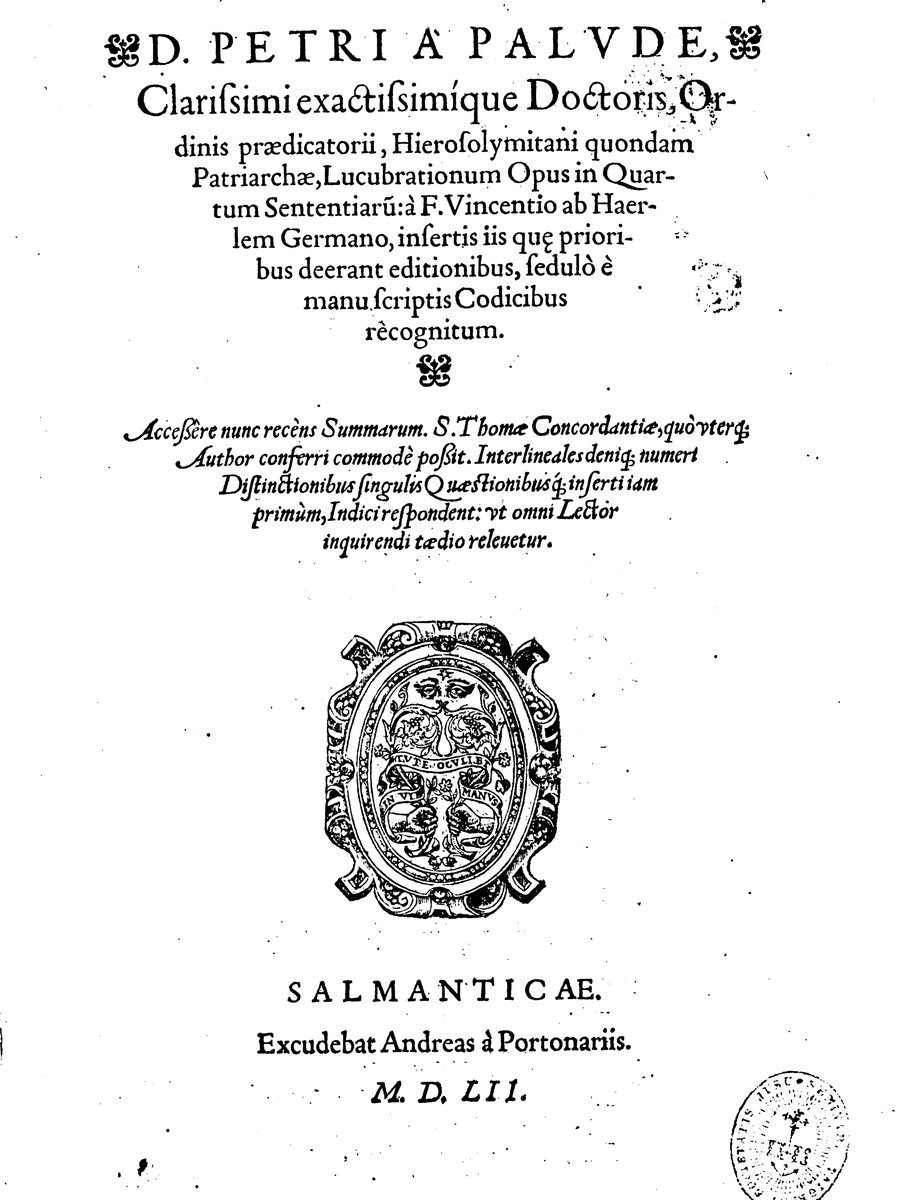
Distinction 25: On Simony
Distinctio Vigesima Quinta: De Simonia
 Peter of Palude
DISTINCTIO. 25. QUÆSTIO. 1.
Circa. 25. distinct. queruntur quinq;. Primo, de ministro sacramenti ordinis. Secundo, de tempore ordinationum. Tertio, de impedimentis ordinum in generali. Quarto in speciali de simonia: vtrum Papa possit committere simoniam. Quinto, vtrum simonia mentalis obliget ad resignationem.
QUANTUM ad primum quæritur, utrum omnes episcopi possint conferre ordines. Et videtur, quod non, quia agens instrumentale, non agit nisi coniunctum principali agenti: sed minister sacramentorum est agens instrumentale respectu Christi, qui est institutor eorum: ergo nullus minister potest conferre sacra, nisi sit coniunctus Christo: sed hæreticus non coniungit Christo: nec per fidem propriam, cum sit infidelis, nec per fidem ecclesiæ, cum sit ab ea præcisus, ergo eps si sit hæreticus, & præcisus ab ecclesia, non potest ordines conferre. Præterea plus est aliquem promouere ad ordines, quam absoluere a pœnis, vel a sententiis iuris: sed eps si sit hæreticus, vel ab ecclesia præcisus, non potest aliquem absoluere a peccatis, nec a sententiis
sententiis , ergo nec ordinare . Contra , quia sacerdos quantuncunq , fit hæreticus , vel alius ab ecclesia præcisus , pot conficere corpus Christi , vt patuit supra di . 13. ergo eps quantucunq , fit hæreticus , vel ab ecclesia præcisus , pot ordines conferre . Probatio consequentie , qa sicut consecratio sacerdotalis ordinatur ad confectionem eucharistiæ , sic epalis ad ordinationem ministrorum ecclesiæ . 3 Respondeo , hic sunt tria videnda , Primo , q eps iure suo pot oes ordines conferre . Secundo , solus eps nisi ex comissione . Tertio , quid de illo , qui resignauit epatum . 4 Quantum ad primum dicunt quida sic probabiliter , & subtiliter . f. q eps pot oes ordines conferre : qd probat primo sic : quia eps ex ordinatione epali habet ex officio administrationem omniu sacrorum . In habentibus enim ordinem potestas superior pot quicquid inferior , & adhuc amplius . Cum igitur consecratio epalis sit superior consecratio , quæ fit in ecclesia , potestas data per eam est suprema respectu oim aliaru . & ideo eps pot , quicqd possunt inferiores in ministrando sacra , & adhuc amplius . Plenitudo ergo administrationis sacramentorum residet apud epm , ex quo sic arguit . Si non ois eps pot ordines conferre , hoc est , vel propter demeritum vitæ , qa etia malus , vel propter defectum fidei , qa hæreticus , vel propter sniam ecclesiæ : qa esset excommunicatus , vel suspensus , seu alias præcisus , vel propter depositionem ab ordine , qa esset degradatus : sed nihil istorum impedit , quin ois eps possit veros ordines conferre . ergo & c . minor probat primo , quo ad duos eius articulos . f . q demeritum vite nec defectus fidei impediat : quin possit oes ordines conferre : quia id , quod habet efficacia ex opere operato , no frustratur ex demerito operantis : dummodo concurrant ea , quæ sunt de necessitate operis : sed sacim ordinis habet efficacia ex opere operato . ergo malitia vitæ , & defectus in fide personali , quæ pertinet ad demeritum operantis , no impediunt quin eps , qui ex sua consecratione est minister oim ordinum , vt declaratum est , possit veros ordines conferre : dum modo seruentur debita forma , & materia , quæ sunt de necessitate sacramenti . Item ad eliciendum aliquem actum non est necessarius habitus , qui solum ponit modum ; sed sufficit potentia , quam quilibet pot exire in actum , vt sonat nomen potentiæ , sed gra , & fides , per qua sunt bona opera , vel bona vita sunt quida habitus , ergo non requiruntur ad hoc , vt eps possit conferre ordines : sed solum ad hoc , vt rite , & licite conferat . Secundo , patet eadem minor quantum ad alios duos articulos . f . eps excommunicatus , vel degradatus possit veros ordines conferre , quia si no posset , hoc esset , vel qa esset priuatus potestate , vel exequutione : no solum iuris , sed facti . Non pot dici , q sit priuatus potestate : qa quædam per consecrationem , manent manente re sacrata : sed potestas conferendi ordines datur epo in sua consecratione . ergo semper manet , nec amitti pot . Item nec priuat exequutionem facti , quia exequutio facti correspondet potestati , quia potestas est , per quam possumus . exequutio autem iuris vltra potestatem requirit licitum vsum : cum ergo per excommunicationem , & degradationem non priuetur episcopus potestate conferendi ordines , no priuat exequutionem facti , quin veros ordines conferat , priuatus est tamen exequutione iuris : qa illicite confert ad damnationem sui , & illius , quia scienter recipit . Et hoc est expresse determinatum ab Augu . in litera , quæ habet in decre . 1 . q . 1 . c . Quod quidem . s Respondeo , prima istorum videtur habere dubiam maiorem , quam assumunt , q in habentibus ordinem quicqd potest inferior , pot & superior : qa in actionibus realibus , & transeuntibus , no quicqd potest corpus , pot spus , & etia in actibus hierarchicis : no quicquid pot episcopus , pot archieps . Sed hoc no valet , qa imo in hoc , q est superior . Convenit enim aliquid esse superius alio
in vno , & non in alio : sed epus superior est sacerdote in administratione : & in omni , quod pot sacerdos , vt sacerdos cum eps sit sacerdos summus . 6 Potest tamen hæc eadem conclusio aliter probari , quia epus æqualis est Papæ in consecratione : vnde & epus electus in Papa , non accipit nouam consecrationem : sed Papa pot oes ordines iure suo conferre : hoc autem non habet ex iurisdictione , in qua excellit : sed ex potestate ordinis , in qua est æqualis : vnde & vocat eos fratres , & vocat se epm . ideo & c . Sed illa probatio , q demeritum vitæ no impediat , sic est intelligenda : qa effectus , qui est ex opere operato , no impedit propter demeritum vite operantis , nec primus , nec secundus : sed propter demeritum vitæ suscipientis impedit secundus effectus , qui est gra , non character , vel ornatus , qui est primus : dum tamen concurrant essentialia : & inter essentialia computari pot intentio suscipiendi , & faciendi , quod ecclesia facit , alias quod exterius geritur , æquiuoce se haberet ad sacrm . Non enim est ablutio materia baptismi , nec verba forma : qn aliqs no vult baptizari , sed balneari , & hmoi ; nisi æquiuoce , & sic exteriora sunt essentialia inquantum sunt intenta , & ex intentione exhibita , vel suscepta : aliter non . 7 Quantum ad secundum est sciendum : solus epus iure suo pot ordines conferre , præcipue maiores : qa non minus est in exercitu ducem præponere , milites ascribere : sed ad solum epm in exercitu ecclesiæ militantis , pertinet milites ascribere per sacim confirmationis , vt patuit supra di . 7 . ergo multo fortius ad ipsum solum pertinet in ecclesia præponere duces , quod fit per sacim ordinis , præcipue quo ad ordines maiores . Sed Papa pot comittere simplici sacerdoti confirmationem , & minores ordines : qa ministrum conferendi ordines summos Christus determinavit summum sacerdotem . i . epm , quem ministrum Papa non potest mutare . Ministrum vero confirmationis , & minorum ordinum Christus posuit sacerdotem , quem ecclesia determinaret : qa nec erat aliquid firmandum ab homine , quousq ; primi confirmatores essent confirmati a Spiritu sto , nec minoribus ordinibus in primitiua ecclesia vtebantur . Et licet hoc sit petere principium : tum ex consuetudine ecclesiæ Romanæ , quæ ista comittit , & non illa : pot conuinci , q ita fuit , & certum est , q possibile fuit . Sed nisi Papa sit consecratus in Papa , vel in epm , quod idem est , non pot hoc comittere , qa omne per accidens reducit ad per se : vnde oportet , omne agens agat , vel in virtute sua , vel alterius . Et quia per se epi est ordinare , & confirmare : inde est , q si ordinans , vel confirmans non sit eps , oportet q hoc sit in virtute veri epi : vnde si electus in Papa non sit verus eps , non pot hoc comittere . Vnde quod dictum fuit dist . 7 . q consecratio epi no est sacrm : sed sacrale : verum est , quantum ad multas ceremonias : sed quantum ad illam partem ipsius consecrationis , qua character sacerdotalis ampliatur ad posse conferre , & ordinare iure suo , & non tim ex comissione est sacrm . i . pars sacri sacerdotii . Nam sicut diceret , sacerdos , qui accepissset potestatem conficiendi corpus Christi , & nondum recepissset manuum impositionem cum potestate ligandi , & soluendi , non haberet iure suo potestatem ligandi , & soluendi : sed posset hoc habere ex comissione Papæ quia ex hoc est capax : sic & hic , aliquis ordinatus totaliter in sacerdotem simplicem capax est potestatis confirmandi , & ordinandi , quam pot recipere duplicit . Vno modo , vt iure alieno hoc faciat : & hoc est sine sacro per commissionem Papæ . Alio modo , vt iure suo , & hoc est per sacramentum epatus . Vel si diceret , ordinatus in sacerdotem per calicis traditionem , omnibus aliis amissis ex comissione Papæ posset inungere , sed no absoluere : nisi per sacralem manus impositionem : sic & sacerdos ea , q sunt minora , pot ex comissione , sed maiora no nisi per sacim sit epus : nec Papa posset comittere consecrationem ipsi simplici sacerdoti , mi
ti, minus quam ordinatione subdiaconi : cum consecratio episcopi sit partialis ordinatio sacerdotis, licet minus digna pars quicquid sit dictum dist. 7. 8 Quantum ad tertium, de illo.f.qui resignauit episcopatui, dicendum, q qui renunciauit loco : sed non dignitati rogatu epi potest oes ordines : minores aute sine rogatu : his qui olim erant sibi subditi, pot licite conferre, vt innuit Hostiensem. Qui autem renunciauit vtriq ;, non debet ordinare ad maiores sine licetia Papæ : sed minores pot de licentia epi extra de ordinatis ab eo qui renunciauit epi.c.r. 9 Sed contra illam distinctione videtur esse ius nouu de temporibus ordinis.c.r.lib.6.vbi dicitur, q indistincte est suspensus perpetuo, qui ordinatus est ab alieno epo sine licetia proprij. Iste aute, qui resignauit statui tantu, vel vtriq ;, vel est depositus ab altero, vel vtroq, no habet alique subditum. ergo cuicunq ; conferat ordine minore sine rogatu proprij epi, videt non conferre exequutione, licet conferat charactere, sicut etia degradatus, quia cu sit vnus, & idem character sacerdotalis, & epalis, sicut prim est indelebilis, ppter quod sacerdos degradatus pot coficere : ita & fcd's, ppter qd' degradatus, & præcisus eps pot ordinare sacerdote, & epm verum : sed promptu est iura iuribus cocordare : vno modo quauis nouu loquitur tamen de maioribus ordinibus. 10 Sed contra hoc est, qa etia saram iure nouo no licet dare, nisi subdito, & multominus alique ordine. 11 Vel potest dici, & loquitur de epo simpliciter alieno : hic aute non est simpliciter alienis illis, qui solebant esse subditi. 12 Sed nec istud valet : qa traslatus ad aliam sede non minus erraret, si antiquitus sibi subditos ordinaret, quam si penitus extraneos : vnde videtur melius, q illud sit correctu : & similiter quantum ad aliu casum : qa q vtriq ; resignauerit, no debet in Pontificalibus celebrare. ergo nec etia minores ordines cuiuscunq ; rogatu coferre, qui aliter coferri non dicunt. 13 Ad primu argumentu dicendu, q eps quantuncuq, malus, hæreticus, præcisus, & degradatus : continuatur, vel coniugitur in administratione sacrorum Christo, vt principali agenti, ratione potestatis ministerialis : quam accepit in cofecratione, & ratione fidei ecclesiæ si intendat facere, quod facit ecclesia, quauis id valere non cre- 14 Ad secundu dicendu est, q non est simile de ordinatione, & absolutione a peccatis : quia sicut dicunt quida, in absolutione no est alius effectus, qua remissio peccatorum, quæ sit per gratia, & quia subiiciens se scienter hæretico peccat, & non est capax gratiæ. & ideo non potest absolui ab eo. In ordine vero primus effectus est potestas ordinis, secundarius vero est gratia. Scienter ergo ordinatus ab hæretico, vel præciso no suscipit gratia ppter dictam causam, recipit tamen charactere, vel potestate ordinis. Sed quod dicut de subiiciente se hæretico scienter verum est, & idem etia est, si ignoranter ex quo est ab ecclesia præcisus, imo eo ipso, & est hæreticus aliquo facto exteriori : qa sic est excomunicatus, & per cosequens non habet exequutione iurisdictiois, quæ requiritur ad absolutione si est publice excomunicatus : vnde sicut no sacerdos no pot absoluere ppter defectu ordinis, sic nec excomunicatus, ppter defectu iurisdictionis, per que est sibi materia subiecta.f. peccator subditus. Ecclesia enim voluntaria iurisdictione potest auferre, quia in hoc, q homo alicui se subiicit, intelligatur semper authoritas superioris excepta, in cuius preiudiciu non pot se subdere alicui de nouo. Cum igit Christus a principio oes subiecerit Petro dicens : Tibi dabo claues. Et super hanc petram. Et pasce oues meas &c. contra inhibitione Petri nullus pot se subdere alteri. Cum ergo ois ho subdat alteri, vel sua sponte, vel ex ordinatione ecclesiæ, vtraq ; subiectione potest ecclesia tollere. Et quia ex natura absolutionis est, vt absol.
uendus sit subditus iudicialiter. Ideo nisi sit subditus nulla est absolutio : sed homo potest dare potestate etia non subdito, sed no pot eum cogere ad recipiendu, ecclesia non pot facere, quin aliquis possit ordinare alienu, quod est dare potestate volenti : qa character est potestas sed pot facere, q non possit absoluere etia ignorante : qa licet omne agens requirat subiectione materiæ, non tamen subiectione iurisdictionis, aut dominis sicut non oportet, hostia, vel calix, quam vult cosecrare sacerdos, vel epus sit sua, vel suus. Nec similiter de illo, quem debet ordinare : qa no habet eum ligare, nec sibi aliqd imponere : sed qui absoluit, habet ligare, & pniam imponere, quod no potest, nisi subdito quo ad iurifdictione. ideo &c. Vnde si est hæreticus, vel excomunicatus, vel suspesus refert : quia aut iste scienter ab illo recipit, & sic perfectionem suam ppter fictione non recipit gratia, & propter illius suspensione non recipit exequutione. Et idem si fit crassa ignorantia, & supina. Si aute iste probabiliter ignorabat, & in nulla culpa fuit, recipit no solu charactere, sed etiam gratia : qa obicem non posuit, qui fictus non accessit. Sed si ille erat publice suspensus, quod tamen ille, qui de nouo venit, potuit probabiliter ignorare, tunc non recipit exequutione, sed pot cum eo per epm dispensari, sicut in ordinato a deposito.de ordi.ab eo, qui renun. epis.c. si.aut occulte, & tunc recipit sine dispensatione exequutione. 15 Ad tertiu dicendu, licet ecclesia ab hæreticis cosecrata sit reconsecrada, & ois consecratio, q non est sacramentum : qa in his totaliter voluit, & potuit ecclesia eis auferre potestate : vnde nec oleum ad infirmos, nec chrisma possunt conficere, sed ordines veros conferunt, & similiter episcopatu : qa est vera pars sacramenti, cuius ministru ecclesia no potest impedire. ideo verus episcopus est ab eis cofecratus : tamen vt sæpe dictu est, hæretici præcisi non possunt absoluere, quia requirit subditus, & contra voluntate Petri de hoc, q homo est ei subditus, non potest alteri se subdere, licet iurisdictio, quæ in foro pænitentiæ requiritur, sit spiritualis voluntaria. In articulo aute mortis potest absoluere excoicatus, vt dictum est supra dist. proxima, sed non hæreticus : qa qui scienter se ei subderet illi, qui magis vellet execrare, qua soluere fictus esset, sed si nulla fictio ex parte morientis interuenerit : puta, quia nesciret ipsum hæreticu, vel si sciret in nullo ei assentire vellet, sed sacramentu necessitatis ab eo reciperet, cum detestatione hærefis, videretur vera absolutio, sicut a simplici excomunicato facta : nec esset necesse coualesceti iteru confiteri : quod quide certum est in casu ignorantiæ. Nam de manu hæretici licet in necessitate recipere baptismu, sed no coione, nec per consequens, vt dicunt quidam pænitentia : qa pnia, & viaticu in morte pari passu currunt.de pœ. Quod in te.sed bene verum est, q cui conceditur viaticu, & pnia, sine qua non digne fumitur, sed no econuerso : qa solenniter pænitenti, & interdicto pnia omni tempore coceditur, non aute eucharistia, qa semper dicitur : Crede, & manducasti. Et sufficit spiritualis maducatio ad salute. Et licet similiter sufficiat cotritio : nihilominus, quia nescit ho, an amore, an odio dignus sit : vbi scit se attritu, nescit tamen se contritu, & nisi absoluatur, vt vi clauiu absolues imperfectu perficiat, est in periculo : vnde quasi sacramentum necessitatis videtur, q licite posset ab heretico tunc recipi, vt dictum est.
De tempore ordinandorum.
SECVNDO quæritur de tempore ordinandorum, & in speciali caufa quæritur, vtrum curatus teneatur infra annum ad sacerdotium promoueri. Et videtur q sic. Alioquin ipso iure vacat beneficium. de elec. c. Licet canon. lib. 6. 2 Contra de plebano. c. tit. c. Statutum. 3 Respondeo, hic videnda sunt quinq;. Primo est de necessitate ad ordines. Secundo, de tepore ordinandoru. Tertio, de tepore ipsorum ordinum in se. Quarto, de ætate beneficiatorum. Quinto, de tepore, infra qd' curatus debet ordinari. 4 Quantum ad primum sunt tres conclusiones. Prima de coactione facti, vbi sciendum, q de necessitate absoluta nullus ad ordinem cogi potest, sicut nec ad baptismum: & si omnino inuitus ordinetur, nihil recipit de baptismo. c. Maiori, sed voluntate conditionata aliquis cogi pot: & sic metu consentiens est, recipit characterem, quia coacta voluntas, voluntas est, sed non gratia: qa fictus est, cum sit inuoluntarius, & per consequens etiam indeuote accedit: sed exequutione recipit: nisi aliud impediat: qa non est ius aliquod, quod ipsum suspendat. Neutro aute modo ad suscipiendum aliquod sacramentum aliquis est cogendus in se. licet in suis filiis ad suscipiendum baptismum cogendi essent a principibus mali Christiani, vel hæretici, vt suos filios, quos occultant, traderent ecclesiæ baptizandos, sicut cum vi armorum Macchabæi pueros circumcidebant, forte inuitis non solum gentilibus, sed patribus, qui sibi præputia fecerant ad ritu gentilium transeuntes.
5 Secunda conclusio est de coactione conditionata per pænam iuris inferenda ppter ecclesiæ necessitatem. Vbi videtur, q cum ad bonum regimen ecclesiæ magis sit obediendum præsideti in spualibus, quantum ad bonum regimen: in temporalibus præsideti in eis: & sic cum vtilitas publica præferenda sit priuatæ, sicut aliquis cogitur suscipere tutelam, vel curam pupilli, vel adulti furiosi, vel prodigi: quia hoc reipublicæ interest: multo magis officium iudicandi in republica debet esse necessarium: vt puta, q sit præpositus, vel balliuus, si res publica indigeat, pro cuius salute bonus ciuis debet etiam se morti exponere: sicut natura brachium opponit pro corpore: multo magis si ecclesia indiget tali, q sit curatus, vel eps, pot ad hoc per superiorem cogi per præceptum, & excomunicatione: sicut aliqui hæremitæ per epos sunt compulsi, & tenentur obedire: qa secundum Gregorium summum pastorem conuincit non amare qui eius gregem renuit pascere, qui dicit: Pasce oues meas, & pasce agnos meos. 6 Tertia conclusio est de coactione conditionata, & consequutiua per priuatione a beneficio per sententiam hominis, nisi excepto eo, quod postea de simplici curato dicetur. 7 Sciendum, q si aliquis habeat beneficium requirens ordinem de iure, vel consuetudine, monendus est, vt se faciat promoueri, sicut beneficium requirit, puta, si archidiaconus est ad diaconatum: si decanus, abbas, & hmoi: aut præbenda, quæ sit sacerdotalis, ad presbyteratum. Quod si monitus canonice infra debitum tempus non fecerit, iusto impedito cessante, beneficio priuandus est. de elec. Cum in cunctis. excepto eo, quod ibi de epo dicit. Si aute habet impedimentum aut temporale, aut perpetuum. Si temporale puta infirmus, quandiu durat, est excusatus, illo cessante idem, quod prius. Si aute habet impedimentum perpetuum, aut præcessit collationem beneficij, & fuit tale, quod non est sibi ius acquisitum: & tunc siue sciuit, siue ignorauit, priuandus est de facto, sicut de facto tenet: puta, qa homicida, vel illegitimus, & nesciebat, vel aliquid hmoi. Si aute fuit tale impedimentum, q ius fuit sibi acquisitum, si sciuit, & tacuit, debet auferri, tanquam ab indigno, si ignorauit idem, ac si superuenisset: qa bona fide, & iusto titulo adeptus, sine culpa sua priuari non debet. Si autem superuenit sine culpa sua: qa mutilatus fuit in
naso, vel oculo, aut factus leprosus, afflictio non est danda afflicto: & tunc non debet priuari, sed de reditibus vicarius sustentari, vel alius assignari: & ipse de reditibus ipsis sustentari. Si aute culpa sua: vt qa se castrauit, vt Origenes, vel culpa sua depræhensus in stupro castratus fuit, debet priuari: qa damnum, quod quis culpa sentit, sentire non videtur. Sic intelligunt iura de corpore vitiatis, & de clerico ægrotante per totum. 8 Quantum ad secundum, s. de tepore ordinandorum, sunt sex conclusiones. Prima, q a septenio, & supra pot dari corona: qui vero ante eam confert per annum est suspensus a collatione tonsuræ. de tem. ordi. ca. vl. li. vi. quicuq; sit ille, qui pot coronam dare, nisi forte religionem intraret, vt ibi dicit. Infans enim, qui ibi ponitur septe annorum intelligitur. C. de iure deli. l. Si infanti. 9 Secunda est de minoribus ordinibus, qui dari non debent, nisi iam habenti vsum rationis circa noue, vel decem annos: sed non oportet, q sit pubes, qa non est hoc præiudicium voti castitatis: & pari passu currunt minores ordines, & beneficium simplex. de filiis presbyterorum. c. 1. lib. 6. Illud aute conferri pot pupillo, vt statim dicetur. 10 Tertia est de subdiaconatu, qui non debet conferri nisi puberi in. 14. anno existenti: qa per votum continentiæ obligatiua debet esse tam firmæ ætatis, quasi deberet contrahere: qa contraria nata sunt fieri circa idem. Puberes aute sunt apti ad vota, & ad iuramenta. C. non pupilli. C. si aduersus rem. Auth. Sacramenta. 11 Quarta est de diaconatu, qa diaconus ante. 20. annum ordinari non debet. 12 Quinta est de presbyteratu, quia presbyter ante. 26. annum non debet ordinari. 13 Sexta est de epatu, q epus non debet ordinari ante. 30. annum. Et quidem subdiaconus olim ante. 20. annum ordinari non debebat. 28. dist. de his. 77. di. c. In singulis. & c. Quicuq;. & c. Subdiaconus. sed hodie sufficit, q habeat. 14. annos vt in vlt. c. huius di. dicit. Olim etiam diaconus non ante 25. annum: nec presbyter ante. 30. vt hic dicit. & 77. dist. Placuit. & dictis c. sed hodie sufficit in sacerdote non epo habeant. 25. & pari ratione in diacono, q habeat. 20. de elec. cum in cunctis. sed in epo oportet, q peregerit, in aliis sufficit attigisse. Sed de ordinato in diaconum in. 13. anno dicitur, extra de tem. ordi. c. vlti. Non est compos, q eps debet suspendi a collatione oim ordinum: & ordinatus ibi suspeditur videlicet ad debitam ætatem.
14 Quantum ad tertium, s. de temporibus ordinum sunt quinq; conclusiones. Prima de corona, quæ omni die dari potest: qa non est prohibitum, & nihilominus ois ordo etiam extra tempus collatus characterem imprimit. de tem. ordi. cap. Consultum. 15 Secunda conclusio est de minoribus ordinibus, qui possunt dari diebus Dnicis, & festis precipuis, & multo magis illis temporibus, quibus maiores ordines: & oes quatuor simul vna die possunt suscipi, de tepore ordi. c. 1. vbi etiam dicit, q Dnicis diebus possunt virgines consecrari, de diebus festiuis. e. tit. c. de eo. 16 Tertia conclusio est de sacris ordinibus, qui non possunt dari nisi in Sabbatis quatuor temporum, & in vigilia Paschæ, & Dnica in Passione: non aute in vigilia Pentecostes, nec in quibuscunq; festis, nisi q Papa subdiaconos facit in diebus Dnicis. de tepori. ordi. c. 1. & 2. 17 Quarta conclusio est de simultate ordinum, qa non debent dari duo ordines sacri simul, nec aliquis sacer, cum non sacro, nec vnus sacer vno die, & alius in alio, s. in crastino etiam continuato ieiunio: licet continuato ieiunio Sabbato ordinatus, in sacerdote sequenti die Dnica possit consecrari in epm dicto tit. c. Ac literas. & c. Dilecti filij. ordinatus aute extra tempus debitum recipit characterem: sed non exequutione secundum quosdam, sed magis videtur suspendendus, q suspensus. extra. c. consultum. Non debet aute ordinatus in subdiaconum a Papa subordinari ab inferiori, nisi de
18 Quinta conclusio est de consecratione epi, quæ debet semper esse in die Dnica: minores autem ordines qui conferunt extra tempus maiorum ordinum, debent conferri paucis, puta duobus, vel tribus, & non multis simul, sicut fit in Sabbatis orationum, vt innuit.extra. De co. Dedicatio aute ecclesiæ omni die fieri pot, sicut de consuetudine patet. 19 Quantum ad quartum.f.de tempore beneficiandorum sunt tres conclusiones. Prima de simplici beneficio, Si enim fit simplex beneficium, sufficit, q fit maior septennio: ga pupillus pot esse canonicus etia in ecclesia cathedrali, licet no habeat vocem in electione, de elec.c. Ex eo, lib.6. tamen iure humano non irritetur talis collatio: tn iure divino illicitum est dare talia beneficia talibus: nisi qn alij non inveniuntur: ga contra iustitiam distributivam est, si datur minus digno, quavis aute iste puer non fit indignus positive propter defectum vitæ, qa est innocens, respectu en illius est indignus, qui habet vitam, & scientiam, quæ statim pot prodesse ecclesie. Et ideo iste est indignus quia, alius est dignior: vnde contento meliore, sanctiore, iustiore, dare alteri est grave peccatum, vt dicit Aug.super Ia
co.2. 20 Secunda conclusio est de dignitate non habente curam animarum, in qua pot eps dispensare cum illo, qui complevit .20. annum, de æta. & quali.c. 1.lib.6. Et sic etia archidiaconatus pot dari tali: qa non habet curam animarum in foro pæniæ, vt oporteat esse sacerdotem, qui requirit .25. annos, sed solum in exteriori foro, & oportet eum esse diaconum, ad quod sufficiunt .20.anni: vt fit minus, qua sacerdos. Sed quavis alias minor .25.annis: non debeat iudex esse: potest tn esse archidiaconus, quod est esse iudicem de consuetudine: vnde dicendum, hoc non est de iure communi, sed de dispensatione epi a Papa permissa. 21 Tertia conclusio est de cura animarum, ad quam debet habere homo.25.annos: sed ad epatum .30. vt dictum est. In prima aute non pot eps dispensare, sed est ipso iure nulla collatio parochie facta illi, qui non attingit 25.annum: imo etia comenda ecclesiæ facta non habenti illa ætate.de elec.c. Licet canon. §.decernentes. & .c.fe. Papa vero licet possit dispensare, non tn intendit, nisi exprimat: vnde qui impetravit beneficium, cum cura, vel sine cura, nisi tempore rescripti haberet .25. annos, non potest sibi provideri de beneficio cum cura: de rescript.c. Si co tempore. Contingit aute cum quida per tale rescriptum per duos annos beneficium cum cura recepissent, obiectum esse sibi, q non habuissent ætatem legitimam, & testibus hinc inde productis, iudex pronunciavit ipsum ætatem legitimam habuisse. Respondi in dubio standum esse sententiæ: & ex quo non est certum de opposito, debet præsumere, & testes non peieraverunt amore eius, nec iudex male iudicavit. Si autem non pot conscientia deponere, quin tempore rescripti fuerit minor annis, tenetur resignare: quia conscientia dictat nullum ius sibi quæsitum esse. 22 Quantum ad quintum de tempore.f.infra, quod curatus debet ordinari, sunt tres conclusiones. Prima, q iure novo potest per epm cum curatis dispensari, vt literarum studio insistens infra annum non teneat, nisi ad subdiaconatum promoveri: sed post septennium infra annum debet quilibet ad sacerdotium promoveri: ita quod primo anno fuerit ordinatus in subdiaconum: & infra octauum in sacerdote, epo sic dispensante vacat ipso iure ecclesia: sed etia nisi eps cum co dispensaret, vel si dispensaretur, & ille literarum studio non insisteret, qualiter eps non habeat potestatem dispensandi, teneret infra annum ordinari in toto: alias ipso iure est privatus, de elec. Cum ex co. lib.6. 23 Secunda conclusio est, & quavis transeat tm de illo tempore, & illo anno, quo debet non possit fieri subdiaconus, vel sacerdos: non tn vacat vsq; anno elapso, & facere fructus suos, si habuit a principio
intentione ordinandi: alias non nisi mutato proposito se fecerit ordinari. Et qui scieter sic affecto dedit, tenet ecclesiam servare indemne. Annus aut pro subdiaconatu, vel sacerdotio non currit, nisi a tempore, quo fuit in possessione pacifica, vel per eum stetit, ex tunc etia est annus vtilis, ga non currit nisi iusto impedimento cessante. Non pot aute sibi conferri ecclesia sic vacans illa vice.i. illa vacatione. Si enim det alicui non acceptanti, adhuc vacat prima vice vacandi, & sic enim non pot conferri prima vice. Similiter si faciat illi dari, qui statim renunciauit in fraude, sic licet secundo vacet isto resignante non valet quoad Deum: sed si bona fide alteri collata, illo mortuo, vel deposito, aut renunciante, vacaverit secundo: tunc potest ei conferri: ga non est prohibitum.de elec.c.comissa.lib.6.
- Tertia conclusio est, de cura non simplici ecclesiis collegiatis, sicut sunt decani in collegiis: priores, & abbates in conventibus, & isti non ligantur isto statuto. de elec. c. Statutum. lib.6. quia non erit tam periculum, si isti non sunt sacerdotes: ga multi sunt in collegiis sacerdotes, qui ex concessione istius curati non sacerdotis facerent, quod ille faceret. Non sic aute in simplici cura sunt parochiani sacerdotes, qui possint ecclesiastica sacra ministrare: propter quod fuit magis necessarium ibi pænam apponere: quavis isti curati arceantur magis ab audiendo leges, vel physicam, qua simplices curati.extra ne cle. vel mona.c.i.qa sunt quasi religiosi, qui sic viuunt in coi, & si non quo ad victum, & vestitum, saltem quo ad Dei cultum, & servitium. Collegium vero hic large accipit, etia pro plebania sub se capellas habente, in qua sunt sacerdotes, per quos poterit suppleri, vt dictum est. 25 Ad argumentum in contrarium responsum est, sed iuxta hoc de facto pendet talis casus: Canonici ordinauerunt, q essent quæda capellaniæ, quas qui haberent, facerent se ordinari infra annum: postea cuidam ex ipsis vna collata, ipse interpellauit epm, vt se ordinaret, vel ad alium remitteret, qui neutrum facere voluit dicens, ipsum cum omnibus canonicis esse excommunicatum: cum converso canonici reputarent epm excommunicatum: anno elapso, canonici dicunt istum capellam suam perdidisse: alius allegat impossibilitatem, quæritur ad iuris. Dicendum, non est privatus ipso iure: qa Decretalis, quæ privat non ordinatum, loquit de curato, vel alio, qui ex statuto iuris, non hominis debet ordinari, sed per sententiam esset privandus, nisi iustam causam habuisset: videtur autem iustam causam habuisse. Nec obstat, non appellavit, quia nec tenebatur litigare, nec ad superiorem recurrere: quia nec superior poterat ordinare, nec licentiare, nec etiam videtur, q ad Papam tenere fire: cum forte reditus ad tot expensas non sufficerent, nec cogitur propriis stipendiis militare.
Thom. 4. distin. 25.q. 2.
Quaeritur tertio de impedimento ordinis. Et videtur, quod ordo non debeat habere impedimentum: quia in entibus illa, quæ sunt maioris dignitatis, sunt minoris impedimenti, vt corpora cælestia: sed ordo, inter cætera sacramenta post eucharistiam, est maioris dignitatis.ergo &c. 2 Contra impedimenta, quæ iura ponunt. 3 Respondeo, tria sunt hic videnda. Primo, de impedimento naturæ. Secundo, de impedimento fortunæ. Tertio, de impedimento maculæ. 4 Quantum ad primum de impedimento naturæ, sunt tres conclusiones. Prima, q mulier non pot ordinari, nec de iure, nec de facto
etiam Papa dispensante , qui non potest mutare materiam sacri , posset sibi dare coronam : quia id est positivum . Omnis autem ordo est sacrum , & non tantum sacrale . Vnde si vera esset opinio dicentium , quod omnes ordines preter sacerdotium essent solum sacralia , & dispositive non essentialiter ad sacramenta pertinentia , videretur Papa posse & formam , & materiam , & suscipientem mutare , sicut potest in aliis sacralibus , vt in catechismo , & exorcismo : nisi quis dicat , non est simile : quia ista sacralia sunt a Deo instituta , & non illa . Est igitur sexus virilis de necessitate sacri , cuius causa principalis est institutio Christi , tamquam ad ministrantes , quam quo ad suscipientes . Christus autem non ordinavit nisi tantum viros in coena , quando potestatem consecrandi eis tribuit , & post resurrectionem , quando Spiritum sanctum eis dedit , dicens : Quorum remiseritis &c. nec enim suam , quavis omnium mulierum sanctissima ad aliquem gradum ordinis promoverit . Apostolus etiam qui tradidit nobis , quod a Domino accepit , vt habetur 1. ad Cor. 11. innuit mulieres non debere ordinari , nec habere gradum doctrinae in ecclesia , qui competit ordinatis dicens : Mulieres in ecclesia loqui non permitto . Nec potest dici , quod illud solum sit ex ordinatione apostolorum , & non ex statuto Christi : quia offerre alicui sibi vtile ad salutem , & concessum a Christo , non potest esse sine praeiudicio , maxime in rebus spiritualibus : sed dignitas ordinis vtilis est ad promotionem salutis in recte vtentibus . ergo si fuisset concessum a Christo , quod mulieres potuissent ordinari , non potuisset sine praeiudicio eis auferri . Tenendum est igitur , mulieres non possunt ordinari ex Christi institutione , nec praedicare , nec confessiones audire , etiam abbatissa . de poe . & re. c. Nova . Ratio autem congruentiae est : quia per ordinem aliquis ponitur in gradu excellentiae , super alios non ordinatos : sed talis gradus non competit mulieribus super viros : sed potius status subiectionis , propter infirmitatem corporis , & imperfectionem rationis : propter illud Gene. 3. Sub viri potestate eris . ergo &c . Sic ergo sexus mulieris impedit susceptionem ordinis : quia oppositum est de necessitate sacri . Nec est simile de ordine , & aliis sacris : potissime quoad mulieres : quia alia sacra ordinant contra defectum communem viris , & mulieribus , vt baptismus , eucharistia , poenitentia , extrema vnctio , vel ad actum communem vtrisque , vt confirmatio , qua ordinatur ad confessionem fidei , ad quam ordinentur tam viri , mulieres . Sacrum autem ordinis consistit in gradu excellentiae super alios : & doctrinae , quae non competit mulieribus , vt dictum est . Nec obstat , quod dicit . 27. q. 1. Diaconissa . nec . 32. dist. c. Presbyter . quia canones vocant diaconissam non ab ordine diaconatus : sed a benedictione , qua competit eis legere homelias in matutinis : non autem Evangelium in missa , vel ministrare circa altare in missa , vt diacono convenit : presbyterissam vero vocat canon viduam , quae habet custodire res ecclesiae , sicut apparet ex sequenti c. Si mulieres . seu presbyterissa vxor sacerdotis Graeci , vel hebdomaria , quae dicit orationes .
Hermaphroditus ordinari non debet : cum sit monstrum in natura , & corpore vitiatus , & est opprobrium clero , & propter periculum : quia nescimus , vtrum sit vir , aut mulier . Oportet tamen , sit alterum tantum , quia in praelatis possunt coniungi vis masculina , & foeminina perfecte : sed nunquam in animalibus perfectis , & maxime hominibus . Si ergo sexus virilis praevalet , est homo , & non mulier : & sic potest ordinari , sed non debet : si autem econverso , sic est mulier , & sic nec de facto ordinari potest . ff. de sta. ho. l. cum Hermaphroditu .
Aetas impedit : quia non debet quis ordinari nisi temporibus supradictis . Aetas igitur puerilis impedit a susceptione maiorum ordinum : quia oppositum est de necessitate praecepti , sed non a susceptione minorum , nisi de congruitate tantum . Ratio primi est , quia maioribus ordinibus est annexum votum continentiae
ex statuto ecclesiae : sed ad id nullus potest se obligare , nisi habens vsum rationis , & discretionis : igitur nullus debet secundum statutum ecclesiae ad maiores ordines promoveri ante annos discretionis . Ratio secundi est , quia congruum est , vt nulli detur gradus , cuius actum exercere non potest : sed actus quorumcunque ordinum etiam minorum non potest debite exerceri , nisi ab habentibus vsum rationis , & discretionis . ergo non est congruum , quod ante hoc tempus aliqui promoveantur , etiam ad minores ordines : nisi forte adsit necessitas , & spes profectus . Verumtamen aetas puerilis non impedit a susceptione ordinum , quantum est ex necessitate sacri , vt videtur quibusdam : quia aliquis potest habere potestatem , cuius non habet vsum . & ideo licet pueri carentes vsu rationis non possint habere executionem ordinum : possunt tamen potestatem recipere , & processu temporis actus eorum exercere .
Sed contra hoc arguunt quidam probabiliter , & subtiliter , si per parvulos intelliguntur pueri , qui omnino carent vsu rationis . Primo , quia satis videtur absurdum , talis parvulus possit sacerdos fieri , vel episcopus ordinari . Secundo , quia ad susceptionem cuiuslibet sacri requiritur intentio suscipiendi propria , si fit adultus , vel interpretativa , si fit parvulus : sed in parvulo si ordinetur de sacro non potest esse propria voluntas suscipiendi ordinem , cum non habeat vsum rationis : nec interpretativa : quia licet voluntas parentum , vel eorum qui vicem gerunt parentum , possit esse voluntas interpretativa parvulorum , quantum ad ea , quae sunt de necessitate salutis parvulorum corporalis , vel spiritualis , propter quod intentio parentum eos offerentium ad baptismum , sufficit ad susceptionem baptismi salutaris : tamen voluntas parentum non videtur sufficere ad hoc , quod suscipiant ordinis sacrum , quod non est de necessitate salutis , sed est supererogationis , & constituit in gradu dignitatis : quia quo ad hoc non bene patet , quomodo voluntas parentum sit interpretativa parvulorum : cum parvuli licite possint talibus dissentire , postquam ad annos discretionis pervenerint . Et iterum quia baptismus ordinatur ad deletionem peccati originalis , quod contrahit parvulus ex actu parentum : congruum est , quod voluntas parentum sufficiat eis ad suscipiendum baptismum : sed haec causa in aliis sacris non habet locum .
Sed licet ista sint probabiliter dicta : communis tamen opinio Theo. & Canonistaram est in contrarium . Potest ergo dici , pueri non deberent ordinari . 1. q. 1. c. Pueri . Si tamen puer ordinaretur , valeret quoad characterem , dum tamen haberet vsum rationis . Si vero vsu rationis careret , puta , quia est puer in cunis , illo casu , in quo baptizari non posset , puta invitis parentibus gentilibus non posset ordinari , sicut nec baptizari : quia nisi prius reciperet baptismum , non reciperet ordinem . Sed supposito puer esset baptizatus , si parentes nollent ordinari , quem volunt baptizari , adhuc non puto , quod posset ordinari : quia plus iuris habent parentes impediendo puerum ab his , quae non sunt necessaria ad salutem , quam in necessariis . Si ergo invitis parentibus non potest puer baptizari , quod est necessarium ad salutem : multo minus ordinari , quod non est necessarium . Si dicat , quod non est simile , quia ex quo baptizatus est ecclesiae subditus est : quae potest de eo in spiritualibus facere quod vult , & auferre parentibus , si in haeresi vellent eum nutrire , non valet : quia haec non sic potest esse iusta causa auferendi parentibus . Sed quid si consentientibus parentibus ordinent . De episcopatu quidem quoad obligationem , quae fit per assensum , & acceptationem , quae dicitur sponsus ecclesiae : certum est , quod non est sponsus quousque habens vsum rationis assentiat , nec est curatus , nec abbas , nec prior , nec huiusmodi : quia quamvis iure civili legata acquirantur ignoranti : tamen iure canonico nullum beneficium ecclesiasticum acquirit homini quousque assentiat . Vnde de praeben. c. Si tibi absenti . lib. 6. dicit , quod quando absenti beneficium confertur , quousque ratum habeat sibi nullum ius acquiritur : licet episcopus dare non possit interim
terim alicui: multo magis in beneficio habente curam animarum: quia nisi ex suo consensu nemo obligatur ad illud. Sed de ipsa consecratione in episcopum videt idem, quod de ceteris ordinibus: quod si parentibus consentientibus, vel ipsis non extantibus, de voluntate illorum, qui sunt loco parentum, si ordinaret, reciperet characterem. 9 Ad primum argumentum istorum potest responderi ad maiorem, & requirit voluntas suscipiendi expressa, vel interpretativa, potest negari in paruulo: quia vbi non esset parens in mundo, nec nisi paruulus, & alius, nec pater, nec mater, adhuc posset paruulum baptizare, & sic ex parte baptizati nulla intentio, nulla voluntas concurreret, & sufficeret sola voluntas conferentis sacri, ita & in proposito: sed in illo, qui habet vsum rationis, qui iam sibi a Domino commissus est, propria voluntas requirit. In paruulo autem, quem adhuc Deus in manu consilii non reliquit, nulla voluntas requirit. Potest etiam dici ad minorem, quod voluntas parentum est etiam voluntas filii, non solum in his, quae sunt necessitatis salutis, sed etiam in aliis: vnde voluntate parentis offerentis potest paruulus confirmari: quia & paruulis Christus manus imponebat benedicens, & de voluntate patris potest acquiri paruulo, sicut per tutorem.
10 Ad illud, quod puer potest postea licite resilire, & dissentire. Si pater, aut mater pro ipso fecerunt votum, verum est: vnde etiam ordinatus in sacerdote in cunis, veniens ad annos discretionis non tenet continere, sed verus sacerdos existens poterit contrahere, quia non potuit nescius obligari.
11 Quod dicunt, quod ideo in baptismo sufficit voluntas parentum: quia ordinatur ad deletionem peccati a parentibus contracti: dicendum, quod imo sufficit voluntas tutorum in defectu parentis: sed etiam solius baptizantis, vbi alius non apparet: & tamen a tutoribus puer illud peccatum non contraxit: imo certum est, quod sufficit voluntas proximorum parentum, a quibus nullum peccatum contraxit, nec forte etiam ipsum originale. Si dicatur, ducatus minus conuenit pueris, quam mulieribus: quia nihil habent de vsu rationis, & minus roboris: igitur si mulier non potest ordinari etiam de facto, nec puer. 12 Solutio, non est simile, quia principatus minus conuenit pueris actu, sed plus aptitudine.
13 Quantum ad secundum, scilicet quantum ad impedimentum fortunae, scilicet homicidium, sunt tres conclusiones. Prima, quid per homicidium intelligit. Et quidem prout causat irregularitatem, requirit mortem hominis, vel mutilationem: & tantum valet mutilatio, quantum occisio. de cle.percuf.c.1.55.dist.c.vlt. Dicitur autem Mors hominis habentis animam rationalem, sine qua non est homo, propter quod occidens in ventre foetum ante animationem istam, vel suspendens iam mortuum cadauer, aut mutilans, non est irregularis. Dicit autem mutilatio membrorum proprie dictorum, quae amputata non crescunt: secus de aliis, vt si capillos raserit, vel vngues sciderit: imo etiam si talia auulserit: ideo de his non intelligitur, sed de aliis: non solum de membris principalibus: quia non solum si pedem, aut manum amputauerit: imo etiam si digitum, vel articulum: nec solum totum digitum, vel oculum, aut nasum: sed si partem notabilem, quae redire non possit, siue sibi, siue alij amputauerit. distin. 55. Si quis semetipsum. c. Qui partem. Non sic autem, si pellem, vel carnem, quae redeunt per naturam quantumcunque, etiam vulnerauerit, vel sanguinem suderit: quia sanguis deperditus restituitur per naturam, non sit irregularis: aut etiam si sic in capite vulnerauerit: quod de osse capitis multum extractum fuerit: quia de membris exterioribus intelligitur, & poenae semper sunt restringendae.
14 Secunda conclusio, quis est homicida in ista materia? Et dicendum, quod ille consilio, auxilio, facto, vel quocunque modo causae est causa homicidij: dumtamen reducatur ad genus causae efficientis. Vnde de cle.pug.in duello.cap.2. dicitur homicidium tam facto, quam præcepto,
quam consilio, aut defensione, non est dubium perpetrari. Vnde in eode cap. Sacerdos. qui posuit pugilem, qui reum ictibus mactauit, irregularis est, ac si per se fecisset. Si autem se prohibente factum est, non est irregularis. de homici.cap.1. Petrus diaconus. Item si solum modum finis est causa: vt puta: quia propter ipsum vindicandum interfectus est homo: ipso nec mandante, nec ratum habente irregularis non est symoniacus, id est, per symoniam promotus dicatur etiam qui ignorante ipso propter ipsum symonia contracta est. Est autem causa efficiens etiam qui non tangit: sed associans illum defendere paratus est si oportet: sicut Paulus seruans vestes lapidantium Stephanum: sed in eius promotione dispensauit Christus, qui dixit: Vas electionis est mihi iste. & Spiritusanctus, qui dixit: Segregate mihi Paulum, & Barnabam. Vnde de homi.c.Sicut dignu.dicitur, constat illos non esse immunes a reatu homicidij, qui licet non occidunt, tamen occisoribus opem ferunt. Si autem mors non sequat, nec mutilatio, quicquid fecerit, non est irregularis, quia lex promotionis factum requirit. Vnde iudex, notarius, & omnes huiusmodi, nisi sequat mors, aut mutilatio, quicquid dixerint, vel scripserint in causa sanguinis, non sunt irregulares: sicut nec is, qui cum telo ambulauit, & vulnerauit, & fecit, quod potuit ad mortem, si non sit sequuta, quauis quidam scribant contrarium de iudice, & alio, qui hoc facit ex officio: sed non est probabile, quod ceteris paribus plus incurrat irregularitatem innocens, quam delinquens, nisi vbi ratio, quæ est in vno, cesat in alio: sicut est in bigamia, quæ contrahit ex actu matrimoniali non fornicario: sed clericus, qui in duello pugnauit licet non fit sequuta mors, nec mutilatio, est depondus, nisi eps cum eo dispensauerit. Similiter dicunt quidam clericum, qui fuit minister causæ sanguinis esse irregulare: sed posse epm cum eo dispensare, nisi mors, aut mutilatio fuerit subsequuta. 236 q.vlt.c.Sæpe. & .c.feq.Sed istud non est verum, quia non inuenitur scriptum expresse, nec aliter est iudicanda irregularitas. Nec refert, vtrum paganum quis occideret, aut Christianum, quia ille homo est sicut iste. Vnde dicit extra de homi.c. Petitio.Clerici contra Saracenos pugnantes si de homicidio cuiusquam dubitant, a sacerdotio abstinebunt. dist. 50. Miros. Et ppter hoc sunt irregulares, qui ligna subiiciunt hæreticis comburendis: si illa ligna per sui combustione ad mortem aliquid agant, licet indulgentiam consequant.
15 Tertia conclusio est ex his, quo contrahitur irregularitas propter homicidium. Et dicendum, quod tantum in duobus casibus. Primus est, quando aliquis est homicida ex scientia, id est, intentione, siue licite, siue illicite: vt patet in iudice: vnde ille, qui interficit hominem seipsum defendendo licite, sed ex intentione est irregularis. Non enim excusatur, quia licite fecit cum iudex licite faciat: nec quia ex necessitate hoc fecit: quia maior est necessitas vitandi mortale, quam mortem, & vitandi mortem multorum, quam vnius, & damna reipublicae, quam vnius personae: iudex autem non potest vitare mortale, nec mortem multorum aliquando, nec damnum reipublicae, nisi condemnet ad mortem istum publicum homicidam: & nihilominus fit irregularis, ergo multo magis iste, qui ob tutelam sui corporis hominem interfecit, ad quod non tenet. Et hoc verum est quantum ad promouendum vlterius: sed quantum ad ministrandum in susceptis, homicidium ineuitable non deiicit ab ordine, nec a beneficio: sicut deiicit homicidium ex officio: quia videt abdicare clericum, qui ex proposito officium sanguinis suscipit: non sic autem, qui ex inopinato ad sui defensione aggressore interficit. 50.di.De his clericis, pro quibus extra de homi.c.Interfecisti.51.di.Aliquantos. Quod autem Petrus mutilans auriculam serui est promotus: Christus dispensauit, quod postea dixit sibi, Pasce oues meas: vel nondum erat prohibitio ecclesiæ. S Nec
Nec ob . quod Dauid vir sanguinum est prohibitus aedificare , quia etiam Salomon vir sanguinum aedificauit : qui Ioab , & alios ad mortem condemnauit . Tunc etiam Finees occidendo sacerdotium promeruit : & Macchabaei bellatores fuerunt sacerdotes . De Dauid autem dictum est propter figuram , vel si tunc erat prohibitum , iudiciale fuit : & post morte Christi non ligauit , nisi qua tunc ecclesia hoc idem statuit dicente Apostolo . Non percufforem . Secundus casus est , quando praeter intentionem aliquis casu occiditur , vel mutilatur , per culpam tamen suam , vtpote quia dabat operam rei illicite : vt si vadens ad lupanatum armis non intentione pugnandi , & praeter intentionem bello orto , inde homicidium fecerit , vel huiusmodi , vel si non medicus de medicando se intromiserit , & mors sequuta fuerit , irregularis est . Item si dabat operam rei licite , non tamen debitam diligentiam adhibuit : vt quia medicus aliquid de contingentibus omisit , vel si putator ex arbore ramum deiecit in publico nec clamauit , sed aliquem occidit irregularis est . Medicus vero , qui membrum amputat secundum regulas artis non videtur irregularis : quia hoc non est mutilare , sed corpus saluare . Si autem praeter intentionem , & culpam mors , vel mutilatio accidat alterius , irregularitate non incurrit . Vbi considerandum est , quod aliquid vni est culpa quod alteri non est . Vnde casus ponebat de puero , qui iaciens sagittam , ea inuersa casu praeter intentionem percussit in oculo socium retro stantem , & exoculauit : quod etiam fuit mirabile . Et dixi , quod dato , quod adultus fuisset irregularis ex illa exoculatione : quia raro sine eius culpa potuisset accidere , puer tamen non , quia in culpa non fuit : quia non tenebatur adhibere diligentiam , quam adhibere nesciebat : alias teneretur ad impossibile : ideo irregularis non est . In casu autem dubii probabilis tenet quis abstinere , sicut in casu certi . Sed vbi est conscientia irrationabiliter meticulosa , est deponenda , quod si non possit deponi , interim est a ministerio , & promotione cessandum , de tempori . or . ad Aures . 50 . distinctionibus . Quantum ad tertium , scilicet , de impedimento corporalis vitii : dicendum , quod impedit in tribus casibus . Primus , quando tale est vitium , quod causat periculum , quod sine periculo homo non potest actum ordinis exercere : vt si non possit facere fractionem , vel ita tremulus est manibus , quod non sine periculo effusionis sanguinis potest tenere calicem . Secundus casus quando generatur scandalum : vt quia habet nasum amputatum , vel aliquid huiusmodi . Tertius est , quando per factum , & culpam suam . Quod autem sanctus Marcus fertur sibi amputasse pollicem , vt sacerdotio reprobus haberetur : qui nihilominus postea fuit patriarcha Alexandrinus , fuit ex dispensatione Spiritus sancti , vel Petri , qui erat Papa : & per consequens in omni tali defectu poterat dispensare : quia nec tantum erat amputatum , quin posset facere fractionem . Ad argumentum dicendum , nobiliora in entibus sunt minoris impedibilitatis in se : sed sunt maxime impedibilitatis in participatione sui ab aliis , & in appropinquatione ad ipsa . Quae enim perfectiora sunt , illa sunt immediate propinqua , & participantia perfectissime , caetera vero remota : & similiter sacramentum ordinis non est in se impedibile , positis suis causis : sed perfectissimi debent esse , qui ei appropinquabant suscipiendo , vel exequendo : & ab hoc multipliciter impediuntur imperfecti .
De Simonia an possit committi a summo Pontifice .
Thom. 2. 2. q. 100.
QUARTO queritur, vtrum Papa possit committere symoniam. Et videtur quod non: quia non minus est ipse dominus in spiritualibus quam Imperator in temporalibus: sed plus cum Imperator non ita deponat principes ad libitum, sicut Papa prelatos, sed quia omnia sunt principis: ipse non pot comittere symoniam laicale, que punitur per legem Iuliam Ambitus. vnde dicit, lex Iulia Ambitus, cessat in vrbe. ff. ad. l. Iulia Ambitus. l. vna. quia scilicet dignitates vrbis conferuntur per principem. ergo & c. 2 Contra, quia Papa erat Petrus, qui timuit symoniam incurrere, quando dixit Symoni: Pecunia tua tecum fit in perditionem & c. 3 Respondeo, hic sunt tria videnda. Primo, de conclusionibus quas omnes concedunt. Secundo, de distinctione, quam Iuriste ponunt de symoniacis. Tertio, de conclusione dubia.
4 Quantum ad primum sunt tres conclusiones. Prima conclusio est, quod Papa pot comittere peccatum symonie in generali: sicut quicunque alius inferior prelatus, quoad culpam grauiorem. Quod quidam sic declarant, & bene. Omne peccatum est deuiatio ab aliqua lege naturali, vel diuina, vel humana recte posita, vnde Ambro. dicit, quod peccatum est dictum, concupitum, vel factum contra legem: quecunque autem lex loquitur his, qui sub lege sunt, loquitur, vt dicit Ro. 3. Ex quo pot sic argui. Omnis homo faciens contra legem, cui subiectus est, peccat: sed omnis homo vendens spirituale pro temporali, peccat contra legem naturalem diuinam, cui omnes subiecti sunt tam Papa, quam alij, ergo talis peccat non nisi peccato symonie. ideo & c. Maior patet ex his, que dicta sunt: minor patebit ex his, que dicentur. 5 Secunda conclusio est, quod Papa non potest comittere symoniam quoad penam iuris positiui, cui non subest: vnde nec suspensione, nec huiusmodi penas iuris sustinet: sicut si percutiat clericum excomunicatus non est: quia princeps legibus solutus est. ff. de legibus. l. princeps. 6 Tertia conclusio est, quod ille, qui etiam a Papa emeret beneficium, vel ordinem etiam penas iuris Canonici non incurreret: quia sicut posset dispensare in penis iam incursis, ita quod non incurrant: sic posset dare priuilegium alicui, quod percutiendo clericum non esset excomunicatus, licet non libenter faceret. Quando autem dat pro pecunia, videtur dispensare quod liceat retinere, sicut quando scienter det irregulari eo ipso dispensat cum eo: vnde qui habuit beneficium per symoniam in curia: si habet conscientiam, quod emanauit de conscientia Pape conferentis, poenitendo de peccato, non tenetur resignare, sed potest retinere. 7 Quantum ad secundum, Primo, ponet illa vulgata distinctio Iuristarum. Secundo, arguit contra eam, sicut aliqui arguunt. Tertio, inquiret de dictis in reprobatione. 8 Quantum ad primum sciendum, quod quidam distinguunt, quod aliquid pot esse symoniacum dupliciter. Vno modo de se, & ideo prohibetur in iure. Alio modo ex sola iuris prohibitione. De se sunt symoniaca, que prohibentur vendi in nouo, vel veteri testamento, vt sacra: cetera vero sunt tantum symoniaca, quia prohibita. Et hec distinctio habet extra, de off. iudi. dele. c. Ex parte. in glo. or. & concordat Inno. & Host. 9 Quantum ad secundum dicunt quidam, quod distinctio non est vera, vt ponit secundo, quod pot esse vera in aliquo sensu. Primum probant quadrupliciter. Prima ratio est talis. Circa id, quod non est de se malum, nisi quia prohibitum, non conuenit peccare, nisi peccato simplicis inobedientiae: quia in talibus tota ratio peccati est ex transgressione prohibitionis. Si ergo venditio simplicis beneficij non sit de se symoniaca: impossibile est, quod ex prohibitione iuris fit ibi, nisi sola inobedientia. Secunda ratio est talis, Symonia est venditio rei spiritualis pro temporali: sed prohibitio iuris non mutat naturas rerum, vt de temporali faciat spirituale, aut econuerso. ergo vbi non est symonia ex natura rei, non pot esse ex prohibitione iuris. Tertia est per exemplum, quia comedere
comedere pluries in die non est de se illicitum, sed ex prohibitione iuris quo ad dies ieiuniorum: sed non peccat tunc comedens pluries in die, nisi peccato solius inobedientie. ergo &c. Similiter quarto, metiri iocose est peccatum veniale: si aute additur preceptum prelati, nisi quis mentiatur: tunc mentiendo non addit simplici mendacio, nisi peccatum solius inobedientie: & sic est omnibus, quia prohibitio hominis, vel iuris non addit, nisi peccatum simplicis inobedientie. 10 Secundo, colorant ista distinctione, dicentes,
quia ista distinctio ponitur in iure: ideo ne totaliter videatur reprobari, dictum Iuristarum potest exponi sic: quod illud, quod non est symoniacum de se, est symoniacum ex prohibitione, non quo ad culpam, quia ibi non potest esse culpa symonie: sed inobedientie, ut dictum est: sed quo ad penam: quia faciens contra talem prohibitionem iuris, simili pena punitur, ac si esset vere symoniacus. Contingit autem quandoque peccata illa simili nomine censent, que simili pena puniunt. Et hoc modo dicitur aliquid symoniacum, quia prohibitum: sicut permutatio beneficiorum, que fit sine authoritate superioris, non est de se symoniaca. Posset enim quis licite permutare canonicatum suum in canonicatum alterius, si hoc faceret ea intentione: ut proficeret magis in ecclesia alia, quam in ea, quam habet: nisi prohibitio iuris esset in contrarium, propter quam hoc iudicatur symoniacum: nisi fiat authoritate superioris, cuius est iudicare, ne quis transeat de ecclesia ad ecclesiam cupiditate maioris lucri, & non animo magis proficiendi. 11 Quantum ad tertium de his inquisitive
posset dici, ad primam rationem improbantem distinctionem Iuristarum,
prohibitio bene constituit aliud peccatum, quam inobedientie: quia in omni virtute medium coniectat ratio: non solum ex his, que per se incidit: sed etiam que per accidens: unde qui homo comedit cibum vetitum, non solum fuit ibi peccatum inobedientie, sed etiam peccatum gule: quia licet non excederet in passionibus gule secundum se: tamen per accidens excessit. Recta enim ratio dictat abstinere a cibo, non solum quantum sanitas corporis, & bona dispositio per se requirit, sed etiam per accidens. Si quis enim fornicaret metu mortis, alias non fornicaturus amore voluptatis: non solum peccaret peccato timiditatis opposito fortitudini, sed etiam peccato intemperantie. Et similiter in proposito, multum esset gulosus, qui vellet comedere, ubi propter comestionem frangeret ieiunium
sub precepto. 12 Contra secundam rationem videtur: quod licet prohibitio iuris non mutat naturas secundum rem, mutat tamen secundum rationem: quia aliqua dicuntur spiritualia ex sola iuris vel hominis ordinatione: sicut omnia, que ex consecratione ecclesiastica dicuntur sacra, ut calices, & talia. Quicquid autem non habet sanctitatem, nec spiritualitatem, nisi ex statuto ecclesie potest per Papam fieri non sanctum, nec spirituale: & sic sine symonia poterit emi, vel vendi, amota illa spiritualitate.
13 Ad tertium dicendum, si homo die ieiuniorum bis comedat, non solum peccat peccato inobedientie, quamvis alias comedat sobrie: sed etiam peccato intemperantie sive gule: quia sobrietas attendit medium, non solum pre satis circumstantiis, que semper concurrunt: sed etiam prout tunc accedunt quando agendum est. 14
Ad quarti, de mendacio iocoso dici potest, precepto addito non solum est peccatum inobedientie, sed peccatum lingue. Aliquando enim est duplex deformitas in peccato: sed una non est nisi alia supposita: sicut accipere rem alienam in ecclesia est duplex peccatum, scilicet furti, & sacrilegii: & tamen nisi esset furtum, non esset sacrilegium: quia accipere rem suam in ecclesia, nullum est peccatum. Ita & ubi loqui nullum esset peccatum: si fit prohibitum, non solum est peccatum inobedientie: sed etiam lingue, licet non sit lingue, nisi supposita inobedientia. 15
De expositione, symoniaca: quia prohibita dicuntur aliqua quo ad penam non culpam. Dicendum, non esset prohibitum emi, vel vendi ex hoc fit symoniacum, sicut res ecclesie prohiberi vendi. Nec propter hoc earum venditio est symonia,
nec positiva, nec divina: sed illa, que prohibent vendi, vel emi a iure: quia iuris reputatione, & ordinatione pro sacris, & spiritualibus haberi debet: que de iure divino non erant, illa dicuntur symoniaca, quia prohibita. Et sunt symoniaca non solum quo ad penam sed etiam quo ad culpam.
Exemplum de permutatione beneficiorum deficit: quia si nunquam esset prohibitum a iure: tamen nec debet, nec potest fieri sine authoritate superioris: quia dato, & quilibet possit suo beneficio resignare, non tamen unus alium instituere. Et dato, fiat authoritate superioris: si tamen fiat ex pacto, est symonia, non solum symonia quo ad penam: sed etiam quo ad culpam: quia hoc est permutare spirituale pro spirituali, & temporale pro spirituali, quia ius Canonice est spirituale: & mirum est quomodo permutatio est minus de se symoniaca, quam venditio: quia ius eligendi episcopum, officiandi ecclesiam: quod non habet per collationem, habet per permutationem: cum in permutatione sit vera collatio, & plus, quia in permutatione est duplex ius: sed in collatione non est nisi unum. 16 Quantum ad tertium, primo ponitur opinio Iuristarum cum suis motiuis. Secundo, ponetur impugnatio
quorumdam probabilis, & inquiretur de ipsa. Tertio, respondetur ad rationes Iuristarum, & ad principale. Quantum
ad primum dicunt Iuriste supposita distinctione sua: quod Papa peccaret peccato symonie in omnibus, que essent de se symoniaca, in aliis autem non. Vendere autem simplicem canonicatum non est symoniacum, nisi quia prohibitum, ut in eadem gloss. dicitur: propter quod, qui non ligatur aliqua prohibitione iuris positivi, non committit vitium symonie in hoc casu, etiam quo ad culpam. Et probatur hec positio
quatuor rationibus, quarum ultima est in arguendo. 17 Prima ratio talis est, quia quod non est symoniacum de se, sed solum ex iuris prohibitione: non ligat Papam, nec inferiores, cum quibus Papa dispensat, sed conferre simplicem canonicatum, cui non est annexa cura animarum, nec sacer ordo non est de se symoniacum: sed solum ex prohibitione iuris: ergo &c. Maior patet, quia statuta Canonum non ligant Papam, nec illum cum quo Papa dispensat: sicut nec leges Imperatorem. Probatur hoc. ff. de le.l. Princeps. 9.q. 3.c.Cuncta. Minor probatur. Primo per Host. qui hoc dicit expresse. extra de symonia super.c.vlt. Item probatur per rationem, quia non videtur, aliquid sit de se symoniacum, nisi emptio, vel venditio sacrorum: ut patet per illud, quod habetur Actu. 8. Unde radix symonie processisse videtur. Symon enim a quo symonia dicta est: voluit quod pecunia gratia conferendi Spiritum sanctum, quem videbat visibiliter dari in sacro confirmationis per impositionem manuum apostolorum, sed in simplici canonicatu, vel beneficio sine cura animarum, & sacro, & ordine, nulla est obligatio ad susceptionem, vel administrationem sacri: ergo vendere vel emere tale beneficium, non est de se symoniacum. 18
Secunda ratio est, quia quum spirituale, & corporale sunt annexa licitum est ex venditione temporalis transferri spirituale, si non augeat pretium: ut patet de iure patronatus: qui transit cum villa vendita, ut habet extra de iure patronatus.c. 9. In oculum. Sed in simplici canonicatu sunt annexa spiritualia cum temporalibus, scilicet officium cum prebenda, ergo cum prebenda possit vendi, videtur, quod cum ea transire possit canonicatus licite: dummodo non vendat plus prebenda propter canonicatus. 19
Tertia ratio est, quia non minus spiritualia sunt antecedentia sacra, quam consequentia: sed antecedentia ad sacra ut vasa sacra possunt licite vendi: dummodo non plus vendant ratione consecrationis, ut patebit. ergo quodcumque beneficium ecclesiasticum cum sit consequens ad sacrum, vel natum consequi: potest licite vendi: dummodo non plus vendat ratione spiritualitatis.
Confirmatur, quia spirituale pure nullo modo licitum est vendere, temporale vero omnino potest vendi: ergo quod est partim spirituale, & partim temporale, ut canonicatus cum prebenda, aliquo modo potest
potest vendi . 20 Quarta ratio tacta est in principio questionis arguendo . 21 Quantum ad secundum probant quidam subtiliter contrarium huius rationibus tribus : quarum
prima talis est : Magis spiritualis est authoritas officiandi ecclesiam , quam authoritas docendi quancunque humanam scientiam : sed authoritas , sive scientia docendi non potest sine pecunia vendi , vt habet extra . Ne pro licentia aliquid exigatur : quasi per totum : ergo fortiori ratione authoritas officiandi ecclesiam nullo modo licite potest vendi : sed in simplici cano-
nicatu est authoritas officiandi ecclesia . ergo &c . 22 Secunda ratio talis est : quia venditio beneficij est prohibita iure divino , & Evangelio : vt Matth . 10 . Non quidem in se , sed in suo simili . Non enim minus est spiritualis authoritas eligendi episcopum , & officiandi ecclesia , quam authoritas praedicandi : sed in simplici canonicatu est authoritas eligendi episcopum , & officiandi ecclesia : cum ergo praedicatio prohibeatur vendi : ergo & authoritas eligendi episcopum , & officiandi ecclesiam , quae est in simplici canonicatu . 23 Tertia ra-
tio est , quia conferre pro pecunia canonicatum est peccatum symoniae , sive symoniacum de se , & non solum ex iuris prohibitione , quod patet sic : In simplici canonicatu sunt duo , scilicet officium , ad quod aliquis mancipatur : & beneficium temporale , quod male perficit : beneficium enim datur propter officium ad sustentationem ministri . Illud autem beneficium non est aliud , quoddam emolumentum temporale , a fundatoribus ecclesiarum , & aliis devotis personis pro loco , & officio , pro sustentatione ministri , qui debet in loco officiare . Instituere autem ministrum pro tali officio , & pro tali loco pertinet ad praelatum : cuius est iudicare de idoneitate ministri : sed quod institutus recipiat beneficium non est ex dono praelati , qui nihil iuris habet in beneficio , quo ad hoc , sed ex dono fundatoris , quod tale beneficium dedit ministro servituro in tali loco , & in tali officio . Ex hoc satis insinuatur in authentica , de sanctissimis epis , & clericis . c . Si qs oratorij domum . col . 9 . vbi expresse dicitur , quod fundatores ecclesiarum debent expensas ministrare clericis : sed clerici debent institui per episcopum , & instituti debent obsecundare . i . obedire , & subservire suis clericis , & adimplere ministerium ecclesiasticum . Ex quo sic arguit : Dare spirituale pro temporali est symoniacum , & contra ius naturale , & divinum , vt patebit : sed vendere canonicatum est spirituale dare pro temporali : ergo est de se symoniacum , & contra ius naturale , & divinum : & sic nullus potest excusari a peccato . ergo &c .
Minor patet ex dictis : quia praelatus non dat aliquod beneficium : nisi quia instituit ministrum loco , & officio : institutio autem ministri ad divinum officium est pure spiritualis , prout nunc loquimur de spirituali , quod de facto vendi-
potest ergo &c . 24 Inquisitive autem loquendo , quod dicunt , venditio simplicis beneficij est de symonia , & prohibita iure divino . Verum est , vt sic : sed primordialis causa est ex iure positivo humano . Non enim est prohibita iure divino , nec symoniaca : quia est de re spirituali , sed quia sic res spiritualis : imo etiam quia sit id , quod est , habet ab institutione hominis . Cum enim non sit sacrum , est ab homine inventum : vnde
potest dici symoniaca , quia prohibita . i . quia non est prohibita , nisi secundum illud , quod est a iure instituta : licet supposita institutione sit a Deo prohibita . Ex quo videt , sicut Papa licite potest vendere calicem consecratum : quia de licentia eius vendit : & si non ratione consecrationis , saltem ratione materiae : sic & a Papa , & de licentia Papae potest vendi beneficium : & si non ratione officij , quod est spirituale , tamen ratione beneficij temporalis : quia sicut in calice est spirituale deputatio ad altare ex institutione ecclesiae confecrantis , & temporale ex artifice fabricante : sic in canonicatu est spirituale ius officiandi , eligendi , & huiusmodi : quod est ex institutione ecclesiae sic ordinatis : & temporale : ipsa temporalia a fundatoribus applicata : vnde viden-
tur ad paria iudicanda , sed opinio eius tutior est , & verior , sicut credo . 25 Quia ad hoc , quod aliquid fit spirituale sic , quod de se fit symoniacum vendere illud , sufficit , quod sit in se spirituale , spiritualitate , quae est relatio rationis : nec oportet quod sit in eo spiritualitas , quae sit ens reale naturale , vel super naturale , sicut vendere calicem consecratum ratione conse-
crationis , quae in eo nihil reale ponit , est de se symoniaca , sicut olim erat symoniacum vendere sacerdotium : quod tamen tunc nullum characterem imprimebat : sed puram relationem rationis . Vnde dicit . Aug . quod ignis sacrificij , qui per 7 . annos Babylonicae captivitatis sub aquis vixerat , ex-
tinctus est , Antiocho vendente sacerdotium Iasonis . Ex quo sic arguitur , & non ideo vendere sacerdotium erat symonia : quia sacerdotium erat a Deo institutum : quia tunc vendere omne ens esset symoniacum , cum omne ens sit a Deo institutum , & creatum : sed quia sacerdotium a quocunque sit institutum , ad Dei cultum institutum est : & ex hoc habet spiritualitatem : quae tunc non erat nisi relatio rationis : ita cum ergo nunc per omne beneficium ecclesiasticum homo ordinetur ad divinum cultum , & servitium , etiam si non teneretur officiare ecclesiam ipsum ius canoniae est spirituale ex ordine ad Dei cultum : licet in se non habeat rem spiritualem . Ad hoc autem , quod aliquid fit de se symoniacum , non oportet , quod habeat eam spiritualem divinam : sed quod in se sit tale formaliter . Sive enim Papa fecisset calicem , non esset propter hoc plus consecratus , quam si faber , cum formaliter sua spiritualitas sit ex consecratione : vnde huiusmodi , quae sunt ex statuto ecclesiae divino cultui annexa , sunt ex se formaliter spiritualia : licet effective per ecclesiam . Sicut ergo olim erat de se symoniacum vendere sacerdotium , quo homo ordinabatur ad Dei cultum in cerimoniis : sic nunc est symoniacum vendere canonicatum , quo quis ordinat ad Dei cultum in ecclesiasticis officiis . 26 Ad argumentum de calice dicendum , quod non est simile : quia quando calix venditur sola materia corporalis non spiritualitas rationis venditur . Sed quando canonicatus venditur : non venditur ipse reditus , quia laico separatim vendi potest , sed ius percipiendi non quodcunque , sed illud idem ius officiandi in spiritualibus : quia sicut est vnus character sacerdotij potestas conficiendi , & absolvendi : sic est vnus canonicatus ius officiandi , & percipiendi officio debitum . Vnde sicut Papa non potest licite vendere consecrationem alicui calicis : sic nec canonicatum . 27 Quantum ad tertium dicendum est
ad primum argumentum secundum quosdam per intereptionem minoris : adquod dicit Hosti , non est necessarium sequi nisi qui voluerit : quod autem subdit , quod in scriptura sacra non inveniet esse aliquid damnatum , vt symoniacum , nisi venditio sacrorum , & operatio miraculorum , falsum est : vt patet in Mat . & Ioan . & ideo prohiberi vendi omnes actus spirituales , ad quorum aliquem simplex canonicus deputatur . In . l . em ve . reprobat , quod aliquis fieret minister per pecuniam , vt habetur . 3 . Reg . 13 . qui volebat , implebat manum , & fiebat sacerdos . 28 Sed contra istam solutionem sunt tria .
Primo enim diceret , quod bene verum est , quod erat olim symoniacum , quod quis fieret minister templi pro pecunia : quia institutio ministrorum ecclesiae erat de iure divino , & sanctificatio sacerdotum , & levitarum : Iurisdictio , & ordinatio fuerit facta a Davide : sed institutio canonicorum non est de iure divino , sicut ordinum , & sacrorum . Secundo , deficiunt : quia auctoritas , quam allegat , loquitur de ministro templi idolorum , vbi nihil sanctum , sed totum prophanum : nec id dicit , quod esset symoniacum . vt apparet non solum templum . Tertio , ad authoritatem Gratis accepistis , gratis date : posset dici de his , quae a Deo accipiunt : non ab homine , vt sunt canonicatus simplices . Sed ad primam instantiam , & ad ultimam iam solutum est : quia spirituali formali accedit causa spiritualis , vel divina , ad hoc , quod eius venditio fit symoniaca , cum deputari ad divinum cultum sit spirituale : sicut & ipse cul-
tus a quocunque fiat hic deputatio: dum tamen ad illum pertineat potestate a Deo deriuata, sic deputare symoniacum est de se illam deputatione vendere.
dicunt quidam, et non est simile de iure patronatus, et collatione beneficiorum: quia ius patronatus, transit vendita villa, vel castro, et non venditur directe, et primo: quia super ipsum non cadit veditio, sed super villam vel castrum, nec debet vendi, nec emi carius propter ius patronatus annexum, alioquin esset symonia. Sed si venderetur beneficium ecclesiasticum, venditio caderet directe super illud, quod est spuale: quia prelatus non habet aliter beneficium conferre: nisi quia habet instituere ministrum ad officium: et ideo quid venderet, hoc primo venderet, et ratione huius quodcunque aliud annexum temporale, et sic caderet venditio directe super illud, quod esset spuale, quod non posset esse sine vitio symonie.
ista solutio non videtur bona, quia prelatus non solum habet ius spuale conferre, imo et temporale. Confert enim statim Papa Canoniam, que est ius spuale: et confert sibi primam prebendam vacaturam, que est beneficium temporale. Vnde posset dicere: Ego confero tibi gratis canonia: sed si cum hoc velis habere prebenda, dabis mihi tantum: cum etiam dimidius canonicus quo ad ius spirituale, est integer canonicus. Ergo si Papa faceret eum canonicum integrum pro pecunia, veditio caderet super pure corporale. Pot ergo aliter dici, f. q accessorium sequitur principale, et non econuerso: vnde quando principale est de se corporale: tunc super ipsum cadit venditio, et spirituale gratis consequitur, et sic est in iure patronatus, quando autem est econuerso, sicut in beneficio, in quo spirituale est principale: tunc sicut ipsum debet gratis concedi, et non vendi, sic nec accessorium, et de iure diuino est, quod qui altari seruit, de altari viuat: vnde contra ius diuinum esset, si id, quod pro officio debet habere non dares sibi, nisi pro pecunia. Si autem de facto prelatus sic diuisim ageret, dicens: Do tibi gratis canonia, et vendo tibi prebendam, et iniuste quidem ageret, quia semel datum venderet. Dando enim canonicatum, dat per consequens prebendam: sed nihilominus committeret symoniam: quia non vendit fructus ipsos: sed ius percipiendi illos fructus: ipsum autem ius est spuale per essentiam: quia est illud idem re, quod canonia: sicut enim est potestas sacerdotis ad duos actus: sic est idem ius canonice, quo habet spualia: sicut locum in choro, et quo habet temporalia.
dicunt quidam, quod antecedentia ad sacrum, vt vasa sacra possunt vendi licite: dummodo non plus vendatur ratione consecrationis: quia super illud, quod est corporale cadit directe venditio: sed officium consequens ad sacrum est secundum se spuale, et ideo vendi non potest, nec ratione temporalis annexi beneficii consequentis: cum non transferat nisi prius translato officio: propter quod etiam venditio caderet super officium, quod est spuale. Per hoc patet ad sequentem confirmationem: quia quod aliquid est partim corporale, et partim spuale, pot aliquo modo vendi ratione corporalis, quando vendens directe, et per se pot illud corporale in alterum transferre, et non mediate spirituali, quod non est in proposito.
quod fuit factum in principio questionis dicendum, quod Imperator vendens magistratum, licet non peccet in legem Iuliam ambitus, peccat tamen in legem naturale, cui subiicitur. Similiter Papa si vendat quodcunque officium ecclesiasticum, licet non peccet in legem canonicam, cui non subiicitur, peccat tamen in legem diuinam.
qui isti dicunt Imperatorem vendendo magistratum, peccare in legem diuinam non videtur per se: quia illa potestas est temporalis, et propter vtilitatem reipublice posset statui, et prepositure venderentur, sicut alicubi fit: dum tamen caueretur, et mala inde
non sequeretur, sicut fit: propter quod est malum per accidens, sed non symoniacum, vt dicit Thomas in epistola ad Ducissam Brabantie.
QUAERITVR quinto, vtrum symonia mentalis obliget ad resignatione beneficij per eam obtenti? Et videtur quod sic: quia maius est peccatum symonie, quam vsure: sed vsura sine pacto ex institutione debet restitui. Ergo et cetera.
de symonia cap. vlt. vbi dicit, sufficit poenitentia coram Deo, quando non interuenit pactio.
hic ad euidentia de symonia tria videnda sunt in generali. Primo, quid sit, et quomodo puniatur, et quomodo in ea dispensetur. Secundo, in quibus materialiter, et obiectiue habeat locum symonia. Tertio, quibus modis, vel in mediis committatur quasi formaliter.
sunt tres conclusiones. Prima de quidditate ipsius, de qua dantur definitiones. Prima Iuristarum. Quod symonia est studiosa voluntas emendi, vel vendendi aliquid spuale, vel spuali annexum. Studiosa voluntas, quia si sine deliberatione a non intendentibus, et nullo modo volentibus fiat aliquid, ad symoniam alias pertinens, symonia non est. Voluntas quo ad Deum. Emendi, omnis non gratuitus contractus, id est permutatio, nisi authoritate episcopi prohibetur. Et similiter transactio intrinseca, vel extrinseca, sed amicabilis compositio est permissa. Vel vendendi, qui et Giezite, vel symoniaci. Aliquid spuale per essentiam, vel eam, vel spirituali annexum antecedenter, concomitanter, et consequenter. Symonia autem est crimen ecclesiasticum, propter tria, quibus distinguitur a ciuili, vel seculari. Primo, penes materiam, vel obiectum: quia in Deum commissum est ecclesiasticum, vt heresis: in proximum autem ciuile, vt homicidium. Secundo, penes cognitionem: quia eius cognitio ad iudicem ecclesiasticum pertinet. Tertio, penes poenam. C. de episcopis et clericis. Authent. Cleric. in glo. Vnde de omni debito personali, pro quo pot agi ad penam ecclesiasticam: quia non solues debitum monitione premissa pot excommunicari: vt posse agi coram iudice ecclesiastico: et similiter de terrena possessione, non tunc pronunciabit esse hmoi: sed monebit restitui, et excommunicabit nolentem, propter que tria symonia est ecclesiasticum crimen. Dicit autem symonia heresis, propter similitudinem actus, vel quantum ad aliquos discipulos Symonis, qui vna cum suo magistro credebant donum Dei pecunia possideri.
est Cantoris Parisiensis. Quod symonia est spualium acceptio, vel collatio non gratuita. Vbi aduertendum, quod priuatio reducit ad genus habitus: vnde sicut est symonia, quando datur pro aliquo eligendo, ita quando datur pro non eligendo: sic pro non testificando est symonia: sicut si dat pro testificando, et sicut licet aduocato recipere pro aduocando, sic econuerso pro tacendo, vt videtur: quia si oppositum in opposito, et propositum in proposito.
est de pena, que est triplex. Prima, preter infamiam, et dispositionem est suspensio secundum distinctionem Tho. quia aut est symonia in ordine suscepto, aut in beneficio. Si in ordine, non recipit excusationem: sed est ipso iure suspensus, quo ad se, et quo ad alios: siue sit occultum, siue manifestum, sicut et notorius fornicator. Extra de symo. Tanta. et sic intelligit. 1.q.1. Reperiunt, et hoc, quia characterem habet furtiuum. Si vero symoniacus est: quia contulit ordinem symoniace, vel quia dedit, vel recipit beneficium
cium symoniace, vel fuit mediator symoniace: si est occultum, est suspensus quo ad se tantum, sicut & quilibet criminosus, non tamen quo ad alios. Si vero est manifestum, est suspensus etiam quo ad alios: & hoc dicit Innoc. & per consequens irregularis. Nam qui indignus est habito, multo magis habendo. Et qui indignus est inferiore, indignus est superiore. ff. de senatoribus. l. Qui indignus. Non autem videtur sequi suspensio, nisi pro symonia in beneficio vel ordine. Vnde in summa in glo.dicit, quod non omnis symonia irregularitate generat: vt si quis vendat aquam benedictam, vel panem benedictum.
Secunda pæna est restitutio, quæ semper facienda est ecclesie, in cuius iniuria datum, vel acceptum est: puta si prebenda, parochia, vel ordine ab episcopo eius, vel a iudice eius illi facienda est: nisi quando omnes de ecclesia sunt in culpa. Tunc enim pauperibus potest, & debet erogari.
Tertia pæna est renunciatio beneficij per symonia obtenti etiam ignoranter, vt dicit in summa.e.tit.Pena.versi.Item qui recipit nisi in tribus casibus. Primus, si inimicus daret malitiose. Secundus, si amicus me contradicente, vbi etiam non est quis symoniacus. extra co. Nobis. Tertius, quando sine pacto, extra.co.c.vlt.tacito, vel expresso.
Ad argumentum autem factum in oppositum dicendum, quod restitutio vsuræ est pæna iuris diuini, quod ponit actum interiorem, sicut exteriorem: sed resignatio beneficij est pæna iuris humani, cum Papa, etiam quandoque episcopus possit in hoc dispensare. Ius autem humanum non punit actum interiorem. ff. de pœnis. l. Cogitationis pænam nemo meret. Vnde symonia mentalis, quæ est peccatum interius, non obligat, sicut pactionalis: quamuis non fit symonia pure interior, quando ad exteriorem dationem est processum, licet non ad pactionem.
Tertia conclusio est de dispensatione: quia Papa potest in omnibus, & per omnia dispensare. Episcopus etiam primo in omni symonia, aliter quam in ordine, & beneficio, vt dicitur in summa Ray. & in gloss. secundo, cum symoniaco quo ignorante symonia contracta est: ita tamen quod beneficio simplici vitiose accepto renunciet: & iterum sibi conferatur. Secus autem si sit dignitas, rectoria, vel cura, & non simplex beneficium tantum sine cura, vt dicitur etiam in summa. Tertio, quantum ad susceptionem ordinum rite ante susceptorum, vt in eis ministret, & quod beneficium antea legitime obtentum retineat: cum alias ab omnibus fit suspensus, & deponendus: vt ibidem etiam dicitur. Quarto, cum ordinante, promouente, & rogante sine conditione, & pacto, vt ibidem. Quinto, cum intrante religione: sicut autem potest dispensare cum secularibus, sic & multo magis cum regularibus subditis. Nam de exemptis est dubium, quia nemo quem condemnare non potest absoluere potest, sed quia quod in fauore aliquorum est introductum, non debet in eorum læsionem retorqueri: vt dicitur. C.de legi. l. Quod pro fauore. ideo videtur, possit cum eis dispensare. Et quidem certum est, quod episcopus potest dispensare cum illis, qui non sunt ipso iure exempti: sed solum habent per priuilegium facultatem se eximendi, & forum declinandi per exceptionem: sicut scholares, qui habent optionem de tribus: secundum illud. C.ne filius pro patre. authentica, habita super hoc. vel sicut illi, qui non habent, quod possint excomunicari, vel suspendi ab ordinario: sed de exemptis ipso iure, & in nullo subditis difficile est videre, quo possit eos absoluere, vel ligare, vel dispensare cum eis, vel indulgentias dare. Religiosi autem habentes priuilegium dispensandi, nisi in casibus, in quibus esset merito ad sedem Apostolicam recurrendum, omnibus casibus prædictis possunt dispensare: quia pro casu, quem episcopus expedire potest, non de necessitate Papa adeundus est: quando autem in prædictis casibus episcopus symoniæ conscius est, non ipse, sed metropolitanus dispen
fare potest. in quæst.5. extra de cle.coniu.diuersis. si detur portario, vel alicui de familia, non vt ipse roget de promouendo: sed solum, vt præstet aditum, vel ingressum, non est symonia. Sexto, dispensat episcopus, quando ignorantia iuris positiui contracta est: vt in illo, qui promisit nihil petere a præsentante. Non enim ignorantia excusat a symonia. extra co. Per tuas. sed tamen excusat, vt per episcopum possit dispensari. Nec obstat illud de sen.excom. Cum illorum. quia qui si non poterat absoluere ab excomunicatione: tunc nec dispensare super irregularitate propter eam scienter, vel ignoranter contractam: alias etiam in casu illo posset propter ignorantia facti, vel iuris: sicut etiam abbas dispensat ibidem super irregularitate a monacho contracta, ignorantia iuris, vel facti, propter excomunicatione, a qua ipse poterat absoluere: non propter alia. Et sic non plus potest abbas, quam episcopus in dispensando, nisi inquantum plus habet in absoluendo: quia episcopus non nisi de leui iniectione: abbas sic nisi de enormi, tamen iste casus dubius est: quia cum symoniaco in ordine symoniace suscepto non inuenitur episcopus dispensare: nisi quando illo ignorante ab alio contracta est symonia. Si autem ab eo forte ignorantia iuris non excusat. Vel potest dici, quod quando aliquis beneficium recipit per symonia, contracta inter conferentem, & amicum eius ipso ignorante, episcopus non potest dispensare, nisi fit simplex beneficium de elec.c. penult. quia ibi fuit collatio vitiosa ex intentione conferentis: sed quando neuter credebat committere symonia. scilicet nec dans, nec recipiens per errore iuris, tunc est minus vitiosa collatio: vnde etiam si essent maiores ordines, vel dignitas, aut cura potest episcopus dispensare, si ipse non commisit eam, vel superior si ipsemet commisit.
Secundus articulus principalis est de obiecto, & materia symoniæ. Circa quem primo ponetur opinio quorundam probabilis. Secundo, arguetur contra eam inquisitive. Tertio, epilogando recolligetur aliquæ conclusiones.
Quantum ad primum dicunt quidam, quod aliquid potest dici spirituale a Spiritu increato, vel a spiritu creato. Si a Spiritu increato hoc potest esse dupliciter: quia vel est spirituale per essentiam, vt gratia, & dona Spiritus Sancti, vel per attributionem, vt sacra, que sunt spiritualia per eam, & ad hæc antecedentia concomitantia, & consequentia spiritualia per essentiam nullo modo vendi possunt, nec de iure, nec de facto: cuius ratio est, quia in omni venditione res vendita potest transferri a vendente in ementem, de iure, vel de facto: sed gratia, & dona spiritualia non possunt ab vno transferri in alium, nec de iure, nec de facto: ergo non possunt aliquomodo vendi, propter quod in venditione talium non potest committi symonia. Sacra vero, quæ sunt spiritualia per eam, possunt quidem vendi de facto sed nunquam de iure, & licite, cuius ratio est triplex secundum tria, quæ sunt in venditione, ad quas res vendita habet comparationem, quæ sunt, pretium, vendens, & ipsa venditio. Primo, ergo patet propositum ex comparatione rei venditæ ad pretium sic. Illa venditio est de se illicita, in qua res vendita non potest per pretium recompensari: hoc enim habet natura emptionis, & venditionis, quod res vendita pretio compenset: sed res spiritualis non potest terreno, vel temporali pretio compensari: iuxta illud Prouer. 3. de sapientia, & fortiori ratione veritatem habet de gratia, & spiritualibus pertinentibus ad gratiam: quia preciosior est cunctis opibus &c. & omnia, quæ desiderantur huic non valent comparari: ergo venditio cuiuscunque spiritualis pro quocunque temporali est de se illicita. Hanc rationem tangit beatus Petrus, condemnans Symonem primatem symoniæ. Actu. 8. dicens: Pecunia tua tecum sit in perditione: quia estimasti donum Dei pecunia possideri.
Secundo patet: idem comparando rem venditam ad vendentem, sic. Illa venditio est de se illicita, in qua venditor non est dominus rei venditæ: sed tantum ministret ad dispensandum, & non ad vendendum: sed prælatus ecclesiasticus est minister tantum, constitutus
tutus ad spualia dispensandu, & non ad vendendum. ergo si vendatur, venditio talis de se est illicita. Maior patet. 1. q. 1. c. Eos qui per pecuniam. vbi dicit sic. Ois enim dns quod habet si vult vendit, siue seruum, siue aliud aliqd eorum, q possidet, & applicat ad casum nostru de symonia. minor probatur. s. q prelatus no sit constitutus a Deo dns spualium: sed tn minister, & dispensator. Primo, per illud quod habet. 1. Cor. 4. Sic nos existimet homo, vt ministros Christi, & dispensatores ministerioru Dei: & Petrus apostolus, & apostoloru princeps vicarius Christi, dicit primæ canonicæ suæ. c. 4. Vnusquisq, sicut accepit gratiam in alterutru illam administrantes, sicut boni dispensatores multiformis gre Dei. Acceperunt aute gratis no ex venditione, sicut Dns dixit. Matth. 10. Gratis accepistis, gratis date. ergo nullo modo licitum est talia vendere. Tertio, patet hoc ide, ex comparatione rei venditæ ad naturam venditionis, sic: Ille contractus est illicitus, in quo natura rei repugnet naturæ contractus: sed sic est in veditione, & emptione rei spualis. ergo talis est simpliciter illicita. Maior patet, qa natura rei debet competere contractui, & econuerso. Minor pbatur, qa accessoriu sequit natura principalis: sacra aute accessoria sunt ad gratia, ideo sequunt natura eius: natura aut gratie est, q gratis det: alioquin non est gra, vt habet Ro. 11. natura aut veditionis, & emptionis est, q sit contractus no gratuitus: igit natura græ, & spualium annexoru repugnat emptioni, & veditioni. Patet igit ex his, q emptio, & veditio sacrorum est de se illicita. Et dicit symonia a Symone, qui voluit emere gratia Spus sancti sanctu conferendi, quem vidit visibiliter dari in sacro confirmationis, per manuu impositione apostoloru: vt habet Actu. 8. vendentes vero pprie Giezitæ dicuntur: secundum illud, qd' habetur de Giezi. 4 Reg. 4. quauis oes tam vendentes, q ementes possint dici symoniaci: qa Symon voluit illam gram emere, vt postea operatione venderet. Et ad ide dicendum est de antecedentibus ad sacra, vt vasa sacra, & ius patronatus, quod est ius præsentadi aliquem ad beneficiu ecclesiaticum: vasa em sacra ratione consecrationis nullo modo sunt vendenda: vt. s. ratione consecrationis eius aliquid plus exigat: tn in necessitate ecclesiæ vendi possunt, quo ad valore eius, quod est in eis pure corporale: vt materia auri, vel argenti. Et tunc si vendantur personæ ecclesiasticæ, possunt integra vendi. Si aute aliis, & no ad vsum ecclesiæ, debent prius frangi, ne sacra tractent ab aliis, q a ministris ecclesiæ. Ius vero patronatus per se vendi no pot, nec in feudu dari: sed si villa, cui ius patronatus est annexum, vendat, vel in feudu detur, ius patronatus transit cum vniuerfitate: vt patet. extra de iure patro. cum secundu. nec ppter ius patronatus debet villa, vel castru plus vendi: concomitantia vero, vt labor corporalis, qui est in ministrando sacra, vel in consecrando ecclesias nullo modo vendi pot: quia nunqua cadit sub venditione labor operantis: sed opus etia in puris corporalibus: quis enim vnquam emerit laborem operantis, nisi ppter fructu opis: null'. 13 Et ideo ridiculum est dicere, q ministri possint labore suum vendere, vbi opus suum licite vendere non pot: si quid ergo recipit minister ecclesiasticus dispensans sacra, non recipit id, vt precium operis, vel laboris, sed vt sustentatione ministri. Et idem dicendum est de officiis consequentibus ad sacra suscepta: vt patebit. Eoru aute, quæ dicunt spiritualia a Spu creato, quedam sunt spualia per essentiam, vt scientia, & virtutes acquisitæ, & hic nullo modo vendi possunt, etia de facto per eandem ratione, quæ posita est de gratia, & de spualibus per essentiam: alia vero sunt spualia per attributione, vt docere, consulere, & iudicare, & testificari: vnde vendere talia no est symoniacum, sed qnq, est aliud genus peccati: qnq; vero nullum. 14 Qn enim aliquis tenetur gratis tales
operas exhibere, vendere eas est iniustum: propter quod cum iudex ex officio suo teneatur iudicare, & subditus eo, q subditus testificari in iudicio, non pot iudex absq; iniustitia vendere suum iudicium, nec testis suum testimonium: licet possit expensas suas petere, quas fecit veniendo ad locum iudicij, & redeundo. Ex quo sequitur, q cum sigillum iudicis non sit nisi testimonium sui iudicij, non apparet, quo modo pro sigillo suo iudex possit aliquid petere, nisi forte expensas ceræ, & sigillatoris, & clericoru ad hoc deputatorum. Qn autem aliquis non tenet tales operas ex officio exhibere, vendere eas non est illicitum: vnde iurispteritus potest licite vendere suum consilium, & aduocatus suum patrocinium, & sic patet primum. 15 Quantum ad secundum, s. inquirendo de his videt, quod dicit. Primo, q spualia per essentiam, nec de iure, nec de facto possunt vendi: dicendum, & est verum quantum ad efficacia transferendi, & acquirendi, quia no est hominis ea transferre, nec dare: Dei aute est dare ea, & per miraculum transferre: accidens enim de subiecto in subiectum Deus posset transferre: sed instantia est de sacro altaris, quod Christianus vendidit Iudæo, & de facto tradidit, vbi spuale per essentiam vere erat: & sic per accidens ratione corporeitatis sensibilis hoc fiebat: & non est dubium, q symonia erat. Nihilominus de spualibus proprie sumptis, videt, q possint de facto emi, & vendi, quo ad symoniam contrahenda: qa Symon Magus voluit symoniace emere gram illam gratis datam, per qua apostoli manus impositione dabant Spum sanctum, quæ erat character epalis, & gratia miraculoru, q Spus visibiliter descendebat. Sic etia si quis credat, q hereticus dando suam consolatione Spum infundat, & hoc ipsum emat ex intentione erroris, symoniacum est. De spuali per cam sicut sunt sacra: videt, q sint etia spualia per essentiam, quantum ad sacrum eucharistiæ. Item quantum ad omne sacrum in quo est virtus spiritualis per essentiam, ad causandum characterem, vel ornatum: vnde secunda ratio, quam tangit, sic debet suppleri, q veditio dispensatoris contra voluntatem domini est illicita: quia si de voluntate domini, ita licita est, si fiat a dispensatore, sicut a domino. De iudicio, & testimonio verum dicit, sed ratio dubia est: qa iudicare, & testificari qnq; est liberum. No enim semper iudex tenetur iudicare per seipsum, sed pot delegare, vel potest a principio no suscipere potestate: & similiter no semper testis cogitur testificari: & tamen siue sponte, siue coactus aliquis iudicet, siue testificet, non licet ei pecuniam recipere pro hoc opere: sed bene pro expensis, si no est ordinarius: qa non tenetur ppriis stipendiis militare, & pro salario assessoris. De hoc tamen est forma taxata. de rescripto. statutum. lib. 6. Pro arbitrio aute suscipiendo non videt prohibitum, de sigillo aute videtur verum differre: sed huiusmodi no sunt illicita tantum, vt debet: sed etia symoniaca, si fiant in causa spuali, & in iurisdictione ecclesiastica: qa sunt accessoria, & annexa spualibus a spiritu creato. Sed de consilio, patrocinio, etia in causa spirituali: sicut ex matrimoniali, vel de præbendis, & decimis, no est petendum: quia no tenet gratis: videt etiam, q vbi teneretur, no esset petendum. Si enim aliquis diues moreretur fame habens pecuniam, teneor sibi subuenire, non tn gratis: qa non est necesse dare, qui pot emere, sicut Thobias non dedit, sed mutuauit Gabelo: qa spes tunc erat, & posset reddere. Similiter medicus tenetur ex officio succurrere morienti de medicina, si est necessaria ad vitam, sicut alius de pane, quem habet, sed non oportet, gratis si est diues. Et ita si aliquis no habet aduocatum, & per defectum aduocati perditurus est cam totius hæreditatis: aduocatus tenet ei patrocinium præstare: & iurisconsultus consilium, non tamen gratis. Ratio quam tangunt, habet dubium de labore, qa sic non licet vendere laborem, qui est in ministrando sacramenta; qa non labor operatis: sed
opus ipsum est: quod homo emere intendit, & ipsum opus non est licitum emere. Contra, qa tunc non licet doctori vendere laborem, quem habet in docendo: qa ipsam scientiam, que est opus operatum non pot vendere, nec de iure, nec de facto. 16 Præterea sicut emptor plus curat emere opus operatum, q operans: sic econuerso alius plus vult vendere laborem suum, q alius. 17 Præter qd' videtur alicui, quod si in talibus homo non vendit nisi laborem suum, secundum q plus, vel minus laborat, debet plus, vel minus accipere, & non secundum quantitatem causæ, vel conditionem ementis. Res enim non debet plus vendi, q valeat, propter conditionem vendentis, aut finis, ad que ordinat, sicut martellus propter hoc, quod emitur ad fabricandum aurum, non plus valet ille idem, quam si ad fabricandum æs, vel ferrum. Non debent ergo aduocati, vbi non laborant, tunc accipere: nisi putent laborem antiquum: sicut homo vendens merces, non solum respicit, quantum sibi constiterunt a principio: sed quantum constiterunt portando &c. sed nec istud excusat eos: quia venditor rem non debet vendere, plusquam valeat in se, quam ius plus sibi constiterit a principio, vel ex post facto. 18 Quantum ad tertium epilogando sunt tres conclusiones. Prima, q sacra non debent vendi, sicut bene probatum est, verum est etiam, q sunt spiritualia solum per causam. Nec obstat, quod ibi probat omnia sacra esse spiritualia per essentiam: qa licet illa virtus sit spiritualis per efficaciam: est tamen corporalis per essentiam: quia sic est subiectue in corpore, q non est nata esse in spiritu: & non solum hoc est verum in generali, sed etiam in speciali de singulis: quia baptismus cum omnibus sacralibus debet gratis conferri: & licet in necessitate liceat vendere calicem consecratum, non tunc in necessitate licet emere baptismum: vnde dato, sacerdos nollet puerum baptizare, nisi sibi daretur pecunia, nullo modo pecunia esset sibi danda: imo tali casu posito liceret tunc cuicumq, puerum baptizare, vel sinere eum in manu dni, si non possit aliter, q pro pecunia baptizari: quia non sunt facienda mala, vt veniant bona secundum quod dicit hic Tho. Eode modo nec pro confirmatione, chrismante, & hmoi. Nec pro confirmatione electionis: nisi redimendo vexationem suam: sicut enim licet iure ciuili, sanguinem suum redimere, sic iure canonum vexationem, quod fit, qn homo dat pecuniam non vt aliquod ius acquirat sibi, sed ne ius acquisitum iniuste impediat: item nec pro eucharistia. Oblationes vero sponte factas licet retinere: sicut in aliis sacerdotes conductitij excusantur: quia in sustentatione vitæ non pretium missæ, nec laboris recipiunt. Et similiter præbendæ pot esse annexum officium celebrandi: sicut cuilibet officium dicendi horas canonicas: qa hoc est in sustentatione ministrorum. Item nec pro pænitentia: vnde sacerdotes, qui nolunt audire confessionem, nisi prius habeant pecuniam, sunt symoniaci, nec etiam pro absolutione in foro exteriori debet pecunia exigi: sed contumacia pot puniri etiam pecuniarie secundum consuetudinem regionis. extra de sen.exco.cap.Venerabilibus. alias incipit cæteru. §.Deniq;. nisi sit delegatus legati in Francia, qui hoc faciendo esset excomunicatus: vt in constitutionibus Symonis. de offic.dele.c.vlt. Item nec pro matrimonio, nisi q inquantum est, in officium datur pro oneribus matrimonij dos: pro benedictione vero nihil exigendum est, licet sponte oblatum possit recipi: & pro iustis consuetudinibus iudicis officium implorari, non in iudicio lis formari, sicut pro decimis licet. Item nec pro ordine similiter, nec pro benedictione abbatum & abbatissarum, & virginum. Item nec pro extrema vnctione. 19 Secunda conclusio est, q symonia habet locum in actibus spiritualibus a spiritu increato, in quibus nec pro labore aliquid licet recipere, sed solum in sustentatione vitæ: de anniuersario autem dicendum est, sicut de præben-
dis, quod est in sustentatione vitæ, & recipiendo ipsum obligantur ad faciendum, sicut canonicus ad horas canonicas. 20 Item oratio pro pecunia non est facienda: sed pro Deo: & propter bonum affectum. Si vero ex pacto pro dicendo psalterio detur pecunia, est expressa symonia. Pro prædicatione vero non licet pecuniam recipere: sed licet prædicanti victum recipere. 1.ad Cor.9. Item prædicare pro eleemosyis alienis, & suis tribuendis: vt Paulus pro collectis faciendis in sanctos coapostolos, & discipulos licet. 1.Cor.vltimo. Non autem in pecuniæ collatione finem prædicationis constituere: sicut illi, qui quæstum estimant pietatem, ad nihil aliud prædicantes, nisi vt pecuniam colligant: ad quam etiam indulgentias fingunt: & in prædicatione sua multa mendacia componunt. Vnde non debent dici prædicatores, sed quæstores, contra quos Apostolus: Non quæro vestra, sed vos: non quia quæro datum, sed quia requiro fructum. Item pro correctione, & visitatione dare pecuniam est symonia, vel etiam accipere pro crimine celando iudice ecclesiastico, vel pro reo purgando. Idem si prece, vel obsequio. Item pro delicto non puniendo, vel minus: sed procuratione visitationis, & dedicanti: non autem non visitanti, vt in exemptis, qa amoto officio, propter quod debet legatum, non debet legatum. ff. de adimen.le.l.Alune.§.Seia. cum eis sufficere debeat, vt temporalia metant a locis spiritualiter visitatis, pro diebus, quibus spiritualia subministrant. extra de censibus.c.fœlicis.li.6. sed tunc quidam exigit procurationem, dicens, Nolo vos corrigere, Diabolus vos corrigat: sed tunc procurationem meam volo exigere: qa iura, quæ dicunt, q qui non facit visitationis officium, non debet recipere procurationis beneficio, loquuntur, qn stat per eum. extra de censi. procu. contra qd' est.l.dicta, qa Papa visitationem transferens, comparatur testatori transferenti executionem. Vnde cui competit beneficium propter officium, si culpa sua priuat, vel suspenditur ab officio, eo ipso a beneficio: sicut in illo, qui ratione beneficij tenetur ad ordinem, si culpa sua fit irregularis: debet perdere beneficium: si autem postq vtruq; ius sibi acquisitum est, sine culpa sua perdit beneficium, non ppter hoc perdit beneficium: sicut qui sine culpa factus est irregularis: licet non possit promoueri: non ppter hoc debet beneficio priuari. Vnde cum diœcesanus sine culpa sua per exemptionem fit priuatus visitationis officio, nisi exprimatur: non propter hoc videt priuatus procurationis beneficio: nec obstat.l.allegata: qa loquit, quando neutrum erat adhuc acquisitum: tunc enim transferendo principale, videt transferri accessorium: secus qn vtruq; iam est acquisitum, & vnum transfertur certa de causa per comparationem, ad quam alterum non est accessorium, & sic est hic. Non enim sequit, si homo est exemptus ab vno, propter hoc fit exemptus ab alio. De receptione autem ad religionem dicendum est, sicut dicit Tho. quod pro necessitate vitæ pot ei dici, quod secum apporter, si vult viuere: alij autem sunt actus, pro quibus licet accipere pro labore, sicut pro doctrina, & aliis spiritualibus a spiritu creato: sed pro doctrina ipsa dicunt quidam, q non est symonia: quia non per relationem ad Spiritum sanctum, sed humanum, alij sic: sed de Theologia videt symonia, de aliis scientiis non pro licentia quidam docendi in quacumq; facultate dare, vel recipere etiam gratis oblatum, nec pro labore, licet pro doctrina etiam non licet, sed pro labore sponte oblata recipere non autem exigere. ff. de var. & extraor. lib.1. Vnde nec libros retinere licet, nisi forte pro sponte promissis: sed q ex officio docere debet, turpiter recipit: nisi a diuitibus, quos gratis docere non tenef. vt extra de magistris. De iudice autem, & teste, & aduocato iurisperito dictum est. 21 Tertia conclusio est de annexis sacro. Primo, quo ad vasa sacra, quæ non licet vendere, nisi in necessitate: & tunc non plus gratia consecrationis, q venduntur clericis, quibus integra
Integra vedi pot. Nam laicis no debent vedi, nisi conflata, quibus tunc possunt obligari. Et ide est de reliquiis, quae gratia auri, & argeti pnt vedi, & obligari, no aliter: qa nemo martyres distrahat, nemo mercet. C. de sacrofan.cc.l. Nemo. Secundo, quod de sepultura ide est: qa coemeteriu no nisi pro necessitate ecclesiae, & pauperu sustentatione, & captiuoru redemptione vedi pot, ratione terrae, non ratione benedictionis. Ipsa aute sepultura vedi no debet, qd facit, q no vult sepelire, nisi pecunia prius obteta: & quicunq; sine causa debita funus arrestat, quousq; aliquid sibi detur, aut promittat, symonia committit. Alia sunt annexa actibus spualibus, vt ius patronatus, quod vedi no potest: sed cu vniuersitate vendita transit: quae si plus propter hoc venderetur, esset symonia, quamuis cadat in laicu: qa non est spuale ratione sui, sed ratione eius, ad qd ordinatur. Item de canonicatu: nam fructus ipsos vendere licet: non autem ius percipiendi, qd spuale est, & in laicu no cadit: & licet redimere decimas de manu laici, & impedimentu iuris sui tollere. 22 Quantu ad tertium argumentu principale, quibus.s.modis committat symonia: est sciendu, q tribus modis, de quibus videndum est per ordinem: qa primo, per munus a manu. Secudo, per munus a lingua. Tertio, per munus ab obsequio. 23 Quantu ad primum de monachis: primo, qui dant abbatib' aliqd pro prioratibus habedis: de quibus est dicendu, q si ibi est aliquid spuale, vt decimae, oblationes, debitu celebrandi diuina, vel aliquid tale, symonia est, siue det de rebus monasterij, vel priorat', vel aliunde: secundu q haec pro profitio, pro, denotat appretiationem, vel causam proximam, vel principale. Paruula aute munuscula, quae non corrupta intentione accipiuntur, ad symonia non pertinent: quod est contra illos, qui dicunt, q visitator nec stylum recipere pot, cuius contrariu dicit glo. extra de cenfi.c.Foelicis.lib.6. quae etia de visitatibus iure ordinario intelligit: vnde non de visitatoribus missis a canonico, vel a magistro, vel a prouinciali. De his aute, quibus ratione officij nihil licet recipere: dicendu, q debent considerare intentione offerentis, vtru alias amicus, vel consanguineus. Na si extraneus, non alias nisi de iudicio daturus, recusandu est, quamuis paruu: quia licet ad praesumptione iuris distinguat, vtru fit magnu, quod verifimile est mouere cor:an paruu, de quo non est verifimile, propter quod & iura talia permittut recipere iudicibus: qa non videtur, q per ea debeat corrupi: sicut esculentum, & poculentu: quod infra paucos dies consumi posset: tame quo ad conscientiam siue paruu, siue magnu fit, pro quo spuale emitur, vel dat, symonia est. 24 Secundo, committit per munus a lingua, & distinguitur, vtrum preces fundat quis pro alio, aut pro se: in primo cafu si pro indigno, symonia est, si pro digno non; in secudo si pro cura animaru symonia est, aliter no: quae distinctio locum habet quo ad praesumptione iuris in foro exteriori: quia in foro conscietiae quicuq; intuitu precu concedit, vel rogat, q propter preces fiat hoc intedens, symoniam committit. Si aute prælatus ad preces alicuius concedit, qd' alias non cocederet: qa supponit, q rogans no nisi pro digno rogaret: ita q suae preces sint quasi testimoniu, non est symonia. Qui aute scit, vel credit conferente sibi contulisse ordine, vel beneficiu principaliter propter obsequia, siue preces carnales a se, vel alio interpositas: si erat indignus, debet resignare, qa tunc succedut loca precij: alioquin si erat dignus, non tenet: sed debet paenitere de intentione corrupta, si illud procurauit. extra eo. Manda. & de aeta. & quali. Tuam. 25 Tertio, per munus ab obsequio, vbi distinguit, an fuerit honestu, & tunc licet: an inhonestu, & sic est symonia: quod est verum quoad praesumptione iuris. Nam secundu veritate si ppter ser-
uitiū quamuis honestū, quasi pro mercede dei beneficiú, symonia est. Et si aliquis ppter hoc seruiat, vt pro renuntione praebendā acquirat, symonia est: sed curiae praelatorum probatiue sunt clericorū, vt dicit quidā. Vnde si aliquis no esset seruiturus praelato, nisi qa sperat ab eo habere praebédā: non sic tū, q hoc velit habere pro mercede, sed vult ostendere se dignū, & benemeritu, vt secundum meritū recipiat, & non secundu seruitiū, & praelat' det non remunerando, sed tanquā digno ex testimonio seruitij: quāuis alias nō daturus: qa per hoc probat eum magis meritū, non est symonia. 26 Ad argumentum in oppositum responsum est in secunda conclusione primi articuli.
DISTINCTION 25. QUESTION 1.
Concerning Distinction 25, five questions are raised. First, concerning the minister of the sacrament of orders. Second, concerning the time of ordinations. Third, concerning the impediments to orders in general. Fourth, in particular concerning simony: whether the Pope can commit simony. Fifth, whether mental simony obliges one to resignation.
AS TO THE FIRST, it is asked whether all bishops can confer orders. And it seems that they cannot, because an instrumental agent acts only when joined to the principal agent; but the minister of the sacraments is an instrumental agent with respect to Christ, who is their institutor; therefore no minister can confer sacred things unless he is joined to Christ; but a heretic is not joined to Christ — not through his own faith, since he is an unbeliever, nor through the faith of the Church, since he has been cut off from it; therefore a bishop, if he is a heretic and has been cut off from the Church, cannot confer orders. Furthermore, to promote someone to orders is a greater act than to absolve from penalties or from legal sentences; but a bishop, if he is a heretic or has been cut off from the Church, cannot absolve anyone from sins or from sentences
therefore neither can he ordain. On the other hand: because a priest, however much he becomes a heretic or is otherwise cut off from the Church, can consecrate the body of Christ, as was shown above at distinction 13; therefore a bishop, however much he becomes a heretic or is cut off from the Church, can confer orders. Proof of the consequence: just as priestly consecration is ordered toward the making of the Eucharist, so episcopal [consecration is ordered] toward the ordination of ministers of the Church. 3 I answer: three things must be considered here. First, that a bishop by his own right can confer all orders. Second, that a bishop alone [can do so] except by commission. Third, what is to be said of one who has resigned the episcopate. 4 As to the first, certain people hold the following position, plausibly and subtly: a bishop can confer all orders. They prove this first as follows: a bishop, by virtue of episcopal ordination, has by office the administration of all sacred things. For among those who hold orders, the higher power can do whatever the lower can, and more besides. Since therefore episcopal consecration is the highest consecration conferred in the Church, the power given through it is supreme with respect to all others; and therefore a bishop can do whatever inferiors can do in administering sacred things, and more besides. The fullness of the administration of the sacraments thus resides with the bishop, from which they argue as follows. If not every bishop can confer orders, this is either because of unworthiness of life — as with an evil man — or because of defect of faith — as with a heretic — or because of a sentence of the Church — as with one who is excommunicated, or suspended, or otherwise cut off — or because of deposition from order — as with one who has been degraded; but none of these things prevents every bishop from being able to confer true orders; therefore, and so on. The minor premise is proved first as to two of its clauses — namely, that neither unworthiness of life nor defect of faith prevents [a bishop] from conferring all orders — because that which has its efficacy from the work performed [ex opere operato] is not frustrated by the unworthiness of the performer, provided that those things which are necessary to the performance are present; but the sacrament of orders has its efficacy from the work performed; therefore wickedness of life and defect of personal faith, which pertains to the unworthiness of the performer, do not prevent a bishop, who by virtue of his consecration is the minister of all orders (as has been declared), from conferring true orders — provided the due form and matter, which are necessary to the sacrament, are observed. Likewise, to elicit some act, a habit is not required — a habit merely adds a mode; a capacity suffices, which anyone can bring into act, as the very word “capacity” [potentia] implies. But grace and faith, through which works are good and life is good, are certain habits; therefore they are not required in order that a bishop may confer orders, but only in order that he may confer them rightly and lawfully. Second, the same minor premise is evident as to the other two clauses — namely, that an excommunicated or degraded bishop can confer true orders — because if he could not, this would be either because he had been deprived of the power, or of the [right of] execution: not only by law, but in fact. It cannot be said that he has been deprived of the power, because certain things remain through consecration as long as the consecrated thing remains; but the power of conferring orders is given to a bishop in his consecration; therefore it always remains and cannot be lost. Likewise, neither is he deprived of factual execution, because factual execution corresponds to power — power being that by which we are able [to act]; whereas legal execution, beyond power, requires lawful use. Since therefore through excommunication and degradation a bishop is not deprived of the power of conferring orders, he is not deprived of factual execution so as to be unable to confer true orders — though he is deprived of legal execution, since he confers unlawfully, to his own damnation and to that of one who knowingly receives [orders from him]. And this is expressly determined by Augustinus in the text [of the Sentences], which is found in the Decretum, distinction 1, question 1, chapter Quod quidem [Gratian, Decretum, C.1 q.1 c.96]. 5 I answer: the first of these arguments seems to have a dubious major premise — namely, that among those who hold orders, the higher power can do whatever the lower can. This does not hold in real and transient things, where whatever the body can do, the spirit cannot necessarily; nor does it hold in hierarchical acts, where whatever the bishop can do, the archbishop cannot necessarily. But this objection does not stand, because the point is precisely about what it means to be superior. For it is possible for something to be superior to another
in one [respect] and not in another: but the bishop is superior to the priest in administration, and in everything that a priest can do as priest, since the bishop is the supreme priest. 6 This same conclusion can also be proved otherwise, because the bishop is equal to the Pope in consecration: whence a bishop-elect elevated to be Pope does not receive a new consecration. But the Pope can confer all orders by his own right — yet this he holds not from his jurisdiction, in which he excels, but from the power of order, in which he is equal [to a bishop]; whence he calls them brothers and calls himself a bishop. Therefore, etc. But the argument that the unworthiness of one’s life does not impede [the conferral of orders] must be understood as follows: the effect that comes ex opere operato is not impeded on account of the unworthiness of the life of the one performing the act, whether as a first or second effect; but on account of the unworthiness of the life of the recipient the second effect — which is grace — is impeded, not the character or adornment, which is the first effect — provided that the essentials are present. Among the essentials may be counted the intention to receive and to do what the Church does; otherwise what is performed outwardly would bear only an equivocal relation to the sacrament. For the washing is not the matter of baptism, nor the words the form, when someone does not wish to be baptized but merely to bathe and the like — except equivocally. Thus the external acts are essential insofar as they are intended and given or received from that intention; otherwise they are not. 7 Regarding the second point, it must be known that the bishop alone can confer orders by his own right, especially the major orders. For it is no small thing to place a commander over an army and to enroll soldiers; but it belongs to the bishop alone, in the army of the Church militant, to enroll soldiers through the sacrament of confirmation, as was shown above at distinction 7. Therefore, with all the more reason does it belong to him alone to appoint commanders in the Church — which is done through the sacrament of order, especially with respect to the major orders. The Pope, however, can delegate to a simple priest the conferral of confirmation and of minor orders, because Christ determined that the minister of the conferral of the highest orders is the supreme priest, namely the bishop — a minister whom the Pope cannot change. But the minister of confirmation and of minor orders Christ established to be a priest whom the Church would designate, because there was nothing to be confirmed in man until the first confirmers had been confirmed by the Holy Spirit, and the Church did not make use of minor orders in the primitive era. And although this may seem to beg the question, yet from the custom of the Roman Church — which delegates the latter but not the former — it can be established that this was so, and it is certain that it was possible. But unless the Pope has been consecrated as Pope or as bishop (which amounts to the same thing), he cannot make such a delegation, since everything accidental is reduced to what is per se; hence every agent must act either by its own power or by that of another. And since it belongs per se to the bishop to ordain and confirm, if the one ordaining or confirming is not a bishop, this must be done in the power of a true bishop. Hence if one elected as Pope is not a true bishop, he cannot make such a delegation. Thus what was said at distinction 7 — that the consecration of a bishop is not a sacrament but a “sacramental” [sacramentale] — is true as regards many of its ceremonies; but as regards that part of the consecration by which the sacerdotal character is extended to the power of conferring [orders] and ordaining by one’s own right, and not merely by delegation, it is a sacrament, that is, a part of the holy priesthood. For just as one would say that a priest who had received the power of consecrating the body of Christ but had not yet received the laying on of hands with the power of binding and loosing would not have the power of binding and loosing by his own right — but could have it by the Pope’s delegation, because by reason of his ordination he is capable of it — so here too, a person fully ordained as a simple priest is capable of the power of confirming and ordaining, which he can receive in two ways: in one way, so that he exercises it by another’s right — and this is without a sacrament, by the Pope’s commission; in another way, so that he exercises it by his own right — and this is through the sacrament of the episcopate. Or as one would say that a priest ordained by the tradition of the chalice alone, all other rites omitted, could by the Pope’s commission perform anointing but not absolve, except through the sacramental laying on of hands — so also a priest can perform by commission what pertains to lesser [powers], but not the greater, unless he is a bishop by sacrament; nor could the Pope commit the consecration of bishops to a simple priest, any more
than the ordination of a subdeacon — since episcopal consecration is a partial ordination of the priest, though a less dignified part, whatever may have been said at distinction 7. 8 Regarding the third point — concerning one who has resigned a bishopric — it must be said that one who has renounced his see but not his dignity, at the request of the bishop, can licitly confer all orders, but minor orders without such request, upon those who were once subject to him, as Hostiensis implies. But one who has renounced both see and dignity should not ordain to major orders without the permission of the Pope; but minor orders he can confer with the permission of the bishop [Extra, de ordinatis ab eo qui renunciavit episcopatui, c. 1]. 9 But against that distinction the new law concerning temporal order seems to be opposed [Sexti, de temporalibus ordinationibus, c. 1, lib. 6], where it is stated that, without distinction, one who has been ordained by a foreign bishop without the permission of his own bishop is permanently suspended. But one who has resigned only his see, or both see and dignity, or has been deposed from one or both, has no subject at all. Therefore, it seems that to whomever he confers a minor order without the request of the proper bishop, he confers not the exercise [executio] but nevertheless the character, just as is the case with one who is degraded — for since the sacerdotal and episcopal character are one and the same, just as the former is indelible, on account of which a degraded priest can consecrate, so too the latter is indelible, on account of which a degraded and excluded bishop can ordain a true priest and a true bishop. But it is straightforward to harmonize the laws with one another: in one way, though the new law speaks generally, it nonetheless speaks of major orders. 10 But against this is the fact that even under the new law one may not give the sacraments except to a subject, and still less any order. 11 Or it can be said that the new law speaks of a bishop who is simply foreign [to the ordinand]; but such a one is not simply foreign to those who were formerly his subjects. 12 But neither does this argument hold: for a bishop translated to another see would err no less if he ordained those formerly subject to him than if he ordained total strangers. Hence it seems better that the earlier rule [the concession for resignation cases] is corrected; and similarly as to another case: one who has resigned both [see and dignity] should not celebrate in pontifical rites, and therefore should not confer even minor orders at anyone’s request, since orders are not said to be conferred otherwise. 13 To the first argument it must be said that a bishop, however wicked, heretical, excluded, or degraded, is joined and connected in the administration of the sacraments to Christ as the principal agent by reason of the ministerial power which he received at consecration, and by reason of the faith of the Church — provided he intends to do what the Church does — although he does not believe this to be efficacious. 14 To the second argument it must be said that there is no parallel between ordination and absolution from sins: because, as some say, in absolution there is no effect other than the remission of sins, which takes place through grace; and since one who knowingly submits himself to a heretic sins and is not capable of grace, he therefore cannot be absolved by him. In ordination, however, the primary effect is the power of order, and the secondary effect is grace. One knowingly ordained by a heretic or an excluded person therefore does not receive grace on account of the said cause, but he does receive the character or power of order. But what they say about one who knowingly submits himself to a heretic is true, and the same holds even for one who does so in ignorance, from the moment the heretic has been excluded from the Church — indeed from the very fact that he is a heretic by some outward act — since in that case he is excommunicated and consequently lacks the exercise of jurisdiction which is required for absolution, if he is publicly excommunicated. Hence just as a non-priest cannot absolve for lack of order, so neither can an excommunicate, for lack of the jurisdiction by which his material subject — namely, a penitent — is made subject to him. For the Church can take away voluntary jurisdiction, because in a man’s subjecting himself to someone, the authority of a superior is always implicitly excepted, against whose prerogative no one can newly submit himself to another. Since therefore Christ from the beginning subjected all to Peter, saying: “To you I will give the keys,” and “Upon this rock,” and “Feed my sheep,” etc. — against the prohibition of Peter no one can submit himself to another. Since therefore every person submits to another either voluntarily or by the Church’s ordering, the Church can remove either form of submission. And because it is of the very nature of absolution that the one to be absolved must be a subject judicially,
the person to be absolved must be a subject judicially. Therefore, unless he is a subject, the absolution is null. But a man can give power even to one who is not his subject; however, he cannot compel him to receive it. The Church cannot prevent someone from being able to ordain another — which is to give power to a willing recipient — since the character is a power. But the Church can act in such a way that even an unknowing person cannot absolve another; for although every agent requires the subjection of matter, it does not require the subjection of jurisdiction or lordship, just as it is not necessary that the host or chalice which a priest or bishop wishes to consecrate be his own. Nor, similarly, is this required of the one he is to ordain, since he does not have power to bind him or impose anything upon him. But one who absolves does have power to bind and to impose penance, which he cannot do except to one who is subject to him in jurisdiction. Hence, etc. Therefore, if the ordaining minister is a heretic, or excommunicated, or suspended, it matters: for either the recipient knowingly receives from him — and then, on account of the fiction [of consent], he does not receive grace, and on account of the other’s suspension he does not receive the execution [of orders] — and likewise if the ignorance was crass and willful. But if the recipient was probably ignorant and bore no fault, he receives not only the character but also grace, since he placed no obstacle, as he did not approach with bad faith. If, however, the minister was publicly suspended, yet the one newly coming could probably have been ignorant of this, then he does not receive the execution of orders, but a dispensation can be granted to him by a bishop, as in the case of one ordained by a deposed person [Extra, de ordinatis ab eo qui renunciavit episcopatui, c. si]. Or if the suspension was occult, he then receives execution without dispensation. 15 To the third objection it must be said that, although a church consecrated by heretics must be reconsecrated, and every consecration that is not a sacrament [must be redone], since in these matters the Church wholly willed and was able to take power away from heretics — whence heretics can neither consecrate oil for the infirm nor chrism — they do nonetheless confer true orders, and likewise the episcopate, since this is a true part of a sacrament whose minister the Church cannot impede. Therefore one consecrated by them is a true bishop. Yet, as has often been said, excised heretics cannot absolve, because absolution requires a subject, and against the will of Peter regarding the person who is subject to him, one cannot submit himself to another — even though the jurisdiction required in the court of penance is spiritual and voluntary. In the article of death, an excommunicated person can absolve, as was said above in the proximate distinction; but not a heretic, since one who knowingly submits to one who would rather curse than absolve would be acting in bad faith. But if no bad faith on the part of the dying person intervened — for instance, because he did not know the minister to be a heretic, or if he knew it but in no way wished to assent to him, and received the sacrament out of necessity from him with detestation of the heresy — then it would seem a true absolution, as if made by a simple excommunicate. And it would not be necessary for one who recovered to confess again; which is certainly true in the case of ignorance. For it is lawful to receive baptism from the hand of a heretic in necessity, but not communion, nor consequently, as some say, penance — since penance and viaticum at death go hand in hand [Extra, de penitentia, Quod in te]. Yet it is truly the case that where viaticum is granted, penance is also granted, without which viaticum is not worthily received, but not conversely, since to one who is solemnly doing penance or under interdict, penance is granted at all times, but not the Eucharist, for it is always said: “Believe, and you have eaten.” And spiritual eating suffices for salvation. And although contrition likewise suffices, nevertheless, since a person does not know whether he is worthy of love or hatred — where he knows himself to be attrite but does not know himself to be contrite — and unless he is absolved, so that the power of the keys may perfect what is imperfect in him, he is in danger. Hence it seems almost a sacrament of necessity that it could lawfully be received from a heretic in that case, as has been said.
De tempore ordinandorum.
SECONDLY, inquiry is made concerning the time for ordinations, and in particular it is asked whether a curate is bound to be promoted to the priesthood within a year — otherwise the benefice falls vacant by operation of law [Extra, de electione, c. Licet canon., lib. 6]. 2 On the other side: [Extra,] de plebano, c. tit., c. Statutum. 3 I respond: here five things must be considered. First, concerning the necessity of receiving orders. Second, concerning the time for ordinations. Third, concerning the time of the orders themselves. Fourth, concerning the age of benefice-holders. Fifth, concerning the time within which a curate must be ordained. 4 Regarding the first, there are three conclusions. The first concerns compulsion in fact: here it must be known that by absolute necessity no one can be compelled to receive an order, just as no one can be compelled to baptism. And if someone is ordained entirely against his will, he receives nothing — as with baptism [c. Maiori]. But with conditioned will, someone can be compelled; and one who consents under fear does receive the character, because a coerced will is still a will — but not grace, since he acts in bad faith, being unwilling, and accordingly approaches without devotion. Yet he does receive the execution [of orders], unless something else impedes, since there is no law suspending him on that account. In neither mode, however, is anyone to be compelled to receive any sacrament in itself — though in the matter of their children, bad Christians or heretics can be compelled by rulers to deliver for baptism the children they are concealing, just as the Maccabees circumcised boys by force of arms, perhaps against the will not only of the pagans but also of the fathers, who had made themselves foreskins [i.e., submitted to Gentile custom] in passing over to the Gentile rite.
5 The second conclusion concerns conditioned compulsion through a legal penalty to be inflicted for the sake of the Church’s need. Here it seems that, since greater obedience is owed to the ruler in spiritual matters for the sake of good governance, just as in temporal matters obedience is owed to the ruler in those matters, and since the public good must be preferred to the private — just as one is compelled to accept the guardianship or custody of an orphan, or of an adult who is mad or prodigal, because this is in the public interest — much more so must the office of judging in the commonwealth be made obligatory: for example, that one be a provost or bailiff, if the commonwealth requires it, for whose welfare a good citizen must even expose himself to death, as nature interposes the arm to protect the body. Much more so, therefore, if the Church requires such a person to be a curate or bishop, he can be compelled to this by his superior through precept and excommunication, just as some hermits have been compelled by bishops and are bound to obey — since according to Gregorius, one who refuses to feed the flock of the chief shepherd proves that he does not love him, who says: “Feed my sheep, and feed my lambs.” 6 The third conclusion concerns conditioned and consequent compulsion through deprivation of a benefice by sentence of a human judge — excepting what will be said below concerning the simple curate. 7 It must be known that if someone holds a benefice requiring an order by law or custom, he is to be admonished to have himself promoted as the benefice requires: for instance, if he is an archdeacon, to the diaconate; if a dean, abbot, or the like, or holds a prebend that is sacerdotal, to the presbyterate. If, having been canonically admonished, he has not done so within the due time, with no just impediment ceasing, he is to be deprived of the benefice [Extra, de electione, Cum in cunctis], except for what is said there regarding the bishop. If, however, he has an impediment, either temporary or permanent: if temporary — for instance, illness — he is excused for as long as it lasts; when it ceases, the same rule applies as before. If he has a permanent impediment, either it preceded the conferral of the benefice and was of such a kind that no right was acquired — and then, whether he knew it or was ignorant, he is to be deprived in fact, as is the rule in fact: for instance, because he is a homicide or illegitimate and did not know it, or something of the kind. If, however, the impediment was of such a kind that a right was acquired: if he knew and was silent, the benefice must be taken away as from an unworthy holder; if he was ignorant, the same applies as if the impediment had supervened, since one who acquired the benefice in good faith and with just title ought not to be deprived without his own fault. But if the impediment supervened without his fault — for instance, he was mutilated in
in the nose or eye, or if he has become a leper — affliction should not be added to the afflicted — and then he ought not to be deprived, but a vicar should be maintained from the revenues, or another should be assigned [to the cure], and he himself supported from those same revenues. But if [the impediment arose] through his own fault — for example, if he castrated himself, as Origenes did, or was castrated through his own fault having been caught in fornication — he must be deprived, because one does not appear to suffer harm that one has brought upon oneself through fault. This is how the laws understand the provisions concerning those physically defective and concerning a cleric taken ill throughout. 8 As to the second point, namely concerning the time for those to be ordained, there are six conclusions. The first: that from the age of seven and above the tonsure can be conferred; but whoever confers it before that age is suspended for one year from conferring the tonsure [de temp. ordi. c. ult. lib. vi], whoever he may be who can give the tonsure, unless perhaps [the candidate] were to enter religious life, as that canon states. For the child placed there is understood to be seven years old [C. de iure deli. l. Si infanti]. 9 The second concerns minor orders, which ought not to be conferred except on one who already has the use of reason, around nine or ten years of age; yet it is not necessary that he be of puberty, since this does not prejudice the vow of chastity; and minor orders and a simple benefice run in step with one another [de filiis presbyterorum c. 1 lib. 6]. A simple benefice can moreover be conferred on a ward, as will be said presently. 10 The third concerns the subdiaconate, which should not be conferred except on one who is of puberty and in his fourteenth year, because through the vow of continence he is bound by an obligation that requires an age firm enough that he could have contracted marriage, since contrary obligations are naturally formed around the same [threshold]. Those of puberty are indeed apt for vows and oaths [C. non pupilli; C. si adversus rem; Auth. Sacramenta]. 11 The fourth concerns the diaconate: a deacon ought not to be ordained before his twentieth year. 12 The fifth concerns the presbyterate: a presbyter ought not to be ordained before his twenty-sixth year. 13 The sixth concerns the episcopate: a bishop ought not to be ordained before his thirtieth year. Indeed, formerly a subdeacon was not to be ordained before his twentieth year [28 dist. de his; 77 dist. c. In singulis; c. Quicumque; c. Subdiaconus]; but today it suffices that he be fourteen, as the last canon of that distinction states. Formerly likewise a deacon not before his twenty-fifth year, nor a presbyter before his thirtieth, as this canon and 77 dist. Placuit and the said canons state; but today it suffices for a priest who is not a bishop that he be twenty-five, and by the same reasoning for a deacon that he be twenty [de elec. cum in cunctis]; but for a bishop it is required that he have completed [the age], whereas for the others it suffices to have reached it. Concerning one ordained to the diaconate at thirteen, it is said in extra de tem. ordi. c. ult. that he is not capable [of executing the order], and the bishop must be suspended from conferring all orders, and the one ordained there is suspended, namely until the due age.
14 As to the third point, namely concerning the times for [conferring] orders, there are five conclusions. The first concerns the tonsure, which can be given on any day, since it is not forbidden; and nonetheless every order, even one conferred outside the proper time, imprints a character [de tem. ordi. cap. Consultum]. 15 The second conclusion concerns minor orders, which can be given on Sundays and principal feasts, and much more so during those times [appointed] for major orders; and all four [minor orders] can be received together on one day [de tempore ordi. c. 1], where it also states that on Sundays virgins can be consecrated [de diebus festivis, eod. tit. c. de eo]. 16 The third conclusion concerns sacred orders, which cannot be given except on the Saturdays of the Ember seasons, and on the vigil of Easter, and on Passion Sunday; not, however, on the vigil of Pentecost, nor on any feasts, except that the Pope ordains subdeacons on Sundays [de tempori. ordi. c. 1 & 2]. 17 The fourth conclusion concerns the simultaneity of orders: two sacred orders ought not to be conferred at once, nor any sacred order together with a non-sacred one, nor one sacred order on one day and another on the next, even with continued fasting. Yet one ordained [as a priest] on Saturday with continued fasting may on the following Sunday be consecrated as a bishop [dicto tit. c. Ac literas; c. Dilecti filii]. One ordained outside the due time receives the character but not the execution [of the order] according to some; but it seems more correct that he is to be suspended rather than [already] suspended [extra c. consultum]. Furthermore, one ordained subdeacon by the Pope ought not to be [re-]ordained by an inferior, unless
18 The fifth conclusion concerns the consecration of a bishop, which must always take place on a Sunday. Minor orders conferred outside the time of major orders, however, ought to be conferred on few [candidates] at a time — say two or three — and not on many together, as is done on the Ember Saturdays, as is indicated in extra de co. The dedication of a church, moreover, can take place on any day, as is clear from custom. 19 As to the fourth point, namely concerning the time for those to be given benefices, there are three conclusions. The first concerns a simple benefice: if the benefice is simple, it suffices that [the recipient] be older than seven years, for a ward can be a canon even in a cathedral church, though he may not have a voice in the election [de elec. c. Ex eo, lib. 6]. Nevertheless, by human law such a conferral is not rendered void; yet by divine law it is illicit to give such benefices to such persons, unless no others can be found, because it is contrary to distributive justice if [a benefice] is given to one less worthy. Although this boy may not be positively unworthy on account of deficiency of life — since he is innocent — he is nonetheless unworthy in respect of one who has the life and learning that can immediately benefit the church. And therefore this person is unworthy because another is more worthy; hence, when a better, holier, and more just man is available, to give to another is a grave sin, as Augustinus says on James
- 20 The second conclusion concerns a dignity not having the cure of souls, for which a bishop can dispense in favor of one who has completed his twentieth year [de aeta. & quali. c. 1 lib. 6]. And thus even an archdeaconate can be given to such a person, since it does not have the cure of souls in the penitential forum — which would require one to be a priest, requiring twenty-five years — but only in the external forum, and [the holder] need be a deacon, for which twenty years suffice, so that he is something less than a priest. But although [such a person] would otherwise, being under twenty-five, not be fit to be a judge, he can nonetheless be an archdeacon, which by custom amounts to being a judge. Hence it must be said that this is not [permitted] by common law but by dispensation of the bishop permitted by the Pope. 21 The third conclusion concerns the cure of souls, for which a man must be twenty-five years of age, but for the episcopate thirty, as has been said. In the first case the bishop cannot dispense; rather, the conferral of a parish upon one who has not reached twenty-five is null by operation of law — and likewise a commendation of a church made to one not of that age [de elec. c. Licet canon. §decernentes; c. fe.]. The Pope, although he can dispense, does not intend to do so unless he expressly states it; hence one who has obtained a benefice with cure, or without cure, cannot be provided with a benefice with cure unless he was twenty-five at the time of the rescript [de rescript. c. Si co tempore]. It happened that when certain persons had held a benefice with cure for two years by virtue of such a rescript, it was alleged against them that they had not been of the lawful age; and with witnesses produced on both sides, the judge pronounced that he had been of lawful age. My response: in case of doubt, the sentence must stand; and since it is not certain from the contrary, one should presume that the witnesses did not perjure themselves out of affection for him, nor that the judge judged wrongly. But if conscience cannot set aside the fact that [the holder] was a minor at the time of the rescript, he is bound to resign, because conscience dictates that no right was acquired for him. 22 As to the fifth point, namely concerning the time within which a curate must be ordained, there are three conclusions. The first: that by modern law a bishop can dispense with curates such that one devoting himself to literary study need not be promoted within the year except to the subdiaconate; but after seven years he must within one year be promoted to the priesthood — so that in the first year he shall have been ordained subdeacon, and within the eighth a priest. If the bishop so dispenses, the church falls vacant by operation of law [if these conditions are not met]; but likewise, unless the bishop had dispensed with him, or if he was dispensed yet was not devoting himself to literary study — in which case the bishop has no power to dispense — he must be ordained in full within the year; otherwise he is deprived by operation of law [de elec. Cum ex eo lib. 6]. 23 The second conclusion: although time may pass only with respect to that period and that year in which [the curate] cannot become subdeacon or priest, nevertheless the benefice does not fall vacant until the year has elapsed, and he may make [the revenues] his own if from the beginning he had the intention
with the intention of being ordained; otherwise, unless he has changed his purpose, he shall have himself ordained. And the one who knowingly gave [the benefice] to such a person is bound to preserve the church harmless. The year [within which one must be ordained] for the subdiaconate or priesthood does not begin to run except from the time when he was in peaceful possession, or when it was his own fault [that he was not]; from that point the year is also a useful year [annus utilis], since it does not run except when a just impediment has ceased. Moreover, the church thus vacant cannot be conferred on him that same occasion — that is, during that vacancy. For if he gives it to someone who does not accept, it is still vacant for the first time of vacating, and so it cannot be conferred during that first vacancy. Similarly, if he arranges for it to be given to someone who immediately resigns in fraud, then although it vacates a second time on account of this resignation, this is not valid before God. But if in good faith it was conferred on another, and that person dies, is deposed, or resigns, so that it vacates a second time, then it can be conferred on him, for there is no prohibition against this. De electione, chapter Commissa, Book VI [Liber Sextus 1.6.43].
- The third conclusion concerns the cure of souls in non-simple [i.e., collegiate] churches, such as deans in colleges, priors and abbots in convents — and these are not bound by that statute. De electione, chapter Statutum, Book VI [Liber Sextus 1.6.14]. For there is not the same danger if these men are not priests, since there are many priests in colleges who, by concession of such a non-priest curate, would do what he would do. This is not the case in a simple cure, where there are no parish priests who can administer the ecclesiastical sacraments — which is why it was more necessary to impose a penalty there. Though these curates are more strictly barred from studying law or medicine than simple curates [extra, Ne clerici vel monachi, c. 1 [X 3.50.1]], because they are, as it were, religious, living in common — and if not in terms of food and clothing, at least in terms of the worship and service of God. The word collegium is taken broadly here, to include also a parish church that has chapels subordinate to it, in which there are priests who can supply [what is needed], as has been said. 25 To the argument on the other side, a response has already been given; but in connection with this, such a case in fact depends on circumstances: Canons ordained that there be certain chaplaincies, and that whoever held them should have themselves ordained within a year. Afterward, when one of these was conferred on a certain man, he appealed to the bishop to ordain him or refer him to another; the bishop, however, was unwilling to do either, saying that this man together with all the canons was excommunicated — while conversely the canons considered the bishop to be excommunicated. When the year had elapsed, the canons declared that this man had forfeited his chapel; the man pleaded impossibility, and the question is asked as a matter of law. The answer is that he is not deprived by the law itself [ipso iure], because the decretal that deprives one who has not been ordained speaks of a curate or another who is bound to be ordained by the statute of law, not of man; he would have to be deprived by sentence, unless he had just cause — and he appears to have had just cause. Nor is it an objection that he did not appeal, because he was not obliged to litigate or have recourse to a superior; for neither could a superior ordain him, nor license him, nor does it seem that he was obliged to go all the way to the Pope, since perhaps the income would not suffice for so many expenses, and he is not compelled to serve at his own expense.
Thom. 4. dist. 25, q. 2.
The third question concerns the impediment to orders. It seems that orders ought to have no impediment: for among beings, those of greater dignity have fewer impediments, as the heavenly bodies do; but orders, among the other sacraments after the Eucharist, is of the greatest dignity — and so on. 2 Against this: there are impediments that the laws set down. 3 I answer: three things are to be considered here. First, the impediment of nature. Second, the impediment of fortune. Third, the impediment of fault. 4 As to the first, concerning the impediment of nature, there are three conclusions. The first is that a woman cannot be ordained, either in law or in fact.
even with the Pope dispensing — who cannot change the matter of a sacrament [sacrum], though he could grant her the tonsure, because that is a positive institution. Now every order is a sacrament [sacrum], and not merely a sacramental [sacrale]. Hence if the opinion were true that holds that all orders other than the priesthood are merely sacramentals, related to the sacraments only as dispositive rather than essentially, it would seem that the Pope could change both the form and the matter and the recipient, just as he can in other sacramentals, such as the catechism and exorcism — unless one were to say the cases are not alike, because those sacramentals are instituted by God whereas these are not. The male sex is therefore a matter of the necessity of the sacrament, whose principal cause is the institution of Christ, both with respect to those who minister and to those who receive. For Christ ordained only men at the supper, when he gave them the power of consecrating, and after the resurrection, when he gave them the Holy Spirit, saying: “Whose sins you shall forgive” [John 20:23], etc.; nor did he advance to any grade of orders even the Blessed Virgin Mary, holiest of all women. The Apostle also, who handed on to us what he received from the Lord, as is found in 1 Corinthians 11, indicates that women ought not to be ordained or hold the grade of teaching in the church that belongs to the ordained, saying: “I do not permit women to speak in church” [1 Corinthians 14:34]. Nor can it be said that this is only from the ordinance of the apostles and not from the statute of Christ; because to take away from someone something useful for their salvation and granted by Christ cannot be done without injury — especially in spiritual matters. But the dignity of orders is useful for the advancement of salvation in those who use it rightly; therefore, if it had been granted by Christ that women could be ordained, it could not have been taken from them without injury. It must therefore be held that women cannot be ordained by Christ’s institution, nor preach, nor hear confessions, even an abbess. De poenitentia et remissione, c. Nova [X 5.38.12]. The fitting reason is: because through orders someone is placed in a grade of excellence above others who are not ordained; but such a grade does not befit women over men, but rather a state of subjection, on account of the weakness of the body and the imperfection of reason — on account of that word in Genesis 3: “You shall be under the power of your husband” [Genesis 3:16] — and so on. Thus therefore the female sex impedes the reception of orders, because the opposite is a matter of the necessity of the sacrament. Nor is the case the same for orders and the other sacraments, especially with regard to women, because the other sacraments are ordered against a defect common to men and women — such as baptism, the Eucharist, penance, and extreme unction — or else for an act common to both, such as confirmation, which is ordered toward the confession of faith, to which both men and women are ordered. But the sacrament of orders consists in a grade of excellence above others, and of teaching, which does not befit women, as has been said. Nor is there an obstacle in what is said at Distinctio 27, q. 1, chapter Diaconissa [Decretum C.27 q.1 c.23], nor Distinctio 32, c. Presbyter [Decretum D.32 c.18]: because the canons call a woman a deaconess not from the order of diaconate, but from a blessing by which it is fitting for her to read homilies at Matins — though not the Gospel at Mass, nor to minister around the altar at Mass as befits a deacon. And the canon calls a woman a presbyteress either as a widow who has custody of the church’s goods, as appears from the following chapter Si mulieres, or as the wife of a Greek priest, or as a hebdomaria [a woman who leads weekly prayers] who recites prayers.
A hermaphrodite ought not to be ordained, being a monster in nature and defective in body, and a disgrace to the clergy, and because of the danger: since we do not know whether such a person is a man or a woman. It must however be one or the other, because in higher beings the masculine and feminine characteristics can be perfectly conjoined — but never in perfect animals, and especially not in human beings. If therefore the male sex prevails, the person is a man and not a woman, and so can be ordained — though ought not to be; but if the contrary, then the person is a woman, and thus cannot be ordained even in fact. Digest, De statu hominum, lex Cum hermaphroditu [Digest 1.5.10].
Age impedes [ordination]: because no one ought to be ordained except at the appointed times. Thus childhood age impedes the reception of major orders, because the contrary is a matter of the necessity of precept — but not the reception of minor orders, except as a matter of suitability only. The reason for the first is that a vow of continence is annexed to major orders.
by statute of the Church: but no one can bind himself to this unless he possesses the use of reason and discretion; therefore no one ought to be promoted to major orders according to the statute of the Church before the age of discretion. The reason for the second point is that it is fitting that no grade be conferred on one who cannot perform its act; but the acts of any orders whatsoever, even minor ones, cannot be duly performed except by those possessing the use of reason and discretion. Therefore it is not fitting that anyone be promoted before this time, even to minor orders — unless perhaps necessity be present and there be hope of progress. Nevertheless, boyhood age does not, by the necessity of the sacred rite itself, impede the reception of orders, as it seems to some: because one can hold a power whose use one does not yet have. And therefore, although boys lacking the use of reason cannot exercise orders, they can nevertheless receive the power and in due course perform their acts.
But against this, certain persons argue with some probability and subtlety, if by “little ones” we understand boys who entirely lack the use of reason. First, because it seems quite absurd that such a little one could be made a priest or ordained a bishop. Second, because for the reception of any sacred order a proper intention of receiving is required — either express, if the recipient is an adult, or interpretive, if he is a child; but in a child being ordained to a sacred order there can be no proper will to receive the order, since he lacks the use of reason, nor can there be an interpretive one: because, although the will of parents or of those acting in place of parents can be the interpretive will of children with respect to those things that are of necessity for the children’s bodily or spiritual salvation — for which reason the intention of parents offering them for baptism suffices for the reception of saving baptism — nevertheless the will of parents does not seem to suffice for the reception of the sacred order, which is not of the necessity of salvation but belongs to the works of supererogation and establishes one in a grade of dignity; for in this respect it is not clearly apparent how the will of parents should be interpretive of children, since children may lawfully dissent from such [arrangements] once they have reached the age of discretion. And further, because baptism is ordered toward the deletion of original sin, which the child contracts through the act of the parents: it is fitting that the will of the parents should suffice for the child’s receiving baptism; but this reason has no place in the other sacred orders.
But although these arguments are stated with some probability, the common opinion of theologians and canonists is to the contrary. One may therefore say that boys ought not to be ordained [1 q. 1, c. Pueri]. If, however, a boy were ordained, it would be valid as regards the character, provided he had the use of reason. But if he lacked the use of reason — for example, because he is a babe in the cradle — in that case, in which he could not be baptized, for instance if his pagan parents were unwilling, he could not be ordained either, just as he could not be baptized: for unless he first received baptism, he would not receive ordination. But supposing the boy were baptized, if the parents were unwilling that the one they wished to have baptized should be ordained, I still do not think he could be ordained: for parents have more right to prevent a boy from those things that are not necessary for salvation than in matters that are necessary. If therefore a boy cannot be baptized against the will of his parents — which is necessary for salvation — much less can he be ordained, which is not necessary. If one should say that this is not analogous because, from the moment he is baptized, he is a subject of the Church, which can do as it pleases with him in spiritual matters and take him from his parents if they wished to raise him in heresy — this does not hold, for this cannot be a just cause for taking him from his parents. But what if they ordain him with the consent of the parents? As regards the episcopate — with respect to the obligation that is created by consent and acceptance, by which one is called the spouse of the Church — it is certain that one is not that spouse until, having the use of reason, one consents; nor is one a parish priest, abbot, prior, or the like: for although by civil law legacies are acquired for one who is unaware of them, yet by canon law no ecclesiastical benefice is acquired for a man until he consents. Hence, concerning prebends [de praebendis, c. Si tibi absenti, lib. 6], it is said that when a benefice is conferred on one who is absent, no right is acquired for him until he ratifies it: though meanwhile the bishop cannot give it to another; much less [can a right be acquired] in a benefice with cure of souls,
meanwhile to anyone else: much more so in a benefice having the cure of souls, for no one is obligated to that office except by his own consent. But with respect to consecration as bishop it seems the same as for the other orders: that is, that if the parents consented, or if they were not present, and he were ordained by the will of those standing in the parents’ place, he would receive the character. 9 To the first argument of these objectors one can respond to the major premise, which requires that the will of receiving be expressed or interpretive, that it may be denied in the case of a child: for where there were no parent in the world, and only a child and another person, neither father nor mother, one could still baptize the child, and so on the part of the one baptized no intention and no will would concur, and the sole will of the one conferring the sacrament would suffice. Thus also in the present case; but in one who has the use of reason, who has now been entrusted to himself by the Lord, a proper will is required. In a child, however, whom God has not yet released into the hand of his own will, no will is required. One may also say to the minor that the will of the parents is also the will of the child, not only in matters of the necessity of salvation but in others as well: hence by the will of a parent offering him, a child can be confirmed, since Christ also used to lay his hands upon children in blessing; and by the will of the father something can be acquired for the child, just as through a guardian.
10 As to the objection that the boy can afterward lawfully withdraw and dissent: if a father or mother has made a vow on his behalf, this is true. Hence even one who was ordained as a priest while in the cradle, upon coming to the age of discretion, is not bound to observe continence; but, being a true priest, he will be able to contract marriage, since he could not be obligated while unknowing.
11 What they say — and therefore the will of the parents suffices in baptism, because it is ordered toward the deletion of sin contracted through the parents — should be answered as follows: even the will of guardians suffices in the absence of the parent; indeed, even the will of the one baptizing alone suffices, where no one else appears; and yet the child did not contract that sin from the guardians — indeed it is certain that the will of close relatives suffices, from whom the child has contracted no sin at all, nor perhaps even original sin itself. If it be said that authority is less fitting for boys than for women, because the boy has none of the use of reason and less bodily strength — and therefore if a woman cannot be ordained even de facto, neither can a boy — 12 the answer is: it is not analogous, because authority is less fitting to boys in act, but more fitting in aptitude.
13 Regarding the second, namely the impediment of fortune, specifically homicide, there are three conclusions. The first concerns what is to be understood by homicide. Indeed, insofar as it causes irregularity, it requires the death of a human being or mutilation; and mutilation counts as much as killing [Extra, de clericis percussoribus, c. 1; dist. 55, c. ult.]. By “death of a human being” is meant the death of one having a rational soul, without which there is no human being; for this reason, one who kills a foetus in the womb before that animation, or who hangs an already-dead corpse or mutilates it, does not become irregular. By “mutilation” is meant the mutilation of limbs properly so called, which when cut off do not grow back; it is otherwise with others, as if one has shaved the hair or cut the nails, or even if one has torn such things off — therefore these are not in view, but others are. Not only the principal members are meant: for not only if one has cut off a foot or hand, but even if a finger or joint, and not merely an entire finger or eye or nose, but also if one has cut off a notable part that cannot return — whether from oneself or from another [dist. 55, Si quis semetipsum, c. Qui partem]. Not so, however, if one merely wounds skin or flesh, which by nature grows back however much, or sheds blood: for since lost blood is restored by nature, one does not become irregular; nor even if one wounds the head such that a considerable piece of skull bone has been removed, since this pertains to the external members, and penalties are always to be construed narrowly.
14 The second conclusion is: who is a homicide in this matter? And the answer is: one who is a cause of homicide through counsel, assistance, deed, or in any manner whatsoever — provided that it be reducible to the genus of efficient cause. Hence [Extra, de clericis pugnantibus in duello, c. 2] it is said that homicide committed both by deed and by command,
than by counsel or defense, there is no doubt that it [the homicide] is perpetrated. Hence in the same chapter Sacerdos: a priest who stationed a fighter who slew the defendant with blows is irregular, just as if he had done it himself. But if it was done against his prohibition, he is not irregular. De homicidio, chapter 1, Petrus diaconus. Likewise, if the end is the only efficient cause — for instance, because a man was killed on account of avenging him, without his having commanded it or ratified it — he is not irregular; and one who does not know of it is called simoniac, that is, said to have been promoted through simony, even when the simony was contracted on his account without his knowledge. Now an efficient cause is also one who does not personally touch [the victim] but who accompanies him, ready to defend him if need be: just as Paul, who guarded the garments of those stoning Stephen — yet in his promotion Christ dispensed, who said, “He is a vessel of election to me,” and the Holy Spirit, who said, “Separate for me Paul and Barnabas.” Hence it is said in De homicidio, c. Sicut dignum, that those are clearly not immune from the guilt of homicide who, even though they do not kill, nonetheless give aid to killers. But if death does not follow, nor mutilation, whatever he may have done he is not irregular, because the law of promotion requires the accomplished act. Hence a judge, a notary, and all such persons, unless death or mutilation follows, whatever they may have said or written in a capital case, are not irregular — just as neither is one who walked about armed and wounded someone and did everything in his power toward death, if death did not in fact follow — although some write the contrary concerning a judge and another who does this ex officio; but it is not plausible that, all else being equal, an innocent person incurs greater irregularity than a guilty one, except where the reason that applies in the one case does not apply in the other: as in bigamy, which arises from a matrimonial act rather than a fornicating one. But a cleric who fought in a duel, even if death or mutilation did not follow, is to be deposed, unless the bishop dispensed with him. Likewise, some say that a cleric who was a minister in a capital case is irregular, but that the bishop can dispense with him unless death or mutilation followed. Distinctio 236, last chapter, c. Saepe, and the following chapter. But this is not true, because it is not found expressly in writing, nor should irregularity otherwise be judged. Nor does it matter whether one killed a pagan or a Christian, because that man is a man just as this one. Hence it says in Extra, De homicidio, c. Petitio: clerics fighting against Saracens, if they are in doubt about killing someone, shall abstain from the priesthood. Distinctio 50, Miros. And for this reason those who supply the wood for burning heretics are irregular, if that wood by its burning contributes in any way to the death, even if they receive an indulgence.
15 The third conclusion is drawn from these points: what contracts irregularity on account of homicide. And it must be said that [it is contracted] only in two cases. The first is when someone is a homicide by knowledge, that is, by intention, whether lawfully or unlawfully — as is evident in the case of a judge. Hence one who kills a man in lawful self-defense but with intention is irregular. He is not excused because he acted lawfully, as a judge acts lawfully; nor because he acted out of necessity — because the necessity of avoiding mortal sin is greater than [the necessity of avoiding] death, and the necessity of avoiding the deaths of many is greater than that of one, and the damage to the commonwealth [is greater] than that of one person. A judge, however, cannot avoid mortal sin, nor sometimes the deaths of many, nor harm to the commonwealth, unless he condemns this public murderer to death — and yet he becomes irregular; therefore all the more does this one [become irregular] who killed a man to protect his own body, which he was not obliged to do. And this is true with respect to further promotion; but with respect to ministering in [orders] already received, unavoidable homicide does not depose from order or benefice — as homicide done ex officio does — because the latter seems to mark out a cleric who deliberately takes up the office of blood, whereas the former does not, since he unexpectedly kills an aggressor in self-defense. Distinctio 50, De his clericis, and through Extra, De homicidio, c. Interfecisti; Distinctio 51, Aliquotos. As for the fact that Peter, who cut off the ear of the servant, was [still] promoted: Christ dispensed, who afterward said to him, “Feed my sheep”; or else the church’s prohibition did not yet exist. But [note]
that David was forbidden to build because he was a man of blood, since Solomon also was a man of blood and yet built [the Temple], and he condemned Joab and others to death. And Phinehas merited the priesthood by killing, and the Maccabees were warriors and yet were priests. Concerning David, however, it was said on account of a figure, or if it was forbidden at the time, it was a judicial precept and did not bind after the death of Christ, except insofar as the church itself then enacted the same thing, following the Apostle’s word, “Not a striker.” The second case is when, apart from intention, someone is killed or mutilated by chance, yet through one’s own fault — for example, because one was engaged in an unlawful undertaking: as if one going to a brothel with weapons, not intending to fight, and a battle breaking out beyond intention, commits homicide thereby, or something of the sort; or if one who is not a physician meddles with medical treatment and death follows, he is irregular. Likewise, if one was engaged in a lawful undertaking but did not exercise proper diligence — for instance, a physician who omitted something among the precautions, or a pruner who threw a branch from a tree onto a public road and did not call out but killed someone — he is irregular. A physician, however, who amputates a member according to the rules of the art does not appear to be irregular, because this is not mutilating but preserving the body. But if apart from both intention and fault the death or mutilation of another occurs, he does not incur irregularity. It must be noted here that something is a fault for one person that is not a fault for another. Hence a case was put of a boy who, throwing an arrow, struck backward by chance, beyond his intention, the eye of a companion standing behind him and put it out — which was remarkable. And I said that, granted that had he been an adult he would have been irregular on account of that blinding, because it could rarely have happened without his fault, the boy nevertheless was not, because he was not at fault: since he was not required to apply the diligence he did not know how to apply — otherwise he would be held to an impossibility — and therefore he is not irregular. In a case of probable doubt, however, one must abstain just as in a case of certainty. But where the conscience is irrationally scrupulous, it is to be set aside; and if it cannot be set aside, in the meantime one must cease from ministry and promotion. De tempori. or. ad Aures; Distinctio 50, De his. As regards the third [impediment], namely the impediment of bodily defect: it must be said that it impedes in three cases. The first is when the defect is such as to cause danger, so that a man cannot perform the acts of orders without peril — for instance, if he cannot make the fraction [of the host], or if his hands tremble so that he cannot hold the chalice without danger of spilling the blood. The second case is when scandal is generated — for instance, because he has had his nose cut off or something of that sort. The third is when [the defect arose] by his own act and fault. As for the report that Saint Mark cut off his own thumb so that he might be found unfit for the priesthood, and yet was afterward Patriarch of Alexandria: this was by the dispensation of the Holy Spirit or of Peter, who was Pope, and consequently could dispense in every such defect; moreover, so little was amputated that he could still make the fraction. To the argument [from the hierarchy of beings] it must be said: nobler beings have less impedibility in themselves, but they have the greatest impedibility in terms of participation in them by others and in approaching them. For those things that are more perfect are immediately close to, and most perfectly participate in [the highest], while the rest are remote. Similarly, the sacrament of orders is not impedible in itself, given its proper causes; but those who approach it by receiving or exercising it must be most perfect, and the imperfect are impeded from this in many ways.
On Simony: Whether It Can Be Committed by the Supreme Pontiff.
Thom. 2. 2. q. 100.
FOURTH, it is asked whether the Pope can commit simony. It seems that he cannot: for he is no less lord over spiritual things than the Emperor is over temporal things — indeed more so, since the Emperor does not depose princes at will as the Pope deposes prelates. But because all things belong to the prince, he cannot commit lay simony, which is punished under the lex Iulia de ambitu [the Julian law on electoral corruption]. Hence the law says, “the lex Iulia de ambitu does not apply in the city” [Digest, Ad legem Iuliam ambitus, l. 1] — because, that is, the dignities of the city are conferred by the prince — and so on. 2 Against this: the Pope was Peter, who feared incurring simony when he said to Simon: “May your money perish with you” [Acts 8:20], and so on. 3 I answer: three things must be considered here. First, the conclusions that all concede. Second, the distinction that the jurists draw among simoniacs. Third, a doubtful conclusion.
4 As to the first, there are three conclusions. The first conclusion is that the Pope can commit the sin of simony in general, just as any other inferior prelate can, with respect to the graver fault. Some explain this as follows, and well. Every sin is a deviation from some natural, divine, or rightly enacted human law — hence Ambrosius says that sin is something said, desired, or done against the law; and every law speaks to those who are under the law, as Romans 3 [:19] says. From this one may argue thus: every person who acts against the law to which he is subject sins; but every person who sells a spiritual thing for a temporal thing sins against the natural and divine law, to which all are subject — the Pope as much as others — therefore such a person sins, and not with any sin other than simony. And so on. The major premise is evident from what has been said; the minor will be evident from what will be said. 5 The second conclusion is that the Pope cannot commit simony with respect to the penalties of positive law, to which he is not subject. Hence he does not incur suspension or penalties of that kind under the law — just as, if he strikes a cleric, he is not excommunicated — because the prince is released from the laws [Digest, De legibus, l. Princeps]. 6 The third conclusion is that a person who were to purchase a benefice or an order even from the Pope would not incur the penalties of canon law either: because just as [the Pope] could dispense with penalties already incurred so that they would not stand, so he could grant a privilege to someone such that by striking a cleric he would not be excommunicated — though he would not readily do so. But when he gives [a benefice] for money, he appears to be dispensing [that person] to retain it lawfully, just as when he knowingly grants [something] to an irregular person, by that very act he dispenses with him. Hence someone who obtained a benefice through simony in the Roman court, if he is aware that it issued from the awareness of the conferring Pope, need not resign it but may retain it, doing penance for the sin. 7 As to the second: first, the jurists’ familiar distinction will be set out. Second, arguments against it will be raised, as some have raised them. Third, the statements made in its rejection will be examined. 8 As to the first point, it should be known that certain people distinguish that something can be simoniacal in two ways. In one way, by its very nature, and is therefore prohibited in law. In another way, solely by reason of legal prohibition. Things that are simoniacal by their very nature are those whose sale is prohibited in the Old or New Testament, such as sacred things; all other things are simoniacal only because they are prohibited. This distinction is found in the extra de officio iudicis delegati [Decretals, X 1.29], chapter Ex parte, in the ordinary gloss, and Innocentius and Hostiensis agree. 9 As to the second point, some say that the distinction is not true as set out in the second part, though it may be true in some sense. They prove the first claim in four ways. The first argument is this: concerning something that is not evil by its nature but only because it is prohibited, one can only sin with the sin of simple disobedience — because in such cases the entire reason for sin consists in the transgression of the prohibition. If, therefore, the sale of a simple benefice is not simoniacal by its nature, it is impossible that from its prohibition in law there arises anything there but simple disobedience. The second argument is this: simony is the sale of a spiritual thing for a temporal thing; but a legal prohibition does not change the natures of things so as to make a temporal thing spiritual or vice versa. Therefore where there is no simony by the nature of the thing, there cannot be simony by legal prohibition. The third argument is by example: for eating
multiple times a day is not illicit by its nature, but [becomes so] by legal prohibition on fast days; yet a person who eats multiple times on such a day sins only with the sin of simple disobedience. And so on. Similarly, fourth: to tell a trivial lie is a venial sin; but if a superior adds a precept that one must not lie, then when one does lie, the simple lie is burdened only with the additional sin of disobedience — and so it is in all cases, because a human prohibition or a legal prohibition adds only the sin of simple disobedience. 10 Second, they palliate this distinction by saying:
since this distinction is established in law, and lest it seem to be altogether rejected, the statement of the jurists can be interpreted as follows: that what is not simoniacal by its nature is simoniacal by prohibition — not with respect to fault, because there the sin of simony cannot be present but only that of disobedience, as was said — but with respect to penalty, because one who acts against such a legal prohibition is punished with the same penalty as if he were a true simoniac. It sometimes happens that sins are reckoned under the same name when they are punished with the same penalty. And in this sense something is called simoniacal because it is prohibited — as, for example, the exchange of benefices without the authority of a superior is not simoniacal by its nature. For one could licitly exchange one’s canonry for another’s canonry, if one did so with the intention of serving the Church better in the other church than in the one one holds — were it not for the contrary legal prohibition, on account of which this is judged simoniacal unless it is done with the authority of a superior, whose office it is to judge that no one passes from one church to another out of desire for greater gain rather than out of genuine zeal to advance [the Church’s good]. 11 As for the third point, by way of inquiry:
it could be said, in reply to the first argument against the jurists’ distinction,
that a prohibition can well constitute a sin other than disobedience: because in every virtue the mean is fixed by reason — and not only from what bears on it directly, but also from what bears on it indirectly. Hence when a man eats forbidden food, there is not only the sin of disobedience but also the sin of gluttony — because, even though he did not exceed the bounds of gluttony as such, he nonetheless exceeded them indirectly. For right reason dictates that one abstain from food not only as much as bodily health and good condition directly requires, but also as much as indirect considerations require. For if someone were to fornicate out of fear of death, whereas he would not otherwise have done so out of love of pleasure, he would sin not only with the sin of timidity opposed to fortitude, but also with the sin of intemperance. And similarly in the present case: one would be very gluttonous indeed who wished to eat where, by eating, he would break a fast
established by precept. 12 Against the second argument it seems that, although a legal prohibition does not change natures in reality, it does change them according to reason: for some things are called spiritual solely by legal or human ordinance — as all things that are called sacred by reason of ecclesiastical consecration, such as chalices and the like. Whatever, however, has no holiness or spirituality except by ecclesiastical statute can be rendered non-holy and non-spiritual by the Pope, and thus can be bought or sold without simony, once that spiritual character has been removed.
13 To the third [argument] it must be said: if a man eats twice on a fast day, he sins not only with the sin of disobedience — even though at other times he would eat soberly — but also with the sin of intemperance or gluttony: because sobriety attends to the mean not only with respect to those circumstances that are always present, but also with respect to those that arise in the particular moment when one is to act. 14
To the fourth, concerning the trivial lie: it can be said that once a precept is added, the sin is not only one of disobedience but also a sin of the tongue. For sometimes there is a double deformity in a sin, yet one deformity only exists when the other is presupposed — as taking something belonging to another in a church is a double sin, namely of theft and of sacrilege; yet if it were not theft, it would not be sacrilege, because taking one’s own property in a church is no sin at all. So too, where speaking [in a given way] would be no sin at all: if it is prohibited, it is not only a sin of disobedience but also a sin of the tongue — though it is not a sin of the tongue except on the supposition of disobedience. 15
Regarding the exposition: [the claim] that certain things are called simoniacal because prohibited — with respect to penalty rather than fault. The answer is: not everything that is prohibited from being bought or sold thereby becomes simoniacal; for example, Church property is prohibited from being sold, yet its sale is not for that reason simony —
neither by positive law nor by divine law. Rather, those things which are prohibited from being sold or bought by law — because they ought to be regarded as sacred and spiritual by legal recognition and ordering, even though they were not such by divine law — are called simoniacal because prohibited. And they are simoniacal not only with respect to penalty but also with respect to fault.
The example of the exchange of benefices is deficient [as a counterargument], because even if it were never prohibited by law, it still ought not and cannot be done without the authority of a superior. For granted that anyone may resign his own benefice, still one person cannot institute another. And even if it is done with the authority of a superior, if it is done by means of a pact, it is simony — and not merely simony with respect to penalty but also with respect to fault. For this is to exchange a spiritual thing for a spiritual thing, and a temporal thing for a spiritual thing, since canonical right is spiritual. And it is remarkable how an exchange is considered intrinsically less simoniacal than a sale: for the right of electing a bishop and of officiating in a church — which one does not have through conferral — one does obtain through exchange, since in an exchange there is a true conferral, and more, because in an exchange there is a double right, whereas in a conferral there is only one. 16 As to the third [article], first the opinion of the Jurists is set forth with its supporting arguments; second, a probable objection [impugnatio]
from certain [theologians] will be set forth and examined; third, replies are given to the arguments of the Jurists and to the principal [question]. As for
the first: the Jurists, on the basis of their distinction, hold that the Pope would commit the sin of simony in all matters that are intrinsically simoniacal, but not in the others. To sell a simple canonry is not simoniacal except because it is prohibited, as the same gloss states; hence one who is not bound by any prohibition of positive law does not commit the vice of simony in this case, even with respect to fault. And this position is proved
by four arguments, the last of which is stated in the form of an objection. 17 The first argument is as follows: what is not intrinsically simoniacal but only by prohibition of law does not bind the Pope, nor those inferiors with whom the Pope dispenses. But to confer a simple canonry — one to which no cure of souls is attached, nor any sacred order — is not intrinsically simoniacal but only by legal prohibition. Therefore, etc. The major premise is clear, because the statutes of the canons do not bind the Pope, nor one with whom the Pope dispenses, just as the laws do not bind the Emperor. This is proved at ff. de legibus, l. Princeps [Digest 1.3.31]; and 9 q. 3 c. Cuncta [Gratian, Decretum]. The minor is proved: first, by Hostiensis, who states this explicitly, extra de simonia [X.5.3], on the last chapter. It is also proved by reason, because nothing appears to be intrinsically simoniacal except the buying or selling of sacred things, as is clear from Acts 8, from which the root of simony seems to derive. For Simon, from whom simony takes its name, wished to purchase with money the power of conferring the Holy Spirit, which he saw visibly given in the sacred rite of confirmation through the laying on of the apostles’ hands. But in a simple canonry or benefice without cure of souls, and without a sacrament, and without a sacred order, there is no obligation to receive or administer a sacrament. Therefore to sell or buy such a benefice is not intrinsically simoniacal. 18
The second argument is: when spiritual and temporal things are joined together, it is lawful for a spiritual thing to pass by means of the sale of the temporal, provided the price is not increased on that account — as is clear from the law concerning the right of patronage, which passes with a sold estate, as held in extra de iure patronatus, c. 9, In oculum [X.3.38.9]. But in a simple canonry, spiritual and temporal things are joined — namely the office with the prebend. Therefore, since the prebend can be sold, it seems that the canonry may lawfully pass along with it, provided one does not sell the prebend at a higher price on account of the canonry. 19
The third argument is: things antecedent to sacred things are no less spiritual than things consequent upon them. But things antecedent to sacred things — such as sacred vessels — can lawfully be sold, provided one does not sell them at a higher price on account of their consecration, as will be shown. Therefore any ecclesiastical benefice whatsoever, since it is consequent upon or destined to become consequent upon something sacred, can lawfully be sold, provided one does not sell it at a higher price on account of its spiritual character.
It is confirmed thus: what is purely spiritual can in no way lawfully be sold, while what is entirely temporal can be sold in every respect. Therefore what is partly spiritual and partly temporal — such as a canonry with its prebend — can in some manner be
be sold. 20 The fourth argument was touched upon at the beginning of the question in the form of an objection. 21 As for the second [point], certain [theologians] argue subtly for the contrary position with three arguments, the
first of which is as follows: the authority to officiate in a church is more spiritual than the authority to teach any human science whatsoever. But the authority, or the science, of teaching cannot be sold for money, as is held in extra, Ne pro licentia aliquid exigatur [X.5.5], throughout almost the whole title. Therefore by stronger reason the authority to officiate in a church can in no way lawfully be sold. But in a simple cano-
ny [canonry] there is the authority to officiate in the church. Therefore, etc. 22 The second argument is: the sale of a benefice is prohibited by divine law and the Gospel, as in Matthew 10 — not indeed in itself, but in its like. For the authority to elect a bishop and to officiate in a church is no less spiritual than the authority to preach. But in a simple canonry there is the authority to elect a bishop and to officiate in a church. Therefore, since preaching is prohibited from being sold, so too is the authority to elect a bishop and to officiate in a church, which exists in a simple canonry. 23 The third argu-
ment is: to confer a canonry for money is the sin of simony, and is intrinsically simoniacal and not merely simoniacal by legal prohibition. This is shown as follows: in a simple canonry there are two things — namely, the office to which someone is assigned, and the temporal benefice which imperfectly fulfills it; for the benefice is given on account of the office, for the sustenance of the minister. Now that benefice is nothing other than a certain temporal emolument given by the founders of churches and other devout persons for [service at] a place and office, for the sustenance of the minister who is to officiate at that place. But to institute a minister for such an office and such a place belongs to the prelate, whose function it is to judge the suitability of the minister. The fact that the one instituted receives the benefice, however, does not come from the gift of the prelate — who has no right over the benefice in this regard — but from the gift of the founder, who gave such a benefice to the minister who would serve in that place and in that office. This is sufficiently indicated in the Authentica, de sanctissimis episcopis et clericis, c. Si quis oratorii domum [Nov. 131.13], col. 9, where it is expressly stated that the founders of churches are obliged to provide expenses to the clergy, but that the clergy are to be instituted by the bishop, and once instituted they are bound to comply [obsecundare] — that is, to obey and serve their fellow clerics — and to fulfill the ecclesiastical ministry. From which the argument proceeds thus: to give a spiritual thing for a temporal thing is simoniacal and contrary to natural and divine law, as will be shown. But to sell a canonry is to give a spiritual thing for a temporal thing. Therefore it is intrinsically simoniacal and contrary to natural and divine law, and thus no one can be excused from sin. Therefore, etc.
Minor patet ex dictis: because the prelate gives no benefice except insofar as he institutes a minister to a place and office; and the institution of a minister for divine office is purely spiritual — speaking as we now do of the spiritual which in practice can be
sold. Therefore, etc. 24 Speaking inquiringly [i.e., examining the question critically]: what they say — that the sale of a simple benefice is [an act] of simony and prohibited by divine law — is true in this sense; but the primary cause is from positive human law. For it is not prohibited by divine law, nor is it simoniacal because it is a spiritual thing, but because such a spiritual thing — indeed, because what it is at all — it has from human institution. Since it is not sacred [in itself], it is something devised by man; hence
it can be called simoniacal because prohibited — that is, because it is not prohibited except insofar as it is constituted by legal institution, although once that institution is presupposed, it is prohibited by God. From this it appears: just as the Pope can lawfully sell a consecrated chalice — because one sells it with his permission — and if not on account of the consecration, at least on account of the material; so too a benefice can be sold by the Pope and with the Pope’s permission — and if not on account of the office, which is spiritual, nonetheless on account of the temporal benefice. For just as in a chalice there is the spiritual element [i.e., its dedication to the altar] arising from the institution of the consecrating church, and the temporal from the craftsman who made it; so also in a canonry there is the spiritual element — the right of officiating, electing, and the like — which derives from the institution of the church as so ordained; and the temporal — the temporal goods applied by the founders. Hence they seem
they are to be judged on equal footing, but his opinion is the safer and truer one, as I believe. §25. For a thing to be spiritual in such a way that selling it is of itself simoniacal, it suffices that it be spiritual in itself with a spirituality that is a relation of reason [relatio rationis], and it is not necessary that there be in it a spirituality that is a real entity, whether natural or supernatural — just as selling a consecrated chalice on account of the con-
secration, which places nothing real in it, is of itself simoniacal, just as it was once simoniacal to sell the priesthood — which at that time imprinted no character but only a pure relation of reason. Hence Augustine says that the sacrificial fire, which had survived under water through the seven years of the Babylonian captivity, was extinguished when Antiochus sold the priesthood to Jason. From this it is argued: the selling of the priesthood was not simony because the priesthood was instituted by God — for then selling every being would be simoniacal, since every being is instituted and created by God — but rather because the priesthood, by whomsoever instituted, was instituted for the worship of God, and from this it derives its spirituality.
That spirituality at that time was nothing but a relation of reason. So too, since every ecclesiastical benefice now orders a man toward divine worship and service, even if he were not required to perform the church’s office, the very canonical right is spiritual by reason of its ordering toward divine worship, even though it contains in itself no spiritual reality. Moreover, for a thing to be of itself simoniacal, it is not necessary that it possess that divine spirituality, but only that it be formally such in itself. For even if the Pope had made a chalice, it would not on that account be more consecrated than if a craftsman had made it, since its spirituality formally consists in the consecration. Hence things of this kind, which are annexed to divine worship by statute of the Church, are formally spiritual of themselves, even though they are so effectively through the Church. Just as it was once of itself simoniacal to sell the priesthood, by which a man was ordered to divine worship in the ceremonial rites, so now it is simoniacal to sell a canonry, by which one is ordered to divine worship in the ecclesiastical offices. §26. As for the argument about the chalice, it must be said that the case is not parallel: for when a chalice is sold, only the bodily matter is sold, not the spirituality of reason. But when a canonry is sold, what is sold is not the income itself — for that can be sold separately to a layman — but the right to receive it, not just any right, but that very same right of performing office in spiritual matters; for just as there is one priestly character with the power of consecrating and absolving, so there is one canonry that is the right of performing office and of receiving what is owed to that office. Therefore, just as the Pope cannot licitly sell the consecration of a chalice to anyone, so neither can he sell a canonry. §27. Concerning the third point, it must be said
that as to the first argument, some respond by denying the minor premise, to which Hostiensis says it is not necessary to follow [him] unless one wishes — for what he adds, namely that in sacred scripture nothing is found to be condemned as simoniacal except the selling of sacred things and the working of miracles, is false, as is plain from Matthew and John. And therefore all spiritual acts, for any one of which a simple canon is appointed, are prohibited from being sold. In the law [l. em ve.] it is condemned that anyone should become a minister for money, as is found in 3 Kings 13 [1 Kings 13]: whoever wished filled his hand and became a priest. §28. But against this solution there are three objections.
First, one might say that it is indeed true that it was once simoniacal for someone to become a minister of the temple for money, because the institution of the ministers of the Church was a matter of divine law, as was the sanctification of priests and Levites; the jurisdiction and ordering [of the clergy] was established by David. But the institution of canons is not a matter of divine law, as is the case with orders and sacred things. Second, [the solution] falls short because the authority cited speaks of a minister of a pagan temple, where nothing is holy but everything profane, and it does not say that the act was simoniacal, as is apparent — not just [from] the temple [alone]. Third, as to the authority Freely you have received, freely give [Matt. 10:8], it could be said that this pertains to those things received from God, not from man, such as simple canonries. But to the first and last objections, the answer has already been given: for to a formal spiritual thing a spiritual or divine cause accrues, making the selling of it simoniacal, since to be appointed to divine worship is spiritual — just as the wor-
ship itself, from whomsoever this appointment proceeds — provided it belongs to him by power derived from God thus to appoint — it is of itself simoniacal to sell that appointment.
some say, and the case of the right of patronage and the conferral of benefices is not parallel: for the right of patronage passes with the sale of a village or castle, and is not sold directly and in the first instance — because the sale does not fall primarily upon it, but upon the village or castle — nor should [a property] be sold or bought at a higher price on account of the right of patronage attached to it, for otherwise it would be simony. But if an ecclesiastical benefice were sold, the sale would fall directly upon what is spiritual, because a prelate has no other way to confer a benefice than by instituting the minister for the office; and therefore whatever he were selling, this he would sell first, and on account of this, whatever other temporal thing is annexed to it — and so the sale would fall directly upon what is spiritual, which could not occur without the vice of simony.
this solution does not seem sound, because a prelate has the right to confer not only what is spiritual but also what is temporal. For the Pope immediately confers the canonry, which is a spiritual right, and confers along with it the first prebend to fall vacant, which is a temporal benefice. Hence one might say: “I confer the canonry upon you freely; but if along with it you wish to have the prebend, you will give me such an amount” — given also that a half-canon with respect to the spiritual right is a full canon. Therefore, if the Pope were to make someone a full canon for money, the sale would fall upon what is purely corporeal. It can therefore perhaps be said otherwise, namely that an accessory follows the principal, and not vice versa. Hence when the principal is of itself corporeal, the sale falls upon it, and the spiritual follows freely — as is the case with the right of patronage. But when the converse holds, as in a benefice in which the spiritual is principal, then just as it must be conferred freely and not sold, so neither may the accessory [be sold]; and it is a matter of divine law that one who serves the altar should live by the altar [1 Cor. 9:13] — hence it would be against divine law if what he ought to receive for his office were not given to him except for money. If, however, a prelate were in practice to act in this divided manner, saying “I give you the canonry freely and sell you the prebend,” he would act unjustly, because he would be selling what he had already given: for in giving the canonry he gives the prebend by consequence. Nonetheless he would still commit simony, because he is not selling the fruits themselves but the right to receive those fruits; and that right is spiritual by its very essence, because it is the same thing in reality as the canonry — for just as the power of the priest extends to two acts, so the same canonical right is that by which one holds spiritual things, such as a place in choir, and that by which one holds temporal things.
some say that the antecedents to a sacred thing, such as sacred vessels, can be licitly sold, provided nothing more is sold on account of the consecration — because the sale falls directly upon what is corporeal. But the office that follows upon a sacred thing is of itself spiritual, and therefore cannot be sold, nor [can it be sold] on account of the temporal annexed benefice that follows from it, since [the benefice] is not transferred except through the prior transfer of the office — by reason of which the sale would also fall upon the office, which is spiritual. This resolves the subsequent confirmation: for a thing that is partly corporeal and partly spiritual can in some way be sold by reason of what is corporeal, when the seller directly and per se can transfer that corporeal element to another, and not mediately through the spiritual — which is not the case in the present question.
which was put at the beginning of the question, it must be said that an emperor who sells a magistracy, though he does not sin against the Julian law on electoral corruption [lex Iulia ambitus], nonetheless sins against the natural law, to which he is subject. Likewise, if the Pope were to sell any ecclesiastical office, though he does not sin against canon law, to which he is not subject, he nonetheless sins against divine law.
what those who say this claim — that an emperor selling a magistracy sins against divine law — does not appear to hold of itself: for that power is temporal and could be instituted for the benefit of the commonwealth, and offices might be sold, as happens in some places, provided safeguards were in place and evils did not
this would not follow, just as in fact it does not — for which reason it is wrong only accidentally, and not simoniacal, as Thomas says in his letter to the Duchess of Brabant.
THE FIFTH QUESTION ASKED is whether mental simony obliges [the offender] to resign a benefice obtained through it. And it seems that it does: because the sin of simony is greater than that of usury; but usury, even without a formal agreement, must be restored by institution [of divine law]. Therefore, etc.
On simony, the final chapter, where it says: when no agreement has intervened, penitence before God suffices.
Here, for clarity regarding simony, three things must be seen in general. First, what it is, how it is punished, and how dispensation is granted in it. Second, in what things simony has its place materially and objectively. Third, by what means or through what intermediaries it is committed, as it were formally.
there are three conclusions. The first concerns its nature, for which definitions are given. The first is that of the jurists: that simony is the deliberate will to buy or sell something spiritual, or annexed to the spiritual. “Deliberate will,” because if something that would otherwise pertain to simony occurs without deliberation on the part of those who do not intend it and in no way will it, it is not simony. “Will” as regards God. “To buy” — any non-gratuitous contract, that is, an exchange, is prohibited unless by the authority of a bishop. Likewise an intrinsic or extrinsic transaction [is prohibited], but a friendly composition is permitted. “Or to sell” — those who do so are called Gehazites [cf. 2 Kings 5], or simoniacs. “Something spiritual by essence, or by its connection to the spiritual” — antecedently, concomitantly, or consequently. Now simony is an ecclesiastical crime, distinguished from a civil or secular one by three things. First, by its subject matter or object: because a crime committed against God is ecclesiastical, as heresy is; whereas crimes against the neighbor are civil, as homicide is. Second, by its jurisdiction: because knowledge of it belongs to the ecclesiastical judge. Third, by its penalty — [see] C. de episcopis et clericis, Authent. Clericis, in the gloss. Hence for every personal debt for which action can be taken to impose an ecclesiastical penalty — because if one does not pay the debt after prior admonition one can be excommunicated — so that action may be brought before an ecclesiastical judge: and similarly for earthly possessions, [the judge] will not then pronounce them to be of this kind, but will admonish that restitution be made and will excommunicate the unwilling — for which three reasons simony is an ecclesiastical crime. Simony is moreover called heresy, by reason of similarity of act, or as regards certain disciples of Simon who, together with their master, believed that the gift of God could be obtained with money.
is that of Cantor Parisiensis: that simony is the non-gratuitous acceptance or conferral of spiritual things. Here it should be noted that privation is reduced to the genus of the habit; hence just as it is simony when something is given in exchange for electing someone, so also when it is given in exchange for not electing him: thus [giving] in exchange for not testifying is simony, just as [giving] in exchange for testifying; and just as it is lawful for an advocate to receive payment for pleading, so conversely for keeping silent, as it seems — because if the opposite [holds] in the opposite case, so the proposed [holds] in the proposed case.
concerns the penalty, which is threefold. The first, beyond infamy and canonical disability, is suspension, according to the distinction of Thomas: for either the simony occurs in a received order, or in a benefice. If in an order, it admits of no excuse, but the offender is suspended by the law itself, both as regards himself and as regards others, whether the offense is occult or manifest — just as a notorious fornicator is [suspended]. Extra de symonia, Tanta. And this is how he interprets 1.q.1. Reperiunt. And this is so because [the order] bears a stolen character. If however the offender is a simoniac because he conferred an order simoniacally, or because he gave or received a benefice
simoniacally, or was a simoniacal intermediary: if the offense is occult, he is suspended only as regards himself, as is every criminal [offender], but not as regards others. If however it is manifest, he is suspended also as regards others; and this, says Innocentius, makes him irregular by consequence. For one who is unworthy in the possession [of an order] is much more unworthy in the acquisition of it. And one who is unworthy of a lesser dignity is unworthy of a greater. ff. de senatoribus, l. Qui indignus. Suspension, however, does not seem to follow except for simony in a benefice or an order. Hence in the Summa, in the gloss, it says that not every simony gives rise to irregularity — as, for example, if someone sells holy water or blessed bread.
The second penalty is restitution, which must always be made to the church in whose injury the thing was given or received: for instance, if it concerns a prebend, a parish, or an order, restitution must be made to that church by its bishop or by its judge — unless all members of the church share in the guilt. For then it can and should be distributed to the poor.
The third penalty is the resignation of a benefice obtained through simony, even if obtained in ignorance — as stated in the Summa, same title, Pœna, verse Item qui recipit — except in three cases. The first: if an enemy gave [the money] out of malice. The second: if a friend gave it against my will — in which case the recipient is not even a simoniac — Extra eodem, Nobis. The third: when [the simony was] without an agreement, whether tacit or express — Extra eodem, c. ult.
To the argument made in opposition [in the opening objection], it must be said that the restitution of usury is a penalty of divine law, which holds the interior act to the same standard as the exterior; but the resignation of a benefice is a penalty of human law, since the Pope, and sometimes even a bishop, can dispense from it. Now human law does not punish the interior act — ff. de pœnis, l. Cogitationis pœnam nemo meret [“No one deserves punishment for mere thought”]. Hence mental simony, which is an interior sin, does not oblige [the offender] as pactional simony does — although there is no purely interior simony when one has proceeded to an external giving, even if not to a formal agreement.
The third conclusion concerns dispensation: because the Pope can dispense in all things and through all means. A bishop can also [dispense]: first, in every simony other than that involving orders and benefices, as is said in the Summa of Raymund and in the gloss; second, with a simoniac who was ignorant of the simony contracted — provided however that he resign the simple benefice viciously received, and that it then be conferred on him again. But this is otherwise if it is a dignity, a rectory, or a benefice with cure of souls, and not merely a simple benefice without cure, as is also stated in the Summa. Third, [a bishop can dispense] as regards the reception of orders rightly received beforehand, so that the recipient may minister in them and retain a benefice previously legitimately obtained — since otherwise one is suspended from everything and subject to deposition, as is also said there. Fourth, [the bishop can dispense] with the ordainer, the promoter, and the petitioner, [when acting] without condition or agreement, as stated there. Fifth, [the bishop can dispense] with one entering religious life. Now just as [the bishop] can dispense with secular persons, so much the more with regulars subject to him. As for exempt persons, there is doubt, because no one can absolve one whom he cannot condemn; but since what has been introduced in favor of certain persons ought not to be turned to their injury — as stated in C. de legi., l. Quod pro fauore — it therefore seems that [the bishop] can dispense with them. And indeed it is certain that a bishop can dispense with those who are not exempt by the law itself, but only have by privilege the faculty of exempting themselves and declining his forum by way of exception — as scholars who have the option among three courts [according to] C. ne filius pro patre, authentica habita super hoc — or such as those who cannot be excommunicated or suspended by the ordinary. But as for those who are exempt by the law itself and subject to him in nothing, it is hard to see how he can absolve, bind, dispense with, or grant indulgences to them. Regulars, however, who have the privilege of dispensing — except in cases where recourse to the Apostolic See would be deservedly required — can dispense in all the aforesaid cases: because for a case that a bishop is able to handle, it is not necessary to have recourse to the Pope; but when in the aforesaid cases of simony the bishop is himself implicated, not he but the metropolitan can dispen-
sare [i.e., dispense]. In question 5 [of the relevant decretal], Extra, on clerics who are married, Diversis [X 3.3.4]: if something is given to a doorkeeper or to someone in the household, not so that he might intercede on behalf of a candidate for promotion, but only to gain access or entry, that is not simony. Sixth, the bishop dispenses when the simony was contracted through ignorance of positive law — as in the case of one who promised to ask nothing of the presenter. Ignorance does not excuse from simony (Extra, same title, Per tuas [X 5.3.28]); it does, however, excuse [the ignorant party] such that the bishop may dispense. Nor does the decretal Cum illorum (de sent. excom.) stand in the way, because if one could not absolve from excommunication, then neither could he dispense from the irregularity contracted on account of it, whether knowingly or unknowingly; otherwise, even in that case, he could act on grounds of ignorance of fact or of law. In the same way an abbot dispenses regarding an irregularity incurred by a monk through ignorance of law or fact on account of an excommunication from which the abbot himself could have absolved — but not for any other reason. And thus an abbot can do no more than a bishop in the matter of dispensation, except insofar as he has greater power of absolution: for a bishop [may absolve] only in cases of minor assault, an abbot [only] short of grievous harm. Yet this case is doubtful: for the bishop is not found to dispense with one who has received holy orders simoniacally, except when the simony was contracted by another party while he [the ordinand] was ignorant. But if the simony was perhaps contracted by him, ignorance of law does not excuse. Or one may say that when someone receives a benefice through simony contracted between the conferrer and a friend of his [the recipient] while the recipient was ignorant, the bishop cannot dispense — unless it is a simple benefice (de elec., c. penult.) — because in that case the conferral was vitiated by the intention of the conferrer; but when neither party believed he was committing simony, that is, neither the giver nor the receiver, through an error of law, then the conferral is less vitiated, and thus even if major orders or a dignity or a cure of souls were involved, the bishop may dispense, if he himself did not commit the simony, or a superior if he himself did commit it.
The second principal article concerns the object and matter of simony. On this topic, first a probable opinion held by certain [authorities] will be set forth; second, arguments will be raised against it by way of inquiry; third, by way of epilogue certain conclusions will be gathered.
Regarding the first point, some hold that something can be called “spiritual” either by reason of the uncreated Spirit or by reason of the created spirit. If by reason of the uncreated Spirit, this can be in two ways: either it is spiritual by essence, such as grace and the gifts of the Holy Spirit, or by attribution, such as the sacraments, which are spiritual through [grace’s] causality — along with the things antecedent, concomitant, and consequent to these that are spiritual by essence. These last can in no way be sold, either in law or in fact. The reason is that in every sale the thing sold must be capable of being transferred from seller to buyer, whether in law or in fact; but grace and the spiritual gifts cannot be transferred from one person to another, either in law or in fact; therefore they cannot in any way be sold, and consequently no simony can be committed by the purported sale of such things. Sacred things, however, which are spiritual by [causal] attribution, can indeed be sold in fact, but never in law and licitly. The reason for this is threefold, corresponding to the three things to which the thing sold stands in relation in a sale: the price, the seller, and the act of sale itself. First, then, the proposition is evident from the comparison of the thing sold to the price: that sale is intrinsically illicit in which the thing sold cannot be recompensed by any price, for it is of the nature of buying and selling that the thing sold should be compensated by a price. But a spiritual thing cannot be compensated by any earthly or temporal price — as is said of wisdom in Proverbs 3 [cf. Prov. 3:15] — and with stronger reason this holds for grace and the spiritual things belonging to grace, because she “is more precious than all riches,” and “all the things that are desired cannot be compared to her.” Therefore the sale of any spiritual thing for any temporal consideration is intrinsically illicit. This argument is touched upon by the blessed Peter, condemning Simon, the originator of simony, in Acts 8 [Acts 8:20], saying: “Your money perish with you, because you thought that the gift of God could be purchased with money.”
Second, the same is evident from comparing the thing sold to the seller: that sale is intrinsically illicit in which the seller is not the owner of the thing sold but is merely a minister charged with dispensing it, not with selling it; but an ecclesiastical prelate is merely a minister, appointed
appointed to dispense spiritual things, not to sell them; therefore if they are sold, such a sale is intrinsically illicit. The major premise is established by C.1 q.1 c. Eos qui per pecuniam [Decretum C.1 q.1 c.1], which says: “Every owner may sell what he has, whether a slave or any other thing he possesses” — and this is applied to the case of simony. The minor premise is proved as follows: a prelate is not appointed by God as owner of spiritual things, but only as minister and steward. First, from 1 Corinthians 4 [1 Cor. 4:1]: “Let a man so account of us as of the ministers of Christ, and stewards of the mysteries of God”; and Peter the Apostle, the prince of the apostles and vicar of Christ, says in his first canonical epistle, chapter 4 [1 Pet. 4:10]: “As every man has received grace, ministering the same one to another, as good stewards of the manifold grace of God.” They received these things freely, not by purchase, as the Lord said in Matthew 10 [Matt. 10:8]: “Freely you have received, freely give.” Therefore it is in no way lawful to sell such things. Third, the same is evident from comparing the thing sold to the nature of the sale: that contract is illicit in which the nature of the thing is repugnant to the nature of the contract. But this is so in the case of the sale and purchase of a spiritual thing; therefore such a sale is simply illicit. The major premise is evident, because the nature of the thing must be compatible with the nature of the contract, and vice versa. The minor is proved as follows: an accessory follows the nature of the principal; but sacred things are accessory to grace, and therefore follow its nature; and the nature of grace is that it be given freely — otherwise it is not grace, as Romans 11 [Rom. 11:6] states — whereas the nature of buying and selling is that it is a non-gratuitous contract. Therefore the nature of grace and of the spiritual things annexed to it is repugnant to buying and selling. It is thus clear from all this that the buying and selling of sacred things is intrinsically illicit. The word “simony” derives from Simon [Magus], who wished to purchase the grace of the Holy Spirit — the grace of conferring the Holy Spirit — which he saw visibly bestowed in the sacrament of confirmation through the imposition of hands by the apostles, as Acts 8 [Acts 8:18–19] records. Those who sell [such things] are properly called Gehazites [Giezitae], after the account of Gehazi in 2 Kings 5 [2 Kings 5:20–27], although all who sell or buy can be called simoniacs, since Simon wished to buy that grace in order afterward to sell its exercise. The same must be said of things antecedent to the sacraments, such as sacred vessels and the right of patronage, which is the right of presenting someone to an ecclesiastical benefice. Sacred vessels, by reason of their consecration, cannot in any manner be sold — that is, one cannot demand anything additional by reason of their consecration; however, in necessity of the Church they can be sold for the value of what is purely corporeal in them, namely the material of gold or silver. And if they are sold to an ecclesiastical person, they may be sold whole; but if to others, and not for the use of the church, they must first be broken, lest sacred things be handled by persons other than the ministers of the Church. The right of patronage, for its own part, cannot be sold, nor can it be given in fief; but if the estate to which the right of patronage is annexed is sold or given in fief, the right of patronage passes with the whole — as is clear from Extra, de iure patronatus, cum secundum [X 3.38.2] — nor should the estate or castle be sold at a higher price on account of the right of patronage. Concomitant things — such as the bodily labor involved in administering the sacraments or in consecrating churches — can in no way be sold, because the labor of the worker never falls under a sale — only the work produced does, even in purely corporeal matters. For who has ever purchased the labor of a worker except for the sake of the product of the work? No one. Therefore it is absurd to say that ministers can sell their labor in cases where they cannot lawfully sell their work. If, then, an ecclesiastical minister who dispenses the sacraments receives anything, he does not receive it as the price of his work or his labor, but as the sustenance of the minister. The same must be said of the offices consequent upon holy orders received — as will be shown. As for those things called spiritual by reason of the created spirit: some are spiritual by essence, such as knowledge and acquired virtues, and these can in no way be sold, even in fact, for the same reason given above regarding grace and things spiritual by essence; others are spiritual by attribution, such as teaching, counseling, judging, and bearing witness. Selling such things is not simoniacal, though it is sometimes another kind of sin, and sometimes no sin at all. For when someone is obligated to render such services gratuitously,
to render such services without charge, it is unjust to sell them. Therefore, since a judge is bound by his office to render judgment, and a subject is bound — insofar as he is a subject — to give testimony in court, a judge cannot without injustice sell his judgment, nor a witness his testimony. A witness may, however, seek reimbursement for the expenses he incurred in traveling to the place of judgment and returning. From this it follows that, since the seal of a judge is nothing other than an attestation of his judgment, it is not apparent how a judge could charge anything for his seal, except perhaps the costs of the wax, the sealer, and the clerks assigned to that task. When, on the other hand, a person is not bound by office to render such services, it is not unlawful to sell them. Hence a legal expert may lawfully sell his advice, and an advocate his representation. So much for the first point. 15 As for the second point — namely, the inquiry into these matters — the following observations seem relevant. First, it is said that spiritual things by essence can be neither sold nor bought, whether in law or in fact. This is true with respect to the efficacy of transferring and acquiring them, since it is not within human power to transfer or bestow them; it belongs to God to give them and to transfer them miraculously — for God could transfer an accident from one subject to another. But there is an objection concerning the sacrament of the altar, which a Christian sold to a Jew and actually delivered, where a spiritual thing by essence was truly present; and yet this happened incidentally by reason of sensible corporeal matter, and there is no doubt that it was simony. Nevertheless, regarding spiritual things properly so called, it seems that they can in fact be bought and sold insofar as simony is contracted thereby — for Simon Magus sought by simony to purchase that freely given grace by which the apostles through the laying on of hands conferred the Holy Spirit, which grace was the episcopal character and the grace of miracles, whereby the Spirit visibly descended. Similarly, if someone believes that a heretic by giving his “consolation” [the Cathar ritual blessing] infuses the Spirit, and purchases this very thing with that erroneous intention, it is simony. Concerning things spiritual by cause — such as the sacraments — it seems that they are also spiritual by essence as regards the Eucharist, and likewise as regards every sacrament in which a spiritual power is present by essence, for the purpose of causing a character or an adornment [of the soul]. Hence the second argument touched upon here should be completed as follows: a sale by a steward against the will of the lord is unlawful; but if it is with the will of the lord, it is just as lawful when done by the steward as when done by the lord himself. Concerning judgment and testimony, what is said is true, but the argument is doubtful, because judging and testifying are sometimes free acts. For a judge is not always bound to judge in person — he may delegate, or may from the outset decline to accept the power. Likewise a witness is not always compelled to testify. Yet whether one judges or testifies voluntarily or under compulsion, he is not permitted to receive money for this act, though he may properly claim expenses if he is not an ordinary officer, since he is not required to serve at his own expense — and similarly for the salary of an assessor. There is, however, a prescribed form for this in de rescripto, Statutum, book 6. As for accepting the role of arbitrator, there seems to be no prohibition. As for the seal, however, the case seems truly to be different; but these matters are not merely unlawful to the degree they should be — they are also simoniacal, if they occur in a spiritual cause and in ecclesiastical jurisdiction, since they are accessories and annexed to things spiritual by a created spirit. But concerning counsel and advocacy, even in a spiritual cause — such as a matrimonial case, or one concerning prebends and tithes — no payment is to be demanded, because [the advocate] is not bound to render [such service] for free. Yet it also seems that even where he would be obligated, payment could not be demanded. For if a wealthy man were dying of hunger while possessing money, I would be obligated to assist him, but not for free — for it is not necessary to give what one is able to purchase, just as Tobias did not give [the money] but lent it to Gabael, because there was hope then that he could repay it [Tob. 4–5]. Similarly, a physician is bound by his office to aid a dying man with medicine when it is necessary for life, just as another person is bound [to offer] bread that he possesses — but not without charge if the patient is wealthy. And so if someone has no advocate, and for want of an advocate stands to lose the case involving his entire inheritance, the advocate is bound to provide representation and the legal counselor to provide advice — though not for free. The argument they touch upon concerning labor raises a doubt, because in that way it would not be lawful to sell the labor involved in administering the sacraments — since it is not the labor of the worker but
the work itself that a person intends to purchase, and it is not lawful to purchase the work itself. But there is an objection: on that basis it would not be lawful for a teacher to sell the labor he expends in teaching, since he cannot sell the knowledge itself — the opus operatum — either in law or in fact. 16 Furthermore, just as the buyer is more concerned with purchasing the opus operatum than with the worker, so conversely a seller is more willing to sell his labor than anything else. 17 In addition, it seems to some that if in such matters a person sells only his labor, he ought to receive more or less according as he labors more or less — not according to the size of the case or the means of the client. For a thing ought not to be sold for more than it is worth on account of the condition of the buyer or the end for which it is ordered; just as a hammer is not worth more because it is bought for working gold than if it were bought for working bronze or iron. Advocates, therefore, ought not to receive [payment] when they do not labor — unless they reckon an old labor [as still owed], just as a merchant selling goods considers not only what they originally cost him, but what they cost to transport, etc. But even this does not excuse them, since a seller ought not to sell a thing for more than it is worth in itself, however much more it may have cost him at the outset or thereafter. 18 As for the third point, by way of summary, there are three conclusions. The first is that sacred things ought not to be sold, as has been well demonstrated — and this is true even of things that are spiritual only by cause. Nor does it matter that the argument there proves all sacraments to be spiritual by essence, because even if that power is spiritual in its efficacy, it is nevertheless corporeal by essence, since it subsists in the body in such a way that it is not naturally suited to exist in a spirit. And this is true not only in general but also in particular for each sacrament. Baptism, together with all its sacramental rites, must be conferred without charge. And although in a case of necessity it may be lawful to sell a consecrated chalice, it is not in that same necessity lawful to purchase baptism; hence, given that a priest refuses to baptize a child unless he is paid, on no account should money be given to him. Indeed, in such a case it would be lawful for anyone to baptize the child, or to leave the child in the hands of the Lord, if it cannot otherwise be baptized except for money — because evil must not be done that good may come, as Thomas says here [cf. Rom. 3:8]. The same holds for confirmation, chrism, and the like. Nor [may payment be demanded] for the confirmation of an election — unless to redeem oneself from harassment; for just as civil law permits one to ransom one’s own blood, so canon law permits one to ransom oneself from vexation, which occurs when a person gives money not to acquire any right for himself but to prevent a right already acquired from being unjustly obstructed. Likewise not for the Eucharist. Voluntary offerings, however, may lawfully be retained, just as in other matters hired priests are excused, because in the sustenance of their livelihood they receive neither the price of the Mass nor of their labor. Similarly a prebend may have annexed to it the duty of celebrating [Mass], just as to any office belongs the duty of saying the canonical hours — for this pertains to the sustenance of the ministers. Likewise not for penance: hence priests who refuse to hear confession unless they first receive money are simoniacs. Nor should money be exacted for absolution in the external forum; contumacy, however, may be punished even by a monetary penalty according to the custom of the region — extra de sent. exco., the chapter Venerabilibus, otherwise beginning Caeterum, §Denique — unless one is a legate’s delegate in France, who by doing this would be excommunicated, as in the constitutions of Simon de offic. dele., the last chapter [Simon of Paris, constitutions on legates]. Likewise not for marriage, except that insofar as it is [a natural office], a dowry is given for the burdens of matrimony; for the blessing, however, nothing is to be demanded, though what is voluntarily offered may be received; and the judge’s office may be invoked for just customary [dues], not for the formal conduct of litigation — as is lawful in the case of tithes. Likewise not for holy orders, nor for the blessing of abbots, abbesses, and virgins. Likewise not for extreme unction. 19 The second conclusion is that simony has a place in spiritual acts deriving from the uncreated Spirit, in which nothing may be received even for labor, but only for the sustenance of life. As for anniversary [Masses], the judgment must be the same as for pre-
[Continuing the second conclusion:] when an anniversary [Mass] pertains to the sustenance of life, those who accept it are obligated to perform it, just as a canon is obligated to the canonical hours. 20 Likewise, prayer should not be offered for money but for God and out of genuine devotion. If money is given by contract for the recitation of a psalter, that is express simony. For preaching, one may not receive money, but a preacher may receive his sustenance. 1 Cor. 9. Likewise, it is permitted to preach for the purpose of gathering alms for others and oneself — as Paul [preached] for collections to be made for the holy co-apostles and disciples. 1 Cor. 16. But it is not permitted to make the accumulation of money the end of preaching, as do those who count godliness as gain, preaching for no other purpose than to collect money, for which they even invent indulgences and compose many falsehoods in their preaching. Such men ought not to be called preachers but hucksters [quaestores], against whom the Apostle [says]: “I seek not yours but you” [2 Cor. 12:14]; “not because I seek the gift, but I seek the fruit” [Phil. 4:17]. Likewise, giving money for correction and visitation is simony, as is receiving money from an ecclesiastical judge to conceal a crime or to clear the accused. The same applies if done through intercession or service. Likewise [simony applies] to not punishing a crime, or punishing it less [than it deserves]; but [a payment for] procuration of visitation and for the consecrating bishop is permitted — yet not for one who does not visit, as in the case of exempt persons, because when the office is removed on account of which the [right to the] payment is owed, the payment is no longer owed. Dig. de adimendis legatis, l. Alune, § Seia [Digest 34.4]. For it ought to suffice them that they reap temporal things from places that have been spiritually visited, in proportion to the days on which they administer spiritual things. Extra de censibus, c. Fœlicis, lib. 6 [Sext. 3.20.1]. Yet there is a certain one who demands his procuration, saying, “I do not wish to correct you; let the Devil correct you — but I wish to exact my procuration,” arguing that the legal texts which say that one who does not perform the office of visitation should not receive the benefit of procuration speak only of a case where it is the visitor’s own fault. Extra de censibus [et] procuratione [Sext. 3.20], against which stands the passage cited, since the Pope in transferring visitation is compared to a testator who transfers the execution [of a legacy]. Hence, one to whom a benefit belongs on account of an office, if by his own fault he is deprived of or suspended from the office, is thereby deprived of the benefit — just as in the case of one who by reason of a benefice is bound to holy orders: if by his own fault he becomes irregular, he ought to lose the benefice. But if, after both rights have been acquired by him, he loses the [exercise of the] office through no fault of his own, he does not for that reason lose the benefit — just as one who has become irregular through no fault of his own: although he cannot be promoted, he ought not for that reason to be deprived of his benefice. Hence when a diocesan bishop is deprived of the office of visitation through no fault of his own by reason of exemption [of a monastery], unless this is expressly provided, he does not seem to be deprived of the benefit of procuration. Nor does the cited passage pose an objection, since it speaks of a case where neither right had yet been acquired: for in that case, when the principal [right] is transferred, the accessory seems to be transferred along with it; but it is otherwise when both have already been acquired and one is transferred for a specific reason by means of a comparison to which the other is not accessory — and such is the case here. For it does not follow that if a man is exempt from one thing, he is therefore exempt from another. Concerning admission to religious life, one must say, as Thomas says, that for the necessities of life one may tell a person to bring [something] with him if he wishes to live [in the community]; but there are other acts for which it is permitted to receive [payment] for one’s labor, such as for teaching and other spiritual things [that proceed] from the created spirit. As for teaching itself, some say it is not simony, because it relates not to the Holy Spirit but to the human spirit; others say it is. But regarding theology, simony seems evident; regarding the other sciences, it is not [simony] for anyone to give or receive even a freely offered [payment] for a license to teach in any faculty, nor [is it simony] for one’s labor — though for teaching itself it is likewise not permitted — but to receive what is freely offered for one’s labor [is permitted], though not to demand it. Dig. de variis et extraordinariis [cognitionibus], lib. 1 [Digest 50.13]. Hence it is not permitted to retain books [as payment], except perhaps for things freely promised; but one who is obligated by office to teach receives shamefully — except from the wealthy, whom he is not bound to teach without charge. Extra de magistris [X 5.5]. As for the judge, witness, and legally learned advocate, it has already been stated. 21 The third conclusion concerns things annexed to sacred [objects and acts]. First, regarding sacred vessels, which may not be sold except in necessity — and then not at a higher price on account of their consecration than they would be sold to clerics, to whom they may be sold intact.
[Continuing the third conclusion:] They may be sold intact. To laypersons they should not be sold except melted down, to whom they may then be pledged as well. The same holds for relics, which may be sold and pledged for the value of their gold and silver, but not otherwise, since “let no one sell the martyrs, let no one trade in them.” C. de sacrosanctis ecclesiis, l. Nemo [Cod. 1.2.6]. Second, concerning burial the same principle applies: a cemetery may be sold only for the necessity of the church, the sustenance of the poor, and the ransom of captives — and then only for the value of the land, not on account of its blessing. Burial itself, however, ought not to be sold; and one who refuses to bury unless money is first obtained, and anyone who improperly delays a funeral until something is given or promised to him, commits simony. Other things are annexed to spiritual acts, such as the right of patronage, which cannot be sold but passes with a whole estate when it is sold; and if the estate were sold at a higher price on that account, it would be simony, even though it may accrue to a layperson — because [the right of patronage] is not spiritual by its own nature but by reason of that to which it is ordered. Likewise, concerning a canonry: its fruits may be sold, but not the right of receiving them, which is spiritual and does not accrue to a layperson. It is also permitted to redeem tithes from the hand of a layperson and to remove an impediment to one’s right. 22 With regard to the third main argument — namely, in what ways simony is committed — one should know that it is committed in three ways, which must be examined in order: first, through the gift of the hand [munus a manu]; second, through the gift of the tongue [munus a lingua]; third, through the gift of service [munus ab obsequio]. 23 Regarding the first, concerning monks: first, those who give something to abbots in order to obtain priories. Concerning these it must be said that if there is anything spiritual involved — such as tithes, offerings, the obligation of celebrating the divine office, or anything of that kind — it is simony, whether the gift comes from the resources of the monastery or of the priory or from elsewhere, insofar as the preposition “for” [pro] here denotes appraisement, proximate cause, or primary [cause]. Small gifts, however, which are accepted without corrupt intention, do not pertain to simony; this is against those who say that a visitor may not accept even a pen, the contrary of which the gloss states. Extra de censibus, c. Fœlicis, lib. 6 [Sext. 3.20.1], which is also understood of visitations by ordinary right — and so not of visitors sent by a canon, a [university] master, or a provincial [minister]. Concerning those who by reason of their office may receive nothing: it must be said that they ought to consider the intention of the person making the offering — whether he is otherwise a friend or a kinsman. For if he is a stranger who would not give it except in view of some [official] judgment, the gift must be refused, however small, because — although the law distinguishes, for the presumption of law [praesumptio iuris], whether the gift is large (which is plausibly likely to move the heart) or small (which is not plausibly likely to do so), and on this account the law permits judges to accept such small things since it does not seem they would be corrupted by them — such as food and drink that could be consumed within a few days — nonetheless in the court of conscience, whether small or large, if it is [given or received] in exchange for something spiritual, it is simony. 24 Second, simony is committed through the gift of the tongue, and a distinction must be drawn: whether a person intercedes for another or for himself. In the first case: if he intercedes for an unworthy person, it is simony; if for a worthy person, it is not. In the second case: if the [office at stake is one involving the] care of souls, it is simony; otherwise not. This distinction holds as regards the presumption of law in the external forum; because in the court of conscience, anyone who grants [a benefit] in consideration of another’s intercession, or who petitions with the intention that this be done on account of the intercession, commits simony. But if a prelate grants something at someone’s request that he would not otherwise have granted, because he supposes that the petitioner would only intercede on behalf of a worthy person — so that the petitioner’s words serve as a kind of testimony — it is not simony. One who knows or believes that the [superior] who conferred an order or benefice upon him did so principally on account of services or carnal intercessions made by himself or another: if he was unworthy, he must resign, since [the services] then take the place of a price; but if he was worthy, [the obligation to resign] does not hold — though he ought to do penance for the corrupt intention if he procured it. Extra eodem [tit.] Mandatum [X 5.3.28] and de aetate et qualitate, Tuam [X 1.14.14]. 25 Third, [simony is committed] through the gift of service, where the distinction is drawn: whether the service was honorable — in which case it is permitted — or dishonorable — in which case it is simony. This is true as regards the presumption of law. For according to the truth of the matter, if on account of ser-
service — even honorable service — as though in payment for a benefice of God, it is simony. And if someone serves with this intent, so as to acquire a prebend in exchange for his service, that too is simony. The courts of prelates are, however, probationary environments for clerics, as a certain person says. Hence, if someone would not have served a prelate except in the hope of obtaining a prebend from him — yet not in such a way that he wants it as a reward for his service, but rather wants to show himself worthy and well-deserving, so that he may receive [the prebend] according to merit and not according to service, and the prelate gives it not as a recompense but as to one who is worthy, on the testimony of his service — though the prelate would not otherwise have given it, this is not simony, because through this he proves himself the more meritorious. 26 To the argument on the other side, an answer was given in the second conclusion of the first article.