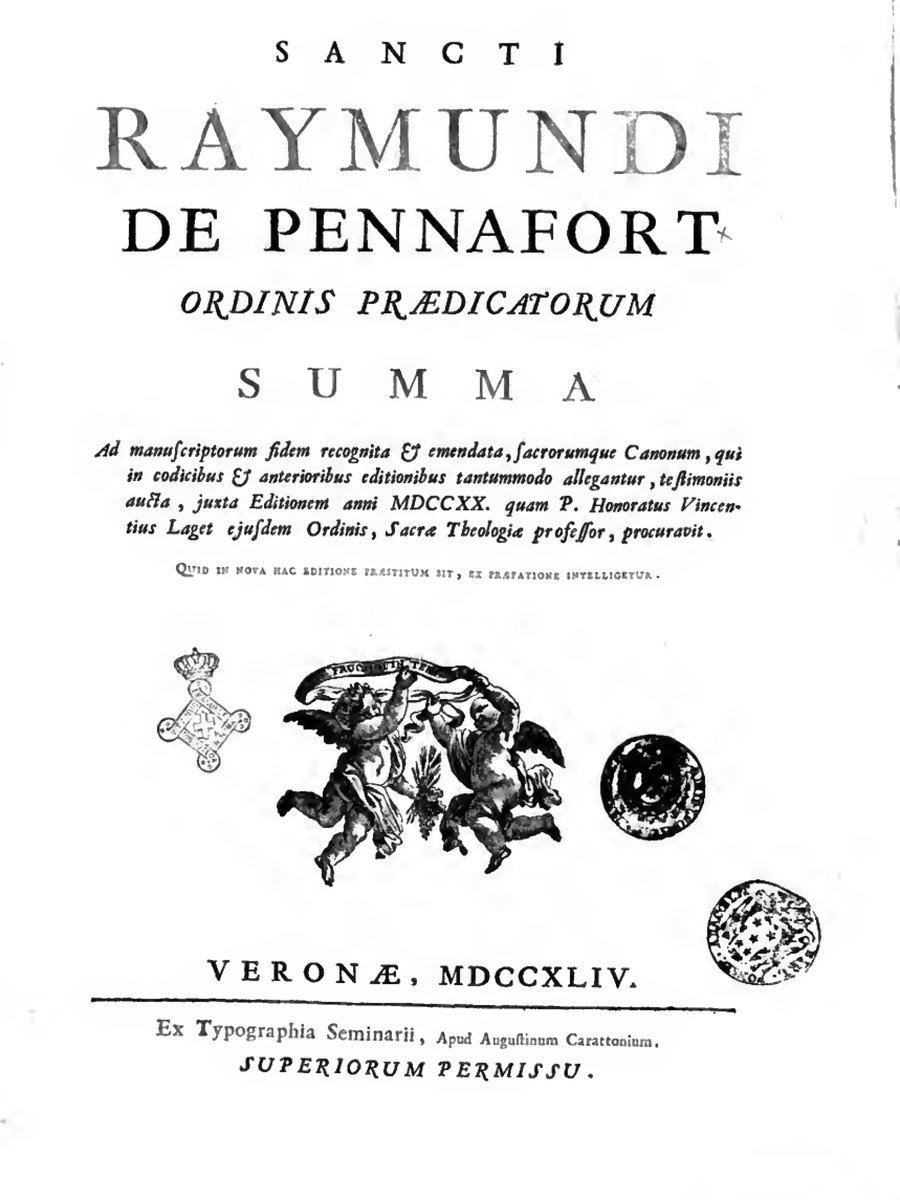
On Simony
De Simonia
 Raymond of Penyafort
De Simonia
Quoniam inter crimina Ecclesiastica Simoniaca hæresis obtinet primum locum, ut causa prima, quæst. ultima c. Patet.
» PAtet Simoniacos veluti primos & præcipuos hæreticos ab omnibus fidelibus respuendos: & si commoniti non resipuerint, ab exteris etiam potestatibus opprimendos. » Omnia etiam crimina ad comparationem Simoniacæ hærefis quasi pro nihilo reputantur.
Videndum est primo quid sit Simonia, unde dicatur, quibus modis contrahatur, qua pæna Simoniacus puniatur, quæ erga ipsum dispensatio fiat. Ultimo de quibusdam dubitabilibus supponemur.
- Simonia est studiosa cupiditas, vel voluntas emendi, vel vendendi aliquod spirituale: nec oportet addi, vel spirituali adnexum: nam spirituali adnexum, spirituale est. Caussa prima, quæst. tertia, c. Si quis objecerit.
» SI quis objecerit, non consecrationes emi, sed res, quæ ex consecratione proveniunt; penitus desipere probatur; nam cum corporalia Ecclesia, aut Episcopus, aut Abbas, aut aliquod sine rebus corporalibus in nullo proficiat, sicut nec anima sine corpore corporaliter vivit; quisquis horum alterum vendit, si ne quo nec alterum provenit, neutram in venditum derelinquit; nullus igitur emat præbendam, vel Ecclesiam, vel aliquod Ecclesiasticum; nec pastillum, nec pactum antea, nec postea quo hujusmodi solvat.
Videtur tamen, quod debeat addi: jus enim patronatus prohibetur vendi, quia est adnexum spirituali. Extra, De jure patron. c. De jure.
» DE jure vero patronatus (& infra) Mandamus, quatenus si R. illud comparavit (cum inconveniens sit vendi jus patronatus, quod est spirituali adnexum) contractum illum irritum esse decernas.
Sed illud dicitur ideo, quia illud jus spirituale, scilicet jus patronatus, cadit in personam laici.
Probatur hæc definitio, seu descriptio Caussa prima, quæst. prima c. Qui studet.
» QUi studet dona Dei pretio mercari, & sacro ordine, nulla ratione de cetero permanere, aut revocari posse, dubium non est; nam Spiritus sancti donum pretio comparari, quid aliud est, quam capitale crimen & simoniaca hærefis?...
Videtur tamen quod sola intentio, vel voluntas non etiam studiosa, vel declarata, faciat moniacum, sicut & usurarium, ut in Luc. 6. Mutuum date, nihil inde sperantes, & extra de usuris c. Consuluit.
» COnsuluit nos tua devotio, an ille in judicio animarum quasi usurarius debeat judicari, qui non alias mutuo traditurus, proposito mutuam pecuniam credit, ut licet omni conventione cessante, plus tamen forte recipiat.... Verum, quia, quid in his casibus tenendum sit, ex Evangelio Lucæ manifeste cognoscitur, in quo dicitur: Mutuum date, nibil inde sperantes; hujusmodi homines pro intentione lucri, quam habent (cum omnis usura, & superabundantia prohibeatur in lege*) judicandi sunt male agere, & ad ea, quæ taliter sunt accepta, restituenda in animarum judicio efficaciter inducendi.
Ad hoc distingue cum Vincentio & Ambrosio: Quædam sunt prohibita, quia simoniaca, ut vendere, vel emere Sacramenta: & breviter, quæ in veteri, novoque testamento simoniaca erant, in istis sufficit sola voluntas. Quædam sunt simoniaca, quia prohibita, scilicet, quæ per constitutionem Ecclesiæ tantum sunt simoniaca; ut quum quis renuntiat Ecclesiæ, illa conditione, vel pacto, ut nepoti suo detur, vel alii: in talibus non sufficit sola voluntas, nisi procedat in actum.
- Item nomine Emtionis, & Venditionis intelligas omnem contractum non gratuitum, præter contractum permutationis: de qua sic teneas; quia permutatio dignitatum, vel præbendarum vel aliorum Beneficiorum Ecclesiasticorum non potest fieri auctoritate partium, absque periculo Simoniz, sicut nec Translatio. Extra de Transact. c. Super eo, & de rerum permut. c. Cum olim.
» SUper eo, quod quæsivisti, utrum de Ecclesiastico beneficio in litigium deducto, posset fieri transactio; tale damus responsum, quod transigi super re sacra & litigiosa non potest. Etenim res sacræ, ut possideantur aliquo dato, vel retento, seu promisso speciem credimus habere Simoniz. Alias si gratis, & amicabiliter inter se litigantes se componant, sacris canonibus nequaquam dicimus obviare.
» CUm olim magister S. & B. Archidiaconatum, & Præposituram adinvicem commutassent (& infra) Licet præditus magister ab initio sponte fuerit de permutatione confessus; idem tamen B. eam inficiabatur omnino, proponens, quod ipse Præposituram sine conditione qualibet resignavit, & post resignationem prædicti magistri, Archidiaconatum fuerat assecutus (& infra) Cum ergo nobis constaret, quod ipse B. suum præstiterat permutationi consensum, præditus autem magister suum publice fatetur errorem; & hunc Præpositura, & illum Archidiaconatu curavimus spoliare, super hoc definitivam contra eos sententiam proferentes.
Episcopus tamen, si caussam Inspexerit necessariam, potest ex officio suo trasferre personas, & facere permutationem. Extra de rerum permut. c. Quæsitum. & c. Cum universorum.
» QUæsitum est ex parte tua, si commutationes fieri valeant Præbendarum, cum commutatio dignitatum in Turonensi Concilio fuerit interdita... (& infra) Generaliter itaque teneas, quod commutationes Præbendarum de jure fieri non possunt, præsertim cum pactione præmissa, quæ circa spiritualia, vel connexa spiritualibus, labem continet semper Simoniz. Si autem Episcopus caussam inspexerit necessariam, licite poterit de uno loco ad alium transferre personas: ut quæ uni loco minus sunt utiles, alibi se valeant utilius exercere.
» CUm universorum (& infra) Intelleximus G. canonico referente, quod cum ipse, & L. Clericus, de permutatione Præbendarum suarum inter se tractare cœpissent, quam utilitati utriusque imminere credebant, tandem inde L. Præbenda ejusdem G. cuidam consanguineo suo adfignata, Præbendam suam ei, sicut promiserat, noluit resignare (& infra) Cum igitur deceptis, & non decipientibus jura subveniant: licet ipsi per se de jure non possent Ecclesiastica Beneficia permutare; ut tamen simplicitati venia tribuatur, mandamus, quatenus si constiterit, prætaxatum G. taliter fuisse deceptum, amota a Præbenda sua consanguineo ipsius L. vel quolibet alio illicito detentore, eam restitui faciat eidem.
Quantum ad proprietatem autem potest fieri permutatio Ecclesiarum, & aliorum beneficiorum, dum tamen fiat auctoritate superioris, & nullum temporale interveniat. Extra, de rer. permut. c. Ad quaestiones.
CLEMENS III. AD quaestiones solvendas (& infra) Accepimus ex litteris tuis, quod duae conventuales Ecclesiae sunt in tua dioecesi constitutae, quarum utraque parochialem habet Ecclesiam cum possessionibus magis alteri, quam sibi vicinam; illis autem desiderantibus permutare eas, cum illarum altera respectu meliorum proventuum plus abundet, & ideo sibi postulat adjici certam summam pecuniae numeratae, ut sic ad aequalitatem permutationis valeant pervenire, utrum posset id licite fieri, extitit dubitatum. (& infra) Respondemus, quod cum de dictis parochialibus Ecclesiis per se queat commutatio celebrari, & in permutatione possessionum per se non sit inhibitum, si altera, ratione possessionum alteri praeponderet, pecuniam posse refundi de ipsarum possessionibus adinvicem, prout visum fuerit expedire; refusa certa pecuniae quantitate, poterit contractus permutationis iniri; sic tamen, quod illi contractus nequaquam sibi invicem misceantur.
Nisi forte altera abundaret multum in reditibus, alia parum; quia tunc minus abundans posset refundere alteri certam pecuniae quantitatem, ita quod temporale pro temporali daretur, & contractus nullo modo miscerentur.
- Dicitur autem simonia a Simone mago, primo in novo testamento hujus sceleris auctore, quia voluit emore gratiam Spiritus sancti a sancto Petro, sicut & Gezi in veteri testamento voluit vendere gratiam sanitatis Naaman Syro: unde proprie venditor spiritualium dicitur Giezita a Giezi; emtor vero simoniacus a Simone; usu tamen uterque dicitur simoniacus.
Committitur simonia tribus modis, ut dicit Greg. super illum locum Isaiae 33 Beatus qui excutit manus suas ab omni munere: non dicit solummodo a munere, sed ab omni munere: aliud enim est Munus a manu, aliud ab obsequio, aliud a lingua. Munus a manu pecunia est. Munus ab obsequio, est servitus indebite impensa. Munus a lingua, favor. Caussa prima q. 1. c. Sunt nonnulli.
SUnt nonnulli, qui quidem numorum praemia ex ordinatione non accipiunt: tamen sacros ordines pro humana gratia, vel laude largiuntur, atque de ipsa largitato, laudis solummodo retributionem quaerunt. Hi nimirum quod accipiunt gratis, gratis non tribuunt, quia de impensae officii sanctitatis, munus expetunt favoris. Unde cum virum justum Propheta describeret, ait: Beatus qui excutit manus suas ab omni munere, non dixit solum a munere, sed ab omni munere: quia aliud est munus ab obsequio, aliud a manu, aliud a lingua. Munus ab obsequio, est servitus indebite impensa: Munus a manu pecunia est: Munus a lingua, favor; qui ergo sacros ordines tribuit, tunc ab omni munere manus excutit, quando in divinis rebus non solum pecuniam nullam, sed nec etiam humanam gratiam requisit.
Si autem dubitetur, utrum gratis, vel ex pactione, vel corrupta voluntate datum sit, tria sunt maxime attendenda, scilicet dantis & recipientis qualitas, videlicet, an a paupere diviti, vel e converso sive a divite locupleti: Muneris quantitas, & magni, vel minoris pretii res data exsistat: & donationis tempus, an scilicet instante necessitate, seu alio tempore conferatur; & secundum hoc est habenda praesumtio, vel pro, vel contra. Extra de simonia, c. Et si quaestiones.
ALEX. III. ET si quaestiones... Cum in accipiendis, vel dandis muneribus tria sunt maxime attendenda, personae scilicet dantis, & accipientis qualitas, quantitas muneris, & donationis tempus, qualitas personarum, ut a quo, vel
Item nota, quod simoniaca dicitur ordinatio, alia ex parte ordinatoris tantum, alia ex parte ordinandi tantum, alia ex parte utriusque, alia ex neutrius parte, quae est, quum, utroque ignorante, amicus ordinaudi dat, vel promittit consiliario Episcopi. Caussa prima, quaest. c. Statuimus 2. & c. Si quis a simoniacis.
NICOLAUS PAPA II. Statuimus decretum de simoniacis simoniace ordinatoribus, vel ordinatis: & de simoniacis non simoniace a non simoniacis: & de simoniacis non simoniace a simoniacis. Simoniaci simoniace ordinati, vel ordinatores secundum Ecclesiasticos Canones a proprio gradu decidunt. Simoniaci quoque simoniace a non simoniacis ordinati, similiter ab officio male accepto semoventur. Simoniacos autem non simoniace a simoniacis ordinatos, misericorditer per manus impositionem pro temporis necessitate in officio concedimus permanere. (Sed hoc intelligendum est de his, qui ordinantur a simoniacis, quos ignorabant esse simoniacos: hos facit simoniacos non reatus criminis, sed ordinatio simoniaci. De quibus Urbanus Papa ait:)
URBANUS PAPA. Si qui a simoniacis non simoniace ordinati sunt, siquidem probare potuerint se, cum ordinarentur, nescisse eos simoniacos esse; & tunc pro catholicis habebantur in Ecclesia, eorum ordinationes misericorditer sustinemus; si tamen eos laudabilis vita commendat: qui vero scienter se a simoniacis consecrari, imo execrari permiserint, eorum consecratio omnino irritam esse decernimus.
Porro sunt casus, in quibus licite pro spiritualibus datur munus a manu, quandoque ab obsequio, quandoque a lingua.
Ex Conc. Tolet. 11. Quidquid invisibilis gratiae consolatione tribuitur, numquam quaestibus, vel quibuslibet praemiis vennundari penitus debet, dicente Domino: Gratis accepistis, gratis date, Matth. 10. & ideo quicumque deinceps in Ecclesiastica ordine constitutus, aut pro baptizandis, confirmandisque fidelibus, pro chrismate, vel promotionibus graduum pretia quaelibet, vel praemia, nisi voluntarie oblata, pro hujusmodi ambitione susceperit, &c.
Munus a manu potest dari in quinque casibus. Primus, si gratis offeratur, non pro spirituali. Caussa 1. quaest. 1. c. Quidquid invisibilis.
cui, videlicet, an a paupere diviti, vel e converso, sive a divite locopleti datum fuerit: aestimatio muoeris, & donatioois tempus, si magni, vel minoris pretii res data exsistat, & an instante necessitate, sive alio tempore conferatur. Si ergo praedictorum Cardinalis & Fratris tui personam & qualitatem pensamus; non fuit magnum ab eodem fratre tuo Cardinali, equum unum transmitti, quem etiam joculatori non petenti, vir tantus, & tam abundans forte donaret. Verum si temporis necessitatem perpendimus, non alia intentione hoc constat factum fuisse, quam ut Cardinali subveniretur in articulo praenotato (& infra) Quod autem scriptum est: Beatus qui excutit manus suas ab omni munere; de illis donis dictum est, quae accipientis animum allicere, vel pervertere solent: quoniam si ipsa etiam persona electi offerat ordinatori, vel consecratori suo electuarium, vel de vino, sive de aliis hujusmodi, quae modici pretii fuerunt, & quae voluntatem recipientis inclinare, vel movere non debeant; non tamen Ecclesia Romana interpretari coosuevit, accipientem in his delinquere, vel dooantem.
Secundus casus est pro operibus spiritualibus, ad quae non teneatur ex officio. Caussa 32. q. 2. c. Caritatem.
CARITATEM... Visitatores Ecclesiarum, Clericique eorum, qui cum ipsis non per suae civitatis parochias fatigantur; aliquod laboris sui capiant te disponente subsidium. Justum namque est, ut illi consequantur stipendium, qui pro tempore suum commodare reperiuntur obsequium.
Tertius etiam pro quibusdam operibus spiritualibus debitis, puta quum consecrat Episcopus Ecclesiam, vel visitat Episcopatum, potest exigere procuratioaem moderatam. Extra de simonia, c. Cum sit Romana. Caussa 10. q. 3. c. Relatum. Extra de praescript. c. Cum ex officii.
CUM sit Romana (& infra) consultationi tuae respond. Quod nihil pro Ecclesiarum consecratione potes, vel debes praeter procurationem exigere.
CUM ex officii sui debito Senonensem provinciam, per Parisiensem dioecesim transitum faciens, ad Abbatis Sancti Maglorii Prioris de Castres & quorumdam aliorum Ecclesias ejusdem dioecesis, necesse habuit declinare: a quibus cum procurationem sibi debitam postularet, ipsi eam inhumaniter negaverunt, ad suae negotiationis defensionem hoc solum allegantes, quod non meminerant, se procurationem hujusmodi praedecessoribus ejusdem Archiepiscopi exsolvisse, nec ab eis aliquando fuisse petitam (& infra) Nos igitur praemissam allegationem eorum nullam penitus reputantes, cum contra procurationem, quae ratione visitationis debetur, praescribi nequiverit, quemadmodum nec contra visitationem ipsam potest aliquo modo praescribi, etsi alius contra eum praescribere posset utramque. Ideoque mandamus, quatenus sententiam, quam in hujusmodi contemtores, de antiqua Metropolis consuetudine tulit Archiepiscopus memoratus, usque ad satisfactionem condignam facias observari; quia secundum Apostolum: Qui Spiritualia seminat, non est magnum, si metet carnalia, cum nemo cogatur suis stipendiis militare. Si quid enim aliud,
superius fuerit allegatum, contra intentionem Archiepiscopi objicere voluerint, & probare, nos eis faciemus justitiam exhiberi.
Quartus pro vita aeterna, & peccatorum remissione, in Dan. 4. Peccata tua eleemosynis redime.
Quintus pro redimenda vexatione, quae sibi fit injuste super jure spirituali. Extra de simonia, cap. Dilectus filius, & Apostolus: Redimentes tempus, quoniam dies mali sunt.
DILECTUS filius R. Praepositus nobis exposuit, quod cum Eboracen. Archidiaconus eum multis gravaminibus afficere non cessaret, promisit ei certam quantitatem pecuniae se daturum, ut ab ipsius desisteret laesione. Verum dictus Archidiaconus post receptionem pecuniae super dignitatibus, & beneficiis suis, ab ejus molestia non quievit. Ideoque dilectioni vestrae mandamus, quatenus si res ita se habet, Archidiaconum restituere, quod accepit (si eum contra promissionem suam venisse constiterit) compellatis.
In munere ab obsequio. Distingue, quia aut est corporale, aut est spirituale. In primo casu, si obsequium est honestum, potest, ut si eat Romam pro Ecclesia, vel serviat alicui Episcopo, vel Ecclesiae in licitis, & honestis, dum tamen sine pactione. Si inhonestum, non potest, ut supra, eodem praec. verf.
Munus ab obsequio, est servitus indebite impensa: si spirituale, non debet facere tale obsequium pro beneficio, vel alio sibi dando, nisi quum tale obsequium fuerit impositum ipsi beneficio, v. gr. alicui praebendae est impositum hoc onus, ut quicumque eam habuerit, cantet quotidie de B. V. Maria Missam. Extra de praebend. cap. Significatum.
SIGNIFICATUM est nobis, quod cuidam sacerdoti praebendam unam in Ecclesia vestra communi voluntate dedistis, ita quod Missam de S. Maria (nisi corporis infirmitate gravatus sit) debeat quotidie celebrare, & Ecclesiam vestram, nonnisi communi tam praepositi, quam capituli assensu possit dimittere, vel cuidam praebendae illius anniversarium delegare. Quam siquidem institutionem eatenus confirmamus, ut praedictus sacerdos, nisi infirmitate corporis fuerit impeditus, assidue debeat obsequium suum impendere Ecclesiae memoratae, & quanto frequentius potest (salva honesta sua & debita devotione) Missarum solemnia celebrare; nec sibi liceat hoc illi subtrahere, sive caussa voluntatis, sive se ad aliam Ecclesiam transferendo.
Pro spiritualibus aut temporalibus aliquid dare, puta, calice, ornamentis & similibus, dicunt quidam, quod non est simonia, nisi inveniatur prohibitum, ut in Ecclesia, Coemeterio, & Chrismate, vel oleo benedicto. Caussa 1. quaest. 1. Placuit 2. Dictum, 2. & Statuimus. 1. Extra De simonia, c. Ad nostram.
PLACUIT, ut nullus Episcoporum pro modico balsami, quod benedictum pro baptismi sacramento per Ecclesias datur, quia singuli tremissem pro ipso exigere solent, aliquid ulterius exigaot; oe forte quod pro salute animarum per Invocationem Spiritus sancti consecratur, sicut Simon magus dooum Dei pecunia voluit emere, ita nos venumdantes damnabiliter venumdemur.
DICTUM est solere in quibusdam locis pro perceptione Chrismatis nummos dari. Similiter pro baptismo, & communione; hoc simoniacae haeresis esse semen, detestata est san-
cta Synodus, & anathematizavit, ut de cetero, nec pro ordinatione, nec pro chrismate, vel baptismo, vel pro balsamo, nec pro sepultura, vel communione quidquam exigatur, statuit. Sed gratis dona Christi, gratuita dispensatione donentur.
STATUIMUS, ut sicut pro dedicandis Basilicis, & dandis ordinibus nihil accipiendum est; ita etiam pro balsamo, vel pro luminaribus emendis, nihil presbyteri chrisma accepturi dent. Episcopi itaque de facultatibus Ecclesiae balsamum emant, luminaria singuli in Ecclesiis suis concinnanda provideant.
AD nostram (& infra) Dilectioni vestrae mandamus, quatenus pro ministerio Ecclesiastico exercendo, sive pro vicariis assignandis, seu pro chrismate nullatenus pecunia exigatis.
In munere a lingua, distinguitur ab Hugotio & multis aliis: aut eligitur quis, vel ordinatur suis precibus, aut alienis. In primo casu, quantumcumque sit dignus, est simonia. Caussa 8. q. 1. c. In Scripturis. Caussa 1. q. 1. c. Ordinationes.
IN scripturis vestris vos magnopere requiem quaesisse narratis, sed per hoc ad pastoralem sollicitudinem vos congrue venisse ostenditis: quia sicut locus regiminis desiderantibus negandus est; ita & fugientibus offerendus est, & sicut scriptum est: Ne quisquam sibi sumat honorem, sed qui vocatur a Deo tamquam Aaron, &c.
ORDINATIONES, quae interveniente pretio, vel precibus, vel obsequio alicui personae, ea intentione impenso, vel quae non communi consensu Cleri, & populi, secundum Canonicas sanctiones fiunt, & ab his, ad quos consecratio pertinet, non comprobantur; falsas esse dijudicamus: quoniam qui taliter ordinantur, non per ostium, id est, per Christum iotrant, sed, ut ipsa veritas testatur, fures sunt & latrones.
In casu secundo, aut illae preces suot carnales, aut spirituales. Si caroales, & sunt pro iodigoo, simonia est. Caussa 1. q. 1. c. De ordinationibus; tunc enim preces succedunt loco pretii. Caussa 1. quaest. 1. c. Sunt nonnulli.
DE ordinationibus accipere aliquid sub stricta interdictione vetuimus. Oportet ergo, ut neque per donum, neque per gratiam, neque per quorumdam supplicationem, aliquos ad sacros ordines coosentias, vel permitteas addnci.
Si vero sunt carnales pro digno, non committitur simooia, dummodo ordinator, vel elector non habeat respectum ad preces, sed ad Deum, & ad merita personae. Extra, de aetate & qualitate & ordine praeficiendorum c. Tuam. Caussa 1. q. 1. c. Latorem.
TUAM in Domino diligentiam commendamus, quam super Monasterio sancti Quirici reformando dignosceres adhibere. Mandamus, quatenus, si non potes eidem monasterio de persona idonea melius providere, ut monachum illum, quem litteris tuis de honestate, ac industria commendasti, per quem status ejusdem loci creditur reformandus (nullum prorsus habens respectum ad petitionem illicitam, quam quidam laici faciebant, sed ex tuae dumtaxat provisionis officio) instituas in Abbatem &c.
LATOREM praesentium per intercessionem vestrae sanctitatis, acolytum fecimus, quem ad obsequia vestra transmisimus, ut si in lucrandis animabus amplius servierit, proficere amplius possit.
Alii sunt, qui dissentiunt in primo articulo, dicentes, quod licite potest quis petere pro se, exemplo Petri dicentis Domino: Ecce nos reliquimus, & sequuti sumus te; quid ergo erit nobis? Ego distinguo, salvo meliori judicio, quod non potest pro se petere Ecclesiam, vel dignitatem, vel aliud beneficium habens curam animarum adnexam, & in hoc sentio cum Hugotio, per jura supradicta, & Extra de jure patron. c. Per nostras.
PER nostras postulasti litteras edoceri, utrum Clericus ad vacantem Ecclesiam, in qua obtinet patronatus, seipsum (si est idoneus) valeat praesentare; cum igitur nullus se ingerere debeat Ecclesiasticae Praelationis officio; respondemus, quod nullus se potest ad personatum alicujus Ecclesiae praesentare, quantumcumque idoneus sit, & quibuscumque studiis & meritis adjuvetur.
Beneficium vero simplex, si indiget, & sentit se dignum, potest petere absque metu peccati, & simoniae. Extra de rescriptis, c. Ad aures, & de praebendis c. Non liceat: & in hoc sentio cum aliis.
AD aures nostras pervenit, quod plerumque Decani, Archidiaconi, Praecentores, vel alii Ecclesiasticis praediti dignitatibus, super minoribus beneficiis litteras impetrantes, nomen supprimit dignitatis suae, & simplici nomine se appellant, tamquam non habeant aliquem personatum (& infra) Tuae igitur consultationi taliter respondemus, quod cum non sit intentionis nostrae, ut personae pluribus reditibus abundantes, per litteras nostras, pauperes Clericos super minoribus beneficiis inquietent; litteras, in quibus actor suae nomen dignitatis supprimit, vires oolumus obtinere.
NON liceat ulli Episcopo ordinare Clericos, & eis nullas alinonias praestare; sed duorum alterum eligat: vel non faciat Clericos, vel si fecerit, det illis, oode vivere possint.
Si vero non indiget, peccat, ut patet per illam, Ad aures, jam citatam: & Caussa 1. quaest. 2. c. Clericos: & Caussa 12. q. 1. c. Illi autem qui.
CLERICOS autem illos convenit Ecclesiae stipendiis sustentari, quibus parentum, & propinquorum nulla suffragantur bona. Qui autem bonis parentum, & opibus suis sustentari possunt, si quod pauperum est, accipiunt, sacrilegium profecto committunt, & per abusionem talium, judicium sibi manducant & bibunt.
ILLI autem, qui tam infirmi sunt, ut possessionibus suis renuntiate noo possint; si ea, quae accepturi erant, dispeosatori relinquant, nihil habentibus conferenda, sine peccato possident sua: quia & ipsi quodammodo sua relinquunt, quando propriis cootenti rebus, nihil eorum, labori, vel ordini suo deberi arbitrantur, accipiont.
Item nota, quod sicut spiritualia noo debent vendi, vel emi, ita nec redimi. Extra de simonia c. Querelam.
QUERELAM Monachorum de Acra recepimus, quod cum ipsi quoddam manerium cum pertintiis suis, & Ecclesiam de Genen. a Monachis de Cardonio sub annuo ceofu qoindecim librarum fuissent adepti, & inde chartam ab ipsis Monachis habuissent; Prior eorum, Capitulo inconsulto, praescriptum manerium & chartam Mo-
nachis de Cardonio accepta pecunia resignavit. Unde quia praefati Monachi de Acra se conqueruntur injuste gravatos; mandamus quatenus partibus convocatis, praescriptam causam concordia, vel judicio terminetis, scituri, quod sicut emi non potuit, ita nec redimi Ecclesia memorata, &c.
Nec aliquo dato, vel retento, vel promisso, possideri Spiritualia possunt, nec super eis transigi. Extra de Transact. c. Super eo. & de pactis, c. Cum pridem. Caussa 1. q. 1. c. Quam pio.
CUM pridem S. Clericus Procurator Prioris, & Monachorum de Acra, & P. Clericus pro caussa, quae inter eos, & praedictum P. ac fratrem ejus, cujus vicem se gerere dicebat, super Ecclesia & Capella de L. vertebatur, ad nostram praesentiam accessissent, inter se (non tamen nobis mediantibus) convenerunt, quod eidem P. pro expensis, quas fecerat, tres marchae argenti solverentur, & idem P. liti cederet, & a Monachorum infestatione cessaret. Cumque compositionem illam auctoritate Apostolica petierent confirmari; Nos eam non duximus admittendam, pro eo quod videbatur pravam illicitae pactionis speciem continere (& infra) Ille igitur nostris monitis acquiescens, & eidem liti pro se, ac fratre suo renuncians, autentica instrumenta, quae super hoc habebat, in nostris manibus resignavit, quae nos Priori, & Monachis destinantes, mandavimus, ut eidem P. & fratri ejus, in aliquo studerent beneficio providere, de quo majus lucrum valeant Apostolica intercessione percipere, quam eis deberet ex illa pactione illicita provenire, &c.
Circa hoc tamen distinguunt quidam, quod & ante, & post electionem, vel ordinationem licite petitur cautio, quae habetur ex jure, vel approbata consuetudine. Distinct. 23. c. Quamquam. Distinct. 63. c. Quia sancta.
QUAMQUAM omnes, qui sacris mancipantur ordinibus, canonicis regulis teneantur adstricti; expedibile tamen est, ut promissionis suae vota sub cautione spondeant, quos ad promotionis gradus Ecclesiastica probat disciplina. Solet enim plus timeri, quod singulariter pollicetur, quam quod generali sponsione concluditur. Et ideo placuit huic sancto Concilio, ut unusquisque, qui ad Ecclesiasticos gradus est ascensurus, non ante honoris consecrationem accipiat, quam placiti sui adnotatione promittat, ut fidem catholicam sincera cordis contritione, & devotione custodiens, juste, & pie vivere debeat, &c.
QUIA sancta Romana Ecclesia, cui, Deo auctore, praesidemus, a pluribus patitur violentias, Pontifice obeunte, quae ob hoc inferuntur, quia absque Imperiali notitia, Pontificis fit electio, & consecratio, nec canonico ritu & consuetudine ab Imperatore directi intersunt nuntii, qui vetent scandala fieri; volumus, ut, cum instituendus est Pontifex, convenientibus Episcopis, & universo Clero eligatur, praefente senatu, & populo, qui ordinandus est, & sic ab omnibus electus, praesentibus legatis Imperialibus consecretur; nullusque sine periculo sui, juramenta, vel promissiones aliquas nova adinventione audeat extorquere, nisi quae antiqua exigit consuetudo; ne vel Ecclesia scandalizetur, & Imperialis magnificentia minuatur.
A superiore vero quaelibet cautio peti potest, dum tamen honesta. Caussa 10. q. 3. c. ult. seu, Illud. Extra de Elect. c. Significasti.
ILLUD Magnitudinem tuam minime volumus ignorare, quod Syracusanae civitatis Episcopus inter alia, quae in cautionem suarum paginarum spopondit, hoc etiam, specialiter sub interpositione poenae legitimae promisisse legitur, numquam se a quolibet suae dioecesis presbytero ultra duos solidos cathedratici nomine petiturum; nec per quamlibet aliam occasionem quidquam in ejus se dispendio esse gesturum. Quod magnitudo tua non solum a praedito Episcopo, sed de omnium Episcoporum Siciliae personis, competenti sollicitudine custodiri non desinat: nec ipsa quoque prandia enormia fieri, sed secundum mediocritatem uniuscujusque loci Episcopo ad consignationem venienti susceptionis praeparari convivium; quia nec eo praetextu pauperibus incute damna volumus, aut qualibet ratione permittimus.
SIGNIFICASTI nobis, Frater carissime, Reges & Regni majores admiratione permotos, quod pallium tibi ab Apocrifiariis nostris tali conditione oblatum fuerit, si sacramentum, quod nobis scriptum detulerant, exhiberes (& infra) Mirentur in hac caussa Dominum nostrum Jesum Christum, qui cum ovium suarum curam Petro committeret, conditionem posoit dicens: Si diligis me, pasce oves meas. Si conscientiarum factor, & cognitor secretorum, conditione hac usus est, nec semel tantum, sed & secundo, & usque ad contristationem; qua nos sollicitudine oportet tantam Ecclesiae praelationem imponere fratribus, quorum conscientias non videmus? &c.
Alii dicunt, quod ante electionem nulla cautio, vel pactio peti potest, & si praeftat, simonia est, quia videtur facere propter hoc, ut eligatur. Caussa 8. q. 3. cap. Talia.
QUOD autem Simoniacus habendus non sit, qui post electionem pro indemnitate Ecclesiae juramentum praestiterit, facile probatur. Aliud est enim ante electionem juramentum facere, vel se pacisci facturum ad hoc, ut eligatur. Aliud est nulla praecedenti conventione post electionem hujusmodi juramentum offerre. Illud ab officio tamquam munus impensum dejicit; hoc autem consecrando nullum impedimentum generat. De priori casu scribit Pelagius Clero Catinensi.
TALIA quidem jam dudum ad fratrem, & Coepiscoporum nostrum Eucarpium de visitatione Catinensis Ecclesiae scripta direximus, ut in eis judicium nostrum potuissetis agnoscere. Verumtamen, quia quosdam ibi non sana intentione, sed pravis studiis dissensiones suscitare, vestra etiam relatione, cognovimus, qui scientes, se ad episcopatum, nec aetate, nec scientia, nec vitae meritis posse perduci, ad hoc tantummodo inquietare Ecclesiam volunt, ut sibi de his, quae ex ipsa praesumta sunt, impunitatem futurus promittat Episcopus, & fiat rapinae securitas, Episcopatus ambitio; hoc etiam vos duximus commonendos, ut decretum in Elpidium Diaconum factum, & subscriptum ab omnibus, quos vestra relatio designavit, & cum eodem diacono matnretis Deo propitiante perducere (& post pauca) Cum igitur huc filius noster magnificus vir Len Prator venisset, retulit nobis de singulis, quae ibi mota sunt, & quomodo vota prope totius civitatis in Elpidio Diacono concordarent. Unde quia de memorati viri testimonio dubita-
tari omnino non possumus; idcirco sicut dictum est, Elpidium diaconum ad nos facite properare, nec exspectis ulterius, ut admonitio ad eum nostra debeat destinari, quem tamen hoc per vestram dilectionem praesenti jussione specialiter admonemus, ne cuiquam se aliquid dare, vel daturum esse promittat; sed neque de Ecclesiasticis praeteritis causis aliquam securitatem cuiquam audeat facere, sive promittere, aut quasi factus Episcopus, ea, quae direpta sunt, non repetat: sed apud eos, a quibus direpta sunt, permanere libere patiatur, sciens quod si tale aliquid fecerit, vel fecit, nec a nobis omnino permittitur valere ipsa promissio, & cum judicii nostri, quod de se ipso habuimus, damno, pastoralis consecrationis ordinem promereri non poterit.
Idem est, si promittat ante electionem, se post electionem juraturum. Caussa 1. q. 2. c. Quam pio, & in praedicto cap. Talia.
QUAM pio mentis affectu, fratres carissimi, vestrae destitutioni Romana compatiatur Ecclesia, &c... Cavete ergo, fratres, quam sit ambiguum, quod petistis consilium: quod quidem secundum vestrae voluntatis propositum, nulla invenimus ratione confirmatum; verumtamen, si vestrae necessitati adeo est opportunus, quem reperiltis, dum tamen omnis absit pactio, omnis cesset conventio, nullaque vestrae Ecclesiae fiat distractio; accedat, gratis Deo servire incipiat, suique regiminis devote gerat obsequium; & postmodum vos quasi subsidii gratia, aliqua suae Ecclesiae munera largiri fratrum solatia, Romana permittit Ecclesia.
Sed post electionem bene potest, quia tunc nihil sperat habere ab eis: dum tamen non fiat ex praecedenti pactione. Caussa 8. q. 3. c. Artuldus.
De secundo vero casu in gestis Urbani secundi legitur.
ARTALDUS Arelatensis Episcopus Narbonensis Ecclesiae Suffraganeus Romam confecrandus ad Dominum Papam Urbanum venit, suus quippe Archiepiscopus eum consecrare nolebat, quia post electionem suam propter bona Ecclesiae conservanda, Canonicis juravit. Consecratus itaque est a Domino Papa Urbano ante purgatus hujusmodi juramento: De juramento, quod canonicis nostrae Ecclesiae feci, post electionam nullam ante conventionem, ut eligerer, feci. Narbonensis vero Ecclesiae Archiepiscopi nulli praeter id, criminis caussa, canonicam consecrationem omisit, me sciente; neque mihi criminis conscius sum, propter quod a sacerdotio me repellat.
A superiore vero potest peti honesta cautio, & ante, & post electionem. Dist. 28. c. De Siracusane. & Dist. 100. c. Optatum: & in hoc concordant cum primis: & haec ultima opinio magis placet.
DE Siracusanae urbis Antistite optaveramus in ipso initio, gloriae vestrae desideriis obedire, nisi nos multiplex ratio ipsius non paucis temporibus ordinationem differre sacerdotii coegisset... Qua de re summo studio ab eodem Siracusanae urbis Episcopo, priusquam a nobis in Episcopum contingeret ordinari, hujusmodi exegimus cautionem, per quam & suam fatereretur, quantula esset, praesentis temporis habita rerum descriptione, substantiam, & nihil numquam per se, aut per filios, & uxorem, sive quamlibet propinquam, aut domesticam, vel extraneam forte personam, de rebus audeat usurpare Ecclesiae, & universae sui Episcopa-
tus quaesita tempore, Ecclesiae suae dominio sociaret: nihil ultra id, quod modo descriptum est, filiis suis, vel haeredibus relicturus.
OPTATUM tibi pallium nunc conferre nequivimus, quia fidei tuae paginam minus, quam oporteat, continere reperimus, cum videlicet nullam in ea sanctarum universalium synodorum, in quibus fidei nostrae Symbolum continetur, nec decretalium Pontificum Romanorum constitutorum secundum morem feceris mentionem: sed nec illam propria subscriptione munieras, nec aliquem qui jurejurando firmaret, miseras.
Circa poenam simoniaci distingue: quoniam aut est simonia in ordine, aut in beneficio; & in ordine, non recipit executionem, sed est ipso jure suspensus quoad se, & quoad alios, sive fit occultum, sive manifestum, sicut & notorius fornicator. Extra de simonia, c. Tanti; & Dist. 32. c. Verum, & sic intelligitur Caussa 1. q. 1. c. Reperiuntur & hoc, quia caracterem habet furtivum.
REPERIUNTUR quam plurimi negotio muneris perituri, mercari velle gratiam Spiritus sancti: dum vile pretium donant, ut Pontificalis ordinis sublimitatem acquirant... Nos huic vulneri canceroso ignitum (quod superest adhuc) injicimus ferrum, decernentes omnino, ut quicumque deinceps pro accipienda divini dignitate doni quodlibet praemium detectus fuerit obtulisse, ex eodem tempore se noverit anathematis opprobio condemnatum, atque a participatione corporis, & sanguinis Christi alienum, ex quo illum constat execrabile Christo perpetrasse flagitium. Quod si aliquis ejus accusator extiterit, ille, qui hunc ordinem, munerum fuerit datione lucratus; & suscepto honoris gradu privetur, & in monasterio sub perenni poenitentia retrudatur: illi vero, qui hac caussa munerum acceptores extiterint, & clerici fuerint, honoris sui amissione multentur; si vero laici, perpetuo anathemate condemnentur.
Item punitur depositione, & infamia, si de crimine, judici suo, aliquo modo, etiam per inquisitionem, vel denuntiationem constiterit. Caussa 15. q. 3. c. Sane. Extra de accusatione c. Inquisitionis.
SANE quisquis hanc sanctam, & venerandam Antistitis sedem pecuniae interventu subisset, aut si quis, ut alterum ordinaret, vel eligeret, aliquid accepisse detegitur, ad instar publici criminis & laesae majestatis accusatione proposita, a gradu sacerdotii detrahatur: nec hoc solum deinceps honore privari, sed perpetuae quoque infamiae damnari decernimus, ut quos facinus par coinquinat, & aequat, utrosque similis poena comitetur.
INQUISITIONIS negotium, quam de Episcopo, & Canonicis Valentinen. vobis commisimus terminandam... (& infra) Secundo quaesivistis, quid vobis sit statuendum, si contra quempiam per inquisitionem probatum fuerit tale crimen, quod deponeret accusatum criminaliter, & convictum. In quo quidem duximus distinguendum, utrum sit tale crimen, quod ordinis executionem suscepti, aut retentionem beneficii, etiam post
post peractam pœnitentiam impedirer, puta, si homicidium commisisset, vel adeptus esset ordinem, aut beneficium, vitio simoniæ, quo cafu erit sicut in accusationis judicio procedendum, &c.
Item qui recipit beneficium simoniace, tenetur renunciare beneficio, & restituere omnes fructus perceptos, & qui percipi potuissent. Caussa 14. q. 6. c. Si res aliena, & extra de restitut. spoliat. c. Gravis.
Item non potest repetere pecuniam, quam dedit, non quia alius bene acceperit, sed quia iste turpiter dedit. Caussa 14. q. 5. c. Non sane.
Non sane, quidquid ab invito sumitur, injuriose aufertur. Cum autem judicia & testimonia, quæ nec justa nec vera venda sunt, iniqua & falsa venduntur, multo sceleratius utique pecunia sumitur; quia scelerare etiam quamvis a volentibus datur. Ille tamen solet tamquam male sibi ablatam pecuniam repetere, qui justum judicium emit, quia venale esse non debuit. Qui vero pro iniquo judicio dedit, vellet quidem repetere, nisi timeret, vel puderet emisse, &c.
Si vero est Simoniacus, quia contulit ordinem simoniace, vel quia dedit, vel recepit beneficium simoniace, vel fuit mediator simoniæ; si est occultum, est suspensus ipso jure quoad se tantum, sicut & quilibet criminosus; non tamen quoad alios. Arg. extra de Simonia, c. Et si quæstiones, & Veniens, & c. Ex sue fraternitatis.
Et intellige fructus, qui supersunt, deductis expensis, quæ fiunt quærendorum, congregandorum, & conservandorum fructuum gratia, qui ducuntur tam a bonæ fidei, quam a malæ fidei possessore, ff. de pet. hæred. Si a patre, §. ultim.
Item intelligo hoc de fructibus, quos non expendit in servitium, & utilitatem Ecclesiæ, sed in alios usus; nam & qui depræbandi caussa accessit ad negotia mea agenda, habet contra me actionem, non in id, quod sibi abest, quia proterve ad negotia mea accessit; sed in quo ego locupletior factus sum, ut ff. de neg. gest. Si pupilli, §. Sed & si quis.
Idem intelligo de illo, quo sciente, & consentiente, facta fuit Simonia, vel statim quum scivit, non renuntiavit. Arg. extra de Simonia, Sicut tuis circa finem cap.
Aliter si esset bonæ fidei possessor, tenetur non de consumtis fructibus, sed de exstantibus tantum. C. de rei ven. Certum. Item hæc pœna clericorum; Laici autem debent excommunicari. Caussa 5. q. 1. c. Reperiuntur, & Si quis Episcopus.
Si vero est manifestum, est ipso jure suspensus, & quoad se, & quoad alios. Extra de Simonia c. Accusatum, & c. Quoties.
Accusatum Simoniacum necesse habuimus prohibere, ne missarum solemnia celebraret, donec quid esset, verius constitisset.
Quoties (& infra) Provenit ad nos, quod per simoniacam hæresim fueris ordinatus, propterea necesse habuimus te prohibere, ne missarum solemnia celebrare debuisses, donec quid sit, verius discerneremus.
Veniens ad nos F. Presbyter proposuit, quod Abbas, & fratres S. R. noluerunt cum in Monachum recipere, quousque triginta solidos dare convenerit: conventione autem facta, sequenti die eum monasticum habitum induerunt, & iidem monachi triginta solidos, Abbas vero decem, & familia duodecim pro pastu (asserentes hoc esse de consuetudine monasterii) postularunt. Quoniam ergo factum hujusmodi perniciosum videtur; mandamus, quatenus, si ita esse inveneris, Abbatem, & Monachos ad restituendam pecuniam præfato F. tam indigne acceptam compellas: & Abbatem, & majores personas monasterii, pro tantæ pravitatis excessu, ab officii executione suspendens, præcipias dicto F. ut in alio monasterio, in habitu monasico, Domino studeat deservire.
Ex tuæ fraternitatis litteris, & ex confessione Sacerdotis præsentis accepimus, quod cum ad Sacerdotii ordinem non aliter voluisset eum ejus Archidiaconus præsentare, sex solidos solvit eidem, & sic ordinem ipsum per eum præsentatus accepit. Unde tibi sic duximus respondendum, ut si hoc non est publicum, sed secretum, eumdem Sacerdotem secreto convenias, monens sine ulla coactione propensus, & inducens, ut ordinem alicujus religionis assumat, & perpetuo ab officio abstineat, quod illicite acquisivit. Alioquin non erit tutum (cum sit secretus ejus excessus) ipsum invitum ab eodem officio coercere, cui tamen secretam pœnitentiam, secundum quod tibi visum fuerit, injungere non postponas.
Si vero est manifestum, est ipso jure suspensus, & quoad se, & quoad alios. Extra de Simonia c. Accusatum, & c. Quoties.
Si quis Episcopus per pecuniam ordinationem fecerit, & sub pretio redegerit Spiritus Sancti gratiam, quæ vendi non potest, ordinaveritque per pecuniam Presbyterum, aut Diaconum, vel quemlibet de his, qui cognominantur in Clero, aut promoverit pecunia dispensatorem, aut defensorem, vel quemlibet, qui subjectus est regulæ, pro suo turpissimi lucri commodo; is, qui hoc attentasse probatus fuerit, proprii gra-
dus periculo subjacebit, & qui ordinatus est, nihil ex hac ordinatione, vel promotione, quæ est pro negotiatione sata, proficiat; sed sit alienus a dignitate, vel sollicitudine, quam pecuniis acquisivit. Si quis vero mediator tam turpibus & nefandis datis, vel acceptis exstiterit, & ipse, siquidem clericus fuerit, a proprio gradu decidat; si vero laicus, anathematizetur.
Item secundum quosdam punitur pœna depositionis & infamiæ Simoniacus in beneficio: sicut supra dictum est de Simoniaco in ordine. Extra de accusat. c. Inquisitionis.
Joannes tamen intelligit illud de depositione, non ab ordine, sed a beneficio, crimine probato in modum denuntiationis vel inquisitionis quia, si in modum accusationis; depeneretur ab ordine, & beneficio, sicut & pro aliis criminibus regulariter.
Sed quid de pecunia, vel possessione simoniace accepta? cui restitui-tur?
Respondeo hæc omnia debere restitui illi Ecclesiæ, in cujus injuriam data sunt, a quocumque accepta fuerint, sive Clerico, sive laico, sive principali, sive mediatore, sive alio. Extra de Simonia c. De hoc autem, & c. Venitas.
De hoc autem quod Episcopus Oxomen. Archidiacono beneficium, & cuidam clerico ante electionem suam Prioratum dicitur promisisse, ut uterque consentiret eidem; tuæ prudentiæ respondemus, quod si manifestum est eumdem Archidiaconum, & Clericum ob causam illam, promissa recepisse, aut exinde confessi fuerunt in jure, vel legitime convicti, ab altaris ministerio sunt perpetuo deponendi. Si vero id manifestum est, nec tamen inde convicti, vel confessi fuerint, sed tantum publica laborant infamia, eis canonica purgatio debet indici; in qua si defecerint, tamquam auctores tanti sceleris sunt puniendi. Regem autem, & principes ejus debeas inducere, ut si qua receperunt a præfato Episcopo, ut ejus electioni præstarent assensum, Ecclesiæ Oxomen. sine diminutione restituant; cum ea sine gravi suæ salutis periculo retinere non possint.
Contra. Ubi restituetur ei, qui dedit? Solutio. Dicunt quidam illud dispensative factum fuisse. Alii distinguunt, quibus asentio, quod si remanet in seculo ille, qui dederat pecuniam, non est ei restitutio facienda, sed Ecclesiæ, ut supra; si vero transeat ad religionem, vel si jam erat persona religiosa, & transeat de illo monasterio ad aliud, debet restitui pecunia simpliciter, & possessiones, saltem quoad usumfructum, illi monasterio, quod ingreditur, ut sicut habet onus, habeat & emolumentum, & sic loquitur contrarium. Simile Caussa 16. q. 6. c. De lapsis, & 27. q. 1. Si quis rapuerit.
Quæ dispensatio fiat erga Simoniacum?
Restat videre quæ dispensatio fiat erga Simoniacum: utrinque distinguitur. Sunt enim quatuor casus, in quibus prohibita est prorsus dispensatio. Unde versus:
Sive bis ordo datur, seu baptismus repetatur, Sive, ut evertatur fidei status, ordo petatur, Vel si præstetur, ut utrumque Simon operetur, Et dispensetur, spes irrita prorsus habetur.
Caussa 1. q. 7. c. Saluberrimum, de consecr. dist. 4. c. Qui bis, caussa 1. q. 7. c. Convenientibus verl. lib. 3. de Sacram.
Porro Simoniaci, caussa 9. q. 1. Ab excommunicatis.
Saluberrimum enim, & specialis pœdinæ utilitate plenissimum est, ut sive presbyteri, sive diaconi, aut cujuslibet ordinis clerici, qui se correptos videri volunt; atque ad catholicam fidem, quam jam pridem amiserant, rursus reverti ambiunt: prius errores suos, & ipsos autores errorum a se damnatos sine ambiguitate fateantur: ut sensibus pravis etiam peremptis nulla desperandi supersit occasio, ne ullum membrum talium possit societate violari, cum per omnia illis professio propria cœperit obviare: circa quos etiam illam Canonum constitutionem præcipimus custodiri, ut in magno habeant beneficio, si adempta sibi omni spe promotionis, in quo inveniuntur ordine, stabilitate maneant perpetua; si tamen iterata unctione non fuerint maculati.
Convenientibus apud Nicæam Bithyniæ &c. Porro Simoniaci ne teneantur ad fidei subversionem, nec intra Ecclesiam catholicam ordinati adversus fidem armantur. Quamvis enim nonnullos per pecuniam ordinent, non tamen fidem impugnant, nec gratiam Spiritus Sancti venalem prædicant. Unde veraci pœnitentia cum hæresim suam detestati fuerint, præmissis auctoritatibus non prohibentur recipi in suis gradibus: verumtamen Capitulo illo Nicænæ Synodi: Si quis per pecuniam &c. & illo alio 7. Synodi: Si quis omnem traditionem: & Innocentii, & aliorum multorum auctoritatibus irreparabiliter damnari jubentur.
Si quis rapuerit, vel sollicitaverit, vel corripuerit Assistariam, Diaconissam, vel monacham &c. bona ipsius, & eorum, qui hujusmodi sceleris communione contaminati sunt, a religioso loco vendicentur, in quo talis mulier habitabat, per religiosos Episcopos, & economos, & præsides provinciarum & officiales eorum: ipsi autem capitali periculo subjiciantur. Mulier autem ubique investigatur, & cum suis rebus in monasterio cautiori tradatur, sin autem Diaconissa fuerit, legitimos habens filios, pars legitima liberis legitimis ejus præstetur.
Ab excommunicatis, quondam tamen catholicis Episcopis ordinatos, si quidem non simoniace ordines ipsos acceperunt, & si ipsos Episcopos simoniacos non fuisse constiterit: ad hoc, & eorum religiosior vita, & doctrinæ prærogativa visa fuerit promoveri; pœnitentia indicta, quam congruam duxeris, in ipsis, quos acceperant, ordinibus permanere permitas. Ad superiores autem conscendere non concedimus, nisi necessitas, & utilitas maxima flagitaverit, & ipsorum sancta conversatio promeruerit. (Sed & illud Gregorii de nominatim excommunicatis intelligitur, quorum ordinationes sunt irritæ, si eorum damnatio non erat ordinandis incognita.)
Alias dispensari potest in ordine a Papa, ex plenitudine potestatis, etiam cum illis, quibus scientibus commissa est. Extra de Simonia c. Nobis, Caussa 1. q. 1. Erga simoniacos.
Nobis fuit ex parte tua intimatum &c.
Ad ultimum, quod in fine consultationis tuæ invenimus, hoc duximus respondendum, quod aliquis in Ecclesiæ cujuslibet Prælatum electus, & ut dictum est, per pravitatem simoniacam reprobatus, ab Episcopo suo dispensationem aliquam de jure obtinere non potest.
Erga simoniacos nullam misericordiam in dignitate servanda habendam esse decernimus; sed juxta Canonum sanctionem, & sanctorum Patrum decreta, eos omnino damnamus, ac deponendos auctoritate Apostolica sancimus. Subaudiendum est, nisi violenter attracti fuerint.
Si quis neque sanctis pollens moribus, vel in regimine Clero, populoque præstans, pulsatione coactus, impudenter Christi sacerdotium, jam quolibet facinore pollutus injusto cordis amore, vel sordidis precibus, sive comitatu, sive manuali servitio, sive fraudulento munusculo, Episcopalem, sen Sacerdotalem, non lucro animarum sed inanis gloriæ avaritia sultus, dignitatem acceperit; & in vita sua non sponte reliquerit, eumque insperata mors pœnitentem non invenerit; proculdubio in æternum peribit.
Præsentium portitorem, quem parentum incuria per pecuniam non Episcopo, sed cuidam principum ejus datam, & invitum sacerdotii dignitatem obtinuisse, significasti: licet Sancti Canones deponendum esse testentur; tamen quia culpam istam nesciens, & coactus commisit, & quia ab eodem ordine, ut depeneretur, supplicavit ultroneus: ex consideratione discretionis (quæ mater est omnium virtutum) magis quam ex rigore Canonum misericordiæ viscera adhibendo, ipsum in eodem ordine esse fraternitati tuæ consulimus: ita tamen, ut si Ecclesia illa, cui deservit, sacerdotum penuriam non patitur, suspensus a sacerdotali officio permaneat: quod si fortasse Ecclesiæ utilitas exegerit, ut curam regiminis assumat; liceat ei ex concessione sui Episcopi, fratrumque obedientia, sacerdotali officio fungi.
Si vero non fuit data pecunia Episcopo, sed collaterali, Episcopo ignorante, potest dispensare Episcopus. Caussa 1. quæst. 5. cap. Præsemium, ut supra.
Sed numquid Episcopus potest dispensare cum talibus?
Dicunt quidam indistincte, quod non. Arg. extra de Judiciis, c. At si clerici.
At si clerici coram sæculari judice convicti fuerint, vel confessi de crimine, non sunt propter hoc a suo Episcopo aliquatenus condemnandi: sicut enim sententia a non suo judice lata non tenet, ita nec facta confessio coram ipso; si vero coram Episcopo de criminibus in jure confessi fuerint, vel legitima probatione convicti; dummodo sint talia crimina, propter quæ suspendi debeant, vel deponi, non immerito, suspendendi sunt a suis ordinibus, vel ab altaris ministerio perpetuo removendi: de adulteriis vero, & aliis criminibus, quæ sunt minora, potest Episcopus cum clericis post peractam pœnitentiam dispensare.
Alii dicunt, & melius, quod si crimen, nescientibus ordinatis, perpetratum est, postquam simpliciter renunciavit exsecutioni ordinis, potest Episcopus dispensare. Extra de Simonia, cap. De simoniace.
De simoniace ordinatis, certum tibi non possumus dare responsum, nisi plenius cognoscamus, qualiter fuerint ordinati: cum quidam licet secundum quandam speciem simoniæ, utpote ipsis ignorantibus, simoniace ordinentur, possunt (quia simoniaci non sunt) in suis ordinibus remanere.
Quod intelligo, si non fuerit data pecunia ipsi Episcopo; nam si Episcopo fuisset data, non posset ipse propter turpitudinem suam, sed solus Papa. Caussa 1. quæst. 1. cap. Erga, & cap. Si quis neque, & Caussa 1. quæst. 5. cap. Præsemium.
Quicumque sane cupiditate parentum, cum adhuc parvuli essent, Ecclesias vel Ecclesiarum partes per pecuniam adepti sunt; postquam eos omnino dimiserint, si canonice in eis vivere voluerint, pro magna misericordia ibidem eos esse concedimus, neque pro hoc facto a sacris ordinibus illos removemus, & alias digni inveniantur. Illi vero, qui per seipsos, cum majoris ætatis essent, nefanda cupiditate eas emerunt, si in aliis Ecclesiis canonice voluerint vivere, servatis propriis ordinibus, pro magna misericordia ibi eos ministrare permittimus. Quod si ad alias fortasse transferri non potuerint, & in eis canonice vivere promiserint; minoribus ordinibus contenti, ad sacros ordines non ascendant, salva tamen in omnibus Apostolicæ sedis auctoritate. Si qui tamen ante emtionem catholice ordinati sunt, cum ea, quæ emerunt, dimise-
miferint, & vitam canonicam egerint, in suis gradibus permittantur, nisi forte hujusmodi Ecclesia sit, ubi primum locum debeant obtinere; primum enim, vel singularem, vel Præposituræ locum in emtis Ecclesiis eos habere non patimur. Hoc autem est non in præjudicium Canonum, sed ex misericordia dispensatione dixisse, ex epistola ejusdem colligi-tur missa Vitali Presbytero.
Immo per condignam pœnitentiam liberatur ex toto. Arg. dist. 50. c. De his clericis, & est 1. q. 1. 41.
Extra de fimonia c. Nobis.
Mandato nostro recepto, ut cum monachis, qui per simoniam dato aliquo, locum in Monasteriis sunt adepti, secundum constitutionem generalis Concilii dispensares (& infra) Consultationi tuæ breviter respondentes, dicimus, mandatum Apostolicum etiam ad Abbates extendi, & ad resignationes spiritualium, & temporalium, quæ nullo pacto, sed affectu animi præcedente, utrinque taliter acquiruntur (in quo casu delinquentibus sufficit per solam pœnitentiam suo satisfacere creatori) eos pro simonia hujusmodi non teneri.
Diverfis fallaciis (& infra) Mandamus, quatenus hujusmodi Clericos beneficiis Ecclesiasticis, quæ in tua Diœcesi sunt adepti, prives appellatione remota, præsertim cum rerum Ecclesiasticarum substantia per tales soleat deperire. Nisi forte tu talibus scienter contuleris ecclesiastica beneficia, quibus eos non per te, sed per superiorem decernimus spoliandos.
Si vero beneficiato sciente, solus Papa dispensare potest. Extra de Simonia c. De regularibus.
De regularibus Canonicis, seu Monachis nos consulere voluisti, qui per simoniam ingressum, ipsis scientibus, habuerunt. Unde cum super hoc auctoritates multæ reperiantur expressiæ, non aliud, quam statuendum est, respondemus, ut locum, quem caliter adepti sunt, omnino dimittant, & solitudines, seu alia monasteria strictiora adeant, in quibus tam execrabilem excessum sine intermissione deplorent; si autem ignorantibus illis pecunia data fuerit, cogas eos ad renunciandum loco eidem, & postmodum in ipsum reducere, si ibi absque scandalo potuerint remanere, vel in alio, qui sit de ordine ipso, ad serviendum Deo poteris collocare.
Item potest dispensare cum illo, qui sola intentione, seu voluntate occulta commisit simoniam, quia non invenio sibi prohibitum. Arg. extra de Sent. Excomm. c. Nuper.
Cum illo quoque, qui ordinem, vel beneficium contulit simoniace, vel fuit mediator simoniæ; dum tamen sit occultum, & cum eo, qui carnales interposuit preces, etiam pro indigno, nulla alia interveniente conditione, vel pacto. Item cum isto, qui ordinem recepit simoniace. In rite autem susceptis, & cum eo, qui recepit beneficium simoniace, post quam resignavit in exsecutione ordinum, credo, salvo meliori judicio, post ultimam pœnitentiam posse Episcopum suum, si ab illo sit peccato immunis, alioquin Metropolitanum debita discretione adhibita, in pœnitentiali judicio dispensare, per jura supra proxime allegata.
Qui vero scit, vel credit, conferentem eidem contulisse ordinem, vel beneficium, principaliter propter obsequia, seu preces carnales a se, vel ab alio interpositas; credo, quod si erat indignus, debeat resignare, quia tunc succedunt preces hujusmodi pretii: alioquin si erat dignus, non tenetur, sed debet pœnitere de intentione corrupta. 1. q. 1. c. Sunt nonnulli. Extra de qualitate, & ætat. præficiend. c. Tuam. Extra de Simonia c. Mandato.
Quid fiet de monasterio, in quibus plures monachi, vel regulares, vel alii religiofi, vel moniales simoniace recepti funt?
Dicas, quod sine exceptione pure, ac simpliciter debent renunciare, seu sint subditi, seu prælati: & si ipsis scientibus fuit commissa, & post Concilium generale, sine spe restitutionis, de suo monasterio repellantur, & ad agendam perpetuam pœnitentiam sunt hujusmodi personæ in locum arctioris regulæ retrudendæ; si vero ante Concilium, & ipsis
Nuper a nobis tua discretio requisivit...
In secunda vero quæstione credimus distinguendum; da vero tien.
Communicato communicat, scienter in crimine communicet criminoso ei consilium impendendo, auxilium, vel favorem, aut alias in oratione, vel osculo, aut orando secum, aut etiam comedendo. In primo quidem articulo, cum talis communicet crimini, & participet criminoso, ac per hoc ratione damnati criminis videatur in eum delinquere, qui damnavit; ab eo, vel ejus Superiore, merito delati, tunc erit absolutio requirenda, cum facientem, & consentientem
scientibus, remotæ de monasteriis, quæ perpetuam sunt ingressæ, debent in aliis locis ejusdem ordinis collocari; quod si commode non potest fieri, ne damnabiliter in sæculo evagentur, debent recipi in eisdem monasteriis dispensative de novo, mutatis minoribus locis, & inferioribus assignatis. Extra de Simonia, c. Dilectus 2, & c. Quoniam simoniaca.
Dilectus filius A. nuncius tuus pro parte tua proposuit, quod cum Cant. diœcesim visitans, in monasteriis, & religiosis locis palpasset reperires simoniacam pravitatem, ita quod in eis multi pretio sunt recepti, qui potius gratis recipi debuissent, immo etiam ad religionis observantiam invitari; dubitans igitur, an quia multitudo reperitur in causa, severitati sit aliquid detrahendum? Nos inquisitioni tuæ taliter respondemus, quod si adversus eos, qui labe fuerint hujusmodi maculati, accusatio coram te fuerit canonice instituta, postquam crimen ordine fuerit judicario patefactum, tam in dantes, quam in recipientes, canonicæ severitatis exerceas ultionem; quod si de hoc tibi per solam inquisitionem constiterit, eos, qui per simoniacam pravitatem in locis talibus sunt recepti, ab illis amotos, ad agendam pœnitentiam ad monasteria dirigas arctiora; Abbatibus autem, Abbatissis, Prioribus, Prælatis quibuslibet, & officialibus eorum injungas pœnitentiam congruentem, & donec illam peregerint, eos a sacrorum ordinum executione suspendas: injungens Episcopis tuis, ut hanc formam per suas diœceses studeant observare: illud tamen gratanter recipi poterit, quod fuerit sine taxatione gratis oblatum.
Simoniaca labes adeo plerasque Moniales infecit, ut vix aliquas sine pretio recipiant in sorores, paupertatis pretexto, volentes hujusmodi vitium palliare, ne id de cetero fiat, penitus prohibemus, statuentes, ut quæcumque de cetero talem commiserint pravitatem, tam recipientes, quam receptæ, sive sit subdita, sive prælata, sine spe restitutionis de suo monasterio expellatur, in locum arctioris regulæ ad agendam perpetuam pœnitentiam retrudenda. De his autem, quæ ante hoc synodale statutum taliter sunt receptæ, ita duximus providendum, ut remotæ de monasteriis, quæ perpetuam sunt ingressæ, in aliis locis ejusdem ordinis collocentur: quod si forte propter nimiam multitudinem alibi nequiverint commode collocari; ne damnabiliter in sæculo evagentur, recipiantur in eisdem monasteriis dispensative de novo, mutatis prioribus locis, & inferioribus assignatis. Hoc etiam circa monachos vel alios regulares decernimus observandum. Verum, ne per simplicitatem, vel ignorantiam se valeant excusare, præcipimus, ut diœcesani Episcopi singulis annis hoc faciant per suas diœceses publicari.
Si autem ipsis ignorantibus, seu ante Concilium, seu post, renuncient, ut supra; & postea possunt eligi de novo, mutatis tamen locis, ut supra. Extra, De Simonia c. Ex infinuatione.
Ex infinuatione tua nobis innotuit, quod pater tuus interveniente pecunia, olim tibi præbendæ beneficium acquisivit, cumque ad annos discretionis perveniens, accepifses Dominicæ crucis signum, dictam præbendam in manu præpositi & fratrum libere resignasti. Sed iidem tibi compatientes, de novo te in suum Canonicum elegerunt, ita videlicet quod per electionem istam, postremum locum in choro, & in aliis obtineres (& infra) Respond. ut indulgentia, quam fratres tui mifericorditer tibi fecisse noscuntur, contentus exsistens, ratione primæ receptionis, nihil audeas in ipsa Ecclesia vendicare.
Item in primo casu, si non invenitur arctior regula, credo cum Joan. quod post renuntiationem debent mutari in aliud monasterium ejusdem regulæ. Quod si non poterit commode fieri, fiat saltem ad tempus. Arg. Dist. 81. c. Valet, & postea eligatur de novo, ut supra; & hoc maxime ubi agitur de pœnitentia.
Ales interdum conversis pro salute suæ animæ mutatio loci; plerumque enim dum mutatur locus, mutatur & mentis affectus. Congruum est enim, inde etiam corporaliter evelli, ubi quisque illecebris deservit. Nam locus, ubi quisque prave vixit, hoc in aspectu mentis apponit, quod sæpe ibi vel cogitavit, vel gessit.
Item credo, quod cum talibus poterit dispensare juxta distinctionem prædictam Episcopus, vel etiam Capitulum, dum tamen ipsi non fuerint participes simoniæ; tunc enim, quam propter hoc puniri debeant, extra, De Simonia c. Dilectus 1, non debent ex eodem facto privilegium obtinere: immo videntur amisisse potestatem eligendi, & alii, qui non peccaverunt, acquisivere. Arg. extra de Elect. c. Bonæ memoriæ.
Bonæ memoriæ Maguntinænsi Archie-pitopo & Canonicis Maguntinæ: cum vota vestra se in varia divisissent, & quibusdam petentibus Wormaciensem Episcopum, quibusdam vero Archiepiscopum vestrum, tunc Præpositum Sancti Petri Maguntinensis, sibi eligentibus in Pastorem: Prænestino Episcopo a sede Apostolica legato dedimus in mandatis, ut si eumdem Episcopum quoad temporalia, vel spiritualia recepisse constaret Ecclesiam Maguntinensem, vel ministravisse in temporalibus, aut spiritualibus in eadem postulationem factam de ipso nunciaret irritam (& infra) Deinde inquireret de ipsius electione Archiepiscopi veritatem, & si ei de vi, quam ipse & sui metuebant, constaret (eo non obstante, quod post appellationem ad nos interpositam, fuerat in ipsius electione processum, cum cum alii, qui appellationi ad nos interpositæ, ne sine ipso, ac sociis ejus haberent in electione processum, non duxerint deferendum; uti contra ipsum hac exceptione non possent, quia frustra legis auxilium invocat, qui committit in legem un-de nec ab eis posse objici videbatur, quod idem esset a paucioribus secundum eorum assertionem electus, cum ipsi appellationem ad nos legitime interpositam contemnentes, & præter licentiam nostram recipientes Episcopum memoratum, reddiderint se indignos) electionem Archiepiscopi confirmaret (& infra) Licet autem essent notoria, quæ contra dictum Wormaciensem Episcopum, & ejus fautores fuerant objecta; prædictus tamen legatus ad majorem cautelam multos testes recepit ex ipsius Archiepiscopi parte produ-ctos. Unde ipse juxta mandati nostri tenorem
rem procedens, postulationem factam de Wormaciensi cassavit, & electionem Archiepiscopi memorati (quamvis a paucissimis celebratam) curavit auctoritate Apostolica confirmare, ipsumque ordinavit in presbyterum, & tandem in Archiepiscopum consecravit (& infra) Contra legati vero processum hoc facere videbatur, quod non citatis Wormaciensi Episcopo, & ejus fautoribus, processisset. Porro excessus notorius examinatione non indiget, & pro his, quae a judice sunt acta, praesumitur, quod omnia rite fuerint celebrata, quamvis & quod citati non fuerint, non posset de facili comprobari: quia negantis factum, per rerum naturam nulla est directa probatio: cum etsi quilibet de se posset asserere, quod ad eum citatio minime pervenisset, singuli tamen vestrum essent in suo testimonio singulares. Ad ipsum quoque legatum, si voluissent, secure potuissent procuratorem idoneum destinare, sicut nuncium destinarant (& infra) Nos igitur etsi propter auctoritatem judiciariam praesumamus pro his, quae acta sunt a legato; illi tamen plus innitimur rationi, quod adversarii Archiepiscopi ex tribus causis praedictis, se usque adeo reddiderunt indignos... ad nos devoluta fuisset hac vice ordinatio Ecclesiae Maguntinensis: quare dictum Archiepiscopum sine juris injuria potuissemus eidem Ecclesiae praeficere in pastorem. Super his ergo, habito diligenti tractatu, cassationem postulationis factae de Wormaciensi Episcopo ratam habuimus, electionem memorati Archiepiscopi confirmantes.
Si vero alterius electionem propter simoniam, eo ignorante, ac ratum non habente, commissam contigerit reprobari, cum eo super praelatione, ad quam taliter electus fuerat, illa vice non poterit Episcopus dispensare, quamvis circa illum, qui ignoranter beneficium recipit simplex per simoniacam pravitatem, post liberam resignationem, Episcopi dispensatio toleretur. Extra de Elect. c. Si alicujus.
Si alicujus electionem propter simoniam, eo ignorante, ac ratum non habente, commissam contigerit reprobari, cum eo super praelatione, ad quam taliter electus fuerat, illa vice non poterit Episcopus dispensare, quamvis circa illum, qui ignoranter beneficium recipit simplex per simoniacam pravitatem, post liberam resignationem, Episcopi dispensatio toleretur.
Item duo casus sunt, in quibus de jure communi non sunt simoniaci, nec tenentur renunciare. Unus, si inimicus meus daret fraudulenter pecuniam pro electione mea, ut postea cassaretur electio, & ego remanerem infamis. Alius si me invito, & expresse contradicente aliquis latenter dedit, vel promisit pecuniam Episcopo nolenti confirmare electionem, vel collatoribus suis. Extra de Simonia, cap. Nobis, & cap. Sicut 2. Et hoc intelligimus verum esse, nisi postea forte concesserim pecuniam solvendo promissam, vel reddendo solutam, ut in illa Sicut. 2.
Tem quaeritur utrum consuetudines circa procurandos conventus post receptionem, vel circa exactiones, & extorsiones, quas plerique faciunt in consecrationibus Episcoporum, benedictionibus Abbatum, & ordinibus Clericorum, dicentes. Tantum est dandum scriptori, tantum portario, tantum cantori, vel similibus, quaeritur, inquam, utrum haec inducant simoniam?
Videtur quod non; quia recipere in sumtus & stipes tabernaculi non est simonia. Caussa 1. quaest. 1. cap. Judices. Item consuetudo facit non esse delictum, quod alias esset delictum, 32. q. 4. Objiciuntur.
Objiciuntur Jacob quattuor uxores, quod, quando mos erat, crimen non erat, sicut Patriarchae conjugibus excipientibus semen suum miscebantur, non concupiscentia perficiendae voluptatis, sed providentia propagandae successionis. Sic Apostoli auditoribus admirantibus doctrinam suam, condelectabantur, non aviditate consequendae laudis, sed caritate seminandae veritatis.
Et videtur expressum Dist. 63. cap. Quia, & 1. q. 3. c. Quaesitum.
Contra. In talibus consuetudo non minuit peccatum, sed auget. Extra De simonia, cap. Non satis.
Non satis...(& Infra) Prohibemus igitur, ne ab iis, qui ad religionem transire volunt, aliqua pecunia requiratur. Nec Prioratus, vel Capellaniae quaelibet monachorum, aut clericorum, annua distractione vendantur. Nec ab eo, cui regimen ipsarum committitur, pro earum commissione ullum pretium exigatur. Unde quisquis contra hoc decretum attentare praesumpserit, tam ille, qui dederit, quam ille, qui receperit, vel consenserit, partem se cum Simone non dubitet habiturum. Pro sepultura quoque, & chrismatis, & olei receptione, nulla cujusquam pretii exactio attentetur; nec sub obtentu cujusquam consuetudinis reatum suum quis tueatur: quia diuturnitas temporis non diminuit peccata, sed auget.
Item nec pastum, nec pastellum debet quis recipere. Caussa 1. quaest. 3. cap. Si quis objecerit. Et expresse prohibentur haec omnia extra, De simonia, c. x. seu c. In ordinando.
In ordinando...(& infra) sicut non debet Minister, vel Notarius in ordinatione ejus, vocem, vel calamum vendere. Pro ordinatione igitur, vel usu pallii, seu chartis, atque pastellis, eum, qui ordinatur, omnino aliquid dare prohibemus.
Solutio. Si talia exacta, vel extorta solvuntur, simoniaci sunt, & qui receperint, & qui dederint, cum Giezi, & Simone condemnantur, nulla consuetudine obstante. Extra De simonia capite 2. jam citato, & cap. Sicut pro certo.
„ Sic-
Sicut pro certo didicimus, in plerisque locis, a plerisque personis quasi columbas in templo vendentibus, fiunt exactiones, & extorsiones turpes & pravae pro consecrationibus Episcoporum, benedictionibus Abbatum, & ordinibus Clericorum: estque taxatum, quantum sit isti, vel illi, quantumve alteri, vel alii persolendum, & ad cumulum damnationis majoris, quidam cupiditatem & pravitatem hujusmodi nituntur defendere per consuetudinem longo tempore observatam. Tantum igitur abolere tentes abusum, consuetudinem hujusmodi (quae magis dicenda est corruptela) penitus reprobamus, firmiter statuentes, ut pro his, sive conferendis, sive collatis, nemo aliquid quocumque praetextu exigere, aut extorquere praesumat; alioquin & qui receperit, & qui dederit hujusmodi pretium omnino damnatum, cum Giezi & Simone condemnetur.
Si vero electus, vel ordinatus, seu alius pro eis, non exactus, sed gratis aliquid offerat, dicunt quidam, quod si fiat ex pactione praecedente, est simonia, aliter non. Alii, & melius, distinguunt, utrum principaliter detur propter illud, aut non, ita quod alias esset daturus. In primo casu est, quia dare, est quandocumque dare; & accipere, quandocumque accipere, q. 1. c. Eos, in fin. & 1. quaest. 3. c. Si quis praebendas.
Emendari placuit, ut qui baptizantur (ut fieri solebant) nummos in concham non mittant; ne sacerdos, quod gratis accepit, pretio distrahere videatur.
Item non sunt excusati a crimine simoniae, qui rei nomen, & tempus solutionis immutantes, nummos, quos primo chrismales, eo quod pro chrismate, & in chrismatis receptione darentur, secundo paschales, tertio consuetudinem mediae quadragesimae nuncuparunt. Extra, de Simonia c. In tantum.
In tantum peccatis exigentibus, corda quorumdam simoniaca pravitas depravavit (& infra) Sane pervenit ad audientiam nostram, quod cum olim quidam suffraganei tui, pro chrismate cartam consueverint accipere pecuniae quantitatem, non metuentes poenam canonicam, & correctionem tuam eludere cupientes, tempus faciendae solutionis anticipant, recipientes in media quadragesima, quod accipere consuevere post pascha, & ut causam recipiendi dissimulent, nomen denariorum variant, deoarios quos prius chrismales, secundo paschales dicebant, consuetudinem mediae quadragesimae nuncupantes (& infra) Cum vero expressius exprimat venditionis speciem, qui prius recipit pretium, quam rem conferat pretiosam, & gratis fit gratia conserenda; mandamus, quatenus taliter excessus corrigas supradictos, suffraganeos tuos, & officiales eorum a tam illicita exactione compescens, quo aliorum culpa, tibi ob tuam negligentiam non imputetur ad poenam.
Pravam etiam illam consuetudinem de tua provincia studeas abolere, per quam pro ecclesiarum investitura, Archidiaconi marcham argenti, minores vero decani vaccam albam sibi dari postulant, vel certam solvi pecuniae quantitatem.
Item per quaestionem proximam intelligas solutam aliam: utrum ratione alterius consuetudinis possint exigi aliqua pro benedictionibus nubentium, sepulturis vel exsequiis mortuorum, chrismate, vel oleo sancto, vel quolibet ecclesiastico sacramento, ut scilicet in eo gratia confertur; quod dico propter matrimonium, ut in quo (ut est tantum officium naturae, & contractus naturalis) non confertur gratia, & ideo pro eo, ut sic, dari pecunia potest. Extra de sponsal. c. De illis.
Eos, qui per pecuniam manus imposuerunt, vel imponunt, Petrus divinus Apostolus (cuius Cathedram sortita est Sanctitas vestra) tamquam Simonem magum deponit... Ait enim Petrus Simoni: Non est tibi pars, neque sors in sermone isto; quia existimasti donum Dei pecunia possideri. Nam & vigesimus nonus Canon Sanctorum Apostolorum, & actus eorumdem, & tertius, & quartus liber Regum alienum omnino a sacerdotio pronunciant eum, qui aliquando dederit vel acceperit pecuniam in aliquo tempore, sive ante manus impositionem, sive in ipsa manus impositione, sive post; accipere enim est quandocumque accipere.
Si quis praebendas vel prioratum, seu decanatum, aut honorem, vel promotionem aliquam Ecclesiasticam, seu quodlibet sacramentum ecclesiasticum, utpote chrisma, vel oleum sanctum, & consecrationes altarium, vel Ecclesiarum, interveniente execrabili ardore avaritiae, per pecuniam comparaverit, honore male acquisito careat, & emtor, atque venditor, & interventor nota infamiae percellantur, & nec pro pastu, nec sub obtentu alicujus consuetudinis ante, vel post a quoquam aliquid exigatur, vel ipse dare praesumat; quoniam simoniacum est: sed libere, & absque diminutione aliqua, collata sibi dignitate, atque beneficio perfruatur.
In secundo casu non est simonia. Extra de Simonia, c. Et si questiones, & Dilectus. 2. in fin. debet tamen quilibet hujusmodi non solum a malo, sed ab omni specie mali secundum Apostolum abstinere: nam licet ordinandus, eligendus vel electus non det cum intentione corrupta, nec alius ita recipiat; tamen ratione temporis, ut si in ipsa collatione, vel parum ante, vel parum post, vel ratione loci, vel personae, vel rei quae datus, surgit
De illis autem, qui praestito juramento promittunt se aliquas mulieres ducturus, & postea eis incognitis, dimittunt terram, se ad partes alias transferentes; hoc tibi volumus innotescere, quod liberum erit mulieribus ipsis (si non amplius in facto est processum) ad alia se vota transferre, recepta tamen de perjurio paenitentia, si per eas steterit, quominus fuerit matrimonium consummatum.
Hoc etiam dico pro calice consecrato, vel similibus, quae possunt vendi absque periculo simoniae, etiam in eadem forma, aliis Ecclesiis in casibus necessitatis, quos reperies infra de Immunit. ecclesiast.
Item utrum similites satione consuetudinis possint aliqua exigi pro intronizandis Episcopis
vel Abbatibus, vel quibuscumque personis Ecclesiasticis investiendis.
Item pro danda excommunicatorum absolutione. Item pro jure decimarum. Item pro justitia Ecclesiastica servanda, quia in omnibus his recipere pecuniam, vel aequipollens, simonia est, non obstante consuetudine. Probantur haec omnia, 1. quaest. 3. c. Salvator, & c. Si quis praebendas; & c. Vendentes, 10. quaest. 2. c. Hoc jus, 12. quaest. 2. Auram, & extra de Simonia, cap. Cum in Ecclesiae, & c. Ad aures.
Salvator praecidit in Evangelio circa finem saeculi, Pseudo-apostolos, & Pseudo-prophetas surgere, & multos seducere... Quis-quis igitur res Ecclesiasticas (quae Dei dona, quoniam a Deo fidelibus, & a fidelibus Deo donantur, quaeque ab eodem gratis accipiuntur, & ideo gratis dare debent) propter sua lucra vendit, vel emit, cum eodem Simone donum Dei possideri pecunia existimat. Ideo quia easdem res non ad hoc, ad quod institutae sunt, sed ad propria lucra munere linguae, vel indebiti obsequii, vel pecuniae largitur, vel adipiscitur, simoniacus est; cum principalis intentio Simonis fuerit sola pecuniae caussa, avaritia, id est, idololatria, ut ait Apostolus Paullus &c.
Vendentes & ementes de templo eliminat Christus, quia vel eos, qui pro munere impositionem manuum tribuunt, vel eos, qui donum Dei emere nituntur, damnat.
Cum in Ecclesiae corpore (& infra) Horribile nimis est, quod in quibusdam Ecclesiis, locum venalitas perhibetur habere; ita ut pro Episcopis, vel Abbatibus, seu quibuscumque personis Ecclesiasticis ponendis in sedem, sive introducendis Presbyteris in Ecclesiam, nec non & pro sepulturis, & exsequiis mortuorum, & benedictionibus nubentium, seu aliia Sacramentis aliquid requiratur: putant autem plures ex hoc licere, quia legem mortis de longa invaluisse consuetudine arbitrantur, non attendentes, quod tanto sunt graviora crimina, quanto diutius infelicem animam tenuerunt alligatam; ne igitur haec de cetero fiant, vel pro personis Ecclesiasticis deducendis in sedem, vel Sacerdotibus instituendis, aut sepeliendis mortuis, seu benedicendis nubentibus, seu aliis Sacramentis conferendis, seu collatis aliquid exigatur, districtius prohibemus. Si quis autem contra hoc venire praesumpserit, portionem cum Giezi se noverit habiturum.
Ad aures nostras pervenisse noveris, quod cum C. de Senevilla propter pecuniam, quam debebat, vinculo fuisset excommunicationis adstrictus, creditoribus satisfecit, sed excommunicatoribus decem libras pro absolutione quaerentibus, non valuit absolutionis beneficium obtinere. Quoniam igitur indignum est, & Ecclesiasticae rationi contrarium, ut absolutionis beneficium redimatur; discretioni vestrae mandamus, quatenus si praefatus C. debitum solvit, ipsum gratis faciatis absolvi, si excommunicatores id non fecerint requisiti.
Si tamen laici ex pia consuetudine solent aliquid in sepultura, vel benedictione nubentium, vel exsequiis mortuorum, & similibus praestare, sive haec non possent a Sacerdotibus exigi, nec propter hoc debeant Sacramenta differri, ex postfacto, per Episcopum veritate cognita debent cogi laudabilem consuetudinem observare. Extra de simonia: Ad Apostolicam.
Ad Apostolicam audientiam frequenti relatione pervenit, quod quidam Clerici pro exsequiis mortuorum, & benedictionibus nubentium, & similibus pecuniam exigunt, & extorquent; & si forte eorum cupiditati non fuerit satisfactum, impedimenta fictitia fraudulenter opponunt. Econtra vero, quidam laici laudabilem consuetudinem erga sanctam Ecclesiam pia devotione fidelium introductam, ex fermento haereticae pravitatis nituntur infringere, sub praetextu canonicae pietatis. Quapropter super his, pravas exactiones fieri prohibemus, & pias consuetudines praecipimus observari, statuentes, ut libere conferantur Ecclesiastica Sacramenta. Sed per Episcopum loci veritate cognita compescantur, qui malitiose nituntur laudabilem consuetudinem mutare.
Item nullus Presbyter debet prece, pretio, vel favore, vel consanguinitate celare Episcopo peccatum publicum parochiani sui, vel minus digne poenitentem ad reconciliationem adducere, & testimonium reconciliationis facere, vel quocumque livore digne poenitentem a reconciliatione removere, quia utrumque simoniacum est. Extra de Simonia, c. Nemo Presbyterorum.
Nemo Presbyterorum xenium, vel emolumentum quodlibet temporale, immo spirituale detrimentum, a quocumque publice peccante accipiat, ut Episcopo, vel ministris ejus peccatum illius celet; nec pro respectu cujuscumque personae consanguinitatis, aut familiaritatis, alienis communicans peccatis, Episcopo innotescere detractet, nec quemquam poenitentem, vel minus digne poenitentem, gratia, vel favore ad reconciliationem adducat, & testimonium reconciliationis ferat eidem, vel quocumque livore digne poenitentem a reconcillatione removeat; simoniacum est utrumque.
Dico, quod si tenetur ex officio ad hanc Missam, vel exsequias, vel simile, exigere propter hoc aliquid, simoniacum est, 1. q. 3. c. Vendentes.
Si vero non tenetur, & desunt ei sumtus, potest licite recipere, 1. q. 1. c. Judices.
Judices, inquit, ejus in muneribus judicabant, sacerdotes ejus in mercede respondebant, propheta ejus in pecuniis divinabant, & super Dominum requiescebant dicentes: Nonne Dominus est in nobis? Non veniens super nos mala. Idcirco propter vos Syon quasi ager arabitur, & Hierusalem ut custodia pomarii erit. Nemo ambigat Hierusalem propter scelera, quae in hoc capitulo leguntur, fuisse subversam (& infra) Poterat utique Petrus Simoni mago vendere quod petebat: immo poterat simulare vendentem (Spiritus enim Sanctus, nec vendi, nec emi potest) sed oblatam pecuniam cum offerente damnavit, (& paullo post) Nec quemquam moveat illud,
illud, quod in primo Regum libro legimus, Saulem volentem ire ad Samuelem, dixisse puero suo, ad eum se ire non posse, quia pretium, quod offerret pro vaticinio, non haberet; & puerum respondisse: Ecce inventa est in manu mea quarta pars sicli pecuniae. Hanc dabo viro Dei, & nunciabit nobis viam nostram. Non enim scriptum est, quod Samuel acceperit, aut quod illi obtulerint; quin potius pascuntur a Propheta... sed fac, eum accepisse: stipes magis aestimandae sunt tabernaculi, quam munera prophetiae. Siclus enim xx. obolos habet, & quarta pars sicli, quinque sunt oboli. Et nostri ergo sacerdotes & volunt vendere prophetiam, & columbas in Cathedris suis proponere, quas Dominus flagello subvertit, quinque tum obolorum sint mercede contenti, qui utinam non pretia villarum, sed quinque obolos acciperent. Hoc ipsum sonat & in tertio Regum libro, quod uxor Hieroboam infirmante filio, pergit ad Achiam hominem Dei, & defert ei decem panes, & crustulam, & vas mellis: quia haec magis in sumtum Prophetae, quam muneri prophetiae reputanda sunt; licet potuerint, qui ad Ariolos ire consueverant, (quia multi Divini, & Arioli erant in Israel) ex malorum consuetudine idipsum existimasse, etiam de prophetis; & voluisse sanctis viris offerre, quod Divinis offerre consueverant. Unde in quarto libro Regum legitur, quod Heliseus venit ad Damascum, & Benadab Rex Syriae aegrotabat, nunciaveruntque ei dicentes: Venit vir Dei huc; & ait Benadab: Tolle tecum munera, & vade in occursum viri Dei, & consulta Dominum per eum, dicens, si evadere de infirmitate hac potero. Ivit igitur Azael in occursum ejus, habens secum munera, & omnia bona Damasci quadraginta camelorum. Sed non est credendum accepisse, sicut de eodem Helisaeo legitur, quod Naaman mundatus a lepra obtulit ei munera dicens: Obsecro te, ut accipias benedictionem a servo tuo: ut ille respondit: Vivit Dominus, ante quem sto, quia non accipiam; cumque vim faceret, penitus non acquievit.
Et potest sacerdos, vel ad diem locare operas suas, vel ad annum, sicut faciunt conductitii sacerdotes. Extra, Ne praelati vias suas, cap. Querelam.
Si autem habet sumtus; non tamen tenetur ad hoc, aut debet cantare gratis, aut cessare; alias videretur facere ex avaritia: & licet hoc forte non esset simoniacum (quum nemo teneatur suis stipendiis militare. Caussa 12. q. 2. capite Caritatem. Extra de simonia, cap. Cum sit) tamen turpe lucrum est, vel ad minus habet speciem mali, a qua nos docet Apostolus abstinere, & Caussa 1. quaest. 1. Emendari.
Celebrata tamen una missa, qui celebrant secundam pro pecunia, vel hominum adulatione indistincte, non evadit damnationem. De consec. Dist. 1. cap. Sufficit.
Sufficit sacerdoti unam missam in die celebrare; quia Christus semel passus est, & totum mundum redemit. Non modica res est unam missam facere, & valde felix est, qui unam digne celebrare potest: quidam tamen pro defunctis unam facimus, & alteram de die, si necesse fuerit. Qui vero pro pecuniis, aut adulationibus saecularium, una die praesumunt plures facere missas, non existimo evadere damnationem.
Quaeritur hic consequenter de processionibus, quas faciunt conventuales Ecclesiae, & aliae in exsequiis defunctorum; data, vel promissa sibi certa pecuniae quantitate, alias non facturi.
Ad hoc dico, salvo meliori judicio, si non fecerunt super hoc statutum, idem quod supra in prima quaestione, & per eadem jura; si vero factum est statutum, & per haec verba vel aequipollentia, quod quicumque reliquerit conventui, debeat habere processiones, nisi tenebantur alias ad hoc, non est simonia; dum tamen hoc intenderent habere ratione laboris. Arg. extra de simonia, cap. Cum sit Romana. Et similium; si autem statutum factum est per haec verba, vel aequipollentia, quod nulli fiat processio, nisi reliquerit conventui 10. non valet statutum; quia removet officium pietatis, videlicet, quod non fiat gratis aliqua processio, vel pro minori summa. Atg. extra de jurejur. cap. Sicut 1. & 2.
Sicut ex litteris tuae discretionis cognovimus, R. Prior monasterii tui, iracundiae calore succensus, juramento firmavit, quod in claustro ejusdam monasterii, quo se vinculo professionis obstrinxit, non esset cum G. monacho ulterius moraturus (& infra) Respondemus quod non licuit monacho supradicto temerarium juramentum facere, maxime cum fidem professionis frangeret, & stabilitatis suae propositum evacuaret. Ideoque circa eum tua sollicitudo provideat, quod talis ei paenitentia injungatur, ut alius quilibet exemplo ejus deterritus, simila aliquid facere pertimescat. Ipse vero in claustro, quod licite abjurare non potuit cum stabilitate perpetua, suam paenitentiam exsequatur.
Sicut nostris est auribus intimatum, Ecclesia Tudertina vacante, ipsius Canonici, & Episcopus cum eis, dum esset in minoribus ordinibus constitutus, juramenta quaedam in damnum Episcopalis juris fecerunt, priusquam de Pontificis electione tractatus aliquis haberetur (& infra) Pro juratione incauta imponi fecimus Episcopo paenitentiam congruentem (& infra) Quia non juramenta, sed perjuria potius sunt dicenda, quae contra utilitatem Ecclesiasticam attentantur. Mandamus, quatenus ab ipsis Canonicis inquiras super praemissis diligentius veritatem, & si ea inveneris esse vera, quod in damnum Episcopalis juris repereris taliter attentatum, in statum debitum appellatione remota reducas.
Quid de confraternitatibus, quae ita constitutae sunt, quod nullus recipiatur, nisi promittat, vel etiam juret se daturum annuatim decem?
Dico, quod si fiunt propter causam honestam, ut puta, pro alendis pauperibus, redimendis captivis, vel similibus; non est simonia, nec sunt reprobandae: immo Gangrense Concilium dicit anathematizandum, qui eas despicit, Dist. 42. cap. Si quis despicit, & Ecclesia universalis approbat.
Si qnis despicit eos, qui fideliter agapes, id est, convivia pauperum exhibent, & propter
ter honorem Domini convocent fratres, & noluerit communicare hujuscemodi vacationibus, parvipendens quod geritur; Anathema sit.
Juramentum tamen non approbo propter periculum perjurii. Plus, si ita dictum est, quod semel, vel bis in anno conveniant omnes confratres ad tractandum de salute animarum, ad audiendum verbum Dei, ad celebrandum Missas & orationes pro vivis, & defunctis, & ad excitandam devotionem, & ideo ponunt singulis annis certam quantitatem, ex qua reficiantur, & provideant pauperibus; bonum est, dummodo intentiones sint mundae, & principaliter in Deo fixae: nam, ut dicit Augustinus: Absit, ut ea, quae propter bonum & licitum facimus, aut habemus, si aliquid mali inde praeter intentionem nostram accidat, nobis debeat imputari. Caussa 23. q. 5. c. De occidendis.
De occidendis... Absit, ut ea, quae propter bonum ac licitum facimus, aut habemus, si aliquid per haec praeter nostram voluntatem cuiquam mali acciderit, nobis imputetur. Alioquin nec ferramenta domestica, aut agrestia sunt habenda, ne quis eis, vel se, vel alterum interimat, nec arbores plantandae, ne quis ex eisdem inde suspendatur, nec fenestra facienda, ne per hanc se quisquam praecipitet. Quid plura commemorem cum ea commemorando finire non possem? Quid enim est in usu hominum bonum, ac licitum, unde non potest etiam pernicies irrogari?
Videtur expressum, quod sic. Extra de simonia, c. De hoc. Item, quia uterque voluntatem habuit, saltem laicus vendendi, & Clericus emendi. Caussa 1. q. 1. c. Qui Audit. Caussa 1. q. 3. c. Salvator.
E contra videtur, quod non est simonia; dedit enim, ut redimeret vexationem suam, quod videtur licuisse. Extra, de simonia, c. Dilectus filius; 1. & Apostolus, ad Eph. 3. Redimentes tempus, quoniam dies mali sunt.
Solutio, dubitari potest: credo tamen simoniam commissam, quia nondum erat ei jus acquisitum; postquam autem esset ei jus acquisitum, secus dicerem: in quo casu loquuntur jura ultimo dicta.
non habeat executionem, non posset illi dare. Caussa 1. q. 1. c. Reperiuntur. Extra de simonia v. pag. 7. c. Tanta.
Tanta est labes hujus criminis, quod etiam servi adversus dominos, & quilibet criminosi admittuntur ad accusationem. Item omnis peccator Missam cantare potest praeter simoniacum, quem quilibet (ut ab ordine male accepto removeatur) accusare potest, et etiam meretrix.
Et potius debet dimittere se excommunicari, quam recipere ordines ab eodem. Arg. Extra de sententia excomm. c. Inquisitioni.
Inquisitioni tuae respondentes credimus distinguendum, utrum alter conjugum pro certo sciat impedimentum conjugii, propter quod sine mortali peccato non valeat carnale commercium exercere, quamvis illud apud Ecclesiam probare non possit, an non sciat pro certo, sed credat. In primo casu debet potius excommunicationis sententiam humiliter sustinere, quam carnale commercium peccatum operari, mortale....
Quid si ignorabat, eum esse simoniacum, quum tamen esset?
Dic, quod quantumcumque sit occultum, & iste ignoret, non recipit executionem, & indiget dispensatione; & hoc in detestationem criminis. Caussa 1. q. 1. c. Si qui a Simoniacis.
Et licet ita dicam de ignorante, secus est de coacto: nam ille recipit executionem. Caussa 1. q. 1. c. Constat.
Constat multos vim passos esse, atque invitos attractos, repugnantesque ab haereticis ordinatos. Sed hujusmodi aliquis si post ordinationem talem non interfuit, cum illi conficerent sacramenta, & communioni corum participatus non est, & statim discedentibus illis, pessimo conciliabulo eorum abrenunciavit, si ad Ecclesiam rediit; talis potest habere colorem aliquem excusationis. Ceterum qui post mensem, aut amplius redierunt, cum se considerarent ab haereticis ordinatos; quamvis nihil ab eis acceperint, rei sunt usurpatae dignitatis.
Et est ratio, quia magis constat de voluntate coacti, quam ignorantis. Extra, de simonia, c. Sicut tuis. Et supra, eodem, §. Quid in fin. Hoc tamen intelligas de conditionaliter coacto: nam absolute coactus non recipit characterem. Extra, de baptisino, c. Majores. §. Item quaeritur verf. Propter quod.
Majores. Propter quod inter invitum, & invitam, coactum, & coactum, alii non absurde distinguunt, quod is, qui terroribus, atque suppliciis violenter attrahitur, & ne detrimentum incurrat, baptismi suscipit sacramentum, talis (sicut & is qui ficte ad baptismum accedit) characterem suscipit christianitatis impressum, & ipse tamquam conditionaliter volens, licet absolute non velit, cogendus est ad observantiam fidei christianae; in quo casu debet intelligi decretum Concilii Toletani, ubi dicitur, quod qui jam pridem ad christianitatem coacti sunt (sicut factum est temporibus religiosissimi principis Sisebuti) quia jam constat eos sacramentis divinis associatos, & baptismi gratiam suscepisse, & chrismate unctos esse, & corporis Domini ex-
Pone, quod scit aliquis Episcopum suum simoniacum esse, & vult ordinari, & petit ab eo licentiam recipiendi ordines ab alio, & ille non vult dare, imma praecipit, quod recipiat ordines ab eo; quid facies?
Dico, quod non debet recipere ab eo, si scit eum simoniacum in ordine: quum enim ille
,,stitisse participes; oportet etiam, ut fidem, quam necessitate susceperunt, tenere cogantur, ne nomen Domini blasphemetur, & fidem, quam susceperunt, vilis ac contemtibilis habeatur. Ille vero qui numquam consentit, sed penitus contradicit, nec rem, nec characterem suscipit sacramenti; quia plus est expresse contradicere, quam minime consentire: sicut nae illo notam alicujus reatus incurrit, qui contradicens penitus, & reclamans thurificare idolis cogitur violenter...
Et ita sentit Joannes & alii plerique, cum quibus Ego. Hugotio tamen intelligit totum de ordinatis ab haereticis: quidam tamen dicunt, quod si non possunt probare eum esse simoniacum, debeo recipere ordines ab eo, si mihi praecipit, licet sciam eum simoniacum; sed non possum exsequi sine dispensatione (dicont quidam) Papae: alii, cujuslibet superioris, quae in secreto erit petenda, ne Episcopos infametur: haec de simoniaco in ordine; secus de alio, secundum distinctionem supra, eodem, §. Circa paenam.
Quid, si credit propter relationem aliquorum eum simoniacum?
Respondeo: non debet credere; verumtamen durante credulitate, non debet ab illo recipere ordines, sed deponere debet errorem: in ordine tamen suscepto ab eo, quum nihil de ipso audierat, potest ministrare. Extra de simonia, cap. Per tuas. 2.
Pone, quod aliquis offert bona sua Ecclesiae pure, ac simpliciter; ea tamen intentione principaliter, ut per temporalia bona, quae offert, Spiritualia valeat adipisci: & Clerici, qui eum in fratrem admittunt, non essent eum, nisi commoda temporalia perciperent, admissuri; numquid erit simonia?
AD hoc respondet Innocentius, quod sine dubio tam illi, quam isti apud districtum judicem, qui scrutator est cordium, & cognitor secretorum, culpabiles judicantur; unde dicunt quidam, quod quum non exprimat eos simoniacos, non est simonia; tenentur tamen ad parem poenam, propter intentionem cum opera subsecuto. Arg. extra de Bigam. cap. Nuper.
,,NUper a nobis tua fraternitas (& infra)... Nos autem in hac quaestione taliter respondemus, quod cum hujuscemodi clericis, qui quantum in ipsis fuit, secundas mulieres sibi matrimonialiter conjunxerunt, tamquam com bigamis non liceat dispensari, licet in veritate bigami non exsistant, non propter sacramenti defectum, sed propter affectum intentionis com opere subsceuto.
Alii, qui dicunt quod sola intentio facit hominem simoniacum, dicunt plane hoc esse simoniam, 1. quaest. 1. e. Quicumque studet, & cap. pag. 7. Reperiuntur.
,,QUicumque studet pretii datione sacrum ordinem mercaris,... sacerdos non est; sed inaniter tantummodo dici concupiscit.
Caussa 14. quaest. 3. cap. 1. seu, Si faeneraveris.
,,SI faeneraveris homini, id est, si mutuo dederis pecuniam tuam, a quo plusquam dedisti, exspectes accipere, non pecuniam solam, sed aliquid plusquam dedisti; sive illud triticum sit, sive vinum, sive oleum, sive quodlibet aliud; si plusquam dedisti exspectes accipere, faenorator es, & in hoc improbandus, non laudandus.
Haec autem omnia intelligit, quum Ecclesia, vel monasterium abundat; alias si monasterium esset adeo tenue, vel paupertate depressum, quod reditus vel vix vel non sufficerent personis praesentibus; non solam intentionem possent habere, sed etiam credo, quod possunt dicere, non sufficiunt nobis; libenter suscepimus te ad spiritualia, ad temporalia non possumus, nisi habeamus plures possessiones: & tunc ille offerat se, ac sua. Extra, De simonia, c. Tua nos.
,,TUa nos duxit discretio consulendos (& infra) Devotioni tuae taliter respondemus, quod si quis clericos cum conditione, vel pacto largiatur, aut offerat bona sua, ut illa postmodum pro Praebenda retineat, & in canonicum admittatur; hujusmodi oblatio, vel receptio fieri non poterit sine vitio simoniae, cum in talibus omnis pactio, vel conventio cessare debeat, juxta canonicas sanctiones. Si vero pure, ac sine pacto, vel conditione qualibet offerat, rogans humiliter, ut in canonicum admittatur, & bona sua retinere sibi liceat pro Praebenda, & clerici ejusdem Ecclesiae pure consentiant; hujusmodi receptio fieri poterit absque scrupulo simoniacae pravitatis. Licet autem taliter diximus respondendum, quia nobis datum est de manifestis tantummodo judicara; si tamen is, qui talem donationem facit, ea intentione ducatur, ut per temporalia bona, quae offert, spiritualia valeat adipisci: & clerici, qui eum in fratrem admittunt, non essent eum, nisi commoda temporalia perciperent, admissuri; sine dubio tam ille quam isti apud districtum judicem (qui scrutator est cordium, & cognitor secretorum) culpabiles judicantur.
Quod autam dicitur in const. Extra, de simonia, c. Quoniam, verf. Paupertatis praetextu; intelligitur, quum hoc dicebant in fraudem. Unde consulendum esset ingredientibus, quod in hoc fraudarent intantionem suam, ut principaliter darent propter Deum, & ne essent onerosi domui. Arg. 16. q. 6. cap. De lapsis.
Sed numquid sic recepti renunciare tenentur, & recipientes restituere, quod taliter acceperunt? Non; quia hujusmodi simonia mortalis per condignam paenitentiam expiatur. Extra, de simonia, cap. Mandata.
Per eamdem etiam decretalem, credo, salvo meliori judicio, quod qui per hypocrisim, simulationem, val ambitionem, dum praetenderent speciem sanctitatis, promoti sunt; nulla tamen interposita conditiona, vel pacto ad ordines, beneficia, vel honores, non tenentur (si veram egerint paenitentiam) resignare.
Quid de quadam consuetudine, quae in plerisque Ecclesiis inoluit, videlicet, dum debent fieri multi Canonici, dicunt, majores praecipue, adinvicem: Canonemus nepotulas nostros, forte adhuc in cunabulis, vel quasi vagientes:
ceat tibi de meo, & mihi placebit de tuo. Sic paciscuntur per hæc verba, vel æquipollentia. Alius modus est etiam: dicit aliquis: Consuetuda est, quod sicut fuisti exauditus in una petitione, ego debeo exaudiri in alia. Item alius dicit: Numquam me vivente fiet aliquis Canonicus in Ecclesia ista, nisi ille, pro quo rogavi, prius fiat Canonicus, vel ad minus cum aliis. Numquid in talibus, & similibus committitur simonia?
Respondeo. In primo & ultimo casu committitur simonia; quia dicit Canon: Absit omnis pactio, cesset omnis conventio. Caussa 1. quæst. 2. c. Quam pia. In secundo casu si preces sunt spirituales, non est simonia. Arg. 63. dist. c. Quia.
Omnes enim, qui in una Ecclesia uni Domino famulantur, pari debent libertate gaudere; quum pondus, & pondus, mensura, & mensura &c. Extra, de constit. c. Cum omnes.
CUm omnes unum corpus sumus in Christo, singuli autem alter alterius membra; non debent majores minoribus, aut seniores junioribus invidere; sed omnes, qui in una Ecclesia uni Deo famulantur, pari gaudere libertate; cum pondus, & pondus, & mensura, & mensura, utrumque abominabile sit apud Deum, & Evangelicus paterfamilias pari mercede primos vineæ suæ operarios remuneraverit, & extremos...
Nec quidquam est alicui personæ honorabilius exhibendum, unde alii scrupuloso corde moveantur. Caussa 16. q. 7. c. 1. seu, Decimas.
DEcimas... Has vero decimas sub manu Episcopi fore cenfemus, ut ille, qui ceteris præest, omnibus juste distribuat, nec equam personis honorabilius exibeat, unde alii scrupulosa corde moveantur; sed sint omnia communia: quia inhonestum videtur, ut alii sacerdotes habeant; alii vero detrimentum patiantur; sed sicut una est fides catholica, ita necesse est, ut ille, qui provisor est loci, quamvis multæ sint Ecclesiæ, omnibus tamen fideliter distribuat.
Et secundum Apostolum 2. ad Corinth. 8. Quorumdam remissio non debet aliis esse tribulatio.
Si preces sint carnales, vel ex pacto quodam facto, vel nunc faciendo, simonia est. Supra, eodem, §. Committitur.
Quid de Episcopis, & aliis prælatis, qui fructus Ecclesiarum, vel aliorum spiritualium beneficiorum vacantium percipiunt per aliquot annos, & postea conferunt, retentis sibi fructibus, & reditibus sic perceptis, vel retenta sibi parte fructuum?
Ad hoc distinguo cum Innocentio: Utrum qui dat spirituale beneficium, proventus ipsius ante donationem percipiat, aut non? nam si proventus ante donationem non percipit ipse, sed alius, & ex donatione consequitur, quod ipse proventus percipiat; non est dubium intercedere simoniacam pravitatem: si vero ante donationem percipit ipse proventus, credimus esse distinguendum; utrum ante donationem constituat, ut ipsi proventus retineantur ad tempus pro caussa justa, & necessaria: an conveniat cum eo, qui accepit beneficium, seu cum mediatore quocumque, ut, officio illo concesso, retineat ipse sibi proventus: primum enim membrum credimus esse licitum, secundum autem dicimus non licere, ne viam aperiamus iis, qui pravitatem suam satagunt palliare.
UT nostrum.... Circa inhonestatem facit, quia non licuit ex pactione, vel conventione quacumque, sub modo, vel tenore præscripto concedere nudum officium, & tibi retinere proventus: cum in Lateranensi Concilio prohibitum sit, ne quis concedendo Ecclesiasticum beneficium, partem proventuum suis usibus retinere præsumat; & alibi cautum reperiatur in canone, quod Ecclesiastica beneficia sine diminutione debent conferri. Unde credimus distinguendum, utrum qui dat spirituale beneficium, proventus ipsius ante donationem percipiat: nam si proventus ante donationem non percipit ipse, sed alius, & ex donatione consequatur, ut ipse proventus percipiat; non est dubium circa hæc intercedere simoniacam pravitatem: si vero ante donationem percipit ipse proventus; credimus distinguendum, utrum ante donationem constituat, ut ipsi proventus retineantur ad tempus pro caussa justa, & necessaria; an conveniat cum eo, qui accepit beneficium, seu cum mediatore quocumque, ut officio illo concesso, retineat ipse sibi proventus: primum enim membrum credimus esse licitum; secundum autem dicimus non licere; ne viam aperiamus his qui pravitatem suam satagunt palliare.
PRohibemus insuper, ne Abbatibus, Episcopis, vel aliis prælatis novi census imponantur Ecclesiis, nec veteres augeantur, nec partem redituum suis usibus appropriare præsumant, sed libertatem, quam sibi majores conservare desiderant, minoribus bona voluntate confervent; si quis vero aliter fecerit, irritum, quod egerit, habeatur.
Aliquis non habet titulum, vult ordinari; non vult eum ordinare Episcopus, eo quod caret titulo, rogat aliquem presbyterum, ut præsentet eum ad titulum Ecclesiæ suæ, quod quum ille recusat facere, iste illi promittit, quod numquam, si præsentet eum in Ecclesia sua, petet aliquam portionem; & sic illo præsentante, ordinatur iste. Quæritur, utrum commiserit simoniam?
REspondetur, quod nisi fuerit cum eo misericorditer dispensatum; nec ad superiores ordines ascendere, nec in suscepto debet secundum rigorem Canonum ministrare. Extra, de simonia, c. Per tuas. 3.
PEr tuas nobis litteras intimasti, quod cum Dilator præsentium vellet in subdiaconum ordinari, & certum titulum non haberet, quemdam presbyterum exoravit, ut ipsum ad Ecclesiæ suæ titulum præsentaret; quod cum ille facere recusaret, ipse illi firmiter repromisit, quod numquam, si præsentaret eumdem, in Ecclesia sua aliquam peteret portionem; & sic
sic ad præsentationem ejus exstitit ordinatus, nec se in hoc egisse aliquid illicitum intellexit (& infra) Nos inquisitioni tuæ taliter resp. quod nisi eum eo fuerit misericorditer dispensatum, nec ad superiores ascendere, nec in suscepto debet ordine ministrare.
Nec etiam excusatur per ignorantiam juris, scilicet, si non credebat hoc esse illicitum, ut colligitur in eadem decretali. Sed quis dispensabit cum isto? Respondeo cum Joan. Papa; quia est simoniacus in ordine; ordinator autem a collatione ordinum, & præsentator ab exsecutione per triennium noverint se suspensos. Extra, de simonia, Si quis ordinaverit.
Si quis ordinaverit, seu ad ordinem præsentaverit aliquem, promissionem vel juramentum ab illo recipiens; quod super provisione sua non inquietet eumdem; ordinator a collatione, præsentator vero ab exsecutione ordinum per triennium, & ordinatus ab ordine sic suscepto, donec dispensationem super hoc per sedem Apostolicam obtinere meruerint, noverint se suspensos.
In summa nota, quod Synodus Calcedonensis judicat simoniacos etiam procuratores rerum Ecclesiasticarum, & defensores, & regulæ subjectos, si per pecuniam ordinantur; & etiam omnes mediatores. Nomine procuratoris intelligitur quilibet administrator rerum Ecclesiasticarum, ut præpositus, seu œconomus, id est, vicedominus, idest, qui præest rebus Episcopi. Nomine defensoris, advocatus, seu syndicus, ille videlicet, qui præest causis Ecclesiæ, & Castaldus, seu major domus, scilicet qui habet curam rerum extrinsecarum Episcopi, & judex Episcopi, sicut in Ecclesia Bononiensi. In subjecto vero regulæ intelligitur Archipresbytar, Archidiaconus, Canonicus, Monachus, & quilibet Ecclesiastico mancipatus officio.
De mediatoribus planum est. Caussa 1. q. 1. Si quis Episcopus, & Caussa 1. q. 3. Salvator.
Salvator... Alioquin cur sancta synodus Calcedonensis sexcentorum triginta Episcoporum, procuratorem, vel defensorem Ecclesiæ, vel quemquam regulæ subjectum eo per pecuniam ordinari prohibet, & interventores quoque tanti sceleris anathematizet, nisi quod eosdem simoniacos judicet? Quod si præfati milites Ecclesiæ ob hujusmodi scelus taliter percelluntur, nemo sapiens negabit, non militantes Ecclesiæ multo damnabilius ob hanc causam, id est, emtionis, vel venditionis debere percelli. Sed & Beatus prædecessor noster Paschalis lib. de consecratione affirmat, quod quisquis eorum alterum vendiderit, sine quo alterum non provenit, neutrum invenditum derelinquit, ac per hoc eum, qui rem Ecclesiæ vendit, vel emit, simoniacum esse intelligitur. Nomine vero procuratoris intelligit præfata synodus quemlibet Ecclesiasticarum rerum administratorem, ut verbi gratia, præpositum, œconomum, vicedominum; defensoris nomine, advocatum, sive Castaldum, & judicem; in subjecto vero regulæ, Archipresbyterum, Archidiaconum, Canonicum, Monachum, vel quemlibet Ecclesiastico mancipatum officio, &c.
On Simony
Since among ecclesiastical crimes the simoniacal heresy holds first place, as [is shown by] Causa prima, the final question, chapter Patet.
» It is manifest that simoniacs, as the foremost and chief heretics, are to be rejected by all the faithful; and if, after being admonished, they do not repent, they are to be suppressed by the secular powers as well. » All crimes, in comparison with the simoniacal heresy, are reckoned as virtually nothing.
It must be considered first: what simony is, whence it takes its name, by what means it is contracted, with what penalty a simoniac is punished, and what dispensation may be granted in his regard. Finally, we shall address certain doubtful cases.
- Simony is a studied desire, or willful intent, to buy or sell something spiritual — nor is it necessary to add “or something annexed to the spiritual,” for what is annexed to the spiritual is itself spiritual. Causa prima, question third, chapter Si quis objecerit.
» IF anyone objects that it is not consecrations themselves that are being purchased, but the things that flow from consecration, he is shown to be utterly foolish; for since the Church, or a bishop, or an abbot, or any [ecclesiastical office] whatsoever profits nothing without material resources — just as the soul cannot live bodily without the body — whoever sells one of these two [i.e., the spiritual office or its material endowment] does not thereby leave the other unsold, since neither proceeds without the other. Therefore let no one purchase a prebend, or a church, or anything ecclesiastical; nor [let there be] any promise or agreement made before or after whereby such [a purchase] is to be discharged.
It appears, however, that [the word “annexed”] ought to be added: for the right of patronage is prohibited from being sold, because it is annexed to something spiritual. Extra, De iure patronatus, chapter De iure.
» REGARDING the right of patronage (and further on): We command that, if R. purchased that right — since it is unseemly for the right of patronage, which is annexed to something spiritual, to be sold — you declare that contract null and void.
But this is said for the reason that this spiritual right — namely, the right of patronage — falls upon the person of a layman.
This definition, or description, is proved by Causa prima, question first, chapter Qui studet.
» WHOEVER endeavors to purchase the gifts of God for a price, and [to remain] in holy orders, it is beyond doubt that he can in no way henceforth remain in or be restored to [his office]; for what else is it to acquire the gift of the Holy Spirit for a price than a capital crime and the simoniacal heresy?...
It appears, however, that mere intention or desire — even without being deliberate or manifested — makes [a person] a simoniac, just as it makes a usurer, as in Luke 6: “Lend, expecting nothing in return,” and Extra de usuris, chapter Consuluit.
» YOUR devotion consulted us whether a man ought to be judged in the court of souls as a usurer who, not intending to lend otherwise, lends money with the design that, even though no express agreement be made, he might perhaps receive back more.... In truth, since what is to be held in these cases is plainly known from the Gospel of Luke, where it is said: “Lend, expecting nothing in return,” such men, on account of the intent of gain which they harbor (since all usury and surplus is prohibited by the law*), must be judged to act wickedly, and are to be efficaciously moved in the court of souls to make restitution of what has been accepted in this manner.
To this point, distinguish with Vincentius and Ambrosius: Some things are prohibited because they are simoniacal — such as selling or buying the sacraments — and briefly, those things which were simoniacal in the Old and New Testaments: in these, mere intention suffices. Other things are simoniacal because they are prohibited, namely those that are simoniacal only by constitution of the Church — as when someone resigns a church on the condition, or by agreement, that it be given to his nephew or to another: in such cases, mere intention does not suffice unless it proceeds to an act.
- Likewise, by the terms “buying” and “selling” understand every non-gratuitous contract, except the contract of exchange — concerning which hold as follows: that an exchange of dignities, prebends, or other ecclesiastical benefices cannot be effected by the authority of the parties themselves without the danger of simony, any more than can a translation. Extra de transactionibus, chapter Super eo, and de rerum permutatione, chapter Cum olim.
» CONCERNING the question you raised, whether a transaction could be made regarding an ecclesiastical benefice that had been brought to litigation: we give this reply, that a transaction cannot be made over a sacred and litigious matter. For we believe that sacred things, when they are to be possessed in exchange for something given, retained, or promised, bear the character of simony. But if the litigants settle the matter freely and amicably among themselves, we by no means say this is contrary to the sacred canons.
» WHEN formerly master S. and B. had exchanged an archdeaconry and a prepositura with one another (and further on): Although the said master had from the outset freely confessed to the exchange, the said B. denied it altogether, claiming that he had resigned the prepositura without any condition whatsoever and had afterward obtained the archdeaconry following the resignation of the said master (and further on): Since it was established to us that the said B. had given his consent to the exchange, and the said master publicly admitted his fault, we took care to deprive the one of the prepositura and the other of the archdeaconry, pronouncing a definitive sentence against them in this matter.
A bishop, however, if he has examined the case and found it necessary, may by his office transfer persons and effect an exchange. Extra de rerum permutatione, chapter Quaesitum, and chapter Cum universorum.
» IT was asked on your behalf whether exchanges of prebends may be made, since the exchange of dignities had been prohibited by the Council of Tours... (and further on): Hold therefore as a general rule that exchanges of prebends cannot be made as a matter of right, especially when a prior agreement is involved, which in matters spiritual or connected to things spiritual always carries the taint of simony. But if a bishop has examined the case and found it necessary, he may lawfully transfer persons from one place to another, so that those who are less useful in one place may be able to employ themselves more usefully elsewhere.
» CUM UNIVERSORUM (and further on): We were informed by the report of canon G. that, after he and clerk L. had begun to treat between themselves of an exchange of their prebends, which they believed to be of mutual benefit, eventually L., having assigned the prebend of G. himself to a certain kinsman of his, refused to resign his own prebend to G. as he had promised (and further on): Since the laws come to the aid of those who have been deceived, and not of those who do the deceiving — even though they could not on their own authority have exchanged ecclesiastical benefices — yet in order that pardon may be granted for their simplicity, we command that, if it is established that the said G. was deceived in this manner, [you] remove from his prebend the kinsman of the said L., or any other person holding it unlawfully, and cause it to be restored to G. himself.
As regards ownership, however, an exchange of churches and other benefices may be made, provided it is carried out by the authority of a superior and no temporal consideration intervenes. Extra, de rer. permut. c. Ad quaestiones.
CLEMENT III. Ad quaestiones solvendas [On resolving questions] (& below) We have learned from your letter that two conventual churches are established in your diocese, each of which has a parish church with possessions lying closer to the other than to itself; and since these churches desire to exchange them, and since one of them, on account of better revenues, is more abundantly provided, it seeks to have a certain sum of money added so that equality in the exchange may be achieved — it was asked whether this could lawfully be done. (& below) We answer that since an exchange of the said parish churches can be celebrated in itself, and since in an exchange of possessions taken by themselves there is no prohibition, if one outweighs the other by reason of possessions, money can be refunded from those same possessions in proportion, as shall seem expedient; and once a certain sum of money has been refunded, the contract of exchange may be entered into, provided that the two contracts are in no way mingled with one another.
Unless perhaps one [church] were far more abundant in revenues and the other far less; for then the less abundant could refund a certain sum of money to the other, so that temporal would be given for temporal, and the contracts would in no way be intermingled.
- Simony is so called from Simon Magus, the first in the New Testament to perpetrate this crime, because he wished to purchase the grace of the Holy Spirit from Saint Peter; just as Gehazi in the Old Testament wished to sell the grace of healing to Naaman the Syrian. Hence, properly speaking, the seller of spiritual things is called a “Gehazite” after Gehazi, and the buyer a “simoniac” after Simon; but in common usage both are called simoniacs.
Simony is committed in three ways, as Gregory says on that passage of Isaiah 33 — Blessed is he who shakes his hands free of every gift — noting that it does not say merely “of a gift” but “of every gift”: for one thing is a gift from the hand, another from service, another from the tongue. A gift from the hand is money. A gift from service is service wrongfully rendered. A gift from the tongue is favor. Causa 1, q. 1, c. Sunt nonnulli.
There are some who do not receive monetary rewards for conferring orders, yet who bestow holy orders out of human favor or praise, and from the very act of bestowing seek only the return of praise. These men, assuredly, do not give freely what they received freely, since they seek the gift of favor in exchange for the service of the sacred office they render. Hence, when the Prophet described the just man, he said: Blessed is he who shakes his hands free of every gift — not merely “of a gift,” but “of every gift” — for a gift from service is service wrongfully rendered; a gift from the hand is money; a gift from the tongue is favor. Therefore, he who confers holy orders then shakes his hands free of every gift when, in matters divine, he seeks not only no money but not even human favor.
If, however, there is doubt whether something was given freely or by agreement or with corrupt intent, three things are chiefly to be considered: the character and standing of the giver and receiver — whether, for instance, it was given by a poor man to a rich man or the reverse, or by a rich man to one of equal wealth — the size of the gift and whether the thing given is of great or small value, and the time of the donation — whether it is made in pressing necessity or at another time; and according to these circumstances, a presumption is to be formed for or against [simony]. Extra de simonia, c. Et si quaestiones.
ALEXANDER III. Et si quaestiones... Since in the receiving and giving of gifts three things are chiefly to be attended to — namely, the character of the giver and receiver, the size of the gift, and the time of the donation — the character of the persons [is relevant] as to from whom, or
Furthermore note that an ordination is called simoniacal: in some cases on the part of the ordainer alone; in others on the part of the ordinand alone; in others on the part of both; and in others on the part of neither — the last occurring when, with both parties ignorant of it, a friend of the ordinand gives or promises something to a counselor of the bishop. Causa 1, q. 1, c. Statuimus 2, & c. Si quis a simoniacis.
POPE NICHOLAS II. Statuimus [We decree]: a decree concerning simoniacs ordained simoniacally — whether ordainers or ordained — and concerning simoniacs ordained non-simoniacally by non-simoniacs, and concerning simoniacs ordained non-simoniacally by simoniacs. Simoniacs who have ordained or been ordained simoniacally are deprived of their proper rank according to the ecclesiastical canons. Simoniacs also who have been ordained simoniacally by non-simoniacs are likewise removed from the office wrongfully received. But those who have been ordained non-simoniacally by simoniacs we mercifully permit to remain in office by the laying on of hands, out of necessity for the times. (But this is to be understood of those who are ordained by simoniacs whom they did not know to be simoniacs: these are rendered simoniacal not by guilt of crime but by the ordination of a simoniac. Concerning them Pope Urban says:)
POPE URBAN. If any have been ordained non-simoniacally by simoniacs, and if they can prove that at the time of their ordination they did not know those men to be simoniacs, and that those men were at that time held to be Catholics in the Church, we mercifully sustain their ordinations — provided their lives are commendable. But those who have knowingly permitted themselves to be consecrated — or rather execrated — by simoniacs, we declare their consecration to be wholly void.
Now there are cases in which a gift from the hand may lawfully be given for spiritual things, sometimes a gift from service, sometimes a gift from the tongue.
From the Council of Toledo XI: Whatever is bestowed by the consolation of invisible grace must never be sold for money or any kind of reward, since the Lord says: Freely you have received, freely give (Matthew 10); and therefore, whoever henceforth, being placed in an ecclesiastical order, shall receive any price or reward — unless voluntarily offered — for baptizing and confirming the faithful, for chrism, or for promotion in holy orders, in pursuit of such gain, etc.
A gift from the hand may be given in five cases. The first: if it is offered freely, not in exchange for a spiritual thing. Causa 1, q. 1, c. Quidquid invisibilis.
to whom — that is, whether it was given by a poor man to a rich man, or the reverse, or by a rich man to one of equal wealth — the appraisal of the gift and the time of the donation, whether the thing given is of great or small value, and whether it is made in pressing necessity or at another time. If therefore we consider the person and standing of the aforesaid Cardinal and your brother: it was not a great thing that one horse should have been sent to that Cardinal by your brother — a man of such rank and so abundantly supplied might well have given as much even to a jester who did not ask. But if we consider the circumstances of the time, it is clear that this was done for no other reason than to assist the Cardinal in the need mentioned above. (& below) As for the text, Blessed is he who shakes his hands free of every gift — this was said of those gifts which are accustomed to attract or corrupt the mind of the recipient; for if even the elect person himself should offer to his ordainer or consecrator a medicinal remedy, or some wine, or other things of modest value which ought not to incline or move the will of the recipient, the Roman Church has not been accustomed to interpret this as making the recipient delinquent, nor the giver.
The second case is for spiritual works to which the person is not bound by office. Causa 32, q. 2, c. Caritatem.
Caritatem... Let the visitors of churches and their clerics, who toil with them not through the parishes of their own city, receive at your arrangement some subsidy for their labor. For it is just that those should receive a stipend who are found to lend their service in due season.
The third case also: for certain spiritual works that are owed — for example, when a bishop consecrates a church or visits his diocese, he may exact a moderate procuration. Extra de simonia, c. Cum sit Romana; Causa 10, q. 3, c. Relatum; Extra de praescript. c. Cum ex officii.
Cum sit Romana (& below): We respond to your consultation that you may not and should not exact anything for the consecration of churches, except the procuration.
Cum ex officii [Since from his office]: [The Archbishop of Sens,] as he was passing through the diocese of Paris while making his visitation of the province of Sens pursuant to his official duty, found it necessary to stop at the churches of the Abbot of Saint-Magloire, the Prior of Castres, and certain others of the same diocese; and when he requested from them the procuration due to him, they inhumanly refused it, alleging in defense of their position only that they did not recall ever having paid such procuration to his predecessors, nor that it had ever been demanded of them. (& below) We therefore, holding their aforesaid allegation to be of no force whatsoever, since prescription cannot run against the procuration owed by reason of visitation, just as it cannot in any manner run against the visitation itself — even if another might prescribe against him on both counts — command that you cause the sentence which the aforesaid Archbishop pronounced against such contemnors according to the ancient custom of his province to be observed until fitting satisfaction is made; because, according to the Apostle: He who sows spiritual things, it is no great matter if he reaps temporal things, since no one is compelled to serve at his own expense. If they wish to object
against the Archbishop’s position and prove anything further alleged above, we shall cause justice to be shown to them.
The fourth case: for eternal life and the remission of sins. As in Daniel 4: Redeem your sins with almsgiving.
The fifth case: to ransom from an unjust vexation which is being inflicted upon one in a matter of spiritual right. Extra de simonia, c. Dilectus filius, and the Apostle: Redeeming the time, for the days are evil.
Dilectus filius: R., a Provost, has set forth to us that when the Archdeacon of York [Eboracum] did not cease to oppress him with many burdens, he promised to give him a certain sum of money so that he would desist from injuring him. But the said Archdeacon, after receiving the money, did not cease from molesting him regarding his dignities and benefices. Therefore we command your fraternity that, if the matter is as stated, you compel the Archdeacon to restore what he received (if it is established that he has acted contrary to his promise).
Concerning a gift from service: distinguish, for service is either bodily or spiritual. In the first case, if the service is honorable, it may [be given for spiritual things] — as if one goes to Rome on behalf of a church, or serves some bishop or church in lawful and honorable matters, provided it is without any agreement. If it is dishonorable, it may not — as above, in the same section.
A gift from service is service wrongfully rendered. If it is spiritual service, one should not render such service in exchange for a benefice or other thing to be given to oneself, unless such service has been imposed upon the benefice itself — for example, if a certain prebend carries the obligation that whoever holds it must sing a daily Mass of the Blessed Virgin Mary. Extra de praebend. c. Significatum.
Significatum est nobis [It has been signified to us] that you gave a prebend in your church by common consent to a certain priest, on condition that he should celebrate Mass of Saint Mary daily (unless prevented by bodily infirmity), and that he should not leave your church nor delegate the anniversary of that prebend to anyone without the common consent of both the provost and the chapter. This arrangement we confirm to this extent: that the aforesaid priest, unless prevented by bodily infirmity, must diligently render his service to the said church, and as frequently as he can (preserving his honest and due devotion) celebrate the solemnities of the Mass; nor is it lawful for him to withdraw this service, whether on grounds of his own will or by transferring himself to another church.
As for giving something for spiritual or temporal things — for instance, a chalice, vestments, and the like — some say this is not simony unless it is found to be prohibited, as in the case of a church, a cemetery, and chrism, or blessed oil. Causa 1, q. 1, Placuit 2, Dictum 2, & Statuimus 1; Extra de simonia c. Ad nostram.
Placuit [It has been decreed]: that no bishop shall demand anything beyond the procuration for the little balsam which, once blessed, is given through the churches for the sacrament of baptism, since individual [bishops] are accustomed to exact a tremissis for it; lest perhaps we, selling what is consecrated for the salvation of souls through the invocation of the Holy Spirit, be ourselves damned — just as Simon Magus wished to purchase the gift of God with money.
Dictum est [It has been stated] that in certain places money is given for the reception of Chrism, and similarly for baptism and communion; the holy Synod has detested this as the seed of the simoniacal heresy, and has anath-
the holy Synod anathematized [it] and decreed that henceforth nothing shall be demanded for ordination, chrism, baptism, balsam, burial, or communion, but that the gifts of Christ shall be dispensed freely and gratuitously.
WE DECREE that just as nothing is to be received for the dedication of churches and the conferral of holy orders, so also priests who are to receive chrism shall give nothing for balsam or for the purchase of lights. Let bishops therefore buy balsam from the revenues of the Church, and let each provide for the lights to be prepared in his own churches.
IT HAS COME TO OUR ATTENTION [...] we command your fraternity that you in no way exact money for the exercise of ecclesiastical ministry, for the assignment of vicars, or for chrism.
Regarding the gift of the tongue, a distinction is drawn by Huguccio and many others: either one is elected or ordained by his own petitions, or by the petitions of others. In the first case, however worthy he may be, it is simony. [See] Cause 8, q. 1, c. In Scripturis; Cause 1, q. 1, c. Ordinationes.
IN YOUR WRITINGS you narrate that you sought rest most earnestly, but by this you show that you have come suitably to pastoral solicitude: because just as the position of governance is to be denied to those who desire it, so it is to be offered to those who flee it, and as it is written: Let no one take honor to himself, but he who is called by God as was Aaron, etc.
ORDINATIONS which are made with the intervention of payment, or of petitions or service rendered to some person with that intent, or which are not made by the common consent of clergy and people according to canonical sanctions, and are not approved by those to whom consecration belongs — we judge to be invalid: for those who are ordained in such a manner do not enter through the door, that is, through Christ, but, as Truth itself testifies, they are thieves and robbers.
In the second case [petitions by others], either those petitions are carnal or spiritual. If carnal, and they are made on behalf of an unworthy person, it is simony, for the petitions then take the place of payment. [See] Cause 1, q. 1, c. De ordinationibus; and Cause 1, q. 1, c. Sunt nonnulli.
WE HAVE FORBIDDEN under strict prohibition the acceptance of anything for ordinations. It is therefore necessary that you neither consent to nor permit anyone to be brought to holy orders through a gift, through favor, or through the supplication of certain persons.
If however the petitions are carnal yet made on behalf of a worthy person, simony is not committed, provided the ordinator or elector has regard not to the petitions but to God and to the merits of the person. [See] Extra, de aetate et qualitate et ordine praeficiendorum, c. Tuam; Cause 1, q. 1, c. Latorem.
WE COMMEND your diligence in the Lord, which you are known to have applied to reforming the monastery of Saint Quiricus. We command that, if you cannot better provide that monastery with a suitable person, you install as abbot the monk whom you have commended in your letter for his integrity and industry, and through whom the state of that place is believed to be reformable — having absolutely no regard to the illicit petition which certain laymen were making, but acting solely from the duty of your own office of provision, etc.
THE BEARER OF THESE LETTERS we made an acolyte through the intercession of your holiness, and we have sent him to your service, so that if he shall have served more abundantly in winning souls, he may be able to advance further.
There are others who dissent on the first point, saying that one may lawfully petition on his own behalf, after the example of Peter saying to the Lord: Behold, we have left all things and followed you; what therefore shall be ours? I distinguish — subject to better judgment — that one cannot petition for himself a church, dignity, or other benefice having cure of souls attached to it, and in this I agree with Huguccio, through the laws cited above and Extra de jure patronatus, c. Per nostras.
YOU ASKED to be informed by our letters whether a cleric may present himself (if he is suitable) to a vacant church in which he holds the right of patronage. Since no one ought to thrust himself into the office of ecclesiastical prelacy, we answer that no one can present himself for the personatus of any church, however suitable he may be, and whatever studies and merits commend him.
A simple benefice, however, if one is in need and considers himself worthy, he may request without fear of sin or simony. [See] Extra de rescriptis, c. Ad aures; and de praebendis, c. Non liceat; and in this I agree with others.
IT HAS COME TO OUR EARS that deans, archdeacons, precentors, or others endowed with ecclesiastical dignities very often, when seeking letters concerning lesser benefices, suppress the name of their dignity and call themselves by a simple name, as though they held no personatus. [And below:] We therefore respond to your consultation as follows: since it is not our intention that persons abounding in many revenues should, by means of our letters, disturb poor clerics concerning lesser benefices, we do not wish letters in which the plaintiff suppresses the name of his dignity to have force.
LET NO BISHOP ordain clerics and provide them no means of support; rather let him choose one of two courses: either let him not make clerics, or if he does, let him give them that from which they may live.
If however one is not in need [and petitions], he sins, as is clear from the decree Ad aures just cited, and from Cause 1, q. 2, c. Clericos, and Cause 12, q. 1, c. Illi autem qui.
THOSE CLERICS ought to be sustained by the revenues of the Church who have no support from the goods of their parents and kinsmen. Those who can be maintained by the goods of their parents and their own resources, if they receive what belongs to the poor, assuredly commit sacrilege, and by the abuse of such things eat and drink judgment to themselves.
THOSE HOWEVER who are so weak that they cannot renounce their possessions — if they leave to the dispensator what they were about to receive, to be distributed to those who have nothing, they possess their own goods without sin: because they too in a certain sense leave their own things when, content with their own resources, they consider that nothing of those [ecclesiastical goods] is owed to their labor or to their order, and [so] receive [nothing of those goods].
Note further that just as spiritual things ought not to be sold or bought, so neither ought they to be redeemed. [See] Extra de simonia, c. Querelam.
WE HAVE RECEIVED the complaint of the monks of Acre that, having obtained a certain manor with its appurtenances and the church of Genen from the monks of Cardona under an annual rent of fifteen pounds, and having obtained a charter from those monks, their Prior, without consulting the Chapter, resigned the said manor and charter to the Mo-
nks of Cardona upon receipt of money. Since therefore the aforesaid monks of Acre complain that they have been unjustly aggrieved, we command that, having convened the parties, you bring the said cause to a conclusion by agreement or by judgment — knowing that just as it could not be bought, so the said church could not be redeemed, etc.
Nor can spiritual things be possessed by anything given, retained, or promised, nor can a compromise be made concerning them. [See] Extra de transactionibus, c. Super eo; de pactis, c. Cum pridem; Cause 1, q. 1, c. Quam pio.
SOME TIME AGO a certain cleric S., procurator of the Prior and monks of Acre, and cleric P., representing the cause which was being contested between them and the said P. and his brother, whose representative he claimed to be, over the church and chapel of L., came into our presence and agreed among themselves (though not with our mediation) that three silver marks should be paid to the said P. for his expenses, and that the same P. should withdraw from the suit and cease from molesting the monks. When they asked for that composition to be confirmed by Apostolic authority, we did not think it fit to admit it, on the grounds that it appeared to contain the corrupt character of an illicit agreement. [And below:] He therefore, acquiescing in our admonitions and renouncing the said suit on behalf of himself and his brother, resigned into our hands the authentic instruments which he held concerning the matter; and we, sending these to the Prior and monks, commanded that they should endeavor to provide the said P. and his brother with some benefice, from which they might obtain greater benefit by Apostolic intercession than ought to have accrued to them from that illicit agreement, etc.
Concerning this matter, however, some distinguish: that both before and after election or ordination, a bond [cautio] may lawfully be sought which is established by law or by approved custom. [See] Distinction 23, c. Quamquam; Distinction 63, c. Quia sancta.
ALTHOUGH all who are entrusted with holy orders are bound by canonical rules, it is nonetheless expedient that those whom ecclesiastical discipline approves for promotion should pledge their vows of promise under a bond. For what is particularly pledged is wont to be feared more than what is concluded in a general undertaking. And therefore it has pleased this holy Council that each one who is about to ascend to ecclesiastical grades should not receive the honor of consecration until he has promised by a written declaration that he will guard the Catholic faith with sincere contrition and devotion of heart, and ought to live justly and piously, etc.
BECAUSE the holy Roman Church, over which we preside by God’s authority, suffers violence from many parties upon the death of the Pontiff — such violence being inflicted because the election and consecration of the Pontiff is made without the knowledge of the Emperor, and imperial envoys, sent by canonical rite and custom, are not present to prevent scandals — we will that when a Pontiff is to be installed, the bishops and all the clergy shall gather and elect him in the presence of the senate and people, and that the one who is to be ordained shall thus, having been elected by all, be consecrated in the presence of imperial legates; and that no one shall dare, on pain of peril to himself, to extort oaths or promises by some new invention, except those which ancient custom requires — lest the Church be scandalized and imperial majesty be diminished.
From a superior, any bond may be sought, provided it is honorable. [See] Cause 10, q. 3, c. ult., i.e., Illud; Extra de electione, c. Significasti.
WE WISH YOUR HIGHNESS in no way to be ignorant of the fact that the bishop of the city of Syracuse, among other things which he pledged in a bond of his written undertaking, is recorded to have promised specifically under penalty of law that he would never demand more than two solidi in the name of cathedraticum from any priest of his diocese, nor in any other way act to its detriment. Your Highness should take care not only to have the said bishop observe this, but also to see that it is maintained with fitting diligence for all the bishops of Sicily; and also that no excessive banquets be held, but that a suitable meal be prepared, proportionate to the means of each place, when the bishop comes for confirmation — for we do not wish, nor do we permit for any reason, that the poor be burdened by this pretext.
YOU HAVE SIGNIFIED TO US, dearest brother, that kings and the greater men of the realm have been moved to astonishment that the pallium was offered to you by our apocrisiaries on such a condition, should you exhibit the oath which they had brought us in writing. [And below:] Let them rather wonder in this matter at our Lord Jesus Christ, who when he committed the care of his sheep to Peter, set a condition, saying: If you love me, feed my sheep. If the maker and knower of consciences and of secrets used this condition — not once only, but a second time, and even to the point of sorrow — with what solicitude ought we to impose so great a prelacy of the Church upon brothers whose consciences we do not see? etc.
Others say that before the election no bond or agreement can be sought, and if one is given, it is simony, because it appears to be done so that [the candidate] may be elected. [See] Cause 8, q. 3, c. Talia.
THAT HE IS NOT TO BE HELD a simoniac who after his election has sworn an oath for the protection of the Church’s interests is easily proved. For it is one thing to swear an oath before the election, or to enter into an agreement to do so in order to be elected. It is another thing, without any preceding agreement, to offer such an oath after the election. The former deposes [the candidate] from office as a gift rendered; the latter generates no impediment to consecration. Concerning the former case, Pelagius writes to the clergy of Catina.
SUCH LETTERS we sent long ago to our brother and co-bishop Eucarpius concerning the visitation of the church of Catina, so that from them you might have been able to know our judgment. Nevertheless, because we have learned also from your account that certain persons there are stirring up dissensions not with good intent but with base designs — men who, knowing that they cannot attain the episcopate on account of age, knowledge, or the merits of their life, wish only to disturb the Church so that the future bishop may promise them immunity for what they have presumed, and episcopal ambition may become security for plunder — we have thought it necessary to warn you also that you should hasten with God’s favor to bring to conclusion the decree made against the deacon Elpidius, subscribed by all whom your account has named, together with the same deacon. [And after a few words:] When therefore our son the magnificent man Len the Praetor came here, he reported to us concerning each of the matters that have been raised there, and how the votes of nearly the whole city were in agreement upon the deacon Elpidius. Since therefore the testimony of the said man cannot in any way be dou
we can entertain no doubt whatever; therefore, as has been said, cause Elpidius the deacon to hasten to us without delay, and do not wait any further for an admonition to be sent to him from us; yet we do hereby admonish him particularly through your charity by this present command, that he must neither promise to give anything to anyone, nor dare to make or promise any security to anyone concerning past ecclesiastical affairs, nor, acting as though already made bishop, reclaim what has been seized, but freely allow it to remain with those who seized it — knowing that if he does or has done any such thing, the promise itself is in no way permitted to stand by us, and he will be unable to merit the order of pastoral consecration without thereby incurring damage to the judgment we have formed of him.
The same applies if he promises before the election that he will swear after the election. Causa 1, q. 2, c. Quam pio, and in the aforesaid c. Talia.
With what pious affection of mind the Roman Church compassionates your desolation, dearest brethren, etc.… Therefore beware, brethren, how ambiguous is the counsel you seek: which counsel we find confirmed by no reason in accordance with the proposal of your will; yet if he whom you have found is so opportune to your necessity — provided that all pact be absent and all convention cease, and no division be made of your church — let him come, let him begin to serve God freely, and devoutly discharge the duty of his governance; and thereafter the Roman Church permits you, as by way of subsidy, to bestow upon him some gifts from his own church as the consolation of the brethren.
But after the election this is certainly possible, because then he [the superior] has no hope of obtaining anything from them; provided it is not made on the basis of a prior agreement. Causa 8, q. 3, c. Artaldus.
Concerning the second case, it is recorded in the acts of Urban II.
Artaldus, Bishop of Arles and suffragan of the church of Narbonne, came to Rome to the Lord Pope Urban to be consecrated; for his own archbishop refused to consecrate him, because after his election, for the sake of preserving the goods of the church, he had sworn to the canons. He was therefore consecrated by the Lord Pope Urban, having first been cleared of this kind of oath: “Concerning the oath which I made to the canons of our church — after my election I made no prior agreement to the effect that I should be elected. The Archbishop of Narbonne withheld canonical consecration from no one but me, and that on grounds of a criminal charge, to my knowledge; nor am I conscious of any crime on my part by reason of which he would repel me from the priesthood.”
From a superior, however, an honest security may be sought both before and after the election. Dist. 28, c. De Siracusane; and Dist. 100, c. Optatum: and in this they agree with the earlier opinions; and this last opinion is the more pleasing.
Concerning the bishop of the city of Syracuse, we had wished from the very beginning to comply with the desires of your glory, had not manifold reason compelled us to defer the ordination of this priest for not a few seasons… For which reason, with the utmost care, we exacted from this same Bishop of the city of Syracuse, before he came to be ordained bishop by us, a security of this kind, by which he both acknowledged his present substance — however small it was, a description of the present state of affairs being taken — and [swore] that he would never dare, either by himself or through his children and wife, or through any near, domestic, or foreign person whatsoever, to usurp anything from the goods of the church, and [that] whatever was acquired during the time of his whole episcopate
he would unite to the property of his church; leaving nothing beyond what has now been described to his children or heirs.
The pallium you desired we were unable to confer on you now, because we found the page of your profession to contain less than is proper — in that you made no mention therein of the holy universal councils in which the Symbol of our faith is contained, nor of the constitutions of the decretals of the Roman pontiffs according to custom; nor had you fortified it with your own subscription, nor had you sent anyone to confirm it by oath.
Regarding the punishment of the simoniac, make the following distinction: for simony is either in [holy] orders or in [ecclesiastical] benefice. In the case of orders, [the simoniac] does not receive [the right to] exercise [ministry], but is suspended by the law itself both with respect to himself and with respect to others, whether the matter is occult or manifest — just as a notorious fornicator [is suspended]. Extra de simonia, c. Tanti; and Dist. 32, c. Verum; and thus is understood Causa 1, q. 1, c. Reperiuntur; and this [is so] because the character [of orders] is obtained by stealth.
Very many are found who, perishing through the traffic in gifts, wish to purchase the grace of the Holy Spirit; while they offer a base price in order to acquire the sublimity of the pontifical order… We apply to this cancerous wound the cautery that still remains, decreeing absolutely that whoever hereafter is found to have offered any reward for receiving the dignity of a divine gift, shall from that moment know himself condemned to the reproach of anathema and cut off from participation in the body and blood of Christ, from which time it is established that he has committed an execrable crime against Christ. But if any accuser comes forward against him, let the one who has obtained this order through the giving of gifts both be deprived of the honor he has received and be shut away in a monastery under perpetual penance; and let those who on this account have been receivers of gifts, if they be clergy, be punished by loss of their honor; but if they be laymen, let them be condemned to perpetual anathema.
Likewise [the simoniac] is punished by deposition and infamy, if the crime has come to the notice of his judge in any way, even by inquest or denunciation. Causa 15, q. 3, c. Sane; Extra de accusatione, c. Inquisitionis.
Whoever has obtained this holy and venerable see of the bishop by the intervention of money, or whoever is discovered to have received anything in order that he might ordain or elect another, shall be dragged down from the rank of the priesthood upon the accusation brought in the manner of a public crime and of treason against majesty; and we decree that such persons be not only deprived henceforth of this honor, but also condemned to perpetual infamy — so that an equal punishment may attend both, whom a like crime stains and makes equal.
The matter of the inquest which we committed to you to be concluded concerning the Bishop and Canons of Valencia… (and below): Secondly you asked what is to be determined by you if against someone it has been proved by inquest such a crime as would depose the accused if criminally charged and convicted. In which matter we have considered a distinction to be made: whether it be such a crime as would impede the exercise of the order received, or the retention of the benefice, even after
completed penance, impede [him] — for instance if he had committed homicide, or had obtained an order or benefice through the vice of simony, in which case proceedings are to be conducted as in an accusatory trial, etc.
Likewise, one who receives a benefice simoniacally is obliged to renounce the benefice and to restore all fruits both received and capable of being received. Causa 14, q. 6, c. Si res aliena; and Extra de restitut. spoliat., c. Gravis.
Likewise, he cannot reclaim the money he gave — not because the other party received it rightly, but because the [simoniac] gave it shamefully. Causa 14, q. 5, c. Non sane.
Not everything taken from an unwilling person is thereby unjustly seized. But when judgments and testimonies, which are not to be sold whether just or genuine, are sold unjustly and falsely, money is seized far more wickedly; because it is also wickedly given, even when given willingly. He is, however, accustomed to demand back the money as wrongfully taken from him who has purchased a just judgment, because it ought not to have been for sale. But one who gave money for an unjust judgment would indeed wish to reclaim it, were he not afraid or ashamed of having bought it, etc.
If, however, someone is a simoniac because he has conferred an order simoniacally, or because he gave or received a benefice simoniacally, or was an intermediary in simony — if the matter is occult, he is suspended by the law itself with respect to himself alone, just as any other criminal [cleric]; but not with respect to others. Argument from Extra de simonia, c. Et si quaestiones, and Veniens, and c. Ex suae fraternitatis.
And understand [the obligation to restore] the fruits as referring to those that remain after deducting the expenses incurred in seeking, gathering, and preserving the fruits, which are deducted both from the bona fide and from the mala fide possessor. Dig. de pet. haered., Si a patre, §. ult.
I further understand this to apply to those fruits which he has not spent in the service and utility of the church, but on other uses; for even one who presumptuously undertook to manage my affairs in order to defraud me has an action against me — not for what he is out of pocket, because he presumptuously undertook my affairs; but for that by which I have been enriched, as Dig. de neg. gest., Si pupilli, §. Sed et si quis.
I understand the same to apply to the one with whose knowledge and consent the simony was committed, or who did not renounce it as soon as he knew. Argument from Extra de simonia, Sicut tuis, near the end of the chapter.
Otherwise, if he were a bona fide possessor, he is liable not for the fruits already consumed, but for the existing ones only. C. de rei ven., Certum. This punishment, moreover, is for clerics; laymen, however, are to be excommunicated. Causa 5, q. 1, c. Reperiuntur, and Si quis Episcopus.
If, however, the matter is manifest, he is suspended by the law itself both with respect to himself and with respect to others. Extra de simonia, c. Accusatum, and c. Quoties.
We were obliged to forbid the accused simoniac to celebrate the solemnities of the Mass, until the truth of the matter could be more surely established.
[Quoties] (and below): It has come to our notice that you were ordained through simoniacal heresy; for this reason we were obliged to forbid you to celebrate the solemnities of the Mass, until we could more surely discern what the matter is.
F., a priest, came before us and set forth that the Abbot and brethren of S. R. refused to receive him as a monk until he agreed to give thirty solidi; and once the agreement was made, on the following day they clothed him in the monastic habit, and these same monks demanded thirty solidi, the abbot ten, and the household twelve for sustenance (asserting this to be the custom of the monastery). Since therefore an act of this kind appears pernicious, we command you, if you find it to be so, to compel the Abbot and monks to restore to the aforesaid F. the money so unworthily received; and, suspending the Abbot and the senior persons of the monastery from the exercise of their office for the excess of such great wickedness, to enjoin on the said F. that in another monastery, in the monastic habit, he endeavor to serve the Lord.
From the letters of your brotherhood, and from the confession of the priest present, we have learned that when his archdeacon was unwilling to present him for the order of priesthood on any other terms, he paid six solidi to the same, and so was presented by him and received the order itself. Wherefore we have thought fit to reply to you as follows: that if this is not public but secret, you should privately confer with the same priest, earnestly warning and inducing him — without any compulsion — to assume the habit of some religious order and perpetually to abstain from the office which he illicitly acquired. Otherwise it will not be safe (since his transgression is secret) to coerce him against his will from that same office; yet you should not fail to impose upon him secret penance, as shall seem good to you.
If, however, the matter is manifest, he is suspended by the law itself both with respect to himself and with respect to others. Extra de simonia, c. Accusatum, and c. Quoties.
If any bishop makes an ordination for money and reduces the grace of the Holy Spirit, which cannot be sold, to a price, and ordains for money a presbyter, or deacon, or any of those who are called by the name of clergy, or promotes by money a steward, or defender, or anyone who is subject to a rule, for the sake of his own most base gain; he who is proved to have attempted this shall be subject to the forfeiture of his own
[Continued from the preceding page:] he shall be subject to danger of losing his own order, and he who has been ordained shall gain nothing from this ordination or promotion, which was undertaken for the sake of trafficking; but let him be a stranger to the dignity or office which he acquired with money. If, however, anyone has been an intermediary in such wicked and abominable givings or receivings, let him likewise — if he is a cleric — fall from his own order; but if he is a layman, let him be anathematized.
Likewise, according to some, a simoniac in a benefice is punished with the penalty of deposition and infamy, just as was said above concerning a simoniac in orders. Extra de accusat., c. Inquisitionis.
Joannes, however, understands that provision to concern deposition not from order but from benefice, once the crime has been proved by way of denunciation or inquisition; because if [the proceeding is] by way of accusation, he would be deposed from order and benefice alike, just as for other crimes in the ordinary course.
But what of money or property received simoniacally? To whom is it to be restored?
I answer that all such things must be restored to that church in whose injury they were given, from whomsoever they were received — whether cleric or layman, whether principal party or intermediary, or anyone else. Extra de Simonia, c. De hoc autem, and c. Venitas.
[De hoc autem:] As to the fact that the Bishop of Osma is said to have promised a benefice to an archdeacon and a priorate to a certain cleric before his own election, in order that each might consent to him: we reply to your prudence that if it is manifest that the same archdeacon and cleric received those promises for that reason, or if they have confessed it in court or been lawfully convicted, they are to be permanently deposed from the ministry of the altar. If, however, the fact is manifest but they have not been convicted or confessed, yet suffer under public infamy, canonical purgation must be enjoined upon them; and if they fail in it, they are to be punished as perpetrators of so great a crime. Moreover you should prevail upon the king and his princes to restore without diminution to the church of Osma whatever they received from the aforesaid bishop in order to give their assent to his election, since they cannot retain it without grave peril to their salvation.
Objection. Shall restitution be made to the one who gave? Solution. Some say that this was done dispensatively. Others distinguish — and I agree with them — that if the one who gave the money remains in the world, restitution is not to be made to him but to the church, as stated above; but if he passes to a religious life, or if he was already a religious person and transfers from one monastery to another, the money should be restored outright, and the properties — at least as regards the usufruct — to the monastery he is entering, so that as it bears the burden it may also have the benefit. And this is how the contrary opinion speaks. A parallel case: Causa 16, q. 6, c. De lapsis, and 27, q. 1, Si quis rapuerit.
What dispensation may be granted to a simoniac?
It remains to consider what dispensation may be granted to a simoniac: the matter is distinguished on both sides. For there are four cases in which dispensation is utterly forbidden. Hence the verse:
Whether order is given twice, or baptism repeated, Whether order is sought in order to overturn the state of faith, Or whether it is conferred so that Simon may accomplish both, And a dispensation be granted — the hope is held to be wholly void.
Causa 1, q. 7, c. Saluberrimum; de consecr. dist. 4, c. Qui bis; Causa 1, q. 7, c. Convenientibus in book 3 de Sacram.
Furthermore, simoniacs: Causa 9, q. 1, Ab excommunicatis.
[Saluberrimum:] For it is most wholesome and full of the special benefit of salutary penance that priests, deacons, or clerics of whatever order who wish to be seen as corrected, and who desire to return to the catholic faith which they had long ago abandoned, should first without ambiguity acknowledge their errors and the very authors of those errors as condemned by themselves — so that, once their perverse opinions are also extinguished, no occasion for despair may remain, and no [church] member may be violated by association with such persons, since their own profession will have come to stand against them in every respect. Regarding them, we also prescribe that the constitution of the canons be observed: let them count it a great benefit if, with all hope of advancement taken from them, they remain permanently in whatever order they are found — provided they have not been defiled by a repeated anointing.
[Convenientibus:] Those assembled at Nicaea in Bithynia, etc. Furthermore, simoniacs are not held to a subversion of the faith, nor are those ordained within the catholic Church set in arms against the faith. For although some ordain through money, they do not attack the faith, nor do they preach the grace of the Holy Spirit as something to be sold. Hence, when by true repentance they have detested their heresy, they are not forbidden by the foregoing authorities to be received back in their orders; yet by that chapter of the Nicene Synod beginning Si quis per pecuniam, etc., and by that other of the Seventh Council beginning Si quis omnem traditionem, and by the authorities of Innocentius and many others, they are ordered to be irrecoverably condemned.
[Si quis rapuerit:] If anyone shall seize, solicit, or carry off a woman who is an assistant, a deaconess, or a nun, etc., her goods and those of everyone defiled by complicity in such a crime shall be claimed for the religious house in which such a woman was living, by devout bishops, stewards, and provincial governors and their officials; but those [who committed the crime] shall be subjected to capital danger. The woman, moreover, is to be sought out everywhere and delivered with her possessions into a more secure monastery; but if she was a deaconess having legitimate children, the lawful portion shall be given to her legitimate children.
[Ab excommunicatis:] Those ordained by bishops who were once excommunicated but formerly catholic — provided they did not receive those orders simoniacally, and provided it is established that those bishops themselves were not simoniacs, and provided further that the candidates’ more devout life and distinction in learning appeared to commend them to advancement — you may permit, upon imposition of such penance as you judge fitting, to remain in the orders they received. We do not, however, grant them leave to ascend to higher offices, unless the greatest necessity and utility demand it and their holy manner of life shall have merited it. (But that text of Gregorius is understood to refer to those excommunicated by name, whose ordinations are invalid if their condemnation was not unknown to those being ordained.)
Otherwise, a dispensation in orders may be granted by the Pope, from the fullness of power, even in the case of those who knew the simony was being committed. Extra de Simonia, c. Nobis; Causa 1, q. 1, Erga simoniacos.
[Nobis:] It has been reported to us on your behalf, etc.
[Ad ultimum:] To the last matter which we find at the end of your consultation, we have judged it proper to reply that a person who has been elected as a prelate of any church and, as stated, has been rejected for simoniacal wickedness, cannot by right obtain any dispensation whatsoever from his own bishop.
[Erga simoniacos:] We decree that no mercy is to be shown to simoniacs in preserving their dignity; but in accordance with the sanction of the canons and the decrees of the holy Fathers, we utterly condemn them and by Apostolic authority ordain that they are to be deposed. It is to be understood [that this applies] unless they were drawn in by force.
[Si quis neque:] If anyone — not distinguished by holy character or outstanding in governing clergy and people — has, when pressed by importunity, shamelessly received the priesthood of Christ, already defiled by some crime, out of an unjust love of his heart or through sordid entreaties, or through attendance, or manual service, or a fraudulent small gift, pursuing episcopal or priestly dignity not for the profit of souls but blinded by the greed of vainglory; and if in his lifetime he has not voluntarily relinquished it, and unexpected death has not found him penitent — without doubt he shall perish forever.
[Præsentium portitorem:] The bearer of the present letter, whom you have reported to have obtained the dignity of priesthood against his will through money given not to the bishop but to a certain one of his princes, owing to the negligence of his parents: although the holy canons testify that he ought to be deposed, yet because he committed this offence unknowingly and under compulsion, and because he has spontaneously petitioned to be deposed from that same order — applying the bowels of mercy out of the consideration of discretion (which is the mother of all virtues) rather than from the rigour of the canons, we advise your fraternity that he may remain in that same order; yet in such a way that, if the church he serves does not suffer from a shortage of priests, he shall remain suspended from the priestly office; but if perchance the utility of the church shall require him to take up pastoral charge, let it be lawful for him, by concession of his bishop and in obedience to the brethren, to exercise the priestly office.
If, however, the money was not given to the bishop but to a subordinate, without the bishop’s knowledge, the bishop is able to dispense. Causa 1, q. 5, c. Præsemium, as above.
But can a bishop dispense with such persons?
Some say, without distinction, that he cannot. Arg. extra de Judiciis, c. At si clerici.
[At si clerici:] If clerics have been convicted or have confessed before a secular judge of a crime, they are not on that account to be in any way condemned by their own bishop; for just as a sentence pronounced by a judge who is not one’s own does not stand, so neither does a confession made before him. But if clerics have confessed to crimes in court before the bishop, or have been convicted by legitimate proof — provided these are such crimes as warrant suspension or deposition — they are not without reason to be suspended from their orders or permanently removed from the ministry of the altar. For adultery and other lesser crimes, however, the bishop can dispense with clerics after completed penance.
Others say, and more correctly, that if the crime was committed without the knowledge of those ordained, once the person has simply renounced the exercise of orders, the bishop can dispense. Extra de Simonia, c. De simoniace.
[De simoniace:] Concerning those ordained simoniacally, we cannot give you a definitive answer without learning more fully how they were ordained; since some, though ordained simoniacally in a certain species of simony — namely when they themselves were ignorant of it — can (because they are not simoniacs) remain in their orders.
I understand this to apply when the money was not given to the bishop himself; for if it had been given to the bishop, he himself could not [dispense] on account of his own dishonor, but only the Pope. Causa 1, q. 1, c. Erga, and c. Si quis neque, and Causa 1, q. 5, c. Præsemium.
[Quicumque sane:] Those who, while still children, obtained churches or portions of churches through money by the cupidity of their parents — once they have entirely relinquished them, if they wish to live canonically in those churches, we grant as a great mercy that they may remain there, and we do not remove them from sacred orders on this account, provided they are otherwise found worthy. Those, however, who when of mature age bought them out of wicked cupidity on their own initiative — if they wish to live canonically in other churches, retaining their own orders, we permit as a great mercy that they may minister there. But if perchance they cannot be transferred elsewhere and promise to live canonically in those same churches, let them be content with minor orders and not ascend to sacred orders — the authority of the Apostolic See being in all things preserved. If, however, some were ordained in the catholic manner before the purchase, once they have relin—
[continued] have relinquished [the churches they purchased] and have led a canonical life, they shall be permitted to remain in their grades, unless the church in question is one in which they ought to hold the first place; for we do not allow them to hold the first, sole, or provostship position in purchased churches. That this was said not in prejudice of the canons but by way of merciful dispensation is gathered from a letter of the same [Gregory] sent to the priest Vitalis.
Indeed, one is fully freed from it [simony] through fitting penance. Argument from Dist. 50, c. De his clericis, and 1 q. 1 [c.] 41.
Extra de simonia, c. Nobis.
Having received our mandate to dispense — in accordance with the constitution of the general Council — with monks who, by giving something through simony, obtained a place in monasteries (and further on): in brief answer to your consultation, we say that the Apostolic mandate extends also to abbots, and to resignations of spiritual and temporal things which are acquired on both sides not by any agreement but by a preceding disposition of the heart (in which case it suffices for those who have erred to make satisfaction to their Creator through penance alone) — that they are not held liable for simony of this kind.
Diversis fallaciis (and further on): We command that you deprive, appeal removed, the clerics in question of the ecclesiastical benefices they have obtained in your diocese, especially since the substance of ecclesiastical things is wont to be dissipated by such persons — unless perhaps you knowingly conferred ecclesiastical benefices on such persons, in which case we decree they are to be despoiled not by you but by your superior.
But if [the simony was committed] with the knowledge of the benefice-holder, the Pope alone can dispense. Extra de simonia, c. De regularibus.
Regarding regular canons or monks who, with their own knowledge, obtained entry through simony, you wished to consult us. Since many authorities are found explicitly on this matter, we respond with nothing other than what must be ordained: that they wholly relinquish the place they so obtained, and betake themselves to solitudes or other stricter monasteries, in which they may unceasingly lament so execrable an excess. If, however, the money was given without their knowledge, you shall compel them to renounce that same place, and afterwards you may restore them to it, if they can remain there without scandal, or you may place them in another house of the same order to serve God.
Likewise the bishop can dispense with one who committed simony only by intention or hidden will, because I do not find that it is prohibited to him. Argument from Extra de sententia excommunicationis, c. Nuper.
He can also dispense with one who simoniacally conferred an order or benefice, or who was a mediator of simony — provided it is occult — and with one who interposed carnal intercessions, even on behalf of an unworthy person, with no other condition or agreement involved. Likewise with one who simoniacally received an order. In [cases of] properly received orders, and with one who simoniacally received a benefice after having resigned the exercise of orders, I believe — saving better judgment — that after final penance his own bishop, if that bishop is free from that sin, or otherwise the metropolitan, may dispense with due discretion in a penitential proceeding, through the legal authorities just cited above.
One who knows or believes that the conferrer granted him the order or benefice chiefly on account of services or carnal intercessions made by himself or another — I believe that if he was unworthy, he must resign, because in that case such intercessions take the place of a price; otherwise, if he was worthy, he is not bound to resign but must do penance for the corrupted intention. 1 q. 1, c. Sunt nonnulli; Extra de qualitate et aetate praeficiendorum, c. Tuam; Extra de simonia, c. Mandato.
What is to be done regarding monasteries in which several monks, whether regular or otherwise religious, or nuns, have been simoniacally received?
Say that without exception they must renounce purely and simply, whether they are subjects or superiors; and if [the simony] was committed with their knowledge and after the general Council, they are to be expelled from their monastery without hope of restoration, and persons of this kind are to be confined for the performance of perpetual penance in a place of stricter rule; but if it was before the Council, and with their own
Nuper a nobis tua discretio requisivit... [Your discretion lately inquired of us...]
In the second question, however, we believe a distinction must be drawn; but attend carefully.
He who communicates with an excommunicate communicates [in his crime] if he knowingly communicates in the crime of the criminal by offering him counsel, assistance, or favor, or otherwise in prayer or a kiss, or by praying with him, or even by eating with him. In the first instance, since such a person communicates in the crime and participates with the criminal, and thereby seems, by reason of the condemned crime, to offend against the one who condemned it, absolution must be sought — once they have been duly reported — from him or his superior, [namely] when the one who acts and the one who consents [are both involved].
[continued] [those received] with their knowledge, who have been removed from monasteries in which they took perpetual vows, are to be placed in other houses of the same order; but if this cannot be conveniently done, lest they wander damnably in the world, they are to be received in those same monasteries by fresh dispensation, with their lesser places changed and inferior ones assigned. Extra de simonia, c. Dilectus 2 and c. Quoniam simoniaca.
Your beloved son A., your messenger, set forth on your behalf that when you were visiting the diocese of Canterbury and making visitation in the monasteries and religious houses you discovered simoniacal wickedness, such that in them many were received for a price who ought rather to have been received freely, indeed even invited to the observance of the religious life; you therefore doubted whether, because the multitude is found at fault, any abatement should be made of rigor. We respond to your inquiry as follows: if an accusation has been canonically instituted before you against those stained by this defilement, once the crime has been publicly established by judicial procedure, you are to exercise the punishment of canonical severity both upon those who gave and those who received; but if this has become known to you only through inquiry, you are to remove from their places those who were received in such houses through simoniacal wickedness and direct them to stricter monasteries for the performance of penance; and upon abbots, abbesses, priors, whatever prelates and their officials you are to impose a fitting penance, and until they have completed it, you are to suspend them from the execution of sacred orders; enjoining your bishops to take care that this form be observed throughout their dioceses. That which was offered freely without any fixed sum may, however, be gratefully accepted.
The simoniacal corruption has infected so many nuns that scarcely any are received as sisters without a price, using the pretext of poverty to conceal this vice. We utterly prohibit this from occurring henceforth, ordaining that any who hereafter commit such wickedness — both those receiving and those received, whether subject or superior — shall be expelled from their monastery without hope of restoration, to be confined in a place of stricter rule for the performance of perpetual penance. Regarding those who were received in this manner before this synodal statute, we have decided to provide as follows: removed from the monasteries in which they took perpetual vows, they are to be placed in other houses of the same order; but if perhaps they cannot conveniently be placed elsewhere on account of excessive numbers, lest they wander damnably in the world, they are to be received in those same monasteries by fresh dispensation, with their former places changed and inferior ones assigned. We decree that this is likewise to be observed regarding monks and other religious. Moreover, lest they be able to excuse themselves by simplicity or ignorance, we command that the diocesan bishops cause this to be published throughout their dioceses each year.
But if [the simony was committed] without their knowledge, whether before or after the Council, let them renounce as above; and afterwards they may be newly elected, with their places changed as above. Extra de simonia, c. Ex insinuatione.
Through your communication it has come to our attention that your father, by the interposition of money, once acquired for you the benefit of a prebend; and when you reached the age of discretion and had received the sign of the Lord’s Cross, you freely resigned the said prebend into the hands of the provost and the brethren. But they, taking pity on you, newly elected you as their canon, such that by this election you would obtain the last place in choir and in other matters (and further on). Response: being content with the indulgence which your brethren are known to have mercifully shown you, you must dare to claim nothing for yourself in that church by reason of the first reception.
Likewise in the first case, if no stricter rule is found, I believe with Johannes [Teutonicus] that after renunciation they ought to be transferred to another monastery of the same rule; but if that cannot conveniently be done, let it be done at least temporarily. Argument from Dist. 81, c. Valet; and afterwards let a new election take place as above — and this especially where the matter concerns penance.
Sometimes a change of place is useful for one converted for the salvation of his soul; for often when place is changed, the disposition of the mind is changed as well. It is fitting that a person be bodily uprooted from the very place where he was enslaved to temptations. For the place where anyone has lived wickedly sets before the mind’s eye what he often thought or did there.
Likewise I believe that the bishop, or even the chapter, can dispense with such persons according to the distinction set forth above — provided they were not themselves participants in the simony; for then, since they ought to be punished on that account (Extra de simonia, c. Dilectus 1), they are not to obtain a privilege from that same fact; indeed they appear to have lost the power of election, and others who have not sinned have acquired it. Argument from Extra de electione, c. Bonae memoriae.
To the [late] Archbishop of Mainz and the canons of Mainz: since your votes were divided in various directions, with some seeking the Bishop of Worms and others choosing your archbishop, then provost of St. Peter’s in Mainz, as pastor for themselves — we gave a mandate to the Bishop of Palestrina, legate of the Apostolic See, that if it was established that the said bishop had received the Church of Mainz in temporal or spiritual matters, or had administered temporal or spiritual affairs in it, he should declare the postulation made of him void (and further on); then he was to inquire into the truth of the election of that archbishop, and if it were established to him that there was duress, which he and his [followers] feared — notwithstanding that after an appeal interposed to us, proceedings had been taken in that election, since the others who interposed an appeal to us lest proceedings be taken in the election without him and his associates did not consider it necessary to defer to it; so that they could not use this objection against him, because one who acts against the law invokes the aid of the law in vain, nor could it seem to be objected against him by them that he had been elected by fewer votes according to their assertion, since they themselves, despising the appeal legitimately interposed to us and receiving the aforementioned bishop without our permission, had rendered themselves unworthy — he should confirm the election of the archbishop (and further on). Although the matters objected against the said Bishop of Worms and his supporters were notorious, the said legate nonetheless received many witnesses produced by the archbishop’s party for greater caution. Wherefore he, proceeding in accordance with the tenor of our mandate,
proceeding accordingly, he nullified the postulation made for the Bishop of Worms, and took care to confirm by apostolic authority the election of the aforementioned Archbishop (though it had been celebrated by very few), ordained him a priest, and finally consecrated him as Archbishop. (And below.) Against the legate’s proceeding, however, it appeared objectionable that he had acted without citing the Bishop of Worms and his supporters. But a notorious offense requires no examination, and it is presumed in favor of acts performed by a judge that all was done in proper form — even though it could not easily be proved that they had not been cited, since by the nature of things there is no direct proof for the denial of a fact: for even if any one of them could assert for himself that a citation had not reached him, each of you would be a sole witness in his own case. Moreover, they could safely have sent a competent proctor to the legate himself, had they wished, just as they had sent a messenger. (And below.) We therefore, though by reason of judicial authority we presume in favor of what was done by the legate, yet rest more firmly on the reasoning that the opponents of the Archbishop rendered themselves so utterly unworthy on the three aforesaid grounds... that the governance of the church of Mainz would have devolved upon us; wherefore we could without injustice to the law have appointed the said Archbishop as pastor of that same church. Having therefore held careful deliberation on these matters, we ratified the annulment of the postulation made for the Bishop of Worms, confirming the election of the aforesaid Archbishop.
But if it happens that another’s election is set aside on account of simony committed without his knowledge and without his ratification, the bishop will not, on that occasion, be able to grant him a dispensation regarding the prelacy to which he had been so elected — although a bishop’s dispensation is tolerated in the case of one who in ignorance received a simple benefice through simoniacal wickedness, after he has freely resigned it. Extra de Elect., c. Si alicujus.
If it happens that someone’s election is set aside on account of simony committed without his knowledge and without his ratification, the bishop will not, on that occasion, be able to grant him a dispensation regarding the prelacy to which he had been so elected — although a bishop’s dispensation is tolerated in the case of one who in ignorance received a simple benefice through simoniacal wickedness, after he has freely resigned it.
Likewise, there are two cases in which, by the common law, persons are not simoniacs nor are they required to resign. One is if my enemy were fraudulently to give money for my election, intending that the election be subsequently annulled and I left dishonored. The other is if, against my will and with my express opposition, someone secretly gave or promised money to a bishop unwilling to confirm the election, or to those collating [the benefice]. Extra de Simonia, cap. Nobis, and cap. Sicut 2. And we hold this to be true unless I should afterward have acquiesced — by paying the promised money or returning what had been paid — as in that Sicut 2.
Likewise, it is asked whether customs regarding the procuring of feasts after the reception [of orders or religion], or regarding the exactions and extortions that many persons practice at the consecration of bishops, the benediction of abbots, and the ordination of clerics — saying “so much is to be given to the notary, so much to the doorkeeper, so much to the cantor,” and the like — whether, I say, these customs constitute simony?
It seems not; for to receive [something] for expenses and the support of the tabernacle is not simony. Causa 1, quest. 1, cap. Judices. Likewise, custom makes that no offense which would otherwise be an offense. 32, q. 4, Objiciuntur.
Jacob’s four wives are cited as an objection: that when it was the custom it was not a crime, just as the Patriarchs lay with their wives’ handmaids to receive seed from them, not in the lust of satisfying pleasure but in the providence of propagating succession. Likewise the Apostles, when their hearers admired their teaching, rejoiced together with them, not in eagerness to obtain praise but in charity to sow the truth.
And this seems to be expressed in Dist. 63, cap. Quia, and 1, q. 3, c. Quaesitum.
On the contrary: in such matters custom does not diminish sin but increases it. Extra de simonia, cap. Non satis.
Non satis... (And below.) We therefore prohibit that any money be required of those who wish to enter the religious life. Nor may any priory, or any chaplaincy of monks or clerics, be sold by annual lease. Nor may any price be exacted from him to whom the administration of these is committed, in exchange for that commission. Therefore whoever shall have presumed to act contrary to this decree — both the one who gave and the one who received, or consented — let him not doubt that he shall have his portion with Simon. Likewise, for burial, for the receipt of chrism and oil, let no exaction of any price be attempted; nor let anyone shield his guilt under the pretext of any custom: for the long duration of time does not diminish sins but increases them.
Likewise, no one should receive food or a pasty. Causa 1, quest. 3, cap. Si quis objecerit. And all these are expressly forbidden in Extra de simonia, c. x., or c. In ordinando.
In ordinando... (And below.) Just as the minister or notary at an ordination ought not to sell his voice or his pen. We therefore wholly forbid that the one being ordained give anything for his ordination, for the use of the pallium, or for charters and pasties.
Solution. If such things are exacted or extorted and paid, then both those who received and those who gave are simoniacs and are condemned along with Gehazi and Simon, no custom notwithstanding. Extra de simonia, cap. 2 already cited, and cap. Sicut pro certo.
„ Sic-
Sicut pro certo we have learned, in many places and by many persons — selling doves in the temple, as it were — shameful and wicked exactions and extortions are made for the consecration of bishops, the benediction of abbots, and the ordination of clerics; and it has been fixed how much is to be paid to this person or that, and how much to yet another — and, to heap up a yet greater damnation, some persons strive to defend this greed and wickedness by a custom long observed. Wishing, therefore, to abolish so great an abuse, we wholly condemn this custom (which ought rather to be called a corruption), firmly decreeing that for these [offices], whether about to be conferred or already conferred, no one shall presume to exact or extort anything under any pretext whatsoever; otherwise both the one who received and the one who gave such condemned payment shall be condemned together with Gehazi and Simon.
If, however, the person elected or ordained, or another acting on his behalf, not under compulsion but freely offers something, some say that if it is done pursuant to a prior agreement it is simony, but otherwise it is not. Others — and more correctly — distinguish whether it is given principally on account of that [benefit], or not, such that he would have given it in any event. In the first case it is simony, because to give is to give at any time whatsoever, and to receive is to receive at any time whatsoever. q. 1, c. Eos, in fine; and 1, quest. 3, c. Si quis praebendas.
A correction was ordained: that those who are baptized [as had been the custom] should not put coins into the font, lest the priest appear to sell for a price what he received freely.
Likewise, those are not excused from the crime of simony who, changing the name of the thing and the time of payment, called the coins — which they first named chrism-coins because they were given for chrism and at its reception — second, Easter-coins, and third, the custom of mid-Lent. Extra de Simonia, c. In tantum.
In tantum — with sins demanding it, simoniacal wickedness has corrupted the hearts of certain people (And below.) For it has come to our attention that whereas some of your suffragans formerly used to receive for chrism a fixed sum of money, now, fearing no canonical penalty and wishing to evade your correction, they anticipate the time of payment, receiving in mid-Lent what they were accustomed to receive after Easter, and in order to disguise the reason for receiving it they vary the name of the coins — coins they formerly called chrism-coins, then Easter-coins, they now call the custom of mid-Lent. (And below.) Since the sale is more expressly manifested when one receives the price before conferring the precious thing — whereas grace to be conferred ought to be conferred freely — we command you to correct the aforesaid excesses accordingly, restraining your suffragans and their officials from so illicit an exaction, lest the fault of others be imputed to you as a penalty on account of your negligence.
You should also endeavor to abolish that wicked custom in your province, by which archdeacons demand that a mark of silver, and lesser deans a white cow, or a fixed sum of money, be given to them for the investiture of churches.
Likewise, by the preceding question understand the solution of another: whether on the basis of some other custom certain things can be exacted for the benediction of those marrying, for the burials or funerals of the dead, for chrism or holy oil, or for any ecclesiastical sacrament by which grace is conferred therein — which I add on account of matrimony, since in it (as it is only a work of nature and a natural contract) grace is not conferred, and therefore money can be given for it as such. Extra de sponsal., c. De illis.
The divine Apostle Peter (whose throne Your Holiness has received by lot) deposes those who have laid on hands for money, or who lay them on, as being [like] Simon Magus... For Peter says to Simon: “Thou hast neither part nor lot in this matter, for thou hast thought the gift of God can be possessed by money.” For the twenty-ninth canon of the holy Apostles, and the Acts of those same Apostles, and the third and fourth books of Kings, pronounce utterly alien to the priesthood anyone who has at any time given or received money in connection with [the imposition of hands], whether before the laying on of hands, or in the laying on of hands itself, or after; for to receive is to receive at any time whatsoever.
If anyone shall have acquired prebends, a priory, a deanery, or any ecclesiastical honor or promotion, or any ecclesiastical sacrament — such as chrism, holy oil, the consecration of altars or churches — by money, through the execrable ardor of avarice, let him be stripped of the dishonorably acquired honor, and let buyer, seller, and intermediary be struck with the mark of infamy; and let nothing be exacted from or presumptuously given by anyone, for food or under the pretext of any custom, before or after; for it is simoniacal — but let him freely and without any diminution enjoy the dignity and benefit conferred upon him.
In the second case it is not simony. Extra de Simonia, c. Et si questiones, and Dilectus 2 in fine. Yet everyone ought to abstain not only from evil but from every appearance of evil, according to the Apostle: for even if the person being ordained, elected, or having been elected does not give with a corrupt intention, nor does another receive it thus; yet by reason of time — as if given at the very collation itself, or a little before or after — or by reason of place, person, or the thing given, [a suspicion] arises
Concerning those, however, who after taking an oath promise to marry certain women and then, without having known them, abandon the land and remove themselves to other regions — we wish to make known to you that the women themselves will be free (if no further step has been taken in the matter) to transfer themselves to other vows, provided penance for the perjury has been received, if they were the reason the marriage was not consummated.
This I also say concerning a consecrated chalice or similar things which can be sold without risk of simony, even in the same form, to other churches in cases of necessity — which you will find below, de Immunit. ecclesiast.
Likewise, whether in the same way, on the basis of custom, certain things can be exacted for the enthronement of bishops
or Abbots, or any ecclesiastical persons whatsoever to be invested.
Likewise, for granting absolution to the excommunicated. Likewise, for the right of tithes. Likewise, for the maintenance of ecclesiastical justice — because in all these cases to receive money or its equivalent is simony, notwithstanding any custom. All these points are proved by Causa 1, q. 3, c. Salvator and c. Si quis praebendas; and c. Vendentes, Causa 10, q. 2, c. Hoc jus, Causa 12, q. 2, Auram; and extra de simonia, c. Cum in Ecclesiae, and c. Ad aures.
The Savior foretold in the Gospel that toward the end of the age false apostles and false prophets would arise and lead many astray... Whoever, therefore, sells or buys ecclesiastical goods — which are gifts of God, since they are given by God to the faithful and by the faithful to God, and are received freely from him, and therefore ought to be given freely — for his own profit, esteems with that same Simon that the gift of God may be possessed for money. Therefore, because he bestows or acquires these same goods not for the purpose for which they were instituted, but for his own profit, by the service of his tongue, or undue compliance, or the giving of money, he is a simoniac; since the chief intention of Simon was solely the cause of money, that is, avarice — which is idolatry, as the Apostle Paul says, etc.
Those who buy and sell in the temple Christ drives out, because he condemns those who grant the laying on of hands for a gift, as well as those who strive to purchase the gift of God.
[From the decretal] Cum in Ecclesiae corpore [In the body of the Church] (and further below): It is exceedingly horrible that in certain churches venality is said to hold sway, so that something is required for the installation of bishops or abbots, or any ecclesiastical persons whatsoever in their seat, or for the introduction of priests into a church, as well as for burials and obsequies of the dead, for the blessings of those to be married, or for other sacraments. Many believe this to be lawful because they judge the law of death to have prevailed through long custom, not heeding that crimes are so much the graver the longer they have held an unhappy soul in bondage. Lest, therefore, these things be done henceforth, we strictly forbid that anything be demanded for the installation of ecclesiastical persons in their seat, or for the institution of priests, or for the burial of the dead, or for the blessing of those to be married, or for the conferring or conferral of other sacraments. If anyone shall presume to act contrary to this, let him know that he shall have his portion with Gehazi.
[From the decretal] Ad aures nostras [To our hearing]: Know that it has come to our attention that when C. of Senevilla had been bound by the bond of excommunication on account of a debt he owed, he satisfied his creditors; but when those who had pronounced the excommunication demanded ten pounds for his absolution, he was unable to obtain the benefit of absolution. Since it is therefore unworthy and contrary to ecclesiastical reason that the benefit of absolution be purchased, we command your discretion that, if the aforesaid C. has paid his debt, you cause him to be absolved freely, if those who excommunicated him have not done so when asked.
If, however, laymen are accustomed by pious custom to offer something at burials, or at the blessing of those to be married, or at the obsequies of the dead, and similar occasions — even though these things cannot be demanded by priests, nor should the sacraments be delayed on their account — after the fact, once the bishop has learned the truth, they ought to be compelled to observe the praiseworthy custom. Extra de simonia: Ad Apostolicam.
[From the decretal] Ad Apostolicam [To the apostolic] hearing: It has come by frequent report that certain clerics demand and extort money for the obsequies of the dead, and for the blessings of those to be married, and similar occasions; and if by chance their greed has not been satisfied, they fraudulently interpose fictitious impediments. On the other hand, certain laymen, out of the leaven of heretical wickedness, strive to break a praiseworthy custom introduced into holy Church by the pious devotion of the faithful, under the pretext of canonical piety. Wherefore, concerning these matters, we forbid wicked exactions to be made and command that pious customs be observed, decreeing that ecclesiastical sacraments be conferred freely. But those who maliciously strive to change a praiseworthy custom are to be restrained by the bishop of the place, once the truth is known.
Likewise, no priest should, for entreaty, payment, favor, or kinship, conceal from the bishop the public sin of his parishioner, or bring a penitent who is doing penance insufficiently to reconciliation and bear witness to his reconciliation, or out of any grudge remove a penitent who is doing penance worthily from reconciliation; for both are simoniacal. Extra de simonia, c. Nemo Presbyterorum.
[From the decretal] Nemo Presbyterorum [Let no one of the priests] receive any gift or any temporal benefit — or rather, any spiritual detriment — from any public sinner, so as to conceal his sin from the bishop or his ministers; nor, out of regard for any person through kinship or familiarity, communicating in another’s sins, shall he hesitate to make it known to the bishop; nor shall he bring any penitent, or one who is doing penance insufficiently, by favor or partiality to reconciliation and bear testimony of reconciliation to him; nor by any grudge remove a penitent who is doing penance worthily from reconciliation. Both are simoniacal.
I say that if he is bound by his office to this Mass, or to these obsequies, or the like, to demand anything for it is simoniacal. Causa 1, q. 3, c. Vendentes.
If, however, he is not so bound, and lacks provisions, he may lawfully receive [something]. Causa 1, q. 1, c. Judices.
[From the canon] Judices [Judges]: Its judges judged for bribes, its priests responded for hire, its prophets divined for money, and they leaned upon the Lord, saying: Is not the Lord among us? No evil shall come upon us. Therefore on your account Zion shall be plowed like a field, and Jerusalem shall be like a watchman’s hut in an orchard. Let no one doubt that Jerusalem was overthrown on account of the crimes that are read in this chapter (and further below). Peter could indeed have sold to Simon Magus what he sought — or rather, he could have feigned to sell it (for the Holy Spirit can neither be sold nor bought) — but he condemned the money offered along with the one who offered it. (And a little later:) And let no one be troubled by that which
we read in the first book of Kings [1 Samuel]: that Saul, wishing to go to Samuel, said to his servant that he could not go to him because he had no payment to offer for the prophecy; and the servant replied: Behold, there is found in my hand a fourth part of a shekel of silver. I will give this to the man of God, and he will tell us our way. For it is not written that Samuel received [anything], or that they offered it to him; but rather the prophet fed them... But grant that he received it: alms for the tabernacle are to be valued more than gifts for prophecy. For a shekel has twenty obols, and a fourth part of a shekel is five obols. And so our priests both wish to sell prophecy and to set up doves in their seats, which the Lord overturned with a whip — and yet they are content with a fee of five obols. Would that they accepted not the price of estates, but merely five obols! The same note is sounded in the third book of Kings [1 Kings]: that the wife of Jeroboam, when his son was ill, went to Ahijah the man of God, and brought him ten loaves of bread, a cracknel, and a jar of honey — for these are to be reckoned as provision for the prophet rather than a gift for the prophecy. Yet those accustomed to going to soothsayers (for there were many diviners and soothsayers in Israel) may well have thought the same of prophets too, out of the custom of evil, and wished to offer to holy men what they were accustomed to offer to diviners. Hence in the fourth book of Kings [2 Kings] we read that Elisha came to Damascus, and Benhadad king of Syria was sick, and they told him, saying: The man of God has come here. And Benhadad said: Take gifts with you, and go to meet the man of God, and inquire of the Lord through him, asking whether I shall recover from this illness. So Hazael went to meet him, bringing with him gifts, and all the good things of Damascus, forty camel-loads. But it is not to be believed that he [Elisha] accepted [them], just as we read of that same Elisha that Naaman, cleansed of his leprosy, offered him gifts, saying: I pray you, accept a blessing from your servant. But he replied: As the Lord lives, before whom I stand, I will not receive it; and when he pressed him, he absolutely refused.
And a priest may hire out his labor either by the day or by the year, just as hired priests do. Extra, Ne praelati vices suas, c. Querelam.
If, however, he has provisions, he is nonetheless not bound to do so, and must either sing [Mass] freely or refrain; otherwise he would appear to act out of avarice. And although this might perhaps not be simoniacal (since no one is bound to serve at his own expense — Causa 12, q. 2, c. Caritatem; extra de simonia, c. Cum sit), yet it is base gain, or at the least bears the appearance of evil, from which the Apostle teaches us to abstain. And [see] Causa 1, q. 1, Emendari.
Once one Mass has been celebrated, whoever celebrates a second for money or for the flattery of men does not escape condemnation, without exception. De consecratione, Dist. 1, c. Sufficit.
[From the canon] Sufficit [It suffices]: It suffices for a priest to celebrate one Mass in a day, because Christ suffered once and redeemed the whole world. It is no small thing to celebrate one Mass, and he is very blessed who can celebrate one worthily. Some of us, however, celebrate one for the dead and another for the day, if necessity requires. But those who, for money or for the flattery of worldly people, presume to celebrate several Masses in a single day, I do not think will escape condemnation.
Here the question arises consequently about processions that conventual and other churches hold at the obsequies of the deceased, given or promised a fixed sum of money, which they would not otherwise hold.
To this I say, saving better judgment: if they have not made a statute about this, [the answer is] the same as above in the first question, and by the same legal authorities. If, however, a statute has been made, and in these words or their equivalent — that whoever leaves [a bequest] to the convent shall be entitled to processions — then, unless they were already otherwise bound to do this, it is not simony; provided, however, that their intent was to receive it on account of the labor involved. Arg. extra de simonia, c. Cum sit Romana, and similar [canons]. If, however, the statute was made in these words or their equivalent — that no procession shall be held for anyone unless he has left the convent ten [solidi] — the statute is not valid, because it removes the office of piety, namely that no procession at all shall be held freely or for a smaller sum. Arg. extra de jurejurando, c. Sicut 1 and 2.
[From the decretal] Sicut ex litteris [As from the letter]: As we have learned from the letter of your discretion, R., prior of your monastery, inflamed by the heat of anger, confirmed by oath that he would no longer remain in the cloister of that monastery to which he had bound himself by the bond of profession, [dwelling there] with monk G. (and further below): We reply that it was not lawful for the said monk to make a rash oath, especially since it would break the fidelity of his profession and void the purpose of his stability. And therefore let your solicitude make provision for him, that such a penance be enjoined upon him that any other [monk], deterred by his example, will fear to do anything similar. Let him, however, carry out his penance in the cloister which he could not lawfully abjure, with perpetual stability.
[From the decretal] Sicut nostris est auribus [As it has been intimated to our ears]: The church of Todi being vacant, its canons and a bishop with them, while he was still in minor orders, made certain oaths to the detriment of episcopal rights, before any discussion of the election of a pontiff had been undertaken (and further below): For his ill-considered oath, we have caused a fitting penance to be imposed upon the bishop (and further below): Because what is attempted against the utility of the Church is to be called not oaths but rather perjuries. We command that you inquire diligently of the canons themselves concerning the truth of the aforesaid matters, and if you find them to be true, that whatever you find to have been attempted in such a manner to the detriment of episcopal rights, you reduce to its proper state, appeal notwithstanding.
What of confraternities constituted in such a way that no one is received unless he promises, or even swears, to give ten [solidi] annually?
I say that if they are established for an honorable purpose — for instance, for feeding the poor, ransoming captives, or similar causes — it is not simony, and they are not to be condemned. Indeed, the Council of Gangra declares that anyone who despises such confraternities is to be anathematized. Dist. 42, c. Si quis despicit; and the universal Church approves.
[From the canon] Si quis despicit [If anyone despises] those who faithfully hold agapae — that is, banquets for the poor — and for the
honor of the Lord to gather the brethren, and [if anyone] will not wish to share in such gatherings, making light of what is done there — let him be anathema.
Yet I do not approve of an oath [as a condition of membership] because of the danger of perjury. Furthermore, if it has been ordained that all the brethren shall assemble once or twice a year to deliberate about the salvation of souls, to hear the word of God, to celebrate Masses and prayers for the living and the dead, and to kindle devotion — and for this purpose they each year contribute a fixed sum from which they may be refreshed and provide for the poor — this is good, provided their intentions are pure and fixed principally upon God. For, as Augustinus says: “Far be it that those things which we do or have for a good and lawful purpose should be imputed to us if some evil should happen from them beyond our intention.” Causa 23, q. 5, c. De occidendis.
De occidendis... “Far be it that those things which we do or have for a good and lawful purpose should be imputed to us if, through them, any evil should befall anyone beyond our will. Otherwise we should keep no household or farm implements, lest someone use them to kill himself or another; no trees should be planted, lest someone hang himself from one; no window should be made, lest someone throw himself headlong through it. What more shall I recount, since I could never finish by recounting? For what is there among the lawful and good usages of men from which harm cannot also be inflicted?”
It seems clearly that it is. Extra de simonia, c. De hoc. Likewise, because both parties had the will [for the transaction]: the layman at least had the will to sell, and the cleric to buy. Causa 1, q. 1, c. Qui Audit; Causa 1, q. 3, c. Salvator.
On the contrary, it seems that it is not simony; for he gave in order to redeem himself from harassment, which appears to have been lawful. Extra de simonia, c. Dilectus filius; and the Apostle, Ephesians [5]:16: “Redeeming the time, because the days are evil.”
Solution: the matter is doubtful. I believe, however, that simony has been committed, because no right had yet been acquired by him; but once a right had been acquired by him, I would say otherwise — which is the case treated by the last-cited authorities.
[one] would not have execution and could not give [it] to him. Causa 1, q. 1, c. Reperiuntur. Extra de simonia, p. 7, c. Tanta.
Tanta: “The stain of this crime is so great that even slaves against their masters, and all manner of criminals, are admitted as accusers. Likewise, every sinner may sing Mass except the simoniac, whom anyone — that he may be removed from the order wrongly received — may accuse, even a harlot.”
And [a person in such a case] ought rather to allow himself to be excommunicated than to receive orders from such a bishop. Arg. Extra de sententia excomm., c. Inquisitioni.
Inquisitioni: “Responding to your inquiry, we believe a distinction must be drawn: whether one of the spouses knows for certain of an impediment to the marriage on account of which he cannot engage in carnal intercourse without mortal sin — even though he cannot prove it before the Church — or whether he does not know it for certain but only believes it. In the first case he ought rather humbly to endure the sentence of excommunication than to commit the mortal sin of carnal intercourse...”
What if [someone] did not know that [the bishop] was a simoniac, even though he was?
Say that, however hidden it may be and however ignorant [the recipient] may be, he does not receive execution and needs a dispensation — and this in detestation of the crime. Causa 1, q. 1, c. Si qui a Simoniacis.
And although I say thus of one who was ignorant, it is otherwise with one who was coerced: for he does receive execution. Causa 1, q. 1, c. Constat.
Constat: “It is established that many have suffered violence and been unwillingly drawn in and, though resisting, ordained by heretics. But if such a person, after such an ordination, did not participate when they performed the sacraments, and did not share in communion with them, and immediately when they departed renounced their wicked assembly [and] returned to the Church — such a person may have some grounds for excuse. But those who returned after a month or more, knowing themselves to have been ordained by heretics — even if they received nothing from them — are guilty of usurping a dignity.”
And the reason is that the will of one who was coerced is more clearly established than that of one who was ignorant. Extra de simonia, c. Sicut tuis; and above, same section, §. Quid, at the end. This, however, is to be understood of one who was conditionally coerced; for one who was absolutely coerced does not receive the character. Extra de baptismo, c. Majores, §. Item quaeritur, v. Propter quod.
Majores: “Propter quod [on which account], some not unreasonably distinguish between an unwilling man and an unwilling woman, and between the coerced and the coerced, [saying] that one who is violently dragged by terrors and torments, and receives the sacrament of baptism lest he incur harm — such a person (like one who approaches baptism in a feigned manner) receives the impressed character of Christianity, and he, as one conditionally willing even though not absolutely willing, must be compelled to observe the Christian faith. In this sense must be understood the decree of the Council of Toledo, which says that those who were already in times past compelled to Christianity (as was done in the days of the most religious Prince Sisebut) — since it is now established that they have been associated with the divine sacraments, and have received the grace of baptism, and have been anointed with chrism, and have been made partakers of the body of the Lord...”
Suppose that someone knows his bishop to be a simoniac and wishes to be ordained, and petitions him for permission to receive orders from another, but the bishop will not grant it, and indeed commands him to receive orders from him [the simoniac bishop] — what should he do?
I say that he ought not to receive [orders] from him, if he knows him to be simoniac in his order; for since that [bishop]
“...been partakers of the body of the Lord; it is therefore necessary that they also be compelled to hold the faith which they received under compulsion, lest the name of the Lord be blasphemed and the faith which they received be held cheap and contemptible. But one who never consented at all, but utterly refused, receives neither the thing nor the character of the sacrament; for to expressly contradict is more than merely to withhold consent — just as no mark of any guilt falls upon one who, utterly contradicting and crying out, is violently compelled to offer incense to idols...”
And thus Joannes and many others judge, with whom I agree. Hugutio, however, understands all of this [the foregoing passage] to pertain to those ordained by heretics. Some, however, say that if [a candidate] cannot prove that the bishop is a simoniac, he must receive orders from him if the bishop so commands, even though he knows him to be a simoniac; but that he cannot exercise [the orders] without — as some say — a dispensation from the Pope, or, as others say, from any superior, which must be sought in secret so that the bishop may not be defamed. This [is said] of a simoniac in his [own] order; it is otherwise with respect to another kind [of simoniac], according to the distinction made above, same section, §. Circa paenam.
What if [someone] believes the bishop to be a simoniac on account of the report of certain persons?
I respond: he ought not to credit it; but while the belief persists, he ought not to receive orders from him, and he should lay aside the error. However, in the case of [an order] already received from him [the bishop] at a time when he had heard nothing about him, he may minister. Extra de simonia, c. Per tuas, 2.
Suppose that someone offers his goods to the Church purely and simply, yet with the principal intention that through the temporal goods he offers he may be able to acquire spiritual [benefits]; and the clerics who admit him as a brother would not admit him if they did not receive temporal advantages — will there be simony?
To this Innocentius responds that without doubt both parties — the one and the others alike — are judged guilty before the strict Judge, who is the searcher of hearts and knower of secrets. Hence some say that, since [the canon] does not expressly declare them simoniacs, this is not simony; yet they are bound to an equal penalty on account of intention joined with consequent act. Arg. Extra de Bigamis, c. Nuper.
Nuper: “Your fraternity has lately brought to us for counsel (& below)... We respond to this question as follows: that with those clerics who, insofar as lay in them, have contracted matrimony with second wives, it is not permissible to dispense as [one would] with bigamists — even though they are not bigamists in truth — not on account of any defect of the sacrament, but on account of the disposition of intention joined with consequent act.”
Others, who hold that intention alone makes a man a simoniac, say plainly that this is simony. Causa 1, q. 1, c. Quicumque studet, and p. 7, c. Reperiuntur.
Quicumque studet: “Whoever strives to purchase holy orders by giving a price... is not a priest, but in vain merely desires to be called one.”
Causa 14, q. 3, c. 1, or, Si faeneraveris.
Si faeneraveris: “If you have lent to a man — that is, if you have given your money on loan from whom you expect to receive back more than you gave — not the money alone, but something more than you gave; whether that be wheat, or wine, or oil, or anything else whatsoever; if you expect to receive back more than you gave, you are a usurer, and in this are to be reproached, not praised.”
All of this, however, is understood when the Church or monastery is well-provided; otherwise, if the monastery were so meagre or oppressed by poverty that its revenues barely or insufficiently sustained its present members, they might [in such a case] not only have such an intention, but I believe they may also openly say: “We do not have enough for ourselves; we gladly receive you [into] spiritual [fellowship], but we cannot [sustain you] in temporal matters unless we have additional resources” — and then let him offer himself and his goods. Extra de simonia, c. Tua nos.
Tua nos: “Your prudence has led you to seek our counsel (& below)... We respond to your devotion as follows: if anyone bestows or offers his goods to the clerics with a condition or pact, that he may thereafter retain them in exchange for a prebend and be admitted as a canon, such an offering or reception cannot take place without the vice of simony, since in such matters every pact or agreement must cease, in accordance with the canonical sanctions. But if he offers purely and without any pact or condition, humbly asking that he be admitted as a canon and be permitted to retain his goods for his prebend, and the clerics of the same Church consent purely — such a reception may take place without scruple of simoniacal wickedness. Although we have said this is how the matter is to be answered, because it has been given to us to judge only of manifest matters, yet if he who makes such a gift is led by the intention of acquiring spiritual benefits through the temporal goods he offers, and the clerics who admit him as a brother would not admit him if they did not receive temporal advantages — without doubt both the one and the others are judged guilty before the strict Judge, who is the searcher of hearts and the knower of secrets.”
But what is said in Extra de simonia, c. Quoniam, v. Paupertatis praetextu, is to be understood when this was said in fraud. Hence it would be advisable to counsel those entering [such arrangements] that in this matter they should correct their intention, so that they give principally for the sake of God and in order not to be a burden to the house. Arg. Causa 16, q. 6, c. De lapsis.
But are those so received bound to renounce [the spiritual benefits], and those who received [the goods] bound to make restitution of what they thus received? No; because this kind of mortal simony is expiated by condign penance. Extra de simonia, c. Mandata.
By the same decretal, I believe — saving better judgment — that those who were promoted to orders, benefices, or honors through hypocrisy, simulation, or ambition while presenting an appearance of holiness, yet without any condition or pact being interposed, are not bound (if they have done true penance) to resign.
What of a certain custom that has grown up in many Churches, namely, that when many canons are to be made, the leading [canons] especially say to one another: “Let us make canons of our nephews” — perhaps still in their cradles, or barely out of them [still wailing]:
[continuing from the previous page, on canons seeking to install their nephews:] “let what is mine please you, and what is yours will please me.” They make their pact through these or equivalent words. There is yet another mode: someone says, “It is the custom that, just as you were heard in one petition, I ought to be heard in another.” Again, another says, “As long as I live, no one shall be made a canon in this church unless the one for whom I have interceded is first made a canon, or at least made a canon along with the others.” Is simony committed in such cases and similar ones?
I reply: In the first and last cases, simony is committed; for the canon says: “Let all pact be absent, let all convention cease.” Causa 1, q. 2, c. Quam pia. In the second case, if the petitions are spiritual, there is no simony. Arg. Dist. 63, c. Quia.
For all who serve one Lord in one church ought to enjoy equal freedom; since “weight and weight, measure and measure,” etc. Extra, de constit., c. Cum omnes.
[Cum omnes:] “Since we are all one body in Christ, and individually members of one another, the greater ought not envy the lesser, nor the older the younger; but all who serve one God in one church should enjoy equal freedom; since weight and weight, and measure and measure, both are an abomination before God, and the Gospel’s householder recompensed the first workers of his vineyard and the last with equal wages…”
Nothing more honorable is to be shown to any one person such that others are thereby troubled in conscience. Causa 16, q. 7, c. 1, Decimas.
[Decimas:] “We decree that these tithes shall be under the hand of the bishop, so that he who presides over the others may distribute them justly to all, and not show more honor to certain persons such that others are troubled in conscience; but let all things be held in common: for it seems dishonest that some priests should have abundance while others suffer want; but just as there is one catholic faith, so it is necessary that he who is the provider of the place, even if there be many churches, should nonetheless distribute faithfully to all.”
And according to the Apostle, 2 Corinthians 8: “The relief of some ought not to be a tribulation for others.”
If the petitions are carnal, or proceed from some pact already made or now in the making, it is simony. See above, same [title], §. Committitur.
What of bishops and other prelates who receive the fruits of vacant churches or other spiritual benefices for some years, and then confer [those benefices upon someone], retaining for themselves the fruits and revenues so received, or retaining for themselves a portion of the fruits?
To this I make the following distinction together with Innocentius: whether the one who gives the spiritual benefice was receiving its revenues before the donation, or not. For if he was not receiving the revenues before the donation, but another was, and by the donation it comes about that he himself receives those revenues — there is no doubt that simoniacal corruption intervenes in this. But if he was receiving the revenues before the donation, I believe a distinction must be drawn: whether, before the donation, he arranged that the revenues should be retained for a time for a just and necessary cause; or whether he made an agreement with the one who received the benefice, or with any mediator, that, once the office was granted, he himself would retain the revenues. The first alternative I believe to be licit; the second I say is not licit, lest we open a path to those who strive to cloak their wickedness.
[Ut nostrum:] “… As to the matter of impropriety [inhonestatem]: it was not licit, by any pact or agreement, under the prescribed form or tenor, to grant a bare office while retaining the revenues for oneself — since the Lateran Council prohibits anyone from presuming, when granting an ecclesiastical benefice, to retain a portion of its revenues for his own use; and elsewhere it is found to be required by canon that ecclesiastical benefices ought to be conferred without diminution. Hence we believe a distinction must be drawn: whether the one who gives the spiritual benefice was receiving its revenues before the donation; for if before the donation he was not receiving the revenues himself, but another was, and by the donation it came about that he himself received the revenues — there is no doubt that simoniacal corruption intervenes in this. But if he was receiving the revenues before the donation, we believe a distinction must be drawn: whether before the donation he arranged that the revenues should be retained for a time for a just and necessary cause; or whether he made an agreement with the one who received the benefice, or with any mediator, that once the office was granted, he himself would retain the revenues. The first alternative we believe to be licit; the second we say is not licit, lest we open a path to those who strive to cloak their wickedness.”
[Lateran Council:] “We furthermore prohibit the imposition of new taxes on churches by abbots, bishops, or other prelates, and the increase of old ones, and that they presume to appropriate a portion of revenues for their own use; but let them, with good will, preserve for those below them the freedom which their superiors wish to preserve for themselves. If anyone acts otherwise, let what he has done be held void.”
Someone lacks a canonical title [for ordination] and wishes to be ordained; the bishop refuses to ordain him because he lacks a title. He asks a certain priest to present him under the title of his church; and when that priest refuses to do so, he promises him that, if the priest presents him in his church, he will never seek any portion [of the benefice]. And so, with that priest presenting him, he is ordained. The question is whether he has committed simony.
The answer is that unless dispensation has been mercifully granted to him, he ought neither to ascend to higher orders nor to minister in the order he has received, according to the strict rule of the canons. Extra, de simonia, c. Per tuas, §3.
[Per tuas:] “By your letters you have made known to us that, when the bearer of the present letters wished to be ordained a subdeacon and did not have a firm title, he entreated a certain priest to present him under the title of his church; and when that priest refused to do so, he firmly promised him that, if the said priest were to present him, he would never seek any portion in his church; and so
[continuing from Per tuas:] he was ordained at the latter’s presentation, and did not understand that he had done anything illicit in this matter. (…) We reply to your inquiry as follows: that unless dispensation has been mercifully granted to him, he ought neither to ascend to higher orders nor to minister in the order he has received.
Nor is he excused by ignorance of the law — that is, if he did not believe this to be illicit — as is gathered from the same decretal. But who will grant dispensation to him? I reply, along with Pope John: because he is a simoniac in his order, the ordainer shall know himself suspended from the conferral of orders, and the presenter from their execution, for three years. Extra, de simonia, Si quis ordinaverit.
“If anyone shall have ordained, or presented someone for ordination, receiving from him a promise or oath that he would not trouble him regarding his provision: the ordainer shall know himself suspended from the conferral of orders, the presenter from the execution of orders for three years, and the ordained from the order so received — until they shall have merited to obtain dispensation in this matter from the Apostolic See.”
Note in summary that the Council of Chalcedon judges as simoniacs even the administrators of ecclesiastical property, defenders [defensores], and those subject to a rule, if they are ordained through money; and also all intermediaries. By the name of administrator [procurator] is understood any administrator of ecclesiastical affairs: for example, a provost [praepositum], or an oeconomus (that is, a vicedominus — that is, one who presides over the bishop’s affairs). By the name of defender, an advocate or syndicus, namely one who presides over the church’s legal affairs, and a castaldus or major domus — that is, one who has charge of the bishop’s external affairs — and the bishop’s judge, as in the church of Bologna. By “those subject to a rule” is understood an archpriest, archdeacon, canon, monk, and any person bound to an ecclesiastical office.
Concerning intermediaries the matter is plain. Causa 1, q. 1, Si quis Episcopus, and Causa 1, q. 3, Salvator.
[Salvator:] “… Otherwise, why would the holy council of Chalcedon, consisting of six hundred thirty bishops, prohibit a procurator or defender of a church, or anyone subject to a rule, from being ordained through money, and anathematize the intermediaries of so great a crime, unless it judged those persons to be simoniacs? And if the aforesaid soldiers of the Church are so struck down on account of this crime, no wise person will deny that those who do not serve the Church are, on account of this same cause — that is, of buying or selling — to be struck down far more severely. Moreover, our blessed predecessor Paschalis affirms in his book On Consecration that whoever shall have sold one of two things [the spiritual and the material], without which the other does not come about, leaves neither one unsold; and by this it is understood that one who sells or buys a thing belonging to the church is a simoniac. By the name of procurator, the aforesaid council understands any administrator of ecclesiastical affairs — for example, a provost, an oeconomus, a vicedominus; by the name of defender, an advocate or castaldus, and a judge; and by ‘those subject to a rule,’ an archpriest, archdeacon, canon, monk, or any person bound to an ecclesiastical office.”