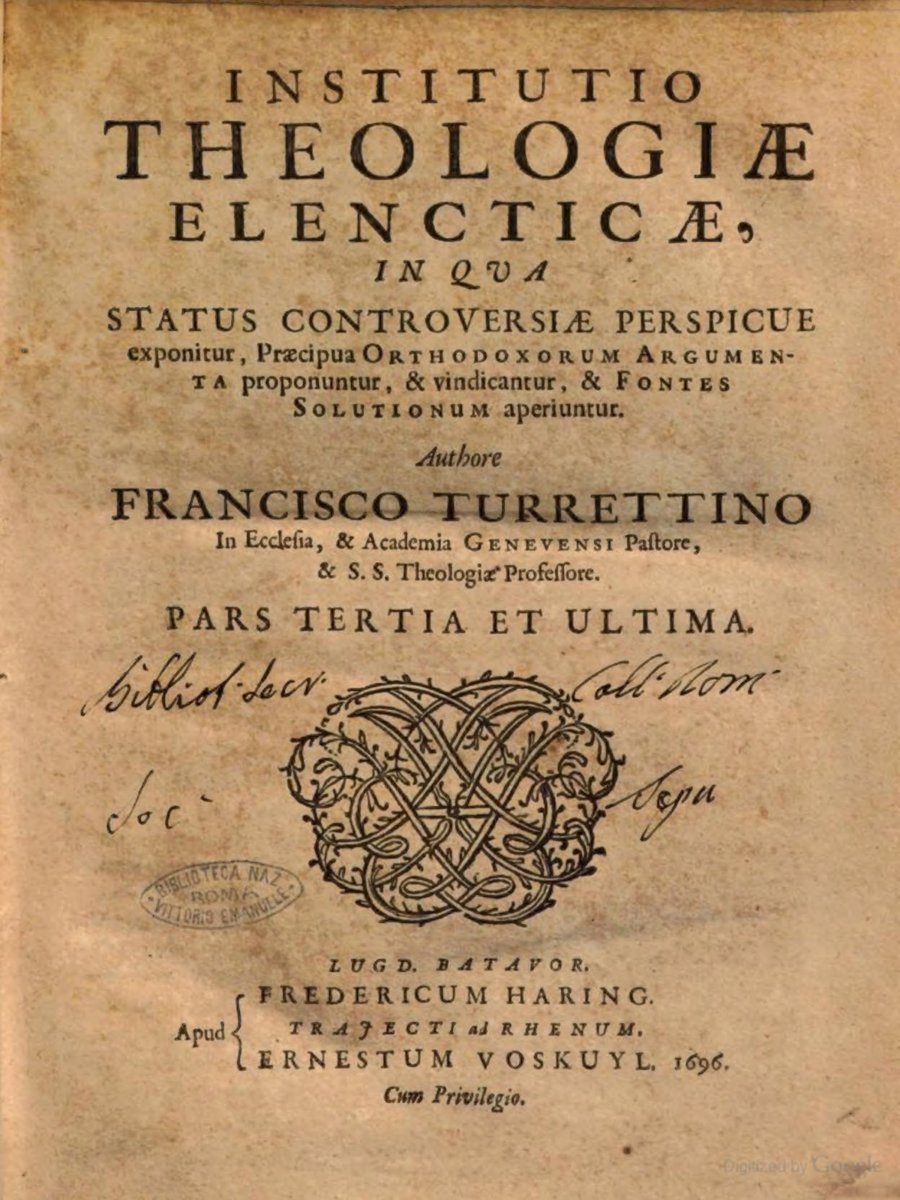
On the Stipends of Ministers and Ecclesiastical Goods
De Stipendiis Ministrorum, & Bonis Ecclesiasticis
 Francis Turretin
Quaestio XXVIII.
De Stipendiis Ministrorum, & Bonis Ecclesiasticis.
An Ministris Ecclesiae aliquod stipendium debeatur? Affirm. contra Anabaptistas.
Quaestio haec mota fuit antehac ab Anabaptistis, qui putarunt gratis praedicandum esse Evangelium, vel a ditioribus, qui de suo abunde habent unde vivant, vel etiam a pauperibus, qui arte aliqua & proprio labore victum & necessaria sibi procurant ad Pauli exemplum, qui σκηνοποιητικήν exercebat, & propriis manibus laborabat 1. Cor. 4. 12. Et Ministros Reformatos non esse veros Ministros censebant, sed mercenarios, qui Ministerium capessunt per modum mercaturae, & operam suam maximum stipendium offerentibus addicere ac locare soleant. Agnoscunt quidem in Colloquio Embdano Act. 78. sect. 4. teneri Ecclesiam Ministris a se vocatis de necessariis prospicere. Sed in eo casu tantum, si ipsis non suppetat, unde familiam honeste sustentare possint, vel ex patrimonio, vel ex mercatura, & opificio, & alia vocatione hujus seculi, sed extra hunc casum teneri Ministros volunt ex charitate & gratis praedicare.
Orthodoxi sic statuunt. Non tantum posse Ministrum ex ministerio vivere, sed & debere. Et licet in casu necessitatis, cum scilicet nec ab Ecclesia, cui inservit, nec ab aliis sustentari potest; Euangelium ἀδάπανον praestare possit; Imo etiam extra casum necessitatis propter graves rationes ex charitate & prudentia Christiana possit Ecclesiae alicui debitum illud remittere, atque adeo illam eleemosynis suis ad tempus aut in perpetuum refocillare; non tamen teneri jure divino & humano; sed contra Ecclesiam teneri absolute ad procurationem & exsolutionem justi stipendii.
Rationes sunt. 1. Ex loco Pauli 1. Cor. 9. 4. 5. usque ad 19. ubi sedes est hujus doctrinae, & Apostolus non tantum hoc jus accipiendi debiti stipendii, & hanc potestatem sibi & omnibus Ministris vindicat, sed argumentis variis ex jure tum divino, tum naturali, & probatis exemplis confirmat; primum petitur ab Apostolis §.5.6. Nonne potestatem habemus, ut & reliqui Apostoli, ducendi uxorem sororem? An solus ego & Barnabas potestatem non habemus non operandi? Secundum ab analogia militis, agricolae, pastoris, quibus stipendia deberi naturalis aequitas & ratio dictat §.7. Quis militat propriis stipendiis? Quis vitem plantat, & ex fructu non comedit? Quis gregem pascit, & ex lacte ovium non bibit? Tertium ex praescripto Legis circa bovem triturantem a minori ad majus, quia bovi trituranti non est os obligendum Deut. 25. 4. ut Deus boves laborantes prohibet a pabulo arceri, quanto minus Ecclesiae Ministri privandi sunt fructu laboris sui? Nec enim hac lege tam boves respuit, quam homines, ne fraudentur justa operis mercede §.9. 10. An Deo cura sunt boves? nonne propter nos ista dicuntur? quia qui arat, debet in spe arare, &c. Quartum ex comparatione imparium, operis & mercedis, §.11. Qui spiritualia seminant, debent colligere corporalia. Quintum ex ordine divinitus instituto, tam in Veteri quam Novo Testamento §.1. Nonne scitis, quod qui sacris operantur, de sacrificiis comedunt, Et qui ministrant altari, debent ex altari participare, sic Deus precepit, ut qui Euangelium praedicant, ex Euangelia vivant.
II. Ex mandato Christi, Matth. 10. 10. & Luc. 10. 7. ubi mittens Apostolos ad praedicandum Euangelium in Judaea, vetat ne quicquam in via portent, ne cibum quidem, sed vult eo illorum expensis vivere ad quos mittebantur. Cujus rei rationem reddit justissimam, nempe quod operarius dignus sit alimento, & mercede sua. Ostendens Ministris Euangelii, non minus juste deberi ab auditoribus & βιωτικά, quae ad se & suos sustentandos sunt necessaria, quam mercenario ob laborem & operam juste debetur merces. Nec opponi debent verba Christi §.8. Gratis accepistis, gratis date. Quia patet ibi eum non agere de Verbi praedicatione, sed de charismatis & donis miraculosis sanationum, & virtutum, pro
quibus vetat pretium accipi, nedum ut venderentur, ut pertendebat Simon Magus Act. 8. 10. Ægros sanate, inquit, leprosos purgate, mortuos excitate, demonia ejicite, gratis accepistis, gratis date. Non posse vero extendi ad justa Ministrorum stipendia verba allata ex ψ. 10. evincunt. Cur enim vult Apostolos sustentari & nutriri ab Auditoribus, quia operarius dignus est mercede sua, si gratis prædicare debuerunt?
III. Ex stipendiis Ministrorum Sacrorum in Vet. Testamento Num. 18. ψ. 8. 9. 10. 11. 12. quibus cedebant ordinario sacrificia, decimæ, primitiæ, & alia id genus præter Urbes quasdam & agros suburbicarios Num. 35. Licet vero in Novo Testamento non obligemur iis legibus quoad specialem materiam ex qua, & modum quo dabantur stipendia, manent tamen quoad genus & analogiam, ut ex loco ante allato 1. Cor. 9. 13. patet.
IV. Ab Exemplo Christi & Apostolorum, qui non recusarunt a fidelibus accipere necessaria ad sui sustentationem. Christus a mulieribus accepit Luc. 8. 3. ut & Paulus a Philippensibus Phil. 4. 10. 15. 16. Et 2. Cor. 11. 8. dicit se οψωνιον accepisse ab aliis Ecclesiis ad Corinthiorum ministerium exequendum, ut posset ipsis gratis Euangelium prædicare, ad declinandam scilicet invidiam avaritiæ & turpis lucri, qua eum gravare conabantur Pseudoapostoli.
V. A minis denegationem stipendii sequentibus. Quia non exsolvere stipendia Ministris, numeratur inter gravissima peccata, injustitiæ in proximum, & impietatis in Deum, cui Deus poenas minatur, & contrarium facientibus benedictionem suam promittit Mal. 3. 8. 10. 12. Nehem. 13. 10. 11. Gal. 6. 6. 7. Deus non irridetur, inquit Apost. quod quisque severit homo, hoc metet.
VI. Ab absurdis, & incommodis consequentibus. Negata enim stipendiorum necessitate, sequeretur. 1. in electione Ministrorum spectandas esse qualitates & prærogativas carnis, illosque præferendos, qui de suo possent sustentari & gratis prædicare, quo fieret ut sæpenumero optimi & meritissimi in electione praetereundi essent. 2. Periculosam discriminationem fore inter Ministros, quorum alii ex charitate & conscientia Dei αδαπανον præstarent Euangelium; alii necessitate sua Ecclesiam graverent, atque adeo viliores, & magis odiosi, minusque grati forent. 3. Sic mutarentur stipendia in eleemosynas, & crederentur Ministri vivere ex eleemosynis, quod falsum est, & contempta redderetur eorum conditio. Hinc sapienter cautum in disciplina Ecclesiarum Reformatorum Galliæ, ut singulis Pastoribus sua assignentur stipendia, nec quisquam ad munus promoveatur sine illis, arti 42. de Pastoribus.
VII. Ex naturali justitia & æquitate, cujus regulam indicit Apostolus 2. Cor. 8. 13. 14. quæ non patitur, ut commodum ex alieno damno per-
percipiatur, ut unus gravetur, dum tota Communitas sublevatur. Imo æquitas postulat, ut qui docentur, doctores bonis suis sustinent Gal. 6.6. Tit. 3. 12. Et qui spiritualia recipiunt ab aliquo, illi saltem temporalia impertiantur.
Aliud est non habere jus petendi & exigendi stipendium. Aliud nolle eo uti certis de causis, manente enim jure, exercitium & usus ejus potest hic & nunc intermitti. Paulus posterius potuit facere, & re ipsa fecit gravibus de causis Act. 20. 33. & 2. Thess. 3.8.9. Sed nec sibi nec aliis Ministris regulam facit, quam constanter sequi debeant, siquidem alibi jure suo usus legitur.
Aliud est μισθοφορία, Aliud φιλαργυρία. Mic. 3. 11. reprehenduntur Sacerdotes, qui in mercede docebant, & Prophetæ, qui in pecunia divinabant, scilicet qui ob pecuniam a ditioribus emungendam falsa docebant, qui loquebantur placentia, & felicem Reipublicæ statum pollicebantur, ut stipendia liberaliora acciperent; cum potius auditorum suorum peccata acriter taxare, & comminatione pœnarum ad pœnitentiam eos hortari debuissent. Sed ex eo inferri nequit, illicitum esse accipere stipendia, quia illis ipsis Sacerdotibus, qui ob avaritiam accusantur, Deus liberalem sustentationem in Lege sua instituerat.
Aliud est stipendii & lucelli causa Ministerium amplecti. Aliud deposcere stipendium, & de illo pacisci ad ministerium commode exequendum. Prius est mercenariorum, qui id unice agunt, ut lucrum ex Euangelio aucupentur. Sed posterius verorum est Pastorum. Sane si non deberetur ipsis pro opere quod faciunt ulla merces; Si collecta illa esset vere arbitraria & gratuita, ut sunt eleemosyna. Tum pacisci stipendia non liceret, & ejusmodi stipulatio sordida foret, & simoniaca. Sed quia debentur justissime ex Dei & Christi præscripto, licet ea pacisci, quando ea aliter & commode haberi non possunt; nec in eo ulla est mercenarii animi labes aut macula, aut suspicio, modo ea sint moderata, non ad gregis gravamen nimia, & sufficiant ad Pastoris ejusque familiæ honestam sustentationem; quorum stipendiorum modus ex prudentum consilio & communi Ecclesiæ consensu constitui debet. Quod si qui pertinaciter & ex impietate & ingrato animo, non ex inopia negant, digni sunt quibus Verbum Dei non annuncietur, & qui a Pastoribus deferantur.
Siqui sunt ex Ministris, qui ex patrimonio se familiamque suam commode ac honeste alere possunt; Ministerii sui stipendiis ideo fraudandi non sunt. Nec illi, nisi peculiaris subsit causa, laborum suorum præmia recusare debent 1. Cor. 9. 18. ne eximæ cujusdam sanctitatis gloriam aucupare videantur, aut tenuiores collegas invidia onerent, & ne populi hac immunitate illecti, avaritiam foveant, magno cum successorum incom-
modo, & totius Ecclesiae, non semper ἀδαπανον ministerium nacturae, periculo. Cum vero stipendii labore suo parti, quisque sit dominus, aequum est, ut suo arbitratu, non alieno, in pauperes, & alios usus eroget, quod visum fuerit.
Variis autem modis stipendia ista exsolvi possunt, Vel ex spontaneis fidelium oblationibus; quae in communem Ecclesiae usum ex Christiana charitate, & justitia liberaliter de bonis suis conferunt, ut fiebat a primis Christianis Apostolorum tempore, & aliquot post seculis: Vel ex mutuo pacto, & singulorum collatitia stipe corrogata; Vel de aerario publico a Christiano Magistratu persoluta, Vel ex decimis petita, Vel denique ex agrorum & praediorum Ecclesiae donatorum & legatorum, aliorumque bonorum Ecclesiasticorum annuis reditibus & proventu collecta. Utrovis autem istorum modorum fiat, parum aut nihil omnino interest ad rem ipsam quod spectat, modo sufficientia Euangelii Ministris solvantur stipendia, modusque in iis servetur, ne plus aequo angusta sint, & infra id quod satis est ad Pastorem, ejusque familiam honeste alendam; Nec minus ampla, quae ad luxum magis & fastum faciant, quam ad id quod satis est & necessarium. Utrumque enim extremum ex aequo periculosum & fugiendum, ne vel contemptui sint apud ingratam plebem ex nimis arcta familiari, vel ne illi luxui, otio, & inani pompae litent & indulgeant ex nimis lauta & splendida, ut factum in Papatu.
Licet Pastor teneatur in certis casibus ad ἀδαπανον praestare; si quidem ipsi facultas suppetat; Cum Ecclesia paupercula est, Vel primum plantata, & adhuc tenella, quae nollet recipere Euangelium, nisi gratis, Vel quando sectarii hoc faciunt, nostrisque Ministris factum exprobrant. Non sequitur hoc illi jus non competere. Quod si Ecclesia satis dives sit, sed nolit, vel ex avaritia, vel ex contemptu & fastidio Ministri sui, necessarium stipendium tribuere; licet illi Ecclesiam deferere, tentatis tamen prius omnibus aliis mediis, & ad alterius Ecclesiae ministerium se offerre; tanta enim invidia erga Ministrum, ne dicam scelus, suadet & permittit migrationem.
Si quaeratur, quid censendum sit de Monachorum, & praesertim Jesuitarum gratis, quod ab Ignatio Ordinis fundatore ipsis praescriptum legitur Regula 17. Responsio est in promptu, non modo crassam esse hypocrisim, sed & audacem & subdolam nihil non corradendi licentiam: quicquid enim docere gratis se simulant, promptissime tamen selectissimos agros, pinguia praedia, & reditus ingentes ipsis per modum doni gratuiti, aut eleemosynae oblatos recipere solent. Et sic operam suam non gratis adverbialiter seu δωρεάν, sed gratis nominaliter, id est, iis, qui beneficium grato animo agnoscunt & remunerantur.
Quoad bona Ecclesiastica, ut aliquid de eorum origine & incrementis dicamus. Certum est jam tempore Christi eorum initium coepisse, per oblationes pias & devotas fidelium, & foeminarum in primis, quarum nomina Lucae 8. commemorantur. Quarum pecuniarum administratio Judae commissa fuit, quae debebant cedere, partim in usum Christi & Apostolorum, partim in usum pauperum, ut Joan. 12. exponitur. Post Christi ascensionem prima Christianorum Ecclesia Hierosolymis collecta, partim charitatis testandae causa, partim ut hostium injuriis esset minus opportuna, & ad migrationes & fugam expeditior, facultates suas in commune aerarium congesit, ditioribus tenuiorum egestatem etiam agrorum suorum dispendio sublevantibus Act. 2. & 4. cap. Verum haec bonorum communio, non & κτησιν, sed & χρησιν, nec extra Hierosolymitanam Ecclesiam locum habuit in aliis Ecclesiis, nec diu ibi duravit ita singulae Ecclesiae aeraria sua habuerunt, in quae quisque stipem conjiceret, & collectae reponerentur, ut patet ex Justini & Tertulliani apologiis.
Non constat inter Scriptores, quo tempore Ecclesia agros & latifundia primum possidere coeperit. Certum est, jam ante Constantinum Ecclesias fundos & praedia obtinuisse; Et Romanam prae caeteris amplissimis oblationibus fuisse ditatam, quae non solum sufficerent sustentandis Clericis & pauperibus, sed & aliis Ecclesiis sublevandis. Sed profuse Largitiones, quibus immane quantum Ecclesia locupletata intumuit, Constantini demum seculo invaluerunt. Quippe hic Imperator, pro suo in Religionem Christianam zelo, erepta a Decessoribus suis restituit Ecclesiis, & vectigalium, tributorum, & publici frumenti partem illis admensus est, & luculentissima ex aureis & argenteis idolorum statuis conflatis donaria obtulit. Sed quoad donationem Urbis Romae cum Occidentis imperio, qui illi tribuitur Dist. 96. C. Constantinus, falsam & suppositam esse pridem observatum & probatum est invictis argumentis a Viris doctis in ipso Papatu Petro de Vineis, Dante, Marsilio Patavino, Cusano, Valla, Othone Frisingensi, Volaterrano, Nanclero, imo & ipso Enea Sylvio. Pipino ergo potius quam Constantino hoc quicquid est doni tribuendum videtur, quamvis nec ille tam multa magnaque profuderit, quam vulgo persuasum est. Longe propius vero, Papas, cum ardente intestinis bellis Italia, oppida ac ditiones non paucas vi ac fraude insedissent, modo hujus aut illius donationem aucupatos fuisse.
Crescente postea superstitione, cujus aestro vulgus fascinatum, nullum esse tam atrox scelus aut turpe flagitium credidit, quod ejusmodi donariis expiari non posset; nullis deinceps aggeribus reprimi potuit exundantium largitionum impetus, quo tanquam decumano fluctu obruta ac pessundata fuit Ecclesia, & spirituale ejus decus in profanae Monarchiae
chiae splendorem ac luxum degeneravit, nimisque vere dictum Religionem peperisse divitias, sed falsam devorasse matrem. Qui plura voluerit de origine & incrementis bonorum Ecclesiasticorum consulat Hospinianum de Bonis Ecclesiasticis, Voetium Polit. Ecclef. P. 1. lib. 4. to. 2. & aureum Tractatum Itall. Pauli Sarpi Veneti de Materiis Beneficiariis.
Question XXVIII.
On the Stipends of Ministers and Ecclesiastical Goods.
Whether some stipend is owed to the ministers of the church? Affirmed, against the Anabaptists.
This question was previously raised by the Anabaptists, who held that the gospel must be preached freely — either by the wealthier sort, who have sufficient means of their own to live on, or even by the poor, who secure their livelihood and necessities through some trade and their own labor after the example of Paul, who practiced tent-making and worked with his own hands (1 Corinthians 4:12). They considered the Reformed ministers to be not true ministers but mere hirelings, who take up the ministry after the manner of a business transaction and are accustomed to selling and hiring out their labor to whoever offers the highest wage. They do indeed acknowledge in the Emden Colloquy, Act 78, sect. 4, that the church is bound to provide necessities for the ministers it has called — but only in the case where ministers lack sufficient means to support their households honorably, whether from an inheritance, trade, craftsmanship, or some other secular calling. Outside that case, however, they hold that ministers are bound to preach out of charity and without charge.
The orthodox establish the following position. Not only may a minister live from his ministry, but he ought to. And although in a case of necessity — namely, when he can be supported neither by the church he serves nor by others — he may provide the gospel without charge; and indeed, even outside a case of necessity, he may, for weighty reasons and out of Christian charity and prudence, remit to some church that debt, and thus refresh it by his own alms for a time or permanently; nevertheless he is not bound by divine and human law to do so. Rather, it is the church that is absolutely bound to the procurement and payment of a just stipend.
The arguments are as follows. 1. From the passage of Paul in 1 Corinthians 9:4–19, where the seat of this doctrine resides, and the Apostle not only claims this right to receive a due stipend — and this authority — for himself and for all ministers, but confirms it by various arguments drawn from both divine and natural law, and from approved examples. The first argument is taken from the Apostles (v. 5–6): “Do we not have the right, as do the other Apostles, to take along a believing wife? Or is it only Barnabas and I who have no right to refrain from working?” The second is from the analogy of the soldier, the farmer, and the shepherd, to whom natural equity and reason dictate that stipends are owed (v. 7): “Who serves as a soldier at his own expense? Who plants a vineyard and does not eat of its fruit? Who tends a flock and does not drink of the milk of the sheep?” The third is from the prescription of the law concerning the threshing ox, argued from the lesser to the greater: since God forbids muzzling an ox while it threshes (Deuteronomy 25:4), and thus prohibits that laboring oxen be barred from their fodder, how much less should the ministers of the church be deprived of the fruit of their labor? For by this law God has in view not so much oxen as men, lest they be cheated of a just wage for their work (vv. 9–10): “Is God concerned with oxen? Or does he say this entirely for our sake? Because the one who plows ought to plow in hope,” etc. The fourth argument is from the comparison of unequal things — labor and wages (v. 11): those who sow spiritual things ought to reap material things. The fifth is from the divinely instituted order in both the Old and New Testaments (v. 13): “Do you not know that those who perform sacred rites eat of the things of the sanctuary, and those who serve at the altar share in what is offered at the altar? So God has ordained that those who proclaim the gospel should live from the gospel.”
- From the command of Christ in Matthew 10:10 and Luke 10:7, where, sending the Apostles to preach the gospel in Judea, he forbids them to carry anything on the road — not even food — but wills that they live at the expense of those to whom they are sent. He gives the most just reason for this, namely, that the laborer is worthy of his food and wages. This shows that the βιωτικά necessary for sustaining themselves and their households are no less justly owed to the ministers of the gospel by their hearers than a wage is justly owed to a hired laborer for his work and effort. Nor should the words of Christ in v. 8 be urged against this: “Freely you have received, freely give.” For it is plain that there he is not dealing with the preaching of the Word, but with the charismatic gifts and miraculous powers of healing and wonders, for
for which he forbids that any price be received, let alone that they be sold, as Simon Magus attempted in Acts 8:10. “Heal the sick,” he says, “cleanse lepers, raise the dead, cast out demons; freely you have received, freely give.” But that the words cited cannot be extended to the just stipends of ministers, the passage in verse 10 makes clear. For why does he want the apostles to be sustained and fed by their hearers on the ground that “the laborer is worthy of his wages,” if they were obligated to preach without charge?
III. From the stipends of the sacred ministers in the Old Testament, Numbers 18, verses 8–12, to which the sacrifices, tithes, firstfruits, and other things of that kind were ordinarily allotted, besides certain cities and suburban fields, Numbers 35. Although in the New Testament we are not bound by those laws with respect to the specific material from which, and the manner in which, stipends were given, they nevertheless remain in force with respect to their general principle and analogy, as is clear from the passage cited above in 1 Corinthians 9:13.
IV. From the example of Christ and the apostles, who did not refuse to accept from the faithful the necessities for their support. Christ received [support] from women, Luke 8:3, as did Paul from the Philippians, Philippians 4:10, 15–16. And in 2 Corinthians 11:8 he says that he received wages (opsōnion) from other churches in order to carry out his ministry to the Corinthians, so that he might preach the gospel to them without charge — namely, to avoid the ill will of avarice and base gain with which the false apostles were endeavoring to burden him.
V. From the threats that follow upon the withholding of stipends. For the failure to pay stipends to ministers is counted among the gravest sins of injustice toward one’s neighbor and impiety toward God, with which God threatens punishments, and to those who do the contrary he promises his blessing: Malachi 3:8, 10, 12, Nehemiah 13:10–11, Galatians 6:6–7. “God is not mocked,” says the apostle; “whatever a man sows, that shall he also reap.”
VI. From the absurdities and inconveniences that follow. For if the necessity of stipends were denied, it would follow: 1. that in the election of ministers one must look to qualities and prerogatives of the flesh, and that those should be preferred who could support themselves from their own means and preach without charge — with the result that very often the best and most deserving would have to be passed over in elections. 2. That a dangerous distinction would arise among ministers, some of whom out of charity and a consciousness of God would furnish the gospel without cost, while others out of necessity would burden the church — and so the latter would be counted more contemptible, more odious, and less welcome. 3. That stipends would thus be turned into alms, and ministers would be thought to live on alms, which is false, and their condition would be rendered contemptible. Hence the wise provision in the discipline of the Reformed churches of France that fixed stipends be assigned to each pastor, and that no one be promoted to the office without them, article 42 on Pastors.
VII. From natural justice and equity, the rule of which the apostle sets forth in 2 Corinthians 8:13–14, which does not allow that advantage be gained at another’s expense,
that one person be burdened while the whole community is relieved. Indeed, equity demands that those who are taught should sustain their teachers from their goods, Galatians 6:6, Titus 3:12. And those who receive spiritual things from someone should at least impart temporal things to him in return.
One thing is to lack the right to seek and demand a stipend. Another is to be unwilling to exercise that right for certain reasons. For while the right remains, its exercise and use can here and now be suspended. Paul was able to do the latter and in fact did so for weighty reasons, Acts 20:33 and 2 Thessalonians 3:8–9. But he makes this neither a rule for himself nor for other ministers to follow constantly, since elsewhere he is recorded as having made use of his right.
One thing is misthophoria [wage-seeking], another is philargyria [love of money]. In Micah 3:11 the priests who taught for reward and the prophets who divined for money are reproved — namely, those who on account of money to be extracted from the wealthy taught falsehoods, who spoke pleasing things and promised a prosperous condition of the commonwealth, so that they might receive more generous stipends; whereas they ought rather to have severely rebuked the sins of their hearers and urged them to repentance by threatening punishment. But from this it cannot be inferred that it is unlawful to receive stipends, because for those very priests who are accused of avarice, God had instituted a liberal provision in his own law.
One thing is to embrace the ministry for the sake of a stipend and petty gain. Another is to demand a stipend and to agree upon it for the sake of duly carrying out the ministry. The former belongs to hirelings, who aim solely at making profit from the gospel. But the latter belongs to true pastors. Certainly, if no wages at all were owed them for the work they do; if such a collection were truly voluntary and gratuitous, as alms are — then it would not be lawful to negotiate stipends, and a stipulation of that kind would be sordid and simoniacal. But because they are most justly owed in accordance with the prescription of God and Christ, it is lawful to negotiate them when they cannot otherwise be conveniently obtained; nor in doing so is there any blemish, stain, or suspicion of a mercenary spirit, provided they are moderate, not excessive to the burden of the flock, and sufficient for the honorable support of the pastor and his family. The measure of such stipends ought to be determined by the counsel of the prudent and the common consent of the church. But if any persons out of stubbornness and impiety and an ungrateful spirit — not out of poverty — withhold them, they deserve to have the Word of God not proclaimed to them and to be denounced by the pastors.
If there are any among the ministers who can comfortably and honorably support themselves and their families from their own patrimony, they are not therefore to be deprived of their ministerial stipends. Nor, unless some particular reason intervenes, ought they to refuse the rewards of their labors, 1 Corinthians 9:18, lest they appear to be angling for the glory of some exceptional holiness, or burden their less affluent colleagues with envy, and lest the people, allured by this immunity, foster avarice, to the great harm of those who come after them,
and of the entire Church, which will not always obtain a ministry rendered without charge — to the great peril of both. But since each minister is the master of the stipend earned by his own labor, it is equitable that he disburse it, as he sees fit, to the poor and to other uses according to his own judgment, not another’s.
Moreover, these stipends may be discharged in various ways: either from the spontaneous offerings of the faithful, who contribute generously from their own goods out of Christian charity and justice for the common use of the Church — as was done by the first Christians in the time of the Apostles and for several centuries thereafter; or from a mutual agreement and contributions pooled from individuals; or from the public treasury, paid out by a Christian magistrate; or from tithes; or finally, gathered from the annual income and proceeds of fields and estates donated and bequeathed to the Church, and from other ecclesiastical goods. Whichever of these modes is employed, it matters little or nothing at all to the substance of the matter, provided that sufficient stipends are paid to the ministers of the Gospel, and that a measure be observed in them — that they be not too meager and fall below what is adequate for honorably sustaining the pastor and his family; nor yet so lavish as to conduce more to luxury and ostentation than to what is sufficient and necessary. For either extreme is equally dangerous and to be avoided: lest ministers be held in contempt by an ungrateful people on account of too straitened a household, or lest they waste themselves in luxury, idleness, and empty pomp on account of too sumptuous and splendid a provision — as was done in the Papacy.
Although a pastor is bound in certain circumstances to minister without charge — if he has the means to do so; when the church is very poor, or newly planted and still tender, and would not receive the gospel unless it were free of charge; or when sectarians do this and reproach our ministers for not doing likewise — it does not follow that this right does not belong to him. But if the church is sufficiently wealthy yet refuses, whether out of avarice or out of contempt and disdain for its minister, to grant the necessary stipend, the minister is permitted to leave that church — after having first tried all other means — and to offer himself for the ministry of another church; for so great a hostility toward the minister, not to say wickedness, warrants and permits his departure.
If one asks what is to be thought of the gratis of the monks, and especially of the Jesuits — which is prescribed to them by Ignatius, the founder of the Order, in Rule 17 — the answer is ready at hand: it is not only gross hypocrisy, but also a bold and cunning license for scraping together everything. For however much they pretend to teach gratis, they are nevertheless most ready to receive the choicest fields, the fattest estates, and enormous revenues offered to them in the manner of a free gift or alms. And so they perform their labor not gratis adverbially — that is, δωρεάν — but gratis nominaliter, that is, for those who acknowledge the benefit with a grateful mind and make return for it.
Regarding ecclesiastical goods, to say something of their origin and growth. It is certain that their beginning dates already from the time of Christ, through the pious and devout offerings of the faithful — and of women especially, whose names are recorded in Luke 8. The administration of these funds was entrusted to Judas, and they were intended to serve partly for the use of Christ and the Apostles, and partly for the use of the poor, as is explained in John 12. After the ascension of Christ, the first church of Christians gathered at Jerusalem — partly to demonstrate mutual charity, and partly to be less exposed to the injuries of enemies and more ready for migrations and flight — pooled its resources into a common treasury, with the wealthier members relieving the poverty of the poorer even at the cost of their own fields (Acts 2 and 4). This community of goods, however, pertained not to possession (κτῆσις) but to use (χρῆσις), and it obtained neither in the other churches outside Jerusalem nor did it endure there for long; and so individual churches had their own treasuries, into which each would contribute his share, and into which collections would be deposited — as is evident from the Apologies of Justinus [Martyr] and Tertullianus.
It is not established among writers at what time the Church first began to possess fields and landed estates. It is certain that already before Constantinus the churches held lands and properties, and that the Roman church had been enriched above the rest by the most generous offerings — sufficient not only to sustain the clergy and the poor, but also to relieve other churches. But the lavish benefactions by which the Church was enriched to an immense degree first flourished in the age of Constantinus. For this emperor, in his zeal for the Christian religion, restored to the churches what had been seized by his predecessors, and apportioned to them a share of the revenues, tributes, and public grain, and offered most magnificent gifts fashioned from golden and silver statues of idols. But as for the donation of the city of Rome together with the empire of the West, which is attributed to him in Dist. 96, C. Constantinus, it has long been observed and proved by invincible arguments to be false and spurious — by learned men even within the Papacy itself: Petrus de Vineis, Dante, Marsilius Patavinus, Cusanus, Valla, Otto Frisingensis, Volaterranus, Nauclerus, and even Aeneas Sylvius himself. The gift, therefore — whatever it amounts to — ought rather to be attributed to Pipinus than to Constantinus, although even he did not lavish as much or as great as is commonly believed. Far more probable is it that the Popes, when Italy was ablaze with internal wars, had seized no few towns and territories by force and fraud, and thereafter eagerly sought donations from one or another party.
As superstition afterward increased — by whose frenzy the common people were so bewitched as to believe that there was no crime so atrocious or disgrace so base that it could not be expiated by such offerings — the torrent of overflowing benefactions could be held back by no embankments, and the Church, overwhelmed and ruined as by a tenth wave, saw its spiritual glory degenerate into the profane splendor and luxury of a Monarchy —
chiae splendor and luxury, and the saying proved all too true: that Religion had given birth to riches, but the false daughter had devoured her mother. Those who wish more on the origin and growth of ecclesiastical goods may consult Hospinianus on Ecclesiastical Goods, Voetius, Politica Ecclesiastica, pt. 1, bk. 4, vol. 2, and the celebrated Italian treatise of Paolo Sarpi of Venice, De Materiis Beneficiariis.