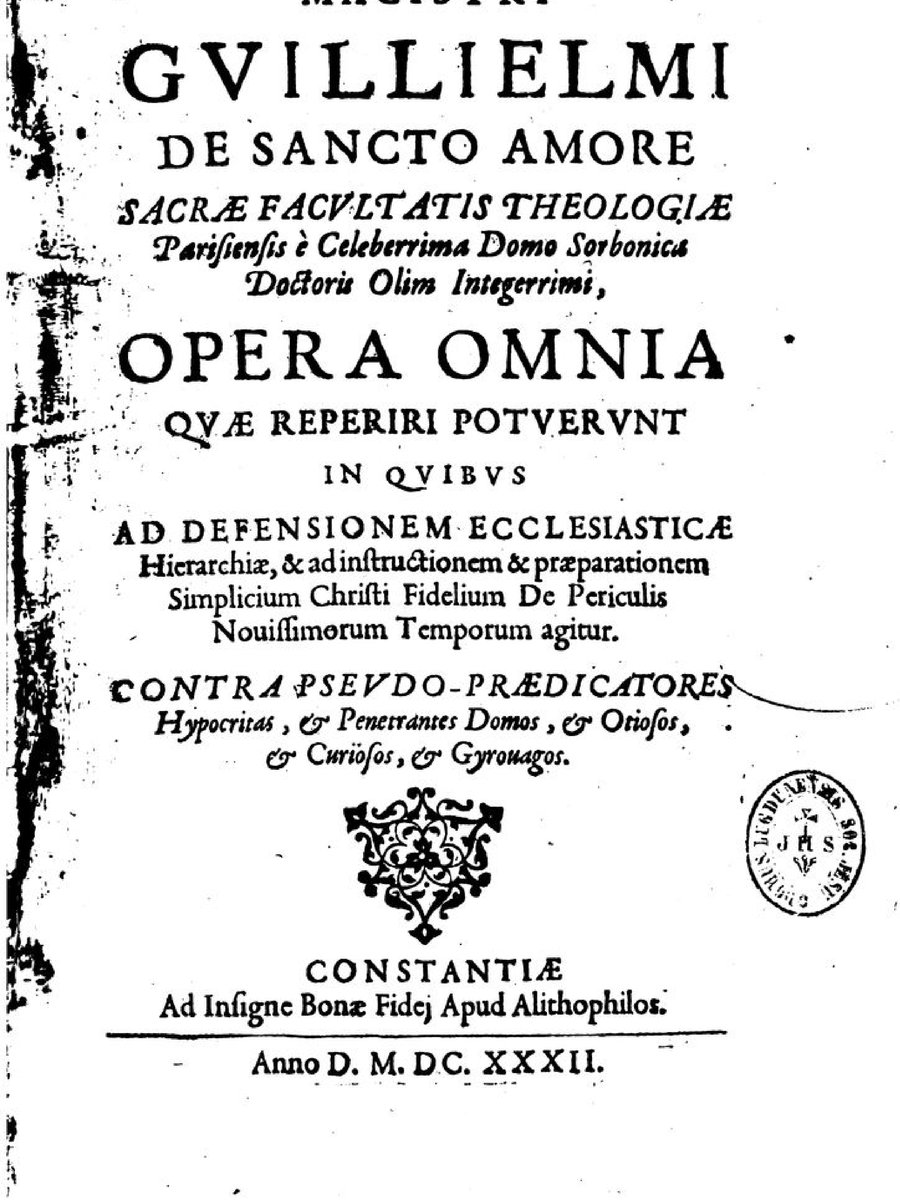
Collectiones, Distinction I: On Helpers
Collectiones, Distinctio I: De Opitulationibus
 William of Saint-Amour
Collectiones, Distinctio I: De Opitulationibus
§. Istorum autem, qui Opitulationes dicti sunt, iam sunt quidam per Ecclesias ordinariè instituti, vt sunt Archidiaconi, & Archipresbyteri; verumtamen, Ecclesiarum necessitate, vel vtilitate exigentibus, augeri possunt Opitulationes extraordinariè per delegationem Maiorum. Vnde Opitulationes extraordinariæ dici possunt, quos Episcopi nonnullis occupationibus impediti, mittunt per suas Dioceses, ad exercendum vice ipsorum regimen animarum, secundùm quod ipsi Episcopi iudicauerunt expedire, vt legitur Extrà, De Officio Ordin. cap. Inter cetera. Quod etiam eadem ratione dici posset de Minoribus Prælatis, vt sunt Plebani, & alij Ecclesiarum Rectores; videlicet, quod per suas Parochias possint Prædicatores mittere, vel vocare, vel inuitare, vt legitur 7. q. 1. cap. Episcopi, vel Presbyteri. Opitulationes etiam dici possunt,
quos Dominus Papa, qui est summus Episcoporum, & Ordinarius singulorum, ex causis prædictis, secundùm quod iudicauerit expedire, mittit per diuersas Ecclesias, vel Prouincias, ad prædicandum, vel ad aliud regimen animarum. Extrà, De Hereticis, cap. Cum ex iniuncto.
§. Verùm si Dominus Papa infinitis & incertis, à se, vel ab Ecclesia, non electis, & sibi non cognitis, vel probatis priùs (V. G. vniuersis Monachis Cluniacensis, aut Cisterciensis Ordinis, aut quoscumque Abbates eorum duxerint destinandos) concedat in generali licentiam prædicandi, confessiones audiendi, pœnitentias iniungendi, in quibus maximè consistit regimen animarum; non est verisimile, quod per talem licentiam in generali concessam intendat, eos facere vniuersales Apostolos, vel etiam vniuersales Opitulationes Ecclesiæ vniuersæ, habentes scilicet generalem & liberam potestatem exercendi prædicta officia in omni Ecclesia Christianorum, irrequisitis Prælatis Ecclesiasticis, vel inuitis; cum Dominus Iesus Christus (cuius est Vicarius generalis, & propter quod debet eum in suo regimine imitari, tamquam eius generalis Minister, iuxta illud Ioan. 10. Qui mihi ministrat me sequatur, Gloss. Id est, me imitetur) dum esset in carne mortali, non nisi certas personas à se electas, conuersatione expertas, & in suo disciplinatu probatas, miserit ad prædictum regimen animarum; videlicet, duodecim Apostolos, Luc. 9. & septuaginta duos Discipulos, Luc. 10. dicens eis Matth. 10. ECCE ego, Gloss. qui elegi, qui docui, MITTO vos, Gloss. id est, de Discipulis, missos vos facio; ideo sitis mansueti, humiles, innocentes. Quasi diceret. Ideo elegi vos, & docui, & probaui in meo disciplinatu, antequam mitterem, vt sitis quales esse oportet, scilicet, mansueti, &c. Ideo autem elegit Dominus, & probauit Discipulos suos, antequam mitteret; non quod ipse probatione indigeret, qui nihil ignorat; sed vt daret formam mittentibus, quod non mitterent passim, & sine delectu; sed deligerent electos, doctos, & diu probatos; præsertim Cum sit Ars Artium Regimen Animarum, Extrà, De ætate & qualitate Præficiendorum, cap. Cum sit Ars Artium, & ideo non sine examine, nec passim quibuslibet, sed solis idoneis committendum. Vnde 2. Timoth. 2. dicit Apostolus. Quæ audisti à me per multos testes, hæc commenda fidelibus hominibus, qui idonei
sint & alios docere. Gloss. Illis enim committendum est prædicandi officium, qui apti sunt illi officio. Ecce qualiter Apostolus, per hoc quod dicit, Qui idonei sint, docet Timotheum, vt quos missurus est ad prædicandum, priùs studeat examinare. Item 1. Timoth. 2. Præcipit Apostolus, vt Episcopi, & Presbyteri, & Diaconi, qui ad regimen Ecclesiæ canonicè eliguntur, priùs probentur, quàm eis administratio verbi Dei, & aliorum spiritualium, committatur, dicens. Et hi autem probentur primùm, & sic ministrent, nullum crimen habentes. Multò magis ergo probandi sunt, qui electione canonicâ non præmissâ, se offerunt, vel, quibuslibet inuitis, se ingerunt ad prædicandum, & ad omne regimen animarum.
§. Beatus etiam Paulus, post Domini Ascensionem ab eodem Domino electus, iuxta illud dictum de ipso Paulo Act. 9. Vas electionis mihi est iste, &c. quamuis in lege secus pedes Gamalielis eruditus, vt legitur Act. 22. nihilominùs tamen, antequam mitteretur ad prædicandum, in raptu suo à Domino est edoctus, cum audiuit arcana verba, quæ non licet homini loqui, 2. Corinth. 12. & licet sic edoctus, non tamen statim factus est generalis Apostolus (Annô enim Passionis & Resurrectionis Domini ad fidem venisse probatur) sed per multos annos expertus & probatus, decimotertiô annô post suam conuersionem, generalem Gentium Apostolatum accepit, vt dicit Gloss. Bedæ super principio Epistolæ Ad Rom. Item Act. 13. super illud, Segregate mihi Saulum & Barnabam, &c. dicit Gloss. Tertiodecimô annô post Passionem Domini, videtur Saulus secundùm ordinem Historiæ, Apostolatum cum Barnaba, & Pauli nomen accepisse; quartodecimô autem annô, iuxta condictum Iacobi, Cepha, & Ioannis, ad Magisterium Gentium profectus est; cui consentit Ecclesiastica Historia. Cum igitur secundùm Apostolum, omnes, quibus committitur prædicationis officium ante commissionem sint à committente probandi; cum etiam Saluator noster, qui errare non potest, certas & à se electas, & sibi experimentô cognitas, & probatas personas miserit ad regimen animarum; & hoc tantùm ad instructionem sequentium Ministrorum suorum fecerit, vt dictum est suprà; Cum omnis eius actio, nostra sit instructio, vt dicit Gloss. super illud Hebr. 5. Qui in diebus carnis suæ preces supplicationesque offudit ad eum, qui posset saluum illum facere à morte: Non est
verisimile, summum Pontificem, Apostolicum, successorem & Christi Vicarium, ac generalem Ministrum, & ob hoc ad eius imitationem, vt ostensum est, obligatum, mittere velle, vel intendere, ad illud regimen, personas infinitas, incertas, à se, vel ab Ecclesia canonicè non electas, nec sibi cognitas, nec probatas, vt Opitulationes generales, habentes scilicet generalem & liberam potestatem eiusdem regiminis per Ecclesiam vniuersam.
§. Item certum est, quod nullus Apostolorum, præter Paulum, fuerit generalis Prædicator totius orbis Gentium; sed singuli ad singulas fuerunt Prouincias destinati. Vnde Rom. 1. super illud, Segregatus in Euangelium Dei, dicit Glos. Destinatus est Paulus Apostolus Gentibus totius orbis Predicator; ac reliqui singulis Prouincijs facti sunt Legati & Predicatores. Item B. Gregorius, licet summus Pontifex esset, tamen nihilominùs vniuersalem Pontificem se prohibet appellari; quoniam alijs subtrahitur, quod alteri, plusquàm ratio exigit, prabetur, vt legitur dist. 99. can. Ecce in præfationè. Non est ergo visimile, quod Dominus Papa, Christi Vicarius & imitator, infinitis & incertis personis, & à se, vel ab alio Prælato canonicè non electis, nec experimentò probatis, concesserit generalem Apostolatum, seu Pontificatum totius orbis, vel etiam generalem Opitulationem, seu Legationem; videlicet prædictam potestatem liberam eis generaliter concedendo; ne illi per hoc, maiores, vel discretiores Apostolis, vel Episcopis omnibus videantur; & ne Prælatis Ecclesiæ vniuersis subtrahi videretur, quod illis infinitis & incertis personis, plusquàm ratio exigit, præberetur; & sic vilesceret nomen Episcopi, & status Ecclesiæ turbaretur. Nam, vt dicit Damasus Papa, si vilescat nomen Pontificum, omnis status Ecclesiæ perturbatur.
§. Item in Euangelio Matth. cap. 10. Apostolorum à Domino electorum, & certus numerus, & certa nomina ideo exprimuntur, vt præter hos, qui futuri erant Pseudo, tamquam incerti, & non electi à Domino excluderentur. Vnde Matth. 10. super illud, Duodecim Apostolorum nomina hæc sunt, dicit Gloss. Catalogus Apostolorum ideo hìc ponitur, vt præter hos, qui Pseudo futuri erant, excluderentur. Præuidebant enim Apostoli multos Pseudo-Apostolos, & multos falsos Doctores in Ecclesia Dei futuros, & Prædicatores sub nomine Chri
sti, voluntatem tamen Diaboli facturos; propter quod prohibuerunt omnes Praedicatores admitti, praeter quàm ipsos, & ipsorum legitimos successores, vel qui ab eis testimonium haberent. Vnde in lib. 4. Historiae Sancti Clementis Papae, in fine, ex Sermone Beati Petri Apostoli in Ciuitate Tripoli, ita legitur. Ne vnius & Veri Dei repararetur Religio Vera, Diabolus festinat continuo in hunc mundum immittere (postquam ei dixit Dominus, DOMINVM DEVM TVVM ADORABIS, ET ILLI SOLI SERVIES*) deterritus & metuens, Pseudo Prophetas, & Pseudo-Apostolos, falsosque Doctores, qui sub nomine quidem Christi loquerentur, Daemonis tamen facerent voluntatem; propter quod obseruate cautiùs, vt nulli Doctorum credatis, nisi qui Iacobi Fratris Domini ex Ierusalem certum detulerit testimonium, vel eius, quicumque post ipsum fuerit; nisi enim quis illuc ascenderit, & ibi probatus fuerit, quod sit Doctor idoneus & fidelis ad praedicandum Christi Verbum; nisi, inquam, inde detulerit testimonium, recipiendus ommino non est. Sed neque Propheta, neque Apostolus in hoc tempore speretur à vobis aliquis, praeter nos; vnus enim est Verus Propheta, cuius nos duodecim Apostoli verba praedicamus.* Videtur ergo, quod praeter Episcopos, qui Apostolis, & praeter Presbyteros, qui Septuaginta duobus Discipulis successerunt, vt ostensum est suprà ead. dist. §. Quoniam igitur, alij Praedicatores incerti, ab Ecclesia, vel à Praelatis Ecclesiae non electi, vel de quorum electione, aut canonica missione non constat, Pseudo sint censendi.
§. Item non est intentionis summi Pontificis, vel imminuere, vel arctare, vel infringere, vel impedire honorem, potestatem, iurisdictionem, & officia Fratrum & Coepiscoporum suorum, iuxta illud Gregorij, Nec honorem meum esse deputo, in quo Fratres meos honorem suum perdere cognosco; meus namque honor est honor vniuersalis Ecclesiae; meus honor est Fratrum meorum solitus Vigor; tunc ego honoratus sum, cum singulis quibusque honor debitus non negatur. dist. 99. can. Ecce in praefatione. Item Gregorius, Absit hoc à me, vt statuta Maiorum Consacerdotibus meis in qualibet Ecclesia infringam; quia mihi iniuriam facio, si Fratrum meorum iura perturbo. 25 q. 2. cap. Quod verò dicitis. Item Gregorius, Si sua vnicuique iurisdictio non seruatur; quid agitur aliud, nisi per nos, per quos Ecclesiasticus ordo illaesus custodiri debuit, confundatur? 11. q. 1. cap. Peruenit. Constat autem quod potestas
& officium Episcoporum est probare, siue examinare, Praedicatores ignotos; de hoc enim commendatur Episcopus Ephesi Apoc. 2. à Domino ei dicente, Scio, id est approbo, opera tua, & laborem tuum, &c. Et infrà. Et probasti eos, qui se dicunt esse Apostolos, & non sunt, & inuenisti eos mendaces. Talis examinatio praecipitur 1. Ioan. 4. vbi dicitur, Charissimi NOLITE CREDERE omni spiritui, Glos. Id est, omni spiritualiter loquenti, SED PROBATE spiritus, si ex Deo sunt, Glos. Id est, si secundum Deum spirituales sint, & si charitate innitantur. Quasi diceret. Probate, si non cupiditati, non ambitioni, non alteri peruersae intentioni seruiant. Et causam huius probationis, seu examinationis, subiungit dicens. Quoniam multi Pseudo-Prophetae exierunt in mundum, &c.
§. Item potestas & officium Episcoporum est, resistere Pseudo-Praedicatoribus. Vnde 1. Timoth. 1. In principio, dicit Glos. Timotheo in Asia relicto Episcopo scribit Apostolus de Episcopali officio; videlicet, quomodò resistat Pseudo-Apostolis. Ecce quod officium & potestas Episcoporum est examinare Praedicatores, & resistere Pseudo Praedicatoribus.
§. Item in hoc consistit honor, iurisdictio, & potestas Episcoporum, & ius, & distinctio, & pax Ecclesiarum, vt in vna Diocesi, non sit, nisi vnus Episcopus; in vno Archidiaconatu, nisi vnus Archidiaconus; in vna Parochia, nisi vnus Rector Parochialis; vt enim dicit Hieron. Singuli Ecclesiarum Episcopi, singuli Archidiaconi, supple in vno Archidiaconatu, singuli Archiepiscopi; & omnis ordo Ecclesiasticus suis Rectoribus vtitur; quasi diceret, non alienis. 7. q. 1. cap. In apibus. Ecclesia enim vna non debet habere plura capita, quasi monstrum, Extra, De Offic. Ordin. cap. Quoniam in plerisque; alioquin Ecclesia non esset vxor, sed scortum. 21. q. 2. cap. Sicut in vna. Ideo non debet in Diocesi vnius Episcopi alter Episcopus publicè praedicare, aut alia officia publica facere, vel plebem regere, nisi à Diocesano, vel eius Presbyteris, fuerit inuitatus. 7. q. 1. cap. Episcopi, vel Presbyteri. 9. q. 2. cap. Nullus primas. cap. Nullum Episcoporum. cap. Nullus Episcopus. cap. Episcopum. cap. Episcopi, & cap. Non inuitati. Et Deut. 23. super illud, Ingressus vineam proximi tui, &c. dicit Glos. In Ecclesia alterius Episcopi potest alter Episcopus aliquos corrigere, vel monere; totam verò plebem non licet ei regere, vel magna negotia tractare; quia po-
alienam messem transiens, falcem mittere non debet. 6. q. 3. cap. Scriptum est; & est sumptum ex Deuter. cap. 23. Item 7. q. 1. cap. 27. Placuit, vt à nullo Episcopo vsurpentur plebes alienæ, nec aliquis Episcoporum supergrediatur in Diocesi Collegam suum. Item Leo Papa. Suis terminis quisque contentus sit, nec supra mensuram iuris sui affectet augeri. 7. q. 1. cap. Si quis Episcopus mediocritate ciuitatis suæ. Vnde si quis à Domino Papa non missus, officium Episcopi sibi vsurpet in Diocesi aliena, inuitô Diocesano, ipso facto excommunicationem incurrit, & etiam debet inuocari contra eum, si necesse fuerit, brachium sæculare. Extrà De Officio Ordinariorum, cap. Quoniam in plerisque, in fine. Si ergo hoc non potest Episcopus in Diocesi aliena, multò minùs ille, qui per ordinationem Ecclesiæ nulli præest iurisdictioni, aut Ecclesiasticæ potestati.
§. Cum igitur, vt dictum est, potestas Episcoporum sit examinare Prædicatores, & resistere illis, si Pseudo fuerint inuenti; & iurisdictio, & honor eorum sit, vt vnius Diocesis vnus sit Episcopus, & vnius Ecclesiæ vnus Rector; & quod nullus à Domino Papa non missus, debeat eis irrequisitis, vel inuitis, in eorum Diocesibus, officia Ecclesiastica exercere; nec sit intentionis Domini Papæ minuere, vel alterare, vel impedire potestatem, vel honorem, vel iurisdictionem eorumdem Episcoporum, vt ostensum est suprà; constat autem, quod si præfatæ infinitæ, & incertæ personæ, sine mandato, aut legatione Domini Papæ speciali, possent Ecclesiastica officia in qualibet Diocesi, & in qualibet Ecclesia, irrequisitis, vel inuitis Episcopis, publicè exercere; ita quod non possent Episcopi ratione Prælationis suæ illos prohibere, vel saltem examinare, nec ijs possent resistere, etiamsi Pseudo essent inuenti; Restat quod per hoc minueretur, immò infringeretur, & turbaretur Prælatio, id est potestas, honor, & iurisdictio Episcoporum. Restat etiam per consequentiam quod ex hoc ordo vniuersæ Ecclesiæ confunderetur; Non enim posset ipsius vniuersitas vlla ratione subsistere, nisi eam Prælationis & Subiectionis ordo seruaret, vt legitur dist. 89. can. Ad hoc. Turbatô etiam Prælationis ordine, pax Ecclesiæ turbaretur; cum ordo, & gradus Prælationis inuentus extiterit ad concordiam Ecclesiæ vniuersæ, vt legitur dist. 93 can. Legimus versu, Quod autem posteà vnus.
§. Cum igitur non sit intentionis summi Pontificis, Recto-
ris Ecclesiæ generalis, confundere ordinem Ecclesiæ vniuersæ, vel turbare pacem Ecclesiæ, quæ duo per ordinem Pręlationis & subiectionis seruantur; sed potiùs sit intentionis eius, Ecclesiam construere, & ordinem seruare; Restat, quod secundùm intentionem Summi Pontificis, vt videtur, pręfatę infinitę, & incertę personę, per prædictam Ecclesiam generalem non possunt dici Opitulationes generales Ecclesię vniuersę, vt per Hoc liberè valeant in Ecclesia generali Ecclesiastica officia publicè exercere, irrequisitis Prælatis Ecclesiasticis, vel inuitis; sed potiùs debent ab Episcopis horum authoritatem requirere; nisi aliter missionem suam, vel legationem sibi à Domino Papa commissam canonicè ostendant, quemadmodum dicitur in Decretali. Quod si Dominus Papa concesserit aliquibus Regularibus, vt Ecclesias suas, cum vacauerint, possint in proprios vsus conuertere, illis tamen vacantibus, non possunt authoritate illius concessionis eas intrare; sed necesse habent Episcoporum authoritatem nihilominùs implorare; quia per talem generalem indulgentiam non intendit Dominus Papa Episcoporum iuribus derogare, nisi & hęc exprimatur in eius concessione Extrà, De priuilegijs, cap. Pastoralis.
§. Item, vt ostendit Augustinus in lib. De Opere Monach. à 3. capitulo, vsque ad 12. certum est, quod potestas sumendi sumptus ex Euangelio, consequens est ad potestatem prędicandi; vnde non potest Prædicatori auferri, quia potestas prædicandi, & potestas viuendi de Euangelio non possunt ab inuicem separari. Et hoc ex præcepto Dominico Deuter. 25. Non alligabis os boui trituranti. Glos. Id est, non prohibebis Prædicatorem sumere necessaria. Et 1. Cor. 9. super eodem verbo, Non alligabis os boui trituranti, dicit Glos. Id est, non prohibebis Prædicatorem viuere de prædicatione. Nam sicut dicitur 1. Corinth. 9. Ordinauit Deus his, qui Euangelium annuntiant, de Euangelio viuere. Glos. Vt expeditiores sint ad prædicandum verbum Dei. Et ideo dicit Augustinus in lib. De Opere Monach. cap. 10. 11. 12. quod Prædicatoribus missis debentur sumptus ex Euangelio, iure Dominicô, id est, iure diuinô.
§. Veruntamen diuersimodè debent sumi sumptus; nimirum, secundùm missiones diuersas. Si enim missi fuerint ordinariâ missione, vt sunt Episcopi, & alij curam animarum habentes, sumere possunt sumptus, tamquam stipendia militiæ suæ
sibi debita à plebibus suis, quibus prædicant, tamquam à Prouincialibus suis; si tamen sine scandalo sumi possunt, vt dicit Augustin. in lib. De opere Monach. cap. 5. Item 2. Timoth. 2. Laborantem Agricolam oportet primum de fructibus percipere, Glos. Id est, necessaria ab Auditoribus. Scandalum enim in hoc vitandum est, 10. q. 3. cap. Cauendum. Vnde Luc. 9. super illud, Nihil tuleritis in via, dicit Glos. Necessaria vitæ debentur Prædicatoribus ab eis, quibus prædicant, quando sine scandalo sumi possunt. Si verò missi fuerint delegatâ missione, tunc distinguitur; Aut enim missi sunt à Summo Pontifice, aut ab Inferioribus Prælatis. Si à Summo Pontifice; tunc sumere possunt sumptus ab eis, ad quorum regimen mittuntur, tamquam Legati mittentis. Extrà, De Censibus, Exactionibus, & Procurationibus, cap. Cum instantia. Si autem missi fuerint tales Prædicatores delegati, ab Episcopis, vel ab aliis Minoribus Prælatis, qui propter onus regiminis subditorum suorum habent ab eis stipendia constituta; tunc debent illi mittentes illis missis necessaria ministrare, vel præbendas assignare, de quibus in officio sibi commisso competenter valeant sustentari. Extrà, De Officio Iud. Ordin. cap. Inter cætera. Et hoc ad instar Imperialis Legati in Prouincia destinati, qui non de rebus Prouincialium, sed de rebus fisci Imperatoris viuere debet, eô quod à Prouincialibus recipit Imperator tributa constituta, vt legitur in Authentica Vt nulli iudicum. §. Nulli. Collat. 9. quod non est in summo Pontifice. Non igitur tenentur subiecti Episcoporum exhibere procurationes Prædicatoribus extraordinariis, ab Episcopis destinatis, nisi forte ipsi Episcopi facerent illos Vicarios suos, non solùm ad prædicandum, sed etiam ad visitandum, & ad exigendum, & recipiendum procurationes sibi debitas vice ipsorum.
§. Si verò dicatur, quod Episcopi compellere possunt Parochiales Presbyteros, vt omnes Prædicatores ab eis destinatos procurent, videtur hoc esse iuri contrarium; quoniam exinde Presbyteri grauarentur & scandalizarentur. Constat enim quod Episcopi, etiam quando visitant suas Dioceses, non possunt grauare, vel scandalizare subiectos Sacerdotes, in procurationibus propriis exigendis. Vnde in Concilio Cabilonensi legitur. Si quando Episcopis ad peragendum ministerium suum, à Fratribus, aut à Subditis aliquid accipiendum est, hoc summe-
perè obseruare debent, ne quem scandalizent, aut grauent. 10. q. 3. cap. Cauendum. Multò minùs igitur grauare debent subiectos Presbyteros, in procurando destinatos ab eis; præsertim cum vltra statuta Patrum nihil possint exigere à subiectis. Vnde in Concilio Leonis Papæ legitur. Nulli Episcoporum liceat à subiecto Sacerdote, vel ab alio quolibet Clerico, vltra statuta Patrum exigere, aut superposita in Angarijs inferre. 16. q. 1. cap. Nulli. Item, cum secundùm doctrinam Dominicam & Apostolicam, Prædicator Apostolicus, seu canonicè missus, debeat sumere necessaria vitæ ab Auditoribus suis, id est ab illis, quibus prædicat, vt ostensum est suprà. §. proximô; Restat, quod non magis tenetur Presbyter Parochialis ad procurationem illius, quàm vnus ex aliis Auditoribus eiusdem; nisi fortè ille Prædicator ad supplendum defectum Presbyteri mitteretur, tamquam in spiritualibus Coadiutor. Quod faciendum non esset, nisi cum causæ cognitione, vel Presbyterô hoc petente. 7. q. 1. cap. Scripsit mihi, & cap. Quia Frater.
§. Patet igitur ex præmissis, quod illis, qui canonicè mittuntur ad prædicandum Euangelium, non potest potestas viuendi de Euangelio adimi, vel auferri; Sed diuersimodè sumere debent sumptus, secundum diuersas missiones. Patet etiam, quod omnes Prædicatores missi a Domino Papa viuere debent de Euangelio, & ministrari illis debent sumptus ab ijs, ad quos mittuntur, & hoc iure Dominicô, id est, ex præcepto diuino. Contra præceptum verò Domini, vel eius ordinationem dispensare, vel ordinare non licet. 25. q. 1. cap. Sunt quidam dicentes. Huic etiam potestati Prædicator renuntiare non potest, cum non sit introducta in fauorem eius, sed in fauorem Euangelij; videlicet, vt per hoc expeditior sit ad prædicandum Euangelium, vt ostensum est paulò ante; Et vt per hoc in labore Euangelij vires valeat reparare, vt dicit Glos. super illud Luc. 10. Dignus est Operarius mercede sua; & super eodem verbo 1. Timoth. 5. Dignus est Mercenarius mercede sua. Quia tamen vsus huius potestatis non est præceptus, sed tantùm permissus, vt probat Augustinus in lib. De Opere Monach. cap. 6. Ideo Euangelista, si hoc viderit Euangelio expedire, potest non vti illà potestate, militando scilicet stipendijs propriis, videlicet victum suum proprijs stipendijs transigendo, ad instar Apostoli sic facientis, & sic ampliùs erogantis; secundùm quod probat August.
in eodem lib. cap. 5. per authoritatem Apostoli 1. Corinth. 9. dicentis, Sed non sumus vsi hac potestate, &c.
§. Cum igitur quilibet Prædicator missus à Domino Papa potestatem habeat viuendi de Euangelio ab Auditoribus suis; quæ potestas ei auferri non potest, nec eidem potest ipse Prædicator renuntiare, vt ostensum est suprà; Relinquitur, quod si præfatæ personæ incertæ, & infinitæ, per prædictam Domini Papæ licentiam generalem potestatem haberent liberam prædicandi in omni Ecclesia Christianorum, per consequentiam potestatem haberent sumendi necessaria vitæ, seu procurationem, in qualibet Ecclesia Christianorum. Constat autem, quod propter eorum multitudinem, & frequentem fortè aduentum, ex tot eorum procurationibus enormiter Ecclesiæ grauarentur. Non est autem verisimile, quod Summus Pontifex, per prædictam licentiam generalem, intendat Ecclesiam grauare, contra illud Apostoli 2. Thess. 3. dicentis, Nocte & die operantes, ne quem vestrum grauaremus, &c. Præsertim cum hoc cederet ad impedimentum Euangelij, contra illud 1. Corinth. 9. Sed non vsi sumus hac potestate, ne quod offendiculum demus Euangelio Christi. Glos. Ne forte odirent Apostolum, si ab eis acciperet. Si Apostolus timebat odium Auditorum suorum, si ab eis acciperet; quantò magis timere deberent, qui Apostolo non sunt pares in potestate? Non est igitur verisimile, quod per prædictam generalem licentiam datam personis prædictis, intendat Dominus Papa, quod illæ personæ, tamquam generales Opitulationes, habeant liberam facultatem exercendi regimen animarum in omni Ecclesia Christianorum, irrequisitis Prælatis Ecclesiasticis, vel inuitis.
§. Sed contra hoc fortè obiiciet primarum cathedrarum in synagogis Amator, volens ostendere per multitudinem talium Prædicatorum Ecclesias non grauari, nec offendiculum Euangelio fieri, dicens. Etsi potestas Apostolica viuendi de Euangelio Predicatori misso auferri non possit, & eidem potestati ipse Predicator renuntiare non possit, vt ostensum est suprà; potest tamen Prædicator secundùm Apostolum illa potestate non vti, hoc modò; videlicet, si ab Auditoribus suis victum petat, non potestatiuè tamquam sibi debitum, sed indicatiuè, petendo scilicet propter Deum; & sic sumendo sumptus non grauantur Auditores, quia dant gratis tantùm, & ideo non fit offendicu
lum Euangelio Christi. Sed verius dici potest, vt asserunt, ipsis Auditoribus gratiam fieri, & eis amplius impendi, siue amplius erogari, iuxta illud Luc. 10. Quidquid amplius erogaueris, ego cum rediero, reddam tibi; & sic in Euangelio, ad instar Apostoli, qui nihil ab Auditoribus suis recepit, misericordius & laboriosius conuersari.
§. Ad quod dicendum est, quod ille, qui hoc dicit, sub specie humilitatis & pietatis mirabiliter fallit, & falsum dicit. Primo, quia cum Prædicator missus Pastor sit, necessaria sumere ab ijs, quibus prædicat, non est mendicitas, sed potestas, vt dicit Augustinus in lib. De Opere Monach. cap. 14. in fine; Et idem dicit Glos. super illud 2. Timoth. 2. Laborantem Agricolam, &c. vbi dicitur, Castum Euangelistam securum facit Apostolus, & vult, vt intelligat, quod Prædicatorem sumere sumptus ab illis, quos tamquam gregem pascit, vel tamquam cultor Vineam exercet, non est mendicitas, sed potestas. Patet igitur, quod Prædicator canonice missus non potest sumere sumptus ab Auditoribus suis mendicitate, sed magis potestate, licet petat illos propter Deum; & sic vtitur Apostolica potestate. Secundo fallit, & falsum dicit, quia cum necessaria vitæ debeantur Prædicatori Apostolico, id est canonice misso, Iure Dominico, id est Iure Diuino, vt dicit Augustinus in eodem libro cap. 11. constat, quod qui petit ea propter Deum, aut propter Dominum, petit ea potestatiue, quia petit ea eo iure, quo petere potest, scilicet Iure Dominico; nam alio modo non potest ea petere Prædicator, nisi forte per constitutiones canonicas & humanas, in quibus tantum cauetur de Prædicatoribus ordinariis, id est de Prælatis, & Legatis Summi Pontificis. Prædicator igitur Apostolicus petens sumptus ab Auditoribus suis propter Deum, petit eos potestatiue; Ergo non petit eos mendicatiue, sed vtitur Apostolica potestate.
§. Item Augustinus in eodem lib. cap. 8. ita dicit. Si Apostolus de spirituali opere victum & tegumentum quæreret, id est, vt ab eis hæc reciperet, quos in Euangelio ædificabat; non consequenter diceret; Sed non sumus vsi hac potestate. Ex hac Authoritate habetur manifeste, quod Prædicator Apostolicus, qui victum aut tegumentum accipit ab illis, quibus prædicat, vtitur potestate viuendi de Euangelio; Ergo accipit ea, non mendicatiue, sed potestatiue, quia ex debito re-
cipit, id est Iure Dominico, licet petat ea propter Deum; & tamen nihilominus recipit ea gratis tantum; idem enim est in Prædicatore, petere vel recipere sumptus gratis, videlicet propter Deum tantum, & petere vel recipere illos ex debito, id est Iure Dominico; quia debentur ex debito Charitatis. Vnde super illud 1. Timotth. 5. Qui bene præsunt Presbyteri, duplici honore digni habeantur, dicit Gloss. Necessitatis est in Prædicatore accipere Vnde Viuitur, Charitatis autem præbere. Panis igitur Prædicatoribus debitus, quia ex Charitate debetur, gratuitus est; & gratuitus appellari debet. Vnde Augustinus in eodem libro cap. 7. Apostoli, sicut constituit Dominus, ex Euangelio viuentes, panem gratuitum manducabant ab eis, quibus gratuitam gratiam prædicabant. Dicitur autem panis Prædicatorum gratuitus, licet sit ex Charitate debitus, quia sine corporali labore recipitur, vt dicit Augustinus in eodem lib. cap. 3. in his verbis, Vt tantummodo spiritualiter operantes, videlicet prædicando, manducent panem a corporali labore gratuitum. Ecce quod panis Prædicatorum gratuitus est, & gratuitus appellatur in Scripturis, licet Iure Dominico debeatur. Restat igitur, quod Prædicator missus, petens vel recipiens sumptus ab Auditoribus suis, licet propter Deum tantum accipiat, tamen non accipit mendicative, sed potestative; & sic sumendo vtitur Apostolica potestate. Falsum ergo dicunt huiusmodi Prædicatores, dicendo se recipere sumptus ab Auditoribus suis, non potestative, sed mendicative, eo quod petant propter Deum.
Collectiones, Distinction I: On the Opitulationes (Helpers)
§. Of those who are called Opitulationes [helpers], some are already instituted in the Churches as ordinary officers, such as Archdeacons and Archpriests. Nevertheless, when the necessity or utility of the Churches demands it, helpers may be increased extraordinarily through delegation by superiors. Hence those whom Bishops, when hindered by various occupations, send through their dioceses to exercise the governance of souls in their stead—according as the Bishops themselves judge expedient—may be called extraordinary helpers, as one reads in Extra, De Officio Ordinarii, cap. Inter cetera. By the same reasoning, the same may be said of lesser Prelates, such as parish priests and other Rectors of Churches: that is, that they may send, summon, or invite Preachers through their parishes, as one reads in 7, q. 1, cap. Episcopi vel Presbyteri. Helpers may also be called
those whom the Lord Pope—who is the highest of the Bishops and the Ordinary of every individual—sends, for the aforesaid causes and as he shall judge expedient, through various Churches or Provinces, to preach or to exercise some other governance of souls. Extra, De Hereticis, cap. Cum ex iniuncto.
§. But if the Lord Pope should grant in a general way—to persons indefinite and uncertain, not chosen by himself or by the Church, and neither previously known nor proven to him (for example, to all the Monks of the Cluniac or Cistercian Order, or to whomsoever their Abbots shall have decided to designate)—a license to preach, to hear confessions, and to impose penances, in which the governance of souls chiefly consists, it is not plausible that by such a license granted in general he intends to make them universal Apostles, or even universal helpers of the universal Church—that is, possessing a general and unrestricted power of exercising the aforesaid offices in every Church of the Christians, without consulting the Ecclesiastical Prelates or even against their will. For the Lord Jesus Christ (of whom [the Pope] is the general Vicar, and on whose account he ought to imitate Him in his governance as His general Minister, according to John 10: He that ministers to me, let him follow me; Gloss: that is, let him imitate me), while He was in His mortal flesh, sent to the aforesaid governance of souls only certain persons chosen by Himself, tested by association with Him, and proven under His discipleship: namely, the twelve Apostles, Luke 9, and the seventy-two Disciples, Luke 10, saying to them in Matthew 10, BEHOLD, I—Gloss: who chose, who taught—SEND YOU—Gloss: that is, from among the Disciples, I make you sent; therefore be gentle, humble, innocent. As though He were saying: For this reason I have chosen and taught and tested you under my discipleship, before sending you, that you may be such as you ought to be, namely gentle, etc. And the Lord chose and tested His Disciples before sending them—not because He Himself stood in need of testing, who is ignorant of nothing, but to provide a pattern for those who send, that they should not send indiscriminately and without selection, but should pick out men who are chosen, learned, and long tested; especially since the Governance of Souls is the Art of Arts, Extra, De ætate et qualitate Præficiendorum, cap. Cum sit Ars Artium, and therefore it is to be entrusted not without examination, nor indiscriminately to anyone whatever, but only to suitable persons. Hence in 2 Timothy 2 the Apostle says: The things you have heard from me through many witnesses, commend these to faithful men, who shall be fit
be, and able to teach others as well. Gloss: For the office of preaching is to be entrusted to those who are fit for that office. See how the Apostle, by what he says — who are fit — teaches Timothy that those whom he is about to send to preach he should first take care to examine. Likewise in 1 Timothy 2 [i.e. 3] the Apostle commands that bishops, presbyters, and deacons, who are canonically chosen for the governance of the Church, be first tested before the ministry of God’s word and of other spiritual things is entrusted to them, saying: And let these also first be proved, and so let them minister, having no crime. Much more, then, must those be tested who, with no prior canonical election, offer themselves, or — over the objections of others — thrust themselves into preaching and into every governance of souls.
§. Blessed Paul too, chosen by the Lord himself after the Lord’s Ascension — according to what is said of Paul in Acts 9, He is a vessel of election to me, etc. — although in the Law he had been instructed at the feet of Gamaliel, as we read in Acts 22, nevertheless, before he was sent to preach, was taught by the Lord in his rapture, when he heard secret words, which it is not granted to man to utter, 2 Corinthians 12. And though so taught, he was not at once made a universal Apostle (for he is shown to have come to the faith in the year of the Lord’s Passion and Resurrection), but, after being tested and proved through many years, in the thirteenth year after his conversion he received the universal Apostolate of the Gentiles, as Beda’s Gloss on the opening of the Epistle to the Romans says. Likewise in Acts 13, on the words Separate me Saul and Barnabas, etc., the Gloss says: In the thirteenth year after the Lord’s Passion, according to the order of history, Saul appears to have received the Apostolate together with Barnabas, and the name Paul; and in the fourteenth year, according to the agreement of James, Cephas, and John, he set out for the teaching of the Gentiles; with which the Ecclesiastical History agrees. Since, then, according to the Apostle, all to whom the office of preaching is committed must be tested by the one committing it before their commissioning; since also our Saviour, who cannot err, sent to the governance of souls only definite persons, chosen by himself, known and proved by his own experience; and did this solely for the instruction of his subsequent Ministers, as has been said above — since his every action is our instruction, as the Gloss says on Hebrews 5, Who in the days of his flesh offered up prayers and supplications to him that was able to save him from death: — it is not
likely that the supreme Pontiff, the Apostolic Lord, successor and Vicar of Christ, and general Minister — and on that account bound, as has been shown, to imitate him — would wish or intend to send to that governance an unlimited and undefined body of persons, not canonically chosen by himself or by the Church, neither known to him nor proved, as general Opitulationes, that is, possessing a general and free power of that same governance throughout the universal Church.
§. Likewise it is certain that none of the Apostles, except Paul, was the general Preacher of the whole world of the Gentiles; rather, they were each assigned individually to individual Provinces. Hence on Romans 1, on the words Separated unto the Gospel of God, the Gloss says: Paul the Apostle was appointed Preacher to the Gentiles of the whole world; while the others were made Legates and Preachers to individual Provinces. Likewise blessed Gregorius, though he was supreme Pontiff, nevertheless forbids himself to be called universal Pontiff; because that is taken away from others which is bestowed on one beyond what reason requires, as is read in dist. 99 can. Ecce in præfatione. It is not likely, therefore, that the Lord Pope, Vicar and imitator of Christ, has granted to an unlimited and undefined body of persons, neither canonically chosen by himself or by another Prelate, nor proved by experience, the general Apostolate or Pontificate of the whole world, or even a general Opitulatio or Legation; that is, by granting them in general the aforesaid free power; lest by this they should appear greater or more discerning than the Apostles, or than all the Bishops; and lest that should appear to be taken away from all the Prelates of the Church which would be bestowed on those unlimited and undefined persons beyond what reason requires; and so the name of Bishop would be cheapened, and the state of the Church disturbed. For, as Pope Damasus says, if the name of the Pontiffs is cheapened, the whole state of the Church is thrown into confusion.
§. Likewise in the Gospel of Matthew chapter 10, both the definite number and the definite names of the Apostles chosen by the Lord are expressed for this reason: that, apart from these, those who were to be False ones — as undefined and not chosen by the Lord — might be excluded. Hence on Matthew 10, on the words The names of the twelve Apostles are these, the Gloss says: The catalogue of the Apostles is set down here so that, apart from these, those who were to be False ones might be excluded. For the Apostles foresaw that many Pseudo-Apostles, and many false Teachers, would arise in the Church of God, and Preachers under the name of Christ
of Christ, would nevertheless do the will of the Devil; on account of which they forbade any preachers to be admitted, except themselves and their lawful successors, or those who held testimony from them. Hence in Book 4 of the History of Saint Clement the Pope, at the end, drawn from a sermon of Blessed Peter the Apostle in the city of Tripoli, it is read thus: Lest the true religion of the one and true God be restored, the Devil—after the Lord said to him, THOU SHALT WORSHIP THE LORD THY GOD, AND HIM ONLY SHALT THOU SERVE—terrified and fearful, hastens continually to send into this world Pseudo-Prophets and Pseudo-Apostles and false teachers, who would speak indeed in the name of Christ, yet would do the will of the demon; on account of which, watch the more cautiously that you give credence to none of the teachers, except one who shall have brought sure testimony from James the Brother of the Lord at Jerusalem, or from whomever shall be [in office] after him; for unless someone has gone up there and been approved there as a fit and faithful teacher to preach the Word of Christ—unless, I say, he brings testimony from thence—he is by no means to be received. But neither prophet nor apostle in this time is to be expected by you, save us; for there is one True Prophet, whose words we, the twelve Apostles, preach. It appears, then, that besides the Bishops, who succeeded the Apostles, and besides the Presbyters, who succeeded the seventy-two Disciples, as has been shown above in the same distinction §. Quoniam igitur, other uncertain preachers—not chosen by the Church or by the Prelates of the Church, or concerning whose election or canonical mission nothing is established—are to be deemed Pseudo [-Preachers].
§. Likewise, it is not the intention of the supreme Pontiff to diminish, or to constrain, or to infringe, or to impede the honor, power, jurisdiction, and offices of his Brothers and Fellow-Bishops, according to that saying of Gregorius: Nor do I reckon that to be my honor in which I know my Brothers to lose their honor; for my honor is the honor of the universal Church; my honor is the accustomed Strength of my Brothers; then am I honored, when to each one the honor due him is not denied, dist. 99 can. Ecce in praefatione. Likewise Gregorius: Far be it from me to infringe the statutes of the Elders concerning my Fellow-Priests in any Church whatsoever; for I do myself injury if I disturb the rights of my Brothers, 25 q. 2 cap. Quod vero dicitis. Likewise Gregorius: If his own jurisdiction is not preserved to each one, what else is brought about, except that through us—through whom the Ecclesiastical order ought to have been kept unimpaired—it is thrown into confusion? 11 q. 1 cap. Pervenit. It is established, moreover, that the power
and office of the Bishops is to test, or examine, unknown preachers; for on this account the Bishop of Ephesus is commended in Revelation 2 by the Lord, who says to him, I know—that is, I approve—thy works, and thy labor, etc. And below: And thou hast tried them who say they are Apostles and are not, and hast found them liars. Such an examination is enjoined in 1 John 4, where it is said, Dearly beloved, BELIEVE NOT every spirit, Glos. That is, every one speaking spiritually, BUT TRY the spirits, whether they are of God, Glos. That is, whether they be spiritual according to God, and whether they rely on charity. As if to say: Test whether they serve not cupidity, not ambition, not any other perverse intention. And he subjoins the cause of this testing, or examination, saying: Because many Pseudo-Prophets have gone out into the world, etc.
§. Likewise, it is the power and office of the Bishops to resist Pseudo-Preachers. Hence on 1 Timothy 1, In principio, the Glos. says: The Apostle, having left Timothy in Asia as Bishop, writes to him concerning the Episcopal office; namely, how he should resist the Pseudo-Apostles. Behold, that the office and power of the Bishops is to examine preachers, and to resist Pseudo-Preachers.
§. Likewise, in this consists the honor, jurisdiction, and power of the Bishops, and the right, distinction, and peace of the Churches: that in one Diocese there be but one Bishop; in one Archdeaconry, but one Archdeacon; in one Parish, but one Parish Rector; for, as Hieronymus says, Each Church has its own Bishops, its own Archdeacons—supply: in one Archdeaconry—its own Archbishops; and every Ecclesiastical order makes use of its own Rectors—as if to say, not of those of others. 7 q. 1 cap. In apibus. For one Church ought not to have several heads, like a monster, Extra, De Offic. Ordin. cap. Quoniam in plerisque; otherwise the Church would not be a wife, but a harlot, 21 q. 2 cap. Sicut in una. Therefore another Bishop ought not, in the Diocese of one Bishop, to preach publicly or to perform other public offices or to govern the people, unless he has been invited by the Diocesan or by his Presbyters. 7 q. 1 cap. Episcopi, vel Presbyteri; 9 q. 2 cap. Nullus primas; cap. Nullum Episcoporum; cap. Nullus Episcopus; cap. Episcopum; cap. Episcopi; and cap. Non invitati. And on Deuteronomy 23, upon that text, Going into thy neighbor’s vineyard, etc., the Glos. says: In the Church of another Bishop, one Bishop may correct or admonish certain persons; but it is not permitted to him to govern the whole people, or to handle great matters; because [he who is]
ought not to put his sickle into another man’s harvest as he passes by. C. 6, q. 3, ch. Scriptum est; and it is taken from Deuteronomy ch. 23. Likewise C. 7, q. 1, ch. 27: It has been resolved that no bishop should usurp the people belonging to another, nor should any of the bishops trespass upon his colleague in his diocese. Likewise Leo Papa: Let each one be content with his own bounds, and not seek to be enlarged beyond the measure of his own right. C. 7, q. 1, ch. Si quis Episcopus mediocritate ciuitatis suæ. Whence if anyone not sent by the Lord Pope usurps to himself the office of bishop in another’s diocese against the will of the diocesan, he incurs excommunication ipso facto, and even the secular arm ought to be invoked against him if necessary. Extra, De Officio Ordinariorum, ch. Quoniam in plerisque, at the end. If therefore a bishop cannot do this in another’s diocese, much less can he who by the Church’s ordination presides over no jurisdiction or ecclesiastical authority.
§. Since therefore, as has been said, it is the power of bishops to examine preachers and to resist them if they are found to be false; and it pertains to their jurisdiction and honor that there be one bishop for one diocese and one rector for one church; and since no one not sent by the Lord Pope ought to exercise ecclesiastical offices in their dioceses without their being consulted or against their will; and since it is not the Lord Pope’s intention to diminish, alter, or impede the power, honor, or jurisdiction of these same bishops, as has been shown above; it is moreover plain that, if the aforesaid infinite and indeterminate persons could—without a special mandate or legation from the Lord Pope—publicly exercise ecclesiastical offices in any diocese and in any church, without the bishops being consulted or against their will, in such wise that the bishops could not by reason of their prelacy forbid them, or even examine them, nor resist them, even if they were found to be false; it remains that by this the prelacy—that is, the power, honor, and jurisdiction—of the bishops would be diminished, indeed broken and disturbed. It remains also as a consequence that from this the order of the universal Church would be thrown into confusion; for the universal body could in no way subsist, unless the order of prelacy and subjection preserved it, as is read in D. 89, can. Ad hoc. And once the order of prelacy is disturbed, the peace of the Church would also be disturbed; since the order and grade of prelacy was devised for the concord of the universal Church, as is read in D. 93, can. Legimus, at the verse Quod autem posteà vnus.
§. Since therefore it is not the intention of the Supreme Pontiff, the recto[r...
...r] of the universal Church, to throw into confusion the order of the universal Church or to disturb the peace of the Church—these two being preserved by the order of prelacy and subjection—but rather it is his intention to build up the Church and preserve order; it remains that, according to the intention of the Supreme Pontiff, as it seems, the aforesaid infinite and indeterminate persons cannot, through the aforesaid universal Church, be called universal helpers [Opitulationes] of the universal Church, so as freely to exercise publicly ecclesiastical offices in the universal Church, without the ecclesiastical prelates being consulted or against their will; but rather they ought to seek the authorization of the bishops; unless they otherwise canonically show their mission, or the legation committed to them by the Lord Pope, just as is said in the Decretal: that if the Lord Pope has granted to certain Regulars that they may, when their churches have become vacant, convert them to their own uses, nevertheless when those churches have become vacant they cannot enter them by the authority of that grant; but they are necessarily required to seek the authorization of the bishops nonetheless; because by such a general indulgence the Lord Pope does not intend to derogate from the rights of the bishops, unless this too be expressed in his grant. Extra, De priuilegijs, ch. Pastoralis.
§. Likewise, as Augustinus shows in the book De Opere Monachorum, from ch. 3 through ch. 12, it is certain that the power of taking sustenance from the Gospel is consequent upon the power of preaching; whence it cannot be taken away from the preacher, because the power of preaching and the power of living from the Gospel cannot be separated from one another. And this from the Lord’s precept in Deuteronomy 25, Thou shalt not muzzle the mouth of the ox that treadeth out the corn. Gloss: That is, you shall not forbid the preacher to take what is necessary. And in 1 Corinthians 9, upon the same word, Thou shalt not muzzle the mouth of the ox that treadeth out the corn, the Gloss says, That is, you shall not forbid the preacher to live by his preaching. For as is said in 1 Corinthians 9, The Lord ordained that they who preach the Gospel should live by the Gospel. Gloss: That they may be the more unencumbered to preach the word of God. And therefore Augustinus says in the book De Opere Monachorum, chs. 10, 11, 12, that to preachers who have been sent, sustenance is owed from the Gospel by the Lord’s right, that is, by divine right.
§. Nevertheless, sustenance ought to be taken in different ways, namely according to the different missions. For if they have been sent by an ordinary mission, as are bishops and others having the care of souls, they can take their sustenance, as the stipends of their warfare
owed to them by their congregations, to whom they preach, as from their own provincials—provided, however, that they can be taken without scandal, as Augustinus says in the book De Opere Monachorum, ch. 5. Likewise, 2 Timothy 2: The husbandman that laboureth must be first partaker of the fruits; Gloss: That is, the necessities of life from his hearers. For scandal must be avoided in this matter, 10. q. 3. ch. Cauendum. Whence on Luke 9, on the words Take nothing for your journey, the Gloss says: The necessities of life are owed to preachers by those to whom they preach, when they can be taken without scandal. But if they have been sent by a delegated mission, then a distinction is to be made: they have either been sent by the Supreme Pontiff, or by lower prelates. If by the Supreme Pontiff, then they can take their expenses from those for whose governance they are sent, as legates of the one sending them. Extra, De Censibus, Exactionibus, et Procurationibus, ch. Cum instantia. But if such delegated preachers have been sent by bishops or by other lesser prelates—who, because of the burden of governing their subjects, have stipends fixed for them by those subjects—then those sending them must furnish necessities to those they send, or assign them prebends from which they may be competently sustained in the office committed to them. Extra, De Officio Iudicis Ordinarii, ch. Inter cætera. And this on the model of an imperial legate assigned to a province, who must live not from the property of the provincials but from the property of the imperial treasury, because the emperor receives fixed tributes from the provincials, as is read in the Authentica Vt nulli iudicum, §. Nulli, Collation 9—which is not the case with the Supreme Pontiff. Therefore the subjects of bishops are not bound to provide procurations to extraordinary preachers sent by the bishops, unless perhaps the bishops themselves were to make them their vicars not only for preaching, but also for visiting, and for exacting and receiving the procurations owed to themselves in their stead.
§. But if it be said that bishops can compel parish priests to procure for all preachers sent by them, this appears to be contrary to law, since thereby the priests would be burdened and scandalized. For it is established that bishops, even when they visit their dioceses, cannot burden or scandalize the priests subject to them in exacting their own procurations. Whence in the Council of Chalon it is read: If at any time something is to be received by the bishops, in carrying out their ministry, from the brethren or from their subjects, this must be most carefully
observed, lest they scandalize or burden anyone. 10. q. 3. ch. Cauendum. Much less, therefore, ought they to burden the priests subject to them in procuring those sent by them—especially since they can demand nothing from their subjects beyond the statutes of the Fathers. Whence in the Council of Pope Leo it is read: Let it be lawful for no bishop to demand from a subject priest, or from any other cleric, beyond the statutes of the Fathers, or to impose additional levies as corvées. 16. q. 1. ch. Nulli. Likewise, since according to the doctrine of the Lord and of the Apostle, an apostolic preacher, or one canonically sent, ought to take the necessities of life from his hearers—that is, from those to whom he preaches, as has been shown above in the immediately preceding section—it remains that a parish priest is no more bound to the procuration of such a preacher than is any one of the other hearers of the same; unless perhaps that preacher were sent to supply the deficiency of the priest, as a coadjutor in spiritual matters. Which should not be done except upon judicial inquiry into the cause, or at the priest’s own request. 7. q. 1. ch. Scripsit mihi, and ch. Quia Frater.
§. It is therefore evident from the foregoing that, with respect to those who are canonically sent to preach the Gospel, the power of living from the Gospel cannot be removed or taken away from them; but they must take their expenses in different ways, according to their different missions. It is also evident that all preachers sent by the Lord Pope must live from the Gospel, and expenses must be supplied to them by those to whom they are sent, and this by the Lord’s right, that is, by divine precept. But it is not lawful to dispense or ordain against the Lord’s precept or his ordinance. 25. q. 1. ch. Sunt quidam dicentes. Nor can the preacher renounce this power, since it was not introduced in his favor, but in favor of the Gospel—namely, that through it he may be the more unhindered in preaching the Gospel, as was shown a little earlier; and that through it he may be able to restore his strength in the labor of the Gospel, as the Gloss says on Luke 10, The labourer is worthy of his hire, and on the same words in 1 Timothy 5, The labourer is worthy of his reward. Yet because the use of this power is not commanded, but only permitted, as Augustinus proves in the book De Opere Monachorum, ch. 6, therefore the evangelist, if he should see this to be expedient for the Gospel, can refrain from using that power—namely, by soldiering at his own expense, that is, by procuring his own livelihood from his own funds, on the model of the Apostle who so acted, and thus gave forth more abundantly; according to what Augustinus proves
in the same book, chapter 5, by the authority of the Apostle in 1 Corinthians 9, who says, But we have not used this power, etc.
§. Since therefore every Preacher sent by the Lord Pope has the power of living from the Gospel from his hearers — a power which cannot be taken from him, nor can the Preacher himself renounce it, as has been shown above — it follows that if the aforesaid indefinite and innumerable persons [i.e. the friars], by virtue of the said general license of the Lord Pope, were to have free power of preaching in every Church of Christians, by consequence they would have the power of taking the necessaries of life, or procuration, in every Church of Christians. But it is clear that, on account of their multitude and perhaps frequent arrival, the Churches would be enormously burdened by so many procurations on their behalf. Now it is not likely that the Supreme Pontiff, by the said general license, intends to burden the Church, contrary to that saying of the Apostle in 2 Thessalonians 3: Working night and day, that we might not burden any of you, etc. Especially since this would tend to the hindrance of the Gospel, contrary to that of 1 Corinthians 9: But we have not used this power, lest we should give any offense to the Gospel of Christ. Gloss: Lest perhaps they should hate the Apostle, if he were to take from them. If the Apostle feared the hatred of his hearers if he were to take from them, how much more ought those to fear who are not equal to the Apostle in power? It is therefore not likely that, by the said general license given to the aforesaid persons, the Lord Pope intends that those persons, as general Helpers [Opitulationes], should have the free faculty of exercising the governance of souls in every Church of Christians, without the Ecclesiastical Prelates being consulted, or even against their will.
§. But against this perhaps the Lover of the chief seats in the synagogues will object, wishing to show by the multitude of such Preachers that the Churches are not burdened, nor any offense given to the Gospel, saying as follows. Although the Apostolic power of living from the Gospel cannot be taken from the Preacher who has been sent, and although the Preacher himself cannot renounce that power, as has been shown above, nevertheless the Preacher can, according to the Apostle, refrain from using that power, in this way: namely, if he asks his hearers for sustenance, not by way of power [potestative] as something owed to him, but by way of indication [indicative], that is, by asking for it for God’s sake; and by taking his expenses in this way the hearers are not burdened, because they give only gratuitously, and so no offense
is given to the Gospel of Christ. But it can more truly be said, as they assert, that a favor is done to the hearers themselves, and that more is bestowed or paid out to them, according to that of Luke 10: Whatsoever thou shalt spend over and above, when I return, I will repay thee; and so [the Preacher] lives in the Gospel, after the manner of the Apostle, who received nothing from his hearers, more mercifully and more laboriously.
§. To which it must be replied that he who says this, under the appearance of humility and piety, deceives wonderfully and speaks falsely. First, because since the Preacher who has been sent is a Shepherd, to take the necessaries from those to whom he preaches is not begging [mendicitas] but a power [potestas], as Augustinus says in the book De Opere Monachorum, chapter 14, at the end. And the same is said by the Gloss on that text of 2 Timothy 2, The husbandman that laboureth, etc., where it is said: The Apostle reassures the chaste Evangelist, and wishes him to understand that for a Preacher to take expenses from those whom he feeds as a flock, or whom he tends as a cultivator tends a Vineyard, is not begging, but a power. It is therefore clear that a Preacher canonically sent cannot take expenses from his hearers by way of begging, but rather by way of power, even though he asks for them for God’s sake; and thus he uses the Apostolic power. Secondly, he deceives and speaks falsely, because since the necessaries of life are owed to the Apostolic Preacher — that is, to one canonically sent — by the Lord’s Right, that is, by Divine Right, as Augustinus says in the same book, chapter 11, it is clear that he who asks for them for God’s sake, or for the Lord’s sake, asks for them by way of power [potestative], because he asks for them by that right by which he is able to ask, namely the Lord’s Right; for in no other way can the Preacher ask for them, except perhaps by canonical and human constitutions, in which provision is made only concerning the ordinary Preachers, that is, the Prelates and Legates of the Supreme Pontiff. The Apostolic Preacher, therefore, in asking his hearers for expenses for God’s sake, asks for them by way of power; therefore he does not ask for them by way of begging [mendicative], but uses the Apostolic power.
§. Likewise Augustinus in the same book, chapter 8, speaks thus: If the Apostle were seeking sustenance and clothing from his spiritual work, that is, that he might receive these things from those whom he was building up in the Gospel, he would not consequently say: But we have not used this power. From this Authority it is plainly established that the Apostolic Preacher who receives sustenance or clothing from those to whom he preaches uses the power of living from the Gospel. Therefore he receives these things not by way of begging, but by way of power, because by debt he re-
ceives them, that is, by the Lord’s Right, although he asks for them for God’s sake; and yet none the less he receives them only gratis. For in the Preacher’s case it is one and the same thing to ask or receive expenses gratis—namely, for God’s sake alone—and to ask or receive them as a debt, that is, by the Lord’s Right; for they are owed by the debt of charity. Hence on that text of 1 Timothy 5, Let the presbyters who rule well be held worthy of double honor, the Gloss says, It is a matter of necessity for the Preacher to accept that whence he lives, and of charity to provide it. The bread, therefore, owed to Preachers, since it is owed out of charity, is gratuitous, and ought to be called gratuitous. Hence Augustinus in the same book, chapter 7: The Apostles, just as the Lord appointed, living from the Gospel, ate gratuitous bread from those to whom they preached gratuitous grace. Now the Preachers’ bread is called gratuitous, although it is owed out of charity, because it is received without bodily labor, as Augustinus says in the same book, chapter 3, in these words: That, working only spiritually—namely, by preaching—they may eat bread gratuitous from bodily labor. See, then, that the Preachers’ bread is gratuitous, and is called gratuitous in the Scriptures, although it is owed by the Lord’s Right. It remains, therefore, that the Preacher who has been sent, when he asks for or receives expenses from his hearers, although he accepts them only for God’s sake, yet does not accept them by way of begging, but by way of power; and in so taking he uses the Apostolic power. Falsely, therefore, do such Preachers speak when they say that they receive expenses from their hearers not by way of power [potestative] but by way of begging [mendicative], on the grounds that they ask for them for God’s sake.