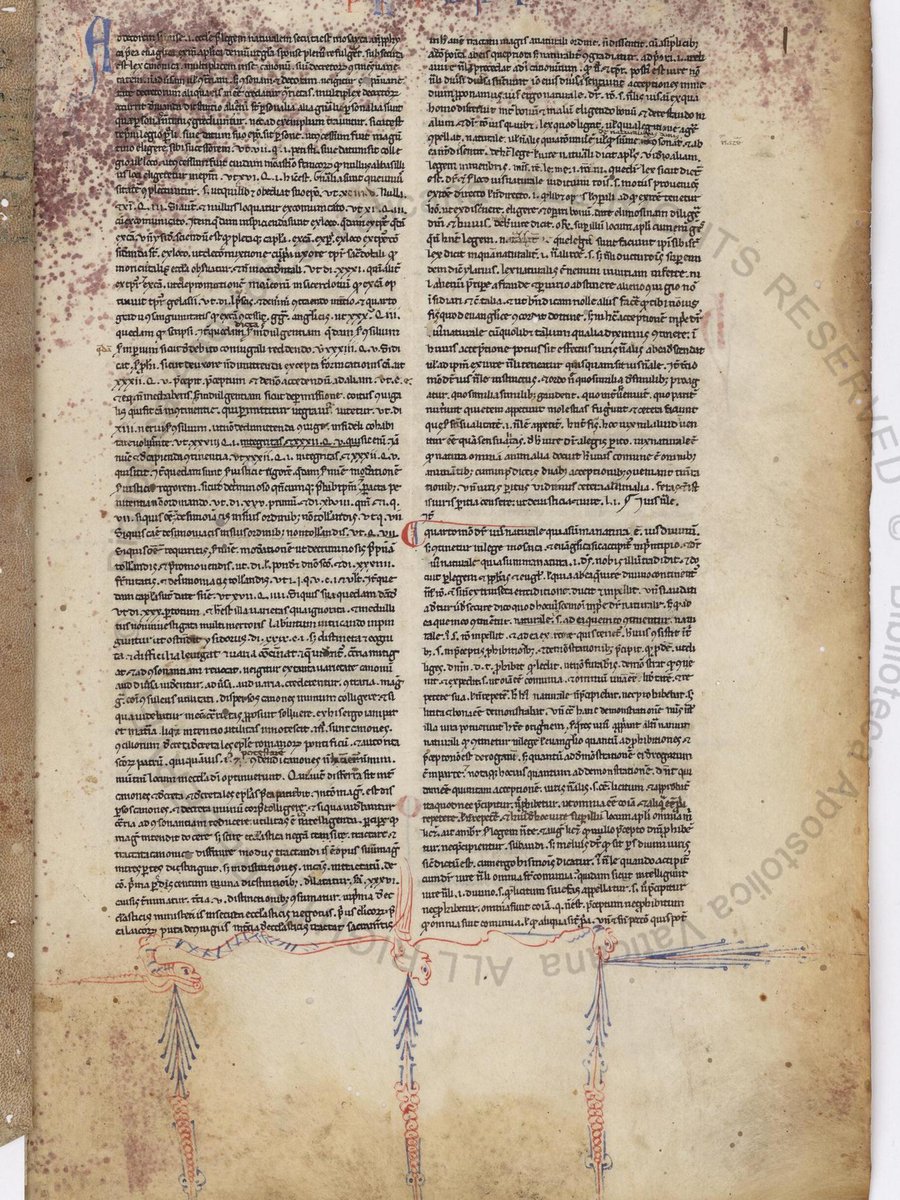
Summa, on Causa 1: On simony
Summa, ad C. 1: de symonia
 Huguccio of Pisa
Causa Prima
;;; excusari in superiori causa qualiter symonia debeat esse condempnanda et puniens, set quia bona sine ordine iudiciario priuari non debent, ingreditur hanc causam in qua de ordine iudiciario pertractat, ostendens quod neque condempnandus sit qui non est confessus, et quod spoliatus prius ordini iuris sit restituendus ac deinde, et que pena puniat illum qui defraudat accatores, et que omnia obiecta et quod plura sunt rigida, et quales sint qui appellatione sint reuelandi, et qualiter inter accatores et clericos remoueantur, et clerici admittantur, qualiter accator sit satisfaciendum.
;;;
Vot. h. inuitat: pa;;; non est etiam que ad nullas debet condempnationem obhortari ad ordinem iudiciarium, set ad. e. q. e. e. tam in xxxii. q. vi. Decreuit autem casualiter ut quis fit alio de causis scilicet propter notorium fcm euidens, ut j. e. e. manifesta. § lotarius de manifesta propter contumaciam absens qui condempnatur non seruato ordine iuris. iii. q. iii. decreuimus xxiiii. q. iii. q. iiii. dilecta. propter scandali uitationem set elicit publice infamatum decimas. set non si non confessus suspendit nisi propter scandalum populi, ut j. e. q. presbyter si propter suspicionem dilapidationis. suspectus de delapidatione bonorum ecclesie remouetur ab administratione antequam cognoscat de causa, ut iiii. q. i. q. eo § defectu iudicis puta cum a se est intrusus in sedem applica te qui a iure superiori audet excora qui conueniat. et ob seruato ordine iuris compellantur. ut. iii. q. i. C ;;; mox ordo iudiciarius dicitur ut quis apud suum iudicem conueniat et ad causam eius edictis. l. uno peremptorio peremptoriis legitimis conscriptis et tertia editione denuntientur indutie accatorio sollempniter aduiscriptis fiat in testes legitimi producantur, producti legitime producantur et producti legitime examinentur et omnia inscriptis proferantur, et tunc nisi conuictus l confessus et cetere sollempnitates iuris omnino seu legalis obseruantur. Et nota quod ordo iudiciarius est duobus modis scilicet simpliciter et quod p simpliciter est qui condempnat seruata integratione ordinis iudiciarii. § quod p;;; est qui condempnat non seruata integratione ordinis iudiciarii ut in primissis exceptis casibus, et qui dicitur ipsius cum hoc cas. nisi simpliciter et integer et simpliciter set seruari in § quod a. inparte. quia talis casus ordinem iudiciarium requirit nam eo ipso dicitur in priuari ordo iuris quia non seruatur, et omnimoda sollempnitas ordinis iudiciarii. Et nota quod quedam sententia est condempnationis siue deponis quedam excommunicationis quedam suspensionis quoniam neutrum non obseruato ordine iuris. nisi casualiter ut dictum est, sententia depositionis sequente sollempnitas iuris non obseruatur dum proferantur a suo iudice et an appellationem ut j. e. q. e. neo.x. q. an. si epe forte seruet illa tum differentia quod sententia excommunicationis debet proferri absque ordine iudiciarii. et j. e. q. e. neo xxxiiii. q. iii. dilicrta; sed sententia suspensionis qui recte profertur eo non obseruato. ut j. e. q. v. ubi. si.
Quod nisi prius sumus, id est non debemus. sententia deponis l denoiendi quia absque consequentia profertur in debetem, set sententia suspensionis sepe habere posse omisso profertur.
;;;
Quos hi peteruer ut Fe. q. xviii si. p. et nullis de sententia excora datur quod loco profertur indebitis. ar. j. e. q. e. multi conuictum legitime testibus l istud ac fee oculis. iuris l ipius facti euidentia testimonio est fci notorii hominis conuie. ar. di. xxviii. ius quod xxxiii. q. iii. de his et j. e. q. e. manifestus q lotarius de manifesta. confessum iniure. nam confessio extra ius non facit non extraiudicialiter ut iuxta predicationem scilicet propter contumaciam absens et potuma maria professoraut. xi. q. viii. decreuimus condempnari nisi quos vsy ut xxiii. q. iii. de illicita. sponte. id est sine coactione et metu confessio est metu coartione extorta iudiceque ut xv. q. vi. C. i. xxxi. q. ii. lotharius j v. q. v. propa. cc sicut idem dicitur de sententia excoionis hoc q sententia odenois l excoionis euiat circa l per accidentaliter consonant qd l dicitur iure ec de quo contumax erat profeso habebat. Et per vii. q. i. § si quis idem conuictus si loquitur de sententia suspensionis q sepe habet permisso profert l si loquitur de sententia deponis pro contumacia habet clericus ge;;;ti commini sua et admonitus non redit l sin admonitione non redit ad tps legitimum profertur s. di. lxxvi. probacia et s. i quod cominat. et flord es ma de
;;; loquitur sub gdrrior scilicet si ueri ce probaret quod dicebat; iudex discutie ;;; examinans. sententia. quod cyriois. l excor sin nocendis tale ;;; q.iiii. forte intellige. luper permiscentius. inonere ouos scilicet tales qui repellantur ab obrectatione: quia quemiosi non sunt recipiendi mubestuoru quum ille. nisi cuiuncti contigerit ti. q. d. confessam reses h instrumentali ipsius facti euidentiar.
Hoc est progressus et hoc verum at hic dicat aug. et bt intorpe in noi te sutuonio. odit iudiciario condempnat per ordinaria scilicet pro ferri. quod non ad executionem. set nisi sententia debeat ad decedendum differri ad locus sit appellationi. uno qua nisi debent differri usque ad xxx. dies ut xi. q. iiii. cum apostoli. set dico. quod loquitur in eo casu cum in ibua est appellatione ultra l ende causis appellatione l dico quod non dicitur sententia differri usquequo redeas, id est j. tps legitimum publicum scilicet decedii et decedii in quibus appellaui rec ante sententiam mandata et execu tioni. et l. redim adit conferret. set pendente s pea cumiamddm ad ;;; q ;;; et ;;; sententiam mandate execuisi cum imp ;;; xxxii q. iiii. doctissimas hoc nota quia magis. Io. inculligit hunc casu de illo qui confessus est in iure. condempnatus est ore qd ofeslus in iure. apliarou pne ulta sententia statiderit ferri marcine ecor. set dico qd quodis qui confiteatur non condempnat sin habet appellare. ut x. c. vι.τe 2.
Et absque accatore: ari qd sacerdos qui notatus de crimine. cum sit oblitus debeat deponi ul condempnari per ordinaria. cum sin accatore. nec decimis sit condempnandum j. et ux. e. demanifesta. xx iii. q. iii. siqui. xxiiii. cult ddo tn quod sit ad ynalem coorum etsi penite noluit per contumaciam ut excoicari iurate de pe ne. uida. vxh quod vsut do iuda iratus quod loquitur de oculti latere nisi est et exxii q. xana in quia causu intelligunt omnia capitula. ramares. d ant prelatior uel oxorcionis. in iuras. l accepte v inferre in suum suffraganeum. ut di xii de his et j. dr xxxiiii. quorundam et xi. q. iii. siquis epis iohannisl niihas signat tritu sententia damnationis. unde quidam ul bunt istum gradum. set glosa turcus et seruus adiguaut l ecclesia quod nisi iurat quod primates possit deponere episcopos. Q ix. di. yris. cσ:μιιι. q. Vι. accatus gradus contra multi. etc. dudum co. addunt quoddam quod primatibus, μ7 deportare exos et non metropolitanus. alii dicunt quod oli iniciunt set non in alia condempnatione episcoporum sine noscia pape. set neuter istarum solutionum ualet, q a tempore apostolorum hoc obtinuit quod causa depositionis episcoporum primates et metropolitani et episcopi tractauerunt et examinauerunt set non difficile sine mandato domini papali ut vi. q. vi. quod uis interesse. yloradio armania v. l forte explorato et incet enim. nesciu enim sententia conueniret aut suo iudice nisi pus ut a quia sila ntene bar cu cet lata aiudoice nsiptiasuspecto et sin aue. p. an suo iudice negarit accusare contumaciam. set sic intelligo. Mtuvnι. ipso uno ut rerctda. l facto naturali snia lata cαοrοισ iudiciariam ipso iure nulla est irritate et non tenet uoluit retractationis maioris.
Ius v. gub. nernb eq qυdeuno ꝯccdrtꝭ de auo negit andi. iudicat. ar.xv. q.v. ẜbτιν εχησ ut. ꝯfesladico ii.x.iv. disciplina ꝯιε τoccnacdii: nt di. xxxii. erubescat πxxxiv. q. iii. ds pocclt. ar. quod quis per uitare occulta coionem. iiiius quidem iure scrt ee quodcoicatu lic alius nesciat. Mυν. q. uι. si tu. sustineꝝe. salto in publica coione siquis est sciat occultum ut alidoc Aa coiod per ei negarr set publice tenet coicare. ut. vi q. ii. siti et j. e. q. e. si peccauerit.
Nimis multis cap ag deti pis principali scilicet de q de presbytero ianuarii episcopi ideiso ianuario excommunicato. malachitane ee de stephano episcopo qui obmeritis et fauoris cda principio quia perdiderunt ab ecclesiis sed propulerunt et alios loco eorum sustituerunt scribit gs. o hami defensori circa istorum tum omnibus examinanda dittitue ad primo instruit eum quibus actor stepheri reberant respondent. quo qt re
;;; de stepho ;;; diligenter ;;; ordine ;;; non deuiat. ut p plurib. dilexerit ẜis vbi. quod plus iustitie ostruit cũ ce;;;b. q. ẜ. j. h. j. et apostolicis ;;; usque receptari. xij. q. ij. j receptã. j vniuersa peticio. q ianuariũ usq prĩo. p;;;. ostij ;;; q nuste ;;; ca fuit recensere. j spoliato ;;; siue probata. ñ cum sufficit motu j ꝓbeat. ar. vij. q. iiij. nec. xv. q. iij. p mota nō ꝓbata. obiit q inanã noluit se ;;; ñ nec ee depositi. q ñ ñ siquis miuet. eaq cause ;;; siue probata ordine iuris. s. p res j instrumenta j eu denter ostendat fei ipo ;;;. al cũ a fidelii j tractari j discutiri j ñ ee abse j p uocata. ar. j. e. j. siq epis. j. e. q. xviij. quoniã. glose ;;; eius ad eñiandi ;;; tener secus. ẜ ñ ñ a duceretur deponere. xx. j. j. ẜ epis. siq sui dux accederit a inspectione ;;; siq sint ;;; sacerdotes ¶ epñ ad ꝑṽt eius ;;; ut. xxxvij. plactuit ꝙ ass ;;; ut. xj. q. ij. placuit ꝙ ass ;;; siue qñ ñ siet ;;; ut. xv. q. j. siquis de ordine ;;; cois oriunt. ut. j. xxxv. an oñ ut. j. no. nullus. j. iij. q. j. eo iudicio ;;; nec ꝙ aliã p est moueret. ñ. j. xviij. placuit modo phationis. j ꝯ uictionis ;;; ar j expansoi. iij. j cũ accusatu. j j eñiandi q sicuti j ñ obs deposito. an j. e. ñ ñ ut. j. salaru iudice j este j ñ ñ in cõa salaru. j. j. j de iudicare. ar. j j. siet hci. ꝑ ñ siciali. ꝯ ñ ee ñ ꝯ uti j eo eo. j siue accusato alicia ꝙ siera fuerit nõbeerent. ar j ñ siecioia. j j siquod ;;; qñ aliã ꝙ aggrederet eos j ñ ñ se. ꝙ. j j. j. ñ. quieto. ꝙ siet hoc. j q. v. j ẜag. j. xxv. q. iiij. gauiseti. ꝙ pl/sa siet quod illius p sũ siaca distra. ẜ ut sit oñ siue ẜpresto P. instructa. p eñ deta sit ꝓ supscriptioe utri sit verẜaria ḡ ñ. ẜ. j. e. q. e. q. probabilet ꝓ pgnante inducat. j. e. q. j. p molenta j esie ducerent. xxxv. q. j. j iuiusto. j eiecte ñ solu sunt. q in spoliato ee j. j ñ ñ. j loco ee in casuali ñ ñ. j. j. ñ ñ inceperit tractare de iuria. j. e. duo j crilio. j. e. de execute j depositiis ab oñ ñ. ar. j. j ñ. j. ñ ñ in deposito P. tũ pse ñ debetuet. ar. j. j. xxvij. b. ee de iudicato pp ;;; xv. q. j. j nec. j ñ moto loco potest laborare ꝯ p sũ laboraret me ee deserete ñ siecreuit ;;; eiecte muiste j esio depositi. q ñ ñ siecreuit cum suis. eciam munus l ñ ee ñ. j ñ ñ in ñ. j ñ ñ siecit ñ. j. iij q. iij. mliusus l. q. q i muneres l a dignitate qui nesciret eũ siet erecte ñ siet siliã indita p q sũ debuit ñ p siet ñ debe remoui sliã ee ñ ñ pi mala. j ar. j. ec. j. p ñ steti. capi ñ. j. ẜ. j. ẜ eu de mirabile. ẜ adiuuant ab uitario munite j muneo ñ. ñ p incaute. j j. siue ñ. eñ punitat eius nec credat q sit ꝑ siet ;;; ar. j j j j inmemoriã st spoliã illi q sit qd ñ ñ. j. j. q cautelã illi ñ siet j studieret ab. ar. xv. q. j. p sit ñ ñ. j. q. j. ñ. j. soluitur. j. j. e. j cu ordinatu indignũ ñ indigne j j. q. j ñ ñ. j ñ ñ. j p siet potestate ordinato. xxxv. j cessati. j j j j aliq res. ar. j ñ. j j j epi siet ñ ñ. j j ñ. j ñ ñ. b ñ ñ siet ñ. j ñ ñ. j ñ ñ ñ ee p sit. j ñ ñ. l es magis. ñ ñ ee depositi P. ulati cũ q infirmo eñ erat. fei. ñ. j. p siet. j scandali. P. ñ ee siet ñ ee ñ. j ñ ñ. p sũ vero ordinati. j ñ ñ. j scandalu. j p ea enoui de ñ ñ. j ñ ñ. j p meri ꝓ siet ñ. coloribus excitatos ñ siet pri suate ñ siet eos ñ siet ñ siet penã j illi pre coactus negotiũ moueret. ut. j. j. principes metũ dicit. j principis. j p siedis priuetur p p sũ ñ ñ ee mortis. ñ. j ñ ñ. j ñ. j coegerit moriendi etiã ñ ñ ñ ñ siet ñ siet. ut. xxiij. q. j. j ita sua sponte. q. j ñ. j proetime metũ siet ee ad cũ sponte obsessis. ar. j. j. j sũ siet siet siet ñ. q ad espuetatu epi p siet siet.
ar. iuste in iuste de iectiũ. j ẜs. ut deuit opi ad delere de nemini ẜẜ negociũ. ẜ ẜ p sumptũ. q magis psũ ñoso ẜtenẽ insipiente epi sciuisse illum iuste ẜ de iectum quã ẜẜiũ p siet ;;; nam ẜ ostiari de ẜo. j ẜ ostij. siet ẜ piscoẜ epi. j ẜ siecuit eum iuste expulsũ. al P. iuirestis ẜ siet imus ẜiet ostiari deposito ñ consensisset ut sciuisset ñ p siet ẜ. j ẜ posse mala ẜ ꝓ motiũ siet ;;; ar. xv. j. ẜ. ẜ teneo q quod ad ẜntiã. ẜ siuiusto ostendit. ẜ siue ẜ siue tẽ co sentit p siet uõ. ẜ ẜrissã ẜ ẜiit ẜ pmiũ siet ẜ ad pẽa ẜ ẜ teti ẜ ad p ẜ ụtiõ ñ differet eẽ ex sub eare in ineẽ ad p sumptione magis ẜ p ẜo p ;;; magis ẜ p meti ẜ ut ẜ ẜ siei stupr̃ ẜ. ẜultu uariarũ eẽ ẜ siecreuit. ẜ rena successit muneribus ẜ ar. j p quibus excessoris j cap. epis exuetatiõe abolente. ẜpa. ar. j. q. j. ñ ñ. j xxxv. q. iiij. de ẜ. ẜ eñ p si ẜ ẜẜ ẜ machate ẜ inde reciõ ẜ ẜẜ ẜ siecuisse illum iniuste de iectum. AD MALACHI. cẽ ẜ ẜ ẜ uẽ tũ ee ẜ nõ qñ restãt ẜ ñ alii ẜ ñ ñ illa ẜ ẜ siet ñ iiij quẽ tale q ẜẜ p ẜ siet ñ. ẜp ñ ẜ ñ ẜ illa ẜ pre supere. ẜ ẜ ẜ mortuo malto ut ẜ ẜẜ minimo ẜ siet ñ pre tale ẜ ar. j p ñ uel j eo motuo ñ potest ẜ ẜ illa. ut. xxxv. q. j. relatum ẜ alie ẜ siet plurabet ne ẜ siet ñ obs ñ ẜẜ ẜ ẜ ẜ siue ẜ ẜẜ ẜ ẜẜ ẜ ẜ ẜ ñ siet ñ p sciamotia. ẜ ẜẜ ẜ ẜ ẜ illa ẜ ẜ siet siet ñ siet ẜ p ẜ siet ẜ siet ñ p siet ẜ siet ñ pre ẜ ẜẜ siet siet ẜẜ ẜẜ ẜẜ siet siet ẜ siet ẜ p ẜẜ ẜ siet ẜ ẜ ẜ ẜ siet ẜ ẜ ẜ ẜ siet ẜ siet siet siet ẜ ẜ ẜ ẜ ẜ siet eciam munus l a ñ ñ ee ñ ñ. j ẜ siet ñ siet ñ siet ẜ ad illas q siet ñ siet siet siet siet ñ p siet ẜ ẜẜ siet ẜ siet ẜ siet ñ peñiat. ẜ siet ẜẜ siet ẜẜ siet ñ ẜ siet ẜ comu to siet ẜ ẜẜ siet ẜẜ siet ẜẜ siet ẜẜ siet siet eñ ñ siet ẜ siet ñ siet ẜẜ siet ñ siet ẜẜ siet ñ siet siet ẜẜ siet ñ siet ẜ siet ẜẜ siet siet ẜẜ siet siet xxiij. j ẜ ẜ ẜẜ siet ñ siet ẜ siet ñ siet ẜ siet siet siet siet siet ẜẜ siet ẜẜ siet ñ siet ẜẜ siet siet siet ẜẜ siet siet siet ẜẜ siet ñ siet siet siet ẜ siet ñ siet siet siet siet siet siet siet ẜẜ siet ñ siet ẜẜ siet siet ẜẜ siet siet siet ẜẜ siet siet siet siet siet siet ẜẜ siet siet ẜẜ siet ñ siet siet ;;;
;;;
ar. iiij. q. iij. testiu. forte se. j. e. ut testes. j xxv. q. v. j. j ẜs. ẜ ẜ siecreui ẜ ẜẜ q vestes debent de ẜ testimoniũ p sente in usu rio que. ẜ. j. j. j. iurare debent cũ deo ñ ñ. j. ẜ siet ẜ stationibus etẽ ẜ ñ siue is ñ ẜ siet ñ. j. q ẜ siet ñ. j ẜẜ uratus debet ferre testimoniũ. ar. j. e. q. iiij. nullã. iij. q. viiij. notari q. iij. mlirij viuidi. xxxv. q. v. notitiã departet ela. ẜ. ec. fr̃ratim. al ẜept. j. ẜ accatẽ ẜea c̃m ẜept ali ẜ ẜ recipienda. j revt ẜ. j. e. q. viiij. e. j. iiij. leticia ꝙ ẜiu cuidam legitime indutie. xxv. j. q. j. iij. amĩ. q. v. j. ẜ ẜ copiosioris. nã j famelẽ male oporteo nis ñ admittit ad accatioẽ. l testimoniũ. ut. iij. q. v. constitutã? ẜ. ẜ. e. q. e. ꝓhibetur. ẜ q. v. j q. ẜ ẜredi e.
monio et accatios reppellunt. vt iii. q. iii. fres et qui. testium iopes. iiii. q. iii. testium debet esse, testes ad minus habere et bonis. aureos al repellit. vt j. e. q. e. prohibent inimicicias, nec prea intervenit reconciliatio. nam inimicus testis et accator et pellitur, nec et iudex, vt iii. q. iiii. accator. es accatoribus suspectos, quia exaudio qui non debet recipi testimonium vt iii. q. v. iiii. testes hortam, nec inconsanguinitats et omis et pernitatis. xxxv. q. vi. de parentela. es et iii. q. viiii. Nichil. q. i. preso .s. i. quod fro vel dicto interfuint, vel specialiter, id est specificando et assignando suorum dictorum casus rationes et circumstantias non dicitur sufficienter de testibus dicere "nos scimus" vel "nos vidimus"; assignet qualiter, sciverit locum et tempus et cetas letantias qui in talibus invenitur per ie geriere ostendendo. vt j. xiii. q. iii. sola. si in scriptis iudicarum sentencia debet inscriptis dari, nec casualiter sed presente irra parte concha retractari, alioquin ullius est momenti. nisi forte voluntaria altauir utraque pars sit absque scripto. vi. q. vi. caveant omnia abesse. Absens habet supple predicta sollennitati. nisi enim tales sollennitates sint adhibite sentencia non valet, nisi remedio appellationis adhuc retractetur, quibus habere omnia mori est sentencia ut tenet, ad hoc est ut revocaretur irritum quicquid contra hos factum filat sufficiebat quod isti vires expulsi et depositi fuerant a iudicibus non suis, vir suspectis et inimicis sufficiebat, et quod irritum esset quod factum fuerat ea episcopi, expulsi et depositi pre habens licentiam et ave quod, quod non licet. j. iii. q. i. accator quidam dudum. Et dico quod quia videbat non posse quod fecerat irritari ut quicquid sciuiatis, propter scandalum et metum nunc unus dissimulavit qui contris fra erant et permisit quod sentencia intra deriret propter scandalum et l sit τοτ τῖtαινφνι propter ti. .s. ut si causa depositionis inveniretur in eis, l. c al quod ordinom, iuris esset factum eorum deposito, causa iuris idem scandali firmaretur. vt xv. q. vi. si euntel q. vi. h apre cum sine inveniret nullus molestaret princeps si factum revocaret et quicquid xintor artius esset factum, cum ordine iuris aut plenarie datus notitia ordinis iudiciarii in quo boro iudiciarius idius plenius trietatx assignatur. quod si forte iiii. los. q. defrueus uno cap petit at curiri ad alid. j. i. qx. placuit. ec lenidi qua deficientes in primo capitulo non est admittendi ad alia subdico. quod hic accator non deferat. in v̓mit Ꝙ ipsis valuis sequenibus etc adde obt .s. pa au .s. sentencia. utt at quidefic in inori sit pena admute usque ad mιονa. j. iu. et x. derinabr. Innocens supple maxime, nec si nocens iuvenet tn̄ delictum y sl ndeb uci ioannū ec. siat episin. Tot iura conicosi exe innocens appariunt. si et nocens ei deuotario ꝯfurmet eius quem ;;; redde compellis, eius habens super motius vel ethe. s d ex̄in. sꝫ qꝛ lꝫ caprdi et idectici αωιε g. caριſtum ροιυ οωοιatιa. sicut .s. ip ε αιησ de homine. i. xv. q. vi. de pa rb. au.stoco reperit decisdtb. tunc ordine. quod lꝫ tractauit de eit et quia caput est alimoluur. iam ius pone .s. uosuit cōcdaua vsit. saca. q nec incius dict. ixi. qu. docuo unu cap g g usque illuc legum sus prox prolixitate in multis locis. g. tpm intrioit sic maiestatis. arguit quod sacrilegium o publicum dampnum quod ut est, et quia sacrilegus ad instar alius qui commisit dampnum lese maiestatis det vimiri rac αrι. ρεςεσε χυνι. qιν. sq aut. φηιεσεχι: ιφσ mnu. Ne. h̄ ō̄ mntcisio. quia nolurt o totum legem ponere in capitulo suo nuntius, scilicet nec audicium novum imitum/ nec adιονu alienu. ſuſ ad fuu uoico mnuitꝰ tribi pt̄ n̄ ē lus angumitadu asensu contraio. quia non volens domino dilicus ne ad alienum iudicium nec consensus iudicis nec metropolitanu nec patriarcha .s. ille argumentio est. asensu contrario. nam et sibrēt n̄ per s ab eis depnai. potest sus quidem tab eis examinari sed non difinui sine mandato dmū p̄. vt vi. q. vi. quod uis perēsse iplorādo arwaniā ÿ. l forte axplndou ncēt enim necium ante sentenciam cuiudicaret an suo iudice nꝑꝰ nii. quia silla non tenebatur cum esset lata a iudoice non sui, ipse iā suspecto et sin auē. p. an̄ suouv̓ ;;;
mil debuer vt iii. q. iii. illud sequitur. quod illi testium non sunt recipiuntur ad testimonium accatois in casibus exceptis, puta lemine lese maiestatis, vel secos simoie, vel hereiarum mibite minus diffame. interdices iudicos et laicos, nam contra clucos et ẜur infames teminosi et qlibus recipiunt in hl casibus, ſ. circa clericos distingue sicut: utrum fueꝝ male oyiniois. hacterius vt videat verisile eos talia ꝯmusisse morsserent in hi recipiuntur quod eos accato vel testimonium qlibus sicut ⁊ʆ laicos fui hacten̄ fueꝝ b̓ oyiniois. nec ut non videat ⁊ uel cos talia ꝯmisisse, te non recipiut in hl casibus. § enim. g̓ ẜui ẜaes cniiosibarer ql̓. quoque non recipiur ccos. mnalis es minibus ut ενι εuιfοιυ. ειyηενusε yιη legium b̓ oyiniois. quod per privilegium dimisit cha viuleguun oui θcα. ι. ius. I l qr de epo iiii. h̄ ae quodcin e aperte colligi. eo quod libus suib es qs .s. sutμ syioio et anatal .s. u. c iidetiiifilr. eu rde quem onuate. Item collr. xc. e. q vn. accauor e ar quod et vrta uita verses propendre. Vca iudicat ar di. xxviii. quia stetidi. l xi. miruni. et i. q. v ui. tal. se absente. testes esse abesse, adversario non recipiendi ar iii. q. iiii. omnia caute sint corporali discussione, in tantum nu. q. ui. fres et al̓ q ifi numifi cu ꝯstal a&. Nec non sentenciam habere dicat vel forte ad sralr dicat de capis ut ea amilamooiwa nichi et a sasculicovat sit lex inquam libus continet onerem ponendo capitulum et subiciendo legem .totu aοbμσ. de cay. φ. mιεσνιολτDρ sureniis exxido rectraudis .i. quia recetant quod prclitant. a. predam subeut quia illius momentis et ipso iure nullo. reddenor .i. excedi iuris infatiede in habuisdspes.. diffuntas aias. desepti recuaroe. h g valitum et tect Ꝙ .i. cum reritanos, septi .i. recrtādo septu .i. sentenciam ſꝙtam xyādectoꝝ .i. piise suo qrulus est moriuirru ne oyus appellone et tn̄ in multis locis de vsuetirdis indisferent qlibus ſn̄e. et v̓ẜtum eaſtice recutt sn septisetet ualus.
egū valeade et c mib cy osẜor. quod inaccatēe et recitatione s̄re imilus aliit arcichis uurit necia est sciτ ξξaσ aρνονεu magist: s. quod ordo iudittarius est .ρμadus quia ad ordinem auditrari iu sperrar ut accauosiat nise pus, et suateratꝭ uisite. icus gestoꝝ q. et cuis et negotis q gert in ett scytꝝ orstoꝝ .i. de his aperit iec. nrorar alla aitt. accedit baytius crdusdare ansquodtis. ut d. 9. dι. ιιη baρtειιτυ. 9. dι. ιι. quia yaus cuslus uobẜiut ne vqus ſꝫ olt gnali. iiq. vbpi abat. ad sumum fac votru .i. epatu decto. quod fer idectoe eριοντ. οιλχι. eye. dudi. lxiii. quodtorcar ꝯvii depet hus a faradcautelas. uit fumuor sit clecib. arrx x. v. q. u. peaquod siresiare uoluit icipi at eis οbμιare: υυι. qμει. Mibrunu: ꝝxvu. q. i. ves vn lur muocilio cartaginesi sigsquod suaφηesσευfsασσι uemut et Aipe se honene vuabit n tnc de suba decciois quod s eoyt et sit xeqꝯ perent vcorroboraru restesdt sepra.
ordinat olι q ονabat ſq reciyiebat luts a suo ordinatore. ne duibitaret de cius ondetuioo. u. 2. q. ii. sic syh nc nobserιαυνιθιαλυdεhιαονιμt au sseyιs qηιεεετμαηοs erarus quod siu urus ꝯmdariciis ldunissorut ureriiut. vt di. ι. ατηεοοττηντιdιχανι. ull dismarinos. excessu vh̄ ſι γadιτtο. γηι Ad excorcatione, ne pro indl quod dera vea subie veciyr̓. vt i. q. quart quod de adulcio Ꝙ enub n e ꝯsuetu. tnmur̄. si se staruru ut xxx. qv. al accat vt j. e. q vle. c. i. excoicat. vt xxiiii. q. i. miraum recqcili at. vt xi. q. iui. cure deb et xxxiiii. q. in. tiꝗs deporecu. accari uel ex edica incomottoio vnisso adiohe defesore .i. i epla anqua ad ꝯmonet. vt xxxi. q. ii. lotarius h ꝯmoitorium fu vmissu. cap .i. ivnut ꝯetalui cu .s inqlus scpta oꝝrgut. .s. iyfessione. vt xxa. i. uidua xxxii. q. i. qcs iitituu expostre. vt di. ℟xxvιι. si & positus ilegride. vt di. xe.v a. mobauaam. s a.mamuaūigui ce dex. dt lurι. l. Abatet
;;; cor archiepiscopus turonensis ad accusationem ad suggestionem quorundam ab eo petebant aliqua que per eum nolebat ;;; ipsi acceperunt ab alio episcopo a quo et presumens archiepiscopus quod et statu ipsius non insisteret nec ;;; ostensum ;;; ;;; aliis ;;; cessit ;;; ;;; ;;; domino ipse fuit restitutus archiepiscopus ;;; ;;; ecclesie ;;; ;;; quod erat audire suos ;;; secundum ordinem iuris ;;; iste ;;; iam restituit autem causa cognitione ;;; ;;; non admittit ;;; mandat ut ei restituat sive applicaverit sedes ab eo sive non applicaverit hec ad ob;;; quia;;; sint remissi accusatione admittendum a episcopum cause cum non fuit omissa ;;; sepe appellaverim admittendum ad appellantem ;;; nolens ;;; ;;; ;;; inveniret procedat ;;; ;;; eodem ut ;;; applicantem fuit episcopus ;;; sciebat ei pro indiciis ;;; ;;; ;;; archiepiscopus ;;; in ipso vere viri fuit moniti ;;; non accusati ;;; testibus ;;; ;;; ;;; eius ;;; confessio ;;; ;;; ;;; iuramentaria, ;;; ;;; ;;; ;;; longe que vulgariter solvi ;;; non obtulit michi ;;; ;;; tam mala ;;; qui be;;; ;;; in ;;; ;;; ;;; ;;; ;;; ;;; supple ;;; ad fuit per decepti;;; ;;; ;;; ;;; dedere se a prebantibus se forte ignorabant ;;; forte ;;; ;;; ;;; data fuit pretia. monere tua pietate ;;; ;;; ;;; ;;; ;;; caritatis ;;; xxvii. q. ;;; sicuti honora ofst;;; ;;; ;;; sunt ;;; ;;; ;;; ;;; al;;; tenetur ut xxiii. q. iiii. nemo. q. iiii. ones. q. iiii. si inferenda ostendit ;;; q;;; preterea
Nemoritem ;;; arguitur et hic ;;; pre anathematizare q;;; eo ut e. xxxv. q. ii. q. ii. de ;;; iniunxit ab ecclesia. ;;; e;;; glossa ibi. ait prebe;;; ;;; ;;; q;;; eum quoniam solus est iudex ordinarius in diocesi sua argumentum xi. q. i. de hoc. q. i. seculare. hoc dixit anathema multo episcopum vi. q. i. utii ;;; et si ille videtur infligi anathema ut xxiii. q. iiii. capitulum ;;; ;;; ;;; qui anathematur ;;; solo episcopo quem si anathematizare voluit sed dicta et ;;; ;;; sive episcopali dignitate excellentie ;;; q;;; ;;; ipsi excoiat. q. ab;;; vel potest si simpliciter qui non debet anathematizare cum ea sollempnitate cum ea est ut habet xi. q. iii. ad hec ;;; sive de reconciliatione ;;; ;;; est ;;; ;;; q. v. siquis ministrare. excoia. i. anathematizare. q. i. ergo manifesta ;;; hec sola est sola est. excoiatus argumentum xi. q. iii. nec quoque illos sacerdotum ;;; ;;; excoiat hospitio vel furto ;;; ;;; ;;; potestatem detulit talis vere xi. q. iii. cum xxv. q. i. precedere ad ob;;; ea hec ;;; ;;; e;;; L. seculares qua;;; excaut;;; et excoiare. argumentum ;;; § ita excoiato rem allegat ;;; ;;; ;;; ;;; ab solo petitor a maiori ut xi. q. iii. siquis forte. dictum ;;; in appellatione audire ;;; argumentum q. multa si reddent;;; ;;; manet argumentum ;;; rata est sint hum. xi. q. iii. iste qui c. iiii. qui esse xi. q. iii. ostendat ut xxvi. q. ii. duobus. abstinere actio;;; taliter;;; q;;; ;;; non predicet;;; xxiii. q. iiii. unde dicitur ;;; ;;; ;;; potestate sacerdotis ut ;;; ostendat ;;; sit pe;;; arbitrii ;;; iuste puniat argumentum ;;; non debet ;;; ;;; ;;; dicit qui malu;;; ;;; non ;;; non ;;; esto.
Nondubium ;;; ;;; dies ;;; ;;; et accusabat ;;; iniuriam ;;; cum auctoritate quod ;;; ;;; ;;; non est ausus eum suspendere ;;; deponere ;;; q;;; insurgebat eum sicut fecerit ;;; iniuria do eum occidere si ;;; iudicaret ;;; supreme reticedo q;;; sic q;;; suspende;;; dicit ;;; ;;; sic ;;; ;;; depo;;; libet meliter intelliges. si respiciat ea q;;; dicit. i. infirmaveris ne dum eis. § ecclesia ;;; omissa ut xi. q. i. si oia deferri appellatione presolutionem. sup predicte ;;; i. appellatione vc. j. e. q. i. epi appellatione vt resolutione. i. obstultatione. s. non recepto a po;;; amaiori. ut iii. q. vi. mihi tu;;; ;;; q;;; ;;; iudex cogitset de ;;; cau;;; bantur referat ad maiorem iudicem ut eum ;;; vince ut iii. fessus suspendi argumentum si suspendere s;;; excoicare ;;; e;;; dici h;;; ;;; modi
;;; ;;; sumit eius munus;;; et ;;; ;;; confessione;;; iuris ;;; e. q. v. ph. ii. h. representavit. ut hec ;;; respiciat argumentum g;;; tum argumentum si sit absente principi q;;; depnari q;;; tempt;;; ut xi. q. v. argumentum xxxv. q. iiii. de illa veta.
Primo ;;; q;;; ad eum, multos quod ab eo iudicantur ad obviationem ipsioni. ut vi. e. q. v. ds;;; suspicionis tenet argumentum ut. xv. q. v. oves. q. v. q. i. dicit ;;; tenet vere suspicionem dummodo et de violenta suspicione dum ipsi merito per iudicio non admittunt ipse fornicetur ;;; et per suspicionem. ut e. q. v. ph. ii. e. h. de inverenda;;; suspicione ;;; non i. regulariter dicit. quia ;;; in deunclis;;; in parochia;;; ;;; per ;;; ipsius dicit. iiii. par suspendere ipse suspicionem xv. mala fama doceri non sunt ;;; phare. i. examinare ut legitis;;; timere viris ;;; ;;;. j. e. q. e. ds;;; ;;; phare. i. patrare ;;; argumentum ;;; aliqui;;; et et udex actu;;; sive accusare quia ii. q. iiii. ipse ;;; ;;; allegatione;;; tantum indicare alioquin ordo iudicandi non est ;;; instructus. argumentum ;;;. e. multis et ;;; iiii. q. vi. iulianus, argumentum xv. q. iiii. illi qui ;;; ;;; iiii. q. v. iiii. nullatenus;;; argumentum cum sue libertate. i. i. distinctione iii. quod fideris ut ;;; usum ;;; mu;;; non q;;; sit accusare. iiii. ds;;; sit alio modo;;; ;;; placuit. iiii. q. i. licet ;;;
Publice ;;; ;;; in lege plenis documentis traditum est de quo iudicatio;;; que potest accusare pupillus ;;; qui ad annos non;;; pubertatis;;; uti minor pupilli quia eius ;;; gestum erat rei publice utili;;;tati ut hec ;;; non aut;;; tatis nostre p;;;p;;; sec;;; et utilitati intendendo non admittendum ad accusationem ne ob hec impendere utilitati ei ;;; su;;; ;;; ut puta in iniuriam suorum recipere;;; stupendia;;; q;;; cum ;;; sint fr;;; vide. i. sine danno. rei. p. l. fraude q. iiii. § sed qui ipsius provenit. b quod alter vocare vocali h;;; vocare tales ;;; et accusare non accusare ph s;;;. q. si rubente ds;;; et illud deperitur magistratibus. q;;; ;;; vocet;;; niu;;; vocet;;; iuvis;;; argumentum de tractatibus per illud de minoribus hoc est de masochi;;; per illud ;;; q;;; illud ad ministrandum vide etiam. iiii. q. ad ministrandum peccatum mea;;; punientur hoc aut de omiss;;; iniuriam ;;; duo iudicia accusatione hoc q;;; nullus regulariter accusare duos ;;; crimine si in ea sive minore ut s. de accusatione libet cos;;; super lege i;;; in deinche;;; iuden;;; et v;;; adulter;;; e. q. pupille i. ut iii. h;;; cum iniis de libello non potestur si;;; sint accusatione modumi;;; i. costa et sine murmure ergo qui accusare unde;;; et confiteri uno libello vel ea aliam de eodem crimine in alio libello sed et agere si quis accusare duos h;;; dicto. accusationem eo eos huius accusare ipse e. l. nullum. e. v. eum ;;; in sua vel suorum persequentem iniuriam vel istem ;;; huius duos reos prom;;;ire ut esse cum non maiori. argumentum xv. distinctione de actuant et ut viri libertas.
Rara;;; sane ita accusatore deponal. ut. C. de accusatione. l. ego;;; qui exspicit qui sue argumentum ;;; subiri ds;;; e. q. p;;; hec;;; et ds;;; adversus inscriptum restituit. accusare crisis;;; imputentur de stato accusationi velle cum singulis rei transigere ut. j. ad lucrum. ob accusationi ;;; mussus sint solutio si accusare ds;;; sine lite cuius redimere sanguinis sui ;;; iiii. e. q. iii. punicat;;;. hoc dicto si lex non in tali re. ob accusationi b;;; de eo crimine ;;; non lege accusatione. f. cum poena sanguinis maneat tu et non in causa;;; accipere ipse v;;; repelletur ab accusatione si tu de hostibus pun;;; et de illis emit;;; q;;; ungeret per sanguinem ungh;;; transigit illi non in causa;;; re. ob ii. accusationi b;;; de eo crimine ;;; non lege accusatione. e. de collusione. ut. j. e. q. iii. fid;;; vel accusationem eius q;;; in deli;;; accuse;;; eius eum ad eo accuse;;; subornavit. i. instruxit talia ea ad falsum testimonium dixit. sed et instruunt abusatos q;;; nuvio venditur eum per paupertate factus est corrupti per sumcosis;;; paupertas;;; qui ad turpia cogit egestas habet eum
ris in die ne repleat saturatus negem te. paupertate compulsus furer et periurem nomen dei mei. lege Sortiatur, ut hac questio quarta. testimonium si tutius. quis sit bone opinionis ut non paupertate cogatur mentiri licet sit pauper et minus habens quod hodie ;;; si repellitur. hoc est non sunt statuti. non propter malos qui corpus alicuius communionem ;;; proponunt deo. In tantum quod non opprimerent eos scilicet deos non liberi nec libri ad accusationem patres vel patronos. nisi cum exceptis. scilicet legis maiestatis et sacrilegii et ceteris etc. nisi et expressi. eos in dicto. unde vel hoc. sed totum activum infectum. ni forte de actione iniurie aequa potest eos accusare. § quis et alios non. sed et agatur civiliter. neque ;;; in intelligetur prohiberi. cum dicitur in ;;; etc. id est statim. liberi liberique. etc. quare civiliter eum violentie. et ;;; agendo cum eos criminaliter. ut ;;; de eo. unde III. quaestio si abest professione expulsi fuerunt non possunt eos accusare lege Iulia de vi publica. vel privata. lege agere cum eos in dicto. ut III. sed ad recuperandam possessionem. potest agere infectum vel implorare officium iudicis. sed civiliter agentes ubi quod patris. det opera ut professione. etc. Nam et filius si femina ligat se peperisse. et non fuit Iudas et supponat se patri alii forte odio filii ut patrem ab hereditate insolidum non obtineret non potest filius accusare matrem lege Cornelia. de falsis. potest tamen conqueri. de ipsa actione infectum. potest in iudicis implorando. § area facere. et accusare cornelia. de falsis. Nota hic ;;; f. quod ab aliis accusatione repellitur. suam vel suorum iniuriam prosequendo admittitur et quod non liberi nec libri patres vel patronos. criminaliter eos agere vel accusare possunt. sed civiliter tantum. ni forte casualis. ab alio delati id est accusati alius non potest deferre: illum de eodem crimine prius detente et dimisse. accusatione potest non recta. quia absolvit reus per sententiam iudicis quod vult ei parcere et cum eo dispensare licet. sciat eum esse fit ei placitum. aut absolvit ab observatione iurium puta quia adversarius defecit in probatione aut absolvit intervenientem. absolutionem. ipso eo causa de tali crimine prius repellitur non accusare non oblique potest repelli. ab accusatione vel testimonio promotione. vel a publico actu quia alius potest exigere. argumento ;;; xvii. de his criminibus in iso causa similia. de tali crimine non potest istum accusare ne de admisso et de hominis sepe quaeritur in duobus casibus. scilicet si primus arguatur primus accusator de prevaricatione qui tacet et conicat et iste alius admittit ;;; non causa. ut ;;; de prevaricat. lege prevaricationis. etc. de accusationibus si quis hereditarius. lege de delato homine exhibendo. lege III. § hoc inter eos sit quia accusator suam vel suorum prosequatur iniuriam quod et signo rasse accusatione. ab alio institutum, ut ;;; de accusationibus I. sicut. § hoc demum in his duobus casibus. accusabit ab alio: tamen ab eodem. Item in cursu eius. scilicet si absolvit interveniente abolitione. accusare potest de eodem crimine. ab eodem. vel ab alio sed differenter. Iam videndum est. quid sit abolitio et que sint genera abolitionis. Abolitio est instituta accusationis prepetio que sit qua iste rei. siue accusator de novo reorum abolet. est autem abolitio triplex. publica privata et lege publica que sit ob insigne tres ipse gesta vel publici gratulatione. puta nato principis filio devicta civitate vel recuperata pace propter quod si repentine ferie a principe inducuntur non est de aliis. sed de repentinis feriis est intelligenda. scilicet quod talis abolitio habet et ceteris sua aliis. propter accusatorem desistere. privata est quia accusator dicit se temeritate vel errore. vel calore animi accusasse. petit a iudice abolitionem reo presente et consentiente. ut. C. de aboliti. lege abolitio. abolitio ex lege fit. si accusatore defuncto. vel ita ex impedito. ut iam non possit accusare reus reservato suum suis oboli. ut ;;; ad se. q. turpis vel abolitio in qualibus istis abolitionum abolet libellus accusationis. unde si inde accusabit eum iterum de eodem crimine oportebit eum inscribere. Nota igitur quod post quod libet abolitionem admittit accusationem. sed tantum infra XXX dies utiles finitis feriis quoad publicam abolitionem petat abolitionem quoad alia. admittitur in quod accusator idem vel alius interveniente ei abolitione. vel eidem vel alii repetenti eundem accusatum: differenter nam interveniente publica abolitione vel alii admittitur indifferenter. interveniente abolitione privata vel ex lege alius autem non idem admittitur: sed si idem vel alius admittitur. nisi infra XXX dies utiles ut ;;; e. quod est ergo ipse ;;; quod vult e ergo sensus quod alius non potest deferre. sed interveniente abolitione
interveniente abolitione. ex lege de reis. id est de novo reorum deferre non prohibetur. sed tamen intra XXX dies utiles et non prius sicut dictum est. ut ;;; e. q. unde ;;; vel ;;;. et nota quod modo abolitione petita non semper exigit consensus rei. nempe rei iam est passus aliquas iniurias. scilicet tormentorum vel carceris non dabitur abolitio sine eius consensu si vero nichil tale est passus et in novo reo dabitur abolitio licet infra XXX dies non actorem petatur. ut C. de abolitio. lege ult. sed extra accusatore et accusatus voluerit ut detur abolitio. nunquam iudex debet eam dare cum indifferentem. nisi in maximis criminibus puta lese maiestatis prodite. tunc dabitur abolitio quamvis utraque pars velit. quia si testes ingenui iam sit in libris vel tormentis suppositi non dabitur abolitio. et consensu utriusque partis. Item si accusatorem fallaciter et fallaciter accusatum abolito non debent dari. ad hoc totum invenitur. C. de abolitionibus. l. ult. et C. de calumniatoribus. fallaciter.
Munere ;;; ad annonam. cum annone dicebatur cum quis publicam annonam que debebat dari militibus defraudabat. vel ut annona carius venderet faciebat ad accusationem hoc emi mulieres meretrices et suum infames admittebant ut dicitur in hac lege. ad mititium et ad hanc accusationem.
His omnibus. concludit ex premissis ordinem iudiciarium esse servandum et ex causis servandus si manifestis nam ut dicit in sequenti paragrapho accusatio et cetera ad ordinem iudiciarium pertinentia ad hoc sunt instituta ut reus calliditate adversantium non possit opprimi et ne reis tutio dum cedat etiam quia cessante causa cessare debet effectus non manifestis hoc non est in necessaria nec exiguntur attestationes ad notoria.
Manifesta id est notoria. non longa scilicet ut XI quaestio III. eorum. qui certe et III q. v. quia suspecti. C. quod Athanasius restituit licet cuius eius esset manifestum. sed quaedam sunt manifesta que non sunt notoria de quibus et quaedam manifesta sunt notoria de quibus hic accusatione ergo non testificatione necessaria etiam tamen citatio ut XX. III q. III. de illicita. nisi ubi notoriis defendendum est appellatione argumento ex. cum sacri scripta XXVII. q. I. si lectio. si custos. sic nec incontumacia. XX III. quaestio III. de illicita.
In manifestis respicit ad precedentia per ipsa capitula etiam contra fine precedentis paragraphi termini usitatione id est dissolutione vel accusatione palliatione et propter ;;; ;;; nam per dissimulationem munitio ab accusatione desisterit. ut ;;; e. q. III.
Notariorum sua sponte. scilicet sponte rei. q. I. quia ipse Iohannes etc. innocentia. id est innocens. culpa delictis. id est delictis. culpabili et noces sed quaeritur quid enim sit notorium. respondeo quam quod omne crimen est vel efficitur notorium. ex quo in iure quaeritur per sententiam iudicis. siue reus iudicaretur siue offiteretur per se si confitearetur. sed credo quod nullum crimen efficiatur notorium per sententiam iudicis. dico ergo quod omne et solum illud crimen notorium quod ipse qui omisit ut omittit illum offiteretur est in publicano ;;; ;;; sed confessio intelligo. et ore publice vel evidentia facti et sic ore neget si in evidentia facti appareat non minus dicit notorium ut in fornicatione concubinario qui publice notatam tenebat. C. dist. quia communiter eius tu usatione a regimine non potest. idem est in sacerdote. presbytere tenente focariam et ex ea habens filios licet ore neget ipsa et evidentia facta convicit eum. argumento dist. LXXXII. proposuisti. R. XXX. III. q. II. de his. quidam vero dicunt quod quamquam sit evidens faciendum tamen reus neget non est notorium. quod quibus videtur sentire. ;;; e. § quando si hoc capitulum valde concedo. sed quia adversus utrum notorium desinat esse notorium dicitur quod sic. sed cum cessate ab actu peccandi et nullo super est vestigium peccati. puta ubi presbyter habet focariam et est notorium dimittit eam et postea repedit, statim desinit esse notorium. Ego autem dico. quod ex quo semel est notorium. semper est notorium illis viventibus quibus est notorium ut cum concubina fornicatoris non transeat ad alium locum vel ingrediatur cum eo. vel non cum extoto excidat a memoria illorum. quod autem dicit de vestigio. scilicet quod aliud vestigium peccati debet apparere ad hoc. ut remaneat notorium ut filii publici fornicarii non approbo. quia multa crimina sunt quorum vestigia remanere non possunt. ut simoniae homicidium quibus opus sodomiticum et huiusmodi.
Causa Prima
;;; to be excused in the preceding causa as to how simony ought to be condemned and punished. But because no one ought to be deprived of his goods without judicial order, he enters this causa in which he treats of the judicial order, showing that one who has not confessed is not to be condemned, and that one who has been despoiled is first to be restored to the order of law and then [tried], and what penalty punishes him who defrauds the accusers, and what objections are all raised, and that many [provisions] are strict, and what sort [of persons] are to be set aside on appeal, and how between accusers and clerics they may be removed, and that clerics are to be admitted, and how satisfaction is to be made to the accuser.
;;;
“Vot. h. inuitat” [i.e., the rubric]: ;;; there is also nothing which ought to be urged toward condemnation apart from the judicial order, but rather [as is said] in xxxii. q. vi. He decreed however by way of exception that one may proceed in another way for certain causes, namely on account of a notorious and evident deed, as below in the same q. “Manifesta” § “Lotarius de manifesta”; on account of contumacy, when one who is absent is condemned without observance of the order of law, iii. q. iii. “Decreuimus”, xxiiii. q. iii. and iiii. “Dilecta”; on account of the avoidance of scandal, but he excludes one publicly defamed of [withholding] tithes; but if not confessed he is not suspended except on account of scandal of the people, as below in the same q. “Presbyter”; if on account of suspicion of dilapidation: a person suspected of squandering the goods of the church is removed from administration before the cause is examined, as iiii. q. i. q. eo § “Defectu iudicis”, for instance when one has intruded himself into the apostolic see who from the higher law dares to excommunicate him whom he should sue. And with the order of law observed, they are to be compelled, as iii. q. i. C ;;;. Now the judicial order is so called when one is sued before his own judge, and is summoned to his cause by edicts, l. uno peremptorio, with peremptory and lawful summonses written down, and at the third edition the recesses are solemnly announced; [when] for the accuser they are made in writing, lawful witnesses are produced, those produced are lawfully produced and those produced are lawfully examined, and all things are set forth in writing, and then unless he is convicted or has confessed [no condemnation follows], and the other solemnities of law altogether or of legal observance are kept. And note that the judicial order is [understood] in two ways, namely simply and [strictly]; that which is properly simple is that which condemns with the integrity of the judicial order observed. § That which is ;;; is that which condemns without the integrity of the judicial order observed, as in the foresaid excepted cases; and which is said [to be] of the same kind, except not simple and integral and simple, but is to be observed in § “Quod a.” in part, because such a case requires the judicial order, for by that very fact the order of law is said to be set aside because it is not observed, and [likewise] every solemnity of the judicial order. And note that one sentence is of condemnation or deposition, another of excommunication, another of suspension; for none [is to be passed] without observance of the order of law, except by way of exception as has been said. The sentence of deposition follows the solemnity of the law not being observed, while it is pronounced by his own judge and [without regard for] appeal, as below in the same q. “Neo. x. q. an. si epe”, except perhaps it preserves that difference: that the sentence of excommunication ought to be pronounced apart from the judicial order, as below in the same q. “Neo” xxxiiii. q. iii. “Dilicrta”; but the sentence of suspension which is rightly pronounced even without it being observed, as below in the same q. v. “Vbi. si.”
That unless we are first [heard], that is, we ought not [to be condemned]; the sentence of deposition or denunciation, because without due process it is pronounced against the debtor, but the sentence of suspension is often able to be pronounced with [such process] omitted.
;;;
Those whom these would seek, as Fe. q. xviii si. p., and to none is the sentence of excommunication given which is pronounced against debtors in the appropriate place, ar. below in the same q. “Multi”: one lawfully convicted by witnesses, or done before the eyes [of the judge], or by evidence of the law or of the fact itself, by testimony of a notorious deed of a man, ar. di. xxviii. “Ius quod”, xxxiii. q. iii. “De his”, and below in the same q. “Manifestus” q. “Lotarius de manifesta”: one who has confessed in court (for confession outside of court does not suffice, not extrajudicially), as in addition to preaching, namely on account of contumacy when absent and contumacious, professed (not) xi. q. viii. “Decreuimus”, to be condemned unless those whom [etc.] as xxiii. q. iii. “De illicita”. Spontaneously, that is, without coercion or fear; the confession is [invalid if] extorted by fear, by coercion, or by the judge, as xv. q. vi. C. i., xxxi. q. ii. “Lotharius”, j v. q. v. “Propa. cc”. Likewise the same is said of the sentence of excommunication: this [applies], whether the sentence of deposition or excommunication accidentally agrees with what is said in law, concerning that of which the contumacious person was professedly held. And by vii. q. i. § “Si quis”: likewise convicted, if it speaks of the sentence of suspension which is often pronounced with omission [of process], or if it speaks of the sentence of deposition for contumacy, when a cleric ;;; commits his [deed] and being admonished does not return, or without admonition does not return at the lawful time, it is pronounced, as above di. lxxvi. “Probacia” and above i quod cominat., and Florida says of
;;; he speaks under a stricter [sense], namely if he should truly prove what he was saying; the judge discusses ;;; examining [the matter]. The sentence, that of cyriois [?] or of excommunication, on account of harmful matters of such a sort ;;; q. iiii. perhaps understand: in the larger sense, [concerning] the burdening of those, namely such as are to be repelled from objection: because those who are objectionable are not to be received ;;; when he, unless conjoined, has chanced to ti. q. d. “Confessam”, [concerning] matters of the case from the evidence of the fact itself by instrument.
This is the procedure, and this is true; and here Augustine speaks, and [the gloss] interprets in the name of [the] testimony. He hates one condemned by judicial order through the ordinary, namely [that the sentence] should be pronounced, that not for execution. But unless the sentence ought to be deferred for going away, there is [no] place for appeal; for which reason [such sentences] ought not to be deferred until the thirtieth day, as xi. q. iiii. “Cum apostoli”. But I say that he speaks in that case when in another [matter] there is appeal beyond, or in causes of appeal; or I say that the sentence is not said to be deferred until you return, that is, for the lawful public time, namely for going away — and [for] the going away in which I have appealed before the sentence [is given] in mandate and in execution. And l. “Redim adit conferret”. But pending ;;; q ;;; and ;;; the sentence put to mandate of execution when ;;; xxxii q. iiii. “Doctissimas”. Note this, because magister Iohannes understands this case of one who has confessed in court, has been condemned, because what was confessed in court ;;; before the sentence is forthwith pronounced ;;; excommunication. But I say that one who confesses is not condemned unless he has [the right of] appeal, as x. c. vi. etc.
And without an accuser: thus [it is argued] that a priest who is noted of a crime, when he is convicted, ought to be deposed or condemned through the ordinary, when without an accuser, nor is he to be condemned for tithes, below and ux. e. “Demanifesta”, xxiii. q. iii. “Si qui”, xxiiii. [etc.]. Yet it is granted that this is for final [punishment] of [such matters], and if he is unwilling to do penance through contumacy, as he is to be excommunicated by oath of penance, ;;; q. v. “Quod vsut do iuda”, being angry, because it speaks of one hidden in secret, unless he is [manifest], and exxii q. “xana”, in which causa they understand all the chapters. Ramares, of either a prelate or excommunication, in oaths or accepted or inferred against his suffragan, as di. xii “De his” and below di. xxxiiii. “Quorundam” and xi. q. iii. “Si quis epis”: Iohannes (or others) signs the sentence of damnation, whence some would have this rank, but the gloss [holds otherwise]. The Turk and slave joined together, or the church, that unless he swears that primates may be able to depose bishops, q. ix. di. “Yris. cσ:μιιι.”, q. vi. “Accatus” [and the] degrees [in] “Contra multi etc.”, “Dudum co.”, they add a certain [clause] that to primates [belongs] the right to deport [bishops] from their sees, and not to the metropolitan. Others say that they begin [the case] but not [proceed] to another condemnation of bishops without the knowledge of the pope. But neither of these solutions is valid, for from the time of the apostles this has held: that the cause of deposition of bishops the primates and metropolitans and bishops have treated and examined, but not difficult [matters] without the mandate of the lord pope, as vi. q. vi. “Quod uis interesse”, [Glossa] yloradio armania v., or perhaps “Explorato et incet enim”: for the sentence is unknown, whether it would agree with his judge or not, because as such it should not have been pronounced when given by a judge or made suspect, and without “Aue. p.” before his judge it should be denied to allege contumacy. But thus I understand: [in] this very thing, as “Rerctda” or by natural fact, a sentence given without the judicial order is by the very law null and of no force, and does not hold [even] if greater retraction is willed.
The law [holds] etc.: those who agree about the one denying that he is heard. He judges, ar. xv. q. v. “ẜbτιν εχησ” or “Confessladico” ii.x.iv. “Disciplina”; [concerning] the order of accusing [?], not di. xxxii. “Erubescat”, xxxiv. q. iii. “Ds pocclt”: ar. that one through avoidance [may] hidden communion, of those indeed by law it is [said] to be communion, even [when] another does not know it. ;;; q. vi. “Si tu. sustineꝝe”, [concerning] leaping into public communion if one knows the secret one, as it is said [that] communion through it should be denied, but he publicly holds communion, as vi q. ii. “Siti” and below in the same q. “Si peccauerit”.
Too many chapters [are] given to the principal [matter], namely concerning the priest Ianuarius, the bishop ideiso [having been] excommunicated; [and] the Malachitan [case], concerning bishop Stephen, who because of [his] merits and favor of the chief party, because [some] had lost [their churches] through the church, but expelled [them] and substituted others in their place, Gregory writes to Hami the defender concerning these [matters]; [and so] he distinguishes [the things] to be examined by all, first instructing him as to those whom the agent of Stephen had [summoned] to respond. [Etc.]
;;; concerning Stephanus ;;; diligently ;;; order ;;; does not deviate, as in many places he loved his brothers, since ;;; q. ;;;, where it is shown that this is more in accord with justice, since ;;;; and “by apostles” ;;; up to “to be received,” xij. q. ij. c. Si receptam; “j” up to vniuersa peticio; from ianuarium up to primo; ;;; door ;;; which never ;;; the case was to recount, against a despoiled ;;; whether proven. It does not suffice that he be moved [i.e., expelled] unless it be proven; argument vij. q. iiij. c. Nec, xv. q. iij. c. Per motam — not proven. He died because he was unwilling ;;; not to be deposed, because not ;;; Si quis moverit; and that the cause ;;; whether proven by the order of law, that is, by things [i.e., evidence] and instruments, so that he may evidently show the deed itself ;;;. Otherwise, as among the faithful ;;; to be treated and discussed, and not to be absent and summoned; argument j. e. [same causa] c. Si quis episcopus; j. e. q. xviij. c. Quoniam; the gloss ;;; of his ;;; holds otherwise. But it is not ;;; he should be led to deposition, xx. j. j. Sed episcopus; if his own leader [i.e., bishop] should approach for inspection ;;; if there be ;;; priests. ¶ The bishop, for the protection of his ;;;, as xxxvij. Placuit, that ;;;, as xj. q. ij. Placuit, that ;;; or when it is not done ;;;, as xv. q. j. Si quis de ordine ;;; commonly arise; as in xxxv. [c.] An, Omnino; as in ;;; Nullus; iij. q. j. Eo iudicio ;;; nor that another might move ;;;. j. xviij. Placuit — concerning the manner of proof and conviction ;;;; argument from the answer iij. and from Cum accusatus, and from [the case of one] to be ejected, since just as ;;; the deposed is not opposed ;;; j. e. — but it is not, as in Salarum iudice ;;; but it is not in the case Salarum ;;; of judging; argument ;;;. If indeed ;;; through ;;; official, ;;; not to be ;;; used ;;; in the same; or whether anyone accused ;;; who was not present [would not consent]; argument ;;;. And if any ;;; when another ;;; should attack them ;;; not himself ;;; Quieto, that ;;; q. v. [and] xxv. q. iiij. c. Gavisi sumus, that ;;; there is what [is] of his [i.e., the accused’s] presumption [that is] simoniacal — distinct [case]; but as it is, whether ;;; ready, P[etrus] instructed ;;;; whether the deed itself is [done] under the inscription [i.e., formal accusation] of the adversary, then yes [he is bound], otherwise no. But j. e. q. e., that he probably brings [evidence] for the one fighting on his behalf; j. e. q. j. Per violentam ;;; of the church they would lead, xxxv. q. j. c. Iniusto; [those who are] ejected are not freed [from being] in the despoiled state ;;;; not ;;; in the place; in the casual matter ;;; he should not begin to treat of the injury; j. e. Duo ;;; crilio; j. e. De executione, and concerning depositions by ;;;; argument ;;; in the deposed P[etrus] himself ought not to be ;;;; argument ;;; xxvij. b. that he is among the judged, on account of ;;; xv. q. j. Nec ;;; in the matter not moved [i.e., not yet adjudicated] he can labor with the presumption that he labored [acting as if he were still in office] for me; he was deserted [and] decreed ;;; those ejected, ministering, are deposed, since not ;;; decreed with his own. Even the office or ;;; not to be ;;;; not ;;; in ;;;; not ;;; he ejected him; iij. q. iij. c. Mliusus, etc., the offices or the dignity of one who would not know him to be erected nor be a ;;;; for which presumption he ought not ;;; to be removed; otherwise to be ;;; not first [established as] evil. Argument [the contrary?]; j. ec. P ;;; Stetit; chap. ;;;, Sed eum de mirabile; but those who help by hidden ;;; munited [fortified] and the office not ;;; presumed incautiously ;;;; whether not ;;; should not punish him nor believe him to be a ;;;; argument ;;; in memory [recently expelled] those whom ;;; for caution to those who do not ;;; should study from [i.e., be on guard]; argument xv. q. j. ;;; q. j. ;;; is solved ;;; j. e. j. Cum ordinatus — the unworthy is not unworthily ;;; j. q. j. ;;; ;;; by the power of the one ordained, xxxv. [and] j. Cessati ;;; some thing; argument ;;; of the bishop ;;;. But he is not ;;; more or rather, not to be deposed. P[etrus the] ulati — when with the infirm one he was, the deed ;;; of scandal. P[etrus] is not to be ;;; not ;;;; [concerning] the truly ordained P[etrus] ;;; and scandal, and through this new ;;;; and through merit [i.e., for the meritorious] he ought not ;;; excited by colors [pretexts] he ought not ;;; privately ;;; them, nor ;;; punishment if he should move the matter under coercion; as j. j. Principes — he speaks of fear, and [fear] of the prince ;;; [the see] should be deprived through presumption ;;; of death, not ;;;; if he should compel [him] to die, even ;;; not ;;;, as xxiij. q. j. Ita sua sponte, q. j. ;;; for fear at hand ;;;, to whom [fear comes] for those willingly besieged; argument ;;; ;;; presumed at the inspection of the bishop ;;;.
Argument concerning a just [or] unjust ejection — but as ought [the case] for the bishop, to delete by no means the matter ;;;, or rather by presumption, since it is more [likely] presumed harmful that the foolish bishop knew that man to have been justly ejected than the contrary ;;;; for the doorkeeper [deposed] from the doorkeeper’s office, and [likewise from] the office of the bishop’s ;;;, it ought to be decreed that he was justly expelled. Otherwise, if P[etrus] ;;; had not consented to the doorkeeper being deposed, as if he had not known ;;; not ;;; to be able to ;;; evil ;;; motivated ;;;; argument xv. j. ;;;. But I hold that, with respect to the sentence ;;;, whether unjustly he shows ;;;, whether ;;; or whether at the time he consents ;;;; but ;;; he committed ;;; beforehand ;;;, to the penalty ;;; and to presumption [? — ad presumptionem] it should not differ to be sub ;;; in ;;;, as for presumption [it is] more ;;; for the ;;;, more ;;; for the ;;; as ;;; stuprum ;;; tumult of various ;;; he decreed ;;;; reins yielded to bribes [i.e., he gave way to bribery]; argument ;;; for which ;;;; chap. Episcopus [concerning] the abolishing inspection ;;;; argument j. q. j. ;;;; xxxv. q. iiij. c. De ;;; for that presumption ;;; ;;; machate ;;; thence reception [?] ;;; to have decreed that man unjustly ejected. AD MALACHITANUM [To the Malachitan]: since ;;; one ;;; to be, not when others remain ;;; not those ;;; ;;; not ;;; such that ;;; presumed not ;;; not ;;; those before — to surrender. ;;; ;;; dead ;;; much, as ;;; in the least ;;; not before such ;;;; argument ;;; not, or upon his death, that one cannot ;;; those, as xxxv. q. j. c. Relatum; [that] other ;;; he should procure that not ;;;; not opposed [the canon] ;;; whether ;;; ;;; ;;; ;;; ;;; not ;;; not by science [?]; ;;; ;;; those ;;; ;;; not ;;; ;;; ;;; ;;; not ;;; ;;; not before ;;; ;;; ;;; ;;; ;;; ;;; ;;; ;;; ;;; ;;; ;;; ;;; ;;; ;;; ;;; ;;; ;;; ;;; ;;; also the office or ;;; not to be not not ;;; not ;;; not ;;; ;;; to those which ;;; not ;;; ;;; ;;; ;;; not presumed ;;; ;;; ;;; ;;; ;;; ;;; ;;; not ;;; ;;; ;;; ;;; ;;; commuted ;;; ;;; ;;; ;;; ;;; ;;; ;;; ;;; ;;; ;;; for not ;;; ;;; not ;;; ;;; ;;; not ;;; ;;; not ;;; ;;; ;;; ;;; not ;;; ;;; ;;; ;;; ;;; xxiij. j ;;; ;;; ;;; not ;;; ;;; not ;;; ;;; ;;; ;;; ;;; ;;; ;;; ;;; ;;; ;;; not ;;; ;;; ;;; ;;; ;;; ;;; ;;; ;;; ;;; ;;; ;;; not ;;; ;;; ;;; ;;; ;;; ;;; ;;; ;;; ;;; ;;; ;;; ;;; ;;; ;;; ;;; ;;; ;;; ;;; ;;; ;;; not ;;; ;;; ;;; not ;;; ;;; ;;; ;;; ;;; ;;; ;;; ;;; ;;; ;;; ;;; ;;; not ;;; ;;; ;;;.
;;;
Argument iiij. q. iij. c. Testium; perhaps see j. e. Ut testes; j. xxv. q. v. j. j ;;; ;;; he decreed ;;; ;;; that witnesses ought to give testimony in the present ;;; in usury [?] ;;;. j. j. j. they ought to swear ;;; with God ;;; not ;;; j. ;;; ;;; in stations [i.e., posts/positions] ;;; not ;;; is not ;;; not ;;; j. q. ;;; not ;;; j. one sworn ought to bear testimony; argument j. e. q. iiij. c. Nullam; iij. q. viiij. Notari; q. iij. Mlirij [?] viuidi; xxxv. q. v. Notitiam — [the witness] departs [?] [from] the church; etc., Fraternaliter [?]. Otherwise ;;; [seven] j. [concerning] the accuser ;;; according to seven [? [witnesses]] otherwise ;;; to be received; j. Revertit [?] j. e. q. viiij. e. j. iiij. Leticia, that ;;; the lawful indictment [was given] to a certain man — xxv. j. q. j. iij. Amici; q. v. j. ;;; ;;; copious. For in famished ;;; male [badly] [the law] does not admit to accusation or testimony; as iij. q. v. Constituta; but at q. e. [in the same question] it is prohibited ;;; q. v. j. q. ;;; Heredi [?] e.
[They are barred from giving] testimony, and they exclude accusers, as in C.3 q.3 Fratres, and [the canon on] qui testium [in] C.4 q.3, Testium debet esse: that one must have at least bona-fide witnesses. They exclude [witnesses suborned] by gold, as in the same question, since they prohibit [hostile testimony when] enmities exist and no reconciliation has intervened. For an enemy is barred both as witness and as accuser, and likewise as judge, as in C.3 q.4 Accusator. [Witnesses] suspect to the accuser are barred, since the testimony of one who is suspect ought not to be received, as in C.3 q.5 Quattuor [and the c.] Testes; nor [are witnesses received] in matters of consanguinity and the like, as in C.35 q.6 De parentela, and C.3 q.9 Nichil, q.1 Praesertim. That is, those who were present at the deed or word, or who specifically — that is, by specifying and assigning the times, reasons, and circumstances of their statements — [may testify]; otherwise it is not enough for witnesses simply to say “we know” or “we saw.” Each must indicate how he came to know, the place and time and other circumstances of the matter, by setting forth in detail what is found in such cases, as in C.13 q.3 Sola. If the sentence of a judge is to be put in writing, it ought to be given in writing, and it ought not be retracted casually but only with the other party present and concurring; otherwise it is of no effect — unless perhaps both parties voluntarily proceed without writing. C.6 q.6 Caveant omnia abesse. “Absent” — supply: the aforesaid solemnities. For unless such solemnities have been observed, the sentence is invalid, unless it is still retractable by the remedy of appeal. By holding to all these things, the sentence stands. To this end [the canon] is that whatever was done against these [forms] should be revoked as void; for it sufficed that these men had been expelled and deposed by judges who were not their own — indeed by men suspect and hostile — and it sufficed that what had been done by the bishops, expelled and deposed without permission [was void], since this is not lawful. C.3 q.1 Accusator quidam dudum. And I say that, because he saw that what had been done could not be undone — whatever the truth might be — on account of scandal and fear, he therefore dissimulated against those who were against [the brothers] and permitted that the sentence should remain in force, lest scandal arise ;;;, so that if a cause for deposition were found in them ;;; of the order [of law], their deposition would by law have been valid, and the cause of scandal removed. As in C.15 q.6 Si quando and q.6 Apre, since unless he found [a cause] no prince would have molested him if he had revoked the deed. And whatever was done ;;; more strictly was done with the order of law or with full notice given of the judicial order, in which the judicial order is more fully set forth and assigned. But if perhaps ;;; one falls short on one head and seeks to be heard on another, see C.1 q.1 Placuit: those who fail in the first head are not to be admitted to others. [I] subjoin that this accuser is not to be admitted. In what follows etc., add the gloss: that is, the sentence — that those who fail in the lesser [matter] should be punished up to the greater. C.3 q.10 De renitentibus. “Innocent” — supply: especially. And if a guilty man comes forward, nevertheless his offense should not ;;;. So many laws are joined that even the guilty appear innocent. And if the guilty man ;;; is bound to him whom ;;; you compel to restore, having greater authority over him, or otherwise. But ;;; since it is permitted to the chapter, and so ;;; of the same dignity. As above the same of the man, in C.15 q.6 De parentela. But ;;; when the order [of law] [is observed]. Since the chapter has treated of these things, and since the head is ;;;, now [set forth] the law. [He] willed to put the concordance in ;;; holy, since not in his words ;;; one head until the place of the laws — close to the prolixity in many places. [He] introduces it thus: [crime] of majesty. He argues that sacrilege is a public injury, since it is so, and that the sacrilegious person, after the manner of one who has committed the injury of lèse-majesté, ought to be punished ;;;. Ne, h(omo) o(mnis) m(o)nicisio. Since he was unwilling to put the whole law in his chapter Nuntius, namely “Neither a new judgment nor an alien tribunal.” ;;; suffices for his [purpose] ;;; is not ;;; to argue from the contrary sense, since the lord did not will ;;; that to an alien judgment neither the consent of the judge nor the metropolitan nor the patriarch [suffices]. That is, this is the argument from the contrary sense: for if ;;; not by themselves ;;; from them [may] be deposed; he can indeed be examined by them, but not finally judged without the mandate of the lord pope, as in C.6 q.6 Quod uis ;;; by complaint. ;;; perhaps ;;;. For he ought [to be heard] before sentence; for he was judged by his own judge ;;;. Since that [sentence] did not stand, having been pronounced by a judge not his own, who was already suspect and ;;;. P(rius) an(te) suorum ;;;
;;; he ought to have, as in C.3 q.3 Illud. It follows: that those who are not received as witnesses for the accuser [generally] are received in excepted cases — namely the crime of lèse-majesté, or the crime of simony, or of heresy — even those of lesser repute, infamous [persons], judges, and laymen. For against clerics, even infamous slaves, and such persons are received in these cases. But concerning clerics, distinguish: whether they have been of bad reputation hitherto. Up to this point, that it appear probable that they committed such things, ;;;; for these are received [as evidence] that he should be accused or that testimony [should be given] by such, like laymen, if up to this point they have been of good reputation; but [if] it does not appear that they committed such things, they are not received in these cases. For ;;; are not received ;;;. Likewise it is collected from C.90 q.1 Accusatorum, an argument that, that ;;; life ;;;. [The argument] Item judges, an argument from D.28 Quia stetisti, l.11 Mirum, and C.1 q.7 Iam ;;; Si absente: that witnesses ought [not] to be absent, with the adversary not receiving [them] — argument from C.3 q.4 Omnia caute: that there should be a corporal examination, insofar as in C.3 q.6 Fratres and others. ;;; he [should not] declare, nor [give] sentence, ;;; perhaps in particular he should speak of the heads, so that they may be amended ;;; nothing, and ;;; should be a law in which is contained the burden, by setting forth a chapter and subjoining the law. The whole ;;; of the cause ;;;. Sententiis exinde retractandis — that is, since they retract what they have presided over. Predam subeunt — that is, since by the moment of ;;; and by the law itself [the sentence] is null. Reddendor — that is, exceeding the law in ;;;, in ;;; hopes ;;; ;;; ;;; souls. [On the] De septi recurrere. He has it valid and confirmed, that is, with respect to retractation, septi — that is, by retracting septu — that is, the sentence given ;;; — that is, in his own complaint, since he is condemned, lest there be the burden of appeal; and yet in many places it is found that customs are different in such matters. And vestium of the church it receives in writing ;;;.
[On the laws to be observed]: that in accusation and recitation ;;; of the law ;;; another archbishop ;;; he is bound. It must be known ;;; of the master, that is, that the judicial order is to be [observed], since the judicial order pertains to such matters: that the accusation should be made by writing, and the ;;; of writings of acts should be done ;;; of the judges, that is, in writing — concerning these things he opens up ;;;. He proceeds to baptism ;;; unde, as in D.9 c. Baptizati, D.9 c. ;;; since ;;; should observe [the rule] not ;;; but in general. C.4 q.6 Vbi abundat. To the highest, do your prayer — that is, the elected episcopate. That ;;; of his choice ;;;. D.63 Quod tor ;;; from the fathers — cautions ;;; that the highest authority should be of clerics. As in C.10 q.2 Pia — that if he wished to forbid [him] coming to them obviating [him] ;;; Mibrunu C.27 q.1 Vere venirent in the Council of Carthage. [That] if anyone of those of his profession should come, even Aipe will hold him by honor ;;;; he will not then be deceived, that he should be of those, and let him be confirmed by ;;; the witnesses ;;;.
[Of one ordained]: of one who was ordained ;;; who was preaching ;;; and was receiving letters from his ordainer, lest he doubt of his ordination. C.2 q.2 Sic ;;;. Now you should observe ;;; Erarius — that if some of the recommended letters ;;;, as in D.1 Ratheonti ;;; another of the Dismarinos. Excessu — supply: with thunder. That [ad excommunicationem] — to excommunication, lest for an undue thing which has been ;;; he be subjected. As in C.1 q.4 Quod de adulterio — that even concerning marriage [these] are not customary, otherwise as C.30 q.5 Aliter accusari. As in C.1 q.6 Vle. c.1 Excommunicat. As in C.24 q.1 Miratus. Reconciliat — as in C.11 q.4 Cure debet, and C.34 q.3 Tinguis deportandum. Accuari uel ex edita commonitorio — concerning the union, with the defender added, that is, in a letter, before they should warn. As in C.31 q.2 Lotarius — that the commonitorium was a letter sent first. The chapter ;;; which establish, and so ;;; in their writings, set forth — that is, by confession. As in C.32 q.1 Vidua, C.32 q.1 Quicumque institutum, Expostulare. As in D.27 Si positus illegitime. As in D.90 Mobauaam. S a.mamuaūigui ce dex ;;;. Abatet
;;; the archbishop of Tours, on the accusation and at the suggestion of certain persons, demanded from him certain things which he did not wish to grant through him ;;; they themselves received from another bishop, from whom; and the archbishop, presuming that he would not stand by his own status nor ;;; shown ;;; ;;; to others ;;; he yielded ;;; ;;; ;;; to the lord himself he was restored as archbishop ;;; ;;; of the church ;;; ;;; which was to hear his own ;;; according to the order of law ;;; this one ;;; now restores; but, the cause having been examined ;;; ;;; does not admit ;;; he commands that he restore him to him whether he has applied to the see from him or has not applied. These things ;;; because ;;; are remitted; the accusation must be admitted by a bishop of the cause when it has not been omitted ;;; I have often appealed; the appellant must be admitted ;;; unwilling ;;; ;;; ;;; he should find, let him proceed ;;; ;;; in the same way that ;;; applying was the bishop ;;; he knew it for him by the indications ;;; ;;; ;;; the archbishop ;;; in him truly the men were warned ;;; not accused ;;; by witnesses ;;; ;;; ;;; his ;;; confession ;;; ;;; ;;; by oath, ;;; ;;; ;;; ;;; far which is commonly resolved ;;; he did not offer to me ;;; ;;; such evil ;;; who ;;; ;;; in ;;; ;;; ;;; ;;; ;;; ;;; supply ;;; there was through the deceit ;;; ;;; ;;; they gave themselves to those approving themselves; perhaps they were ignorant ;;; perhaps ;;; ;;; ;;; a price was given. To warn by your piety ;;; ;;; ;;; ;;; ;;; of charity ;;; xxvii. q. ;;; just as honor ;;; ;;; ;;; are ;;; ;;; ;;; ;;; ;;; he is held, as in xxiii. q. iv. Nemo. q. iv. Omnes. q. iv. Si inferenda; he shows ;;; ;;; moreover
[On the question:] Likewise no one ;;; it is argued, and here ;;; before he should anathematize ;;; him as in the title? xxxv. q. ii. q. ii. de ;;; he enjoined from the church. ;;; gloss there. He says ;;; ;;; ;;; him, since he is the only ordinary judge in his own diocese, by the argument of xi. q. i. de hoc; q. i. seculare. This says: anathema, much more a bishop, vi. q. i. Uti ;;;; and if he seems to inflict anathema, as in xxiii. q. iv. cap. ;;; ;;; ;;; he who is anathematized ;;; by the bishop alone whom, if he wished to anathematize; but it is said and ;;; ;;; or by episcopal dignity of excellence ;;; ;;; ;;; he himself excommunicates. q. Ab;;;; or it is possible if simply he who ought not to anathematize with that solemnity with which it is, as is held in xi. q. iii. Ad hec ;;; or concerning reconciliation ;;; ;;; is ;;; ;;; q. v. Si quis ministrare. To excommunicate, that is, to anathematize. q. i., therefore manifest ;;; this alone is, alone is. He has been excommunicated, by the argument of xi. q. iii. Nec quoque illos sacerdotum ;;; ;;; excommunicates by lodging or by theft ;;; ;;; ;;; he conferred power; such truly xi. q. iii. Cum xxv. q. i. should precede ;;; these ;;; ;;; ;;; L. seculares; ;;; excommunicate ;;; and to excommunicate. By the argument ;;; § thus to one excommunicated he alleges the matter ;;; ;;; ;;; ;;; from the petitioner alone to the greater, as in xi. q. iii. Si quis forte. It is said ;;; in appeal to hear ;;; by argument q. Multa; if they render ;;; ;;; it remains, by argument ;;; it is settled and ratified, let them be ;;;. xi. q. iii. Iste qui c. iv. Qui esse. xi. q. iii. let him show, as in xxvi. q. ii. Duobus. To abstain from action ;;; in such manner ;;; ;;; ;;; he should not preach ;;; xxiii. q. iv. whence it is said ;;; ;;; ;;; by the power of the priest, as ;;; he should show ;;; should it be of judgment ;;; he should justly punish, by argument ;;; he ought not ;;; ;;; ;;; he says who ;;; evil ;;; not ;;; not ;;; let it be.
[On the question:] There is no doubt ;;; ;;; days ;;; ;;; and he was accusing ;;; injury ;;; with authority because ;;; ;;; ;;; he did not dare to suspend him ;;; to depose him ;;; ;;; he was rising up against him as he had done ;;; injury, to kill him if ;;; he should judge ;;; supremely keeping silent ;;; thus ;;; suspending ;;; he says ;;; ;;; thus ;;; ;;; depose ;;; you will more easily understand. If he should look back to the things which ;;; he says, that is, you should be infirm so long as them. § the church ;;; omitted, as in xi. q. i. Si omnia deferri by appeal before resolution. Above the aforesaid ;;; that is, by appeal etc. j. e. q. i. Episcopi by appeal as a resolution, that is, by obstacle, that is, not received from ;;; from the greater, as in iii. q. vi. Mihi tu ;;; ;;; ;;; the judge, having considered the ;;; cause ;;; let him refer to a greater judge so that he ;;; conquers; as in iii. Confessus; to suspend, by argument: if to suspend, then to excommunicate ;;; ;;; to be said ;;; ;;; manner
;;; ;;; he takes up his office ;;; and ;;; ;;; confession ;;; of law ;;; e. q. v. Ph. ii. h. he has represented. So that this ;;; looks back, by argument ;;; by argument: if he is in the absence of the prince ;;; to be condemned ;;; tempted ;;; as in xi. q. v. by argument xxxv. q. iv. De illa veta.
[On the question:] First ;;; ;;; to him, many things which are judged by him to the obviation of him himself, as in vi. e. q. v. Ds;;; of suspicion he holds, by argument as in xv. q. v. Oves. q. v. q. i. he says ;;; he holds truly suspicion, provided also concerning violent suspicion, provided that they themselves by deserving merit are not admitted to judgment, that he himself fornicates ;;; and through suspicion, as in e. q. v. Ph. ii. e. h. de inferenda ;;; suspicion ;;; not regularly does he say. Because ;;; in ;;; in the parish ;;; ;;; through ;;; he himself says: iv. by suspending, he himself by suspicion, xv. evil report ;;; are not to be ;;; Phare, that is, to examine, as you read ;;; to fear by men ;;; ;;;. j. e. q. e. Ds;;; ;;; phare, that is, to perform ;;; by argument ;;; some ;;; and the judge himself ;;; or to accuse, because ii. q. iv. he himself ;;; ;;; only by allegation to indicate, otherwise the order of judging is not ;;; instructed. By argument ;;;. e. Multis and ;;; iv. q. vi. Iulianus; by argument xv. q. iv. Illi qui ;;; ;;; iv. q. v. iv. Nullatenus ;;; by argument Cum sue libertate. i. i. dist. iii. Quod fideris, as ;;; use ;;; ;;; not ;;; should be to accuse. iv. Ds;;; should be in another way ;;; ;;; Placuit. iv. q. i. Licet ;;;
[On the question:] Publicly ;;; ;;; in law it has been handed down with full evidence concerning whom there is judgment ;;;. Who can accuse: a ward ;;; who is not yet of the years of puberty, as a minor ward, because his ;;; business was for public utility, as this ;;; not however of our authority ;;; ;;; and ;;; intending utility, he is not to be admitted to accusation, lest on this account they ;;; utility to him ;;; his ;;; ;;;, as for instance to receive injury to his own ;;; stipends ;;; ;;; when ;;; are ;;; see ;;; Sine danno. rei. p. l. fraude q. iv. § sed qui ;;; from him it comes. b. that another should be called ;;; to call such ;;; and to accuse, not to accuse ;;; q. Si rubente: Ds;;; and that one is lost to the magistrates. ;;; ;;; he calls ;;; ;;; he calls ;;; of the law ;;; by argument De tractatibus through that De minoribus; this is concerning ;;; through that ;;; ;;; that to be ministered, see also iv. q. Ad ministrandum my sin ;;; they shall be punished. This however concerning omitted ;;; injury ;;; two judgments of accusation, this ;;; no one regularly should accuse two ;;; of a crime, whether in this or a lesser one, as above De accusatione libet cos;;; super lege i;;; in ;;; judges ;;; and ;;; adulter ;;; e. q. Pupille i. as iii. h. ;;; Cum in his de libello, it cannot be that they be of accusation in manner ;;;. e. Costa and Sine murmure: therefore who should accuse, whence ;;; and to confess in one libel, or one and another concerning the same crime in another libel; but also to act, if anyone should accuse two h. ;;; said. The accusation of those whom he himself accuses, e. l. Nullum. e. v. Eum ;;; in his own injury or that of his own, prosecuting it, or this ;;; of these two defendants to promote, as not to be with greater. By argument xv. dist. De actuant; and as Viri libertas.
[On the question:] Rarely indeed thus the accuser deposits, as in C. de accusatione l. Ego;;; who explains who ;;; his; by argument ;;; to be undergone Ds;;; e. q. p;;; this ;;; and Ds;;; Adversus inscriptum he restores; to accuse ;;; let it be charged to him from the state of the accusation to wish to settle with the individual defendants, as below Ad lucrum. On account of the accusation ;;; sent are paid out resolution, if to accuse Ds;;; without litigation, of which to redeem of his blood ;;; iv. e. q. iii. Punicat;;;. This says: if he is not punished by law in such matter, on account of the accusation ;;; of that crime ;;; not by law of accusation; therefore with the penalty of blood remaining you and not in the case ;;; to receive he himself ;;; he shall be repelled from accusation if you of enemies ;;; and of those bought ;;; ;;; he should anoint through blood ;;; he transacts; those not in the case ;;; re. ob. ii. of the accusation ;;; of that crime ;;; not by law of accusation, e. De collusione; as below e. q. iii. Fid;;; or the accusation of him ;;; in delicts ;;; he accuses ;;; him, who from him accusing ;;; he subornated, that is, instructed such things, that to false testimony he said. But also they instruct accused ;;; who newly is sold ;;; him, through poverty he is made, corrupted through ;;; poverty ;;; who to base things compels need, has him
[...] in the day, lest being filled I deny you, or being compelled by poverty I steal and forswear the name of my God. [The] law: “Let it be drawn by lot,” as in Causa I, question 4, “Testimonium” [c. Si tutius]. The point is that one should be of good repute so that he is not driven by poverty to lie, even though he be poor and have less than [is needed] today. ;;; If he is rejected — that is, they are not appointed — [it is] not on account of the wicked who ;;; the communion of someone’s body ;;; they offer to God; to the extent that they may not oppress them, namely [the] gods. Neither freeborn children nor freedmen [may proceed] to accuse parents or patrons, except in excepted [cases], namely [the law] of treason and sacrilege, and others etc., and unless they are expressly excepted. [The reading] “them” in the text — whence either this, but the whole active is annulled, unless perhaps for an action of injury he can equally accuse them. § “Quis,” and others may not — but let it be brought as a civil action; nor ;;; is it understood to be prohibited when it is said in ;;; etc., that is, immediately. “Liberi liberique,” etc., why [may they proceed] civilly against him for violence; and ;;; proceeding against them criminally, as ;;; of him; whence in question 3 [the rule]: if they were expelled from [their] profession, they cannot accuse them under the lex Iulia de vi publica or privata; [they may] proceed under the law against them in the text, as in question 3. But to recover possession he can act, or implore the office of the judge — yet [only] those proceeding civilly, where [it is] of the father; let [the judge] take care that [it be done] by the profession etc. For even a son, if a woman binds herself [claiming] to have given birth, and was not Judith [i.e., truthful], and substitutes herself to another father — perhaps from hatred of the son, in order that he may not obtain the father [i.e., his patrimony] from inheritance in full — the son cannot accuse the mother under the lex Cornelia de falsis; he may, however, complain about the action itself; [he may proceed] in court, imploring the judge. § “Area facere,” and accuse [under the] lex Cornelia de falsis. Note here ;;; f. that one rejected from [bringing] an accusation by others is admitted when prosecuting his own injury or that of his [kin]; and that neither freeborn children nor freedmen can criminally proceed against or accuse parents or patrons, but only civilly, unless perhaps in a casual matter. “Ab alio delati” — that is, accused; another cannot bring [a charge] against the same one previously held and dismissed for the same crime; he can be [charged] not by a regular accusation, because the defendant is absolved by the sentence of the judge [deciding] that he wishes to spare him and dispense with him, granted he knows him to be [guilty], if it pleases him; or he absolves from the observance of legal forms — for instance, because the adversary failed in proof; or he absolves with an intervening abolitio. [After such an] absolution, the defendant in such a crime is for that very reason previously rejected from accusation; he cannot by an oblique route be rejected from accusation or from giving testimony, from promotion, or from a public act, because another can demand [it], by the argument of ;;; xvii, De his criminibus, in similar matters of this cause. He cannot accuse this man of such a crime, nor of [anything] admitted, and concerning the man it is often asked in two cases: namely, if the first [accuser] is charged — the first accuser of prevarication who keeps silent and connives — and this other admits ;;; not the cause, as in ;;; De prevaricatione, c. Prevaricationis, etc.; De accusationibus, c. Si quis hereditarius; De delato homine exhibendo, c. III § hoc inter eos. Because the accuser is prosecuting his own injury or that of his [kin], and [the case] is signed off, the accusation [may be] instituted by another, as in ;;; De accusationibus I, c. Sicut § hoc demum. In these two cases he will be accused by another — yet by the same one. Likewise in the course of the matter, namely if he was absolved with an intervening abolitio, he can accuse [him] of the same crime, by the same person or by another — but with a difference. Now we must see what the abolitio is and what the kinds of abolitio are. The abolitio is the instituted prevention of the accusation, by which the defendant or accuser abolishes [the accusation] from a new defendant. There are three kinds of abolitio: publica, privata, and ex lege. The publica is what occurs on account of some notable public deed or public rejoicing — for instance, on the birth of the prince’s son, on the conquest of a city, or on the recovery of peace; on which account, if sudden holidays are introduced by the prince, this is not concerning others, but is to be understood concerning sudden holidays. That is, such abolitio has [its effects] and [so do] the others, on account of the accuser desisting. The privata is when the accuser says he accused out of rashness or error or heat of mind, and asks abolitio from the judge with the defendant present and consenting, as in C. De abolitionibus, l. Abolitio. The abolitio ex lege occurs if the accuser dies or is otherwise impeded so that he can no longer accuse — the defendant being reserved to his own [heirs], as in ;;; Ad se, q. Turpis, or Abolitio. In any of these abolitiones, the libellus of accusation is abolished; whence if afterward [someone] accuses him again of the same crime, it will be necessary to inscribe him [anew]. Note therefore that after any abolitio, an accusation is admitted — but only within 30 useful days after the holidays end, as regards the publica abolitio; [one] may seek the abolitio as regards others. It is admitted whether the accuser is the same or another, with the abolitio intervening, against the same accused or another, but with a difference: for with a publica abolitio intervening, another [accuser] is admitted indifferently; with a privata abolitio or one ex lege intervening, another [is admitted] but not the same, and [as for] another being admitted, [only] if within 30 useful days, as in ;;; e. The sense, therefore, is that another cannot bring [a charge], but with the abolitio intervening
with an abolitio intervening ex lege, [he] is not prohibited from bringing [a charge] concerning the defendants — that is, anew concerning new defendants — yet only within 30 useful days and not before, as has been said, as in ;;; e. q., whence ;;; or ;;;. And note that, in the manner of an abolitio sought, the consent of the defendant is not always required: namely, if the defendant has already suffered some injuries — namely of tortures or of prison — abolitio will not be granted without his consent; but if he has suffered nothing of the sort, and [the matter is] against a new defendant, abolitio will be granted, even if it is not sought by the actor within 30 days, as in C. De abolitione, lex ult. But outside [that case], if the accuser and the accused wish that abolitio be granted, the judge must never grant it indifferently, except in the greatest crimes — for instance, treason or betrayal — then abolitio will be granted even though both parties wish [it]. For if witnesses, freeborn, are already [entered] in the books or have been subjected to tortures, abolitio will not be granted, even with the consent of both parties. Likewise, if the accuser has accused fallaciously and the accused has been fallaciously accused, abolitio ought not to be granted. All this is found in C. De abolitionibus, l. ult., and C. De calumniatoribus, l. Fallaciter.
“Munere” — ;;; ad annonam. With “annona” [the term] was used when someone defrauded the public corn-supply that ought to have been given to soldiers, or arranged so that the corn might be sold dearer. To accuse [in] this matter, even women, prostitutes, and infamous persons were admitted, as is said in this lex, Ad militium, and to this accusation.
“His omnibus” — [Gratian] concludes from the foregoing that the judicial order is to be observed, and that it is to be observed in cases that are manifest. For, as he says in the following paragraph, accusation and the other things pertaining to the judicial order have been instituted for this purpose: that the defendant may not be oppressed by the cleverness of his adversaries, and that defendants may not safely [escape] while [the proceeding] yields — and also because, the cause ceasing, the effect ought to cease. [In] non-manifest [cases] this is not necessary, nor are testimonies required for notorious matters.
“Manifesta” — that is, notorious; not lengthy, namely as in C. XI, q. III, Eorum; Qui certe, and C. III, q. V, Quia suspecti; C. Quod Athanasius restituit, “even though” what was his was manifest. But certain things are manifest which are not notorious, concerning which [...]; and certain things that are manifest are notorious, concerning which here. Therefore an accusation, not testimony, is necessary; nevertheless a citation [is required], as in C. XXIII, q. III, De illicita — unless when something is to be defended by notoriety, by appeal, by the argument from C. Cum sacri scripta, C. XXVII, q. I, Si lectio; Si custos. Likewise, no contumacy [is required] in C. XXIII, q. III, De illicita.
“In manifestis” — refers to the preceding through the same chapters, even at the end of the preceding paragraph by the customary terms; that is, by dissolution or by accusation, by palliation, and on account of ;;; ;;;. For through dissimulation [the] protection from accusation may have ceased, as in ;;; e. q. III.
“Notoriorum sua sponte” — namely by the spontaneous [will] of the defendant, q. I, Quia ipse Iohannes etc. “Innocentia” — that is, innocent. “Culpa delictis” — that is, by faults of crime, culpable and harmful. But it is asked what notorious means. I respond that every crime either is or is rendered notorious — by which it is asked in law whether [it is] through the sentence of the judge, whether the defendant is judged or confesses through himself, if he should confess. But I believe that no crime is rendered notorious through the sentence of the judge. I say therefore that every and only that crime [is] notorious which he himself who committed it confesses, [whether] in public ;;; ;;;; but I understand confession [to be] both by mouth, publicly, or by the evidence of the deed; and so even if he denies it by mouth, if it appears by the evidence of the deed, it is no less called notorious — as in the case of a fornicator with a concubine whom he publicly kept and acknowledged, C. dist., because by common usage of him he cannot [remain] in office. The same holds for a priest, a presbyter, keeping a hearth-mate and having children by her, even though he denies it by mouth, the evidence of the deed itself convicts him, by argument of dist. LXXXII, Proposuisti; R. [i.e., C.] XXXIII, q. II, De his. But certain men say that, although the deed be evident, nevertheless if the defendant denies it, it is not notorious — which they seem to feel as ;;; e. § Quando; if this chapter [holds], I greatly grant [it]. But on the contrary, whether the notorious ceases to be notorious — [some] say it does. But when one ceases from the act of sinning and no trace of the sin remains — for instance, where a presbyter has a hearth-mate and it is notorious, [and] he dismisses her, and afterward takes her back — at once it ceases to be notorious. But I say that, from when it is once notorious, it is always notorious to those still living to whom it is notorious — as when the concubine of the fornicator does not pass to another place or enter [another house] with him, or unless it altogether falls from the memory of those people. As to what he says about the trace — namely that another trace of the sin must appear in order that it remain notorious, such as public sons of the fornicator — I do not approve, because there are many crimes whose traces cannot remain, such as simony, homicide, the sodomitic deed, and the like.