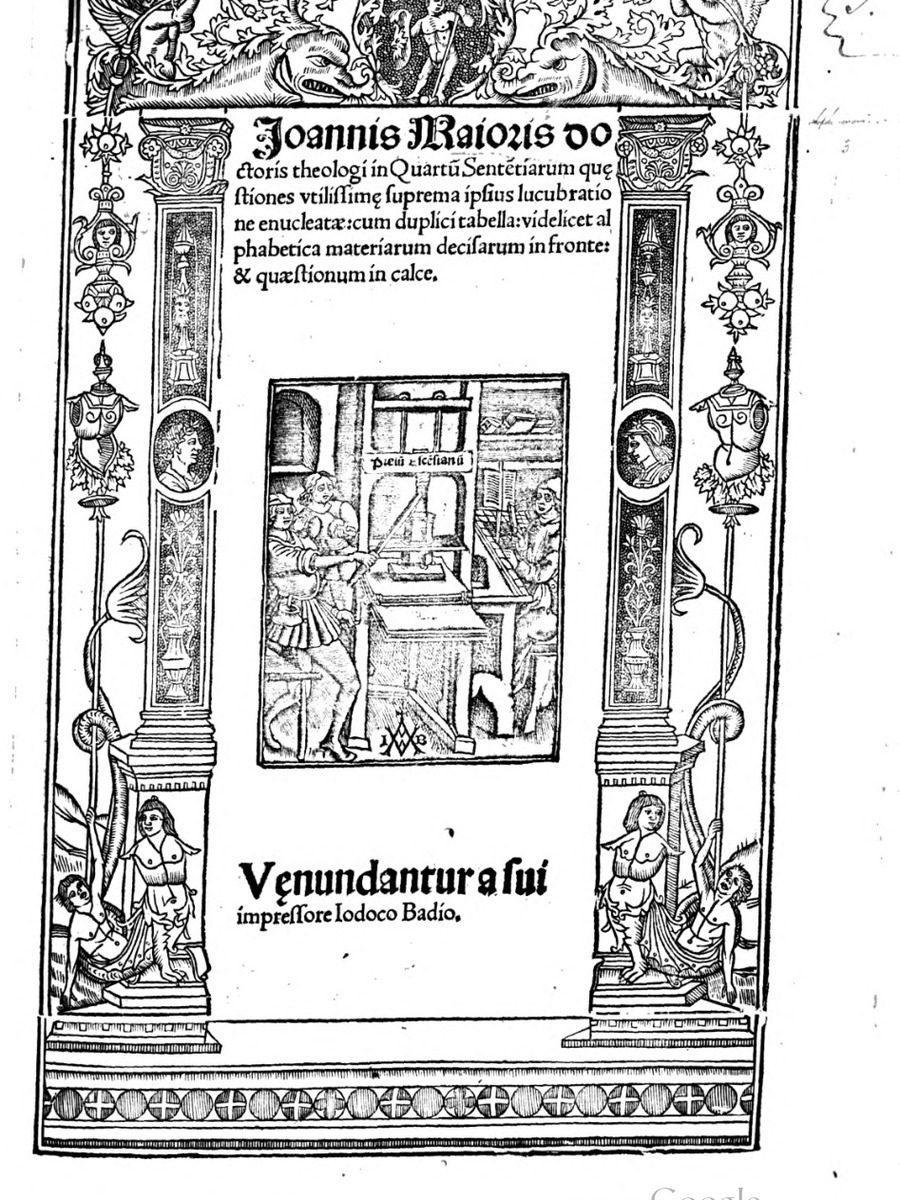
Distinction 25: On Simony
Distinctio Vigesima Quinta: De Simonia
 John Major
Distinctionis Vigesimequinte Questio Prima.
Quia magister in ij. et iij. capitis huius vigesimequinte distinctionis de simonia loquitur: idcirco circa eandem quero aliqua. primo quid sit simonia. quia quid nominis est principium doctrine. in questionibus sequentibus locuturus in speciali de casibus prauitatis simoniace suspectis. Simonia comuniter sic diffinit. Simonia est studiosa voluntas emendi vel vendendi spirituale vel spirituali annexum. Sed Hostiensis dicit hanc diffinitionem esse diminutam et addendi esse (cum opere subsecuto) quia in solo affectu non est simonia. ad hoc canones allegat. vt. i. q. i. ca. Qui studet. Et modo ei comuniter canoniste sequuntur in capitulo finali huius tituli. Sed nec totaliter placet aliorum diffinitio: ea qua ipse facit minus valet: et illam particulam male su-
peraddit. Assertiones has sic ostendo. Omnis simonia est peccatum commissionis: nulla voluntas est peccatum commissionis cum sit anima: ergo nulla voluntas est simonia. consequentia tenet in secundo modo secunde figure. Sed dices. voluntas capitur loco volitionis. Contra. hic adhuc est simonia. nolo dare beneficium nisi habeam pecuniam et tamen non est volitio. Secundo male additur (studiosa). quia vel per (studiosa) intelligis frequentationem actuum vel deliberationem in actu. non primum. quia si primus actus non fuerit simonia: nec aliquis posterior. Non secundum. quia motus secundo primus simoniacus vel actus non plene deliberatus est simonia. quod patet in omnibus inductiue de odio / ira / et periurio / indeliberatis que manent in denominatione totius. igitur. Contra dictum hostiensis arguitur sic. probando quod sit aliqua simonia sine opere subsecuto. et hoc sic. Hic actus est peccatum. volo emere beneficium pecunia: et ad nullum aliud vitium spectat quam ad simoniam. igitur. Insuper simonia a simone mago procedens et nomen infame gerens non habuit opus subsecutum. vt patet Actuum octauo. Preterea qui vult mecheri et non mechatur in opere mechiam committit sicut opere adimplens: iuxta saluatoris sententia. Qui viderit mulierem ad concupiscendum eam: iam mechatus est eam in corde suo. canones aut inducti intelliguntur de penis canonicis non illatis: vt de suspensione et huiusmodi. Aliter ergo diffinio simoniam sic. Simonia est volitio in forma vel in valore emendi vel vendendi spirituale vel spirituali annexum. Dico emere et vendere extenduntur ad omnem contractum non gratuitum. dixi (in valore) propter talem actum: nolo dare beneficium nisi habuero pecuniam: qui in se parit volitionem. Omnes spiritualium emptores vel venditores simoniacos reputant. Et eodem modo cum suis annexis. Vnde capitulo tertio dicit Magister. Nam quisquis horum alterum vendit sine quo alterum non habetur: neutrum invenditum relinquit. Et patet per pascalem papam. i. q. iij. ca. Si quis obiecerit. quidem iuris est in vnum con eorum que in reliquo. iij. q. vi. hec quippe. .ff. de iureiuran. eu qui. Si libertus. ergo ex ratione et vsu loquendi patet diffinitionem esse bonam. Et licet Balaam prophetie donum vendere voluerit. vt patet Numeri. xxij. et recitat Petrus canonica secunda. cap. ij. Cor exercitatum in auaritia habentes: maledictionis filij derelinquentes via recta errauerunt: sequuti via Balaam ex Bosor mercedem iniquitatis amauit: correptionem vero habuit sue vesanie: subiugale mutum animal in hominis voce loquens prohibuit prophete insipientis. Et in Epistola Jude scribitur. Et in errore Balaam mercede effusi sunt. Et Gezi cum lepre pretium accepit: hec tamen pestis non vocatur Balaamia nec gezia sed simonia. Nomina enim ad placitum significant. Nec est querenda vigens ratio. licet congruentia hic dari possit quare simonia vocetur. a simone scilicet mago quod emere voluit spirituale vt iterato venderet: et in lege gratie. Juxta illud Baptiste Mantuani in primo libro Alphonsi dicentis. Volitans per aera simon. Infamis magus et lucri execrabilis auctor. Ex dictis infero aliquas propositiones. quarum prima est. Idem valet dicere: est simonia: et emitur vel venditur spirituale vel spirituali annexum. Secundo sequitur quod simonia est mentalis: et per consequens multum ignota: licet per exteriora nonnunquam homines in notitiam eius perfectam vel caliginosam deueniant. Tertio sequitur quod aliqua est simonia sine pacto. patet in casu inter Petrum et Simonem magum. Textus in co. mandato. de simo. in antiquis. de mentali simonia loquens dicit quod sola penitentia satisfacit suo creatori et per simonis
huiusmodi non teneri. hoc est post penitentiam non sunt simoniacis et pene iuris non subijciantur. Quarto sequitur quod Romanus pontifex potest simoniam committere sicut alij. patet. tota diffinitio potest ei competere. Et propterea ab illa abhorrebat Petrus ne pecuniam a simone mago acciperet. Quinto sequitur. aliqua est simonia conditionalis, ut vellem emere beneficium si iste vellet vendere. alia est absolute categorica. Sexto sequitur. non omnis simoniacus tenetur ad restitutionem. patet. aliquis est simoniacus qui nihil simoniace habuit. Septimo sequitur quod aliquis est simoniacus in quo non est actus simonie. patet in dormiente vel actum non habente qui beneficium emit et adhuc non sufficienter penituit. habitus enim non sufficit aliquem denominare simoniacum, ut patet in habitu remanente, actu simonie purgato. Octauo sequitur quod hec pestis fuit in ecclesia antequam vocaretur simonia. patet ex dictis. Nono sequitur. interdum est simonia ex parte vendentis tantum et ementis tantum, nonnunquam ex parte vtriusque. Decimo sequitur quod aliquis est simoniace promotus et tamen non est simoniacus. patet si parentes Titij penitus ignorantes ei beneficium emant, iam titulo simoniaco beneficium acquirit, et cum sit in ignorantia inuincibili non est simoniacus. Similiter aliquis est simoniacus et non simoniace promotus, ut quando episcopus dat alicui iustum titulum in beneficio et alter mentaliter vellet beneficium emere, sed in opus non exit. Tertius est aliquis simoniacus simoniace promotus. aliquis sit nec simoniacus nec simoniace promotus non cadit in dubium.
pro intelligentia istius vocabuli (spirituale et spirituali annexum) Arguitur sic. Simoniacum est vendere sacramenta, et tamen ipsa sunt pure corporalia ut in singulorum sacramentorum exordijs explanare consueuimus. Forte dicis: sunt annexa spiritualibus. Contra. sic sunt fructus beneficiorum, libri et calices, que tamen venduntur. Respondetur. quis potest sic capere spirituali annexum ut spiritualia includat et econuerso, sed illa non est intentio diffinitionis. Spirituale concretum vocabuli spiritus in vna acceptione corpori non conuenit. quomodo dixit Christus. spiritus carnem et ossa non habet. Luce vltimo. Dicimus tamen virum deuotum spiritualem, et visionem magis spiritualem quam auditionem, quia secundum materiam subiectam sermones accipiendi sunt. comuniter dicitur. aliquod est spirituale per essentiam ut gratia et virtutes. Secundo per causalitatem, ut sacramenta que sunt causa gratie characteris vel ornatus in anima. Tertia sunt spiritualia per effectum. Contra hoc arguitur sic. actus meritorius esset spirituale secundo modo, et homo predicans vel docens, similiter scientia creata que vendi potest, non quod de subiecto in subiectum transeat, sed de per accidens ad venditionem scientie, vel sciens scientiam producit in alium, et ratione illius potest capere precium temporale ut posthac dicetur. Dico spirituale in proposito esse illud quod ordinatur ad opus quod miraculose et supnaturaliter speratur a spiritusancto. exempla de illis, ut sacramenta ordinantur ad infusionem gratie virtute operis operati: dare virtutem, miraculose infirmum curare, varijs loqui linguis, prophetizare et cetera id genus. propterea Heliseus nolebat accipere aliquid pro miraculosa cura Naaman Syri. et illud quadrat cum responso Petri Actuum viij. Cum vidisset aut Simon quia per impositionem manus apostolorum daretur spiritussanctus, hoc est eius donum, loqui varijs linguis et more apostolorum supna-
turaliter agere. sequitur. Obtulit eis pecuniam. cui respondit Petrus. Pecunia tua tecum sit in perditionem quoniam donum dei existimasti pecunia possideri. Et Matthei x. Christus premissis miraculis apostolis mandatis subiunxit. Gratis accepistis, gratis date. supple hoc. si autem theologia esset alicui infusa vel alia scientia, quia homo naturaliter alios docendo applicat, pro laboribus et scientia qua docet potest capere lucrum, sicut per scientia naturaliter acquisita. Ergo sacramenta ipsa et facere illa supnaturalia sunt spiritualia. Annexum spirituali est ius quod habet aliquis in fructibus leuandis ratione officij diuini et illud quod tale officium precise manutenendum sicut in fine septime questionis dicetur. labor autem licet hic annectatur est vnum comune quod in quolibet officio est necessarium, quare non est spirituali annexum. Sicut scientia acquisita non est spirituale in proposito, ita nec libri nec alia necessaria sunt spirituali annexa ut in proposito capimus. Ex quo et sequitur quod non omne spirituale per essentiam est spirituale ut in proposito capimus. patet de scientia acquisita.
sic tenet Durandus et Paludanus, quia secus dicendo esset palliatio simonie. nec est verisimile (dicunt) quod pro tam paruo labore daretur tantum pecunie, ut patet in celebrante missam cui sex parui albi porriguntur. sed ille rationes non concludunt. Ratio. Celebrans vel aliud diuinum officium faciens per pecunia potest dicere se pecuniam capere ratione sustentationis, quod est licitum secundum omnes. Et si cesset tanta palliatio in vendendis spiritualibus accipiendo pecuniam ratione sustentationis sicut ratione laboris. Nec aliud concludit quod pro ita paruo labore quem habet sacerdos celebrando capiet sex paruos albos, quia illos capit tam ratione laboris quam ratione sustentationis. nam celebrando opus totius diei compleuit, pro vesperis enim et alijs horis nihil ei conferri solet. Etiam vnus pro paruo labore plus capit quam alter multum laborans. patet de aduocato et lapides ferente. Et quod pro labore accipere liceat patet. Numeri xviij scribitur. Filijs Leui dedi omnes decimas Israel pro ministerio quo seruiunt mihi in tabernaculo federis. et paulo post sequitur. Comedetis eas vos et familie vestre, quoniam precium est pro ministerio quo seruitis in tabernaculo testimonij. hoc tenet glossa in capitulo Significatum de prebendis, quod licet sacerdoti locare operas ad certum tempus et recipere mercedem pro suo labore, si alioquin ratione beneficij ad hoc non tenetur conformiter ad legem diuinam vnicuique mercedem secundum suum laborem reddentem. hoc tenet Bonauentura hic. Preterea aliud est quod multum mouet: facultas nostra a xxxiiij annis preteritis contra fratrem Joannem angeli qui in secundo articulo sic predicabat: curatus parochialis nihil debet recipere a parochianis suis pro confessione et sacramentorum administratione. sic definiuit. hec propositio est contra dispositionem iuris naturalis et diuini expresse, ideo falsa et notorie heretica. Nam sacerdos non capit pro sacramentis sed pro eorum administratione que actionem et laborem importat.
Altisiodorus tertia parte, questione penultima de simonia dicit simoniacum esse aliquid capere pro doctrina. Alij autem capiunt pro labore sicut sacerdos conductus accipit pro labore. quem modum Alexander Halensis in secunda parte insequitur. Alius modus est sicut comunior ita et verisimilior, quod actus spirituales a spiritu creato procedentes vendi possunt.
probatio. Alioquin non liceret artifici pecuniam pro suo artificio capere: cuius oppositum asserunt omnes. Nec sufficit dicere quod capit ratione laboris quia tunc semper magis laborans deberet plus capere: quod est falsum. Item iurisperitus consilium et advocatus patrocinium vendere potest.
Sed contra istud arguitur argumento Altissiodori. Ars fabrilis vendi non potest. ergo nulla ars antecedens patet. est donum dei: sicut dicit glossa interlinearis Exodi xxxi super verbo (Beseleel) Impleui spiritu dei et sapientia et intelligentia et scientia in omni opere ad excogitandum quicquid fabrifieri poterit.
Respondetur. licet quelibet res mundi sit donum dei et ars quecumques illuminans intellectum: tamen hoc non sufficit ad spirituale in proposito ut patet ex dictis. Secundo arguitur. posse vendere scientiam sine simonia est contra determinationem Romani pontificis. patet de magistris capitibus primo et secundo. in capitulo primo et pro licentia vero docendi sic scribitur. Pro licentia vero docendi nullus precium exigat vel sub obtentu alicuius consuetudinis: ab eis quos docet aliquid querat. Et in capitulo sequente scribitur. Prohibeas ne in parochia tua pro licentia docendi exigatur aliquid: aut etiam promittatur. Si quid vero postea solutum fuerit vel promissum: remitti et promissum facias restitui.
Respondetur negando quod illud quod diximus sit contra pontificis determinationem. Illic enim non prohibetur accipere aliquid pro doctrina: immo licitum est et capere et petere tam pro doctrina quam pro labore in docendo habito: si quis non fuerit ad hoc stipendijs deuinctus. Sed prohibet illic pontifex capere pecuniam pro danda facultate alicui ad docendum. quia sic non idonei essent admissi. Et propterea in capitulo primo: de magistris allegato prohibet pontifex negare licentiam idoneo docere: inquiens. Nec docere quemquam qui sit idoneus, petita licentia, illis interdicat. Qui autem contra hoc venire presumpserit: ab ecclesiastico fiat beneficio alienus. Dignum quippe videtur ut in ecclesia fructum sui laboris non habeat: qui cupiditate animi dum vendit docendi licentiam: ecclesiasticum profectum nititur impedire. Et propterea Cardinalis Cameracensis quendam tractatulum contra cancellarium parisiensem scripsit, ostendere laborans simoniaci esse: pro licentie munere aliquid accipere. Et illud patet ex capitibus duobus allegatis.
Hactenus quid nominis simonie spiritualis et spirituali annexi: et quod licitum est in spiritualium administratione: ut sacramentorum aut quorumcumques aliorum aliquid temporale accipere: nedum pro sustentatione: sed pro labore ipso. Etiam quis quale creatum vendere potest, ut pictor pro sue artis eruditione: et similiter citharedus aliquid accipit: et non pro solo labore. in arte aut eruditus et ingeniosus: minus laboris habet quam ineruditus et rudis: et tamen plus premij capit. ita denique in omnibus artificibus: non tamen quia artem sibi inherentem in alium producat, quia accidens de subiecto in subiectum migrare naturalis philosophia non admittit. sed lumen, lumen spirituale causat in passum susceptiuum: sicut unum corpus luminosum ab alio illuminatur. sed in luminis spiritualis productione passum nedum patitur: sed agit. quod in corporali lumine non contingit.
Preterea vigilanter considera siue dicas laborem venalem: siue scientiam creatam, siue non: non amplius dilatatur os simonie quam dicendo oppositum. Patet exemplariter de tribus doctis artificibus aut philosophis paribus tam in traditione artis quam in eruditione: equalem pecuniam accipientibus: quorum unus dicat se capere pro sustentatione sui et suorum. Alius dicat se capere pro labore quem non tenetur alijs gratis
impendere: et nihil pro sua scientia. Tertius dicat se accipere tam pro sustentatione et labore quam pro sue artis traditione. Et hoc patet in ministratione sacramentorum. fateor tamen quod licet aliquid recipere uno respectu: et non alio. sicut postea in eadem hac distinctione elucescet.
Secundo circa hac distinctionem queritur. Utrum simonia sit graue peccatum. Respondetur per conclusiones. Prima est affirmatiua ad questionem. que conclusio sic probatur. Omnis actus iuri nature diuino et humano oppositus est malus: simonia est huiusmodi: igitur. probatio minoris. contra equitatem naturalem est quod quis vendat dona spiritus sancti que non sunt in sua potestate: imo ipsum spiritum sanctum tradit sicut seruum suum. ut patet ex epistola Tharasij episcopi Constantinopolitani ad Adrianum papam missa. Et recitatur prima questione i capitulo Eos qui. ubi scribitur. Tolerabilior est eorum Macedonianorum qui circa ipsum sunt spiritus sancti impugnatorum impia heresis. illi enim creaturam et seruum dei patris et filij, spiritum sanctum delirando fatentur. isti vero spiritum sanctum efficiunt suum seruum. Omnis enim dominus quod habet si vult vendit, siue seruum, siue aliquid aliud eorum que possidet.
Etiam est contra ius naturale queuis capere pecunia pro translatione rei que non est in sua potestate. Tertio dato quod esset in eius potestate: vendit rem precio temporali inestimabilem: quia est spirituale pro pecunia. Sapientie vij scribit quod ipse est pretiantior cunctis opibus et talia desiderabilia non valent ei comparari.
Forte dicis. non oportet respicere ad valorem rei in se: sed res transmutantur secundum indigentiam humanam: secundum illud Augustini xi de ciuitate dei capitulo xviij. Quis enim non domi panem quam mures infimos et pulices habere malit. Seruus viliori precio distrahetur quam gemma. licet de scientia creata possis argumentum sic refellere probabiliter non tamen de spirituali de quo loquimur: quoniam bona humana in valore humane indigentie exuperat, hoc est de valore fori et non de valore rei loquendo. Et propterea omnes traditorem Judam merito carpunt quod redemptorem orbis Deum tam modico ere vendiderit.
Et licet simonia sit contra ius nature: stat tamen de multis casibus dubitare: an in eis sit simonia. hoc patet de usura et fornicatione simplici que a gentilibus non putabatur esse contra ius nature. Quod sit contra ius diuinum patet Actuum viij, Matthei x: gratis accepistis: gratis date. ubi glossa dicit. hic prohibetur simonia. Illic enim erat sermo de miraculis et stupendis prodigijs faciendis, quia ante ista verba immediate dicitur. Infirmos curate: mortuos suscitate: leprosos mundate: demones eijcite. gratis accepistis: gratis date. ubi glossa interlinearis. sicut ego sine precio talem potestatem do: et vos gratis date. per hoc tamen non oportet quod scientiam acquisitam gratis habens alijs gratis comunicet.
Preterea iij Regum xij capitulo de Hieroboam legitur. Quicumques volebat implebat manum suam: et fiebat sacerdos excelsorum. Forte dicis. colebat idola et erant sacerdotes idolorum. Responsio. dato quod sic: vendendo sacerdotium: et non capiendo sacerdotes de tribu leui: et de domo Aaron, grauiter deliquit. ut patet per literam sequentem. Et propter hanc causam peccauit domus Hieroboam et euersa est et de
let a de superficie terre. Propterea lepra Naaman adhesit Giezi et semini eius in sempiternum, ut patet III Regum v. Ergo est contra ius divinum. Quod fit contra ius humanum patet, de simonia per totum, I q. i per totum. Ergo minor vera quae restabat probanda.
Simonia est pessimum monstrum in ecclesia. Probatio: illa pestis est pessima in ecclesia per quam promoventur inidonei, posthabitis maxime idoneis, sicut contagiosus esset morbus homines impellens accipere lapides putridos pro templo materiali construendo, posthabitis marmoribus. Sed hoc potissimum fit per simoniam, per quam improbi ad honores conscendunt, nequientes per virtutes ascendere, assumentes illud insane Iunonis apud Maronem: Flectere si nequeo superos, Acheronta movebo. Munera enim porrecta animos etiam prudentum flectunt, secundum illud Nasonis: Munera crede mihi placant hominesque deos; placatur numis Juppiter ipse suis. Preterea hoc est pessimum monstrum in ecclesia quod hominem reddit utraque manu iniquitate refertum. Sed hoc per simoniam fit, igitur. Probatur minor per illud psalmiste, psalmo xxv: In quorum manibus iniquitates sunt, dextera eorum repleta est muneribus. Insuper ille est fur iniquus qui calicem, libros ecclesie et huiusmodi furatur. Sed totum beneficium simoniacus furatur. Joannis x: Qui non intrat per ostium in ovile ovium, ille est fur et latro. In furto autem tota eius vita deprehenditur, nam uno inconvenienti dato in principio multa mala contingunt, primo Phy. Et difficile est ut bono peragantur exitu, quae malo sunt inchoata principio, I q. i ca. Principatus. Amplius huius pestis gravitas patet ex displicentia dei, nam ignis sacrificii qui datus est in deserto celitus, scilicet secundo anno egressionis de Egypto, et duravit ad captivitatem Babylonicam, et tunc absconsus in profundo puteo ab Ieremia propheta, illic mansit septuaginta annis integer. Et iterum habitus tempore Neemie, postea Antiocho sacerdotium Jasoni vendente extinctus est, ut patet II Maccabeorum primo.
Contra has conclusiones arguitur sic. Simonia est circa intellectum, ergo non est peccatum. Consequentia tenet: omne peccatum est in libera potestate facientis, ergo circa voluntatem. Antecedens patet quia simonia est heresis, I q. i Quisquis et cap. Presbyter. Respondetur: assentiri huic, donum Spiritus Sancti est venale pro pecunia, est heresis, et sic Simon magus putabat. Unde Ambrosius in primo libro de Penitentia, ad Novatianum scribens, dicit: Petrus cum Simon magice artis consuetudine depravatus putasset quod gratiam Christi per impositionem manus et infusionem Spiritus Sancti pecunia compararet, ait: non est tibi sors neque pars in hac fide, quia cor tuum non est rectum apud deum. Hoc est: erras in fide catholica, et sic hoc pertinaciter asserens est hereticus. Non tamen oportet nunc alium simoniacum tenere heresim, nam contingit prelatum recte assentiri in intellectu quod in venditione beneficii committitur simonia et male agitur, quo non obstante agit, quia crebro voluntas contra it ex sua libertate recto intellectus iudicio. Etiam consequentia illic illata nulla est, quia probaret nullum hereticum peccare, nam assensus erroneus in fide in intellectu est liber et a voluntate dependens, quia potest homo libere heresim non admittere, vel admissam adimere.
Presbyter celebrat pro sex parvis albis anniversarium in certa quota pecunie constitutum. In facultate nostra Parisiensi mos est ut magister in theologia det facultati nonaginta vel centum francos pro
missa perpetua dicenda, in qua cuilibet missam visitanti in distributionibus communicatur duodenus. In istis autem spirituale pro temporali datur, ergo non omnis datio temporalis pro spirituali et econverso est simonia, vel reputatissimos viros labe simonie infectos dabis.
Quis potest celebrare pro sex parvis albis septupliciter. Primo tanquam pro fine principali et ultimato. Secundo tanquam pro precio adequato, ac si esset iustitia comutativa et valor rei ad rem, sicut est de emptione bovis in foro. Tertio pro sex parvis albis tanquam pro fine minus principali et subordinato vel subordinabili alteri fini ulteriori. Quarto modo vult celebrare pro sex parvis albis et habere pecuniam pro sua sustentatione. Quinto modo pro suo labore quem habet in celebrando. Sexto pro distractione et impedimento quo impeditur celebrando ne aliis negociis vacet, et potest esse mixtio harum specierum. Et prime due intentiones sunt simoniace denotatione intrinseca, et tales actus habens est simoniacus. Alie simplices sunt licite et in habente gratiam meritorie. Sed si unus primorum duorum modorum copulatim misceatur cum alio, mixtio est illicita. Sic hic est amphibologia: Sortes celebrat pro sex parvis albis, secundum quod "pro" potest dicere circumstantiam finalem, et hoc bifariam, vel circumstantiam ultimati finis, vel finis non ultimati. Alii sensus clari sunt.
quod canonicus surgit de nocte ut habeat distributiones et propter deum, nec tamen propterea committit simoniam. Similiter plerique veniunt ad servitium ea hora qua dantur distributiones, alioquin non venturi, sine labe simonie. Et licet indoctus etiam sacerdos nesciat ita punctualiter distinguere in quo sensu pro sex parvis albis celebret, est excusatus, quia videt talem consuetudinem celebrandi a doctis admissam et non reprobatam, ergo et est danda venia, licet in fine aliqualiter aberret, nam contingit quod in nullum finem actualiter refert ultra sex albos. Et licet simonia sit contra ius nature extendendo vocabulum quod sapientes deprehendunt, non tamen quodlibet contra ius nature propriissime dictum.
Presbyter non celebrabit nisi habeat sex parvos albos. Similiter nec canonicus veniet ad horas canonicas si non sit distributiones recepturus. Ergo pecunia est causa principalis, cum ea posita ponatur adventatio et ea seclusa non ponatur, ergo est causa principalis. Respondeo: non concesso antecedente, nego consequentiam, quia posita causa minus principali cum causa principali ponitur effectus, neutra tamen illarum sufficit ad positionem effectus, sed quacunque illarum seclusa removetur effectus. Quemadmodum quis vadit ad Sorbonam ut disputantes audiat et de vino baccalaureorum bibat, qui tamen propter unum tantum non iret, sed propter illa duo, nam uno illorum remoto, ut in die ieiunabili, non accedit. Non tamen propterea sequitur quod sex parvi albi sunt causa principalis. Illa enim causa est magis principalis que plus appreciative movet, vel ad quam alia reducitur tanquam finis sub fine. Sed contra: celebrando ut habeam sex parvos albos, illi sunt finis celebrationis in uno sensuum illicito, et ergo sex parvi albi sunt causa principalis. Patet in simili: non evangelizamus ut comedamus, sed comedimus ut evangelizemus. Similiter non vivimus ut comedamus, sed comedimus ut vivamus. Respondetur: licet aliquorum sit opinio quod pervertitur ordo finium quando finis principalis ad finem minus principalem ordinatur, hoc tamen non oportet, ut patet ex solutione argumenti, ubi celebratio ad sustentationem ordinatur. Sic potest esse de predicatione, et ex consequenti dicendum est quod homo evangelizat ut comedat, sed
comestio non est causa finalis vltimata nec econuerso.
ponuntur alique regule. quarum prima est. Deus est causa finalis omnium sicut causa efficiens. Apocalypsis primo. Ego sum alpha et o. principium et finis. in quem omnes bone operationes sunt virtualiter et finaliter ordinande: licet non semper actualiter. Secunda regula. Inter fines medios ille est principalior qui est alio perfectior: et immediatius in finem vltimum tendit quam alter. sic est euangelizare verbum Christi populo communicando: quod est multum spiritualiter excellens. Manducatio vero est circa corpus sine quo in hac mortali vita viuere nequimus. quantumcunque enim alte per aera aquila volitauerit: oportet in terram descendat pro corporis cibo habendo. Tertia propositio. Non tamen peruertitur ordo finium quando vnus finis mediatus et principalior ordinatur in alium finem minus principalem ad aliquem bonum sensum. vtpote quando finis principalis sine fine minus principali haberi non potest: vt prouisione aliunde non habens non potest euangelizare sine sustentatione. propterea potest euangelizare vt sustentationem habeat. et iterum prudens capit illam sustentationem vt euangelizet: euangelizat vt deo placeat: et habeat beatitudinem: et sic est finium reciprocatio. Et sic est quodam modo nisi vnus finis tantum secundum philosophum tertio Topicorum. vbi vnum propter alterum: ibi vnum tantum. Et sic duplex premium accipit euangelizans. vnum temporale quo ad sustentationem a populo. Aliud eternum expectat a deo. Vnde super illud prime ad Timotheum quinto. Qui bene presunt presbyteri etc. dicit glossa Augustini. Accipiens sustentationem necessitatis a populo: mercedem dispensationis a domino. Ex isto patet quod quis potest religionem assumere vt sustentationem in ea habeat. Similiter velle esse sacerdos vt beneficium obtineat: non tamen vltimate.
ex ista sextuplici distinctione ad solutionem argumenti missa datur palliatio simonie. nam vendens beneficium dicet. capio mille scuta in donatione beneficij non pro precio adequato: nec pro fine vltimo: sed pro sustentatione / labore / vel huiusmodi. Respondetur. capere mille scuta in donatione beneficij non est medium ad hoc subordinatum. et est simile ac si diceres. volo occidere istum hominem propter gloriam dei. Aliquid est ordinabile in finem vltimum: aliquid vero non. Et licet versipellis collator dicat. capio mille scuta gratis: et do ei beneficium gratis: deus scrutatur corda et renes: et presumptio capientem et dantem simonie labe notat. Et dato quod non esset simonia (quod est falsum) peccaret alios scandalizando: et suam famam imputabiliter negligit. Et propterea precipit Apostolus prime ad Thessal. vltimo. Ab omni specie mala abstinete vos. nam contingit aliquid intrinsece non esse malum: sed propter pellem malitie esse malum.
quando vacat aliqua prebenda pinguis conferenda: potest episcopus seruare ad tempus pro aliqua pia causa aliquam portionem illius prebende pro duobus vel tribus annis secundum exigentiam occurrentem. ponamus quod fructus isti leuandi ad mille francos se extendant. hoc supposito. arguitur sic. episcopus potest beneficiando dicere. des mihi mille francos in promptu et beneficium libere tibi dabo: cum omnibus fructibus eius: mille francos tuos applicabo fabrice ecclesie vel tale hospitale reparando vel instruendo: si potest successiue hos fructus colligere: quare non potest eos capere? Respondetur illam suppositio-
nem concedendo et potissimum post consultationem habitam cum sapientibus iam non erit vmbra simonie: sed non licet illas pecunias in promptu capere: cum nesciatur an conferens morietur ante fructus leuatos tum etiam propter speciem mali.
licet vendere ius patronatus et tamen ius patronatus est quid spirituali annexum antecedenter: cum ordinetur ad presentandum clericum ad beneficium ecclesiasticum. igitur. probatio maioris. vendens dominium in quo est ius patronatus in emptorem ius patronatus transfert. nisi specialis fuerit mentio de retentione eius. de iure patronatus capitulo Ex literis. Respondetur negando quod vendat ius patronatus: sed ipsum transfert cum colligantia dominij cui annectitur. Et si dominium mille libras stirlingorum valeat sine iure patronatus vendendo dominium ratione patronatus non licet plus accipere.
Omne ius quod venditor habet in emptorem transfert titulo emptionis et venditionis. sed quandoque hanc propositionem absque negabis: queritur quo titulo in alium transfert ius patronatus: Respondetur titulo colligantie de per accidens ius patronatus potest a dominio separari. sed non nisi in casu speciali. sicut vendens hominem / bonum angelum et malum a sua domo alienat sed non titulo venditionis nisi de per accidens. Fateor tamen quod venditio est causa sine qua non accessionis iuris patronatus.
Quis potest emere omnes fructus huius beneficij vt decimas et tamen decime sunt annexe spirituali. igitur. quod liceat: constat. cum decime sunt triticum / agni / cape / et huiusmodi. Forte dicis. licet istas decimas emere et eas vendere: sed non licet emere ius leuandi decimas. hoc enim ad ecclesiasticum spectat qui habet titulum in quo fundatur ius leuandi. Contra hoc argumentor. ius leuandi decimas est aliquid: vel ergo est realiter res decime vel homo leuans decimas. Si primum. sic argumentor. has decimas licet sorti laico emere. he decime sunt ius leuandi decimas. ergo ius leuandi decimas licet sorti emere. Et eodem modo probabo quod liceat alteri vendere. Insuper laicus capiens fructus ecclesie per triennium a prelato habet ius leuandi decimas: alioquin iniuste eos leuaret. Si dicas ius leuandi esse sacerdotem: sortes habet ius leuandi sicut habet gradum. quero a te. que res est gradus non est aliud quam homo graduatus. Sed pono quod venundetur sicut paulinus Nolane vrbis episcopus pro liberando filio vidue. Tunc sic. prelato hunc presbyterum emit. hic presbyter est ius leuandi decimas. igitur. Ridetur negando consequentiam. sed ius leuandi decimas emit: qui capit beneficium triennio iuste leuat. et habet ius leuandi: sed non ratione officij. Beneficiatus autem est ius leuandi ratione officij secus est de capiente ab illo. et dato per possibile quod sacerdos beneficiatus esset seruus licet sit preter rationem: dominus eius non habet dominium in bonis ecclesie: quia non sunt illi nec illo modo distrahere licebit illius ponantur decimi fructus colligendi. Concedo similiter quod prelato ius leuandi decimas emit: sed non emit ius leuandi decimas ratione officij. nam emere importat actum voluntatis: et sic facit appellationem rationis. hoc complexum (ius leuandi decimas ratione officij) supponit pro prelato connotando quod suo officio incumbit hos fructus leuare: vel pro decimis ipsis connotando quod a tali ratione officij leuari possunt.
simonia esse peccatum graue. et quo modo licet pro spirituali accipere pecuniam tanquam pro sustentatione et labore. non aut pro precio adequato rei: ac si esset iustitia comutatiua. et recipiendo / conscientiam non debet facere. nam vnus potest tantum licite lucrari sicut alter illicite. vt vnus concionator colligit scilicet pecuniam tanquam valorem adequatum verbi
diuini. alter pro sustentatione equales equaliter lucratur in bursa: unus licite: alter illicite. Amplius pauca de reductione finium: et de principaliori et minus principali dignoscendo diximus.
Tertio queritur circa materiam simonie. An prece et obsequio committatur simonia. et pro questionis solutione ponuntur conclusiones. quarum prima est. Non est simoniacum preces porrigere pro idoneo sive pro se sive pro alio. Quod quis possit pro se beneficium petere: distinctione precedenti ostendimus. probatur conclusio. omnis simonia est peccatum: porrigere preces pro idoneo non est peccatum: ergo porrigere preces pro idoneo non est simonia. consequentia tenet in Baroco. Probatio minoris. quis licite potest petere pro se: ergo a fortiori pro alio idoneo erga quem minus efficitur. Secundo probat idem. video sortem ad officia curatiuarum multum idoneum et gregis utilissimum pastorem: et indigum. quis diceret me male agere collatorem rogando ut huic conferat beneficium
episcopus huic beneficium conferens quod est idoneus: licet preces sint causa sine qua non: bene agit. nam contingit quod preces effundens: sit dignus cuius testimonio de bonitate beneficiandi fides adhibeatur.
licet fictione iuris episcopus idoneo beneficium conferens principaliter propter preces non curando de idoneitate: non fit simoniacus: tamen coram deo et in rei veritate est simoniacus. Prior pars patet. quod est presumptio quod det beneficium ratione idoneitatis. Et casus ambiguus de bono et malo in meliorem partem est interpretandus ut in regula.
quia si esset inidoneus: non minus ei beneficium conferret. ponamus talem cui non est cordi idoneitas: istum munera lingua principaliter mouent. et patet eadem pars. volens occidere Titium / et percutiens statuam quam credit esse Titium / imputabiliter est homicida. et ratio est quia animus eius in Titij occasionem tendit: de statua non curando. eodem modo est in proposito.
Si idoneitas eius pro quo rogatur esset collatori incognita esset simonia: sed dat beneficium intuitu precum / sive sit idoneus sive inidoneus et sic committit simoniam: scientia enim in proposito eum non mouet: et perinde se habet ac si collatorem lateret. ergo si nullo modo idoneitas mouet ad collationem beneficij / est simonia: et etiam si minus principaliter idoneitas mouet: est simonia / licet minus grauis. potest enim malus peruertere ordinem finium. Eodem modo dicendum est de obsequio.
dans inidoneo beneficium ratione precum simoniam committit. patet. ratione precum dat precise. cum enim nulla sit idoneitas in viro / ratione illius non dat. et perinde est ac si pecunia a beneficiando caperet. quia possunt preces magnam valere pecuniam in consideratione collatoris: ut quia collator cupit amicitiam rogantis / laudem vel huiusmodi. hoc patet de vulgata distinctione de triplici munere. scilicet. de munere a prece / manu / et obsequio.
Quis rationabiliter seruit collatori beneficij credens quod bonum seruitium et fidele cognoscet et sua idoneitas et citius promouebitur quam alter: sed conferetur ei beneficium ratione idoneitatis sine pactione ulla. si tamen principaliter seruit ut beneficium habeat: inique agit. nec est cura quo seruitio is seruit: dummodo sit idoneus et honeste honestate morali seruiat.
Dans beneficium famulo in subleuamen mercedis reddende eidem / simoniam committit. probetur. capit virtualiter pecunias pro spirituali annexo. ergo committit simoniam. nam idem est remittere centum scutos collatori / que debet famulo reddere: et illa recepta collatori dare. Propterea dictum Hostiensis est nullum qui dicit. Si episcopus recipiat clericum in seruitium promittens ei salarium annuatim donec ei prouideat de beneficio competenti: collato beneficio remittitur salarium et non est simonia. immo est. quia intenditur inter eos quod gratis seruiat beneficio adepto. ergo virtualiter episcopus capit pecuniam quam deberet pro seruitio dare ratione beneficij. ergo est vera simonia. patet per dictionem communem de triplici munere. scilicet. de munere a manu / lingua et obsequio: ad simoniam incurrendam.
Non refert in rei veritate parum collator capiat: quod est causa beneficij conferendi: licet pro modico non presumatur episcopus tortuose motus. probatio. dare beneficium alio respectu quam idoneitatis et vtilitatis publice est iniquum et ad acceptionem personarum spectat ex distinctione precedenti: sed hoc est simoniacum. ut ex dicendis patebit. igitur. Preterea paruum furtum ex parte obiecti furem mouentis ad furandum est furtum et peccatum sicut furtum magnum: licet non ita graue. ergo paruum acceptum collatorem mouens ad tortuose conferendum est peccatum sicut magnum. Alterius munusculum tantum suauem et imprudentem mouet ad tortuose agendum sicut magnum munus liberalem et prudentem. ergo ad magnitudinem obiecti non est respiciendum: sed ad animum illius qui flectitur sinistre. nam contingit unum tantum moueri ob deauratam imaginem vix duo scuta valentem: quantum alium propter optimum gradarium
quia si conclusiones essent vere: sequeretur hec conclusio. quod collator beneficium conferens consanguineo ratione consanguineitatis esset simoniacus sicut dicebat cantor parisiensis. hoc Altisiodorus. Beatus Thomas et posteriores omnes reprobant. Et quod sequatur patet sic. dat pro munere a sanguine. Sed dices sicut dicunt isti doctores. episcopus hic nihil accipit: et sic licet peccet edificando sion in sanguinibus: non tamen committit simoniam. probo quod isti repugnant sibi sic dicendo: quia nec capit pecuniam collator conferens beneficium inidoneo vel idoneo principaliter propter preces. ergo est repugnantia unum concedendo et illa ratione aliud negando. Dominus Innocentius in cap. Tuam. de eta. et quali ordinan. dicit quod preces ratione precij non causant simoniam bene autem si ad pecuniam referantur. et in eodem cap. Cardinalis insequitur.
isti doctores et communiter loquentes sic dicere nequeunt: quia sic ista distinctio esset nulla. Item arguitur ratione. preces alicuius tantum mouent aliquem ad tortuose conferendum beneficium quantum ducenti vel trecenti ducati quod eis equivalent in apprehensione conferentis. sed unum sufficit ad simoniam: ergo et reliquum. Propterea recte dicit Seneca de beneficiis libro secundo. Non tulit ille gratis qui cum rogasset accepit. Insuper nulla res charius constat quam que precibus empta est. ut patet in cap. Sunt nonnulli. i. q.i. Sunt nonnulli (inquit Beatus Gregorius) qui prorsus pretia ex ordinatione non accipiunt: et tamen sacros ordines pro humane gratie fauore largiuntur
atos de ipsa largitate laudis solummodo retributionem querunt. hi nimirum qui accipiunt gratis: gratis non retribuunt: quia de impenso officio sanctitatis: nunquam petunt fauoris. vnde bene cum virtuosum prophetam describeret: ait. Beatus qui excutit manus suas ab omni munere. non dixit solum a munere: sed ab omni munere. quia aliud est munus ab obsequio: aliud a manu: aliud a lingua. Sic ille.
et non soli sanguis: sed timor incussus a tyranno: et cetera id genus: quecunque fuerint. nec de illa distinctione trimembri curandum est. nam plura sunt alia membra. forte dices. quando beneficium confert consanguineo affini vel alteri: aliquis loquitur pro consanguineo vel aliqua. et nec munus a lingua beneficium tenere. hoc non iuuat aduersarios de sanguine loquentes tanquam ab istis tribus separato. et Preterea stat collatorem dare beneficium nullo loquente: sola intuitu sanguinis vel affinitatis. igitur.
Sed contra istud arguitur. In distinctione precedenti dicebam quod inidoneus ad idoneitatem accedens non tenetur beneficium sibi collatum restituere: et quodlibet beneficium habens simoniace beneficium ipsum resignare tenetur. igitur. Insuper secundum dicta quilibet peccans conferendo: simoniam comitteret: et sic collator idoneo beneficium conferens/ relicto magis idoneo comitteret simoniam: quod est absurdum.
Ad primum concedo maiorem. et minor est falsa. imo in casu tertie conclusionis beneficium idoneo simoniace confertur. et tamen idoneus ille non tenetur beneficium restituere: cum alter sit capax. et collator realiter confert licet propter malum finem: hoc non vitiat collationem. vt si liberaliter darem forti decem adiungendo circunstantiam venialem vel mortalem in ratione obiecti cadentem: doni tenet. et alter doni dominium acquirit. hoc in distinctione precedenti de hypocrita et paupere diximus. Non valet ratio domini Armacani libro decimo ad Armenios dicentis. intrantem per peccatum in beneficium non acquirere verum titulum in ipso. cum non ingrediatur per ostium sed aliunde ergo est fur et latro. Joan.x. Sed absit vt christianus dicat (inquit) ingrediens per peccatum per ostium ingrediatur. Non valet inquam hec ratio. quia pluribus modis per peccatum homo acquirit verum titulum in re aliqua. patet de vendente equum in festo prohibito. quod acquirit dominium pecunie: et alter dominium equi. dato etiam alter sit excomunicatus: et clericus cui talis negociatio est vetita: et a triplici capite peccat: et tamen res transferuntur. ergo non est inconueniens quod aliquis in beneficium intret per peccatum tanquam ostium. quod per hunc actum ingreditur: hic actus est peccatum. et per peccatum ingreditur. sed hoc non est ratione qua est peccatus: sed ratione qua ponuntur omnia essentialia ad collationem beneficij vel ad rerum translationem acquisita. illud Joannis.x. ad literam intelligitur de fide catholica: vt glossa interlinearis exponit. Qui bene sentit de Christo: intrat per ostium in ouile. qui aliunde ascendit: de Christo male sentiendo: ille est fur et latro.
quia constat virum peccare peccato impertinente collationi beneficij et tamen propterea collatio non erit simoniaca. sed si peccet in actu conferendi: concedo quod simoniam comittit. et conceditur quod beneficium conferens idoneo/ magis idoneo pretermisso simoniam comittit. sed alter non tenetur ad restitutionem secundum dicta in questione precedenti. et loquendo de penis simoniacorum postea amplius patebit.
forte potest dare pecuniam licite prelato: quatinus pro se apud episcopum intercedat pro beneficio obtinendo
ergo eodem modo potest pecuniam prebere episcopo pro beneficio obtinendo. Antecedens patet. licite dat ianitori pecuniam quatinus aditum habeat ad episcopum saltem sine vitio simonie. quod patet. si sera aperiat clauiculo vel claui sub ostio absconsa vel frangat fores: licet in hoc peccet tollendo obicem ne impediatur ab accessu ad episcopum: tamen non comittit simoniam.
Respondetur negando quod quis possit dare pecuniam alteri ad intercedendum pro se. et concedo illud quod assumitur de ianitore dummodo ianitor non amplius loquatur: potissimum si est idoneus: quia tollit obiicem se impedientem ne ad collatorem habeat accessum. quod est sine vitio simonie vt argumentum sufficienter aperuit.
minus principalis vel causa sine qua non collationis. ergo eodem modo pecunia. Respondetur. non est idem dicere. est causa finalis minus principalis et causa sine qua non. et Notitia enim secundum multos est causa sine qua non volitionis: non tamen cause finalis. seruitium ibi est causa sine qua non. quod per illud cognoscitur fidelis diligentia et industria viri. de pecunia nihil tale contingit.
Romanus pontifex licite vendit beneficia: et in eo non est simoniacum. ergo in nullo est simoniacum. Ais preterea Lex iulia ambit cessat in vrbe Romana. eo quod magistratus illic princeps creat. ff. ad. l. Julia ambit. l. vnica. et sic cessat turpitudo ambitus beneficiorum: cum a principe summo spirituali beneficium emitur. Etiam dispensare videtur cum illo cui beneficium vendit vt possit ipsum tenere.
Respondetur. aliqua sunt simoniaca quia prohibita. et in his summus pontifex non comittit simoniam. Exemplum. vt in benedictione calicis vestium sacerdotalium et huiusmodi a sola ecclesia institutorum. ista non sunt simoniaca de lege nature vel diuina. Aliqua sunt prohibita quia simoniaca. quemadmodum sunt illa que lege nature et diuine contrauenit. in talibus comittere simoniam pontifex: sicut et quilibet alicui legi est subiectus: non tamen incurrit penas positiuas humanas quas alius inferior incurrit. Non accipere aliquod temporale pro collatione beneficij quod tenetur gratis conferre: diuino iuri et nature contrauenit. Textus est clarus in capitulo. Ex diligenti. de simo -- Quocirca. Et hoc tenet Panor de Simo. cap. i. Durandus Petrus paludan hoc sufficienter probant. quia cum capere aliquid pro licentia docendi sit simoniacum ex prehabitis: a fortiori capere aliquid pro iure eligendi episcopum: et officiendi in diuinis. Beatus Thomas secunda secunde questione centesima dicit ibi esse hereticum tenere papam non posse comittere simoniam. Ad vltimam partem argumenti. an dispenset cum illo cui beneficium vendit. Joannes Andreas dicit in mercurialibus. reg. cui licet. Si episcopus statuit penam excomunicationis ipso similiter omnibus ludentibus ad hasardum: non propterea liberatur qui inductus ab episcopo cum ipso ad hasardum luserit. immo post ille excomunicationem incurrit: episcopus denuo cum ipso ludens maiorem excomunicationem incurrit: comunicans ipsi criminoso in crimine damnato: et pro prima vice minorem tantum si induxerit: tunc enim censetur causa cur alius ludit: et sic vt operans maiorem excomunicationem. quemadmodum si eius mandato vel consilio clericus percutiatur. ca. Mulieres. de sententia excomunica. Quemadmodum scienter verbo aut osculo participans excomunicato per hoc absoluere ipsum nulla ratione censetur: nisi se velle exprimat illum ex hoc pro absoluto haberi. patet de sententia excomunicationis. capitulo. Si summus pontifex. in Clementinis. Sic videtur omnino in proposito quod non dispensat cum illo nisi hoc aliter aperiat.
prophete acceperunt pecuniam pro actu prophetandi et
tamen actus prophetandi est dei donum et via humana haberi non potest. maior patet per Saul. i. Reg. ix. qui reddit pecuniam Samueli vt indicaret de asinis patris sui. vbi sic scribit. Rursum puer respondit Sauli. et ait. Ecce inuenta est in manu mea quarta pars stateris argenti demus homini dei vt indicet nobis viam nostram. Idem patet ij. Regu. xiiij. de vxore Hieroboam que munera ad Ahiam prophetam portauit. Sic et habemus de Heliseo: cui Naaman Syrus et Benadab rex Syrie magna obtulerunt munera. Concedo quod est simoniacum pacto prophetico capere pecuniam: nec hoc fecerunt prophete vel sicut Hieronymus super Micheam dicit. Judei enim cum veris prophetis assueti minutissima munera obtulerunt pro sustentatione prophete. Vxor Hieroboam regina regni Israel portauit solum decem panes / crustulam / et vas mellis: iudicauit viri dei paucissimis contenta munere regineo exasperari. Et iam non legimus de prophetis quod ista acceperint licet erat eis licita: non aut capiendo pacto prophetico: sed idololatre gentiles cum pseudoprophetis delusi immensa vendere munera. sicut in. iij. Regum legimus de Naaman syro. Et octauo illius scribit. Venit quoque Heliseus Damascum: Benadab rex Syrie egrotabat: nunciaueruntque ei dicentes. Et paulo post sequitur. Iuit igitur Hazael in occursum eius habens secum munera et omnia bona Damasci: onera quadraginta camelorum. sed nihil legitur quod acceperit: immo quod non accepit: conuincitur dum diceret ei Naaman syrus. Obsecro te vt accipias benedictionem a seruo tuo. At ille respondit. Viuit dominus ante quem sto: quia non accipiam. Cumque vim faceret / penitus non acquieuit. et est verisimile quod in facto simili hoc pretermiserit. Ecce quomodo in triplici munere: scilicet lingua / prece et seruitio et in alijs sinistre trahentibus eos ad beneficiorum collationem committitur simonia. et quomodo aliqua seruitus et preces simoniam inducunt: aliqua vero non. Et quod aliquis simoniace beneficium acquirit et inique: non tamen iniuste contra iustitiam distributiuam. hoc est. non relinquit essentiale ad collationem beneficij: licet aliquid addatur bonitatem moralem actus vitians in conferente vel accipiente / vel in vtroque. Et iste non tenetur beneficium relinquere: sed sufficit de peccato penitere / bene deseruiendo cum sit idoneus.
Queritur quarto circa simonie materiam. An licet aliquid recipere ratione consuetudinis et cogere nolentem ad dandum secundum consuetudinem loci licitam in collatione sacramentorum et beneficiorum. hec questio est anceps et materiam conscientie tangens. propterea paululum immorabor: prolixitatis tamen semper memor ne tedium lectoribus afferam. Imprimis conclusiones modum dicendi aliorum ponam. postea quid mihi dicendum videatur positurus.
Licet post factum capere aliquid dono gratuito. probatur. nemo peccat capiens donum gratuitum: sed cum pecunia datur post factum: apparentissimum est signum doni gratuiti. ergo beneficij offerens potest aliquid post collationem beneficij vel sacramenti capere loco doni gratuiti. quod seruato opposito quod capere non potest: sequitur hec conclusio. quod benefactor alicuius est minus capax doni liberalis quam fortes Hiericuntinus. quod est inconueniens. suppono rectam intentionem tam proferentis quod accipientis: et cetera requisita: si conferens det munus gra-
tia vlterioris beneficij habendi: iam actus eius est malus sed actum bonum preteritum non vitiat: siue statim post factum detur / siue post diu.
Licet forte male agat cogendo laicos dare pecuniam ante spiritualia exhibita: eis tamen exhibitis subiectos sibi laicos cogere potest auctoritate superioris seruare laudabiles consuetudines: hoc est: soluere secundum consuetudinem non reprobatam in tali loco. Hanc conclusionem probat capitulum ad apostolicam. de simonia. vbi sic scribit pontifex. Ad apostolicam audientiam frequenti relatione peruenit quod clerici pro exequijs mortuorum et benedictionibus nubentium / et similibus / pecuniam exigunt et extorquent. si forte eorum cupiditati non fuerit satisfactum: impedimenta fictitia fraudulenter opponunt. Econtra vero quidam laici laudabilem consuetudinem erga sanctam ecclesiam pia deuotione fidelium introductam ex fermento heretice prauitatis nituntur infringere sub pretextu canonice pietatis. Quapropter super his prauas exactiones fieri prohibemus et pias consuetudines precipimus obseruari: statuentes vt libere conferant ecclesiastica sacramenta. et per episcopum loci veritate cognita compescantur qui malitiose nituntur laudabilem consuetudinem immutare. Ergo vult dicere pontifex quod sacramenta et beneficia libere danda sunt sine pactione preuia vel tempore dationis. sed tamen cogendi sunt accipientes seruare laudabilem consuetudinem.
ab hostiensi Panormitano et canonistis communiter ponitur. quod non valet consuetudo qua clerici pro spiritualibus receptis vel recipiendis dent aliquid temporale alijs. Hoc patet per locum a contrario sensu in capitulo allegato. in quo fit specialis mentio de laicis. Sed dices. locus a contrario sensu non tenet quando ad oppositum sequitur absurditas sicut hic. nam vix potest dari discrimen quare laici sunt cogendi seruare laudabiles consuetudines: et non clerici. pro conclusione. per capitulum Jacobus. de simonia. et capitulum primo eiusdem tituli. et. i. q. iij. capitulum Si quis episcopus. hostiensis in capitulo Jacobus. assignat discrimen tertie conclusionis a secunda. quare laicos consuetudo excuset et non clericos videlicet. est publica vtilitas quando clerici a laicis capiunt. priuate vtilitatis est quando clerici dant clericis. Francisci sunt clericis oppido infesti. Item nec curandum quod ecclesia habeat / quod non fit cum remaneat bona per laicos: istud discrimen nullius momenti est. pondus discriminis in hoc stat. quod clerici possunt et debent omnia a laicis capere: quia clericis sunt infesti. sic multi clerici laicis sunt infesti et ignauiter viuere ex bonis a laicis concessis vitam ducunt. Et si non curandum sit quod ecclesia habeat debet quelibet ecclesia fructus suos alteri concedere: quod est falsum. Est quidam canonista qui libellum super hoc fecit quem alias vidi: verum nomen non recolo: omnes indifferenter excusans. nam ita late prodit: vt ei placeat per vlceratum digitum lingere. dum vult omnes has monstruosas prelatorum pestes circa exactiones indifferenter excusare. propterea aliud discrimen inter clericos et laicos est dandum quod prelati videlicet collatores ex officio obligantur illa que sibi incumbunt gratis ministrare. quod ad hoc habent stipendia ex redditibus ecclesie. Et propterea simoniam committunt vltra exigendo ab ecclesiasticis: ad restitutionem tenentur. et sanctus Thomas secunda secunde questione. c. arti. iij. dicit quod ille cui committitur spiritualis potestas / ex officio obligatur ad vsum potestatis sibi comisse in spiritualium dispensatione: etiam pro sua sustentatione statuta stipendia habet ex reditibus ecclesiasticis. Et ideo si aliquid acceperit pro vsu spiritualis potestatis: non intelligeretur locare operas suas quas ex debito suscepto officio debet impendere: sed intelligeretur vendere ipsum spiritualis gratie vsum. propter hoc non licet per quamcunque dis-
pensatione aliquid accipere : nec etiam per hoc q subditos suos corrigat : vel a corrigendo desistat . Et probatur q istud sit verum per canones summorum pontificum rationabilissimos in equitate naturali fundatos qui per consuetudinem in oppositum tolli no possunt.vt isti olei venditores dicunt . Et a posteriore arguit sic.q enim si tertia conclusio esset vera : diceres omnes epos probe agere : qui per fas et nefas episcopatuum prouentus exaggerant tam in beneficiorum q in sacramentorum collationibus : qui bonis ad nauseam abundant : et a pauperibus quorum miserendi foret / capiunt : in magnam deformitatem cleri : a qua sacri canones tanq ab aspide cauere iusserunt.preterea arguitur ad idem.q si consuetudo currens sic eos excusaret : pro collatione vnius ordinis successu temporis via aperires : q licebit quatuor aut quinos scuta capere : non ratione sacramenti ( dicent ) sed consuetudinis velamine.q via peccatoribus aperires.Amplius cum illud sit contra sacros canones non in solo iure positiuo sed in equitate naturali fundatos : nulla consuetudo potest hos canones e medio tollere.Credo Aristotelem cum Platone in gentilitatis tenebris incedentes ingenue fassuros preter rationem fore q vnus de sorte cleri : licet caput in dioecesi : sugat alimenta a minutis membris in eorum iacturam / potissimum q caput est monstruose nimis magnum : cui opima honesta diminutio esset maxime expediens q sit relinquendo : saltem non extorquendo a pauperibus membris.Rursus.si vis eos omnes excusare a consuetudine aut potius a corruptela : hoc erit propterea quia per hanc tertiam conclusionem plurimi epi sunt in periculoso statu viuendi . sed hoc no tollit conclusionem : vt patet de multis scelerate viuentibus tam in clero q in populo . Aliqui tamen sunt boni episcopi ab his omnibus immunes . Teneo ergo tertiam conclusionem : nec auderem in conscientia eos more istius excusare .
Capere hanc pecuniam a consuetudine introductam est extra prouentus ecclesie debitos colligere . vt patet de prouentibus quos pastor habuit ante consuetudinem introductam.ergo iniuste cogit populum consuetudinem seruare.Respondetur.plerunq curati etiam in hoc peccant : et nimis sunt solliciti : vt patet in cap.Suam huius tituli . sed in regnis in quibus quilibet vicus regulariter habet ecclesiam parochialem : cure sunt tenues communiter : naturale est cum in spiritualibus laborant pro plebe / ab ea nutriantur . Et decimas quo ad quotam in plerisq locis non habent . prouentus communes ante hanc dationem pecuniarum non sufficiebant propterea ex liberali dono populus eis vltro post spiritualia exhibita aliquid pie dedit.Et licet alique cure sint pingues vt parisijs videmus : ille tamen sunt pauce in comparatione totius multitudinis.possunt etiam in eis cogere subiectos seruare consuetudines : licet no sit eadem ratio legis potissimum quando curatus est parum idoneus.Quando autem lex vel consuetudo est communis : ipsa est seruanda : licet in quolibet membro non sit eadem vis legis . De custodia huius consuetudinis Romanus pontifex in cap . Ad apostolicam.dicit q per episcopum loci veritas est cognoscenda.ac si diceret . Si exorbitanter plebani petant arcendi sunt.Et licet prima fronte videretur q in tenui cura debet cogere subiectos tenere consuetudinem : non autem in pingui : hoc non valet . quia esset eneruare consuetudinem dioecesis.et per consequens vim consuetudinis abolere in iacturam etiam viri valde idonei plus valentis q alij duo valeant . Sed contra hoc arguitur.populus libere sua sponte plebano concessit talem pecunie summam
ab exordio : sed ex liberali dono non nascitur necessitas seruandi . Si ego liberaliter in quolibet primo die anni soleo dare tibi decem hoc duodecies vel vigesies replicem : non potes propterea in foro contradictorio cogere me ad solutionem.Et eodem modo filium meum vel nepotem.
Stat q hic modus soluendi per exactionem et cum peccato auaritie sit introductus.ergo non est laudabilis consuetudo : sed corruptela que minime ligat.Et patet in cap . Suam nobis.de simo . Ad primum conceditur q populus sua sponte et libere a principio dedit : vtputa aliqui deuoti a principio videntes curatum vndecunq dignum quo exemplo vicini moti sunt ad consimiliter liberaliter dandum ita q mansit talis datio aliquanto tempore continuata : quousq a multis putaretur esse de precepto et postea a maiori parte et sic erat virtualis consensus populi ad hoc se obligantis : non potentis discernere : an esset de iure debita talis pecunie summa prelato an non cum a consuetudinibus fructus laborum eius dependeant.Exemplum in simili.solum pro festo assumptionis diue virginis est de precepto ecclesie quo ad ieiunium et attamen ex consuetudine omnia profesta antique nostre domine ieiunant : omittentes iudicant malefactores : et sic consuetudo est eis obligatoria : habuit tamen initium de consilio solum assumptum : q populus erronee putabat fuisse legem scriptam ad hoc obligantem : vel quia putabat idem de profesto natiuitatis christifere virginis : et assumptionis ad superos . Sic propter aliquem colorem introducitur consuetudo preceptoris.Et idem esset si agricola habens terras ab aliquo domino : daret sua sponte a principio certos capos libere potest continuando liberalitatem in preceptum conuertere : quando no potest docere de principio.quia no presumitur q sic continuaret libere.Et si agricola debet aliquos redditus domino : est maior presumptio.sed primum solum sufficit.vides non esse simile si ego dem alicui in primo die anni scutum : vbi possum docere de initio libero et progressu spontaneo.Ex quo patet hoc argumentum esse nullius momenti.possum probare q hec datio pecunie post funeralia sacramenta fuit libera . ergo ad eam nunc no obligor.sacerdos enim debet hanc pecuniam capere no ratione spiritualium populo exhibitorum : quia illa gratis exhibet . Sic Christus qui precepit hec gratis exhiberi : etiam precepit eis cui hec exhibentur dare ministrantibus necessaria.vt patet Matthei.x.vbi illa duo simul vnico contextu precipiuntur . Dicat ergo se capere ratione sustentationis : et eius titulus ad hoc in consuetudine fundatur : quia aliter probare non potest in particulari q aliquid ei debeatur.
Innocentius tertius in cap.prefato.Suam.ponit oppositum sic inquiens . Suam nobis parochiani de villa franca querimoniam destinarunt q capellanus eorum per exequias mortuorum et benedictionibus nubentium et illicite pecuniam ab eis exigit et extorquet . et infra . dil.v.mandamus quatinus dictum capellanum : vt a tanta presumptione desistat etiam pro excessu satisfaciat competenter / moneatis : sibi ( si obedire noluerit ) penam canonicam infligentes.et in ca . Cum in ecclesie.eisdem spiritualibus recitatis dicit . putant autem plures ex hoc licere : quia legem mortis de longa inualuisse consuetudine arbitrantur : non attendentes q tanto grauiora sunt crimina quanto diutius infelicem animam tenuerint alligatam . Et postea sequitur : ne igitur hec de cetero fiant : vel pro personis ecclesiasticis deducendis in sedem vel sacerdotibus instituendis aut sepeliendis mortuis : seu benedicendis nubentibus : seu alijs sacramentis conferendis seu collatis aliquid exigatur / districtius prohibe
mus. Si quis autem contra hoc venire presumpserit portionem cum gezi se nouerit habiturum. Vides ista capitula sunt apparentia contra conclusionem secunda videntur bellum cum cap. Ad apostolicam mouere. sed dicimus quod ista capitula intelliguntur quando consuetudo non est sufficienter introducta. quia saltem requiruntur decem anni populo non recalcitrante: quia certissimum est indistincte consuetudo contra solos laicos decennio roboratur: vt notari solet in l. de quibus. de lege et per glossam in capitulo finali de consue. libro vi. Ad secundum argumentum duo dico. Primum est. licet ita fuerit: non sequitur quin iam consuetudo fit bona. et patet de primis gallis qui non ieiunarunt omnium nouem apostolorum profesta. Et de iis de omnibus consuetudinem contra legem scriptam introducentibus peccantibus posteriores tamen non peccant quia iam per consuetudinem lex est abrogata. Ad consuetudinem autem oportet probare eius initium fuisse bonum: quia aliqua est consuetudo nunc rationabilis que initium habere poterat ex peccato aliqua sine peccato. Secundo dico presumendum est in meliorem partem vbi de opposito non vocetur. Ex tota solutione patet quod vbi non est consuetudo accipere pecuniam pro his nominatis prelatus non potest cogere populum ad dandum. patet vbi consuetudo est quodam modo introducta non sufficienter stabilita non potest cogere vti patet in cap. cum in ecclesie ergo a fortiori non potest vbi nihil consuetudinis est introductum. Item queritur quo titulo talem pecuniam exigit non sufficit alia loca allegare: quia sic possem in gallia vesci extremitatibus interioribus animalium omnibus diebus sabbatiuis extra quadragesimam: quia sic Castellani faciunt. Et in illis diebus inter festa natalia et purificationem inclusiue liceret comedere carnes in Britannia more parisiensium quod est falsum. Sed contra istud arguitur contingit plebanum non habere sumptus necessarios ergo tunc potest cogere eos subire consuetudinem soluendi locorum vicinorum. Respondetur adhuc non potest aliquid erigere potius aut doceat pueros: scribat: querat victum manibus vel industria vt dicitur xci distinc. Clericus victum sicut fecit Apostolus de censi cap. Cum apostolus. Et si nesciat victus aliunde querere tunc populus ei prouidebit: ad hoc compelletur.
Secunda infert contradictorium tertie ergo ille due conclusiones pugnant: quia si inferiori liceat: superiori licebit nam nisi sic: inferior in iurisdictione erit proportionabiliter maior superiore. Respondetur negando harum conclusionum repugnantiam nam pauper plebanus magnum habens laborem in plebe cum consuetudinibus omnibus interdum egre colligit sexaginta ducatos: nonnunquam vix triginta vel minus: plures habebis opinione mea non colligentes centum ducatos immo sexaginta et habebis colligentes vltra hanc summam et etiam omnibus consuetudinibus in sortem deputatis. Episcopi vero prouentus regulariter sufficientes habent. Nunquid duo milia vel tria ducatorum sufficiant episcopo pro sustentatione: qui si etiam sit profundissimus theologus tot oculos in cura habens sicut argus etiam nobilis: Quid opus est ergo cum tot prouentus habeat pro se et suis nutriendis facere tot exactiones: Adde vlterius si opus fuerit potest ecclesiasticos viros habere episcopus dando eis pauca quibus potest prouidere pro loco et tempore non ratione seruitij: sed ratione idoneitatis cognite seruiendo. Et vbi esset alijs pau-
ca habens secundum suum statum comunem deberet suum statum temporalem et transitorium diminuere potius quam alijs dare occasionem male agendi quia si episcopus pauca habens capiat pecuniam post spiritualium exhibitionem sub titulo sustentationis (potissimum si bonus fuerit) putabunt opulenti episcopi hoc sibi licere. Motiua cuiusdam oppositum tenentis nulli sunt momenti dicit episcopos grauatos esse cura totius dioecesis nam contra equitatem naturalem non currit consuetudo vt superius diximus nec valet dictum eius quod papa scit et tolerat ergo est licitum. Antecedens enim est falsum: vt patet per constitutiones Martini quinti: Eugenij quarti et Pauli Xisti et multorum aliorum posteriorum pontificum. Secundo consequentia est nulla vt patet de multis criminibus irretitis tam inter ecclesiasticos et laicos.
Diximus quod plebanus licite cogit subiectos laudabilem seruare consuetudinem: post factum tamen quando consuetudo est totaliter prescripta ante factum enim aut tempore exhibitionis sacramenti facere non potest: licet non capiat ratione sacramenti sed ratione consuetudinis: quia adhuc non est consuetudo et esset color de sacramentorum venditione species autem mali est relinquenda. gratis tamen oblata capere potest. Nec obstat capitulum Emendari i. q. i. vbi prohibetur numos in concham mittere ne videatur sacerdos vendere baptismum. hoc est propter speciem mali: sed in capitulo sequenti dicitur quod gratis oblata capere potest. episcopi autem ista facere non possunt: cum sufficientes redditus regulariter habeant. Quo fit quod minor venia danda sit opulento episcopo ista capienti quam pauperi. Sed dicis si pauper occulte caperet aliquid pro sui sustentatione non comitteret simoniam ergo nec diues simoniam comittit. Respondeo consequentia intelligenti nullam apparentiam habet vbi non est consuetudo cogens homines soluere simoniam comitteret: non autem vbi est consuetudo in plebanis sicut negociator capit lucrum vltra sortem sine vsura et si is qui non est negociator simile lucrum caperet vti per vsuram comitteret. Ille simoniam comittit qui in exhibitione spiritualium temporale capit preter rationem: licet dicat pro sui sustentatione se capere. Et hec de consuetudine tam episcoporum quam inferiorum. De notarijs et similibus videndi est an habeant sustentationem deputatam vt gratis suum officium exequantur an non. Et secundum hoc consequenter dicendum est de simonis vel non simonis.
Queritur quinto. An simoniace promotus cum munere a manu iustum titulum in beneficio acquirat. Respondetur negatiue vt patet per extrauagantem Martini quinti in concilio Constantiensi que incipit. Culte ita inquit sacro approbante concilio declaramus quod ordinati simoniace ab executione suorum ordinum sunt ipso iure suspensi. Electiones autem et postulationes confirmationes: et queuis prouisiones simoniace ecclesiarum monasteriorum dignitatum personatuum officiorum et beneficiorum quorumcunque que deinceps facte nulle sint ipso iure nullumque per illas ius cuiquam acquirat.
Nec promoti confirmati aut prouisi faciant fructus suos : sed ad illorum restitutionem tanquam iniuste ablatorum teneantur. Statuentes insuper quod dantes et recipientes ipso facto sententiam excommunicationis incurrant : etiam si pontificali aut cardinalatus prefulgeant honore : realiter tamen ordines quis simoniace promotus acquirit : sed ordinum executionem non acquirit.hoc est non potest exercere illa que ordinis sunt sub pena mortalis peccati.
Stat Romanum pontificem simoniace a cardinalibus eligi : tamen verum ius acquirit in pontificatu maximo.ergo conclusio falsa.nulla dubietas videtur nisi in minore : et sic euacuatur.quia dato opposito crebriter incertum esset de capite ecclesie quod est inconueniens.Respondetur concedendo vtramque premissarum. nam ipse solus excipitur. Et patet istud de electionibus in ca. Licet.vbi scribitur. Licet de vitanda discordia in electione Romani pontificis manifesta satis ante.no.manauerint : quia tamen sepe post illa et improbe ambitionis audaciam grauem passa est ecclesia scissuram : nos etiam ad malum hoc vitandum de consilio fratrum nostrorum et sacri approbatione concilij aliquid decreuimus adiungendum. Statuimus ergo vt si forte inimico homine superseminante zizaniam inter cardinales de substituendo summo pontifice non poterit esse plena concordia : et duabus partibus concordantibus : pars tertia concordare noluerit : aut sibi alium presumpserit nominare : ille absque vlla exceptione ab vniuersali ecclesia Romanus pontifex habeatur : qui a duabus partibus electus fuerit et receptus. Ecce hic dicitur ( absque vlla exceptione ) hoc est iuris positiui humani.glossa heresim excipit. Sed dico illam exceptionem nullam.Nam propter heresim papa non cadit a dignitate papali : nec eum repugnat eligi : quia tunc esset incertitudo in pontificatu.propterea si esset simoniacus vel homicida post duarum tertiarum electionem erit pontifex. Panor.in ca.prefato infert quod laicus a duabus partibus electus erit pontifex. probatio eius est de Petro qui erat primus papa et laicus. sed probatio est nulla.licet enim Christus ante passionem promiserit ei pontificatum.vt patet Matthei.xvi. Et transumptiue. xxiiij.q.i. Quodcunque.tamen non erat maximus pontifex viuente Christo.sed illa potestas fuit ei collata post resurrectionem vt distinctione precedenti diximus : et tamen erat sacerdos factus in vltima cena.ergo falsum assumit in probatione.conclusionem tamen puto veram. Non credo de iure diuino esse requisitum ad hoc vt quis dignitatem papalem habeat quod sit clericus. Vides sicut ius habet ab alijs pontificibus separatum : ita aliam electionem. Nam alij episcopi eliguntur a maiori parte capituli : nec requiritur consensus duarum tertiarum.sed sufficit pluralitas.vt patet. Ex hoc.in dicto cap. Licet. Alij episcopi confirmantur et consecrantur : quod in eo non requiritur. Non appellatur dominus electus : ceterorum more : sed Romanus pontifex. Sed grauiter peccat pecuniam dans vt eligatur : magne ambitionis est nota : et alijs prelatis pessimi dat exemplum.Aliqui de sui electione dubitantes legimus papatui renunciasse.vt de Leone quarto. Honorio secundo. Cardinales tamen ab eo accipientes pecuniam quatinus eum eligant tenentur illam restituere : quia generaliter de iure nature est quod homo non acquirit dominium pecunie per actum quem tenetur gratis facere. vt si des latroni pecuni
am quatinus te non occidat : vel debitori pecuniam vt tibi soluat debitum nec sicarius : nec debitor illius pecunie acquirit dominium : sed eam restituere tenetur. Et ratio est.quia tenetur ad oppositum. modo sic est in proposito.Cardinales tenentur gratis eligere Romanum pontificem : si eligent : et prohibentur tale munus accipere : non solum de iure positiuo humano.ergo illius pecunie non acquirunt dominium : sed illam pecuniam restituere sunt obnoxij.Contradicis.mulier capit pecuniam pro sui corporis turpi locatione : et tenetur ad oppositum : nihilo tamen minus illius pecunie acquirit dominium.Respondetur.mulier non tenetur gratis dominium sui corporis alteri communicare : quia nullo modo tenetur vsum sui corporis alteri communicare.sed licet talis vsus sit ei interdictus : acceptio pecunie non est ei vetita : nec ad restitutionem tenetur. Nec ipse postquam est pontifex potest eis illam pecuniam remittere.sic scilicet quod sint salui in conscientia qualitercunque illam pecuniam exponant. illa fuit pecunia ecclesiastica vt supponitur : cuius pontifex non est dominus : sed solum fidelis dispensator.Sed contra istud arguitur per dictum Nicolai pape quod recitatur.lxxix.distinct.cap.Si quis pecunia.vbi sic dicitur. Si quis pecunia vel gratia humana aut populari seu militari tumultu : sine concordi et canonica electione et cardinalium et sequentium religiosorum clericorum fuerit apostolice sedi intronizatus : non apostolicus sed apostaticus habeatur : liceatque cardinalibus et alijs clericis deum timentibus et laicis maiorem illum anathematizare : et humano auxilio a sede apostolica pellere. Respondet illic glossa quod textus loquitur de eo qui per simoniam electus est ab illis qui non habebant potestatem eligendi : non a cardinalibus.hec glossa est Aurelianensis. Et patet per verba textus nuperrime allegate.sed dico illud fuisse antiquum ius.Et reuocatur in cap. Licet.nec illud ius in concilio Constantiensi allegatum in probatione conclusionis : hanc legem reuocat.quia ista lex in capitulo licet est rationabilis / consideratis his temporibus.
Si Sortes habeat verum ius ad a. beneficium : et impediatur ab aliquo potest redimere vexationem pecunia vt beneficium suum habeat.ergo conclusio falsa. Antecedens patet per cap.Dilectus filius. vbi prepositus rehabuit pecuniam mandato summi pontificis ab archidiacono Eboracensi non seruante promissum de cessatione a vexatione. Respondetur.hic non comittitur simonia : quia non datur temporale pro spirituali : sed datur temporale pro re estimabili precio. Nam cessatio iniuste vexationis est res temporalis estimabilis precio.ergo aliquis licite potest illam iniustam vexationem redimere : licet alter iniuste vexans peccet : et tenetur accepta restituere : quia redimens illam vexationem habet iustam causam redimendi : nec cooperatur peccato alterius : quia non consentit in vexationem actiuam alterius : nec placet ei receptio pecunie quam alius accipit : sed ei placet cessatio iniuste vexationis et solutio precij eiusdem. que non est mala.vt in decimaquinta distinctione / de vsura diximus. Sed quando quis habet ius plene acquisitum : tam in spiritualibus quam in temporalibus : licitum est vexationem redimere.secundum illud Apostoli. Redimentes tempus quoniam dies mali sunt. siue in possessione positus fuerit siue non : sed est iniuste a possessione impeditus : et hoc quando constat indubitanter esse ius acquisitum.per pecuni
em enim non acquiro nouum ius: sed tollo impedimentum iuris mei habendi. patet aliunde. possum dare pecuniam tyranno vt cesset a maiore peccato: si non possim eum a peccato remouere totaliter. propterea ne me in nemore occidat: do ei pecuniam: in cuius acceptione minus peccat quam me occidendo. Sed minus est et peccatum capere paruam pecuniam quam beneficium continuo tenere. illud patet ex ca. allegato Dilectus: vbi habetur quod datio pecunie pro iure spirituali quesito conseruando contra molestationem indebitam non inducit simoniam nec turpitudinem. alioquin non potuisset vexatus ibi pecuniam datam repetere: quia quando turpitudo ex vtraque parte versatur: non est locus repetioni. i. q. iij. Quantum. Sed si Sortes sit idoneus electus: an pecuniam dare possit confirmanti vt se confirmet: qui indebite confirmationem negat viro idoneo electo: est maior difficultas. Ad partem affirmatiuam est color. nam cum sit idoneus electus ius habet confirmationem petendi: superior tenetur electionem confirmare nisi habeat causam legitimam contra electum. vbi certo scit nullam esse causam non confirmandi nisi quia non datur pecunia: forte non est improbabile quod in foro anime pecuniam dare potest pro vexatione tollenda. In spiritualibus vero vt euitetur simoniaca labes: pro iure acquirendo non est licitum dare pecuniam. illic enim non est locus redimendi vexationem iniustam. si autem de iure ei contradicatur: dando pecuniam notissima est simonie labes. patet in cap. Matther et ca. De hoc. possum tamen dare pecuniam: vt electores non eligant inidoneum et vt idonei eligant. Ad hoc ius acquisitum habeo et continetur in secundo membro: non tamen vt me idoneum eligant. non enim debeo me solum presumere idoneum: nec solum Sortem. Hoc modo Jacobus ius primogeniture quam deus sibi actualiter datum erat: a fratre non emit: sed modum emptionis vexationem suam redemit: ac si detur pecunia contradicentibus de facto et non de iure. Securius tamen est abstinere non dando pecuniam contradicentibus de facto et pro confirmatione ob speciem mali. et vbi est ius plene acquisitum in confirmatione: et contradicentes de facto forte habent apparentiam contradicendi de iure. Eodem modo si quis fuerit iniuste excommunicatus potest dare pecuniam gratia vexationis redimende: quia forte impeditur ne eligat vel eligatur: vel aliam iacturam incurrit. Sermo est de excommunicatione iniusta que est nulla. Ratio. talis excommunicatus habet iam ius acquisitum ad hoc. Eodem modo si habeam paruulum morti proximum: vbi nullus adest ei baptizaturus nisi sacerdos solus: qui non vult baptizare sine pecunia: nec possum ei aliud suadere: dabo pecuniam redimendo vexationem meam iniustam. Quicquid autem specificat / siue pro sustentatione / siue sacramento: mihi satis est quod illo intuitu non do. illic solum datur temporale pro temporali: et ius acquisitum habeo.
Spirituali annexum potest permutari per pecuniam. patet in permutatione duorum beneficiorum quorum vnum est altero pinguius: refundendo pecunias quousque veniatur ad equalitatem in prouentibus. patet in cap. Ad questiones. De rerum permu. et tamen illic est simonia ex dictis. igitur. Respondetur. capitulum se exponit. possessiones possunt inter se permutari et ecclesie inter se: sed non debent illa inter se misceri. puta possessio cum ecclesia vt textus dicit. Si quis permutet beneficium debitis oneratum ratione beneficij et non beneficiati / debita con-
tracta sunt: potest etiam pacisci quod permutet cum alio ea lege vt alter hec debita soluat. Ratio quia sine pactione alter ad hoc cogeretur: nihil in pacto deducitur vltra illa que tacite inerant. beneficium autem pro beneficio per se permutatur: de per accidens transeunt illa debita.
duobus contendentibus pro beneficio possunt inter se transigere: sicut quotidie videmus: vni pensio perpetua assignatur: alteri beneficium. Et casus est in iure expressus. in cap. Nisi. de preben. vbi vnus habuit beneficium et alter pensionem. pl. librarum annuatim: et ius ad beneficium vendidit precio. pl. librarum. ergo spirituali annexum pro temporali. de ratione transactionis est quod fit pactio non gratuita qua aliquid datur vel retinetur: vt a lite recedatur. per hoc enim ab amicabili compositione proprie dicta discrimen habet.
quando ambo habent titulum probabilem possunt auctoritate prudentum transigere: nec transactio et permutatio beneficiorum est simoniaca: sed ob periculum simonie et fraudis iura hec prohibent. propterea dicit pontifex in dicto cap. Nisi. illam compositionem haberet suspectam si non esset honestas illarum personarum. non timendum est. multis verba iuris et non sensum ponderantibus non est credendum: quod non liceat permutantibus beneficia / ad inuicem tractatum habere: sed vnus debet episcopum adire ei insinuando quod in alio loco melius proficeret: faciendo mentionem de beneficio alterius: et postea episcopus vtrunque conueniet. hoc non oportet: sed possunt mutuo colloqui super hoc et suam mentem inuicem explicare. et dicere se contentos si superiori placuerit. sed propter legem contractum irritantem / non possunt effectualiter permutare sine facultate episcopi. verbi causa. Si ego sum in hoc loco inuisus et minus gratus: sed possum alibi proficere subditis: quod alius erit ouibus meis gratior: quare non possem desiderare alium locum adire: cum non possim in hoc mortali statu more angelico loqui: quare mentem meam alteri non patefaciam: Vtilitas ecclesiarum vel ecclesie vel personarum: vel persone profectus sine iactura ecclesie est sufficiens ratio permutationis: si non esset lex lata quod non fiat permutatio sine consensu episcopi vel episcoporum quando sunt ex diuersis dioecesibus: duo prudentes possent inter se permutare. nec vllo modo esset simonia. sed propter simonie vel auaritie periculum hoc prohibetur: et ita permutatio facta sine auctoritate episcopi / potest vicio simonie labe et vocabulo: quia prohibita. Quod amplius est dico. Si Sortes habet a. beneficium et simoniace commutet ipsum cum b. beneficio Platonis iuste: Plato postea habet iustum titulum in a. et Sortes in b. beneficio. ratio. resignarunt sua beneficia in manus superioris qui de nouo dedit hec beneficia. vterque est capax: nisi aliqua lex positiua humana preiudicium Sorti inferret. b. beneficium non datur pro a beneficio tanquam precium ei respondens: sed de nouo confertur. Secus est de agris vsura emptis: reo qui loco incrementi vsure succedit.
nego quod pensio sit quid mere temporale: beneficium interdum in recto pro iure fructus colligendi supponit ratione officij diuini quod communiter canonia vocatur: ad quod homo est obligatus: nonnunquam fructibus ipsis et tunc est aliquid temporale. vt in ca. i. de vsuris. Sic pensio capitur pro iure leuandi talis fructus ratione cultus diuini cum homo est alligatus: res est virtualiter beneficium et temporanea partitio. Et obligatur orare pro his pro quibus alter qui est in possessio
ne totius categorematice. Et sic vnum spirituale ius ambiguum maioris prouentus si haberet permutat pro alio spirituali minoris importantie: quis non vocetur beneficium eius non refert: nomina enim significant ad placitum. vt quando duo litigant et vterque habet apparentem titulum: si sortes habeat paruum beneficium: illud platoni concedit litiganti quatinus iuri suo cedat: et in neutra parte peccatum committitur ergo si neuter eorum haberet beneficium: vnus capit nomen beneficii: et vocatur curatus vel rector in britannia: signando alteri pensionem ad vitam vel quousque ei prouideatur de pinguiori: dummodo fiat consilio prudentum hoc totum est licitum. Sed si vnus nihil iuris habeat: et hoc scit: alter ius habens potest redimere vexationem signando ei portionem: vel dando pecuniam vt cedat sine peccato: quia non plus iuris acquirit quam antea habuit. patet. dat pecuniam vt non vexetur sed alter iniuste capit et tenetur restituere. Contra. duobus probabiliter litigatibus forte a platone in fine processus cognoscitur quod plato non habet ius: sed ius sophisticum solum habuit. sequitur quod licet sortes possit remittere platoni expensas factas: plato eas capere non possit sana conscientia. Respondetur: non sequitur quia licet minus iuris habeat appellabit: et nunc ius vni crescere videtur / nunc oppositum: et sine illo propter probabile principium huius in litigando et procedendo pro tempore eum excusabit. Ex dictis percipere potes an ius habens acquisitum ad beneficii licet de facto molestetur: possit illud ius permutare pro alio beneficio practico. et palam est quod sic. Vlterius percipere potes an pro iure probabili possit beneficium minus certum accipere.
licet simoniace et pactionaliter eligatur. quia de episcopatu non debet esse difficultas cum sit ordo: et etiam quo ad iurisdictionem in eo. Et istud est rationabile ne sit confusio et incertitudo in capite. Signum tamen est magne ambitionis et viri deum non timentis sic ad papatum conscendere. Ex quo patet licet talis ascensus sit lege diuina et nature vetitus: non tamen est interdictus ei papatus. Amplius patet quod quis potest redimere vexationem In temporalibus tam pro iure acquisito quam acquirendo. In spiritualibus potest redimere vexationem pro iure acquisito: siue sit in possessione siue non: nihil iuris talis emit: sed quam vexationem redimit. De transactione et beneficiorum permutatione locuti sumus: si fiant consilio prudentum: nec simonia committitur nec simonie figura. Vlterius diximus quod viri possunt colloqui seorsum pro beneficiorum permutatione quando vident illud ecclesie vel sibi spiritualiter conducere: vel obesse.
Sexto queritur. An possit esse pactio in spiritualibus. Respondetur per duas conclusiones. quarum prior est. Res spiritualis potest pactione duci pro re spirituali. patet de permutatione ecclesiarum. vt do tibi titulum ecclesie mee: Et accipio titulum ecclesie tue ex questione precedenti. Secundo. duo assueti celebrare: sortes hora octaua / et plato decima propter impedimentum possunt licite pacisci. quod si plato hora octaua celebret sor-
tes hora decima celebrabit. Insuper episcopus confert alicui ecclesiam curatam sub conditione si resignet primam: iam valet collatio. Tacite enim inest quod per receptionem secunde ecclesie curate vacat prima. capitulo. De multa. de preben. immo valet collatio beneficij in capitulo. Significatum. de preben. sub conditione quod beneficiatus deberet quotidie missam de beata virgine celebrare. Preterea religiosi patres promittunt alicui iuueni quod si bene studuerit biennio vel triennio eum in religionem recipient. Et episcopus honeste dicit iuueni. Si bene studueris et probum te ostenderis / prouidebo tibi de beneficio. etiam licite promittit quod si vitiosam vitam in bonam mutauerit dabit ei beneficium.
Res temporalis ecclesie licite applicatur adiecto onere spirituali: et contra spirituale pro temporali promittitur: quia in traditione rei sue potest quilibet sibi legem prefigere quam vult. lege. In traditionibus. ff. de pac. Etiam si traditio fiat ecclesie Ad hoc est textus in capitulo. Verum. de condi. appo. in spon. hoc modo multa cenobia et multe ecclesie dotate sunt: temporalia capientes cum onere vt pro relinquentibus et eorum posteris religiosi vel sacerdotes presentes et successuri orarent. Sicut aurum res prophana ecclesie traditur: vt fiat calix ad seruiendum in diuino officio: ita est de pecunia relicta pro anniuersarijs et in multis alijs similibus. Rursus videmus probos curatos habentes rationabile causam per quam abesse coguntur ab ecclesia substituentes bonos vicarios: conuenientes cum eis in certa quota pro seruitio in ecclesia. Preterea presbyter potest pro sex paruis albis celebrare ex questione secunda huius distinctionis: ergo illud potest deduci in conditionem. Sed dicis et bene. consequentia est nulla: quia collator beneficij potest capere palafredum post collationem beneficij gratis: et tamen non potest hoc in conditione deduci. Propterea aliter arguitur. Omne illud quod est licitum sine conditione nec illicitum et difforme ex parte conditionis prouenit potest in conditione poni: sed sic est in proposito. vt patet ex allegatis ad primam conclusionem. Amplius possum licite in conditione apponere illud quod tacite inest: sed me faciente aliquem pro me spiritualiter laborare / tacite inest quod detur ei sustentatio in parte vel in toto: vt patet prime ad Corinthios nono. ergo possum sic pacisci. si celebres pro me / quandocumque eris dispositus: dabo tibi victum et vestitum. Ex concilio Agathesi sic scribitur prout patet in capitulo. Clerici. i. q. ij. Clerici omnes qui ecclesie fideliter vigilanterque deseruiunt stipendia sanctis laboribus debita secundum seruitij sui meritum per ordinationem canonum a sacerdotibus consequantur: et cum licitum sit capere stipendium pro sanctis laboribus: nec videtur aliqua deformitas inuolui in pactione illud est licitum.
est simonia quod rei prophane onus spirituale annectitur. Respondetur negando quod sit simonia. patet ex dictis questione secunda. et de hoc glossa in. capitulo. Signatum de preben. dat cautelam ad simoniam euitandam. que est hec. vt onera diuinorum celebrandorum apponatur rei et postmodum res tradantur simpliciter: tunc transibit res cum illis oneribus. dicit Innocentius. onus temporale potest apponi: non autem spirituale excepta redemptione captiuorum. x. q. j. hoc ius. xij. q. j. aurum. Innocentij et panor. insequitur. hoc non valet. Si illa pia causa annecti potest / captiuos redimere et a fortiori apponi potest redimere animas de purgatorio et ad gloriam dei. Illa auctoritas est Ambrosij
In libro de officijs dicentis. Aurum habet ecclesia non vt seruet: sed vt eroget et subueniat in necessitatibus. Quid est opus custodire quod nihil adiuuat: An ignoremus quantum auri atque argenti de templo domini Assyrii sustulerunt? Nonne melius conflat sacerdos pro alimonia pauperum si aliqua subsidia desint quam si sacrilegus contaminet et asportet hostis et que sequitur. vbi beatus Ambrosius non solum dicit opes ecclesie pro redemptione captiuorum esse dandas: sed etiam pro pauperum alimonia et sepultura: concludens in his tribus generibus vasa ecclesie etiam initiata licere confringere conflare et vendere. et non solum intelligit de istis sed de omnibus similibus pijs causis: contra ecclesie prelatos neotericos et contra aliquos sue tempestatis. modo sicut dicebam/ plus est animam liberare de purgatorio quam corpus a captiuitate. nunquid prebende annectitur onus docendi: Textus est expressus in.c.penul.de magistr. et nec etiam opus est cautela glosse. Non video quin in datione rei temporalis et prophane possit conditio spiritualis et pia apponi. Et ad simoniam non refert siue ante siue tempore dationis onus spirituale annectatur. Et idem patet de dissensione inter quendam nostratem abbatem de Melros et quendam nobilem de foresta nomine Alanum. vbi pontifex respexit intentionem patris illius Alani de conditione apposita.
ex conclusionibus et earum probationibus sequitur quod aliquis potest dare bona ecclesie adiecta conditione. quod ecclesia non faciat sicut promittit poterit reuocare illa bona heredes etiam propria auctoritate vel successorum. hoc est inconueniens. igitur. Et quod sequatur patet per probationes ad primam conclusionem. Respondet. donator potest multifaria aliquid dare. ecclesie. vno modo sic. do bona ecclesie. licet intendat quod minister bene viuat et superflua in pios vsus exponat. Secundo modo sic. do. talem possessionem ecclesie vt quotannis tali die celebretur anniuersarium: addens. si non seruetur illud: ego et heredes mei reuocare possumus. tertio sic. reuocare possumus sine auctoritate superioris immo propria auctoritate. Primo modo donatio valet nec reuocari potest: modo non seruato. hoc modo dotate sunt ecclesie in beneficis. nam dotantes ecclesiam viderunt fructus Christo et ministris eius exponendos. In secundo modo res reuocari possunt si non adimpleat conditio. Ad hoc est textus expressus in.c.verum.de conditio.apo.in despon. vel in alijs contractibus. vbi romanus pontifex dicit. verum cum alicui ecclesie possessio qualibet interposita conditione donatur: a donatore donum postea reuocari non potest nisi forte sit tali conditione collatum quod ea cessante debeat reuocari. et hoc modo concessa sunt stipendia pro anniuersarijs celebrandis. quia ita a communi hominum consuetudine reputatur nisi fuerit rationabile impedimentum. Vnde Augustinus ad Casselanum inquit. De quibus nil certi statuit diuina scriptura: mos populi dei et instituta maiorum pro lege sunt tenenda. Si dicas. que semel dicata sunt ecclesijs/ non debent in vsus prophanos reuocari. hoc est verum si categorice collata sint. Circa tertium membrum esset difficultas. Sed teneo partem illam quod non potest reuocare propria auctoritate sed auctoritate iudicis: alioquin esset sacrilegium. c. Quicunque militum. c. Nulli.xij.q.ij. et ratio est. propter multos malos qui nimis terrenis bonis afficiuntur: qui fingerent de non causa causam. Si petas. quomodo istud capitulum potest obligare successores ad celebrandum anniuersarium? Respondet. res transit cum onere. et beneficium datur propter officium. c. finali.de rescrip.libr. vt. sic ob stipendium quod est beneficium pro hoc anniuersario officio.
Qui enim capit emolumentum/ pariter debet subire onus.
Concludendo dico. quod spiritualia cum spiritualibus permutanda sunt et conditio spiritualis rei prophane addi potest dummodo ipsa sit rationabilis: cuius ratio a iure scripto colligitur et ex consequentibus ex eo vel in lumine naturali et iudicio prudentum. Alique autem conditiones essent inhoneste et contra rationem. vtpote si beneficium semper detur vni cognatorum. cum collator teneatur magis idoneo conferre. Idem est in effectu addere conditionem rei de anniuersario quotannis celebrando: et postea illam rem cum onere ecclesie dare et annectere conditionem tempore donationis. quod probatur. vel conditio erat licita a principio vel illicita: non secundum vt notum est secundum eos. Si primum: ergo potest addi in translatione rei sicut ante translationem. Nec est opus dicere. nos relinquimus vobis tot redditus quotannis ex talibus agris leuandos. Et rogemus vos amore dei vt quotannis pro nobis celebretis anniuersarium tali die. Dixi non opus esse. nam mos ille dicendi est bonus et a consuetudine hominum posset fieri obligatio: sed volo dicere quod conditio potest apponi. et satis distincte vt institui missa de festo corporis Christi: vel vt cantet Salue regina quolibet die sabbatino coram nostra domina/ apponendo conditione. si non adimpleant officium/ non leuabunt redditus. Illic enim datur eis calcar benefaciendi quatinus imploretur auxilium christifere virginis: sicut pueri ad studium vel ad sanctos mores alliciuntur munusculis. non secus institute sunt distributiones nocturne et diurne in ecclesia. Quare de viris mirandum est qui hoc in dubium vertunt: Et etiam de alijs: quomodo varias (vt dicit) cautelas excogitarunt pro euitanda simonia: cum sit eadem sententia. vt patet ab hominum consuetudine et hoc in foro contradictorio declararet. Si autem heredes defuncti redditus recuperare vellent: vel si ecclesia officium iniunctum dicere nollet: semper homines intelligant quod illud spirituale officium non datur pro illis temporalibus bonis vltimate et pro precio adequato. nec damnandi sunt simplices quocunque modo loquendi vtantur: suam fidem et modum assentiendi conformantes formaliter vel virtualiter ecclesie. Si enim fieret eis obiectio quod male iudicarent illic esse emptionem vel huiusmodi: dicerent se putare habere melius/ scilicet spirituale pro temporali: et ad gloriam dei et ad salutem animarum suarum et parentum hec factitantes: et sibi ostendi cuperet qualiter loqui in hac parte oporteat. immo aliqui fundant obitus plurimos/ assignantes redditus fratribus minoribus peccantibus illos redditus assumendo cum sit contra eorum professionem. Absit quod pie redditus fundantes peccarent nisi super hoc essent edocti: quemadmodum vulgus dans eis pecuniam non peccat quia non cognoscit eorum regulam nec scire tenetur. Secus est de docto qui peccat quia peccato recipientium cooperatur scienter vel ignoranter vincibiliter. quod enim vni est ignorantia vincibilis: alteri est inuincibilis.
Septimo et vltimo circa hanc materiam queritur. Que sit pena simoniacorum.
Respondetur. licet multiplices sint eorum pene: tamen de grauioribus solum loquar. Vna pena est quod simoniaci in ordine vel beneficio sunt excomunicati: nec ius acquirunt in beneficio. hoc questione quarta
in probatione conclusionis diximus. Et Martinus quintus in alia extrauagante facta anno secundo sui pontificatus Mantue. que incipit Damnabilem. confirmat omnes excommunicationes / suspensiones / priuationes et interdicta et alias censuras a summis pontificibus latas contra simoniacos: quas vult incurrere ipso facto omnem simoniacum occultum vel manifestum vbicunque simoniam commiserit: cuiuscunque status etiam si episcopatus aut cardinalatus / vel quauis alia ecclesiastica vel temporali prefulgeat dignitate: dictarum excommunicationum / suspensionum et penarum absolutionem sibi reseruans nisi in mortis articulo. nec vult quod virtute concessionis indulti aut cuiuscunque facultatis absoluendi concesse vel concedende a sede apostolica possint absolui: nisi specialiter de peccato simonie auctoritatem absoluendi contineant. hoc idem Eugenius in extrauagante que incipit Cum detestabile. voluit. Paulus secundus in processu que in die iouis sancta fecit. Et Xistus quartus. Secunda pena est quo ad restitutionem que est onerosior in foro anime. Dicitur quod ab omnibus penis a canone latis / suspensione / irregularitate / infamia / excommunicatione pontifex dispensare potest. Et hec sit vna propositio siue conclusio. cuius ratio est. Non est aliquod statutum pure papale quod potest eum obligare. sicut enim par in parem non habet auctoritatem: ita nec idem in seipsum.
Non potest dispensare quin simonia contra ius diuinum sit peccatus. probatio. Inferior non potest legem superioris reuocare.
potest tamen facere quod actus qui esset simoniacus propter suam prohibitionem in inferiori: sit non simoniacus. hoc sequitur per probatione prime propositionis. non tamen potest facere quod illud quod in preterito fuit peccatum non fuisset peccatum. de preterito non potest facere non preteriti. sicut nec deus vi. Ethicorum.
potest dispensare cum simoniaco pactionali quando est pecunia data. quod talis licite teneat beneficium: probatur. potest dare ei nouam collationem illius beneficij: nec ius nature vel diuinum repugnat quin talis sit illius beneficij capax. ergo potest ei illud conferre. Satis purgat vitium quandoque res peruenit ad dominum. ff. de vsucap. l. Si fur. et. c. versiculo quida. §. si forte. l. q. i. vt ego haberem equum tuum furto sublatum equo manente penes me / potes in me transferre dominium equi et manebit meus. modo pontifex potest conferre beneficium et preuenire communes collatores. et rationabile est in proposito. quia alioquin homines contra conscientias non resignarent hec beneficia: licet potest esse aliqualis occasio emendi beneficia. Sed de munere ab obsequio quando nulla est pactio: si homo sit idoneus: quocunque fine famulet: non credo quod tenetur beneficium restituere. Eodem modo si prece vel consanguineitate beneficium acquisiuit dimodo sit idoneus / sufficit penitere de peccato / siue erat intentio principalis per obsequium vel preces habere beneficium siue non. istud potest ostendi per capitulum finale de simonis.
Sed de simonia mentali inter doctores est difficultas non modica propter. c. fi. huius rubrice. vtrum homo beneficium acquisitum per simoniam mentalem si secum non dispenset a romano pontifice teneatur resignare. Pro cuius intelligentia considerato. Quedam est simonia mentalis sine opere. Quedam mentalis cum opere subsecuto sine pactione. Quedam cum opere subsecuto pactionali. Et intelligo de pactione in munere in re vel in spe. Pono exempla. vnum. do collatori a. summam pecunie vt habeam pactione beneficij realiter: et ipse sic accipit. De ista pactionali non reuocat in dubium quin homo teneatur beneficium resignare.
ter penitere vt in.c.inquisitionis.de accu.et pene exco municationis premisse sunt contra hos late.de menta li sine opere no est de restitutione facienda : certum est.qꝝ illic nihil datur vt in vno corollario prime questiois pa tuit.De secundo mebro . vt quado do prelato pecunia : vt beneficium habeam tepore vacationis eius vel an tes : et ipse scit me hac intetione dare et illa intentione suscipit / nihil mihi loquens varie sunt positiones . Io annes andreas dicit quod sola intentio nunquod inducit nisi simoniam mentalem.hoc approbat Panor.in.c.Tua nos . Contra hoc arguit.beneficium in hoc casu acqui rens tenetur ipsum restituere.nec titulum in beneficiu acquirit.patz per allegata.alioquin esset simonie pal liatio.et tacite sine pactione formali hoies emerent be neficia . Et pontifices voletes simoniaca labem e me dio tollere / contra istam potissimu sicut contra vulpe culam loquitur . et Preterea si quis nomine sortis / sorte ignorante et etia episcopo : apud collaterale episcopi si moniam comisit : sortes tenetur beneficiu resignare.i . q.i.presentiu.ergo a fortiori in casu nostro.Et patz in regularitate / infamia / excomunicatione pontifex dispe sat.Dicis.pecunia fenebris est accipietis ad vsuras qua pecunia pontifex remittere no potest.restitutio enim simoniaca est facienda ecclesie qua remittere po test ecclesia si vult.contra.vna ecclesia non potest remit tere pecunia alterius ecclesie . No valet dictu postie sis dicetis vsura iure diuino phibitam : Simonia ve ro in beneficio / de iure solu humano.hoc est contra pre dicta in questione secuda huius distinctionis . Ioanes andreas dat aliquas friuolas rationes dicens.magis quis obligatur ad mutuu quod ad beneficium . in simonia mens vtriusꝗ potest esse lacerata : ideo melior est codi tio possidentis.in mutuo solum deprauatur mes mutua tis . Prima est falsu.quis enim obligatur alteri dare be neficium : in mutuo vero no / extra casum necessitatis . contingit etiam quod in simonia vnius solu mens lacera tur : et in vsura aliquado vtriusꝗ mens . Panor.tame in ca.fi. discedit ab opinioe priori in ca.tua nos . Magis explanando membru de quo est questio : Sortes dat trecentos ducatos prelato tepore prebede vacantis et nihil loquitur : episcopus hos trecentos capit.et ratioe eoꝝ sine pactione dat prebenda . hic est vera simonia et tenetur restituere vt opinor pecunia episcopus : nec alter acquirit ius in beneficio . Et est simile si ego depo nerem mille quod episcopus no dabit fratri meo beneficiu vacans / credens quod hac via auarus episcopus fratri meo dabit beneficiu et de facto ita facit : tunc dico quod episco pus tenetur hanc pecunia restituere : nec frater acqui rit ius in beneficio . et ita vtrobiq quado effectus simo nie metalis est causa motiua habedi beneficij . Alia est simonia metalis que no est causa habedi beneficij . tale beneficium vel pecunia acquisita non oportet restitue re.vt si idoneus aliquis det episcopo palafredu hac in tentione vt sibi prebeda det : nihil sup hoc episcopo si gnificans : iam iste talis est simoniacus . post annu vel duos episcopus memor et muneris accepti et p idonei tatis dat ei beneficiu quod idoneus est.fortasse equus quo inuehitur est causa memorie : nec episcopus te netur restituere gradu sibi : nec clericus prebeda.atta men precessit simonia metalis . et hoc quadrat aliter ꝗ qua posui que cogruit proposito . [ Tene quod ide est es se in vsura et simonia . Et pportionabiliter hic dicedus est ad dicta de vsura in simili.Et tuc ad caput finale hu ius rubrice dico quod illic est sermo de monacho.et ordina tum erat in cocilio quod religiosi recepti precio vna cum recipientibus de monasterio expellantur et in arctiorib monasterijs ad perageda penitentia detrudantur . Sed recepti ante illud cocilium ponebatur sicut recepti in
Question One of the Twenty-Fifth Distinction.
Because the Master speaks about simony in the second and third chapters of this twenty-fifth distinction, I therefore raise several questions concerning it. First, what is simony? For a definition of terms is the starting point of any inquiry. In the questions that follow I shall speak in particular about cases suspected of the corruption of simony. Simony is commonly defined as follows: Simony is the deliberate will to buy or sell a spiritual thing, or something annexed to a spiritual thing. But Hostiensis says this definition is incomplete and that one must add “with a subsequent act,” because simony does not consist in mere desire alone. He cites canons to this effect, namely C.1 q.1 c. Qui studet. And the canonists now commonly follow him in the final chapter of this title. But the definition of the others does not entirely satisfy either, because the one he himself constructs is even less adequate, and he adds that clause badly.
I demonstrate these assertions as follows. Every act of simony is a sin of commission; no will is a sin of commission, since it is the soul; therefore no will is simony. The inference holds in the second mood of the second figure. But you will say: “will” is taken in place of “volition.” Against this: here there is still simony — “I refuse to give a benefice unless I receive money” — and yet it is not a volition i.e., a positive willing. Second, “deliberate” is badly added, because by “deliberate” you mean either a repetition of acts or deliberation in the act. Not the first, because if the first act were not simony, neither would any subsequent one be. Not the second, because a semi-deliberate simoniacal movement motus secundo primus, or an act not fully deliberate, is still simony. This is evident inductively in all cases of hatred, anger, and perjury — when indeliberate, they retain the character of the whole. Therefore. Against the position of Hostiensis, the argument runs as follows, proving that there can be simony without a subsequent act, and in this way: This act is a sin — “I will to buy a benefice with money” — and it pertains to no other vice than simony. Therefore. Moreover, the simony that originated from Simon Magus and bears his infamous name did not involve a subsequent act, as is clear from Acts 8. Furthermore, he who wills to commit adultery and does not carry it out in deed commits adultery just as if he had accomplished it, according to the Savior’s pronouncement: “Everyone who looks at a woman with lustful intent has already committed adultery with her in his heart” Matthew 5:28. The canons cited, however, are to be understood as referring to canonical penalties not imposed — such as suspension and the like. I therefore define simony differently, as follows: Simony is a volition, in form or in effect, of buying or selling a spiritual thing, or something annexed to a spiritual thing. I say that “buying” and “selling” extend to every non-gratuitous contract. I said “in effect” on account of such an act as this: “I refuse to give a benefice unless I shall have received money,” which in itself gives rise to a volition. All who buy or sell spiritual things are deemed simoniacs. And the same applies to things annexed to them. Hence the Master says in chapter three: “For whoever sells one of these things without which the other cannot be had, leaves neither unsold.” And this is clear from Pope Paschal, C.1 q.3 c. Si quis obiecerit: what is the right of one is shared with the other, C.3 q.6 Hec quippe, Digest, De iureiurando, Eu qui, Si libertus. Therefore from both reason and common usage it is clear that the definition is sound. And although Balaam wished to sell the gift of prophecy, as is clear from Numbers 22, and Petrus recounts in his second canonical letter, chapter 2: “They have hearts trained in greed, accursed children, forsaking the right way they have gone astray, following the way of Balaam son of Bosor, who loved the wages of unrighteousness, but was rebuked for his own transgression: a dumb donkey, speaking with a human voice, restrained the prophet’s madness” 2 Peter 2:14-16. And in the Epistle of Jude it is written: “And they abandoned themselves to Balaam’s error for profit” Jude 1:11. And Gezi received payment along with leprosy 2 Kings 5. Yet this pestilence is not called “Balaamia” or “Gezia” but simony. For names signify by convention, and a compelling reason need not be sought, although a fitting one can be given here for why it is called simony — namely, from Simon Magus, because he wished to buy a spiritual thing in order to sell it again, and this under the law of grace. As the poet Baptista Mantuanus says in the first book of his Alphonsus: “Simon flying through the air, that infamous magician and wretched author of profit.” From what has been said I draw several propositions. The first is: it amounts to the same thing to say “there is simony” and “a spiritual thing, or something annexed to a spiritual thing, is bought or sold.” Second, it follows that simony is a mental act and consequently largely hidden, although through external signs people sometimes arrive at a perfect or at least a dim knowledge of it. Third, it follows that there is simony without any pact, as is clear in the case between Petrus and Simon Magus. The text in c. Mandato, de simonia Extra, de simonia, in the older collections, speaking of mental simony, says that by penance alone one makes satisfaction to one’s Creator, and through simony
of this kind one is not bound — that is, after penance such persons are not simoniacs and are not subject to the penalties of law. Fourth, it follows that the Roman Pontiff can commit simony just as others can. This is clear: the entire definition can apply to him. And for this reason Petrus shrank from it, lest he accept money from Simon Magus. Fifth, it follows that there is a conditional simony — for example, “I would wish to buy a benefice if that man were willing to sell it” — and another that is absolute and categorical. Sixth, it follows that not every simoniac is bound to make restitution. This is clear: someone may be a simoniac who has obtained nothing by simony. Seventh, it follows that someone may be a simoniac in whom no act of simony is present. This is clear in the case of one who is sleeping or not performing any act, who has bought a benefice and has not yet sufficiently repented. For a habit alone does not suffice to designate someone a simoniac, as is evident when the habit remains after the act of simony has been purged. Eighth, it follows that this pestilence existed in the Church before it was called simony. This is clear from what has been said. Ninth, it follows that sometimes there is simony on the part of the seller only, or of the buyer only, and sometimes on the part of both. Tenth, it follows that someone may be simoniacally promoted and yet not be a simoniac. This is clear if the parents of Titius, acting in complete ignorance, buy a benefice for him: he acquires the benefice by a simoniacal title, and since he is in invincible ignorance, he is not a simoniac. Likewise, someone may be a simoniac and yet not simoniacally promoted — as when a bishop gives someone a just title to a benefice and the other mentally wished to buy the benefice, but the wish never issued in action. A third case: someone is both a simoniac and simoniacally promoted. That someone may be neither a simoniac nor simoniacally promoted falls outside any doubt.
For an understanding of the terms “spiritual” and “annexed to a spiritual thing,” the following argument is made. It is simoniacal to sell the sacraments, and yet they are purely corporeal, as we have customarily explained at the beginning of each sacrament’s treatment. Perhaps you say: they are annexed to spiritual things. Against this: so too are the fruits of benefices, books, and chalices, and yet these may be sold. The response is that one can take “annexed to a spiritual thing” in such a way that it includes spiritual things and vice versa, but that is not the intention of the definition. “Spiritual,” as a concrete term derived from “spirit,” in one sense does not apply to a body — as Christ said: “A spirit does not have flesh and bones,” Luke 24 Luke 24:39. Yet we call a devout man “spiritual,” and we say that sight is more spiritual than hearing, because words must be understood according to their subject matter. It is commonly said that something is spiritual in three ways: first, by essence, as grace and the virtues; second, by causality, as the sacraments, which are the cause of grace, of a character, or of an adornment in the soul; third, things are spiritual by effect. Against this last category the following argument is made: a meritorious act would be spiritual in the second sense, and so would a man who preaches or teaches; likewise acquired knowledge, which can be sold — not that it passes from one subject to another, but incidentally, in the sale of knowledge the knowledgeable person produces knowledge in another, and for this reason he may receive a temporal payment, as will be said below. I say that “spiritual” in the present context is that which is ordered to a work that is miraculously and supernaturally hoped for from the Holy Spirit. Examples of such things: the sacraments are ordered to the infusion of grace by the power of the work performed ex opere operato; to bestow virtue, to cure the sick miraculously, to speak in various tongues, to prophesy, and other things of this kind. For this reason Heliseus refused to accept anything for the miraculous cure of Naaman the Syrian 2 Kings 5. And this accords with the response of Petrus in Acts 8: “Now when Simon saw that the Spirit was given through the laying on of the apostles’ hands” — that is, his gift of speaking in various tongues and acting supernaturally in the manner of the apostles —
the text continues: “He offered them money.” To whom Petrus replied: “May your silver perish with you, because you thought you could obtain the gift of God with money” Acts 8:18-20. And in Matthew 10, Christ, having first set forth miracles and given mandates to the apostles, added: “Freely you have received; freely give” Matthew 10:8 — supply: this. Now if theology were infused in someone, or any other knowledge, because a person naturally applies himself to teaching others, for the labors and the knowledge by which he teaches he may receive payment, just as for naturally acquired knowledge. Therefore the sacraments themselves, and performing those supernatural works, are spiritual things. What is annexed to a spiritual thing is the right that someone has to collect the revenues by reason of a divine office, and that which is needed precisely for maintaining such an office, as will be said at the end of the seventh question. Labor, however, although it is connected here, is something common that is necessary in any office, and therefore it is not annexed to a spiritual thing. Just as acquired knowledge is not spiritual in the present sense, so neither are books nor other necessaries annexed to a spiritual thing as we understand the term here. From this it also follows that not everything spiritual by essence is spiritual as we understand the term here. This is clear from the case of acquired knowledge.
So hold Durandus and Paludanus, because to say otherwise would be a cover for simony. Nor is it plausible, they say, that so much money would be given for such little labor, as is evident in the case of a priest celebrating Mass who is offered six small white coins. But those arguments are not conclusive. The reason: a priest celebrating, or anyone performing another divine office, can say that he receives money for his sustenance, which is lawful according to everyone. And if such a pretext ceases, there is as much cover for selling spiritual things by accepting money for sustenance as for labor. Nor does the other argument conclude — that for the small labor a priest has in celebrating he receives six small white coins — because he receives them both for labor and for sustenance. For by celebrating he has completed the work of the entire day, since for vespers and the other hours nothing is customarily given him. Also, one person receives more for a small labor than another who labors much. This is clear from the advocate and the stone-carrier. And that it is lawful to receive payment for labor is clear. In Numbers 18 it is written: “To the sons of Levi I have given all the tithes in Israel for their ministry by which they serve me in the tabernacle of the covenant” Numbers 18:21. And shortly afterward: “You shall eat them, you and your households, for it is your payment for your ministry in the tabernacle of the testimony” Numbers 18:31. This is held by the gloss on c. Significatum, de praebendis Extra, de praebendis: that it is lawful for a priest to hire out his services for a fixed period and receive payment for his labor, provided he is not already bound to this by reason of a benefice — in conformity with the divine law that renders to each his reward according to his labor 1 Corinthians 3:8. This is the view of Bonaventura here. Furthermore, there is another matter that weighs heavily: the determination of our Faculty, thirty-four years ago, against Brother Joannes Angeli, who in his second article preached as follows: “A parish curate ought to receive nothing from his parishioners for confession and the administration of the sacraments.” The Faculty defined thus: “This proposition is contrary to the disposition of natural and divine law expressly, and is therefore false and notoriously heretical.” For the priest does not receive payment for the sacraments but for their administration, which involves action and labor.
Altisiodorus, in the third part, in the penultimate question on simony, says it is simoniacal to accept anything for teaching. Others accept payment for labor, just as a hired priest accepts payment for labor — a position that Alexander Halensis follows in the second part. Another view, being both more common and more probable, holds that spiritual acts proceeding from a created spirit can be sold.
Proof: otherwise it would not be lawful for a craftsman to accept money for his craft, the opposite of which everyone asserts. Nor is it sufficient to say that he accepts payment for labor, because then the person who labors more should always receive more — which is false. Likewise, a jurist can sell his counsel and an advocate his services.
But against this position the argument of Altisiodorus is raised: the smith’s art cannot be sold; therefore no art can be. The antecedent is clear: it is a gift of God, as the interlinear gloss on Exodus 31 says concerning the word “Beseleel”: “I have filled him with the Spirit of God, with wisdom and understanding and knowledge in every craft, to devise whatever can be made by a smith” Exodus 31:3-4.
The response is this: although every thing in the world is a gift of God, and every art that illumines the intellect is likewise such a gift, this does not suffice to make it spiritual in the present sense, as is clear from what has been said. Second, the argument is made that to be able to sell knowledge without simony is contrary to a determination of the Roman Pontiff. This is clear from c. De magistris, chapters one and two Extra, de magistris. In the first chapter, concerning the license to teach, it is written: “For the license to teach, let no one exact a fee, nor under the pretext of any custom seek anything from those whom he teaches.” And in the following chapter it is written: “You shall prohibit anyone in your parish from exacting or even having promised anything for a license to teach. If anything should afterward have been paid or promised, you shall cause what was paid to be returned and what was promised to be released.”
The response is to deny that what we have said is contrary to the Pontiff’s determination. For in those passages what is prohibited is not accepting something for teaching — indeed it is lawful both to accept and to ask for payment, both for the teaching itself and for the labor involved in teaching, if one is not bound to this by stipends. But what the Pontiff prohibits there is accepting money for granting someone the faculty to teach, because in that way unqualified persons would be admitted. And therefore in the first chapter of De magistris cited above, the Pontiff forbids denying a qualified person the license to teach, saying: “Let them not forbid anyone who is qualified from teaching, once a license has been sought.” “But whoever shall presume to act against this shall be removed from his ecclesiastical benefice. For it seems fitting that in the Church he should not enjoy the fruit of his labor who, through cupidity of spirit, while selling the license to teach, strives to impede ecclesiastical progress.” And for this reason the Cardinal of Cambrai wrote a certain treatise against the Chancellor of Paris, laboring to show that it is simoniacal to accept anything for the conferral of a license. And this is clear from the two chapters cited.
Thus far we have discussed the definition of simony, of “spiritual” and “annexed to a spiritual thing,” and established that in the administration of spiritual things — such as the sacraments or any other such things — it is lawful to accept something temporal, not only for sustenance but also for labor itself. Also, anyone may sell any created quality, just as a painter accepts payment for the training in his art; and similarly a harpist accepts something — and not for labor alone. Indeed, a man trained and skilled in an art has less labor than one untrained and unskilled, and yet he receives more in payment. And so it is finally with all craftsmen. Not, however, because a craftsman produces the art inhering in himself in another person, for natural philosophy does not allow an accident to migrate from one subject to another. But a light — a spiritual light — produces its effect in a susceptible patient, just as one luminous body is illuminated by another. But in the production of spiritual light, the patient not only receives but also acts — which does not occur in the case of corporeal light.
Furthermore, consider carefully: whether you say that labor is saleable, or that created knowledge is or is not, the scope of simony is no more broadened than by saying the opposite. This is shown by the example of three equally learned craftsmen or philosophers, equal both in the transmission of their art and in their training, each accepting equal payment: one of whom says he accepts it for the sustenance of himself and his dependents; another says he accepts it for the labor which he is not bound to perform for others gratuitously;
to expend: and nothing for his knowledge. A third person may say that he accepts payment both for his sustenance and labor and for the transmission of his art. And this is evident in the administration of the sacraments. I grant, however, that it is permissible to receive something under one aspect and not under another, as will become clear later in this same distinction.
Secondly, concerning this distinction, it is asked: whether simony is a grave sin. The answer is given through conclusions. The first conclusion is affirmative to the question, and it is proved as follows. Every act opposed to natural, divine, and human law is evil; simony is of this kind; therefore. Proof of the minor premise: it is contrary to natural equity for someone to sell the gifts of the Holy Spirit, which are not within his power — indeed, he hands over the Holy Spirit himself as though he were his own slave, as is evident from the letter of Tharasius, Bishop of Constantinople, sent to Pope Adrianus. And this is recited in the first question, chapter one, Eos qui, where it is written: “More tolerable is the impious heresy of those Macedonians who are assailants of the Holy Spirit himself. For they, in their madness, declare the Holy Spirit to be a creature and servant of God the Father and the Son; but these men make the Holy Spirit their own servant. For every master sells what he has if he wishes — whether a slave or anything else among his possessions.”
Moreover, it is contrary to natural law for anyone to take money for the transfer of a thing that is not within his power. Third, even granting that it were within his power, he sells a thing that is beyond temporal estimation, because it is something spiritual exchanged for money. Wisdom 7 states that wisdom is more precious than all riches, and desirable things cannot be compared to it.
Perhaps you say that one need not look to the value of a thing in itself, but that things are exchanged according to human need, in accordance with what Augustinus says in City of God XI, chapter 18: “For who at home would not rather have bread than lowly mice and fleas?” A slave will be sold at a lower price than a gemstone. Although you might refute the argument plausibly in the case of created knowledge, you cannot do so for the spiritual goods of which we speak, since they surpass human goods in the estimation of human need — that is, speaking of market value and not of the intrinsic value of the thing. And for this reason all people rightly censure the traitor Judas for having sold the Redeemer of the world, who is God, for so paltry a sum.
And although simony is contrary to natural law, it is still possible to have doubt about many cases — whether simony is present in them. This is evident from the cases of usury and simple fornication, which the pagans did not consider to be contrary to natural law. That simony is contrary to divine law is evident from Acts 8 and Matthew 10: Freely you have received; freely give, where the Gloss says: “Here simony is prohibited.” For there the discourse concerned performing miracles and astounding prodigies, because immediately before those words it says: Heal the sick, raise the dead, cleanse lepers, cast out demons. Freely you have received; freely give, where the Interlinear Gloss says: “Just as I give you such power without price, so you too should give freely.” Nevertheless, it does not follow from this that one who possesses acquired knowledge freely must communicate it freely to others.
Furthermore, in 3 Kings 12 1 Kings 12, it is read concerning Hieroboam: Whoever wished, he filled his hand, and he became a priest of the high places. Perhaps you say that he worshipped idols and that they were priests of idols. Response: granted that this is so, by selling the priesthood and not taking priests from the tribe of Levi and from the house of Aaron, he gravely sinned, as is evident from the text that follows: And on account of this the house of Hieroboam sinned and was overthrown and
destroyed from the face of the earth. For this reason, the leprosy of Naaman clung to Giezi and to his descendants forever, as is evident from 4 Kings 5 2 Kings 5. Therefore it is contrary to divine law. That it is contrary to human law is evident from the title de simonia throughout, and from Causa I, quaestio i, throughout. Therefore the minor premise that remained to be proved is true.
Simony is the worst monster in the Church. Proof: that plague is the worst in the Church through which unfit persons are promoted while the most qualified are passed over — just as it would be a contagious disease that drove people to take rotten stones for building a material temple while setting aside marble. But this happens most especially through simony, by which the wicked ascend to honors, being unable to rise through virtues, adopting the saying of the maddened Juno in Maro: If I cannot bend the gods above, I shall move the underworld Aeneid VII.312. For gifts placed before them bend the minds even of the prudent, according to the saying of Naso: Gifts, believe me, win over both men and gods; Jupiter himself is appeased by his own coins. Furthermore, that is the worst monster in the Church which renders a person filled with iniquity in both hands. But this happens through simony; therefore. The minor is proved by that saying of the Psalmist, Psalm 25 26: In whose hands are iniquities, and their right hand is filled with bribes. Moreover, that person is a wicked thief who steals the chalice, the books of the church, and things of that sort. But the simoniac steals the entire benefice. John 10: He who does not enter by the door into the sheepfold of the sheep — he is a thief and a robber. And in this theft his whole life is caught, for once one impropriety is granted at the beginning, many evils follow, as in Physics I. And it is difficult for things that began with a bad beginning to reach a good end, Causa I, quaestio i, chapter Principatus. Furthermore, the gravity of this plague is evident from God’s displeasure, for the fire of sacrifice that was given from heaven in the desert — namely, in the second year of the exodus from Egypt — and which endured until the Babylonian captivity, and which was then hidden by the prophet Jeremias in a deep well, where it remained intact for seventy years, and was recovered again in the time of Neemias, was subsequently extinguished when Antiochus sold the priesthood to Jason, as is evident from 2 Maccabees 1.
Against these conclusions it is argued as follows. Simony concerns the intellect; therefore it is not a sin. The consequence holds: every sin is within the free power of the one who commits it, and therefore concerns the will. The antecedent is evident because simony is heresy, Causa I, quaestio i, Quisquis and chapter Presbyter. Response: to assent to the proposition “the gift of the Holy Spirit can be sold for money” is heresy, and this is what Simon Magus believed. Hence Ambrosius, writing against Novatianus in the first book of De Poenitentia, says: “When Petrus saw that Simon, corrupted by the practice of the magical art, thought that the grace of Christ through the imposition of hands and the infusion of the Holy Spirit could be purchased with money, he said: You have no lot or part in this faith, because your heart is not right before God Acts 8:20-21.” That is: you err in the Catholic faith, and thus one who pertinaciously asserts this is a heretic. Nevertheless, it is not necessary that any other simoniac now hold heresy, for it can happen that a prelate rightly assents in his intellect that simony is committed in the sale of a benefice and that it is wrongly done, yet notwithstanding this he acts, because the will frequently, by its own freedom, goes against the right judgment of the intellect. Furthermore, the consequence drawn there is invalid, because it would prove that no heretic sins — for an erroneous assent in matters of faith resides in the intellect, is free, and depends on the will, because a person can freely refuse to admit heresy, or having admitted it, can set it aside.
A priest celebrates an anniversary Mass for six small albi coins, fixed at a certain sum of money. In our Faculty at Paris it is the custom that a master in theology gives the faculty ninety or one hundred francs for
a perpetual Mass to be said, in which every person attending the Mass receives twelve coins in distributions. But in these cases a spiritual thing is given for a temporal thing; therefore not every giving of a temporal thing for a spiritual thing and vice versa is simony — or else you will be declaring men of the highest repute to be stained with the taint of simony.
A person can celebrate for six small albi in seven different ways. First, as for a principal and ultimate end. Second, as for an adequate price, as if it were commutative justice and the value of one thing against another, as in the purchase of an ox at market. Third, for six small albi as for a less principal end, subordinated or subordinable to another, further end. Fourth, he may wish to celebrate for six small albi and to have the money for his sustenance. Fifth, for his labor, which he undergoes in celebrating. Sixth, for the distraction and impediment by which he is prevented in celebrating from attending to other business — and there can be a mixture of these types. The first two intentions are simoniacal by intrinsic denotation, and one who has such acts is a simoniac. The other simple intentions are licit, and in one who possesses grace, meritorious. But if one of the first two modes is mixed conjunctively with another, the mixture is illicit. Thus there is an amphiboly here: “Sortes celebrates for six small albi,” insofar as the word “for” can denote a final circumstance — and this in two ways: either the circumstance of an ultimate end, or of a non-ultimate end. The other senses are clear.
that a canon rises at night in order to receive his distributions and for the sake of God, and yet he does not thereby commit simony. Likewise, many come to the service at the hour when distributions are given, who otherwise would not come, without the taint of simony. And even if an unlearned priest does not know how to distinguish so precisely in what sense he celebrates for six small albi, he is excused, because he sees that such a custom of celebrating is accepted and not condemned by learned men; therefore he is to be pardoned, even if he errs somewhat in his end — for it can happen that he actually refers his action to no end beyond the six albi. And although simony is contrary to natural law in the extended sense of the term that the wise discern, it is not, however, contrary to natural law in the strictest sense.
A priest will not celebrate unless he receives six small albi. Likewise, a canon will not come to the canonical hours if he is not going to receive distributions. Therefore money is the principal cause, since when it is present the attendance is present and when it is absent the attendance is absent; therefore it is the principal cause. I reply: not conceding the antecedent, I deny the consequence, because when a less principal cause is present together with a principal cause, the effect is produced, yet neither of them suffices by itself to produce the effect, but the effect is removed if either of them is removed. Just as someone goes to the Sorbonne both to hear the disputants and to drink the wine of the bachelors, and yet would not go for one of those reasons alone, but for both together — for if one of them were removed, as on a fast day, he would not go. Nevertheless, it does not follow that the six small albi are the principal cause. For that cause is more principal which moves the agent to a greater degree in his estimation, or to which the other is reduced as an end under an end. But against this: by celebrating in order to have six small albi, those coins are the end of the celebration in one of the illicit senses, and therefore the six small albi are the principal cause. This is evident from a parallel: we do not preach the Gospel in order to eat, but we eat in order to preach. Likewise, we do not live in order to eat, but we eat in order to live. Response: although it is the opinion of some that the order of ends is perverted when the principal end is ordered toward a less principal end, this is not necessarily the case, as is evident from the solution to the argument, where the celebration is ordered toward sustenance. The same can be true of preaching, and consequently one must say that a person does preach the Gospel in order to eat, but
eating is not the ultimate final cause, nor vice versa.
certain rules are set down. The first rule is: God is the final cause of all things, just as he is the efficient cause. Apocalypse Revelation 1: I am the Alpha and the Omega, the beginning and the end — to whom all good works are to be ordered virtually and finally, though not always actually. The second rule: among intermediate ends, that one is more principal which is more perfect than another and tends more immediately toward the ultimate end than the other. Thus it is to preach, communicating the word of Christ to the people, which is something highly excellent spiritually. But eating concerns the body, without which in this mortal life we cannot live. For however high an eagle may fly through the air, it must descend to earth for the sake of bodily food. The third proposition: nevertheless, the order of ends is not perverted when one mediate and more principal end is ordered toward another, less principal end in some good sense — as, for instance, when the principal end cannot be had without the less principal end. For example, one who has no provision from elsewhere cannot preach the Gospel without sustenance. Therefore he can preach in order to have sustenance. And in turn the prudent person takes that sustenance in order to preach; he preaches in order to please God and to attain blessedness; and thus there is a reciprocation of ends. And in this way there is in a certain sense only one end, according to the Philosopher in Topics III: “Where one thing exists on account of another, there is only one thing.” And thus one who preaches the Gospel receives a double reward: one temporal, with respect to sustenance from the people; another eternal, which he awaits from God. Hence, on the passage in 1 Timothy 5, Let the elders who rule well etc., the Gloss of Augustinus says: “Receiving the sustenance of necessity from the people, the reward of dispensation from the Lord.” From this it is evident that a person can enter religious life in order to have sustenance therein. Likewise, one can wish to be a priest in order to obtain a benefice — though not as an ultimate end.
From this sixfold distinction offered in the solution to the argument, a cloak is given to simony. For one selling a benefice will say: “I take a thousand crowns in the bestowal of this benefice — not as an adequate price, nor as an ultimate end, but for sustenance, labor, or the like.” Response: to take a thousand crowns in the bestowal of a benefice is not a means subordinated to that purpose. And it is just as if you were to say: “I wish to kill this man for the glory of God.” Some things can be ordered toward an ultimate end; others cannot. And even if the crafty conferrer says, “I take a thousand crowns freely, and I give the benefice freely,” God searches hearts and minds, and the presumption marks both the one who takes and the one who gives with the taint of simony. And even granted that it were not simony (which is false), he would sin by scandalizing others and culpably neglecting his own reputation. And for this reason the Apostle commands in 1 Thessalonians 5 at the end: Abstain from every form of evil. For it can happen that something is not intrinsically evil, yet is evil because of the appearance of malice.
When some rich prebend falls vacant and is to be conferred, a bishop can reserve for a time, for some pious cause, a certain portion of that prebend for two or three years according to the needs that arise. Let us suppose that the revenues to be collected amount to a thousand francs. Given this supposition, the argument proceeds as follows: the bishop can say to the one he is beneficing: “Give me a thousand francs on the spot and I will freely give you the benefice with all its revenues; I will apply your thousand francs to the fabric of the church, or to repairing or furnishing such-and-such a hospital.” If he can collect these revenues successively, why can he not take them at once? Response: that supposition is granted,
and especially after consultation has been had with wise men — there will then be no shadow of simony. But it is not permitted to take that money on the spot, both because it is unknown whether the conferrer will die before the revenues have been collected, and also because of the appearance of evil.
It is permissible to sell the right of patronage, and yet the right of patronage is something antecedently annexed to a spiritual thing, since it is ordered toward presenting a cleric for an ecclesiastical benefice; therefore. Proof of the major: one who sells an estate in which there is a right of patronage transfers the right of patronage to the buyer, unless there has been a special mention of its retention — de iure patronatus, chapter Ex literis. Response: I deny that he sells the right of patronage; rather, he transfers it with the attachment of the estate to which it is annexed. And if the estate is worth a thousand pounds sterling without the right of patronage, he may not take more when selling the estate on account of the patronage.
Every right that the seller has, he transfers to the buyer by title of purchase and sale. But sometimes you will deny this proposition without qualification; in that case the question arises: by what title does he transfer the right of patronage to another? Response: by title of attachment — the right of patronage can incidentally be separated from the estate, but only in a special case. Just as one who sells a person alienates the good angel and the bad angel from his household, but not by title of sale except incidentally. I grant, however, that the sale is a sine qua non cause of the accession of the right of patronage.
A person can buy all the revenues of a benefice, such as tithes, and yet tithes are annexed to a spiritual thing; therefore. That it is permissible is clear, since tithes consist of grain, lambs, onions, and things of that kind. Perhaps you say that it is permissible to buy those tithes and to sell them, but it is not permissible to buy the right of collecting tithes. For this right belongs to the churchman who holds the title on which the right of collection is founded. Against this I argue: the right of collecting tithes is something; therefore it is either really the tithe-goods themselves, or the person collecting the tithes. If the first, then I argue as follows: it is permissible for Sortes, a layman, to buy these tithes; these tithes are the right of collecting tithes; therefore it is permissible for Sortes to buy the right of collecting tithes. And by the same reasoning I shall prove that it is permissible for another person to sell it. Furthermore, a layman who takes the revenues of a church for a three-year period from a prelate has the right of collecting tithes; otherwise he would collect them unjustly. If you say that the right of collecting is the priest himself: Sortes has the right of collecting just as he has a degree. I ask you: what thing is a degree? It is nothing other than a graduated person. But suppose that he is sold, as Paulinus, Bishop of Nola, sold himself for the liberation of the son of a widow. Then: the prelate buys this priest; this priest is the right of collecting tithes; therefore. This is laughed off by denying the consequence. But he who takes a benefice for three years and justly collects does buy the right of collecting tithes, and he has the right of collecting — but not by reason of office. A beneficed cleric, however, is the right of collecting by reason of office; it is otherwise for one who takes from him. And even granting, for the sake of argument, that a beneficed priest were a slave (though this is against reason), his master would not have dominion over the goods of the church, because they are not his, nor would it be permissible to dispose of them in that manner — let them collect the tithe-revenues. I likewise concede that he who buys from a prelate does buy the right of collecting tithes, but he does not buy the right of collecting tithes by reason of office. For “to buy” implies an act of the will, and thus qualifies the appellation of reason. This complex expression — “the right of collecting tithes by reason of office” — stands for the prelate while connoting that it pertains to his office to collect these revenues, or for the tithes themselves while connoting that they can be collected by such a person by reason of office.
that simony is a grave sin, and in what manner it is permissible to accept money for a spiritual thing — namely, as for sustenance and labor, but not as an adequate price for the thing, as if it were commutative justice. And in receiving, one ought not to make it a matter of conscience, for one person can licitly gain just as much as another illicitly — as when a preacher collects money, namely, as the adequate value of the word
of the divine. The other, for sustenance, earns equally in the purse: one licitly, the other illicitly. Moreover, we have said a few things about the reduction of ends and about discerning what is more and less principal.
The third question concerning the matter of simony is whether simony is committed through prayer and service. For the resolution of the question, certain conclusions are set forth, the first of which is: It is not simoniacal to offer prayers on behalf of a suitable candidate, whether for oneself or for another. That a person may petition for a benefice for himself we demonstrated in the preceding distinction. The conclusion is proved thus: every act of simony is a sin; to offer prayers on behalf of a suitable candidate is not a sin; therefore to offer prayers on behalf of a suitable candidate is not simony. The inference holds in Baroco a valid syllogistic mood. Proof of the minor premise: a person may licitly petition for himself; therefore, a fortiori, he may petition for another suitable candidate toward whom he is less personally involved. A second proof of the same point: I see that Sortes is highly suited for the duties of a parish cure and would make an excellent pastor for the flock, yet he is in need. Who would say that I act wrongly in asking the collator to confer a benefice upon him?
A bishop who confers a benefice on a person who is suitable — even though prayers are the cause without which he would not have done so — acts rightly. For it may happen that the person offering the prayers is one whose testimony regarding the worthiness of the candidate deserves to be trusted.
Although by a fiction of law a bishop who confers a benefice on a suitable candidate principally on account of prayers, without attending to suitability, does not become simoniacal, nevertheless before God and in truth he is simoniacal. The first part is evident: there is a presumption that he gives the benefice on the basis of suitability. And an ambiguous case, concerning good and evil, is to be interpreted in the more favorable sense, as the rule provides.
For if the candidate were unsuitable, the bishop would confer the benefice on him no less readily. Let us suppose the case of a person who has no concern for suitability: such a man is moved principally by the gift of words i.e., flattery. The same part is further evident: one who wishes to kill Titius and strikes a statue that he believes to be Titius is imputably a homicide. The reason is that his intent tends toward the destruction of Titius, with no concern for the statue. In the same way it is in our case.
If the suitability of the one for whom prayers are offered were unknown to the collator, it would be simony; but the collator gives the benefice in consideration of the prayers, whether the candidate is suitable or not, and thus commits simony. For his knowledge of suitability does not in this case move him, and he proceeds just as if the suitability were hidden from the collator. Therefore, if suitability in no way moves him to confer the benefice, it is simony; and even if suitability moves him, but only as a less principal motive, it is simony — though less grave. For a wicked man can pervert the order of ends. The same must be said of service.
One who gives a benefice to an unsuitable candidate on account of prayers commits simony. This is clear: he gives precisely on account of prayers. For since there is no suitability in the man, he does not give on account of suitability. And this is no different from taking money from the candidate for the benefice, because prayers can be worth a great deal of money in the estimation of the collator — for instance, because the collator desires the friendship of the petitioner, or his praise, or the like. This is evident from the well-known distinction concerning the threefold gift: namely, the gift from prayer, from the hand, and from service munus a prece, a manu, ab obsequio.
A person reasonably serves the collator of a benefice, believing that the collator will recognize his good and faithful service and that his suitability will thereby become known, so that he will be promoted sooner than another; but the benefice will be conferred on him on the basis of suitability, without any pact. If, however, he serves principally in order to obtain a benefice, he acts unjustly. Nor does it matter what kind of service he renders, provided he is suitable and serves honorably with moral integrity.
One who gives a benefice to his servant in relief of wages owed to that servant commits simony. Proof: he virtually takes money for a spiritual thing that is annexed. Therefore he commits simony. For it is the same thing to remit to the collator a hundred crowns that he owes the servant, as to receive the money and then give it to the collator. For this reason the dictum of Hostiensis is worthless when he says: if a bishop takes a cleric into his service, promising him an annual salary until he provides him with a suitable benefice, and after conferring the benefice remits the salary — this is not simony. On the contrary, it is simony, because the understanding between them is that the cleric will serve without pay once the benefice has been obtained. Therefore the bishop virtually takes the money he ought to give for the service on account of the benefice. Therefore it is true simony. This is clear from the common dictum concerning the threefold gift — namely, the gift from the hand, from the tongue, and from service — any of which suffices to incur simony.
In truth, it does not matter that the collator takes only a small amount as the cause for conferring a benefice, even though it is not presumed that a bishop is corruptly moved by a trifle. Proof: to give a benefice on any consideration other than suitability and public utility is unjust and amounts to respect of persons, as we showed in the preceding distinction; and this is simoniacal, as will be clear from what follows. Furthermore, a petty theft — petty on the part of the object that moves the thief to steal — is nonetheless theft and sin, just as a large theft is, even if not as grave. Therefore a small amount received that moves the collator to confer corruptly is a sin just as a large amount is. Another person’s small gift moves the complaisant and imprudent man to act corruptly just as a large gift moves the generous and prudent man. Therefore one must look not to the magnitude of the object but to the disposition of the one who is corruptly swayed. For it happens that a man is moved as much by a gilded image scarcely worth two crowns as another man is by a first-rate riding horse.
If these conclusions were true, the following conclusion would follow: that a collator who confers a benefice on a relative on account of kinship would be simoniacal, just as the cantor of Paris maintained. This position Altissiodorensis, Blessed Thomas, and all subsequent authorities reject. And that it follows is shown thus: the collator gives in return for a gift of blood munus a sanguine. But you will say — as these doctors do — that the bishop here receives nothing, and thus, although he sins in building Sion with blood cf. Micah 3:10, he does not commit simony. I prove that these authorities contradict themselves in saying this: for neither does the collator take money when he confers a benefice on an unsuitable candidate, or on a suitable one principally on account of prayers. Therefore there is a contradiction in granting the one case and denying the other on the same grounds. The Lord Innocentius, in the chapter Tuam De aetate et qualitate ordinandorum, says that prayers, considered merely as entreaties, do not cause simony, but they do if they are directed toward money. And in the same chapter the Cardinal follows suit.
These doctors and the common opinion cannot consistently say this, because on their account this distinction between types of gifts would be meaningless. The point is also argued on rational grounds: the prayers of a particular person move a collator to confer a benefice corruptly as much as two hundred or three hundred ducats, because the prayers are equivalent to that amount in the estimation of the one conferring. But the one suffices for simony; therefore so does the other. Moreover, Seneca rightly says in the second book of De beneficiis: “He did not receive it freely who received it after having asked.” Furthermore, nothing costs more dearly than what is purchased by prayers. As is clear in the chapter Sunt nonnulli C.1 q.1: “There are some” (says Blessed Gregory) “who take absolutely no payment for ordination, and yet they bestow sacred orders for the sake of human favor.
They seek only the reward of praise from their generosity itself. Assuredly, those who receive freely do not give freely in return, because from the sacred office they have performed they seek the reward of favor. Whence, when he was describing the virtuous prophet, he aptly said: Blessed is he who shakes his hands from every gift Isaiah 33:15. He did not say merely ‘from a gift,’ but ‘from every gift,’ because one kind is the gift from service, another from the hand, another from the tongue.” So says Gregory.
and not blood alone, but fear instilled by a tyrant, and all other things of that kind, whatever they may be. Nor should one be concerned with the threefold distinction of gifts, for there are many other categories. Perhaps you will say: when a collator confers a benefice on a kinsman or in-law or on another person, some man or woman speaks on behalf of the kinsman, and so it should be considered a gift of the tongue munus a lingua. This does not help the adversaries who speak of blood as something separate from the other three categories. And moreover, it remains the case that a collator may give a benefice with no one speaking on the candidate’s behalf, solely out of regard for kinship or affinity. Therefore.
But against this position it is argued: In the preceding distinction I said that an unsuitable candidate who subsequently attains suitability is not bound to restore the benefice conferred on him, and that anyone who holds a benefice obtained simoniacally is bound to resign it. Furthermore, according to what has been said, anyone who sins in conferring a benefice would be committing simony, and so a collator who confers a benefice on a suitable candidate while passing over a more suitable one would commit simony — which is absurd.
To the first objection, I grant the major premise. The minor premise is false. Indeed, in the case of the third conclusion, a benefice is conferred on a suitable candidate simoniacally, and yet that suitable candidate is not bound to restore the benefice, since he is capable of holding it. And the collator does validly confer, even though he acts from a bad motive: this does not vitiate the conferral. Just as if I were to give ten coins generously to a brave man while adding a circumstance — venial or mortal — falling under the formal aspect of the object, the gift holds, and the other party acquires ownership of the gift. We discussed this in the preceding distinction in the case of the hypocrite and the poor man. The argument of the Lord of Armagh, in the tenth book of his work Ad Armenios, is not valid when he says that one who enters a benefice through sin does not acquire true title to it, since he does not enter through the door but by another way, and therefore is a thief and a robber (John 10:1). “But far be it from a Christian to say” (he writes) “that one who enters through sin enters through the door.” This argument, I say, is not valid, because in many ways a person acquires true title to a thing through sin. This is evident in the case of someone who sells a horse on a prohibited feast day: the seller acquires ownership of the money, and the buyer acquires ownership of the horse — even if the other party is excommunicated and is a cleric for whom such commerce is forbidden, so that he sins on three counts. And yet the transfer of property takes place. Therefore it is not inconsistent that someone enters upon a benefice through sin, as through a door: the act by which he enters is a sin, and he enters through sin — but not by reason of the act being sinful, but by reason of the fact that all the essentials for the conferral of the benefice or for the transfer of property are present. The passage in John 10 is to be understood literally as referring to the Catholic faith, as the interlinear Gloss explains: he who holds right belief about Christ enters the sheepfold through the door; he who climbs in by another way — by holding false belief about Christ — is a thief and a robber.
because it is established that a man may sin with a sin that is irrelevant to the conferral of a benefice, and yet on that account the conferral will not be simoniacal. But if he sins in the act of conferring itself, I grant that he commits simony. And it is granted that one who confers a benefice on a suitable candidate while passing over a more suitable one commits simony — but the recipient is not bound to make restitution, as we said in the preceding question. When we speak of the penalties for simoniacs, this will become further apparent.
Perhaps one may licitly give money to a prelate so that he will intercede on one’s behalf with the bishop for obtaining a benefice.
Therefore in the same way one may give money to the bishop for obtaining a benefice. The antecedent is clear: a person licitly gives money to a doorkeeper so as to gain access to the bishop — at least without the vice of simony. This is evident: if the petitioner were to open the lock with a latch or with a key hidden under the door, or were to break down the doors, even though he would sin in doing so by removing the obstacle that prevents him from gaining access to the bishop, he would not commit simony.
The reply is that it is denied that a person may give money to another to intercede on his behalf. And I grant the point that is assumed about the doorkeeper, provided the doorkeeper says nothing further — especially if the petitioner is suitable — because he is merely removing an obstacle that prevents him from gaining access to the collator. This is without the vice of simony, as the argument has sufficiently made clear.
or a cause without which the conferral would not have occurred causa sine qua non. Therefore money may serve in the same way. The reply: it is not the same thing to say “it is a less principal final cause” and “a cause without which not.” For knowledge, according to many, is a cause without which volition does not occur, yet it is not a final cause. Service in this case is a cause without which not, because through it the man’s faithful diligence and industry become known. Nothing comparable applies to money.
The Roman pontiff licitly sells benefices, and in his case it is not simoniacal. Therefore it is simoniacal in no one’s case. You say, moreover, that the Lex Julia on electoral bribery ambitus does not apply in the city of Rome, because there the prince creates the magistrates Digest, Ad legem Juliam de ambitu, lex unica. And thus the turpitude of trafficking in benefices ceases when a benefice is purchased from the supreme spiritual prince. He also appears to dispense with the one to whom he sells the benefice, so that that person may hold it.
The reply: some things are simoniacal because they are prohibited mala prohibita, and in these matters the supreme pontiff does not commit simony. An example: as in the blessing of chalices, priestly vestments, and the like — things instituted solely by the Church. These are not simoniacal by natural or divine law. But other things are prohibited because they are simoniacal mala in se — namely, those that contravene natural and divine law. In such matters the pontiff commits simony, just as any other person is subject to some law — though he does not incur the positive human penalties that an inferior would incur. Taking anything temporal for the conferral of a benefice that one is bound to confer freely contravenes divine and natural law. The text is clear in the chapter Ex diligenti, De simonia X 5.3. And this is the position of Panormitanus on De simonia, chapter 1. Durandus and Petrus Paludanus prove this sufficiently, because since it is simoniacal to take anything for the license to teach (as was established above), a fortiori it is simoniacal to take anything for the right to elect a bishop and to officiate in divine services. Blessed Thomas, in the Secunda Secundae, question 100, says it would be heretical to hold that the pope cannot commit simony. To the last part of the argument — whether he dispenses with the one to whom he sells the benefice — Joannes Andreae says in the Mercuriales commentary on the rule Cui licet: If a bishop establishes a penalty of excommunication, applicable equally to all who gamble at dice hasardum, he is not thereby released if someone, induced by the bishop, plays dice with him. On the contrary, the other party incurs the excommunication, and the bishop, playing with him again, incurs a greater excommunication — by communicating with a person who is criminal in a crime for which he has been condemned. For the first offense, the induced party incurs only the lesser excommunication if the bishop induced him, because the bishop is then considered the cause of the other’s playing, and thus as the principal agent he incurs the greater excommunication — just as if by his command or counsel a cleric were struck cf. the chapter Mulieres, De sententia excommunicationis. Just as one who knowingly participates with an excommunicated person by word or kiss is not thereby deemed to have absolved that person — unless he expressly states his will that the person be regarded as absolved cf. De sententia excommunicationis, chapter Si summus pontifex, in the Clementines — so it seems entirely that in our case the pope does not dispense with the buyer unless he makes this clear by some other means.
The prophets received money for the act of prophesying, and
nevertheless the act of prophesying is a gift of God and cannot be obtained by human means. The major premise is clear from the case of Saul (1 Samuel 9), who offered money to Samuel so that he might reveal the whereabouts of his father’s donkeys. The text reads: “Again the servant answered Saul and said: Behold, I have found in my hand a quarter of a shekel of silver; let us give it to the man of God, that he may tell us our way.” The same is evident from 2 Kings 14 1 Kings 14, concerning the wife of Jeroboam, who brought gifts to Ahijah the prophet. Likewise we read of Elisha, to whom Naaman the Syrian and Ben-hadad king of Syria offered great gifts. I grant that it is simoniacal to accept money by prophetic contract; nor did the prophets do this. Or as Hieronymus says commenting on Micah: the Jews, accustomed to true prophets, offered the most trifling gifts for the prophet’s sustenance. The wife of Jeroboam, queen of the kingdom of Israel, brought only ten loaves, a cake, and a jar of honey; she judged that a man of God, content with very little, would be vexed by a lavish royal offering. And indeed we do not read that the prophets accepted such things, though it was lawful for them to do so — not, however, by accepting them under a prophetic contract. Rather, it was the idolatrous pagans, deluded by false prophets, who were accustomed to trade immense gifts for prophecy. As we read in 3 Kings 1 Kings concerning Naaman the Syrian. And in the eighth chapter of that book it is written: “Elisha also came to Damascus; Ben-hadad king of Syria was sick, and they told him, saying...” And shortly afterward it continues: “So Hazael went to meet him, bringing with him gifts and all the good things of Damascus, the loads of forty camels.” But nothing is read to the effect that Elisha accepted them; indeed, that he did not accept is proven by what Naaman the Syrian said to him: “I beseech thee, take a blessing from thy servant.” And he answered: “As the Lord liveth, before whom I stand, I will receive none.” And when Naaman pressed him, he utterly refused. And it is plausible that in a similar case he would have done the same. Behold, then, how in the threefold gift — namely of the tongue, of entreaty, and of service — and in other things that draw persons improperly toward the conferral of benefices, simony is committed; and how certain kinds of service and entreaties induce simony, while others do not. And that someone may acquire a benefice simoniacally and wrongfully, yet not unjustly against distributive justice — that is, he does not lack what is essential for the conferral of the benefice, even though something is added that vitiates the moral goodness of the act in the one conferring, or in the one receiving, or in both. Such a person is not bound to relinquish the benefice; rather, it suffices to repent of the sin, serving well since he is suitable.
The fourth inquiry concerning the matter of simony is this: Is it permissible to receive something by reason of custom and to compel the unwilling to give according to the lawful custom of the place in the conferral of sacraments and benefices? This question is difficult and touches upon matters of conscience. For this reason I shall dwell upon it a little; yet ever mindful of prolixity, lest I weary my readers. First I shall set out conclusions stating the manner of speaking of others; afterward I shall state what seems to me the right thing to say.
It is permissible after the fact to accept something as a gratuitous gift. Proof: no one sins by accepting a gratuitous gift; and when money is given after the fact, it is the clearest possible sign of a gratuitous gift. Therefore, one who confers a benefice may accept something after the conferral of a benefice or sacrament in the nature of a gratuitous gift. For if the opposite were maintained — that he cannot accept — this consequence would follow: that the benefactor of someone would be less capable of receiving a free gift than a highway robber of Jericho. And that is absurd. I presuppose a right intention on the part of both the one offering and the one accepting, and the other requisite conditions. If the one conferring gives a gift for the sake of
obtaining a further benefice, then his act is evil; but it does not vitiate a good act already past — whether the gift is given immediately after the fact or long afterward.
Although the one who compels laypeople to give money before spiritual services have been rendered perhaps acts wrongly, nevertheless once those services have been rendered, he can by the authority of his superior compel laypeople subject to him to observe praiseworthy customs — that is, to pay according to the custom that has not been disapproved in that place. This conclusion is proved by the chapter Ad apostolicam X 5.3.4, De simonia, where the pontiff writes thus: “It has come to our apostolic hearing by frequent report that clerics demand and extort money for the burial of the dead, the blessing of those marrying, and similar things; and if their cupidity is not satisfied, they fraudulently raise fictitious impediments. On the other hand, certain laypeople, from the leaven of heretical wickedness, endeavor to abolish praiseworthy customs introduced into holy Church by the pious devotion of the faithful, under the pretext of canonical piety. Wherefore we prohibit wrongful exactions from being made in these matters, and we command that pious customs be observed, decreeing that the sacraments of the Church be freely conferred, and that those who maliciously endeavor to change a praiseworthy custom be restrained by the bishop of the place once the truth has been ascertained.” Therefore the pontiff means to say that sacraments and benefices must be given freely, without a prior pact or one made at the time of conferral; but nevertheless those who receive them are to be compelled to observe praiseworthy custom.
This is commonly held by Hostiensis, Panormitanus, and the canonists generally: that no custom is valid by which clerics give anything temporal for spiritual things received or to be received from other clerics. This is clear by argument from the contrary sense in the chapter just cited, in which special mention is made of laypeople. But you will object: an argument from the contrary sense does not hold when an absurdity follows from the opposite, as is the case here — for it is scarcely possible to give a reason why laypeople should be compelled to observe praiseworthy customs and clerics should not. In support of the conclusion: by the chapter Jacobus X 5.3.30, De simonia, and the first chapter of the same title, and C.1 q.3, chapter Si quis episcopus. Hostiensis, commenting on the chapter Jacobus, assigns the distinction between the third and second conclusions — explaining why custom excuses laypeople but not clerics — namely: it serves the public good when clerics receive from laypeople, but it serves only private interest when clerics give to clerics. The Franciscans are exceedingly hostile to clerics in this regard. Likewise, one should not be concerned that the Church possesses what does not arise from it, since goods remain with the laypeople. This distinction is of no weight. The force of the distinction rests on this: that clerics can and ought to receive everything from laypeople because laypeople are hostile to clerics. But in the same way, many clerics are hostile to laypeople and live slothfully on the goods conceded by laypeople. And if one should not be concerned about what the Church possesses, then any church should concede its revenues to another — which is false. There is a certain canonist who wrote a booklet on this subject, which I have seen in the past, though I do not recall the name; he excuses everyone indiscriminately. For he goes so far abroad that he is content to lick with an ulcerated finger i.e., to gloss over festering wounds, while he wishes to excuse indiscriminately all these monstrous plagues of prelates regarding exactions. For this reason a different distinction between clerics and laypeople must be given: namely, that prelates who are collators are bound by their office to administer freely those things that are incumbent upon them, because they have stipends from the revenues of the Church for this purpose. And therefore they commit simony by exacting anything further from ecclesiastics, and they are bound to restitution. And Saint Thomas (Summa theologiae II-II, q.100, a.3) says that the one to whom spiritual power is committed is bound by his office to exercise the power committed to him in the dispensation of spiritual things; and he also has stipends established for his sustenance from ecclesiastical revenues. And therefore, if he should accept anything for the exercise of spiritual power, he would not be understood as hiring out his labors — which he is bound to expend by reason of the office he has undertaken — but rather as selling the very exercise of spiritual grace. For this reason it is not permissible through any
dispensation to accept anything, nor even to accept anything for correcting one’s subjects or for desisting from correction. And it is proved that this is true through the canons of the supreme pontiffs, canons most reasonable and grounded in natural equity, which cannot be overturned by contrary custom, as these sellers of oil i.e., peddlers of dispensations claim. And he argues a posteriori thus: for indeed, if the third conclusion were true, you would say that all bishops act rightly who by fair means and foul heap up the revenues of their bishoprics, both in the conferral of benefices and of sacraments — bishops who abound in goods to the point of nausea, while they take from the poor on whom they ought to have pity, to the great disfigurement of the clergy, from which the sacred canons have commanded us to guard as from a serpent. Furthermore, the same point is argued: if current custom excused them in this way, for the conferral of a single order, in the course of time a way would be opened so that it would be permissible to take four or five scudi — not by reason of the sacrament (they will say) but under the veil of custom. This would open the way to sinners. Moreover, since this is contrary to the sacred canons — canons founded not merely in positive law but in natural equity — no custom can remove these canons from their force. I believe that Aristotle and Plato, walking in the darkness of paganism, would freely confess that it is contrary to reason for one member of the clerical estate — even though he is the head of the diocese — to suck nourishment from the lowly members to their detriment, especially when the head is monstrously too large, for whom an ample and honorable reduction would be most expedient — at least by refraining from extorting from the poor members, if not by giving up what he has. Again: if you wish to excuse all of them on the basis of custom — or rather corruption — this will be because, under this third conclusion, a great many bishops are living in a perilous state. But this does not overturn the conclusion, as is evident from the many who live wickedly, both in the clergy and among the people. Some bishops, however, are good and immune from all these things. I therefore hold the third conclusion and would not dare in conscience to excuse them in the manner of that canonist.
To take this money introduced by custom is to collect beyond the revenues owed to the Church, as is clear from the revenues the pastor had before the custom was introduced. Therefore he unjustly compels the people to observe the custom. The response is: pastors often sin in this matter too, and are excessively solicitous, as is clear from the chapter Suam X 5.3.14 of this title. But in kingdoms where every village regularly has a parish church, the livings are commonly meager. It is natural that when clerics labor in spiritual things for the people, they should be sustained by them. And they do not have tithes in respect of their quota in a great many places. The ordinary revenues before this payment of moneys did not suffice. Therefore, by a free gift, the people of their own accord, after spiritual services had been rendered, piously gave the clergy something. And although some livings are rich, as we see in Paris, those are few in comparison with the entire multitude. In such places too, pastors can compel their subjects to observe customs, even though the rationale for the law is not the same — especially when the curate is not very suitable. But when a law or custom is general, it must be observed even if the same force of the law does not apply in every individual case. Regarding the preservation of this custom, the Roman pontiff in the chapter Ad apostolicam says that the truth is to be ascertained by the bishop of the place — as if to say: if the parish priests demand exorbitantly, they are to be restrained. And although at first glance it might seem that in a meager living the pastor should compel his subjects to observe the custom but not in a rich one, this does not hold — because it would be to enervate the custom of the diocese and consequently to abolish the force of custom to the detriment even of a very suitable man who is worth more than two others combined. But against this it is argued: the people freely and of their own accord originally granted this sum of money to the parish priest,
from the very beginning. But from a free gift no obligation to continue arises. If I freely give you ten on the first day of every year, even if I repeat this twelve or twenty times, you cannot on that account compel me to pay in a court of law. And the same applies to my son or grandson.
It may be that this manner of paying was introduced through exaction and with the sin of avarice. Therefore it is not a praiseworthy custom but a corruption, which does not bind at all. And this is clear from the chapter Suam nobis X 5.3.14, De simonia. To the first argument it is conceded that the people originally gave freely and of their own accord — for instance, some devout persons at the beginning, seeing a curate wholly worthy, by whose example neighbors were moved to give similarly and freely, so that such giving continued for some time until many came to think it was obligatory; and afterward the greater part concurred, and thus there was a virtual consent of the people binding themselves to this — the people being unable to discern whether such a sum of money was owed to the prelate by right or not, since the fruits of his labors depended on customs. An analogous example: only for the feast of the Assumption of the Blessed Virgin is fasting a precept of the Church, and yet by custom the people fast on all the vigils of feasts of Our Lady; those who omit them judge themselves evildoers. And so the custom is binding upon them, yet it had its origin only in counsel voluntarily taken up — because the people erroneously believed it to be a written law obligating them, or because they believed the same about the vigil of the Nativity of the Christ-bearing Virgin as about the Assumption into heaven. Thus through some plausible rationale a preceptive custom is introduced. And the same would apply if a farmer holding lands from a lord were to give of his own accord from the beginning certain capons: by continuing the free gift he can convert it into an obligation when he cannot prove its origin — because it is not presumed that he would continue so freely. And if the farmer already owes certain rents to the lord, the presumption is even stronger. But the first case alone suffices. You see, then, that the analogy is not apt if I give someone a scudo on the first day of the year, where I can prove the free origin and the voluntary continuation. From this it is clear that this argument is of no weight: I can prove that this payment of money after funerary rites was originally free, therefore I am not now bound to it. For the priest ought to take this money not by reason of the spiritual services rendered to the people — because those he renders freely. Just so, Christ who commanded that these things be rendered freely also commanded that those to whom they are rendered should give the ministers what is necessary for their sustenance, as is clear from Matthew 10, where those two things are commanded together in a single continuous passage. Let the priest therefore say that he takes it by reason of sustenance, and his title to this is grounded in custom — because otherwise he cannot prove in a particular case that anything is owed to him.
Innocentius III in the aforesaid chapter Suam X 5.3.14 states the opposite, saying thus: “Their parishioners from Villafranca have sent us their complaint that their chaplain unlawfully demands and extorts money from them for the burial of the dead and the blessing of those marrying.” And further on: “We command that you admonish the said chaplain to desist from such presumption, and also to make fitting satisfaction for his excess; and if he refuses to obey, inflict canonical punishment upon him.” And in the chapter Cum in ecclesia X 5.3.15, after reciting the same spiritual services, the pontiff says: “Many people think this is permissible because they consider that a law of death has prevailed through long usage, not realizing that crimes are all the graver the longer they hold an unhappy soul in bondage.” And afterward it continues: “Lest therefore these things be done henceforth — whether for ecclesiastical persons being installed in their seats, or for priests being instituted, or for burying the dead, or for blessing those marrying, or for conferring or having conferred other sacraments — we most strictly prohibit that anything be demanded.
If anyone presumes to act contrary to this, let him know that he shall have his portion with Gehazi” cf. 2 Kings 5:27. You see that these chapters are apparently against the second conclusion and seem to wage war with the chapter Ad apostolicam. But we say that these chapters are to be understood of cases where the custom has not been sufficiently established — because at least ten years are required while the people do not resist, since it is well established that a custom against laypeople alone is strengthened by a decade, as is customarily noted on the law De quibus Dig. 1.3.32, De lege, and through the gloss on the final chapter De consuetudine in the Liber Sextus. To the second argument I say two things. First: even if it were so i.e., introduced with sin, it does not follow that the custom is not now good. This is clear from the first Gauls, who did not fast on the vigils of all nine Apostles’ feasts. And from all those who introduce a custom contrary to written law while sinning — yet their successors do not sin, because the law has now been abrogated by custom. Moreover, to establish a custom it is not necessary to prove that its origin was good, because some custom is now reasonable that could have had its origin in sin, and some without sin. Secondly, I say that the more favorable interpretation is to be presumed where the opposite is not demonstrated. From the entire solution it is clear that where there is no custom of accepting money for the things named, the prelate cannot compel the people to give. It is clear that where the custom has been introduced in some fashion but not sufficiently established, he cannot compel — as is evident from the chapter Cum in ecclesia — and therefore all the more so he cannot compel where nothing of custom has been introduced. Likewise the question arises: by what title does he demand such money? It does not suffice to cite other places — for in that way I could eat the inner parts of animals in France on every Saturday outside of Lent, because the Castilians do so. And on those days between Christmas and Candlemas inclusive, it would be permissible to eat meat in Brittany after the custom of the Parisians — which is false. But against this it is argued: it happens that the parish priest does not have the necessary means of support; therefore he can then compel them to adopt the custom of paying that prevails in neighboring places. The response is: he still cannot exact anything. Rather, let him teach children, let him write, let him seek his livelihood by his hands or by his industry, as is stated in Distinction 91, the chapter Clericus victum — just as the Apostle did, as in the chapter Cum apostolus D.91 c.4. And if he does not know how to seek a livelihood by other means, then the people will provide for him and will be compelled to do so.
The second conclusion entails the contradictory of the third; therefore these two conclusions are in conflict — because if it is permissible for the inferior, it will be permissible for the superior, since otherwise the inferior in jurisdiction would be proportionally greater than the superior. The response is to deny that these conclusions are repugnant to one another. For a poor parish priest who has great labor among his people, even with all his customary dues, sometimes barely collects sixty ducats, and sometimes scarcely thirty or less. In my estimation you will find many who do not collect a hundred ducats — indeed, not even sixty — and you will find some collecting beyond that sum even when all customary dues are counted in their total. Bishops, however, regularly have sufficient revenues. Are two or three thousand ducats not enough for a bishop’s sustenance — even if he were the most profound theologian, with as many eyes in his pastoral care as Argus, and noble besides? What need is there, then, when he has so many revenues for supporting himself and his household, to make so many exactions? Add further: if need be, the bishop can have ecclesiastical men in his service by giving them small amounts, for which he can provide according to place and time — not by reason of service, but by reason of recognized suitability in their service. And where there might be others who are
one having sufficient means according to his common station ought to diminish his temporal and transitory condition rather than give others occasion to act wickedly, because if a bishop having little takes money after the administration of spiritual things under the title of sustenance (especially if he is a good man), wealthy bishops will think this is permitted to them. The arguments of a certain person who holds the opposite view carry no weight: he says that bishops are burdened with the care of the entire diocese — but custom does not prevail against natural equity, as we have said above. Nor is his argument valid that the Pope knows of and tolerates it, and therefore it is lawful. For the antecedent is false, as is evident from the constitutions of Martin V, Eugenius IV, Paul, Sixtus, and many other subsequent pontiffs. Second, the consequence is invalid, as is evident from the many crimes in which both ecclesiastics and laypeople are ensnared.
We have said that a parish priest may lawfully compel his subjects to observe a praiseworthy custom — but only after the fact, when the custom is fully established by prescription. Before the fact, or at the time of administering the sacrament, he cannot do so, even though he takes payment not by reason of the sacrament but by reason of the custom, because the custom does not yet exist, and there would be an appearance of selling sacraments — and the appearance of evil is to be avoided. He may, however, accept what is freely offered. Nor does the chapter Emendari C.1 q.1 stand in the way, where it is forbidden to place coins in the basin lest the priest appear to be selling baptism — this is on account of the appearance of evil. But in the following chapter it is said that he may accept what is freely offered. Bishops, however, cannot do these things, since they regularly have sufficient revenues. Whence it follows that less pardon should be given to a wealthy bishop who takes such payments than to a poor one. But you say: if a poor priest were to accept something secretly for his sustenance, he would not commit simony; therefore neither does a rich one commit simony. I reply: to one who understands, the consequence has no plausibility. Where there is no custom compelling people to pay, he would commit simony; but not where there is a custom among parish priests — just as a merchant takes profit beyond the principal without usury, whereas if one who is not a merchant were to take similar profit, he would commit usury. That person commits simony who, in the administration of spiritual things, takes a temporal payment without justification, even though he says he takes it for his sustenance. And this concludes the matter of custom as it pertains to both bishops and their inferiors. Regarding notaries and similar officials, one must consider whether they have an assigned sustenance so that they may carry out their office without charge, or not. And accordingly one must judge whether they are simoniacal or not.
It is asked, fifth, whether one who has been simoniacally promoted by a gift from the hand munus a manu acquires a just title to a benefice. The answer is in the negative, as is evident from the extravagant decree of Martin V issued at the Council of Constance, which begins Culte. It states as follows: “With the approval of this sacred council, we declare that those ordained simoniacally are by that very fact ipso iure suspended from the exercise of their orders. Moreover, elections, postulations, confirmations, and any simoniacal provisions whatsoever to churches, monasteries, dignities, parsonages, offices, and benefices of any kind that are hereafter made shall be null by that very fact, and no right shall be acquired by anyone through them.”
Nor shall those promoted, confirmed, or provided make the fruits their own, but they shall be bound to make restitution of them as having been unjustly taken. We decree furthermore that those who give and those who receive shall incur the sentence of excommunication by that very fact, even if they hold the honor of the pontifical or cardinalate dignity. In reality, however, one who has been simoniacally promoted does acquire orders, but does not acquire the right to exercise those orders — that is, he cannot perform those things that pertain to the order without the penalty of mortal sin.
It is possible for the Roman Pontiff to be simoniacally elected by the cardinals, and yet he acquires a true right to the supreme pontificate. Therefore the conclusion is false. There appears to be no doubt except regarding the minor premise, and so the objection is answered: because if the opposite were granted, it would frequently be uncertain who is the head of the Church, which is unacceptable. The reply is to concede both premises, for he alone is excepted. And this is evident concerning elections in the chapter Licet Licet de vitanda, X 1.6.6, where it is written: “Although concerning the avoidance of discord in the election of the Roman Pontiff, sufficiently clear provisions had previously issued from us, nevertheless, because the Church has often thereafter suffered a grave schism from the audacity of wicked ambition, we too have decreed that something should be added to avoid this evil, with the counsel of our brothers and the approval of the sacred council. We therefore decree that if, perchance, the enemy sowing tares, there cannot be full concord among the cardinals regarding the appointment of a supreme pontiff, and two parts being in agreement, the third part should refuse to concur or should presume to nominate another for itself, that person shall without any exception be held by the universal Church as Roman Pontiff who has been elected and received by the two parts.” Note that it says here “without any exception” — this is of positive human law. The Gloss excepts heresy. But I say that exception is void. For a pope does not fall from the papal dignity on account of heresy, nor is it inconsistent that a heretic be elected, because then there would be uncertainty in the pontificate. Therefore, if he were simoniacal or a homicide, after the election by two thirds he will be pontiff. Panormitanus, in the aforesaid chapter, infers that a layman elected by two parts will be pontiff. His proof is from Petrus, who was the first Pope and a layman. But the proof is invalid. For although Christ promised him the pontificate before the Passion, as is evident from Matthew 16 — and by extension, C.24 q.1 Quodcunque — nevertheless he was not supreme pontiff while Christ was living. Rather, that power was conferred upon him after the Resurrection, as we said in the preceding distinction; and yet he had been made a priest at the Last Supper. Therefore Panormitanus assumes a falsehood in his proof. I think the conclusion is true, however. I do not believe it is required by divine law that a person be a cleric in order to hold the papal dignity. You see that just as the Pope has a right separated from other pontiffs, so he has a different mode of election. For other bishops are elected by the greater part of the chapter, and the agreement of two thirds is not required — a plurality suffices, as is evident. From this, in the said chapter Licet: other bishops are confirmed and consecrated, which is not required in his case. He is not called “lord elect” in the manner of others, but “Roman Pontiff.” But one who gives money to be elected sins gravely: it is a mark of great ambition and gives the worst example to other prelates. We read that some who doubted their election renounced the papacy, as did Leo IV and Honorius II. The cardinals, however, who accept money from him so that they may elect him, are bound to return it, because as a general matter of natural law, a person does not acquire ownership of money through an act which he is bound to perform gratuitously — as when you give money to a robber so that
he will not kill you, or money to a debtor so that he will pay you what he owes: neither the assassin nor the debtor acquires ownership of that money, but is bound to restore it. And the reason is that he is bound to do the opposite. So it is in the case at hand. The cardinals are bound to elect the Roman Pontiff gratuitously, if they are to elect at all, and they are forbidden to accept such a gift — not only by positive human law. Therefore they do not acquire ownership of that money, but are obligated to restore it. You object: a woman receives money for the shameful hire of her body, and she is bound to do the opposite; nevertheless, she does acquire ownership of that money. The reply is: a woman is not bound to communicate gratuitously the dominion of her body to another, because she is in no way bound to communicate the use of her body to another. Rather, although such use is forbidden to her, the acceptance of money is not forbidden to her, nor is she bound to make restitution. Nor can the Pope himself, once he is pontiff, remit that money to them — that is, so that they are safe in conscience however they spend that money. That was ecclesiastical money, as is supposed, of which the pontiff is not the owner but only a faithful steward. But against this it is argued from the statement of Pope Nicholas that is recited in Distinction 79, chapter Si quis pecunia, where it says: “If anyone has been enthroned in the Apostolic See by money or by human favor or by popular or military tumult, without a concordant and canonical election by the cardinals and the other religious clergy, let him be held not as apostolic but as apostate, and let it be lawful for the cardinals and other God-fearing clerics and laypeople to anathematize him and to drive him from the Apostolic See with human assistance.” The Gloss there responds that the text speaks of one who was elected through simony by those who did not have the power of election — not by the cardinals. This is the Orleans gloss. And this is evident from the words of the text just cited. But I say that was the old law, and it is revoked in the chapter Licet. Nor does the law cited at the Council of Constance in the proof of the conclusion revoke this law, because that law in the chapter Licet is reasonable, considering the times in which we live.
If Sortes has a true right to benefice A and is impeded by someone, he can redeem the vexation with money so as to have his benefice. Therefore the conclusion is false. The antecedent is evident from the chapter Dilectus filius, where a provost recovered money by mandate of the supreme pontiff from the Archdeacon of York, who had not kept his promise to cease from vexation. The reply is: simony is not committed here, because a temporal thing is not given for a spiritual thing, but a temporal thing is given for something that has an estimable monetary value. For the cessation of unjust vexation is a temporal thing with an estimable monetary value. Therefore someone may lawfully redeem that unjust vexation, even though the one who unjustly vexes him sins and is bound to restore what he accepted, because the one redeeming the vexation has a just cause for redeeming it, and he does not cooperate in the sin of the other, because he does not consent to the active vexation of the other, nor is he pleased by the reception of money that the other accepts; rather, what pleases him is the cessation of the unjust vexation and the payment of the price for it, which is not evil — as we said in the fifteenth distinction, concerning usury. But when a person has a fully acquired right, whether in spiritual or temporal matters, it is lawful to redeem vexation, according to the saying of the Apostle: “Redeeming the time, because the days are evil” Ephesians 5:16 — whether he has been placed in possession or not, but is unjustly impeded from possession. And this applies when the right is indubitably established as acquired. For by means of money
I do not acquire a new right, but I remove an impediment to holding the right I already have. This is evident from another angle: I can give money to a tyrant so that he ceases from a greater sin, if I cannot entirely dissuade him from sinning — and so, lest he kill me in the forest, I give him money, in the acceptance of which he sins less than he would by killing me. But it is a lesser sin to take a small amount of money than to hold a benefice continually without right. This is evident from the cited chapter Dilectus, where it is held that the giving of money for the preservation of an acquired spiritual right against undue molestation does not constitute simony or turpitude. Otherwise the one vexed could not have sought recovery of the money given, because when turpitude exists on both sides, there is no ground for recovery C.1 q.3 Quantum. But if Sortes is a suitable person who has been elected, whether he can give money to the one confirming him so that the latter will confirm him — when the confirming authority wrongfully denies confirmation to a suitable person who has been elected — is a matter of greater difficulty. There is a colorable argument for the affirmative. For since he is a suitable person who has been elected, he has a right to seek confirmation; the superior is bound to confirm the election unless he has a legitimate cause against the elect. Where he knows for certain that there is no cause for not confirming except that money is not given, it is perhaps not implausible that in the forum of conscience he can give money to remove the vexation. In spiritual matters, however, in order to avoid the taint of simony, it is not lawful to give money for the acquisition of a right. For in that case there is no ground for redeeming unjust vexation. But if the objection to his right is made on legal grounds, the taint of simony in giving money is manifest — as is evident in the chapter Matther and the chapter De hoc. I can, however, give money so that the electors do not elect an unsuitable candidate and so that they elect suitable ones. To this I have an acquired right, and it falls under the second category — but not so that they elect me as a suitable candidate, for I ought not to presume that I alone am suitable, nor that Sortes alone is. In this way, Jacobus did not buy the right of primogeniture that God had actually given him from his brother, but redeemed his vexation in the manner of a purchase — as if money were given to those opposing in fact but not in law. It is safer, however, to abstain from giving money to those opposing in fact and for confirmation, on account of the appearance of evil, and where the right in confirmation is fully acquired and those opposing in fact may perhaps have the appearance of opposing in law. In the same way, if someone has been unjustly excommunicated, he can give money for the purpose of redeeming the vexation, because perhaps he is impeded from electing or being elected, or incurs some other loss. I am speaking of an unjust excommunication that is null. The reason is: such an excommunicated person already has an acquired right to this. In the same way, if I have a small child near death, and no one present will baptize him except a priest who is alone and who will not baptize without payment, and I cannot persuade him otherwise, I shall give money, redeeming my unjust vexation. Whatever he may specify — whether for sustenance or for the sacrament — it suffices for me that I do not give with that intention. In that case only a temporal thing is given for a temporal thing, and I have an acquired right.
Something annexed to a spiritual thing can be exchanged for money. This is evident in the exchange of two benefices, one of which is richer than the other, with money refunded until equality of revenues is reached — as is evident in the chapter Ad questiones, under the title De rerum permutatione. And yet there is simony in this according to what has been said. Therefore. The reply is: the chapter explains itself. Possessions can be exchanged among themselves, and churches among themselves, but these things ought not to be mixed together — namely, a possession with a church, as the text says. If someone exchanges a benefice burdened with debts contracted by reason of the benefice and not of the benefice-holder, the debts
were contracted on behalf of the benefice: he can also agree that he will exchange with another on the condition that the other party pay these debts. The reason is that without such an agreement the other party would be compelled to do so; nothing is brought into the agreement beyond what was tacitly inherent. A benefice is exchanged for a benefice in itself; those debts pass along incidentally.
When two persons contend for a benefice, they can settle between themselves, as we see every day: a perpetual pension is assigned to one, and the benefice to the other. And the case is expressly stated in law, in the chapter Nisi, under the title De praebendis, where one person received the benefice and the other a pension of a certain number of pounds annually, and sold his right to the benefice for the price of a certain number of pounds. Therefore something annexed to a spiritual thing is exchanged for a temporal thing. The essence of a settlement is that a non-gratuitous agreement is made in which something is given or retained so that the parties withdraw from the lawsuit. For it is by this feature that it differs from an amicable composition properly so called.
When both have a probable title, they can settle by the authority of prudent men; nor is a settlement and exchange of benefices simoniacal in itself, but on account of the danger of simony and fraud the laws forbid it. Therefore the Pontiff says in the said chapter Nisi that he would hold that composition suspect if it were not for the respectability of those persons — there is nothing to fear. Those who weigh the words of the law and not their meaning are not to be believed when they say that it is not lawful for those exchanging benefices to have discussions with one another, but that one must go to the bishop, informing him that he would do better in another place, making mention of the other’s benefice, and then the bishop will bring both together. This is not necessary: they can speak with one another about this and explain their intention to each other, and say that they are content if it pleases the superior. But on account of the law invalidating the contract, they cannot effectively exchange without the permission of the bishop. For example: if I am disliked and less welcome in this place, but can serve my subjects well elsewhere, and another would be more welcome to my flock — why could I not desire to go to another place? Since I cannot in this mortal state speak in the manner of angels, why should I not make my mind known to another? The advantage of the churches or of the church, or the advancement of the persons without detriment to the church, is a sufficient reason for exchange. If there were no law enacted that an exchange should not take place without the consent of the bishop or bishops (when they are from different dioceses), two prudent men could exchange among themselves, and it would in no way be simony. But on account of the danger of simony or avarice, this is forbidden; and so an exchange made without the authority of the bishop can be tainted with the vice of simony in name, because it is prohibited. I say further: if Sortes has benefice A and simoniacally exchanges it for benefice B of Plato who acts justly, Plato thereafter has a just title to benefice A and Sortes to benefice B. The reason is that they resigned their benefices into the hands of the superior, who conferred these benefices anew. Each is capable of holding the benefice, unless some positive human law prejudices Sortes. Benefice B is not given as the price corresponding to benefice A, but is conferred anew. It is otherwise with fields purchased through usury: the defendant who takes the place of the usurious increment succeeds to the obligation of restitution.
I deny that a pension is something purely temporal. “Benefice” sometimes stands in the nominative for the right of collecting fruits by reason of the divine office, which is commonly called a canonry, to which a person is obligated; and sometimes it stands for the fruits themselves, and then it is something temporal — as in chapter 1, under the title De usuris. So a pension is understood as the right of levying such fruits by reason of divine worship when a person is bound to the office: the thing is virtually a benefice and a temporary apportionment. And the pensioner is obligated to pray for those for whom the other who is in possession
of the whole categorematically. And so a person who holds one spiritual right of uncertain title but greater revenue may exchange it for another spiritual right of lesser importance — it does not matter that it is not called a benefice; names signify by convention. For example, when two persons are in litigation and each has an apparent title: if Sortes holds a small benefice, he may concede it to Plato, the other litigant, on condition that Plato cede his right; and neither party commits a sin. Therefore, if neither of them held a benefice, one takes the title of the benefice and is called curate or rector in Britain, assigning to the other a pension for life or until provision is made for him of a richer living — provided this is done on the counsel of prudent men, all of this is licit. But if one of them has no right at all and knows this, the one who does have the right may redeem the vexation by assigning the other a portion, or by giving money so that he will withdraw, without sin — because he acquires no more right than he had before. This is clear: he gives money so as not to be harassed, while the other party takes it unjustly and is bound to make restitution. Against this: when two persons are litigating with probable claims, it may happen that at the end of the proceedings it is discovered that Plato has no right but had only a sophistical claim. It follows that, although Sortes may remit to Plato the expenses incurred, Plato cannot accept them with a clear conscience. I reply: this does not follow, because even though Plato has less right, he will appeal; and now the right appears to grow in favor of one party, now of the other — and without that certain right, the probable basis for his litigation and proceedings will, for the time being, excuse him. From what has been said you can discern whether one who has an acquired right to a benefice, even though he is in fact being harassed, may exchange that right for another actual benefice — and it is clear that he may. Furthermore, you can discern whether for a probable right one may accept a less certain benefice.
even if he is elected simoniacally and by corrupt agreement — because there should be no difficulty regarding the episcopate, since it is an order, and also with respect to the jurisdiction inherent in it. And this is reasonable, lest there be confusion and uncertainty in the head of the Church. It is, however, a sign of great ambition and of a man who does not fear God to ascend to the papacy in this manner. From this it is clear that, although such an ascent is forbidden by divine and natural law, the papacy itself is not thereby denied to him. Furthermore, it is clear that a person may redeem a vexation in temporal matters, both for a right already acquired and for one being acquired. In spiritual matters, one may redeem a vexation for a right already acquired — whether or not one is in possession — since such a person buys no right but merely redeems a vexation. Concerning transactions and the exchange of benefices, we have said that if they are carried out on the counsel of prudent men, neither simony nor the appearance of simony is committed. Furthermore, we have said that individuals may confer privately about the exchange of benefices when they see that it would benefit the Church or serve them spiritually, or that it is harmful.
The sixth question is: whether there can be a pact in spiritual matters. The answer is given through two conclusions, of which the first is: A spiritual thing may be contracted for in exchange for another spiritual thing. This is clear from the exchange of churches — as in “I give you the title to my church, and I take the title to your church,” from the preceding question. Second: two persons accustomed to celebrating — Sortes at the eighth hour and Plato at the tenth — may, on account of an impediment, licitly agree that if Plato celebrates at the eighth hour, Sor-
tes will celebrate at the tenth. Moreover, a bishop confers upon someone a parish church on the condition that he resign his first — and the conferral is valid, for it is tacitly implied that by accepting a second parish church the first becomes vacant capitulo De multa, de praebendis. Indeed, a conferral of a benefice is valid in capitulo Significatum, de praebendis even under the condition that the beneficiary should celebrate a daily Mass of the Blessed Virgin. Furthermore, religious fathers promise a certain young man that if he studies well for two or three years, they will receive him into the religious order. And a bishop honorably says to a young man: “If you study well and show yourself to be upright, I will provide you with a benefice.” He may also licitly promise that if the young man changes his dissolute life for a good one, he will give him a benefice.
A temporal thing belonging to the Church may licitly be applied with the addition of a spiritual obligation, and conversely a spiritual thing may be promised in exchange for a temporal one — because in the handing over of one’s property, anyone may set whatever condition he wishes lege In traditionibus, ff. de pactis. Even if the transfer is made to a church, there is a text to this effect in capitulo Verum, de conditionibus appositis in desponsatione. In this way many monasteries and many churches have been endowed: receiving temporal goods with the obligation that the religious or priests, both present and future, should pray for the benefactors and their posterity. Just as gold, a profane thing, is given to the church so that a chalice may be made for use in the divine office, so it is with money left for anniversaries and in many other similar cases. Again, we see upright parish priests who have reasonable cause compelling their absence from the church appointing good vicars and agreeing with them on a fixed sum for service in the church. Moreover, a priest may celebrate Mass for six small coins, as established in the second question of this distinction; therefore, this may be made the subject of a condition. But you rightly object: the inference is invalid, because the one who confers a benefice may accept a palfrey after the conferral as a free gift, and yet he may not make this a condition. For this reason, the argument is made differently: Everything that is licit without a condition — and no illicitness or impropriety arises from the condition itself — may be made a condition. But this is the case in the matter at hand, as is clear from what was cited for the first conclusion. Furthermore, I may licitly make a condition of that which is tacitly implied — and when I have someone perform spiritual labor on my behalf, it is tacitly implied that sustenance should be provided to him in part or in full, as is clear from 1 Corinthians 9. Therefore I may make such an agreement: “If you celebrate for me, whenever you are disposed to do so, I will give you food and clothing.” From the Council of Agde it is written, as is found in capitulo Clerici, C.1 q.2: “Let all clerics who faithfully and vigilantly serve the church receive the stipends due to their holy labors according to the merit of their service, by the ordinance of the canons, from the priests.” And since it is licit to receive a stipend for holy labors, and no impropriety appears to be involved in making a pact to that effect, this is licit.
It is simony to attach a spiritual obligation to a profane thing. I reply by denying that this is simony, as is clear from what was said in the second question. And on this point, the Gloss on capitulo Signatum, de praebendis, provides a safeguard for avoiding simony. It is this: that the obligations of divine services to be celebrated should be attached to the thing itself, and afterward the thing should be transferred unconditionally — then the thing passes with those obligations attached. Innocentius says that a temporal obligation may be attached, but not a spiritual one, except for the redemption of captives C.10 q.1, Hoc ius; C.12 q.1, Aurum. Panormitanus follows Innocentius. This does not hold. If that pious cause can be attached — namely, redeeming captives — then a fortiori there can be attached the cause of redeeming souls from purgatory and promoting the glory of God. That authority is from Ambrosius
in his book De officiis, where he says: “The Church has gold not to hoard it but to spend it and to relieve those in need. What purpose is there in guarding what serves no good? Do we not know how much gold and silver the Assyrians carried off from the temple of the Lord? Is it not better for a priest to melt it down for the nourishment of the poor, if other resources are lacking, than for a sacrilegious enemy to defile and carry it off?” And what follows. Here blessed Ambrosius says that the wealth of the Church should be given not only for the redemption of captives, but also for the nourishment of the poor and for burial — concluding that in these three categories it is lawful to break, melt down, and sell the vessels of the Church, even those that have been consecrated. And he means not only these cases but all similar pious causes — against the more recent prelates of the Church and against certain men of his own time. Now, as I was saying, it is a greater thing to free a soul from purgatory than a body from captivity. Is not the obligation of teaching attached to a prebend? There is an express text in c. penult., de magistris. Nor is the safeguard of the Gloss even necessary. I see no reason why a spiritual and pious condition may not be attached in the giving of a temporal and profane thing. And for the question of simony, it makes no difference whether the spiritual obligation is attached before or at the time of the giving. The same point is evident from the dispute between a certain abbot of ours at Melrose and a certain nobleman of the forest named Alanus, where the Pontiff looked to the intention of Alanus’s father regarding the condition that had been attached.
From the conclusions and their proofs it follows that if someone gives goods to the Church with a condition attached, then if the Church does not fulfill its promise, the heirs — even by their own authority or that of successors — may revoke those goods. This is an absurd consequence. And that it follows is clear from the proofs for the first conclusion. I reply: a donor may give something to the Church in many ways. In one way, thus: “I give goods to the Church” — even though he intends that the minister live well and spend the surplus on pious uses. In a second way, thus: “I give such-and-such a possession to the Church so that on such-and-such a day each year an anniversary should be celebrated,” adding: “If this is not observed, I and my heirs may revoke the gift.” In a third way: “We may revoke it without the authority of a superior — indeed, by our own authority.” In the first way, the gift is valid and cannot be revoked even if the condition is not observed. In this way churches have been endowed with benefices, for those who endowed a church intended that the revenues be spent for Christ and his ministers. In the second way, the goods may be revoked if the condition is not fulfilled. To this effect there is an express text in c. Verum, de conditionibus appositis in desponsatione, and in other contracts, where the Roman Pontiff says: “Indeed, when any possession is donated to a church under whatever condition, the gift cannot afterward be revoked by the donor, unless perhaps it was conferred under such a condition that upon its cessation the gift ought to be revoked.” And in this way stipends have been granted for the celebration of anniversaries, because this is how common custom regards the matter, unless there is a reasonable impediment. Whence Augustinus says to Casselanus: “Concerning those matters about which divine Scripture has determined nothing certain, the custom of the people of God and the practices of our ancestors are to be regarded as law.” If you say that things once dedicated to churches ought not to be recalled to profane uses, this is true if they were given unconditionally. Concerning the third case, there would be a difficulty. But I hold the position that a person cannot revoke by his own authority but only by the authority of a judge — otherwise it would be sacrilege c. Quicunque militum; c. Nulli, C.12 q.2. And the reason is this: on account of the many wicked persons who are excessively attached to earthly goods, who would fabricate a cause where none exists. If you ask how this arrangement can bind successors to celebrate the anniversary, I reply: the thing passes with its obligation, and a benefice is given on account of the office c. finali, de rescriptis, libro ut — so that on account of the stipend, which is the benefice, they are bound to perform this anniversary office.
For he who receives the benefit ought likewise to bear the burden.
In conclusion, I say that spiritual things are to be exchanged for spiritual things, and a spiritual condition may be added to a profane thing, provided the condition is reasonable — the rationale for which is gathered from the written law and from what follows from it, or from the light of nature and the judgment of prudent men. Certain conditions, however, would be dishonest and contrary to reason — for instance, if a benefice were always to be given to one of one’s kinsmen, since the collator is bound to confer it upon the most suitable person. To attach a condition concerning the celebration of an anniversary each year is in effect the same thing as giving that thing with its attendant obligation to the church and annexing the condition at the time of the donation — which is proved as follows. Either the condition was licit from the beginning, or it was illicit. Not the second, as is well known according to these authorities. If the first: then it can be added at the transfer of the thing just as it could before the transfer. Nor is it necessary to say, “We leave to you such-and-such revenues to be collected each year from such-and-such lands, and we ask you for the love of God to celebrate an anniversary for us each year on such-and-such a day.” I have said that this is not necessary, for that manner of speaking is good, and from the custom of men an obligation could arise from it; but I mean to say that the condition may be attached — and quite distinctly so — as when a Mass is instituted for the feast of Corpus Christi, or when one is to sing the Salve Regina every Saturday before Our Lady, with the condition attached that if they do not fulfill the duty they shall not collect the revenues. For in that case a spur to doing good is given to them, so that the aid of the Christ-bearing Virgin may be implored — just as children are enticed to study or to holy conduct by small gifts. In no different fashion were the nocturnal and diurnal distributions in the church instituted. It is therefore astonishing that there are men who call this into doubt. And it is equally astonishing that others have devised various precautions (as he says) for avoiding simony, when the meaning is the same — as is evident from human custom, and this would be declared so in a court of law. If, however, the heirs of the deceased wished to recover the revenues, or if the church refused to perform the appointed office, people should always understand that the spiritual office is not given for those temporal goods as an ultimate end and as an adequate price. Nor should simple folk be condemned no matter what manner of speaking they employ, since they conform their faith and manner of assent, formally or virtually, to the Church. For if an objection were raised against them that they wrongly judged there to be a purchase or something of the kind, they would say that they thought they were getting the better of the exchange — namely, receiving the spiritual for the temporal — and that they were doing these things for the glory of God and the salvation of their own souls and those of their parents, and that they would wish to be shown how one ought to speak in this matter. Indeed, some people establish numerous obits, assigning revenues to the Friars Minor, who sin by accepting those revenues since it is contrary to their profession. Far be it that those who piously endow revenues should sin, unless they had been instructed on this point — just as the common people who give them money do not sin, because they do not know the friars’ rule and are not bound to know it. It is different for a learned person, who sins because he knowingly cooperates in the sin of those who receive, or does so through vincible ignorance. For what is vincible ignorance for one person is invincible ignorance for another.
Seventh and last concerning this matter, the question is asked: what is the penalty for simoniacs?
The reply is that although their penalties are manifold, I shall speak only of the graver ones. One penalty is that simoniacs in respect of orders or benefices are excommunicated, and they acquire no right in a benefice. This we stated in the fourth question,
in the proof of the conclusion. And Martin V, in another extravagant issued in the second year of his pontificate at Mantua, which begins Damnabilem, confirms all excommunications, suspensions, deprivations, interdicts, and other censures issued by the supreme pontiffs against simoniacs. He wills that every simoniac, whether secret or manifest, wherever he may have committed simony, of whatever status — even if he holds the dignity of a bishopric or cardinalate, or any other ecclesiastical or temporal dignity — shall incur these penalties by the very fact of the act, reserving to himself the absolution from the said excommunications, suspensions, and penalties except at the point of death. Nor does he will that by virtue of any grant, indult, or any faculty of absolving, whether already granted or to be granted by the Apostolic See, such persons may be absolved, unless the authorization specifically includes the power to absolve from the sin of simony. Eugenius IV willed the same in the extravagant beginning Cum detestabile. So too Paul II in the decree he issued on Holy Thursday, and Sixtus IV. The second penalty concerns restitution, which is more burdensome in the forum of conscience. It is said that the pontiff can dispense from all penalties imposed by canon law — suspension, irregularity, infamy, and excommunication. Let this stand as a first proposition or conclusion, the rationale for which is as follows: there is no purely papal statute that can bind him, for just as an equal has no authority over an equal, so neither does the same person have authority over himself.
He cannot dispense so as to make simony committed against the divine law not a sin. Proof: an inferior cannot revoke the law of a superior.
He can, however, bring it about that an act which would be simoniacal on account of his own prohibition in the case of an inferior is not simoniacal. This follows from the proof of the first proposition. He cannot, however, bring it about that what was a sin in the past was not a sin. Concerning the past, he cannot make the past not to have been past — just as not even God can, as stated in Book 6 of the Ethics of Aristotle.
He can dispense with a pactional simoniac, when money has been given, so that such a person may licitly hold a benefice. Proof: he can give him a new collation of that benefice, and neither natural law nor divine law stands in the way of such a person being capable of holding that benefice; therefore he can confer it upon him. The taint is sufficiently purged when the matter comes into the hands of the lord Digest, De usucapionibus, lex Si fur, and the passage beginning quidam, section si forte; Causa 1, quaestio 1 — that is, just as if I were to hold your horse, obtained by theft, with the horse remaining in my possession, you could transfer ownership of the horse to me, and it would remain mine. Now the pontiff can confer a benefice and can act in advance of ordinary collators, and this is reasonable in the case at hand, because otherwise men would not resign these benefices against their own consciences — although there can be some occasion for purchasing benefices. But concerning the gift of service when there is no pact: if a man is suitable, for whatever purpose he may serve, I do not believe he is bound to restore the benefice. In the same way, if someone acquired a benefice through entreaty or kinship, provided he is suitable, it suffices to repent of the sin, whether or not his principal intention was to obtain the benefice through service or entreaties. This can be shown from the final chapter De simoniis in the Decretals.
But concerning mental simony, among the doctors there is no small difficulty, on account of the final chapter under this rubric — namely, whether a man who has acquired a benefice through mental simony is bound to resign it if the Roman pontiff does not dispense with him. For understanding this, it should be considered that there is one kind of mental simony without any external act, another kind of mental simony with a subsequent external act but without a pact, and another with a subsequent pactional external act. And I understand “pact” here as referring to a gift already given or one promised in expectation. I offer examples. First: I give to a collator a sum of money so that I may have, by real agreement, a benefice, and he accepts on that basis. Concerning this pactional simony, no one calls into doubt that the man is bound to resign the benefice.
to repent, as in c.inquisitionis De accusationibus; and the penalties of excommunication mentioned above have been issued broadly against these persons. Concerning mental simony without an external act, there is no obligation to make restitution — this is certain, for there nothing is given, as was shown in one corollary of the first question. Concerning the second member — that is, when I give money to a prelate so that I may have a benefice at the time it falls vacant, or beforehand, and he knows my intention in giving and accepts with that same intention, yet nothing is said openly between us — there are various positions. Johannes Andreas says that intention alone never gives rise to anything other than mental simony. Panormitanus approves this in c.Tua nos. Against this it is argued: a person acquiring a benefice in this case is bound to restore it, nor does he acquire title to the benefice, as is clear from the authorities cited — for otherwise it would be a disguise for simony, and men would tacitly purchase benefices without any formal pact. And the pontiffs, wishing to remove the stain of simony from among men, speak against this kind most especially, as against a little fox. Moreover, if someone, without the knowledge of the chapter and even of the bishop, committed simony alongside a chapter member, the chapter is bound to resign the benefice — i.q.i. Presentium — therefore a fortiori in our case. And it is clear that the pontiff can dispense with regard to irregularity, infamy, and excommunication. You may say: usurious money must be returned to those who received it on interest, money which the pontiff cannot remit; for simoniacal restitution must be made to the church, which the church can remit if it wishes. Against this: one church cannot remit money belonging to another church. The response given has no force. After this, you may say that usury is prohibited by divine law, whereas simony in respect of a benefice is prohibited by human law alone — but this runs counter to what was said in the second question of this distinction. Johannes Andreas gives some trivial arguments, saying that a man is more strictly bound in respect of a loan than of a benefice; that in simony the mind of both parties can be corrupted, and therefore the condition of the possessor is stronger; whereas in a loan only the lender’s mind is corrupted. The first argument is false: for who is bound to give a benefice to another? In a loan, no such obligation holds, except in a case of necessity. It also happens that in simony only one party’s mind is corrupted, and in usury sometimes both parties’ minds are. Panormitanus, however, in c.fi. departs from his earlier opinion in c.Tua nos, setting out the member under discussion more fully: Sortes gives three hundred ducats to a prelate at the time a prebend is vacant and says nothing; the bishop takes these three hundred and, on account of them, gives the prebend without any pact. This is true simony, and I believe the bishop is bound to restore the money, and the other party acquires no right to the benefice. And it is similar if I were to deposit one thousand ducats so that the bishop would not give a vacant benefice to my brother, believing that by this means the avaricious bishop would give the benefice to my brother, and he in fact does so: then I say that the bishop is bound to restore this money, and my brother acquires no right to the benefice. And in both cases alike, when the effect of mental simony is the motivating cause of obtaining a benefice. There is another kind of mental simony which is not the cause of obtaining a benefice; a benefice or money acquired in such a case need not be restored — as if some suitable person gives a bishop a palfrey with the intention that he grant him a prebend, signifying nothing of this to the bishop: he is already a simoniac in that regard. A year or two later the bishop, remembering both the gift received and the man’s suitability, gives him a benefice for which he is suitable — perhaps the horse he rides on is what prompted the memory. Neither is the bishop bound to restore the grade to him, nor the cleric to restore the prebend, even though mental simony preceded. And this fits differently from what I set out, which suits the present purpose. [Hold that the case in usury and in simony is the same, and what is said of usury applies proportionally here as well. And then, as for the final chapter of this rubric, I say that there the text speaks of a monk, and it was ordained in the council that religious persons admitted for a price, together with those who received them, should be expelled from the monastery and confined in stricter monasteries to perform penance. But those admitted before that council were placed in the same situation as those admitted in